Tungsten West and the Second-Chance Trap: Same Tungsten Mine, More Than Eight Times the Shares
One operator has already failed at the Hemerdon mine in Devon: Wolf Minerals entered administration in October 2018. Since September 15, 2026, ore has been running through the plant again, the UK government's National Wealth Fund has put in £36 million of equity, and a U.S. buyer has signed up for eight years. The annual report also shows that there are now more than eight times as many shares as in March 2025, some issued at 3 pence, and that the government loan runs for just 366 days. The question is not whether the mine works this time, but who ends up owning what it earns.
 Thomas Mücke
Founder & Publisher
As of Today
As of: October 26, 2026
- Closing price
- 0.34 £ -4.23%
- Market Capitalisation
- 0.5 £B
This analysis has a cut-off date. The Stock Guard tells you when something material changes in the numbers. Reserve your free spot
Chart
Too few trading days on record for a price history - here are the key figures.
Last price: 0.34 £ (As of: October 26, 2026)
Note: pure fact-based analysis, not investment advice and not a solicitation to buy or sell. All figures without guarantee.
There is one thought that reliably softens investors up: "This time they've learned from their mistakes." A project fails, someone buys the remains cheaply, reads the post-mortem and starts again — and we believe the second attempt is safer simply because the first one went wrong. That is the second-chance trap. It overlooks two things: the rock in the ground hasn't changed. And whoever finances the second chance picks their place in the queue in advance.
Tungsten West plc (AIM: TUN) is a textbook case. The company runs the Hemerdon tungsten-tin mine near Plymouth in Devon, England. Someone has already failed there, and the IPO admission document says so plainly:
"Wolf Minerals ran into a number of operational and financial difficulties, which ultimately led to them applying to enter voluntary administration in October 2018."
— Tungsten West plc, AIM admission document dated October 15, 2021, page 12
Since September 15, 2026, ore has been running through the Hemerdon plant again. The UK government has come in through its National Wealth Fund, and a U.S. buyer has signed up for eight years. Before you get carried away, let's read together what Tungsten West itself has published: the audited annual report for the fiscal year ended March 31, 2026, and its regulatory announcements to the London Stock Exchange (RNS) through October 26, 2026. Tungsten West does not file with the U.S. securities regulator, the SEC; here, the annual report under UK company law and the announcements required by the AIM rules take the place of SEC filings. In the end, the decision is yours.
What Tungsten West actually does — a mine that has failed once before
Tungsten is one of the hardest and densest metals there is and only melts above 3,400 degrees Celsius. It goes into carbide cutting tools, aerospace, defense and electronics. China dominates the world market; in February 2025, China introduced export controls on tungsten, which, according to the annual report, materially tightened supply outside China and pushed prices up. According to the annual report, Hemerdon is one of the largest tungsten deposits in the world: the 2025 resource estimate puts it at 39.7 million metric tonne units (mtu) of tungsten trioxide. One mtu is 10 kilograms of tungsten trioxide — the standard trading unit in which prices are quoted.
The business model is easy to explain: mine the rock, crush it, sort it, upgrade the tungsten and tin ore by gravity and sell it as concentrate. High-quality construction aggregate comes out as a by-product, which Tungsten West also intends to sell. Think of Hemerdon as a huge cake with very few raisins — on average 0.15 percent tungsten trioxide in the ore reserve. To make money, you have to sift enormous amounts of dough cheaply and reliably.
That is exactly where Wolf Minerals failed. According to the admission document, the previous owner invested over £170 million, mined from 2015 to 2018 — and struggled with a poorly designed processing route, downtime, ore ground so fine that the tungsten could no longer be recovered, high debt and an onerous offtake contract. According to the 2025 annual report, the old roll crushers were not robust enough for high volumes of granite and kept failing. Tungsten West bought the mine out of receivership in 2019 and listed on London's AIM growth market in October 2021. The restart took longer than announced: in its trading update of October 11, 2022, the company planned to commission its plant upgrades in the second quarter of 2023; in October 2024, trading in the shares was suspended because follow-on funding for the year-end accounts was not yet secured; and ore has only been running through the plant again since September 2026. The rebuild continues to this day: new crushers, ore sorters, pressure jigs, a refurbished processing plant. That defines the central tension of this analysis, and it runs through every chapter: The mine may well work this time — but the second chance was bought at such a price that the original shareholders are left with only a small slice.
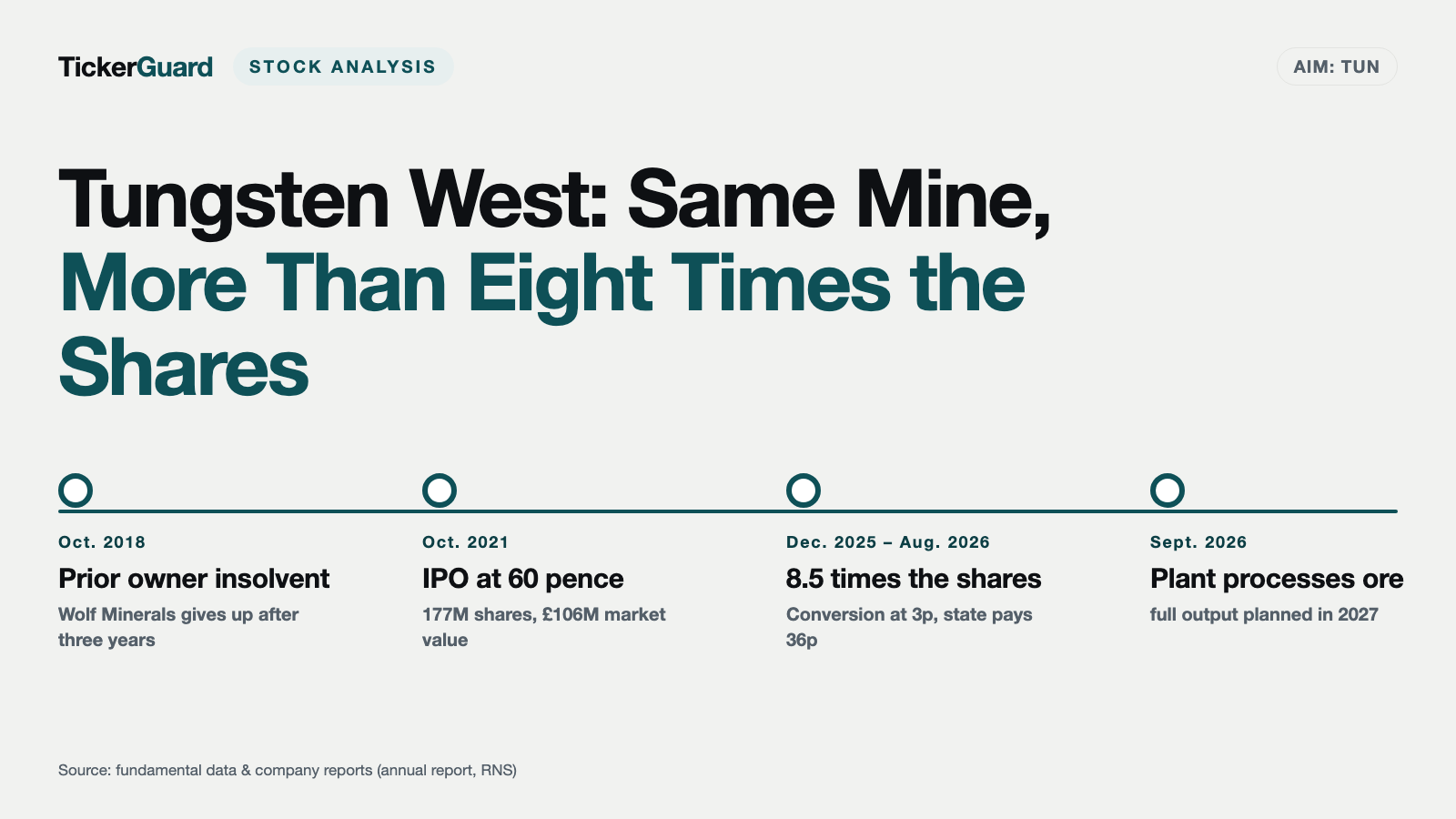
Company history for investors
-
2018
Wolf Minerals goes under
The previous owner applies for administration in October 2018 and the mine stops. Lesson for investors: a big deposit alone does not make a profitable mine.
-
2021
IPO at 60 pence
Tungsten West lists on AIM in October 2021 with 177 million shares and a £106 million market value. Anyone who bought then is still under water in October 2026 despite the restart.
-
2024
Trading suspension
Trading is suspended on October 1, 2024: without secured follow-on funding, the auditor cannot sign off on going concern. The company lives on convertible notes from its major shareholders.
-
2025
Feasibility study and Chinese export controls
China restricts tungsten exports in February; in August, Tungsten West publishes its new study: $190 million NPV at $400 per mtu. The price surge that followed is what made the financing possible.
-
2026
Rescue, government fund, production start
Conversion at 3 pence, placing at 18 pence, government fund at 36 pence; ore runs through the plant from September 15. For existing shareholders, that means more than eight times as many shares.
How the stock landed on our desk
Tungsten West landed on our desk because on October 26, 2026, the stock ranked among the most-discussed names in the forum of the German investor site wallstreet-online.de. Our in-house stock scanner doesn't cover the stock and can't: it is built for U.S. listings, while Tungsten West trades in British pence on AIM. So there are no scanner metrics here — we recalculated everything from the annual report.
The price history shows why there is so much chatter (closing prices, fundamental data): at the October 2021 IPO, the stock cost 60 pence. On December 27, 2023, it closed at 1.25 pence; on August 25, 2026 — the day of the National Wealth Fund announcement — at 51.6 pence; and on October 26, 2026, at 32.8 pence. Anyone who bought at the bottom has made many times their money; anyone who bought at the IPO is still under water despite the restart. Keep this in mind from the start: With Tungsten West, what matters is not only whether the mine works, but what price you paid for your share of it.
The numbers over the years — an honest assessment
First, what genuinely went right in 2026 — and it is a lot. At the end of March 2025, Tungsten West had just £18,442 in the bank, equity was negative at −£4.4 million, and the auditor flagged a material uncertainty about the company's ability to continue as a going concern. Twelve months later, cash stood at £25.5 million, equity at £58.3 million, and the going-concern warning was gone. There was also revenue for the first time: £0.6 million from selling tungsten concentrate from limited processing of lower-grade material, all to a single customer. The operating loss narrowed from £19.0 million to £7.9 million, although the prior year had been weighed down by a £9.5 million impairment of abandoned design work.
The progress continued after year-end: the National Wealth Fund came in in August 2026; on September 15, Tungsten West announced that ore was running through the plant; and in October, according to the corporate presentation, commissioning of the coarse gravity circuit began. The full plant with new crushers and ore sorters is due to be finished in the first quarter of 2027. The bottom line for fiscal 2026, however, is a loss that makes every reader flinch:
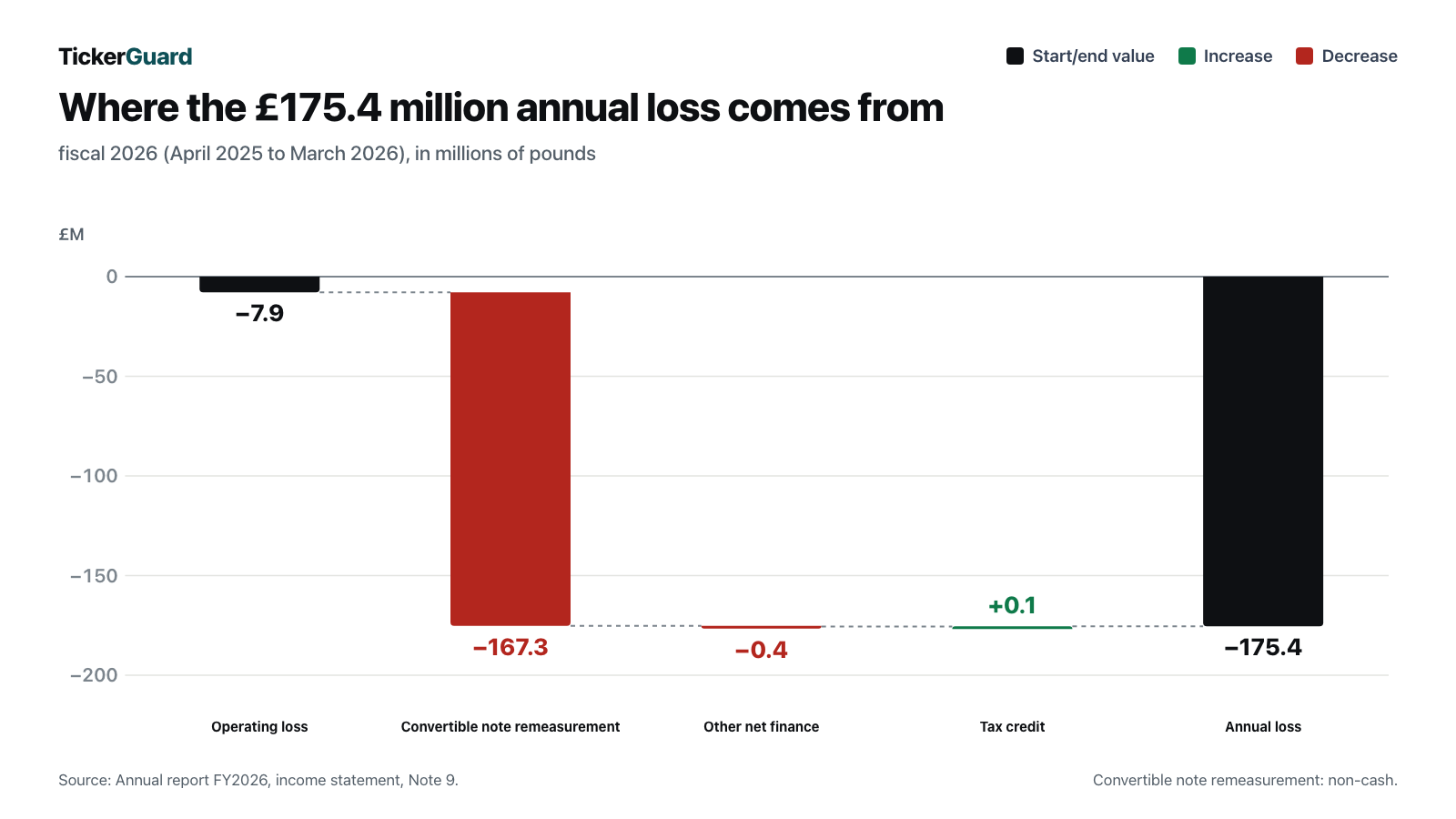
So the record loss is not a hole in the bank account. Actual cash outflows for the year were £15.1 million from operations and £5.6 million for investment in plant and equipment. What the £167.3 million really stands for is the first uncomfortable truth. In short: In 2026, the company went from bankruptcy candidate to fully funded project — that, not the revenue, is the real achievement.
What the reports say — the uncomfortable truths
Uncomfortable truth No. 1: The record loss is accounting — the dilution is real
For years, Tungsten West kept itself afloat with a convertible note subscribed mainly by its major shareholders Lansdowne Partners, Drakewood and Henry Maxey — at 20 percent interest a year. In July 2023, according to the annual report, the company had to notify these lenders of multiple breaches of the note terms, which they waived. On December 31, 2025, most of the note was converted into ordinary shares at 3 pence a share — while the stock traded at 11.5 pence (closing price 12/31/2025); the rest followed in February 2026 as B shares. Because the note was carried at fair value, Tungsten West had to book that gap as a loss:
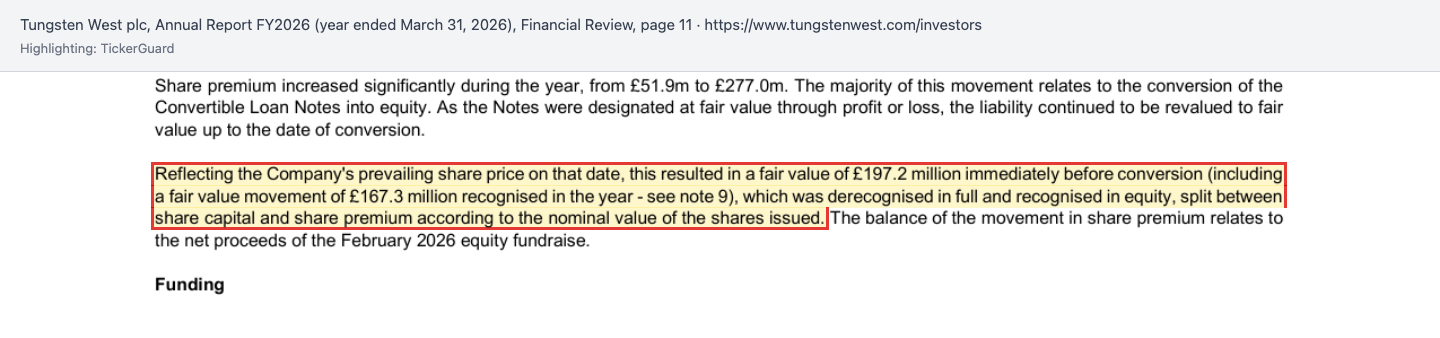
"Reflecting the Company's prevailing share price on that date, this resulted in a fair value of £197.2 million immediately before conversion (including a fair value movement of £167.3 million recognised in the year - see note 9), which was derecognised in full and recognised in equity, split between share capital and share premium according to the nominal value of the shares issued."
— Tungsten West plc, Annual report for the year ended March 31, 2026, Financial Review, page 11
For the cash balance, that is neutral; for you as a shareholder, it is not. The note turned into 584.8 million ordinary shares and 490.4 million B shares — B shares carry no vote but have the same economic rights. They were created because Lansdowne and the Drakewood group would otherwise have crossed 30 percent of the votes and, under UK takeover rules, would have had to make a mandatory offer to all shareholders. Then came a placing at 18 pence in February 2026 (about £43 million) and the National Wealth Fund at 36 pence in August 2026. The chart shows the result:
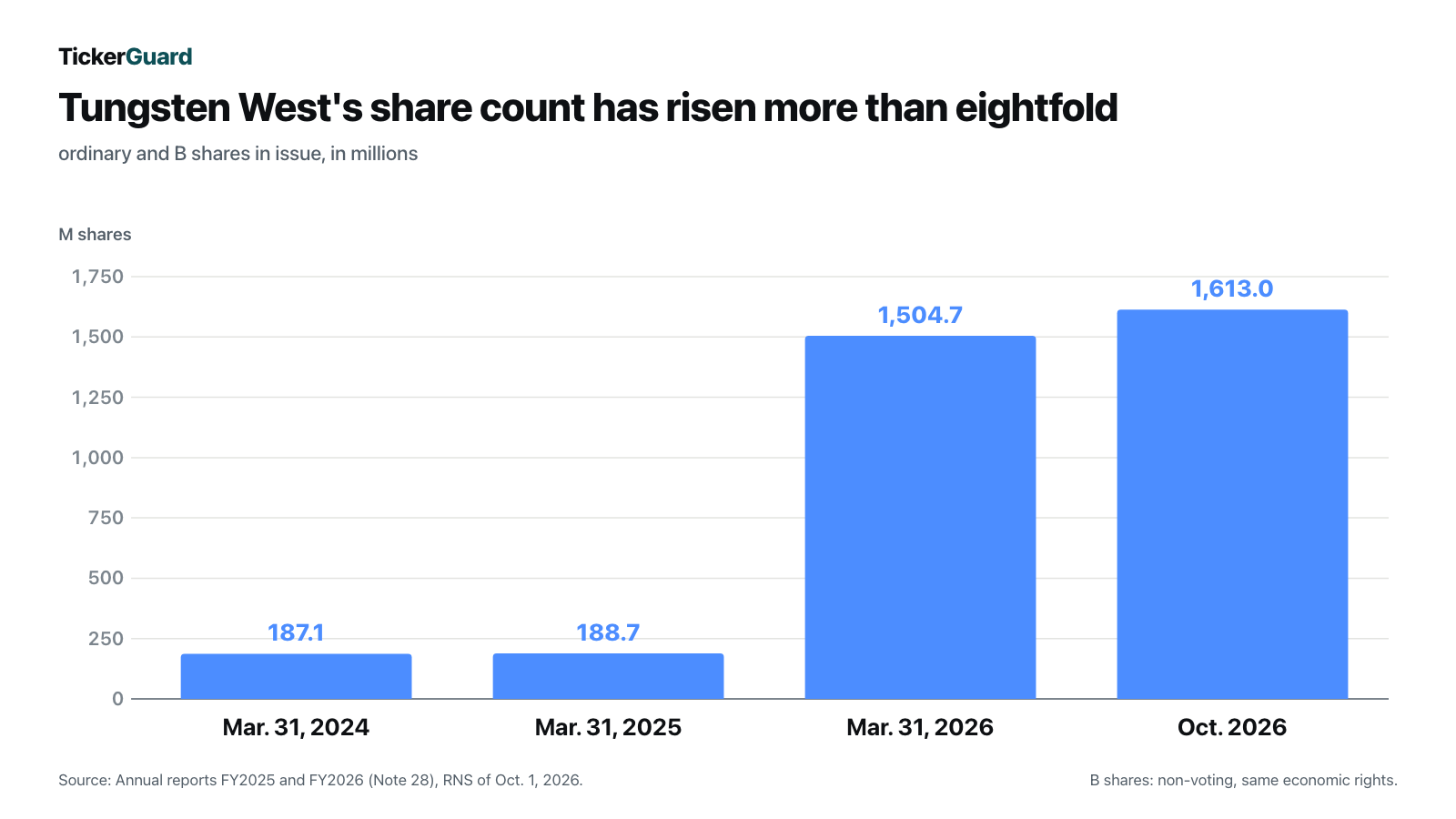
From 188.7 million to 1,613.0 million shares — that is 8.5 times as many. Think of it this way: whoever owned a slice of the cake before the rescue and didn't buy more now holds only about an eighth of their former stake — the cake got bigger, but the new guests came in on tickets priced at 3, 18 and 36 pence. Anyone who bought 1 percent of the 177.1 million shares at the IPO now holds about 0.1 percent. In voting terms, Lansdowne Partners held 25.96 percent of the ordinary shares on October 6, 2026; on top of that come the non-voting B shares held by Lansdowne, Drakewood and Henry Maxey.
Uncomfortable truth No. 2: "Fully funded" means a one-year loan at a rising rate
According to the October 2026 corporate presentation, Tungsten West needs no further funding. The financing rests on three pillars: cash on hand, £36 million of new equity from the National Wealth Fund, and a £25 million loan from the same fund. The terms of that loan are in the announcement of August 25, 2026:
"Interest rate of SONIA + 5.5 per cent. (approximately 9 per cent. per annum), increasing by 1 per cent. per quarter;"
— Tungsten West plc, RNS "Strategic Investment by the UK Government NWF," August 25, 2026, section "Debt Facility"
The loan runs for 366 days and, according to the annual report, had been fully drawn by September 2, 2026. It therefore falls due in late summer 2027 — a good six months after the plant is scheduled for completion. The directors' report explains how they intend to deal with it:
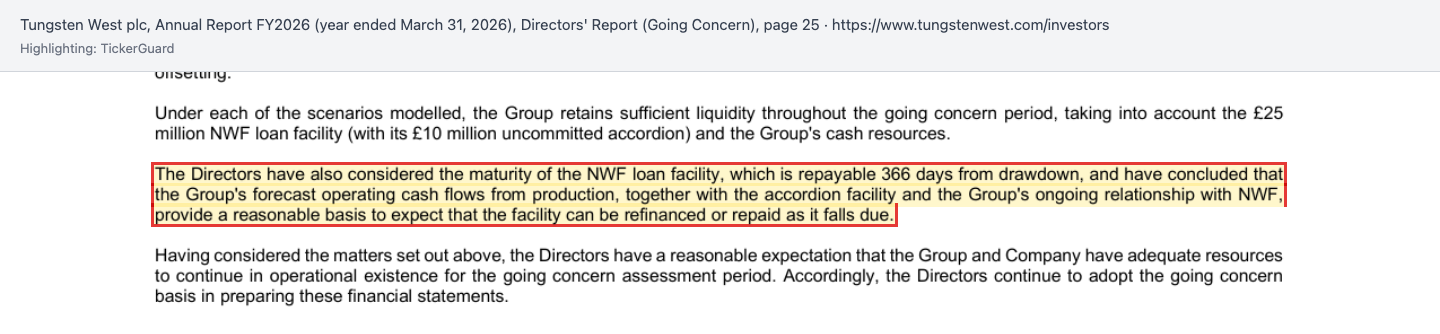
"The Directors have also considered the maturity of the NWF loan facility, which is repayable 366 days from drawdown, and have concluded that the Group's forecast operating cash flows from production, together with the accordion facility and the Group's ongoing relationship with NWF, provide a reasonable basis to expect that the facility can be refinanced or repaid as it falls due."
— Tungsten West plc, Annual report for the year ended March 31, 2026, Directors' Report (Going Concern), page 25
The additional £10 million accordion is explicitly uncommitted. And there is a second bill: to terminate the old mining contract, Tungsten West paid contractor Hargreaves £3 million in April 2026 and owes it another £7 million by May 15, 2027; its own mining fleet is financed through a £22.3 million equipment facility with Komatsu dealer McHale. The sources-and-uses table in the NWF announcement also already counts on £15 million of revenue received before peak funding. The budget is also tighter than the headline suggests: according to the October 2026 corporate presentation, the original project scope is forecast at £118 million, below its £120 million budget, but including expansion and improvement projects the total comes to £134 million against £122 million — £12 million over plan, with £40 million to £45 million still to be spent. "Fully funded" only holds if the plant ramps up as planned. Spring 2026 shows how quickly financing plans can change: on May 21, 2026, Tungsten West reported that due diligence on a debt package of up to $85 million was complete and documentation was still being negotiated. Until then, a $25 million bridge loan agreed at the same time with an entity controlled by major shareholder Gregory Coffey was to carry the project. Tungsten West has not announced closing the larger package; the bridge loan was replaced by the government fund in August 2026.
Uncomfortable truth No. 3: Options at 3 pence for the top floor
On July 22, 2026, the stock closed at 35 pence. That same day, three directors received options under the new long-term incentive plan — most of them with an exercise price of 3 pence:
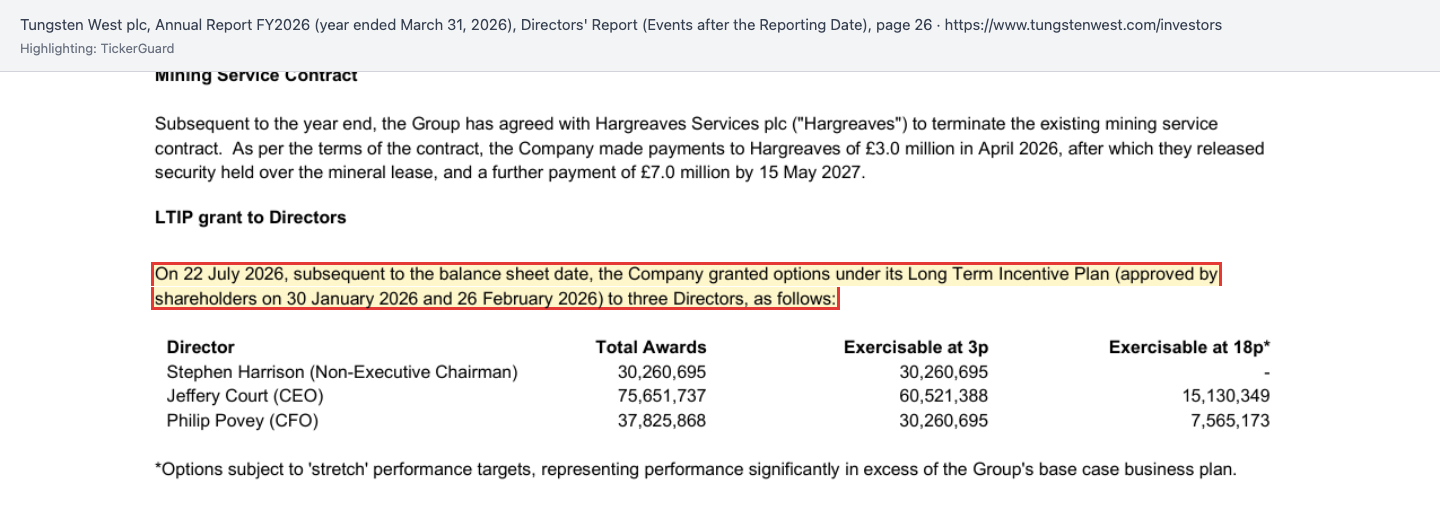
That adds up to 143.7 million options, 121.0 million at 3 pence and 22.7 million at 18 pence for stretch targets — about 8.9 percent of all 1,613.0 million ordinary and B shares. The options are tied to production milestones, run for 15 years and vest immediately in a takeover. Note the first name on the list: according to the table, Stephen Harrison is Non-Executive Chairman — the non-executive chair of the board, who is supposed to oversee management — and he receives performance options himself. Shareholders approved the plan in January and February 2026. For you, it means that once the mine is running, another large block of shares arrives at close to nominal value.
Uncomfortable truth No. 4: Four errors in the prior-year accounts
In fiscal 2026, Tungsten West changed auditors: PKF Littlejohn replaced PKF Francis Clark. The new annual report corrects the prior-year figures in several places:
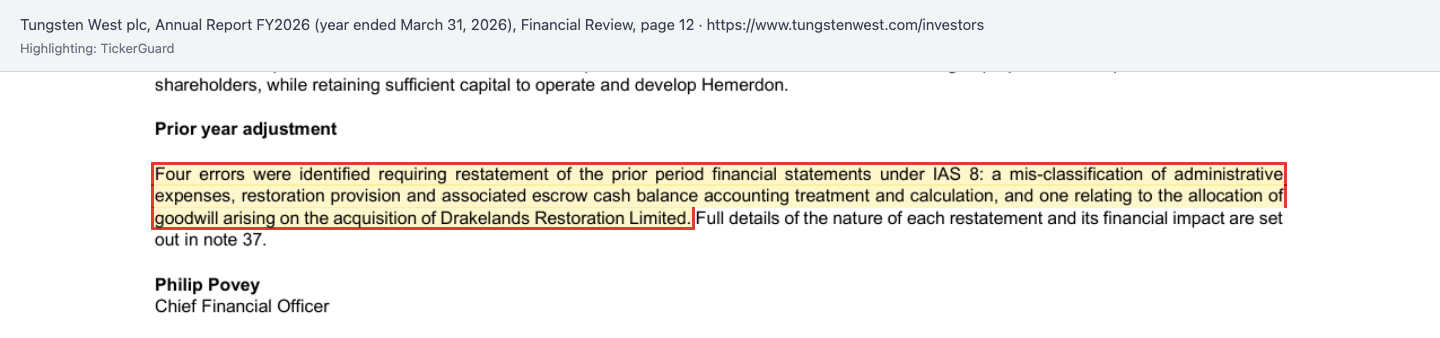
"Four errors were identified requiring restatement of the prior period financial statements under IAS 8: a mis-classification of administrative expenses, restoration provision and associated escrow cash balance accounting treatment and calculation, and one relating to the allocation of goodwill arising on the acquisition of Drakelands Restoration Limited."
— Tungsten West plc, Annual report for the year ended March 31, 2026, Financial Review, page 12
The restatements reduced equity at April 1, 2024, by £1.1 million. The amount is small; the signal is not. The restoration provision — the money Tungsten West owes for restoring the landscape later — had been calculated using the wrong method: according to Note 37, it used the escrow account balance as a proxy instead of an independent cost estimate, and inflation and risk adjustments were applied more than once. For a company whose biggest job is cost control, that is a point worth remembering. The new auditor issued an unmodified opinion on the accounts.
Uncomfortable truth No. 5: The £1.4 billion contract is not revenue
On September 23, 2026, Tungsten West announced a binding offtake agreement with Elmet Technologies, a U.S. maker of tungsten products: 1,000 tonnes of tungsten trioxide a year for eight years, which the company says is worth over £1.4 billion. That sounds like locked-in business — the announcement itself applies the brakes:
"This figure is indicative and does not represent guaranteed revenue to Tungsten West."
— Tungsten West plc, RNS "Strategic Tungsten Supply and Offtake Agreement with The Elmet Group," September 23, 2026, section "Further information"
Pricing is variable and tied to the European tungsten reference price (APT); the £1.4 billion is the September 2026 price multiplied by eight years of volume. For comparison: the August 2025 feasibility study assumes steady-state output of 332,000 mtu of tungsten trioxide a year, or about 3,320 tonnes. Elmet gets a little over 30 percent of that, and the UK government holds a time-limited right to negotiate for up to 50 percent. Among the things that sank Wolf Minerals was an offtake contract that penalized it for missed volumes and specifications — Tungsten West has not published what obligations the Elmet agreement contains.
Valuation — what the market is paying for the restart
At a closing price of 32.8 pence on October 26, 2026, all 1,613.0 million ordinary and B shares were worth about £529 million; counting only the 1,356.0 million ordinary shares, about £445 million. A price-to-earnings or price-to-sales ratio makes no sense on £0.6 million of revenue. Equity stood at £58.3 million at March 31, 2026, so the market is paying roughly nine times book value — and still about five to six times if you add the £36 million from the National Wealth Fund.
What you are paying for is the future — and that hinges on the tungsten price. At a price of $400 per mtu, the August 2025 feasibility study arrived at a project value (net present value at a 7.5 percent discount rate) of $190 million and all-in sustaining costs of $144 per mtu at steady state. At the end of March 2026, the market price was about $2,995 per mtu, according to Tungsten West. On May 21, 2026, Tungsten West reported APT pricing "consistently above US$3,000/metric tonne unit"; the announcements give no later figure. The Elmet indicative value of September 23, 2026 (over £1.4 billion for 8 × 100,000 mtu) works out to roughly £1,750 per mtu. At such prices, revenue per mtu would sit far above the study's all-in sustaining costs of $144; but the company has not published updated economics.
A rough back-of-the-envelope calculation of our own shows the order of magnitude: the 332,000 mtu a year the study expects at steady state would bring in notional revenue of about £580 million a year at the Elmet reference value — before the concentrate price discounts Tungsten West does not disclose, and before costs and taxes. The market value is roughly equal to one such year of revenue. Adding all options — 150.2 million under the long-term incentive plan (143.7 million for the three directors, 6.5 million for the COO and other senior managers) plus 6.8 million founder and employee options — the October 2026 corporate presentation puts the fully diluted share count at 1,770.1 million, or a market value of about £581 million (32.8 pence, October 26, 2026). That math only holds as long as the tungsten price stays where China's export policy currently keeps it. For a different route into the tungsten market, see our analysis of tungsten producer Almonty Industries. Remember: Tungsten West's valuation is a bet on a tungsten price many times higher than the one in its own feasibility study.
Opportunities and risks at a glance
What speaks for Tungsten West:
- According to the annual report, one of the world's largest tungsten deposits, fully permitted, with infrastructure in which the previous owner invested over £170 million.
- Production has been running since September 15, 2026; the full plant is due in the first quarter of 2027; per the corporate presentation, the original project scope is forecast at £118 million, below its £120 million budget.
- UK government backing: £36 million of equity and a £25 million loan from the National Wealth Fund, plus a government right to negotiate for up to 50 percent of output.
- An eight-year offtake agreement with Elmet for 1,000 tonnes of tungsten trioxide a year.
- A tungsten price at the end of March 2026 about seven and a half times the level assumed in the feasibility study; the Elmet indicative value of September 2026 (about £1,750 per mtu) is also a multiple of it.
What speaks against Tungsten West:
- One operator has already failed at the same plant; the real test — steady-state operation with the new crushers and sorters — only begins in 2027.
- The share count has risen more than eightfold; another 143.7 million director options may be added.
- The £25 million government loan runs for just 366 days at a rising rate; plus £7 million owed to Hargreaves by May 2027.
- Four corrected errors in the prior-year accounts, a change of auditor and slipped timelines: commissioning of the plant upgrades was announced in October 2022 for the second quarter of 2023.
- Dependence on a tungsten price driven largely by Chinese export policy; a handful of major shareholders control much of the vote.
A human conclusion — the second chance doesn't belong to everyone equally
The second-chance trap whispers that the restart is safer because the first attempt failed. With Tungsten West, there is even some truth to that: the post-mortem was thorough, the technology was replaced, the government stands behind the project, and the tungsten price is a completely different one from 2018. The mine has a real chance this time.
But for you as an investor, the question is a different one. The second chance was financed by lenders who converted at 3 pence, by investors at 18 pence and by the government at 36 pence — and the three directors received options at 3 pence. Anyone buying now pays up front for a success in which others hold stakes acquired at far lower prices. Whether that is enough for you depends on how confident you are about the tungsten price and how much patience you have for a ramp-up running into 2027. What you make of it is your call — and that's exactly how it should be.
Sources
- Tungsten West plc, annual report for the year ended March 31, 2026 (audited by PKF Littlejohn LLP, approved September 2, 2026, published September 3, 2026)
- Tungsten West plc, annual report for the year ended March 31, 2025
- AIM admission document, October 15, 2021
- RNS "Strategic Investment by the UK Government NWF" (August 25, 2026)
- RNS "Strategic Tungsten Supply and Offtake Agreement" (September 23, 2026)
- RNS "Processing operations commence" (September 15, 2026)
- RNS "Grant of Awards under Long Term Incentive Plan" (July 22, 2026)
- RNS "Q1 2026 Project Funding and Debt Update" (May 21, 2026) and "Q1 2026 Project Update" (April 8, 2026)
- RNS "Short-Term Loan Repayment" (August 28, 2026)
- RNS "Exercise of Options & TVR" (October 1, 2026) and major holdings notification, Lansdowne Partners (October 6, 2026)
- RNS "Convertible Loan Note Conversion" (January 2, 2026) and "Result of Bookbuild and Subscription Raising" (February 6, 2026)
- RNS "Development and Economic Plan for Hemerdon" (May 30, 2025) and "Completion of Updated Feasibility Study" (August 5, 2025)
- RNS "Temporary Suspension of Trading on AIM" (October 1, 2024)
- Tungsten West, corporate presentation, October 2026
- Price and market data: Source: fundamental data (closing prices in pence, as of October 26, 2026)
Transparency & disclaimer: this analysis is journalistic commentary on publicly available company reports. It is not investment advice and not a solicitation to buy or sell securities. Shares of mining developers are highly risky; a total loss is possible. Tungsten West does not file with the SEC; this analysis is based on the audited annual report and the company's regulatory announcements to the London Stock Exchange. The interim report for the six months to September 30, 2026, had not been published as of the editorial cutoff (October 26, 2026). The author holds no position in Tungsten West shares.
Our Bottom Line at a Glance
- Deposit & project status positive
- Per the annual report, one of the world's largest tungsten deposits (39.7 million mtu of tungsten trioxide), fully permitted; ore has been running through the plant since 9/15/2026, with the full plant scheduled for the first quarter of 2027.
- Funding & balance sheet neutral
- Equity of £58.3 million and cash of £25.5 million (3/31/2026), then £36 million from the government fund; against that, a 366-day £25 million loan at a rising rate and £7 million owed to Hargreaves by 5/15/2027.
- Dilution negative
- Ordinary and B shares up from 188.7 million (3/31/2025) to 1,613.0 million (October 2026); conversion at 3 pence; another 143.7 million director options at 3 and 18 pence (7/22/2026).
- Accounting & governance negative
- Four errors in the prior-year accounts restated, change of auditor, breaches of the convertible note terms in 2023, trading suspension in October 2024; performance options even for the non-executive chairman.
- Tungsten market positive
- Chinese export controls since February 2025; reference price about $2,995 per mtu at the end of March 2026 versus $400 in the feasibility study; eight-year offtake agreement with Elmet.
Tungsten West shows how the second-chance trap works: Wolf Minerals failed at the Hemerdon mine in 2018, and in 2026 it is restarting with new technology, government money and a U.S. buyer. The annual report also shows a share count up more than eightfold, conversions at 3 pence, options at 3 pence for the top floor, a 366-day loan and four restated accounting errors. Buyers are betting on a smooth ramp-up and a high tungsten price. Not investment advice.
What Our Rating Means
Open questions
The business works in principle, but one material question is open. As long as it stays open, our findings do not carry a quality verdict.
The restart is funded, equity is positive again and the auditor no longer sees a going-concern risk — so not red. But operations are unproven: the only revenue so far came from limited processing of lower-grade material, one operator has already failed at the same plant, and the government loan has to be repaid from production or extended in 2027. Yellow, because the decisive operational question is still open. The decision is yours.
A journalistic assessment by our editorial team at the time of the deep dive, based on public sources — not investment advice and not a solicitation to buy or sell. Your personal circumstances (investment goals, risk capacity, taxes) cannot be taken into account. What our levels mean, how verdicts are formed, and what conflicts of interest exist →
Worth Noting
- Hook: list of the most-discussed stocks in the wallstreet-online.de forum on 10/26/2026. Price references (closing prices in pence, fundamental data): 60 (IPO October 2021, admission document), 1.25 (12/27/2023), 11.5 (12/31/2025), 35 (7/22/2026), 51.6 (8/25/2026), 32.8 (10/26/2026).
- Tungsten West is not an SEC filer (EDGAR company search: no match, 10/26/2026). The basis is the audited annual report for FY2026 (year ended 3/31/2026, published 9/3/2026) and all RNS announcements through 10/26/2026. The interim report for the six months to 9/30/2026 was not yet available (AIM deadline 12/31/2026). No company row in our own database: a stock quoted in pence would distort scanner thresholds built for U.S. listings.
- Own calculations: market value from 1,613,034,732 ordinary and B shares or 1,355,958,899 ordinary shares × 32.8 pence (10/26/2026); option share 143,738,300 / 1,613,034,732 ≈ 8.9%; Elmet indicative value £1.4B / 8 years ≈ £175M per year; Elmet share 1,000 t / 3,320 t ≈ 30%. Not to be confused with Almonty Industries or other tungsten names.
Stock Watch
This analysis is as of October 26, 2026. Stock Watch will tell you what's changed at TUN.LSE since then.
Later $1 a month per stock — signing up is free, and you'll be the first to know when it launches.
The full analysis as a PDF for later
We will send you this analysis as a PDF — to print, file away, and read at your own pace. And we will add you to the free Stock Watch list for Tungsten West PLC (TUN.LSE), so you hear about it when something material in this analysis changes.
Frequently Asked Questions
Tungsten West plc (AIM: TUN) owns and operates the Hemerdon tungsten-tin mine near Plymouth in Devon, England, which its annual report calls one of the world's largest tungsten deposits. It mines ore, upgrades it into tungsten and tin concentrate and plans to sell construction aggregate as a by-product. Ore has been running through the plant again since September 15, 2026; full capacity is planned for 2027.
The previous owner, Wolf Minerals, mined there from 2015 to 2018 and applied for administration in October 2018. According to Tungsten West's admission document, the causes were a poorly designed processing route with frequent downtime, ore ground so fine that tungsten was lost, high debt and an offtake contract with penalties. The 2025 annual report adds roll crushers that were not robust enough. Tungsten West has therefore rebuilt the plant with new crushers and ore sorters.
The largest shareholder is Lansdowne Partners with 25.96 percent of the voting rights (October 6, 2026). Gregory Coffey last notified 15.57 percent on April 10, 2026 — before the National Wealth Fund's equity raise; there is no more recent notification. The National Wealth Fund held about 7.42 percent after investing in August 2026. Other major holders: Baker Steel (7.82 percent), Drakewood (7.00 percent) and Henry Maxey (6.28 percent). There are also 257 million non-voting B shares.
The fiscal year ends on March 31. Fiscal 2026 therefore ran from April 2025 to March 2026; the audited annual report was published on September 3, 2026. Interim reports cover the six months to September 30 and are published within three months. AIM does not require U.S.-style quarterly reports; Tungsten West reports progress through project updates.
No. In the fiscal year ended March 31, 2026, revenue of £0.6 million compared with an operating loss of £7.9 million, and the annual loss came to £175.4 million. Of that, £167.3 million was the non-cash remeasurement of a convertible note. Operations consumed £15.1 million of cash. Profits depend on a successful ramp-up from 2027.
At March 31, 2026, Tungsten West had hardly any financial debt. After that came a £25 million loan from the National Wealth Fund, fully drawn, with a 366-day term at about 9 percent, rising one percentage point each quarter. £7 million is still owed to former contractor Hargreaves by May 15, 2027, and mining equipment is financed through a £22.3 million facility.
It doesn't — Tungsten West is "not ratable." Our AI rating relies on filings with the U.S. securities regulator, the SEC, and Tungsten West files none. The 2026 annual report and the company's announcements do not mention artificial intelligence in its own business; AI appears only in the corporate presentation as a demand driver for tungsten.
Found an error?
Did you spot a factual error, an outdated number, or a typo in this deep dive? Let us know briefly — your report goes straight to the editorial team.