Kuros Biosciences: A Twentyfold Stock, a First Profit — and Nearly Half of Customer Invoices Past Due
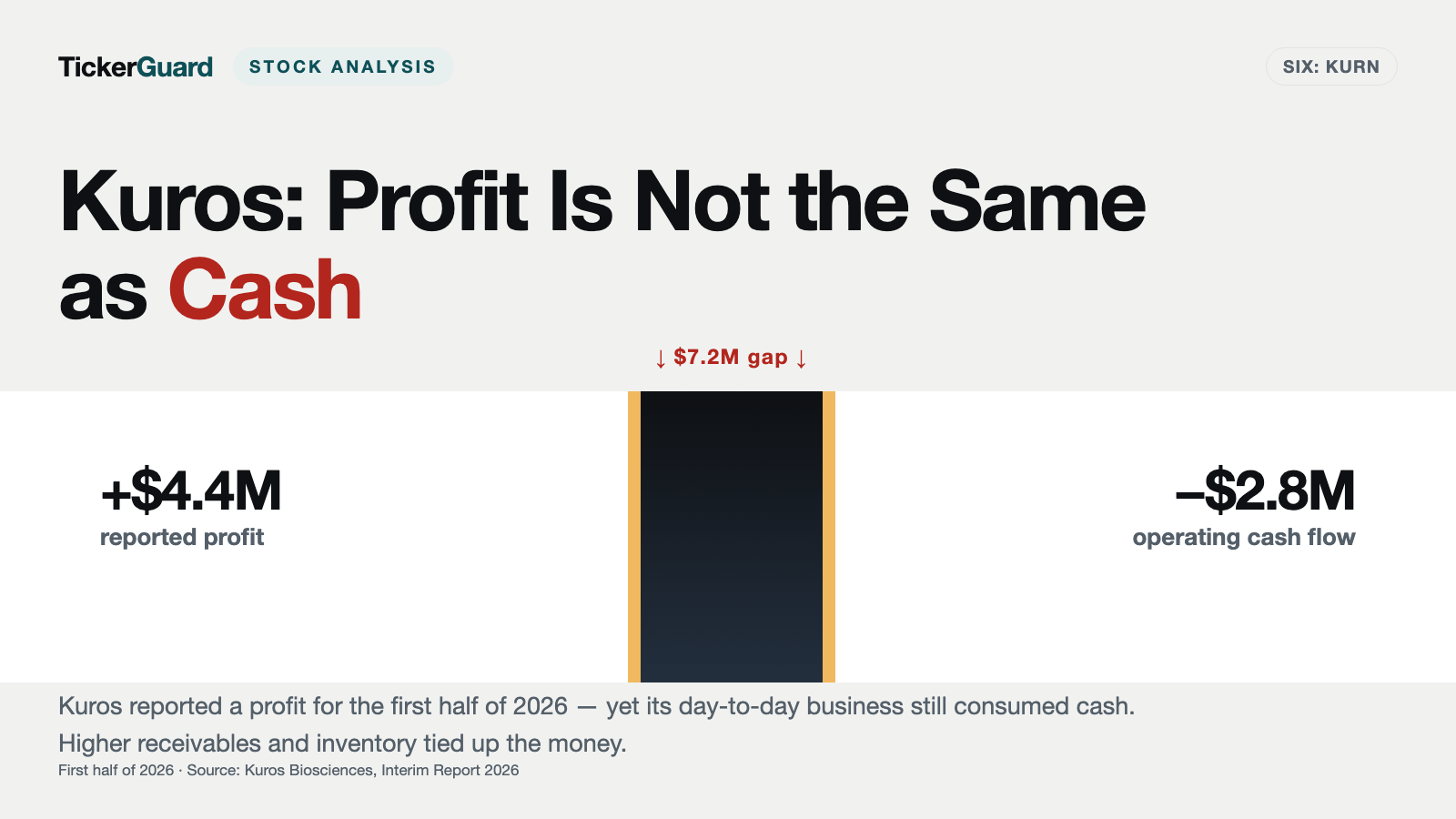
Shares of Zurich-based bone graft maker Kuros rose more than twentyfold from the end of 2022 to October 2025, yet in the first half of 2026, $4.4 million in profit came with $2.8 million flowing out of day-to-day operations. How much of Kuros’ profit actually turns into cash?
 Thomas Mücke
Founder & Publisher
As of Today
As of: October 26, 2026
- Closing price
- 20.30 CHF +0.09%
- Market Capitalisation
- 0.8 CHFB
- P/E
- 384.3
This analysis has a cut-off date. The Stock Guard tells you when something material changes in the numbers. Reserve your free spot
Chart
Interactive price chart (TradingView).
Last price: 20.30 CHF (As of: October 26, 2026)
Note: pure fact-based analysis, not investment advice and not a solicitation to buy or sell. All figures without guarantee.
A spine surgeon in an American hospital squeezes a white putty from a syringe between two vertebrae. For the operation, that is the end of it; for Kuros Biosciences, it is just the beginning: the hospital gets an invoice, revenue is booked in Schlieren near Zurich — and the income statement shows the sale long before a single dollar reaches the bank. At the end of 2025, nearly half of those customer invoices at Kuros were past due.
You rarely read about that side, because the headlines are too good: revenue up 72 percent in 2025, the first annual profit in the company’s history, higher guidance on October 15, 2026, and a share price that climbed from CHF 1.47 at the end of 2022 to CHF 33.36 in October 2025. We call the investor weakness lurking here headline faith: read “profit” in the headline and you assume cash in the bank. The profit at Kuros is real, and the product is backed by a strong study — but so far the profit has barely shown up as cash, and growth is shrinking quarter by quarter.
What Kuros Actually Does — Bone Graft in a Syringe
When surgeons permanently join two vertebrae — a spinal fusion — they need material that new bone can grow along. For a long time the gold standard was the patient’s own bone, usually harvested from the pelvis: effective, but a second operation with its own pain. Kuros sells a synthetic alternative: MagnetOs, a calcium phosphate material with a tiny, needle-shaped surface structure the company calls NeedleGrip. It comes as granules, a moldable putty, a prefilled delivery system for minimally invasive surgery and a flexible matrix. According to the company, more than 150,000 patients have been treated with it worldwide.
The strongest sales argument is a randomized trial published in the journal Spine in 2024. Kuros cites it regularly in its releases:
“In a Level I human clinical study published in Spine, MagnetOs achieved nearly twice the fusion rate of autograft (79% vs. 47%) in posterolateral fusions (PLFs).”
— Kuros Biosciences, Q3 2026 trading update, October 15, 2026, “About MagnetOs”
The fine print of Kuros’ releases belongs in the picture: MagnetOs is cleared in the U.S. through the 510(k) pathway, which according to the August 13, 2026, half-year release does not require clinical data, and according to the Q3 trading update the U.S. Food and Drug Administration has expressly not cleared it as an osteoinductive (bone-forming) graft. The trial is a genuine competitive edge — but it is a study, not a regulatory label.
Economically, Kuros is a one-product company with one main market. Of $92.4 million in first-half 2026 revenue, $90.0 million came from the U.S. (97.5 percent) and $1.9 million from the European Union. Sales run through a mix of in-house reps and independent distributors; until recently everything was manufactured in Bilthoven, the Netherlands. Since October 2026, a second plant in Alpharetta, Georgia, has been producing. Kuros had 213 employees at the end of June 2026. Its largest shareholder, according to the 2025 annual report, is Optiverder B.V. of Delft, the Netherlands, with 24.8 percent.
Company history for investors
-
2016
Cytos becomes Kuros, MagnetOs joins
Listed Cytos acquired Kuros and took its name; in December it agreed to buy Xpand of Bilthoven and its MagnetOs graft — the foundation of today’s business.
-
2024
Study in “Spine,” revenue of $85 million
A randomized trial showed 79 versus 47 percent fusion rates against the patient’s own bone; revenue reached $85.2 million and the stock rose sixfold over the year.
-
2025
First annual profit, revenue up 72 percent
$146.1 million in revenue and $2.6 million in profit — but operating cash flow of minus $0.5 million. The stock peaked at CHF 33.36 in October.
-
2026
U.S. plant opens, growth slows
Production started in Georgia in October and guidance was raised; quarterly growth fell to 31 percent, and the stock closed at CHF 20.30 on October 23.
How the Stock Landed on Our Desk
Not through our in-house stock scanner, but through the list of most-discussed stocks on the forum of wallstreet-online, a German retail investor site. Our system first registered Kuros there on August 12, 2026, one day before the half-year results. That is an attention signal, not a quality signal. The stock people are talking about has quite a track record: at the end of 2022 it traded at CHF 1.47 on the SIX Swiss Exchange; on October 17, 2025, it closed at CHF 33.36 — more than twenty times higher. Then it headed down. On October 23, 2026, it closed at CHF 20.30, about 39 percent below that peak, even though the business is still growing.
If you are interested in the foot and ankle market that Kuros is now entering, our Treace Medical analysis covers a U.S. company in that field.
The Numbers Over the Years — Fairly Assessed
First, what genuinely impresses. Within a few years, Kuros has gone from a research outfit to a medtech company with nine-figure revenue. According to the 2025 annual report, sales were $13.7 million three years earlier. In 2024 they reached $85.2 million, and in 2025 $146.1 million. Gross margin — the share of revenue left after direct production costs — was 87 percent in 2025. Operating profit swung from a loss of $5.6 million (2024) to a profit of $8.9 million (2025), and net income came to $2.6 million. In the first half of 2026 it was $4.4 million, after a $2.0 million loss a year earlier.
A note on reading the numbers: since January 1, 2025, Kuros has reported in U.S. dollars instead of Swiss francs, because most of its revenue and costs are in dollars. The company restated prior years. If you put older franc-based reports next to them (2024: CHF 75.6 million in revenue), you are not comparing the same unit.
Now the sober part. Growth is high, but it is shrinking quarter by quarter:
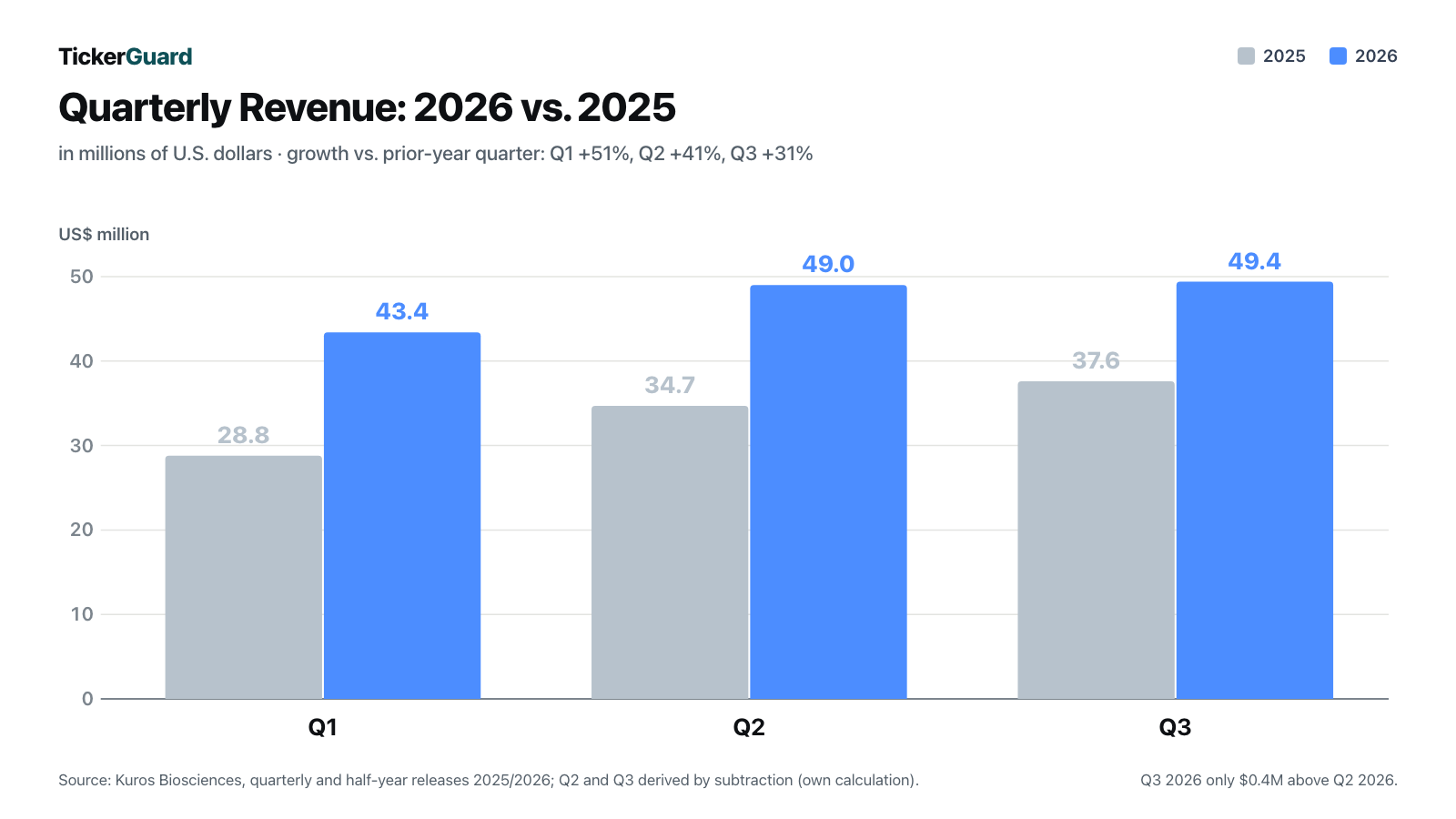
After nine months, revenue is up 40 percent at $141.8 million. For the full year, management now expects growth of 36 to 40 percent, or roughly $199 million to $205 million. That requires $57 million to $63 million in the fourth quarter — a jump of 15 to 27 percent over the third. That is not pulled out of thin air: in 2025, the fourth quarter ($45.0 million) was also about 20 percent above the third ($37.6 million). But it is a bet on a strong finish, not a sure thing. By 2028, Kuros is targeting $300 million to $330 million in revenue; starting from 2025, that implies roughly 27 to 31 percent growth per year.
Uncomfortable Truth No. 1: The Profit Is Not Showing Up as Cash
Back to the invoice sent to the hospital. In accounting, profit is booked the moment Kuros invoices a shipment. Cash arrives only when the hospital pays. And Kuros has to pre-finance product that is still sitting in inventory. Operating cash flow — the money that actually lands in the bank from day-to-day business — therefore tells a different story than the income statement:
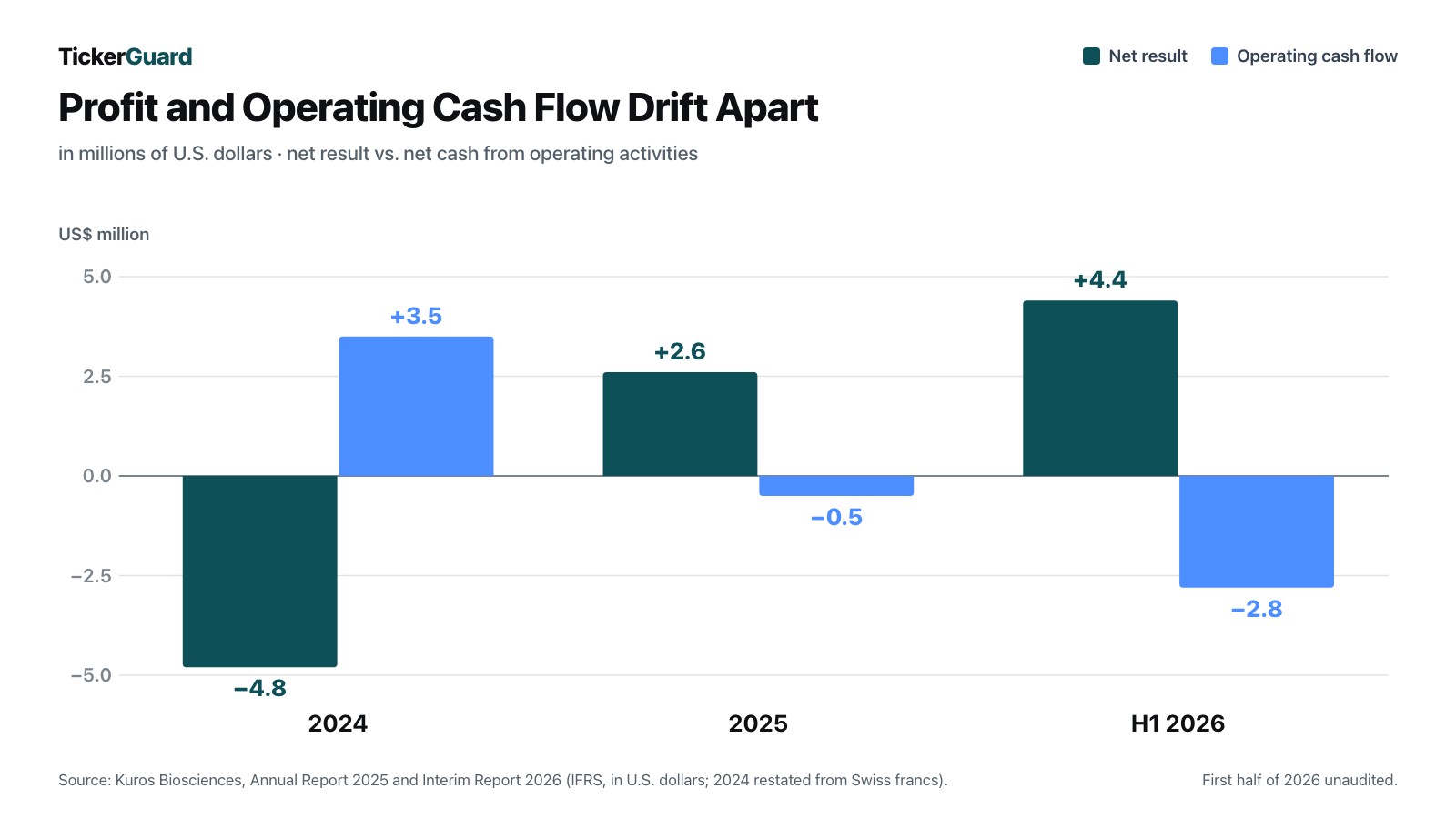
The reasons are in the cash flow statement. In 2025, the business tied up an extra $15.7 million in receivables, inventory and other items; trade and other receivables alone rose by $22.6 million. In the first half of 2026, another $10.4 million followed, including $5.3 million for higher inventory and $4.6 million for higher receivables. At the same time, Kuros spent $6.7 million on property and equipment, mostly for the new plant in Georgia. Cash fell from $19.8 million at the end of 2025 to $9.7 million on June 30, 2026.
That makes one sentence in the notes to the 2025 annual report all the more remarkable:
“Throughout the year, the Group generated operating cash flow that was sufficient to substantially finance its organic growth, investments in working capital and capital expenditures.”
— Kuros Biosciences AG, Annual Report 2025, Note 1, page 95
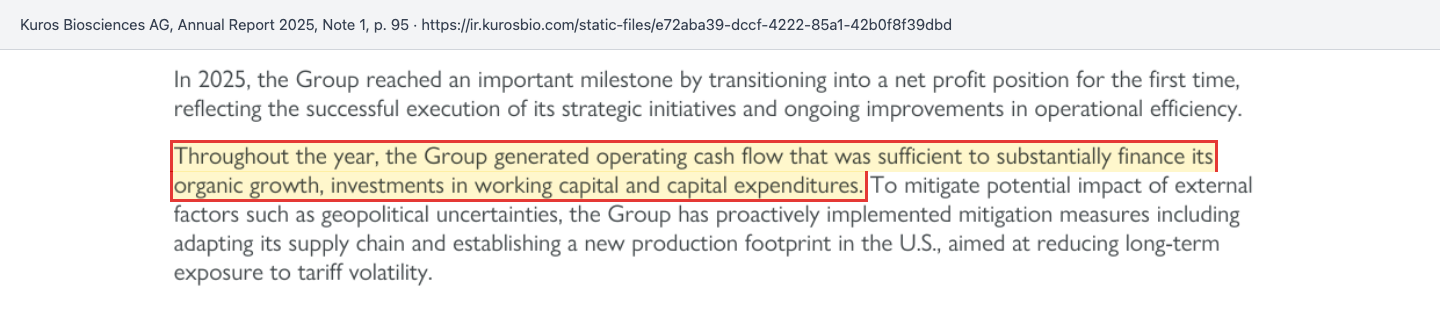
How do the two fit together? One possible reading: the sentence refers to cash generated before changes in working capital, $17.0 million according to the cash flow statement. After the build-up in receivables and inventory, interest and taxes, minus $0.5 million was left. In 2025, the plant and the growth were therefore funded mainly from $2.2 million paid in by holders of stock options when they exercised them, and to a smaller extent from existing cash. The sentence is not false, but it is generously worded. When Kuros talks about “funds available” in its releases, receivables are included, by the way — the company says so itself: $54.2 million as of June 30, 2026, of which only $9.7 million was cash.
In fairness, here is what came next. As of September 30, 2026, Kuros reported cash of $19.6 million, “ahead of plan” — an increase of $9.9 million in one quarter, with no equity raise announced. The short quarterly update does not say where the money came from, and Kuros does not publish a third-quarter cash flow statement. Possible explanations would include collection of overdue receivables, a smaller inventory build-up or lower capital spending after the plant was completed — none of that is documented. Stock options hardly explain it: according to filings with the SIX, executives exercised options in September and October 2026 and paid in a combined CHF 0.4 million or so for them, only about CHF 0.1 million of it in the third quarter; there was also a block sale of 30,000 shares at CHF 18.40 on October 6 to cover taxes and a purchase of 1,800 shares at CHF 17.00 on September 22. Whether the third quarter marked the turnaround in cash flow or a one-off will only become clear in the 2026 annual report. Kuros has no bank debt; according to the interim report, it carries $10.1 million in lease liabilities, mostly for the new sites, and a $3.6 million liability from a former collaboration.
Uncomfortable Truth No. 2: Nearly Half of Customer Receivables Were Past Due
According to the notes, Kuros’ customers are mainly hospitals and other health care providers. How quickly they pay is shown by the aging of receivables as of December 31, 2025:
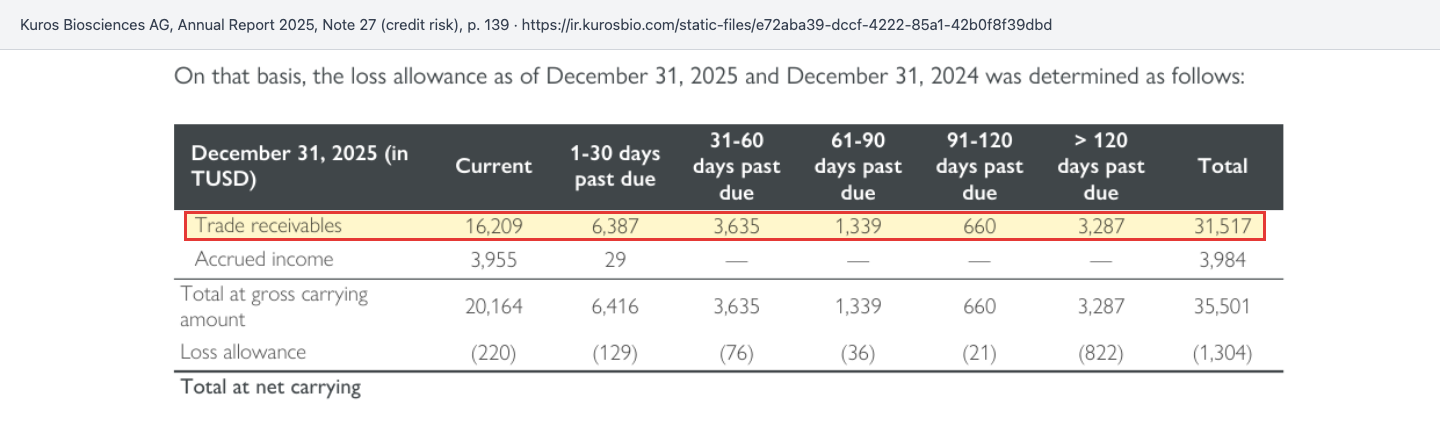
Added up, $15.3 million, or 48.6 percent, of trade receivables were past due. More than 120 days overdue were $3.3 million — up from $0.9 million a year earlier, a 3.6-fold increase while revenue rose 72 percent. Kuros has set aside $0.8 million as a loss allowance for these oldest items, meaning it considers that part likely uncollectible; it still expects to collect the remaining $2.5 million. The company itself sees little credit risk:
“The credit quality of the Group’s debtors is high, since they are primarily composed of health care providers, leading pharmaceutical companies, and tax authorities.”
— Kuros Biosciences AG, Annual Report 2025, Note 27 (credit risk), page 139
That may well be true; hospitals are regarded as debtors that rarely default but often pay slowly. For you as a shareholder, though, the direction matters. Converted into days, net trade receivables stood at about 63 days of sales at the end of 2024 and about 75 days at the end of 2025. Measured against 2025 revenue, those twelve extra days tie up roughly $5 million — more than the entire year’s net income. As of June 30, 2026, trade receivables had eased slightly to $27.5 million, while other receivables rose from $10.0 million to $16.9 million. At the end of 2025 those consisted mainly of VAT receivables and revenue already booked but not yet invoiced, according to the annual report; the interim report does not break down the June figure. Kuros publishes a new aging table only in its annual report.
Uncomfortable Truth No. 3: “Adjusted” EBITDA Strips Out the Tariffs
Kuros manages itself — and guides investors — on a self-defined metric: adjusted EBITDA. EBITDA is earnings before interest, taxes, depreciation and amortization; “adjusted” means the company removes further costs it regards as non-recurring or non-operating. For the first half of 2026, $7.4 million in EBITDA compares with $12.5 million in adjusted EBITDA — about two-thirds more. The largest adjustment is U.S. import duties:
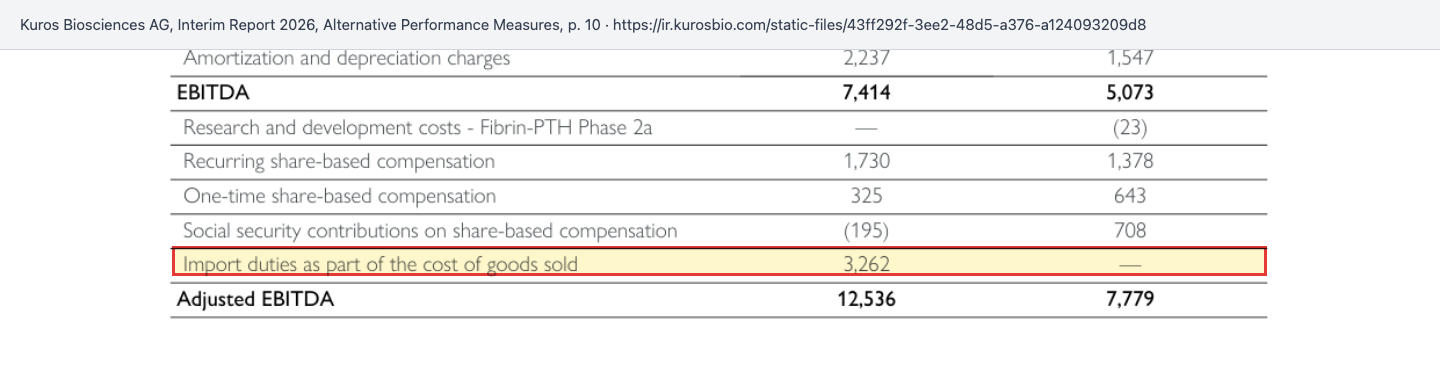
$3.3 million in duties in the first half of 2026 and $2.0 million in 2025 — those are real costs, booked as part of cost of goods sold, because the product has so far been shipped from the Netherlands into the U.S. The company justifies the adjustment with its new plant:
“The Group is building a production facility in the US, expected to be operational in the second half of 2026. Once operational, the Group anticipates a sizable reduction in US customs duties.”
— Kuros Biosciences AG, Interim Report 2026, Alternative Performance Measures, page 9
The argument makes sense, and production in Georgia has indeed been running since October 2026. Still: as long as the duties are incurred, they are costs. And a second adjustment is permanent: recurring share-based compensation of $1.7 million in the half-year. Paying employees in stock instead of cash does not drain the bank account, but it costs shareholders a slice of the company. At the end of 2025, outstanding options and share awards represented 7.1 percent of share capital, according to the annual report. The 2026 guidance of an adjusted EBITDA margin of “more than 14.5%” and the target of at least 20 percent by 2028 both refer to this adjusted figure — not to the bottom line.
One footnote points the other way. According to the 2025 annual report, the U.S. Supreme Court on February 20, 2026, invalidated certain tariffs imposed in 2025 under an emergency powers statute (IEEPA); whether and when tariffs already paid will be refunded is open. Kuros writes in its interim report:
“Following the US court decisions concerning certain import tariffs imposed under the International Emergency Economic Powers Act (IEEPA), the Group is closely monitoring the tariff recovery. As of June 30, 2026, the Group had not met the recognition criteria for recording a receivable, as it had not established an enforceable entitlement to a refund or been able to reliably determine the amount and timing of any potential recovery.”
— Kuros Biosciences AG, Interim Report 2026, Note 14, page 21
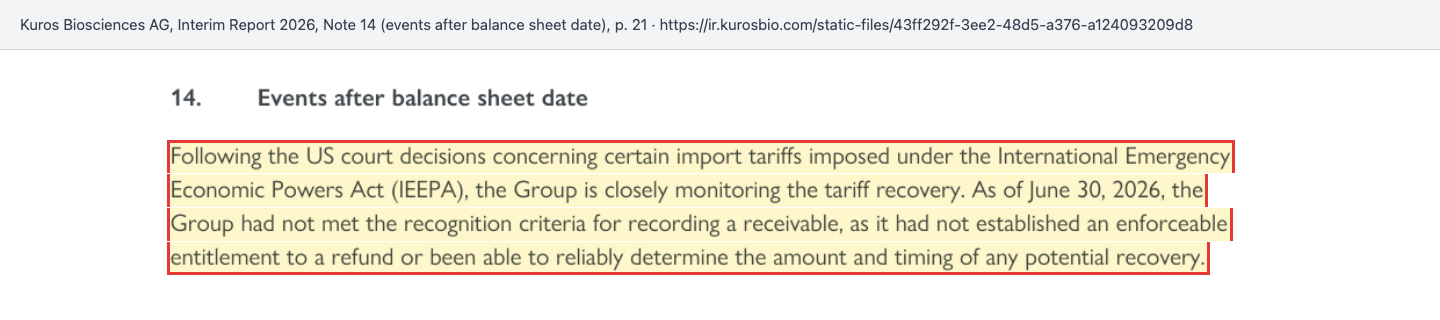
The report does not say how much of the $5.2 million in duties expensed since 2025 relates to IEEPA tariffs. If money does flow back, it would be a one-off boost to cash and profit — one that appears in no guidance.
Uncomfortable Truth No. 4: One Product, One Country, One Sales Model
In the first half of 2026, 97.5 percent of revenue came from the U.S., and virtually all of it from the MagnetOs family. That is the flip side of the success story: Kuros depends on the U.S. health care system, on the purchasing committees of hospital networks, on reimbursement and on trade policy. According to its August 13, 2026, half-year release, MagnetOs is now the third-largest bone graft brand by U.S. revenue — a market where large medtech groups compete with their own products. Selling is expensive, too: Kuros spent $84.5 million on sales and marketing in 2025, 58 percent of revenue; in the first half of 2026, it was $53.3 million, again 58 percent. According to the annual report, Kuros works with distribution partners in the U.S. and actively manages margins, pricing and commissions. From an 87 percent gross margin, that leaves a 6 percent operating margin after sales, research and administration (2025).
That is not a mistake but the typical phase of a growing medtech company: first win the surgeons, then expand margins. Whether margins expand is the real question behind the target of at least 20 percent adjusted EBITDA margin by 2028. So far, the adjusted margin is rising slowly: 11.9 percent (2024), 13.4 percent (2025), 14.5 percent for the first nine months of 2026.
What the Stock Costs
At CHF 20.30 (SIX close on October 23, 2026) and 39.46 million shares (June 30, 2026, our calculation from the annual and interim reports), Kuros has a market value of about CHF 801 million, roughly $970 million. Subtract cash as of September 30, 2026 ($19.6 million) and add lease liabilities ($10.1 million as of June 30), and enterprise value comes to just over $960 million.
Against trailing twelve-month revenue through September 2026 (about $187 million), that is a little more than five times sales; against the 2026 guidance, a little under five times. Measured by earnings, the stock is expensive: the four quarters through June 2026 produced about $9.0 million in net income, implying a price-to-earnings ratio of roughly 108. Even adjusted EBITDA for the four quarters through June (about $24 million) covers enterprise value only about 40 times. Other data sources, including the price box on this page, may show very different price-to-earnings ratios because they use a different earnings base and currency conversion; our calculation relies on the reports. Anyone buying today is not paying for today’s profit but for the 2028 target: $300 million to $330 million in revenue at an adjusted margin of at least 20 percent.
For context on the share price: on October 15, 2026, Kuros raised its guidance; the next day the stock closed at CHF 16.80, after CHF 18.49 the day before — a drop of about 9 percent. There is no official explanation. But anyone who lines up the quarterly numbers can see that the third quarter was barely above the second.
Upside and Risks at a Glance
What speaks for Kuros:
- Strong, documented growth: $146.1 million in revenue in 2025 (up 72 percent), $141.8 million after nine months of 2026 (up 40 percent); 2026 guidance raised to 36 to 40 percent.
- Very high gross margin of 87 percent (2025) and first profits: $2.6 million in 2025, $4.4 million in the first half of 2026.
- Clinical evidence as a selling point: a randomized trial showing 79 versus 47 percent fusion rates against the patient’s own bone, with three more Level I trials underway.
- No bank debt, 60 percent equity ratio (June 30, 2026); cash back at $19.6 million as of September 30, 2026.
- U.S. production since October 2026 — lower tariff costs and a possible refund of past duties that is not yet on the balance sheet.
What speaks against it:
- Profit has not yet turned into cash: operating cash flow of minus $0.5 million (2025) and minus $2.8 million (first half of 2026).
- 48.6 percent of trade receivables were past due at the end of 2025; items more than 120 days overdue rose to $3.3 million (prior year: $0.9 million).
- Growth is slowing noticeably: up 51, 41 and 31 percent in the first three quarters of 2026.
- Concentration risk: 97.5 percent of revenue from the U.S., nearly all from one product family; high selling costs (58 percent of revenue).
- Rich valuation: roughly five times sales and a price-to-earnings ratio of about 108; the margin targets refer to an adjusted metric.
A Human Conclusion
Back to the operating room. Kuros is no castle in the air: the customers are real, the product is clinically well supported, and revenue grew 72 percent in 2025. Anyone who wrote the company off as a research shop with no future in 2022 was wrong. But headline faith strikes precisely when a story is so good that you stop looking behind the headline. At Kuros, what sits behind it is more than $15 million in past-due invoices (end of 2025), a growing stockpile, tariffs stripped out of the preferred metric and growth that shrinks quarter by quarter.
Whether the third quarter of 2026, with its replenished cash, marked the turning point will be answered by the 2026 annual report, with its cash flow statement and its new receivables aging table. Until then: the profit is in the headline, the cash is in the notes. What you make of it is your decision. And that is as it should be.
Sources
All original documents used, for your own reading:
- Kuros Biosciences AG — Q3 2026 trading update: guidance raise and nine-month revenue (ad hoc release, October 15, 2026)
- Kuros Biosciences AG — Interim Report 2026 (as of June 30, 2026, published August 13, 2026, unaudited) and half-year release of August 13, 2026
- Kuros Biosciences AG — Annual Report 2025 (published March 10, 2026, auditor PricewaterhouseCoopers) and full-year release of March 10, 2026
- Kuros Biosciences AG — Q1 2026 trading update (April 14, 2026)
- SIX Exchange Regulation — management transaction notifications (Kuros, September 17 to October 19, 2026: option exercises, one block sale to cover taxes, one small purchase)
- Fundamental data (share price history and SIX closing prices, USD/CHF exchange rate; data as of October 23, 2026). All revenue, earnings, balance sheet and cash flow figures come from the reports listed above; Q2 and Q3 quarterly figures, enterprise value, valuation multiples, receivable days and percentages are our own calculations on that basis.
Transparency & disclaimer: This analysis is a journalistic assessment of publicly available information. It is not investment advice, not financial analysis in the regulatory sense and not a solicitation to buy or sell securities. Investing in stocks carries substantial risks, up to and including total loss. All information without guarantee; the data date is noted in the text. Positions held by the operator are disclosed daily; where one exists, it appears as a notice at the top of this deep dive.
Our Bottom Line at a Glance
- Growth positive
- Revenue up 72 percent in 2025 to $146.1 million, up 40 percent after nine months of 2026; 2026 guidance raised to 36 to 40 percent on October 15, 2026.
- Growth momentum negative
- Quarterly growth fell from 51 to 41 to 31 percent in 2026; the third quarter was only $0.4 million above the second.
- Profit and cash flow negative
- First annual profit in 2025 ($2.6 million), $4.4 million in the first half of 2026 — but operating cash flow of minus $0.5 million (2025) and minus $2.8 million (H1 2026); cash only rose back to $19.6 million as of September 30, 2026.
- Receivables negative
- At the end of 2025, 48.6 percent of trade receivables were past due, $3.3 million by more than 120 days (prior year: $0.9 million).
- Balance sheet positive
- No bank debt, equity of $89.3 million and a 60 percent equity ratio (June 30, 2026); lease liabilities of $10.1 million.
- Dependence and valuation neutral
- 97.5 percent of revenue from the U.S., essentially one product family; market value of about CHF 801 million, a little more than five times trailing twelve-month revenue (October 23, 2026).
Kuros Biosciences is a genuine growth company with a clinically well-supported product, a very high gross margin and its first profits. The open question is whether profit turns into cash: operating cash flow was negative in 2025 and the first half of 2026, nearly half of receivables were past due at the end of 2025, and growth is slowing quarter by quarter. Not investment advice.
What Our Rating Means
Open questions
The business works in principle, but one material question is open. As long as it stays open, our findings do not carry a quality verdict.
Yellow, because the business works — strong growth, an 87 percent gross margin, first profits, no bank debt — but a material operating question is open: profitability is young and thin (a 6 percent operating margin in 2025), and so far it has not translated into cash inflow, because receivables and inventory are growing faster than revenue. We see no threat to the company’s substance. That the stock is expensive at a little more than five times revenue does not affect this rating; whether it is worth the price to you is your call. The decision is yours.
A journalistic assessment by our editorial team at the time of the deep dive, based on public sources — not investment advice and not a solicitation to buy or sell. Your personal circumstances (investment goals, risk capacity, taxes) cannot be taken into account. What our levels mean, how verdicts are formed, and what conflicts of interest exist →
Worth Noting
- How it landed on our desk: the list of most-discussed stocks on the wallstreet-online forum (there since 08/12/2026), not our in-house stock scanner.
- Kuros is not an SEC filer; all evidence comes from reports and releases on ir.kurosbio.com. Latest periodic report: Interim Report 2026 (unaudited); reviewed afterwards: Q3 trading update of 10/15/2026, without balance sheet or cash flow statement.
- Presentation currency U.S. dollar since 2025, share price in Swiss francs; converted at CHF 0.825 per dollar (10/23/2026). Q2/Q3 quarterly figures, enterprise value, receivable days, price-to-earnings ratio and the share count as of 06/30/2026 are our own calculations.
Stock Watch
This analysis is as of October 26, 2026. Stock Watch will tell you what's changed at KURN.SW since then.
Later $1 a month per stock — signing up is free, and you'll be the first to know when it launches.
The full analysis as a PDF for later
We will send you this analysis as a PDF — to print, file away, and read at your own pace. And we will add you to the free Stock Watch list for Kuros Biosciences AG (KURN.SW), so you hear about it when something material in this analysis changes.
Frequently Asked Questions
Kuros Biosciences of Schlieren, near Zurich, makes MagnetOs, a synthetic calcium phosphate bone graft used in spinal fusion and foot and ankle surgery. The company had $146.1 million in revenue in 2025, and 97.5 percent of first-half 2026 revenue came from the U.S. Its shares are listed on the SIX Swiss Exchange under the symbol KURN.
Yes, on the income statement since 2025: net income of $2.6 million in 2025 and $4.4 million in the first half of 2026. Operating cash flow was negative in both periods, however (minus $0.5 million and minus $2.8 million), because receivables and inventory grew sharply. As of September 30, 2026, cash rose back to $19.6 million.
After 72 percent in 2025, revenue grew 40 percent in the first nine months of 2026 to $141.8 million. The pace is slowing: up 51 percent in the first, 41 percent in the second and 31 percent in the third quarter of 2026. For the full year Kuros expects 36 to 40 percent, and by 2028 revenue of $300 million to $330 million.
Since January 1, 2025, the U.S. dollar has been the presentation currency because most revenue and costs are in dollars; nearly all revenue comes from the U.S. Kuros restated prior years. Older franc-based reports, such as CHF 75.6 million in revenue for 2024, are therefore not directly comparable with today’s dollar figures.
Kuros has so far shipped from the Netherlands into the U.S. and booked import duties as costs: $2.0 million in 2025 and $3.3 million in the first half of 2026. It strips these costs out of adjusted EBITDA. A plant in Georgia has been producing since October 2026; as of June 30, 2026, Kuros had not yet recorded a possible refund of IEEPA tariffs.
According to the 2025 annual report, Optiverder B.V. of Delft, the Netherlands, held 24.8 percent of the shares as of December 31, 2025. BlackRock reported 3.4 percent and UBS Fund Management (Switzerland) 3.0 percent. Outstanding employee options and share awards represented 7.1 percent of share capital.
Found an error?
Did you spot a factual error, an outdated number, or a typo in this deep dive? Let us know briefly — your report goes straight to the editorial team.