STS Group: €8M Went to the Major Shareholder’s Group in 2025 — Market Value €27M
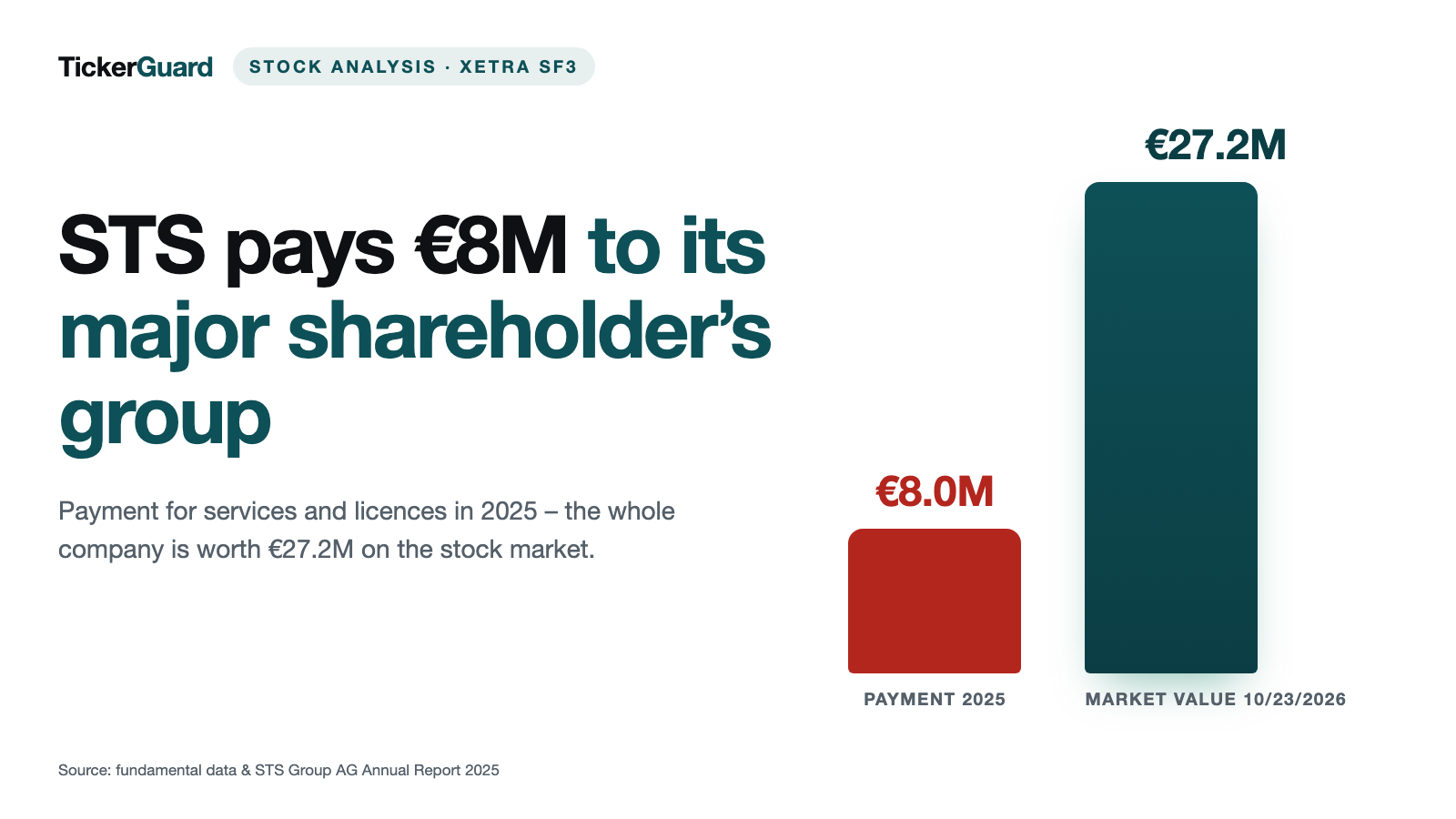
Buy into STS Group and you are along for the ride — major shareholder Adler Pelzer is at the wheel. In 2025, the German truck supplier paid his group €8.0 million for sales, management and consultancy services and, for the first time, for licences, more than a third of its EBITDA; the entire company was worth about €27 million on the stock market on October 23, 2026. The bottom line for 2025 was a loss, and the €12.70 price target comes from a study STS paid for itself.
 Thomas Mücke
Founder & Publisher
As of Today
As of: October 25, 2026
- Closing price
- 4.22 € 0.00%
- Market Capitalisation
- 27.2 €M
- P/E
- 10.0
This analysis has a cut-off date. The Stock Guard tells you when something material changes in the numbers. Reserve your free spot
Chart
Interactive price chart (TradingView).
Last price: 4.22 € (As of: October 25, 2026)
Note: pure fact-based analysis, not investment advice and not a solicitation to buy or sell. All figures without guarantee.
Picture yourself getting into a car that belongs to someone else. He is at the wheel, he picks the route and sets the pace. You are allowed to ride along, and the destination sounds tempting. Many small shareholders think exactly this way about companies with a strong controlling owner: if an industrial group holds three quarters of the shares, it will surely make the ride worthwhile. We call it the piggyback hope. It is comfortable, because it replaces your own homework with trust in the driver.
At STS Group AG of Hagen, Germany, that hope got an extra anchor in the summer of 2026: on August 19, 2026, SMC Research upgraded the stock to “Buy” and raised its price target to €12.70 — at a share price of €3.58, as quoted in the study itself. Let’s make a deal: we set the price target aside for a moment and read together what STS itself reports — in its 2025 annual report and its 2026 half-year report. The tension running through this analysis: on paper, STS is dirt cheap — a market value of about €27 million against €292 million in revenue and €23 million in EBITDA. But before anything reaches the free-float shareholders, part of the revenue flows as payments for sales, management and consultancy services plus licences to the group of the majority owner, Adler Pelzer, which in 2021 even announced plans to take the stock off the exchange.
What STS Group Actually Does — the Plastic Skin of Trucks
STS makes parts from plastics and composite materials, mostly for heavy trucks. Stand in front of the cab of a modern semi-truck and you see much of what such suppliers deliver: front modules, roof fairings, deflectors, fenders and entry steps. Inside the cab there are modules like the “bunk box” under the driver’s bed or shelving elements; for cars, parts such as tailgates and battery covers for electric vehicles. A key material is SMC (sheet molding compound), a glass-fiber-reinforced plastic sheet that is pressed into shape under heat and pressure. It is stiff, heat-resistant and lighter than sheet metal — a selling point for vehicle makers that need to save weight.
The group is organized in three segments. Plastics makes the parts in Europe, Mexico and the U.S. and is the core, with €130.7 million in revenue in the first half of 2026. China mainly supplies truck makers there (€19.5 million). Materials produces the SMC itself, for its own plants and for outside customers (€17.2 million, of which €10.5 million went to the other segments). According to the half-year report, STS runs twelve plants and three development centers in France, Germany, Mexico, China and the U.S.; it had 1,431 employees as of December 31, 2025.
One detail shapes everything that follows: STS is not an independent, widely held company. Since 2021, the majority has belonged to the Italian-led Adler Pelzer Group, a supplier of acoustic and interior parts. As of December 31, 2025, it held 74.42 percent, according to the annual report. At the top sits G.A.I.A. Holding S.r.l. in Desio near Milan, controlled by the Scudieri family. STS’s sole management board member, Alberto Buniato, is employed by Adler Pelzer Holding; supervisory board chairman Paolo Scudieri heads the board of G.A.I.A. Holding, supervisory board member Pietro Lardini is a managing director of Adler Pelzer Holding, and the third member, Pietro Gaeta, sits on the boards of G.A.I.A. Holding and AdlerGroup S.p.A.
Company history for investors
-
2021
Adler Pelzer takes over, offer at the legal minimum
Mutares sold 73.25 percent at €7.00; the offer to all other shareholders, at €7.31, sat exactly at the legal minimum price and came with the intention to end the listing.
-
2022
Group net loss of €9.9 million
EBITDA halved to €9.6 million — the start of four loss years in a row.
-
2025
First licence costs paid to the group
€4.6 million in sales, management and consultancy services plus €3.4 million in licence costs went to the majority owner's group; the group lost €0.5 million, and there is no dividend for 2025.
-
2026
First-half profit, stock up 70 percent
EBITDA of €14.9 million and a group net profit of €2.6 million; between August 10 and September 3, the stock rose from €2.94 to €4.99.
How the Stock Landed on Our Desk
Not through our in-house stock scanner, but through the list of most-discussed stocks on the forum of wallstreet-online, a German retail investor site. Our system first registered STS there on August 12, 2026, one day after the half-year report. That is an attention signal, not a quality signal. The reason shows up in the price: on August 10, 2026, the stock closed at €2.94 on Xetra; on September 3, it closed at €4.99 — a gain of about 70 percent in just over three weeks. On October 23, 2026, it closed at €4.22.
A sober number about trading itself belongs here. On a typical day in the three months to October 23, 2026, only about 1,400 shares changed hands on Xetra (the median, meaning half of the days were above and half below) — at prices around €4, a few thousand euros’ worth. A handful of buyers can move the price, and a seller will not always find a counterparty right away.
For how the customer side of the industry is doing — the truck makers themselves — see our Daimler Truck analysis. STS does not name its major customers in its annual report.
The Numbers Over the Years — Fairly Assessed
First, what genuinely holds up. Revenue is well above its 2021 level: €242.0 million back then, €311.1 million in 2024 and €292.0 million in 2025 — with declines in 2022 and 2025. EBITDA — earnings before interest, taxes, depreciation and amortization — rose from €9.6 million in the weak year 2022 to €23.0 million in both 2024 and 2025. The first half of 2026 was clearly better than a year earlier: revenue up 9.3 percent to €156.8 million, EBITDA up 35 percent to €14.9 million, an EBITDA margin of 9.5 percent and a group net profit of €2.6 million, or €0.40 per share (first half of 2025: a loss of €0.7 million). The China segment grew 26.1 percent, and the U.S. plant continued to stabilize and contributed more to earnings. Management confirmed its 2026 guidance: revenue at the 2025 level, EBITDA slightly above €23.0 million.
The balance sheet has eased, too. Net financial debt (bank, loan and lease liabilities minus cash and loans granted to related parties) fell to €10.9 million as of June 30, 2026, from €20.0 million at the end of 2025. Cash stood at €44.9 million. Operating cash flow even reached €41.5 million in 2025.
Now the sober part. EBITDA is not profit. Between the €23.0 million and what shareholders actually kept in 2025 stand depreciation of machines and tooling, interest and taxes:
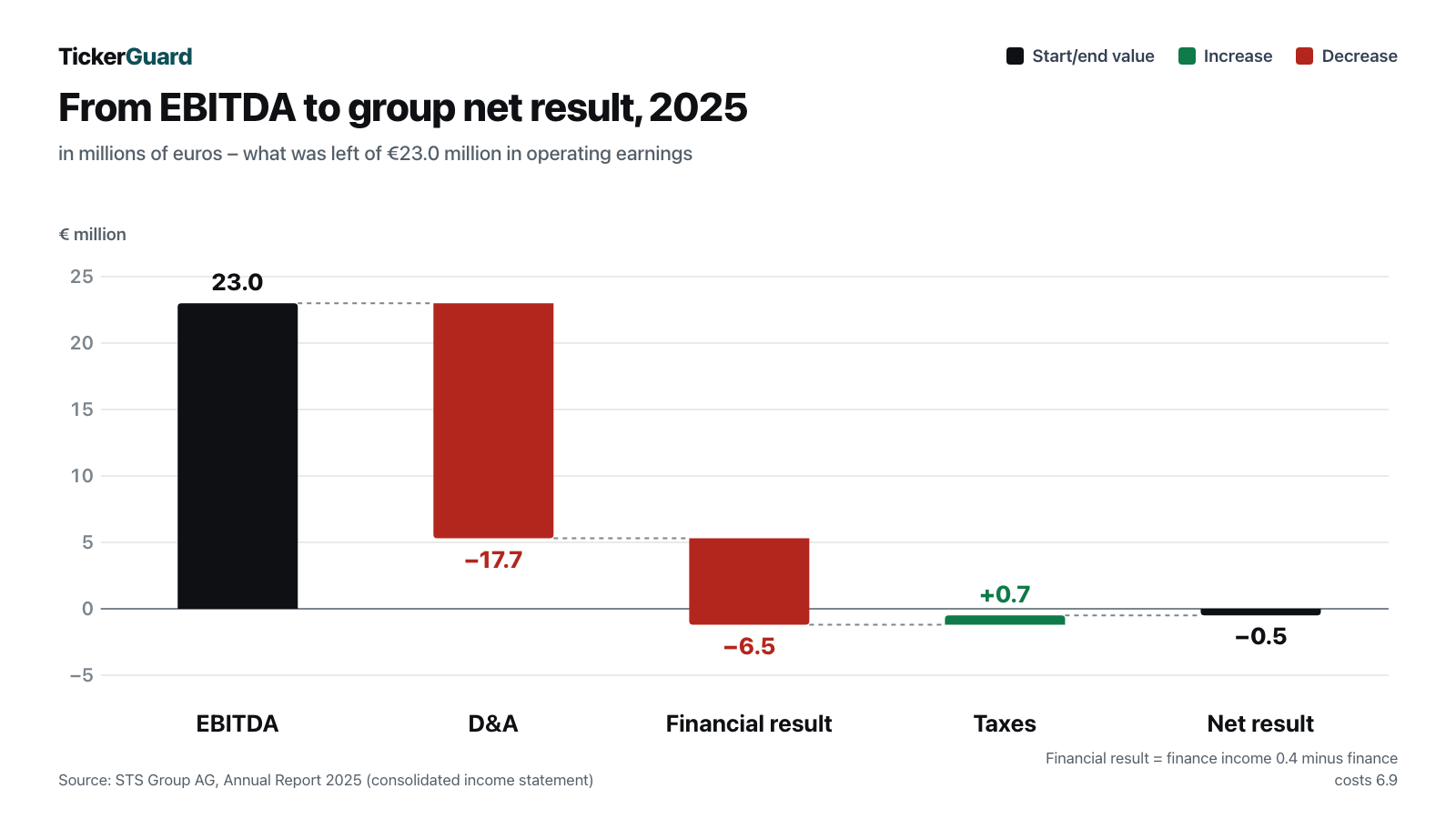
This is not a one-off. The group posted a profit of €1.8 million in 2021, followed by four loss years in a row: minus €9.9 million (2022), minus €1.2 million (2023), minus €0.6 million (2024) and minus €0.5 million (2025). In 2025, operating profit (EBIT) did not cover finance costs: €5.3 million in EBIT against €6.9 million in finance costs, an interest coverage of about 0.8. The first half of 2026 looked better — €6.5 million in EBIT against €2.1 million in finance costs.
And the strong 2025 operating cash flow has an explanation that does not repeat every year: €18.8 million came from the change in working capital, including €10.8 million from higher contract liabilities — put simply, money customers paid in advance. In the first half of 2026, by contrast, inventories rose by €10.4 million, mainly customer tooling at the French subsidiaries that had not yet been invoiced.
Uncomfortable Truth No. 1: Before Anything Reaches the Bottom, STS Pays the Majority Owner's Group
Money flows between a subsidiary and its majority owner in two ways: as a dividend, which every shareholder receives in proportion, and as compensation for services that the parent’s group provides — such as management, sales or licences. That compensation is a cost to the subsidiary and arises before any profit exists that everyone shares. The notes to the 2025 annual report quantify them under related parties:
“Goods and services procured from the G.A.I.A. Group in the 2025 financial year amounted to EUR 10.5 million (2024: EUR 3.9 million). These were primarily attributable to sales, management and consultancy services provided by Adler Pelzer Holding GmbH amounting to EUR 4.6 million (2024: EUR 2.5 million) and to licence costs of EUR 3.4 million, which were incurred for the first time in the financial year.”
— STS Group AG, Annual Report 2025, notes, section 5.5.1, page 130

Together that is €8.0 million for sales, management and consultancy services plus licences, hereafter simply group services and licences — more than a third of 2025 EBITDA, or about €1.24 per share; for comparison, STS earned about €0.43 per share in the twelve months to June 2026. The licence costs alone equal about 1.2 percent of revenue. For scale, even though an annual payment and a market value are different things: the entire company was worth about €27.2 million on the stock market on October 23, 2026. How the €4.6 million splits between sales, management and consultancy, the report does not break down. In the same year, the group lost €0.5 million. The sales, management and consultancy services alone have more than doubled since the first full year under Adler Pelzer (2022: €2.1 million), and the licence costs were new in 2025: according to the management report, the Adler Pelzer Group introduced a group-wide licence model under which the use of technical know-how and patents is “systematically remunerated for the first time.” In the first half of 2026, STS procured goods and services worth €6.7 million from the G.A.I.A. group, almost twice as much as in the first half of 2025 (€3.5 million), including €2.5 million that the report shows as expenses for management services received; the half-year report does not show licence costs separately.
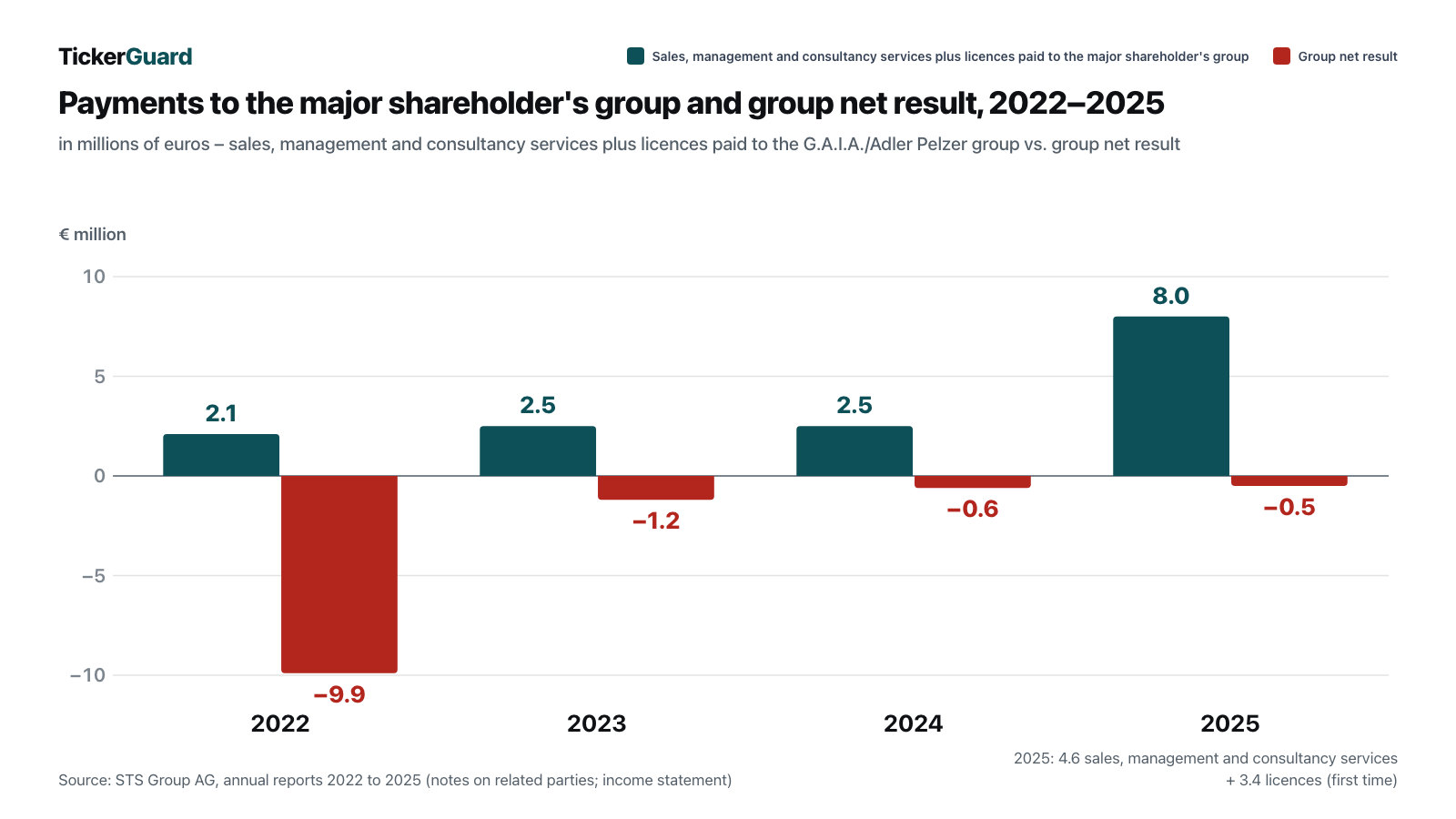
Fairness requires the other side. The money does not flow in one direction only: STS itself supplied €1.8 million in goods and services to the G.A.I.A. group in 2025 (2024: €1.5 million), mainly work in progress. And the services it procured are not worthless: the CEO is not employed by STS; according to the notes, Adler Pelzer Holding charges his work as part of its management fees (€0.2 million for 2025), STS uses the purchasing power and know-how of the larger group, and according to the risk report the majority owner provides short-term loans where necessary to bridge liquidity bottlenecks. And there is a statutory check: because STS is a controlled company under German law, management must prepare an annual dependency report that the auditor examines. For 2025, Forvis Mazars confirmed without qualification that “in the legal transactions listed in the report, the company’s contribution was not unreasonably high or disadvantages have been offset” (supervisory board report in the 2025 annual report).
Still, as a free-float shareholder, you face an asymmetry. The sole management board member, who is responsible for STS’s dealings with the group, is employed by Adler Pelzer Holding, which bills part of these services; the supervisory board that oversees them has three members, all of whom hold positions in the majority owner’s group. Loans run both ways, too: a €9 million loan from Adler Pelzer Holding taken out in 2023 carries 10.38 percent annual interest, according to the notes; €3.8 million of it was outstanding at the end of 2025. At the same rate, two French STS subsidiaries in turn lent Adler Pelzer Holding €1.2 million each in 2024; those loans were repaid in full in 2025. And the next major project, the new plant in Taixing, China, is described in the half-year report this way: “The plant is being built by companies of the Adler Pelzer Group; in future, the production space is to be shared by the Adler Pelzer Group (APG) and the STS Group. This will enable synergies to be realised and production space and investments to be used efficiently.” So STS does not have to build the plant itself; on what terms STS will produce there, the report does not say. To fund the build-out, according to the management report no dividend from the Chinese subsidiary flowed to STS Group AG in 2025; its investment income was zero (2024: €2.6 million). STS Group AG itself posted a standalone (HGB) net loss of €2.1 million and pays no dividend for 2025.
One detail from the annual meeting on July 10, 2026: in every vote — discharge of the management and supervisory board members, election of the auditor — about 282,300 to 282,600 shares voted no, roughly 4.3 percent of the capital. In the vote to discharge Pietro Lardini, the Adler Pelzer Holding managing director on the supervisory board, votes were cast for only 5.39 percent of the share capital; the majority owner’s votes were missing on this item. A plausible explanation, though not confirmed by the company, is the statutory voting ban (Section 136 (1) of the German Stock Corporation Act): no one may vote on their own discharge, and Lardini runs Adler Pelzer Holding, the majority shareholder. That is why the same no-vote block tipped the balance here (80.6 percent of the votes cast), and the discharge was rejected. This says nothing about Lardini’s conduct in office. For free-float shareholders, it merely shows how little a no-vote block of just over 4 percent achieves as long as the majority owner votes.
Uncomfortable Truth No. 2: One Customer, Half the Revenue
The second risk sits in the segment report. Two customers each accounted for more than 10 percent of third-party revenue in 2025, and one of them is very large:
“Revenue from the largest customer is attributable to the Plastics BU and amounts to EUR 150.4 million (2024: EUR 176.4 million).”
— STS Group AG, Annual Report 2025, notes, section 1 (segment reporting), page 83

€150.4 million is 51.5 percent of 2025 group revenue — more than half. The second-largest customer accounted for €57.5 million, just under a fifth; together, a little over 70 percent. How dependent STS is on this one buyer shows in the year-over-year comparison: revenue with it fell by €26.0 million in 2025 — more than the entire group’s revenue decline of €19.1 million. STS does not disclose who the customer is.
In its risk report, management itself rates “dependence on major customers” as low in impact and unlikely to occur; it says it is in talks with other truck makers to broaden the customer base. For a supplier whose parts are engineered for specific vehicle models that run for years, that is not implausible. But one number remains: if a large model program ends or the customer shifts orders, half of STS’s business is affected.
Uncomfortable Truth No. 3: The Price Target Comes From a Study STS Paid For
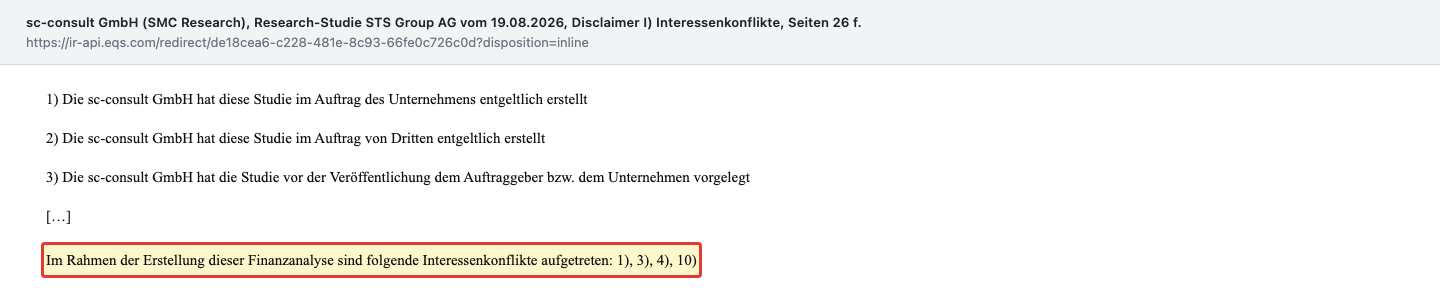
Back to the anchor from the beginning. On STS’s investor relations page (accessed October 25, 2026), SMC Research is the only analyst in the table of recommendations; since April 2024, its price targets there ranged from €10.70 to €20.80, each time three to roughly four and a half times the Xetra closing price on the day of the study. At the end of the latest study, dated August 19, 2026, it says who commissioned it. The study is available in German only; the disclosure lists the conflicts of interest that applied: the study was prepared for a fee on behalf of the company (conflict 1), shown to the company before publication (3), changed in content at the company’s suggestion (4) — according to the disclaimer only in response to factually justified objections — and the stock is held in one of the firm’s model portfolios (10).
Commissioned research like this is common and legal for small listed companies; without it, there would often be no coverage at all. STS’s own management and supervisory boards put its weight in perspective in 2021, in their statement on the takeover offer at the time:
“The Management Board and the Supervisory Board point out once again that the price target analyses of SMC-Research are not independent analyst reports, but SMC-Research was commissioned by STS within the scope of a ‘Sponsored Research’ for the price target analysis.”
— STS Group AG, joint statement on the takeover and delisting tender offer (English convenience translation, 2021), section 5.8 c., page 36
The same applies to €12.70. It is a calculation based on assumptions, not a price anyone pays.
Uncomfortable Truth No. 4: The 2021 Delisting Plan and an Offer at the Legal Minimum
We do know the price someone actually paid. In March 2021, the financial investor Mutares agreed to sell 73.25 percent of STS’s shares to Adler Pelzer Holding for €7.00 per share; the deal closed at the end of June 2021. In August 2021, a public offer to all remaining shareholders followed: a takeover offer combined with a so-called delisting tender offer at €7.31 per share. The joint statement of the management and supervisory boards recorded what the bidder intended:
“In Section 8.6.3 of the Offer Document, the Bidder states that it and the Bidder Parent Shareholders intend to propose an application for the revocation of the admission of all STS shares to trading on the regulated market (Regulierter Markt) (General Standard) of the Frankfurt Stock Exchange (Frankfurter Wertpapierbörse) at the earliest at the end of the Additional Acceptance Period and to have STS file the delisting application.”
— STS Group AG, joint statement on the takeover and delisting tender offer (English convenience translation, 2021), section 6.1 c., page 46

Two things matter for you. First, the price: according to the statement, €7.31 was exactly the volume-weighted three-month average price before the announcement, the legal minimum — a premium of 0.68 percent over the six-month average of €7.26. Over the last closing price before the announcement (€6.98) the premium was, according to the statement, €0.33 or about 4.5 percent; against the price before the Mutares sale became known (€8.16), it was a discount. That was not a typical takeover premium. Even so, the management and supervisory boards considered the price “fair and adequate” in their statement — based on the market valuations of comparable automotive suppliers and on a fairness opinion from the law firm Flick Gocke Schaumburg. Few shareholders accepted: together with the shares bought from Mutares, Adler Pelzer reached 73.59 percent as of the reporting date (Annual Report 2021).
Second, the intention: five years later, the stock is still listed on the regulated market, according to the 2026 half-year report. Whether Adler Pelzer still pursues a delisting, the 2025 and 2026 reports do not say. What it means for you: in 2021, the majority owner declared its intention to propose a delisting, and the management and supervisory boards considered that “appropriate” at the time — citing the costs and the fact that STS had not used the capital market since its IPO. A new attempt is possible at any time, and the yardstick for the price in 2021 was the legal minimum, not a study’s price target. For a delisting tender offer, according to the 2021 statement, that floor is set by the weighted average share price over the six months before the announcement and by what the bidder itself paid during that period — so a new attempt would start from the share price of the preceding months, not from the 2021 price. The October 23, 2026, closing price of €4.22 is more than 40 percent below what Adler Pelzer offered in 2021 — and there is no guarantee that any future offer would come in above it.
What the Stock Costs
At €4.22 (Xetra close on October 23, 2026) and 6,450,000 shares outstanding — 6,500,000 minus 50,000 treasury shares — STS has a market value of about €27.2 million. Adding net financial debt of €10.9 million (June 30, 2026) gives an enterprise value of about €38 million. That is roughly 1.7 times 2025 EBITDA (€23.0 million), little for an industrial supplier. The market value is about 9 cents per euro of revenue and just under 60 percent of shareholders’ equity of €46.7 million, or €7.24 per share. Over the twelve months to June 2026 (second half of 2025 plus first half of 2026), STS earned about €0.43 per share, for a price-to-earnings ratio of just under 10. That the P/E looks unremarkable while the EBITDA multiple looks dirt cheap is no contradiction; it is the very subject of this analysis: after depreciation and interest, little of the EBITDA turns into profit.
Why is the discount so large? The numbers above give three answers. After depreciation and interest, little of the EBITDA turns into profit; part of the revenue flows to the majority owner’s group as payments before any earnings arise; and there is no dividend for 2025, because management intends to use future profits primarily to finance growth, especially in China. Add the thin trading. A company can look cheap and stay cheap when the path from profit to the free-float shareholder is obstructed. Investors call that a value trap.
Upside and Risks at a Glance
What speaks for STS:
- Operational turnaround in the first half of 2026: revenue up 9.3 percent to €156.8 million, EBITDA up 35 percent to €14.9 million, group net profit of €2.6 million; full-year guidance (EBITDA slightly above €23.0 million) confirmed.
- Eased balance sheet: net financial debt of €10.9 million against €44.9 million in cash (June 30, 2026).
- China is growing (up 26.1 percent in the first half of 2026), and a new plant in Taixing is slated to start production in 2026 and expand its business with passenger-car customers, especially in electric mobility.
- Very low valuation: enterprise value about 1.7 times 2025 EBITDA, market value just under 60 percent of equity.
- A strong group behind it: purchasing, know-how and financing from the Adler Pelzer Group; for 2025, the auditor confirmed that in group transactions STS’s contribution was not unreasonably high or disadvantages were offset.
What speaks against it:
- Payments of €8.0 million to the majority owner’s group in 2025 (2022: €2.1 million, 2024: €2.5 million), against a group net loss of €0.5 million.
- Four loss years in a row (2022 to 2025); in 2025, EBIT did not cover finance costs.
- One customer accounted for 51.5 percent of 2025 revenue, the two largest together for a little over 70 percent.
- The majority owner holds 74.42 percent and announced a delisting plan in 2021; the offer at the time sat exactly at the legal minimum price.
- Very thin trading (typically about 1,400 shares a day), no dividend for 2025, and the only price target listed on STS’s investor relations page comes from a study the company paid for.
A Human Conclusion
Back to the piggyback hope. Riding along is not wrong. A majority owner with industry know-how can stabilize a company, and at STS you can see that in the first half of 2026: more revenue, more margin, less debt, finally a profit. But if you ride along, you should know who is at the wheel and who picks the route. At STS, the driver’s group bills group services and licences, companies of his group are building the new plant in Taixing, on terms the report does not disclose — and in 2021 he announced plans to propose taking the stock off the exchange.
The low valuation is therefore likely partly the price of this setup, not a market oversight. Whether it is too low depends on how much of the improving business reaches you in the future — as earnings per share, as dividends, or as a fair price if Adler Pelzer does pursue a delisting after all; its legal floor generally follows the share price of the preceding months, not a price target. The €12.70 price target does not answer that question. What you make of it is your decision. And that is how it should be.
Sources
All original documents used, for your own reading:
- STS Group AG — Half-Year Report 2026 (January 1 to June 30, 2026, published August 11, 2026)
- STS Group AG — Annual Report 2025 (financial statements published April 16, 2026)
- STS Group AG — annual reports 2024, 2023, 2022 and 2021 (German editions)
- STS Group AG — joint statement of the management and supervisory boards on Adler Pelzer Holding GmbH’s takeover and delisting tender offer (English convenience translation, 2021)
- STS Group AG — voting results of the annual meeting on July 10, 2026 (German)
- SMC Research (sc-consult GmbH) — research study on STS Group AG dated August 19, 2026 (German), linked on STS Group’s share page
- Fundamental data (price history and Xetra closing prices, trading volume; data as of October 23, 2026). All earnings, balance sheet and cash flow figures come from the reports above; enterprise value, interest coverage, shares and valuation ratios are our own calculations on that basis.
Transparency & disclaimer: This analysis is a journalistic assessment of publicly available information. It is not investment advice, not financial analysis in the regulatory sense and not a solicitation to buy or sell securities. Investing in stocks involves substantial risks, up to and including total loss. All information without guarantee; the data date is noted in the text. Positions held by the operator are disclosed daily; where one exists, it appears as a notice at the top of this deep dive.
Our Bottom Line at a Glance
- Operating trend positive
- In the first half of 2026, revenue (€156.8 million, up 9.3 percent) and EBITDA (€14.9 million, up 35 percent) rose, and the group earned €2.6 million; 2026 guidance was confirmed.
- Balance sheet and liquidity positive
- Net financial debt of €10.9 million against €44.9 million in cash as of June 30, 2026; equity ratio of 19.0 percent.
- Bottom line negative
- Group net losses from 2022 to 2025, most recently minus €0.5 million on €23.0 million in EBITDA; in 2025, EBIT (€5.3 million) was below finance costs (€6.9 million).
- Majority owner negative
- Adler Pelzer holds 74.42 percent; in 2025, €8.0 million for group services and licences went to its group, and companies of that group are building the new Taixing plant, on terms the report does not disclose. According to the auditor, STS's contribution was not unreasonably high or disadvantages were offset.
- Customer concentration negative
- One customer accounted for €150.4 million, or 51.5 percent of group revenue in 2025; the two largest customers together for a little over 70 percent.
- Listing and price target neutral
- Majority owner's 2021 delisting plan (offer at €7.31, the legal minimum) never carried out; the only price target listed on the investor relations page (€12.70) comes from a study STS paid for.
STS Group is improving operationally and trades at a very low valuation. For free-float shareholders, though, it remains unclear how much of that reaches them: four loss years in a row, €8.0 million in payments to the majority owner's group in 2025, no dividend for 2025, one major customer with half of revenue and a 2021 delisting plan on which the current reports are silent. Not investment advice.
What Our Rating Means
Open questions
The business works in principle, but one material question is open. As long as it stays open, our findings do not carry a quality verdict.
Yellow, because the business fundamentally works, the balance sheet is solid after the first half of 2026 and there is no sign of a going-concern risk — but key questions remain open: profitability is volatile (four loss years, interest coverage below 1 in 2025, clearly above 1 in the first half of 2026), more than half of revenue depends on one customer, and part of the revenue flows to the majority owner's group as payments before any earnings arise. That the stock looks very cheap is not a quality argument. The decision is yours.
A journalistic assessment by our editorial team at the time of the deep dive, based on public sources — not investment advice and not a solicitation to buy or sell. Your personal circumstances (investment goals, risk capacity, taxes) cannot be taken into account. What our levels mean, how verdicts are formed, and what conflicts of interest exist →
Worth Noting
- How it landed on our desk: the list of most-discussed stocks on the wallstreet-online forum (there since 08/12/2026), not our in-house stock scanner.
- STS is not an SEC filer; all evidence comes from STS Group AG reports and documents on sts.group. Latest periodic report: Half-Year Report 2026 of 08/11/2026 (unaudited, not reviewed); no quarterly statement is required in the General Standard.
- Enterprise value, interest coverage, revenue shares, price-to-earnings ratio and trading volume (median of daily Xetra volumes from 07/23 to 10/23/2026) are our own calculations.
Stock Watch
This analysis is as of October 25, 2026. Stock Watch will tell you what's changed at SF3.DE since then.
Later $1 a month per stock — signing up is free, and you'll be the first to know when it launches.
The full analysis as a PDF for later
We will send you this analysis as a PDF — to print, file away, and read at your own pace. And we will add you to the free Stock Watch list for STS Group AG (SF3.DE), so you hear about it when something material in this analysis changes.
Frequently Asked Questions
STS Group of Hagen, Germany, makes plastic and composite parts, mainly for heavy trucks: front modules, roof and exterior fairings, interior modules, plus parts such as tailgates and battery covers for cars and EVs. According to its 2026 half-year report, it runs twelve plants in France, Germany, Mexico, China and the U.S.; 2025 revenue was €292.0 million.
Adler Pelzer Holding GmbH of Hagen, part of the Adler Pelzer Group, held 74.42 percent of the shares as of December 31, 2025. The ultimate parent is G.A.I.A. Holding S.r.l. in Italy, controlled by the Scudieri family. STS's CEO and all three of its supervisory board members hold positions in the majority owner's group.
Because €17.7 million in depreciation and amortization and a negative financial result of €6.5 million were deducted from 2025 EBITDA of €23.0 million; after a €0.7 million tax credit, a group net loss of €0.5 million remained. In the first half of 2026, the result turned to a profit of €2.6 million.
According to the 2025 annual report, STS procured goods and services worth €10.5 million from the G.A.I.A. group, including €4.6 million in sales, management and consultancy services from Adler Pelzer Holding and, for the first time, €3.4 million in licence costs. In the dependency report, the auditor confirmed that STS's contribution was not unreasonably high or that disadvantages were offset.
Unclear. With its 2021 offer of €7.31 per share, Adler Pelzer Holding stated its intention to propose revoking the stock's admission to trading. According to the 2026 half-year report, the shares are still listed on the regulated market (General Standard) of the Frankfurt Stock Exchange; the 2025 and 2026 reports do not say whether the plan is still being pursued.
Not for fiscal 2025. In its standalone German GAAP (HGB) statements, STS Group AG reported a net loss and an accumulated loss of €2.1 million each for 2025, and management intends to use future profits primarily to finance growth, especially in China. For 2024, a total of about €0.3 million was paid out in 2025.
No. According to the disclaimer of the August 19, 2026, study, sc-consult GmbH (SMC Research) prepared it on behalf of and for a fee paid by STS Group, showed it to the company beforehand and changed its content following a suggestion. Back in 2021, STS's boards described SMC price targets as not independent analyst reports.
Found an error?
Did you spot a factual error, an outdated number, or a typo in this deep dive? Let us know briefly — your report goes straight to the editorial team.