Tripod Technology: The AI Server Boom Is Real — So Where Is the Cash Going?
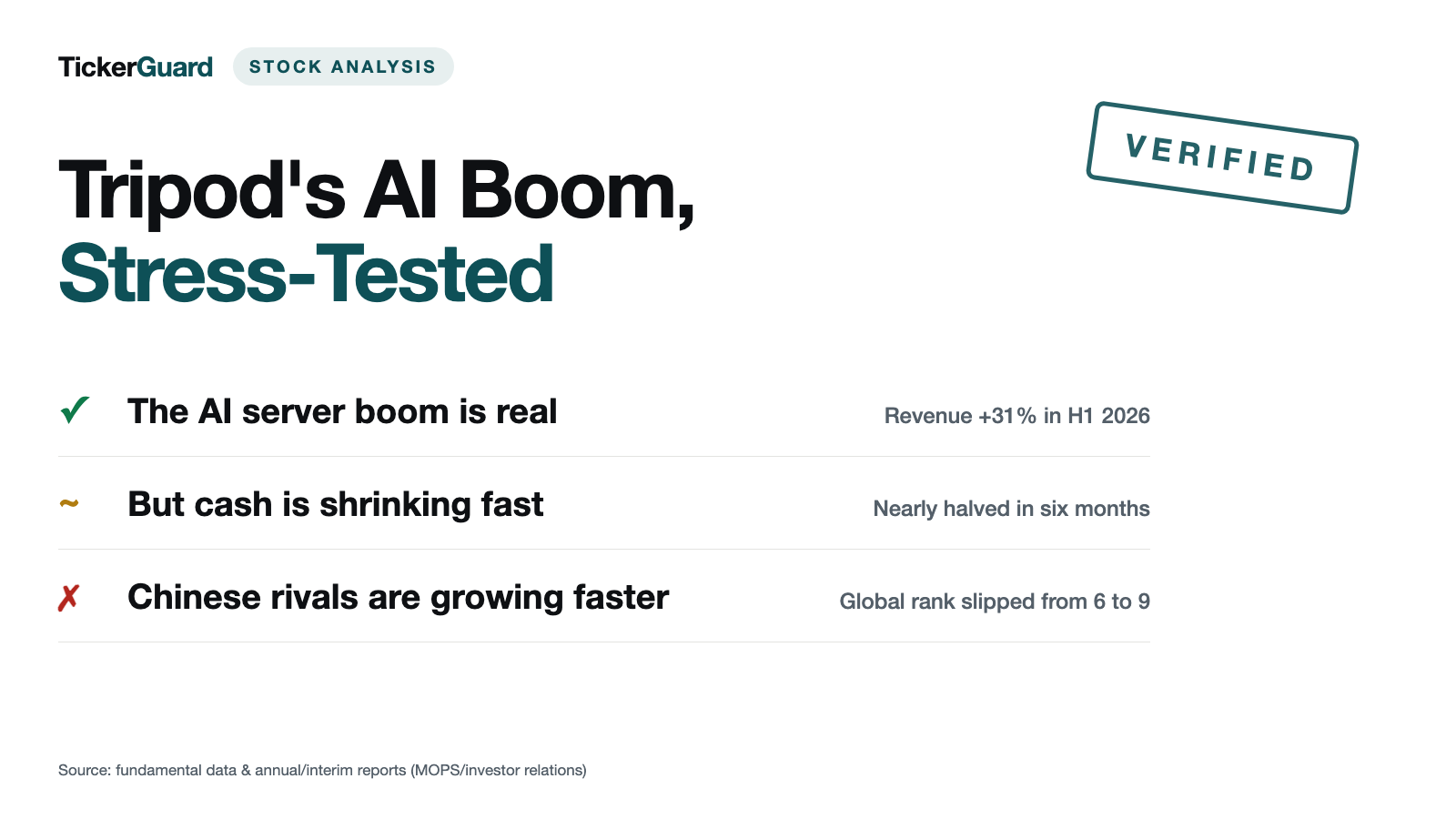
Tripod Technology (TWSE: 3044) is one of Taiwan's largest printed-circuit-board makers: in the first half of 2026 revenue rose 30.8% to NT$45,822 million, and in the second quarter of 2026 alone gross margin climbed to a two-year high of 30.1% — powered by the global AI server build-out. But the audited interim report also shows cash on hand falling from NT$26,659 million to NT$13,963 million in six months, while capex and inventory grew sharply. And the company's own investor presentation shows Tripod slipping from rank 6 (2021) to rank 9 (2025) among the world's largest PCB makers. Not investment advice — just the question of what a growth record is worth when the cash balance is shrinking at the same time.
 Thomas Mücke
Founder & Publisher
Thomas Mücke
Founder & Publisher
There is a number that switches off the brain's skepticism the instant it is big enough: the growth rate. Put a double-digit plus sign in front of it, and the automatic reaction is "this is working" — the reasoning stops right there. Call it the growth halo effect: it is so reliable precisely because it feels like proof. A company that grows, the thinking goes, must be doing something right.
At Tripod Technology Corporation (TWSE: 3044), one of Taiwan's largest printed-circuit-board makers, the growth rate really is impressive: revenue rose 30.8% in the first half of 2026 to NT$45,822 million (roughly €1.25 billion), and profit climbed 42.6%. The driver is the worldwide build-out of AI data centers: when server and memory makers ramp up capacity, they need the circuit boards their chips sit on — and Tripod is one of the companies that builds those boards.
The catch: anyone who only looks at the growth number misses what is happening in the cash line at the same time. We read the interim report to 30 June 2026, the audited 2025 annual report and several reports going back to 2023 — plus the company's own investor presentations. The central tension running through this analysis: what is missing from the cash balance while the revenue curve breaks records. Not investment advice — just the question of whether a growth record is automatically good news.
What Tripod actually does
Picture a computer circuit board — the green panel with all the copper traces that the processor, memory and other chips sit on. That is exactly what Tripod builds: printed circuit boards (PCBs), from simple ones to the most demanding variants that exist — "heavy-copper" boards with unusually thick copper traces for high currents, "HDI" boards (High Density Interconnect) with extremely fine traces to pack many connections into a small area, and multilayer boards stacking up to several dozen layers on top of each other. Those two board types — heavy-copper and multilayer — are exactly what an AI server needs: it must deliver high currents to the graphics chips while moving enormous amounts of data between components at the same time.
Founded in 1991, with its own manufacturing in northern Taiwan's Taoyuan since 1998, Tripod internationalized production early: two plants in Wuxi (China's Jiangsu province, since 2003 and 2007), a plant in Xiantao (Hubei province, since 2013) — and, the most recent addition, a plant in Vietnam's Bien Hoa since 2023. The timing is no coincidence: during the US-China trade conflict, many electronics suppliers have been shifting capacity to Southeast Asia to reduce tariff risk; Tripod is following that pattern.
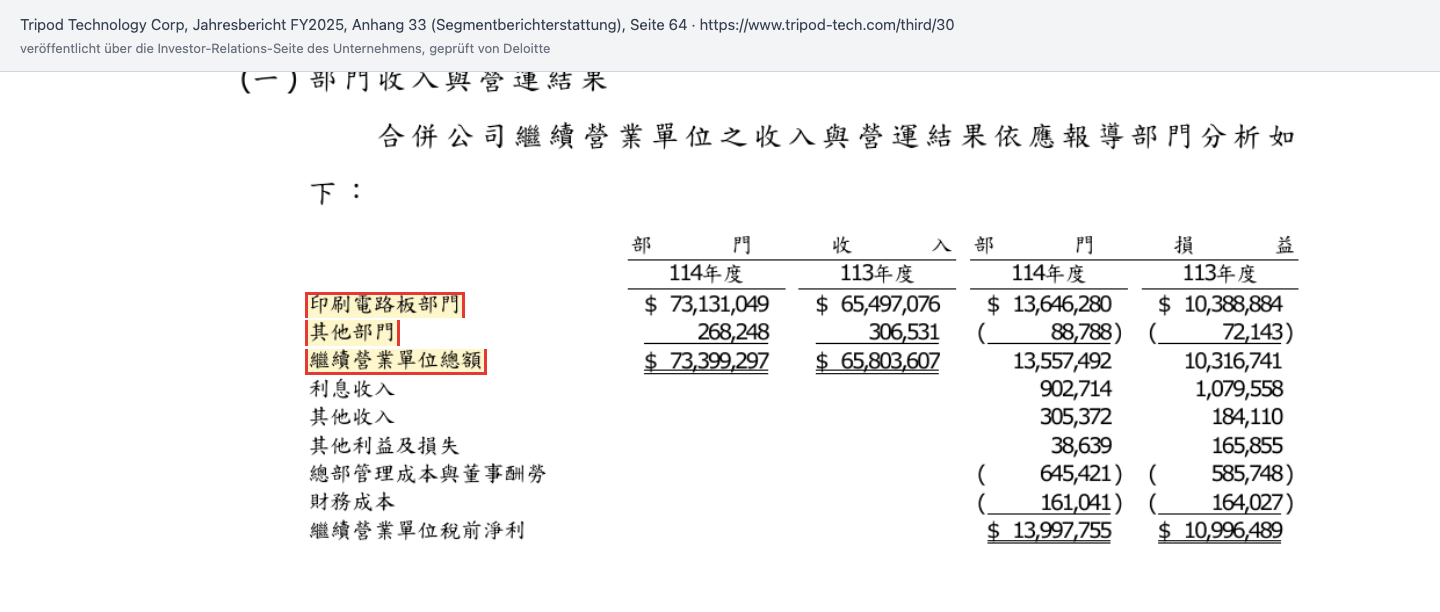
On paper, the company runs three business divisions — printed circuit boards, industrial automation and an "innovation" division. The balance sheet tells a different story. The segment note in the 2025 annual report shows the PCB business contributing NT$73,131 million in revenue — 99.6% of consolidated revenue — and the entire segment operating profit of NT$13,646 million (consolidated operating profit after unallocated corporate costs: NT$12,912 million). The remainder, grouped as "other", brought in NT$268 million in revenue and a loss of NT$89 million.
The consolidated financial statements are audited by Deloitte; both 2024 and 2025 carry an unqualified opinion. The only "key audit matter" the auditor names is revenue recognition at above-average-growth customers — a standard audit focus area for a growing company, not a warning sign.
Company history for investors
-
1998
First own manufacturing plant in Taiwan
The PingJen plant in Taoyuan began operations — still the Taiwanese core of production today, seven years after the company was founded in 1991.
-
2003
First China plant, in Wuxi
The Jiangsu-province plant marked the start of internationalization; a second plant at the same site followed in 2007.
-
2013
Plant in Xiantao, Hubei province
A third China plant expanded capacity — at a time when the US-China trade conflict was not yet a factor.
-
2023
New plant in Vietnam
With Bien Hoa, Tripod responded to rising tariff risk for China-made electronics and began shifting capacity to Southeast Asia.
-
2026
January: 2026 capex target announced
Per Digitimes, the company set a target of over NT$5 billion in capital spending — a benchmark investors could later measure actual spending against.
-
2026
New record dividend for fiscal year 2025
Shareholders approved NT$12.70 per share, more than ever before; paid 14 August 2026 — a visible sign of rising profitability.
-
2026
Second quarter: record revenue for the quarter, margin at a two-year high — and shrinking cash
The August interim report showed 30.1% gross margin, but also cash on hand nearly halved within six months.
How this stock landed on our desk
Honestly: through a striking combination in the fundamental data. As of 2 September 2026, the data showed a stock that had nearly doubled in twelve months, rising from around NT$290 to as high as NT$573, with double-digit revenue and profit growth in nearly every one of the past ten quarters. At the same time, something stood out: cash on hand had shrunk by nearly half within six months. That combination — record growth and a melting cash pile at the same time — was unusual enough to warrant a closer look.
A note on our own methodology, because it shapes the evidence base: no publicly available earnings-call transcripts exist for Tripod. We checked our own transcript archive — zero hits for this ticker — and additionally tried to fetch transcripts automatically; that also returned nothing. The chapter on management's statements therefore relies on the company's own investor presentations (most recently August 2026) and, explicitly labeled where used, on trade-press reporting.
The numbers over the years
Revenue has grown double digits for years: NT$58,862 million in 2023, NT$65,804 million in 2024 (+11.8%), NT$73,399 million in 2025 (+11.5%) — before the pace picked up markedly again in the first half of 2026. Net profit grew even faster: NT$6,062 million in 2023, NT$8,383 million in 2024 (+38.3%), NT$10,225 million in 2025 (+22.0%). Margins kept climbing throughout — gross margin rose from 19.3% (2023) through 23.2% (2024) to 25.9% (2025).
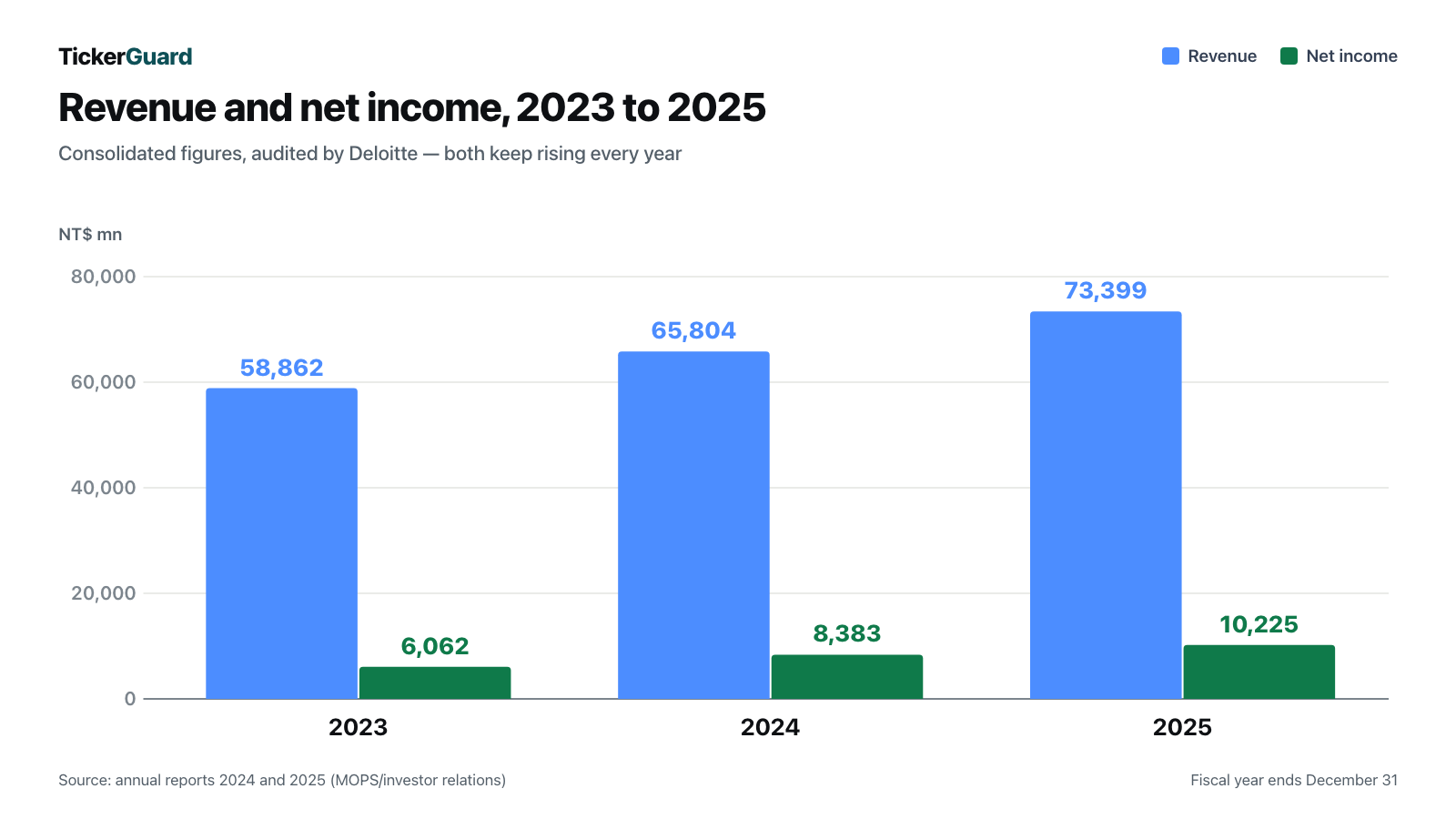
The pace accelerated further in the first half of 2026. NT$45,822 million in revenue is up 30.8% from the first half of 2025 (NT$35,031 million); profit climbed 42.6% to NT$6,843 million. In the second quarter of 2026 alone, gross margin reached 30.1% — the highest level in at least two years, up from 26.2% in the year-earlier quarter. Earnings per share rose from NT$4.65 to NT$7.41 in the second quarter, up 59%.
What is behind it? Server and memory-module boards. Trade publication Digitimes reported in May 2026 on a "spillover" effect: because competitors are concentrating capacity on the most demanding AI-server boards, ordinary server orders are shifting to Tripod — on top of already-rising demand for memory-module boards tied to the AI boom.
What management promised — and what came of it
Because no transcripts exist, management can only be measured against what is publicly documented. Two points can be checked concretely.
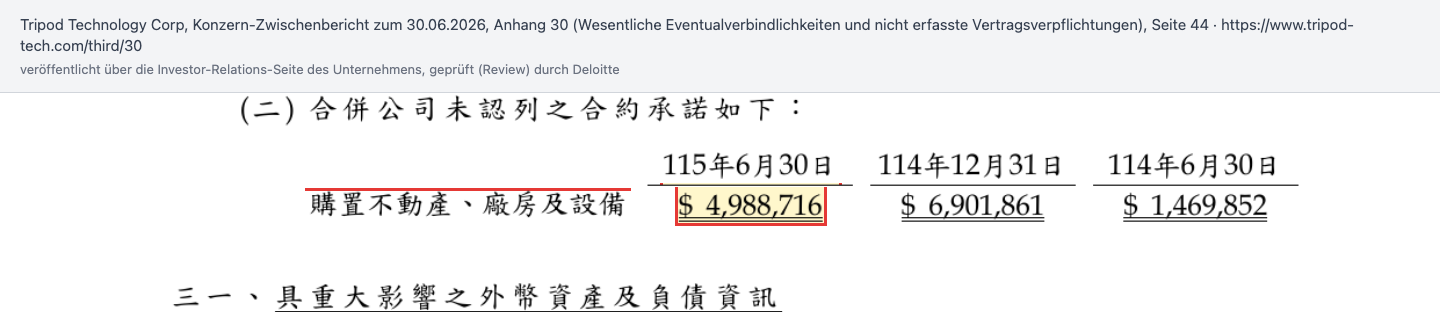
First, capital spending. According to a Digitimes report dated 21 January 2026, Tripod set a full-year 2026 capex target of "over NT$5 billion," mainly for expanding its plants in Vietnam and China. The audited interim report shows: in the first six months of 2026 alone, Tripod already spent NT$7,188 million on property, plant and equipment — 44% more than the full-year target announced in January. And that is only what has already been paid: as of 30 June 2026, an additional NT$4,989 million in contractually committed but not-yet-recognized capital commitments sat on the books — up from NT$1,470 million a year earlier. Management did not merely meet its own investment target; it clearly exceeded it.
Second, pricing. Per Digitimes' coverage of the second-quarter results, dated 13 August 2026, Tripod raised its own prices to offset higher raw-material costs — copper above all. It worked: gross margin hit a two-year high in the same quarter. That is one of the most honest management claims an investor can verify: a company that announces price increases and then shows higher, not lower, margins in the same quarter has genuine pricing power — not a given in an industry with many suppliers.
What the reports show — the uncomfortable truths
Uncomfortable truth #1: cash is melting while profits rise
At the end of 2025, Tripod held NT$26,659 million in cash. By 30 June 2026 — barely six months later — that was down to NT$13,963 million. A drop of 47.6%, in six months during which the company reported a record profit of NT$6,843 million.
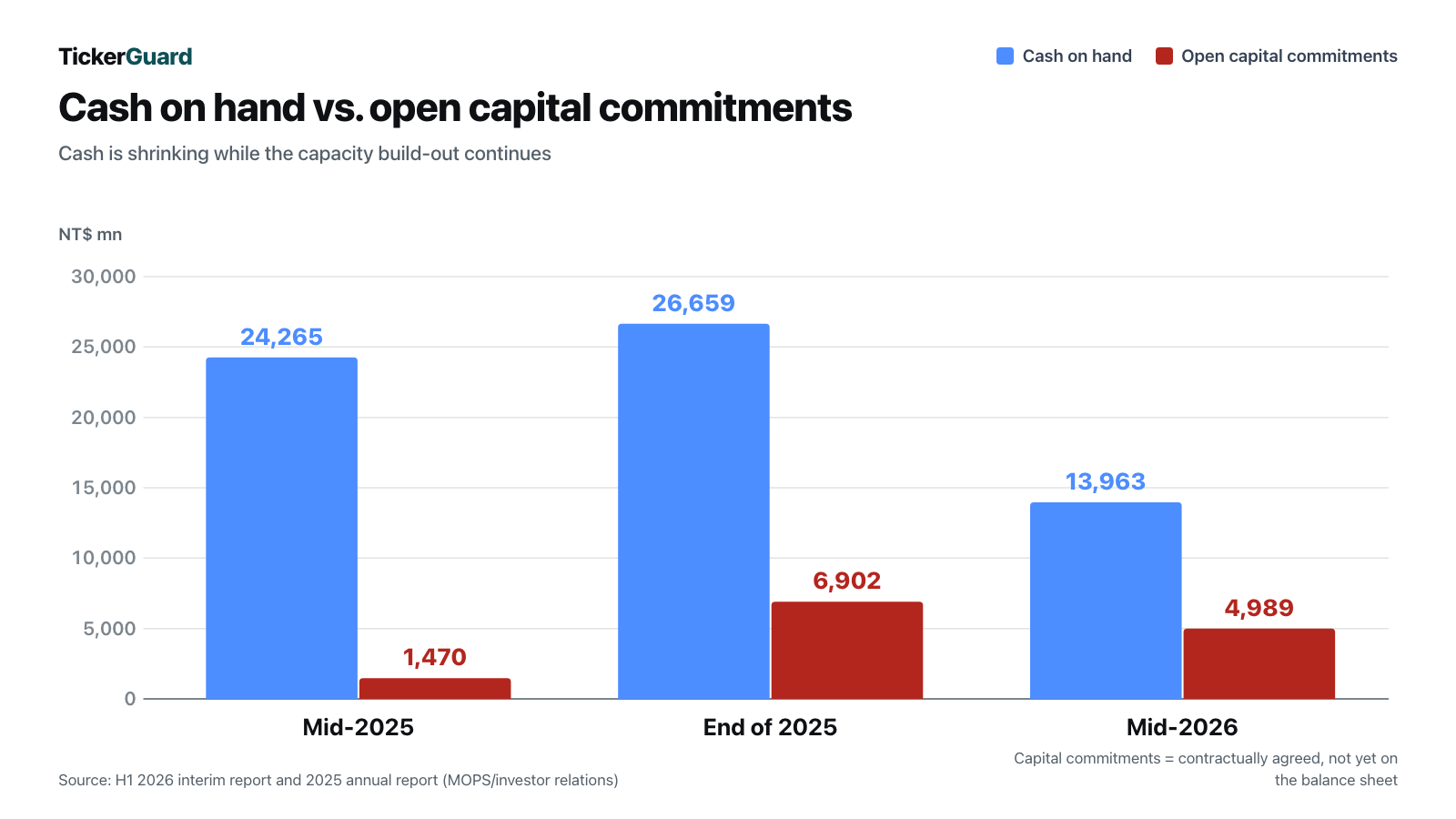
How does that add up? Operating cash flow in the first half of 2026 was only NT$3,594 million — well below the reported profit of NT$6,843 million, and only about half of the year-earlier figure (NT$6,322 million). The reason: inventory and receivables grew sharply — inventory rose 42% since year-end, from NT$12,019 million to NT$17,071 million, faster than revenue. That is cash tied up in operations before it ever shows up as profit in the bank. At the same time, the pace of investment more than quadrupled: from NT$1,773 million in capital expenditure in the first half of 2025 to NT$7,188 million in the first half of 2026.
The full cash bridge, per the cash flow statement: against operating cash flow of NT$3,594 million stands NT$13,272 million in cash used for investing activities — NT$7,188 million of that for property, plant and equipment, and a further NT$6,098 million shifted into financial assets with maturities beyond three months (not spent, but moved from the "cash" line into a different asset class on the balance sheet). Add NT$3,701 million used in financing activities, mostly repayment of short-term bank loans, and a positive foreign-exchange effect of NT$683 million, and the result is the NT$12,696 million decline. Part of the "vanished" cash was not spent at all, only reallocated — that does not change the higher investment intensity, but it does soften the picture of pure cash depletion.
Is this a red flag? Not in the sense of an existential threat — the balance sheet is too solid for that: NT$55,723 million in equity stands against just NT$3,786 million in short- and long-term bank debt, and the current ratio, despite the decline, still stands at 162%. But it is a genuine bet: the company is putting its own cash behind a continued AI-server boom. If the bet pays off, cash should rebuild within a year or two, as it did between 2022 and 2024. If demand cools before the new capacity is fully utilized, the investment came too early.
Uncomfortable truth #2: more than half of outstanding invoices sit with ten customers
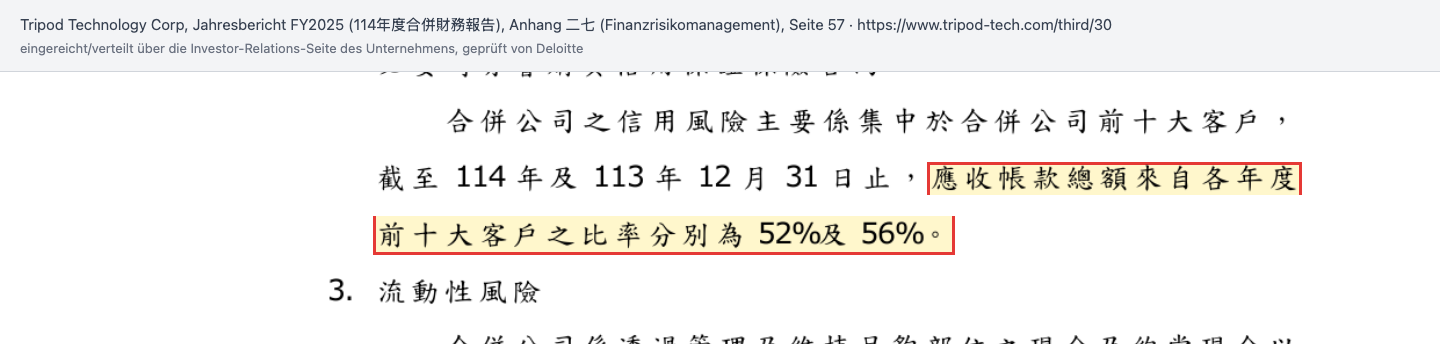
The 2025 annual report calls it "credit risk": 52% of all outstanding receivables at year-end 2025 were owed by the group's ten largest customers — down from 56% a year earlier. The report does not name individual customers, standard practice in Taiwanese annual reports, but the scale is clear: a single large customer shifting orders or switching to a competitor would hit Tripod harder than it would a more diversified company.
「合併公司之信用風險主要係集中於合併公司前十大客戶,截至114年及113年12月31日止,應收帳款總額來自各年度前十大客戶之比率分別為52%及56%。」
— Tripod Technology Corp, FY2025 annual report, Note 27 (Financial Risk Management) — "The group's credit risk is concentrated mainly in the group's ten largest customers; as of 31 December 2025 and 2024, the share of total receivables held by the ten largest customers was 52 percent and 56 percent, respectively."
The good news sits right next to it: the share is falling, not rising — a sign that extra demand from the server boom is broadening the customer base rather than deepening reliance on existing accounts. Still, it is a metric worth watching, especially because server and memory customers are among the more concentrated buyer groups in the electronics industry.
Uncomfortable truth #3: the company's own slide deck shows Tripod itself falling behind
Of all places, it is Tripod's own investor presentation that delivers the most uncomfortable finding. It contains — updated monthly — the ranking of the world's twenty largest PCB makers, based on data from market researcher Prismark. And it shows Tripod slipping within the global top 20. In 2021 the company ranked 6th with $2,257 million in revenue. In 2022 it fell to 7th ($2,218 million, -1.7% — one of the few years with declining revenue). 2023: still 7th ($1,919 million). 2024: 8th ($2,050 million). 2025: 9th ($2,361 million, +15.2%).
The pattern behind it: Tripod's own revenue growth is real, and strong in the most recent year — but Chinese competitors are growing faster. Shennan Circuits grew 32.2% in 2025, Wus Group 40.8%, Victory Giant 79.9%. Industry-wide, the trend has been consistent for years: China's share of global PCB production rose from 53.7% (2019) to a projected 57.7% (2026) — at the expense of Taiwan, Japan, Korea and every other location combined. Tripod is riding the AI boom, but growing more slowly than the most aggressive part of its competition. An investor buying this stock is not buying the fastest-growing player in the industry — they are buying a solid, but relatively fading, incumbent.
Valuation: what the market is paying for this growth
On 2 September 2026, Tripod shares cost NT$502. With 525.6 million shares outstanding, that puts the market cap at roughly NT$263.9 billion — converted at that same day's exchange rate (1 US dollar = NT$31.75, 1 euro = $1.1578), about $8.3 billion or €7.2 billion.
Based on the trailing four reported quarters (NT$23.34 in combined earnings per share), the price-to-earnings ratio works out to roughly 21.5. Using the average analyst estimate for full-year 2026 (NT$29.79, average of five estimates per the fundamentals data), the P/E drops to about 16.9 — implying the market expects earnings to keep rising. Against a book value of NT$106.0 per share (as of 30 June 2026, per the investor presentation), the stock trades at a price-to-book ratio of 4.74 — not a bargain, but given a recently reported return on equity of 24.9%, not an obvious overvaluation either. The dividend approved for 2025 — NT$12.70 per share, a record, with a payout ratio of 65% of net profit, paid in August 2026 — works out to a yield of about 2.5% at the current price.
Opportunities and risks at a glance
Opportunities: structurally growing demand for high-end circuit boards for AI servers and memory modules, solid double-digit margins with demonstrated pricing power, a very solidly financed balance sheet (equity ratio above 51%) despite the investment surge, geographic diversification across Taiwan, China and, since 2023, Vietnam, and a dividend that has grown for years and just hit a record.
Risks: operating cash flow that recently lagged well behind profit as inventory and capex grew sharply; a customer base half-concentrated among ten buyers; a structural competitive disadvantage against faster-growing Chinese manufacturers in an industry increasingly dominated by China; and heavy dependence on a single demand driver — the AI server cycle — whose duration nobody knows. Readers interested in the demand side of that cycle can find it in our Nvidia stock analysis — and in our Hon Precision analysis, another Taiwanese supplier riding the same boom.
The human verdict
Back to the growth halo effect from the opening: revenue up 31%, profit up 43% — numbers like that feel like a buy signal before anyone reads past the headline. What Tripod actually shows is more nuanced. The growth is real, the margin is real, the pricing power is real. But it is equally real that cash was nearly halved in six months, that more than half of outstanding invoices sit with ten customers, and that the company's own slide deck documents a slow but steady loss of relative standing against Chinese competitors.
The honest question, then, is not "Is Tripod growing?" — the report answers that with a clear yes. It is: do you trust a management team to exceed its own investment promise without the cash running too thin before the new capacity is paid for? What you make of that is your decision. And that is exactly how it should be.
Sources
All original documents used in this analysis — for readers who want to check them directly:
- Tripod Technology Corp — Interim report to 30 June 2026 (distributed via the investor-relations page) — the most recent periodic report, source of the balance sheet, quarterly/interim income statement, capital commitments and share count
- Tripod Technology Corp — Audited annual report, fiscal year 2025 (Deloitte opinion dated 10 March 2026) — source of the 2024/2025 annual figures, customer concentration (Note 27) and segment reporting (Note 33)
- Tripod Technology Corp — Audited annual report, fiscal year 2024 (Deloitte opinion dated 27 February 2025) — source of the 2023 annual figures
- Tripod Technology Corp — Investor presentations, August 2026 and November 2023 — source of the multi-year figures, global PCB market data and top-20 maker ranking (underlying data: Prismark)
- Digitimes — reporting dated 21 January, 11 May and 13 August 2026 on capex targets, order spillover and pricing — marked as a secondary source wherever no primary source was available
- Bank of Taiwan / market rate USD:TWD as of 2 September 2026 (31.7460) and European Central Bank, EUR:USD reference rate as of 2 September 2026 (1.1578)
- Fundamental data (price, 52-week range, analyst estimates; data as of 2/3 September 2026)
Transparency & disclaimer: This analysis is a journalistic assessment of publicly available information and does not constitute investment advice, a regulated financial analysis, or a solicitation to buy or sell any security. Stock investments carry substantial risk, including total loss; foreign stocks carry additional currency risk. All figures are provided without guarantee; the data's as-of date is noted throughout the text. The author holds no position in Tripod Technology Corporation shares as of publication.
Our Bottom Line at a Glance
- Revenue and margin trend positive
- Revenue grew from NT$58,862 million (2023) through NT$65,804 million (2024) to NT$73,399 million (2025), and a further 30.8% in the first half of 2026 to NT$45,822 million. Gross margin climbed from 19.3% to 30.1% (Q2 2026) over the same period — evidence of genuine pricing power, not just higher volume.
- Balance sheet strength positive
- Despite a heavy investment surge, the balance sheet remains solid: NT$55,723 million in equity (51.2% of total assets) stands against just NT$3,786 million in bank debt, and the current ratio stands at 162%. The audited statements carry an unqualified opinion from Deloitte.
- Cash flow quality negative
- Operating cash flow of NT$3,594 million in the first half of 2026 covered only about half of the reported NT$6,843 million profit. Combined with capex that quadrupled to NT$7,188 million, cash on hand fell 47.6% in six months to NT$13,963 million.
- Customer concentration neutral
- The ten largest customers accounted for 52% of receivables at year-end 2025 — a real, if slightly declining, concentration risk (prior year: 56%). Not unusual for a contract manufacturer serving a handful of very large electronics makers, but no reason for complacency either.
- Competitive position negative
- In its own investor presentation, Tripod slipped from rank 6 (2021) to rank 9 (2025) in the ranking of the world's 20 largest PCB makers, as Chinese competitors such as Victory Giant (+79.9% in 2025) grew markedly faster. China's share of the global market keeps rising structurally.
- Payout policy positive
- The dividend rose from NT$10.30 (fiscal year 2024) to NT$12.70 per share (fiscal year 2025, a record) at a payout ratio of roughly 65% — sustainable given the earnings trend, even though it also ties up cash that has just gotten tighter.
Tripod Technology is a solidly financed, clearly profitable PCB maker whose revenue and margins are benefiting strongly from the AI server boom — revenue up 30.8%, gross margin in the second quarter of 2026 at a two-year high of 30.1%. At the same time, cash on hand fell nearly by half in six months, because capex and inventory grew faster than operating cash flow. Add to that a 52%-on-ten-customers concentration and a documented slide in the global PCB-maker ranking against faster-growing Chinese competition. Not investment advice.
What Our Rating Means
Open questions
The business works in principle, but one material question is open. As long as it stays open, our findings do not carry a quality verdict.
The rating is yellow because the business fundamentally works — a solid balance sheet, rising margins, an unqualified audit opinion — yet several material operating questions remain open: operating cash flow covered only about half of profit in the first half of 2026, while capital expenditure quadrupled and cash fell 47.6% in six months. Add a real customer concentration of 52% across ten buyers and heavy dependence on a single, cyclical demand driver — the AI server boom, whose duration cannot be predicted. None of these points individually threatens the company's survival; this is explicitly not a solvency risk. But together they are exactly the kind of open operating questions the yellow rating exists for. Between two levels, the more cautious one applies.
A journalistic assessment by our editorial team at the time of the deep dive, based on public sources — not investment advice and not a solicitation to buy or sell. Your personal circumstances (investment goals, risk capacity, taxes) cannot be taken into account. What our levels mean, how verdicts are formed, and what conflicts of interest exist →
Worth Noting
- Data basis: interim report to 30 June 2026 (most recent periodic report), audited annual reports for 2025 (opinion dated 10 March 2026) and 2024 (27 February 2025), investor presentations from August 2026 and November 2023. Price and valuation data as of 2/3 September 2026.
- No SEC filer: there is no 10-K, no 10-Q and no 20-F. Mandatory reports sit in Taiwan's MOPS disclosure system; the listing venue is the Taiwan Stock Exchange.
- No publicly available earnings-call transcripts exist for 3044.TW. Statements about capex targets and pricing rely on the company's own investor presentations and, explicitly labeled, on Digitimes reporting.
- Data note: all euro/dollar figures in this analysis use the actual market rate as of 2/3 September 2026 — roughly NT$31.75 per US dollar. The P/E ratio (21.5) and per-share figures in this analysis are recalculated from the audited interim report (Note 24, 525,606 thousand weighted shares). Automated data feeds elsewhere may show a different P/E for this ticker (around 24.5, based on the 52-week-high price rather than the current price) or slightly different per-share figures (based on a share count of roughly 528,100 thousand rather than the audited 525,606 thousand); this analysis relies on the figures recalculated from the audited report.
- Not to be confused with: Tripod Technology Corporation (TWSE 3044) is not the same company as other similarly named firms or the general term "tripod" (camera stand).
The full analysis as a PDF for later
We will send you this analysis as a PDF — to print, file away, and read at your own pace.
Frequently Asked Questions
Tripod Technology Corporation (TWSE: 3044) is a Taiwanese maker of printed circuit boards (PCBs) — from simple boards to highly complex heavy-copper and HDI boards used in AI servers and memory modules. Founded in 1991, the company runs plants in Taiwan (since 1998), China (since 2003) and Vietnam (since 2023). Per its segment report, 99.6% of 2025 revenue came from the PCB business.
Because demand for high-end circuit boards for AI servers and memory modules is growing strongly. Revenue rose 30.8% to NT$45,822 million in the first half of 2026, and gross margin climbed to 30.1% in the second quarter of 2026 — the highest level in two years. Per trade-press reporting, Tripod is also benefiting as competitors concentrate capacity on the most demanding AI-server boards and hand off ordinary server orders to Tripod.
Because the company is investing heavily and building up inventory. Cash on hand fell from NT$26,659 million (end of 2025) to NT$13,963 million (30 June 2026) — a 47.6% drop in six months. Capital expenditure quadrupled year over year to NT$7,188 million, and inventory grew 42%. Operating cash flow of NT$3,594 million lagged well behind the NT$6,843 million net profit.
Highly concentrated. Per the audited 2025 annual report, 52% of all outstanding receivables were owed by the group's ten largest customers — down from 56% a year earlier. The report does not name individual customers, standard practice for Taiwanese annual reports. The declining trend suggests a slightly broader customer base, but the concentration risk remains real.
For fiscal year 2025, shareholders approved a dividend of NT$12.70 per share — a record, up from NT$10.30 for fiscal year 2024. That is a payout ratio of roughly 65% of earnings per share (NT$19.45) and was paid on 14 August 2026. At the 2 September 2026 price of NT$502, that works out to a dividend yield of about 2.5%.
Because Tripod Technology is listed exclusively on the Taiwan Stock Exchange and is not a US reporting company. Its mandatory filings appear in Taiwan's MOPS (Market Observation Post System): an audited annual report, an interim report and two quarterly reports, supplemented by the company's own investor-relations publications.
Per the company's own, monthly-updated investor presentation, Tripod has slipped in the global ranking of the 20 largest PCB makers from rank 6 (2021, $2,257 million revenue) to rank 9 (2025, $2,361 million). The cause is not shrinking revenue at Tripod, but faster-growing Chinese competitors such as Victory Giant (+79.9% in 2025) or Wus Group (+40.8%).
No. No publicly available earnings-call transcripts could be found for 3044.TW — neither in our own transcript archive nor through an automated attempt to fetch them. Statements about corporate strategy in this analysis therefore come from the company's own investor presentations and, explicitly labeled, from Digitimes reporting.
Found an error?
Did you spot a factual error, an outdated number, or a typo in this deep dive? Let us know briefly — your report goes straight to the editorial team.