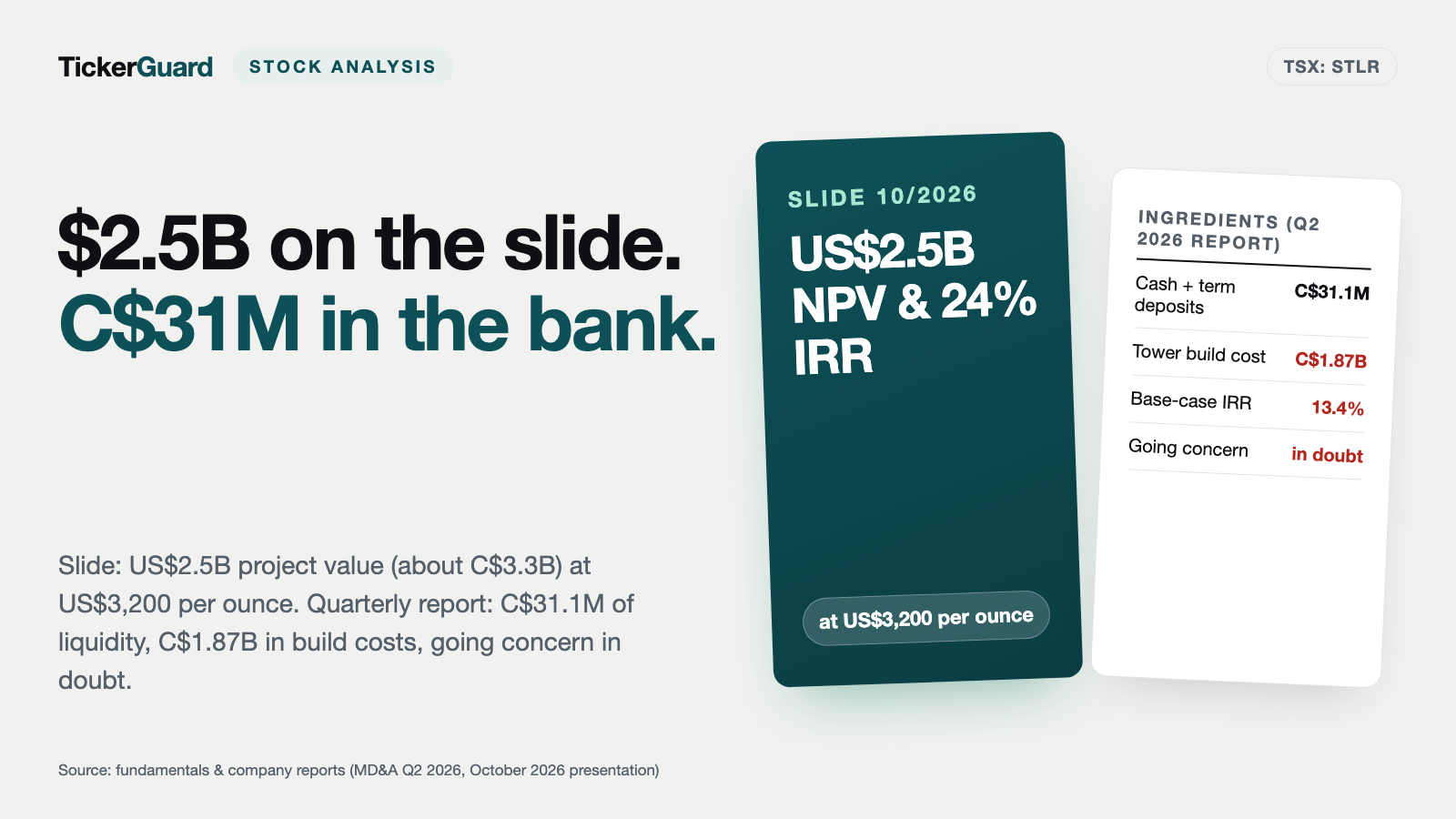
STLLR Gold and the Billion-Dollar Illusion: $2.5 Billion on the Slide, C$31 Million in the Bank
Up front in the October 2026 corporate presentation, the Tower gold project carries a US$2.5 billion project value. The quarterly report for the period ended June 30, 2026, shows C$31.1 million of liquidity, going-concern doubt and a royalty dispute over Tower that the presentation leaves out. Which leaves one question: who pays for the mine before it pours any gold?
 Thomas Mücke
Founder & Publisher
As of Today
As of: October 26, 2026
- Closing price
- 1.19 C$ -4.03%
- Market Capitalisation
- 0.2 C$B
This analysis has a cut-off date. The Stock Guard tells you when something material changes in the numbers. Reserve your free spot
Chart
Interactive price chart (TradingView).
Last price: 1.19 C$ (As of: October 26, 2026)
Note: pure fact-based analysis, not investment advice and not a solicitation to buy or sell. All figures without guarantee.
There is one number that reliably scrambles investors' judgment: a billion. Put it in large type on a slide, set it next to a market value of less than C$200 million, and your brain does the math on its own — that's ten times the money lying in the street! Call it the billion-dollar illusion: the anchoring effect of one big number. It makes us forget which assumption the number rests on, who still has to earn it, and how much money has to go in first.
STLLR Gold Inc. (TSX: STLR) is a good place to practice. Slide 4 of the October 2026 corporate presentation says of the flagship Tower project: “US$2.5 billion NPV5% & 24% IRR after-taxes @ US$3,200/oz gold.” The quarterly report for the period ended June 30, 2026, cites the same study with different numbers. Before the anchor pulls you along, let's read together what STLLR itself has published: the Q2 2026 interim financial statements and management's discussion and analysis (MD&A), the October 2026 presentation and the circular for the annual meeting. STLLR does not file reports with the U.S. securities regulator, the SEC; it reports under Canadian rules through the SEDAR+ system. The call is yours at the end.
What STLLR Gold Actually Does — Three Gold Projects, No Mine
STLLR is a developer: a company that explores gold deposits, defines them and moves them toward permits, but doesn't run a mine yet. Its roots go back a long way. The company was incorporated in Ontario on October 14, 1910, and produced gold at the Moneta mine near Timmins from 1939 to 1943. On February 6, 2024, what was then Moneta Gold acquired Nighthawk Gold Corp., consolidated its shares one-for-two and renamed itself STLLR Gold. It has no mining revenue today.
The portfolio holds three projects:
- Tower in the Timmins mining camp in Ontario, which the quarterly report calls Canada's most prolific gold belt, with more than 85 million ounces produced. The 2025 resource estimate shows 4.0 million ounces indicated and 7.0 million ounces inferred, at grades of around one gram of gold per tonne of rock (0.89 and 1.08 grams).
- Colomac, about 200 kilometers north of Yellowknife in the Northwest Territories, a former mine inherited from Nighthawk: 3.4 million ounces indicated and 1.7 million inferred (2023 estimate).
- Hollinger tailings in Timmins: waste from the Hollinger mine, which operated from 1910 to 1968. The November 2025 estimate shows 412,000 ounces indicated at 0.35 grams per tonne and 93,000 inferred at 0.37 grams; in February 2026 STLLR received the first permit issued under Ontario's new regime for recovering minerals from old mine waste.
Together that's roughly 16.6 million ounces. It sounds like treasure — but for now it's a map. In plain terms: “indicated” means the drill holes are close enough together that you can reasonably trust the shape of the deposit. “Inferred” means there's been enough drilling to believe something is there, but not enough to plan a mine around it. At STLLR, about 53 percent of all ounces sit in that second drawer. That defines the central tension of this analysis: On paper there are billions; in the bank there's a fraction of that — and in between sits a mine that somebody still has to pay for.
Company history for investors
-
1910
Incorporated in Ontario
The company is incorporated on October 14, 1910, and produces gold at the Moneta mine near Timmins from 1939 to 1943. Today it operates no mine.
-
2024
Nighthawk merger, new name
On February 6, 2024, Moneta Gold acquires Nighthawk Gold Corp. and its Colomac project, consolidates its shares 2:1 and becomes STLLR Gold.
-
2025
Tower study and equity raise
In June, the Tower economic study is released (13.4% IRR at US$2,500); in October, STLLR sells new shares for about C$36.6 million at a base price of C$1.28.
-
2026
Permit, royalty dispute, price slide
In February, the first permit for Hollinger; in April, royalty claims on Tower claims. The stock slides from its C$2.12 high in March to C$1.19 in late October.
How the Stock Landed on Our Desk
STLLR Gold came onto our radar because on October 26, 2026, it ranked among the most-discussed stocks in the forum of the German investor site wallstreet-online.de. Metrics such as the price-to-earnings ratio or revenue growth, which our in-house stock scanner works with, simply don't apply to a developer with no revenue. So we did the math from the filings ourselves. We had no transcripts of analyst calls for STLLR; instead we reviewed the quarterly report, the presentation and the annual meeting materials.
Why the stock gets so much attention shows in the price history (closing prices in Canadian dollars, fundamental data): C$0.83 at the end of 2024, C$1.63 at the end of 2025, and a 52-week high of C$2.12 on March 2, 2026. On October 26, 2026, it closed at C$1.19 — below the C$1.28 at which STLLR sold new shares in October 2025. Anyone who bought at the high is sitting on a loss of roughly 44 percent. Over the same stretch, gold fell too, from about US$5,350 per ounce on March 2 to about US$3,990 on October 23, 2026 (fundamental data) — a drop of roughly a quarter. Keep this in mind: A developer with no production works like leverage on the gold price, in both directions — and on top of that comes the question of how much new money it still needs.
The Numbers Over the Years — a Fair Look
First, what looks good. STLLR is running leaner than a year ago: its first-half 2026 net loss fell to C$9.3 million (prior year: C$15.3 million), and exploration and evaluation spending halved to C$6.9 million. The reason isn't magic, it's the calendar: 2025 carried the expensive Tower studies, while 2026 is mostly drilling and environmental baseline work. STLLR has no debt in the usual sense; its C$8.4 million of liabilities are payables, leases and reclamation obligations. Shareholders' equity stood at C$119.7 million at June 30, 2026.
The 2026 drill results were good, too. At the Jonpol deposit, STLLR reported intercepts such as 13.00 grams of gold per tonne over 22.75 meters (June 2026) and 12.46 grams over 16.17 meters (August 2026). Another roughly 15,000 meters of drilling are planned through year-end, after 8,536 meters in the first half.
But none of that earns STLLR money; it spends it. Here's what that looks like over the last eight quarters:
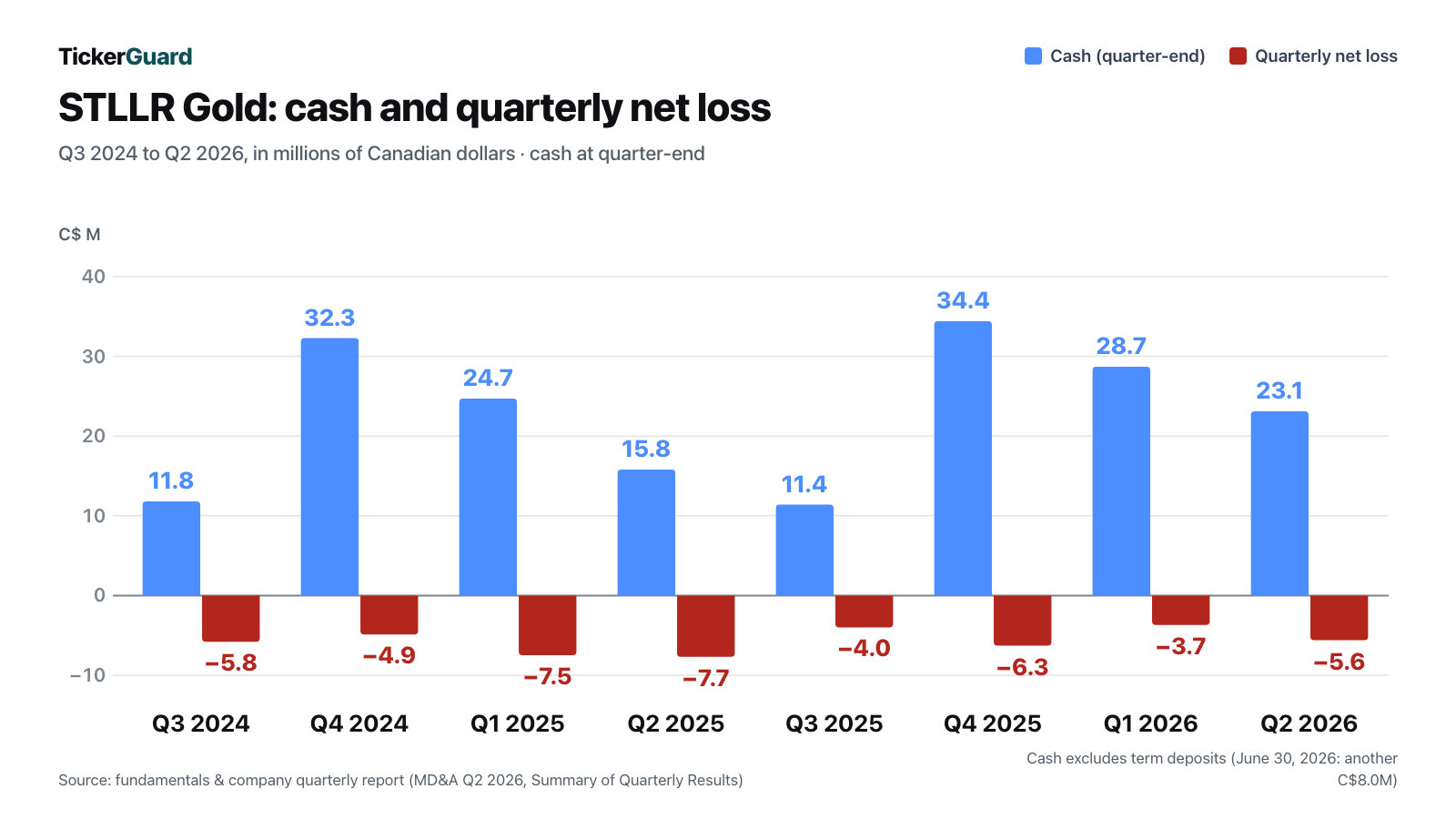
The pattern is a sawtooth: cash runs down, then gets topped up by an equity raise. In late November 2024, STLLR sold units of one share plus half a warrant (according to its U.S. Form D notice); on October 15, 2025, it closed a placement of about C$36.6 million — 20.8 million shares at C$1.28 and 6.0 million tax-advantaged “flow-through” shares at C$1.54 and C$1.792. Buyers of flow-through shares pay a premium because they can deduct the exploration spending on their taxes; in return, the company has to spend that money on Canadian exploration on schedule. For 2025, the four quarterly losses add up to C$25.6 million. In short: The numbers show a disciplined explorer — but not one that pays its own way.
What the Filings Say — the Uncomfortable Truths
Uncomfortable Truth No. 1: “Solid Balance Sheet” on the Slide, Going-Concern Doubt in the Statements
Slide 8 of the October 2026 presentation is headlined “Solid Balance Sheet and Investor Support” and shows estimated working capital of C$31 million — in line with the quarterly report's June 30, 2026, figure (C$30.6 million). Note 1 of the interim financial statements for the same date says something different:
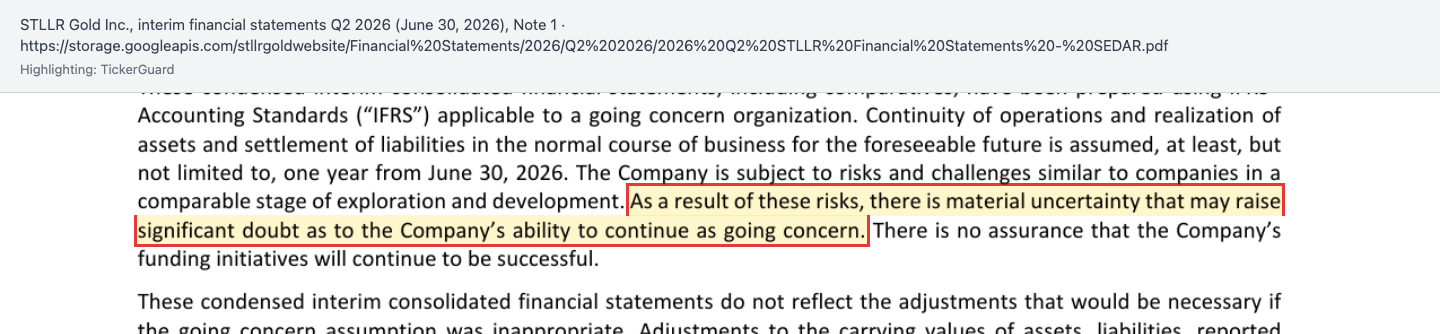
“As a result of these risks, there is material uncertainty that may raise significant doubt as to the Company’s ability to continue as going concern.”
— STLLR Gold Inc., Q2 2026 interim financial statements (June 30, 2026), Note 1 “Nature of operations and going concern”
To be fair, plenty of explorers with no revenue carry this sentence. It doesn't mean the lights go out tomorrow — it means the company can't execute its plans without fresh outside money. The math behind it is simple: C$31.1 million of liquidity (C$23.1 million in cash plus C$8.0 million in term deposits) against C$11.1 million of operating cash outflow in the first half. At that pace, the money lasts a little over five quarters. But the second half is far more drilling-heavy, with about 15,000 meters planned, and STLLR still has to spend C$6.6 million of flow-through money on exploration by December 31, 2026. It's a “solid balance sheet” only if you read that as “free of bank debt.”
Uncomfortable Truth No. 2: The Billion Assumes US$3,200 Gold — the Base Case Says 13.4 Percent
The Tower economic study dates from June 2025 and is a preliminary economic assessment (PEA), the roughest stage of mine planning. Its base case appears in the quarterly report:
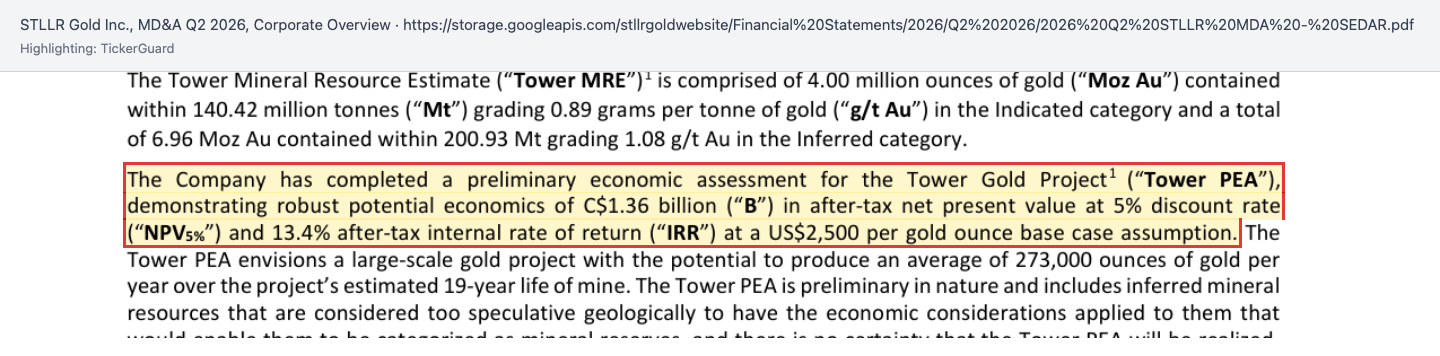
“The Company has completed a preliminary economic assessment for the Tower Gold Project (“Tower PEA”), demonstrating robust potential economics of C$1.36 billion (“B”) in after-tax net present value at 5% discount rate (“NPV5%”) and 13.4% after-tax internal rate of return (“IRR”) at a US$2,500 per gold ounce base case assumption.”
— STLLR Gold Inc., Management's Discussion & Analysis for Q2 2026, “Corporate Overview”
The presentation headlines the study's second scenario, US$3,200 per ounce: there the net present value rises to C$3.3 billion (the US$2.5 billion on the slide) and the return to 24 percent. Both are correctly calculated — but only one of them is the base case. The base case appears in the presentation only in the appendix (slide 37). For Colomac, too, the front of the presentation uses a higher price: slide 4 cites US$1.59 billion and a 56 percent return at US$2,000, while the quarterly report carries the 2023 study at C$1.17 billion and 34.6 percent at US$1,600.
More important than the choice of gold price is what sits next to the net present value. According to the study, Tower would cost C$1.87 billion before the first ounce, plus C$1.72 billion of sustaining capital over 19 years. In the base case, payback takes 5.8 years, and all-in sustaining costs come to US$1,537 per ounce. And the study also relies on inferred resources that are too speculative geologically to be turned into reserves — STLLR says so in its own report. Put simply: the billion is the value of a blueprint, not of a mine.
Uncomfortable Truth No. 3: A Royalty Fight Over the Heart of Tower
In April 2026, two companies that trade in royalties on resource production came forward. They claim a 2 percent royalty on 8 Tower claims — and they assert more than that:
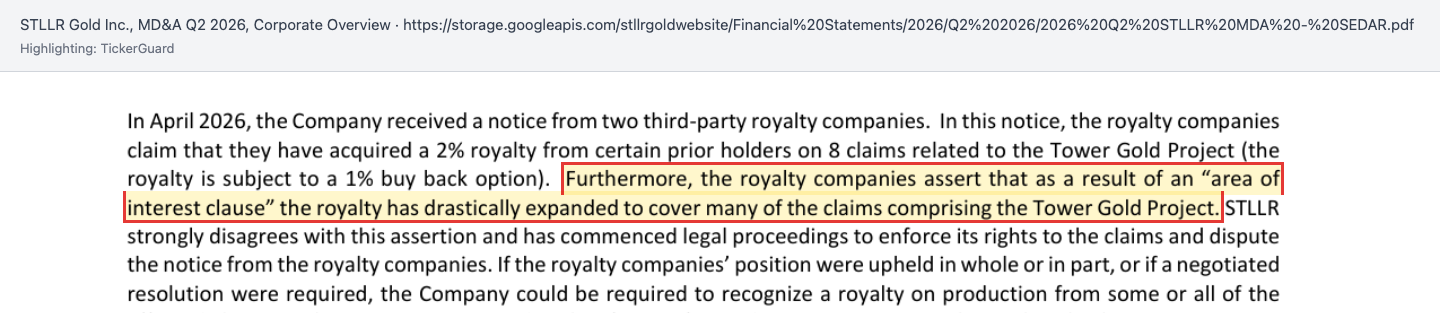
“Furthermore, the royalty companies assert that as a result of an “area of interest clause” the royalty has drastically expanded to cover many of the claims comprising the Tower Gold Project.”
— STLLR Gold Inc., Management's Discussion & Analysis for Q2 2026, “Corporate Overview”
STLLR “strongly disagrees” and has commenced legal proceedings. The report is candid about the possible consequences: royalties on production, payments, unfavorable buybacks, changed mine plans — and, even if STLLR wins, legal and advisory costs and delays. Who the counterparties are and exactly which claims are affected is not in the report. And the October 2026 presentation doesn't mention the dispute at all; it only includes the known 1.5 percent royalties on the Garrison area. A rough upper bound of our own shows what could be at stake: the study has Tower producing 5.24 million ounces. At the US$2,500 base price and the study's exchange rate of C$1.34 per U.S. dollar, 2 percent of that would be roughly C$350 million over the life of the mine — almost twice the market cap. That only holds if the royalty hit every Tower ounce, and it is not a forecast. For you, that means: Part of the income the slide promises could go to third parties if STLLR loses the royalty fight.
Uncomfortable Truth No. 4: Colomac Is Waiting for Money, Hollinger for a Business Case
Three projects sound like choice. But the quarterly report makes clear that the money only stretches to one:
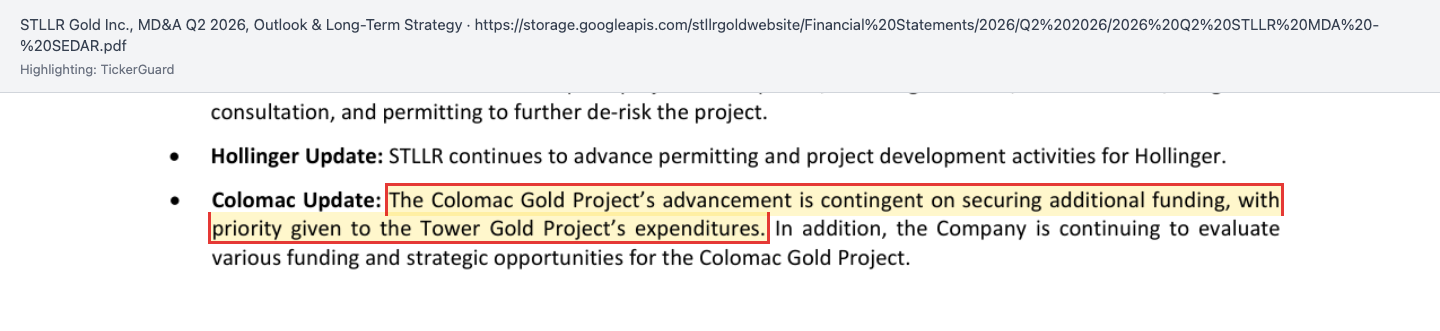
“The Colomac Gold Project’s advancement is contingent on securing additional funding, with priority given to the Tower Gold Project’s expenditures.”
— STLLR Gold Inc., Management's Discussion & Analysis for Q2 2026, “Outlook & Long-Term Strategy”
And Hollinger? The presentation promises the “potential to generate near-term cash flow at current gold prices.” But the January 9, 2026, technical report on Hollinger is a resource estimate only; it explicitly lists the economic analysis section (Item 22) as “not applicable.” So there is no published calculation of what Hollinger would cost and earn — and at a grade of 0.35 grams per tonne and a measured recovery of 61.3 percent in leach testing, that's no footnote.
One more detail from the cost lines fits the picture: professional and consulting fees rose from C$0.35 million to C$0.90 million in Q2 2026, and marketing and investor relations from C$0.03 million to C$0.55 million. The report's explanation: higher legal and consulting fees “for the evaluation of corporate development initiatives and strategic alternatives,” plus more conferences and roadshows. STLLR doesn't say what exactly is being evaluated. For shareholders, that could mean many things — from a partner for Colomac to the sale of a project.
Valuation — What the Market Pays for About 16 Million Ounces
With 151.7 million shares outstanding (as of August 12, 2026) and a closing price of C$1.19 on October 26, 2026, STLLR was worth roughly C$181 million. Subtract the C$31.1 million of liquidity and about C$150 million is left for the projects — a little over C$9 per ounce in the ground across all 16.6 million ounces, or about US$6.45. STLLR itself supplies a comparison: slide 7 of the presentation (prices as of October 5, 2026) puts STLLR at US$8 per resource ounce, while the twelve developer projects it selected range from US$7 (Valor) to US$786 (Skeena), with an average of US$157. The average means all values added up and spread evenly — a single outlier like Skeena pulls it up sharply; without Skeena it would be about US$100. The slide calls this attractive; you can just as well read the gap as the price of the funding gap, grades of around one gram per tonne and an open royalty dispute. A price-to-earnings or price-to-sales ratio makes no sense without revenue. For context: gold traded at about US$3,990 per ounce on October 23, 2026 (fundamental data) — well above both price assumptions in the Tower study.
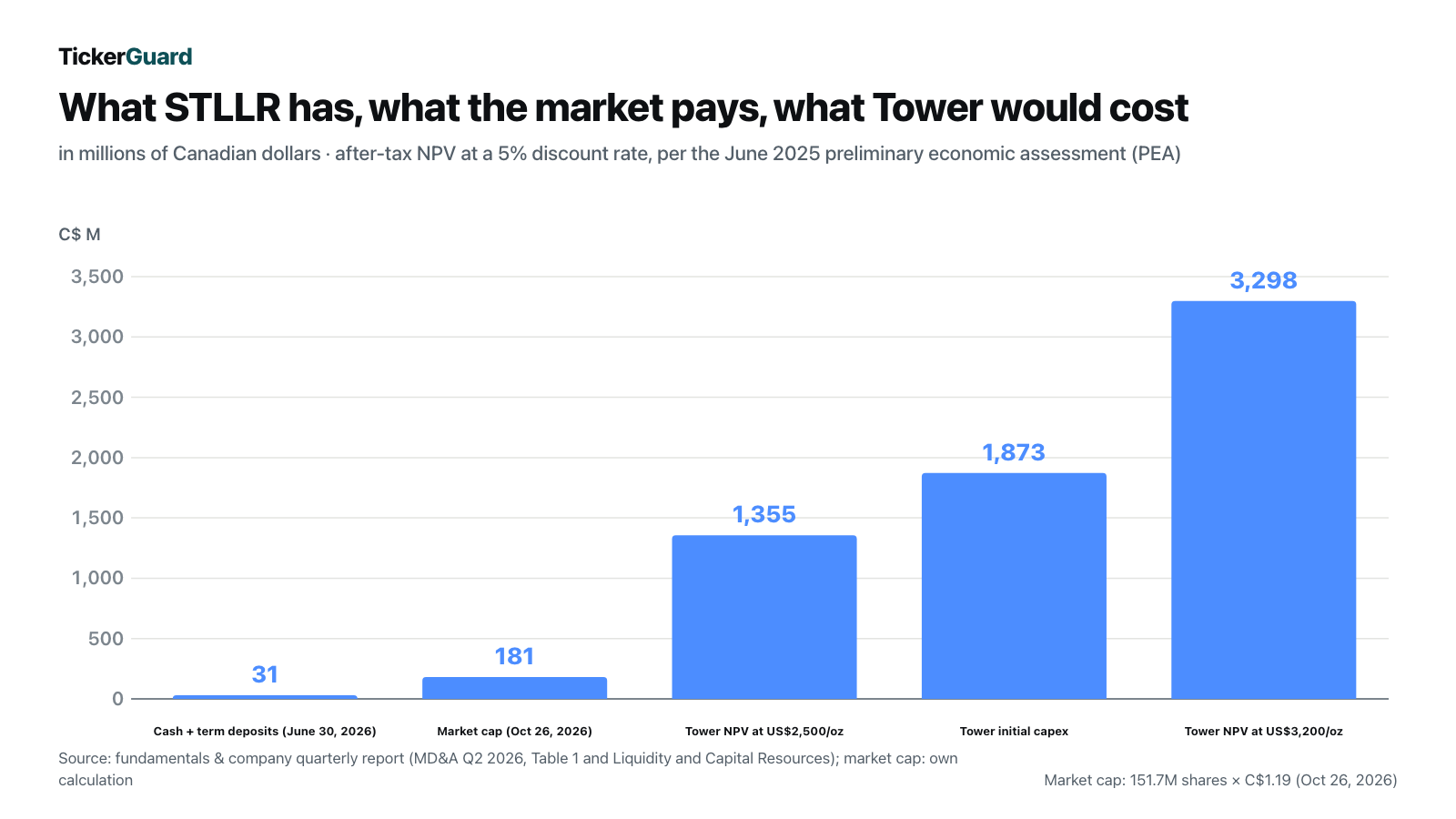
This is the core of the billion-dollar illusion. The market cap equals about 13 percent of Tower's base-case net present value and just over 5 percent in the US$3,200 case. That looks cheap — but it's normal for developers, because the net present value only materializes after construction. Whoever has to raise C$1.87 billion pays with loans, with sales of future gold to financiers, or with new shares. A rough back-of-the-envelope calculation of our own shows the scale: if just one third of the build cost came from equity, that would be a little over C$620 million — more than three times today's market cap. So buyers today aren't only betting on the gold price, but on the terms on which that money arrives later.
Even before that, there's an overhang of potential dilution: 12.0 million stock options, 14.7 million warrants (10.1 million of them at C$1.54, expiring in November 2026) and 0.4 million share units for management. On a fully diluted basis, the report counts 178.9 million shares. The 10.1 million warrants at C$1.54 were well out of the money at the C$1.19 close on October 26, 2026: if they expire unexercised in November, they won't dilute — but the roughly C$15.5 million an exercise would have brought in won't arrive either. Two well-known names stand behind the company: through his holding company, Eric Sprott owned about 14.9 percent at June 30, 2026, and gold producer Agnico Eagle about 10.8 percent — Agnico bought more in the October 2025 placement at C$1.28 and jointly owns another 46 square kilometers around Tower with STLLR. How expensive the step from project to mine in Canada's north can get is shown in our analysis of B2Gold and its Goose mine in Nunavut. Remember: The discount to net present value isn't a gift; it's the price of the funding gap.
Upside and Risks at a Glance
What speaks for STLLR Gold:
- About 16.6 million ounces of resources across three projects, with Tower in the storied Timmins camp, close to roads, power and mills.
- Gold at about US$3,990 per ounce on October 23, 2026 — well above the study assumptions of US$2,500 and US$3,200.
- High-profile shareholders: Eric Sprott (14.9 percent) and Agnico Eagle (10.8 percent), both in the 2025 raise; directors and officers also bought C$0.59 million.
- No bank debt; losses fell markedly in 2026; strong drill results at Jonpol.
- The first permit under Ontario's new recovery regime, for Hollinger (February 2026).
What speaks against STLLR Gold:
- No revenue, a going-concern uncertainty in the interim statements, C$31.1 million of liquidity against about C$5.6 million of cash outflow per quarter.
- Tower needs C$1.87 billion up front according to the study — roughly ten times the market cap; financing is entirely open.
- A base-case return of just 13.4 percent; more than half of all ounces are only “inferred”; the mine-plan grade is 0.99 grams per tonne.
- Gold fell by about a quarter between March 2 and October 23, 2026; with no production, a developer feels that with leverage.
- A royalty dispute over many Tower claims, not mentioned in the presentation.
- Colomac depends on additional funding, and there's no published business case for Hollinger.
A Human Conclusion — the Billion Belongs to Whoever Builds the Mine
The billion-dollar illusion whispers that the gap between a C$181 million market cap and US$2.5 billion on a slide is free money. At STLLR, some of it is real: according to the quarterly report, Tower sits in Canada's most prolific gold belt, the gold price is still above every assumption in the studies despite its pullback since March, and in Sprott and Agnico the company has heavyweight shareholders.
But the billion is a calculation for the day the mine is running. Before that, STLLR needs a more detailed study (planned in about 24 months), an environmental assessment, a resolution of the royalty fight — and above all close to C$2 billion in construction capital. Every one of those steps helps decide how much of the billion ends up with today's shareholders, and how much with banks, financiers and new shareholders. Whether you want to come along for that ride depends on how sure you are about the gold price and how much dilution you can stomach. What you do with this is your decision. And that's how it should be.
Sources
- STLLR Gold Inc., interim financial statements for Q2 2026 (June 30, 2026, unaudited)
- STLLR Gold Inc., Management's Discussion & Analysis Q2 2026 (effective date August 12, 2026)
- STLLR Gold Inc., interim financial statements and MD&A Q1 2026
- STLLR Gold, corporate presentation, October 2026
- STLLR Gold, management information circular dated April 16, 2026 (annual meeting May 27, 2026)
- News release of August 10, 2026 (Jonpol drill results, second-half drill plan) and of August 20, 2026 (Colomac, Arctic corridor)
- NI 43-101 technical report “Hollinger Tailings Project” (WSP Canada, January 9, 2026) and PEA report “Tower Gold Project” (InnovExplo, June 30, 2025), both on stllrgold.com
- U.S. Form D notice of December 9, 2024 (EDGAR, CIK 1979408)
- Price and market data: Source: fundamental data (closing prices in Canadian dollars, as of October 26, 2026; gold price as of October 23, 2026)
Note: This article is a journalistic assessment based on publicly available company reports. It is not investment advice and not a solicitation to buy or sell securities. Shares of pre-revenue gold developers are highly risky; a total loss is possible. STLLR Gold does not file reports with the U.S. SEC; this analysis relies on the quarterly reports and documents the company publishes under Canadian rules. The quarterly report for the period ended September 30, 2026, was not yet available at our editorial cutoff (October 26, 2026). Positions held by the operator are disclosed daily; where one exists, it appears as a notice at the top of this deep dive.
Our Bottom Line at a Glance
- Deposits positive
- About 16.6M oz of resources in three Canadian projects, Tower in the Timmins camp with infrastructure; strong Jonpol drill results in 2026. But more than half is only inferred, and the Tower mine-plan grade is 0.99 g/t.
- Project economics neutral
- Tower study (June 2025): 13.4% IRR and C$1.36B NPV in the US$2,500 base case, 24% at US$3,200; gold at about US$3,990 on 10/23/2026. A preliminary study that includes inferred resources.
- Funding & balance sheet negative
- Liquidity of C$31.1M (6/30/2026) against C$11.1M of outflow in the half-year; material going-concern uncertainty; Tower initial capex of C$1.87B, roughly ten times the market cap.
- Legal risk negative
- Since April 2026, a dispute over a 2% royalty allegedly covering many Tower claims, with litigation under way; not mentioned in the October 2026 presentation.
- Shareholder base positive
- Eric Sprott 14.9%, Agnico Eagle 10.8% (6/30/2026); both took part in the October 2025 placement at C$1.28, and directors bought alongside.
STLLR Gold shows how the billion-dollar illusion works: the presentation puts a US$2.5 billion project value up front, while the quarterly report shows a 13.4 percent base-case return, C$1.87 billion of build costs, C$31.1 million of liquidity and going-concern doubt. Add a royalty dispute over Tower and a Colomac project waiting for money. Buyers are betting on the gold price and on financing at good terms. Not investment advice.
What Our Rating Means
Substance risk
We found at least one documented issue that threatens the company itself — regardless of how the stock is currently valued.
STLLR has no revenue, its operations used about C$5.6 million a quarter in the first half of 2026, and it itself discloses a material going-concern uncertainty in its interim statements as of June 30, 2026 — under our criteria that is a substance risk, even though it is common among explorers and the cash should last a little over five quarters at the current pace. The projects may prove valuable, but none of that is proven while C$1.87 billion of financing remains open. The decision is yours.
A journalistic assessment by our editorial team at the time of the deep dive, based on public sources — not investment advice and not a solicitation to buy or sell. Your personal circumstances (investment goals, risk capacity, taxes) cannot be taken into account. What our levels mean, how verdicts are formed, and what conflicts of interest exist →
Worth Noting
- Hook: list of the most-discussed stocks in the wallstreet-online.de forum on 10/26/2026. Price reference (closing prices in C$, fundamental data): 0.83 (12/31/2024), 1.63 (12/31/2025), 2.12 (3/2/2026, 52-week high), 1.19 (10/26/2026); placement price 1.28 (10/15/2025). Gold on 10/23/2026 about US$3,990 per ounce (fundamental data).
- STLLR Gold does not file periodic reports with the SEC: EDGAR lists only two Form D notices under CIK 1979408 (STLRF), dated 5/30/2023 and 12/9/2024. Basis: interim statements and MD&A Q2 2026 (effective 8/12/2026) with audited comparatives at 12/31/2025, the October 2026 presentation and news releases through 8/20/2026; no further release through 10/26/2026. The report for the quarter ended 9/30/2026 was not yet available.
- Own calculations: market cap 151,733,886 shares × C$1.19 ≈ C$180.6M; liquidity 23.067 + 8.000 = C$31.1M; resources 10.963 (Tower) + 5.089 (Colomac) + 0.505 (Hollinger) = 16.56M oz, of which 8.76M inferred (53%); 2025 net loss = 7.519 + 7.744 + 4.044 + 6.306 = C$25.6M; royalty upper bound 5.237M oz × US$2,500 × 1.34 × 2% ≈ C$351M; per ounce (180.6 − 31.1) / 16.56 ≈ C$9.0 ≈ US$6.45 (US$0.714 per C$, fundamental data); warrant proceeds 10,061,930 × 1.54 ≈ C$15.5M; slide 7 peer table: average 1,889 / 12 ≈ US$157, without Skeena 1,103 / 11 ≈ US$100. Not to be confused with Stellar AfricaGold (SPX.TO).
Stock Watch
This analysis is as of October 26, 2026. Stock Watch will tell you what's changed at STLR.TO since then.
Later $1 a month per stock — signing up is free, and you'll be the first to know when it launches.
The full analysis as a PDF for later
We will send you this analysis as a PDF — to print, file away, and read at your own pace. And we will add you to the free Stock Watch list for STLLR Gold Inc. (STLR.TO), so you hear about it when something material in this analysis changes.
Frequently Asked Questions
STLLR Gold Inc. (TSX: STLR) is a Canadian gold developer based in Toronto. It owns the Tower project in the Timmins mining camp in Ontario, the Colomac project in the Northwest Territories and the Hollinger tailings in Timmins. It drills, runs studies and advances permits, but mines no gold and has no revenue (as of Q2 2026).
According to the Q2 2026 report, about 16.6 million ounces of resources: Tower 4.0 million indicated and 7.0 million inferred, Colomac 3.4 and 1.7 million, Hollinger 0.41 and 0.09 million. More than half is only inferred, the least certain category. STLLR has no reserves yet, meaning no ounces with demonstrated economic viability.
At June 30, 2026, STLLR had C$23.1 million in cash and C$8.0 million in term deposits. Operations used C$11.1 million in the first half; at that pace the money lasts a little over five quarters. The second half is more drilling-heavy, and the interim statements disclose a material uncertainty about the company's ability to continue as a going concern.
According to the June 2025 preliminary economic assessment, Tower needs C$1.87 billion of initial capital, plus C$1.72 billion of sustaining capital over 19 years. The US$2,500-per-ounce base case yields a C$1.36 billion net present value and a 13.4 percent after-tax return; at US$3,200 it is C$3.3 billion and 24 percent.
At June 30, 2026, Eric Sprott held about 14.9 percent of the shares through 2176423 Ontario Ltd., and Agnico Eagle Mines held about 10.8 percent through a subsidiary. Both took part in the October 2025 equity raise at C$1.28 per share. A total of 151.7 million shares were outstanding on August 12, 2026.
In April 2026, two royalty companies claimed a 2 percent royalty on 8 Tower claims and asserted that an area-of-interest clause extends it to many more claims in the project. STLLR disputes this and has gone to court. If it loses, it could face royalties on production, payments or changes to the mine plan.
It doesn't — STLLR Gold is "not ratable." Our AI rating relies on mandatory filings with the U.S. SEC, and STLLR files no annual or quarterly reports there. Its 2026 quarterly report, presentation and annual meeting materials do not mention artificial intelligence in its own business.
Found an error?
Did you spot a factual error, an outdated number, or a typo in this deep dive? Let us know briefly — your report goes straight to the editorial team.