Smith-Midland: Revenue Is Growing Double Digits — the Fine Print Has Repeated the Same Warning for Two Years
Smith-Midland Corporation (Nasdaq: SMID) pours highway barriers, sound walls, and facade panels from concrete — and rents part of the fleet out, too. Revenue grew 19% to $93.4 million in 2025, and backlog stood at $57.4 million in early August 2026. The same annual report, for the second year running, also says internal controls over financial reporting are not effective. Nasdaq has already sent three deficiency notices for late filings — each one cured after the fact. No earnings-call transcripts were available for this analysis. Not investment advice — just a close look at what a compliance warning actually means, and what it doesn't.
 Thomas Mücke
Founder & Publisher
Thomas Mücke
Founder & Publisher
As of Today
As of: October 9, 2026
- Closing price
- 22.40 $ +0.90%
- Market Capitalisation
- 0.1 $B
- P/E
- 11.5
- Growth Score
- 7/10
- AAQS
- 6/10
Price change since August 26, 2026: -12.5%
This analysis has a cut-off date. The Stock Guard tells you when something material changes in the numbers. Reserve your free spot
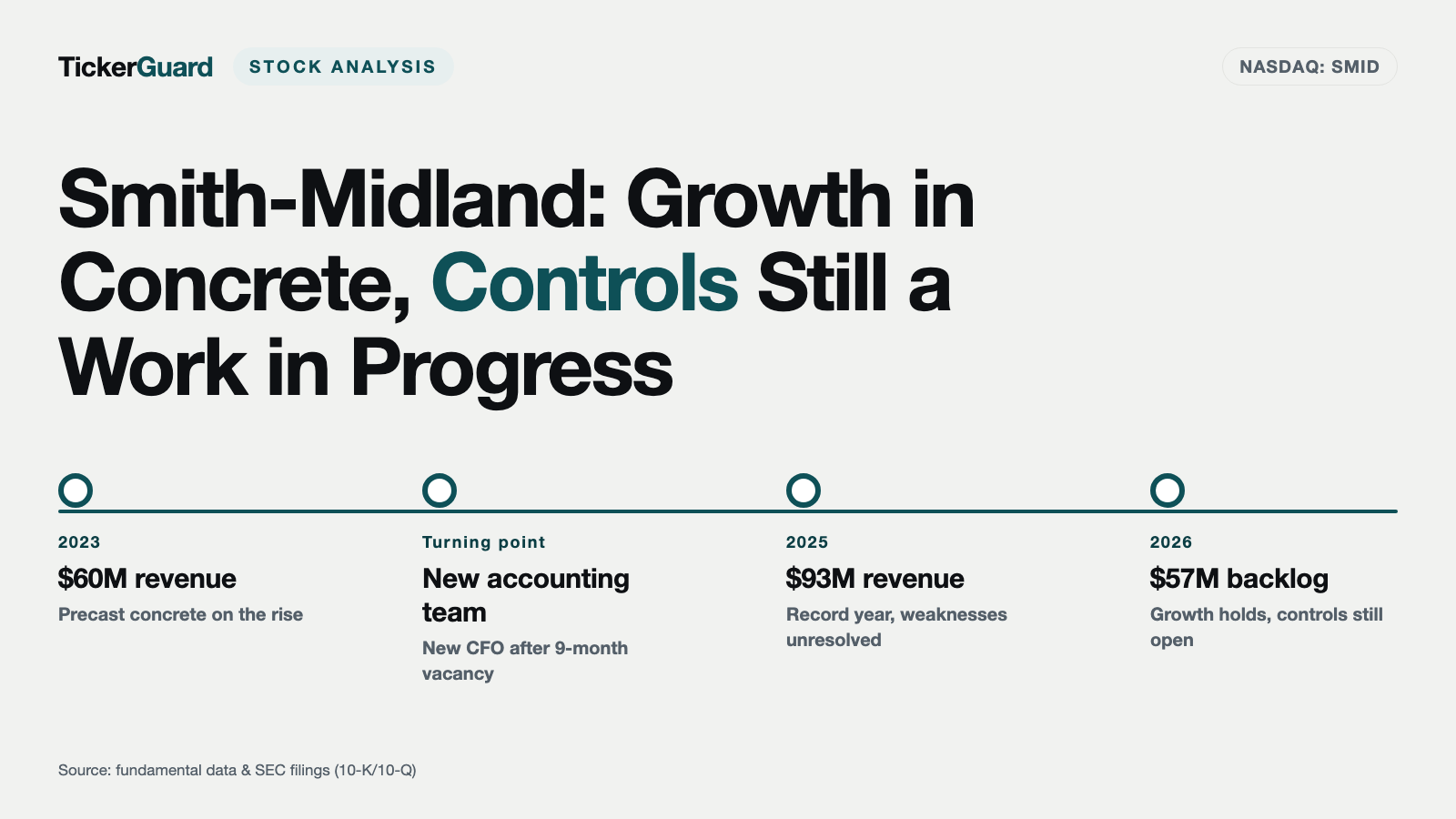
Chart
Interactive price chart (TradingView).
52-week range: 22.00 $ to 40.10 $ · Last price: 22.40 $ (As of: October 9, 2026)
Note: pure fact-based analysis, not investment advice and not a solicitation to buy or sell. All figures without guarantee.
There's an investor trap that catches exactly the careful, thorough readers — the ones who actually open the annual report instead of just watching the price. It goes like this: you read the sentence "management identified material weaknesses in internal controls" in an SEC filing, your brain instantly translates it to "accounting scandal," and you close the tab before reading the next line. Call it jargon fright: a technical term sounds more alarming than the specific situation actually warrants — which is exactly why it pays to read it to the end instead of just recognizing it. Smith-Midland Corporation (Nasdaq: SMID) of Midland, Virginia, is a good example. In 2025 the company poured more concrete into more revenue than ever before — $93.4 million, up 19% — and, in the very same annual report, disclosed for the second year in a row that its internal control over financial reporting was not effective. Both facts sit on the same pages. So let's make a deal: before you decide "risky" or "harmless," let's read together what the company actually told the SEC — the Form 10-K for 2025 and the Form 10-Q for the quarter ended June 30, 2026. An SEC filing is honest under penalty of law. In the end, the decision is yours.
What Smith-Midland Actually Makes — Sell It, Rent It, or License It
Smith-Midland is, in plain terms, a concrete toolbox for roads and buildings — with three distinct ways of turning that into revenue. The company develops, manufactures, rents, licenses, sells, and installs precast concrete products from three plants: Midland, Virginia; Reidsville, North Carolina; and Hopkins/Columbia, South Carolina. Its key products: SlenderWall, a lightweight, energy-efficient concrete-and-steel composite exterior wall panel for building facades; J-J Hooks Barrier, a proprietary, positive-connected highway safety barrier; Sierra Wall and SoftSound, sound-attenuation walls for busy roads; and Easi-Set and Easi-Span, transportable concrete buildings. It also makes utility vaults and farm products such as cattleguards.
What matters for understanding the numbers is that the annual report splits revenue into four distinct sources that behave very differently. First, product sales — the classic manufacture-and-sell business, the largest at $48.3 million in 2025. Second, barrier rentals — highway barriers Smith-Midland doesn't sell but rents out to contractors and government agencies, often for work-zone protection; this business grew 64% to $19.7 million in 2025 but is extremely lumpy, since individual large projects can dominate a single quarter. Third, royalty income — other precast plants across the US are licensed to manufacture the Easi-Set or J-J Hooks systems themselves for a fee, a high-margin but small business ($4.2 million in 2025). And fourth, shipping and installation — transporting finished products to job sites and installing them there, $21.3 million in 2025. Anyone who doesn't keep these four lines separate will inevitably mistake a routine dip in the rental business for a problem in the core business — exactly what happens further below in this analysis.
Company history for investors
-
1995
IPO on Nasdaq
Listed since December 1995 — with only 5.3 million shares outstanding to this day, one of the smaller, thinly traded industrial stocks on the market.
-
2024
CFO Departs — Nine-Month Vacancy
No CFO from July 2024 to April 2025: this gap is where the control weaknesses investors still read about in every filing took shape.
-
2025
New CFO, but the Annual Report Is Late
Dominic Hunter starts on April 17, 2025; the 2024 annual report doesn't follow until May 27, 2025 — with the first official disclosure of material weaknesses.
-
2025
Second Nasdaq Notice — Just Two Days After the First
Because the annual report ran so late, the Q1 2025 quarterly report slipped too: a second notice hits on May 29, 2025, and the report follows on July 10, 2025.
-
2026
Third Nasdaq Notice Over Late Filing
On May 29, 2026, another Nasdaq notice hits over a late quarterly report — this time the filing arrives six weeks ahead of the deadline.
-
2026
Record Revenue Published in the 2025 Annual Report
$93.4 million in revenue and $12.5 million in profit for the year — the same report states: controls remain not effective.
-
2026
Backlog Rises Despite a Weaker Quarter
$57.4 million in backlog as of August 1, 2026, up 19% quarter over quarter — while the stock hits a 52-week low the same month.
Why We're Looking Now
The immediate trigger is the Form 10-Q for the quarter ended June 30, 2026, filed August 14, 2026 — on time, unlike the two reports before it. What makes this report interesting is the contrast between two numbers on the same page: according to the same-day earnings release, backlog rose to $57.4 million as of August 1, 2026 — up 19% from the prior quarter and 6% year over year, driven in part by a $10 million contract for a Virginia Department of Transportation highway project (I-81). At the same time, the stock hit a 52-week low that same month. A company with a growing order pipeline and a stock searching for a floor is either a bargain or a warning sign — and the only way to tell the difference is reading the primary source instead of the price chart. Add to that: Smith-Midland isn't a stock followed by ten analysts. There is little professional coverage, which means a careful reader of the original filing can gain a genuine information edge over the general market consensus — provided they read to the end.
The Numbers Over the Years
First, the scale: Smith-Midland is a small company with a market capitalization of roughly $136 million (price $25.60, as of August 26, 2026) — but its business has grown meaningfully over the past six years. Revenue rose from $43.9 million in 2020 to $93.4 million in 2025, more than doubling, and the company was profitable in every single one of those six years — even in 2022 and 2023, when net income was razor-thin at roughly $0.8 million each. Growth accelerated sharply in 2024 and 2025: revenue up 32% to $78.5 million (2024), then up 19% to $93.4 million (2025); net income from $7.7 million to $12.5 million; diluted earnings per share from $1.45 to $2.36.
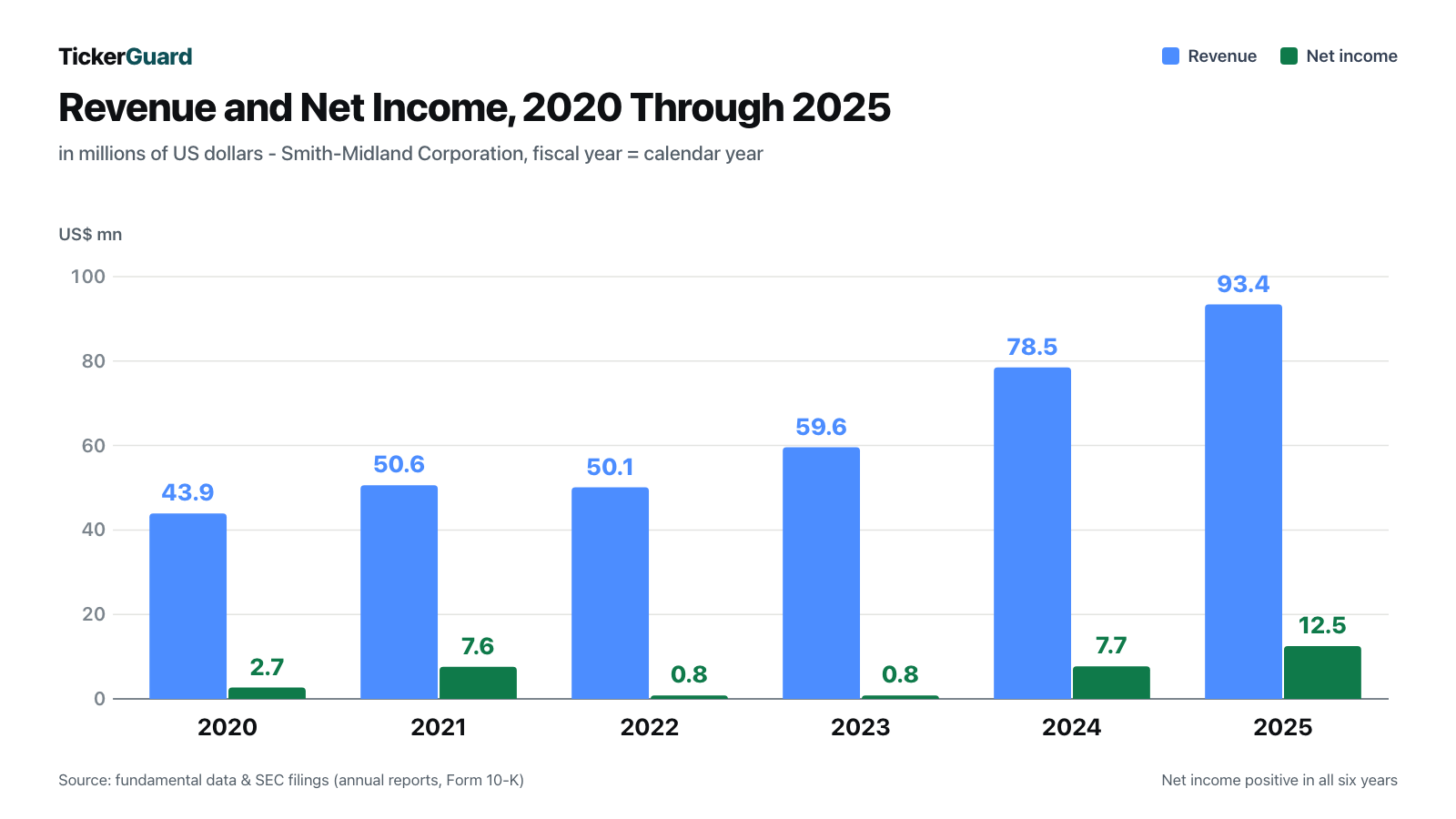
Then comes the second quarter of 2026 — at first glance, a break in that curve. Revenue of $23.4 million versus $26.2 million in the year-ago quarter, down 11%; net income of $1.4 million versus $4.2 million, down 67%. Before you turn that into a trend: the quarterly report explains the decline itself, line by line, and the explanation maps directly onto the four revenue sources described above.
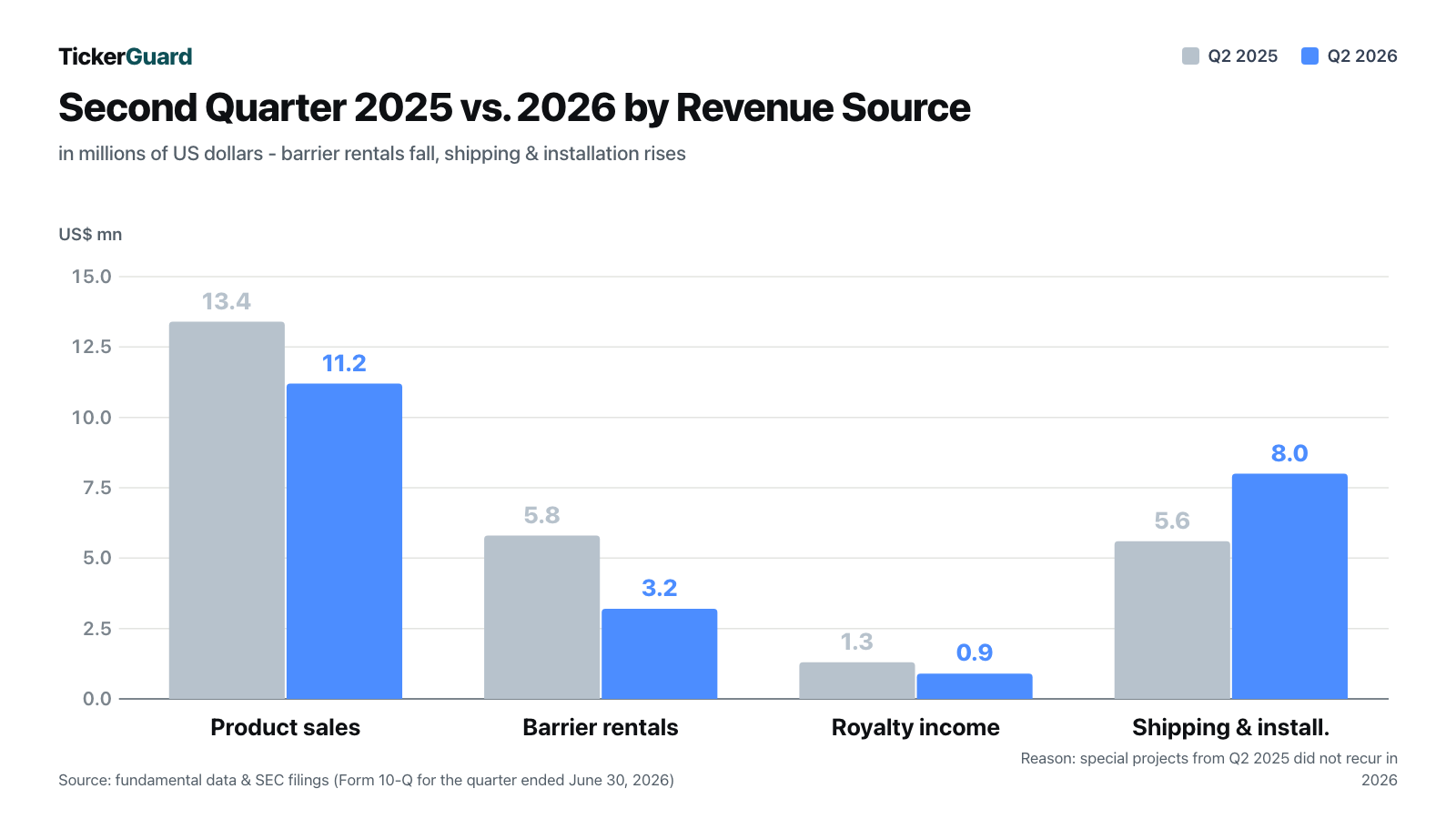
Barrier rentals fall the most (−44%), shipping and installation rises the most (+42%) — that's not a coincidence, but two sides of the same cause. The quarterly report names it directly:
"This decrease is mainly attributed to two special barrier projects, one in each of the first and second quarters of 2025, but no such special barrier projects in the first half of 2026."
— Smith-Midland Corporation, Form 10-Q for the quarter ended June 30, 2026, Item 2 MD&A "Barrier Rentals"
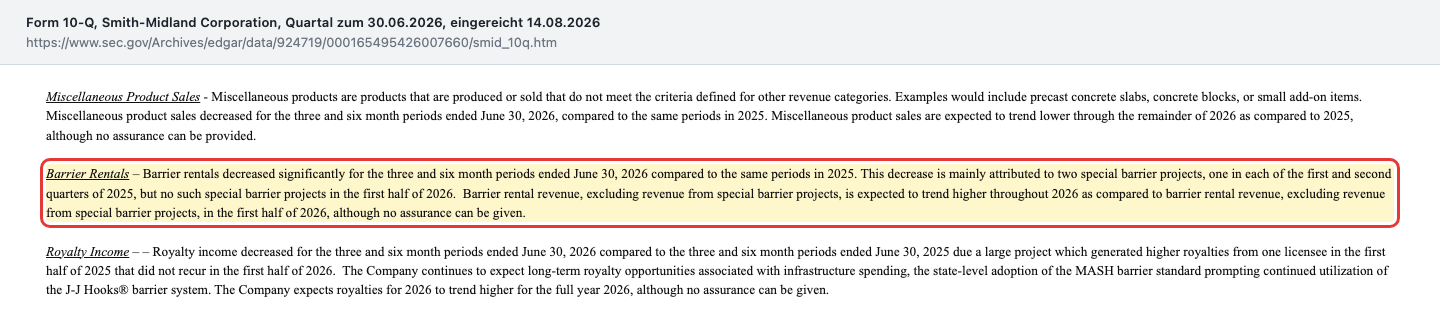
In plain terms: picture a rental company that had two huge special orders last year — those are simply missing from this year's comparison, even though the ongoing business keeps running. What's left once you strip out the special projects? That's exactly why the fourth revenue source, shipping and installation, grew 42% — multi-year large contracts, including a significant data-center project, are entering their delivery phase in 2026. The $57.4 million backlog as of August 1, 2026, up 19% from the prior quarter, backs up this reading: new business is flowing in; the quarterly comparison is misleading because it uses the wrong year as its yardstick.
What Management Promised — and What Came of It
Honesty first: no earnings-call transcripts were available for this analysis. A corresponding lookup through the usual transcript services returned no results on August 28, 2026 — Smith-Midland is evidently too small or too thinly covered for a transcript service to record its analyst calls. We instead base this assessment on what is actually available: the 2025 annual report (filed April 14, 2026) and the most recent quarterly earnings releases — both are literal, legally binding SEC documents, even without an analyst Q&A.
And a pattern emerges here that only becomes visible when you lay several reports side by side: in April 2026, the company explicitly wrote in its 2025 annual report that it expected a decline in special barrier projects for 2026, because 2025 had seen "substantial projects in the first half." Four months later, in the Form 10-Q for the quarter ended June 30, 2026, exactly that happened — barrier rentals down 44% in the second quarter, with the same explanation. That's not a spectacular forecast, but an accurate one: management flagged the decline before it showed up in the numbers, rather than explaining it after the fact. At the same time, the company sticks to its more upbeat claim — that barrier rentals excluding special projects will be higher in 2026 than the prior year, supported by the nationwide rollout of a new barrier standard (MASH TL-3) and funding from the Infrastructure Investment and Jobs Act. Whether that holds true will only be visible in the next report — but the first prediction has already been confirmed.
The August 14, 2026 earnings release quotes CEO Ashley Smith with a sober assessment that fits this pattern:
"Our second quarter results benefited from tailwinds related to the ongoing barrier replacement cycle and continued demand for data centers, although total revenue and net income were lower due to a challenging comparison from last year's large special barrier project."
— Ashley B. Smith, Chairman & CEO, Second-quarter 2026 earnings release (SEC Exhibit 99.1 to Form 8-K, filed 08/14/2026)
No sugarcoating, no hiding behind jargon — the decline is named and explained in the very same paragraph as the good news (backlog). That's exactly the kind of management communication you want when there's no earnings call to press for follow-up: it answers the obvious question before you'd have to ask it.
What the Filings Show — the Uncomfortable Truths
Uncomfortable Truth No. 1: Controls Remain Unremediated for a Second Straight Year — Despite a Clean Audit Opinion
Now to the heart of the jargon fright from the opening. What does "material weakness" actually mean? The annual report defines it itself: a deficiency in internal controls such that there is a reasonable possibility that a material misstatement in the annual or interim financial statements would not be prevented or detected on a timely basis — not a finding that such a misstatement has already occurred. In the annual report for 2025 (filed April 14, 2026), the company states plainly:
"Based on this assessment, our management concluded that our internal control over financial reporting was not effective as of December 31, 2025, due to the material weaknesses in our internal control over financial reporting described below."
— Smith-Midland Corporation, Form 10-K for 2025, Item 9A "Controls and Procedures"

The causes the report itself cites: inadequately designed entity-level controls (control environment, risk assessment), turnover in the CFO role, insufficient qualified accounting personnel, and weaknesses in IT access controls and change management for financial systems. The root cause is traceable to a specific gap: from July 2024 through April 17, 2025, Smith-Midland went nine months without a chief financial officer — precisely the stretch during which, in hindsight, the control deficiencies took shape. And the Form 10-Q for the quarter ended June 30, 2026, makes clear this remains unresolved:
"Management has determined that the following material weaknesses in the Company's internal control over financial reporting have not been remediated as of June 30, 2026."
— Smith-Midland Corporation, Form 10-Q for the quarter ended June 30, 2026, Item 4 "Controls and Procedures"

What jargon fright overlooks belongs in this picture too: auditor BDO USA, P.C. issued an unqualified opinion on the 2024 and 2025 financial statements — confirming the numbers are fairly stated in all material respects under US accounting standards. As a "smaller reporting company," Smith-Midland is also exempt from having an auditor separately attest to the effectiveness of its controls (Sarbanes-Oxley Section 404) — meaning the company self-assesses here, which weakens the finding's rigor but does not mean the numbers are wrong. There was no restatement, no accounting scandal, no fraud allegation. In plain terms: this isn't the message "the books don't add up," it's the message "our checkbook system doesn't yet have a strong enough second layer of review" — worth taking seriously because it has gone unresolved for two straight years, but something different from an already-realized loss.
Uncomfortable Truth No. 2: Three Nasdaq Notices in Thirteen Months — Each One Cured After the Fact
The practical consequence of the thin accounting bench: Smith-Midland filed three required reports late — the first two in a direct domino effect. First, the annual report for 2024 — Nasdaq flagged it on April 17, 2025, and the company eventually filed it on May 27, 2025, along with the first disclosure of material weaknesses. Just two days later, on May 29, 2025, came the second notice: because the annual report ran so late, the close for the first quarter of 2025 slipped too — the required Form 10-Q for the quarter ended March 31, 2025, still hadn't been filed. Smith-Midland explained it this way:
"The delay in filing the 10-Q is related to the Company requiring additional time to complete its financial reporting close process as a result of delays in filing the Company's 10-K."
— Smith-Midland Corporation, Form 8-K filed June 4, 2025, Item 3.01
The Form 10-Q for the quarter ended March 31, 2025, followed on July 10, 2025 — a good six weeks after the notice. Only then did the filing cadence normalize again, until the pattern repeated a third time, this time with the Q1 2026 quarterly report:
"On May 29, 2026, Smith-Midland Corporation (the 'Company') received a notice (the 'Notice') from The Nasdaq Stock Market LLC ('Nasdaq') stating that because the Company had not yet filed its Quarterly Report on Form 10-Q for the quarterly period ended March 31, 2026 (the 'Form 10-Q'), the Company is not in compliance with Nasdaq Listing Rule 5250(c)(1)."
— Smith-Midland Corporation, Form 8-K filed 06/04/2026, Item 3.01

The notice itself states it has "no immediate effect on the listing" and sets a deadline: without a cure by July 28, 2026, Smith-Midland would have had to submit a compliance plan to Nasdaq. That didn't happen: the company filed the overdue quarterly report on June 10, 2026 — eight business days after the notice and more than six weeks ahead of the deadline by which Nasdaq would otherwise have required a compliance plan. The next quarterly report, for the period ended June 30, 2026, then arrived on the regular schedule (August 14, 2026). For you as an investor, that means: a pattern of three missed deadlines in a bit over thirteen months is a real, well-documented risk for future filings — but it is (as of this analysis) not a risk that has ever seriously jeopardized the listing itself, because all three times the company caught up in time.
Valuation
How expensive is Smith-Midland? On a trailing-twelve-month basis, the price-to-earnings ratio sits around 17.5 — for a company that has more than doubled revenue since 2020 and grew double digits in 2024 and 2025, that's not a growth premium, but it's no longer a bargain either, now that the weaker second quarter of 2026 has fed into the trailing twelve-month figure. Price-to-sales is around 1.5, and enterprise value to EBITDA is around 7.6 — ratios that fit a mature industrial company better than the growth story the numbers actually show. The balance sheet supports a calmer read: as of June 30, 2026, $86.7 million in total assets stood against roughly $57.0 million in equity and only $4.1 million in debt — a practically debt-free company with solid reserves. Smith-Midland hasn't paid a dividend since December 2019; freed-up capital instead flows into the company's own rental fleet and expanding the Virginia and North Carolina plants, as CEO Ashley Smith noted in the second-quarter 2026 earnings release. The moderate valuation can be explained by three factors that have nothing to do with operating quality: very thin float and trading volume, the lack of broad analyst coverage — and the material-weakness finding itself, which automatically screens the stock out for many institutional investors with strict governance criteria, regardless of how the operating business is actually performing.
Opportunities and Risks at a Glance
What speaks for Smith-Midland:
- Revenue has more than doubled since 2020 ($43.9 million to $93.4 million in 2025) while staying profitable in all six years; net income rose 63% to $12.5 million in 2025.
- Four distinct, complementary revenue streams (product sales, barrier rentals, royalties, shipping & installation) with tailwinds from the nationwide MASH TL-3 barrier standard and the Infrastructure Investment and Jobs Act.
- Backlog of $57.4 million as of August 1, 2026 (+19% quarter over quarter, +6% year over year), supported by concrete new contracts such as the $10 million I-81 project for Virginia.
- Practically debt-free balance sheet ($4.1 million in debt against $57.0 million in equity, as of 06/30/2026) and an unqualified audit opinion from BDO USA despite the material weaknesses.
- Moderate valuation relative to growth (P/E around 17.5, P/S around 1.5) — partly because so few analysts follow the stock.
What argues against it:
- Material weaknesses in financial reporting have, per the Form 10-Q for the quarter ended 06/30/2026, remained unremediated since the 2024 annual report — a finding across three consecutive filings now.
- Three Nasdaq deficiency notices for late required filings within thirteen months (April 2025, May 2025, May 2026); all cured after the fact so far, but a recurring pattern.
- Very thin float (roughly 2.7 million freely tradable shares) and low trading volume — a single large seller can move the price sharply.
- A single investment adviser (Thompson Davis & Co.) holds roughly a third of the shares in a fiduciary capacity for its clients — more in the side-find accompanying this analysis.
- Barrier rentals are inherently lumpy: individual large projects can dominate a single quarter and distort the year-over-year comparison, as seen in Q2 2026.
- No earnings-call transcripts available and little professional analyst coverage — anyone investing here has to read the SEC filings themselves, with little second opinion available.
A Human Conclusion
Back to the jargon fright from the opening. Its core isn't that the warning is invented — the material weaknesses at Smith-Midland are real, documented for two years running, and (as of June 30, 2026) unremediated. Ignoring that would be a mistake. But its core is equally that a technical term alone isn't an instruction to act. "Material weakness" means: there is a possibility of an error the current controls don't reliably prevent. It does not mean: an error has already happened, the numbers are wrong, or the company is in trouble. The auditor signed off, there was no restatement of published figures, and the operating business — revenue, backlog, balance sheet — is moving in the direction you'd expect from a growing, profitable industrial company. Investing in Smith-Midland, then, means buying neither "a company with accounting problems" nor "a worry-free growth story," but both at once: real operating growth and a real, still-open question about reporting quality. The honest question for you, then, isn't "does that sound scary?" but: Do you trust this management to actually close the controls gap it has documented for two years — and is the risk of a fourth late filing worth the discount the stock trades at because of it? If yes, that's an informed position. If no, that's an equally informed decision. What you do with it is yours to decide — and that's exactly as it should be.
Sources
All original documents used in this analysis — for your own reading:
- Smith-Midland Corporation — Form 10-K for 2025 (filed April 14, 2026)
- Smith-Midland Corporation — Form 10-Q for the quarter ended June 30, 2026 (filed August 14, 2026)
- Smith-Midland Corporation — Form 8-K filed June 4, 2026 (Nasdaq deficiency notice, Item 3.01)
- Smith-Midland Corporation — Form 8-K filed June 4, 2025 (Nasdaq deficiency notice on the Q1 2025 quarterly report, Item 3.01)
- Smith-Midland Corporation — Form 8-K filed April 23, 2025 (Nasdaq notice on the 2024 annual report + CFO appointment, Item 3.01/5.02)
- Smith-Midland Corporation — Second-quarter 2026 earnings release (SEC Exhibit 99.1, August 14, 2026)
- Thompson Davis & Co., Inc. — Schedule 13D/A filed December 10, 2024 (SEC EDGAR)
- Full SEC filing history for Smith-Midland Corporation: EDGAR overview (sec.gov)
- Fundamental data (ratios, price anchor, ownership list, multi-year series; data as of August 26–28, 2026), reconciled against the SEC filings.
- For a similar governance finding at a small infrastructure name, see also our analysis of Cardinal Infrastructure.
Transparency & disclaimer: This analysis is a journalistic assessment of publicly available information and does not constitute investment advice, a regulated financial analysis, or a solicitation to buy or sell securities. Equity investments carry substantial risk, including total loss — a thinly traded stock like this one carries additional liquidity risk. All information is provided without guarantee; the as-of date for each figure is noted in the text. We disclose the operator's own positions as of the publication date; if one exists, it appears as a note at the top of this analysis.
Key figures at a glance
All monetary figures in millions of $; earnings per share as reported.
| Metric | 2021 | 2022 | 2023 | 2024 | 2025 |
|---|---|---|---|---|---|
| Revenue | 50.6 | 50.1 | 59.6 | 78.5 | 93.4 |
| Operating Income (EBIT) | 6.2 | 0.9 | 1.1 | 9.9 | 17.0 |
| Net Income | 7.6 | 0.8 | 0.8 | 7.7 | 12.5 |
| Net Margin | 14.9% | 1.6% | 1.3% | 9.8% | 13.4% |
| Earnings Per Share | 1.45 $ | 0.15 $ | 0.15 $ | 1.45 $ | 2.36 $ |
Source: fundamental data & SEC filings (annual and quarterly reports, 10-K/10-Q)
Our Bottom Line at a Glance
- Operating growth positive
- Revenue more than doubled from $43.9 million (2020) to $93.4 million (2025), profitable in all six years; net income rose 63% to $12.5 million in 2025. Backlog stood at $57.4 million as of 08/01/2026, up 19% quarter over quarter.
- Internal controls & reporting quality negative
- Material weaknesses disclosed since the 2024 annual report and, per the Form 10-Q for the quarter ended 06/30/2026, still unremediated — a finding across three consecutive filings; root cause includes a nine-month CFO vacancy (07/2024–04/2025).
- Filing timeliness negative
- Three Nasdaq deficiency notices for late required filings within thirteen months (2024 annual report, Q1 2025 quarterly report, Q1 2026 quarterly report); each cured ahead of the set deadline, but a recurring pattern.
- Balance sheet & audit opinion positive
- Practically debt-free ($4.1 million in debt against $57.0 million in equity, as of 06/30/2026); auditor BDO USA issued unqualified opinions on the 2024 and 2025 financial statements, no restatement of published figures.
- Tradability & transparency negative
- Very thin float (roughly 2.7 million shares), low trading volume, a single investment adviser holds roughly a third of shares in a fiduciary capacity; little analyst coverage, no earnings-call transcripts available.
Smith-Midland shows two things that are both true at once: a growing, consistently profitable precast-concrete business (revenue more than doubled since 2020, backlog up 19% quarter over quarter) and an internal-controls weakness that has gone unremediated for two years, already triggering three late filings and Nasdaq deficiency notices. Both facts sit in the very same annual report. Not investment advice.
What Our Rating Means
Open questions
The business works in principle, but one material question is open. As long as it stays open, our findings do not carry a quality verdict.
The operating business is solid and growing, the balance sheet is practically debt-free, and the auditor issued an unqualified opinion — there is no sign an actual misstatement has occurred. What remains open is a genuine operating question: whether management will actually close the material weaknesses it has documented for two years before a fourth late filing triggers a more serious Nasdaq response. Anyone watching should check every future report for three things: has the phrase "not remediated" finally disappeared, are filings arriving on time, and does backlog hold at its current level? The decision is yours.
A journalistic assessment by our editorial team at the time of the deep dive, based on public sources — not investment advice and not a solicitation to buy or sell. Your personal circumstances (investment goals, risk capacity, taxes) cannot be taken into account. What our levels mean, how verdicts are formed, and what conflicts of interest exist →
Worth Noting
- This analysis was triggered by the Form 10-Q for the quarter ended 06/30/2026 (filed 08/14/2026): a record year 2025 alongside still-unremediated material weaknesses — a contrast that only becomes visible by reading the full report, not the headline.
- No earnings-call transcripts were available for this analysis (lookup on 08/28/2026 returned no results); the assessment of management's statements relies on the 2025 annual report and the most recent quarterly earnings releases.
- Valuation figures are dated and evergreen: price $25.60 and ratios as of August 26–28, 2026; analyses are evergreen, daily prices are not a buy argument. The stock is thinly traded — small order sizes can move the price disproportionately.
Stock Watch
This analysis is as of August 28, 2026. Stock Watch will tell you what's changed at SMID since then.
Later $1 a month per stock — signing up is free, and you'll be the first to know when it launches.
The full analysis as a PDF for later
We will send you this analysis as a PDF — to print, file away, and read at your own pace. And we will add you to the free Stock Watch list for Smith-Midland Corp (SMID), so you hear about it when something material in this analysis changes.
Frequently Asked Questions
Smith-Midland Corporation (Nasdaq: SMID) of Midland, Virginia, develops, manufactures, rents, licenses, and sells precast concrete products: highway barriers (J-J Hooks Barrier), sound walls (Sierra Wall, SoftSound), lightweight facade panels (SlenderWall), and transportable concrete buildings (Easi-Set/Easi-Span). The company operates three plants in Virginia, North Carolina, and South Carolina and earns revenue from four distinct sources: product sales, barrier rentals, royalty income, and shipping & installation.
The 2025 annual report and the Form 10-Q for the quarter ended June 30, 2026, both state that internal control over financial reporting is not effective — meaning there is a possibility that a material misstatement would not be prevented or detected in time. It is not a finding that an error already exists in the published numbers: auditor BDO USA issued an unqualified opinion on the 2024 and 2025 financial statements, and there was no restatement of previously reported figures.
Each was about late required filings, not financial trouble: in April 2025, Nasdaq flagged the late 2024 annual report (filed May 27, 2025); just two days later, on May 29, 2025, it flagged the late Q1 2025 quarterly report (filed July 10, 2025) — a direct consequence of the annual-report delay; in May 2026, it flagged the late Q1 2026 quarterly report (filed June 10, 2026, more than six weeks ahead of the set deadline). All three instances were cured without ever putting the Nasdaq listing at risk.
The decline (−11% to $23.4 million) was, per the quarterly report, mostly driven by barrier rentals, which had benefited in the year-ago quarter from two special projects that did not recur in 2026. The core business kept running — shipping and installation, for instance, grew 42% — and backlog rose 19% quarter over quarter to $57.4 million as of August 1, 2026.
No. The company last paid a dividend in December 2019. Since then, per management's statements, freed-up capital has gone toward expanding its own barrier rental fleet and expanding production capacity in Virginia and North Carolina.
The largest single shareholder is investment adviser Thompson Davis & Co., Inc. of Richmond, Virginia, with roughly 34.7% of shares as of March 31, 2026 — held in a fiduciary capacity for its advisory clients. Management and insiders together hold roughly 13.9%. The freely tradable float is correspondingly thin, at roughly 2.7 million shares.
No. A lookup through the usual transcript services returned no results on August 28, 2026 — Smith-Midland is too small or too thinly covered for systematic recording of its analyst calls. The assessment of management's statements instead relies on the 2025 annual report and the most recent quarterly earnings releases, which are also legally binding SEC documents.
Found an error?
Did you spot a factual error, an outdated number, or a typo in this deep dive? Let us know briefly — your report goes straight to the editorial team.