Cardinal Infrastructure: $60 to $38 in Two Days — What Sank the Rocket
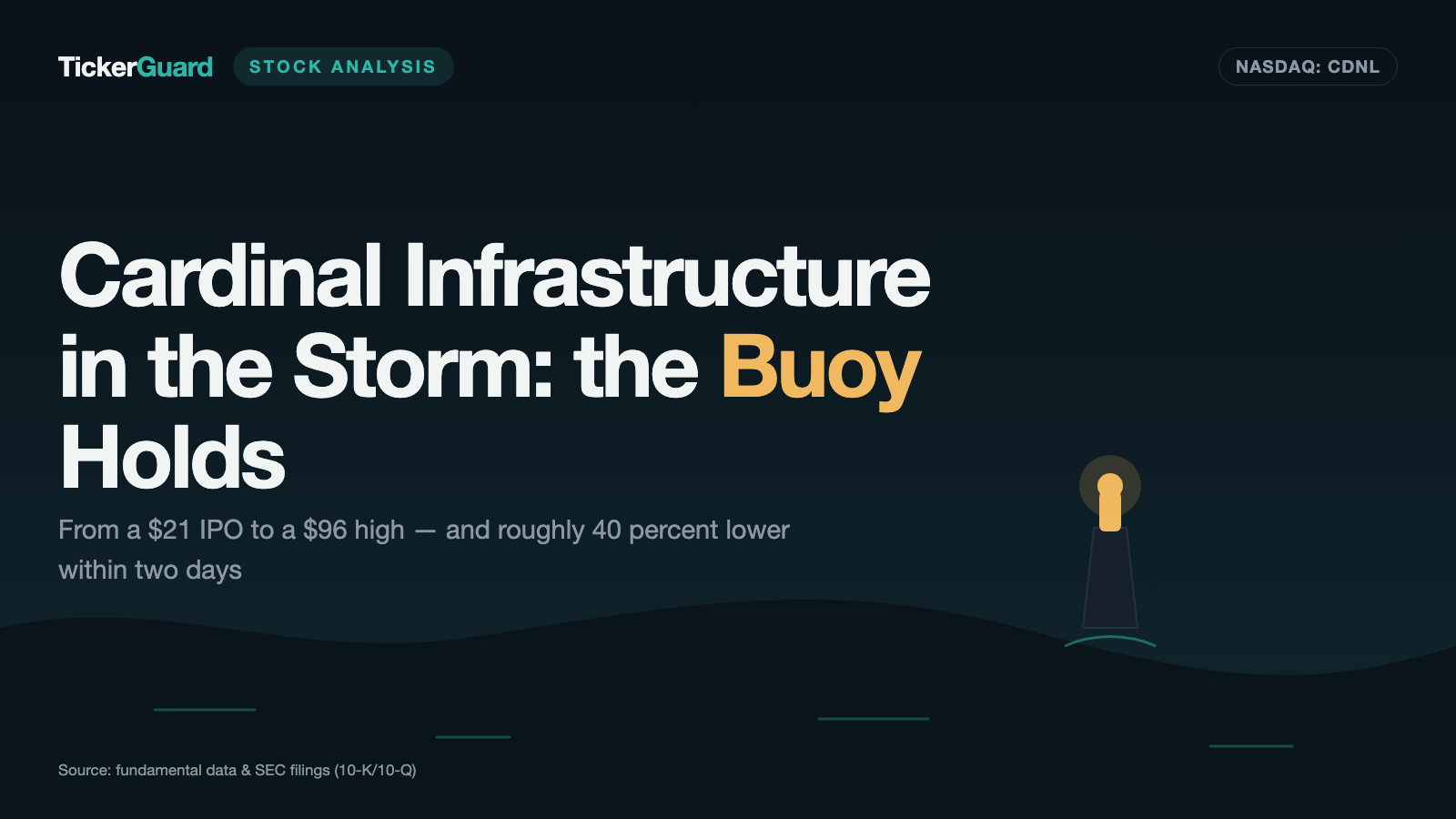
There is an investor weakness that feels like an instinct: FOMO — the fear of missing out. A stock keeps climbing, and at some point you stop asking whether the company deserves it and start asking only how you can still get in. Cardinal Infrastructure Group (Nasdaq: CDNL) showed that movie in record time: an IPO on December 11, 2025 at $21.00, a 52-week high of $96.40 seven months later, then on August 11, 2026 — the day of its second-quarter earnings — a crash from $60.00 to $38.27 in two trading days, and to $35.97 the day after. Revenue grew 113.9 percent year-over-year in the second quarter of 2026 to $226.9 million, yet gross profit margin fell from 13.9 percent to 10.8 percent over the same period — and in the very same release the company cut its own 2026 adjusted EBITDA margin guidance from "20 percent plus" to 16 to 18 percent. Read the filings and you also find a corporate structure in which 85 percent of all tax benefits flow to the pre-IPO owners, who still held roughly 57 percent of the vote at the end of June 2026. Let's make a deal: we'll read the fiscal 2025 annual report (10-K) and the quarterly report (10-Q) for the period ended June 30, 2026 together — and look at what the price chart alone doesn't show. Not investment advice, just a look under the rocket's hood.
 Thomas Mücke
Founder & Publisher
Thomas Mücke
Founder & Publisher
As of Today
As of: October 2, 2026
- Closing price
- 30.70 $ +3.30%
- Market Capitalisation
- 0.6 $B
- P/E
- 35.7
- Growth Score
- 4/10
- AAQS
- 5/10
Price change since August 19, 2026: -29.1%
This analysis has a cut-off date. The Stock Guard tells you when something material changes in the numbers. Reserve your free spot
Chart
Interactive price chart (TradingView).
52-week range: 22.00 $ to 94.30 $ · Last price: 30.70 $ (As of: October 2, 2026)
Note: pure fact-based analysis, not investment advice and not a solicitation to buy or sell. All figures without guarantee.
There is an investor weakness that feels like an instinct: FOMO — the fear of missing out. A stock keeps climbing, the headlines get louder, and at some point you stop asking whether the company has earned that growth and start asking only how you can still get in. Cardinal Infrastructure Group Inc. (Nasdaq: CDNL) played that movie in record time: an IPO on December 11, 2025 at $21.00 per share, a 52-week high of $96.40 within seven months — nearly five times the offer price — and then, on August 11, 2026, the day of its second-quarter earnings, a drop from $60.00 to $38.27 within two trading days. Anyone who bought on the way up knows the feeling: riding a rocket without quite knowing what's fueling it. Let's make a deal: we'll read the fiscal 2025 annual report (10-K) and the quarterly report (10-Q) for the period ended June 30, 2026 together — filings that, by law, must be honest — and see what the price chart alone doesn't show. By the end, the decision is yours.
What Cardinal Infrastructure Actually Does
Before a single-family home, a warehouse complex or a school can go up, someone has to prepare the ground: install water and sewer lines, run stormwater drains, grade the site, clear trees and brush, blast rock if needed, and finally pave the access roads. That's exactly what Cardinal Infrastructure Group does: a civil-construction company that lays the invisible groundwork before vertical construction even begins. The company provides "wet utility installations" (water, sewer and stormwater systems), plus grading, land clearing, erosion control, drilling and blasting, and paving — for homebuilders, commercial and industrial customers, and municipal and state agencies across the southeastern United States, concentrated in North Carolina, Georgia and South Carolina.
The business was founded in 2013 in Raleigh, North Carolina, by Jeremy Spivey, the company's current CEO and Chairman, as "Cardinal NC" — a niche water-utility installer. From there it grew into a regional market leader, both organically and through acquisitions. Until September 2025, the company was named Civil Infrastructure Group Inc., before rebranding to Cardinal Infrastructure Group Inc. ahead of its IPO — the same company, the same SEC filer number (CIK 0002079999), just a new name for the public markets. As of December 31, 2025, the company employed roughly 1,480 people, including 42 project managers and 57 superintendents overseeing 208 field crews.
Company history for investors
-
2013
Founded as Cardinal NC
Jeremy Spivey founds a niche water and sewer installation business in Raleigh — the starting point of today's company.
-
2025
IPO at $21.00
Cardinal Infrastructure Group goes public on Nasdaq on December 11, 2025. Proceeds are used partly to repay credit-facility debt and to buy out LLC interests from the founding owners.
-
2026
Acquisition of A.L. Grading Contractors
On February 18, 2026, Cardinal acquires site-development specialist ALGC — including its own $12.3 million tax receivable agreement for the sellers.
-
2026
Follow-on offering at $73.00
On June 24, 2026, Cardinal sells another 4.6 million Class A shares, raising roughly $318.4 million — more than triple the IPO price.
-
2026
Earnings release and stock crash
On August 11, 2026, Cardinal reports 113.9 percent revenue growth alongside a declining gross margin — the stock drops from $60.00 to $35.97 within two trading days.
How the Stock Landed on Our Desk
This time the trigger wasn't a hit in our in-house stock scanner — it was the price action itself, and it has been unusually dramatic for a construction company. Per the annual report, the Class A stock has been listed on Nasdaq since December 10, 2025; it closed that first trading day at $23.50, and at $25.31 the next day — December 11, 2025, when the $21.00 IPO closed. From there it climbed almost without interruption: $40.91 by early April 2026, $54.24 by early June, a jump to $81.94 on the day of the follow-on offering (June 24, 2026, more on that below), and a 52-week high of $96.40 on July 1, 2026 — nearly five times the IPO price in seven months. For anyone watching, that was a textbook FOMO setup: a small, little-known construction company behaving like a growth rocket.
Then came August 11, 2026. That day, Cardinal released its second-quarter 2026 results via a required filing (Form 8-K, Item 2.02) — and the stock, which had closed the previous day at $60.00, dropped to $38.27, then fell further to $35.97 the next day when the quarterly report (10-Q) was filed. A roughly 40 percent decline in two trading days, even though revenue had grown 113.9 percent year-over-year. That contradiction — strong growth, but a stock crash — is exactly why a closer look matters: growth numbers alone don't tell the whole story. By August 19, 2026, the stock had recovered somewhat to $43.33.
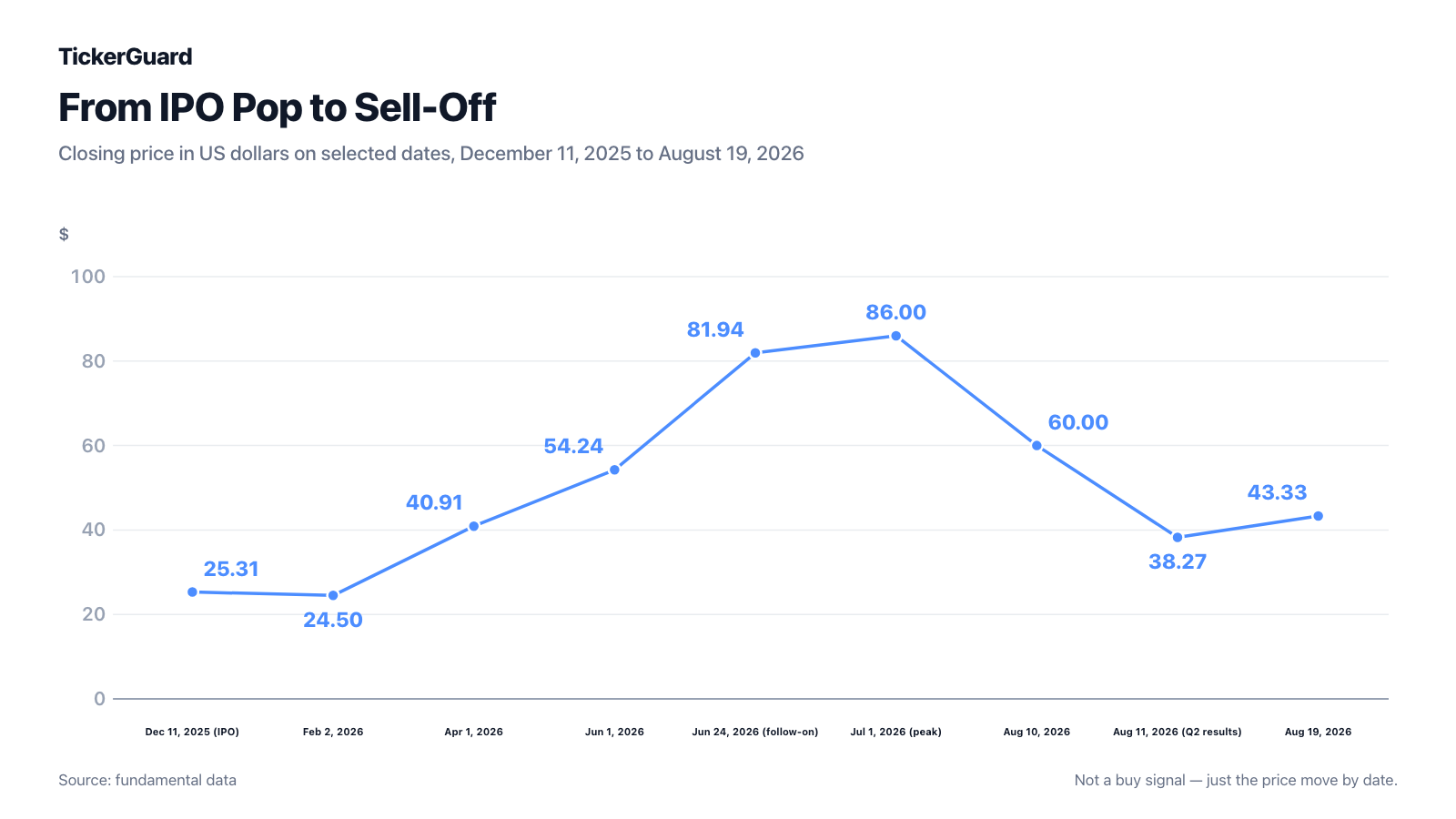
One detail for context: on June 24, 2026, Cardinal sold 4.6 million new Class A shares at $73.00, raising roughly $318.4 million net — more than triple the IPO price, seven months after going public. $33 million of that went toward repaying credit-facility debt, with the remainder earmarked for further acquisitions. Reading that timeline, one thing stands out: management itself used the elevated share price to raise fresh capital — a pattern worth keeping in mind with any stock that has run up sharply.
The Numbers Over the Years — Fairly Assessed
First, what genuinely speaks in Cardinal Infrastructure's favor. Revenue grew to $456.0 million in fiscal 2025, up 44.7 percent from $315.2 million in 2024. Net income rose from $28.3 million to $31.1 million. And the backlog — signed but not-yet-completed contracts — stood at a hefty $682.0 million as of December 31, 2025 and grew further to $866.0 million by June 30, 2026 (June 30, 2025: $643.0 million), of which $701.0 million sits in signed contracts and $165.0 million in letters of intent and issued contracts. That's a cushion many smaller construction companies don't have, and it provides visibility into coming quarters.
Growth accelerated further in the first half of 2026: $394.4 million in revenue (up 109.9 percent from $187.9 million in the first half of 2025), including $226.9 million in the second quarter alone (up 113.9 percent from $106.1 million a year earlier). A large share of that jump, however, is not organic — it comes from acquisitions. Since January 2025, Cardinal has acquired five companies: Purcell Construction (January 3, 2025), Page & Associates (May 30, 2025), Red Clay Industries (October 1, 2025), A.L. Grading Contractors (February 18, 2026) and Piedmont Pipe Construction (May 29, 2026) — and on August 11, 2026 it agreed to a sixth, Allied Paving Contractors of Atlanta. The company itself puts organic growth in the second quarter at 64 percent; acquisitions supplied the rest. The balance sheet reflects that: total assets grew from $394.6 million as of December 31, 2025 to $1,014.5 million as of June 30, 2026 — mostly goodwill ($133.2 million) and intangible assets ($101.9 million) from those deals.
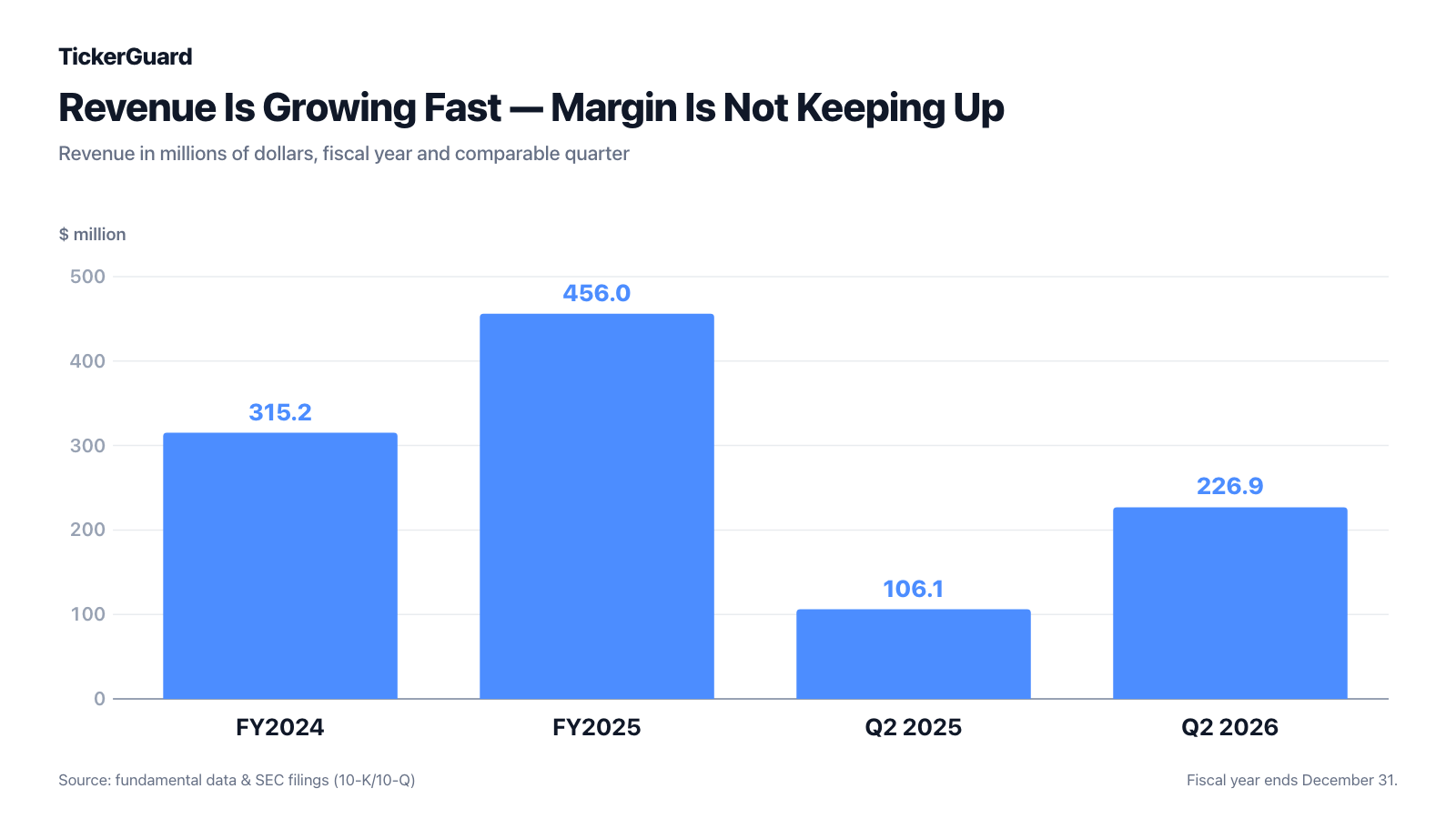
This is exactly where the story the price chart told on August 11, 2026 begins — because there's a gap between these impressive growth numbers and gross margin that we now need to look at more closely.
What the Filings Say — the Uncomfortable Truths
Uncomfortable Truth No. 1: Margin Is Falling as Revenue Explodes
The quarterly report (10-Q) for the period ended June 30, 2026 names the reason for the August 11, 2026 stock crash plainly:
"Gross Profit Margin declined to 10.8% for the three months ended June 30, 2026, as compared to 13.9% for the three months ended June 30, 2025."
— Cardinal Infrastructure Group Inc., Form 10-Q for the period ended June 30, 2026, "Gross Profit and Gross Profit Margin"

The filing also names the drivers: higher subcontracted labor and equipment rental costs, higher amortization of intangible assets from the 2025 and 2026 acquisitions, and a shift in customer mix toward larger commercial and industrial projects, which carry different startup economics than the company's historically homebuilding-heavy core business. In plain terms: imagine a contractor who suddenly takes on twice as many jobs as last year — but has to hire more subcontractors and rent more equipment because the in-house crew can't scale that fast. Revenue explodes, but less of each dollar sticks. That's not necessarily a red flag on its own — growing pains during a string of acquisitions are common.
Gross margin was only half the news that day. In the same required filing (Form 8-K, Exhibit 99.1) dated August 11, 2026, Cardinal raised its 2026 revenue guidance sharply — from $675 million to $685 million up to $880 million to $900 million — and in the same breath cut its adjusted EBITDA margin guidance from "20 percent plus" to 16 percent to 18 percent. Put the two side by side and the real signal appears: more revenue, but meaningfully less profit per revenue dollar than the company itself had promised only three months earlier. The reported numbers already showed it — adjusted EBITDA margin came in at 12.4 percent in the second quarter of 2026, down from 18.6 percent a year earlier. The chief executive said so plainly in the same release:
"Keeping pace with this level of customer demand, and investing to capture the opportunity it represents, cost more than we expected this quarter, resulting in margins below plan."
— Jeremy Spivey, Chairman & CEO, Cardinal Infrastructure Group Inc., Form 8-K filed August 11, 2026, Exhibit 99.1
That is why the market sold rather than celebrated on August 11, 2026: a raised revenue outlook is worth little when the company says in the same sentence that less of each additional dollar will stick. The same release also carried the next deal — Allied Paving Contractors of Atlanta, roughly $120 million in purchase price ($62.5 million cash, $57.5 million in Class A stock) for a business with about $108 million in annual revenue, expected to close in October 2026. The roll-up pace stays high — and with it the question of whether integration can keep up.
Uncomfortable Truth No. 2: 85 Percent of Tax Benefits Go to the Pre-IPO Owners
Cardinal Infrastructure Group is not an ordinary corporation — it's structured as an Up-C: the publicly traded Cardinal Infrastructure Group Inc. holds only a stake in the actual operating business (Cardinal Civil Contracting Holdings LLC), with the rest still owned by the pre-IPO owners, the "Continuing Equity Holders." That structure comes with a contractual side agreement described in the annual report as follows:
"Pursuant to the Tax Receivable Agreement, the Company is required to pay the Continuing Equity Holders 85% of certain of the Company’s realized tax savings as a result of certain tax benefits related to the IPO and Reorganization transactions. The Company expects to benefit from the remaining 15% of any tax benefits that it may actually realize."
— Cardinal Infrastructure Group Inc., Form 10-K for fiscal year 2025, Tax Receivable Agreement discussion

As of June 30, 2026, the balance sheet already carried a $47.2 million liability for this agreement (December 31, 2025: $39.4 million) — cash that is contractually owed to the pre-IPO owners once the underlying tax benefits are realized. This structure isn't unusual for U.S. IPOs and is fully disclosed — comparable, for example, to the structure at Flowco Holdings, another Up-C IPO we've analyzed. But for you as a new Class A shareholder, it means a meaningful share of the tax advantage the company itself gains from going public doesn't benefit you — it benefits the sellers from before the IPO.
Uncomfortable Truth No. 3: The Same Pre-IPO Owners Still Hold the Voting Majority
Whoever collects 85 percent of the tax benefits also runs the show at Cardinal Infrastructure. The fiscal 2025 annual report states it plainly:
"The Continuing Equity Holders control, in the aggregate, approximately 61.0% of the voting power represented by all our outstanding shares of capital stock as of December 31, 2025."
— Cardinal Infrastructure Group Inc., Form 10-K for fiscal year 2025, Risk Factors, "Risks Related to the Ownership of our Class A Common Stock"

Per the filing, that control extends to electing and removing directors, amending the charter, and approving major corporate transactions. As a Class A shareholder, that means: you're a co-owner, but you don't have a say in the big decisions. One detail slightly softens that picture: through the June 2026 follow-on offering of 4.6 million new Class A shares and the conversion of 339,426 Class B shares into Class A stock, Cardinal's own ownership share in the operating business rose from 39.00 percent (December 31, 2025) to 42.63 percent as of June 30, 2026 — the Continuing Equity Holders' share fell correspondingly from 61.00 to 57.37 percent. Because each of those units carries exactly one Class B share with one vote, the voting majority shrinks in step. After a further 190,000 units were exchanged post quarter-end, Cardinal held 43.03 percent as of the filing date. So control is gradually diluting — but on the latest documented figures it is still a majority.
Uncomfortable Truth No. 4: Two-Thirds of Revenue Rides on Homebuilding — and Nearly 10 Percent on One Customer
The last piece isn't about the corporate structure — it's about the operating business itself. The annual report breaks down where 2025 revenue came from:
"For the year ended December 31, 2025, our largest revenue customer was Pulte Homes, which represented approximately 9.9% of our revenue and our top five customers represented approximately 30.7% of our revenue and our top 10 customers represented approximately 45.5% of our revenue."
— Cardinal Infrastructure Group Inc., Form 10-K for fiscal year 2025, Business

That lines up with the revenue mix by customer segment: 66 percent of 2025 revenue came from residential builders, 23 percent from commercial/industrial/retail customers, just 5 percent from municipal and state agencies, and 6 percent from materials and paving. In plain terms: Cardinal Infrastructure looks like a supplier two-thirds dependent on a single industry cycle — homebuilding, which itself is highly sensitive to interest rates and mortgage costs. If rates rise and builders like Pulte Homes slow new construction, Cardinal feels it disproportionately. The mix shift toward larger commercial projects that the quarterly report cites as a margin driver (Uncomfortable Truth No. 1) is, from this angle, also a diversification strategy — it costs margin in the short run but reduces homebuilding-cycle exposure over time.
Uncomfortable Truth No. 5: The Company's Own Controls Are "Not Effective"
The last finding sits in the driest chapter of the quarterly report, the section on internal controls — and it bears directly on the margin question:
"Based on this evaluation of our disclosure controls and procedures as of June 30, 2026, our Chief Executive Officer and Chief Financial Officer concluded that our disclosure controls and procedures were not effective due to the material weaknesses in internal control over financial reporting. The material weaknesses identified in our internal controls over financial reporting are related to information technology general controls, segregation of duties and ineffective controls over the review of estimates to complete for construction contracts."
— Cardinal Infrastructure Group Inc., Form 10-Q for the period ended June 30, 2026, Item 4, "Controls and Procedures"
Why this is more than paperwork: a construction company recognizes revenue by percentage of completion. It continuously estimates what a project will still cost, and derives from that how much profit it may book today. The review of exactly those estimates is what the filing calls ineffective — at a company whose stock just lost 40 percent over a margin question. In fairness, the same paragraph states that despite these weaknesses the financial statements present fairly, in all material respects, the company's financial position — and material weaknesses are closer to the rule than the exception at newly public companies. But they are the reason to read this company's margin figures with more caution than those of a firm listed for decades, and to check the next annual report (10-K) for whether the weaknesses are reported as remediated.
Valuation: What the Market Still Pays After the Crash
At a closing price of $43.33 on August 19, 2026, the market capitalization stood at roughly $885 million (20,428,610 Class A shares). Against trailing-twelve-month revenue of $662.6 million (calculated as fiscal 2025 revenue minus first-half 2025 revenue plus first-half 2026 revenue), that works out to a price-to-sales ratio of roughly 1.3. Read that number with care, because with an Up-C structure it is the crux: it sets only the 20.4 million publicly traded Class A shares against the entire consolidated revenue. Count the 27.0 million LLC units held by the pre-IPO owners, exchangeable one-for-one into Class A stock, and you get 47.5 million units and a full economic equity value of about $2.06 billion — a price-to-sales ratio of roughly 3.1. Anyone who sees only the 1.3 understates the valuation by more than half. For comparison: at the 52-week high of $96.40, the same math would have produced a multiple of that — the sell-off has meaningfully reset the valuation without making it "cheap." A conventional price-to-earnings ratio is only loosely useful here given the company's aggressive acquisition pace and shifting share count (ongoing Class B-to-Class A conversions, recent capital raises) — we deliberately skip a headline multiple that would imply false precision. What's clear: the stock still trades at roughly double the $21.00 IPO price as of August 19, 2026 — not a bargain, but not a fire-sale price either, sitting somewhere between a growth premium and margin skepticism.
Opportunities and Risks at a Glance
What speaks for Cardinal Infrastructure:
- Genuine double- to triple-digit revenue growth: +44.7 percent in fiscal 2025, +113.9 percent year-over-year in the second quarter of 2026 — both organically and through five acquisitions since January 2025.
- A backlog of $866.0 million as of June 30, 2026, up from $682.0 million at December 31, 2025 — including $701.0 million in signed contracts, providing visibility into coming quarters.
- A solid balance sheet with no going-concern disclosures: $593.5 million in stockholders' equity as of June 30, 2026, covenants in compliance, an effective interest rate of 6.25 percent on the credit facility.
- Diversification away from pure homebuilding toward larger commercial and industrial projects — reduces cyclicality over time, even if it costs margin in the near term.
- The stock still trades at roughly double the IPO price ($21.00) even after the crash — early investors remain in the black despite the sell-off.
What speaks against it:
- Falling gross margin despite the revenue surge: 13.9 to 10.8 percent quarter-over-quarter (Q2 2025/2026), and adjusted EBITDA margin down from 18.6 to 12.4 percent — plus the company's own margin guidance cut from "20 percent plus" to 16 to 18 percent, the trigger for the August 11, 2026 stock crash.
- Up-C structure with a Tax Receivable Agreement: 85 percent of all realized tax benefits flow to the Continuing Equity Holders, who held roughly 61.0 percent of the vote as of 12/31/2025 and roughly 57.4 percent as of 6/30/2026 — and every acquisition adds its own such agreement (most recently $12.3 million for ALGC).
- High customer concentration: 66 percent of revenue from residential builders, largest single customer Pulte Homes at 9.9 percent, top 10 customers at 45.5 percent — heavily exposed to the interest-rate cycle and a handful of large customers.
- Debt-funded acquisition growth: borrowings rose from $120.0 million to $195.0 million within six months (12/31/2025 to 6/30/2026), with further acquisitions the stated strategy.
- Disclosure controls judged "not effective" as of June 30, 2026, with material weaknesses in IT general controls, segregation of duties and the review of estimates to complete for construction contracts.
- A short trading history (public only since December 2025) and extreme volatility — a 52-week high of $96.40 followed by a roughly 40 percent two-day drop shows how fast sentiment can turn.
The Decision Is Yours
Back to the FOMO trap from the beginning. Its core isn't that the rocket lacks real fuel — Cardinal Infrastructure does have a growing, profitable core business with a healthy order book. Its core is that a steeply rising stock chart makes it feel like the homework is already done, because everyone else is apparently already in. Anyone who bought at $80 or $90 over the summer of 2026 actually bought three very specific things: a construction company whose margin came under pressure from its own growth strategy; a corporate structure in which 85 percent of tax benefits flow to pre-IPO owners who also hold voting control; and a two-thirds exposure to the homebuilding cycle. That can still be a reasonable bet for you — if you keep an eye on the pace of the roll-up, the margin trend and the governance structure, and you're prepared to live with the volatility this stock has already shown in the first eight months of its public life. The honest question, then, isn't "Am I missing the next rocket?" but rather: would you buy at $43.33 today if the stock had been trading flat for months instead of riding a roller coaster? If yes, you have a thesis. If no, you had FOMO. What you do with that is your call. Not investment advice.
Sources
All original documents used in this analysis — for further reading:
- Cardinal Infrastructure Group Inc. — Form 10-K for fiscal year 2025 (filed March 23, 2026)
- Cardinal Infrastructure Group Inc. — Form 10-Q for the period ended June 30, 2026 (filed August 12, 2026)
- Cardinal Infrastructure Group Inc. — Form 8-K filed August 11, 2026 (Item 2.02, Q2 results, including Exhibit 99.1)
- Cardinal Infrastructure Group Inc. — Form 8-K filed May 12, 2026 (Item 2.02, Exhibit 99.1: guidance of $675 million to $685 million in revenue and "20%+" adjusted EBITDA margin)
- Full SEC filing history for Cardinal Infrastructure Group Inc.: EDGAR overview (sec.gov)
- Fundamental data (price, market cap, valuation; as of August 19, 2026), cross-checked against the SEC filings.
Transparency & Disclaimer: This analysis is journalistic commentary on publicly available information and is not investment advice, not a regulated financial analysis, and not a solicitation to buy or sell securities. Investing in stocks carries substantial risk, including total loss. All figures are provided without guarantee; data dates are noted throughout the text. Positions held by the operator are disclosed daily; where one exists, it appears as a notice at the top of this deep dive.
Key figures at a glance
All monetary figures in millions of $; earnings per share as reported.
| Metric | 2023 | 2024 | 2025 |
|---|---|---|---|
| Revenue | 247.9 | 315.2 | 456.0 |
| Operating Income (EBIT) | 29.5 | 38.8 | 40.2 |
| Net Income | 20.6 | 21.4 | 22.7 |
| Net Margin | 8.3% | 6.8% | 5.0% |
| Earnings Per Share | 1.56 $ | 1.62 $ | 1.53 $ |
Source: fundamental data & SEC filings (annual and quarterly reports, 10-K/10-Q)
Our Bottom Line at a Glance
- Revenue growth positive
- Revenue rose 44.7 percent in fiscal 2025 to $456.0 million, and 113.9 percent year-over-year in the second quarter of 2026 to $226.9 million, of which 64 percentage points were organic. Backlog grew to $866.0 million as of June 30, 2026 (December 31, 2025: $682.0 million), supporting future-revenue visibility.
- Margin trend negative
- Gross profit margin fell to 10.8 percent in the second quarter of 2026, down from 13.9 percent a year earlier, and adjusted EBITDA margin from 18.6 to 12.4 percent. On August 11, 2026 the company cut its own 2026 adjusted EBITDA margin guidance from "20 percent plus" to 16 to 18 percent while raising revenue guidance to $880 million to $900 million.
- Capital structure & governance negative
- As an Up-C structure, the company pays 85 percent of realized tax benefits to the Continuing Equity Holders under a Tax Receivable Agreement; those holders held roughly 61.0 percent of the vote as of December 31, 2025 and roughly 57.4 percent as of June 30, 2026. Every acquisition adds its own tax-receivable agreement (most recently $12.3 million for ALGC).
- Internal controls negative
- The CEO and CFO concluded that disclosure controls were "not effective" as of June 30, 2026, citing material weaknesses in IT general controls, segregation of duties and the review of estimates to complete for construction contracts. The same disclosure states the financial statements are nevertheless fairly presented; material weaknesses are common at newly public companies.
- Customer concentration negative
- Residential builders accounted for roughly 66 percent of 2025 revenue, with the largest single customer, Pulte Homes, at 9.9 percent and the top 10 customers at 45.5 percent. The business is heavily tied to the homebuilding cycle and a handful of large customers.
- Balance sheet & leverage neutral
- Stockholders' equity of $593.5 million as of June 30, 2026, no going-concern disclosures, and covenant compliance. But debt rose from $120.0 million to $195.0 million within six months — and debt-funded acquisition growth is the company's stated strategy going forward.
Cardinal Infrastructure Group shows a genuinely growing civil-construction business with real revenue growth and a backlog that grew to $866.0 million — but the stock crash following the August 11, 2026 earnings release had a documented cause: on that day the company raised its own revenue guidance and simultaneously cut its adjusted EBITDA margin guidance from "20 percent plus" to 16 to 18 percent. On top of that sits a corporate structure in which 85 percent of tax benefits flow to the pre-IPO owners, who still held roughly 57 percent of the vote at the end of June 2026, and disclosure controls judged "not effective". Growth is real, but it is being bought expensively and shared unevenly. Not investment advice.
What Our Rating Means
Open questions
The business works in principle, but one material question is open. As long as it stays open, our findings do not carry a quality verdict.
One significant operating question remains open: whether the second-quarter 2026 margin weakness is a temporary integration effect from recent acquisitions or a structural pattern of a debt-funded roll-up strategy cannot be determined confidently after just one soft quarter. Add to that a high concentration cannot be determined confidently after just one soft quarter — and the company's own reduced margin guidance argues for more than a one-off. Add to that a high concentration in the cyclical homebuilding market, an Up-C structure that diverts a substantial share of tax benefits to the controlling pre-IPO owners, and material weaknesses that hit the very estimates behind construction revenue. Against the harsher grade: the balance sheet, equity and interest coverage hold up, and the auditor raised no going-concern flag. This is a judgment about the business model, not a call on the current stock price. The decision is yours.
A journalistic assessment by our editorial team at the time of the deep dive, based on public sources — not investment advice and not a solicitation to buy or sell. Your personal circumstances (investment goals, risk capacity, taxes) cannot be taken into account. What our levels mean, how verdicts are formed, and what conflicts of interest exist →
Worth Noting
- This analysis was triggered by the stock's own price action — from the $21.00 IPO through a 52-week high of $96.40 to the crash following the August 11, 2026 earnings release —, not a hit in our in-house stock scanner.
- Valuation figures as of August 19, 2026; operating figures are each labeled with their own fiscal or balance-sheet date.
- Not to be confused: Cardinal Infrastructure Group was named Civil Infrastructure Group Inc. until September 2025 — both names refer to the same company under the same SEC filer number (CIK 0002079999).
Stock Watch
This analysis is as of August 26, 2026. Stock Watch will tell you what's changed at CDNL since then.
Later $1 a month per stock — signing up is free, and you'll be the first to know when it launches.
The full analysis as a PDF for later
We will send you this analysis as a PDF — to print, file away, and read at your own pace. And we will add you to the free Stock Watch list for Cardinal Infrastructure Group Inc. (CDNL), so you hear about it when something material in this analysis changes.
Frequently Asked Questions
Cardinal Infrastructure Group (Nasdaq: CDNL) is a civil-construction company headquartered in Raleigh, North Carolina. It builds water, sewer and stormwater systems, and performs site development, land clearing, erosion control, blasting and paving for homebuilders, commercial customers and municipalities across the southeastern United States. Founded in 2013 by CEO Jeremy Spivey as "Cardinal NC," the company grew both organically and through acquisitions.
On August 11, 2026, the company reported second-quarter 2026 results: revenue rose 113.9 percent year-over-year to $226.9 million, but gross profit margin fell from 13.9 percent to 10.8 percent — driven, according to the quarterly report, by higher subcontracted labor and equipment rental costs, acquisition-related intangible amortization, and a shift toward larger commercial projects. The decisive part came next: Cardinal raised full-year 2026 revenue guidance to $880 million to $900 million but cut adjusted EBITDA margin guidance from "20 percent plus" to 16 to 18 percent. The stock fell from $60.00 to $38.27 that day, and to $35.97 the day after.
It is a contractual obligation dating back to the IPO: Cardinal Infrastructure Group Inc. pays the pre-IPO owners (Continuing Equity Holders) 85 percent of the U.S. tax benefits it actually realizes from purchasing or exchanging their interests. As of June 30, 2026, the balance sheet carried a $47.2 million liability for this agreement — plus $12.3 million from a separate agreement tied to the A.L. Grading Contractors acquisition.
The Continuing Equity Holders — the pre-IPO owners around CEO Jeremy Spivey — held roughly 61.0 percent of the voting power as of December 31, 2025, according to the annual report, through their Class B shares; after the June 2026 follow-on offering and Class B conversions, the quarterly report puts their share at roughly 57.4 percent as of June 30, 2026. That is still a majority, and it covers board composition, charter amendments and major corporate decisions.
A substantial amount: since January 2025, the company has completed five acquisitions — Purcell Construction, Page & Associates, Red Clay Industries, A.L. Grading Contractors and Piedmont Pipe Construction — and agreed to a sixth, Allied Paving Contractors, on August 11, 2026. Total assets alone grew from $394.6 million (December 31, 2025) to $1,014.5 million (June 30, 2026), mostly goodwill and intangible assets from those deals. The company puts organic growth in the second quarter of 2026 at 64 percent; the rest came from acquisitions.
At $43.33 on August 19, 2026, the market capitalization of the Class A shares was roughly $885 million — a price-to-sales ratio of about 1.3 on a trailing-twelve-month basis. Count the 27.0 million LLC units the pre-IPO owners can exchange one-for-one into Class A stock and the full economic equity value is about $2.06 billion, or roughly 3.1 times sales. Well below the 52-week high of $96.40, but not a fire-sale price.
Found an error?
Did you spot a factual error, an outdated number, or a typo in this deep dive? Let us know briefly — your report goes straight to the editorial team.