Siemens Energy: A €162 Billion Backlog — and the Biggest Financier Is the Customer
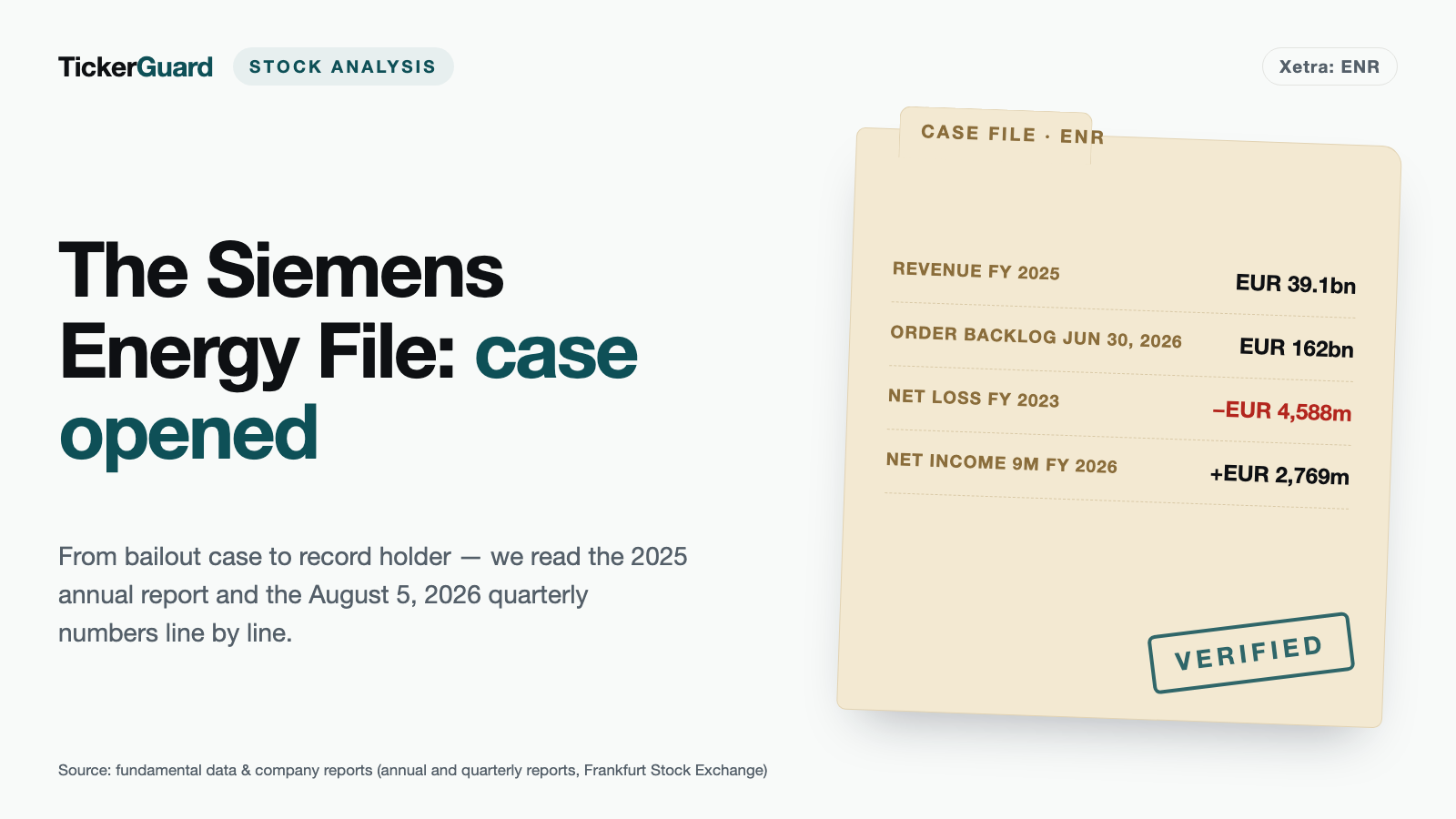
Siemens Energy builds gas turbines, power grids and wind farms — and on August 5, 2026 it reported the best quarter in its history: €17,926 million in orders, €11,447 million in revenue, €1,188 million in net income. Three years earlier the books showed a €4,588 million loss and the German federal government had to step in with a counter-guarantee. We read what the record actually rests on: €28,071 million of customer prepayments on the balance sheet, and a data-center boom the company itself lists as a risk in its own annual report. Not a buy or sell recommendation — just the question of whether a patient who can walk again is already healthy.
 Thomas Mücke
Founder & Publisher
Thomas Mücke
Founder & Publisher
Chart
Interactive price chart (TradingView).
Note: pure fact-based analysis, not investment advice and not a solicitation to buy or sell. All figures without guarantee.
There is an investor trap that springs shut precisely when a story ends well: the hospital-bed trap. We watch a patient who has been lying down for months get up — and in that same moment we decide he is healthy. We stop asking who paid the bill, whether the drip is still attached, and what happens when it comes out. We applaud. With Siemens Energy (Xetra: ENR) the temptation is unusually strong, because the recovery story is real and well documented. Fiscal 2023 closed with a net loss of €4,588 million, the German federal government stepped in with a counter-guarantee in December 2023, and three years later, on August 5, 2026, the same company reported the best quarter in its history. So let us make a deal: we will neither celebrate the recovery nor talk it down — we will read the reports. The 2025 annual report, the quarterly statement of August 5, 2026, and the press releases in between. And that is where the tension running through this analysis sits: the record is real — but it stands on €28 billion of customer money and on a data-center boom that Siemens Energy lists as a risk in its own annual report.
What Siemens Energy actually does
Siemens Energy builds the machines that generate and move electricity. In plain terms: if a country's power system were a circulatory system, Siemens Energy builds the heart and the major arteries — not the outlet in your living room. The group reports in four divisions. Gas Services builds and services gas and steam turbines and generators, the classic power-plant business, complemented by long-term service agreements. Grid Technologies supplies high-voltage equipment: transformers, switchgear, direct-current transmission systems, offshore wind grid connections. Transformation of Industry sells compressors, industrial steam turbines and electrolyzers to chemicals, oil and gas, mining and, increasingly, data centers. And Siemens Gamesa builds onshore and offshore wind turbines.
At June 30, 2026 the group employed roughly 106,000 people, 29,000 of them in Germany (September 30, 2025: 103,000 and 27,000). Revenue in fiscal 2025 came to €39,077 million. By the company's own estimate, about one sixth of the electricity generated worldwide is based on Siemens Energy technology.
One detail shapes this entire analysis and is easy to miss: the Siemens Energy fiscal year ends on September 30, not December 31. When this piece refers to "fiscal 2026," it means October 1, 2025 to September 30, 2026. The third quarter of that year — the most recent numbers available — covers April 1 to June 30, 2026.
Company history for investors
-
2020
Spin-off from Siemens AG
The energy business becomes independent and lists on the exchange. The corporate name stays borrowed: it rests on a time-limited trademark license agreement with Siemens AG.
-
2023
Net loss of €4,588 million
Quality problems at Siemens Gamesa cost the division €4,347 million. In December 2023 a federal counter-guarantee backstops the guarantee facility for the project business — with a dividend ban attached.
-
2025
Federal counter-guarantee redeemed early
In June 2025 a €9 billion bank guarantee facility replaces the state backstop. On July 30, 2025 the Bundestag budget committee lifts the dividend restriction — a year earlier than planned.
-
2026
Dividend and buyback return
The annual shareholders' meeting approves a dividend of €0.70 per share for fiscal 2025 on February 26, 2026. In parallel, a buyback of up to €6 billion runs through the end of fiscal 2028.
-
2026
New brand Omterra announced
On July 14, 2026 the company announces it will operate together with Siemens Gamesa under the name Omterra. For shareholders that means the established name disappears on schedule.
-
2026
Record quarter and first profit at Siemens Gamesa
On August 5, 2026 Siemens Energy reports quarterly profit before special items of €1,623 million and a €162 billion backlog. The wind division posts its first quarterly profit since fiscal 2022.
Why there is no 10-K here — and where the numbers come from instead
A word on the evidence base first: Siemens Energy files no 10-K and no 10-Q. It is not a U.S. reporting company and files no periodic reports with the U.S. securities regulator, the SEC. Its mandatory reporting runs through the regulated market of the Frankfurt Stock Exchange: an audited IFRS annual report, a half-year report subject to review, and short, unaudited quarterly statements under Section 53 of the exchange rules. Every figure in this analysis therefore carries the label "Source: fundamental data & company reports (annual/quarterly report, Frankfurt Stock Exchange)" rather than "SEC filings." The underlying logic is unchanged — an audited IFRS statement carries liability for its accuracy — it simply follows German and European capital-markets law instead of U.S. law.
Siemens Energy shares this setup with many German industrial names. In our Hensoldt analysis the entire evidence chain likewise ran through the company's own annual and quarterly reports rather than through sec.gov.
How this stock landed on our desk
Honesty first: no screener hit put us on this trail. The trigger was a date — the quarterly statement of August 5, 2026, in which Siemens Energy reported record orders, revenue and profit and, in the same breath, the first black quarter at Siemens Gamesa since fiscal 2022. Announcements like that are the classic trigger for the hospital-bed trap, which is exactly why this name is here.
What our in-house stock scanner says as of the August 7, 2026 data cutoff is remarkably unexcited. The Piotroski score — a nine-point checklist for balance-sheet quality — comes out at 6 out of 9. That is decent, not outstanding; a genuinely robust company scores 8 or 9. The equity ratio of roughly 18 percent is normal for a plant engineering group but thin against classic industrials. And the Altman Z-score, an early-warning indicator for financial distress, sits at 2.3 — in the grey zone between "unproblematic" (above 3) and "watch out" (below 1.8). In this case that does not come from debt but from balance-sheet structure: a group financed to the tune of 44 percent of total assets by customer prepayments automatically looks more strained in such ratios than it is. That structure is exactly what we examine next.
The numbers over the years — fairly credited
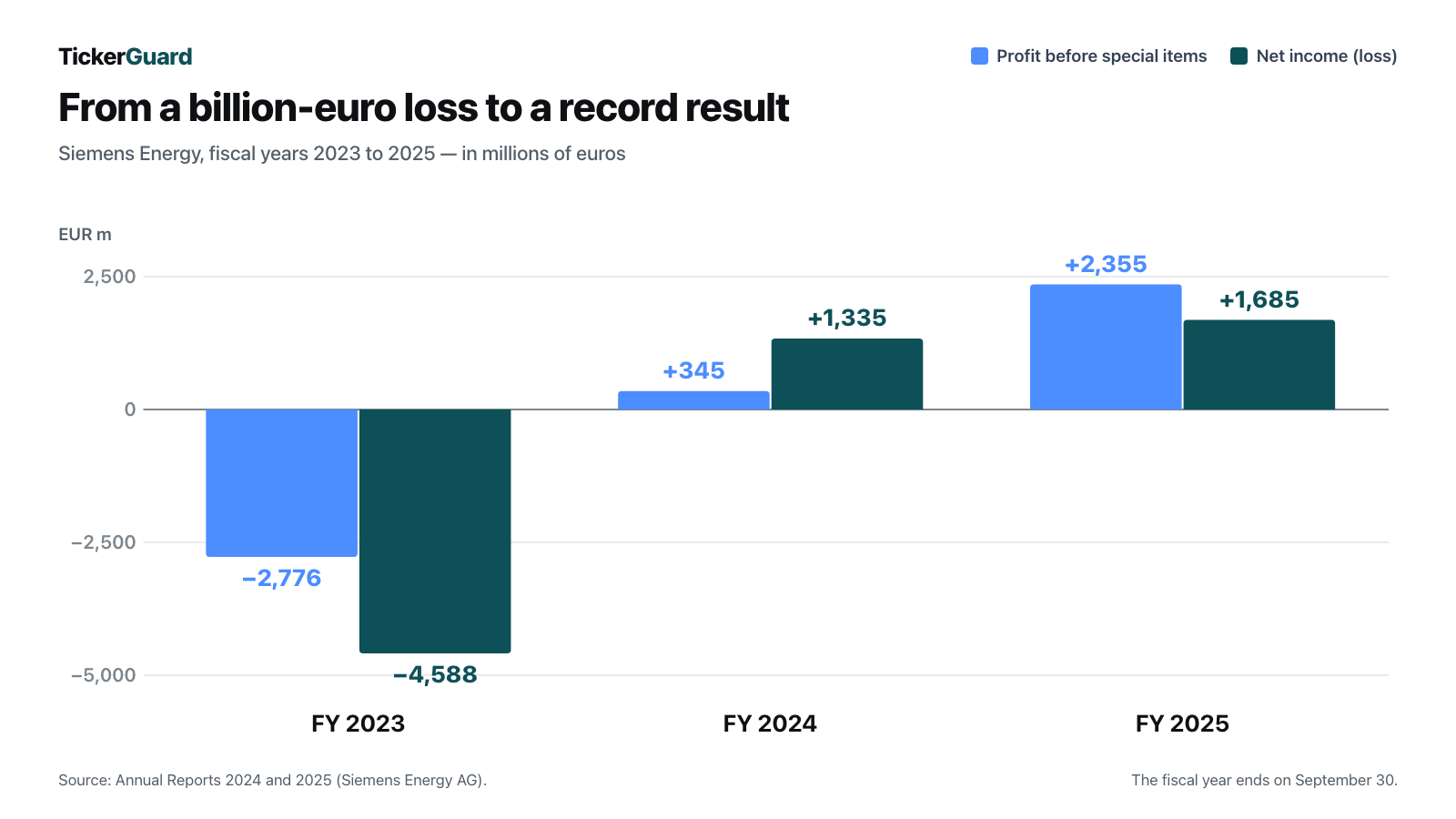
First what genuinely impresses, and there is plenty. The swing from 2023 to 2025 is one of the sharpest any large German industrial group has produced in recent years. Revenue rose from €31,119 million in fiscal 2023 through €34,465 million in 2024 to €39,077 million in 2025. Profit before special items — the group's own steering metric — turned from minus €2,776 million through plus €345 million to plus €2,355 million. And net income moved from minus €4,588 million to plus €1,335 million and then plus €1,685 million. Basic earnings per share: minus €5.47 in 2023, plus €1.37 in 2024, plus €1.63 in 2025.
The single most important sentence about this swing sits in the letter from the executive board in the 2025 annual report — and it is not about profit, it is about the guarantee:
"We agreed on a new guarantee facility with banks in June 2025 and redeemed the German government's counter guarantee ahead of schedule."
— Siemens Energy AG, Annual Report 2025, Letter from the Executive Board, page 5
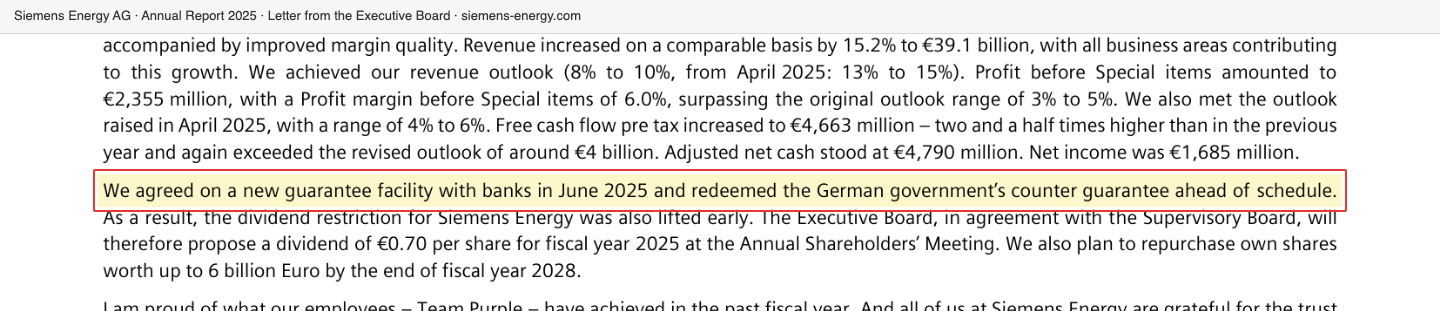
Why that matters more than any profit figure: the German government counter-guarantee of December 2023 backstopped a guarantee facility without which Siemens Energy could not have run its project business at all — builders of large plants must post bonds to their customers on every contract. Attached to that counter-guarantee was a condition that no dividend may be distributed in years in which guarantees are drawn. That is why none was paid or proposed for fiscal 2024. On June 5, 2025 a group subsidiary agreed its own €9 billion guarantee facility with a bank consortium, the counter-guarantee ended early, and on July 30, 2025 the budget committee of the German Bundestag lifted the dividend restriction for fiscal 2025 — a year earlier than planned.
The consequence for shareholders: a dividend of €0.70 per share for fiscal 2025, approved at the annual shareholders' meeting on February 26, 2026, with €601 million actually paid out according to the cash flow statement. The dividend policy targets 40 to 60 percent of net income; for 2025 the payout ratio came to 50 percent of the adjusted figure. On top of that comes a share buyback of up to €6 billion by the end of fiscal 2028. The first tranche ran from March 4 to May 19, 2026 and repurchased 12,618,469 shares for €1,999,999,412.91 at an average price of €158.50. The second tranche, of up to €1 billion, has been running since June 4, 2026; through July 31, 2026 it had acquired 5,300,495 shares for €819,428,270 at an average of €154.59.
The ratings followed suit. The 2025 annual report cites BBB− from S&P Global and Baa2 from Moody's, both with a positive outlook. So does the balance sheet: a once-strained group now carries €7,719 million of adjusted net cash at June 30, 2026 (September 30, 2025: €4,790 million). Cash and cash equivalents stood at €11,088 million against €2,959 million of debt.
The quarter reported on August 5, 2026 — what changed
The latest numbers are the best in company history, and they are best in every single line. In the third quarter of fiscal 2026 (April 1 to June 30, 2026), orders came to €17,926 million (up 8.5 percent on a comparable basis) and revenue to €11,447 million (up 18.5 percent) — the highest quarterly revenue the company has ever recorded. Profit before special items tripled to €1,623 million from €497 million in the prior-year quarter, lifting the corresponding margin from 5.1 to 14.2 percent. Net income climbed to €1,188 million from €697 million and basic earnings per share to €1.28 from €0.71. Free cash flow pre tax reached €2,319 million against €419 million.
The order backlog rose to €162 billion from €136 billion a year earlier. For scale: that is more than four times annual revenue. Over nine months, orders total €53,284 million (up 23.1 percent comparable), revenue €31,416 million, profit before special items €3,946 million and net income €2,769 million.
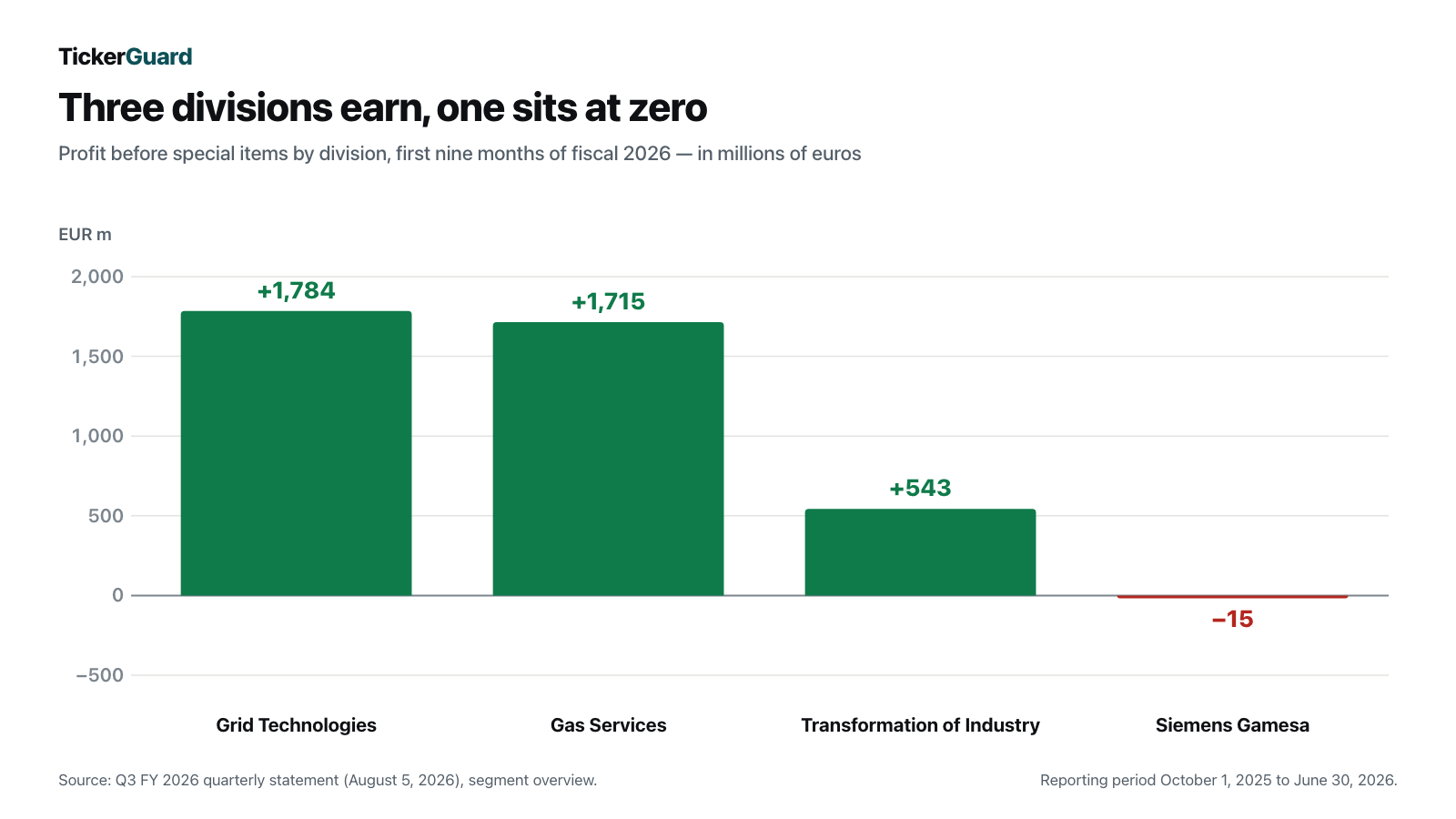
Line the divisions up next to each other, though, and the picture is strikingly uneven.
For the full 2026 fiscal year Siemens Energy confirmed the outlook it had raised in the spring: comparable revenue growth of 14 to 16 percent and a profit margin before special items of 10 to 12 percent — in its own words "towards the upper end" of that range — plus net income of around €4 billion and free cash flow pre tax of around €8 billion. For Siemens Gamesa the target is unchanged: break-even.
What the reports say — the uncomfortable truths
Uncomfortable truth no. 1: two thirds of the operating cash inflow is customer money
This is the core of the analysis. In the first nine months of fiscal 2026, Siemens Energy generated €7,759 million of cash from operating activities. Look into the cash flow statement to see which items feed that inflow, and the largest by far is not profit but a balance-sheet position: contract liabilities rose by €5,359 million — 69 percent of the entire operating inflow. Contract liabilities are, in plain language, money customers have already transferred even though the turbine has not been built yet. It sits in the bank account but economically it still belongs to the customer.
Siemens Energy states this openly in the quarterly statement:
"The sharp increase resulted largely from the improvement in cash-effective profit and was further supported by customer advance payments associated with the strong order intake."
— Siemens Energy AG, Earnings Release Q3 FY 2026, August 5, 2026, page 1
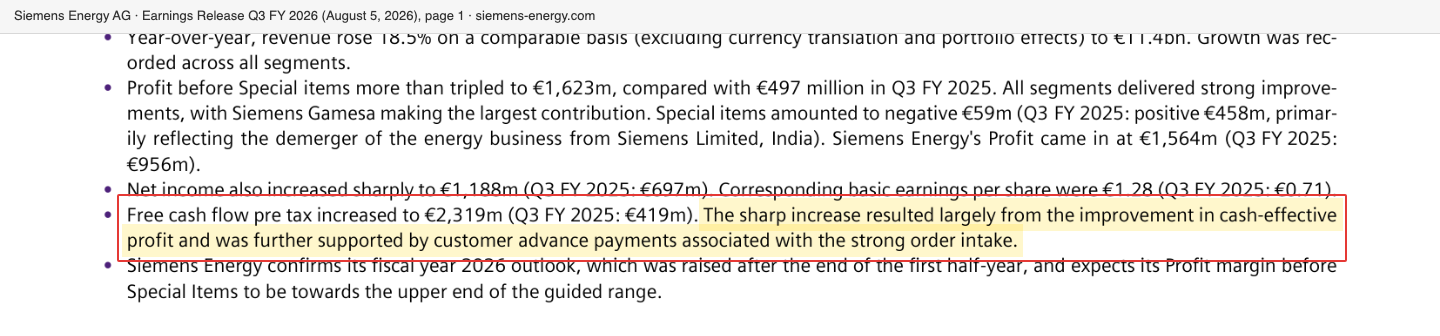
On the balance sheet at June 30, 2026 those contract liabilities stand at €28,071 million (September 30, 2025: €22,321 million). Put that in proportion: group equity is €11,171 million and total assets are €63,836 million. Customer prepayments are therefore 2.5 times equity and roughly 44 percent of the balance sheet. Put differently: the biggest financier of Siemens Energy is neither a bank nor a shareholder. It is the customer.
In large-scale plant engineering that is entirely normal and, on its own, no criticism — quite the opposite, it is a sign of market power. Anyone who wants a gas turbine and accepts a three-year lead time pays in advance. Remember: cash from prepayments is not earned money, it is an advance on work still to be done. As long as order intake grows, that advance grows with it and the bank account fills up. If order intake plateaus, the effect reverses: prefinanced work gets executed and paid for while no new customer money arrives. The €162 billion backlog is the insurance against that — it covers more than four years of revenue on paper. But it is worth knowing which of the two numbers carries the cash.
Uncomfortable truth no. 2: the tailwind is AI data centers — and it sits in the company's own risk report
Why is the business booming so suddenly? The executive board names it in the 2025 annual report: the global rise in electricity demand is being driven "by the electrification of entire industries and the surge in data centers supporting artificial intelligence." The regional table in the quarterly statement shows where that surge sits. Orders from the United States rose 60.2 percent over nine months to €21,644 million — roughly 41 percent of the group's total order intake of €53,284 million. Over the same period, orders from Europe, the C.I.S., the Middle East and Africa fell 4.0 percent to €22,093 million. At Gas Services alone, third-quarter orders jumped 61.9 percent to €9,967 million, with the company citing "large orders related to data centers" among the main drivers.
Now comes the passage readers tend to skip. Siemens Energy lists that very same tailwind in its risk report:
"Our markets may also be impacted by reduced power demand from data centers, particularly if hyperscalers scale back investments in energy infrastructure, which could affect demand for our offering."
— Siemens Energy AG, Annual Report 2025, Combined Management Report, risk section "Market and price development", page 41
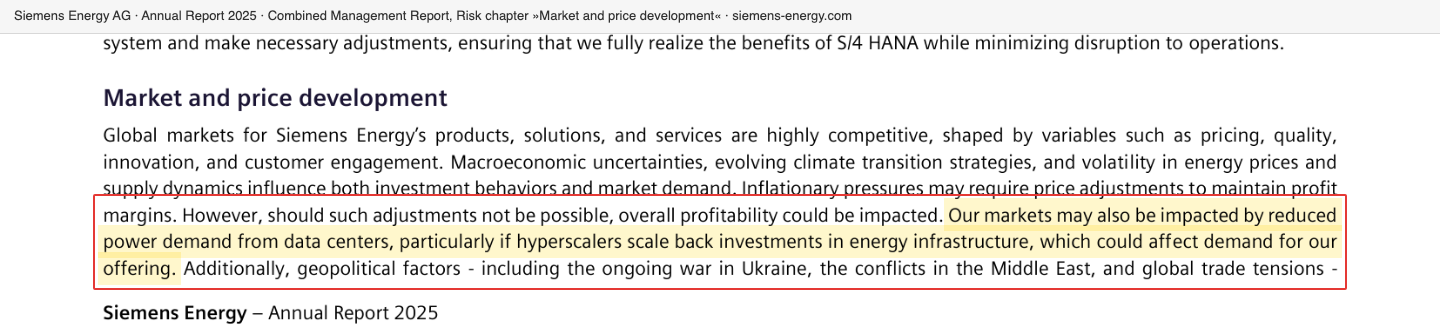
That is not a contradiction, it is candour — but it changes the perspective. The backlog is booked and contractually secured; nobody cancels a gas turbine casually. The refill, however, depends on a manageable number of very large technology companies sticking to their capital spending plans. Investors who want exposure to that chain will find the same dependency one step further down the value chain — at Powell Industries, for instance, which builds switchgear and power distribution for the very same data centers.
Uncomfortable truth no. 3: Siemens Gamesa celebrates its first profit — and still burns more cash than last year
The wind division is the reason Siemens Energy stood at the cliff edge in 2023. In fiscal 2023 its profit before special items came to minus €4,347 million, caused by quality problems on the 4.X and 5.X onshore platforms and ramp-up trouble offshore. Which makes the August 5, 2026 headline all the louder: Siemens Gamesa posted plus €75 million in the third quarter, its first positive quarterly result since fiscal 2022 (prior-year quarter: minus €438 million).
Three figures from the same table temper the celebration. First, over nine months the division is still at minus €15 million. Second, free cash flow pre tax at Siemens Gamesa came to minus €1,717 million after nine months — worse than the minus €1,658 million a year earlier, even though profit improved by more than a billion euros. Third, the refill: division order intake fell 77.0 percent in the third quarter to €1,050 million and 57.9 percent over nine months to €3,452 million. The book-to-bill ratio for the quarter was 0.38 — for every euro of revenue, only 38 cents of new orders arrived. The division backlog dropped to €31 billion.
Siemens Energy explains the collapse by noting that the prior-year quarter included two large offshore orders worth more than €3 billion combined, with nothing comparable this time. That is plausible and probably correct. Translated, it still means: one profitable quarter is not a profitable year, and a shrinking backlog is the revenue base of the day after tomorrow. The company's testable commitment is that Siemens Gamesa reaches break-even in fiscal 2026. After nine months, €15 million are missing — achievable, but not done.
Uncomfortable truth no. 4: the company does not own its own name
This truth appears on no balance sheet, but it will shape the coming years. Siemens Energy may use the name "Siemens" only because a group subsidiary holds a trademark license agreement with Siemens AG — a time-limited one. The takeover-relevant disclosures in the 2025 annual report state plainly that Siemens AG holds a termination right if a material competitor acquires 15 percent, or any other third party 25 percent, of that subsidiary, and that the right to the name ceases after graded transitional periods. At September 30, 2025 Siemens AG still held more than 10 percent of the voting rights indirectly through a subsidiary.
On July 14, 2026 the company drew the consequence and announced that it will operate together with Siemens Gamesa under a new brand: Omterra. Chief executive Christian Bruch put it this way:
"Since our spin-off, it has been clear that the licensed Siemens Energy brand would be available to us for a limited period."
— Christian Bruch, President and CEO, press release "Siemens Energy begins preparations for the launch of an independent brand", Berlin, July 14, 2026
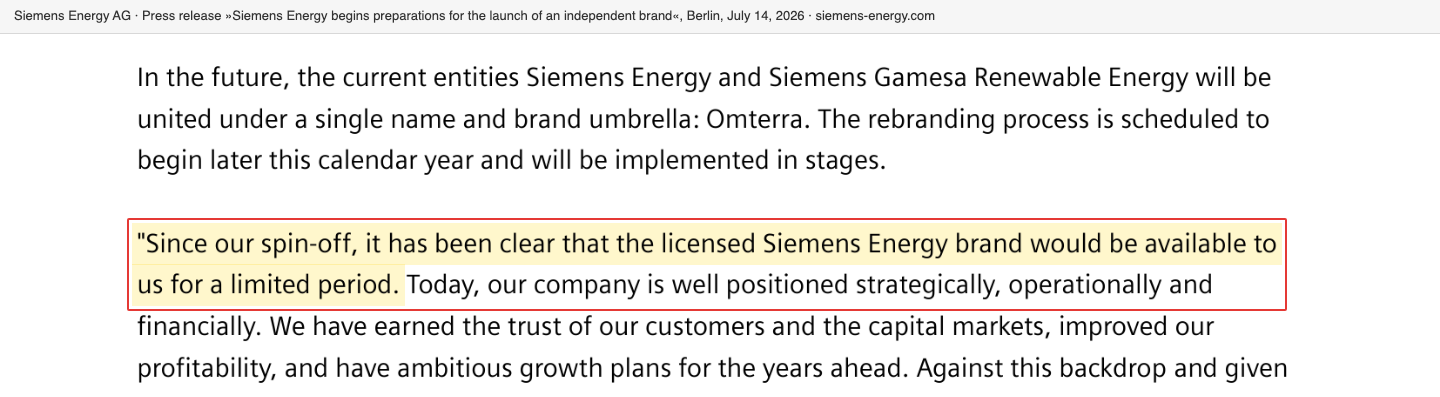
For an investor that means three things. First, the trademark license costs money — the 2024 combined management report explicitly named a sharp rise in Siemens brand fees as a drag on profit; they sit in the central items of the reconciliation. Second, a rebranding of this scale also costs money, spread over several years. Third, and this is the real point: the familiarity of the name "Siemens" is part of what customers and investors are currently buying — and that part is scheduled to disappear. The company stresses that its strategic direction remains unchanged for customers, partners and employees.
What the stock costs
At the closing price of August 7, 2026 the shares stood at €153.54 on Xetra. With 861,104,914 registered no-par shares issued, less repurchased treasury shares, that works out to a market capitalization of roughly €130 billion (data cutoff August 7, 2026). The 52-week range runs from €83.32 on September 3, 2025 to €191.66 on April 24, 2026 — the stock more than doubled at its peak within a year and has since given back about a fifth from the high.
What does that mean in valuation terms? On fiscal 2025 earnings per share of €1.63, the price-to-earnings ratio comes to roughly 94. That number is misleading, because it captures a year that was only halfway through the recovery. Using the company's own fiscal 2026 guidance — net income of around €4 billion — the ratio falls to roughly 33. Measured against guided free cash flow pre tax of around €8 billion, the yield is a little over 6 percent of market value; here the caveat from truth no. 1 applies, namely that a substantial share of that inflow is customer money. Fiscal 2025 revenue of €39.1 billion puts the price-to-sales ratio at roughly 3.3.
Translated: the market is paying prices for Siemens Energy that are historically high for a plant engineering group — and it is doing so not because of the past but on the assumption that margins keep climbing. The 2026 guidance of 10 to 12 percent margin before special items, against 6.0 percent in fiscal 2025, shows how much movement is still assumed. Whether that is enough is not for this analysis to decide.
Upside and risks at a glance
Upside
- An order backlog of €162 billion at June 30, 2026 — more than four years of revenue, contractually secured.
- All four divisions improved in the third quarter of fiscal 2026; Grid Technologies reached a 19.9 percent and Gas Services a 17.3 percent margin before special items.
- The balance sheet is repaired: €7,719 million of adjusted net cash at June 30, 2026, ratings of BBB− and Baa2 with positive outlooks, and no state guarantee in place.
- Capital returns have resumed: a €0.70 dividend for fiscal 2025 and a buyback programme of up to €6 billion through the end of fiscal 2028.
- Structural tailwind from electrification, grid expansion and data-center power demand, especially in the United States (nine-month orders up 60.2 percent).
Risks
- €28,071 million of customer prepayments finance the cash position; 69 percent of the nine-month operating inflow came from their increase.
- Siemens Energy itself names a decline in data-center demand as a risk should hyperscalers scale back investment.
- Siemens Gamesa stands at minus €15 million profit and minus €1,717 million free cash flow pre tax after nine months, with order intake down 57.9 percent.
- The rebranding to Omterra from calendar 2026 costs money and gives up an established name.
- Valuation: roughly 33 times the company's own fiscal 2026 net income guidance — a setback in margin or order intake would bite disproportionately.
- An equity ratio of roughly 18 percent (data cutoff August 7, 2026); retained earnings were still negative at minus €1,971 million on June 30, 2026.
A human conclusion
Remember the hospital-bed trap from the opening? After reading the reports it can be stated more precisely. Siemens Energy is no longer a patient — that much is documented: no state guarantee, €7,719 million of net cash, investment-grade ratings with positive outlooks, a dividend and a buyback, three of four divisions with double-digit margins. Anyone who had predicted in 2023 that this company would deliver €1,623 million of quarterly profit before special items three years later would have been laughed at.
And yet a drip is still attached to this recovered body, and it is worth knowing about. It is called customer prepayments, stands at €28,071 million on the balance sheet, and supplies two thirds of the operating cash inflow. It is not a disease — it is the normal physiology of large-scale plant engineering. But it only works while new orders keep arriving, and the biggest driver of those orders is a capital-spending cycle the company itself files under "risks." Add a wind division that, after one celebrated quarter, is still negative over nine months and consuming more cash than a year ago, plus a corporate name scheduled to disappear.
What follows from that is neither a recommendation nor a warning, but a request for precision. With this name, do not ask whether the turnaround succeeded — it did. Ask what carries the record, and what happens when that support weakens. The next testable checkpoint is November 11, 2026, when Siemens Energy publishes its fiscal 2026 figures. The same table will then show whether Siemens Gamesa reached break-even and how much of the cash inflow was genuinely earned. What you do with that until then is your decision. And that is exactly as it should be.
Sources
- Siemens Energy AG, Earnings Release Q3 FY 2026 (April 1 to June 30, 2026), published August 5, 2026 — segment overview, income statement, balance sheet, cash flow statement, regional tables, outlook.
- Siemens Energy AG, Annual Report 2025 (IFRS consolidated financial statements, fiscal year to September 30, 2025) — letter from the executive board, combined management report, risk section, takeover-relevant information, consolidated financial statements.
- Siemens Energy AG, Combined Management Report 2024 — comparative figures for fiscal 2023 (revenue €31,119m, profit before special items minus €2,776m, net loss €4,588m).
- Siemens Energy AG, Half-year Financial Report 2026 (May 12, 2026).
- Siemens Energy AG, press release "Siemens Energy begins preparations for the launch of an independent brand", Berlin, July 14, 2026 — the Omterra brand.
- Siemens Energy AG, Investor Relations: share buyback 2026 — tranches, share counts, average prices (retrieved August 9, 2026).
- Siemens Energy AG, Investor Relations: financial calendar — next date, the "Extended Q4 FY2026 Call" on November 11, 2026 (retrieved August 9, 2026).
- Price, valuation and scanner metrics: fundamental data, cutoff August 7, 2026.
Transparency & disclaimer: this analysis is journalistic commentary on publicly available information. It is not investment advice, not a regulated financial analysis and not a solicitation to buy or sell securities. Equity investments carry substantial risk up to total loss. All information without warranty; each figure carries its own date in the text, and the overall cutoff for this edition is August 9, 2026. The next report (fiscal 2026) is scheduled for November 11, 2026. Positions held by the operator are disclosed daily; where one exists, it appears as a notice at the top of this deep dive.
Our Bottom Line at a Glance
- Growth and order book positive
- In the third quarter of fiscal 2026 orders rose to €17,926 million and revenue climbed 18.5 percent to €11,447 million — the highest quarterly revenue in company history. The order backlog reached a record €162 billion at June 30, 2026, up from €136 billion a year earlier.
- Profitability positive
- Profit before special items tripled to €1,623 million in the third quarter of fiscal 2026 (prior-year quarter €497 million) and the margin rose from 5.1 to 14.2 percent. Across three fiscal years the path runs from minus €2,776 million in 2023 through plus €345 million in 2024 to plus €2,355 million in 2025.
- Balance sheet and financing positive
- At June 30, 2026 cash of €11,088 million stood against debt of €2,959 million, giving adjusted net cash of €7,719 million after €4,790 million at September 30, 2025. The federal counter-guarantee was replaced by a €9 billion bank facility in June 2025; ratings are BBB− and Baa2, both with a positive outlook.
- Source of the cash inflow negative
- Of the €7,759 million operating cash inflow in the first nine months of fiscal 2026, €5,359 million came from the increase in customer prepayments — 69 percent. At June 30, 2026 those contract liabilities stood at €28,071 million, 2.5 times total equity of €11,171 million.
- Siemens Gamesa neutral
- The wind division delivered €75 million in the third quarter of fiscal 2026, its first positive result since fiscal 2022. Over nine months it remains at minus €15 million, free cash flow pre tax at minus €1,717 million (prior-year period minus €1,658 million), and order intake fell 57.9 percent to €3,452 million.
- Demand concentration neutral
- Orders from the United States rose 60.2 percent over nine months to €21,644 million, about 41 percent of the group total, with data centers cited explicitly as a driver. In the risk section of its 2025 annual report Siemens Energy simultaneously lists a decline in that demand as a risk should hyperscalers scale back investment.
Siemens Energy has documented its turnaround: from a €4,588 million net loss in fiscal 2023 to the record quarter reported on August 5, 2026, with €1,623 million of profit before special items, a €162 billion backlog and €7,719 million of net cash. The cash position, however, is 69 percent carried by customer prepayments, the wind division is still negative after nine months, and the most important demand driver sits in the company's own risk section. Not investment advice.
What Our Rating Means
Open questions
The business works in principle, but one material question is open. As long as it stays open, our findings do not carry a quality verdict.
Yellow here is explicitly not about the balance sheet or about survival. The balance sheet at June 30, 2026 is that of a healthy group: €11,088 million of cash against €2,959 million of debt, €7,719 million of adjusted net cash, investment-grade ratings with positive outlooks, no state guarantee and no going-concern flag. The business is visibly carrying too: three of four divisions with double-digit margins, a €162 billion backlog, and profit before special items that tripled in the quarter. The high valuation is deliberately not an argument for this rating — price is not a quality attribute. Yellow stands because two operating questions are open. First, the wind division: Siemens Gamesa took an important step with a positive quarter, but over nine months it is still at minus €15 million, consumes more cash than a year earlier at minus €1,717 million of free cash flow pre tax, and collected 57.9 percent fewer orders — the turnaround there is under way but not proven. Second, where the money comes from: 69 percent of the nine-month operating cash inflow came from the increase in customer prepayments, which at €28,071 million amount to 2.5 times equity. That is customary in large-scale plant engineering and is no defect, but it ties the cash position to continued growth in order intake, whose most important driver — data-center investment — the company itself files under risks. Both can work out; neither is proven before the fiscal 2026 figures on November 11, 2026. The decision is yours.
A journalistic assessment by our editorial team at the time of the deep dive, based on public sources — not investment advice and not a solicitation to buy or sell. Your personal circumstances (investment goals, risk capacity, taxes) cannot be taken into account. What our levels mean, how verdicts are formed, and what conflicts of interest exist →
Worth Noting
- Siemens Energy is not a U.S. reporting company: there is no 10-K and no 10-Q. All figures come from the Annual Report 2025 (fiscal year to September 30, 2025), the Combined Management Report 2024 (for the 2023 comparatives), the Half-year Financial Report 2026 and the quarterly statement of August 5, 2026.
- The fiscal year ends on September 30. "Fiscal 2026" denotes October 1, 2025 to September 30, 2026; the latest figures cover the quarter from April 1 to June 30, 2026.
- Adjusted net cash of €7,719 million at June 30, 2026 is the company's own "Adjusted Net debt/(Net cash)" metric from the quarterly statement, not our own calculation.
- Price, valuation and scanner metrics carry the data cutoff August 7, 2026 (the last Xetra close before publication). The overall cutoff for this edition is August 9, 2026.
- Possible confusion: the shorthand ENR.DE used here means "Siemens Energy, listed in Germany" — it is not an official exchange code. The shares trade as Xetra: ENR. Not to be confused with Siemens AG (Xetra: SIE) or Siemens Healthineers (Xetra: SHL).
The full analysis as a PDF for later
We will send you this analysis as a PDF — to print, file away, and read at your own pace.
Frequently Asked Questions
Siemens Energy AG of Munich builds the technology that generates and transmits electricity: gas and steam turbines plus service (Gas Services), high-voltage equipment and grid connections (Grid Technologies), compressors and electrolyzers for industry (Transformation of Industry) and wind turbines (Siemens Gamesa). At June 30, 2026 it employed roughly 106,000 people, 29,000 of them in Germany.
On September 30, not December 31. Fiscal 2026 therefore runs from October 1, 2025 to September 30, 2026. The figures reported on August 5, 2026 cover the third quarter of that year, April 1 to June 30, 2026. Full fiscal 2026 results are scheduled for November 11, 2026.
It was the best quarter in company history: €17,926 million in orders, €11,447 million in revenue (up 18.5 percent comparable) and profit before special items of €1,623 million against €497 million a year earlier. Net income came to €1,188 million and the order backlog reached €162 billion.
Because of quality and ramp-up problems at its wind subsidiary Siemens Gamesa. In fiscal 2023 that division posted profit before special items of minus €4,347 million and the group lost €4,588 million overall. In December 2023 a federal counter-guarantee backstopped the guarantee facility for the project business. A €9 billion bank facility replaced it ahead of schedule in June 2025.
Yes, again. None was paid for fiscal 2024 because the federal counter-guarantee ruled out distributions. After the Bundestag budget committee lifted that restriction on July 30, 2025, the annual shareholders' meeting of February 26, 2026 approved a dividend of €0.70 per share for fiscal 2025; €601 million were paid out. The policy targets 40 to 60 percent of net income.
Considerably. Orders from the United States rose 60.2 percent to €21,644 million in the first nine months of fiscal 2026, about 41 percent of group order intake, and the company explicitly cites data-center orders as a driver. In the risk section of its 2025 annual report Siemens Energy simultaneously lists a decline in that demand as a risk.
Because the name is only borrowed. Siemens Energy uses the "Siemens" brand under a time-limited license agreement with Siemens AG. On July 14, 2026 the company announced that it will operate together with Siemens Gamesa under the new brand Omterra. The transition is due to begin later in calendar 2026 and roll out in stages; the strategy, the company says, stays the same.
Siemens Energy is listed on the regulated market of the Frankfurt Stock Exchange and is not a U.S. reporting company, so it files neither a 10-K nor a 10-Q. It must publish an audited IFRS annual report, a reviewed half-year report and short quarterly statements. This analysis rests on the 2025 annual report and the quarterly statement of August 5, 2026.
Found an error?
Did you spot a factual error, an outdated number, or a typo in this deep dive? Let us know briefly — your report goes straight to the editorial team.