RUM Group: A $1.61 Billion Revenue Jump That Was Bought, Not Earned
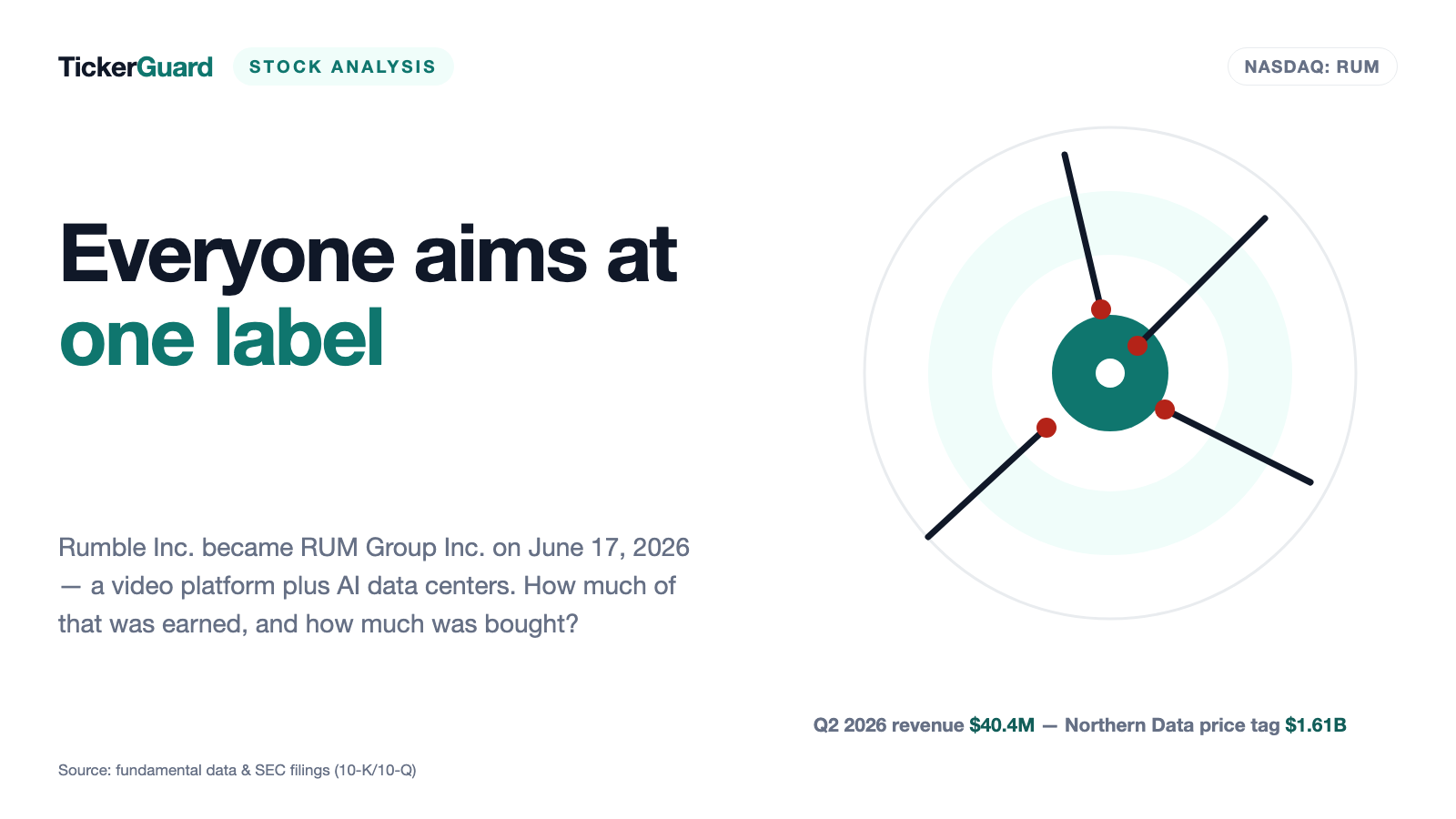
RUM Group Inc. (Nasdaq: RUM) was still called Rumble Inc. until June 17, 2026 — the same day it closed the acquisition of roughly 85 percent of Germany's Northern Data AG and turned overnight into a self-described AI infrastructure company running about 22,000 NVIDIA GPUs. Total consideration was $1,608,906,565, paid almost entirely in stock and warrants to seller Tether, with essentially no cash out the door. Revenue jumped to a record $40.4 million in the second quarter of 2026, and for the third quarter of 2026 the company issued its first-ever formal guidance of $87 million to $93 million. But the same quarterly report shows that had the deal closed on January 1, 2026, Northern Data alone would have contributed a $545.0 million pretax loss for the year. On top of that sit up to 159 million potential new shares, two unresolved Swedish tax assessments worth roughly $56 million combined, and a European Public Prosecutor's Office investigation citing exposure of up to roughly €110 million. We read the 10-Q filed August 10, 2026 and the 2025 10-K so you don't have to choose between the new name and the old numbers. Not investment advice — just the question of who actually paid for this deal.
 Thomas Mücke
Founder & Publisher
Thomas Mücke
Founder & Publisher
As of Today
As of: October 2, 2026
- Closing price
- 7.60 $ -0.90%
- Market Capitalisation
- 3.8 $B
- Growth Score
- 5/10
- AAQS
- 5/10
Price change since August 17, 2026: -7.8%
This analysis has a cut-off date. The Stock Guard tells you when something material changes in the numbers. Reserve your free spot
Chart
Interactive price chart (TradingView).
52-week range: 4.70 $ to 10.20 $ · Last price: 7.60 $ (As of: October 2, 2026)
Note: pure fact-based analysis, not investment advice and not a solicitation to buy or sell. All figures without guarantee.
When a company buys another for $1.61 billion and touches almost no cash doing it, somebody else paid: you. Not by wire transfer, but with a piece of your own stake. Call that figure the silent co-buyer — the shareholder who automatically helps fund every stock-financed acquisition without ever being asked, and who only notices the invoice when he counts how many shares now exist. Our minds play along: we watch the company get bigger and book that as a win, while the fact that our own slice got thinner at the very same moment never makes a headline.
On June 17, 2026, that is exactly what happened on the Nasdaq. Rumble Inc., the video platform known for positioning itself as the rebel alternative to Big Tech streaming, became RUM Group Inc. overnight — with a second business it did not have before: AI data centers running roughly 22,000 NVIDIA GPUs. So let us make a deal: we will read together what RUM Group actually told the U.S. securities regulator, the SEC — the 10-Q for the quarter ended June 30, 2026, filed August 10, 2026, and the 10-K for fiscal year 2025. A filing to the SEC is honest under penalty of law; a new corporate name costs nothing. And this filing tells a story more complicated than “Rumble becomes an AI company”: a revenue jump that was not earned so much as bought — paid for almost entirely in stock whose count even a seasoned reader can barely track. By the end, it is your call whether you like that trade.
What RUM Group Actually Is Today
RUM Group Inc. (Nasdaq: RUM), founded and run by Chairman and CEO Chris Pavlovski, went public on September 16, 2022 through a merger with a SPAC — a blank-check shell company created solely to complete an acquisition. Until June 17, 2026, the company was named Rumble Inc. and was, at its core, exactly what it was known for: a video platform positioning itself as an alternative to the big streaming players. Since June 17, 2026, a second, entirely different business has joined it: Quake AI, a provider of AI compute capacity.
What Quake AI actually does is easiest explained with an everyday image. A GPU (graphics processing unit) is a chip originally built to render video games smoothly — today it's the workhorse for training and running AI models, because it handles thousands of calculations in parallel instead of one after another. Quake AI says it operates roughly 22,000 of NVIDIA's H100 and H200 GPUs, running at about 85 percent utilization in the second quarter of 2026. A company that rents out GPU compute to others without being a cloud giant like Amazon or Microsoft itself is what the industry calls a "neocloud" — essentially a landlord of computing power instead of office space. And when Quake AI houses a customer's own servers inside its data centers, that's called colocation: you rent a rack in someone else's warehouse instead of building your own. A facility like this also needs serious networking gear to tie it all together — how critical that piece is to the entire AI buildout is something our Arista Networks stock analysis covers in detail, since Arista is one of the major networking suppliers for exactly these data centers.
Both businesses now run, per the quarterly filing, as two distinct units with different revenue models and different capital needs:
“With the completion of our acquisition of Northern Data AG on June 17, 2026, the Company has taken a major step toward becoming a significant participant in the AI infrastructure business, and now operates two distinct businesses: our video platform (“Rumble”) and our AI and cloud infrastructure business (“Quake AI”). While both businesses are core to the Company’s strategy, their economics and capital profiles are materially different, including different revenue models and capital requirements.”
— RUM Group Inc., SEC quarterly report 10-Q for the period ended June 30, 2026, MD&A "Transition of Key Business Metrics"
That split is why the RUM Group name isn't just marketing — the company genuinely has become a different animal than the one that went public in 2022. How and at what cost is the subject of the rest of this piece.
Company history for investors
-
2022
SPAC IPO
Rumble went public via SPAC merger on 09/16/2022 — the start, for shareholders, of a loss streak that continues today.
-
2024
Record loss from a derivative
A −$184.7M fair-value swing pushed the 2024 net loss to $338.4M — an early warning about the capital structure's volatility.
-
2025
Tether becomes a major holder
On 02/07/2025 Tether bought $775M of new shares while 70M legacy shares were repurchased — Tether became a central capital provider.
-
2025
Northern Data acquisition agreement
On 11/10/2025 RUM Group signed to buy 85% of Northern Data — the AI infrastructure pivot began on paper.
-
2026
Deal closes, company renamed
On 06/17/2026 the deal closed and Rumble Inc. became RUM Group Inc. — the day the label changed overnight for shareholders.
-
2026
First formal guidance
On 08/10/2026 the company issued its first-ever revenue guidance ($87–93M for Q3) — early evidence the acquired business is actually generating revenue.
How This Stock Landed On Our Desk
Full disclosure: RUM Group isn't a hit from our in-house stock scanner. It can't be — the company hasn't reported a profitable year since going public in 2022, and a scanner built to screen for quality demands exactly that: profit, positive margins, healthy balance-sheet ratios. On RUM Group, the scanner shows nothing to be proud of — and that's not a bug, it's the correct result.
This stock made our research list for two other reasons that rarely coincide. First, the 10-Q for the quarter ended June 30, 2026, filed with the SEC on August 10, 2026, shows total assets that more than sextupled in six months — from $336.8 million to $2.12 billion. Second, the renaming from Rumble Inc. to RUM Group Inc. on June 17, 2026, recorded in the SEC's EDGAR filer history as a formal legal name change. A company that multiplies its balance sheet within six months and changes its name on the same day earns a second look — regardless of whether that look turns out flattering. This piece is that second look.
The Numbers Over the Years — Honestly Appraised
Start with what genuinely impresses. Rumble/RUM Group revenue has grown every year since going public: from $9.47 million in 2021 through $39.38 million (2022) and $80.96 million (2023) to $95.49 million (2024) and $100.62 million in fiscal 2025. Then came a record in the second quarter of 2026: $40.4 million in revenue, up 61 percent year over year. Rumble's video business alone — stripped of any Northern Data contribution — also hit a record at $30.3 million, up 21 percent year over year and 19 percent quarter over quarter. The user base is growing too: 57 million average monthly active users in the second quarter of 2026, up 2 percent quarter over quarter, at $0.48 in revenue per user (up 20 percent). Cash sat at $203.3 million as of June 30, 2026, and before the Northern Data deal the company carried essentially no bank debt.
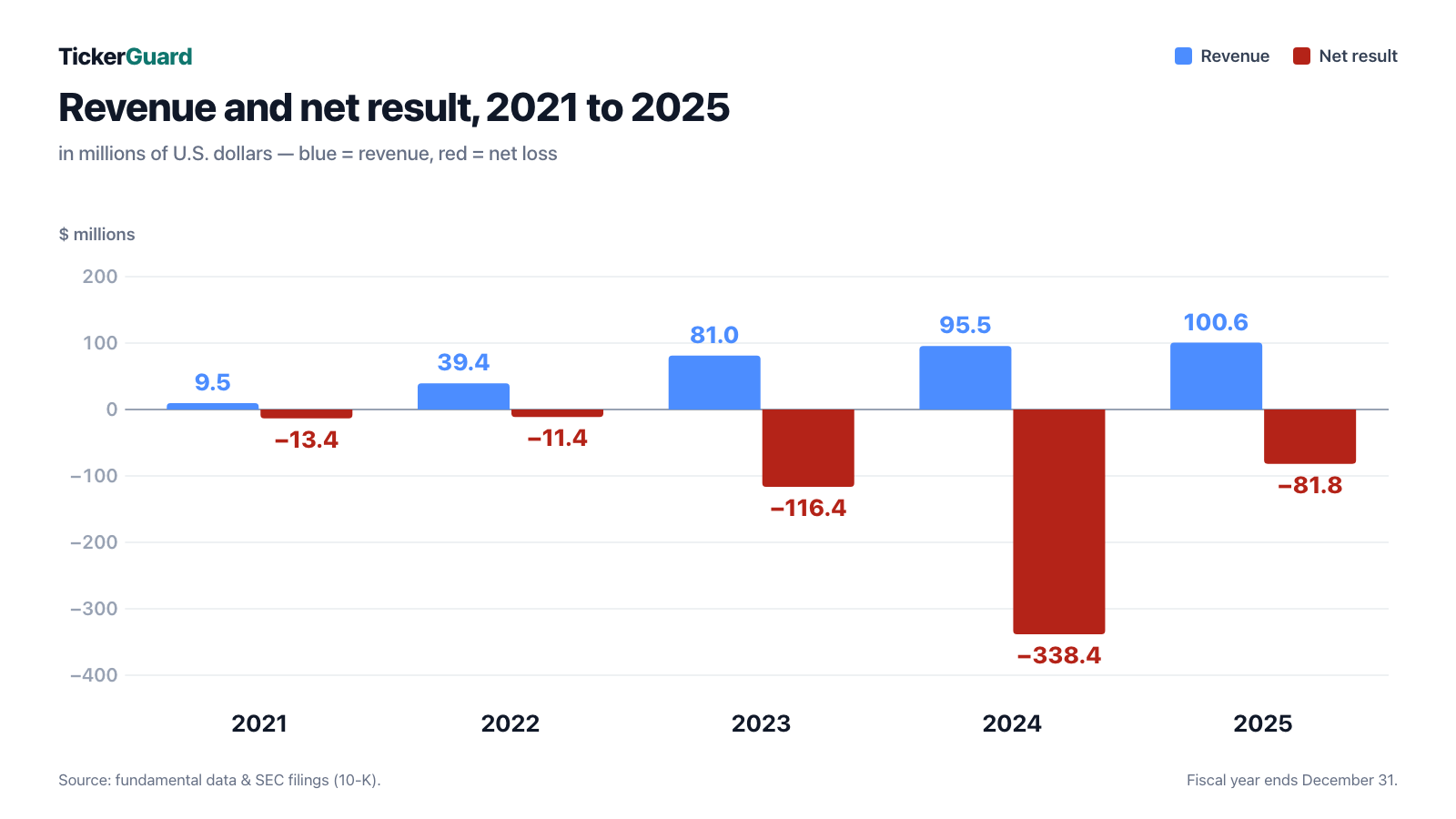
That's half the story. The other half: the company has never once posted an annual profit since its 2022 IPO. Net loss was $13.41 million in 2021, $11.40 million in 2022, $116.42 million in 2023, a record $338.36 million in 2024 — driven largely by a single derivative fair-value swing of −$184.7 million — and $81.83 million in 2025. By June 30, 2026, the accumulated deficit stood at $674.8 million. Remember this picture: a company can grow revenue every single year and still lose money every single year — both are true for RUM Group at once, and that's the foundation the AI infrastructure pivot is now being built on.
What the Filings Say — The Uncomfortable Truths
Five things sit in the 10-Q filed August 10, 2026 and the 2025 10-K that don't come through with the same clarity in the "transformational quarter" press release.
Uncomfortable Truth No. 1: The Revenue Jump Was Bought, Not Earned
Start with the single most important number in this analysis. Total consideration for roughly 85 percent of Germany's Northern Data AG was $1,608,906,565 — and practically none of it came out of RUM Group's cash. Payment consisted of 59.3 million new Class A shares ($432.6 million), 98.3 million pre-funded warrants issued to Tether ($716.3 million), and a $366.6 million note payable to Tether. The deal actually brought in $51.0 million of net cash, according to the filing — it was funded entirely with freshly printed paper, not cash.
So what did that paper actually buy? The 10-Q answers with a pro forma calculation showing what results would have looked like had the deal closed at the start of the year:
“From the date of acquisition on June 17, 2026, NDAG contributed $10,092,593 of revenue and $11,968,936 of loss before income taxes. If the acquisition had taken place at the beginning of the fiscal year, NDAG would have contributed approximately $168,244,631 of revenue and $(545,037,732) of loss before income taxes.”
— RUM Group Inc., SEC quarterly report 10-Q for the period ended June 30, 2026, Note 3 "Business Combinations"

Read that number twice: a $545 million pretax loss — on an annualized basis, from the acquired business alone. That's more than four times what the entire company lost in all of 2025. Picture it this way: you buy a second store and pay for it with shares of your own business instead of cash — and that new store, had it belonged to you for the whole year, would have cost you a multiple of what your existing store even brings in. The $545 million is a pro forma estimate, not a real cash outflow — much of it is likely valuation and amortization noise from a purchase price allocation the filing itself calls "provisional." But it shows that the revenue jump guided for the third quarter of 2026 ($87 million to $93 million) doesn't mean the acquired business is profitable. Revenue genuinely rose. Whether it earns anything is a separate question — and right now the filing answers that question with a very large negative number.
Uncomfortable Truth No. 2: How Many Shares Actually Exist?
Dilution means your slice of the pie keeps shrinking because new slices keep getting cut — without the pie itself growing. At RUM Group, the number of slices has grown so large and so branched that even a careful reader loses count. As of August 6, 2026 (the most recent date the 10-Q cover page reports), 276,328,597 Class A shares, 123,690,477 Class C shares and 95,791,120 non-economic Class D shares were outstanding — roughly 495.8 million shares across three classes. On top of that sit 102,863,674 pre-funded warrants that the company itself treats as economically equivalent to Class A shares because they're essentially exercisable on demand.
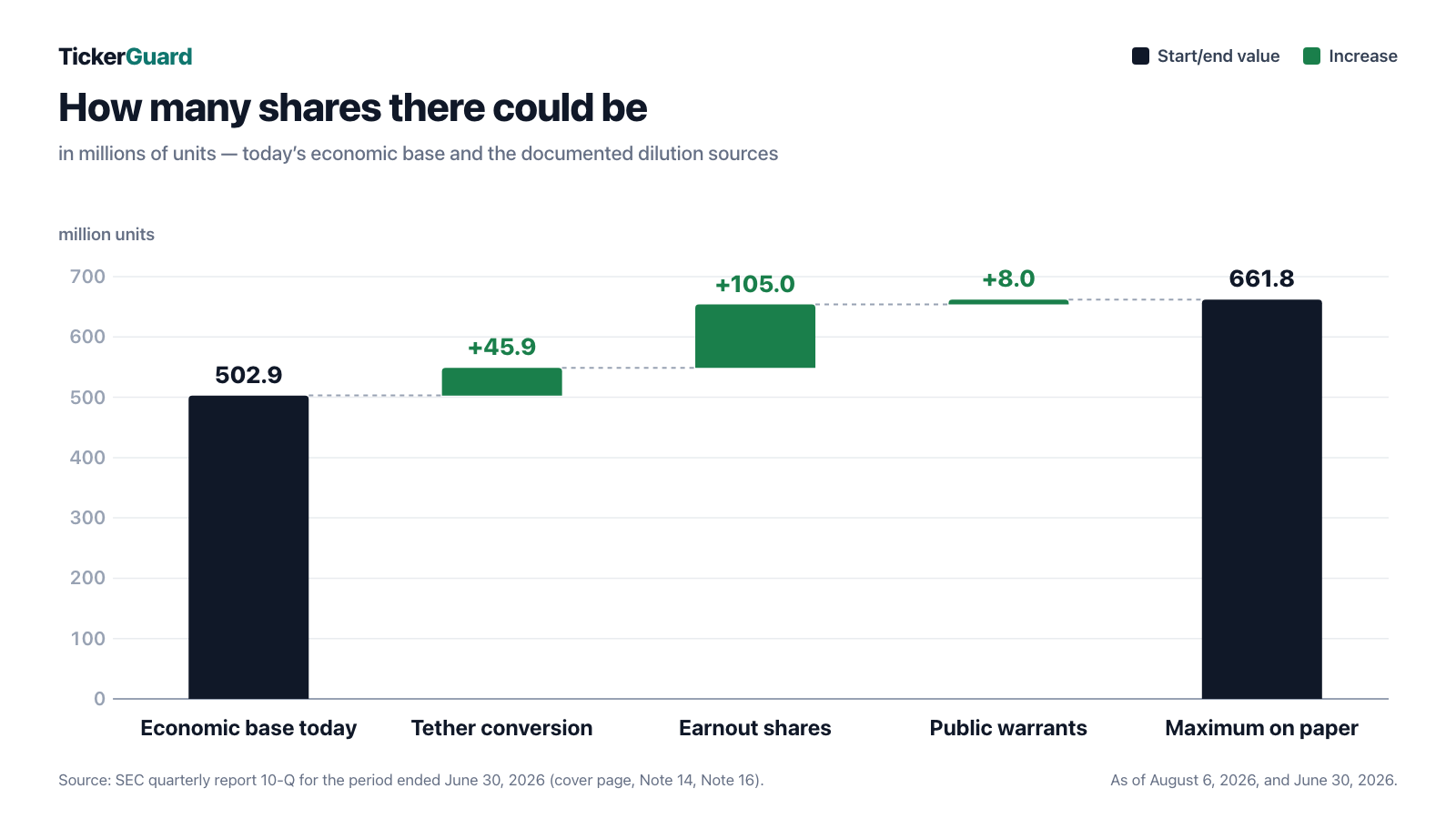
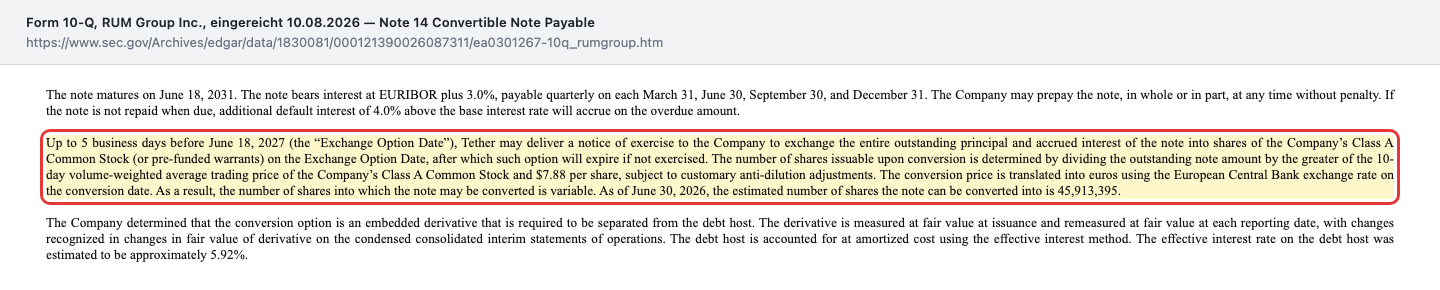
And that's just the present. At least three more dilution sources loom. First, a convertible note payable to Tether with a €317.5 million principal (carrying value $358.8 million as of June 30, 2026), convertible into shares until a few business days before June 18, 2027:
“The number of shares issuable upon conversion is determined by dividing the outstanding note amount by the greater of the 10-day volume-weighted average trading price of the Company’s Class A Common Stock and $7.88 per share, subject to customary anti-dilution adjustments. … As of June 30, 2026, the estimated number of shares the note can be converted into is 45,913,395.”
— RUM Group Inc., SEC quarterly report 10-Q for the period ended June 30, 2026, Note 14 "Convertible Note Payable"
Second, an earnout of up to 105,000,000 additional Class A shares owed to former Rumble shareholders, triggered once the stock trades at $15.00 or $17.50 across 20 of any 30 trading days — deadline September 16, 2027. Third, 8,046,040 public warrants with an $11.50 strike price, also expiring September 16, 2027. Add it up: 45.9 million plus 105.0 million plus 8.0 million — nearly 159 million potential new shares — against a current economically relevant base of roughly 502.9 million shares. That's a pie facing more than 30 percent additional claims without growing any bigger.
Uncomfortable Truth No. 3: Tether Sits on Every Side of the Table
Northern Data was majority-owned by Tether, issuer of the world's largest dollar stablecoin, before the deal. You might expect Tether to exit the picture once it sold its stake. The opposite happened — Tether now shows up in practically every corner of the capital structure. As seller, Tether received most of the deal consideration: 98.3 million pre-funded warrants ($716.3 million) and a $366.6 million note — deliberately structured as warrants rather than shares to keep Tether's voting stake under 9.90 percent. As shareholder, Tether had already bought 103,333,333 new shares for $775 million on February 7, 2025, while the company simultaneously repurchased 70 million legacy shares for $525 million. As creditor, Tether has held the €317.5 million convertible note described above since June 17, 2026. And as lender, Tether provided a financing commitment of up to $200 million, tied to the Swedish VAT matter — $36.2 million of it already drawn on June 3, 2026 and settled on June 17, 2026 for 4.6 million additional warrants. Here's how the filing itself frames the strategic reason for the deal:
“The primary reason for the acquisition is to obtain large-scale AI compute infrastructure, GPU capacity, data center assets and power resources that accelerate the growth of our cloud business.”
— RUM Group Inc., SEC quarterly report 10-Q for the period ended June 30, 2026, Note 3 "Business Combinations"
Picture this: the same relative sells you a car, finances your loan for it, holds a stake in your business, and lends you extra cash for the next repair. Each role on its own is common and fully disclosed. Together, they add up to a dependency in which a single counterparty effectively influences the sale, the financing and the voting power across nearly every important corner of the balance sheet.
Uncomfortable Truth No. 4: A Tax Dispute With No Reserve — and a European Prosecutor
Northern Data brought a Swedish tax matter along with it, affecting two subsidiaries in Boden. At Decentric Europe B.V., the Swedish Tax Agency denied input VAT deductions for January 2021 through June 2024; a final decision dated March 30, 2026 demands roughly $35 million (tax, surcharge and interest). The amount was paid on May 12, 2026, an appeal was timely filed, and a payment deferral was granted on May 21, 2026 — with the paid amount to be refunded. At Hydro66 Svenska AB, a final decision dated June 22, 2026 demands roughly $21 million; an appeal and deferral request were filed, with the deferral granted on July 29, 2026. A third subsidiary remains under review. The filing is explicit that no reserve can be estimated:
“At this time, we cannot reasonably estimate the possible loss or range of loss, if any, and accordingly no liability has been recorded, nor can the Company reliably determine the fair value of any asset or liability that may ultimately arise from these matters under the business combination accounting guidance.”
— RUM Group Inc., SEC quarterly report 10-Q for the period ended June 30, 2026, Note 19 "Commitments and Contingencies"
A parallel criminal track runs alongside it. The European Public Prosecutor's Office (EPPO), an EU body that investigates cross-border fraud against the EU budget, is investigating the same matter against former employees and officers of Northern Data:
“Separately, the European Public Prosecutor’s Office (“EPPO”) has initiated an investigation relating to VAT-related matters involving, among others, certain former employees and directors of Northern Data and its subsidiaries Decentric, Hydro66 Svenska and Hydro66 Services. Public documentation associated with the investigation refers to potential VAT exposure of up to approximately EUR 110 million (approximately USD 125 million), excluding any potential penalties, surcharges or interest.”
— RUM Group Inc., SEC quarterly report 10-Q for the period ended June 30, 2026, Part II Item 1 "Legal Proceedings"

Telling detail: Tether's up-to-$200 million financing commitment is explicitly tied to this exact VAT matter — the seller has already arranged funding for a risk it partly sold along with the business.
Uncomfortable Truth No. 5: The User Number Is Disappearing From the Filings
Until now, Rumble's user count was one of the few metrics that let you track the core business independently of the acquisition: 57 million average monthly active users in the second quarter of 2026, up 2 percent quarter over quarter, at $0.48 revenue per user. Two caveats undercut that. First, the company won't keep reporting these two metrics in this form going forward — starting in the third quarter of 2026, it switches to reporting by the Rumble and Quake AI segments instead. Second, and more to the point, even the last MAU figure isn't quite what it used to be:
“Because our reported MAUs consist of directly measured users and modeled estimates as of that date, MAU figures for the three months ended June 30, 2026 and future periods may not be directly comparable to previously reported figures.”
— RUM Group Inc., SEC quarterly report 10-Q for the period ended June 30, 2026, MD&A "Monthly Active Users"
The cause is a tracking consent management tool introduced on June 11, 2026; part of the MAU figure now comes from modeled estimates rather than directly counted users, and the underlying data comes from Google Analytics, unaudited. So the one metric that best let you follow the original Rumble business independently is becoming both methodologically softer and editorially retired at the same time. A related find from the same filing: in the second quarter of 2026, one customer accounted for 10 percent of total revenue, and as of June 30, 2026, three customers accounted for 51 percent of total receivables — no single customer had crossed that threshold a year earlier. Picture a neighbor telling you his shop is thriving — but more than one dollar in ten now comes from a single big customer, and over half of everything owed to him sits with just three names. Would you pause?
Valuation: What Are You Paying For?
How expensive is RUM Group? The honest answer: it depends which revenue figure you use — and both answers are correct at the same time. Based on trailing-twelve-month revenue (roughly $117.7 million) and a market capitalization of roughly $3.7 billion to $4.1 billion (depending on whether you count only outstanding shares or also the economically equivalent warrants), the price-to-sales ratio comes out to roughly 31 to 35. Using the company's own third-quarter 2026 guidance instead — $87 million to $93 million in a single quarter, annualized to roughly $350 million to $370 million — the same ratio drops to roughly 10 to 12.
Why are both true at once? Because the first number describes what the company actually earned over the past twelve months — mostly still without Northern Data. The second is a bet on the future: that the third-quarter 2026 jump isn't a one-time effect from a few weeks of consolidation but the new normal. In other words, the first P/S values what RUM Group was; the second values what RUM Group is supposed to become. The gap between 31 and 11 isn't a math error — it's the price of uncertainty about exactly that question. A similarly wide gap between story and numbers shows up elsewhere in the AI trade — our Brainchip stock analysis walks through how far an AI narrative and the actual filings can diverge at a chip company.
As "the professionals' view," the average analyst price target sits at $22 (data as of August 16, 2026) — well above the $8.24 close on August 17, 2026 (52-week range: $4.62 to $10.54). That's not proof of anything, just an opinion shared by several analysts who are likely making the same third-quarter bet as the low-P/S math — and who, a year earlier, when the company was still a pure video platform, were presumably working from an entirely different valuation base. The price itself is only a dated anchor here, not an argument: it stood at $6.21 on August 10, 2026, the day of the earnings release, and climbed to $8.24 by August 17, 2026 — a market reaction to exactly the guidance we just walked through.
Opportunities and Risks at a Glance
What speaks for RUM Group:
- Genuine, double-digit growth in the core business: Rumble's video segment hit a record $30.3 million in the second quarter of 2026 (+21 percent year over year), independent of the Northern Data deal.
- First-ever formal guidance: $87 million to $93 million in revenue for the third quarter of 2026 (announced August 10, 2026) — a concrete, checkable benchmark for the coming reports.
- Substantial AI infrastructure already on the balance sheet: roughly 22,000 NVIDIA GPUs running at about 85 percent utilization, plus roughly 250 megawatts of capacity the company says won't be monetized until 2027.
- Solid liquidity: $203.3 million in cash as of June 30, 2026, backstopped by a Tether financing commitment of up to $200 million running through 2028.
- A multi-year contract with Together AI for GPU cloud capacity — evidence the acquired business finds demand outside the parent company too.
What speaks against it:
- On a pro forma basis, the acquisition alone would have contributed a $545.0 million pretax loss for the year — more than four times the entire company's 2025 net loss.
- Up to 159 million potential new shares (Tether conversion, earnout, warrants) sit against an economic base of roughly 502.9 million shares — a dilution risk well above 30 percent.
- Two unresolved Swedish tax assessments totaling roughly $56 million and an EPPO investigation citing exposure of up to roughly €110 million sit on the books with no reserve recorded.
- Seller Tether is simultaneously shareholder, creditor and lender — a concentration of interests in a single counterparty that would be hard to untangle in a conflict.
- The company has never posted a profitable year since its 2022 IPO; operating cash outflow widened to $66.1 million in the first half of 2026.
A Human Conclusion
Back to the silent co-buyer from the opening. The trap is not that the acquisition is bad — Quake AI is real: roughly 22,000 GPUs, a multi-year contract with Together AI, a first formal revenue guide. The trap is that we see the company’s new size and miss what it cost, because that cost never shows up as a number on our own statement: $1.61 billion, paid in shares, plus up to 159 million more shares that conversion, earnout and warrants could still create. Buy into RUM Group today and you are not buying a finished AI infrastructure company — you are buying a two-legged bet: that Rumble’s video business keeps growing at a double-digit clip, for which there is real evidence, and that the acquisition currently showing a $545.0 million paper loss turns out to be what the new name promises in the quarters ahead. So the honest question is not “Is RUM Group an AI stock now?” It is this: would you have approved this purchase if anyone had asked you — and would you chip in again for the next one? The next quarterly report will break out Rumble and Quake AI separately for the first time, so both can finally be checked on their own. The decision is yours.
Sources
All original documents used in this analysis — for further reading:
- RUM Group Inc. — SEC quarterly report 10-Q for the period ended June 30, 2026 (filed August 10, 2026)
- RUM Group Inc. (formerly Rumble Inc.) — SEC annual report 10-K for fiscal year 2025 (filed March 5, 2026)
- RUM Group Inc. — SEC current report 8-K dated August 10, 2026 with Exhibit 99.1 (Q2 2026 press release)
- Rumble Inc. — SEC current report 8-K dated June 18, 2026 (closing of the acquisition and renaming)
- Full SEC filing history for RUM Group Inc.: EDGAR filer page (sec.gov)
- Fundamental data (metrics, market capitalization, analyst estimates; data as of August 16–18, 2026), cross-checked against the SEC filings.
Transparency & disclaimer: This analysis is a journalistic contextualization of publicly available information and is not investment advice, not a regulated financial analysis, and not a solicitation to buy or sell any security. Stock investments carry substantial risk, including total loss. All figures are provided without warranty; data cut-off dates are noted throughout the text. Positions held by the operator are disclosed daily; where one exists, it appears as a notice at the top of this deep dive.
Key figures at a glance
All monetary figures in millions of $; earnings per share as reported.
| Metric | 2021 | 2022 | 2023 | 2024 | 2025 |
|---|---|---|---|---|---|
| Revenue | 9.5 | 39.4 | 81.0 | 95.5 | 100.6 |
| Operating Income (EBIT) | -10.5 | -35.6 | -135.5 | -130.9 | -77.1 |
| Net Income | -13.4 | -11.4 | -116.4 | -338.4 | -81.8 |
| Net Margin | -141.7% | -29.0% | -143.8% | -354.4% | -81.3% |
| Earnings Per Share | -0.08 $ | -0.05 $ | -0.58 $ | -1.66 $ | -0.32 $ |
Source: fundamental data & SEC filings (annual and quarterly reports, 10-K/10-Q)
Our Bottom Line at a Glance
- Core business growth positive
- Rumble's video segment posted a record $30.3 million in the second quarter of 2026 (+21 percent year over year), and Quake AI runs roughly 22,000 NVIDIA GPUs at about 85 percent utilization. On August 10, 2026 the company issued its first-ever formal guidance of $87 million to $93 million for the third quarter of 2026.
- Pro forma loss from the deal negative
- Had the Northern Data acquisition closed on January 1, 2026, it would have contributed roughly $168.2 million of revenue but a $545.0 million pretax loss for the year (10-Q Q2 2026, Note 3). The real contribution since June 17, 2026 was already negative: $11.97 million of loss on $10.09 million of revenue.
- Share count and dilution negative
- As of August 6, 2026, roughly 495.8 million shares across three classes were outstanding, plus 102.9 million economically equivalent pre-funded warrants; up to 45.9 million (Tether conversion), 105.0 million (earnout) and 8.0 million (legacy warrants) could still be added. The capital structure is barely trackable even for an experienced reader.
- Balance sheet and liquidity neutral
- Total assets sextupled to $2.12 billion by June 30, 2026, cash dipped slightly to $203.3 million, and the Tether convertible note (carrying value $358.8 million) introduced meaningful debt for the first time. The accumulated deficit grew to $674.8 million.
- Unresolved tax and legal risk negative
- Two former Northern Data subsidiaries received final Swedish tax assessments totaling roughly $56 million in 2026 with no reserve recorded, while the European Public Prosecutor's Office separately investigates exposure of up to roughly €110 million. A separate lawsuit pending since January 2022 before the Ontario Superior Court of Justice claims $419.0 million against the company and founder Chris Pavlovski.
RUM Group rebranded overnight from a video platform into a self-described AI infrastructure company — with a revenue jump that was largely bought rather than earned: $1.61 billion in consideration, almost entirely in stock, for a deal that on an annualized pro forma basis would have added $545.0 million of pretax loss. Rumble's video business and Quake AI are both genuinely growing, but the share count is barely trackable, unresolved Swedish tax matters and the EPPO investigation sit with no reserve recorded, and seller Tether simultaneously sits as major shareholder, creditor and lender. Not investment advice.
What Our Rating Means
Open questions
The business works in principle, but one material question is open. As long as it stays open, our findings do not carry a quality verdict.
The operating business is demonstrably growing — Rumble's video segment and Quake AI both post real, rising revenue. But the big jump in the consolidated balance sheet comes from an as-yet-unproven acquisition whose own pro forma numbers show a $545.0 million loss, from a capital structure that has never turned a profit and could add well over 150 million new shares, and from two open tax proceedings carrying no reserve. That's not a solvency crisis, but it is a material operating question the coming quarterly reports will have to answer. The decision is yours.
A journalistic assessment by our editorial team at the time of the deep dive, based on public sources — not investment advice and not a solicitation to buy or sell. Your personal circumstances (investment goals, risk capacity, taxes) cannot be taken into account. What our levels mean, how verdicts are formed, and what conflicts of interest exist →
Worth Noting
- This stock didn't make our research list through a quality hit on our in-house stock scanner — it lacks the profit and positive margin that requires — but through the 10-Q filed August 10, 2026 and the simultaneous renaming of Rumble Inc. to RUM Group Inc. on June 17, 2026.
- Analyses are evergreen; daily prices are not a buy argument. The $8.24 close (August 17, 2026) and the $4.62–$10.54 52-week range serve only as a dated valuation anchor.
- The price-to-sales ratio depends heavily on the time slice used: roughly 31 to 35 on trailing twelve-month revenue, roughly 10 to 12 annualizing the company's own Q3 guidance — both figures are correct at once and describe different bets.
Stock Watch
This analysis is as of August 26, 2026. Stock Watch will tell you what's changed at RUM since then.
Later $1 a month per stock — signing up is free, and you'll be the first to know when it launches.
The full analysis as a PDF for later
We will send you this analysis as a PDF — to print, file away, and read at your own pace. And we will add you to the free Stock Watch list for Rumble Inc. (RUM), so you hear about it when something material in this analysis changes.
Frequently Asked Questions
RUM Group Inc. (Nasdaq: RUM) has carried that name only since June 17, 2026 — before that, since its SPAC IPO on September 16, 2022, the company traded as Rumble Inc. The rename landed on the exact day the company closed its acquisition of roughly 85 percent of Northern Data AG. It now runs two businesses: the Rumble video platform and the Quake AI cloud/AI infrastructure unit.
Total consideration was $1,608,906,565, almost all of it in stock and warrants: 59.3 million Class A shares ($432.6 million), 98.3 million pre-funded warrants issued to Tether ($716.3 million), and a $366.6 million note payable to Tether. Almost no cash changed hands — the deal actually brought in $51.0 million of net cash, per the 10-Q.
The 10-Q filed August 10, 2026 includes a pro forma calculation: had the acquisition closed on January 1, 2026, Northern Data alone would have contributed roughly $168.2 million of revenue but a $545.0 million pretax loss for the year — more than the real revenue jump reported for the second quarter was worth.
On top of the roughly 496 million shares outstanding across all classes as of August 6, 2026, up to 45.9 million could come from converting a Tether note (as of June 30, 2026), up to 105 million from a price-triggered earnout (deadline September 16, 2027), and 8.0 million from legacy warrants — together roughly 32 percent of today’s economic base of about 502.9 million shares.
Tether sold its Northern Data majority stake for RUM Group stock and warrants, bought 103.3 million RUM Group shares for $775 million back in February 2025, has held a €317.5 million convertible note since June 2026, and provided a financing commitment of up to $200 million tied to the Swedish VAT matter. Seller, shareholder, creditor and lender, all in one counterparty.
In the second quarter of 2026, Rumble averaged 57 million monthly active users (+2 percent quarter over quarter) at $0.48 in revenue per user (+20 percent). The company says it's reporting these two metrics for the last time this quarter and will switch to segment-based reporting for Rumble and Quake AI starting in the third quarter of 2026.
Found an error?
Did you spot a factual error, an outdated number, or a typo in this deep dive? Let us know briefly — your report goes straight to the editorial team.