Republic Airways: The Airline Its Customers Own – and a Profit Jump That Is Half Arithmetic
American, Delta and United pay Republic Airways to fly their regional routes – and together own almost 58 percent of it. The results of October 29, 2026 show net income of $34.6 million versus $6.7 million. The filings with the SEC show how much of that is arithmetic (about half of the jump in operating income) and who really delivers the growth. Not investment advice – the question is not whether the number looks pretty, but who pays for it and who owns the airline.
 Thomas Mücke
Founder & Publisher
As of Today
As of: October 30, 2026
- Closing price
- 19.30 $ -3.30%
- Market Capitalisation
- 0.9 $B
- Growth Score
- 4/10
- AAQS
- 2/10
Price change since October 30, 2026: -0.1%
This analysis has a cut-off date. The Stock Guard tells you when something material changes in the numbers. Reserve your free spot
Chart
Interactive price chart (TradingView).
52-week range: 1.30 $ to 24.80 $ · Last price: 19.30 $ (As of: October 30, 2026)
Note: pure fact-based analysis, not investment advice and not a solicitation to buy or sell. All figures without guarantee.
There is a trap that catches especially attentive investors because it feels like a win: the percentage trap. A company reports that quarterly profit rose from $6.7 million to $34.6 million – more than five times as much. Your brain multiplies the factor and forgets the base. A small number times five is still a small number, and celebrating a record that lives off a weak prior year means buying a facade. That is what makes Republic Airways (ticker RJET) instructive: the results released on October 29 and the quarterly report filed on October 30, 2026 read like a breakthrough. The filings with the U.S. Securities and Exchange Commission (SEC) show what is craft and what is arithmetic.
There is a second feature that is easy to overlook: Republic is an airline whose three customers – American Airlines, Delta Air Lines and United Airlines – also own almost 58 percent of its shares. You are not only buying a business but a relationship in which buyer, owner and contract partner are the same parties. That tension runs through the whole piece.
What Republic Airways does – an airline that does not sell tickets
If you fly “American Eagle,” “Delta Connection” or “United Express,” you are often sitting in a Republic aircraft. Republic flies under someone else’s flag: the planes wear the big airline’s colors, the flight number belongs to the big airline, and the big airline sells the ticket. Republic operates the jets and gets paid for it under a capacity purchase agreement (CPA). Think of a haulage contractor paid per scheduled run: whether the truck is full or half empty is not its problem.
The 2025 annual report (10-K) describes it this way:
“Our compensation is not materially or directly affected by variations in fares or passenger load factors, nor by variations in the price of fuel, the cost of which is paid directly by our Partner Airlines, effectively providing us with contractual monthly revenues, while reducing our exposure to fluctuations in fuel prices, fare competition, and passenger loads.”
— Republic Airways Holdings Inc., SEC annual report 10-K for 2025, Item 7 “Overview”
That is the good side: fuel prices, fare wars and empty seats are the customer’s burden. The flip side shows up in the customer mix. Republic flies only Embraer E170/E175 jets and has just three customers. At September 30, 2026, 275 aircraft were in service for the partner airlines (year-end 2025: 275 operational; year-end 2024: 208), plus eight spares and 31 aircraft leased to American Airlines. Roughly 8,400 employees (as of December 31, 2025) work for the group, about 71 percent of them union-represented.
A note on the name: until November 2025 the listed company was Mesa Air Group (ticker MESA). On November 25, 2025, the formerly unlisted Republic Airways merged with Mesa; the legal shell Mesa Air Group was renamed “Republic Airways Holdings Inc.,” and the stock has traded as RJET since. For accounting purposes, legacy Republic is the acquirer (a “reverse acquisition”), so pre-merger comparison figures show Republic’s history, not Mesa’s. Before closing, Mesa shares underwent a 15-for-1 reverse split. After the merger, former Republic shareholders hold 88.1 percent, former Mesa shareholders 6.0 percent and United Airlines 5.9 percent, in settlement of outstanding Mesa liabilities (10-Q for September 30, 2026, merger note). If a data portal shows a time series that starts before December 2025, you may be looking at Mesa figures – not comparable with Republic.
The merger brought a new contract: on November 25, 2025, Republic signed a ten-year CPA with United for 60 E175 aircraft that United owns and Republic flies through Mesa. United paid a non-refundable upfront fee of $49.0 million, recognized evenly as revenue over the ten years – roughly $1.2 million per quarter (our calculation: $49.0 million ÷ 40 quarters). That is not a special gain but a slowly recognized advance.
Company history for investors
-
2025
CEO change: Bedford leaves for the FAA
The CEO moves to head the aviation regulator on July 1, 2025; the severance costs about $20.8M in 2025 and distorts the 2026 year-over-year comparison.
-
2025
Merger with Mesa Air Group
On November 25, 2025, Republic Airways Holdings (RJET) emerges, with a 10-year contract for 60 United aircraft and a $49M upfront payment.
-
2026
Escrow shares released
On February 9, 2026, the share split becomes final: 88.1% legacy Republic, 6.0% legacy Mesa, 5.9% United – the share count is settled.
-
2026
Koscal becomes CEO
Matthew Koscal has led the company since June 15, 2026; David Grizzle returns as chairman. The second change at the top in twelve months.
-
2026
Guidance raised
In July and October 2026 management raises the EBITDAR target to $410–420M. The pledge is so far exceeded, but the year is not over.
Why the stock is in focus now – the results of October 29, 2026
On October 29, 2026, Republic reported third-quarter results; the quarterly report (10-Q) followed on October 30. The headlines look excellent: revenue of $553.5 million (+34.3 percent versus $412.0 million in the third quarter of 2025), operating income of $63.2 million (prior year $26.9 million), net income of $34.6 million (prior year $6.7 million) and earnings per share of $0.75 (prior year $0.17). Management also raised full-year guidance: adjusted EBITDAR of $410 million to $420 million, up from $395–405 million in July and $380 million in March (EBITDAR = earnings before interest, taxes, depreciation, amortization and aircraft rent), plus adjusted earnings of more than $3.30 per diluted share (earnings call, October 29, 2026).
One caution so a data glitch does not mislead you: some data portals show a loss per share for the third quarter of 2025. The quarterly report itself shows a profit for that period ($6.7 million, $0.17 per share). The filing trumps any data feed. Earnings did not turn “from loss to profit”; they went from “barely positive” to “clearly positive” – and the chapter after next explains how real that improvement is.
The numbers over the years
First, the facts in Republic’s favor. The business grows and has made money for years. According to the 2025 annual report (10-K), revenue rose from $1,429.1 million (2023) to $1,474.0 million (2024) and $1,676.5 million (2025). Operating income grew from $135.3 million to $137.0 million to $168.3 million; net income from $54.8 million to $64.6 million to $76.2 million. Diluted earnings per share (restated in the report to the new share basis) rose from $1.38 to $1.62 to $1.87. Adjusted EBITDA – operating profit before depreciation, excluding merger and severance costs – was $295.0 million in 2023 (20.6 percent of revenue), fell to $257.2 million in 2024 (17.4 percent) and rose to $341.7 million in 2025 (20.4 percent).
The pattern is typical of regional airlines: revenue and profit move almost linearly with aircraft flown and block hours (time from gate to gate), not with the business cycle. Interest costs grow along with it: $49.1 million (2023), $57.7 million (2024), $60.6 million (2025) – yet only about a third of the fleet is debt-financed (31 percent per the March 4, 2026 call), 34 percent is owned outright and the rest is partner-controlled.
The first nine months of 2026 continue the trend: revenue of $1,652.0 million (+36.3 percent), operating income of $176.1 million (+31.2 percent), net income of $92.7 million (+30.2 percent). But something already stands out that the headline omits: earnings per share rose only from $1.78 to $2.01, up 12.9 percent. The reason is the merger – Republic has about 15 percent more shares (diluted 46.2 million versus 40.0 million a year earlier).
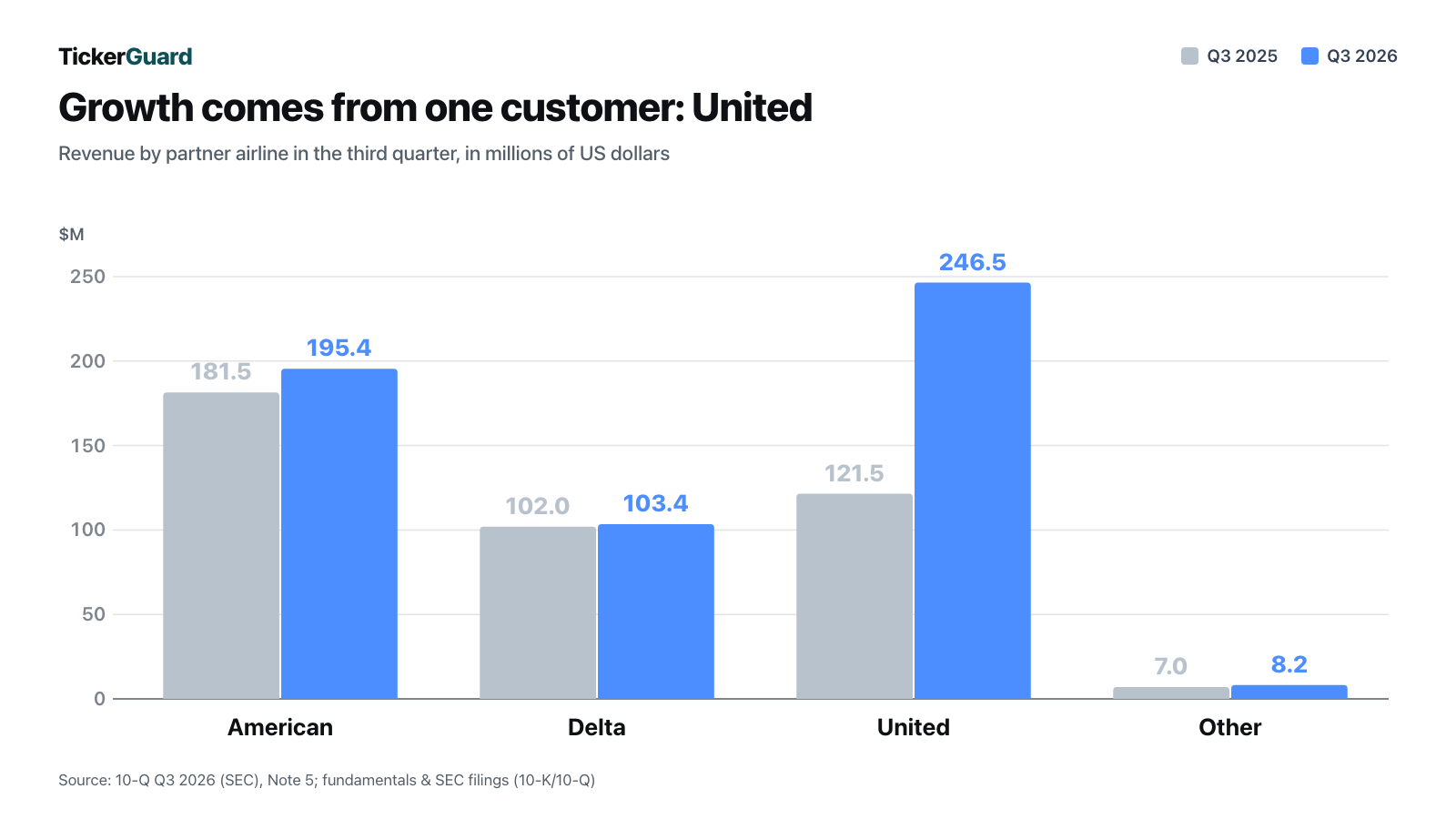
The chart shows where the growth comes from. We return to it in the chapter on uncomfortable truths; for now: of the $141.5 million in additional third-quarter revenue, $125.0 million – more than 88 percent – comes from a single customer.
One-offs and adjusted figures – what is left of the profit jump
This is the chapter to read before you repeat any headline number. The net income of $34.6 million is not comparable with the $6.7 million of the prior-year quarter, because last year contained an item that is almost absent this year: the line “Executive separation and Merger-related items” – severance for executives and merger costs.

“Executive separation and Merger-related items decreased $18.3 million, or 73.2%, to $6.7 million for the three months ended September 30, 2026 from $25.0 million for the three months ended September 30, 2025, primarily due to $18.8 million of cash severance and share based compensation expense recognized during the three months ended September 30, 2025 in connection with the retirement of a former Chief Executive Officer.”
— Republic Airways Holdings Inc., SEC quarterly report 10-Q for September 30, 2026, Item 2 (Executive separation and Merger-related items)
Former CEO Bryan Bedford was nominated to head the Federal Aviation Administration (FAA) and retired on July 1, 2025; his departure cost about $20.8 million in 2025 (10-K 2025). That item sits in the comparison quarter – and explains a large part of the gap.
How much of the jump is real? The following calculation uses only figures from the quarterly report:
- Operating income, reported: $63.2 million versus $26.9 million – up $36.3 million.
- Of which from the dropped severance and merger costs: $18.3 million. That is half of the jump, with nothing improving in flight operations.
- Adjusted operating income (without that item): $69.9 million versus $51.9 million, i.e. +$18.0 million or +34.7 percent. The margin is 12.6 percent in both quarters – unchanged.
- Adjusted net income (per the company’s reconciliation: excluding severance and merger costs and excluding investment income or loss, at a baseline tax rate): $39.6 million versus $26.8 million (+47.8 percent); adjusted earnings per share $0.85 versus $0.67 (+27 percent).
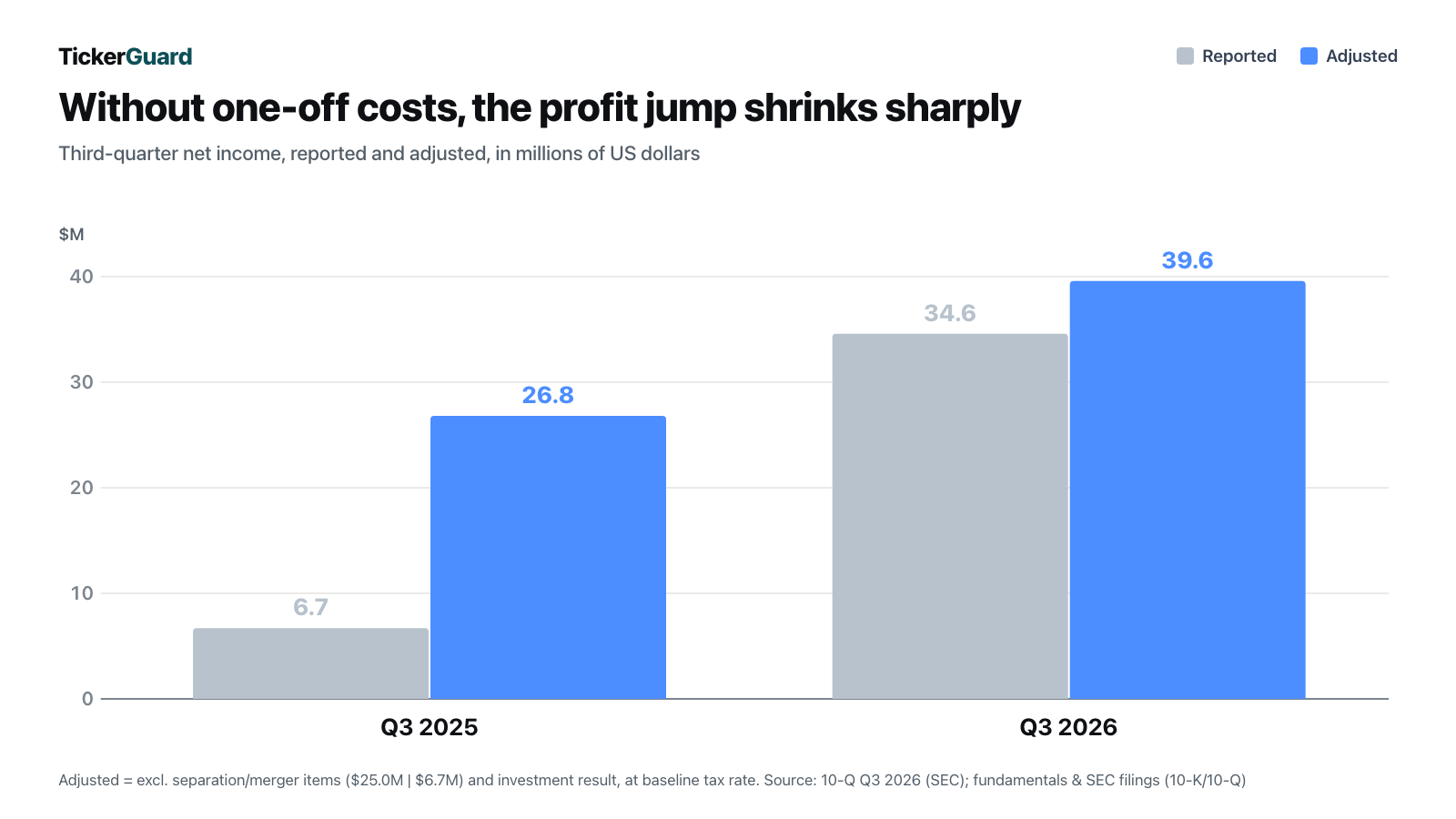
So the picture is split. True: the business is growing, by about a third in adjusted operating income. Equally true: the headline “profit more than quintupled” owes half of its size to the weak comparison quarter; the margin itself did not move, and earnings per share grow by only a little over a quarter. Taking an unadjusted figure as proof of a trend would be misleading – and that cuts both ways: the adjusted number is not “clean” either.
“Adjusted” leaves out real costs. Merger and severance items add up to $29.8 million in the first nine months of 2026 (prior-year period: $31.8 million) – not a one-time outlier but an item that recurs every quarter while integration runs. Over nine months there is therefore no base effect: net income rises 30.2 percent ($92.7 million versus $71.2 million), adjusted net income 31.6 percent ($116.5 million versus $88.5 million) – nearly the same. The most honest view is the nine-month one: just over 30 percent more profit, 13 percent more earnings per share.
One more item below the line: in the third quarter of 2026 the “(income) loss from investments” item in the company’s reconciliation swung from a $5.7 million loss a year earlier to a $0.3 million gain; other expense overall improved by $3.7 million, driven mainly by $5.9 million of additional income from the investment in EVE (an electric-aircraft developer in Embraer’s orbit). That too has nothing to do with flying. The tax rate also rose, from 27.2 to 29.7 percent. Bottom line: neither the reported nor the adjusted figure tells the story alone – together they describe a solid but not spectacular quarter.
What the filings say – the uncomfortable truths
Uncomfortable truth no. 1: the growth comes from one customer
The third quarter by customer (revenue in $ millions, Q3 2026 versus Q3 2025): United 246.5 versus 121.5 (+103 percent), American 195.4 versus 181.5 (+7.7 percent), Delta 103.4 versus 102.0 (+1.4 percent). Without United, revenue grew only 5.7 percent in the quarter ($307.0 million versus $290.5 million, our calculation). The extra revenue at United in turn stems from the new contract for the 60 Mesa aircraft, not from more flying for existing customers.
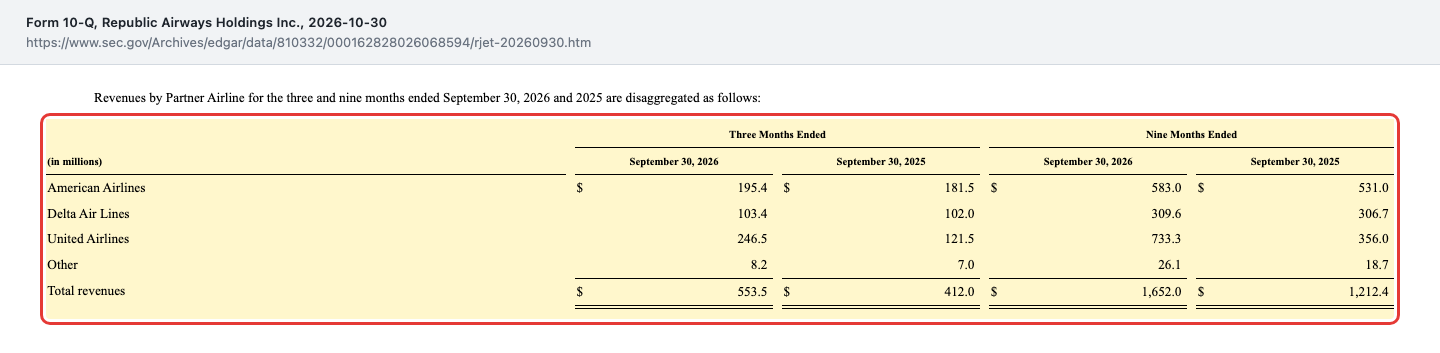
“Revenues increased $141.5 million, or 34.3%, to $553.5 million for the three months ended September 30, 2026 compared to $412.0 million for the three months ended September 30, 2025, due to a 26.2% increase in block hour production and a 23.5% increase in departures due to additional flying under the new CPA with United Airlines as a result of the Merger, beginning November 25, 2025. Additionally, pass-through revenues increased $49.1 million, primarily due to shop-level maintenance for the 60 additional aircraft related to the Merger.”
— Republic Airways Holdings Inc., SEC quarterly report 10-Q for September 30, 2026, Item 2 (Revenues)

Two things sit in that sentence. First, the growth was acquired, not organic – the merger brought 60 aircraft and a contract. Second, $49.1 million of the $141.5 million in extra revenue is “pass-through,” i.e. reimbursed revenue. When Republic pays for maintenance on United’s aircraft and United reimburses it, revenue and costs rise together – profit does not. Total maintenance cost rose 70.7 percent to $133.5 million in the quarter. Remember: for an airline service provider, revenue growth is the weakest of all metrics; it says little about margin.
The flip side is a plus: United owns those 60 aircraft. Republic does not have to buy, depreciate or finance them – depreciation rose only 11.4 percent in the quarter while revenue grew 34.3 percent, and spending on property and equipment (mostly aircraft and parts) fell to $142.3 million in the first nine months (prior year: $286.9 million). That is the favorable math behind the merger.
Uncomfortable truth no. 2: the customers are the owners
Who are Republic’s largest shareholders? The 2026 proxy statement (as of March 27, 2026) answers:
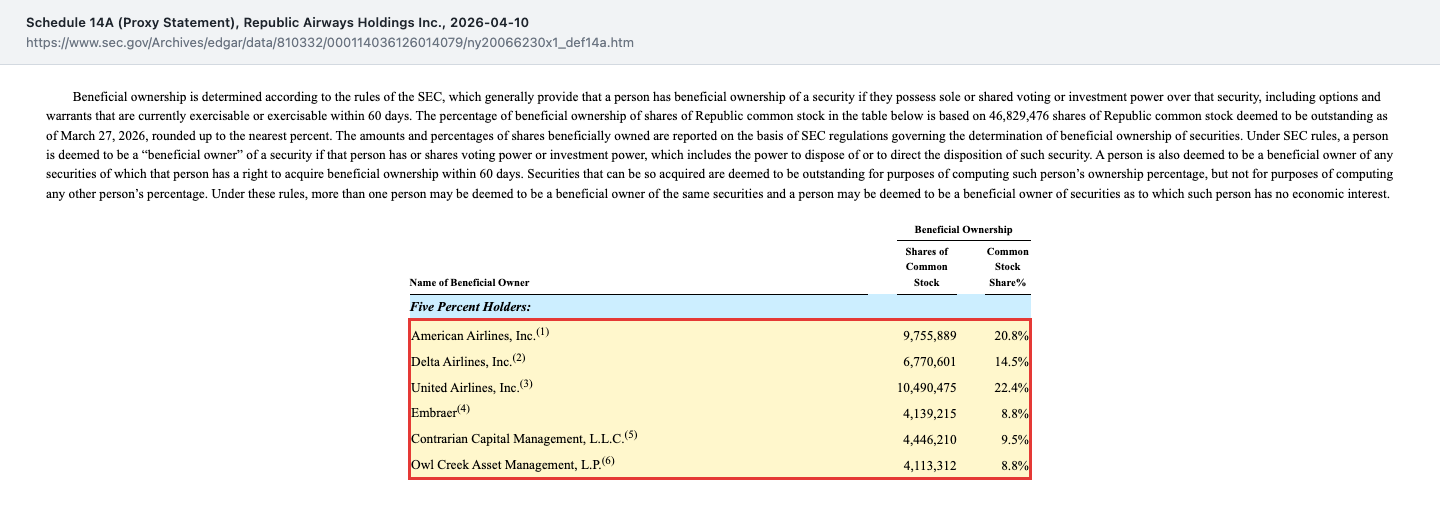
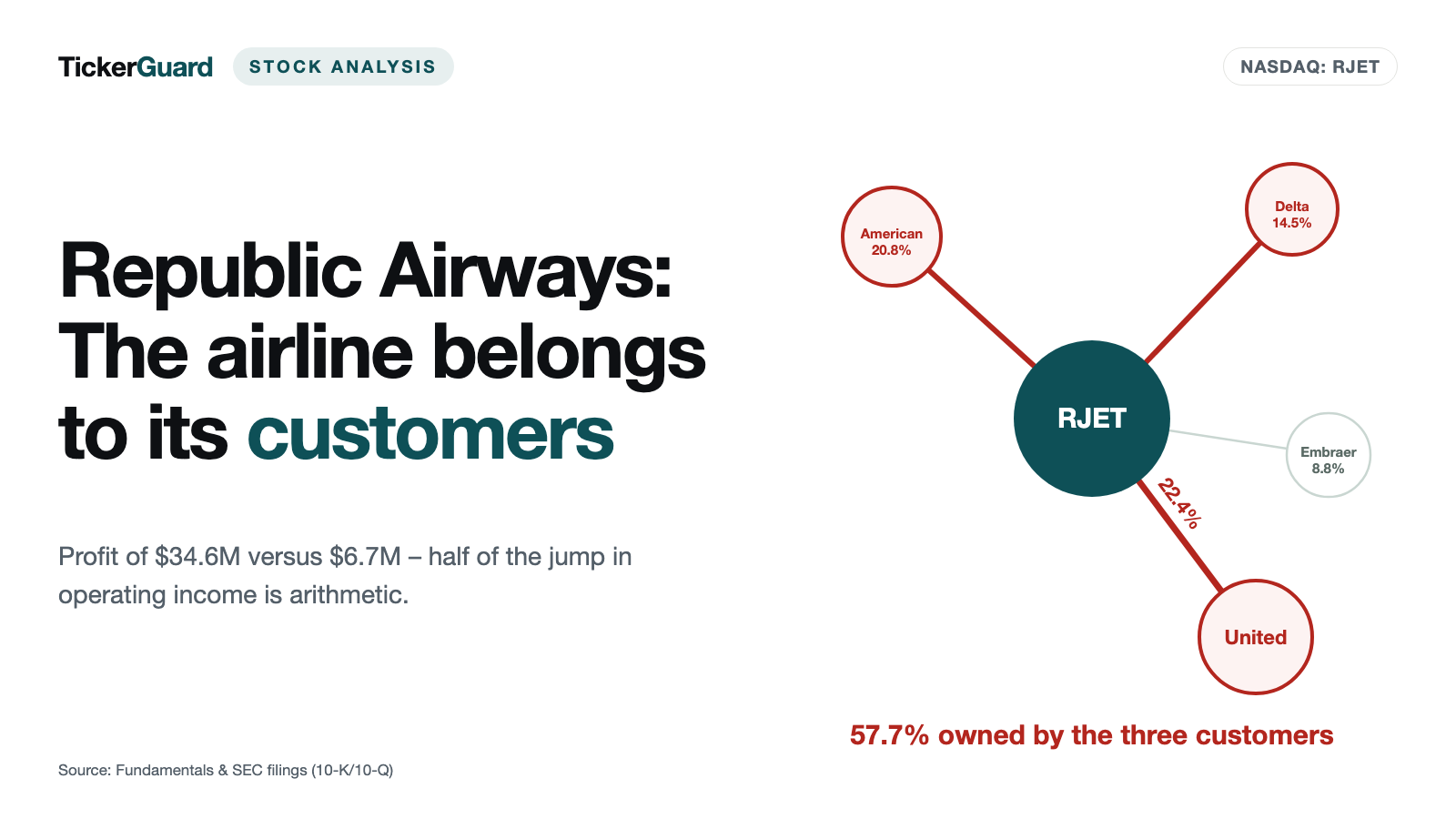
American Airlines holds 20.8 percent, Delta Air Lines 14.5 percent, United Airlines 22.4 percent – together roughly 57.7 percent of the shares (our addition of the three stakes: 27.0 million of 46.8 million shares). Add Embraer, the aircraft maker, with 8.8 percent; Republic buys aircraft, deposits and spare parts from the manufacturer and reports those purchases as related-party transactions ($73.0 million in the first nine months of 2026). The financial investors Contrarian Capital (9.5 percent) and Owl Creek (8.8 percent) are the only large holders that are not also business partners.
What does that mean? On one hand it is a vote of confidence: whoever holds shares does not lightly walk away from a contract. On the other, across the table from you as a minority shareholder sits someone who is both buyer and co-owner: every dollar Republic asks for in a contract extension is a dollar of extra cost for Delta, American and United – and only a fraction of it flows back to them as shareholders. Next up are the Delta contracts (57 aircraft according to an analyst’s question on the Q3 call, average expiry at the end of 2028 per the Q4 2025 call); management’s answer was general (see the chapter on the earnings calls).
Uncomfortable truth no. 3: profit grows faster than your share of it
The merger cost shares: the diluted share count rose from 40.0 million (nine months 2025) to 46.2 million (nine months 2026). That is why net income rose 30.2 percent over nine months while earnings per share rose only 12.9 percent. And the margin points down for 2026: the adjusted EBITDA margin was 18.8 percent over nine months versus 21.4 percent a year earlier; in the third quarter 19.0 versus 20.3 percent. Part of the margin decline is pure arithmetic – pass-through maintenance revenue ($49.1 million of extra revenue in the third quarter, without profit) inflates revenue and dilutes the percentage margin. Operating metrics also eased slightly: the completion factor (share of scheduled flights flown) fell from 95.92 to 94.59 percent – management attributes this on the call to weather and air traffic control; the controllable completion factor was practically unchanged at 99.96 versus 99.99 percent – and daily utilization per aircraft from 9.6 to 9.5 hours. Whether integration weighs on the margin as well cannot be proven from the filings.
Uncomfortable truth no. 4: profit is not cash in the bank
Cash flow from operations fell 10.1 percent to $186.1 million in the first nine months of 2026 (prior year: $207.0 million) – with net income 30 percent higher. That is the counterpart to reported profit: the quarterly report names the decrease in working capital – the timing of collecting receivables and settling liabilities – as the cause. On top of that comes interest: $49.3 million was paid in the first nine months. The balance sheet at September 30, 2026 shows debt and finance leases of $1,024.6 million in total ($183.2 million current, $841.4 million long-term) and cash plus securities of $290.1 million. Management cites net debt including lease obligations of $863 million, $66 million less than in December 2025, and leverage of 2.2x (prior year 2.8x). That is better – but this is an airline: shareholders’ equity of $1,422.5 million faces total assets of $3,261.7 million, mostly aircraft.
What management promised – and what came true
Promises are cheap; kept promises are not. So we lined up Republic Airways' earnings calls side by side and checked what leadership announced – and what had become of it one, two or three quarters later. One honest caveat up front: the company has only traded as RJET since its merger with Mesa Air Group in November 2025. Transcripts of earlier calls from 2023 through 2025 are not available to us. This review therefore rests on four calls: Q4 2025 (March 4, 2026), Q1 2026 (April 29, 2026), Q2 2026 (July 30, 2026) and Q3 2026 (October 29, 2026). All figures come from those transcripts; where we did our own arithmetic, we say so.
Two terms first: block hours measure the time from pushback at the gate to arrival at the destination – for a regional carrier flying for the major airlines, it is the core output metric that drives revenue. Adjusted EBITDAR is operating profit before interest, taxes, depreciation, amortization and aircraft rent – roughly, what the flying business earns before financing costs kick in.
Promised → Delivered?
| What was promised | When | What happened | Status |
|---|---|---|---|
| 2026 guidance: at least 865,000 block hours, revenue of about $2 billion, adjusted EBITDAR of $380 million | Q4 2025 call, March 4, 2026 | Raised on the Q2 call (July 30, 2026) to about 880,000 block hours, revenue above $2.1 billion and EBITDAR of $395–$405 million. Raised again on the Q3 call (October 29, 2026) to EBITDAR of $410–$420 million, plus adjusted EPS above $3.30. | Exceeded so far – the year is not over yet |
| Bring net leverage below 2.2x by year-end 2026, long-term target below 1.5x | Q4 2025 call, March 4, 2026 | Flat at 2.7x after Q1 (Q1 call, April 29, 2026). 2.2x at the end of September, net debt of $863 million, down $66 million since December 2025 (Q3 call, October 29, 2026). | Almost there – "below 2.2x" still pending |
| Repay $165 million of debt in 2026 | Q4 2025 call, March 4, 2026; reaffirmed on the Q1 call, April 29, 2026 | Reported repayments: $49 million (Q1), $43 million (Q2), $38 million (Q3) – $130 million after three quarters by our addition. | On track |
| Back-office consolidation (HR, compliance, finance, supply chain) substantially complete by Q3 2026 | Q4 2025 call, March 4, 2026 | Re-dated to Q4 2026 on the Q1 call – in the same breath as "slightly ahead of plan." On the Q3 call: substantially all of Mesa's corporate functions have moved to the Carmel, Indiana campus. | Achieved, but the target date moved in between |
| Consolidate IT systems by end of 2026 (excluding the dedicated IT operations systems) | Q4 2025 call, March 4, 2026 | Described on the Q1 call as a multiyear process that only fully wraps up with the single operating certificate in 2028. That certificate requires five FAA revision cycles; cycle 1 was accepted in Q2, cycle 2 in Q3. | Milestones met, end date stretched |
| Mesa fleet harmonization: 40% done by year-end 2026, complete by year-end 2027 | Q4 2025 call, March 4, 2026 | On the Q3 call: heavy-check turnaround times about 40% lower than a year ago, target still end of 2027. The 40% work-completion milestone was not quantified again on any later call; supply chain constraints were added. | Open |
| Joint collective bargaining agreements with every labor group | Q4 2025 call, March 4, 2026 | Flight attendants: agreement reached in December 2025, being implemented in 2026 (Q1–Q3 calls). Pilots: still negotiating; absent a deal, interest-based arbitration is expected to begin in mid-December (Q3 call, October 29, 2026). | Half done – the most expensive part is missing |
| Redeploy unallocated aircraft | Q1 call, April 29, 2026 (7 E170s unallocated); Q2 call, July 30, 2026 (8 aircraft) | 5 E170s enter service for American Airlines in early December on a 6-year term (Q3 call, October 29, 2026). | Largely delivered |
Bottom line: on financial targets, management has so far delivered more than it promised. On merger timelines, by contrast, some target dates were pushed back without management explicitly explaining the change.
Where the tone shifted
From Q4 2025 to Q1 2026: "ahead of plan" – with a later date. In March, the back-office timeline sounded like this:
This work is well underway and we expect it to be substantially completed by Q3 of 2026.
Earnings call Q4 2025, March 4, 2026
Eight weeks later:
We are slightly ahead of plan on the back-office integration, and we expect that work to be substantially complete by Q4 of this year.
Earnings call Q1 2026, April 29, 2026
In effect the message was "slightly ahead of plan" – and the completion date moved back a quarter. Other lines moved on the same call: the next Embraer delivery slid from early 2027 to April 2028, and IT integration went from "end of 2026" to a process running into 2028. The Embraer deferral came with a plausible rationale (matching deliveries to partner demand); the back-office date did not.
From Q2 to Q3 2026: "ahead of schedule" becomes "on track." In July, the message was confident:
I'm pleased to report that we remain ahead of schedule and this quarter delivered a significant milestone.
Earnings call Q2 2026, July 30, 2026
By October, "ahead of schedule" had disappeared. In its place: "on track" – and a new caveat:
Supply chain challenges remain an industry headwind as you've heard throughout this earnings season, and we have made this harmonization progress despite these constraints.
Earnings call Q3 2026, October 29, 2026
On the most sensitive topic, the pilots, the tone hardened too. In July, management said it was actively negotiating and would update the market as meaningful progress was achieved. In October, a fallback appeared for the first time:
If we are unable to reach an agreement, interest-based arbitration is expected to begin in mid-December and continue into 2027.
Earnings call Q3 2026, October 29, 2026
Arbitration is not a crisis, but it is the opposite of smooth sailing. For investors, the cost of a new pilot contract is the big unknown for 2027 – and none of the four calls put a number on it.
The Q&A: where analysts pushed – and where they didn't
Prepared remarks are a glossy brochure. What happens when analysts follow up is more revealing. The first thing that stands out is how thin the Q&A sessions became: three analysts asked questions in March, three in April (one of them twice), two in July – and in October just a single representative with two questions. For you as a reader it means a lot simply went unasked.
The recurring pattern: no breakdown. In the very first Q&A, Savi Syth (Raymond James) asked how much the merger would drag on 2026 and how much would be unlocked afterwards. The answer:
Yes, we aren't breaking that out specifically in our guidance.
Earnings call Q4 2025, March 4, 2026
In April she asked how much the winter had hit earnings. Again: "We didn't break out the impact." In the same breath, Koscal did say "a little over 3 full points" – without saying of what. And in July, Michael Linenberg (Deutsche Bank) pressed on whether full integration could add a couple hundred basis points of margin:
So Mike, I don't know if we're ready to unpack what it looks like at the end of the road here yet.
Earnings call Q2 2026, July 30, 2026
That is the core question of any merger – how much more profit sticks at the end? – and after four calls it remains open. To be fair, on operational follow-ups management did get specific, citing a 10% to 15% utilization uplift for the Mesa fleet once maintenance is fully harmonized and roughly 9.8 hours per day per scheduled available aircraft (Q2 call, July 30, 2026). Ask a concrete operational question and you get numbers – just not on margins.
A signal that was honored. In April, Linenberg noted the company seemed to be running ahead of plan despite the winter chaos. The answer was unusually candid:
And look, in any other environment that we're sitting here talking to you today after the quarter that we put together and what we're seeing in our block hour demand going into Q2, Q3, we would be taking up our guidance.
Earnings call Q1 2026, April 29, 2026
Three months later the raise did come – despite a storm-hit July with a completion factor of only 91% through July 28 (Q2 call). Here, management kept its word.
Two readings of pilot attrition. In April, asked about pilot attrition, Matt Koscal – then still President and CEO-designate – said:
Attrition remained through the quarter at normalized trends, going back to a pre-COVID standard, healthy level of attrition
Earnings call Q1 2026, April 29, 2026
In October, the look back sounded different: attrition had been below normal in the first half, mainly because Spirit Airlines' liquidation put pilots on the market. Verbatim: "we experienced reduced attrition of pilots throughout the first half of 2026, mostly driven by the availability of Spirit pilots post their liquidation." (Q3 call, October 29, 2026) It is more than a detail: the April statement did not yet mention the external effect that management cites in October for the first half.
What went unanswered on the latest call. The only questioner in October, Carter Eades (for Raymond James), asked about extending the Delta contracts – according to his question, 57 aircraft with average expirations in 2028. That makes Delta the partner with the earliest contract ends (per the Q4 2025 call: late 2028, American 2030, United 2034). The answer stayed general:
So we're in a constant conversation and negotiation on extensions.
Earnings call Q3 2026, October 29, 2026
On the follow-up about the earnings contribution of additional block hours in 2027, CFO Joe Allman offered 3% to 5% block hour growth but sidestepped profit: "we're not prepared to talk about 2027 just yet." That leaves three questions open that will matter most over the next few years: the Delta extension, the cost of the pilot contract and margins once integration is complete.
Bottom line
Four calls are a short track record, but the picture is clear enough. On hard financial targets, Republic has delivered: 2026 guidance was raised twice, debt is coming down as announced, and the April hint ("we would be taking up our guidance") was honored. On the softer targets – merger timeline, pilot contract, end-state margins – a pattern emerges that is worth knowing: dates were pushed back several times, and the questions that move the most money get no breakdown. That is no proof of trouble, but it is no proof against it either. The human bias to guard against here is the halo of a beat-and-raise: a company that lifts guidance twice easily earns credit for what it leaves unsaid. Whether the merger delivers the promised efficiency will not be decided before 2027 and 2028 – and on exactly that point, management has so far said nothing that can be checked.
Valuation – what the market is pricing in
Valuation figures age faster than anything else, so each carries a date. At the October 30, 2026 closing price ($19.32 per share) and 45.95 million shares outstanding (balance sheet at September 30, 2026), the market capitalization is roughly $888 million (our calculation). Add management’s stated net debt of $863 million and you get an enterprise value of about $1.75 billion (our calculation) – roughly 4.2 times the adjusted EBITDAR targeted for 2026 (midpoint of the range: $415 million; our calculation).
On earnings: against guidance of “more than $3.30” adjusted earnings per share, the price-to-earnings ratio is below 5.9. On trailing twelve-month reported earnings – about $2.1 per share, consisting of the nine-month figure of $2.01 plus the 2025 fourth quarter (about $0.12 per share per the March 4, 2026 call) – it is about 9 (our calculation). Against book value ($1,422.5 million ÷ 45.95 million shares ≈ $31 per share), the stock trades at about 0.6 times (our calculation).
At first glance those look cheap – and they explain why the market hesitates anyway: an airline is capital-hungry, interest eats a lot, there are only three customers, and their contracts expire (Delta end of 2028, American 2030, United into 2034; calls). The market also knows that regional-airline profits hang on contract pricing – which is being renegotiated with owners on the other side. Whether 5.9 or 9 or 4.2 is cheap depends not on the number but on whether earnings survive the extensions. The guidance is management’s, not ours; since March management has raised it twice (see the calls chapter).
Opportunities and risks
What speaks for the company:
- Contracts with fixed monthly compensation: fuel, fares and load factors are borne by the customer; contracts run on average to 2028 (Delta), 2030 (American) and 2034 (United).
- Scale after the merger: by its own account the second-largest independent U.S. regional airline; back office and maintenance are being consolidated, and shop turn times are down about 40 percent according to the Q3 call.
- Guidance raised twice since the March original (July and October 2026); leverage cut from 2.8x to 2.2x within a year.
- The quarterly report considers financing for the next twelve months covered; a secured loan (collateral: spare engines) was extended from 2030 to 2031.
What speaks against it:
- Three customers who also hold 57.7 percent of the shares: a potential conflict of interest in contract extensions.
- Almost nine-tenths of third-quarter 2026 growth comes from one customer and one merger; organically American and Delta grow only 7.7 and 1.4 percent.
- Open pilot labor contracts: without agreement, interest-based arbitration is expected to begin in mid-December 2026 per the Q3 call and may run into 2027. Management gave no cost figure in any of the four calls.
- Falling adjusted EBITDA margin (18.8 versus 21.4 percent over nine months; the operating margin in the third quarter stayed at 12.6 percent) and declining operating cash flow (−10.1 percent over nine months) despite rising profit.
- High debt: $1.0 billion plus lease obligations; interest expense of $49.9 million in nine months alone ($49.3 million was paid in cash).
- Leadership change: Matthew Koscal has been CEO since June 15, 2026, his predecessor David Grizzle (in office since July 1, 2025) is non-executive chairman again – the second change at the top within twelve months.
For the opposite model – an airline that sells its own tickets and therefore bears every fuel price swing and empty row itself – see our stock analysis of Allegiant Travel.
Conclusion – the percentage trap
Back to the start: quarterly profit more than quintupled, and that is true. But half of the jump in operating income did not come from better flying; it came from a cost line that shrank versus last year. Adjusted, the business grew by roughly a third – decent, bought through a merger, at a constant margin. One caveat remains: the contracts that carry this margin will be renegotiated over the coming years – with partners who together own almost 58 percent of the company.
The human weakness behind the percentage trap is not stupidity but haste: a big number is a signal, a small base is work. The next time a headline says “profit up fivefold,” take the time to read the comparison base and the adjustment line – that is most of what an analyst does. Whether Republic Airways is worth buying is your call – this analysis gives you the math, not the recommendation.
Sources and data cut-off
- Quarterly report 10-Q for September 30, 2026, filed October 30, 2026 (accession 0001628280-26-068594), sec.gov
- Earnings release (8-K, Item 2.02) of October 29, 2026, and quarterly reports for June 30, 2026 (filed July 31, 2026) and March 31, 2026 (filed May 1, 2026)
- Annual report 10-K for 2025, filed March 19, 2026, sec.gov
- Proxy statement DEF 14A, filed April 10, 2026, sec.gov
- Leadership filings (8-K of April 28, 2026 and June 17, 2026, Item 5.02)
- Earnings call transcripts of March 4, April 29, July 30 and October 29, 2026
- Source: fundamental data & SEC filings (annual and quarterly reports, 10-K/10-Q); price and market capitalization as of October 30, 2026
Disclaimer: This is not investment advice and not an invitation to buy or sell securities. All information without guarantee; our own calculations are marked as such.
Key figures at a glance
All monetary figures in millions of $; earnings per share as reported.
| Metric | 2021 | 2022 | 2023 | 2024 | 2025 |
|---|---|---|---|---|---|
| Revenue | 503.6 | 1,327.2 | 1,429.1 | 1,474.0 | 1,676.5 |
| Operating Income (EBIT) | -51.8 | 132.3 | 135.3 | 137.0 | 215.4 |
| Net Income | 16.6 | 67.8 | 54.8 | 64.6 | 76.2 |
| Net Margin | 3.3% | 5.1% | 3.8% | 4.4% | 4.5% |
| Earnings Per Share | 6.41 $ | 26.65 $ | 20.05 $ | 23.35 $ | 1.87 $ |
Source: fundamental data & SEC filings (annual and quarterly reports, 10-K/10-Q)
Our Bottom Line at a Glance
- Business model positive
- Fixed fees under capacity purchase agreements: fuel, fares and load factors are the partners’ burden. Revenue grew from $1,429.1M to $1,676.5M in 2023–2025, net income from $54.8M to $76.2M; contracts run on average to 2028 (Delta), 2030 (American) and 2034 (United).
- Earnings quality neutral
- Quarterly profit ($34.6M versus $6.7M) is half a base effect: $18.3M of severance and merger costs dropped out. Adjusted, operating income is +34.7 percent at an unchanged 12.6 percent margin; over nine months net income is +30.2 percent.
- Customer dependence & owners negative
- Three customers supply all flying revenue (United 44.5, American 35.3, Delta 18.7 percent in Q3 2026) and own about 57.7 percent of the shares. 88 percent of the extra revenue comes from United; the Delta extension (end of 2028) is open.
- Balance sheet & cash flow neutral
- Debt and finance leases $1,024.6M, net debt including leases $863M (2.2x, prior year 2.8x); equity $1,422.5M. Operating cash flow fell 10.1 percent to $186.1M over nine months; interest expense is $49.9M ($49.3M paid).
- Margins & integration negative
- Adjusted EBITDA margin 18.8 versus 21.4 percent over nine months; completion factor 94.59 versus 95.92 percent (weather-related per management). Pilot contracts are open (arbitration possible from mid-December 2026); management names no cost.
Republic Airways is a solid contract business with predictable revenue whose latest profit jump is half arithmetic: adjusted, operating income grew 34.7 percent in the third quarter of 2026 at the same margin. Growth comes almost entirely from one customer and one merger, three customers own almost 58 percent of the company, and the key contracts and labor agreements are open over the next years. Not investment advice.
What Our Rating Means
Open questions
The business works in principle, but one material question is open. As long as it stays open, our findings do not carry a quality verdict.
The business works and has made money for years, and the balance sheet holds (leverage 2.2x, twelve months of financing covered). One material operating question is open, though: does the margin hold when the pilot contracts are renegotiated and the Delta contracts extended – with three customers who also own almost 58 percent of the shares? In addition, third-quarter 2026 growth hangs almost nine-tenths on one customer and one merger. That is not a solvency risk, but it is an unresolved dependency. The decision is yours.
A journalistic assessment by our editorial team at the time of the deep dive, based on public sources — not investment advice and not a solicitation to buy or sell. Your personal circumstances (investment goals, risk capacity, taxes) cannot be taken into account. What our levels mean, how verdicts are formed, and what conflicts of interest exist →
Worth Noting
- The occasion for this analysis is the quarterly report for September 30, 2026 (filed October 30, 2026). One-offs and adjusted figures have their own chapter; quoting profit without adjustment would be misleading.
- Data portals sometimes show a loss per share for the third quarter of 2025; the quarterly report shows $0.17 of profit. For time series before December 2025, Mesa figures are not comparable with Republic (merger, 15-for-1 reverse split).
- Valuation figures dated: price $19.32 (close of October 30, 2026), 45.95 million shares (September 30, 2026). Our own calculations are marked in the text; daily prices are not a reason to buy.
Stock Watch
This analysis is as of October 31, 2026. Stock Watch will tell you what's changed at RJET since then.
Later $1 a month per stock — signing up is free, and you'll be the first to know when it launches.
The full analysis as a PDF for later
We will send you this analysis as a PDF — to print, file away, and read at your own pace. And we will add you to the free Stock Watch list for Republic Airways Holdings Inc (RJET), so you hear about it when something material in this analysis changes.
Frequently Asked Questions
Republic Airways Holdings (Nasdaq: RJET) operates Embraer E170/E175 regional jets on behalf of American Airlines, Delta Air Lines and United Airlines. Flights run under the American Eagle, Delta Connection and United Express brands; tickets, fares and fuel sit with the partners, while Republic receives contractually agreed compensation (capacity purchase agreements). At December 31, 2025 the group employed about 8,400 people.
Third-quarter 2026 net income rose from $6.7 million to $34.6 million. Half of the rise in operating income ($18.3 million of $36.3 million) is a base effect: the prior-year quarter carried severance and merger costs of $25.0 million (of which $18.8 million for a former CEO’s departure), versus $6.7 million this year. Adjusted, net income rose from $26.8 million to $39.6 million (+47.8 percent) and adjusted operating income by 34.7 percent at an unchanged margin of 12.6 percent.
On November 25, 2025, the previously unlisted Republic Airways merged with the listed Mesa Air Group. The Mesa Air Group shell was renamed Republic Airways Holdings Inc.; Mesa shares had undergone a 15-for-1 reverse split beforehand. For accounting purposes legacy Republic is the acquirer, so pre-merger comparison figures show Republic’s history.
According to the 2026 proxy statement (as of March 27, 2026), United Airlines holds 22.4 percent, American Airlines 20.8 percent and Delta Air Lines 14.5 percent – about 57.7 percent together – plus Embraer 8.8 percent, Contrarian Capital 9.5 percent and Owl Creek 8.8 percent. The three largest shareholders are also the company’s three customers.
At September 30, 2026, the balance sheet shows debt and finance leases of $1,024.6 million ($183.2 million current) against $290.1 million of cash and securities. Management cites net debt including lease obligations of $863 million and leverage of 2.2x (prior year 2.8x). Shareholders’ equity is $1,422.5 million.
In March 2026 management guided to at least 865,000 block hours, about $2 billion of revenue and $380 million of adjusted EBITDAR; guidance was raised in July ($395–405 million) and October 2026 ($410–420 million EBITDAR, adjusted earnings of more than $3.30 per share). On merger timelines, targets were partly pushed out; the margin after integration and the cost of the pilot contracts remain open.
Found an error?
Did you spot a factual error, an outdated number, or a typo in this deep dive? Let us know briefly — your report goes straight to the editorial team.