Rakuten: the first quarterly profit in six years — and where the 27 billion yen actually came from
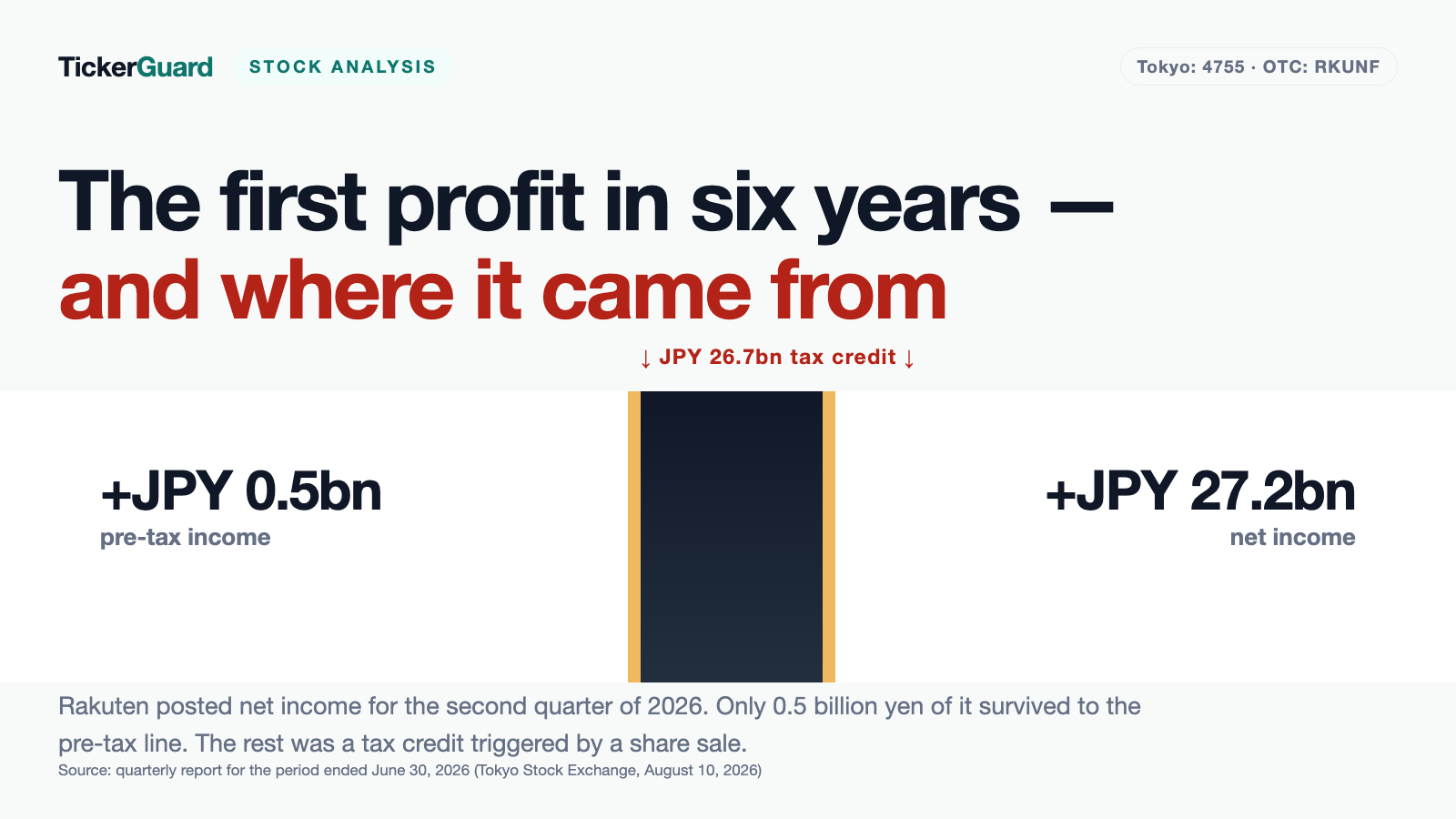
On August 10, 2026, Rakuten reported net income of 27.2 billion yen for the second quarter — the first profit for its own shareholders in six years. Only 0.5 billion yen of that survived to the pre-tax line. The remaining 26.7 billion was a tax credit triggered by a share sale whose every trading day is on file with the U.S. securities regulator. Across the full first half, shareholders are still down 10.9 billion yen. We read what the report actually says — and what the headline leaves out.
 Thomas Mücke
Founder & Publisher
Thomas Mücke
Founder & Publisher
As of Today
As of: September 30, 2026
- Closing price
- 4.20 $ 0.00%
- Market Capitalisation
- 9.2 $B
- Growth Score
- 4/10
- AAQS
- 5/10
Price change since August 14, 2026: -12.7%
This analysis has a cut-off date. The Stock Guard tells you when something material changes in the numbers. Reserve your free spot
Chart
Interactive price chart (TradingView).
52-week range: 4.10 $ to 7.00 $ · Last price: 4.20 $ (As of: September 30, 2026)
Note: pure fact-based analysis, not investment advice and not a solicitation to buy or sell. All figures without guarantee.
There is an investor trap that catches all of us because it is so comfortable: the headline trap. A headline hands you a finished feeling — "first profit in six years" — and your brain files the matter away before you have read a single number. It works especially well with words like "first", "finally" or "in six years": they narrate a turning point, and turning points sell. On August 10, 2026, Rakuten delivered exactly such a headline. The group reported net income of 27.2 billion yen for the second quarter of 2026 and its first profit for its own shareholders since the second quarter of 2020.
So let us make a deal. We leave the headline where it is and read the report it came from instead: the quarterly filing with the Tokyo Stock Exchange dated August 10, 2026, the results presentation of the same day, and a handful of documents Rakuten was required to file in the United States. Out of that comes the tension this analysis turns on: Rakuten's business has been getting better for years — and the celebrated profit still originated almost entirely outside that business.
What Rakuten actually does — department store, bank and mobile network under one roof
Rakuten Group, Inc., headquartered at Rakuten Crimson House in Setagaya-ku, Tokyo, is best understood as a Japanese blend of Amazon, a direct bank and a mobile carrier — except that in Japan all three belong to the same group and are tied together by a shared loyalty points system. Founded in 1997 by Hiroshi Mikitani, who still runs it as chairman and chief executive, the company was called simply "Rakuten, Inc." until March 31, 2021; shareholders approved the new trade name on March 30, 2021 and it took effect on April 1, 2021.
Reporting runs in three segments. Internet Services is the origin: the Rakuten Ichiba marketplace, where merchants operate their own storefronts, plus travel booking, advertising, logistics and, internationally, the e-book retailer Kobo and the Viber messenger. In 2025 the segment produced 1,369,697 million yen of revenue and 88,943 million yen of operating income on the company's own measure. FinTech is the earner: Rakuten Card, Rakuten Bank, Rakuten Securities, payments and insurance — 975,931 million yen of revenue and 199,922 million yen of operating income in the same year. Mobile is the project that overshadows everything: since 2020 Rakuten Mobile has been building a nationwide network of its own against the three incumbents NTT Docomo, KDDI and SoftBank — 482,838 million yen of revenue and an operating loss of 161,841 million yen in 2025.
The glue between the parts is Rakuten Points. Shop online, pay with the Rakuten card, use Rakuten mobile and bank with Rakuten, and you earn more points — which makes leaving for a competitor more expensive. Rakuten calls this its ecosystem; in the segment report it appears as a separate line crediting the mobile business with a contribution from the rest of the group (21,155 million yen in the first half of 2026). As of December 31, 2025, the group employed 29,419 people.
Company history for investors
-
2020
Launch of its own mobile network
Rakuten enters as the fourth carrier against NTT Docomo, KDDI and SoftBank. For shareholders it starts a loss run that had cost roughly JPY 1.86 trillion by mid-2026.
-
2023
Rakuten Bank listing and capital increase
The bank goes public in April; in May, 542,306,800 new shares are issued at JPY 566. Existing holders are diluted, and part of group profit now belongs to outsiders.
-
2024
Operating income turns positive again
After three loss years Rakuten reports JPY 52,975m of IFRS operating income. Shareholders are still left with a loss of JPY 162,442m.
-
2025
First positive mobile EBITDA and 10 million subscriptions
Mobile earns money before depreciation for the first time, and the 10 million subscription mark falls on December 25. The operating loss narrows to JPY 161,841m.
-
2026
Half the AST SpaceMobile stake sold
Roughly $1.256bn comes in between April 14 and May 5. The money funds the mobile business — and the sale triggers the tax credit that turns the quarter positive.
-
2026
First quarterly profit in six years
On August 10, Rakuten reports JPY 7.7bn of profit for shareholders. Across the full half year they are still down JPY 10,941m.
Why there is no SEC annual report here — and what sits at the SEC anyway
One point up front, because it shapes the evidence behind this analysis: Rakuten files no 10-K and no 10-Q — and no 20-F either, the form foreign companies with a U.S. listing normally submit. Rakuten is not registered as a reporting company with the U.S. securities regulator, the SEC; the group relies on an exemption that lets foreign issuers furnish their home-market disclosures instead of U.S. reports. Its mandatory reporting therefore runs through the Tokyo Stock Exchange: a quarterly and annual statement (決算短信, Kessan Tanshin) and, once a year, the detailed annual securities report (有価証券報告書, Yūka Shōken Hōkokusho). Rakuten publishes both in English. Every figure in this analysis is therefore sourced to "fundamental data and financial reports (Tokyo Stock Exchange quarterly and annual filings)" rather than to SEC filings.
One detail matters. The quarterly report for the period ended June 30, 2026 carries the line "This financial report is not subject to an audit firm's interim review." — so it was not even reviewed, let alone audited. That is standard practice for a Japanese quarterly statement and no accusation, but it is a different standard of assurance than an audited annual account.
The SEC file is interesting nonetheless. There is one, under CIK 0001294591, administered by the "International Corp Fin" office and carrying the old name "Rakuten, Inc." until February 2021. It contains no financial statements, but three kinds of document that matter to investors: Form F-6 filings for the American depositary receipt programme, quarterly 13F-HR reports on Rakuten's own U.S. securities holdings — and, filed through Hiroshi Mikitani's personal identifier, Schedule 13D/A and Form 4 reports on a stake in a U.S. satellite company. That last group will carry a good part of this analysis.
RKUNF, RKUNY, 4755 — three tickers, one company
Type "Rakuten" into an order screen and, depending on your broker, you get something different. Worth sorting out, because the difference costs money.
The common share trades on the Tokyo Stock Exchange Prime Market under code 4755 (ISIN JP3967200001). That is where the real trading happens. In the United States there are two sideshows in over-the-counter trading: RKUNF is the direct representation of that same common share, while RKUNY is an American depositary receipt. For the receipt programme, JPMorgan Chase Bank, N.A. filed a Form F-6 with the SEC, and the ratio is stated there verbatim:
"American Depositary Shares evidenced by American Depositary Receipts, each American Depositary Share representing one common share of Rakuten Group Inc."
— Rakuten Group Inc., Form F-6 POS (Post-Effective Amendment No. 2), filed December 4, 2023, registration number 333-192545, calculation of registration fee

In practice: one company, three price tags. More important than the ratio is tradability. The American RKUNF line is exceptionally thin. Across the 39 trading days between June 1 and August 14, 2026, the median daily volume was 600 shares — at a price of $4.81 that is roughly $2,900 of turnover on an average day. On individual days 30 shares changed hands. Anyone buying or selling through a line like that moves the price with their own order and pays a bid-ask spread they would never see in Tokyo. We described the same pattern — well-known foreign group, paper-thin U.S. secondary line — in our analysis of Haier Smart Home.
How the stock reached our desk
Not through one of our quantitative scanners: a group with five consecutive loss years and an equity ratio of 4.2 percent fails most quality screens. Rakuten reached our research list through the discussion rankings of the German investor forum wallstreet-online, where it was among the heavily debated names in August 2026. That is a hook, not a buy signal — forum attention measures enthusiasm, not quality.
The second reason to look closer is the announcement itself. When a group of this size reports its first quarterly profit in six years, the news travels through every wire. That is precisely when it pays to ask what sits underneath the headline. And the answer sits in a single paragraph of the results presentation.
The numbers over the years — credit where it is due
First what genuinely impresses, and there is more of it than the loss record suggests. Rakuten grows reliably. Consolidated revenue rose from 1,681,757 million yen in 2021 through 1,920,894 (2022), 2,071,315 (2023) and 2,279,233 (2024) to 2,496,575 million yen in 2025, up 9.5 percent. The company calls 2025 its 29th consecutive record year — a streak few businesses anywhere can match.
The operating picture is turning too. IFRS operating income — the measure Rakuten is actually bound by — was negative 194,726 million yen in 2021, negative 371,612 in 2022 and negative 212,857 million in 2023. Since 2024 it has been positive: 52,975 million (2024) and 14,382 million yen (2025). And per the quarterly report, income before tax turned positive in the first half of 2026 for the first time in seven years:
"Notably, during this interim period, both income before income tax and net income turned profitable for the first time in seven years, since the six months ended June 30, 2019."
— Rakuten Group, Inc., quarterly report (決算短信) for the six months ended June 30, 2026, published August 10, 2026, section 1 (1)
Except that income before tax for the half year was 17,883 million yen on revenue of 1,309,052 million. That is a pre-tax margin of 1.4 percent. And one level further down, where the shareholder stands, it is still red. The chart below puts both lines side by side, and it is the core of this analysis.
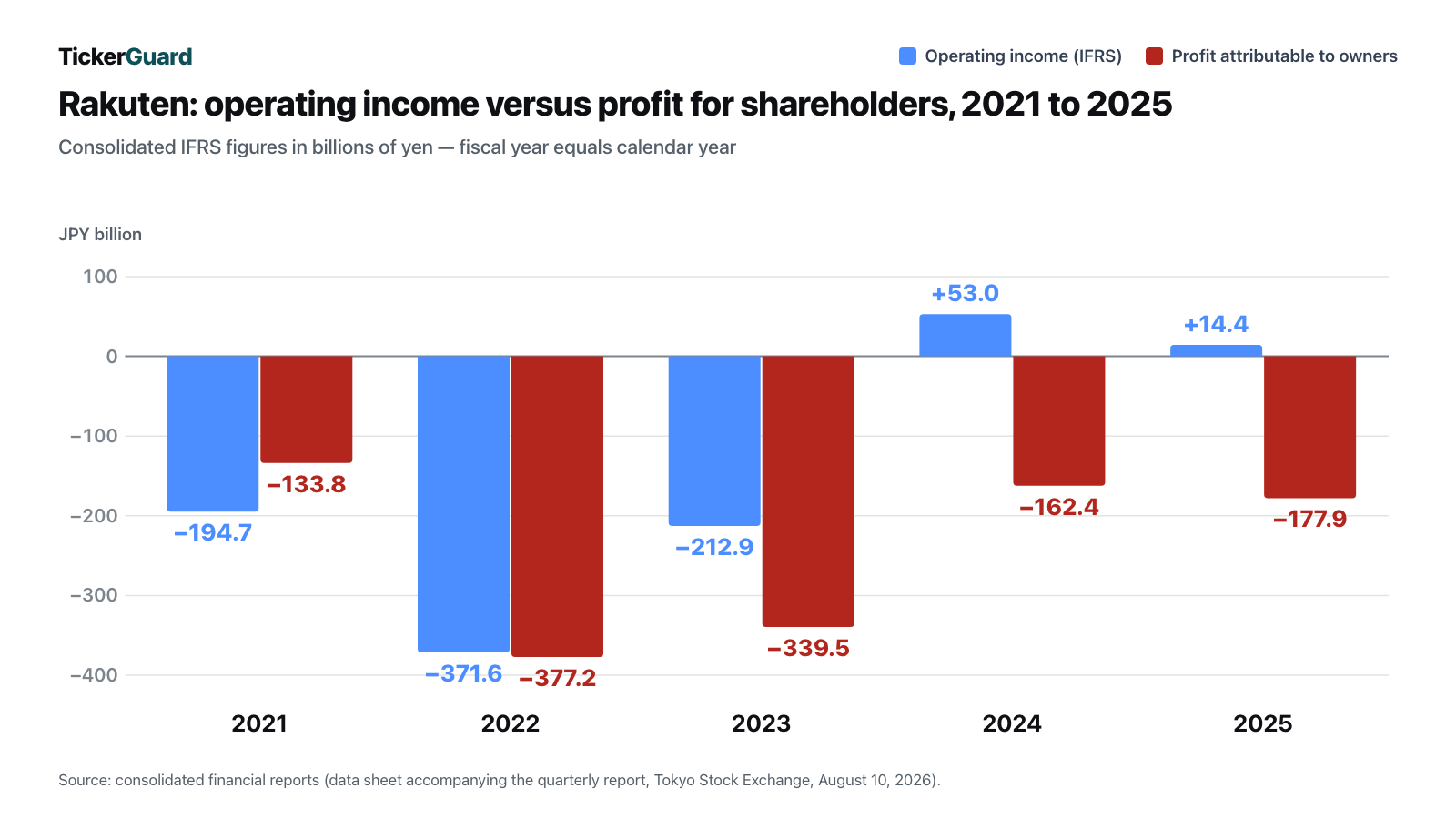
Two floors sit between operating income and what reaches the shareholder: financing costs and minority interests. Both are unusually large at Rakuten, and both get their own section below.
Credit is also due to the mobile business. For years it was the hole everything drained into — and it is measurably improving. The segment operating loss shrank from 475,916 million yen in 2022 through 314,570 (2023) and 208,933 (2024) to 161,841 million yen in 2025; 2025 was also the first year in which mobile posted positive earnings before depreciation and amortization. As of June 30, 2026, Rakuten Mobile counted 10.75 million subscriptions, 1.78 million more than a year earlier, with a churn rate of 1.38 percent and average revenue per user of 2,921 yen a month. The 10 million mark fell on December 25, 2025.
What the filings say — the uncomfortable truths
Uncomfortable truth no. 1: the profit came from the tax line, not from the business
The celebrated quarterly profit has a very precise origin. Rakuten's deputy chief financial officer, Eiichi Kaga, explains it himself in the results presentation:
"In addition, income before tax was positive for the fourth consecutive quarter since the third quarter of last year. Furthermore, as I will explain later, a reversal of tax expense arose in connection with the sale of shares we held, and as a result, quarterly net income attributable to owners of the parent returned to profit for the first time in six years, since the second quarter of 2020."
— Eiichi Kaga, deputy chief financial officer, second-quarter 2026 results presentation with speaker notes, August 10, 2026
And, in the same document:
"Please understand that this negative tax expense reflects the fact that no actual tax payment was incurred. This accounting treatment highlights the fact that, as a result of past strategic investments, the Company holds tax loss carryforwards exceeding one trillion yen."
— Eiichi Kaga, deputy chief financial officer, second-quarter 2026 results presentation with speaker notes, August 10, 2026
Let us walk the whole path from operating income to the shareholder — Rakuten supplies the bridge in the presentation itself:
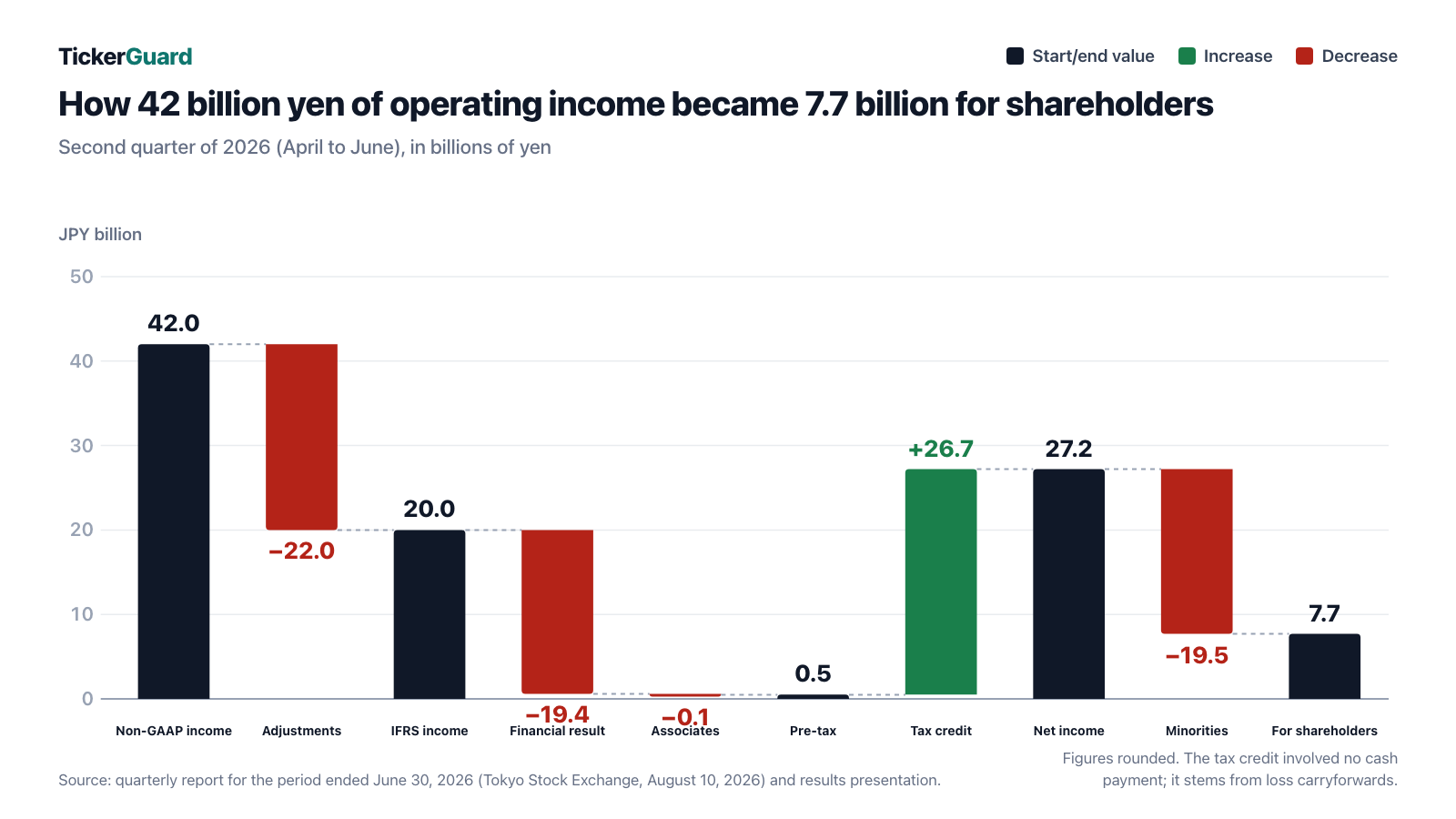
Put in everyday terms: a workshop earns 500 euros of profit in a quarter, is then credited 26,700 euros of tax from earlier loss years — and reports a profit of 27,200 euros. Nothing about that is wrong or improper; loss carryforwards are a normal, legitimate instrument, and Rakuten states plainly that no payment was made. But a profit of that kind does not repeat by itself. It depends on shares being sold. For valuing a stock the distinction is decisive: a profit from the ongoing business is a forecast for coming years, while a profit from a disposal is a one-time event that leaves the following quarter without the asset that produced it.
Uncomfortable truth no. 2: the measure in the headline is self-made
When Rakuten states its result, it states Non-GAAP operating income first. That is not a statutory measure but a calculation of the company's own. The quarterly report defines it verbatim:
"Non-GAAP operating income is operating income under IFRS Accounting Standards (hereinafter "IFRS operating income") after deducting unusual items and other adjustments as prescribed by the Rakuten Group. […] Note: For disclosure of Non-GAAP financial measures, the Rakuten Group refers to the rules specified by the U.S. Securities and Exchange Commission but does not fully comply with such rules."
— Rakuten Group, Inc., quarterly report (決算短信) for the six months ended June 30, 2026, published August 10, 2026, section 1 (1)
A company that writes, in its own filing, that it refers to the regulator's rules but does not fully comply with them has warned its readers fairly. You only have to take the warning seriously. Fiscal 2025 shows the size of the gap: Non-GAAP operating income was 106,277 million yen and IFRS operating income 14,382 million. The 91,895 million yen in between breaks down as 5,172 million of amortization of intangible assets, 15,645 million of share-based compensation — and 71,078 million yen of one-off items.
The point is not that such items exist. The point is their direction. In 2024 the very same adjustments worked the other way: 7,048 million yen of Non-GAAP operating income became 52,975 million under IFRS because one-off items added 68,658 million. A year later they subtracted 71,078 million. A measure that hides 69 billion yen of gains in one year and 71 billion of costs in the next is of limited use for comparing years. In the second quarter of 2026 the one-off items included 17.0 billion yen from the logistics business, of which 15.7 billion were impairments: Rakuten wrote its owned warehouses in Matsudo, Kohoku and Ibaraki down to zero.
Uncomfortable truth no. 3: Rakuten shareholders get the smaller share of group profit
Rakuten has partly listed and partly sold down its financial subsidiaries. Rakuten Bank went public on the Tokyo Stock Exchange in April 2023, Mizuho Securities holds 49 percent of Rakuten Securities, and the Mizuho group holds close to 15 percent of Rakuten Card. Rakuten still consolidates all of them in full — revenue and profit appear at 100 percent in the group accounts. The portion belonging to outside holders is deducted only at the very bottom of the income statement.
That portion has become large. In the second quarter of 2026, 19.5 billion of the 27.2 billion yen of group net income went to minority interests — 72 percent. Across the whole first half of 2026 the effect is starker still: the group earned 25,429 million yen while Rakuten shareholders were left with a loss of 10,941 million yen. Earnings per share came to minus 5.03 yen.
The annual series tells the same story. Group net loss in 2025 was 123,213 million yen, while the loss attributable to owners was 177,886 million — minority holders earned 54,673 million that year. A Rakuten shareholder reading the group figure is reading a number that only partly concerns them. Effective October 1, 2026, Rakuten is also restructuring the financial arm: Rakuten Bank becomes the parent of Rakuten Card and the securities holding company. Rakuten describes the transaction in its presentation explicitly as one involving a net capital outflow for the group, not as a fundraising.
Uncomfortable truth no. 4: the money for the mobile network came from selling the satellite partner
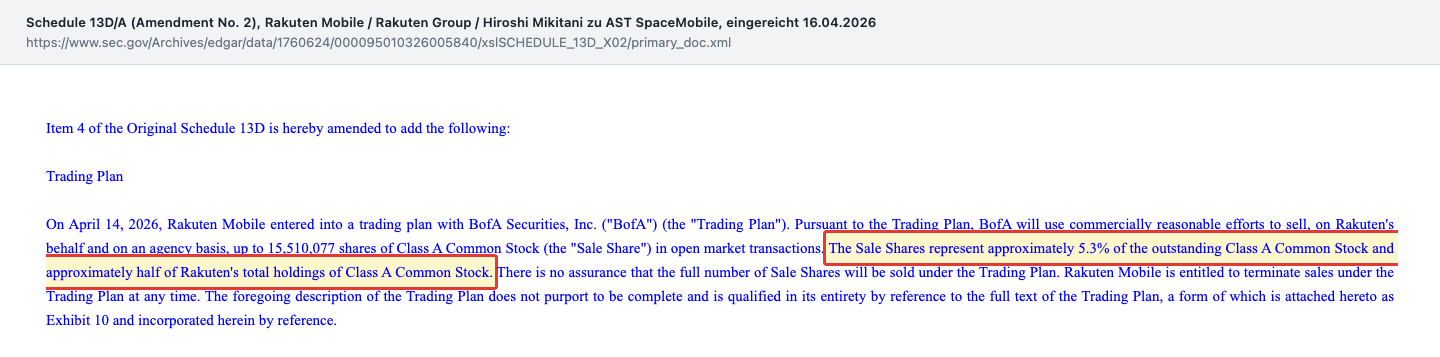
Here the circle closes back to the SEC file. Since 2021, Rakuten Mobile has held a stake in AST SpaceMobile, Inc., a Nasdaq-listed U.S. company building satellites that ordinary handsets can talk to directly — a strategic partner for a carrier with coverage gaps. Because Rakuten holds more than five percent, every change to that position must be reported to the SEC. On April 16, 2026, that report arrived:
"On April 14, 2026, Rakuten Mobile entered into a trading plan with BofA Securities, Inc. […] Pursuant to the Trading Plan, BofA will use commercially reasonable efforts to sell, on Rakuten's behalf and on an agency basis, up to 15,510,077 shares of Class A Common Stock […]. The Sale Shares represent approximately 5.3% of the outstanding Class A Common Stock and approximately half of Rakuten's total holdings of Class A Common Stock."
— Rakuten Mobile, Inc. / Rakuten Group, Inc. / Hiroshi Mikitani, Schedule 13D/A (Amendment No. 2) on AST SpaceMobile, Inc., filed with the SEC April 16, 2026, Item 4
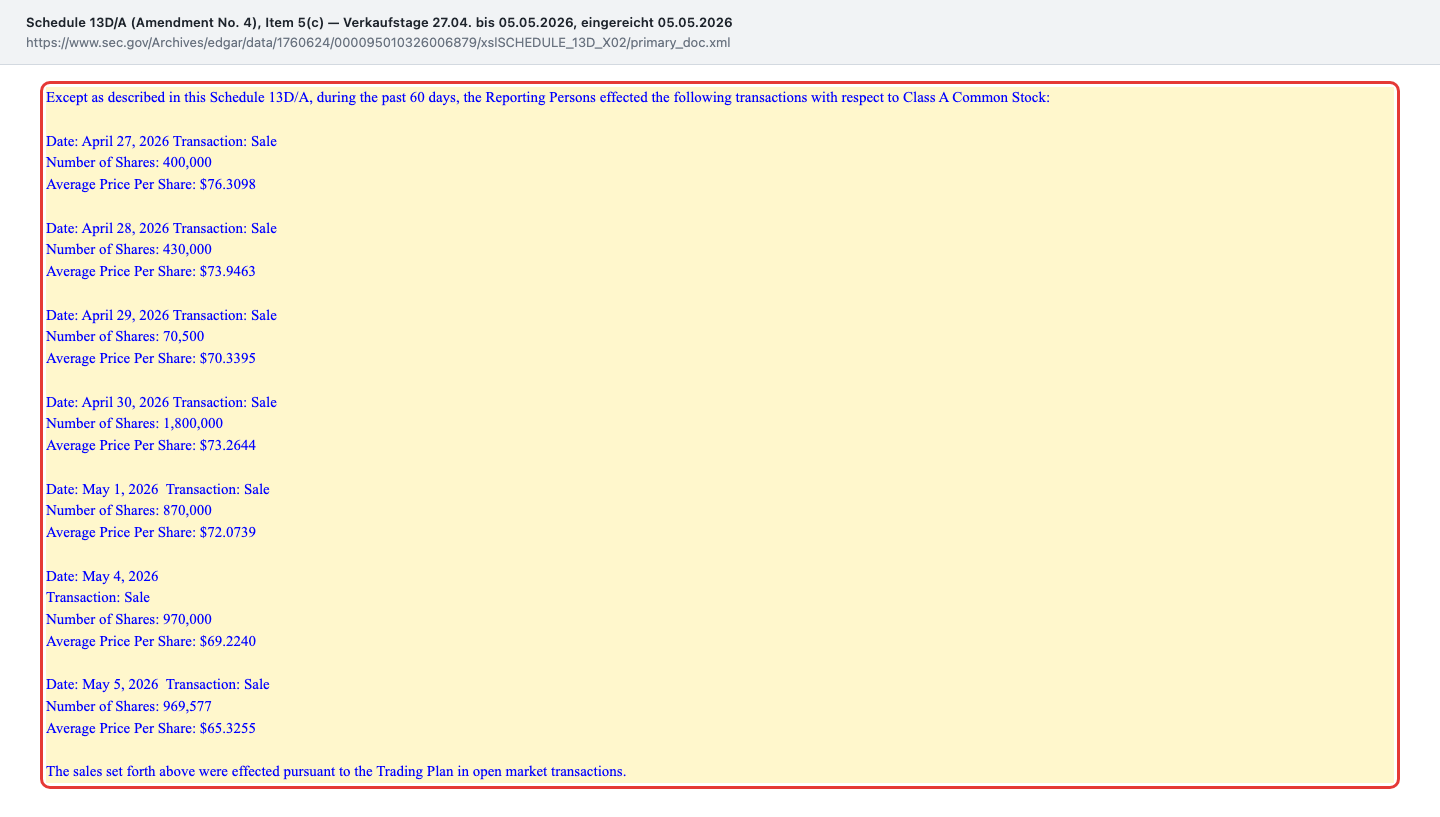
Three weeks later it was done. The amendment of May 5, 2026 consists, in substance, of two sentences: "The Trading Plan has been completed. All Sale Shares have been sold pursuant to the Trading Plan."

Because every single transaction appears in the filings with date, share count and average price, the whole disposal can be recalculated. Across 16 trading days between April 14 and May 5, 2026, exactly 15,510,077 shares were sold — precisely the announced quantity — for gross proceeds of roughly $1.256 billion at an average price of $80.99 per share. The path is what stands out: on the first day the average price was $91.42, on the last $65.33. Rakuten sold into a falling market — and a programme of that size contributed to the fall.
What the money was for, Rakuten says itself. In the appendix to the results presentation the sale appears under the heading "self-funding": "In May 2026, we raised approximately 200 B JPY through the sale of held securities." On the same page Rakuten states the purpose of self-funding as meeting the mobile business's capital needs without relying on external financing. The half-year cash flow statement confirms the order of magnitude: 199,311 million yen of proceeds from sales and redemption of investment securities.
So the pieces fit together. Selling the satellite partner funded the mobile network, triggered the tax credit, and the tax credit produced the headline. What remained, Rakuten reported to the SEC itself: as of June 30, 2026, still 15,510,078 shares worth $1,378,225,531. Measured against Rakuten's own market value of roughly $10.5 billion, that is still a very large position in someone else's stock.
Uncomfortable truth no. 5: the network is not enough — and the deal with the rival is being wound back
Rakuten Mobile advertises nationwide coverage. Part of it is rented: where its own network does not reach, Rakuten customers ride on the network of competitor KDDI, an arrangement called roaming that costs money. In August 2026 KDDI publicly said it would scale that roaming back. Mikitani addressed it in the results presentation:
"We have entered into a proper agreement with KDDI regarding this matter. First, regarding areas where Rakuten Mobile requires coverage, we will continue roaming services beyond October in accordance with the contract. On the other hand, regarding areas where Rakuten provides its own coverage, we understand the policy is to gradually scale back roaming services."
— Hiroshi Mikitani, chairman and chief executive, second-quarter 2026 results presentation with speaker notes, August 10, 2026
The appendix to the same presentation, on the page covering spectrum, puts it more drily: "Roaming provision from October 1, 2026 onward to be decided upon consultation between the two companies." A contract whose continuation is still "to be decided upon consultation" is not a concluded contract.
Why it matters: Rakuten no longer discloses a current population-coverage figure for its own network in its investor materials at all — so there is no way to size the gap that roaming fills. On the so-called platinum band — the low frequencies around 700 megahertz that penetrate buildings and valleys far better — Japan's Ministry of Internal Affairs and Communications approved the deployment plan in October 2023, and commercial service began on June 27, 2024 according to the annual securities report, but with only 6 megahertz of bandwidth against 40 megahertz in the 1.7 gigahertz band. A narrow band in a good place is no substitute for a dense network. If roaming shrinks faster than Rakuten builds towers, network quality suffers — and with it the churn rate, last reported at 1.38 percent.
Valuation: what the market pays for a rebuild
Start with what cannot be done. A price-earnings ratio cannot be calculated for Rakuten, because profit attributable to owners was negative in each of the last five fiscal years. The usual balance-sheet safety metrics — Altman Z for distance from insolvency, net current asset value per share — are also left empty in our database, for a substantive reason: Rakuten reports in yen while the RKUNF line trades in U.S. dollars. Any metric dividing a market value in one currency by balance-sheet items in another would simply be wrong. We leave them out rather than invent a number.
What can be said are orders of magnitude. At 777.40 yen on the Tokyo Stock Exchange (August 17, 2026) and 2,181,203,900 shares outstanding, the market value is roughly 1.70 trillion yen, or about $10.5 billion. Against 2025 revenue of 2.50 trillion yen that is a price-to-sales ratio of about 0.7. Against equity attributable to owners of 915,291 million yen at June 30, 2026, the price-to-book ratio is about 1.9.
Both numbers say much the same thing: the market prices Rakuten like a thin-margin retailer, not like a technology company. That is defensible — at a 1.4 percent pre-tax margin in the first half of 2026 the margin is thin. At the same time the group contains a bank with 13.1 trillion yen of customer deposits, a credit card business and a brokerage that together earned roughly 199 billion yen of operating income in 2025. Buying Rakuten is a bet that the mobile business stops consuming that profit.
Financing belongs in the picture. S&P Global Ratings affirmed a rating of BB with a stable outlook on July 29, 2026 — below investment grade, in speculative territory. The Japanese agencies R&I (BBB+) and JCR (A−) take a friendlier view, a familiar pattern for Japanese issuers. Rakuten redeemed subordinated dollar bonds worth 81.7 billion yen in April 2026 and yen senior bonds worth 20.0 billion yen in June 2026 out of cash on hand, and says its 2026 redemptions are fully funded. The real hurdle comes after that: in February 2027 a dollar bond of $1.8 billion matures, carrying a coupon of 11.250 percent. It is carried at 278,285 million yen in the accounts as of December 31, 2025.
And a figure income investors often miss: Rakuten pays no dividend. It distributed 0.00 yen per share for fiscal 2025, and per the quarterly report nothing has been decided for 2026. Anyone buying the stock for the payout is buying the wrong paper. For a contrast in how payout policy and earnings quality can diverge, see our analysis of PayPal — a payments company that also distributes nothing but earns from operations.
Finally, dilution. At the end of 2020 there were roughly 1.43 billion Rakuten shares; at June 30, 2026 there were 2,181,203,900 — an increase of more than 52 percent in five and a half years. The biggest single step was the May 2023 capital increase: 542,306,800 new shares at 566 yen, about 296 billion yen in total. Dilution in everyday terms: the cake does not shrink, but it is cut into more slices — your slice gets smaller even though you sold nothing.
Opportunities and risks at a glance
Opportunities
- The mobile loss is shrinking on the record: from 475,916 million yen in 2022 through 314,570 and 208,933 to 161,841 million yen in 2025, and in the first half of 2026 to 71,080 million against 88,457 million a year earlier.
- The financial business is growing strongly and earning: revenue of 570,751 million yen in the first half of 2026, up 25.1 percent, and segment profit of 127,708 million yen, up 46.9 percent.
- The mobile subscriber base keeps growing: 10.75 million subscriptions at June 30, 2026 against 8.97 million a year earlier, with average revenue per user up to 2,921 yen.
- Tax loss carryforwards exceeding one trillion yen can shelter future profits for years — by the company's own account a contribution to maximising cash flow.
- Refinancing is orderly: 2026 redemptions made from cash on hand and, per the company, fully funded; S&P affirmed the rating with a stable outlook on July 29, 2026.
Risks
- Five consecutive loss years for shareholders (2021 through 2025) and a half-year loss of 10,941 million yen in the first half of 2026 — the turnaround is not established at the shareholder level.
- Operating income does not cover the interest bill: 14,382 million yen of IFRS operating income in 2025 against net interest expense of 82,423 million yen.
- The quarterly profit rests on a 26.7 billion yen tax credit arising from a share sale and is not repeatable in that form; only 0.5 billion yen remained before tax.
- The equity ratio stood at 4.2 percent at June 30, 2026, and at 2.9 percent counting only equity attributable to owners; retained earnings are deeply negative at minus 971,240 million yen.
- A dollar bond of $1.8 billion carrying a coupon of 11.250 percent matures in February 2027 — carried at 278,285 million yen as of December 31, 2025; the S&P rating of BB sits in speculative territory.
- Roaming provision by KDDI from October 1, 2026 is, per Rakuten's own appendix, still to be agreed — a rollback would hit network quality and churn.
- The RKUNF listing is effectively illiquid, with a median daily volume of 600 shares between June 1 and August 14, 2026; the share count has risen more than 52 percent since the end of 2020.
- No dividend for 2025 and none declared for 2026.
A human conclusion
Back to the headline trap. "First profit in six years" is not a false headline. It is true, it comes from a mandatory filing, and Rakuten explained openly in the same presentation where the profit came from — you only had to read as far as page 51. The trap is not that somebody is lying. The trap is that the headline creates a feeling the numbers beneath it do not support: the feeling that something has been concluded.
Nothing has been concluded. Rakuten is a group doing three things at once. It runs a very large, functioning commerce and financial business. Alongside it, since 2020, it has been building a mobile network that had cost roughly 1.86 trillion yen in operating losses by mid-2026. And it now funds that build partly by selling holdings, while a billion-dollar bond at 11.25 percent falls due in February 2027. All three movements run in parallel, and none of them is finished.
There is an honest case for this stock: the mobile loss has shrunk by two thirds, the subscriber base is growing, the financial business earns handsomely, and if mobile eventually reaches break-even what remains is a group with 2.5 trillion yen of revenue and a trillion yen of loss carryforwards that make future profits largely tax-free. There is an equally honest case against: five loss years, operating income that does not cover interest, an equity ratio of 2.9 percent at the shareholder level, a speculative rating and a roaming contract still under negotiation.
What this analysis can do is evidence both cases with the same numbers and spare you the trouble of mistaking the headline for the result. The next test is concrete and dated: the third-quarter 2026 report, expected in November. That will show whether income before tax holds up without a tax gift — and what became of the roaming arrangement. What you make of it is your decision. And that is exactly as it should be.
Sources
- Rakuten Group, Inc.: quarterly report (決算短信), "Consolidated Financial Reports (IFRS) for the six months ended June 30, 2026", published August 10, 2026 — most recent periodic report; consolidated income statement, balance sheet, segment report, cash flow statement, share count, going-concern and subsequent-event disclosures.
- Rakuten Group, Inc.: second-quarter 2026 results presentation with speaker notes and appendix, August 10, 2026 — earnings bridge, financing policy, spectrum, roaming footnote, statements by Hiroshi Mikitani and Eiichi Kaga.
- Rakuten Group, Inc.: "Rakuten Group Q2 FY2026 Financial Results Highlights", August 10, 2026 — quarterly and segment figures.
- Rakuten Group, Inc.: "Rakuten Group FY2025 and Q4 FY2025 Financial Results Highlights", February 12, 2026, and the full-year 2025 appendix — annual and segment figures for 2025, mobile EBITDA.
- Rakuten Group, Inc.: annual securities report (有価証券報告書) for the 29th fiscal year, 2025, published March 26, 2026 — audited annual accounts; source for the 2025 segment results, the shareholder register as of December 31, 2025, the headcount and the bond schedule with the coupon and carrying amount of the dollar bond maturing in February 2027.
- Rakuten Group, Inc.: official financial data sheet accompanying the quarterly report, as of August 10, 2026 — multi-year series for revenue, operating income, profit attributable to owners and segments. Note: Rakuten retroactively restated segment results from the first quarter of 2025 because AI development costs have been allocated to the segments since 2026. The 2025 segment figures in this analysis are those of the audited annual accounts.
- Rakuten Mobile, Inc. / Rakuten Group, Inc. / Hiroshi Mikitani: Schedule 13D/A (Amendment No. 2) on AST SpaceMobile, Inc., filed with the SEC April 16, 2026 — announcement of the disposal programme.
- Same reporting persons: Schedule 13D/A (Amendment No. 3) of April 24, 2026 and Schedule 13D/A (Amendment No. 4) of May 5, 2026 — every selling day with share count and average price.
- Rakuten Group, Inc.: 13F-HR reports on U.S. securities holdings, reporting dates September 30, 2025 through June 30, 2026 — AST SpaceMobile share count and market value.
- Rakuten Group Inc.: Form F-6 POS (Post-Effective Amendment No. 2), filed with the SEC December 4, 2023, registration number 333-192545 — ratio of the depositary receipt programme.
- Price, volume and reference data for RKUNF: fundamental data, as of August 14, 2026; price for 4755.T as of August 17, 2026.
Note on scope: This article is journalistic analysis and expressly not investment advice, not a recommendation to buy or sell and not a solicitation to buy or sell securities. Share prices can move sharply; a total loss of the capital employed is possible. Two additional risks apply here: the currency exposure between the yen, the U.S. dollar and the euro, and the very poor tradability of the U.S. secondary listing RKUNF. All figures come from the sources named above and carry the reporting date stated with them; later developments are not reflected. Positions held by the operator are disclosed daily; where one exists, it appears as a notice at the top of this deep dive. or AST SpaceMobile, Inc.
Key figures at a glance
All monetary figures in millions of JPY; earnings per share as reported.
| Metric | 2021 | 2022 | 2023 | 2024 | 2025 |
|---|---|---|---|---|---|
| Revenue | 1,681,757.0 | 1,927,878.0 | 2,071,315.0 | 2,279,233.0 | 2,498,753.5 |
| Operating Income (EBIT) | -284,662.0 | -326,240.0 | -163,644.0 | 52,975.0 | 97,493.0 |
| Net Income | -133,828.0 | -375,911.0 | -339,473.0 | -162,442.0 | -178,041.2 |
| Net Margin | -8.0% | -19.5% | -16.4% | -7.1% | -7.1% |
| Earnings Per Share | -87.62 JPY | -236.91 JPY | -177.27 JPY | -75.66 JPY | -82.31 JPY |
Source: fundamental data & SEC filings (annual and quarterly reports, 10-K/10-Q)
Our Bottom Line at a Glance
- Growth positive
- Consolidated revenue rose from JPY 1,681,757m in 2021 to JPY 2,496,575m in 2025 and by a further 12.9 percent to JPY 1,309,052m in the first half of 2026. Rakuten calls 2025 its 29th consecutive record year. All three segments grew in the first half of 2026, with the financial business leading at 25.1 percent.
- Earnings quality negative
- The quarterly profit reported on August 10, 2026 did not come from the business: about JPY 0.5bn remained before tax, and only a tax credit of roughly JPY 26.7bn from loss carryforwards lifted the result to JPY 27.2bn — with, in the company's own words, no actual tax payment. Non-GAAP operating income and IFRS operating income were also JPY 91,895m apart in 2025.
- Leverage and interest cover negative
- IFRS operating income of JPY 14,382m in 2025 faced net interest expense of JPY 82,423m, so the operating business did not cover its interest bill. The equity ratio stood at 4.2 percent on June 30, 2026, and at 2.9 percent counting only equity attributable to owners. S&P has rated the credit BB, in speculative territory, unchanged since July 29, 2026.
- Mobile turnaround neutral
- The direction is right: the segment operating loss fell from JPY 475,916m in 2022 to JPY 161,841m in 2025 and to JPY 71,080m in the first half of 2026 against JPY 88,457m a year earlier, and 2025 was the first year with positive mobile EBITDA. Management names no date for operating break-even, and roaming provision by KDDI from October 1, 2026 is still to be agreed.
- Shareholders' share of profit negative
- Rakuten fully consolidates its bank, card and brokerage operations even though substantial parts belong to others. In the second quarter of 2026, JPY 19.5bn of JPY 27.2bn in group profit went to minority interests. In the first half the group earned JPY 25,429m while Rakuten shareholders were left with a loss of JPY 10,941m — a fifth consecutive loss year is taking shape.
- Tradability and payout negative
- The RKUNF listing carried a median daily volume of 600 shares between June 1 and August 14, 2026 — at $4.81 roughly $2,900 of turnover a day. Rakuten paid no dividend for 2025 (JPY 0.00) and has declared none for 2026. The share count has risen more than 52 percent since the end of 2020, to 2,181,203,900.
Rakuten has grown reliably for years and has cut the mobile loss by two thirds since 2022 — that is real progress. The celebrated quarterly profit of August 10, 2026, however, came almost entirely from a tax credit triggered by a share sale, and across the whole first half of 2026 shareholders are still down. Three figures decide the case, and all three carry a date: income before tax without special effects, the dollar bond maturing in February 2027, and the roaming arrangement with KDDI from October 2026. Not investment advice.
What Our Rating Means
Substance risk
We found at least one documented issue that threatens the company itself — regardless of how the stock is currently valued.
We assign red at a point that can be documented precisely: operating income does not cover the interest bill. IFRS operating income of JPY 14,382m in 2025 faced net interest expense of JPY 82,423m, and 2024 was negative on the same test at JPY 52,975m against JPY 81,897m. That is exactly what produces five consecutive loss years for shareholders. Add an equity ratio of 2.9 percent at the owner level, deeply negative retained earnings of minus JPY 971,240m, and a speculative S&P rating. This is expressly not a judgement on the share price and no doubt about the substance of the commerce and financial businesses: the filing contains no going-concern qualification and no liquidity problem, the 2026 refinancing is done, and the mobile loss is shrinking measurably. Should income before tax hold up without a tax gift and interest cover move durably above one, a better grade is due. The decision is yours.
A journalistic assessment by our editorial team at the time of the deep dive, based on public sources — not investment advice and not a solicitation to buy or sell. Your personal circumstances (investment goals, risk capacity, taxes) cannot be taken into account. What our levels mean, how verdicts are formed, and what conflicts of interest exist →
Worth Noting
- Rakuten reached our research list through the discussion rankings of the German investor forum wallstreet-online (August 2026), not through a quantitative screen. Forum attention is a hook, not a buy signal.
- Data as of August 17, 2026. The most recent periodic report is the quarterly report for the period ended June 30, 2026, published August 10, 2026; it contains neither a going-concern qualification nor reportable subsequent events. All filings after that date were reviewed.
- Risk of confusion: 4755 (Tokyo), RKUNF (U.S. over-the-counter common share) and RKUNY (U.S. depositary receipt) all denote the same company. Not to be confused with the separately listed subsidiary Rakuten Bank, Ltd. Non-GAAP operating income must also be distinguished from IFRS operating income.
- Currency mismatch: Rakuten reports in yen while the RKUNF listing trades in U.S. dollars. Metrics that would mix the two — Altman Z and net current asset value per share — are therefore deliberately left empty.
Stock Watch
This analysis is as of August 26, 2026. Stock Watch will tell you what's changed at RKUNF since then.
Later $1 a month per stock — signing up is free, and you'll be the first to know when it launches.
The full analysis as a PDF for later
We will send you this analysis as a PDF — to print, file away, and read at your own pace. And we will add you to the free Stock Watch list for Rakuten Group, Inc. (RKUNF), so you hear about it when something material in this analysis changes.
Frequently Asked Questions
At group level yes, for shareholders no. IFRS operating income was positive in 2024 at 52,975 million yen and in 2025 at 14,382 million. But the result attributable to Rakuten shareholders was negative in each fiscal year from 2021 through 2025, most recently at 177,886 million yen. The first half of 2026 also left them with a loss of 10,941 million yen.
Rakuten is not registered as a reporting company with the U.S. securities regulator, the SEC, and relies on an exemption available to foreign issuers. There is therefore no annual report (10-K), no quarterly report (10-Q) and no foreign-issuer Form 20-F. Its mandatory reporting runs through the Tokyo Stock Exchange: the quarterly and annual statement (決算短信) and the yearly annual securities report (有価証券報告書), both also published in English.
All three refer to the same company. 4755 is the common share on the Tokyo Stock Exchange (ISIN JP3967200001) and the actual trading venue. RKUNF is the over-the-counter U.S. representation of that same common share, while RKUNY is an American depositary receipt in which, per the SEC Form F-6, one receipt equals one common share. Both U.S. lines trade very thinly.
No. Rakuten distributed 0.00 yen per share for fiscal 2025, and 0.00 yen for the second quarter of 2026; no distribution record date is set for the first quarter. The quarterly report of August 10, 2026 states expressly that no dividend for fiscal 2026 has been decided. Rakuten is therefore not a holding for investors seeking regular income.
From the launch of its own network in 2020 through June 30, 2026, the mobile segment accumulated roughly 1.86 trillion yen of operating losses on Rakuten's own measure. The annual loss is shrinking markedly, however: from 475,916 million yen in 2022 to 161,841 million in 2025. Rakuten Mobile counted 10.75 million subscriptions at June 30, 2026.
It is a self-defined measure: IFRS operating income adjusted for items Rakuten classifies as unusual, plus share-based compensation and certain amortization. The quarterly report notes expressly that Rakuten refers to the U.S. regulator's rules for such measures but does not fully comply with them. In 2025 the two figures were 91,895 million yen apart.
Founder Hiroshi Mikitani controlled roughly 27.5 percent as of December 31, 2025, split across himself (8.14 percent), Crimson Group LLC (10.43 percent), his wife Haruko Mikitani (5.19 percent) and Mikitani Kosan and Spirit Inc. (1.88 percent each). The largest institutional holder is a trust account of the Master Trust Bank of Japan with 10.84 percent; Japan Post Holdings holds 6.04 percent.
Rakuten Mobile uses competitor KDDI's network in areas without its own coverage. In August 2026 Mikitani said roaming would continue past October under contract where Rakuten needs coverage, but would be gradually scaled back in areas Rakuten covers itself. The appendix to the results presentation is more cautious: provision from October 1, 2026 is still to be agreed between the two companies.
Found an error?
Did you spot a factual error, an outdated number, or a typo in this deep dive? Let us know briefly — your report goes straight to the editorial team.