Quanta Computer: Stock Down 9.9%, While the Market Jumped Double Digits
Quanta Computer (TWSE: 2382) has built notebooks for other brands since 1988 — and through its subsidiary Quanta Cloud Technology (QCT), it has become one of the world's most important Nvidia-certified builders of AI servers. Revenue has nearly tripled since 2023, and in the second quarter of 2026 it crossed NT$1 trillion for the first time. But two weeks earlier, Quanta had pulled off Taiwan's largest share sale in 19 years — at a discount, with roughly 6 percent dilution — and gross margin had fallen to a 15-quarter low in the first quarter. We read what is left of the story once you put the numbers next to it.
 Thomas Mücke
Founder & Publisher
Thomas Mücke
Founder & Publisher
There is a very specific pull that only a handful of stocks trigger: when a company gets mentioned in the same breath as Nvidia, breaks ground on new plants in California and Mexico, and posts record revenue quarter after quarter, the brain often switches to autopilot. The story is so plausible — AI boom, server builder, Nvidia partner — that people stop looking for the catch. Behavioral economists call this the story-over-numbers trap: a narrative feels truer the more often you hear it, regardless of whether the balance sheet keeps up.
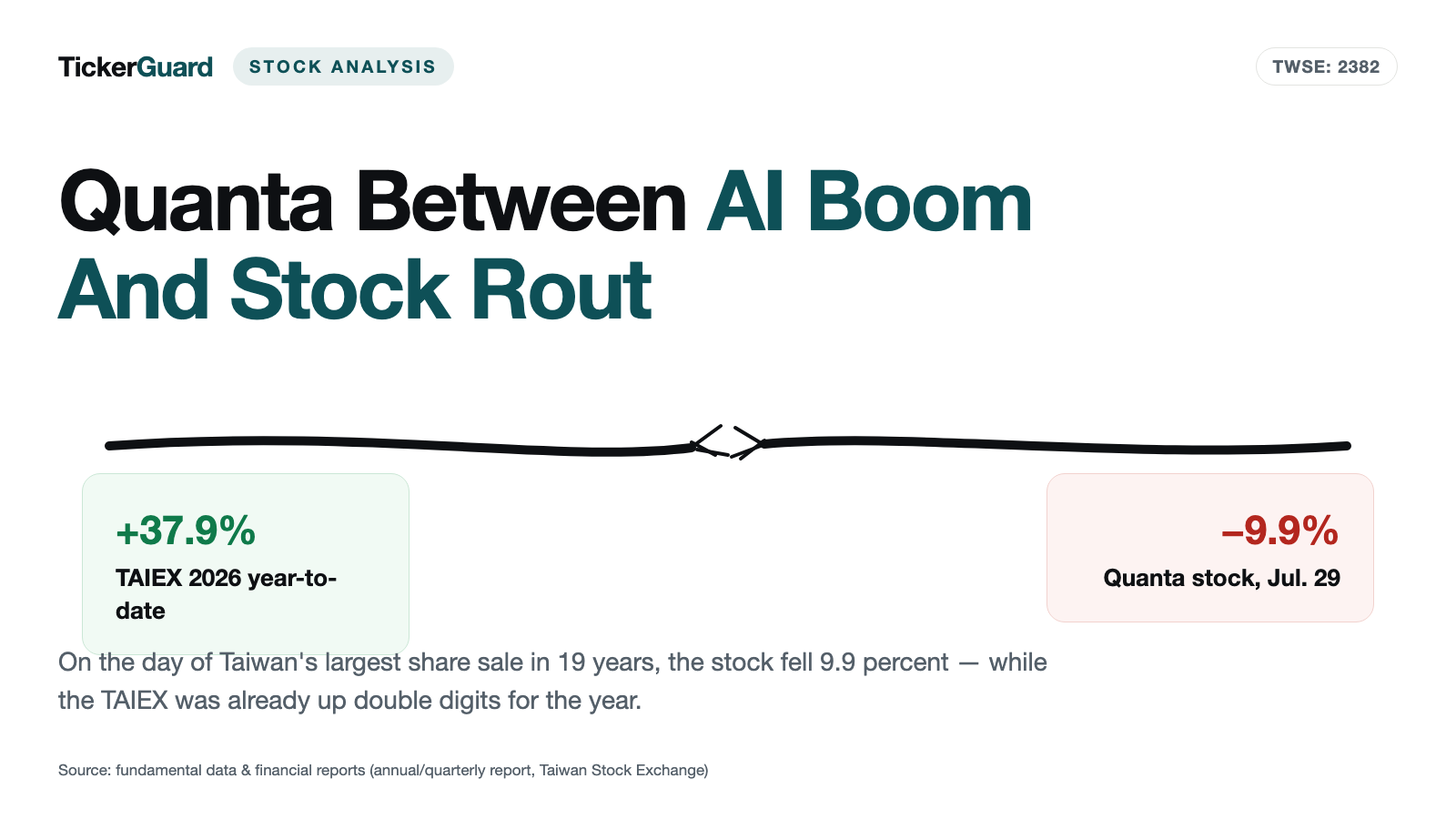
Quanta Computer is a textbook case. The stock shows up in the same headlines as Nvidia, GB300, and multibillion-dollar hyperscaler orders. And yet it fell 9.9 percent on the day of Taiwan's largest share sale in 19 years — while the broader market gained double digits over the same stretch. Two weeks later, the same company reported its first-ever quarterly revenue above NT$1 trillion. Both are true, both happened in the same summer of 2026. The deal for this article: we read both numbers side by side before letting the louder one decide for us.
What Quanta Actually Does
Quanta Computer was founded in 1988 in Taoyuan City, Taiwan, by Barry Lam and C. C. Leung — with less than $900,000 in startup capital. The core business to this day is original design manufacturing (ODM) for notebooks. Quanta designs and builds laptops not under its own name, but for other brands — Apple, HP, Dell, and Lenovo have counted among the notebook customers of Taiwan's ODM industry for decades, according to industry coverage, alongside Wistron, Compal, and Inventec. Anyone buying a notebook from a well-known U.S. brand is fairly likely holding a device one of these four Taiwanese companies actually built — the name just never shows up on the box.
The second, now larger business runs through subsidiary Quanta Cloud Technology (QCT): servers for cloud data centers, increasingly specialized in AI servers built around Nvidia GPUs. Industry coverage lists QCT among the handful of contract manufacturers that Nvidia certifies as a primary "Certified Systems" supplier for full GB200 and GB300 racks — alongside Foxconn/Hon Hai, Wistron, and Wiwynn. Customers include hyperscalers such as Google, Amazon (AWS), and Meta, who order complete AI server racks from QCT to build out their own Nvidia-accelerated data centers.
The mix shifted fast: in fiscal 2024, servers accounted for roughly 60 percent of group revenue, notebooks for roughly 33 percent. By the first quarter of 2026, the ratio had nearly reversed — servers above 80 percent, notebooks below 15 percent, with 75 percent of server revenue coming from AI servers (quarterly filing analysis, Taipei Times, May 15, 2026). At the Q2 2026 earnings call, management confirmed the trend: servers stayed above 80 percent of group revenue, AI servers 75 to 80 percent of server revenue (BigGo Finance, August 13, 2026). In just over two years, a notebook supplier with a side business in servers turned into an AI server builder with a side business in notebooks. How tightly even smaller Taiwanese suppliers are now coupled to the same cycle shows in our analysis of cooling specialist AVC, whose stock price tripled in a single year.
Company history for investors
-
1988
Founded by Barry Lam and C. C. Leung
From less than $900,000 in startup capital grew, over decades, one of the largest contract manufacturers in the world — the founding family still shapes the company today.
-
2007
CEO Michael Wang resigns after a strategy dispute
The power struggle between operating management and the chairman showed early on: at Quanta, the founder has the final word, not the chief executive.
-
2008
U.S. Supreme Court rules for Quanta in patent dispute
The win against LG Electronics (patent exhaustion doctrine) shielded the contract-manufacturing business model from licensing claims further down the supply chain.
-
2025
Management cites order visibility into 2027 (November)
Investors got a multi-year commitment for the AI server business for the first time — a vote of confidence that has kept growing since.
-
2026
Taiwan's largest share sale in 19 years (July 29)
$2.16 billion at a 7.3 percent discount meant roughly 6 percent dilution for existing shareholders — the stock fell 9.9 percent the same day.
-
2026
First quarterly revenue above NT$1 trillion (August 13)
The record quarter backed up the AI server story with numbers, but management simultaneously raised 2026 capex spending by a third.
How This Stock Landed On Our Desk
Two publicly documented, dated events put Quanta in focus over the summer of 2026. First, the share sale mentioned above, priced July 29, 2026 — at $2.16 billion, the largest Taiwanese share offering since Innolux Display's $1.35 billion GDR sale in 2007 (Bloomberg, July 29, 2026). Second, the Q2 2026 earnings call on August 13, 2026, in which Quanta reported quarterly revenue above NT$1 trillion for the first time while sharply raising its capex budget. Both events drew wide financial-press coverage on their own merits — not because of a quiet anomaly buried in the numbers, but because each was unusually large in its own right.
The Numbers Over The Years
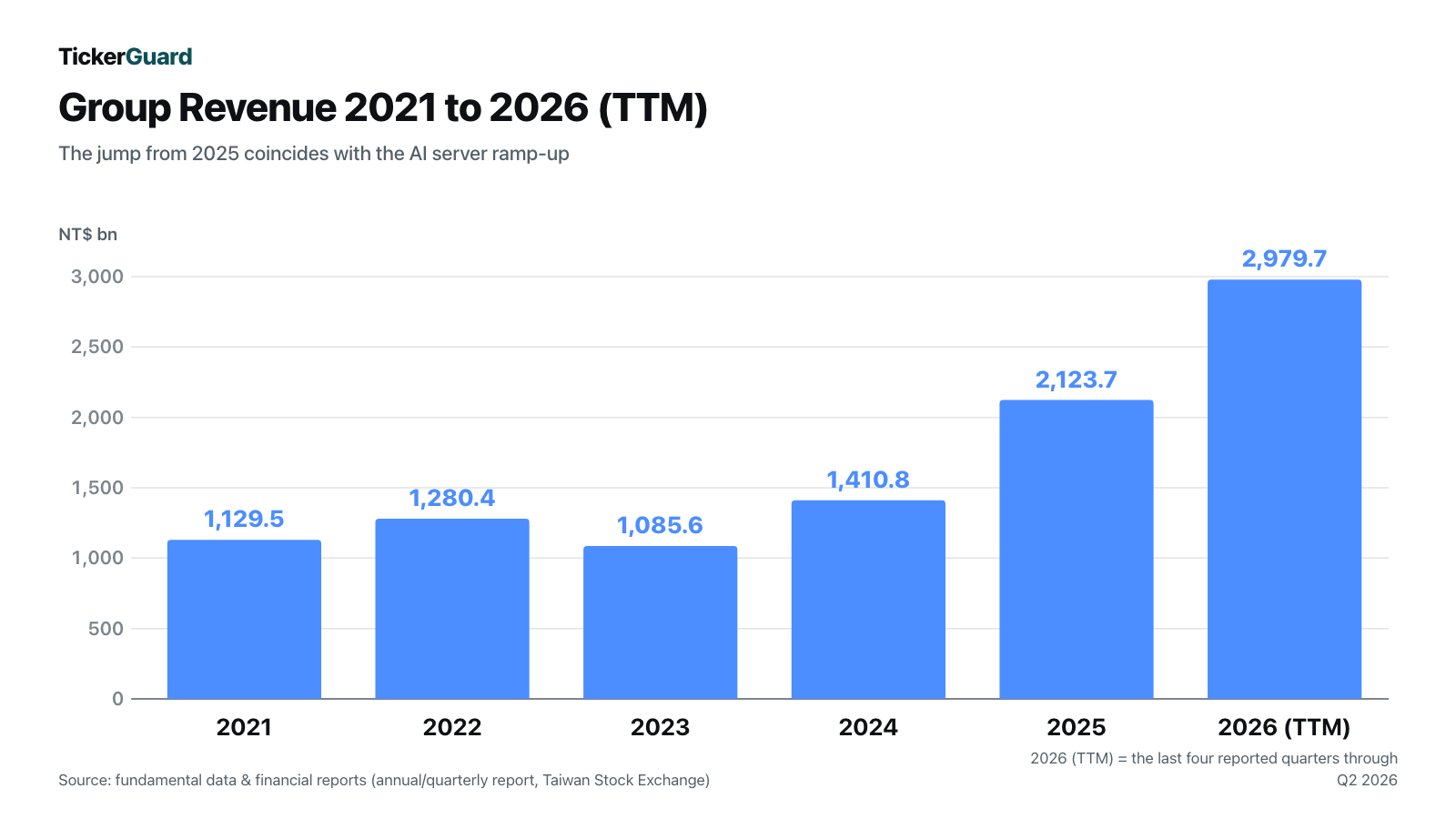
First, what genuinely impresses: group revenue grew roughly 175 percent between 2023 and the trailing four reported quarters through Q2 2026 — from NT$1,085.6 billion to NT$2,979.7 billion. That is not a one-quarter outlier but a multi-year acceleration that lines up with the AI server ramp.
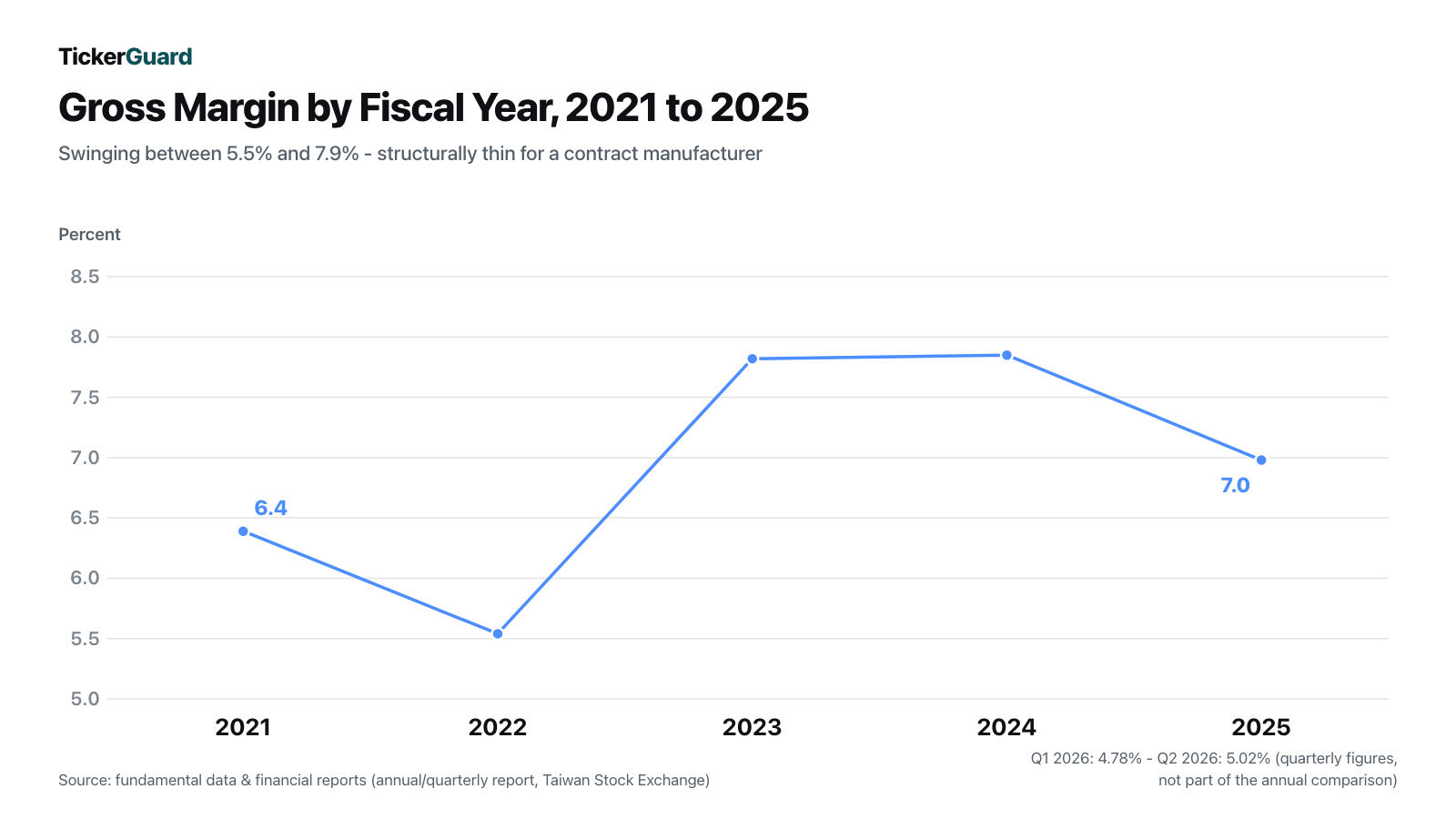
But revenue growth says nothing about what actually reaches shareholders. And here the picture gets messier: gross margin stood at 6.4 percent in 2021, fell to 5.5 percent in 2022, recovered to roughly 7.8 to 7.9 percent in 2023/2024 — and slipped back to 7.0 percent in 2025. For an ODM this is not surprising in itself (contract manufacturers earn thin margins per unit by design, volume drives the profit), but it means a tripled revenue line does not automatically produce a tripled profit line.
Net margin and earnings per share follow the same pattern, one floor down: net income rose from NT$39.7 billion (2023) to NT$75.0 billion (2025) — up 89 percent, while revenue over the same period rose 96 percent. Profit is growing roughly in step with revenue, not faster — an early sign that the AI server business's scale advantages have not (yet) translated into disproportionately rising margins.
What Management Said On The Earnings Calls
Full disclosure upfront: no publicly available, word-for-word analyst transcript exists for Quanta, unlike what U.S. filers typically offer through providers such as Motley Fool or Seeking Alpha. We checked through the official channel (transcript sync run against this publication's database, as of August 30, 2026) — result: zero hits. A targeted search on Quartr, Yahoo Finance, and Motley Fool likewise turned up no searchable full transcript with speaker attribution. What exists are journalistic recaps with partial quotes from investor-relations leadership — mainly from Taipei Times and BigGo Finance, published on or shortly after each call date. The critical analyst Q&A section, which often carries the real news on U.S. calls, is therefore not available verbatim for this analysis — a genuine gap, not a stylistic choice.
What can be read from the sequence of these recaps is how management's tone shifted across three dates. In August 2025, the company cited a target of "AI servers at 70 percent of server revenue for 2025" and roughly a year of order visibility. By November 2025, the target had moved to "above 80 percent for 2026" and visibility to 2027. By August 2026, at the Q2 call, management spoke of visibility into 2028 — each time more optimistic, never more cautious. That stands out because gross margin deteriorated over the same period. One quote from a company release captures this posture:
"Our innovations with NVIDIA underscore a shared mission to make AI infrastructure more powerful, more efficient, and more accessible."
— Mike Yang, President of Quanta Cloud Technology, QCT press release for GTC 2026, March 16, 2026
A sign that management itself views margin as a work in progress also surfaced at the Q2 call: to counter margin pressure from the GB200-to-GB300 platform transition, Quanta is reportedly leaning more heavily on a consignment model — customers procure the expensive GPUs and memory chips directly, and Quanta handles only assembly and integration. That would push reported gross margin even lower going forward (because fewer material costs flow through Quanta's own books), even as absolute profit per server holds steady or rises — a technical detail likely to complicate comparability of the margin series in coming quarters.
What The Reports Show: Three Uncomfortable Truths
First: gross margin fell to 4.78 percent in the first quarter of 2026 — a 15-quarter low based on our analysis of the quarterly figures — in the very quarter revenue hit a record NT$809.2 billion (Taipei Times/howtheymake.money, May 15, 2026). Record revenue and a margin low in the same report are not a contradiction, but they temper the pure growth story: a bigger business is not automatically a better one.
Second: the July 29, 2026 GDS offering priced at a 7.3 percent discount to the prior close of NT$309.50 — not a sign of overwhelming demand, but a concession to cautious investors. The reference price of $44.17 per GDS landed mid-range within the bookbuilding range ($43.91 to $44.77), not at the top. The stock lost 9.9 percent on announcement day; at that point Quanta was up just 2.6 percent for the year, while Taiwan's broad TAIEX index had gained 37.9 percent over the same stretch (Yahoo Finance/Bloomberg, July 29, 2026). It took the record results of August 13, 2026 to turn that picture around: by August 28, 2026, the stock was back up roughly 22.2 percent for the year. That four-week roller coaster shows how heavily the valuation hangs on individual dates.
Third: the purpose Quanta itself cited for the share sale was not the widely assumed AI capacity expansion, but "purchases of materials in foreign currencies" — ordinary working capital (Bloomberg, July 29, 2026). Details on this and the roughly 6 percent dilution are in a side-find tied to this analysis.
Valuation
At a closing price of NT$332.50 on August 28, 2026, Quanta's market capitalization was roughly NT$1,363.1 billion — about $43.1 billion, or roughly €37.2 billion at that day's exchange rate. The fundamentals-based trailing price-to-earnings ratio sits at roughly 14.7 based on the trailing four quarters' reported earnings, and roughly 10.5 based on 2026 earnings estimates. Price-to-book sits at roughly 5.6, price-to-sales at roughly 0.46 — low because the business is revenue-rich but margin-poor.
Compared with the other large Taiwanese contract manufacturers, an interesting pattern emerges: Hon Hai/Foxconn (2317.TW) trades at a forward P/E of roughly 15.2, Wistron (3231.TW) at roughly 11.8, Inventec (2356.TW) at roughly 21.6 — Quanta, at roughly 10.5, sits at the low end of that group, even though its AI server growth profile is regarded as the strongest of the group alongside Hon Hai's. That can be read as the market's skepticism toward the margin quality of the AI server business — the same concern the uncomfortable truths above describe. Analyst consensus (multiple research houses, aggregated by financial data providers, as of late August 2026) sits at "Buy" with an average price target of roughly NT$400 to NT$422 — an upside of roughly 20 to 27 percent from the price at the time, though with a wide spread of individual targets (NT$240 to NT$420 depending on the source).
Opportunities And Risks At A Glance
Opportunities:
- Firmly embedded in the Nvidia ecosystem as one of a handful of certified GB200/GB300 primary suppliers, with documented orders from hyperscalers Google, Amazon, and Meta.
- Management-cited order visibility extending into 2028 — significantly longer than the 2027 horizon communicated just a year earlier.
- Broad geographic manufacturing diversification (California, Thailand, Mexico, and soon Germany via subsidiary QCG) reduces dependence on any single production site.
- Continuous dividend payments since 1999, currently yielding roughly 4.7 percent on the August 28, 2026 price.
Risks:
- Structurally thin and volatile gross margin (5.5 to 7.9 percent year over year, 4.78 percent in the first quarter of 2026) — a low-margin business stays low-margin even as it grows faster.
- Customer concentration in the AI server business: management cites the "top five" cloud service providers as the main drivers without disclosing individual percentages (BigGo Finance, August 13, 2026) — a single lost customer could have an outsized effect.
- Freshly diluted shareholder base after the July 29, 2026 share sale (roughly 6 percent), with a stated purpose pointing more toward ongoing financing needs than growth investment.
- Geopolitical exposure: part of production remains in mainland China while the main customers are U.S. corporations; a January 2026 U.S.-Taiwan tariff deal cut tariffs on Taiwanese goods from 20 to 15 percent in exchange for investment pledges — relief, but not a permanent shield against future trade tension.
- Currency risk: the reporting currency is the New Taiwan dollar, while a substantial share of revenue is invoiced in U.S. dollars; no specific management sensitivity disclosure on this is publicly available.
A Human Conclusion
Back to the pull we opened with: the temptation with Quanta is to read its Nvidia proximity as a free pass — anyone plugged into the AI boom can only win. The numbers tell a more nuanced story. Revenue growth is genuinely real, the customer relationships are genuinely documented, and order visibility keeps extending call after call. But margin — the thing profit per share ultimately depends on — has not kept pace over the same period, and in the very quarter revenue hit a record, the company had to raise fresh capital, at a discount, for routine material purchases. That is not proof the story is wrong. It is proof it is more complicated than a headline reading "Nvidia partner" makes it sound. What you make of that is your decision. And that is exactly how it should be.
Sources
- Fundamental data & metrics, as of August 28-30, 2026
- Annual/quarterly revenue series 2021-2025 and TTM through Q2 2026, aggregated from Quanta's MOPS filings (secondary source stockanalysis.com/quote/tpe/2382, as of August 30, 2026)
- Taipei Times, "Quanta predicts growing AI server quarterly revenue," May 15, 2026
- BigGo Finance, Q2 2026 earnings-call recap, August 13, 2026 (finance.biggo.com/news/TW_2382.TW_2026-08-13)
- Bloomberg, "Nvidia Partner Quanta Raises $2.2 Billion From Share Sale," July 29, 2026
- Yahoo Finance/Reuters, "Quanta prices $2.16 billion share sale in Taiwan's record GDS deal," July 29-30, 2026
- Taipei Times, "Quanta eyes big growth next year from AI servers," November 14, 2025
- TweakTown, "NVIDIA GB300 AI server orders are so big they're 'unimaginable' says Quanta Computer AI boss," September 15, 2025 (citing a UDN report)
- QCT press release, "QCT Builds the Next Frontier of AI With NVIDIA at GTC 2026," qct.io, March 16, 2026
- Forbes, "Wang Quits Quanta Computer," August 27, 2007
- Wikipedia, "Quanta Computer" (cross-checked against the linked primary sources on Quanta Computer, Inc. v. LG Electronics, Inc., U.S. Supreme Court 2008), accessed August 30, 2026
- DigiTimes, multiple articles on capacity expansion (May 20, 2026; January 19, 2026) and the capex increase (August 13, 2026)
This article is journalistic analysis of publicly available information and not investment advice. The author holds no position in the stock discussed as of publication. Stocks are volatile; a total loss is possible. Quanta Computer Inc. (TWSE: 2382) is not affiliated with Quanta Services, Inc. (NYSE: PWR), a U.S. energy and telecommunications infrastructure company unrelated to Quanta Computer.
Our Bottom Line at a Glance
- Revenue growth positive
- Group revenue more than doubled from NT$1,085.6 billion (2023) to NT$2,979.7 billion (TTM through Q2 2026), crossing NT$1 trillion in a single quarter for the first time in Q2 2026 (BigGo Finance, August 13, 2026).
- Nvidia ecosystem positive
- One of a handful of Nvidia-certified GB200/GB300 primary suppliers, with documented orders from Google, Amazon, and Meta (TweakTown, 2024/2025).
- Gross margin negative
- Structurally thin and volatile between 5.5% and 7.9% (2021-2025), falling to a 15-quarter low of 4.78% in Q1 2026 (Taipei Times/howtheymake.money, May 15, 2026).
- Capital structure negative
- Taiwan's largest share sale in 19 years on July 29, 2026, with roughly 6% dilution and a 7.3% discount; stated purpose was routine material purchases, not capacity expansion (Bloomberg, July 29, 2026).
- Customer concentration neutral
- Management cites the "top five" cloud service providers as the main drivers of the server business without disclosing individual percentages (BigGo Finance, August 13, 2026).
- Dividend continuity positive
- Ongoing dividend payments since 1999 per available data, roughly 4.7% yield at the August 28, 2026 price, no documented suspension.
Quanta shows real, documented revenue growth in its AI server business — but gross margin has not kept pace over the same period, and the fresh share sale, by the company's own account, funded routine material purchases rather than expansion. Not investment advice.
What Our Rating Means
Open questions
The business works in principle, but one material question is open. As long as it stays open, our findings do not carry a quality verdict.
The business model works and the customer relationships are genuinely documented — but one material operating question remains open: whether the AI server growth will eventually generate enough margin to structurally outgrow notebook-typical thin returns, or whether it merely scales up volume at the same thin margin. There is no substance risk in the sense of going concern or negative equity. The decision is yours.
A journalistic assessment by our editorial team at the time of the deep dive, based on public sources — not investment advice and not a solicitation to buy or sell. Your personal circumstances (investment goals, risk capacity, taxes) cannot be taken into account. What our levels mean, how verdicts are formed, and what conflicts of interest exist →
The full analysis as a PDF for later
We will send you this analysis as a PDF — to print, file away, and read at your own pace.
Frequently Asked Questions
Quanta is a Taiwanese original design manufacturer (ODM) that has built notebooks for other brands since 1988. In recent years a second, now larger business has grown faster: through subsidiary Quanta Cloud Technology (QCT), the company builds AI/cloud servers with Nvidia GPUs for hyperscalers including Google, Amazon, and Meta. In the first half of 2026, servers made up more than 80 percent of group revenue, notebooks less than 15 percent.
No, the two companies have nothing in common beyond the similar name. Quanta Computer Inc. is a Taiwanese electronics contract manufacturer (Taiwan Stock Exchange: 2382). Quanta Services, Inc. (NYSE: PWR) is a U.S. construction company for energy and telecommunications infrastructure, unrelated to electronics manufacturing. Mixing up the two tickers quickly leads to the wrong numbers.
Quanta is a contract manufacturer — this business model structurally runs on high volume at a thin margin per unit, not on high per-unit profit. Gross margin ranged between 5.5 and 7.9 percent from 2021 through 2025 and fell to a 15-quarter low of 4.78 percent in the first quarter of 2026, as the transition from Nvidia's GB200 to the GB300 platform added costs before pricing to customers had fully caught up.
On July 29, 2026, Quanta placed 245 million new shares via Global Depositary Shares and raised $2.16 billion — at a 7.3 percent discount and roughly 5.97 percent dilution for existing shareholders. The stock fell 9.9 percent on announcement day. The company cited purchases of materials in foreign currencies as the purpose, not the widely assumed capacity expansion.
At the Q2 2026 earnings call (August 13, 2026), management put the server share of group revenue above 80 percent, with 75 to 80 percent of that being AI servers — roughly 60 to 65 percent of total group revenue by rough math. For comparison, the total server share was around 60 percent in fiscal 2024. Quanta has not publicly disclosed a standalone AI server revenue figure.
Yes, based on available data Quanta has paid an annual dividend since 1999, most recently NT$15.60 per share, which works out to roughly a 4.7 percent yield at the August 28, 2026 price. The payout ratio is reported differently depending on the calculation basis (sources cite between roughly 57 and 84 percent of 2025 net income) — we deliberately cite the range rather than a falsely precise figure.
Measured against 2026 expected earnings (forward P/E roughly 10.5), Quanta is cheaper than Taiwanese ODM peers Hon Hai/Foxconn (roughly 15.2), Wistron (roughly 11.8), and Inventec (roughly 21.6) — even though Quanta shows the strongest AI server growth in the group next to Hon Hai. That can be read as market skepticism toward the margin quality of the AI server business.
The publicly documented targets have so far been met or exceeded: the 70 percent AI-server-share-of-server-revenue target cited in August 2025 for 2025 was, per press coverage, reached in the first three quarters of 2025; the November 2025 target of over 80 percent for 2026 was already on track in the first half of 2026. No publicly available verbatim analyst transcript documenting the critical follow-up questions exists for Quanta, however — this analysis therefore relies on recaps, not full transcripts.
Found an error?
Did you spot a factual error, an outdated number, or a typo in this deep dive? Let us know briefly — your report goes straight to the editorial team.