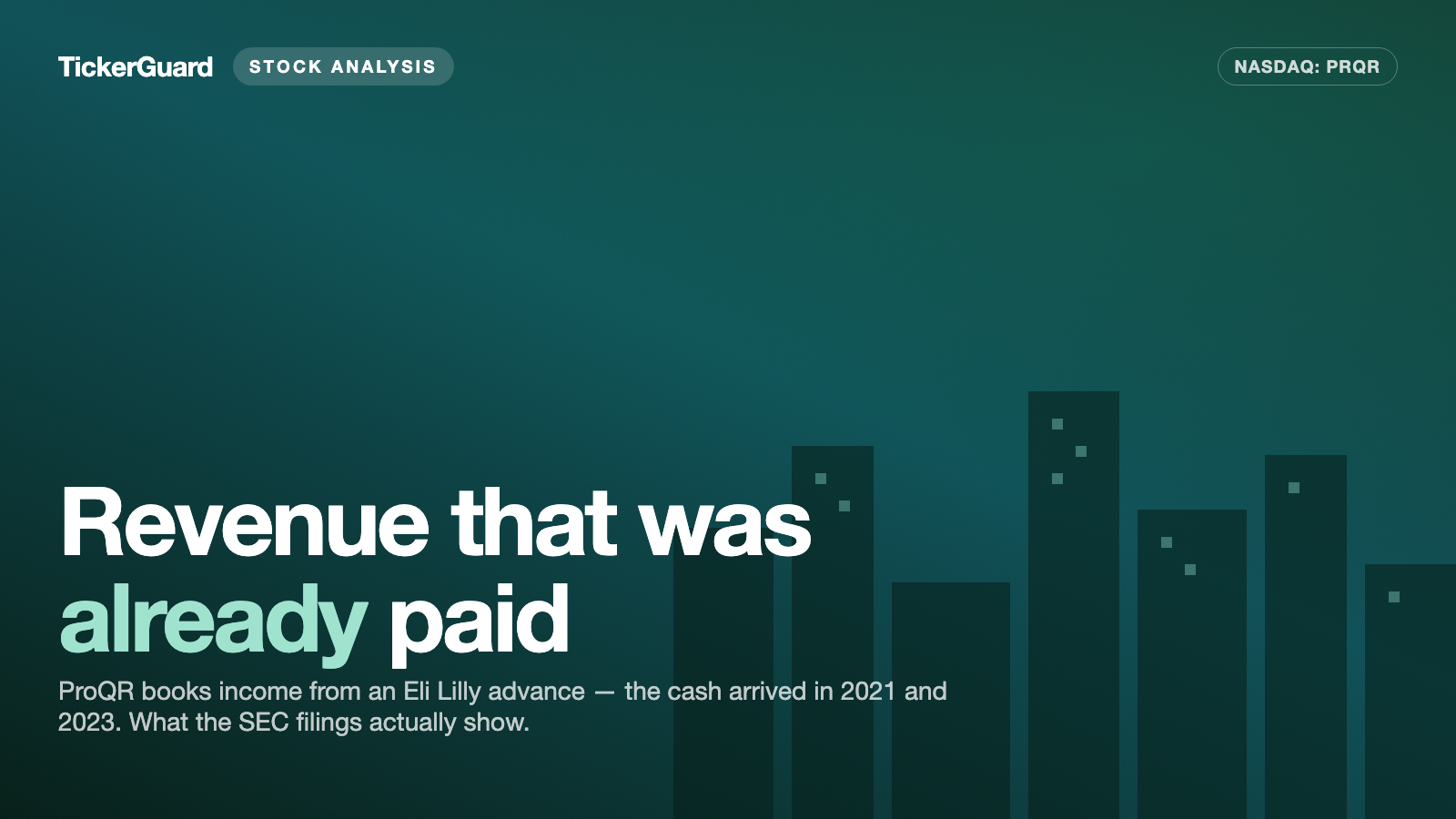
ProQR Therapeutics: The revenue is a check written in 2021 — and the share count grew by a third in six months
ProQR rewrites single letters in the body's blueprint, a technique that gave its first sign of life in humans in June 2026. The filings with the U.S. securities regulator, the SEC, tell a second story alongside it. The EUR 10.792 million of revenue reported for the first half of 2026 is, to the euro, the amount by which deferred revenue from the Eli Lilly advance shrank: from EUR 38.946 million to EUR 28.154 million. No new milestones were reached in that period. Shareholders paid for the rest — shares outstanding rose 33.9 percent between December 31, 2025 and June 30, 2026, and the authorized share capital went from 170 million to 270 million. Not investment advice — just the question of what a first sign of life is really worth.
 Thomas Mücke
Founder & Publisher
Thomas Mücke
Founder & Publisher
As of Today
As of: September 17, 2026
- Closing price
- 1.90 $ +1.60%
- Market Capitalisation
- 0.3 $B
- Growth Score
- 4/10
- AAQS
- 4/10
Price change since July 2, 2026: +5.0%
This analysis has a cut-off date. The Stock Guard tells you when something material changes in the numbers. Reserve your free spot
Chart
Interactive price chart (TradingView).
52-week range: 1.40 $ to 3.10 $ · Last price: 1.90 $ (As of: September 17, 2026)
Note: pure fact-based analysis, not investment advice and not a solicitation to buy or sell. All figures without guarantee.
There is an investor trap that works more reliably in biotechnology than anywhere else — call it the trailer trap. It goes like this. You watch a movie trailer. Two minutes, the best scenes, dramatic music, and your head assembles an entire film from it, happy ending included. That is exactly how we read drug development press releases. "Positive Phase 1 data" sounds like chapter one of a cure, and your head runs the story all the way to the pharmacy shelf. At ProQR Therapeutics (NASDAQ: PRQR) of Leiden, the Netherlands, there was such a trailer in June 2026, and it was a good one: for the first time, the company's technology showed in a human body that it does what it is designed to do. The stock then surfaced on a Reddit attention list (as of September 9, 2026). So let us make a deal: before you picture the finished film, we read together what the company itself filed with the U.S. securities regulator, the SEC — the annual report on Form 20-F for 2025 and the interim report on Form 6-K as of June 30, 2026. Management is liable for false statements in them — which leaves the figures and notes little room for gloss. They describe a technology with a genuine first sign of life, a revenue line that is really an old check, and a share count that grew by a third in six months. The conclusion is yours to draw.
What ProQR actually does — spell-checking the body's blueprint
Every cell in your body works from a blueprint: DNA. To build a protein, the cell first copies the relevant passage into a working draft, the messenger RNA. Picture it as a note a cook copies out of a big cookbook and carries to the stove. If the cookbook holds a typo, so does the note — and the dish fails. Classical gene therapy tries to correct the cookbook itself; that is permanent, but also irreversible. ProQR corrects the note instead. Its platform is called Axiomer and works with editing oligonucleotides — short, synthetic molecules that attach to a specific spot on the messenger RNA. There they recruit a tool every human cell already owns: an enzyme called ADAR. The enzyme then swaps a single letter — an A becomes an I, and the cell reads that I as a G. A typo is fixed without anyone touching the cookbook. Because working drafts are continually renewed, the effect does not last forever; the medicine has to be given again. That is also its safety advantage: whatever is not permanent can be stopped.
The lead program is AX-0810 and targets a transport protein called NTCP. Simply put, NTCP is the door through which bile acids pass from the blood into liver cells. In diseases such as biliary atresia — a rare, severe liver condition in infants — those bile acids build up in the liver and destroy it. ProQR's idea is to pull that door partly shut so less bile acid gets in. Alongside sit AX-0811 — per the quarterly release of August 13, 2026 “generated by ProQR’s AI-enabled discovery engine” and preclinically more potent and longer-lasting than AX-0810 —, AX-0422 against the metabolic disease MPS I Hurler syndrome, and AX-2911 against the fatty liver condition MASH. On top comes a collaboration with the U.S. pharmaceutical group Eli Lilly, signed in September 2021 and expanded in 2022. And that names the central tension of this analysis, which runs through every chapter: ProQR sells a future that has so far produced not a single euro of product revenue — and funds it with money that was either banked long ago or is being raised fresh from shareholders right now.
Company history for investors
-
2014
Nasdaq listing (September 18)
ProQR started out as a specialist in eye and lung diseases. Anyone buying in then bought a different company from today's.
-
2021
Collaboration with Eli Lilly (September)
Lilly subscribed for 3,989,976 shares for $30 million and paid a $20 million up-front in October. That pot still supplies the reported revenue today.
-
2022
A complete change of strategy (August)
Clinical development of sepofarsen and ultevursen ended and the entire ophthalmology business was dropped. Shareholders owned a pure platform company overnight.
-
2023
Expanded Lilly agreement and sale of the eye assets
A second up-front of $60 million arrived in February; in December sepofarsen and ultevursen went to Théa. Cash grew while the owned pipeline shrank to one technology.
-
2024
Equity raise at $3.50 per share (October)
Roughly 19.9 million new shares plus 3,523,538 to Lilly brought in about EUR 60.2 million net. That price was nearly double the level of the next round.
-
2026
First sign of life in humans and a raise at $1.81 (June)
AX-0810 cleared its pre-set threshold by a wide margin — the next step was funded with 32.7 million new shares. Each existing holder's slice shrank noticeably.
-
2026
First participant dosed with AX-0811 (September 9)
The AI-discovered successor reached the clinic. Initial data from two dose cohorts are announced for early January 2027 — the next date on which the thesis must prove itself.
How the stock reached our desk
ProQR did not arrive on our research list through a valuation or momentum filter of our in-house stock scanner, but through the Reddit hype scanner: a forum attention list, as of September 9, 2026. The timing is striking, because on that very day ProQR told the SEC that the first participant had been dosed in the Phase 1 study of AX-0811. One point of framing matters: attention in a forum is not a quality signal, it is a timestamp. It says when many people are looking, not why it is worth looking. And at a company without a product, the usual metrics mislead anyway. A price-to-earnings ratio cannot be formed because there are no earnings, and a price-to-sales ratio would be misleading because the reported revenue — as we are about to see — is not a sale at all. Note the finding right at the start: at ProQR you measure with the calendar, not the calculator. What matters is when which data arrive and how long the money lasts.
The numbers over the years — given their due
Start with what genuinely speaks for ProQR, because there is more of it than a pure loss statement suggests. In June 2026 AX-0810 delivered the first confirmation in humans that the technology works in principle. The quarterly release of August 13, 2026 puts a number on it: an up to eight-fold increase in total serum bile acids at a dose of 6 milligrams per kilogram — against a pre-defined threshold of merely two-fold. Translated: the company had committed in advance to what would count as success, and cleared that bar by a wide margin. Add a half-life of eight weeks, meaning the drug would stay active long enough for infrequent dosing, plus, per the company, no serious adverse events and no pruritus — the itching that patients with bile disorders dread. The money is orderly too. As of June 30, 2026 ProQR held EUR 117.125 million in cash and cash equivalents, up from EUR 92.413 million six months earlier, and the half-year accounts explicitly confirm the going concern basis for at least twelve months. On the company's own estimate the cash runs to mid-2028.
And now the chart that tells the second half of the story — revenue against operating costs:
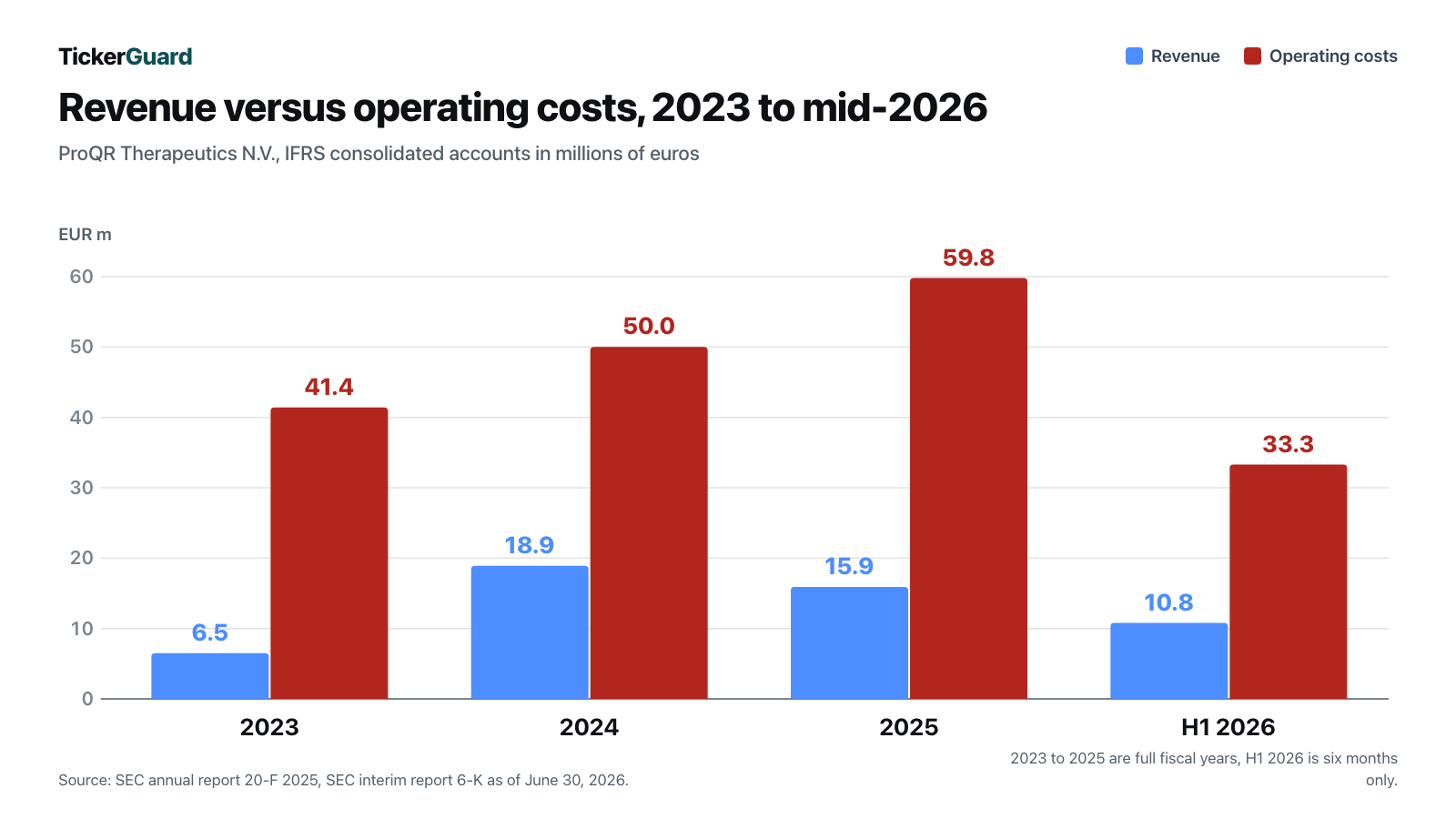
The figures in plain terms: the loss for 2025 came to EUR 42.184 million, after EUR 27.763 million in 2024 and EUR 27.735 million in 2023. Net cash used in operating activities was EUR 52.791 million in 2025, up from EUR 36.393 million the year before, with a further EUR 23.415 million in the first half of 2026. The bulk of the spending sits in research: EUR 44.733 million in 2025 and EUR 24.497 million in the first half of 2026 — for a company developing medicines, that is precisely the right place to spend. One point of framing matters here: these figures are stated in euros while the stock trades in U.S. dollars. As a Dutch company ProQR reports under IFRS in euros but is traded in New York in dollars. We do not mix the two currencies below; each figure carries the currency of the original filing.
What the filings say — the uncomfortable truths
Uncomfortable truth no. 1: the revenue is a check cashed in 2021 and 2023
"Revenue" sounds like something someone bought and paid for. At ProQR it is the accounting release of money that has long been in the bank. The mechanics: Eli Lilly paid an up-front of $20 million in October 2021 and a further $60 million in February 2023 for the expanded agreement. A company may not book such cash as revenue immediately — it goes onto the balance sheet as deferred revenue, parked, and is then moved piece by piece into the income statement as the promised research work is performed. Translated: a contractor receives a large deposit but may only record it as income once the work has actually been done. How much of it is still outstanding is stated verbatim in the notes to the interim report:
"Our total deferred revenue balance related to this Lilly performance obligation amounts to € 28,154,000 at June 30, 2026 (December 31, 2025: € 38,946,000)."
— ProQR Therapeutics N.V., SEC interim report 6-K as of June 30, 2026, Note 4 (i) b

Now the calculation worth doing yourself. The parked amount fell from EUR 38.946 million to EUR 28.154 million — a drop of EUR 10.792 million. And ProQR reports exactly EUR 10.792 million as revenue for the first half of 2026. The two numbers are identical to the euro. The entire half-year revenue is therefore advance money moving from the balance sheet into the income statement. No new revenue was earned in the period. That no success payments fell due in that half either is stated in a single sentence in the revenue note:
"During the six month period ended June 30, 2026 the Company did not reach any milestones under the agreement."
— ProQR Therapeutics N.V., SEC interim report 6-K as of June 30, 2026, Note 13 "Revenue"

In fairness: this is entirely proper accounting and the norm in research partnerships. But it changes how the number should be read. The revenue pot is emptying, not filling. With EUR 28.154 million left and the pace of the first half maintained, the pot runs dry after roughly two and a half more half-year periods — that is, in a little over a year — unless Lilly pays again. That possibility exists: the agreement grants Lilly an option to expand further for $50 million, and development milestones plus sales-based royalties are contracted. Just not in this half-year.
Uncomfortable truth no. 2: an estimate of labor hours decides how large the revenue is
If revenue arises from working through an advance, the question becomes: by what yardstick? The answer sits in the same note and is remarkably soft. ProQR recognizes revenue by the share of labor hours already incurred against the total estimated labor hours required. The filing warns about the consequence itself:
"As the Company's estimate of the total labor hours required is dependent on the evolution of the research and development activities, it may be subject to change. If the progression and/or outcome of certain research and development activities would be different from the assumptions that were made during the preparation of these financial statements, this could lead to material adjustments to the total estimated labor hours, which might result in a reallocation of revenue between current and future periods."
— ProQR Therapeutics N.V., SEC interim report 6-K as of June 30, 2026, Note 4 (i) b
Translated: the contractor books his deposit on the rule of thumb "I am roughly half done." If he revises his view of how much work is needed in total, how much he has already earned shifts retroactively — even though not one extra cent has moved. How unevenly a revenue line derived this way can run shows in 2026: ProQR reported EUR 8.759 million of revenue in the second quarter, but only EUR 10.792 million for the full first half — leaving roughly EUR 2.0 million for the first quarter. One quarter was four times as "revenue-rich" as the other without a single new customer appearing — the filing gives no reason for the split. Note the pattern: this revenue line measures an estimate, not a sale. Read as a growth curve, it is read wrong.
Uncomfortable truth no. 3: a third more shares in six months — and the ceiling was lifted
A company doing research without a product pays for it with shareholders' money. At ProQR what that meant in the first half of 2026 is well documented. In June the company placed 27,624,310 new shares at $1.81, raising gross proceeds of $50.0 million (EUR 44.1 million); after costs of roughly EUR 3.0 million, EUR 41.1 million remained net. At the same time Eli Lilly bought 5,100,780 shares at the same price in a separately negotiated transaction for around $9.2 million. For comparison: the October 2024 placement still fetched $3.50 per share. To raise the same money in 2026, the company had to issue roughly twice as many shares. For you as a shareholder, dilution simply means: your slice of the cake gets smaller while the cake stays the same size. The numbers behind it: 105,361,064 shares were outstanding on December 31, 2025, and 141,121,476 on June 30, 2026 — a rise of 33.9 percent in half a year.
The second part of this truth sits a few lines further down and is the quieter but more important one. The authorized share capital — the ceiling the articles of association permit without a fresh shareholder vote — was raised sharply in 2026:
"The authorized share capital of the Company amounting to € 21,600,000 consists of 270,000,000 ordinary shares and 270,000,000 preference shares with a par value of € 0.04 per share. At June 30, 2026, 143,466,309 ordinary shares were issued …"
— ProQR Therapeutics N.V., SEC interim report 6-K as of June 30, 2026, Note 12 "Shareholders' Equity"

The annual report for 2025 carried a different figure in the same place: 170,000,000 ordinary shares, on authorized capital of EUR 13.6 million. The ceiling was therefore lifted by 100 million shares in 2026. The chart below sets the two side by side:
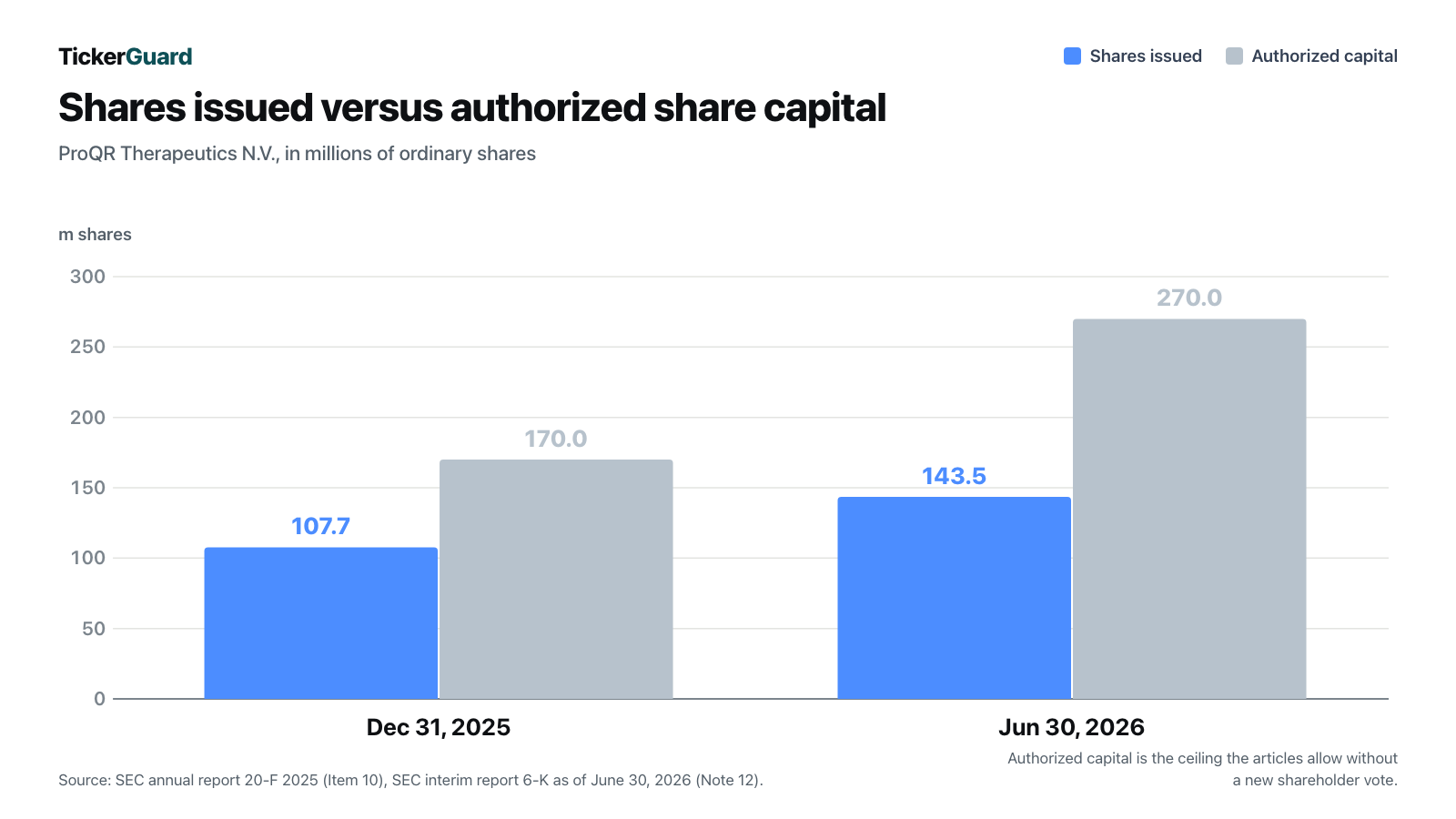
Take the sum to its conclusion, because that is the real information. Between the 143.5 million shares issued and the 270 million ceiling lie roughly 126.5 million shares — almost as many as exist in total today. Add 16,066,305 employee options outstanding as of December 31, 2025 (weighted average exercise price EUR 2.56), of which 9,631,699 were immediately exercisable. Even if all were drawn, room would remain under the ceiling for over 110 million further shares. And the route is already open: of the shelf registration from September 2024 totalling $300 million, $75 million is allocated to an at-the-market sales agreement — of which, by the company's own statement, not a single share had been issued as of June 30, 2026. This is not a forecast but an inventory: the stock of potential dilution is substantial, and the company has shown over the past two years that it uses it.
Uncomfortable truth no. 4: what EUR 518 million of shareholder money has bought so far
This last figure sits in the annual report and puts everything before it in order. Since its stock market debut in September 2014 and through December 31, 2025, ProQR had raised EUR 518.0 million in gross proceeds from public offerings and private placements of equity — the $59.2 million from June 2026 is not yet included. What is left of it today? As of June 30, 2026: EUR 117.125 million in cash and equity of EUR 79.477 million. On the other side of the balance sheet sits the accumulated deficit since inception: EUR 487.412 million. There is still no approved medicine.
That is not an accusation but a description of the business model. Drug development burns money before it earns any — true of every company of this kind, including the successful ones. The point is a different one: the road was long and expensive, and it changed direction at least once. Until August 2022 ProQR was betting on eye diseases with sepofarsen and ultevursen. It then announced it would focus exclusively on the RNA editing platform and end clinical development of both; in December 2023 the rights went to French ophthalmology specialist Théa. Anyone who invested in ProQR in 2019 bought an eye company; anyone investing in 2026 buys a liver company. And one echo of that era still sits on the balance sheet — a state loan of EUR 3.907 million at the time, granted explicitly for the discontinued sepofarsen program. The listing itself has been at risk once before: in May 2022 Nasdaq notified the company that its price had traded below the one-dollar mark for 30 consecutive trading days; in October 2022 ProQR moved from the Nasdaq Global Market to the less demanding Nasdaq Capital Market, and in December 2022 the requirement was met again. The last price documented in a prospectus, on July 2, 2026, was $1.81 — above the threshold, but without much room.
Valuation: what the market pays for a platform without a product
There is no price-to-earnings ratio, and after all of the above a price-to-sales ratio would be false precision. What remains is a calculation that can be made cleanly without an intraday price. The last share price documented in an SEC prospectus dates from July 2, 2026 and was $1.81. Multiplied by the 141,121,476 shares outstanding on June 30, 2026, that gives a market capitalization of roughly $255 million. Against it stands EUR 117.125 million of cash. For the conversion we use no intraday rate but the exchange relationship ProQR itself documents in the same filing: the June placement of $50.0 million corresponded to EUR 44.1 million. On that basis, EUR 117.1 million is roughly $133 million.
The valuation question then fits into a single sentence: at that date the market was paying about $122 million above the cash — for the platform, the five programs listed in the profile box ranging from Phase 1 to preclinical, and the Lilly agreement combined. Whether that is a lot or a little hangs on one question, and it cannot be answered today: will target engagement in healthy volunteers translate into benefit for sick patients? A look at the order of proof helps here. What ProQR showed in June 2026 is the first of several steps — the technology reaches its target in the body. Not yet shown is that anything improves in people who are ill; the first patient study is due to begin in China, with initial data expected in the first half of 2027, a potentially registration-enabling Phase 2 program from mid-2027, and a first interim analysis by mid-2028. Anyone wanting a sense of the scale of such timelines will find an instructive counterpart in an established European drug discoverer such as Evotec. And one detail on the honesty of the arithmetic: the company's own cash runway to mid-2028 ends almost exactly when that first interim analysis would fall due.
Opportunities and risks at a glance
What speaks for ProQR:
- A first sign of life in humans: in June 2026, AX-0810 achieved an up to eight-fold increase in total serum bile acids at 6 milligrams per kilogram — against a pre-defined success threshold of two-fold; per the company without serious adverse events and without pruritus, with an eight-week half-life.
- A solid cash position for a company this size: EUR 117.125 million as of June 30, 2026 after EUR 92.413 million half a year earlier, a company runway estimate to mid-2028, and the going concern basis explicitly confirmed in the half-year accounts.
- A partner putting up more of its own money: Eli Lilly again bought shares for around $9.2 million at the placement price in June 2026, subject to a six-month lockup and a standstill; an option to expand the agreement further for $50 million remains open.
- Several shots in the magazine rather than one: alongside the NTCP franchise (AX-0810, AX-0811) sit AX-0422 for MPS I Hurler syndrome and AX-2911 for MASH, with data points announced for 2027.
- The repeatable approach is a genuine safety advantage: because Axiomer edits the working draft and not the genome, the effect is time-limited and can, in case of doubt, be stopped — unlike permanent interventions in DNA.
What speaks against it:
- No product, no genuine revenue: the EUR 10.792 million of first-half 2026 revenue equals exactly the decline in the parked Lilly advance from EUR 38.946 million to EUR 28.154 million; per Note 13, no milestones were reached in that period.
- Persistent losses: EUR 42.184 million loss for 2025 on EUR 52.791 million of net cash used in operating activities; a further EUR 22.111 million of loss and EUR 23.415 million of cash outflow in the first half of 2026 — the funding need does not end with the cash runway.
- Dilution with a large reserve behind it: shares outstanding up 33.9 percent in six months (105,361,064 to 141,121,476), an issue price of $1.81 against $3.50 in October 2024, the authorized capital lifted from 170 million to 270 million shares, and a $75 million at-the-market facility still entirely unused.
- Everything hangs on early data: every program sits in Phase 1 or earlier; benefit in sick people has not been shown, and the first patient study is planned as an investigator-initiated trial in China with data only in 2027 — regulatory and geopolitical risks included.
- Currency and listing questions: the accounts are in euros while the stock trades in U.S. dollars, which complicates every comparison of metrics; and the last documented price of $1.81 does not sit far above the one-dollar threshold on which Nasdaq already notified the company once, in 2022.
A human conclusion
Back to the trailer trap from the opening. Its core is not that the trailer lied — ProQR's June announcement was real, the figures in it are documented, and a compound that hits its target in the human body eight times more clearly than promised is a solid piece of work. Its core is that our heads build an entire film out of two minutes of preview, unbidden. Anyone buying ProQR shares today is not buying a medicine but three very concrete things: a technology that has given one sign of life in humans; a cash position that, on the company's own arithmetic, lasts to mid-2028 — roughly the date on which the first genuinely meaningful analysis is due; and a capital ceiling with room for almost as many shares again as exist today. That can pay off. It can also mean you own the same company in 2028 with a markedly smaller share of it. So the honest question for you is not "does the technology work?" — there is a first, encouraging hint on that. It is: can you sit out the years until the first real patient benefit, and are you willing to give up a slice of your stake again and again along the way? If yes, you have a thesis. If no, you had a trailer. What you make of it is your decision. And that is exactly as it should be.
Sources
Every original document used in this analysis — to read for yourself:
- ProQR Therapeutics N.V. — SEC annual report on Form 20-F for 2025 (filed March 12, 2026)
- ProQR Therapeutics N.V. — SEC interim report on Form 6-K as of June 30, 2026, unaudited half-year accounts (filed August 13, 2026)
- ProQR Therapeutics N.V. — SEC Form 6-K, second quarter 2026 operating and financial results (August 13, 2026)
- ProQR Therapeutics N.V. — SEC Form 6-K of September 9, 2026: first participant dosed in the Phase 1 study of AX-0811
- ProQR Therapeutics N.V. — SEC Form 6-K of June 26, 2026: offering of 27,624,310 shares and private placement with Eli Lilly
- ProQR Therapeutics N.V. — SEC prospectus 424B5 of July 15, 2026 (price reference as of July 2, 2026)
- Complete SEC filing history of ProQR Therapeutics N.V. (CIK 0001612940): EDGAR overview (sec.gov)
- Fundamental data (company master data and metrics), reconciled with the SEC filings; data as of September 9, 2026.
- Reddit mentions: forum attention list, as of September 9, 2026; surfaced via our in-house stock scanner.
Transparency & disclaimer: this analysis is journalistic commentary on publicly available information. It is not investment advice, not a financial analysis in any regulatory sense, and not a solicitation to buy or sell securities. Equity investments carry substantial risk up to total loss — particularly at companies without an approved product. All information without warranty; the date of each figure is noted in the text. The author holds no position in ProQR shares at the time of publication.
Key figures at a glance
All monetary figures in millions of €; earnings per share as reported.
| Metric | 2021 | 2022 | 2023 | 2024 | 2025 |
|---|---|---|---|---|---|
| Revenue | 1.3 | 3.6 | 6.5 | 18.9 | 15.3 |
| Operating Income (EBIT) | -57.2 | -65.2 | -31.9 | -30.5 | -42.2 |
| Net Income | -60.7 | -64.4 | -28.1 | -27.8 | -40.5 |
| Net Margin | -4,549.8% | -1,792.5% | -431.7% | -146.9% | -265.2% |
| Earnings Per Share | -0.95 € | -0.90 € | -0.35 € | -0.34 € | -0.38 € |
Source: fundamental data & SEC filings (annual and quarterly reports, 10-K/10-Q)
Our Bottom Line at a Glance
- Technology & first evidence positive
- In June 2026 AX-0810 produced an up to eight-fold increase in total serum bile acids at 6 milligrams per kilogram in healthy volunteers — against a pre-defined success threshold of two-fold, with an eight-week half-life and, per the company, no serious adverse events. It is the first documented evidence that the Axiomer platform works in a human body.
- Quality of revenue negative
- The EUR 10.792 million of first-half 2026 revenue matches exactly the decline in deferred revenue from the Eli Lilly advance (EUR 38.946 million to EUR 28.154 million). It is the release of cash that arrived in 2021 and 2023; per Note 13 no milestones were reached in that half. Its size also rests on an estimate of labor hours performed, which the filing itself describes as subject to change.
- Dilution negative
- Shares outstanding rose from 105,361,064 (December 31, 2025) to 141,121,476 (June 30, 2026), up 33.9 percent in six months, at an issue price of $1.81 after $3.50 in October 2024. The ceiling in the articles of association grew from 170 million to 270 million shares, and a $75 million at-the-market facility was entirely unused as of June 30, 2026 — the reserve for further dilution is large.
- Financial position & runway neutral
- As of June 30, 2026, EUR 117.125 million of cash stood against equity of EUR 79.477 million and only EUR 5.017 million of borrowings; the going concern basis is explicitly confirmed in the half-year accounts and the company's runway estimate is mid-2028. Against that sits EUR 23.415 million of operating cash outflow in the first half of 2026 alone — the runway ends roughly when the first registration-relevant interim analysis would fall due.
- Dependence on the partner neutral
- Eli Lilly is the sole source of revenue but put up roughly $9.2 million of its own money again in June 2026 and is subject to a six-month lockup and a standstill. An option to expand the agreement for a further $50 million remains open. ProQR develops the lead NTCP franchise wholly on its own account — survival depends on the cash, not on the partner.
ProQR Therapeutics is where the trailer trap shows in its purest form. The June 2026 announcement was a real, well-documented first hit in humans — an up to eight-fold rise in bile acids against a pre-set two-fold threshold. Beside it sits a set of accounts with no sale in them: the EUR 10.792 million of first-half 2026 revenue is, to the euro, the decline in the parked Lilly advance, no new milestones were reached, and costs came to EUR 33.263 million. Shareholders pay for the difference: 33.9 percent more shares in six months and an authorized capital lifted from 170 million to 270 million. Cash runs to mid-2028 on the company's own estimate — roughly the date on which the first genuinely meaningful patient finding is expected. Not investment advice.
What Our Rating Means
Open questions
The business works in principle, but one material question is open. As long as it stays open, our findings do not carry a quality verdict.
Yellow judges the company here, not the share price — and it is deliberately not red. Documented findings argue against a threat to substance: EUR 117.125 million of cash as of June 30, 2026 against EUR 23.415 million of operating outflow in the half, positive equity of EUR 79.477 million, only EUR 5.017 million of borrowings, and a going concern basis explicitly confirmed in the half-year accounts. Yellow stands for the one large operating question that is open: whether target engagement in healthy volunteers becomes benefit for sick people will not be settled before 2027 — until then there is no product, no genuine revenue, and with an authorized capital of 270 million shares, ample room for further dilution. The decision is yours.
A journalistic assessment by our editorial team at the time of the deep dive, based on public sources — not investment advice and not a solicitation to buy or sell. Your personal circumstances (investment goals, risk capacity, taxes) cannot be taken into account. What our levels mean, how verdicts are formed, and what conflicts of interest exist →
Worth Noting
- ProQR reached our research list via a forum attention list (Reddit hype scanner, as of September 9, 2026) — the same day the company reported the first participant dosed in the Phase 1 study of AX-0811. Attention in a forum is a timestamp, not a quality signal.
- The U.S. securities regulator, the SEC, treats ProQR as a foreign private issuer, so it files annual reports on Form 20-F and interim reports on Form 6-K; there is no U.S. quarterly report (Form 10-Q) for this company. It reports under IFRS in euros while trading in U.S. dollars — metrics that mix the two currencies should be read with care. The valuation chapter converts using the relationship the company documents itself for the June placement ($50.0 million corresponded to EUR 44.1 million).
- The valuation anchor is the last share price documented in an SEC prospectus: $1.81 on July 2, 2026, cited in the 424B5 prospectus of July 15, 2026. Analyses are evergreen; an intraday price is not a reason to buy. Not to be confused: ProQR Therapeutics N.V. of Leiden is not the same as similarly named drug developers; the SEC identifier CIK 0001612940 is decisive.
Stock Watch
This analysis is as of September 9, 2026. Stock Watch will tell you what's changed at PRQR since then.
Later $1 a month per stock — signing up is free, and you'll be the first to know when it launches.
The full analysis as a PDF for later
We will send you this analysis as a PDF — to print, file away, and read at your own pace. And we will add you to the free Stock Watch list for ProQR Therapeutics BV (PRQR), so you hear about it when something material in this analysis changes.
Frequently Asked Questions
ProQR Therapeutics N.V. (NASDAQ: PRQR) of Leiden, the Netherlands, develops medicines with its proprietary Axiomer platform. It does not alter DNA but messenger RNA — the working draft of a blueprint — swapping single letters there. To do so it recruits an enzyme called ADAR that every human cell already carries. The lead programs AX-0810 and AX-0811 target liver diseases involving bile stasis. There is no approved product.
It does not sell anything. The EUR 10.792 million of revenue in the first half of 2026 came entirely from releasing an advance paid by Eli Lilly. That deferred revenue fell over the same period from EUR 38.946 million to EUR 28.154 million — exactly the amount reported as revenue. The underlying cash arrived in October 2021 ($20 million) and February 2023 ($60 million). No new milestones were reached in the first half of 2026.
To mid-2028, on the company's own estimate. As of June 30, 2026 ProQR held EUR 117.125 million in cash and cash equivalents, up from EUR 92.413 million on December 31, 2025. Net cash used in operating activities was EUR 23.415 million in the first half of 2026 and EUR 52.791 million across the whole of 2025. The half-year accounts explicitly confirm the going concern basis for at least twelve months from signing.
Substantially. Shares outstanding rose from 105,361,064 on December 31, 2025 to 141,121,476 on June 30, 2026 — up 33.9 percent in six months. The June 2026 issue priced at $1.81 per share after $3.50 in October 2024. At the same time the authorized share capital was raised from 170 million to 270 million shares; a $75 million at-the-market sales facility was still entirely unused as of June 30, 2026.
They show the technology reaches its target in the body — no more than that. In June 2026 ProQR reported an up to eight-fold increase in total serum bile acids at 6 milligrams per kilogram in healthy volunteers, against a pre-defined threshold of two-fold, plus an eight-week half-life and, per the company, no serious adverse events. Benefit for people who are ill has not been shown; initial patient data are expected in the first half of 2027.
ProQR is a Dutch public limited company (N.V.) based in Leiden and therefore reports under the international standard IFRS in euros. Its shares trade on the U.S. Nasdaq exchange in dollars. The U.S. securities regulator, the SEC, treats ProQR as a foreign private issuer, so it files annual reports on Form 20-F and interim reports on Form 6-K — there is no U.S. quarterly report (Form 10-Q) for this company.
In September 2021 the two signed a global licensing and research collaboration on genetic disorders of the liver and nervous system; Lilly subscribed for 3,989,976 shares for $30 million and paid a $20 million up-front in October 2021. In December 2022 the agreement was expanded: 9,381,586 further shares for $15 million, plus a $60 million up-front in February 2023. Lilly may extend the partnership for a further $50 million; development milestones and sales-based royalties are contracted.
A price-to-earnings ratio cannot be formed for lack of earnings, and a price-to-sales ratio would mislead because the revenue comes from an old advance. A cash comparison says more: at the documented price of $1.81 on July 2, 2026 and 141,121,476 shares outstanding, market capitalization works out at roughly $255 million. Cash of EUR 117.1 million equals about $133 million on the exchange relationship documented in the filing. The market was therefore paying some $122 million above the cash for platform and pipeline.
Found an error?
Did you spot a factual error, an outdated number, or a typo in this deep dive? Let us know briefly — your report goes straight to the editorial team.