PROG Holdings Stock: Only 2.8 Percentage Points of the 25.6 Percent Revenue Gain Come From Within — and a Buyback Comes Despite a Lower Outlook
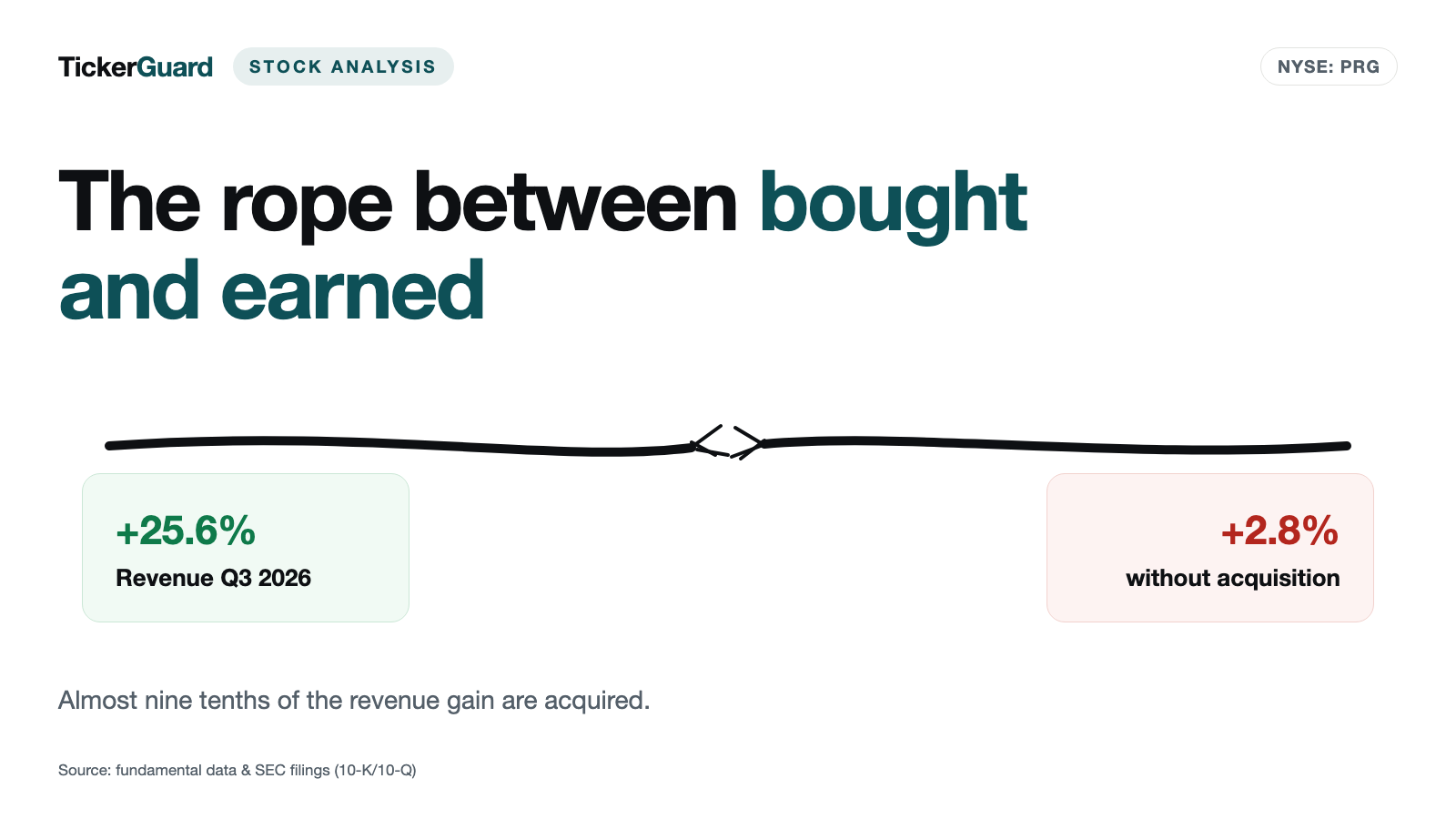
On October 28, PROG Holdings cut its outlook and announced the same day an accelerated buyback of $100 million, partly to be funded from its credit facility — after buying back shares at an average of $41.47 in the third quarter; the stock closed at $30.88 on October 28. Behind the 25.6 percent revenue gain sits the acquired Purchasing Power unit; without it revenue grew 2.8 percent, and the Progressive Leasing core earned 12.7 percent less. We read the quarterly report, the earnings release and the transcripts of the last three years of earnings calls: what did management promise, and what came true? (Updated October 29, 2026, quarterly report for September 30, 2026.)
 Thomas Mücke
Founder & Publisher
As of Today
As of: October 30, 2026
- Closing price
- 34.80 $ +3.80%
- Market Capitalisation
- 1.4 $B
- P/E
- 8.9
- Growth Score
- 4/10
- AAQS
- 7/10
Price change since October 28, 2026: +12.7%
This analysis has a cut-off date. The Stock Guard tells you when something material changes in the numbers. Reserve your free spot
Chart
Interactive price chart (TradingView).
52-week range: 26.20 $ to 47.50 $ · Last price: 34.80 $ (As of: October 30, 2026)
Note: pure fact-based analysis, not investment advice and not a solicitation to buy or sell. All figures without guarantee.
There is a reflex that catches every investor once a stock has fallen: the old price stays stuck in your head and becomes the yardstick. Call it the anchor-price trap. On July 24, 2026, PROG Holdings, Inc. (NYSE: PRG) closed at $43.71; on October 28, 2026, at $30.88 — a drop of about 29 percent in three months. If your first thought is "that's a third cheaper now," you are doing math with a price the company itself no longer confirms: on that same October 28, PROG cut its full-year outlook. Before the reflex takes over, let's read what the quarterly report as of September 30, 2026 says, what the earnings release of October 28 says — and what management promised on its earnings calls over the last three years. Because a stock is not cheap because it has fallen. It is cheap if the earnings you expect from it hold up.

What PROG Holdings actually does — installment buying for people without a credit card
PROG Holdings is based in Draper, Utah, incorporated in Georgia, and employed 1,235 people as of December 31, 2025. The company is what is left of Aaron's: the group was split on November 30, 2020 (spin-off from The Aaron's Company), the furniture-store business went its own way, and the holding company carried the name "Aaron's Holdings Company, Inc." until November 23, 2020. What remained is a financial-technology holding with three building blocks.
Progressive Leasing is the core. The model in everyday terms: you stand in a furniture store in front of a $1,200 couch, and your credit is not good enough for an installment loan. Progressive buys the couch from the retailer and leases it to you — with weekly, biweekly or monthly payments over a maximum of twelve months. If you pay it off, it is yours. If you change your mind, you return it. It is offered at roughly 24,000 partner locations and online stores in 45 states; Progressive has no stores of its own. In 2025 the segment accounted for about 96 percent of consolidated revenue of $2,409.2 million (annual report 10-K 2025); in the third quarter of 2026, after the acquisition, it was 76 percent ($552.7 of $725.8 million).
Four is the buy-now-pay-later app that splits a purchase into four interest-free installments over about six weeks. If you want a comparison, you will find it in our analysis of Sezzle, the listed company that does almost nothing but this business model. Purchasing Power, part of the group since January 2, 2026, works differently: employers offer their staff a voluntary benefit through which they pay for brand-name goods in monthly installments by payroll deduction, regardless of creditworthiness and secured through the payroll deduction. Add MoneyApp, an app for interest-free paycheck advances, still too small to be a segment of its own.
The tension in this analysis runs through every chapter: The group is growing because it bought growth — the core business barely grows, and the customers all three building blocks live on are, by management's own account, under more pressure.
Company history for investors
-
2020
Spin-off from Aaron's
On November 30, 2020, PROG becomes a standalone lease-to-own and payments holding company; the furniture-store business stays with Aaron's. Investors have held a pure financial business since.
-
2020
$175 million FTC settlement
In April 2020, Progressive Leasing settles allegations about advertising practices without admitting guilt — regulatory risk has been a fixture ever since.
-
2025
Purchase agreement for Purchasing Power
On December 1, 2025, PROG signs the purchase of the payroll-deduction provider — a second customer channel alongside leasing, paid for with cash and debt.
-
2026
Acquisition closes, higher debt cap
On January 2, 2026, PROG pays $424.2 million; permitted net leverage rises to 3.25x. From now on the balance sheet carries goodwill and interest costs.
-
2026
Outlook raised (July 29)
After the second quarter, PROG raises 2026 adjusted EBITDA to $355 to $375 million — expectations for the acquisition and for leasing go up.
-
2026
Outlook cut, buyback announced (October 28)
Three months later the range is $345 to $355 million; at the same time PROG announces a $100 million accelerated buyback — confidence in earnings, against pressure on customers.
How the stock reached our desk
The occasion is the fresh quarterly report: on October 28, 2026, PROG filed the quarterly report (10-Q) as of September 30, 2026 and the earnings release (current report 8-K, Item 2.02), and held its earnings call the same morning. Our first analysis from the summer was still based on the quarterly report as of March 31, 2026 — since then two reports have been added (as of June 30 and September 30), the outlook was first raised and then cut, and the stock has moved almost 30 percent. This edition replaces the old one entirely.
A look at the reaction: on October 27, the day before the report, the stock closed at $29.61; on October 28 at $30.88 — a gain of 4.3 percent after a report that cut the outlook. A price reaction is not a verdict on the company; the stock was already about 32 percent below its July 24 level before the report ($29.61 against $43.71).
The numbers over the years — and what the third quarter of 2026 added
Let's start with what is good. PROG Holdings is not a loss-making company searching for a business model, but a company that has earned hundreds of millions of dollars for years. Consolidated revenue from continuing operations was $2,339.4 million in 2023, $2,399.1 million in 2024 and $2,409.2 million in 2025 — a flat, stable line. Pre-tax income from continuing operations rose to $174.5 million in 2025 from $163.4 million the year before. Operating cash flow jumped to $335.0 million in 2025 from $138.5 million (2024) — mainly because less new business ties up less cash in buying lease merchandise.
Then came the acquisition, and the line bends upward — visible in revenue, less so in profit. The nine months of 2026 compared with the prior year (quarterly report 10-Q as of 09/30/2026, continuing operations):
- Revenue: $2,188.2 million versus $1,834.6 million (+19.3 percent) — in the third quarter $725.8 million versus $577.7 million (+25.6 percent).
- Pre-tax income: $150.7 million versus $143.1 million (+5.3 percent); in the third quarter $52.3 million versus $44.7 million.
- Net income: $111.1 million versus $104.4 million; per diluted share $2.73 versus $2.55. In the third quarter $0.92 versus $0.80.
- Interest expense: $47.8 million versus $29.5 million — the acquisition was paid for with debt, and that costs money every quarter.
- Operating cash flow: $386.2 million versus $389.9 million — practically unchanged despite the cash used for the acquisition.
And then there is Four. The small segment is clearly the best thing on this balance sheet: new volume rose from $163.1 million in the third quarter of 2025 to $330.4 million (+102.6 percent), and pre-tax income from $1.3 million to $10.0 million. On an annual view, this shows up in gross merchandise volume (GMV, the merchandise value of newly written business):

Remember this: the smallest segment is the healthiest one — and consolidated revenue tells you little about how the largest one is doing.
Adjusted or real? What is inside the earnings figure
PROG reports two earnings figures: the one under U.S. accounting rules (GAAP) and an "adjusted" one (non-GAAP). For the first nine months of 2026 they are $2.73 and $3.50 per share (diluted, continuing operations); in the third quarter $0.92 and $1.06. Read only the second and you see a gain of 26 percent over $2.77 a year earlier; read the first and you see 7 percent. So the question is: what is inside the $0.77 gap — and is the better figure the more honest one? The reconciliation from the earnings release of October 28, 2026:
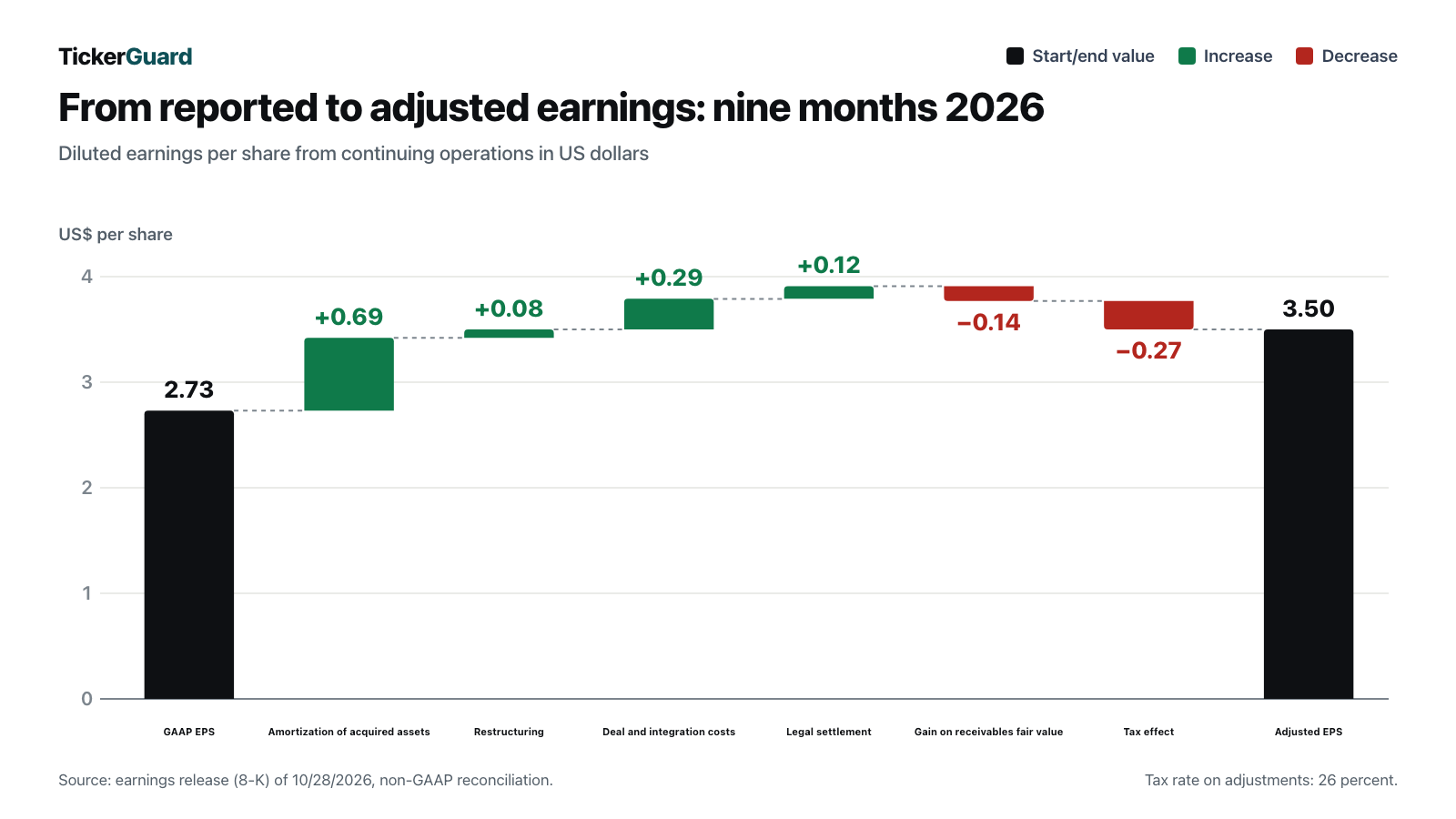
Sorted by what they mean (all amounts before tax, nine months of 2026, millions of dollars):
- Amortization of acquisition assets: 28.2. This is not a one-off. PROG recorded $319.0 million of intangible assets for Purchasing Power (customer relationships, broker network, brand, technology) and writes them down quarter after quarter — $7.8 million in the third quarter, $4.0 million in the prior-year quarter. It is non-cash, but it is the price the acquisition leaves in the income statement, and it runs for years. Strip it out and you value the acquisition as if it had been a gift.
- Acquisition and integration costs: 12.0. A genuine one-off, almost entirely in the first half; only 0.4 in the third quarter.
- Legal settlement: 4.75 (intellectual-property dispute, June 2026) and restructuring costs: 3.1 for the nine months — in the third quarter even a credit of 0.8. Both one-off.
- Valuation gain on receivables: −5.7 in the first quarter. This is the only item that raised reported earnings, which is why it is removed.
The result of the check: the one-off items depress reported earnings on balance, they do not inflate them — before tax, $19.8 million of costs stand against $5.7 million of gains. So the adjusted figure is not dressed up with special gains. The caveat lies elsewhere: it leaves out the ongoing amortization of the acquisition ($0.69 of the $0.77), and the EBITDA measure also excludes stock-based compensation ($24.9 million in the nine months, after $21.4 million a year earlier). And two sources of profit that do not come from the core business remain in the results: gains on the sale of written-off lease receivables of $14.0 million (in both figures) and valuation gains on the acquired receivables of a total of $9.0 million, of which only the $5.7 million from the first quarter is adjusted out. Reported earnings therefore contain $23.0 million (roughly 15 percent of the pre-tax income of $150.7 million), adjusted earnings still $17.3 million. In the third quarter alone they were $2.9 million and $1.5 million, or 8 percent of quarterly pre-tax income of $52.3 million — nothing was adjusted out there.
To put the third quarter in context: reported earnings per share from continuing operations rose from $0.80 to $0.92 (+15 percent), the adjusted figure from $0.87 to $1.06 (+21.8 percent). The result from discontinued operations (the sold credit-card business Vive) was an insignificant minus $0.2 million; total earnings per share were $0.91 versus $0.82.
What the filings say — the uncomfortable truths
Uncomfortable truth no. 1: The core business barely grows — and earns less
Progressive Leasing accounts for three quarters of revenue. In the third quarter of 2026, new volume (GMV) grew 2.3 percent to $420.4 million, segment revenue fell 0.7 percent to $552.7 million, and pre-tax income dropped 12.7 percent to $40.8 million (prior-year quarter: $46.7 million). The segment's adjusted EBITDA of $56.5 million was 12.3 percent below the prior year. The 25.6 percent gain in consolidated revenue is thus almost entirely bought: strip out the $131.8 million from Purchasing Power and $594.0 million remain, against $577.7 million — about 2.8 percent (our own calculation), and the entire gain comes from the small Four (+$19.8 million), while Progressive Leasing lost $3.9 million.
Management names the cause itself: according to the earnings call of October 28, the approval rate on new customer contracts is almost 300 basis points — nearly three percentage points — below the prior year, because PROG tightened its credit screening. That is volume given up voluntarily to keep losses under control; we come back to it in the call chapter. On top of that come the legacy burdens from the 2025 annual report: the bankruptcy of Big Lots (filing in September 2024, wind-down in December 2024) and that of the furniture retailer American Signature in November 2025 — and two individual retail partners that each brought in more than 10 percent of group revenue in 2025. The report does not say who they are.
That is why the outlook was cut most sharply for this segment. The forecast for Progressive Leasing's pre-tax income fell on October 28 from $188.5–193.0 million to $178.5–179.0 million. The wording of the release:
“Given the ongoing macroeconomic pressures on many of our consumers, the Company is reducing its revenues and earnings outlook ranges for the Fiscal Year ending December 31, 2026 as well as providing outlook for the fourth quarter of 2026.”
— PROG Holdings, SEC current report (8-K) of October 28, 2026, Exhibit 99.1 (earnings release), section “2026 Outlook”
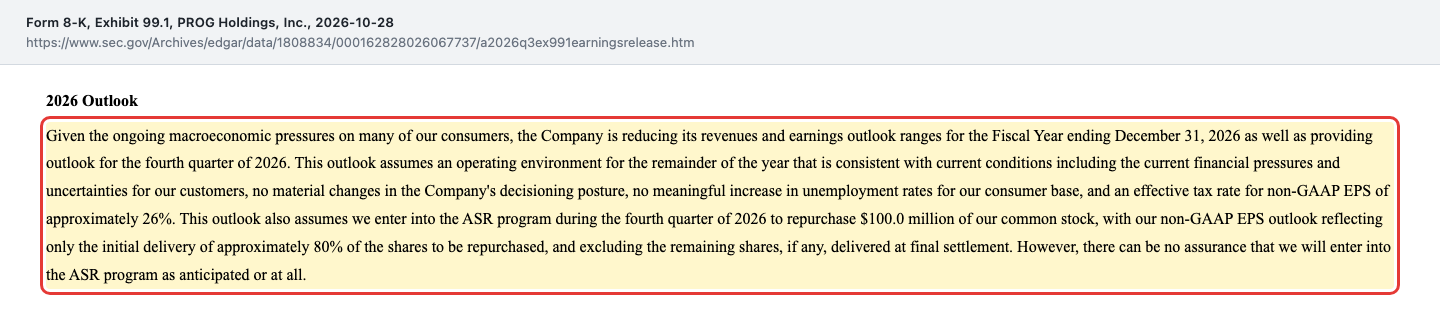
Group-wide: revenue $3,015 to $3,050 million (previously $3,025 to $3,100), adjusted EBITDA $345 to $355 million (previously $355 to $375), adjusted earnings per share $4.70 to $4.85 (previously $4.75 to $5.00). One qualification belongs here: the cut in adjusted earnings per share is cushioned by the planned share repurchase, because the forecast already includes the first delivery of roughly 80 percent of the shares (earnings release). And the Four segment was the only one raised: pre-tax income of $28 to $30 million instead of $22 to $25 million.
Uncomfortable truth no. 2: The acquisition has its first quarterly profit — and needs a holiday quarter
On December 1, 2025, PROG signed the purchase agreement for Purchasing Power; on January 2, 2026, it closed. The wording of the current report:
“The aggregate consideration paid by the Purchaser to the Seller at the closing was approximately $420 million in cash, subject to customary adjustments. In addition, the Acquired Entity has approximately $330 million of non-recourse funding debt under its securitization and warehouse facilities that remained in place following the closing.”
— PROG Holdings, SEC current report (8-K) of January 2, 2026, Item 2.01

The exact math: $424.2 million of total consideration, of which $319.0 million went to intangible assets (customer relationships 258.0, broker network 24.0, brand 29.0, technology 8.0) and $110.7 million to goodwill. It was paid in cash and with debt, not with shares.
And what has the acquisition delivered? In the first quarter of 2026, $107.1 million of revenue came with a pre-tax loss of $7.5 million. In the third quarter: $131.8 million of revenue and $3.0 million of pre-tax profit — the unit's first reported quarterly profit, with adjusted EBITDA of $12.9 million. New volume was $161.2 million, 12.3 percent above the prior-year quarter, when the unit did not yet belong to PROG. For the nine months, though, a loss of $4.8 million before tax still stands.
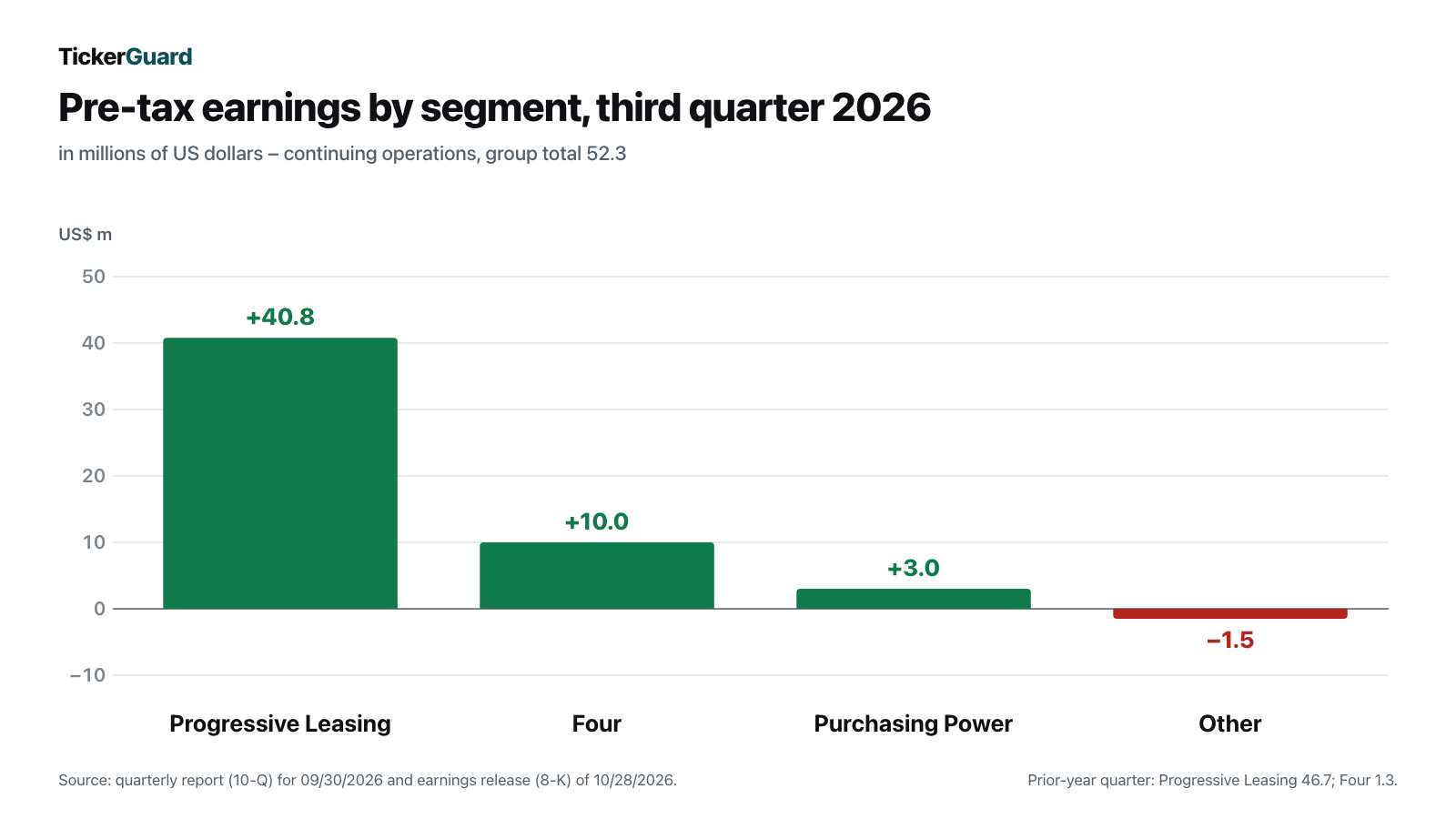
Now the catch. Management has cut the full-year forecast for Purchasing Power: revenue $605 to $615 million (previously $620 to $640), pre-tax income $14.0 to $18.5 million (previously $17.0 to $21.5). Subtract the nine months (revenue $369.3 million, income minus $4.8 million) and the fourth quarter has to deliver roughly $236 to $246 million of revenue and $18.8 to $23.3 million of pre-tax profit (our own calculation) — six to eight times the third quarter. That is plausible, because payroll-deduction business is highly seasonal: in 2025, $247.6 of $649.3 million of new volume — 38 percent — fell into the fourth quarter (earnings release, prior-year figures). But it is a bet on a single quarter. Management itself said on the call that the unit is heading into its most important quarter of the year.
Uncomfortable truth no. 3: The credit-loss provision has tripled
The income statement contains a line the group barely knew before the acquisition: the provision for credit losses. It was $30.5 million in the third quarter, against $10.0 million in the prior-year quarter, and $85.4 million for the nine months, against $23.5 million. The quarterly report shows who causes it: Purchasing Power $16.0 million (nine months: $43.9 million), Four $12.0 million (nine months: $35.3 million); the rest falls to Other, such as MoneyApp ($2.5 million against $2.4 million in the prior-year quarter). On top comes the classic write-off in leasing: 8.3 percent of lease revenue in the third quarter, after 7.4 percent a year earlier (provision $46.0 million versus $41.0 million). The company's own target band is 6 to 8 percent:

The rate was 7.5 percent in 2025, 7.3 in the first quarter of 2026, 8.4 in the second and 8.3 percent in the third (earnings calls). Two quarters in a row above the upper limit — this is the number analysts press hardest in the call chapter below.
Purchasing Power adds a particularity. The quarterly report names as the most important credit indicator for its receivables whether the debtor is employed by the federal government, because federal employees can unilaterally end the payroll deduction under current law. The age structure of the customer receivables written after the purchase (Note 4, excluding "other receivables") shows the difference: among federal employees, $4.5 of $25.9 million is past due — 17.3 percent —, among all others $29.2 of $238.4 million — 12.2 percent (our own calculation from the table values). Federal employees account for only about 10 percent of these receivables, so the risk is limited, but measurably higher. Part of the acquired receivables ($39.6 million) is also carried at fair value, with no visible provision line — losses there run through valuation changes.
Uncomfortable truth no. 4: Deleveraging, yes — but the buyback is also meant to be paid from the credit facility
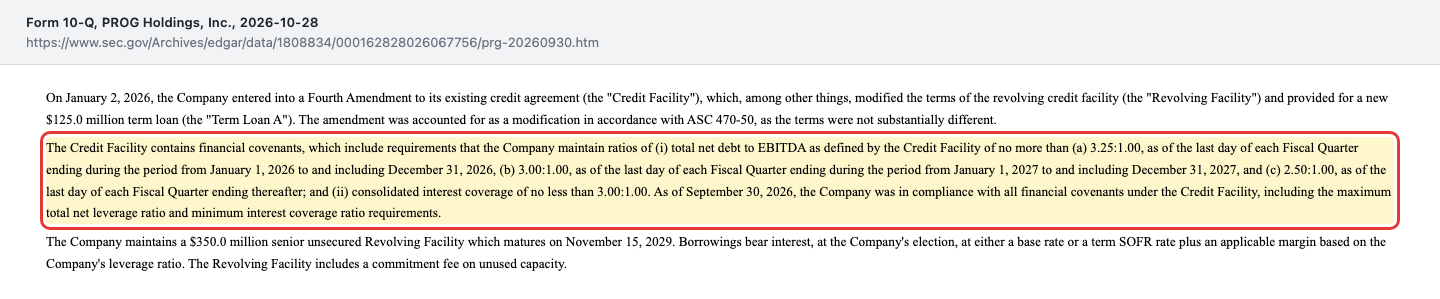
First the good news: PROG visibly pays down debt. Gross debt fell from $943.7 million (March 31, 2026) to $872.0 million (September 30, 2026); since the acquisition the company says it has repaid $326.6 million of debt. The net leverage ratio was 1.5 according to the earnings release — at the bottom of the self-imposed target band of 1.5 to 2. Of the debt, $272.0 million is non-recourse funding of the acquisition; the unsecured 6.00 percent notes of $600 million run until November 15, 2029. The $350 million credit facility is undrawn. The debt cap in the credit agreement — 3.25 in 2026, 3.00 in 2027, 2.50 after that — is being met:
“As of September 30, 2026, the Company was in compliance with all financial covenants under the Credit Facility, including the maximum total net leverage ratio and minimum interest coverage ratio requirements.”
— PROG Holdings, SEC quarterly report (10-Q) as of September 30, 2026, note on debt
Then the uncomfortable part. Cash fell from $308.8 million (December 31, 2025) to $108.9 million. And on October 28, PROG announced an accelerated share repurchase (ASR) of $100 million and topped the authorization back up to $500 million — with funding that the quarterly report names outright:
“The Company intends to fund the accelerated share repurchase using cash on hand and borrowings under its revolving credit facility.”
— PROG Holdings, SEC quarterly report (10-Q) as of September 30, 2026, note on equity

Two numbers belong next to it: in the third quarter, PROG bought back $36.7 million of its own shares at an average price of $41.47 — on October 28 the stock stood at $30.88. And $100 million equals roughly 8 percent of the market capitalization of about $1.2 billion. That management justifies the buyback with confidence in 2027 earnings, and expects net leverage at the top of its target band (about 2x) at year-end, is understandable. It remains a buyback in the middle of a forecast cut, partly paid for with borrowed money.
One more look at balance-sheet quality: goodwill and other intangible assets are carried at $755.3 million (end of 2025: $353.8 million) — 37 percent of total assets of $2,055.6 million and 93 percent of equity of $808.0 million. Equity without these items is only about $53 million (our own calculation). That is normal after an acquisition; but it means the balance sheet absorbs an impairment at Purchasing Power less comfortably than the equity ratio of 39 percent suggests.
Uncomfortable truth no. 5: The regulatory risk remains
A lease-to-own provider for customers with weak credit operates in a field that regulators watch permanently. In April 2020, Progressive Leasing paid $175 million to the U.S. Federal Trade Commission (FTC) to settle allegations about advertising and marketing practices — without admitting guilt. In the third quarter of 2024, the same agency again requested documents to demonstrate compliance. Almost every state regulates lease-to-own on its own, and the stricter laws cap what a provider may charge above the retail price. For Four, a joint investigation by seven state attorneys general into the buy-now-pay-later industry has been added since December 2025 — Four itself was not contacted. New is an information request: in October 2026, Progressive Leasing received a civil investigative demand from the Attorney General of North Carolina concerning its lease-to-own offerings and business practices in that state. PROG says it complies with applicable law but does not rule out litigation, fines and costs and cannot predict timing or outcome (quarterly report for September 30, 2026). On top comes a lawsuit pending since October 2025, filed as a putative class action, against the MoneyApp business, alleging that its cash advances violate the Military Lending Act and the Truth in Lending Act; PROG intends to defend itself. The settlement of about $4.8 million reached in June 2026, by contrast, concerned a commercial dispute over intellectual property — PROG did not admit liability. How tight the framework can get for comparable providers is shown by our analysis of World Acceptance.
What management promised — and what actually arrived
The numbers in the quarterly report say what was. The earnings calls say what management wanted — and comparing the two shows how reliable its promises are. We read the transcripts of all calls from February 2022 to October 2026, focused on the twelve calls since February 2024, and gave the question-and-answer part more weight than the prepared statement: the statement says what the company wants to say; the questions show what analysts doubt. All quotes were checked verbatim. The speakers are CEO Steven Michaels and CFO Brian Garner.
The scorecard of promises
Kept:
- Write-off range 2025: In February 2025, Garner promised to deliver write-offs within the full-year target band of 6 to 8 percent. Result according to the annual report: 7.5 percent.
- Outlook 2025 (held after a cut): Adjusted EBITDA was supposed to be $260 to $280 million in February 2025, was cut to $245 to $265 million in April and finally came in at about $269 million — after the April cut, that is above the lowered range and within the original one.
- Debt reduction after the acquisition: In February 2026, management put debt reduction first. Net leverage fell from about 2.5 through 2.0 (first quarter) and 1.7 (second) to 1.5 in the third quarter of 2026 — three quarters in a row inside the target band.
- Four becomes profitable: In the fall of 2025, Michaels said Four would have positive adjusted EBITDA for the full year. It was $9.9 million for 2025; the first quarter of 2026 alone exceeded that.
- Dividend: $0.12 (early 2024), $0.13 (2025), $0.14 per quarter (2026; declared August 5, 2026, payable September 3, 2026).
Not kept:
- Volume growth 2025: In February 2025, Michaels was confident of returning to volume growth in 2025. In fact, leasing new volume in the fourth quarter of 2025 was 10.6 percent below the prior year.
- Vive integration: In early 2024, the line was that 2024 would be a key year in which Vive would be integrated further. In the fall of 2025, the credit-card portfolio was sold.
- 90-day buyouts: In April 2026, Garner said fewer early buyouts after 90 days would be a net positive over the year. In October he reported the opposite: buyouts run higher on the tightened contract base.
- The outlook raised in July: On July 29, adjusted EBITDA for 2026 stood at $355 to $375 million; three months later at $345 to $355 million.
Open: For Purchasing Power, Garner named $50 to $60 million of adjusted EBITDA in February 2026. In July it was $620 to $640 million of revenue and $54 to $60 million of EBITDA, in October $605 to $615 million and $51 to $55.5 million — the revenue outlook has been cut by about 3 percent since July (midpoints of the two ranges: $630 million versus $610 million), while the EBITDA target holds in the lower half of the February range. Also open are the buyback, the three-year growth targets named in March 2026 (Michaels in October: nothing about this quarter or about our outlook for the fourth quarter has changed our view of the three-year growth rates) and the statement that leasing revenue will be back above the prior year in the fourth quarter.
The pattern: financial commitments that management controls itself — debt, dividend, write-off rate through the end of 2025 — were reliably met. Commitments that depended on customer behavior — volume, buyouts, outlooks — were missed or cut: the 2025 outlook in April (by year-end the original range was reached), the 2026 outlook in October.
Where the tone turned
Two turning points stand out. The first: February to April 2025. In February, Michaels called the burdens from Big Lots and the industry manageable headwinds. Two months later the same man sounded like this: inflation, tariff worries and the possibility of a recession were adding to the pressure on the business — the outlook was cut.
The second, more recent: July to October 2026. On July 29, when the outlook was raised, Michaels said the company was firmly back on a growth path in leasing. In the Q&A he described customers as stressed but resilient. On October 28:
“The longer the stress goes on, the harder it is to maintain resiliency.”
— PROG Holdings, earnings call for the third quarter of 2026 (10/28/2026), Q&A section, CEO Steven Michaels (transcript via the company's investor relations site)
In the CFO's prepared statement, a more cautious view of the consumer into year-end was added. The reason Michaels gave for tightening credit again: the pressure on customers had persisted and in places even intensified. Three months, one outlook up and one down lie between the two calls. In fairness, management has a counterargument: the midpoint of the lowered EBITDA outlook ($350 million) sits at the top of the first range given in February ($320 to $350 million); at that time it had not foreseen the conflict in the Middle East and its effect on gasoline and other prices for its customers. So the cut came from a bar that was raised in July ($355 to $375 million), not from the starting point.
What analysts really press on
Five topics recur in almost every Q&A: the state of the consumer (usually the first question), the write-off rate in leasing, capital return, the credit quality of Four and the seasonality of Purchasing Power. Where management evades is just as visible: on repurchase amounts, on trends after quarter-end and on the names of new retail partners. The most revealing pair concerns the write-off range. In July, Brad Thomas (KeyBanc) asked whether management could raise the 6 to 8 percent range. Garner:
“[…] moving that range at any given point in time in the future, obviously, would be you know, taken very seriously, and we would not do that lightly.”
— PROG Holdings, earnings call for the second quarter of 2026 (07/29/2026), Q&A section, CFO Brian Garner
Three months later, Hal Goetsch (B. Riley) asked how confident management was of landing within the range. Michaels:
“I would say the six part of that six to eight is not really appropriate anymore.”
— PROG Holdings, earnings call for the third quarter of 2026 (10/28/2026), Q&A section, CEO Steven Michaels
That effectively makes the range 7 to 8 percent — without it having been officially changed: in the same sentence Michaels made clear that he was not announcing a change to the range ("I am not making news here, in changing that range"). In July the question had been whether management could raise the range; Garner tied that to a robust, sustained data picture. For the full year, Garner expects a figure near the upper end of the range; the quarterly values were 7.3, 8.4 and 8.3 percent. In July, Bobby Griffin (Raymond James) had still called the rate above 8 percent the one weak spot of the quarter, and Michaels had replied that the company could also have made decisions that would have delivered a seven before the decimal point — in other words, it knowingly traded margin for volume.
The second pattern concerns Four. In October, Griffin brought up a public report questioning Four's credit quality. Michaels and Garner both answered at length; Garner explained that the provision is booked up front under CECL rules and deviates little from actual losses, and added:
“No re-agings.”
— PROG Holdings, earnings call for the third quarter of 2026 (10/28/2026), Q&A section, CFO Brian Garner
What is meant: past-due receivables are not retroactively reset to "current," which would flatter loss figures. Management denies that; the statement cannot be cross-checked in the quarterly report. Four's provision rose with volume from $7.6 million to $12.0 million; relative to new volume it fell by about one percentage point against the prior year, according to Garner. Anyone buying Four as a growth engine should know that this is exactly where analyst questions grew sharper.
And the buyback: in October, Brad Thomas asked why the company was doing an accelerated repurchase right now, amid so much uncertainty for consumers. Michaels saw it as a chance to put capital into the company's own business because the balance sheet allows it; the earnings targets had not provided for such a step, he said, and the three-year growth rates could even be affected by shares being retired. He justified the buyback with $260 million of recourse debt repaid since the acquisition ($326.6 million in total) and the expectation that it will lift earnings per share in 2027. In the fall of 2025, Anthony Chukumba (Loop) had asked whether management should not be buying back shares aggressively. Garner answered with the order of capital uses — growth first, then acquisitions, then returning excess capital — and, when Hoang Nguyen followed up, Michaels said the company does not comment on what it will repurchase in any given quarter. Buying then began only in the second quarter of 2026: 280,000 shares at an average of $36.34, and in the third quarter about 885,000 at $41.47.
What the stock costs — valuation in orders of magnitude
As of the data cut-off of October 28, 2026, the market capitalization was about $1.2 billion. The cross-check holds: 38,996,676 shares (cover page of the quarterly report, as of October 23, 2026) times a closing price of $30.88 gives $1.204 billion; the fundamental data show $1.23 billion. Compared with the cover page of the April quarterly report (40,065,564 shares on 04/24/2026), that is roughly 1.07 million fewer shares — the repurchases are working.
Orders of magnitude follow from that — and here you have to say which earnings figure is meant. The midpoint of the full-year earnings forecast under U.S. accounting rules ($3.78 to $3.93 per share) gives a price-earnings ratio of about 8; the midpoint of the adjusted outlook ($4.70 to $4.85) about 6.5; on a trailing-twelve-month basis the fundamental data show about 9.6. The price-sales ratio is roughly 0.4 to 0.5, the price-to-book ratio 1.5 (book value $20.72 per share: $808.0 million of equity divided by 38.996 million shares). Strip out goodwill and intangibles and only about $1.35 of book value per share remains — the price-to-book ratio then climbs above 20. Translated: the market pays only six and a half to just under ten dollars for a dollar of annual earnings, a discount of the kind a business bears whose customers are the first to come under pressure when prices rise. And: the earnings the valuation rests on are exactly the figure whose forecast was just cut.
What the pros say: seven analyst votes (six "Strong Buy," one "Buy") give an average price target of $52 (data as of October 29, 2026) — a very generous range on a narrow base of seven votes. The dividend is $0.14 per share per quarter (declared August 5, 2026, payable September 3, 2026), that is $0.56 a year and a yield of about 1.8 percent at the quoted price. The stock fluctuates more than average (beta 1.78) and moved between $25.18 and $47.73 over the past twelve months (data as of October 29, 2026).
Opportunities and risks at a glance
Opportunities
- Four is growing at triple digits and earning money: new volume +102.6 percent to $330.4 million in the third quarter of 2026, pre-tax income $10.0 million after $1.3 million; the outlook for Four was the only one raised.
- The acquisition delivered a positive result for the first time in the third quarter ($3.0 million of pre-tax profit, adjusted EBITDA $12.9 million) and brings a sales channel through employers that PROG did not have; according to management, two large employers launch in the fourth and first quarters.
- Valuation with a margin of safety: a price-earnings ratio of roughly 6.5 to 9.6, depending on the earnings figure; a price-to-book ratio of 1.5; a 1.8 percent dividend yield.
- Visible deleveraging: gross debt from $943.7 to $872.0 million, net leverage ratio 1.5, credit-agreement covenants met, the $350 million credit facility undrawn.
- The earnings figure is not inflated by special gains: the one-off items of the nine months depress earnings by a net $14.1 million before tax.
Risks
- The core business (76 percent of revenue) grows new volume by only 2.3 percent, its revenue is shrinking, its income fell 12.7 percent; the forecast for its pre-tax income was cut by $10 to $14 million.
- The credit-loss provision has tripled to $30.5 million in the quarter; the leasing write-off rate was above 8 percent for two quarters in a row, and management no longer considers the six in the range "appropriate."
- The acquisition's profit hangs on a single quarter: the fourth quarter needs $18.8 to $23.3 million of pre-tax profit, after $3.0 million in the third.
- The balance sheet carries $755.3 million of goodwill and intangible assets — 93 percent of equity; an impairment at Purchasing Power would hit equity directly.
- A $100 million buyback is also meant to be paid from the credit facility — after purchases at $41.47, with the stock at $30.88 and cash of only $108.9 million left.
- Permanent regulatory risk (FTC settlement of $175 million in 2020, industry investigation into buy-now-pay-later since December 2025, civil investigative demand from the North Carolina Attorney General in October 2026) and the most vulnerable customer base: management attributes the strain to energy prices following the Middle East conflict.
A human conclusion
Back to the anchor-price trap from the beginning. If you see PRG at $30.88 and think of the $43.71 from July 24, you are doing math with a price that rested on assumptions the company itself has since withdrawn: the July outlook, the firm return to a growth path, the six in the write-off range. The price fell as those assumptions fell — the old price is no longer a yardstick.
That does not mean the stock is expensive. On the contrary: a price-earnings ratio of six and a half to just under ten, net leverage of 1.5 and a management that pays down debt and raises dividends are not the signs of a company at the edge of the abyss. But it is a company whose core business is stagnating, whose acquisition has one profitable quarter behind it and a second, decisive one ahead, and whose customers, in the words of its own CEO, are less resilient the longer the pressure lasts. Management keeps its word where it steers itself — debt, dividend, discipline — and had to backpedal where the customers decide. That pattern is the most important piece of information from three years of earnings calls.
Whoever buys PRG buys the bet that the acquisition delivers in the holiday quarter and that pressure on consumers does not increase further. Whoever waits will see, at the latest from the next forecast adjustment, which way it goes. What you make of this is your decision. And that is how it should be.
Sources
- SEC quarterly report (10-Q) as of September 30, 2026 (filed 10/28/2026) — segment results, provision for credit losses, receivables structure, debt and covenants, share repurchase, share count on the cover page
- SEC current report (8-K) of October 28, 2026, Exhibit 99.1 (earnings release) — third-quarter results, reconciliation to adjusted figures, reduced 2026 outlook, fourth-quarter outlook
- SEC current report (8-K) of August 5, 2026 — quarterly dividend of $0.14 per share
- SEC quarterly report (10-Q) as of March 31, 2026 (filed 04/29/2026) — first-quarter segment figures, purchase price allocation
- SEC annual report (10-K) for fiscal year 2025 (filed 02/18/2026) — business model, segments, employees, write-off rates, regulation, cash flow statement
- SEC annual report (10-K) for fiscal year 2024 (filed 02/19/2025) — comparative figures for new volume
- SEC current report (8-K) of December 2, 2025 — purchase agreement for Purchasing Power
- SEC current report (8-K) of January 2, 2026 — closing of the acquisition, credit agreement amendment
- Transcripts of the earnings calls on quarterly results, February 2022 to October 28, 2026 (company investor relations site) — commitments, tone and analyst questions
- Fundamental data & SEC filings (annual and quarterly reports, 10-K/10-Q), data as of October 28-29, 2026 — prices, valuation ratios, analyst votes
This analysis is journalistic commentary on publicly available filings. It is not investment advice, not a buy or sell recommendation and not a solicitation to buy or sell securities. Share prices can move sharply and a total loss is possible. Every figure carries the cut-off date of its source and may have changed since. Positions held by the operator are disclosed daily; where one exists, it appears as a notice at the top of this analysis.
Key figures at a glance
All monetary figures in millions of $; earnings per share as reported.
| Metric | 2021 | 2022 | 2023 | 2024 | 2025 |
|---|---|---|---|---|---|
| Revenue | 2,677.9 | 2,597.8 | 2,408.3 | 2,463.5 | 2,409.2 |
| Operating Income (EBIT) | 333.5 | 185.6 | 225.6 | 194.9 | 238.3 |
| Net Income | 243.6 | 98.7 | 138.8 | 197.2 | 146.8 |
| Net Margin | 9.1% | 3.8% | 5.8% | 8.0% | 6.1% |
| Earnings Per Share | 3.69 $ | 1.90 $ | 2.98 $ | 4.53 $ | 3.59 $ |
Source: fundamental data & SEC filings (annual and quarterly reports, 10-K/10-Q)
Our Bottom Line at a Glance
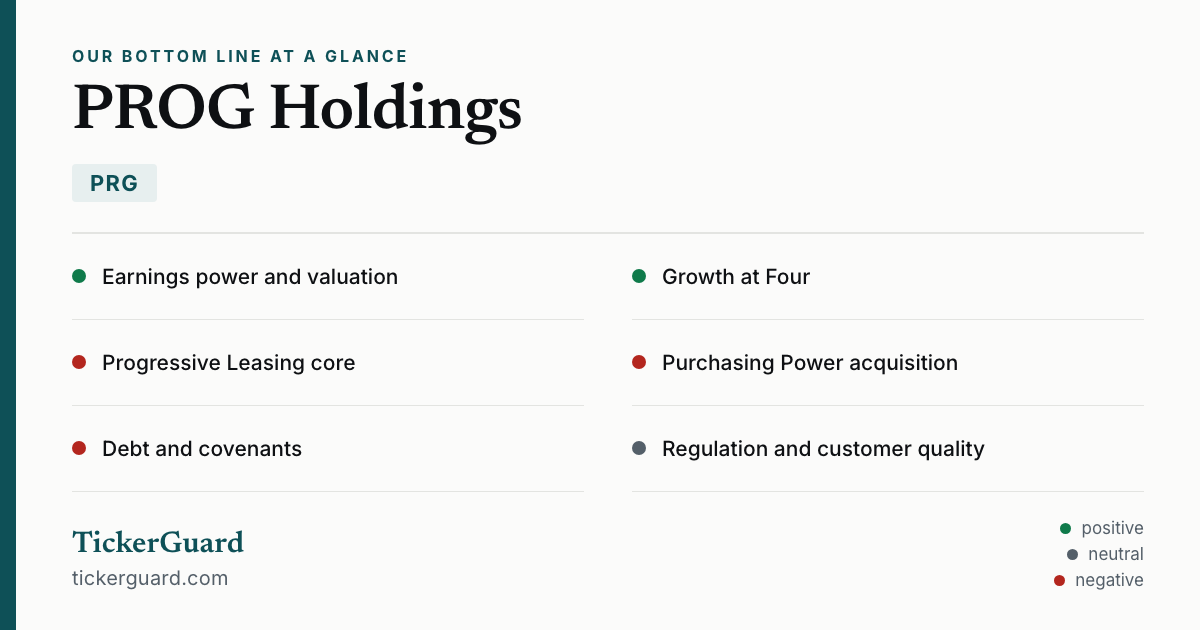
- Earnings power & valuation positive
- $52.3 million of pre-tax income in the third quarter of 2026 (prior year 44.7), $386.2 million of operating cash flow in nine months against a market capitalization of about $1.2 billion — price-earnings ratio about 8 (midpoint of the GAAP earnings outlook), price-to-book ratio 1.5 (10-Q as of 09/30/2026; price 10/28/2026).
- Growth at Four positive
- New volume in the third quarter of 2026 $330.4 million (+102.6 percent), pre-tax income $10.0 million after $1.3 million; the only segment with a raised outlook (pre-tax income $28–30 instead of $22–25 million; 8-K of 10/28/2026).
- Progressive Leasing core business negative
- Three quarters of revenue: new volume +2.3 percent, revenue −0.7 percent, pre-tax income −12.7 percent ($40.8 million after $46.7 million); segment forecast cut by $10–14 million; approval rate almost 300 basis points below the prior year (8-K and earnings call of 10/28/2026).
- Purchasing Power acquisition neutral
- First quarterly profit ($3.0 million before tax on $131.8 million of revenue), but minus $4.8 million over nine months; the full-year target of $14.0–18.5 million requires $18.8–23.3 million in the fourth quarter; revenue outlook cut since July 2026 from $620–640 to $605–615 million (10-Q and 8-K of 10/28/2026).
- Credit losses & earnings quality negative
- Provision for credit losses $30.5 million after $10.0 million in the quarter; leasing write-off rate 8.3 percent (second quarter in a row above the upper limit of 8); adjusted earnings per share $3.50 versus $2.73 reported — $0.69 of the gap is acquisition amortization, not special gains (10-Q and 8-K of 10/28/2026).
- Balance sheet & capital return neutral
- Gross debt $943.7 → $872.0 million, net leverage ratio 1.5, covenants met; at the same time cash of $108.9 million, goodwill and intangibles at 93 percent of equity and a $100 million buyback that is also meant to be paid from the credit facility (10-Q as of 09/30/2026).
PROG Holdings is a solidly earning, modestly valued lease-to-own business whose growth is bought: revenue rose 25.6 percent in the third quarter of 2026, about 2.8 percent without the Purchasing Power acquisition, and the Progressive Leasing core earned 12.7 percent less. The credit-loss provision has tripled, the outlook was cut, and in October management backed away from the six part of the write-off range. The adjusted earnings figure is not inflated by special gains, but it leaves out the amortization of the acquisition. Whoever buys here buys the bet that the acquisition delivers in the holiday quarter and that pressure on consumers does not increase further. Not investment advice.
What Our Rating Means
Open questions
The business works in principle, but one material question is open. As long as it stays open, our findings do not carry a quality verdict.
The business earns money, the balance sheet holds up, the covenants are being met and the valuation is modest — but a material operating question is open: the core business grows only through acquisition, the acquisition has just one profitable quarter and needs a strong holiday quarter, and credit losses sit above the company’s own target band. Management has reliably kept commitments it controls itself (debt, dividend) and cut commitments that depend on customers (volume, outlook) twice. For a green quality rating, evidence is missing that the core business grows again and that losses stay within the range; for red, there is no substantive finding. The decision is yours.
A journalistic assessment by our editorial team at the time of the deep dive, based on public sources — not investment advice and not a solicitation to buy or sell. Your personal circumstances (investment goals, risk capacity, taxes) cannot be taken into account. What our levels mean, how verdicts are formed, and what conflicts of interest exist →
Worth Noting
- The occasion for this edition is the quarterly report as of September 30, 2026 (filed 10/28/2026, with the earnings release in the current report 8-K Item 2.02 the same day); it replaces the first edition based on the report as of 03/31/2026. The earnings calls from February 2022 to October 2026 were also evaluated.
- Data cut-off: price $30.88 (close 10/28/2026), share count 38,996,676 (10-Q cover page, 10/23/2026) — market capitalization $1.204 billion, cross-checked against the fundamental data ($1.23 billion). Valuation ratios and analyst votes: as of 10/29/2026.
- Our own calculations (not reported in the filings): revenue growth without Purchasing Power (+2.8 percent), share of past-due customer receivables for federal employees and all other customers (17.3 and 12.2 percent), the fourth-quarter target for Purchasing Power ($18.8–23.3 million of pre-tax income) and equity without goodwill and intangible assets.
- Risk of confusion: PROG Holdings is not the furniture retailer Aaron's (formerly NYSE: AAN), from which the holding company was spun off on November 30, 2020, and not the biotech stock Precigen (Nasdaq: PGEN). The ticker PRG trades on the New York Stock Exchange.
- Vive Financial, a segment of its own until October 20, 2025, was sold and is reported as a discontinued operation; all revenue and earnings series in this analysis therefore refer to continuing operations.
Download the verdict card (traffic light and rating of this analysis as an image, PNG)
Stock Watch
This analysis is as of October 29, 2026. Stock Watch will tell you what's changed at PRG since then.
Later $1 a month per stock — signing up is free, and you'll be the first to know when it launches.
The full analysis as a PDF for later
We will send you this analysis as a PDF — to print, file away, and read at your own pace. And we will add you to the free Stock Watch list for PROG Holdings Inc (PRG), so you hear about it when something material in this analysis changes.
Frequently Asked Questions
PROG Holdings, Inc. (NYSE: PRG, Draper, Utah, 1,235 employees as of 12/31/2025) runs four businesses: Progressive Leasing leases furniture, appliances, phones and jewelry with a purchase option to customers with weak credit (third quarter of 2026: $552.7 of $725.8 million in revenue). Four offers payment in four interest-free installments, Purchasing Power purchases by payroll deduction through employers, and MoneyApp interest-free paycheck advances.
Revenue rose 25.6 percent to $725.8 million, of which $131.8 million came from the acquired Purchasing Power unit; without it, growth was about 2.8 percent (our own calculation). Earnings per share from continuing operations were $0.92 (prior year $0.80), adjusted $1.06 ($0.87). Progressive Leasing earned 12.7 percent less before tax, while Four grew new volume by 102.6 percent (quarterly report 10-Q as of 09/30/2026, earnings release in the current report 8-K of 10/28/2026).
On October 28, 2026, PROG cut its 2026 outlook: revenue $3,015 to $3,050 million (previously $3,025 to $3,100), adjusted EBITDA $345 to $355 million ($355 to $375), adjusted earnings per share $4.70 to $4.85 ($4.75 to $5.00). The company cites ongoing macroeconomic pressure on many of its consumers and describes a more cautious view of the consumer. Only the outlook for Four was raised.
No, if anything the reverse: for the first nine months of 2026, reported earnings per share are $2.73 against $3.50 adjusted. Of the $0.77 gap, $0.69 comes from the ongoing amortization of acquisition assets, the rest from acquisition, restructuring and legal costs, less a valuation gain of $5.7 million and tax effects. Gains on the sale of receivables ($14.0 million) remain in both figures; of the valuation gains ($9.0 million), $3.3 million remain in adjusted earnings.
In the third quarter of 2026 for the first time: $3.0 million of pre-tax income on $131.8 million of revenue (adjusted EBITDA $12.9 million). Over the nine months, a loss of $4.8 million still stands. The full-year forecast requires $18.8 to $23.3 million of pre-tax profit in the fourth quarter (our own calculation); the revenue outlook for the unit has been cut since July 2026 from $620–640 to $605–615 million.
Gross debt fell from $943.7 million (03/31/2026) to $872.0 million (09/30/2026); cash stands at $108.9 million (12/31/2025: $308.8). The net leverage ratio was 1.5, the covenants in the credit agreement (at most 3.25 in 2026) are being met, and the $350 million credit facility is undrawn. The announced $100 million share repurchase is also to be funded from the credit facility.
Kept were debt reduction (net leverage from about 2.5 to 1.5), the dividend ($0.12 → $0.13 → $0.14), the 2025 write-off rate (7.5 percent within the 6 to 8 target band) and the profitability of Four. Not kept were the volume growth in leasing promised for 2025, the Vive integration and the outlook raised in July 2026. In October 2026, the CEO said the six part of the write-off range is “not really appropriate anymore.”
The quarterly dividend is $0.14 per share (declared August 5, 2026, payable September 3, 2026), a yield of about 1.8 percent at the $30.88 price (10/28/2026). In the third quarter of 2026, PROG bought $36.7 million of its own shares at an average of $41.47 and on October 28 announced an accelerated repurchase of $100 million; the authorization was raised to $500 million and extended to October 26, 2029.
Found an error?
Did you spot a factual error, an outdated number, or a typo in this deep dive? Let us know briefly — your report goes straight to the editorial team.