Photronics: $673 million in the bank — and $504 million of it sits inside joint ventures
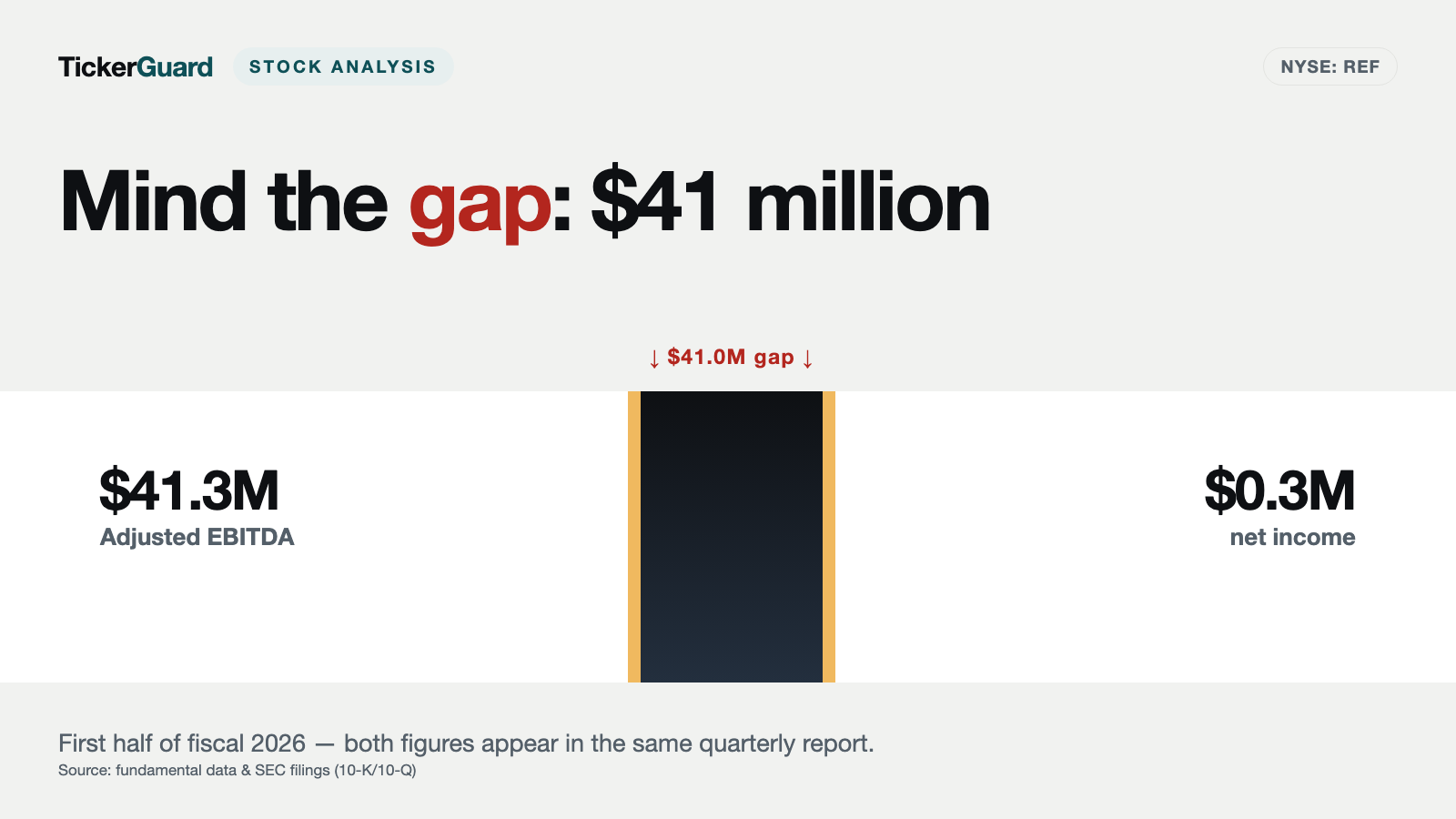
No photomask, no chip — and Photronics counts itself among the world's leading makers of those exposure templates in its own annual report. The company is effectively debt-free, has been profitable in each of the past five fiscal years and reported revenue of $216.0 million for the quarter ended August 2, 2026. The filings with the U.S. securities regulator, the SEC, still reward a second look: of $147.3 million in group net income over nine months, $44.0 million went to the minority holders of its joint ventures, and $503.5 million of the $672.8 million cash pile sits inside those same ventures. We read the annual report, the quarterly report and every filing since. Not investment advice — just the question of how much of a strong balance sheet actually reaches the shareholder.
 Thomas Mücke
Founder & Publisher
Thomas Mücke
Founder & Publisher
As of Today
As of: September 17, 2026
- Closing price
- 28.50 $ +2.40%
- Market Capitalisation
- 1.7 $B
- P/E
- 9.8
- Growth Score
- 4/10
- AAQS
- 5/10
Price change since September 8, 2026: -2.9%
This analysis has a cut-off date. The Stock Guard tells you when something material changes in the numbers. Reserve your free spot
Chart
Interactive price chart (TradingView).
52-week range: 20.30 $ to 55.00 $ · Last price: 28.50 $ (As of: September 17, 2026)
Note: pure fact-based analysis, not investment advice and not a solicitation to buy or sell. All figures without guarantee.
There is an investor trap familiar to anyone who has ever shared a flat: the refrigerator illusion. You open the door, you see two shelves of yogurt, cheese and beer, and for a moment it feels like abundance. Then you remember that three quarters of it belongs to your flatmates. The fridge was never empty. It was just never entirely yours. We make the same mistake with companies, only with more zeros: we read “$672.8 million in cash” and think of room to maneuver. Photronics, Inc. (Nasdaq: PLAB) of Brookfield, Connecticut is the textbook case — and it happens to be a company with a great deal going for it: in business since 1969, effectively debt-free, profitable in each of the past five fiscal years, and by its own annual report one of the world’s leading photomask manufacturers. So here is the deal: before you decide for or against this stock, let us read together what the company itself has told the U.S. securities regulator, the SEC — the Form 10-K for fiscal 2025, the Form 10-Q for the quarter ended May 3, 2026 and the earnings release of August 26, 2026. Those filings are honest under penalty of law. And this one describes a business the world needs, two partners who own a large slice of it, and revenue that has fallen for two years while earnings per share have kept rising. In the end, the decision is yours.
What Photronics actually does — the template without which no chip exists
A chip is not assembled, it is exposed. Inside a semiconductor fab, a silicon wafer sits beneath a light source, and between light and wafer hangs a photomask: a quartz or glass plate carrying the circuit pattern in microscopic detail. The everyday image is a stencil. If you want to spray a hundred letters in one night, you cut one clean stencil and use it a hundred times. A photomask is exactly that — except the lines on it are a few nanometers wide, and a single defect in the stencil ruins every chip exposed with it.
Photronics makes those stencils for two worlds: for integrated circuits (IC in the filings — processors, memory, automotive and industrial chips) and for flat panel displays (FPD — phone screens, televisions, monitors). The company runs 11 manufacturing sites across Asia, Europe and North America and served roughly 636 customers in fiscal 2025. As of October 31, 2025 it employed 1,908 people; none of them was represented by a union.
One thing matters for every figure in this piece: the Photronics fiscal year ends on October 31, not December 31. Fiscal 2025 therefore ran from November 1, 2024 to October 31, 2025 and broadly covers calendar 2025. The third quarter of fiscal 2026 ended on August 2, 2026.
The photomask market has one feature that shapes the whole case: many large chipmakers produce their masks in-house — captive facilities, in the industry\'s language. Photronics is one of the few merchant suppliers selling to everyone. That brings breadth (636 customers) and vulnerability at once: a supplier standing in the shadow of giants rarely negotiates from strength. The annual report says as much and names Dai Nippon Printing, Hoya, LG Innotek, SK-Electronics and Taiwan Mask Corporation among its competitors. That frames the central tension of this analysis, and it runs through every chapter: Photronics is indispensable to the supply chain — and still has only limited access to the money earned inside it.
Company history for investors
-
1969
Founded in Connecticut
Fifty-six years in the photomask business. For investors that means this company has survived several semiconductor cycles, not only the latest one.
-
2018
PDMCX joint venture in Xiamen (January)
Dai Nippon Printing takes 49.99 percent. Since then the plant's full profit appears in the group accounts — and is split out again at the very bottom.
-
2020
First $100 million buyback authorization (September)
Through October 2022, 5.8 million shares are retired for $68.3 million — the start of a falling share count.
-
2023
Record revenue of $892.1 million
The highest annual revenue on record. Two consecutive declines follow, because mainstream gives way faster than high-end grows.
-
2025
Repurchase of 5.0 million shares for $97.4 million
At an average of $19.52 apiece. Remaining shareholders gained a larger claim on the company without the company having to earn more.
-
2026
Executive suite rebuilt (January)
The chief technology officer leaves effective December 29, 2025 with no successor named; the chief financial officer becomes President as well. Both fall into the largest investment phase in years.
-
2026
Record high-end share (August 26)
44 percent of IC revenue in the quarter ended August 2, 2026 — the highest figure reported. The share also rises because the mainstream part is shrinking.
How this stock reached our desk
Photronics did not arrive via a valuation or momentum hit from our in-house stock scanner but through the Reddit hype scanner — the count of how often a ticker appears in the large retail investor forums (as of September 9, 2026). Such hits are never a buy argument for us, only a question: what woke people up?
The share price answers it. Over twelve months the stock has traded between $20.05 and $56.00 and closed at $29.36 on September 8, 2026. A security that nearly triples and then halves generates forum posts in both directions. What interests us is different: whether there is a business underneath the noise that a reader can understand. Here there is, because Photronics is one of the few companies whose product can be explained in a single sentence.
The numbers over the years — given their due
Start with what genuinely impresses, because there is plenty of it.
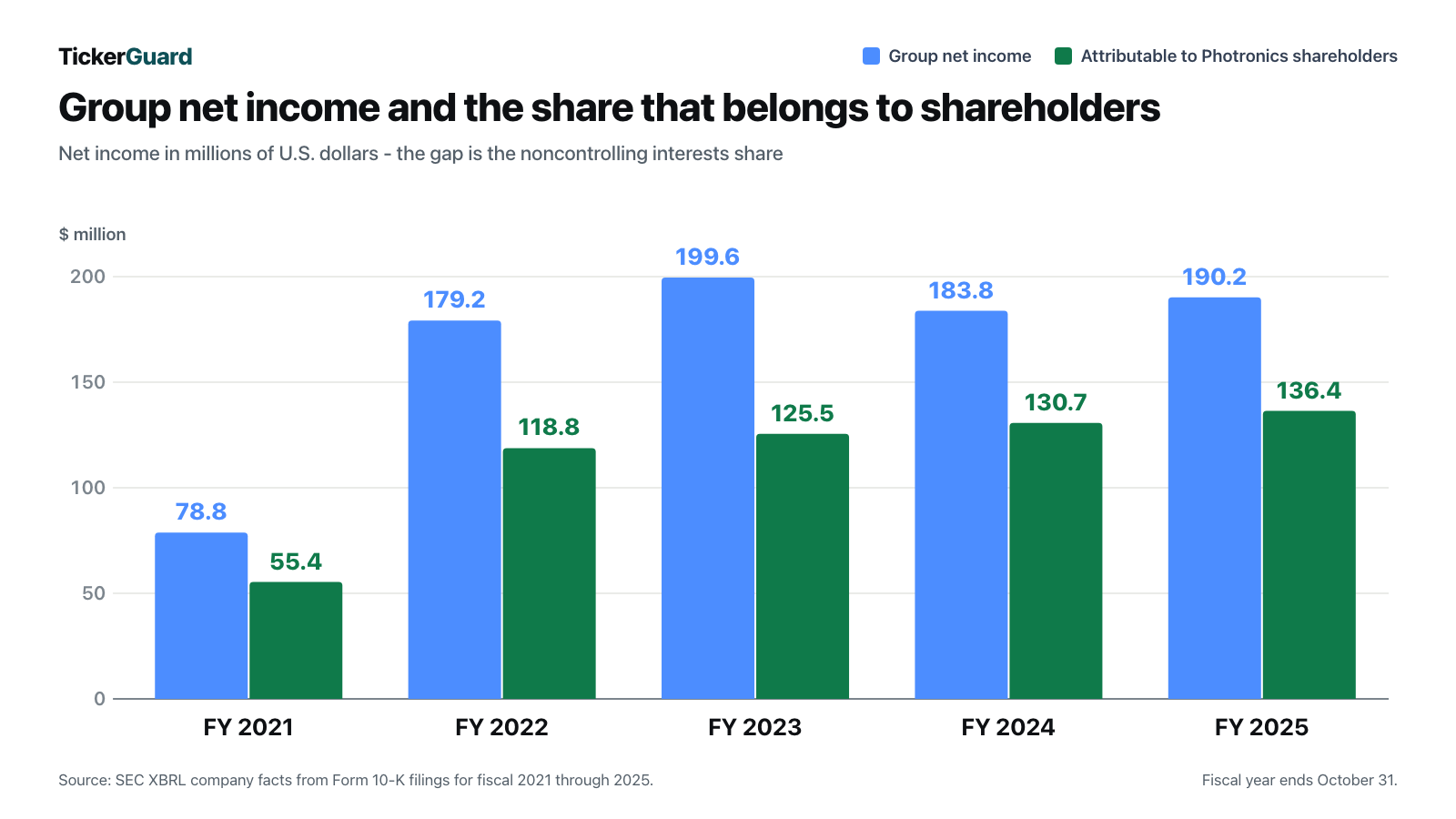
First, this company makes money, every year. Group net income went from $78.8 million in fiscal 2021 to $179.2 million (2022), $199.6 million (2023), $183.8 million (2024) and $190.2 million (2025). No loss year, no downside surprises. Diluted earnings per share climbed over the same span from $0.89 to $2.28 — and through the first nine months of fiscal 2026 reached $1.76, against $1.23 a year earlier. Diluted means the figure already accounts for shares that employee awards might create later; your slice of the pie is not smaller than that number claims.
Second, the balance sheet is unusually clean. On August 2, 2026, total assets of $1,990.7 million stood against $3.9 million of current and $4 thousand of long-term debt. That is not low leverage, that is effectively none. For comparison: interest payments across all of fiscal 2025 came to $0.1 million. Against that sit $672.8 million of cash and short-term investments and $955.0 million of net property, plant and equipment — plants, machines, exposure tools.
Third, the business throws off cash. Net cash provided by operating activities was $247.8 million in fiscal 2025 ($261.4 million in 2024, $302.2 million in 2023), and $220.6 million through the first nine months of fiscal 2026 against $160.0 million a year earlier. That is not an accounting profit, that is money arriving in the account.
And now the part you have to read alongside it.
What the filings say — the uncomfortable truths
Uncomfortable truth no. 1: a third of the profit does not belong to shareholders
Photronics runs part of its plant base together with partners and holds 50.01 percent of each — a bare majority. Under the accounting rules that means the full revenue and full profit of those plants appear in the consolidated accounts, and only at the very bottom is the partners\' share deducted again. That line is called noncontrolling interests, and at Photronics it is large.
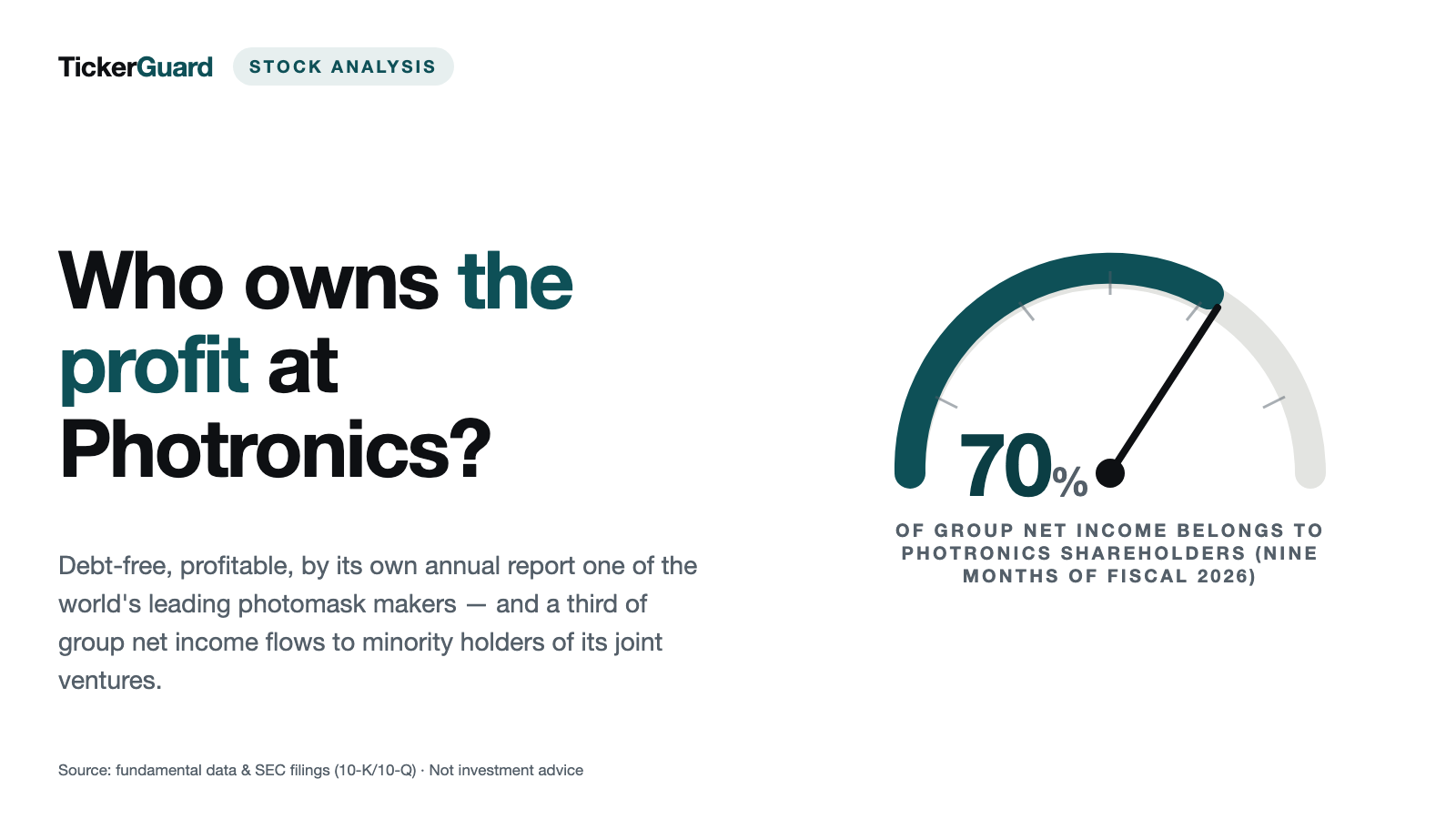
Through the first nine months of fiscal 2026 the group earned $147.3 million. Of that, $44.0 million went to noncontrolling interests and $103.3 million to Photronics shareholders — just under 70 percent. In fiscal 2025 the split was $190.2 million to $53.8 million to $136.4 million, again roughly 72 percent for shareholders. In fiscal 2023 it was only 63 percent, because $74.1 million of $199.6 million went to the partners.
This is neither a scandal nor an accounting trick — it is the honest consequence of a deliberate structure. But it changes every back-of-the-envelope calculation: divide group net income by the share count and you make yourself richer than you are. The filings make the difference explicit by reporting net income and net income attributable to Photronics, Inc. shareholders separately. Skip the distinction and you skip a third.
Uncomfortable truth no. 2: three quarters of the cash sits in the joint ventures
The same structure works on the asset side — and there it is even more pronounced. The third-quarter fiscal 2026 earnings release states it in a single sentence:
“Cash, cash equivalents and short-term investments at the end of the quarter were $672.8 million, of which $503.5 million was associated with our Joint Ventures, of which we own 50.01%.”
— Photronics, third quarter fiscal 2026 earnings release (Form 8-K filed August 26, 2026, Exhibit 99.1)
So 74.8 percent of the cash sits in companies Photronics owns only by a bare majority. Freely available at group level is arithmetically the remaining $169.3 million; of the rest Photronics economically owns half, but access is a matter of shareholder resolutions, distributions and — for one plant in China — capital transfer rules as well. The annual report explicitly flags regulations that “restrict our ability to transfer assets between operations not within the same legal jurisdiction.”
In fairness: Photronics does not hide this. It states the split in the same breath as the cash figure in every quarterly release. But anyone valuing the company has to strip it out themselves — no data portal does it for them.

Uncomfortable truth no. 3: the growing half is the smaller one
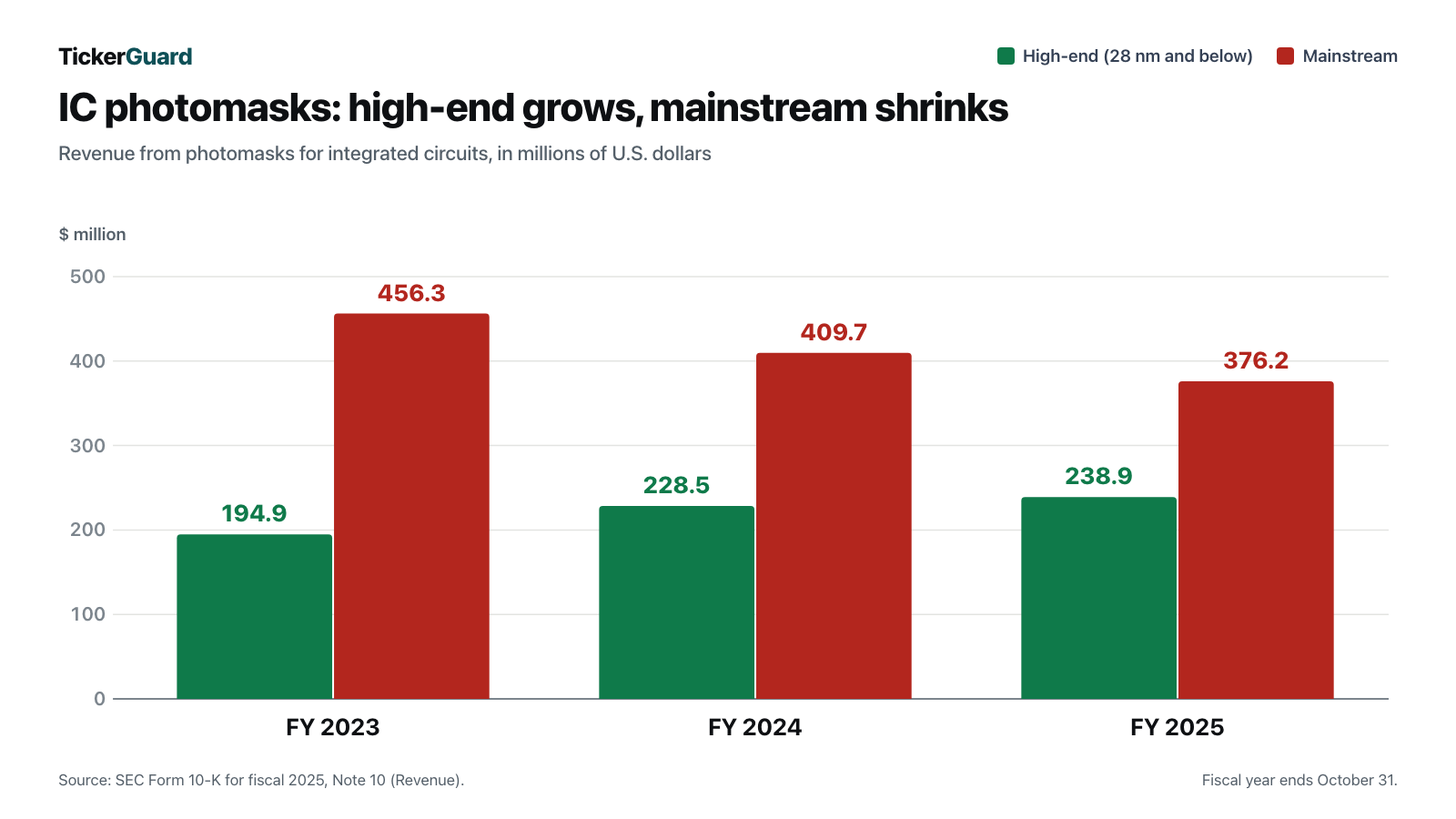
The notes to the annual report split revenue by product type, and that table is the most revealing in the entire document. Photronics distinguishes high-end (for ICs: geometries of 28 nanometers and below) from mainstream (everything above, meaning older, coarser process nodes).
In chip photomasks, high-end revenue rose from $194.9 million in fiscal 2023 through $228.5 million (2024) to $238.9 million (2025) — a gain of $43.9 million in two years. Over the same span mainstream revenue fell from $456.3 million through $409.7 million to $376.2 million — a loss of $80.1 million. Net of both, the chip business shrank from $651.3 million to $615.1 million. Display photomasks were steadier: $240.8 million (2023), $228.8 million (2024), $234.2 million (2025).
That is why group revenue declined two years running: $892.1 million (2023), $866.9 million (2024), $849.3 million (2025). And it is why the chief executive\'s line in the latest earnings release — that the high-end share reached a record 44 percent of total IC revenue — is both accurate and incomplete: the share also rises because the denominator is shrinking.
The good news sits in the current year. Through the first nine months of fiscal 2026, revenue of $651.1 million was 2.8 percent above the prior-year period ($633.5 million). The decline has stopped — for now.
What the company has not offset is the margin. Gross margin — the share of revenue left after cost of goods sold — fell to 33.2 percent through nine months of fiscal 2026, from 35.4 percent a year earlier. On $651 million of revenue, 2.2 percentage points is roughly $14 million that no longer comes through.
Uncomfortable truth no. 4: two customers account for nearly a third of revenue
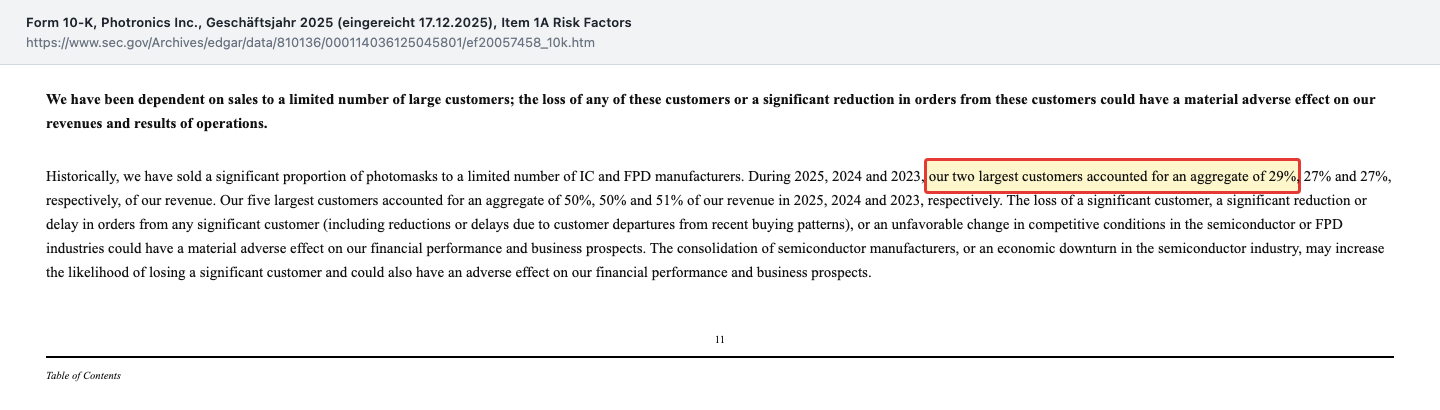
Photronics served roughly 636 customers in fiscal 2025 — a reassuringly large number. The distribution behind it is less so. The risk factors in the annual report state:
“During 2025, 2024 and 2023, our two largest customers accounted for an aggregate of 29%, 27% and 27%, respectively, of our revenue. Our five largest customers accounted for an aggregate of 50%, 50% and 51% of our revenue in 2025, 2024 and 2023, respectively.”
— Photronics, Form 10-K for fiscal 2025, Item 1A Risk Factors
Broken out individually: Customer A accounted for 16 percent of group revenue in fiscal 2025, Customer B for 13 percent and Customer C for 8 percent. No single customer is existential on its own — but half the business hangs on five phone numbers. And the concentration is rising, not falling: from 27 percent to 29 percent for the top two.
Then there is the map. By place of origin, fiscal 2025 revenue split across Taiwan ($283.8 million), China ($221.0 million), South Korea ($158.5 million), the United States ($148.9 million), Europe ($34.1 million) and other regions ($2.9 million). Roughly 78 percent of revenue is earned in East Asia, 59 percent in Taiwan and China alone. The filing puts total non-U.S. revenue at 82 percent (2024: 83 percent, 2023: 86 percent). Buying this stock means betting that chip production around the Taiwan Strait continues undisturbed. That is a political assumption, not a financial one.
Uncomfortable truth no. 5: a $177 million obligation with no debt line
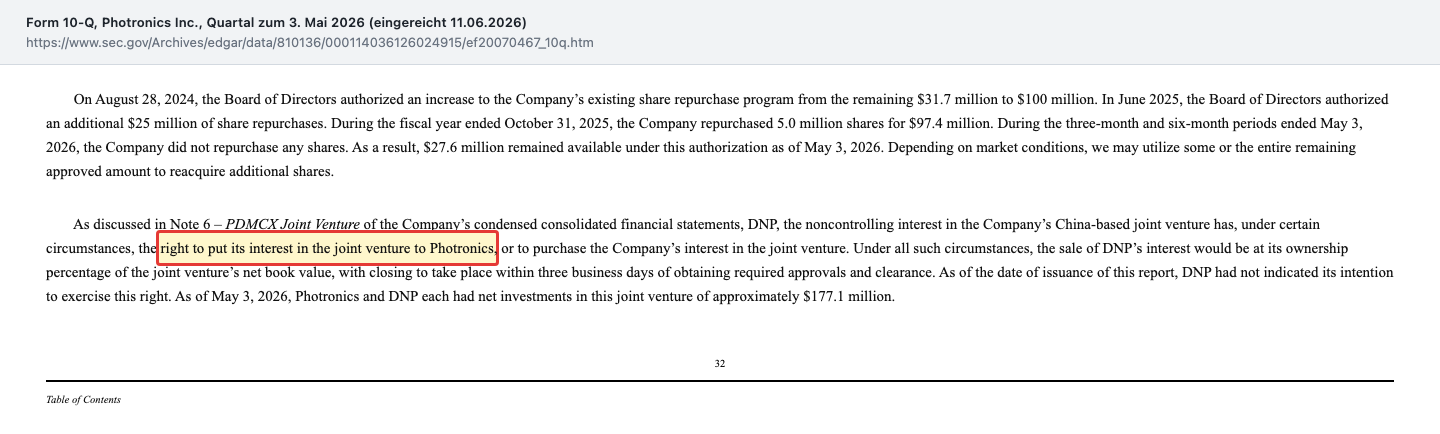
The debt-free group carries an obligation you will not find on the balance sheet. It sits in the management discussion of the quarterly report, in the liquidity section, and concerns PDMCX, the Chinese joint venture in Xiamen that Photronics has run since January 2018 together with the Japanese printing group Dai Nippon Printing (DNP) — 50.01 percent Photronics, 49.99 percent DNP.
“DNP, the noncontrolling interest in the Company’s China-based joint venture has, under certain circumstances, the right to put its interest in the joint venture to Photronics, or to purchase the Company’s interest in the joint venture.”
— Photronics, Form 10-Q for the quarter ended May 3, 2026, management discussion (Part I, Item 2), liquidity section
A put right means, in plain language: the partner may leave, and you must buy. The price follows the partner\'s ownership percentage of net book value, and closing happens within three business days of the necessary approvals. The same paragraph gives the size: as of May 3, 2026, each partner held a net investment of roughly $177.1 million in that plant, up from $160.4 million on October 31, 2025. That equals roughly 14 percent of the $1,280.7 million of equity attributable to Photronics shareholders on August 2, 2026.
The report states explicitly that as of its issuance date DNP had not indicated any intention to exercise the right. So this is not an acute problem — but it is not nothing either: a debt-free company with $169 million of freely available group cash would not hold enough liquidity outside the joint ventures for such an event and would have to distribute, divest or borrow for the first time in years.
Uncomfortable truth no. 6: the buyback is idle and the executive suite was rebuilt
Two developments in fiscal 2026 belong together. The first concerns the money. In fiscal 2025 Photronics repurchased 5.0 million of its own shares for $97.4 million, at an average of $19.52. The share count fell as a result from 63.35 million (August 29, 2024) to 58.96 million (June 4, 2026). Through the first nine months of fiscal 2026, by contrast, not a single share was repurchased, even though $27.6 million of authorization remains open. Capital expenditures instead rose from $130.9 million to $188.1 million (up 43.7 percent), and as of May 3, 2026 the company carried $211.3 million in capital commitments, of which $199.0 million is expected to be funded within twelve months. Free cash flow — operating cash flow less capital expenditures — consequently fell to $59.7 million in fiscal 2025, the lowest reading since fiscal 2021.
The second concerns people. Effective December 29, 2025, Chief Technology Officer Dr. Christopher J. Progler stepped down; the filing cites severance of $445,805, equal to twelve months of base salary, and names no successor. Two weeks later, on January 12, 2026, Chief Financial Officer Eric Rivera was additionally appointed President while remaining principal financial officer. The annual report itself counts the chief technology officer among the key personnel whose loss “could have a material adverse effect.” For a company investing hundreds of millions in plants in the United States and Korea right now, a vacant technology post is not a side issue.
Valuation — what the market pays for this structure
The closing price on September 8, 2026 was $29.36. Against 58,963,698 shares outstanding (as of June 4, 2026, from the quarterly report cover page) that gives a market capitalization of roughly $1.73 billion — which matches the published market value of about $1.73 billion, so the figure holds up.
The price-to-earnings ratio — the price measured against annual earnings per share — therefore sits at roughly 10. On a trailing four-quarter basis: $1.76 from the first nine months of fiscal 2026 plus $1.07 from the fourth quarter of fiscal 2025 gives $2.83 per share. The price-to-sales ratio is roughly 2 and the price-to-book ratio roughly 1.35 (shareholders\' equity of $1,280.7 million, or $21.72 per share).
A P/E of 10 is not expensive for a profitable, debt-free supplier to the semiconductor industry — the equipment makers in the same chain have traditionally traded far higher, as our analyses of ASML and Lam Research show. You just need to know what that price does not include.
The cash, for instance. Credit the full $672.8 million against the market capitalization and you arrive at an enterprise value of roughly $1.06 billion — five times fiscal 2025 operating income of $208.2 million. Credit only the economically attributable portion — the $169.3 million at group level plus half of the $503.5 million inside the joint ventures, roughly $421 million together — and you arrive at roughly $1.31 billion, or six times. Both calculations are our own derivation from the reported figures, not a company disclosure; the difference between them is precisely the refrigerator effect from the opening.
And the company\'s own guidance belongs here. For the fourth quarter of fiscal 2026 Photronics expects revenue between $207 million and $227 million, an operating margin between 19 and 24 percent and non-GAAP diluted earnings per share between $0.40 and $0.56. The midpoint of the revenue range is roughly the level of the third quarter ($216.0 million). Management is guiding to stability, not acceleration.
Upside and risks at a glance
What speaks for Photronics:
- An indispensable product: no photomask, no chip and no display — and Photronics counts itself among the world’s leading manufacturers in its own annual report.
- A balance sheet without debt: $3.9 million of current debt against $672.8 million of cash and short-term investments (August 2, 2026); interest payments of $0.1 million in fiscal 2025.
- Five consecutive profitable years with rising earnings per share: $0.89 (2021) to $2.28 (2025), and $1.76 through nine months of fiscal 2026.
- A rising high-end share: 44 percent of IC revenue in the third quarter of fiscal 2026 — the highest figure the company has reported.
- A revenue decline that appears to have stopped: $651.1 million through nine months of fiscal 2026 against $633.5 million a year earlier.
What speaks against it:
- Roughly 30 percent of group net income goes to noncontrolling interests ($44.0 million of $147.3 million through nine months of fiscal 2026).
- 74.8 percent of the cash sits inside joint ventures; freely available at group level is arithmetically $169.3 million.
- Mainstream shrinks faster than high-end grows: minus $80.1 million against plus $43.9 million between fiscal 2023 and fiscal 2025.
- Gross margin fell to 33.2 percent through nine months of fiscal 2026, from 35.4 percent a year earlier.
- Two customers account for 29 percent and five customers for 50 percent of revenue — and the concentration is rising.
- Roughly 78 percent of revenue is earned in East Asia, 59 percent in Taiwan and China alone.
- A put right held by partner DNP over a net investment last sized at roughly $177.1 million, appearing on no debt line.
- The share buyback has been idle for three quarters while $211.3 million of capital commitments remain open.
- The chief technology officer stepped down effective December 29, 2025 with no successor announced.
A human conclusion
Back to the refrigerator. The annoying part of the flatshare illusion is not that there is too little inside — it is that we lie to ourselves while looking. Photronics is not a bad company; on the contrary, it is one of the most solid we have examined this year: debt-free, profitable, 56 years in business, with a product every chip fab on earth needs. Anyone reading this analysis as a warning has misread it.
But it is an invitation to look closely before you start calculating. Three of this company\'s numbers are bigger than they should feel — the profit, the cash and the revenue — and three are smaller: what of it would reach you, what the group can actually touch, and the part of the business that is still growing. The filings say all of it openly; you just have to read the line beneath the line.
Whether a price-to-earnings ratio of roughly 10 is appropriate for a company whose profit is 30 percent owned by others, whose largest business segment is shrinking and which earns more than three quarters of its revenue in East Asia — that is not a question a spreadsheet answers. It is a question of how much uncertainty you will carry for how much substance. What you make of it is your decision. And that is exactly as it should be.
Sources
- Form 10-K for fiscal 2025, period ended October 31, 2025, filed December 17, 2025 — business model, headcount, customer concentration, revenue by product type and region, buyback program, PDMCX
- Form 10-Q for the quarter ended May 3, 2026, filed June 11, 2026 — share count, the DNP put right, capital commitments, the idle buyback program
- Third quarter fiscal 2026 earnings release (Form 8-K filed August 26, 2026, Exhibit 99.1) — quarter ended August 2, 2026, balance sheet, cash flow statement, fourth-quarter guidance
- Form 8-K filed January 2, 2026 — departure of the chief technology officer effective December 29, 2025
- Form 8-K filed January 13, 2026 — appointment of the chief financial officer as President, new chief accounting officer
- Photronics filing index at the SEC (CIK 0000810136)
Metrics from fundamental data and the SEC filings listed above; multi-year series from SEC XBRL company facts for the annual reports covering fiscal 2021 through 2025. Price reference: closing price of $29.36 on September 8, 2026.
This article is journalistic analysis and not investment advice. It contains no buy or sell recommendation and is not a solicitation to buy or sell securities. Stocks can lose substantial value; a total loss of invested capital is possible. All figures come from the primary sources named above and carry the reporting dates stated; later developments are not reflected. The author holds no position in Photronics shares at the time of publication.
Key figures at a glance
All monetary figures in millions of $; earnings per share as reported.
| Metric | 2021 | 2022 | 2023 | 2024 | 2025 |
|---|---|---|---|---|---|
| Revenue | 663.8 | 824.5 | 892.1 | 866.9 | 849.3 |
| Operating Income (EBIT) | 94.6 | 211.9 | 253.1 | 221.5 | 208.4 |
| Net Income | 55.4 | 118.8 | 125.5 | 130.7 | 136.4 |
| Net Margin | 8.4% | 14.4% | 14.1% | 15.1% | 16.1% |
| Earnings Per Share | 0.89 $ | 1.94 $ | 2.03 $ | 2.09 $ | 2.28 $ |
Source: fundamental data & SEC filings (annual and quarterly reports, 10-K/10-Q)
Our Bottom Line at a Glance
- Balance sheet substance positive
- On August 2, 2026, total assets of $1,990.7 million stood against just $3.889 million of current and $4 thousand of long-term debt, with $672.8 million of cash and short-term investments. Interest expense across fiscal 2025 came to $0.1 million. Equity attributable to shareholders was $1,280.7 million.
- Earnings power positive
- Five consecutive profitable fiscal years: group net income of $78.8 million (2021), $179.2 million (2022), $199.6 million (2023), $183.8 million (2024) and $190.2 million (2025). Diluted earnings per share rose without interruption from $0.89 to $2.28 and reached $1.76 through the first nine months of fiscal 2026, against $1.23 a year earlier. Operating cash flow in fiscal 2025 was $247.8 million.
- Who owns the profit negative
- Of $147.3 million in group net income through the first nine months of fiscal 2026, $44.0 million went to noncontrolling interests — roughly 30 percent. In fiscal 2023 it was $74.1 million of $199.6 million. The same holds on the asset side: $503.5 million of $672.8 million in cash sat inside the joint ventures on August 2, 2026, in which Photronics holds 50.01 percent.
- Business trajectory neutral
- Group revenue declined two years running, from $892.1 million (2023) through $866.9 million (2024) to $849.3 million (2025), because mainstream IC photomask revenue fell $80.1 million between fiscal 2023 and 2025 while high-end gained only $43.9 million. Through the first nine months of fiscal 2026 revenue of $651.1 million was back 2.8 percent above the prior-year period — but gross margin slipped from 35.4 to 33.2 percent.
- Dependencies negative
- The two largest customers accounted for 29 percent of fiscal 2025 revenue (2024 and 2023: 27 percent each), the five largest for 50 percent. Regionally, roughly 78 percent of revenue is earned in East Asia, 59 percent in Taiwan and China alone (fiscal 2025). On top of that sits the put right held by partner Dai Nippon Printing over a net investment last sized at roughly $177.1 million (May 3, 2026) that appears on no debt line.
- Capital allocation and leadership neutral
- In fiscal 2025 Photronics repurchased 5.0 million shares for $97.4 million; through the first nine months of fiscal 2026 it bought back none, with $27.6 million of authorization still open. Capital spending rose instead from $130.9 million to $188.1 million (up 43.7 percent), and $211.3 million of capital commitments were outstanding as of May 3, 2026. In parallel, the chief technology officer stepped down effective December 29, 2025 with no successor announced, and the chief financial officer was appointed President on January 12, 2026.
Photronics is a solid company with an indispensable product: no photomask, no chip, and the company has counted itself among the world's leading manufacturers since 1969. The balance sheet is effectively debt-free, the business was profitable in each of the past five fiscal years, and earnings per share rose from $0.89 to $2.28. Two things qualify that picture without overturning it: roughly 30 percent of group net income and 74.8 percent of the cash belong to joint ventures in which Photronics holds only 50.01 percent — and the large mainstream business is shrinking faster than the high-end business is growing. Anyone valuing this stock has to strip both out themselves. Not investment advice.
What Our Rating Means
Open questions
The business works in principle, but one material question is open. As long as it stays open, our findings do not carry a quality verdict.
Yellow, because material operating questions are open without a substance risk being present. In favor of yellow: the far larger mainstream part of the chip business lost $80.1 million between fiscal 2023 and fiscal 2025 while high-end gained only $43.9 million; gross margin fell from 35.4 to 33.2 percent through the first nine months of fiscal 2026; and customer concentration is rising (two customers 29 percent, five customers 50 percent in fiscal 2025) — pronounced concentration without immediate existential danger. Clearly against red: there is no going-concern indication, equity attributable to shareholders is $1,280.7 million, debt totals $3.9 million, operating cash flow was $247.8 million in fiscal 2025, and the company was profitable in each of the past five years. Against green stands the structure: a third of the profit and three quarters of the cash do not economically belong to shareholders alone. Price arguments play no part in this rating — the fact that the stock looks inexpensive at a price-to-earnings ratio of roughly 10 changes nothing about the quality question. Before buying, we would wait for two figures in the next report: mainstream chip photomask revenue and gross margin. The decision is yours.
A journalistic assessment by our editorial team at the time of the deep dive, based on public sources — not investment advice and not a solicitation to buy or sell. Your personal circumstances (investment goals, risk capacity, taxes) cannot be taken into account. What our levels mean, how verdicts are formed, and what conflicts of interest exist →
Worth Noting
- Photronics reached our research list through the Reddit hype scanner (as of September 9, 2026) after a twelve-month range of $20.05 to $56.00. We reviewed the Form 10-K for fiscal 2025 (filed December 17, 2025), the Form 10-Q for the quarter ended May 3, 2026 (filed June 11, 2026) and every filing since: the beneficial ownership reports SCHEDULE 13G/A filed July 14, 2026 and SCHEDULE 13G filed July 31 and August 14, 2026 (institutional holders, no impact on the figures) and the third quarter earnings release (Form 8-K filed August 26, 2026, Item 2.02, Exhibit 99.1). The third-quarter Form 10-Q was not yet on file as of September 9, 2026; quarterly figures therefore come from the company’s unaudited earnings release rather than a reviewed interim statement.
- Risk of confusion: Dai Nippon Printing, the partner in the Chinese joint venture, is also named as a competitor outside Taiwan and China in the annual report. Two earnings lines must be kept apart — net income (group) and net income attributable to Photronics, Inc. shareholders; only the second belongs to shareholders. Photronics is unrelated to Photronix or similarly named companies; the SEC lists no former names for CIK 0000810136.
- Valuation figures are dated and evergreen: closing price of $29.36 on September 8, 2026, market capitalization of roughly $1.73 billion based on 58,963,698 shares (as of June 4, 2026). Cross-check against the published market value of roughly $1.73 billion: a deviation of less than one percent. Balance sheet and earnings figures carry the reporting dates August 2, 2026, May 3, 2026 or October 31, 2025. Analyses are evergreen; daily prices are not a buy argument.
- The split of the cash into freely available at group level ($169.3 million) and economically attributable (roughly $421 million) is our own derivation from the reported figures of $672.8 million and $503.5 million together with the 50.01 percent ownership stake — the company itself publishes no such breakdown.
Stock Watch
This analysis is as of September 9, 2026. Stock Watch will tell you what's changed at PLAB since then.
Later $1 a month per stock — signing up is free, and you'll be the first to know when it launches.
The full analysis as a PDF for later
We will send you this analysis as a PDF — to print, file away, and read at your own pace. And we will add you to the free Stock Watch list for Photronics Inc (PLAB), so you hear about it when something material in this analysis changes.
Frequently Asked Questions
Photronics, Inc. (Nasdaq: PLAB) of Brookfield, Connecticut manufactures photomasks — quartz or glass plates carrying microscopic circuit patterns that serve as the exposure template in chip and display production. Without them no semiconductor exists. Founded in 1969, the company runs 11 plants across Asia, Europe and North America and served roughly 636 customers in fiscal 2025 with 1,908 employees.
On October 31. Fiscal 2025 ran from November 1, 2024 to October 31, 2025 and therefore broadly covers calendar 2025. The quarters are shifted accordingly: the third quarter of fiscal 2026 ended on August 2, 2026. Comparing Photronics with companies whose year ends on December 31 means comparing slightly different periods.
Because Photronics operates several plants jointly with partners and holds 50.01 percent of each. Revenue and profit of those joint ventures appear in full in the consolidated accounts; only at the end is the partners' share deducted. Through the first nine months of fiscal 2026 that share was $44.0 million of $147.3 million — roughly 30 percent. Photronics shareholders were left with $103.3 million.
Of $672.8 million in cash and short-term investments on August 2, 2026, the earnings release reports that $503.5 million sat inside the joint ventures. Arithmetically that leaves roughly $169.3 million freely available at group level. Photronics economically owns 50.01 percent of the remainder, but access depends on shareholder resolutions — and for the plant in China on capital transfer rules as well.
Effectively none. On August 2, 2026 the balance sheet showed $3.889 million of current and $4 thousand of long-term debt against total assets of $1,990.7 million and cash of $672.8 million. Total interest payments in fiscal 2025 came to $0.1 million. Equity attributable to Photronics shareholders stood at $1,280.7 million.
Because the growing part is the smaller one. High-end chip photomask revenue rose from $194.9 million in fiscal 2023 to $238.9 million in fiscal 2025, while the larger mainstream business fell from $456.3 million to $376.2 million. Group revenue therefore declined from $892.1 million (2023) through $866.9 million (2024) to $849.3 million (2025). Through nine months of fiscal 2026 it was back above the prior-year level at $651.1 million.
The Japanese printing group Dai Nippon Printing holds 49.99 percent of PDMCX, the Chinese joint venture in Xiamen, and may under certain circumstances put that interest to Photronics — at its ownership percentage of net book value, closing within three business days of the required approvals. As of May 3, 2026 the net investment per partner was roughly $177.1 million. Per the quarterly report, DNP had not indicated any intention to exercise it.
At the closing price of $29.36 on September 8, 2026 and 58,963,698 shares outstanding, the market capitalization is roughly $1.73 billion. That puts the price-to-earnings ratio at roughly 10 (trailing four-quarter earnings per share of $2.83), the price-to-sales ratio at roughly 2 and the price-to-book ratio at roughly 1.35. The 52-week range ran from $20.05 to $56.00.
Found an error?
Did you spot a factual error, an outdated number, or a typo in this deep dive? Let us know briefly — your report goes straight to the editorial team.