Lam Research Stock: A Record Year in the AI Boom — and Four Customers Now Pay Over Half the Bill
Lam Research builds the machines without which no modern chip gets made — and delivered a record fiscal year 2026: $23.2 billion in revenue, $7.3 billion in net income, a record June quarter and guidance that points to another 20-percent-plus jump for the September quarter. We read the fresh annual report (10-K), the earnings call and the latest insider filings (Form 4): four customers now pay 55 percent of the bill — up from two customers and 32 percent a year ago — a third of revenue still hangs on China, and the stock has fallen roughly a quarter since July 2026 even as the numbers keep breaking records. Not investment advice — we simply count what the record costs and what it hangs on.
 Thomas Mücke
Founder & Publisher
Thomas Mücke
Founder & Publisher
As of Today
As of: September 17, 2026
- Closing price
- 269.30 $ 0.00%
- Market Capitalisation
- 371.4 $B
- P/E
- 47.0
- Growth Score
- 8/10
- AAQS
- 10/10
Price change since September 2, 2026: -7.6%
This analysis has a cut-off date. The Stock Guard tells you when something material changes in the numbers. Reserve your free spot
Chart
Interactive price chart (TradingView).
52-week range: 121.90 $ to 433.30 $ · Last price: 269.30 $ (As of: September 17, 2026)
Note: pure fact-based analysis, not investment advice and not a solicitation to buy or sell. All figures without guarantee.
There is a sentence investors use to talk themselves into any price: "You can always buy quality." It feels wise because it sounds like Warren Buffett, and it is dangerous because it ends the thinking before the thinking starts. A year has passed since our first Lam Research analysis, and the real-world test came back clear: Lam Research (Nasdaq: LRCX) delivered one record quarter after another in fiscal year 2026 — and the stock has still fallen roughly a quarter since July 2026. Quality alone did not hold the price. So let's make the same deal again: before you settle on any verdict, we read together what Lam itself reported to the U.S. securities regulator, the SEC — in the fresh annual report (10-K) for fiscal year 2026, in the earnings conference call, and in the insider filings (Form 4) of the executive floor. An SEC filing is honest under penalty of law. And at Lam it contains both: one of the best money machines of the chip world. And a cluster risk that nearly doubled in the same year. In the end, you decide for yourself.
What Lam Research actually does
A modern memory chip is a high-rise with well over a hundred floors — just a few nanometers wide. It is built not with cranes but with machines that apply wafer-thin layers of material (deposition) and then mill holes, trenches and channels back into them with atomic precision (etch). Exactly these machines are what Lam Research builds — plus systems for cleaning the silicon wafers. Translated: Lam sells the excavators and concrete pumps of the chip age. The customers are the world's big memory, foundry and logic manufacturers; their fabs sit mostly in Asia. Add a second, steadier leg: spare parts, service, upgrades and refurbished equipment — already $2.47 billion of the $6.72 billion in revenue in the June 2026 quarter alone. The company was founded in 1980, headquarters are in Fremont, California, and per the fiscal year 2026 annual report (10-K), about 23,300 people work for Lam worldwide (as of August 4, 2026) — a sizeable jump from roughly 19,000 a year earlier.
Two peculiarities you have to know before we go into the numbers. First: the fiscal year ends in late June, not in December. So when this analysis speaks of "fiscal year 2026", it means the twelve months from late June 2025 through June 28, 2026. Second: Lam carried out a 10-for-1 stock split in October 2024; all price and share figures in this analysis are split-adjusted. You may already know the industry from our analysis of inspection-equipment maker KLA — KLA checks what has been built, Lam builds it. Both earn from the same boom: no new fabs, no AI chips — and no new fabs without Lam machines.
Company history for investors
-
2024
10-for-1 stock split
In October 2024, each share was split into ten — no change in value for investors, just a new denomination, but the basis for every later price comparison.
-
2025
Change of independent auditor
After 44 years, KPMG replaced Ernst & Young as auditor in September 2025 — per the current report, without disagreements; starting with fiscal 2026, KPMG conducted its first full audit.
-
2026
Record quarter and a third guidance raise
The June 2026 quarter became the best in company history at $6.72 billion in revenue; management raised its annual WFE forecast for the third time running.
-
2026
Customer concentration jumps to 55 percent
The annual report (10-K) of August 7, 2026 shows four major customers instead of two — a concentration risk that sharpened noticeably for investors in the very same record year.
The metrics at a glance: quality with a price tag
Let's take a sober look at the raw numbers first, before we get to the stories behind them. In fiscal year 2026, Lam earned roughly 65 percent return on every dollar of equity (net income against average equity), the operating margin was around 35 percent, the net margin around 31 percent. The balance sheet is a fortress: an equity ratio around 53 percent (up from 46 percent a year earlier), financial debt down to barely 30 percent of equity, $5.60 billion in cash as of June 28, 2026. These are figures only a handful of industrial companies worldwide reach — numbers that, on their own, would justify any quality free pass.
But the market paid an extreme premium for that quality for a full year, and has since pulled some of it back: on September 2, 2026, per an insider filing (Form 4), the stock stood at $291.32 — roughly 25 percent below the price at which the CEO had sold as recently as July 2, 2026 ($390.01). At that price, with roughly 1.251 billion shares outstanding (as of August 4, 2026), Lam's market value comes to roughly $365 billion — about 50 times annual earnings and 16 times annual revenue for fiscal 2026. Still expensive, but noticeably less expensive than in the summer, when the same ratios stood at roughly 70 times earnings. Remember the tension of this analysis, it is the connecting thread for everything that follows: the machine is more flawless than ever — but the market has started pricing the risks from its own annual report (10-K) back in.
The numbers over the years — one record quarter after another
Let's start with what this company has earned — in both senses of the word. In fiscal year 2026 (through June 28, 2026), revenue rose 26.0 percent to $23.2 billion and net income 35.6 percent to $7.3 billion — of every revenue dollar, more than 31 cents stuck as profit, and earnings per share climbed to $5.76 (from $4.15). The gross margin climbed to 50.5 percent (from 48.7). And the June 2026 quarter — $6.72 billion in revenue, a 51.7 percent gross margin, a 37.4 percent operating margin and $1.81 in earnings per share — was the best quarter in company history, up 15.1 percent from the already strong March quarter. For the September 2026 quarter, Lam's current report (8-K) of July 29, 2026 guides to roughly $8.1 billion in revenue (plus or minus $400 million) — another jump of about 20.5 percent quarter-on-quarter — at a non-GAAP gross margin of 52.0 percent and earnings per share of $2.15.
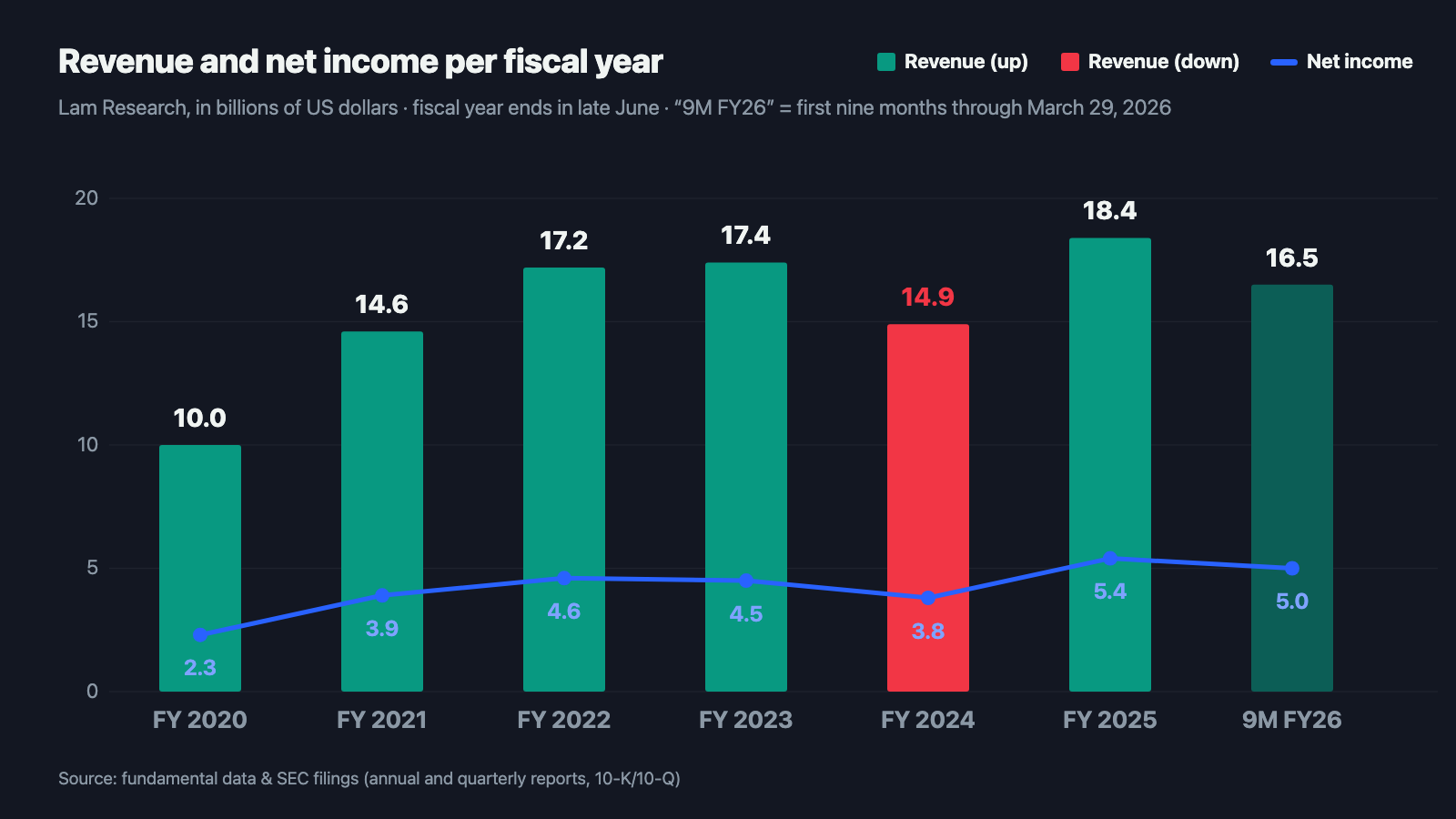
Per the annual report (10-K), the record year was carried mainly by foundry investment plus a strong push in the memory business: per the July 29, 2026 earnings call, NAND revenue (flash memory) doubled from the March to the June quarter alone, driven by AI data centers increasingly relying on multi-layer NAND parts for storage. Lam now sees calendar 2026 wafer fab equipment spending (WFE) across the industry at "the low $150 billion range" — in January 2026 management still expected $135 billion, in April $140 billion. This string of guidance increases is part of the story we unpack in more detail in the earnings-call chapter below.
What the filings say — the uncomfortable truths
Uncomfortable truth no. 1: four customers now pay 55 percent of the bill — up from two customers at 32 percent
This is the most striking change of the entire year, and it stands soberly in the notes to the new annual report (10-K):
"In fiscal year 2026, four customers accounted for approximately 16%, 15%, 12%, and 12% of total revenues, respectively. In fiscal year 2025, two customer accounted for approximately 17% and 15% of total revenues. In fiscal year 2024, one customer accounted for approximately 17% of total revenues, respectively. No other customers accounted for 10% or more of total revenues."
— Lam Research, SEC annual report 10-K for fiscal year 2026, notes (segment and customer disclosures)
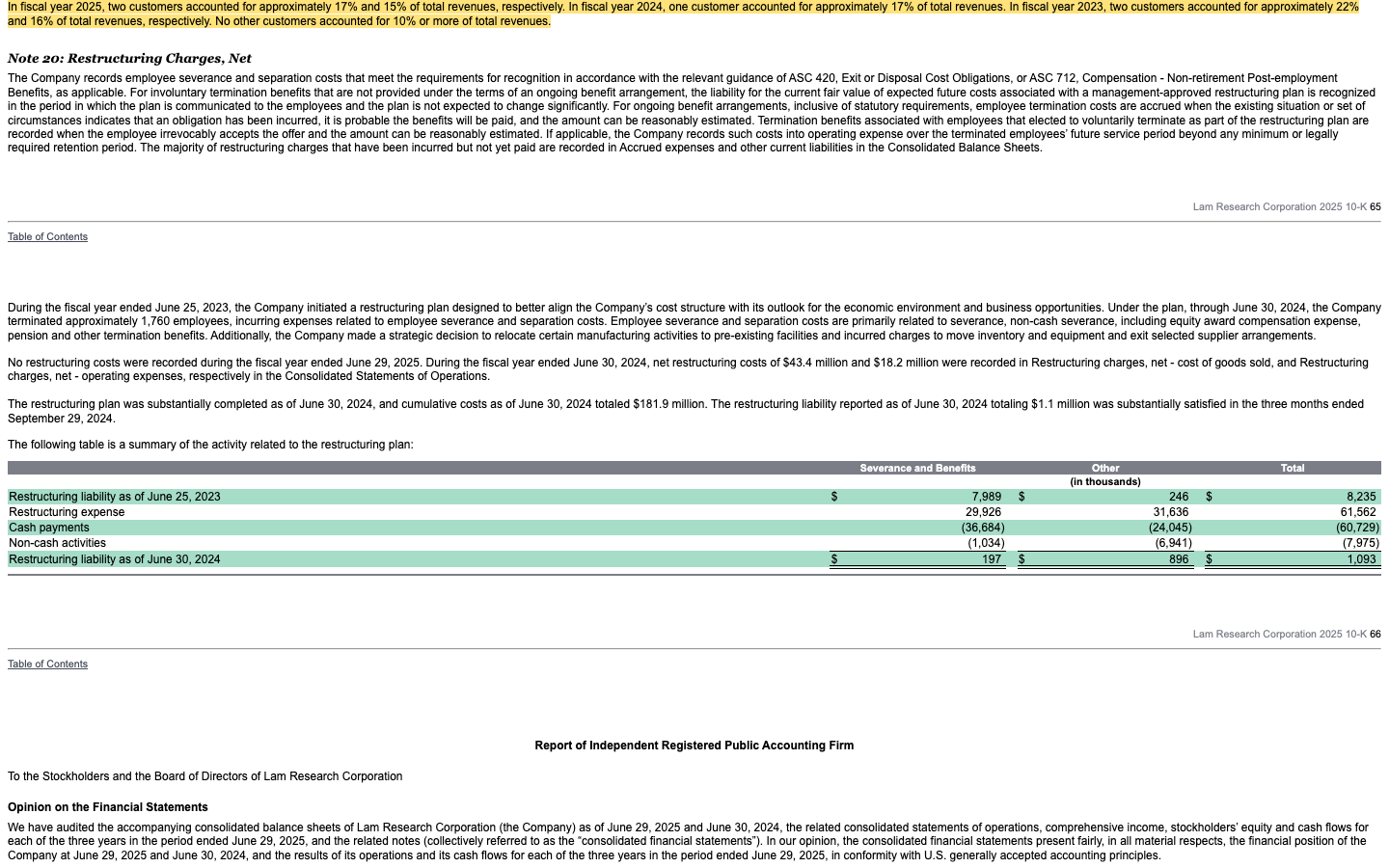
Do the math: two years ago, a single customer accounted for 17 percent of revenue. A year ago, it was two customers at 32 percent combined. Now it is four customers at 55 percent combined — more than half of total company revenue hangs on just four addresses. The report still does not name them, but the scale fits the world's largest memory makers and foundries: financially powerful groups, not shaky candidates. The real risk stays the same as last year, just bigger: the annual report warns explicitly that consolidation of the customer base means the investment decision of a single customer visibly moves demand — and now four such decisions instead of two determine more than half of the order book. For an equipment maker trading at a price-to-earnings ratio of 50, that is not a footnote risk but one of the few spots where a single postponed mega-project could dent the entire record year.
Uncomfortable truth no. 2: a third of revenue still comes from China — with sharp swings quarter to quarter
The second cluster risk has stayed stable on paper, but is more volatile underneath than the annual figure suggests. The annual report (10-K) gives the three-year series:
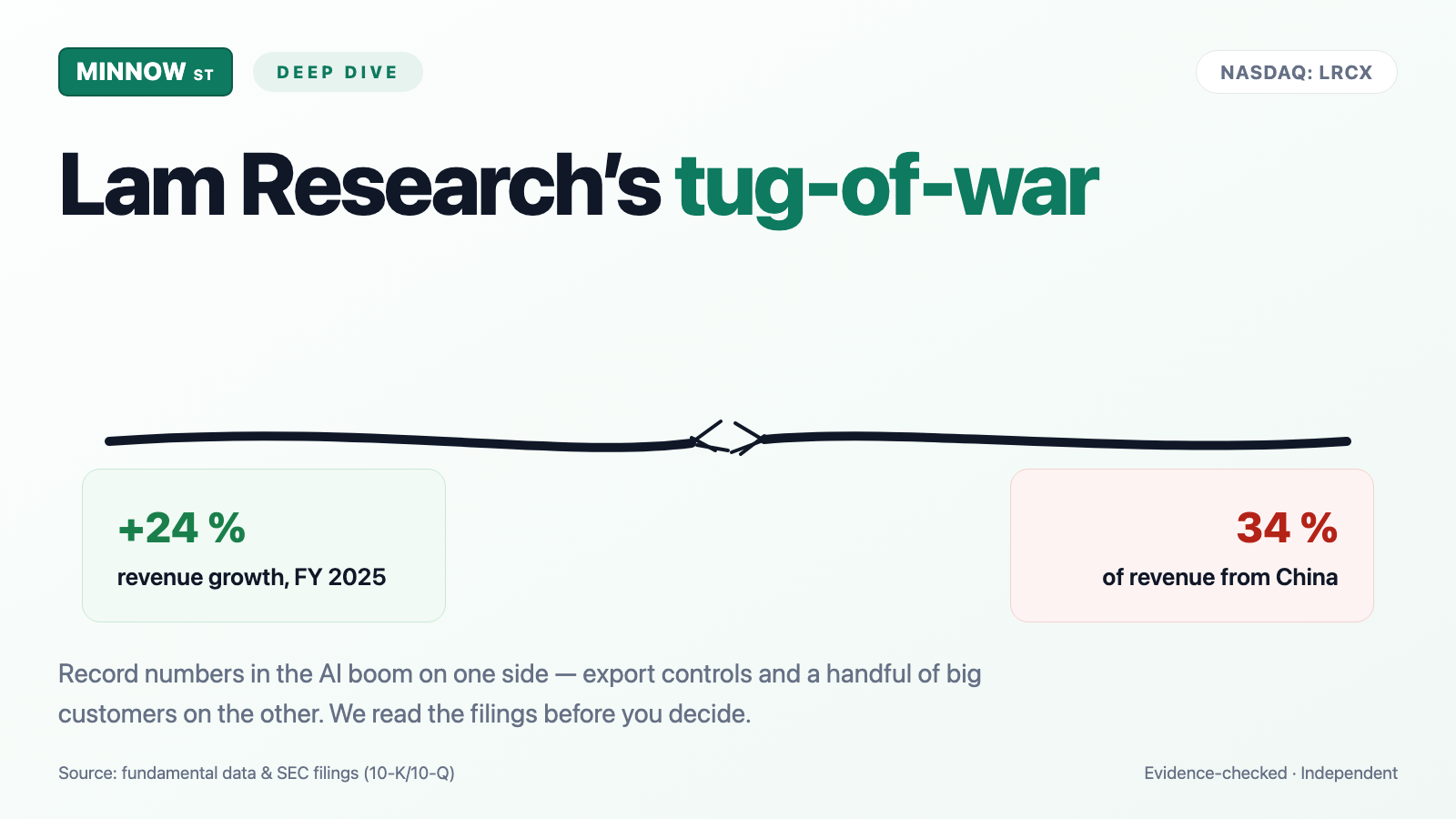
"China represents a large and fast-developing market for the semiconductor equipment industry and therefore is important to our business. Revenue in China, which includes global customers and domestic Chinese customers with manufacturing facilities in China, represented approximately 34%, 34%, and 42% of our total revenue for fiscal years 2026, 2025, and 2024, respectively."
— Lam Research, SEC annual report 10-K for fiscal year 2026, Item 1A "Risk Factors"
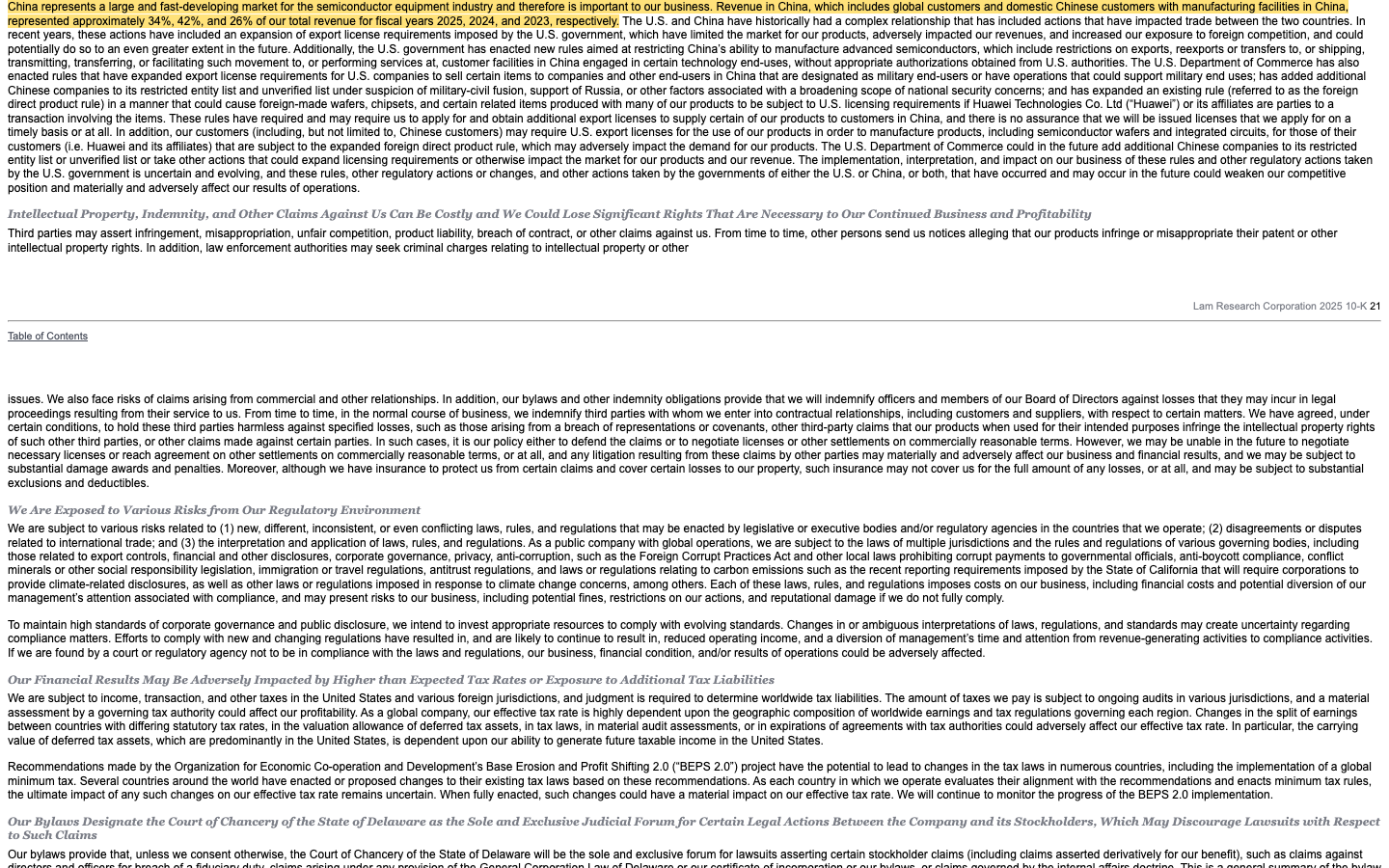
On an annual basis that looks almost reassuringly stable — 34 percent, two years in a row. But the current report (8-K) of July 29, 2026 shows the June 2026 quarter snapshot: Taiwan 27 percent, China only 26 percent, Korea 20 percent. On the same day's earnings call, an analyst asked pointedly about the sequential China decline; CFO Doug Bettinger answered that industry-wide China investment remained "flat to slightly up" but "lumpy" quarter to quarter — and drew a distinction that matters for the risk picture: global customers with fabs in China grew in the June quarter, while revenue from domestic Chinese customers declined. That shifts the picture slightly: part of the "China" line is, in reality, business with U.S., European and other Asian multinationals that happen to manufacture in China — not exclusively with Chinese-owned equipment makers Beijing is nursing up with state money. It changes nothing about the underlying risk: a third of the business still depends on U.S. export licenses with no assurance of approval, and several Chinese customers remain on sanctions lists.
Uncomfortable truth no. 3: the counterstrike is running out — China's rare-earth controls expire in November 2026
The risk factor that flips the export-control logic around still stands unchanged in the annual report (10-K) — only the deadline is now just two months away. China is the primary source of the rare earths Lam needs for its own manufacturing:
"China is the primary source of supply of certain rare earth elements critical to the manufacture of certain of our products. The Chinese government has imposed export controls and license requirements on certain rare earth elements […] (which have been suspended in part until November 2026 (unless extended)) and could expand such controls or licensing requirements in the future."
— Lam Research, SEC annual report 10-K for fiscal year 2026, Item 1A "Risk Factors"
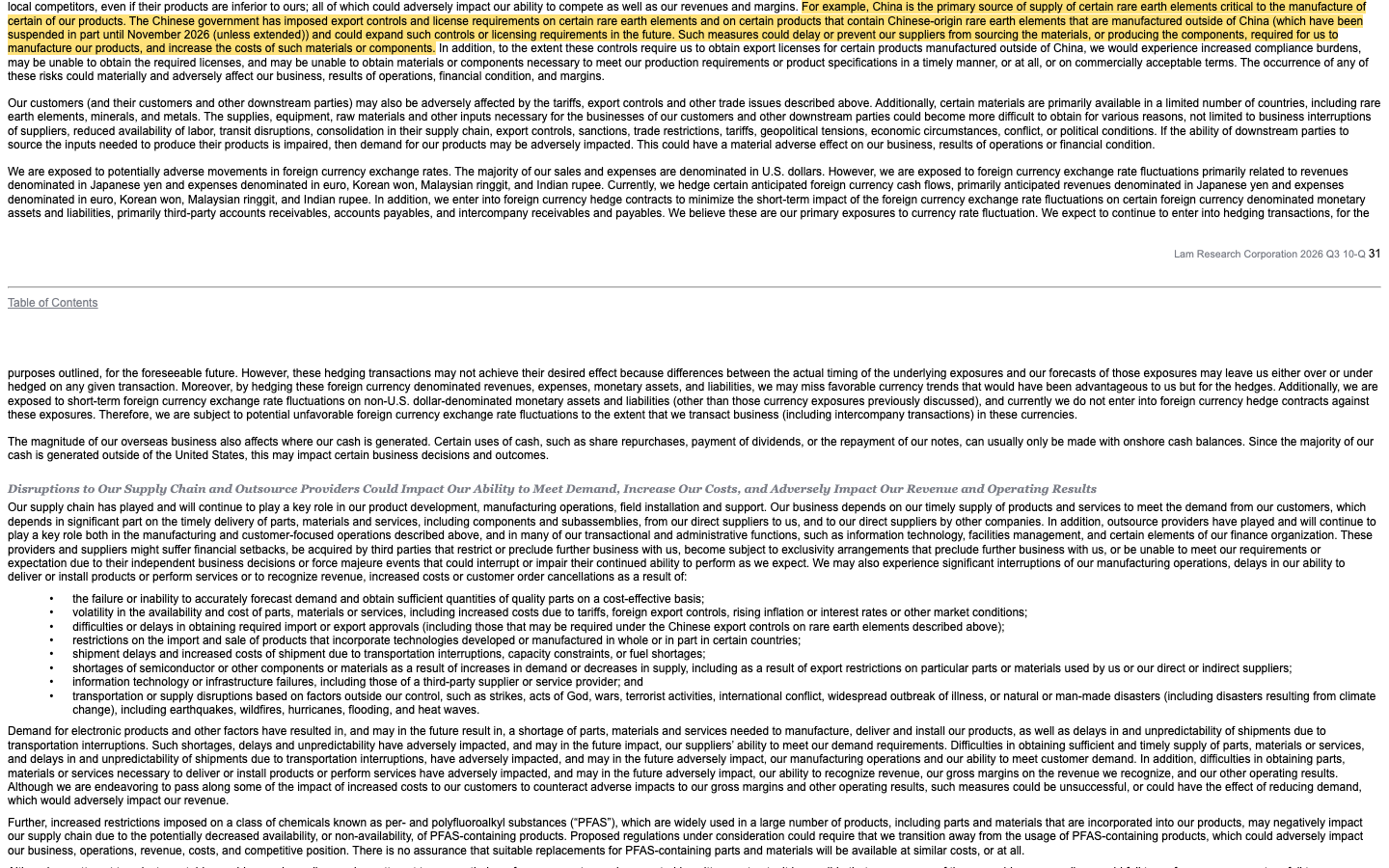
Lam thus still hangs on both sides of the same trade conflict: Washington decides what Lam may sell to China — Beijing decides whether Lam's suppliers get the raw materials the machines are built from. A year ago, "November 2026" was a comfortably distant deadline; now it is the next concrete date on the calendar that will show whether the relationship between the two governments keeps easing or tightens again.
Uncomfortable truth no. 4: buybacks kept getting pricier — until the stock fell below the company's own cost basis
Lam gives its shareholders a lot back: the quarterly dividend rose in fiscal year 2026 to $0.26 per share (from $0.23), $1.27 billion in total; on top, the company repurchased roughly $3.85 billion of its own stock in fiscal year 2026 (including net settlement of employee stock-based compensation) — together with dividends, capital expenditures and debt repayment, total outflows came to roughly $6.84 billion ($3.85 billion in buybacks, $1.27 billion in dividends, $966 million in capital expenditures and $755 million in debt repayment), more than the $5.86 billion of operating cash flow. It gets interesting when you lay the quarterly prices next to it:
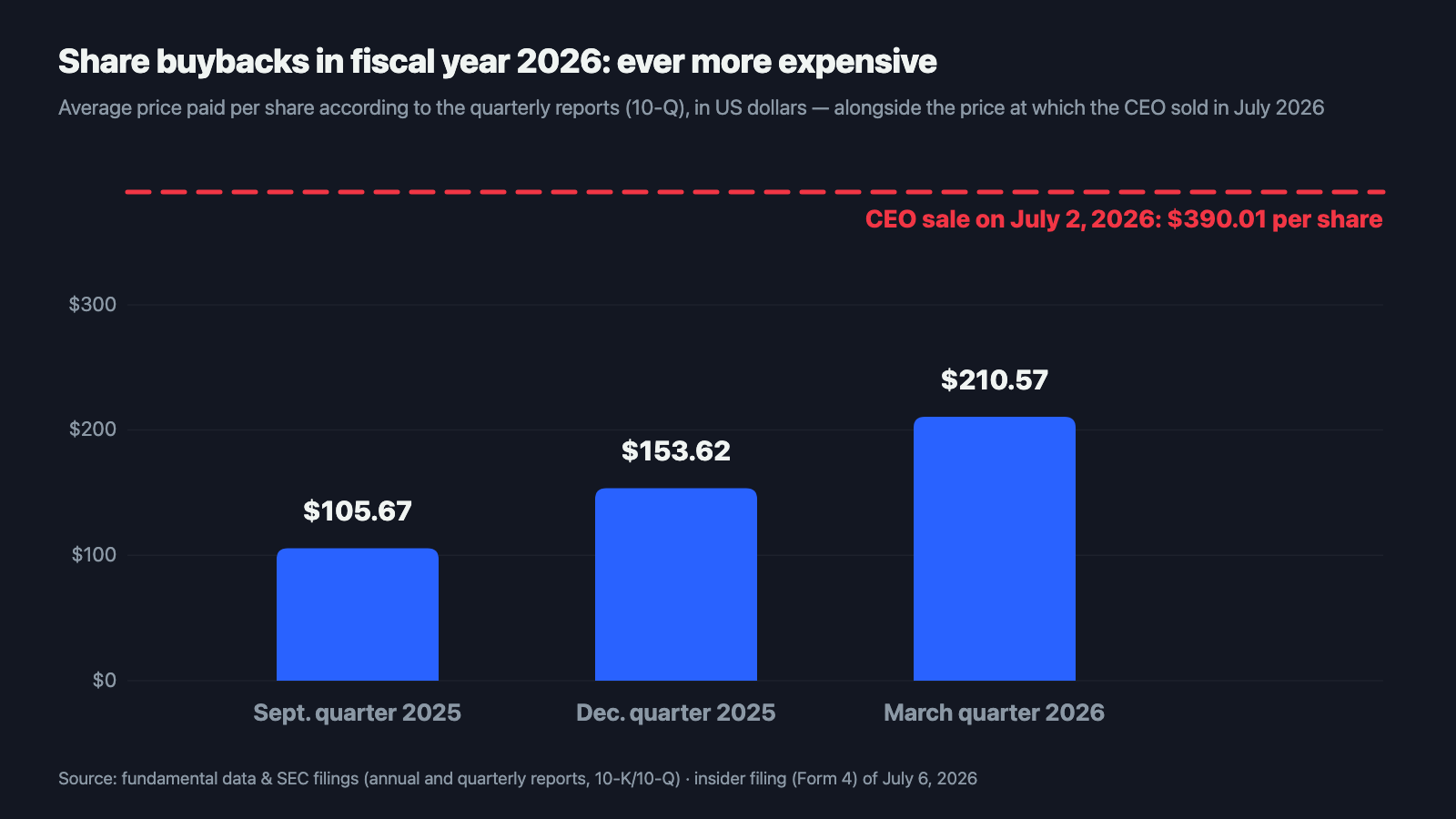
Per the annual report (10-K), Lam paid an average of $105.67 for its own shares in the September quarter of 2025, $153.62 in the December quarter, $210.57 in the March quarter of 2026 — and $325.14 on average in the June 2026 quarter (the final five weeks of the quarter alone averaged $370.15); roughly $4.04 billion of buyback authorization remained as of June 28, 2026. Notably, in early September 2026 Senior Vice President Seshasayee Varadarajan sold, per an insider filing (Form 4), at $291.32 — below the price the company itself had paid on average for its own stock as recently as the June quarter. That is a different story than as recently as July 2026, when CEO Tim Archer's sale at $390.01 sat clearly above every buyback price: instead of "insiders exit at the top", the picture now looks more like "the market has clawed back part of the buyback premium". And Archer himself sold another 30,000 shares on August 6, 2026, per an insider filing (Form 4), at $300 — already below that quarter's buyback price. Chief Legal Officer Ava Harter sold on August 31, 2026 at $302.46, likewise below the June-quarter average. Such plan-based sales (10b5-1) are legal and, taken alone, no alarm signal — but they do show the executive floor did not counter the price decline with additional purchases of its own.
What the earnings calls show — promises against reality
Numbers from filings are one thing; the tone on the conference call with analysts is another — and it often reveals more about management's mood than the prepared text of a press release. We reviewed the calls of April 22, 2026 (fiscal Q3 2026) and July 29, 2026 (the closing quarter) in detail, paying particular attention to the question-and-answer section — that is where analysts push back, and it tends to reveal more than the scripted remarks.
The guidance series was raised every quarter, never cut. In January 2026, management still expected calendar-2026 wafer fab equipment spending (WFE) of roughly $135 billion. On the April 22, 2026 call, CEO Tim Archer raised that to "$140 billion with upside bias" and reported the March quarter had landed "at the upper end of our guidance ranges", with earnings per share even beating the top of the range. On the July 29, 2026 call came the next increase, to "the low $150 billion range" — and Archer spoke openly of an "extraordinary setup" for 2027 WFE growth. This string of three consecutive raises (135 → 140 → "low $150" billion) within seven months is a rare, clean example of a management that consistently forecasts more conservatively than it then delivers.
The Q&A was overwhelmingly about growth drivers, not risks. On the July call, analysts asked mainly about the source of the gross-margin improvement (the shift of manufacturing to Malaysia, scale efficiencies, pricing power — CFO Bettinger confirmed explicitly, "we're always working on getting fairly paid for the value we're delivering"), about market-share gains in memory (DRAM, HBM) and about the sustainability of growth in Taiwan. Notably, across both calls reviewed, not a single analyst asked about customer concentration or possible overvaluation — the mood among observers was consistently upbeat, bordering on euphoric.
The one moment of real pushback was on China — and that is exactly where the tone turned more cautious than elsewhere. When an analyst raised the sequential China revenue decline in the June quarter on the July call, CFO Bettinger answered more evasively than on other topics: he repeated the "flat to slightly up" view for Chinese WFE but conceded "quarter-by-quarter lumpiness" and drew the distinction between global and domestic Chinese customers — a sign that management itself is watching more closely since the picture got murkier.
Put together, the earnings calls paint the picture of a management that consistently delivers operationally and even over-delivers — the guidance raises are documented, not a claim. That makes the roughly 25 percent decline in the stock since July 2026 all the more notable: it did not happen because the story broke, but even though it kept running as planned. That points more toward a correction of a previously stretched valuation than toward a new operational worry — the one genuinely new operational worry, customer concentration, did not come up in the earnings calls at all and only shows up in the annual report (10-K).
And AI? The boom is the business — not the product
Because in 2026 every second investment story starts with two letters, we checked the filings systematically on this too. The finding is unchanged from a year ago: Lam does not sell AI — Lam sells the shovels for the AI gold rush and uses AI itself as a tool along the way. The annual report (10-K) still names artificial intelligence as a central demand driver, and CEO Tim Archer attributed the record quarter on the July 29, 2026 earnings call expressly to "AI-driven demand" reshaping the semiconductor industry. At the same time, the annual report describes equipment makers like Lam using machine learning and AI in their own technology development, and still names the company's own AI use as its own risk factor. The flip side is likewise in the filing: as an earnings risk, Lam explicitly names changes in the extent of investment in artificial intelligence and associated infrastructure. Translated: if the data-center giants push their orders out by even one or two quarters, it hits the shovel sellers first. In our AI classification we therefore still file Lam Research under "Uses AI" — with the AI boom as its demand engine, not as its own product shelf.
Valuation: the price after the first correction
On September 2, 2026, per an insider filing (Form 4), Lam Research traded at $291.32 per share — we deliberately rely on a filing-sourced price here, because it was a real, executed trade documented with a name, a date and a share count. With roughly 1.251 billion shares outstanding (as of August 4, 2026), that puts the market value at roughly $365 billion — 50 times net income and 16 times revenue for fiscal year 2026. For comparison: in early July 2026, at the insider sale of $390.01 (Form 4 of July 2, 2026), the same ratios as reported at the time, on a trailing-four-quarter basis, stood at roughly 70 times earnings and roughly 23 times revenue. The market has thus clawed back a meaningful part of the premium — without anything about the operating story, per the earnings calls, getting worse. At this price, the dividend yield comes to roughly 0.4 percent ($0.26 quarterly dividend, annualized). A price-to-earnings ratio of 50 is still historically high for a cyclical equipment maker — but it is a different starting point than a ratio of 70, and it now leaves at least some room for the risks spelled out in the company's own annual report: 55 percent customer concentration, a 34 percent China share, and an expiring rare-earth grace period in November 2026.
Opportunities and risks at a glance
What speaks for Lam Research:
- Records with substance: revenue up 26 percent to $23.2 billion in fiscal year 2026, a record June 2026 quarter ($6.72 billion, 51.7 percent gross margin) and guidance of roughly $8.1 billion for the September quarter — another jump of about 20 percent.
- Structural tailwinds: AI data centers need memory (DRAM, NAND) and cutting-edge logic chips — both are made on Lam equipment; management raised its own 2026 WFE forecast three times within seven months (135 → 140 → "low $150" billion).
- Fortress balance sheet and capital discipline: about $5.60 billion in cash (June 28, 2026), an equity ratio around 53 percent, financial debt down to barely 30 percent of equity, a quarterly dividend since 2014 (recently raised to $0.26) and buybacks that reliably shrink the share count.
- Earnings power: a return on equity around 65 percent, an operating margin around 35 percent, a net margin around 31 percent in fiscal year 2026 (per the annual report, 10-K).
- Valuation has eased noticeably since the price decline that began in July 2026: a price-to-earnings ratio around 50 instead of around 70, a price-to-sales ratio around 16 instead of around 23 (data as of September 2, 2026).
What speaks against it:
- Customer concentration nearly doubled: four unnamed major customers accounted for 55 percent of fiscal year 2026 revenue (prior year: two customers, 32 percent) — per the annual report (10-K), the investment decision of individual groups moves overall demand, and now four such decisions do that instead of two.
- A China cluster still large and volatile within the year: a 34 percent revenue share in fiscal year 2026, but only 26 percent in the June quarter — dependent on U.S. export licenses with no assurance of approval, while China's rare-earth controls on Lam's supply chain remain only partially suspended, and only until November 2026.
- A cyclical business whose price still assumes flawlessness: revenue down 14.5 percent in fiscal year 2024; currently a price-to-earnings ratio around 50, price-to-sales around 16 — more moderate after the correction, but still historically expensive for an equipment maker.
- Insiders keep selling, just at lower prices: sales in August and September 2026 between $291 and $302, including CEO Archer himself (August 6, $300) — well below his own sale of July 2, 2026 at $390.01 — per the filings reviewed, not a single insider bought shares in the same period.
- AI dependence as an earnings risk: the annual report (10-K) explicitly names changes in the extent of investment in artificial intelligence and associated infrastructure as a swing factor; in addition, fiscal 2026 saw roughly $5.12 billion flow to shareholders and buybacks combined — more than came in from operations net of capital expenditures.
A human conclusion
A year ago, this analysis ended with the line that the price was "a bet on flawlessness." Twelve months later, we know: Lam Research won that bet operationally — record revenue, record profit, one record quarter after another, guidance raised three times running and never cut. And yet the stock has fallen roughly a quarter since July 2026. That is the real lesson of this update: it was not the operating story that turned, it was the price the market is willing to pay for flawless execution. At the same time, a genuinely new risk sharpened in the very same year, one that has nothing to do with the stock price: customer concentration jumped from 32 to 55 percent, and nobody on the earnings calls asked about it. "You can always buy quality" still comes with fine print in two places: once in the price, which has since normalized somewhat — and once in the customer base, which got narrower while everyone was watching China and the AI story. The next test is already on the calendar, when fiscal 2027's first-quarter numbers arrive in late October 2026 — and in November 2026, when the rare-earth grace period expires. What you make of it is your decision. And that is exactly as it should be.
Sources
All original documents used in this analysis — to read for yourself:
- Lam Research Corporation — SEC annual report 10-K for fiscal year 2026 (ended June 28, 2026; filed August 7, 2026)
- Lam Research Corporation — Current report (8-K) of July 29, 2026: June-quarter 2026 results, full-year results and September-quarter guidance
- Lam Research Corporation — Current report (8-K) of August 27, 2026: two board members retiring effective November 2, 2026
- Lam Research Corporation — earnings conference calls of July 29, 2026 and April 22, 2026 (transcript / webcast, company investor-relations site)
- Lam Research Corporation — insider filings (Form 4): S. Varadarajan, trade date September 2, 2026 (filed September 3), A. Harter, trade date August 31, 2026 (filed September 1), T. Archer, trade date August 6, 2026 (filed August 7), T. Archer, trade date July 2, 2026 (filed July 6)
- Lam Research's complete SEC filing history: EDGAR overview (sec.gov)
- Fundamental data (share count; data as of September 2, 2026), reconciled with the SEC filings and the SEC's XBRL company facts. The stock price on that date is sourced from an insider filing (Form 4), because the fundamental-data feed had hit its daily limit that day.
Transparency & disclaimer: This analysis is a journalistic contextualization of publicly available information and is not investment advice, not a financial analysis in the regulatory sense, and not a solicitation to buy or sell securities. Stock investments carry substantial risks up to total loss. All information without guarantee; the data cut-off is noted in the text in each case. Positions held by the operator are disclosed daily; where one exists, it appears as a notice at the top of this deep dive.
Key figures at a glance
All monetary figures in millions of $; earnings per share as reported.
| Metric | 2022 | 2023 | 2024 | 2025 | 2026 |
|---|---|---|---|---|---|
| Revenue | 17,227.0 | 17,426.7 | 14,905.4 | 18,435.6 | 23,232.7 |
| Operating Income (EBIT) | 5,381.8 | 5,174.9 | 4,263.9 | 5,901.0 | 8,199.8 |
| Net Income | 4,605.3 | 4,510.9 | 3,827.8 | 5,358.2 | 7,265.4 |
| Net Margin | 26.7% | 25.9% | 25.7% | 29.1% | 31.3% |
| Earnings Per Share | 3.27 $ | 3.32 $ | 2.90 $ | 4.15 $ | 5.76 $ |
Source: fundamental data & SEC filings (annual and quarterly reports, 10-K/10-Q)
Our Bottom Line at a Glance
- Growth & order books positive
- Revenue up 26.0 percent to $23.2 billion in fiscal year 2026, a record June 2026 quarter ($6.72 billion, 51.7 percent gross margin) and guidance of roughly $8.1 billion for the September quarter — management raised its own WFE forecast three times within seven months.
- Profitability & balance sheet positive
- A 50.5 percent gross margin, an operating margin around 35 percent, a 31.3 percent net margin in fiscal year 2026; about $5.60 billion in cash, an equity ratio around 53 percent, financial debt down to barely 30 percent of equity.
- Capital returns neutral
- The quarterly dividend was raised to $0.26 and buybacks came to roughly $3.85 billion in fiscal year 2026 — but buyback prices rose quarter over quarter ($105.67 to $325.14), and insiders were already selling below that by early September 2026.
- Customer concentration negative
- Four unnamed major customers = 55 percent of fiscal year 2026 revenue — up from two customers at 32 percent a year earlier. The concentration nearly doubled, and it never came up on the earnings calls.
- China & export controls negative
- 34 percent of fiscal year 2026 revenue from China under U.S. license reservation with no assurance of approval (just 26 percent in the June quarter alone); China's rare-earth controls on Lam's supply chain remain only partially suspended, and only until November 2026.
- Valuation & insider behavior neutral
- A price-to-earnings ratio around 50, a price-to-sales ratio around 16 (data as of September 2, 2026) — noticeably more moderate than in July 2026 (around 70 and 23) after the stock fell roughly a quarter; insiders sold at $390.01 in July 2026, then at markedly lower prices in August and September (between $291 and $302).
Lam Research is a flawless cyclical in record form: the AI boom fills the order books, the margins are first-rate, the balance sheet a fortress, and the stock has already given back part of its earlier excess. But a third of the revenue hangs on China, and customer concentration jumped from 32 to 55 percent in the same year — an operational risk that sharpened while everyone was watching the record numbers. Not investment advice.
What Our Rating Means
Open questions
The business works in principle, but one material question is open. As long as it stays open, our findings do not carry a quality verdict.
The business model demonstrably works, the numbers are first-rate and the balance sheet is a fortress — that speaks for itself. Still, the rating stands at yellow because a material operating question sharpened in fiscal year 2026, documented in the company's own annual report (10-K): strong customer concentration without an existential threat — four customers instead of two now account for 55 percent instead of 32 percent of revenue. That is an operating risk, not a pricing question: even after the roughly 25 percent price decline, the rating would stay yellow, because an expensive valuation alone would not be reason enough. The decision is yours.
A journalistic assessment by our editorial team at the time of the deep dive, based on public sources — not investment advice and not a solicitation to buy or sell. Your personal circumstances (investment goals, risk capacity, taxes) cannot be taken into account. What our levels mean, how verdicts are formed, and what conflicts of interest exist →
Worth Noting
- The fiscal year ends in late June: "fiscal year 2026" = late June 2025 through June 28, 2026; the numbers for the first quarter of fiscal year 2027 are usually presented in late October.
- All price and share figures are split-adjusted (10-for-1 stock split in October 2024). Insider sales are legal and often long pre-planned.
- Governance margin note: two board members (Sohail Ahmed, Michael Cannon) are retiring effective November 2, 2026, per the current report (8-K) of August 27, 2026; the board shrinks from 12 to 10 members. Starting with fiscal year 2026, KPMG conducted its first full annual audit (having replaced Ernst & Young in September 2025).
- The stock price used for the valuation in this analysis is sourced from an insider filing (Form 4) dated September 2, 2026, because the fundamental-data feed used had hit its daily limit that day — a real, traded and dated figure, not an estimate.
Stock Watch
This analysis is as of September 3, 2026. Stock Watch will tell you what's changed at LRCX since then.
Later $1 a month per stock — signing up is free, and you'll be the first to know when it launches.
The full analysis as a PDF for later
We will send you this analysis as a PDF — to print, file away, and read at your own pace. And we will add you to the free Stock Watch list for Lam Research Corp (LRCX), so you hear about it when something material in this analysis changes.
Frequently Asked Questions
Lam Research builds equipment for chip fabrication: etch machines that mill structures into silicon wafers with atomic precision, deposition systems that apply wafer-thin layers of material, and cleaning systems. Customers are the big memory, foundry and logic manufacturers. Added to that is a growing business in service, spare parts and upgrades. Headquarters are in Fremont, California; about 23,300 employees (as of August 4, 2026).
A record year: revenue rose 26.0 percent to $23.2 billion, net income rose 35.6 percent to $7.3 billion. The closing quarter (through June 28, 2026) was the best in company history at $6.72 billion in revenue and a 51.7 percent gross margin. For the September 2026 quarter, the company guides to roughly $8.1 billion in revenue — another jump of about 20 percent.
Considerably more than a year ago: per the annual report (10-K), four unnamed major customers accounted for a combined 55 percent of fiscal year 2026 revenue (16, 15, 12 and 12 percent). In fiscal year 2025 it was still two customers with 32 percent combined. The report does not name them, but the concentration has nearly doubled.
Still considerably: 34 percent of fiscal year 2026 revenue came from China per the annual report (10-K) — unchanged from the prior year. In the June 2026 quarter, however, the share fell to 26 percent, which the CFO attributed mainly to softer demand from domestic Chinese customers. On top of that, China's partial suspension of rare-earth export controls expires in November 2026.
A management that raised its own forecast for global chip-equipment spending three times within seven months (from $135 billion to $140 billion to the "low $150 billion" range) and regularly delivered quarterly results at or above the high end of its own guidance. Critical analyst questions were almost entirely about China — customer concentration did not come up in either of the earnings calls we reviewed.
Per insider filings (Form 4), the stock fell from $390.01 on July 2, 2026 to $291.32 on September 2, 2026 — a drop of roughly a quarter, even though the quarterly results in between broke records and guidance was raised. The price-to-earnings ratio fell from around 70 to around 50 as a result: the market clawed back part of a previously very high valuation premium without anything about the operating story getting worse.
Yes, but indirectly: Lam sells no AI products but the fabrication equipment on which memory and logic chips for AI data centers are made — the CEO attributed the record June 2026 quarter expressly to AI-driven demand. The flip side is in the annual report (10-K): if the big customers change the pace of their AI investments, Lam's results swing first. In our AI classification, Lam therefore counts as "Uses AI" — the boom as a demand engine, not as a product shelf.
Yes, a quarterly dividend has flowed since April 2014, raised in fiscal year 2026 to $0.26 per share (a yield of roughly 0.4 percent at the September 2, 2026 price level). Much bigger are the share buybacks: roughly $3.85 billion in fiscal year 2026 — with the average buyback price rising quarter over quarter from $105.67 to $325.14. By early September 2026, insiders were already selling below that closing-quarter average.
Found an error?
Did you spot a factual error, an outdated number, or a typo in this deep dive? Let us know briefly — your report goes straight to the editorial team.