Pampa Energía: Revenue Up 53 Percent — and the Stock Fell Anyway
Our in-house stock scanner "Revenue Accelerator" put Pampa Energía at rank 6 on its list: revenue at the Argentine oil, power and petrochemicals conglomerate has been growing at a sharply accelerating pace, up 53 percent year-over-year in the second quarter of 2026 — powered by the Rincón de Aranda shale-oil block in Vaca Muerta and the deregulation of Argentina's power market under President Milei. But whoever reads only the growth rate misses the second story: reported net income fell in 2025 anyway, net debt has nearly tripled since the end of 2024, and the stock is down for the year. We read the original filings with the U.S. securities regulator, the SEC — 20-F and 6-K, because an Argentine issuer like Pampa never files a 10-Q. Not investment advice, just the numbers as they actually stand.
 Thomas Mücke
Founder & Publisher
Thomas Mücke
Founder & Publisher
As of Today
As of: October 7, 2026
- Closing price
- 80.10 $ -1.70%
- Market Capitalisation
- 4.3 $B
- P/E
- 6.9
- Growth Score
- 7/10
- AAQS
- 6/10
Price change since August 21, 2026: +0.8%
This analysis has a cut-off date. The Stock Guard tells you when something material changes in the numbers. Reserve your free spot
Chart
Interactive price chart (TradingView).
52-week range: 59.30 $ to 92.30 $ · Last price: 80.10 $ (As of: October 7, 2026)
Note: pure fact-based analysis, not investment advice and not a solicitation to buy or sell. All figures without guarantee.
There is an investor trap that springs exactly when a metric looks most impressive: the story-versus-numbers trap. A headline like "revenue up 53 percent" feels like a verdict already reached — buy, and buy fast. But a growth rate alone says nothing about whether more money actually reaches shareholders, or whether the company is reaching deeper into its credit line to produce it. Pampa Energía S.A. (NYSE: PAM), Argentina's large integrated energy conglomerate, is a case study right now. Our in-house stock scanner "Revenue Accelerator" put the stock at rank 6 on its list, because revenue has genuinely been exploding lately. And there really is an impressive story behind the number — a shale-oil block called Rincón de Aranda that tripled its output within a year, plus a country deregulating its power market under President Javier Milei. But let's make a deal before you take the growth rate at face value: we read together what Pampa actually reported to the U.S. securities regulator, the SEC — the annual report (Form 20-F) and the quarterly releases (Form 6-K), because an Argentine issuer never files a 10-Q the way U.S. companies do. And that report describes, alongside the growth story, a net profit that fell in 2025 anyway, net debt that has nearly tripled in a year and a half, and a stock that is down so far in 2026. In the end, the decision is yours.
What Pampa Energía actually does — an oil, power and petrochemicals conglomerate with a government stake
Pampa Energía is an integrated energy company headquartered in Buenos Aires — in everyday terms, a company that earns money at nearly every link of Argentina's energy chain, from the wellhead to the wall socket. Four segments carry the business. First, oil and gas: production across several blocks in the Neuquén Basin, chiefly the shale-oil field Rincón de Aranda in the world-famous Vaca Muerta formation ("dead cow," named after the land, not the business). Second, power generation: thermal, hydro and wind plants with about 5,472 megawatts of installed capacity. Third, petrochemicals: styrene, synthetic rubber and polystyrene from the Bahía Blanca plant. Fourth, holding, transportation and other — including minority stakes in the grid operators Transener (high-voltage network, 22,445 kilometers) and TGS (gas pipelines, 9,248 kilometers). Important for the numbers in this piece: Pampa has reported in U.S. dollars as both its functional and presentation currency for years — the annual report states it plainly:
"The Company's functional currency is U.S. Dollars, which is also the presentation currency."
— Pampa Energía S.A., SEC annual report 20-F for 2025, "Functional and Presentation Currency"
That does not mean Argentina's inflation history is irrelevant to you. Individual subsidiaries and associates whose own functional currency is the Argentine peso still apply hyperinflation accounting under IAS 29 at their own level before their figures are translated into the U.S.-dollar consolidated statements — an echo of decades of Argentine high inflation, even though Pampa itself has reported in dollars at the group level for years. And the political backdrop remains central: Javier Milei has governed with a sweeping deregulation agenda since December 2023 (Decree 70/23, the June 2024 "Bases Law" that created the RIGI incentive regime), inflation fell from 117.8 percent (2024) to 31.5 percent (2025), and the October 2025 midterm elections confirmed Milei's party with roughly 40.7 percent of the vote for the Chamber of Deputies. Yet the annual report itself warns soberly:
"We cannot assure you that the reforms spearheaded by President Milei will be sustained in the long term."
— Pampa Energía S.A., SEC annual report 20-F for 2025, Argentina risk factors
That names the central tension of this analysis, and it runs through every chapter: Pampa's revenue is accelerating faster than almost ever before — carried by a reform window and an oil field whose durability nobody can guarantee, while the bill for that growth is already showing up as more debt and a more volatile bottom line.
Company history for investors
-
2008
Renamed Pampa Energía — and the ANSES stake is born
Pampa Holding becomes Pampa Energía; the same year, Argentina nationalizes its private pension funds. Their share holdings (20.50 percent of Pampa) pass to the new agency ANSES — still the largest single shareholder today.
-
2023
Javier Milei becomes president, deregulation decree 70/23
The new president announces a sweeping reform course, including the liberalization of energy prices. For investors, this opens the regulatory window that later enables Pampa's growth acceleration.
-
2024
"Bases Law" creates the RIGI incentive regime
Law 27,742, passed in June 2024, sets up 30 years of tax, customs and FX stability for large investments — the later basis for Rincón de Aranda's RIGI approval.
-
2025
Oil output jumps 145 percent
Driven by the Rincón de Aranda build-out, company-wide oil production rises from 4.8 to 11.7 thousand barrels per day — the volume-based proof that the later revenue acceleration is not an accounting story.
-
2026
RIGI approval for Rincón de Aranda (07/21/2026)
The economy ministry approves the application: a $4.5 billion investment plan through 2041, 30 years of stability guarantees. The clearest regulatory backing yet for the core project, from a shareholder's view.
-
2026
Board approves $2.7 billion urea project
On 07/17/2026, the board greenlights Latin America's largest urea plant (Fértil Pampa, Bahía Blanca) — the company's largest single investment to date, on top of the ongoing RDA capex peak.
Where the stock shows up on our scanner
Pampa Energía landed on our list through the in-house stock scanner "Revenue Accelerator" — it hunts specifically for companies whose revenue growth is accelerating right now, rather than simply cruising along at a steady pace. Criterion: the most recent two-plus quarters each grow 30 to 70 percent versus the year-ago quarter, the four quarters before that each grew under 15 percent, the revenue base (sum of the trailing four quarters) is at least $100 million, there are at most two such acceleration quarters (so the company is early in the move, not late), and there is no heavy shareholder dilution. On August 24, 2026, Pampa ranked 6th of 28 hits on the list with a revenue base of $2,417.0 million — price $79.50, market cap $4.3 billion, P/E 6.9, P/S 1.8, Piotroski balance-sheet-quality score 6 of 9 ("okay, not great — a truly healthy balance sheet sits at 8 or 9"), analyst consensus 3.9 (from 8 estimates).
Let's check that criterion against the primary sources — Pampa's own quarterly releases to the SEC, not an automatically derived data series. The chart below shows each quarter's revenue change versus the same quarter one year earlier, exactly as Pampa states it in the headline of every earnings release:
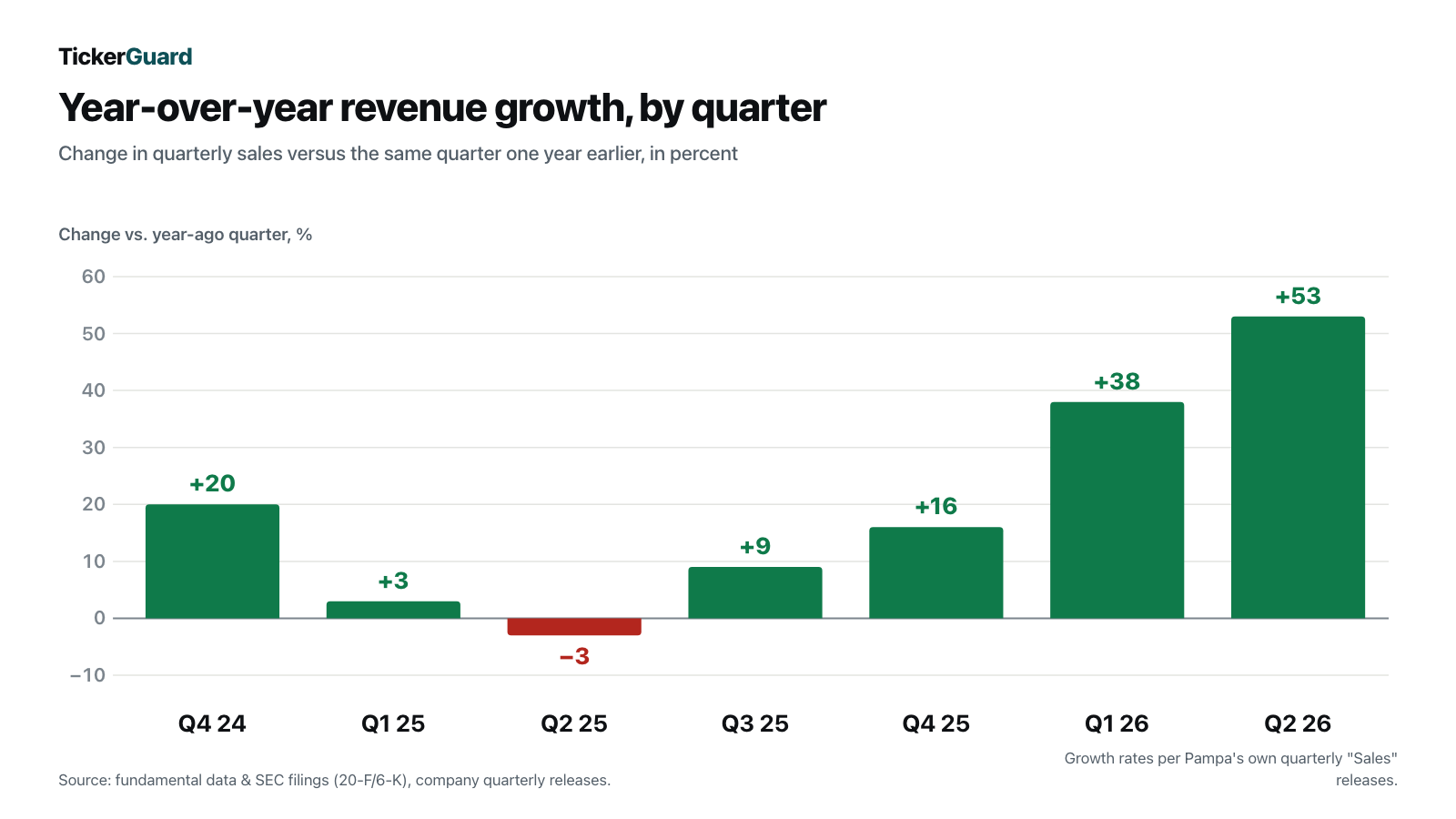
The two most recent quarters land cleanly inside the required 30-to-70-percent band. Among the four quarters before that, an honest look at the fine print matters: three sit clearly below 15 percent (+3, −3, +9 percent), while the fourth — Q4 2025 at +16 percent per Pampa's own release — sits one percentage point above the threshold. The automated data feed our scanner uses actually shows a decline for the same quarter, because its Q4 2024 comparison base differs from the figure Pampa itself stated in its Q4 2024 earnings release ($435 million rather than $535 million). Either way, the picture is the same: four calm-to-flat quarters, then a jump starting in early 2026 — the core of the scanner hit holds up under scrutiny, even if one single quarter lands slightly differently at the threshold depending on which data series you use.
The numbers over the years — honestly appraised
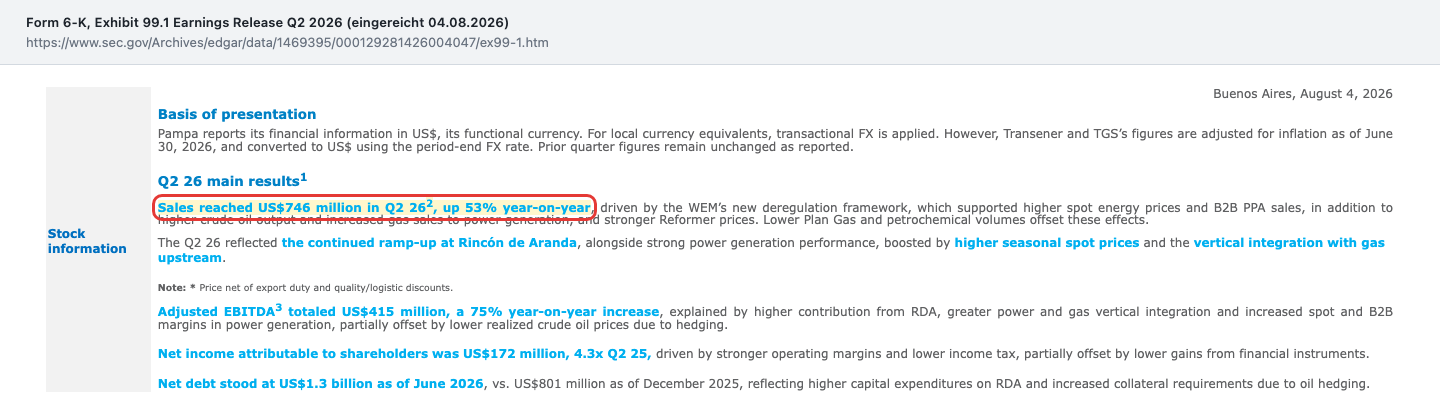
First, what genuinely impresses. In the second quarter of 2026, Pampa reported revenue of $746 million, adjusted EBITDA of $415 million (up 75 percent year-over-year), and net income of $172 million — 4.3 times the year-ago quarter:
The engine behind these numbers is above all a single oil field: Rincón de Aranda, 100 percent owned by Pampa, with a production concession through 2058. Company-wide oil output rose 145 percent in 2025 to 11.7 thousand barrels per day (2024: 4.8 thousand), carried almost entirely by this one field. In the second quarter of 2026, Rincón de Aranda production averaged 22,200 barrels per day across 43 producing wells — a year earlier there were only 17. On July 21, 2026, Argentina's economy ministry approved the project's application to join the state RIGI incentive regime (Régimen de Incentivo para Grandes Inversiones): a $4.5 billion investment plan through 2041, 259 planned wells, a processing facility for up to 45,000 barrels of oil and 0.8 million cubic meters of gas per day — and, per the company, expected export revenue of $17 billion over the project's entire useful life:
"The approval of the RIGI represents a significant milestone for the development of RDA, as it provides a stable framework and tax, customs, and foreign exchange incentives for 30 years. […] Pampa expects to export all of RDA's production, which is estimated to generate US$17 billion over the project's useful life."
— Pampa Energía S.A., SEC Form 6-K, Exhibit 99.1, Q2 2026 earnings release, Section 1.2 Oil and Gas
The second growth driver is the deregulation of Argentina's wholesale power market (WEM): higher spot prices and more direct power-purchase agreements with industrial customers (B2B PPAs) lift the generation segment's revenue, reinforced by vertical integration with Pampa's own gas production. Is the growth organic, then? At its core, yes: it comes from more barrels produced and more energy sold, not an acquisition. But it is at the same time highly project-driven — concentrated on a single oil field and a single regulatory window whose durability the company's own annual report explicitly does not guarantee. With that framing in mind, it's worth looking at the flip side the growth rate alone does not show.
What the filings say — the uncomfortable truths
Uncomfortable truth no. 1: the record revenue carries a debt price tag
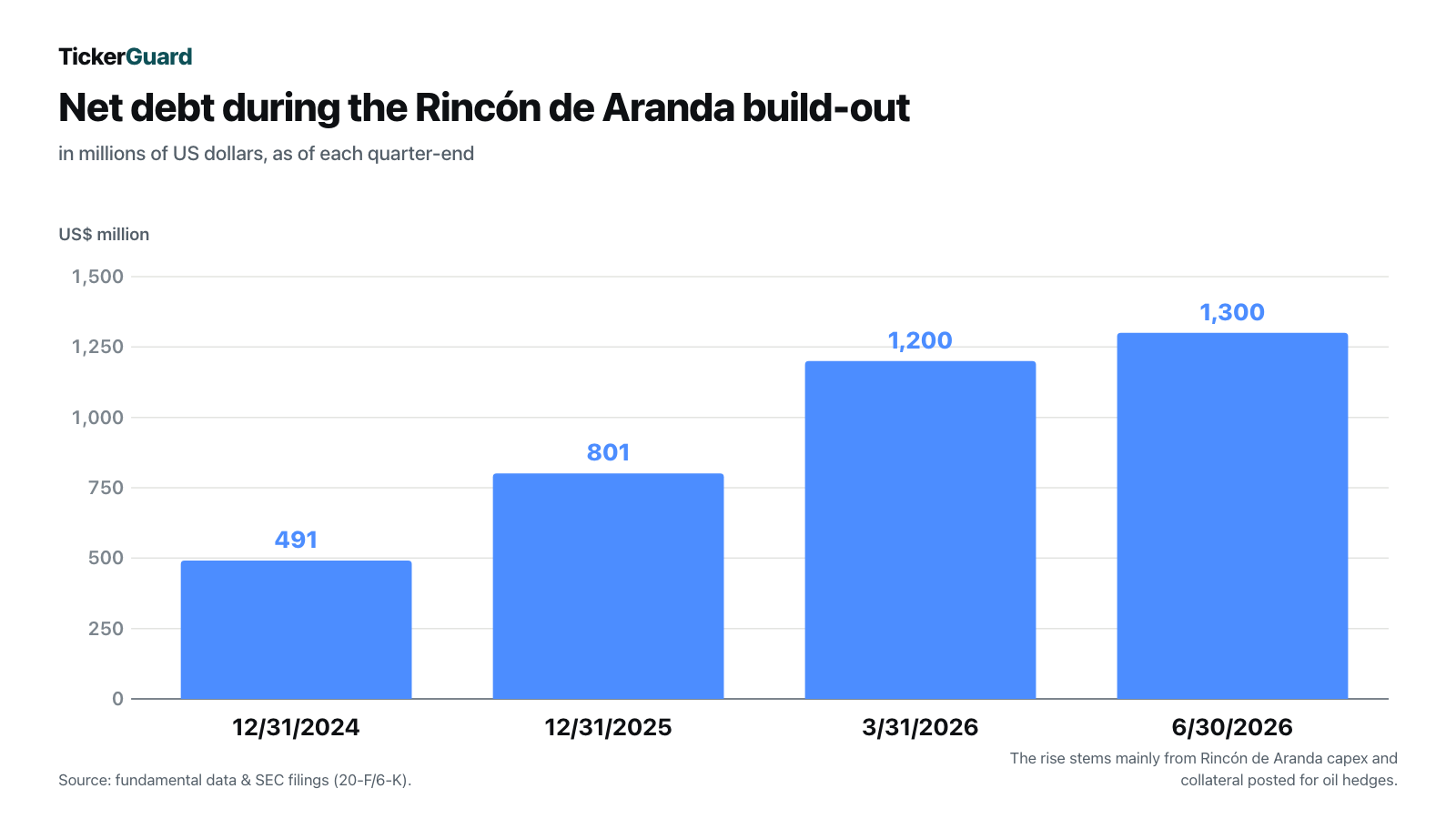
Rincón de Aranda costs money before it pays out. Capital expenditure in the oil-and-gas segment jumped to $1,039 million in 2025 (2024: $354 million) — nearly triple, almost entirely for drilling, facilities and the field's processing capacity. A significant share of that is financed with fresh debt, and the full hedge on oil production against price swings (100 percent at a fixed Brent price of $65 per barrel through April 2027) additionally ties up collateral. The result: net debt has nearly tripled in a year and a half.
"Net debt stood at US$1.3 billion as of June 2026, vs. US$801 million as of December 2025, reflecting higher capital expenditures on RDA and increased collateral requirements due to oil hedging."
— Pampa Energía S.A., SEC Form 6-K, Exhibit 99.1, Q2 2026 earnings release
The full curve, for context: $491 million in net debt as of 12/31/2024, $801 million as of 12/31/2025, $1.2 billion as of 03/31/2026, $1.3 billion as of 06/30/2026. The leverage ratio (net debt divided by total capital) rose from 12.97 to 18.18 percent:
On the Q1 2026 earnings call, CFO Adolfo Zuberbühler, per media reports (including Investing.com), acknowledged when asked about free cash flow that it remains pressured by the capex peak and the hedge collateral, and guided 2026 capital expenditure to roughly $1 billion, falling to about $700 million in 2027 and then to a maintenance level of roughly $600 million; leverage was guided to rise over the next two to three years to a maximum of roughly two times EBITDA before declining. That is guidance, not proof — whether it holds will only be clear from the next annual report.
Uncomfortable truth no. 2: 2024's profit looked better than it was — 2025 shows the flip side
Read only the bottom line and you'd be puzzled: consolidated net income fell to $377 million in 2025, down 39 percent from $619 million in 2024 — even though revenue rose 6.5 percent and pre-tax profit actually rose 17 percent (to $582 million from $498 million). The reason lies not in operations but in the tax line: in 2024 Pampa booked a credit of $121 million there, in 2025 a charge of $204 million — a swing of roughly $325 million that consumes essentially the entire operating improvement. These deferred-tax effects are a recurring theme in Pampa's quarterly releases and hinge on the relationship between Argentine inflation and peso devaluation:
"US$153 million net profit to the Company's shareholders, 43% lower than in Q1 24 due to a smaller recovery from non-cash deferred income tax and increasing operating costs."
— Pampa Energía S.A., SEC Form 6-K, Exhibit 99.1, Q1 2025 earnings release
The pattern shows up most clearly in the oil-and-gas segment itself, which actually improved operationally: operating income rose 32 percent to $91 million in 2025. But the financial result — interest, hedging losses, FX effects — worsened 30 percent to negative $136 million, leaving a segment net loss of $55 million (2024: −$5 million):
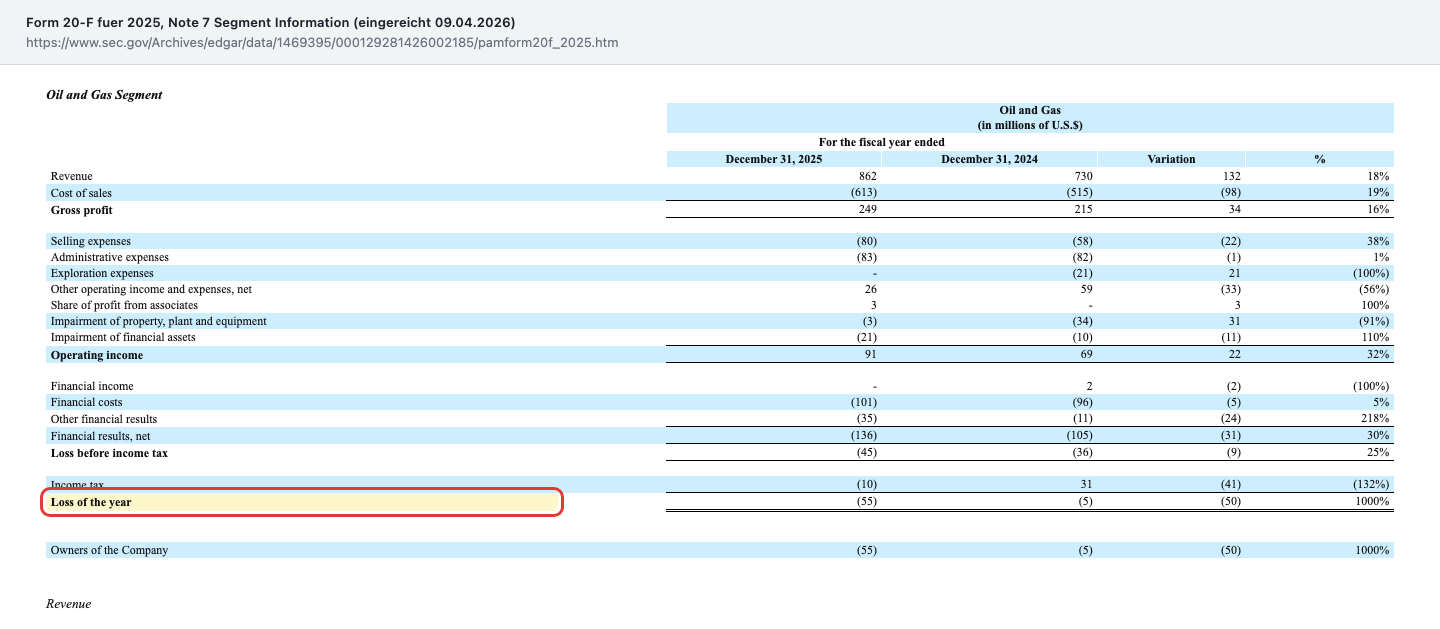
In everyday terms: picture a contracting business whose order book and gross margin both grow — but the loan for the new workshop and the cost of hedging materials eat up the entire improvement before it reaches the owner. That is exactly what the oil-and-gas numbers show. For you as a reader of the headline, that means: a rising revenue figure says nothing about whether more or less profit ultimately reaches the shareholder — you have to read one line further down.
Uncomfortable truth no. 3: the largest shareholder is the Argentine state
Look for Pampa Energía's largest single shareholder and you won't find Chairman Marcos Marcelo Mindlin (13.87 percent of the vote) — you'll find Argentina's national social security agency, ANSES, at 22.81 percent, more than any private major shareholder and more than the entire management control group combined (roughly 21.85 percent). The footnote in the annual report explains how that came about:
"These transferred assets included 295,765,953 common shares of the Company, representing 20.50% of our capital stock at that date."
— Pampa Energía S.A., SEC annual report 20-F for 2025, Item 6.E Share Ownership, footnote 1
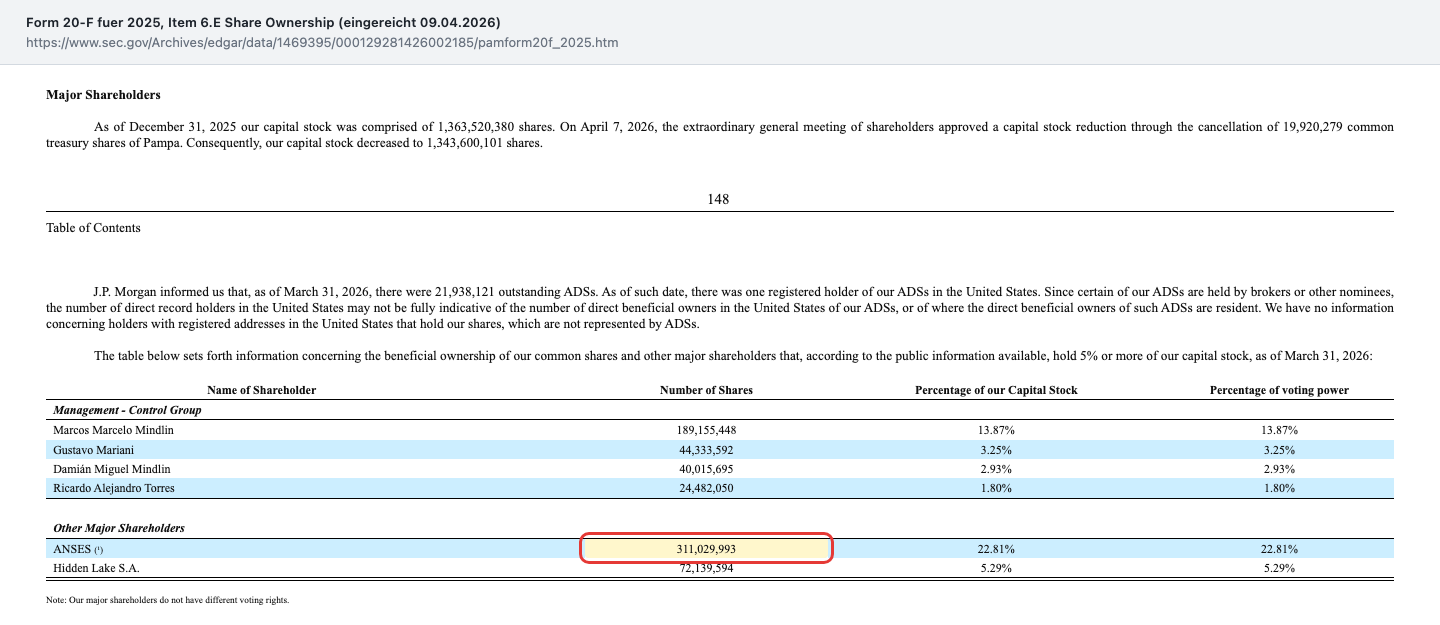
In 2008, Argentina nationalized the private pension funds and transferred their share holdings to the newly created ANSES; since a 2011 decree, the agency may exercise its voting power in proportion to its actual stake. Legally, that is nothing unusual — many Argentine blue chips carry the same legacy. For you as an investor, it still means: nearly a quarter of the company sits with an agency whose course is shaped by whichever government is in office. One positive side note from the same table: on April 7, 2026, the extraordinary shareholders' meeting cancelled 19,920,279 treasury shares, cutting the share count from 1,363,520,380 to 1,343,600,101 — Pampa has, if anything, slightly concentrated its shares lately rather than diluting them.
Valuation: a cheap P/E, an expensive country
At the analysis price of $79.50 per ADS (August 21, 2026), Pampa trades at a price-to-earnings ratio of roughly 7 and a price-to-sales ratio of roughly 1.8 — metrics that look cheap at first glance for a company with 53 percent revenue growth in its most recent quarter. Eight analysts see a consensus price target of roughly $121 (fundamental data, data as noted in the fact sheet) — good for about 50 percent above the analysis price. But a low P/E on an Argentine energy conglomerate is not a bargain without a reason: the market demands a visible discount for country risk, currency uncertainty, and the question of whether the reform course holds beyond 2027. The Piotroski balance-sheet-quality score sits at 6 of 9 — "okay, not great," a truly healthy balance sheet would sit at 8 or 9. The Altman Z-score of 1.6 sits in a grey zone that would worry an analyst covering a U.S. industrial company; for a heavily capex-driven commodity producer with growing operating income and ample liquidity, it reads more as a comment on the capital structure than an alarm bell — but it still belongs on the watch list, precisely because leverage is rising right now. And the share-price path does not match the growth pace: the stock is down 9.8 percent year-to-date in 2026, down 4.3 percent over six months, and sits 13.9 percent below its 52-week high of $92.30 (December 2025). Growth and price action are diverging here — a pattern that often emerges when the market weighs the risks (leverage, deferred-tax volatility, political dependence) more heavily than the operating acceleration.
Opportunities and risks at a glance
What speaks for Pampa Energía:
- Real, documented production growth: oil output up 145 percent in 2025 to 11.7 thousand barrels/day; Rincón de Aranda at 22,200 barrels/day across 43 wells in Q2 2026 (a year earlier: 17 wells).
- RIGI approval for Rincón de Aranda (07/21/2026) with 30 years of tax, customs and FX stability plus an export-duty exemption starting in year two — and, per the company, expected export revenue of $17 billion over the project's life.
- A diversified business across four segments (oil & gas, power generation, petrochemicals, grid stakes) rather than dependence on a single line of business.
- No dilution: the share count fell from 1,363.5 to 1,343.6 million shares through the cancellation of treasury shares on 04/07/2026.
- Cheap-looking valuation metrics (P/E around 7, P/S around 1.8) and an analyst consensus price target well above the analysis price.
What speaks against it:
- Net debt nearly tripled: from $491 million (end of 2024) to $1.3 billion (06/30/2026), leverage ratio from 12.97 to 18.18 percent.
- Reported consolidated profit fell 39 percent in 2025 ($377 million versus $619 million) despite a higher pre-tax result — driven by a $325 million swing in deferred income tax that could recur at any time.
- The oil-and-gas segment posted a $55 million net loss in 2025 despite an operating gain — interest and hedging costs exceed the operating improvement.
- Political and regulatory concentration risk: the company's own annual report explicitly warns that the Milei reforms are not guaranteed to endure; a policy reversal would hit both the RIGI incentives and the power-market deregulation.
- The Argentine state (ANSES) is the largest single shareholder at 22.81 percent — political voting behavior outside management's control; on top of that, an additional $2.7 billion investment commitment in the new urea project.
A human conclusion
Back to the story-versus-numbers trap from the start. Its core is not that the growth story is fabricated — Rincón de Aranda really is producing three times as much oil as a year ago, the RIGI approval is real, and the power-market deregulation shows up in genuinely higher revenue. Its core is that a single, impressive percentage spares you the second question an investment decision actually demands: what does this growth cost, and who bears the risk if the political or market environment turns? For Pampa, the honest answer is: the growth costs a nearly tripled net debt, a reported profit that fell in 2025, and dependence on a reform window the company itself cannot guarantee — while a state agency that answers to no shareholder owns nearly a quarter of the company. Whoever buys "53 percent revenue growth" is really buying a bundle: a real, concentrated investment project, a balance sheet with rising leverage, and a political bet on Argentina beyond 2027. That can be perfectly fine for you — if you weigh those three things individually instead of letting a single growth number hide them. What you make of it is your decision. And that is exactly as it should be.
Sources
All original documents used in this analysis — to read for yourself:
- Pampa Energía S.A. — SEC annual report 20-F for 2025 (filed April 9, 2026)
- Pampa Energía S.A. — SEC Form 6-K, Q2 2026 earnings release (filed August 4, 2026)
- Pampa Energía S.A. — SEC Form 6-K, Q1 2026 earnings release (filed May 6, 2026)
- Pampa Energía S.A. — SEC Form 6-K, Q4/full-year 2025 earnings release (filed March 2, 2026)
- Pampa Energía S.A. — SEC Form 6-K, Q4/full-year 2024 earnings release (filed March 5, 2025)
- Full SEC filing history of Pampa Energía S.A.: EDGAR overview (sec.gov)
- Fundamental data (metrics, price, analyst consensus; data as of August 21–24, 2026), reconciled with the SEC filings.
- Study on our in-house "Revenue Accelerator" scanner: Revenue Inflection Backtest Study — fresh acceleration returned 16.6 percent annualized versus 9.9 percent for established growers.
Transparency & disclaimer: This analysis is a journalistic contextualization of publicly available information and is not investment advice, not a financial analysis in the regulatory sense, and not a solicitation to buy or sell securities. Stock investments carry substantial risks up to total loss, and emerging-market issuers carry additional country and currency risk. All information without warranty; the data cut-off is noted in the text. Positions held by the operator are disclosed daily; where one exists, it appears as a notice at the top of this deep dive.
Key figures at a glance
All monetary figures in millions of $; earnings per share as reported.
| Metric | 2021 | 2022 | 2023 | 2024 | 2025 |
|---|---|---|---|---|---|
| Revenue | 1,508.0 | 1,829.0 | 513,727.0 | 1,876.0 | 1,998.0 |
| Operating Income (EBIT) | 579.0 | 631.0 | 120,409.0 | 440.0 | 332.0 |
| Net Income | 273.0 | 456.0 | 34,488.0 | 619.0 | 377.0 |
| Net Margin | 18.1% | 24.9% | 6.7% | 33.0% | 18.9% |
| Earnings Per Share | 4.86 $ | 8.11 $ | 25.25 $ | 11.38 $ | 6.93 $ |
Source: fundamental data & SEC filings (annual and quarterly reports, 10-K/10-Q)
Our Bottom Line at a Glance
- Operating growth positive
- Real, volume-based growth: oil output rose 145 percent in 2025, and Rincón de Aranda reached an average of 22,200 barrels/day across 43 wells in Q2 2026 (a year earlier: 17). Revenue grew 53 percent year-over-year in Q2 2026, aided by power-market deregulation.
- Earnings quality negative
- Reported net income fell 39 percent in 2025 to $377 million despite a higher pre-tax result, because a deferred-tax effect swung from a credit to a charge (a roughly $325 million swing). The oil-and-gas segment posted a $55 million net loss in 2025 despite an operating gain — interest and hedging costs eat the operating improvement.
- Leverage negative
- Net debt nearly tripled from $491 million (end of 2024) to $1.3 billion (06/30/2026), leverage ratio from 12.97 to 18.18 percent. Per media reports on the earnings call, leverage is guided to rise further over the next two to three years to roughly two times EBITDA before declining.
- Political & regulatory environment neutral
- Deregulation under President Milei and the RIGI incentive regime directly drive growth — but the company's own annual report explicitly warns that these reforms are not guaranteed to endure. Argentine inflation (2025: 31.5 percent) and peso devaluation remain structural sources of uncertainty.
- Ownership & governance neutral
- Argentina's state pension agency, ANSES, holds 22.81 percent — more capital than the entire management control group combined (~21.85 percent) — a leftover of the 2008 pension-fund nationalization. No dividend. On the plus side: no dilution; the share count was recently reduced slightly through the cancellation of treasury shares.
Pampa Energía is the story-versus-numbers trap in pure form: a real, volume-backed growth acceleration (oil output +145 percent in 2025, Q2 2026 revenue +53 percent) meets a balance sheet that pays a visible price for it — net debt nearly tripled, reported profit down in 2025 despite a better operating result, plus political dependence on a reform window the company's own annual report does not guarantee, and a state agency as the largest single shareholder. Not investment advice.
What Our Rating Means
Open questions
The business works in principle, but one material question is open. As long as it stays open, our findings do not carry a quality verdict.
The operating business is carrying its weight and demonstrably growing — this is not a story without substance. What remains open is one material operating question: can the balance sheet carry the Rincón de Aranda capex peak until leverage declines again, and does Argentina's political reform window hold over the timeframe management has laid out? Both are plausibly set up (the RIGI approval, capex guided lower from 2027 onward) but not yet proven by results. Anyone investing should check every future report against two things: is the leverage ratio falling as guided, and does the deferred-tax effect stay a one-time story rather than a recurring one. The decision is yours.
A journalistic assessment by our editorial team at the time of the deep dive, based on public sources — not investment advice and not a solicitation to buy or sell. Your personal circumstances (investment goals, risk capacity, taxes) cannot be taken into account. What our levels mean, how verdicts are formed, and what conflicts of interest exist →
Worth Noting
- Pampa Energía surfaced through our in-house stock scanner "Revenue Accelerator" (rank 6 of 28 hits, as of August 24, 2026). The two most recent quarters land cleanly inside the required 30-to-70-percent growth band; among the four quarters before that, one single quarter (Q4 2025) sits slightly on either side of the 15 percent threshold depending on the data series used — the underlying pattern of an acceleration starting in early 2026 holds under both readings.
- Foreign Private Issuer: Pampa files no 10-Q, but an annual report 20-F and quarterly/current reports 6-K. This analysis's data-origin formula reads accordingly "(20-F/6-K)."
- Statements from the August 5, 2026 earnings call (capex guidance, leverage target, dividend statement) come from media reports (including Investing.com) and are labeled as such — not as a verbatim SEC quote, since Pampa does not file a full transcript with the SEC, only the slide presentation.
- Not to be confused with: Pampa Energía (ticker PAM, an Argentine energy conglomerate) is a different company from the U.S. natural-gas producer Antero Resources or the Peruvian mining company Buenaventura — all three occasionally show up in the same sector screens.
Stock Watch
This analysis is as of August 26, 2026. Stock Watch will tell you what's changed at PAM since then.
Later $1 a month per stock — signing up is free, and you'll be the first to know when it launches.
The full analysis as a PDF for later
We will send you this analysis as a PDF — to print, file away, and read at your own pace. And we will add you to the free Stock Watch list for Pampa Energia SA (PAM), so you hear about it when something material in this analysis changes.
Frequently Asked Questions
Pampa Energía S.A. (NYSE: PAM, Buenos Aires: PAMP) is an integrated Argentine energy company with four segments: oil and gas (including the Rincón de Aranda shale-oil block in Vaca Muerta), power generation (about 5,472 megawatts installed), petrochemicals (styrene, synthetic rubber, polystyrene), and holding/transportation with minority stakes in the grid operators Transener and TGS. It is headquartered in Buenos Aires; CEO is Gustavo Mariani.
Per the company's own releases, revenue rose 38 percent in Q1 2026 and 53 percent in Q2 2026 versus the respective year-ago quarter. The main driver is the production ramp-up at the Rincón de Aranda shale-oil block (oil output up 145 percent in 2025), together with the deregulation of Argentina's wholesale power market, which enabled higher spot prices and more direct power-purchase agreements with industrial customers.
At its core, yes: it comes from more barrels of oil produced and more energy sold, not from an acquisition. But it is heavily project-driven — concentrated on a single oil field (Rincón de Aranda) and a regulatory reform window whose durability the company's own annual report explicitly does not guarantee.
Consolidated net income fell in 2025 to $377 million (2024: $619 million), even though pre-tax profit rose 17 percent to $582 million. The reason is a swing in non-cash deferred income tax from a credit ($121 million, 2024) to a charge ($204 million, 2025) — an effect tied to the relationship between Argentine inflation and peso devaluation, not to the operating business.
Net debt rose from $491 million (end of 2024) through $801 million (end of 2025) to $1.3 billion as of 06/30/2026, and the leverage ratio from 12.97 to 18.18 percent. Per media reports on the earnings call, management guided leverage to rise further over the next two to three years to roughly two times EBITDA, then decline once the Rincón de Aranda capex peak has passed.
No, not currently. Per media reports on the Q1 2026 earnings call, CFO Adolfo Zuberbühler answered the dividend question simply with "No." Under the bylaws, annual profit is first allocated to the legal reserve (up to 20 percent of capital stock) before any distribution is even discussed.
Surprisingly, the largest single shareholder is not the founding family but the Argentine state: the social security agency ANSES holds 22.81 percent of the capital stock (as of 03/31/2026) — a leftover of the 2008 nationalization of private pension funds. Chairman Marcos Marcelo Mindlin holds 13.87 percent, and the entire management control group around CEO Gustavo Mariani holds roughly 21.85 percent combined.
Found an error?
Did you spot a factual error, an outdated number, or a typo in this deep dive? Let us know briefly — your report goes straight to the editorial team.