Pagaya: A $45 Million Record Profit and a $42 Million Loss on Its Own Paper
For the same quarter, Pagaya names two profits: $45.3 million under U.S. accounting rules and $101.0 million "adjusted". The difference is mostly write-downs on credit paper the company has to keep from its own network — $42.3 million of losses in the second quarter of 2026 alone. Of that paper, $886.7 million has no market price and is valued on management assumptions; the assumed loss rate fell from 17.0 to 16.2 percent as of June 30, 2026. And just under 60 percent of quarterly revenue comes from vehicles Pagaya itself sponsors and administers. Not investment advice — just the question of which of the two profit figures the owners actually get to keep.
 Thomas Mücke
Founder & Publisher
Thomas Mücke
Founder & Publisher
As of Today
As of: September 17, 2026
- Closing price
- 20.60 $ -5.00%
- Market Capitalisation
- 1.7 $B
- P/E
- 18.1
- Growth Score
- 8/10
- AAQS
- 7/10
This analysis has a cut-off date. The Stock Guard tells you when something material changes in the numbers. Reserve your free spot
Chart
Interactive price chart (TradingView).
52-week range: 10.60 $ to 43.80 $ · Last price: 20.60 $ (As of: September 17, 2026)
Note: pure fact-based analysis, not investment advice and not a solicitation to buy or sell. All figures without guarantee.
There is one investor trap that never makes you look stupid — quite the opposite, it feels like a reward for paying attention: the preferred-number trap. It springs when a company reports two profit figures for the same period and both are correct. At Pagaya Technologies (NASDAQ: PGY) the two numbers for the second quarter of 2026 are $45.3 million under U.S. accounting rules and $101.0 million in the company's own "adjusted" arithmetic. Your brain reaches for the second one automatically. It is bigger, it sounds like the "real" business, and it sits at the top of the press release. So let us make a deal: before you pick one, we read together what lies between them. The source is the quarterly report (Form 10-Q) for the period ended June 30, 2026, filed on July 30, 2026 with the U.S. securities regulator, the SEC, together with the same-day earnings release (Exhibit 99.1 to a current report on Form 8-K) and the annual report (Form 10-K) for 2025. Filings like these are honest under penalty of law. And this one describes a business growing fast, a technology handing out credit — and a stack of paper Pagaya has to keep and value on its own assumptions. The decision at the end is yours.
What Pagaya actually does — the second opinion on declined loans
Picture applying to your bank for an instalment loan and being turned down. For the bank the matter is closed — and mildly annoying, because it paid for the marketing, screened your application and earned nothing. That is exactly where Pagaya sits. The company calls its core product "Decline Monetization": the partner automatically forwards the declined application to Pagaya's network, where it runs through models working with far more data points than the bank has on its own. If the model says yes, the loan is written after all. The partner still originates it, an investment vehicle buys it, and Pagaya collects a fee.
Two things about this are unusual. First, the scale: according to the annual report (10-K) for 2025, the network has processed more than $3.6 trillion of loan applications since inception — applications, not funded loans. Second, the label in the accounts: the largest revenue line is literally called "Network AI fees" and consists of "AI integration fees" plus capital markets execution fees. In 2025 it produced roughly $1,131.3 million out of $1,261.3 million of total fee revenue — close to 90 percent. At Pagaya the technology is not a tool in the background; it is the invoice line. Buying the stock means buying the claim that these models judge credit risk better than the bank next door.
The third building block is the one this analysis turns on. To make the loans purchasable, Pagaya bundles them into securities — asset-backed securities, or ABS. In plain terms: thousands of individual loans go into a box, and slices of that box are sold to investors. In the United States, whoever packs such a box must keep part of it. That rule dates from after the financial crisis and exists so the packer shares the pain rather than shipping bad goods. This risk retention lands on Pagaya's own balance sheet. That defines the central tension of this analysis, and it runs through every chapter: the fees are real money that arrives immediately; the paper Pagaya must keep in exchange is a bet on the very same loans — and its value appears in no price sheet, only in the company's own valuation model.
One more point of context, because it confuses data sheets: Pagaya is an Israeli company with its head office in New York (335 Madison Avenue) and its engineering in Tel Aviv. For fiscal 2023 it first filed the foreign private issuer annual report (Form 20-F, filed March 8, 2024) — and then, in April 2024, voluntarily filed a U.S.-style annual report (Form 10-K) for the same year on top of it. Since then Pagaya has reported like a U.S. domestic company throughout: annual report (10-K), quarterly reports (10-Q), current reports (8-K). As of June 30, 2025 the company determined that it no longer met the criteria for foreign private issuer status — what began as a voluntary practice became an obligation. As of December 31, 2025 it also lost emerging growth company status and became a large accelerated filer — which means, among other things, that the auditor must now attest to internal control over financial reporting for the first time. For shareholders that is good news: the reporting bar has been raised.
How the stock reached our desk
Not through a screener but through the SEC filing calendar. On July 30, 2026 two documents arrived at once: the quarterly report (10-Q) for the period ended June 30, 2026 and, the same day, a current report (8-K) carrying the earnings release as Exhibit 99.1 and a shareholder letter as Exhibit 99.2. That combination always deserves a second look, because the company outlook appears only in the exhibit, never in the quarterly report itself. At Pagaya the exhibit carried plenty: a raised full-year outlook, six ABS transactions totalling $3.7 billion in the quarter, and a Fitch rating outlook lifted to positive.
The contrast was what stood out. The release was headed "record performance across key metrics". The quarterly report next to it showed, in the very same income statement, a line reading minus $42.3 million. Contradictions like that are exactly why we do not write analyses from press releases. Remember the finding right at the start: at Pagaya the most interesting number is not in the headline, it is four lines below operating income.
The numbers over the years — given their due
First the part that genuinely impresses, and there is plenty of it. Total revenue and other income rose from $812.1 million (2023) through $1,032.2 million (2024) to $1,301.4 million (2025) — 26 percent growth in the last full year — with $705.0 million booked in the first half of 2026. Network volume, the company's term for the credit it places, reached $3.5 billion in the second quarter of 2026 against $2.6 billion a year earlier. And operating income, the result of the running business before all financing items, swung hard: minus $24.4 million (2023), plus $66.8 million (2024), plus $263.8 million (2025), plus $185.8 million in the first half of 2026. That is not cosmetic; technology, sales and administrative costs actually fell in absolute terms in 2025.
More important still: cash from operations is positive and growing. For a company that carries paper at fair value, that is the decisive cross-check, because valuation gains can be booked while cash cannot be invented. The series from the annual report reads: minus $21.7 million (2023), plus $47.8 million (2024), plus $238.6 million (2025), plus $117.9 million in the first half of 2026. Reported profits alongside a permanently empty till would be a first-order warning sign; that is not the case here. Now the chart that shows what the growth cost:
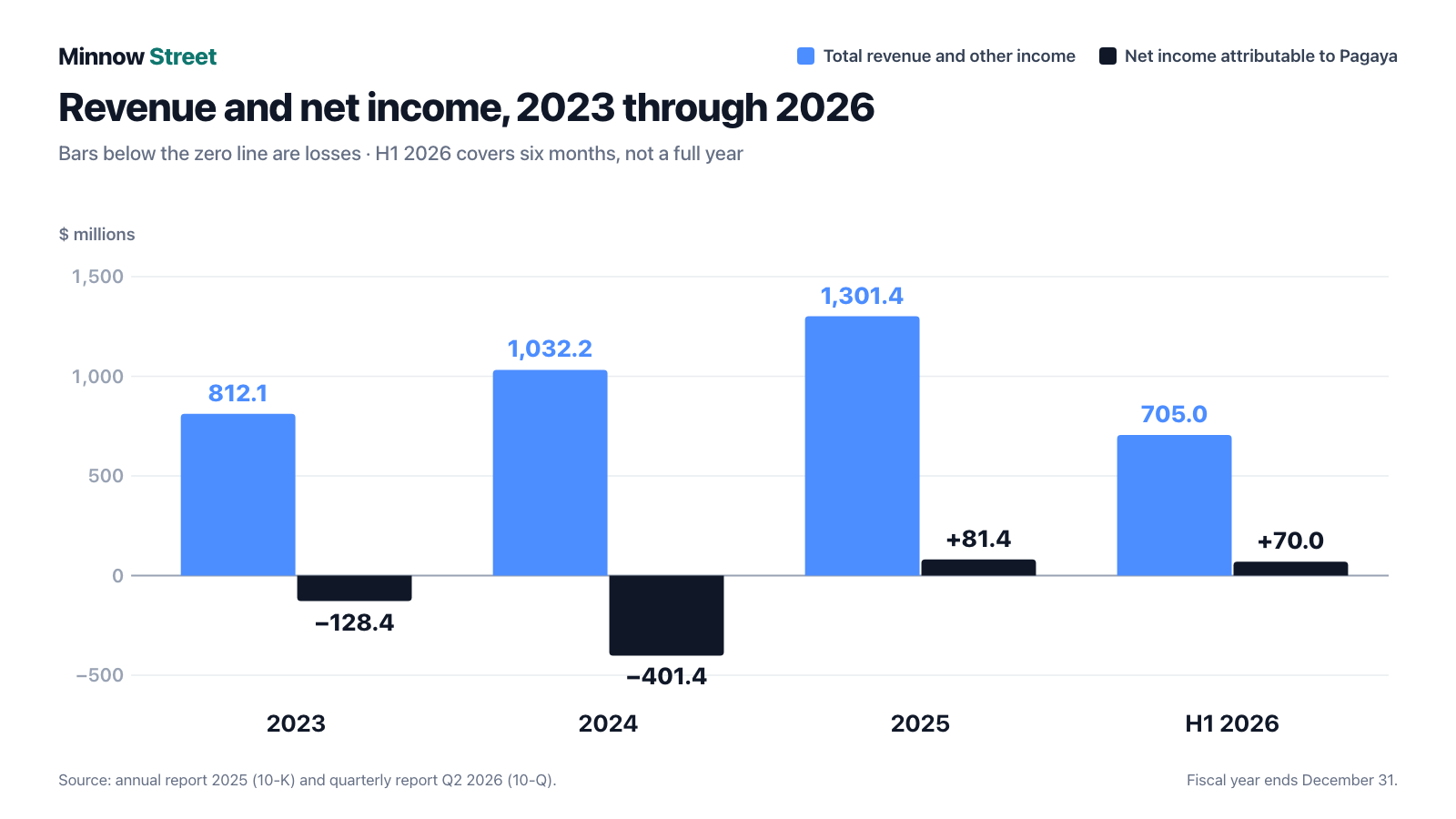
Those black bars are the story. Pagaya lost $128.4 million in 2023 and $401.4 million in 2024, on revenue of roughly a billion dollars. Only in 2025 did an $81.4 million profit appear, followed by $70.0 million in the first half of 2026. The accumulated deficit — the sum of every loss since inception — still stood at $792.7 million on June 30, 2026. Remember the picture: Pagaya is not an established earner, it is a company in the second year of its profitability. A turnaround one year old is a start, not a proof.
The bars also explain why valuation is hard to grip: no price-earnings ratio can be formed for 2023 or 2024, because there were no earnings. Anyone quoting one today is working with a year and a half of profit. Where the swing came from — and why it is more fragile than the press release suggests — is the subject of the next chapters.
What the filings say — the uncomfortable truths
Uncomfortable truth no. 1: 60 percent disappears between operating income and net income
Here is the arithmetic no press release shows. In the second quarter of 2026 Pagaya earned operating income of $105.8 million. At the bottom of the income statement stood $45.3 million. Four lines sit in between, and the most important is called "Gains and (losses) on investments in loans and securities":
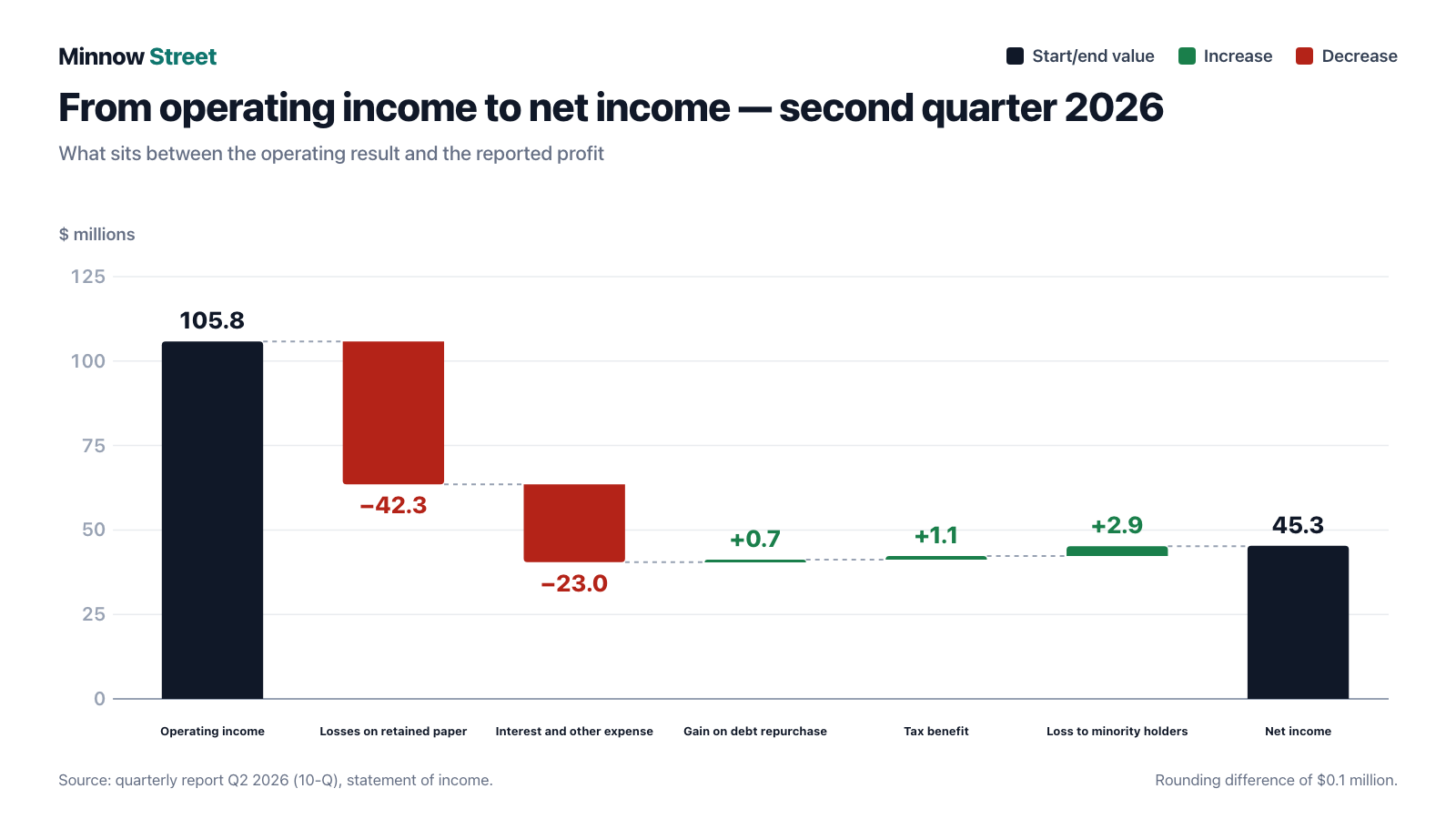
What drains away here is not an accounting nicety but write-downs on precisely the loans Pagaya's models selected. Credit-related impairment on the Level 3 paper alone came to $30.2 million in the second quarter of 2026 and $70.8 million in the first half (prior-year periods: $28.9 million and $63.2 million). Across the years that single line adds up: minus $131.3 million (2023), minus $404.2 million (2024), minus $107.0 million (2025) and minus $80.3 million in the first half of 2026 — roughly $722.8 million in three and a half years.
And now the moment the preferred-number trap springs. Pagaya's "adjusted" result of $101.0 million is built partly by adding back an item called "Impairment loss on certain investments, net" of $38.0 million. Translated: the losses on the loans its own technology picked are stripped out of the metric meant to prove how good that technology is. It is neither forbidden nor hidden — it is disclosed cleanly — but it is circular. The short version: a company that measures its skill with a number from which the consequences of that skill have been removed is measuring nothing.
Uncomfortable truth no. 2: 85 percent of the paper has no market price
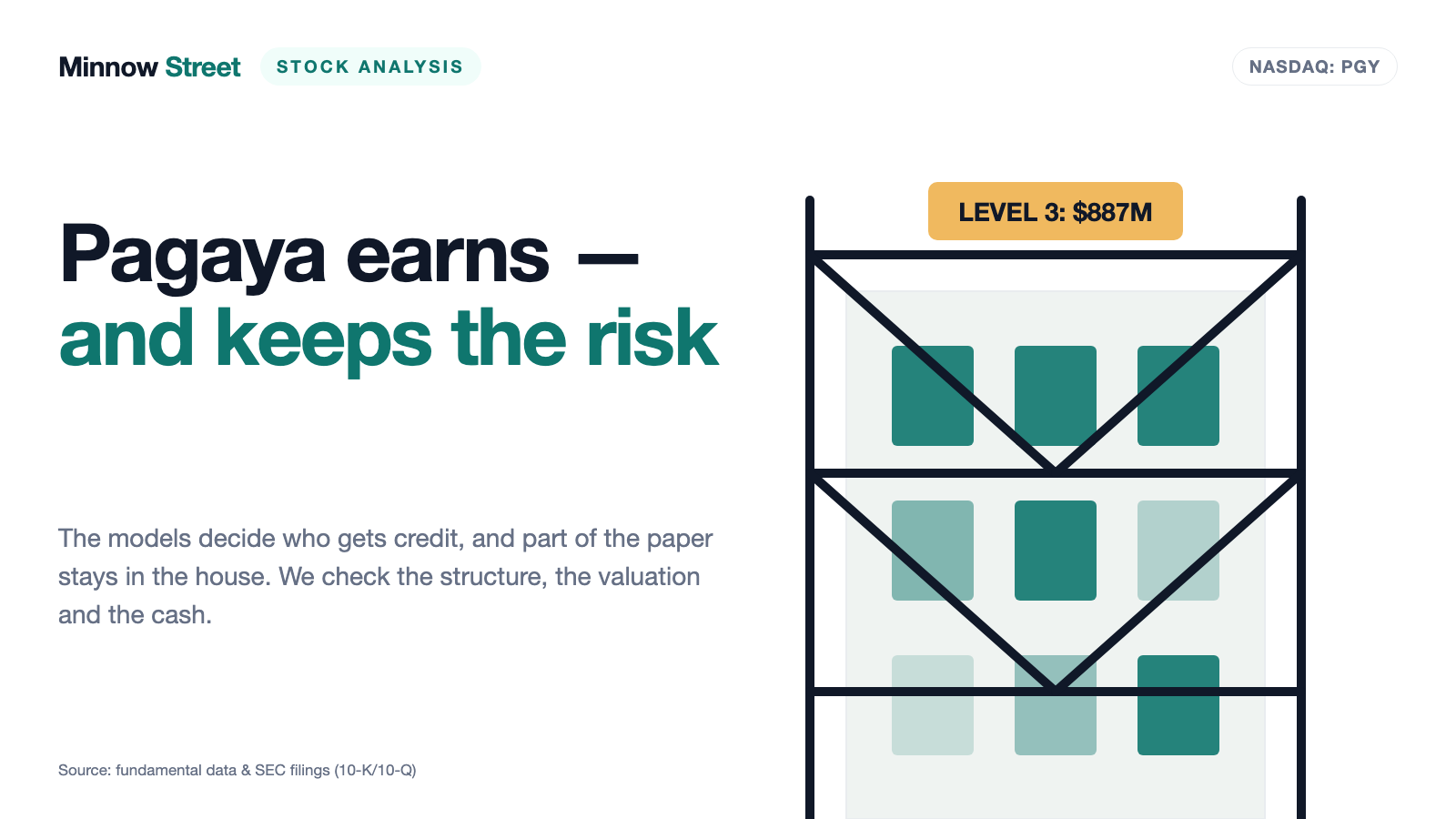
As of June 30, 2026 the balance sheet carried $1,040.1 million of "investments in loans and securities" against total assets of $1,693.1 million and equity of $594.2 million. In other words: this single item is almost twice the size of all shareholders' equity. Of it, $542.1 million was explicitly held for regulatory risk retention. Now the valuation question. Accounting sorts securities into three levels: level 1 is quoted prices, level 2 derived prices, level 3 covers values for which no observable market exists and which the company models itself. As of June 30, 2026 Pagaya assigns $886.7 million — roughly $887 million, or 85 percent of the portfolio — to level 3. The quarterly report says so plainly:
"The Company has determined that its certificates, loans and certain subordinated notes meet the definition of Level 3 assets, as their fair value measurements are characterized by a lack of observable market data and a reliance on management's assumptions."
— Pagaya Technologies Ltd., SEC quarterly report 10-Q for the period ended June 30, 2026, Note 7 "Fair Value Measurement"

On its own that would be normal — securitization tranches are valued this way. It gets interesting at the dials. The filing names three key assumptions with their weighted averages, as of June 30, 2026 against December 31, 2025: discount rate 14.6 versus 15.0 percent, loss rate 16.2 versus 17.0 percent, prepayment rate 13.2 versus 14.2 percent. And the same filing explains which way that works: "an increase in the discount, credit risk, or prepayment rates, in isolation, would result in a lower fair value measurement." Read the other way round: all three assumptions moved in the first half of 2026 in the direction that supports the value of the portfolio.
This is not an accusation. If actual defaults are falling, that is exactly how it should be booked. But it is the reason you have to read the assumptions at Pagaya, not just the result. An everyday image: anyone valuing their own house can set the price within wide limits — as long as they do not sell. Only the sale tells the truth. At Pagaya that truth test runs continuously, and in the first half of 2026 it came out mixed: $114.7 million of gains on sales stood against $146.2 million of losses.
Uncomfortable truth no. 3: nearly 60 percent of revenue comes from its own vehicles
The quarterly report carries a line that is easy to skim past. For the second quarter of 2026 Pagaya names revenue from related parties of $231.4 million — $227.5 million from the ABS securitization trusts and $3.9 million from investment funds. Set against total revenue and other income of $387.0 million, that is 59.8 percent.

Before anyone builds a scandal out of that: Pagaya explains the reason itself, and it is plausible. The trusts and funds are overwhelmingly filled with third-party money; they count as related parties only because Pagaya sponsors, administers and — in the case of the funds — acts as registered investment adviser to them. Still, the finding is uncomfortable: Pagaya sets the price for a service it sells to a vehicle it founded and steers itself. Two individual ABS trusts together accounted for roughly 29 percent of fee revenue in the second quarter of 2026, and $124.3 million of the $190.5 million of total fee receivables came from these relationships.
The time series eases the picture somewhat — and raises a fresh question. To keep the years comparable we measure against one and the same base throughout, namely total revenue and other income. On that basis the related-party share was 76.6 percent in 2023 ($622.2 million of $812.1 million), 65.8 percent in 2024 ($679.1 million of $1,032.2 million) and 50.2 percent in 2025 ($652.7 million of $1,301.4 million). Pagaya is clearly broadening its funding, not least through forward flow agreements with direct buyers. In the first half of 2026, however, the share climbed back to 55.4 percent ($390.3 million of $705.0 million), and to 59.8 percent in the second quarter alone. Whether that is noise or a reversal will show in the next quarterly report.
Uncomfortable truth no. 4: the technology has never run through a downturn
Credit where it is due: this sentence stands in Pagaya's own annual report, in the summary of principal risks, right next to the note that a limited number of partners account for a substantial portion of volume.
"Our AI technology has not yet been extensively tested during different economic conditions, including down-cycles."
— Pagaya Technologies Ltd., SEC annual report 10-K for 2025, Item 1A "Risk Factors"

Why this is more than boilerplate: Pagaya was founded in 2016 and has been listed only since June 2022. That span brought rate shocks and inflation but no real recession with sharply rising unemployment — and unemployment is what decides whether consumer loans get repaid. Risk retention makes that acute. A pure credit broker with no balance sheet exposure would simply earn less in a downturn. Pagaya would earn less and have to write down its own tranches. A second sentence from the same filing puts it more clearly than any analysis could:
"Failure to increase revenue and FRLPC, maintain cost levels sufficiently to keep pace with our investments, or material fair value losses associated with our investments in risk retention assets could prevent us from generating GAAP net income in the future."
— Pagaya Technologies Ltd., SEC annual report 10-K for 2025, Item 1A "Risk Factors"
One early indicator is already visible. The metric the company itself treats as central — fee revenue less production costs, measured against network volume — fell from 4.8 to 4.2 percent in the second quarter of 2026 against the same quarter a year earlier. Pagaya cites asset class mix, new partners and tighter pricing on its ABS transactions in the face of higher funding costs. Volume, in other words, is growing faster than margin — a pattern worth tracking. What a lender looks like when it keeps the loans on its own books entirely is set out in our analysis of Oportun Financial; a third route to model-driven credit runs through our analysis of Dave.
Uncomfortable truth no. 5: the bond market prices this company more cautiously than the stock market
In July 2025 Pagaya borrowed $500 million at 8.875 percent, maturing August 1, 2030. The coupon alone says something: no company regarded as safe borrows that expensively. What has happened since is more interesting. Pagaya keeps buying pieces of its own bond back below par: $6.9 million of principal at 87.4 percent in December 2025, a further $7.4 million at 87.3 percent in February 2026 and another $3.8 million at 78.5 percent in May 2026, leaving $481.9 million of the original principal outstanding. In the fair value table of the quarterly report, long-term debt appears with a carrying amount of $471.9 million and a fair value of $413.6 million — meaning the bond market paid roughly 88 cents on the dollar as of June 30, 2026.
For the company the repurchases are good business; each produced a book gain ($0.7 million, $0.8 million and $0.7 million). For the assessment they are still a signal: while the share price jumped from $16.19 on July 29, 2026 to roughly $22 on August 3, 2026 — both figures documented in SEC filings — bondholders were still demanding a discount of some 12 percent to carrying value as of June 30, 2026. Holding a company's shares and its bonds side by side gets you two opinions for the price of one.
Now to dilution, the second point under this heading. As of July 29, 2026 there were 72,137,266 Class A shares and 11,288,577 Class B shares outstanding — 83.4 million together — plus 2,027,147 preferred shares. Many data sheets show only the Class A figure; anyone computing market capitalisation from it is roughly 14 percent short. The earnings-per-share footnote adds 22,433,501 instruments excluded from the diluted calculation because they would currently be anti-dilutive, of which 19,883,294 are options to restricted shares. That is roughly 27 percent on top of today's share count. In everyday terms: your slice of the cake has already been cut, but guests are still sitting at the table waiting for a plate.
One source of dilution can safely be crossed off, and it explains a figure that otherwise reads like a typo: the listed warrants trading as PGYWW. They date from the 2022 listing via a shell company. In March 2024 Pagaya combined twelve shares into one — a reverse share split of 1 for 12 — so twelve warrants are now required for a single share, and the effective exercise price works out at $138 per share. The quarterly report gives the share price as $16.19 as of July 29, 2026. These warrants would only be in the money after roughly an eightfold rise; the up to $169.6 million of proceeds mentioned in the filing are theoretical for the foreseeable future.
What the balance sheet carries — and what sits beside it
The balance sheet as of June 30, 2026 is sturdier than the loss history suggests. Assets include $249.3 million of cash plus $55.2 million of restricted cash, $190.5 million of fee receivables and the $1,040.1 million of investments already discussed. Liabilities include $253.0 million of secured borrowing, $150.1 million of exchangeable notes (6.125 percent, due 2029) and $471.9 million of long-term debt. The $132 million revolving credit facility was fully repaid at the balance sheet date, leaving $115.0 million available. All covenants were met. Equity attributable to Pagaya shareholders rose over the half year from $480.0 million to $594.2 million.
Two positions sit beside the balance sheet, and both are worth knowing. First, the trusts themselves: Pagaya does not consolidate them, because it does not direct the decisive activity — collecting the payments. Those trusts hold assets of $13.383 billion. Pagaya's own interest in them, which is simultaneously its maximum exposure to loss, is put at $972.8 million:

Second, the guarantees. Under its forward flow agreements — the continuing direct sale of loans to individual investors — Pagaya has given a performance undertaking: if the loans fall short of a contractually agreed performance level, Pagaya must top them up to a contractual cap. As of June 30, 2026 the unfunded maximum potential amount of those guarantees was $141.3 million; $48.1 million sits in segregated accounts against it and $20.9 million is already accrued as a liability. That is roughly 24 percent of equity — not an existential question, but not a footnote either.
And third, a structure worth reading twice: the three entities through which risk retention is held are only 20 percent owned by Pagaya, with affiliated entities holding 80 percent. Because Pagaya directs them, they are consolidated at 100 percent, with the outside share shown as a noncontrolling interest ($54.6 million as of June 30, 2026). That is why a plus of $2.9 million appears in the waterfall above: it is the loss borne in the quarter by the 80 percent co-owners and added back to Pagaya's result.
One formality that puzzles database users deserves a note: the 2025 annual report has two amendments. The first, dated April 30, 2026, supplied only Part III — directors, executive compensation, auditor fees — because the proxy statement would not be filed within the 120-day window. The second, dated June 1, 2026, reissued the entire annual report in order to expand Note 19 (Segments and Geographical Information) with a more detailed breakdown of long-lived assets by geography and to update Note 20 (Subsequent Events); the opinion of auditor Kost Forer Gabbay & Kasierer was re-dated specifically with respect to those two notes. The amendment states expressly that the financial position for the periods presented is unaffected. No restatement of numbers, then — but a sign that the reporting is still being fine-tuned.
Valuation — orders of magnitude rather than daily prices
Start with what is actually documented — and strictly from mandatory filings, without a price database. The warrants section of the quarterly report gives the share price of $16.19 on July 29, 2026. Against 83.4 million ordinary shares that implies a market capitalisation of roughly $1.35 billion. After the quarterly numbers landed on July 30 the stock moved sharply higher: two insider reports on Form 4, filed August 4, 2026, document sales on August 3, 2026 at $21.9783 and $22.00 per share. On that basis market capitalisation works out at roughly $1.83 billion. We name both anchors deliberately, because they sit a week apart and that spread is itself a fact about this stock.
That gives the orders of magnitude — measured against the more recent of the two anchors, roughly $1.83 billion. Against trailing twelve-month revenue of $1,390.0 million, the price-sales ratio is roughly 1.3 — not expensive for a technology company growing 26 percent, and not cheap for a credit intermediary carrying balance sheet risk. Against trailing twelve-month net income of $126.9 million, the price-earnings ratio is roughly 14. Using the company's own full-year outlook of $155 to $180 million it falls to about 11. That sounds inexpensive — and only is if you believe an earnings figure that depends substantially on the valuation assumptions applied to $887 million of Level 3 paper.
What about professional opinion? Analyst estimates appear in no mandatory filing, so we stick to three judgments that are documented — and they point in different directions. Rating agency Fitch raised its outlook to positive, according to the earnings release of July 30, 2026, citing improvement in profitability, leverage and interest coverage. Bondholders stayed cautious at the same time: fair value of $413.6 million against a carrying amount of $471.9 million as of June 30, 2026. And insiders used the jump: on August 3, 2026 a board member and the company president together sold 49,470 shares at roughly $22 — against 72.1 million Class A shares that is 0.07 percent, so neither an exit nor a vote of confidence. Three professional views, three shades. None of them is a blank cheque.
The company's own outlook, published July 30, 2026, calls for full-year 2026 network volume of $12.5 to $13.25 billion, revenue of $1.425 to $1.525 billion, adjusted EBITDA of $460 to $490 million and GAAP net income of $155 to $180 million. For the third quarter of 2026 Pagaya guides to $3.425 to $3.625 billion of volume and $42 to $52 million of net income. Those are firm anchors for the next review.
Opportunities and risks at a glance
What speaks for Pagaya:
- Real operating leverage. Operating income rose 87 percent to $105.8 million in the second quarter of 2026 while technology, sales and administrative costs together fell from $78.5 million to $62.5 million. Growth without cost growth is the rarest kind of growth.
- The cash is real. $238.6 million of cash from operations in 2025 and $117.9 million in the first half of 2026 — comfortably more than reported net income. That defuses the most common suspicion against companies using fair value accounting.
- Diversification is happening. The related-party share of total revenue fell from 76.6 percent (2023) to 50.2 percent (2025). The auto vertical reached an annualised network volume of $4.8 billion in the second quarter of 2026.
- Funding secured and cheaper. The revolving credit facility was refinanced on October 1, 2025 — the margin over the reference rate fell from 7.50 to 3.50 percentage points — and was fully repaid as of June 30, 2026; in July 2026 a receivables facility was raised from $65 million to $100 million and extended into 2029. Fitch lifted its rating outlook to positive.
- A network effect with a data lead. More than $3.6 trillion of loan applications processed since inception is a data base a newcomer cannot simply buy.
What speaks against it:
- Earnings depend on the company's own assumptions. $886.7 million of Level 3 paper with no market price, valued with an assumed loss rate cut from 17.0 to 16.2 percent within six months.
- The technology is untested in a downturn — by the company's own admission. With unemployment rising, fees and paper values would fall together.
- Concentration. 59.8 percent of quarterly revenue from related-party vehicles, two ABS trusts alone at roughly 29 percent of fee revenue, plus the annual report's note that a limited number of partners accounts for a substantial portion of volume.
- Margin pressure. Fee revenue less production costs as a share of network volume fell from 4.8 to 4.2 percent — volume is growing faster than earnings.
- Dilution and interest cost. 22.4 million instruments on top of 83.4 million shares, an 8.875 percent coupon on the 2030 notes, whose fair value sits at roughly 88 percent of carrying value.
- Young profitability. First profitable year in 2025, accumulated deficit of $792.7 million. One year of profit is a snapshot, not a track record.
A human conclusion
Back to the preferred-number trap. Both profit figures for the second quarter of 2026 are correct — they simply answer different questions. The $101.0 million answers: "How well is the fee business running if you set the credit losses aside?" The $45.3 million answers: "What was left for the owners at the end?" The first question is interesting. The second one is yours.
Lay them side by side and you see what Pagaya really is: not a pure software vendor selling licences but a credit intermediary obliged to keep part of its own goods in the warehouse — and estimating the value of that warehouse itself. This can end very well. The fee business scales, the cash genuinely arrives, the partner list is growing, and the company's own outlook is ambitious and has recently been beaten. It can also end differently, and then the lever works twice: in a downturn fees fall while the paper on the books has to be written down at the same time. The company puts that possibility in its own risk section — you only have to read it.
What you make of it is your decision. We would open three lines first in every new quarterly report: the assumed loss rate in the Level 3 table, the share of revenue from related parties, and the fee margin on network volume. If those three hold steady while volume grows, Pagaya is right. If they move in opposite directions, it has merely kept the prettier number pretty for longer. And that is a good thing — because you can run that check yourself, in a document that becomes public free of charge every quarter.
Sources
- SEC quarterly report 10-Q for the period ended June 30, 2026 (filed July 30, 2026) — balance sheet, income statement, cash flow statement, Note 3 (revenue), Note 4 (investments), Note 5 (variable interest entities), Note 6 (borrowings), Note 7 (fair value), Note 9 (guarantees), Note 11 (related parties), Note 12 (earnings per share), Note 13 (subsequent events)
- SEC current report 8-K dated July 30, 2026 (Items 2.02, 7.01, 9.01) with Exhibit 99.1 (earnings release and outlook) and Exhibit 99.2 (shareholder letter)
- SEC annual report 10-K for 2025 (filed March 2, 2026) — business model, Item 1A risk factors, cash flow statement, segment and revenue disclosures
- SEC amendment 10-K/A no. 1 dated April 30, 2026 (Part III: directors, executive compensation, auditor fees)
- SEC amendment 10-K/A no. 2 dated June 1, 2026 (reissued annual report with expanded Note 19 on segments and geographical information)
- SEC insider report on Form 4 filed August 4, 2026 and second Form 4 filed August 4, 2026 — sales on August 3, 2026 at $21.9783 and $22.00 per share; the only price evidence after the earnings release and the basis for the market capitalisation cross-check
- Filing index for Pagaya Technologies Ltd. at SEC EDGAR (CIK 0001883085)
Disclaimer: This article is journalistic analysis of publicly available company filings. It is not investment advice, not a solicitation to buy or sell securities and not a personal recommendation. All figures come from the primary sources linked above and carry the as-of date stated there; they may have changed since. Shares in companies such as Pagaya can be highly volatile — a total loss of capital is possible. Positions held by the operator are disclosed daily; where one exists, it appears as a notice at the top of this deep dive. at the time of publication and receives no compensation from the company, directly or indirectly. Review every investment decision yourself or with a licensed adviser.
Key figures at a glance
All monetary figures in millions of $; earnings per share as reported.
| Metric | 2021 | 2022 | 2023 | 2024 | 2025 |
|---|---|---|---|---|---|
| Revenue | 445.9 | 685.4 | 772.8 | 1,004.6 | 1,261.3 |
| Operating Income (EBIT) | -5.8 | -315.0 | -24.4 | 66.8 | 223.8 |
| Net Income | -91.2 | -302.3 | -128.4 | -401.4 | 81.4 |
| Net Margin | -20.4% | -44.1% | -16.6% | -40.0% | 6.5% |
| Earnings Per Share | -5.60 $ | -5.19 $ | -2.14 $ | -5.66 $ | 0.98 $ |
Source: fundamental data & SEC filings (annual and quarterly reports, 10-K/10-Q)
Our Bottom Line at a Glance
- Growth and operating leverage positive
- Total revenue and other income rose from $812.1 million (2023) to $1,301.4 million (2025) and by 19 percent to $387.0 million in the second quarter of 2026. Operating income in that quarter jumped 87 percent to $105.8 million while technology, sales and administrative costs together fell from $78.5 million to $62.5 million. Network volume reached $3.5 billion.
- Quality of earnings negative
- Between operating income ($105.8 million) and net income ($45.3 million) in the second quarter of 2026 sit chiefly $42.3 million of losses on the company's own securitization paper. The company's preferred metric of $101.0 million adds precisely those write-downs back. Since 2023 this single line adds up to roughly $722.8 million.
- Reliability of balance sheet values negative
- $886.7 million of the $1,040.1 million of investments are Level 3 assets with no observable market price (June 30, 2026) — more than the entire $594.2 million of equity. Within six months the assumed loss rate fell from 17.0 to 16.2 percent and the discount rate from 15.0 to 14.6 percent, both supporting fair value. The 2025 annual report itself calls the technology untested in a down-cycle.
- Customer structure and concentration negative
- $231.4 million of the $387.0 million of quarterly revenue (59.8 percent) comes from vehicles Pagaya sponsors or advises; two ABS trusts alone accounted for roughly 29 percent of fee revenue in the second quarter of 2026. The related-party share of total revenue is nonetheless falling over time: 76.6 percent (2023), 65.8 percent (2024), 50.2 percent (2025) — although it climbed back to 55.4 percent in the first half of 2026.
- Balance sheet and funding neutral
- Sound as of June 30, 2026: $304.4 million of cash including restricted cash, $594.2 million of equity, an undrawn revolver with $115.0 million available, all covenants met and $117.9 million of cash from operations in the half year. Against that stands an 8.875 percent coupon on the 2030 notes, whose $413.6 million fair value sits below the $471.9 million carrying amount, plus performance guarantees of up to $141.3 million.
- Dilution and share structure negative
- Alongside 83.4 million ordinary shares outstanding (July 29, 2026) sit 22,433,501 instruments from options, restricted share awards and warrants that are currently excluded from diluted earnings per share — roughly 27 percent. Class B shares carry ten votes each and therefore about 61 percent of the voting power on roughly 13.5 percent of the capital.
Pagaya is the preferred-number trap in its purest form: two correct profit figures stand side by side for the second quarter of 2026 — $45.3 million under U.S. accounting rules and $101.0 million "adjusted" — and the difference consists largely of write-downs on loans the company's own models selected. Behind it stands a fast-growing fee business with genuine cash generation ($238.6 million in 2025, $117.9 million in the first half of 2026) and, at the same time, a balance sheet in which $886.7 million is valued without a market price on the company's own assumptions, nearly 60 percent of quarterly revenue comes from self-sponsored vehicles, and the fee margin has slipped from 4.8 to 4.2 percent. Not investment advice.
What Our Rating Means
Open questions
The business works in principle, but one material question is open. As long as it stays open, our findings do not carry a quality verdict.
Yellow here stands for an open operating question, not for a risk to the substance. The substance is documented: $304.4 million of cash including restricted cash and $594.2 million of equity as of June 30, 2026, an undrawn revolver with $115.0 million available, all covenants met, no going-concern warning, $238.6 million of cash from operations in 2025 and $117.9 million in the first half of 2026, and interest cover of more than five times in the second quarter of 2026. What is open is earning power itself: the first profitable year is barely a year old, preceded by losses of $401.4 million and $128.4 million and an accumulated deficit that still stands at $792.7 million. Eighty-five percent of the securities portfolio has no market price and is valued on assumptions that all moved in favour of fair value during the first half of 2026; the fee margin on network volume fell from 4.8 to 4.2 percent, and the company itself writes that its technology has not been extensively tested in a down-cycle. Whether the stock is cheap at a price-earnings ratio of roughly 14 on trailing twelve months and roughly 11 on its own outlook belongs to the price question and does not drive this assessment. Red would require cash from operations to turn, equity to be eaten up by write-downs, or the funding of the retained positions to stall; green would require several quarters with a stable loss assumption, a stable fee margin and a falling related-party share. The decision is yours.
A journalistic assessment by our editorial team at the time of the deep dive, based on public sources — not investment advice and not a solicitation to buy or sell. Your personal circumstances (investment goals, risk capacity, taxes) cannot be taken into account. What our levels mean, how verdicts are formed, and what conflicts of interest exist →
Worth Noting
- Pagaya reached our research list through the SEC filing calendar: on July 30, 2026 the quarterly report (10-Q) for the period ended June 30, 2026 arrived together with a same-day current report (8-K) carrying the earnings release as Exhibit 99.1 and a shareholder letter as Exhibit 99.2. The company outlook appears solely in Exhibit 99.1, not in the quarterly report.
- Data basis: annual figures as of December 31, 2025 from the annual report (10-K) for 2025, interim figures as of June 30, 2026 from the quarterly report (10-Q), outlook as of July 30, 2026 from Exhibit 99.1 to the current report (8-K). This analysis deliberately rests on mandatory filings alone: market capitalisation is not taken from a price database but calculated — 83.4 million ordinary shares (cover page of the quarterly report, July 29, 2026) times the price in two Form 4 insider reports filed August 4, 2026, which document sales on August 3, 2026 at $21.9783 and $22.00. The second anchor is the $16.19 price quoted in the quarterly report as of July 29, 2026. Analyst consensus, price targets, short interest and beta cannot be evidenced from any mandatory filing and therefore do not appear in this analysis.
- On the share count: many data sheets show only the 72,137,266 Class A shares. Market capitalisation and valuation multiples must also include the 11,288,577 Class B shares — roughly 83.4 million ordinary shares together (as of July 29, 2026). Class B carries ten votes per share. Every price and per-share figure in this analysis is stated on the basis after the 1-for-12 reverse share split of March 2024; older price and per-share series are therefore not comparable.
- On the reporting format: Pagaya is an Israeli company but has filed annual reports (10-K), quarterly reports (10-Q) and current reports (8-K) on U.S. domestic forms since April 2024 — voluntarily at first; for fiscal 2023 it also filed the foreign private issuer annual report (20-F). Foreign private issuer status lapsed on June 30, 2025, which made the U.S. forms mandatory. Emerging growth company status ended on December 31, 2025, since when Pagaya has been a large accelerated filer with an auditor attestation on internal control over financial reporting.
- On the amendments: the 2025 annual report was supplemented twice — on April 30, 2026 with Part III (directors, executive compensation, auditor fees) and on June 1, 2026 with a more detailed geographic breakdown of long-lived assets in Note 19 plus a re-dated audit opinion. Neither amendment changed the reported financial position or results.
Stock Watch
This analysis is as of August 26, 2026. Stock Watch will tell you what's changed at PGY since then.
Later $1 a month per stock — signing up is free, and you'll be the first to know when it launches.
The full analysis as a PDF for later
We will send you this analysis as a PDF — to print, file away, and read at your own pace. And we will add you to the free Stock Watch list for Pagaya Technologies Ltd. (PGY), so you hear about it when something material in this analysis changes.
Frequently Asked Questions
Pagaya Technologies Ltd. (NASDAQ: PGY) takes the credit decision off the hands of banks and fintechs. When a partner declines a loan application, it is passed automatically to Pagaya's models and re-underwritten; if the model approves, the partner originates the loan after all and an investment vehicle buys it. Pagaya collects fees for this, reported as "Network AI fees" — roughly $1,131.3 million in fiscal 2025. The company is incorporated in Israel and headquartered in New York.
Because one figure follows U.S. accounting rules and the other is adjusted by the company. For the second quarter of 2026 Pagaya reported $45.3 million of GAAP net income and $101.0 million of "adjusted" net income. The largest single difference is a $38.0 million impairment on its own securitization paper that the adjusted figure adds back. Both are disclosed; the adjusted one, however, excludes the credit losses on the very loans Pagaya's models selected.
Anyone bundling loans into securities in the United States must keep part of the deal — a rule introduced after the financial crisis so the packager shares the risk. At Pagaya, $542.1 million of the $1,040.1 million of total investments was held explicitly for regulatory risk retention as of June 30, 2026. That is why credit losses hit earnings directly: they cost $42.3 million in the second quarter of 2026.
Level 3 describes assets with no observable market price, whose value the company estimates with its own model. At Pagaya that came to $886.7 million as of June 30, 2026 — roughly 85 percent of the securities portfolio and more than the entire $594.2 million of equity. The three key inputs are the discount rate (14.6 percent), the assumed loss rate (16.2 percent) and the prepayment rate (13.2 percent). All three were lower than six months earlier, which supports the carrying value.
Since 2025, and not before. Under U.S. accounting rules the company lost $128.4 million in 2023 and $401.4 million in 2024; 2025 brought the first profit at $81.4 million, followed by $70.0 million in the first half of 2026. The accumulated deficit still stood at $792.7 million as of June 30, 2026. Cash from operations is also positive and rising: $238.6 million in 2025 and $117.9 million in the first half of 2026.
As of July 29, 2026 there were 72,137,266 Class A shares and 11,288,577 Class B shares outstanding — roughly 83.4 million together — plus 2,027,147 preferred shares. Many data sheets show only the Class A figure. On top of that sit 22,433,501 instruments from options, restricted share awards and warrants that are currently excluded from diluted earnings per share — roughly 27 percent above today's share count.
Because Pagaya carried out a 1-for-12 reverse share split in March 2024: twelve shares became one. The warrants trading as PGYWW date from the 2022 listing and were adjusted accordingly — twelve warrants are now needed for one share, and the effective exercise price works out at $138. The quarterly report gives the share price as $16.19 as of July 29, 2026, leaving the warrants far out of the money.
The first amendment, dated April 30, 2026, supplied only Part III of the annual report — directors, executive compensation and auditor fees — because the proxy statement would not be filed within the 120-day window. The second, dated June 1, 2026, reissued the annual report in full in order to break out long-lived assets by geography in more detail in Note 19. Both state expressly that the financial position for the periods presented is unaffected.
Found an error?
Did you spot a factual error, an outdated number, or a typo in this deep dive? Let us know briefly — your report goes straight to the editorial team.