Orion Energy Stock: Its Best Quarter in Years — and a Backlog That Shrank by a Fifth in the Same Three Months
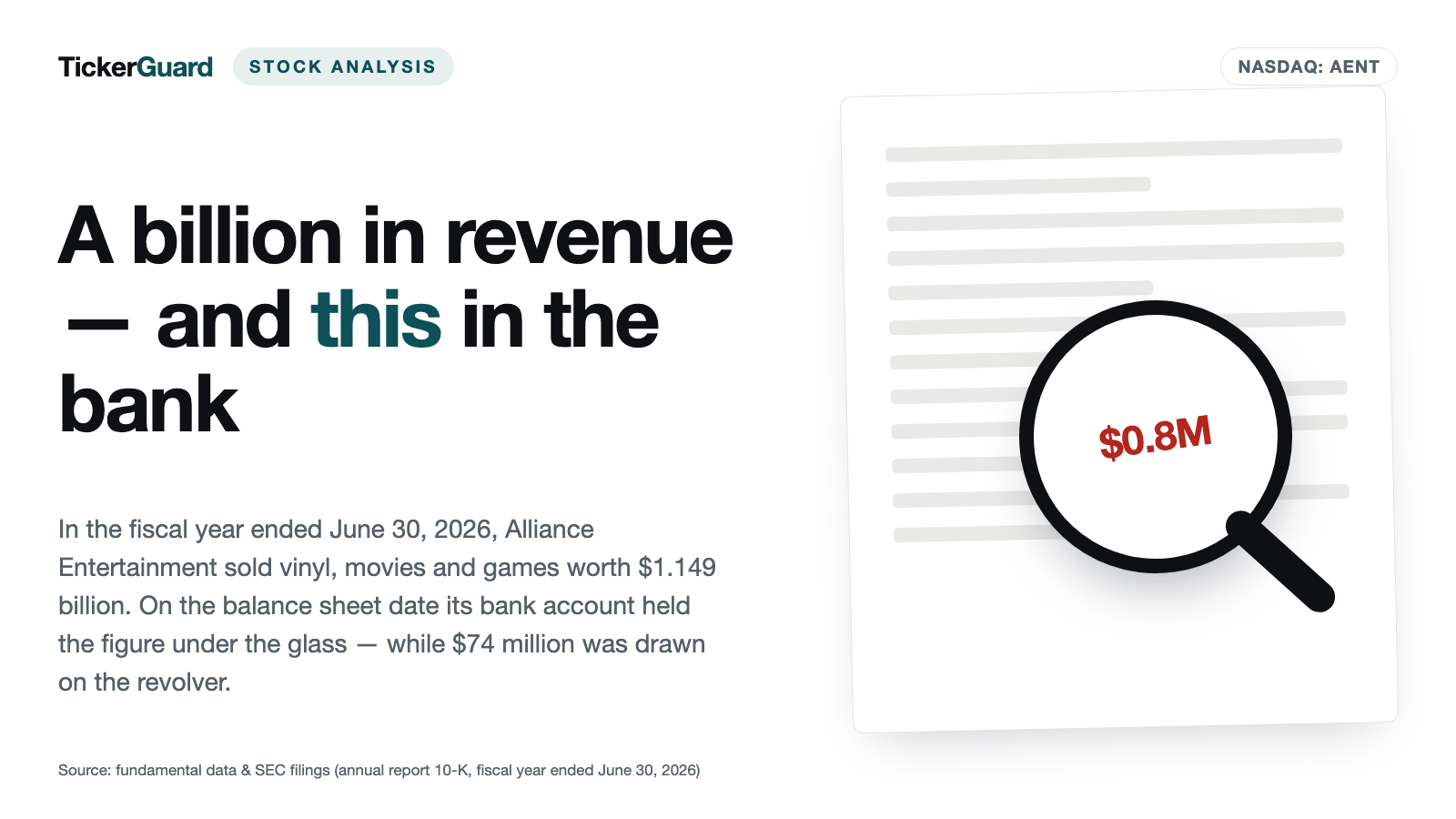
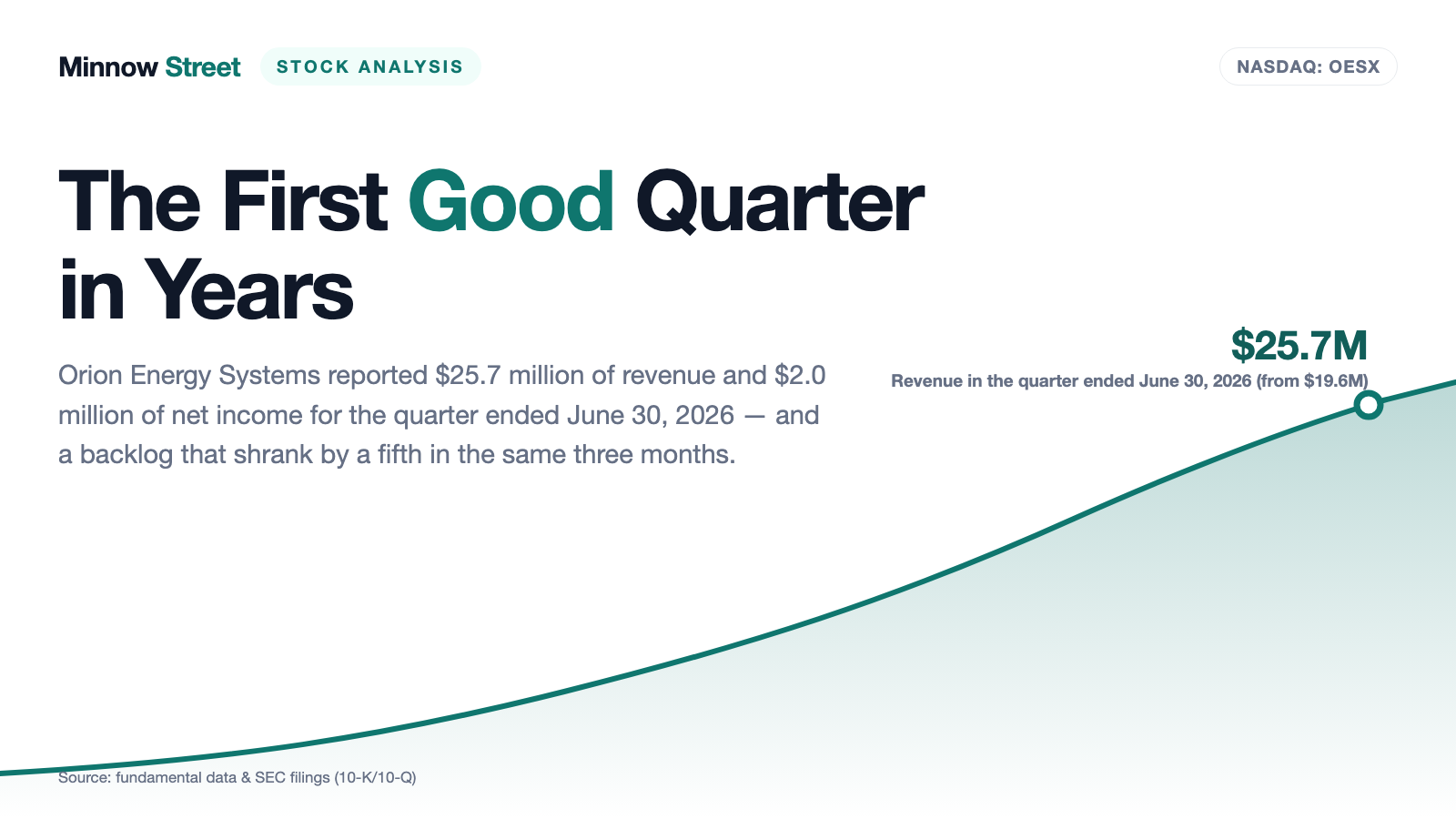
Orion Energy Systems, based in Manitowoc, Wisconsin, builds LED lighting, services lighting systems, and installs EV charging stations. In the quarter ended June 30, 2026, everything finally came together: $25.7 million in revenue (up 31.5 percent), a 34.6 percent gross margin, and $2.0 million in profit after a $1.2 million loss in the year-ago quarter. The filings with the U.S. securities regulator, the SEC, name three numbers in the same breath that sound far less good: backlog fell from $30.1 million to $23.7 million, a single customer accounted for 38.1 percent of revenue, and the share count has risen from 3.30 million to 4.09 million since March 31, 2025 — after a 1-for-10 reverse split that saved the listing in August 2025. Not investment advice — just the question of what is left of a record quarter once you set the backlog beside it.
 Thomas Mücke
Founder & Publisher
Thomas Mücke
Founder & Publisher
As of Today
As of: September 23, 2026
- Closing price
- 28.40 $ -2.10%
- Market Capitalisation
- 0.1 $B
- Growth Score
- 2/10
- AAQS
- 4/10
This analysis has a cut-off date. The Stock Guard tells you when something material changes in the numbers. Reserve your free spot
Chart
Interactive price chart (TradingView).
52-week range: 8.00 $ to 30.50 $ · Last price: 28.40 $ (As of: September 23, 2026)
Note: pure fact-based analysis, not investment advice and not a solicitation to buy or sell. All figures without guarantee.
There is an investor trap that needs no fraud to work reliably — call it the fresh-paint trap. It goes like this: a company combines its shares, ten old ones become one new one. Overnight the price goes from $1.20 to $12, the chart in your brokerage app draws the past cleanly, the penny-stock look is gone. Not a single brick has moved, but the facade is freshly painted. And when a genuinely good quarter follows, your mind fills in the rest on its own: "Something new is starting here." Orion Energy Systems (NASDAQ: OESX) of Manitowoc, Wisconsin is exactly this case. On August 22, 2025, the company combined its shares 1-for-10 to regain compliance with Nasdaq's minimum bid price rule. Not quite a year later, on August 5, 2026, it reported its best quarter in years: $25.7 million in revenue, up 31.5 percent, and $2.0 million in profit after a $1.2 million loss in the year-ago quarter. So let's make a deal: before you mistake the fresh coat of paint for a new house, let's read together what Orion itself reported to the U.S. securities regulator, the SEC — the quarterly report (10-Q) as of June 30, 2026, the annual report (10-K) for fiscal 2026, and the Form 8-K filings in between. An SEC filing is honest under penalty of law. And this one describes real operating progress — and a backlog that shrank by a fifth in that very record quarter. In the end, the decision is yours.
What Orion Energy Systems actually does — lighting, maintenance, charging stations
Orion Energy Systems is not a technology conglomerate; it's a trade and project business with its own factory. Picture it this way: imagine a big-box retail chain with 300 stores still lit by old fluorescent tubes. Orion surveys the buildings, designs the new lighting, builds some of the fixtures itself in Manitowoc, sends out installers, swaps out the system, handles rebate applications with the utility — and then services the system for years afterward. The industry calls this a "retrofit": upgrading an existing building rather than building new.
The business rests on three legs the company has reported as separate segments for years. The Lighting segment is by far the largest: LED fixtures, wireless networked controls, design and turnkey execution for large retail chains, government agencies, schools and military bases — in the quarter ended June 30, 2026, $17.667 million of the $25.743 million in revenue came from this segment. The Maintenance segment ($4.096 million) repairs and replaces lighting and electrical equipment in other companies' buildings, often under multi-year contracts. The EV segment ($3.980 million), created through the 2022 acquisition of Voltrek, designs and installs EV charging stations, including the grid connection. Fiscal 2026 also added electrical installation and battery storage as new service lines.
Two ground rules matter here, or you'll misread every annual figure. First: the fiscal year ends March 31. "Fiscal 2026" ran from April 1, 2025 through March 31, 2026, and the current "fiscal 2027" ends March 31, 2027 — comparing Orion to a calendar-year company means comparing shifted time periods. Second: there is almost no recurring revenue. The annual report says so plainly:
"Other than our multi-year maintenance service contracts, we generally do not have long-term contracts with our customers for product or turnkey services that provide us with recurring annual revenue."
— Orion Energy Systems, Inc., SEC annual report 10-K for fiscal 2026, Item 1 Business
That names the central tension of this analysis, and it runs through every chapter that follows: Orion earns its money project by project. A good quarter proves the company can deliver — not that next quarter's work is already booked. There's a metric for exactly that question, and we'll get to it below.
How this stock reached our desk
Not through a momentum or value scanner, but through the U.S. securities regulator's event trail: on August 5, 2026, Orion filed a Form 8-K (Item 2.02) with its earnings release for the first quarter of fiscal 2027 — 32 percent revenue growth, a swing from loss to profit, the seventh straight quarter of positive adjusted EBITDA (earnings before interest, taxes, depreciation and amortization, a company-defined non-GAAP metric). Jumps like that at a company with under $100 million in annual revenue are rare enough to warrant a closer look.
What the numbers show is mixed and, frankly, hard to pin down — so here's the valuation up front instead of a bare figure. Market capitalization stood, as of the August 8, 2026 data date, in the range of $70 to $80 million against roughly $92.5 million in trailing-twelve-month revenue; that works out to a price-to-sales ratio of about 0.8 — for an industrial business with a thin margin, neither cheap nor expensive, just ordinary. Book value per share was around $4.60, so the stock traded well above book. The 52-week trading range ran from $5.60 to $19.93 (data as of August 8, 2026) — with only 4.09 million shares outstanding and roughly 3.4 million in free float, that is a very thin market where even small orders move the price. Two analyst firms cover the stock, both positive, with a price target of $22 (data as of August 8, 2026). Keep this early finding in mind: at Orion, the price isn't the problem — the question is how sustainable the earnings are.
The numbers over the years — given their due
First, what genuinely impresses. The quarter ended June 30, 2026 is not a dressed-up quarter — it's an honestly earned one. Revenue rose 31.5 percent to $25.743 million. Gross margin — what's left of every revenue dollar after materials, labor and installation — climbed from 30.1 to 34.6 percent. SG&A expenses fell 13.9 percent to $3.694 million. An operating loss of $1.013 million became operating income of $2.111 million; a $1.244 million net loss became net income of $1.959 million, or $0.48 per share ($0.47 diluted). And the profit was real cash: operating cash flow was plus $1.352 million, up from minus $0.515 million in the year-ago quarter. Higher revenue, better margin, lower costs, cash in the bank — that's the pattern of a genuine turnaround, not an accounting trick.
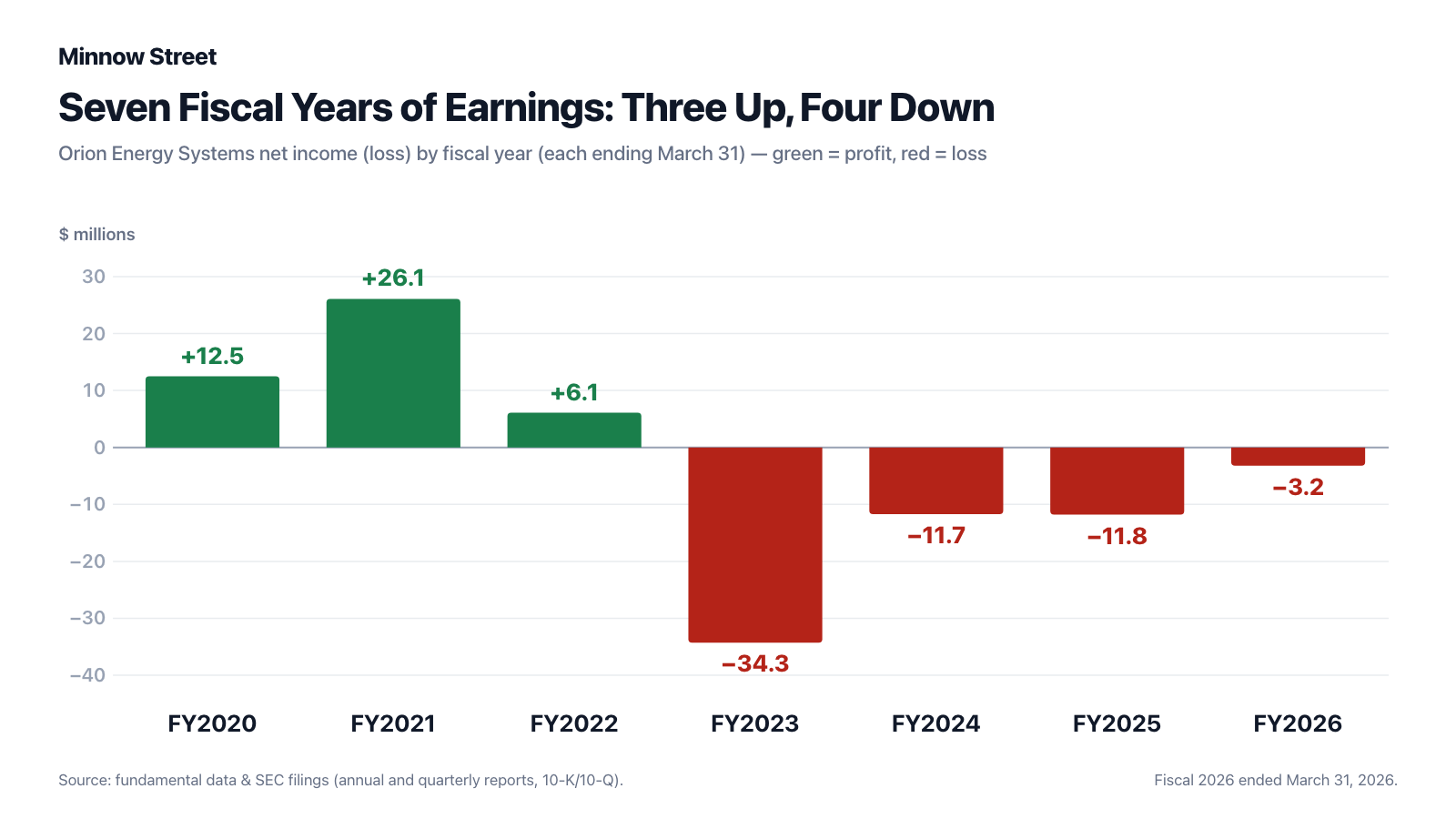
This curve says two things at once. First: the trend points up. The loss shrank from $34.3 million (FY2023) through $11.7 million and $11.8 million to just $3.2 million in FY2026 — and in the first quarter of FY2027 it turned into a profit. Second: this company has delivered three straight profitable years before (FY2020 through FY2022, $44.7 million combined) — and then lost $61.0 million over the following four years. Anyone who bought the 2022 turnaround story would have been sitting on a revenue decline from $124.4 million to $77.4 million by 2023. Remember the picture: at Orion, a good year is not proof, it's a snapshot. Revenue has swung accordingly: $150.8 million (FY2020), $116.8 million, $124.4 million, $77.4 million, $90.6 million, $79.7 million, and most recently $86.3 million in FY2026.
There's one more piece of context for the current quarter that the press release leaves out: the growth isn't broad, it's concentrated.
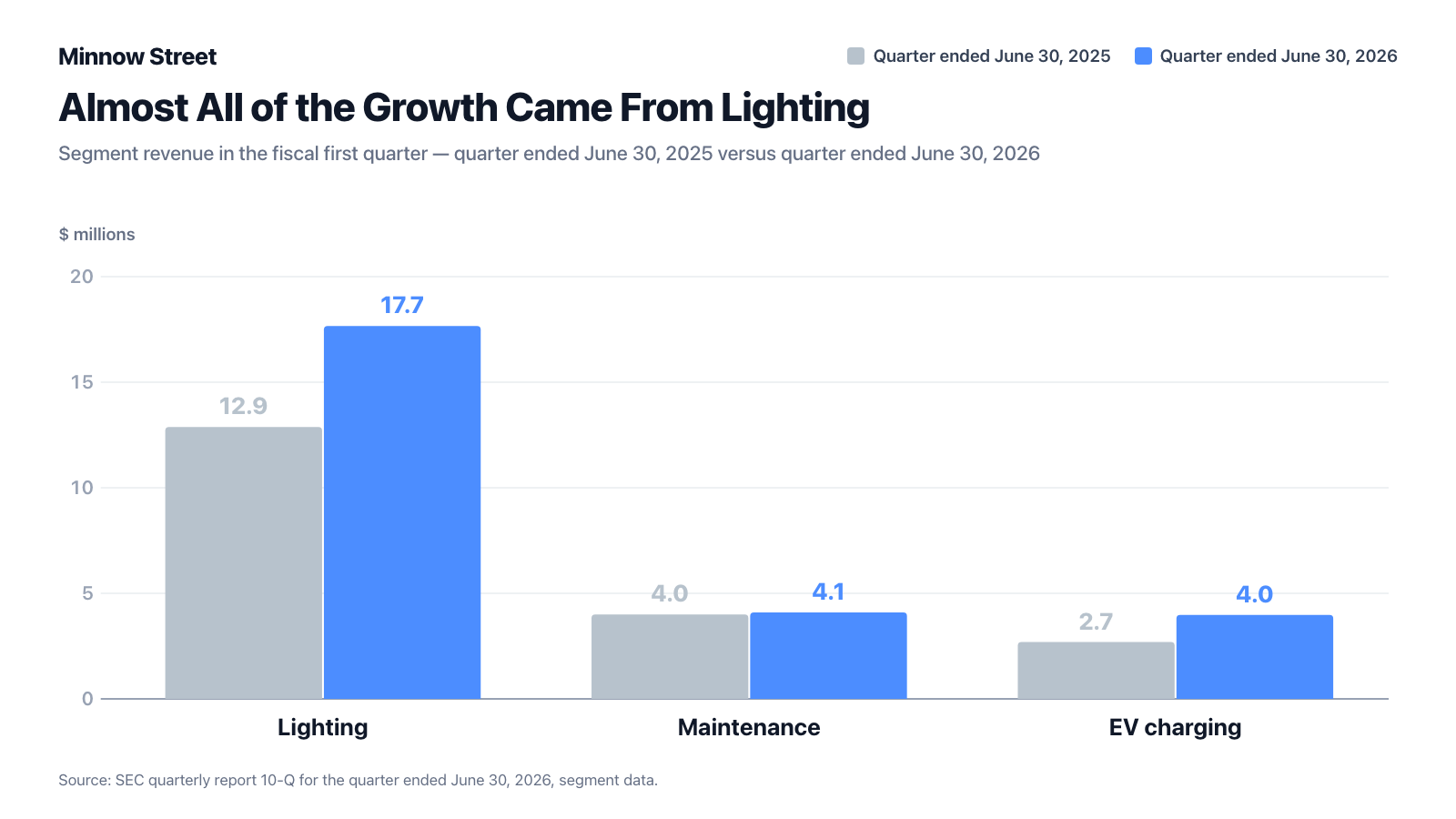
The Lighting segment delivered $4.8 million of the $6.2 million in additional revenue and turned its operating income from $0.235 million to $2.576 million — its operating margin jumped from 1.8 to 14.6 percent there. Maintenance grew only 2.5 percent ($4.096 million versus $3.997 million) but earned better ($0.447 million versus $0.128 million). The EV segment grew 47.6 percent to $3.980 million and, with $0.142 million, posted positive operating income again for the first time after a $0.322 million loss. In the company's own words, the jump came "primarily from additional turnkey projects." In plain English: from large orders. And large orders are exactly what makes one quarter shine — and the next one empty, if no new ones arrive.
What the filings say — the uncomfortable truths
Uncomfortable truth No. 1: the fresh coat of paint has a reason — the stock traded under a dollar for 30 days
Open Orion's chart today and you see a stock trading in the double digits. Open the filings and you see why. On September 20, 2024, Nasdaq notified the company that it had violated the minimum bid price rule: the closing price had stayed below $1.00 for 30 consecutive trading days. Orion got 180 days, until March 19, 2025, missed it, got another 180 days until September 15, 2025 — and then reached for the last tool available:
"Ultimately, in order to regain compliance with the Minimum Bid Price Rule, Orion effected a 1-for-10 reverse stock split of its common stock as of the opening of trading on August 22, 2025."
— Orion Energy Systems, Inc., SEC annual report 10-K for fiscal 2026, "Compliance with the Continued Listing Standards of the Nasdaq Capital Market"

What that meant arithmetically is spelled out in the Form 8-K of August 19, 2025: roughly 35.2 million shares outstanding became roughly 3.5 million, authorized capital fell in the same ratio from 200 million to 20 million shares, and fractional shares were paid out in cash. On September 8, 2025, Nasdaq confirmed compliance was regained. Important for context: a reverse split creates not a single dollar of value — it slices the same cake into fewer, bigger pieces. Someone who held ten shares at $1.20 each now holds one share at $12. What it does change is optics: the company disappears from the penny-stock screens, many institutional investors are allowed to buy again, and the chart of the past few years suddenly looks like a solid stock. That's legitimate, and it was the only alternative to being delisted. But it's the paint job, not the house.
Uncomfortable truth No. 2: one customer brings 38.1 percent of revenue
The second number sits in the footnotes of the quarterly report and is the single most important risk figure at the company:
"For the three months ended June 30, 2026, one customer accounted for 38.1% of total revenue. For the three months ended June 30, 2025, one customer accounted for 30.2% of total revenue."
— Orion Energy Systems, Inc., SEC quarterly report 10-Q as of 06/30/2026, Note 2 "Concentration of Credit Risk and Other Risks and Uncertainties"

Measured across fiscal years, the same customer's share swings substantially: 25.6 percent of revenue in FY2024, 18.1 percent in FY2025, 26.0 percent in FY2026. That swing is the real story — it shows the company has already lived through this one big customer's ups and downs before, and the FY2025 downturn (revenue $79.7 million, loss $11.8 million) falls exactly in the year with the lowest share. The company says so explicitly in its own risk factors: the decline at its largest customer over multiple fiscal years has already had a material adverse effect. In everyday terms: Orion is a trade business where a single client pays close to four out of every ten invoices. As long as that client keeps building, business is thriving. If that client pauses for a year, nearly half of revenue disappears — and because the factory, administration and sales team keep running, that hits the bottom line almost unfiltered. That's exactly what happened between fiscal 2022 and fiscal 2023.
Uncomfortable truth No. 3: backlog fell by a fifth in the record quarter
And now the number this article exists to write about. Backlog — the sum of firm, binding orders still to be completed — is the best forward-looking view available in a project business. It doesn't appear in the press release; it's in the quarterly report:
"Backlog totaled $23.7 million and $30.1 million as of June 30, 2026 and March 31, 2026, respectively. We generally expect our backlog to be recognized as revenue within one year. Backlog does not include any amounts for contracted maintenance services."
— Orion Energy Systems, Inc., SEC quarterly report 10-Q as of 06/30/2026, Item 2 MD&A, "Backlog" section

Let's do the math, on the right basis. In the same report, Orion confirmed its own annual guidance: $95 to $97 million in revenue for fiscal 2027 with positive adjusted EBITDA. $25.7 million of the first quarter is already done, leaving roughly $70 million for the remaining nine months. Against that stands $23.7 million of firm backlog plus maintenance contracts, which aren't counted in backlog and recently brought in roughly $4.1 million per quarter — call it $12 million for nine months. Together, that's about $36 million. Roughly half of the annual guidance, then, has to come from orders that hadn't been signed as of June 30, 2026. That isn't automatically alarming in a project business — Orion wins and delivers short-lead retrofits continuously, and backlog is not a revenue plan. But it explains why the guidance isn't a given, and it makes one line in the next quarterly report the most important line in the whole document. Remember the sentence: in a project business, revenue measures the past; backlog measures the future.
Uncomfortable truth No. 4: new shares 19 percent below the market price — and a compensation pool over 22 percent of the company
The reverse split cut the share count by a factor of ten overnight — but it has been climbing back up ever since. As of March 31, 2025, 3,298,389 shares were outstanding; by March 31, 2026, already 4,056,528; by August 4, 2026, 4,089,286 shares. That's a rise of roughly 24 percent in 16 months. The largest single item was a capital raise in early February 2026:
"We are offering 500,000 shares of our common stock, no par value per share (the "Common Stock"). The purchase price of each share of Common Stock is $14.00 per share. … The last reported sale price of our Common Stock on the NASDAQ Capital Market on January 28, 2026 was $17.27 per share."
— Orion Energy Systems, Inc., SEC Form 424B5 prospectus supplement of February 2, 2026

$14.00 versus $17.27 — that's a 19 percent discount to the last reported price. Existing shareholders pay that discount in the form of dilution; in plain terms, your slice of the pie gets smaller because new guests were seated more cheaply at the table. To be fair: the company needed the cash — its balance had fallen to $3.265 million as of March 31, 2026 — and the offering was capped at a third of public float value under the rules for small issuers anyway (roughly $20.8 million against a public float of $62.4 million).
Then there's a second item decided three days after the record quarter. At the annual meeting on August 6, 2026, shareholders approved expanding the equity compensation plan: the shares available under it rose from 600,000 to 900,000, and the term was extended by ten years. Against 4,089,286 shares outstanding, 900,000 shares are roughly 22 percent of the company that can be issued over the years to employees, executives and directors; total authorized capital is only 20 million shares. For context: 82 percent of votes cast were in favor, and equity-based pay is common at small U.S. companies because it conserves cash. But the direction is notable — a company that had to combine its shares by a factor of ten the year before just to stay listed is now setting aside a compensation pool worth a fifth of the company again.
Valuation: not expensive, but no safety net either
How expensive is Orion? A trailing price-to-earnings ratio can't be built meaningfully for the past twelve months — fiscal 2026 ended with a $3.2 million loss, and annualizing one profitable quarter in a project business with wildly swinging quarters is exactly the mistake this article is warning against. The more honest yardstick is the price-to-sales ratio: about 0.8, against a market cap in the $70 to $80 million range and $92.5 million in trailing-twelve-month revenue (data as of August 8, 2026). For an industrial services company with roughly 34 percent gross margin and a single-digit operating margin, that is an ordinary valuation, not an ambitious one.
Two dated anchors help here, and both sit below today's price: the company itself sold new shares at $14.00 in early February 2026, and book value per share was recently around $4.60 — the stock trades at a clear premium to its book equity of $18.746 million (June 30, 2026). That's not unusual for a services company without a large asset base, but it also means there is no cushion of underlying assets to absorb a setback. Buying here means buying the earnings power of the next few years, not today's balance sheet. A similar picture applies to another small energy-sector company whose turnaround was real yet still came with an asterisk — see our FuelCell Energy analysis. And for a look at what it looks like when an energy-transition story never gets its cost side under control, see our Eos Energy analysis.
Opportunities and risks at a glance
What speaks for Orion Energy Systems:
- The turnaround is documented in the numbers, not just the story: revenue up 31.5 percent to $25.743 million, gross margin from 30.1 to 34.6 percent, operating income from minus $1.013 million to plus $2.111 million, operating cash flow from minus $0.515 million to plus $1.352 million (quarter ended June 30, 2026).
- The loss trend has narrowed for four straight years: minus $34.3 million (FY2023), minus $11.7 million, minus $11.8 million, minus $3.2 million (FY2026) — and shareholders' equity has risen again for the first time in years, from $11.884 million (March 31, 2025) through $16.628 million to $18.746 million (June 30, 2026).
- Financing has gotten easier: the $25 million credit line was extended in May 2026 through June 30, 2030, of which only $3.0 million was drawn as of June 30, 2026 against a borrowing base of roughly $15.8 million; the company reports net liquidity of $18.1 million, up from $9.8 million a year earlier.
- Three legs instead of one: Lighting, Maintenance and EV Charging all earned operating profit in the quarter ended June 30, 2026 ($2.576 / $0.447 / $0.142 million) — a year earlier, the EV segment was still $0.322 million in the red.
- New growth areas with tailwind: for the first quarter of fiscal 2027, Orion cites a multi-million-dollar order from a very large data center operator as its entry into that market, plus new products in street lighting, battery storage and electrical installation; its own manufacturing in Wisconsin helps with bids carrying "Buy American" requirements.
What speaks against it:
- Backlog fell in the record quarter from $30.1 million to $23.7 million (down 21 percent) — roughly half of the confirmed $95 to $97 million annual guidance has to come from orders that hadn't been awarded as of June 30, 2026.
- Customer concentration risk: 38.1 percent of quarterly revenue and 30.9 percent of receivables came from a single customer as of June 30, 2026; across fiscal years that share has swung between 18.1 and 26.0 percent, and the company says the decline at this customer has already had a material adverse effect.
- No proof of durability: across seven fiscal years, three profitable years stand against four loss years; after three profitable years (2020 through 2022, $44.7 million combined) came four loss years totaling $61.0 million. The cumulative accumulated deficit is $116.097 million (June 30, 2026).
- Dilution: the share count rose from 3,298,389 (March 31, 2025) to 4,089,286 (August 4, 2026), including 500,000 new shares at $14.00 against a last reported price of $17.27; the equity compensation plan was expanded on August 6, 2026 from 600,000 to 900,000 shares — roughly 22 percent of shares outstanding.
- Thin market and outside dependencies: only around 3.4 million shares in free float, and the company itself names tariffs, fading government incentives for charging infrastructure, pricing pressure from foreign competitors and an ongoing ERP system migration as risks.
A human conclusion
Back to the fresh-paint trap from the start. Its point isn't that the paint job is bad — under Orion's paint, considerably more is in order than you'd expect after an emergency reverse split. Margin is rising under its own power, costs have fallen, all three segments earn money, equity is growing again, and the bank extended the credit line through 2030. That's not a facade, that's real work. Its point is something else: a fresh coat of paint and a shining quarter both answer the same question — is next year's work already booked? — with silence. And on that exact question, Orion itself gives an uncomfortable answer, tucked into the footnotes: $23.7 million of backlog, down from $30.1 million three months earlier.
The honest question for you, then, isn't "is the turnaround real?" — it is, for this one quarter, and that's documented. It's this: would you lend money to a trade business that just reported its best quarter ever, where one customer pays four out of every ten invoices, and whose order book got a fifth thinner in that very same quarter? If you trust this company to refill its order book, you have a thesis — and then the next line you're waiting for isn't revenue, it's backlog in the quarterly report for the period ended September 30, 2026. If not, you had a fresh coat of paint. What you make of that is your decision. And that's exactly as it should be.
Sources
Every original document used in this analysis — for you to read yourself:
- Orion Energy Systems, Inc. — SEC quarterly report 10-Q as of 06/30/2026 (filed August 5, 2026)
- Orion Energy Systems, Inc. — SEC annual report 10-K for fiscal 2026 (filed June 4, 2026)
- Orion Energy Systems, Inc. — SEC Form 8-K of 08/05/2026, Exhibit 99.1 (first-quarter fiscal 2027 earnings release)
- Orion Energy Systems, Inc. — SEC Form 8-K of 08/19/2025 (1-for-10 reverse stock split)
- Orion Energy Systems, Inc. — SEC Form 8-K of 09/08/2025 (regained compliance with the Nasdaq minimum bid price rule)
- Orion Energy Systems, Inc. — SEC Form 8-K of 03/20/2026 (Voltrek settlement, unwinding of the solar power purchase agreements)
- Orion Energy Systems, Inc. — SEC Form 8-K of 08/07/2026 (annual meeting of 08/06/2026, expansion of the equity compensation plan)
- Orion Energy Systems, Inc. — SEC Form 424B5 prospectus supplement of 02/02/2026 (500,000 shares at $14.00)
- Full SEC filing history of Orion Energy Systems, Inc.: EDGAR overview (sec.gov)
- Fundamental data (valuation, share count, trading range, analyst estimates; data as of August 8, 2026), reconciled with the SEC filings and the SEC's XBRL data series.
Transparency & disclaimer: this analysis is journalistic commentary on publicly available information. It is not investment advice, not a regulated financial analysis, and not a solicitation to buy or sell securities. Equity investments carry substantial risk up to and including total loss. All information without warranty; the as-of date of each figure is stated in the text. Positions held by the operator are disclosed daily; where one exists, it appears as a notice at the top of this deep dive.
Key figures at a glance
All monetary figures in millions of $; earnings per share as reported.
| Metric | 2022 | 2023 | 2024 | 2025 | 2026 |
|---|---|---|---|---|---|
| Revenue | 124.4 | 77.4 | 90.6 | 79.7 | 86.3 |
| Operating Income (EBIT) | 8.4 | -16.0 | -10.8 | -10.6 | -1.6 |
| Net Income | 6.1 | -34.3 | -11.7 | -11.8 | -3.2 |
| Net Margin | 4.9% | -44.4% | -12.9% | -14.8% | -3.7% |
| Earnings Per Share | 1.95 $ | -10.83 $ | -3.59 $ | -3.59 $ | -0.89 $ |
Source: fundamental data & SEC filings (annual and quarterly reports, 10-K/10-Q)
Our Bottom Line at a Glance
- Operating turnaround positive
- The quarter ended June 30, 2026 is honestly earned: revenue up 31.5 percent to $25.743 million, gross margin from 30.1 to 34.6 percent, SG&A down 13.9 percent, operating income from minus $1.013 million to plus $2.111 million, and operating cash flow of plus $1.352 million after minus $0.515 million. All three segments earned operating profit.
- Order backlog negative
- In the same quarter, backlog fell from $30.1 million (03/31/2026) to $23.7 million (06/30/2026), a drop of 21 percent. Against the confirmed fiscal 2027 guidance of $95 to $97 million, roughly half of annual revenue has to come from orders that hadn't been awarded as of the balance-sheet date.
- Customer structure negative
- One customer accounted for 38.1 percent of revenue in the quarter ended June 30, 2026 (year-ago quarter: 30.2 percent) and 30.9 percent of receivables. Across fiscal years 2024 through 2026, the same customer's share swung between 18.1 and 26.0 percent — the FY2025 downturn fell exactly in the year with the lowest share. Other than maintenance contracts, there is no recurring revenue.
- Balance sheet & financing neutral
- Shareholders' equity has risen for the first time in years — from $11.884 million (03/31/2025) through $16.628 million to $18.746 million (06/30/2026) — and the $25 million credit line, extended in May 2026, runs through June 30, 2030 and was only lightly drawn at $3.0 million. Against that stand just $5.165 million of cash and a $116.097 million accumulated deficit.
- Share count & dilution negative
- After the 1-for-10 reverse split of August 22, 2025, the share count climbed back from 3,298,389 (03/31/2025) to 4,089,286 (08/04/2026), including 500,000 new shares at $14.00 against a last reported price of $17.27 (01/28/2026). On August 6, 2026, shareholders expanded the equity compensation plan from 600,000 to 900,000 shares — roughly 22 percent of shares outstanding.
- Track record over the years negative
- Across seven fiscal years, three profitable years (2020 through 2022, $44.7 million combined) stand against four loss years (2023 through 2026, $61.0 million combined). Revenue swung between $150.8 million and $77.4 million. A single good quarter, in this record, is no proof of a lasting turnaround.
Orion Energy Systems delivered in the quarter ended June 30, 2026: $25.743 million in revenue (up 31.5 percent), 34.6 percent gross margin, $1.959 million in profit and $1.352 million in operating cash flow — all three segments positive, shareholders' equity rising for two consecutive periods. But the same report shows backlog falling from $30.1 million to $23.7 million, one customer bringing in 38.1 percent of revenue, and the share count climbing back to 4,089,286 despite the 1-for-10 reverse split of August 2025. The turnaround is documented for this quarter; its continuation is not. Not investment advice.
What Our Rating Means
Open questions
The business works in principle, but one material question is open. As long as it stays open, our findings do not carry a quality verdict.
Yellow, because one material operating question is open — not because of price. The substance holds up: $18.746 million in shareholders' equity as of June 30, 2026, only $3.0 million of a $25 million credit line drawn (term through 06/30/2030), positive operating cash flow, no going-concern signal, and Nasdaq compliance regained since September 8, 2025. What's open is earning power beyond this one quarter: across seven fiscal years, three profitable years stand against four loss years, one customer brings in 38.1 percent of revenue, and backlog fell — in the record quarter, of all quarters — from $30.1 million to $23.7 million. Anyone investing is betting the order book refills — verifiable against exactly one line in the quarterly report for the period ended September 30, 2026. The decision is yours.
A journalistic assessment by our editorial team at the time of the deep dive, based on public sources — not investment advice and not a solicitation to buy or sell. Your personal circumstances (investment goals, risk capacity, taxes) cannot be taken into account. What our levels mean, how verdicts are formed, and what conflicts of interest exist →
Worth Noting
- Orion Energy Systems reached our research list through the U.S. securities regulator's event trail: the Form 8-K (Item 2.02) of August 5, 2026, with the earnings release for the first quarter of fiscal 2027. Every filing dated on or after that day was reviewed (Form 8-K of 08/05 and 08/07/2026, Form S-8 of 08/07/2026); there is no Form 15 and no Form 25.
- The fiscal year ends March 31. "Fiscal 2026" covers April 1, 2025 through March 31, 2026; the first quarter of fiscal 2027 covers April through June 2026. Comparing Orion to calendar-year companies means comparing shifted time periods.
- All share and price figures refer to the period after the 1-for-10 reverse split effective August 22, 2025; older, pre-split prices aren't directly comparable. Valuation figures carry the data date of August 8, 2026 and are orders of magnitude, not buy arguments — this analysis is deliberately evergreen.
Stock Watch
This analysis is as of August 26, 2026. Stock Watch will tell you what's changed at OESX since then.
Later $1 a month per stock — signing up is free, and you'll be the first to know when it launches.
The full analysis as a PDF for later
We will send you this analysis as a PDF — to print, file away, and read at your own pace. And we will add you to the free Stock Watch list for Orion Energy Systems Inc (OESX), so you hear about it when something material in this analysis changes.
Frequently Asked Questions
Orion Energy Systems, Inc. (NASDAQ: OESX), based in Manitowoc, Wisconsin, retrofits buildings with LED lighting, services lighting and electrical systems, and installs turnkey EV charging infrastructure. The company designs, manufactures some of its own fixtures, installs, and then maintains. Customers include large retail chains, government agencies, schools and U.S. military bases. As of March 31, 2026, Orion had 174 full-time employees.
To stay listed on Nasdaq. On September 20, 2024, the exchange notified the company that its closing price had stayed below $1.00 for 30 consecutive trading days, violating the minimum bid price rule. After two deadline extensions to September 15, 2025, Orion combined its shares 1-for-10 on August 22, 2025: roughly 35.2 million shares became roughly 3.5 million. On September 8, 2025, Nasdaq confirmed compliance was regained. A reverse split like this creates no value.
In the quarter ended June 30, 2026, revenue rose 31.5 percent to $25.743 million, and gross margin climbed from 30.1 to 34.6 percent. Operating income swung from minus $1.013 million to plus $2.111 million, and net income was $1.959 million versus a $1.244 million loss in the year-ago quarter. Operating cash flow was plus $1.352 million. Growth came almost entirely from the Lighting segment, $4.8 million of the $6.2 million total.
Backlog covers firm, binding orders and is the best forward-looking view available in a project business. It fell from $30.1 million as of March 31, 2026 to $23.7 million as of June 30, 2026, a drop of 21 percent. Maintenance contracts are not included. Against the confirmed fiscal 2027 guidance of $95 to $97 million, that means roughly half of annual revenue has to come from orders that hadn't been awarded as of the balance-sheet date.
Very, with a sharply fluctuating share. In the quarter ended June 30, 2026, one customer accounted for 38.1 percent of revenue (year-ago quarter: 30.2 percent) and 30.9 percent of receivables as of the balance-sheet date. Across full fiscal years, the same customer stood at 25.6 percent (2024), 18.1 percent (2025) and 26.0 percent (2026). Other than multi-year maintenance contracts, the annual report says there are no contracts securing recurring annual revenue.
March 31. "Fiscal 2026" ran from April 1, 2025 through March 31, 2026 and brought in $86.3 million in revenue against a $3.2 million loss. The current "fiscal 2027" began April 1, 2026 and ends March 31, 2027; its first quarter covers April through June 2026. Comparing Orion to a calendar-year company means comparing time periods that are shifted against each other.
A trailing price-to-earnings ratio can't be built meaningfully, because fiscal 2026 ended with a $3.2 million loss. Measured against revenue, the valuation is unremarkable: about 0.8 on a market cap in the $70 to $80 million range and $92.5 million in trailing-twelve-month revenue (data as of August 8, 2026). Book value per share was around $4.60, and the company's own capital raise in early February 2026 priced shares at $14.00 — so there's no cushion of underlying assets.
As of June 30, 2026, $5.165 million of cash stood against $53.303 million in total assets and $18.746 million of shareholders' equity. The $25 million credit line was extended in May 2026 through June 30, 2030; $3.0 million was drawn, against a borrowing base of roughly $15.8 million. A minimum coverage ratio only applies once the available line drops below $4.0 million — it hadn't, as of the balance-sheet date. The company says its resources are sufficient for at least the next twelve months.
Found an error?
Did you spot a factual error, an outdated number, or a typo in this deep dive? Let us know briefly — your report goes straight to the editorial team.