Opera: The Browser You Remember Now Sells Ads — And a Quarter of Its Balance Sheet Cannot Be Bought
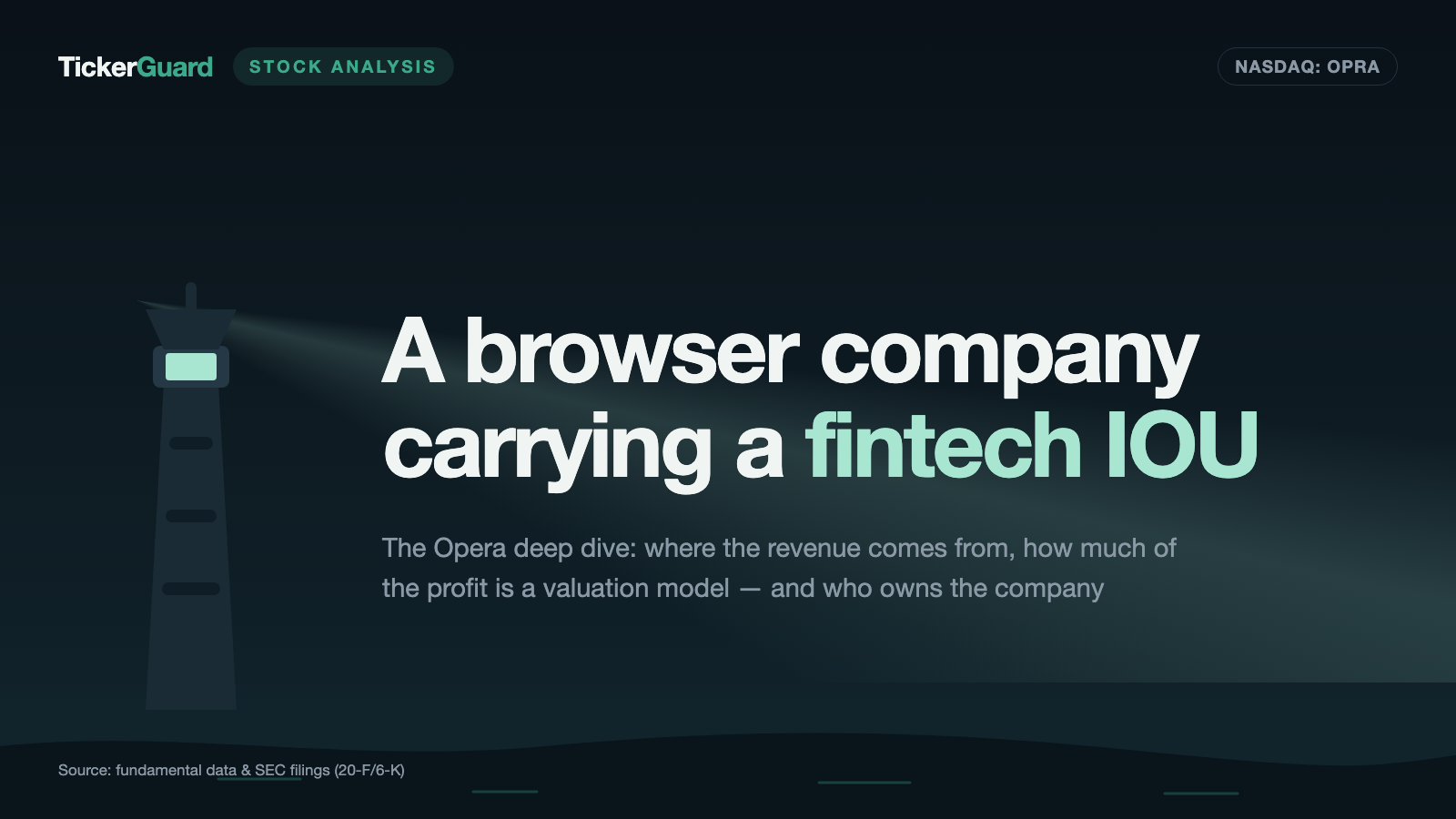
For most investors the memory of Opera Limited (Nasdaq: OPRA) stops around 2008: the browser you tried once. The filings with the U.S. securities regulator, the SEC, tell a different story. Revenue reached $353.8 million in the first half of 2026, up 24 percent year over year, and 65 percent of it came from advertising rather than from the browser itself. On the asset side sits a 9.5 percent stake in the Nigerian fintech OPay carried at $300.9 million — valued not by a market but by a model whose scenarios span $0.2 billion to $6.0 billion. And 68.0 percent of the shares belong to a Chinese parent. This analysis swaps the memory for the balance sheet.
 Thomas Mücke
Founder & Publisher
Thomas Mücke
Founder & Publisher
As of Today
As of: October 5, 2026
- Closing price
- 17.70 $ +0.10%
- Market Capitalisation
- 1.6 $B
- P/E
- 12.8
- Growth Score
- 6/10
- AAQS
- 6/10
Price change since August 21, 2026: -6.6%
This analysis has a cut-off date. The Stock Guard tells you when something material changes in the numbers. Reserve your free spot
Chart
Interactive price chart (TradingView).
52-week range: 11.80 $ to 20.50 $ · Last price: 17.70 $ (As of: October 5, 2026)
Note: pure fact-based analysis, not investment advice and not a solicitation to buy or sell. All figures without guarantee.
There is an investor weakness that needs no chart to do damage: we price a company at the moment we last thought about it. Call it the memory discount. With Opera the memory usually reads: “that browser I tried once and never opened again.” The sentence is even true — Opera has been building browsers since 1995. It just no longer describes how the company earns its living.
The discount cuts both ways. Sometimes you never look, because the memory smells of 2008. Sometimes you overpay, because the memory glows. Either way it substitutes for reading the numbers — and the numbers are the only thing that has verifiably changed since 2008.
The deal for this piece: no recommendation, no price target. Only what Opera itself filed with the U.S. securities regulator, the SEC, every figure carrying its own date. The central tension running through each chapter is this: what the name promises versus what the balance sheet shows. The name says browser. The balance sheet as of June 30, 2026 shows an asset of $300.9 million that is neither browser nor advertising: a 9.5 percent stake in a Nigerian payments company that no exchange prices.
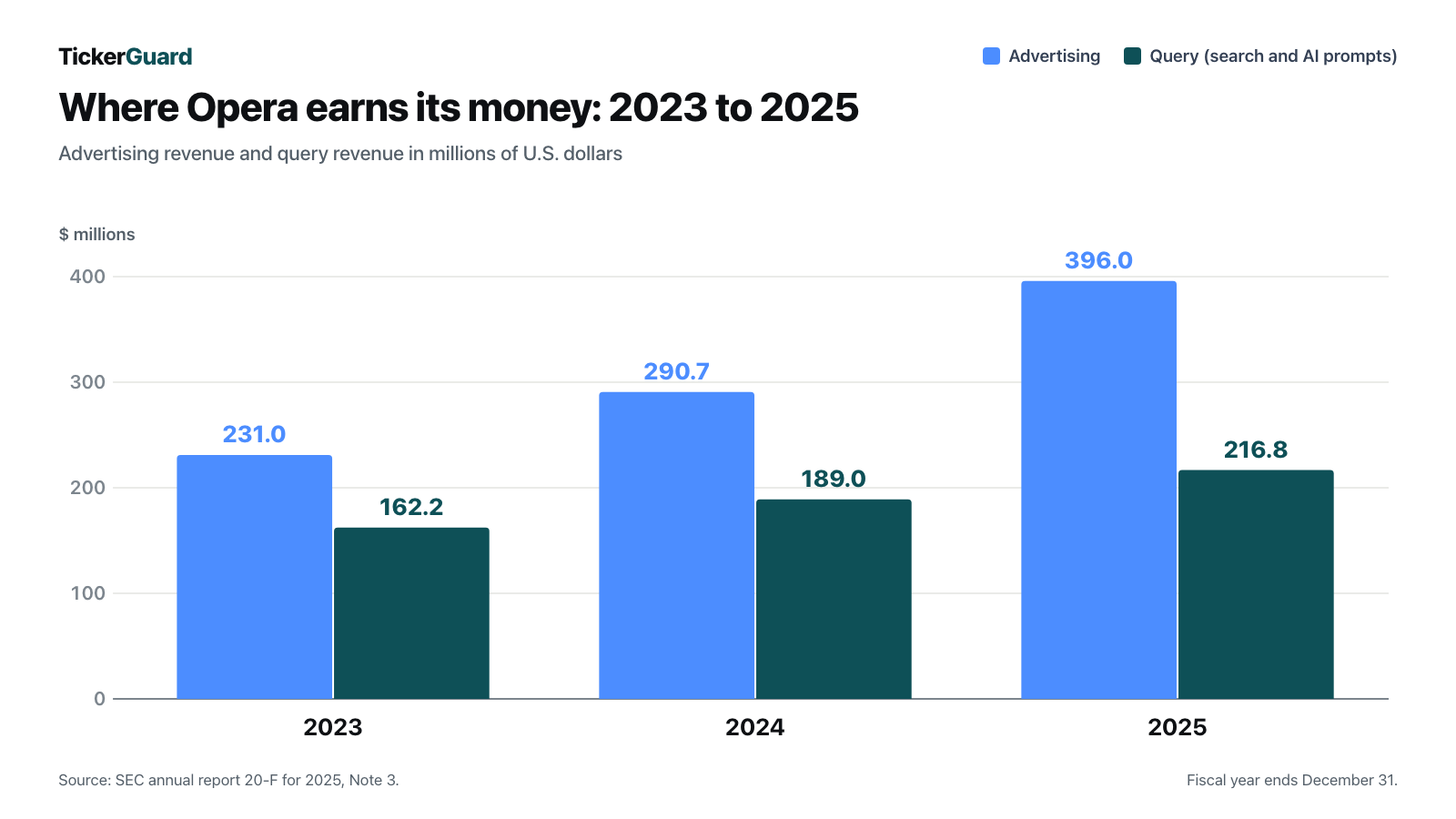
What Opera actually does — build browsers, sell ads, route queries
Opera builds browsers, gives them away and earns money from what people do with them. That is the whole trick, and it splits into two buckets.
Advertising is the larger one: $396.0 million in 2025, or 64 percent of total revenue of $614.8 million. It covers ad slots inside Opera’s own browsers — the tiles on the start page, promoted items in the news feed — and Opera Ads, the company’s own platform, through which Opera also sells ad space belonging to other publishers. Hold on to that second part; it returns later. What Opera sells there, it has to buy first.
Query revenue is the smaller bucket: $216.8 million in 2025, or 35 percent. The label is new; this used to be called search revenue. The mechanics: type something into the address bar, land on a result through a partner, and Opera receives a share of what that partner earns. The 20-F for 2025 puts it this way:
“Query revenue is generated from traffic referral arrangements with search engine providers, e-commerce platforms, AI platforms and other partners, and is earned when users submit qualifying queries or access partner services through our integrated browser features.”
— Opera Limited, SEC annual report on Form 20-F for 2025, Note 3
The browser family is broader than the old memory suggests: Opera One as the flagship, Opera GX for gamers (37 million monthly active users in the second quarter of 2026), Opera Mini for markets where mobile data is expensive, Opera Air with focus features, and since late 2025 Opera Neon — a paid subscription browser that carries out tasks on the web by itself. The annual report calls it a “premium, subscription-based agentic AI browser.” Alongside sits MiniPay, a crypto wallet for emerging markets that reached 18 million cumulative activated wallets by June 2026, up 121 percent year over year.
Across all products Opera counted 288 million monthly active users in the second quarter of 2026. Annualized average revenue per user stood at $2.46, up 25 percent from a year earlier. That is the real story of recent years: the user base has not grown, the revenue per user has. Between the first quarter of 2024 and the fourth quarter of 2025, total monthly active users fell from 303.6 million to 284.3 million according to the annual report, largely because feature phones are disappearing (45.4 million down to 30.7 million). In 2026 the curve turned back up, to 288 million.
One word about domicile, because it matters later: Opera Limited is a Cayman Islands company run from Oslo and listed on Nasdaq, which makes it a foreign private issuer in the eyes of the SEC. Such companies file no annual report on Form 10-K and no quarterly reports on Form 10-Q. They file an annual report on Form 20-F and interim reports on Form 6-K. If you are looking for an Opera 10-Q, you will not find one.
Company history for investors
-
2018
Nasdaq listing
American Depositary Shares have traded under the ticker OPRA since 27.07.2018. For investors that meant access to a browser business whose majority never sat on the exchange.
-
2023
A model gain outstrips operating profit
A fair value gain of $89.8m lifted net income to $153.3m against $62.9m of operating profit. Anyone computing an earnings multiple back then was computing with paper money.
-
2023
Dividend program begins
Opera has paid twice a year since 2023. For shareholders a pure growth name turned into one that hands back part of its earnings directly.
-
2025
Lin Song becomes sole CEO
The co-CEO arrangement ended on 10.10.2025. Operating responsibility has since rested with one person, while the chairmanship stays within the majority owner’s orbit.
-
2025
Opera Neon turns AI into a paid product
Late 2025 brought a paid subscription browser that carries out tasks on its own. For investors it is the first revenue stream that does not depend on advertising partners.
-
2026
A $300 million repurchase program
Authorized on 26.02.2026 for two years. Shares are bought on the exchange and, pro rata, from the majority shareholder — whose stake therefore stays intact.
-
2026
Second quarter beats guidance, full-year target raised
On 19.08.2026 Opera reported revenue of $178.1m (+25 %) and lifted full-year guidance to $734m–$742m. Growth accelerated instead of flattening out.
How the stock landed on our desk
No scanner hit and no hype signal, but a sweep of our U.S. universe on August 23, 2026: which Nasdaq-listed companies have we not yet examined? With Opera the eye caught on a combination that rarely appears together.
- Growth of 24 percent in the first half of 2026 ($353.8 million of revenue, up from $285.7 million).
- A price-to-earnings ratio of 13.7 on trailing twelve-month earnings of $1.38 per share (data as of August 23, 2026). For context: a growing software business rarely trades below 20 times earnings on Nasdaq.
- A dividend yield of 4.2 percent, from two payments of $0.40 per share a year, measured against the closing price of $18.96 on August 21, 2026.
- No financial debt. As of June 30, 2026, total liabilities of $148.8 million sat against $1,013.4 million of equity — and not one bank loan among them.
Growth, a low earnings multiple, a high dividend and no debt almost never appear together without a reason. Finding that reason is the job of the next chapters. A note to carry along: when something looks cheap and grows, either the market missed something — or you have not finished reading. The odds are rarely even.
The numbers over the years — honestly credited
Start with what genuinely impresses, because there is plenty of it.
Revenue rose from $396.8 million in 2023 through $480.6 million in 2024 to $614.8 million in 2025 — up 21 percent and then 28 percent. And the pace did not slacken in 2026, it picked up: $175.8 million in the first quarter (up 23 percent), $178.1 million in the second (up 25 percent). On August 19, 2026, Opera raised full-year guidance to $734 million to $742 million of revenue, with adjusted EBITDA of $172 million to $175 million.
A quick translation: EBITDA is profit before interest, taxes, depreciation and amortization — a rough proxy for the earning power of the running business. “Adjusted” here also strips out share-based compensation, impairments and the results of investments. Never take the measure at face value, but as a yardstick across years it works.
The money actually arrives: in the first half of 2026, $64.3 million of cash came in from operating activities, or 76 percent of adjusted EBITDA of $84.4 million — exactly the same conversion as in the prior-year period. After capital spending, capitalized development and lease payments, $52.4 million of free cash flow from operations remained. A company that turns book profit into cash is rarer than you would think.
The balance sheet as of June 30, 2026 is unusually quiet: $1,162.1 million of total assets, of which $145.2 million is cash, $430.2 million is goodwill from earlier acquisitions, $108.5 million other intangibles and $300.9 million the OPay stake. On the other side: $148.8 million of total liabilities — essentially trade payables, leases, taxes and deferred revenue. No bank loan, no bond. If you want to know what a company that pays no interest looks like, this is it.
And the company pays out. Twice a year $0.40 per share, in January and July — $35.9 million in the first half of 2026 and a further $35.6 million in July. On top of that, a repurchase program of up to $300 million authorized on February 26, 2026, under which 1,776,194 shares had been bought back for $28.1 million by June 30, 2026.
One honest footnote: in the first half of 2026 the company paid out $35.9 million of dividends and $27.1 million of buybacks, $63.0 million in all, against $52.4 million of free cash flow. Cash fell from $155.5 million to $145.2 million accordingly. With this balance sheet that is no problem — but it does mean the payout currently distributes a little more than the business generates in the same period.
What the filings say — the uncomfortable truths
Now the other side. Four findings, each with a source.
Uncomfortable truth No. 1: a quarter of the balance sheet is priced by a model, not a market
After goodwill, the largest single asset on the balance sheet is an investment: 9.5 percent of OPay, a privately held payments company operating across Africa and Asia. Carrying amount as of June 30, 2026: $300.9 million — almost 26 percent of total assets and roughly 18 percent of Opera’s entire market capitalization. Because OPay does not trade on an exchange, there is no market price for that stake. It is estimated:
“Because OPay is a private entity with no active market for its shares, we estimate its fair value using a probability-weighted expected return method (‘PWERM’). This Level 3 valuation methodology requires us to make highly subjective assumptions regarding future events that are inherently uncertain.”
— Opera Limited, SEC annual report on Form 20-F for 2025, critical accounting estimates
“Level 3” is the technical term for: there is no observable market input at all, the company works entirely from its own assumptions. How far apart those assumptions are is printed right below — and that figure deserves a slow read.
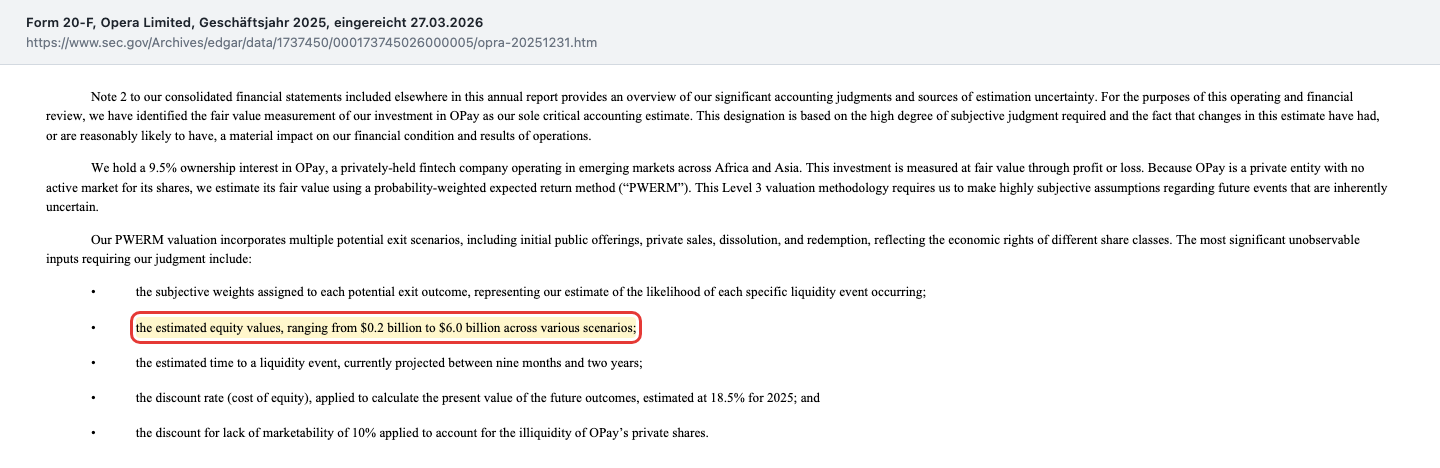
From $0.2 billion to $6.0 billion. That is not a range, it is a corridor. And out of that model come gains that land in net income without a cent changing hands: $89.8 million in 2023, $5.0 million in 2024, $36.3 million in 2025 and a further $6.3 million in the second quarter of 2026 alone. The stated reason for the latest step-up, in the words of the August 19, 2026 release, is the passage of time affecting the present value of probability-weighted expected returns. Translated: nothing happened, except that three months went by.
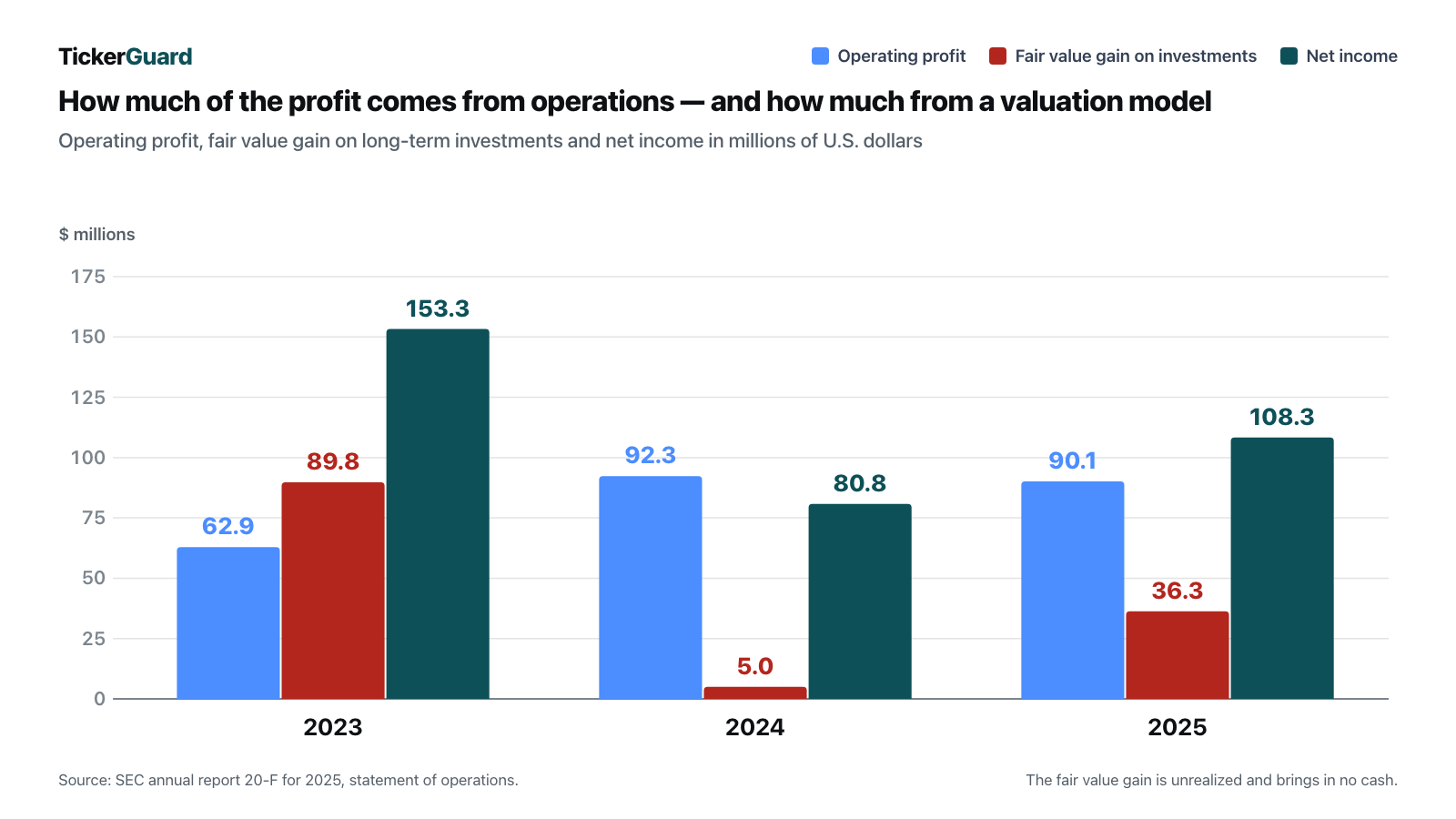
For you as an investor that means two things. First, the price-to-earnings ratio of 13.7 contains a slice of profit that comes from a model and can turn negative in a bad year. Second, the stake is still worth something — nobody just knows how much. Anyone valuing Opera has to hold both sentences at once.
Uncomfortable truth No. 2: the growth is bought — and it is getting more expensive
Remember the ad space belonging to other publishers? Here is the bill. Cost of inventory sold rose from $85.8 million in 2023 through $118.7 million in 2024 to $205.1 million in 2025.

“The cost of inventory sold increased $86.5 million, or 73%, from 2024 to 2025, and represented 33% of our revenue in 2025, up from 25% of our revenue in 2024.”
— Opera Limited, SEC annual report on Form 20-F for 2025, operating and financial review
Add the three cost-of-revenue lines together — technology and platform fees, content cost and inventory — and a shrinking gross margin appears: 23.5 percent of revenue went to them in 2023, 27.6 percent in 2024, 35.9 percent in 2025. Gross margin fell from roughly 76 percent to roughly 64 percent. The first half of 2026 carried on in the same direction: 37 percent in the first quarter, 38 percent in the second.
A comparison with a classic advertising landlord makes it plain. A company like Clear Channel Outdoor, which owns its billboards, carries high fixed costs but earns almost every incremental dollar of revenue without added cost. A company that buys ad space from others and resells it has the reverse problem: barely any fixed costs, but every incremental dollar of revenue arrives with a purchase price attached.
What is remarkable is that the operating margin did not fall with it: 16 percent in 2023, 19 percent in 2024, 15 percent in 2025 and 16 percent in the first half of 2026. Opera absorbed the pressure elsewhere — marketing and distribution fell from 28 percent of revenue to 23 percent, personnel costs from 17 percent to 13 percent. That is good cost discipline. It is also a lever you can pull only once.
Uncomfortable truth No. 3: 68 percent belongs to a Chinese parent
Buy an Opera share and you buy a minority interest in a subsidiary. The annual report says so in a single sentence:

“As of the date of this annual report, Kunlun, a Chinese public company listed on the Shenzhen Stock Exchange, indirectly owns approximately 68.0% of our outstanding ordinary shares, and we are therefore a consolidated subsidiary of Kunlun.”
— Opera Limited, SEC annual report on Form 20-F for 2025, risk factors
Opera’s executive chairman, Mr. Zhou, is also a controlling shareholder of Kunlun. Under Nasdaq rules Opera qualifies as a “controlled company” and may therefore skip requirements that would otherwise be mandatory — among them that a majority of the board be independent. The annual report additionally names heightened regulatory scrutiny of Chinese-controlled companies and restrictions on cross-border capital movements as risks.
None of that is an accusation. It is a fact with consequences. It explains part of the low earnings multiple, it explains the thin float of roughly 28.8 million shares (data as of August 23, 2026), and it explains a quirk of the repurchase program: Opera buys shares not only on the exchange but pro rata directly from the majority shareholder, whose percentage therefore stays intact.
Uncomfortable truth No. 4: the company’s own filing names AI as a threat to its own product
Opera sells AI — Opera Neon on subscription, the in-house browsing AI Opera AI built on the company’s own Composer engine, and since 2026 the Browser Connector, which lets outside AI services such as Claude and ChatGPT read open pages and tabs. Which makes it all the more striking how bluntly the same annual report describes AI as a threat to the core business.

“Users may increasingly rely on AI-powered tools that generate synthesized responses or perform tasks on their behalf, reducing the need for conventional browsing, page navigation, and direct visits to websites.”
— Opera Limited, SEC annual report on Form 20-F for 2025, risk factors
Then there is partner concentration. The annual report states: “A limited number of business partners account for a significant portion of our revenue, and Google, our largest partner, continues to represent a material share of our total revenues.” The search distribution agreement with Google dates back to 2001 according to the filing, with the current version signed in 2012; Opera names Yandex as its second search partner, a relationship of more than 15 years.
Put together, that frames the real question for the coming years: if answers are assembled inside an AI interface, who still pays for the referral? Opera is trying to flip the answer — from router to execution layer. Whether that works will show up in query revenue, not in announcements. How hard life gets for companies whose business model hangs directly on AI is visible from an entirely different corner of the same market in our BrainChip analysis.
Valuation: what the market pays for the browser business
The valuation anchor: $18.96, the closing price on August 21, 2026. At 88,917,384 shares outstanding as of June 30, 2026 that works out to roughly $1.69 billion of market capitalization; fundamental data as of August 23, 2026 shows $1.70 billion. The difference is under one percent and changes nothing about the order of magnitude.
The simple ratios first: a price-to-earnings ratio of 13.7 on trailing twelve-month earnings of $1.38 per share, a price-to-sales ratio of roughly 2.5 and a price-to-book ratio of roughly 1.7 against book value of $11.27 per share. The $0.80 annual dividend equals roughly 58 percent of those earnings per share and a yield of 4.2 percent.
It gets more interesting once the non-operating parts come out. From the roughly $1.69 billion market capitalization, subtract $145.2 million of cash and — if you believe the carrying amount — $300.9 million for the OPay stake. What remains is roughly $1.24 billion for the actual business. Measured against the company’s own 2026 guidance (midpoints: $738 million of revenue and $173.5 million of adjusted EBITDA), that is about 1.7 times revenue and 7.2 times adjusted EBITDA — for a business growing at roughly 20 percent a year.
The calculation cuts both ways on purpose. If you do not trust the OPay carrying amount, strike it out in whole or in part — and the price of the operating business rises accordingly. If you do trust it, you are buying a growing advertising business at a multiple that is modest for Nasdaq. Both calculations are legitimate; they differ only in one assumption that nobody can verify.
The professionals’ view, as of August 23, 2026: seven research houses cover the stock, five with a strong buy rating and two with a buy, none with hold or sell. The average price target is $26.29. Take such numbers for what they are — an opinion from people who read the same filings we do, with more meetings attached. With a float of roughly 28.8 million shares, coverage is thin in any case.
Opportunities and risks at a glance
What speaks for Opera:
- Growth is accelerating rather than fading: up 21 percent in 2024, up 28 percent in 2025, up 23 percent and 25 percent in the first two quarters of 2026 — and full-year guidance was raised again on August 19, 2026.
- Profit turns into cash: $64.3 million of operating cash flow in the first half of 2026, or 76 percent of adjusted EBITDA, exactly matching the prior-year period.
- No financial debt, plenty of cash: $145.2 million of cash against $148.8 million of total liabilities as of June 30, 2026, with no bank loan among them. Interest is not a topic for this company.
- Capital returns are established, not announced: two dividends of $0.40 per share every year since 2023, plus a repurchase program of up to $300 million since February 26, 2026.
- Revenue per user keeps rising: $2.46 annualized in the second quarter of 2026, up 25 percent year over year, on a user base that is growing again in 2026.
What speaks against it:
- 26 percent of the balance sheet hangs on a model: the $300.9 million OPay stake, valued across scenarios from $0.2 billion to $6.0 billion of equity value. A write-down would hit equity and earnings at the same time.
- Gross margin is falling: cost of revenue climbed from 23.5 percent in 2023 to 35.9 percent in 2025 and 38 percent in the second quarter of 2026. Offsetting it through lower marketing and personnel ratios has a limit.
- No control for outside holders: 68.0 percent at Kunlun Tech, an executive chairman who is also a controlling shareholder of Kunlun, and controlled company status with exemptions from Nasdaq independence rules.
- Few large partners: the annual report names Google as the largest, representing a material share of total revenues. A change in terms would show up immediately.
- AI can devalue the core product: the company’s own risk section describes how synthesized AI answers can make conventional browsing — and with it ad space and referrals — unnecessary, explicitly including within its own products.
- Foreign private issuer reporting: Opera files no quarterly reports on Form 10-Q, only interim reports on Form 6-K with a lighter disclosure standard. If you want the quarter-by-quarter detail a U.S. filer provides, you get a leaner version of it here.
A human conclusion
We started with the memory discount: “the browser from back then.” Stop at that memory and you miss a company that turned over more than $600 million in 2025, accelerated its growth in 2026 and never took out a single bank loan.
But read only the headline ratios — growth, a 13.7 earnings multiple, a 4.2 percent dividend, no debt — and you miss the other half: that a quarter of the balance sheet hangs on a valuation model, that gross margin has been falling for two years because the growth is bought, and that the company is steered not by the market but by a shareholder with 68.0 percent.
So the old memory was too small — and the new enthusiasm would be too big. Opera is neither the forgotten browser nor the cheap growth story. It is a profitable, decently run advertising business with a lottery ticket built into the balance sheet and a majority owner you either trust or you do not.
That is exactly where our work stops. We read, we did the arithmetic, we linked the sources. Whether $1.24 billion strikes you as fair for an advertising business growing at 20 percent, whether you credit the OPay model with a dollar or with nothing, and whether 68 percent in one pair of hands lets you sleep — nobody can decide that for you. What you make of it is your decision. And that is exactly as it should be.
Sources
- Opera Limited, annual report on Form 20-F for fiscal year 2025 (filed March 27, 2026) — business model, products, risk factors, statement of operations 2023 to 2025, revenue split, OPay valuation, ownership, user metrics, headcount, repurchase program
- Opera Limited, interim report on Form 6-K of August 19, 2026, exhibit 99.1 — second quarter 2026 results, balance sheet as of June 30, 2026, cash flow statement, statement of changes in equity, share count, raised full-year guidance
- Opera Limited, interim report on Form 6-K of April 28, 2026, exhibit 99.1 — first quarter 2026 results, March 2026 repurchases, share count as of March 31, 2026
- Opera Limited, interim report on Form 6-K of June 10, 2026, exhibit 99.1 — declaration of the $0.40 per share semi-annual dividend, payable July 14, 2026
- Opera Limited, interim report on Form 6-K of October 10, 2025, exhibit 99.1 — Lin Song becomes sole chief executive officer
- SEC EDGAR, filing history for Opera Limited (CIK 0001737450) — complete list of filings as of August 23, 2026
- Fundamental data (price and valuation data, analyst estimates, float; data as of August 23, 2026)
Disclosure: This article is journalism, not investment advice. It contains no buy, hold or sell recommendation and is not a solicitation to buy or sell securities. Shares can lose their entire value; a total loss is possible. All figures come from the sources named above and carry the dates stated there; later developments are not reflected. Positions held by the operator are disclosed daily; where one exists, it appears as a notice at the top of this deep dive.
Key figures at a glance
All monetary figures in millions of $; earnings per share as reported.
| Metric | 2021 | 2022 | 2023 | 2024 | 2025 |
|---|---|---|---|---|---|
| Revenue | 251.0 | 331.0 | 396.8 | 480.6 | 616.7 |
| Operating Income (EBIT) | -6.2 | 66.8 | 62.9 | 92.3 | 92.7 |
| Net Income | -44.0 | 15.0 | 153.3 | 80.8 | 108.6 |
| Net Margin | -17.5% | 4.5% | 38.6% | 16.8% | 17.6% |
| Earnings Per Share | -0.38 $ | 0.14 $ | 1.69 $ | 0.90 $ | 1.19 $ |
Source: fundamental data & SEC filings (annual and quarterly reports, 10-K/10-Q)
Our Bottom Line at a Glance
- Growth and earning power positive
- Revenue rose from $396.8 million in 2023 through $480.6 million in 2024 to $614.8 million in 2025, then grew another 24 percent to $353.8 million in the first half of 2026. Adjusted EBITDA reached $142.5 million in 2025, a 23 percent margin; on August 19, 2026 the company raised full-year guidance to $734 million to $742 million of revenue and $172 million to $175 million of adjusted EBITDA.
- Balance sheet and liquidity positive
- As of June 30, 2026, total assets of $1,162.1 million and equity of $1,013.4 million faced just $148.8 million of total liabilities — without a single bank loan or bond. Cash stood at $145.2 million, and operating cash flow in the first half came to $64.3 million, or 76 percent of adjusted EBITDA.
- Quality of reported earnings negative
- A substantial part of net income comes from unrealized fair value gains on the OPay stake: $89.8 million in 2023 (against $62.9 million of operating profit), $5.0 million in 2024, $36.3 million in 2025 and $6.3 million in the second quarter of 2026. The carrying amount of $300.9 million as of June 30, 2026 rests on a Level 3 model with scenarios spanning $0.2 billion to $6.0 billion of equity value.
- Margin and the cost of growth negative
- Cost of inventory sold rose 73 percent to $205.1 million in 2025 and reached 33 percent of revenue, up from 25 percent in 2024. All cost-of-revenue lines together climbed from 23.5 percent in 2023 to 35.9 percent in 2025 and 38 percent in the second quarter of 2026. The offset came from falling marketing and personnel ratios — a lever with a limited reservoir.
- Ownership and shareholder voice negative
- Kunlun Tech, listed on the Shenzhen Stock Exchange, indirectly holds roughly 68.0 percent of the ordinary shares according to the 20-F for 2025; Opera is its consolidated subsidiary and the executive chairman is also a controlling shareholder of Kunlun. As a controlled company Opera uses exemptions from Nasdaq board independence rules, and the float stands at roughly 28.8 million shares (data as of August 23, 2026).
- Partner concentration and the AI shift neutral
- The annual report names Google as the largest partner, representing a material share of total revenues, and at the same time describes how synthesized AI answers can make conventional browsing — and with it ad space and referrals — unnecessary, explicitly including within its own products. Against that stand Opera’s own AI revenues: the subscription browser Opera Neon since late 2025 and query revenue that, per Note 3, also comes from AI platforms.
Opera Limited earns its money from advertising and referrals around a browser family with 288 million monthly users. The business is growing faster, not slower — up 28 percent in 2025 and 24 percent in the first half of 2026 — throws off cash and carries no financial debt; two dividends of $0.40 per share and a $300 million repurchase program flow back to shareholders. Against that stand three documented points: a quarter of the balance sheet consists of an investment that only a Level 3 model can price; cost of revenue climbed from 23.5 percent to 35.9 percent in two years because growth is bought; and 68.0 percent of the shares sit with a Chinese majority owner. Not investment advice.
What Our Rating Means
Open questions
The business works in principle, but one material question is open. As long as it stays open, our findings do not carry a quality verdict.
Yellow, because the business fundamentally works while one material operating question stays open: a growing share of the revenue growth is purchased. Third-party ad inventory cost rose 73 percent to $205.1 million in 2025 and thus to 33 percent of revenue; all cost-of-revenue lines together climbed from 23.5 percent in 2023 to 35.9 percent in 2025 and 38 percent in the second quarter of 2026. That the operating margin nevertheless held at 15 to 16 percent is down to falling marketing and personnel ratios — an offset that cannot be repeated indefinitely. Add the concentration on a handful of partners with Google at the top, and a $300.9 million investment whose value comes solely from a model spanning $0.2 billion to $6.0 billion. Red is out of the question: the balance sheet as of June 30, 2026 carries no financial debt, $1,013.4 million of equity and $145.2 million of cash, and operations are consistently profitable and cash-generative. Green is out of reach while the margin question is this large, and in case of doubt the more cautious grade applies. The decision is yours.
A journalistic assessment by our editorial team at the time of the deep dive, based on public sources — not investment advice and not a solicitation to buy or sell. Your personal circumstances (investment goals, risk capacity, taxes) cannot be taken into account. What our levels mean, how verdicts are formed, and what conflicts of interest exist →
Worth Noting
- The starting point was a sweep of our U.S. universe on August 23, 2026: growth, a price-to-earnings ratio of 13.7, a 4.2 percent dividend yield and no financial debt rarely appear together.
- Data status: full-year figures from the annual report on Form 20-F for 2025 (filed March 27, 2026), half-year and balance sheet figures from the interim report on Form 6-K of August 19, 2026 (as of June 30, 2026), price and valuation data as of August 23, 2026, valuation anchor $18.96 from August 21, 2026.
- Do not confuse Opera Limited (Nasdaq: OPRA) with Opera Software ASA, the predecessor listed in Oslo whose browser business was sold to a Chinese consortium in 2016. Nor with the Options Price Reporting Authority, which uses the same OPRA acronym in U.S. options trading.
- As a foreign private issuer Opera files no quarterly reports on Form 10-Q and no annual report on Form 10-K; every figure in this analysis comes from the annual report on Form 20-F and the interim reports on Form 6-K.
Stock Watch
This analysis is as of August 26, 2026. Stock Watch will tell you what's changed at OPRA since then.
Later $1 a month per stock — signing up is free, and you'll be the first to know when it launches.
The full analysis as a PDF for later
We will send you this analysis as a PDF — to print, file away, and read at your own pace. And we will add you to the free Stock Watch list for Opera Ltd (OPRA), so you hear about it when something material in this analysis changes.
Frequently Asked Questions
Opera Limited (Nasdaq: OPRA), headquartered in Oslo, develops web browsers — Opera One, Opera GX for gamers, Opera Mini for markets with expensive mobile data, Opera Air, and since late 2025 the paid AI browser Opera Neon. The money comes not from the browser itself but from advertising ($396.0 million in 2025) and from referrals to search, commerce and AI partners ($216.8 million). The crypto wallet MiniPay sits alongside.
In 2025 revenue reached $614.8 million, up 28 percent, with net income of $108.3 million and operating profit of $90.1 million. In the first half of 2026 revenue grew 24 percent to $353.8 million and net income 54 percent to $52.3 million. For the full year 2026 the company guided on August 19, 2026 to revenue of $734 million to $742 million.
Because the SEC treats Opera as a foreign private issuer — a Cayman Islands company managed from Norway. Such companies file an annual report on Form 20-F instead of a 10-K, and interim reports on Form 6-K instead of quarterly reports on Form 10-Q. The required disclosure is lighter, but the numbers still appear every quarter.
On the balance sheet as of June 30, 2026 the 9.5 percent stake in the Nigerian payments company OPay is carried at $300.9 million, roughly 26 percent of total assets. Because OPay is not listed, Opera estimates the value with a model (PWERM, Level 3). The equity values assumed in that model range from $0.2 billion to $6.0 billion depending on the scenario, according to the 20-F for 2025. No reliable market price exists.
Yes, twice a year since 2023. On June 10, 2026 the board declared $0.40 per share payable July 14, 2026; the same amount had already been paid in January 2026. That is $0.80 per share a year — roughly 58 percent of trailing twelve-month earnings of $1.38 per share, and a yield of 4.2 percent against the closing price of $18.96 on August 21, 2026.
The majority sits with Kunlun Tech, a Chinese company listed on the Shenzhen Stock Exchange, which indirectly owns roughly 68.0 percent of the ordinary shares; Opera is its consolidated subsidiary. Opera’s executive chairman is also a controlling shareholder of Kunlun. Under Nasdaq rules Opera therefore qualifies as a controlled company and uses the related exemptions from board independence requirements.
Because a growing share of advertising revenue comes from third-party ad space that Opera buys and resells. According to the 20-F for 2025, the cost of that inventory rose 73 percent to $205.1 million and reached 33 percent of revenue, up from 25 percent in 2024. All cost-of-revenue lines together grew from 23.5 percent of revenue in 2023 to 35.9 percent in 2025; in the second quarter of 2026 the figure was 38 percent.
At the valuation anchor of $18.96 (closing price August 21, 2026) and 88,917,384 shares as of June 30, 2026, market capitalization is roughly $1.69 billion. That equals a price-to-earnings ratio of 13.7, a price-to-sales ratio of about 2.5 and a price-to-book ratio of about 1.7. Strip out cash and the OPay carrying amount and roughly $1.24 billion remains for the operating business — about 7.2 times expected 2026 adjusted EBITDA.
Found an error?
Did you spot a factual error, an outdated number, or a typo in this deep dive? Let us know briefly — your report goes straight to the editorial team.