Clear Channel Outdoor: The stock whose ceiling is written into a contract
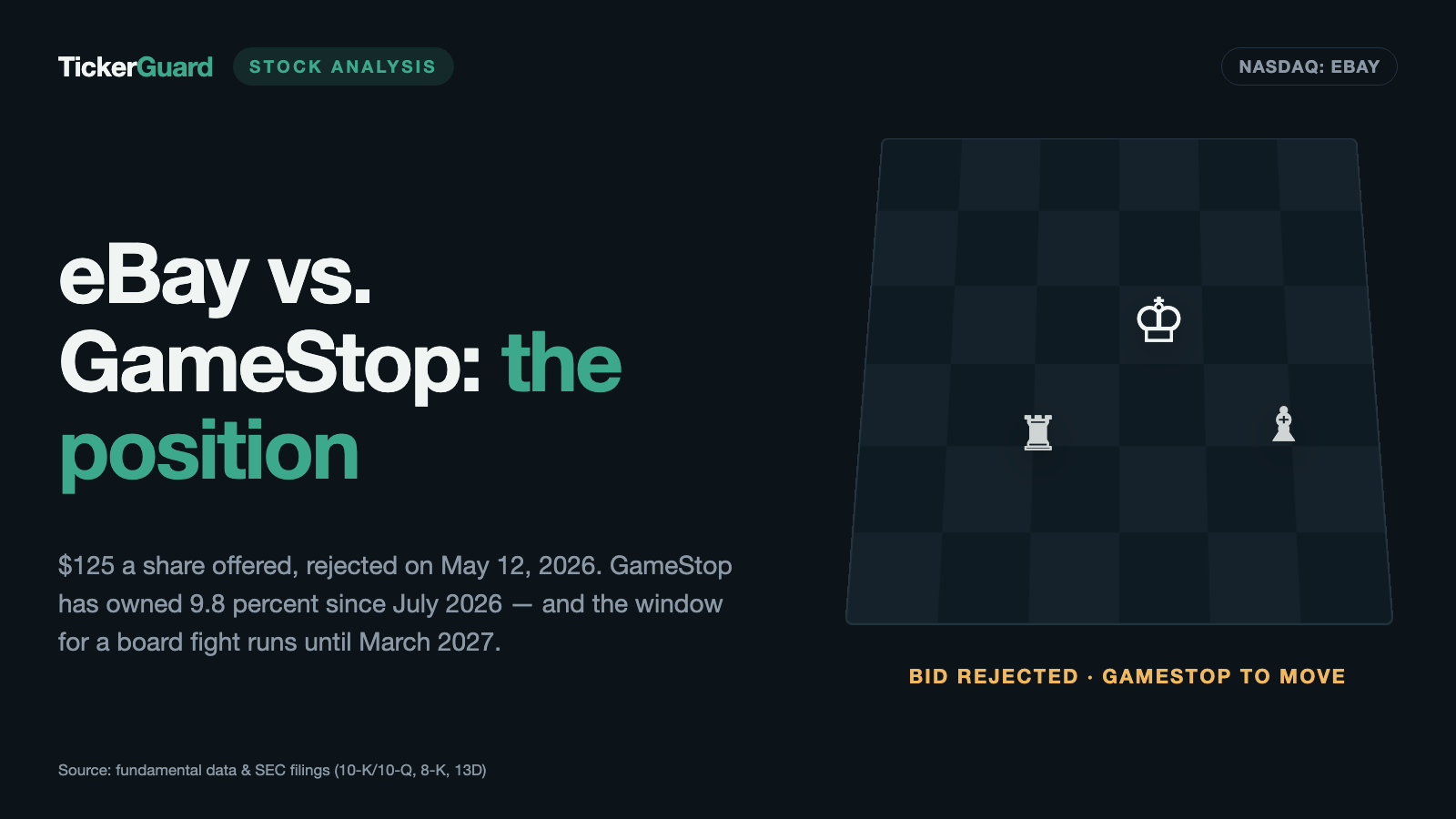
A stock at just over two dollars, a name everyone knows, thousands of billboards along American highways — on the hype lists Clear Channel Outdoor looks like a cheap entry. The filings with the SEC say something else: since February 9, 2026 there is a signed merger agreement at $2.43 per share in cash, shareholders approved it on May 12, 2026, and underneath sits a business carrying $4,915.5 million of net debt and a $3,457.1 million stockholders' deficit. Buying here is not a bet on a company. It is a bet on a decision made by an agency in Washington.
 Thomas Mücke
Founder & Publisher
Thomas Mücke
Founder & Publisher
As of Today
As of: September 30, 2026
- Closing price
- 2.40 $ +0.40%
- Market Capitalisation
- 1.2 $B
- Growth Score
- 5/10
- AAQS
- 0/10
This analysis has a cut-off date. The Stock Guard tells you when something material changes in the numbers. Reserve your free spot
Chart
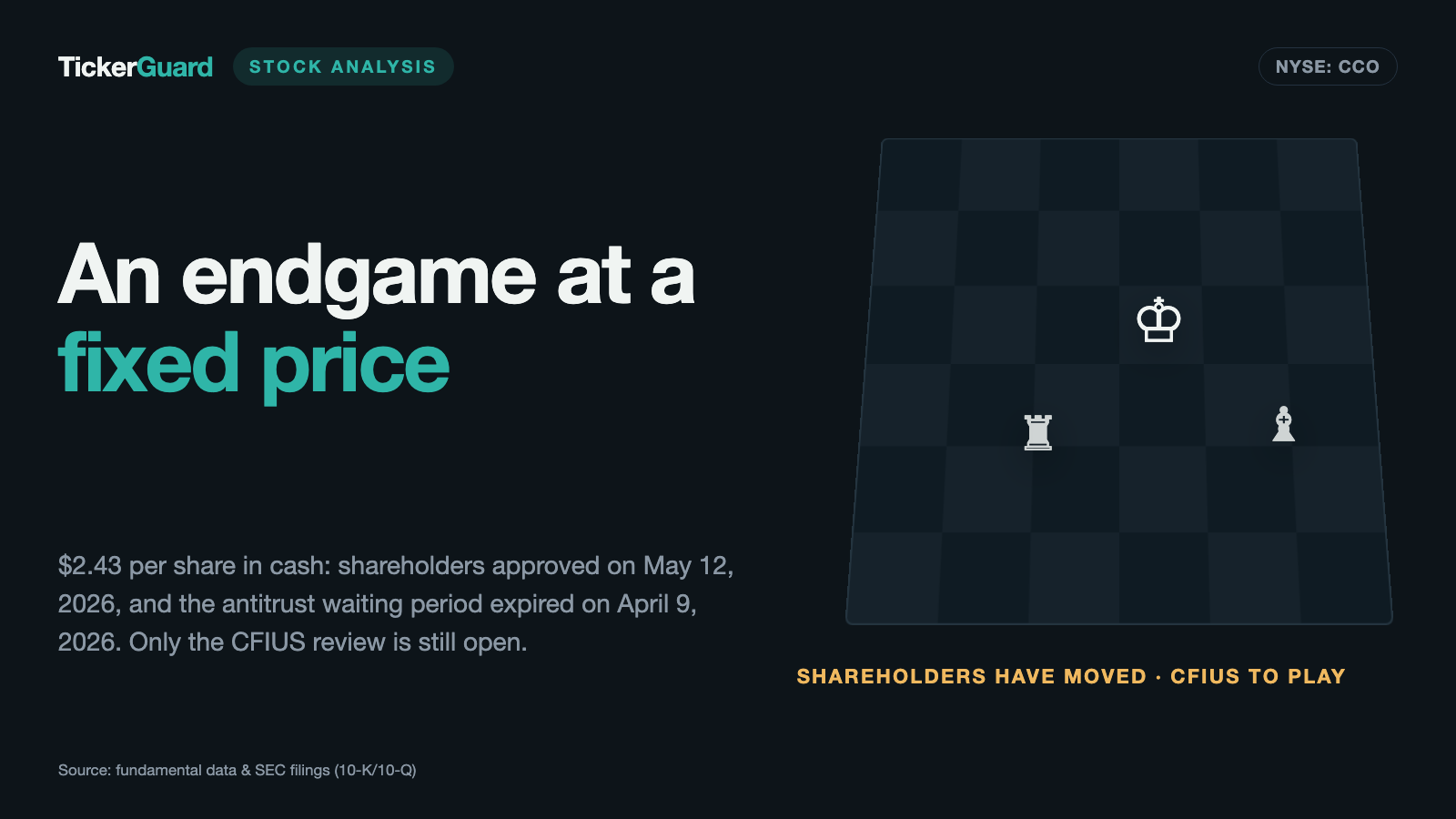
Interactive price chart (TradingView).
52-week range: 1.30 $ to 2.40 $ · Last price: 2.40 $ (As of: September 30, 2026)
Note: pure fact-based analysis, not investment advice and not a solicitation to buy or sell. All figures without guarantee.
The ceiling illusion
There is one kind of stock that always looks good on a hype list: the cheap one. Two dollars and change, a name you recognise, thousands of billboards along American highways. A hundred dollars buys you forty shares. And because forty shares feel like more than one share at a hundred dollars, a sensation takes hold that has nothing to do with valuation: there must be room to run.
Call it the ceiling illusion. We see a low price and infer a long runway, when the price on its own says nothing of the sort. With Clear Channel Outdoor the runway is unusually easy to measure. It is written into a contract, signed on February 9, 2026 and filed with the SEC: $2.43 per share, in cash, without interest. Nothing more will be paid, however well the business performs.
That makes this something other than an ordinary stock analysis. We are not looking at a company whose value should reveal itself over the coming years, but at a situation with two possible outcomes — and the question is what happens in each. So we read the quarterly report of August 5, 2026, the 2025 annual report, the merger agreement and the merger proxy of April 13, 2026, which contains things a company would otherwise never publish.

What Clear Channel Outdoor actually does
The business model is one of the oldest in advertising and fits into a single sentence: the company owns or leases surfaces where people see advertising while they are out and about, and rents those surfaces to advertisers. Billboards along arterial roads, illuminated panels above intersections, display cases at bus shelters, screens in airport terminals. The industry calls it out-of-home advertising.
As of June 30, 2026 Clear Channel Outdoor operated more than 64,500 printed and digital displays — 64,521 to be exact — with a presence in 83 U.S. designated market areas, including 43 of the top 50. The company reports in two segments:
- America — U.S. roadside advertising: 34,107 billboards (2,059 of them digital) and 18,656 other displays such as bus shelters and transit (525 digital), concentrated in 28 designated market areas. Second-quarter 2026 revenue: $324.3 million, up 7.0 percent.
- Airports — airport advertising: 11,758 displays (2,561 digital) across more than 60 commercial airports and a number of private ones, primarily in the U.S. with a limited presence in the Caribbean. Second-quarter 2026 revenue: $113.6 million, up 14.0 percent.
The dominant trend in the business is the digitisation of the surfaces themselves: a digital panel rotates through several customers instead of carrying one for four weeks. In fiscal 2025, $707.7 million or 44.1 percent of consolidated revenue came from digital displays, up from $622.3 million and 41.3 percent in 2024. The company also sells data tools under the RADAR brand for planning and measuring the reach of an out-of-home campaign — an attempt to make posters as buyable as online advertising.
One point matters for reading the numbers: Clear Channel Outdoor used to be a global group and no longer is. Across 2025 and 2026 essentially all international operations were sold — the Europe-North business, the Latin American operations and finally Spain, whose sale closed on August 4, 2026 for approximately $132.3 million. Every revenue and earnings figure in this analysis therefore refers to continuing operations, that is the remaining U.S. business, and prior-year figures have been restated accordingly in the filings. Anyone placing 2021 or 2022 group numbers alongside them is comparing two different companies.
How the stock landed on our desk
The trigger was not a fundamental screen but our sweep of the tickers being talked about unusually often in retail investor forums. CCO showed up there, and the first look at the metrics explains why. A share price just above two dollars, a familiar brand, revenue growth of 8.7 percent in the most recently reported quarter — it reads like a recovery story.
The second look, the one into the SEC register, tells a completely different story. And it is the reason this analysis is built differently from the usual: at a company with a signed merger agreement, the share price is no longer driven by operating performance but by a legal and political question. That shift is something you need to understand before you buy.
The numbers over the years — and the one that overshadows them
Start with what is going well, because there is more of it than you might expect.
Revenue has grown for years. $1,434.2 million in fiscal 2023, $1,505.2 million in 2024, $1,604.1 million in 2025 — up 6.6 percent in the most recent year. The first half of 2026 added $811.9 million, 10.2 percent more than a year earlier. Growth in the second quarter of 2026 was driven in part by the FIFA World Cup in North America and by strong demand from technology advertisers in the San Francisco Bay Area.
Operating income is rising too. It climbed from $216.8 million (2023) through $279.2 million (2024) to $310.6 million (2025) — a 43 percent improvement in two years on a 12 percent increase in revenue. The company is measurably more efficient.
And then comes the line that overshadows all of it.
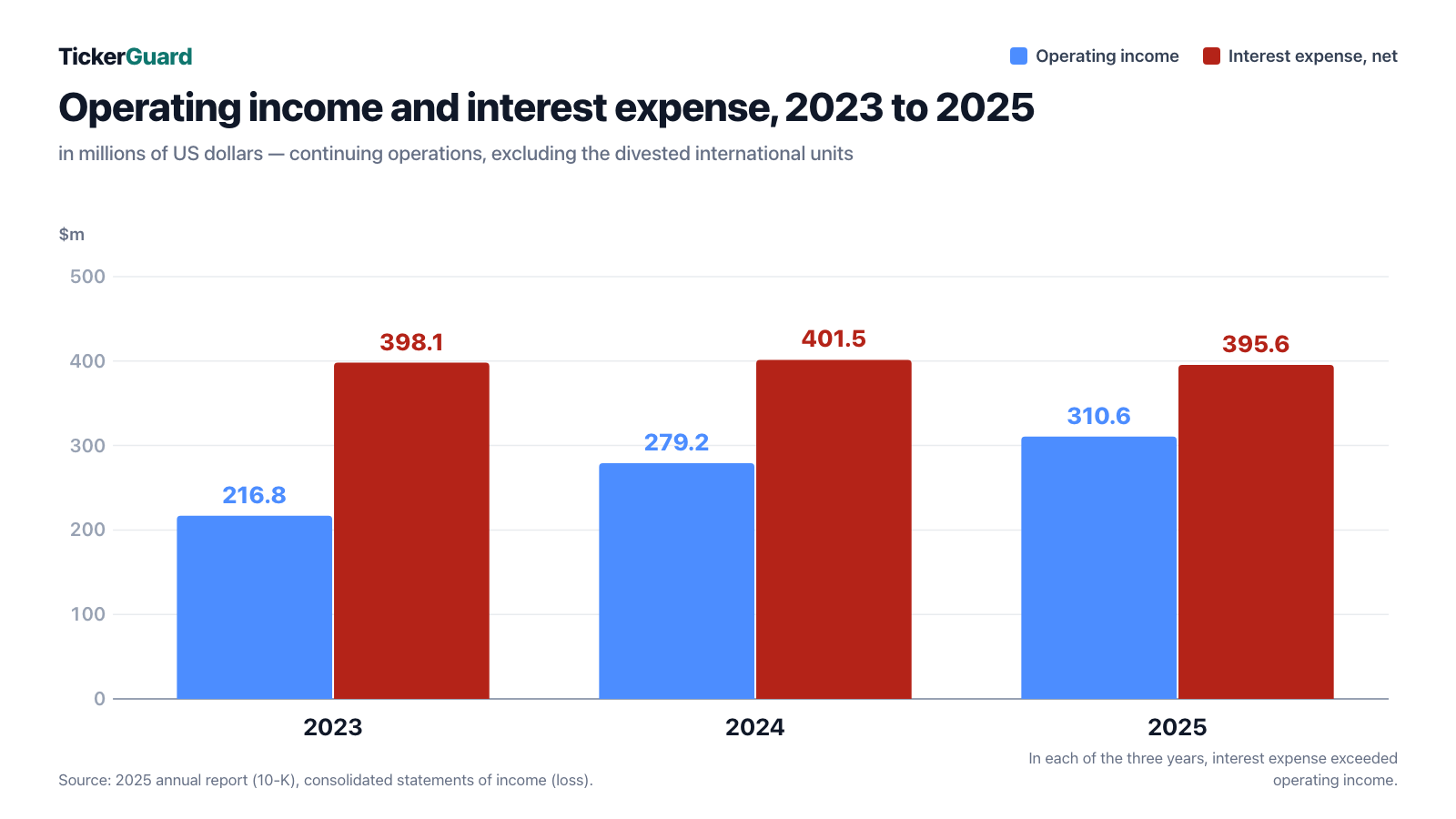
Interest expense was $398.1 million in 2023, $401.5 million in 2024 and $395.6 million in 2025. In every single year it exceeded total operating income. The ratio has a name — interest coverage, operating income divided by interest expense — and it stood at roughly 0.5 (2023), 0.7 (2024) and 0.8 (2025). A reading below 1 simply means that what the operating business earns is not enough to pay the lenders.
That holds for the best quarter in recent company history as well. In the second quarter of 2026, $89.1 million of operating income faced $99.0 million of interest expense. In the first half of 2026 it was $128.5 million against $197.5 million. Which is why rising revenue still ends in a minus: continuing operations produced a loss of $10.0 million in the second quarter of 2026 and $59.4 million in the first half.
A fair note on the year-earlier comparison: in the second quarter of 2025 the company still reported income of $6.3 million from continuing operations. That did not come from the business but from a $28.8 million book gain on the extinguishment of old debt. Without it, 2025 would have shown a loss as well.
The takeaway for this section: the business is running better than ever — and still does not carry its interest.
What the filings say
Uncomfortable truth no. 1: the price is a number in a contract, not a market view
On February 9, 2026 Clear Channel Outdoor signed a merger agreement with two purpose-built entities called Madison Parent Inc. and Madison Merger Sub Inc. Behind them stands an investor consortium of funds advised by Mubadala Capital, together with TWG Global. The agreement spells out what happens to every single share:
“each share of common stock, par value $0.01 per share, of the Company … will be automatically cancelled, extinguished and converted into the right to receive cash in an amount equal to $2.43, without interest thereon (the ‘Per Share Price’).”
— Clear Channel Outdoor Holdings, Inc., Form 8-K of February 9, 2026, Item 1.01

Two details deserve attention. First, that small phrase without interest thereon. Anyone buying today and waiting for closing receives exactly $2.43, whether closing arrives in four weeks or in six months. Time costs money here — the foregone return on the capital tied up.
Second, the agreement contained a go-shop provision, a window in which the company was allowed to actively solicit better offers. It ran until 11:59 p.m. Eastern time on March 26, 2026. A superior proposal would have triggered a $19.9 million break fee to the buyer. None arrived. After that, the company is barred from seeking alternatives and the break fee rises to $39.8 million. Conversely, the buyer owes the company $92.9 million if it lets the merger fail through its own fault.
On the scale of the whole thing: the consortium's backers have committed to contribute up to $3.3 billion of equity to the acquiring entity — considerably more than the shares themselves cost. The reason is in the next section.
Uncomfortable truth no. 2: $8.4 billion of committed payments rank ahead of the shareholder
As of June 30, 2026 Clear Channel Outdoor reported $5,107.6 million of debt against $192.1 million of cash. That leaves $4,915.5 million net. The equity is long gone: the balance sheet shows a stockholders' deficit of $3,457.1 million (December 31, 2025: $3,394.4 million). On the books, what belongs to shareholders is a negative number.
The debt is not due imminently, and that deserves saying. It consists of a $425.0 million term loan (maturing August 2028) and five bonds: $899.3 million at 7.750 percent (April 2028), $906.0 million at 7.500 percent (June 2029), $865.0 million at 7.875 percent (April 2030), $1,150.0 million at 7.125 percent (February 2031) and $900.0 million at 7.500 percent (March 2033). As of June 30, 2026 the company stated it was in compliance with all covenants.
Coupons between 7.1 and 7.9 percent explain why a company with $1.6 billion of revenue pays roughly $400 million a year in interest. In the first half of 2026, $205.8 million of interest was actually paid out — against $47.8 million of cash provided by operating activities over the same period.
And debt is only the largest item. An out-of-home advertiser usually does not own the ground under its structures; it leases it, and those leases are committed long-term. As of December 31, 2025 future lease payments totalled $2,218.6 million (undiscounted, weighted average remaining term 12.4 years). On top come $877.6 million from non-cancelable contracts that do not qualify as leases for accounting purposes, and $152.7 million of committed capital expenditure, mostly under airport and street furniture contracts.
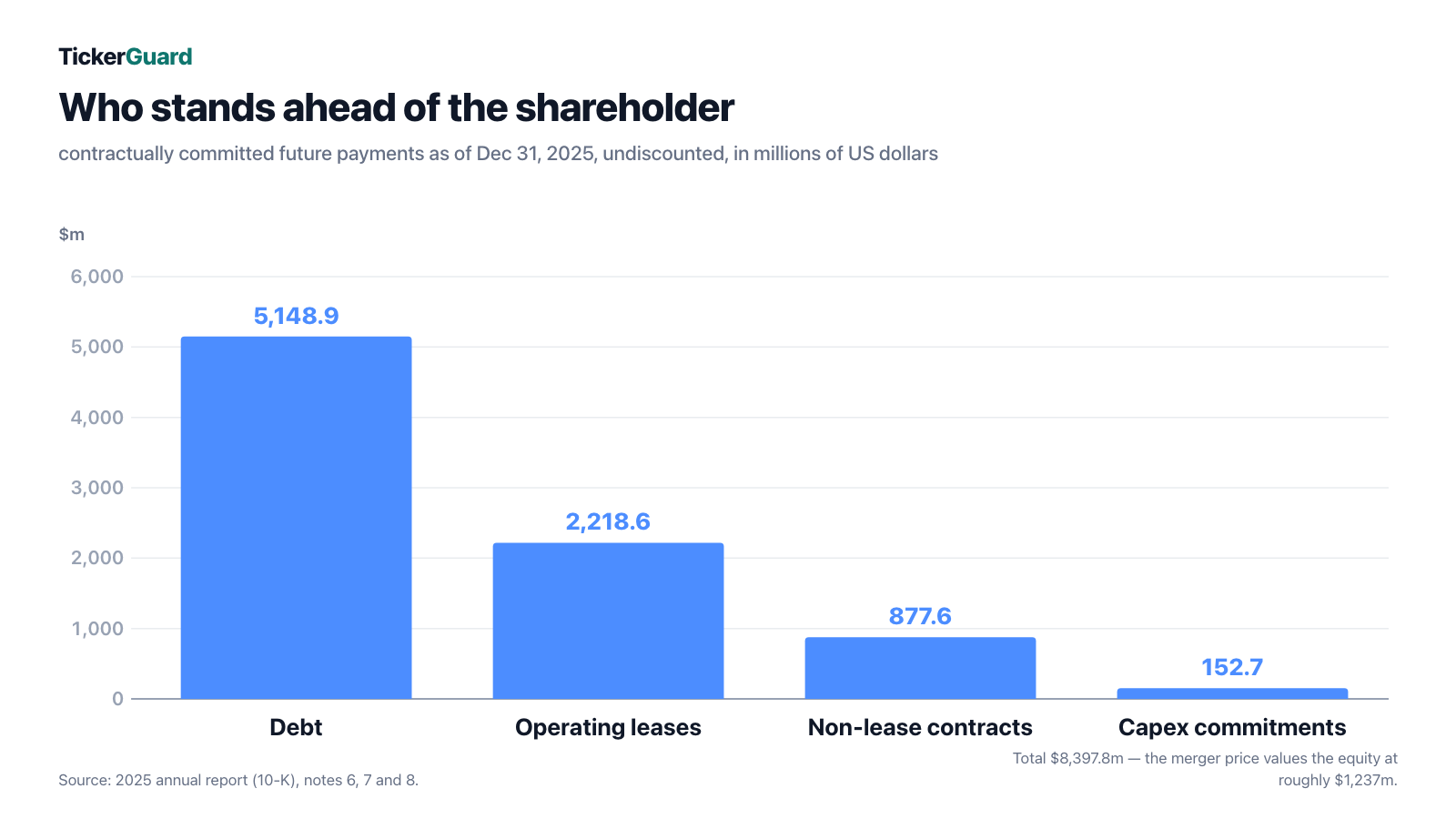
Together that is $8,397.8 million of committed future payments. The merger price of $2.43 values the equity of this company, at 509,093,845 shares outstanding (as of July 31, 2026), at roughly $1,237 million. Here is the everyday picture of this balance sheet: you buy a house for 1.2 million with mortgages and ground rents of 8.4 million attached to it. That can pay off — but it is not a bet on the house. It is a bet on the leverage.
Uncomfortable truth no. 3: management's own plan leaves almost nothing after interest
Merger proxies are so valuable to investors because Delaware corporate law forces a company to disclose things it would otherwise never show. The document of April 13, 2026 contains the internal plan management prepared in October 2025 and updated in January 2026 — six years in numbers, handed to the board, to both advisors and, for the years through 2028, to the buyers.
The plan describes a solid, slowly growing business: revenue rising from $1,604 million (2025) to $1,966 million (2030), adjusted EBITDA from $505 million to $668 million. After share-based compensation and capital expenditure, the plan leaves $418 million (2025), $433 million (2026), $471 million (2027), $498 million (2028), $527 million (2029) and $557 million (2030).
Now the counter-calculation. In the first half of 2026 the company paid $205.8 million of interest; annualised, that is roughly $412 million. For 2026 its own plan foresees $433 million left after share-based compensation and capital expenditure. The difference is a little over $20 million — at a company with $1.6 billion of revenue. Even in plan year 2030, $557 million would face a debt service bill that only changes if the debt is repaid or refinanced more cheaply.
That is the real explanation for everything else. The board did not sell because the business is bad. It sold because this business will, for the foreseeable future, hand almost everything it earns to its lenders. A buyer with $3.3 billion of equity and a new capital structure can do something with that which a listed company carrying this balance sheet cannot.
Uncomfortable truth no. 4: the analysts saw the stock below the offer
The same document contains a number you rarely hear in takeover debates. As a reference point for the board, Morgan Stanley compiled where six brokers saw the stock trading in twelve months — independent of the merger:
“The range of undiscounted broker price targets was $1.35 to $1.75 per share of Company Common Stock.”
— Clear Channel Outdoor Holdings, Inc., Form DEFM14A of April 13, 2026, Opinion of Morgan Stanley

$2.43 sits 39 to 80 percent above that range. For anyone who feels the company is being taken out on the cheap, this is an important cross-check: the buyer is paying noticeably more than professional observers expected the shares to be worth without a deal.
The fairness opinions themselves paint a different picture, and that belongs to the truth as well. Morgan Stanley's discounted cash flow analysis produced a range of $2.00 to $3.89 per share, and its comparable-companies work $2.13 to $4.12. Moelis arrived at $1.97 to $4.18. The offer falls inside all three ranges — but well below their upper bounds. That is the classic point of contention in takeovers: the price is defensible, but it is not generous.
How strongly a valuation multiple travels through this much leverage is easy to show with the proxy's own figures. At the merger price, enterprise value is roughly $6,153 million ($1,237 million of equity plus $4,915.5 million of net debt). Measured against the 2026 plan figure after share-based compensation ($521 million), that is about 11.8 times. As of February 6, 2026 the two listed competitors traded at 14.2 times (Outfront Media) and 15.8 times (Lamar Advertising). The discount is clear — but it is not unfounded, because both peers carry considerably less debt.
Uncomfortable truth no. 5: only one approval is missing — the political one
Formally the merger is nearly done. The waiting period under the Hart-Scott-Rodino Act expired on April 9, 2026. On May 12, 2026 shareholders approved at a special meeting; of 506,416,345 shares entitled to vote as of the April 6, 2026 record date, 411,434,631 were present or represented, roughly 81 percent. In April and May 2026 the company agreed amendments with its lenders so the merger does not count as a change of control, and issued conditional redemption notices for the two unsecured bonds totalling $1,805.3 million. Everything is prepared.
One signature is missing, and it is the hardest one:
“The Merger is expected to close by the end of the third quarter of 2026, subject to the satisfaction of remaining customary closing conditions, including receipt of regulatory approvals, such as review by the Committee on Foreign Investment in the United States.”
— Clear Channel Outdoor Holdings, Inc., Form 10-Q as of June 30, 2026, Note 1

The Committee on Foreign Investment in the United States, CFIUS for short, is an interagency panel of the U.S. government. It assesses whether the purchase of an American company by foreign investors touches national security. Mubadala Capital is associated with the emirate of Abu Dhabi, and Clear Channel Outdoor operates advertising surfaces across 83 American designated market areas and more than 60 airports — locations, cameras, movement data. Whether that becomes a problem is decided by an agency, not by a balance sheet.
The agreement puts a clock on it:
“if the Merger is not consummated on or before November 9, 2026, subject to extension to February 9, 2027 if the requisite regulatory approvals are not previously obtained”
— Clear Channel Outdoor Holdings, Inc., Form 8-K of February 9, 2026, Item 1.01 (Termination Rights)

If that deadline passes without closing, either side may walk away. The ceiling disappears — and so does the floor. What would remain is a stock whose reference point is once again the $1.35 to $1.75 the brokers had in mind, with the same balance sheet and without the buyer who could have repaired the capital structure.
What the market pays — and what that says about the odds
At a company under a merger agreement, the share price is no longer a valuation judgement but a probability calculation. As of the data date of this analysis, August 14, 2026, market capitalisation stood at roughly $1,181 million. Across 509,093,845 shares that corresponds to about $2.33 per share — some 4 percent below the contractually promised $2.43.
That gap is the merger spread, and it pays for two things: the risk that the deal fails, and the time until closing. Four percent is not a dramatic figure for a transaction that needs only one more approval — as of the data date, the market considered completion fairly likely. A side note worth having: the average analyst price target on the same date was exactly $2.43. The analysts have stopped valuing the company and are simply doing the contract arithmetic.
Anyone who knows this pattern will recognise it. We described the same setup recently at a far larger company: AES is likewise under a shareholder-approved all-cash offer, and there too the upper bound of its own advisor's valuation sits well above the price on the table. And what it looks like when debt genuinely consumes a listed equity is on display at Wolfspeed: the company was rescued — the shares of that era no longer exist.
So the sober framing for Clear Channel Outdoor is this. As of the data date, this stock is not an investment in out-of-home advertising but a short-dated, asymmetric instrument. The upside is roughly four percent, contractually capped and unpaid for waiting. The downside is open and is set by the question of what a stock with $4.9 billion of net debt and a stockholders' deficit would be worth without a buyer. That is not a judgement. It is a description of the payoff structure.
Opportunities and risks at a glance
Opportunities
- The price is contractually fixed and shareholder-approved: $2.43 per share in cash, adopted on May 12, 2026 with roughly 81 percent of shares represented.
- The hardest antitrust hurdle is cleared — the Hart-Scott-Rodino waiting period expired on April 9, 2026.
- The financing is in place: equity commitments of up to $3.3 billion from the consortium plus committed debt. A failure caused by the buyer would trigger a $92.9 million payment to the company.
- The operating business really is growing: revenue up 10.2 percent in the first half of 2026, adjusted EBITDA up 19.0 percent to $247.3 million; the Airports segment gained 22.8 percent in the second quarter.
- The sale of the Spanish business on August 4, 2026 brought in approximately $132.3 million, which the company intends to use to reduce debt — subject to the outcome of the merger.
Risks
- The share price is capped. The agreement provides for no more than $2.43 per share, and explicitly without interest for the waiting period.
- The remaining condition is a political decision: the CFIUS review of a buyer associated with Abu Dhabi. The agreement further requires that approval come without a burdensome condition.
- The outside date is November 9, 2026, extendable to February 9, 2027. After that either side may terminate.
- Without the merger, what remains is a balance sheet with $4,915.5 million of net debt and a $3,457.1 million stockholders' deficit (June 30, 2026) — and broker price targets of $1.35 to $1.75 as the reference point (as of February 8, 2026).
- Operating income did not cover interest expense in any year from 2023 to 2025, nor in the first half of 2026. Management's own plan leaves barely $20 million for 2026 after share-based compensation, capital expenditure and interest.
- Since announcing the merger the company has held no earnings call and provides no guidance. Investors therefore see less than before.
- Site costs in the Airports segment are rising faster than revenue: second-quarter 2026 site lease expense there rose 12.0 percent to $67.1 million, driven in part by higher minimum guaranteed payments and the renewed contract with the Metropolitan Washington Airports Authority.
A human conclusion
Back to the ceiling illusion. It persists because it attaches to something true: a two-dollar stock genuinely can double, and sometimes does. But the price on its own is never the information that decides it. At Clear Channel Outdoor the decisive information sits in a contract anyone can read, and it says that for the foreseeable future nobody here receives more than $2.43.
That is not a criticism of the company. Clear Channel Outdoor runs a solid, comprehensible business. It rents attention in places people pass anyway, it holds those places across 83 American designated market areas, it is digitising its inventory, and it has improved its operations substantially in three years. Management also did what you would want it to do: it sold what was not core, and then offered the company to a buyer who can repair the capital structure.
The stock, however, is not the company. Anyone buying it today is buying neither billboards nor revenue growth, but the probability that a panel in Washington gives its blessing over the coming months. Whoever can calculate and judge that has a precisely described trade in front of them, with a known gain, a known window and a downside defined by the balance sheet. Whoever cannot should at least know that this is exactly what they are buying — and not a cheap stock with plenty of room to run.
What you do with that is your decision. And that is exactly as it should be.
Sources
- Clear Channel Outdoor Holdings, Inc., Form 10-Q as of June 30, 2026 (filed August 5, 2026) — balance sheet, statements of income and cash flows, Note 1 (merger, CFIUS, deadlines), Note 2 (dispositions and discontinued operations), Note 5 (long-term debt, supplemental indentures, conditional redemptions), Note 6 (commitments), Note 7 (income taxes), cover page (shares outstanding as of July 31, 2026)
- Clear Channel Outdoor Holdings, Inc., Form 10-K for 2025 (filed February 26, 2026) — business model, segments, headcount, risk factors, financial statements for 2025, 2024 and 2023, Note 6 (debt and maturities), Note 7 (leases, MTA contract), Note 8 (commitments, Metropolitan Washington Airports Authority contract), Note 9 (income taxes)
- Clear Channel Outdoor Holdings, Inc., Form 8-K of February 9, 2026 — Items 1.01, 5.02, 7.01 and 8.01: merger agreement with Madison Parent Inc. and Madison Merger Sub Inc., per share price, go-shop provision, closing conditions, termination rights and fees, financing commitments
- Clear Channel Outdoor Holdings, Inc., Form DEFM14A of April 13, 2026 — management projections for 2025 through 2030, fairness opinions of Morgan Stanley and Moelis, broker price targets, trading multiples of Outfront Media and Lamar Advertising
- Clear Channel Outdoor Holdings, Inc., Form 8-K of May 12, 2026 — Item 5.07: results of the special meeting of stockholders, share counts as of the April 6, 2026 record date
- Clear Channel Outdoor Holdings, Inc., earnings release of August 5, 2026 (Exhibit 99.1 to the Form 8-K, Item 2.02) — second-quarter 2026 results, segment data, debt, liquidity, completion of the Spanish disposal
- Fundamental data (market capitalisation, price, share count, sector and reference data), as of August 14, 2026
Note: this article is journalistic commentary on publicly available company filings and is not investment advice. It contains no buy or sell recommendation and no invitation to acquire or dispose of securities. For stocks under a pending merger agreement, the outcome depends materially on whether the merger closes; if it fails, the price can fall well below the offered consideration. Shares in companies with a stockholders' deficit can become entirely worthless — a total loss of the capital employed is possible. Positions held by the operator are disclosed daily; where one exists, it appears as a notice at the top of this deep dive. at the time of publication. All figures are taken from the original documents named above and carry the as-of dates stated there.
Key figures at a glance
All monetary figures in millions of $; earnings per share as reported.
| Metric | 2021 | 2022 | 2023 | 2024 | 2025 |
|---|---|---|---|---|---|
| Revenue | 1,768.8 | 1,381.6 | 1,434.2 | 1,505.2 | 1,604.1 |
| Operating Income (EBIT) | 58.8 | 255.9 | 216.8 | 279.2 | 304.4 |
| Net Income | -433.8 | -96.6 | -310.9 | -179.3 | -104.6 |
| Net Margin | -24.5% | -7.0% | -21.7% | -11.9% | -6.5% |
| Earnings Per Share | -0.93 $ | -0.20 $ | -0.65 $ | -0.37 $ | -0.21 $ |
Source: fundamental data & SEC filings (annual and quarterly reports, 10-K/10-Q)
Our Bottom Line at a Glance
- Business model & operating performance positive
- Out-of-home advertising is a comprehensible business that is hard to attack, with regulatory barriers to entry — new billboard locations are blocked by permitting rules across much of the U.S. Revenue rose from $1,434.2 million (2023) to $1,604.1 million (2025) and by a further 10.2 percent in the first half of 2026; operating income grew from $216.8 million to $310.6 million over the same period. Digital revenue already accounted for 44.1 percent of the total in 2025.
- Leverage & equity negative
- As of 30.06.2026, $5,107.6 million of debt faces $192.1 million of cash, and the balance sheet shows a stockholders' deficit of $3,457.1 million. Adding up the undiscounted committed payments as of 31.12.2025 — debt, operating leases, non-lease contracts and capital expenditure commitments — produces $8,397.8 million ranking ahead of the shareholder.
- Interest coverage negative
- Operating income stayed below interest expense in every year from 2023 to 2025 ($216.8m against $398.1m, $279.2m against $401.5m, $310.6m against $395.6m), leaving interest coverage permanently below 1. The strong second quarter of 2026 changed nothing: $89.1 million of operating income against $99.0 million of interest expense. Management's own plan leaves barely $20 million for 2026 after share-based compensation, capital expenditure and an annualised debt service bill of roughly $412 million.
- Merger: price and protections positive
- The merger agreement of 09.02.2026 provides for $2.43 per share in cash; shareholders approved on 12.05.2026 with roughly 81 percent of shares represented, and the antitrust waiting period expired on 09.04.2026. The financing is backed by equity commitments of up to $3.3 billion, and a failure caused by the buyer triggers a $92.9 million payment to the company. The go-shop period through 26.03.2026 produced no superior proposal.
- Merger: remaining risk neutral
- What is still open is the CFIUS review of a buyer associated with Abu Dhabi — a political rather than a commercial decision; the agreement additionally requires that approval come without a burdensome condition. The outside date is 09.11.2026, extendable to 09.02.2027. As of 14.08.2026 the market priced a roughly 4 percent discount to the offer, implying a high but not complete probability of completion.
- Valuation versus peers neutral
- At the merger price, enterprise value is roughly $6,153 million, or about 11.8 times the company's own 2026 plan figure after share-based compensation. Competitors Outfront Media (14.2x) and Lamar Advertising (15.8x) traded higher as of 06.02.2026 — though both carry considerably less debt. The two advisors' valuation ranges span $1.97 to $4.18 per share; the offer falls inside them but clearly below the upper bound.
Clear Channel Outdoor runs a solid out-of-home advertising business with 64,521 displays across 83 U.S. designated market areas, growing revenue (+10.2 percent in the first half of 2026) and operating income up 43 percent in three years. Underneath sits a balance sheet with $4,915.5 million of net debt and a $3,457.1 million stockholders' deficit (June 30, 2026); interest expense exceeded operating income in every year since 2023. Since February 9, 2026 a shareholder-approved merger agreement at $2.43 per share in cash has been pending — all that remains is the CFIUS review, with an outside date of November 9, 2026 extendable to February 9, 2027. The share price is therefore capped by contract on the upside and defined by the balance sheet on the downside. Not investment advice.
What Our Rating Means
Substance risk
We found at least one documented issue that threatens the company itself — regardless of how the stock is currently valued.
The quality light is red because two documented threats to the substance of the business come together: book equity is negative, with a stockholders' deficit of $3,457.1 million as of June 30, 2026, and interest coverage has been below 1 for years — operating income fell short of interest expense in 2023, 2024, 2025 and the first half of 2026. Under our rules each of those is a red criterion in its own right. Against that stands the explicit absence of a liquidity emergency: the company was in compliance with all covenants as of June 30, 2026, the next large maturity falls in August 2028, and there is no going-concern qualification. The light judges the company, not the stock and not the pending merger: whether the shares pay off before closing is a probability calculation about a regulatory decision, and that belongs in the scanners rather than in this quality verdict. The decision is yours.
A journalistic assessment by our editorial team at the time of the deep dive, based on public sources — not investment advice and not a solicitation to buy or sell. Your personal circumstances (investment goals, risk capacity, taxes) cannot be taken into account. What our levels mean, how verdicts are formed, and what conflicts of interest exist →
Worth Noting
- CCO came onto the research list through our sweep of tickers being discussed unusually often in retail investor forums. The first look into the SEC register revealed the merger agreement pending since February 9, 2026, which turns this from a valuation analysis into a situation analysis.
- Important when comparing figures: Clear Channel Outdoor sold essentially all of its international operations during 2025 and 2026 (Europe-North, Latin America and finally Spain on 04.08.2026 for approximately $132.3 million). All revenue and earnings figures in this analysis refer to continuing operations and have been restated in the filings; older group figures are therefore not comparable.
- Potential confusion in the SEC register: the same CIK 0001334978 carries Forms 15-12B from 2019 (14.05. and 01.07.2019) and a Form 25-NSE (02.05.2019). They stem from the group restructuring of that time and do not concern the current listing — as of the data date of this analysis the common stock was still listed on the New York Stock Exchange under CCO, and the most recent quarterly report is dated August 5, 2026.
- Valuation figures are dated and evergreen: the merger price of $2.43 per share is fixed by contract and is therefore not a market value. Market capitalisation of roughly $1,181 million and the derived price of about $2.33 per share carry the data date 14.08.2026; the peer multiples for Outfront Media and Lamar Advertising come from the merger proxy and refer to 06.02.2026.
Stock Watch
This analysis is as of August 26, 2026. Stock Watch will tell you what's changed at CCO since then.
Later $1 a month per stock — signing up is free, and you'll be the first to know when it launches.
The full analysis as a PDF for later
We will send you this analysis as a PDF — to print, file away, and read at your own pace. And we will add you to the free Stock Watch list for Clear Channel Outdoor Holdings Inc (CCO), so you hear about it when something material in this analysis changes.
Frequently Asked Questions
Clear Channel Outdoor Holdings is one of the largest out-of-home advertising companies in the U.S. Headquartered in San Antonio, Texas, it owns or leases advertising surfaces and rents them to advertisers: roadside billboards, bus shelter displays, transit advertising and screens in airport terminals. As of June 30, 2026 that amounted to 64,521 displays across 83 U.S. designated market areas, 5,145 of them digital.
Yes. On February 9, 2026 the company signed a merger agreement with an investor consortium of funds advised by Mubadala Capital, together with TWG Global. The price is $2.43 per share in cash, without interest. Shareholders approved on May 12, 2026. Once the merger closes, the common stock will no longer be listed on any public market.
The antitrust waiting period expired on April 9, 2026 and shareholders approved on May 12, 2026. What remains is essentially the review by the Committee on Foreign Investment in the United States (CFIUS), which assesses whether an acquisition by foreign investors affects national security. In its quarterly report of August 5, 2026 the company expected closing by the end of the third quarter of 2026.
The agreement gives either side a termination right if closing has not occurred by November 9, 2026; that date extends to February 9, 2027 if the required regulatory approvals are still outstanding. If the merger fails, the contractual price support disappears. The reference point would again be the broker price targets of $1.35 to $1.75 that Morgan Stanley compiled for the board in February 2026, with an unchanged balance sheet. If the buyer causes the failure, it owes the company $92.9 million.
As of June 30, 2026, $5,107.6 million of debt faced $192.1 million of cash, leaving $4,915.5 million net. Book equity is negative, with a stockholders' deficit of $3,457.1 million. The debt consists of a $425.0 million term loan (due 2028) and five bonds with coupons between 7.125 and 7.875 percent maturing from 2028 to 2033. In the first half of 2026, $205.8 million of interest was paid.
Operationally yes, on the bottom line no. Operating income rose from $216.8 million (2023) through $279.2 million (2024) to $310.6 million (2025). Interest expense in those same years was $398.1 million, $401.5 million and $395.6 million — higher every time. Continuing operations therefore produced a $103.7 million loss in 2025; the reported consolidated net income of $24.7 million came from the sale of the international businesses.
As of the data date of August 14, 2026, market capitalisation of roughly $1,181 million corresponded to a price of about $2.33 per share — some 4 percent below the promised $2.43. That gap pays for two things: the remaining uncertainty over whether the merger closes, and the waiting time until it does, which explicitly earns no interest.
The answer sits in management's own plan, which only became public through the merger proxy of April 13, 2026. It projects revenue rising to $1,966 million and adjusted EBITDA to $668 million by 2030. After share-based compensation and capital expenditure, however, 2026 leaves only $433 million — against roughly $412 million of debt service, annualised from the first half of 2026. A listed company carrying this balance sheet can barely create value for shareholders out of that.
Found an error?
Did you spot a factual error, an outdated number, or a typo in this deep dive? Let us know briefly — your report goes straight to the editorial team.