Allianz: A €17.4 Billion Record, a 225 Percent Capital Cushion — and the Fine Print Behind the Dividend Staircase
Almost everyone in Europe knows Allianz, and millions are insured there — which is exactly what makes the stock so dangerously comfortable. We read the 2025 annual report, the 2026 half-year report and every mandatory disclosure through the end of September 2026: record numbers, yes. But also a one-off gain in the half-year, a capital ratio with a footnote and billions in commitments. A familiar name is not a verified one, so we did the reading.
 Thomas Mücke
Founder & Publisher
Thomas Mücke
Founder & Publisher
Chart
Interactive price chart (TradingView).
Note: pure fact-based analysis, not investment advice and not a solicitation to buy or sell. All figures without guarantee.
There is a trap that does not feel like a trap at all: the familiarity trap. What we see every day, we assume we understand. The logo on the car insurance, the agent around the corner, the name on the stadium — and suddenly the stock feels like an old friend. The catch: you do not ask an old friend for his bank statements. Familiarity quietly replaces the check.
Few European companies are as familiar as Allianz. The Munich-based group says it serves around 97 million private and corporate customers in almost 70 countries (as of December 31, 2025), and through its subsidiaries PIMCO and Allianz Global Investors it manages €2.161 trillion of other people’s money (June 30, 2026). In 2025 it earned more at the operating level than ever before: €17.4 billion. The dividend has risen year after year, most recently to €17.10 per share. That sounds like a stock you no longer need to read up on.
Let’s make a deal anyway: we read together what Allianz itself writes — in the 2025 annual report, the 2026 half-year report, the earnings releases and the mandatory announcements through the end of September 2026. Allianz does not report to the U.S. securities regulator, the SEC; it publishes its reports in English on allianz.com, and we quote those originals. The central tension of this analysis: Allianz delivers record results and a 225 percent capital cushion — but the profit jump in the first half of 2026 contains a one-off, the capital ratio carries a footnote, and for 2026 and 2027 the group has paid or committed around €12.8 billion for payouts and acquisitions. Whether the trust holds is your call.
What Allianz actually does — selling protection, managing money
An insurer works differently from a manufacturer. It gets the money first — the premium — and pays out later, when a claim occurs. In between, it invests the money. So it earns twice: on underwriting itself, when claims and costs are smaller than premiums, and on investing the cash that sits in the till until it is paid out. Allianz runs this business in three pillars, and all three earned solidly in 2025 (earnings release of February 26, 2026):
- Property-casualty insurance (auto, home, liability, commercial risks): €86.7 billion in business volume and €9.0 billion in operating profit.
- Life and health insurance (retirement savings, private health insurance): €5.6 billion in operating profit.
- Asset management with PIMCO (bonds) and Allianz Global Investors: €3.3 billion in operating profit.
The key metric of the insurance business is the combined ratio. It tells you how much of every €100 of premium goes to claims and administration. In the first half of 2026 it stood at 91.4 percent: of €100 in premium, €8.60 remained as underwriting profit before a single euro of investment income was earned. Above 100, an insurer loses money on underwriting. If you want to see how this metric plays out at a smaller specialty insurer, our Hamilton Insurance analysis offers a comparison.
Allianz is leaning increasingly on artificial intelligence: according to a company article dated March 18, 2026, more than 900 AI use cases are registered across the group, and since January 2026 a partnership with the AI company Anthropic has been working on automated claims workflows. In 2025, around 156,000 people worked for the group.
Company history for investors
-
2009
Exit from the New York Stock Exchange
Since then U.S. investors trade only the OTC certificate ALIZY (1/10 share); reports appear on allianz.com, no longer with the SEC.
-
2022
Structured Alpha resolution with U.S. authorities
Allianz Global Investors’ U.S. unit admits misleading investors; over $1bn to the SEC and, with Allianz SE, over $5bn in restitution.
-
2025
Sale of the Indian stakes to Bajaj
Announced in March 2025 at about €2.6bn, completed in January and March 2026 for about €2.3bn; the €1.1bn gain flatters the 2026 half-year comparison.
-
2026
February: record year, €17.10 dividend
Operating profit €17.4bn for 2025, dividend +11.0%, new buyback of up to €2.5bn; 2026 outlook unchanged at €17.4bn ± €1bn.
-
2026
July/August: three billion-euro deals
HSBC Life Singapore for €2.0bn, at least €1.4bn for former employees’ PIMCO stakes, UOB Asset Management for €376m — some closing only in 2027.
How the stock landed on our desk — through the ALIZY ticker
Not through a hit in our in-house stock scanner, but through a ticker: at the end of September 2026, ALIZY showed up in the rankings of a large German stock portal. Look it up and you quickly see it is not a separate company but a side door to the German stock. ALIZY is an American Depositary Receipt — a certificate issued by JPMorgan that represents one-tenth of one Allianz share. It trades over the counter in the U.S., in dollars. The actual stock trades as ALV on Xetra in Frankfurt (ISIN DE0008404005), in euros.
Allianz was listed on the New York Stock Exchange until 2009. According to its SEC records, it withdrew in October 2009 (Form 25 dated October 14 and deregistration on Form 15F on October 30, 2009). Since then it has filed no annual reports with the SEC; the ADR registration dated March 6, 2018 points to an exemption (Rule 12g3-2(b)) and to the English reports on allianz.com. This analysis therefore rests entirely on the company’s original reports. We did not have earnings call transcripts for Allianz; instead we worked through the annual report, the half-year report and the earnings releases. Rule of thumb: ALIZY is the same Allianz — but in dollars, and it takes ten certificates to make one share.
The numbers over the years — honestly appraised
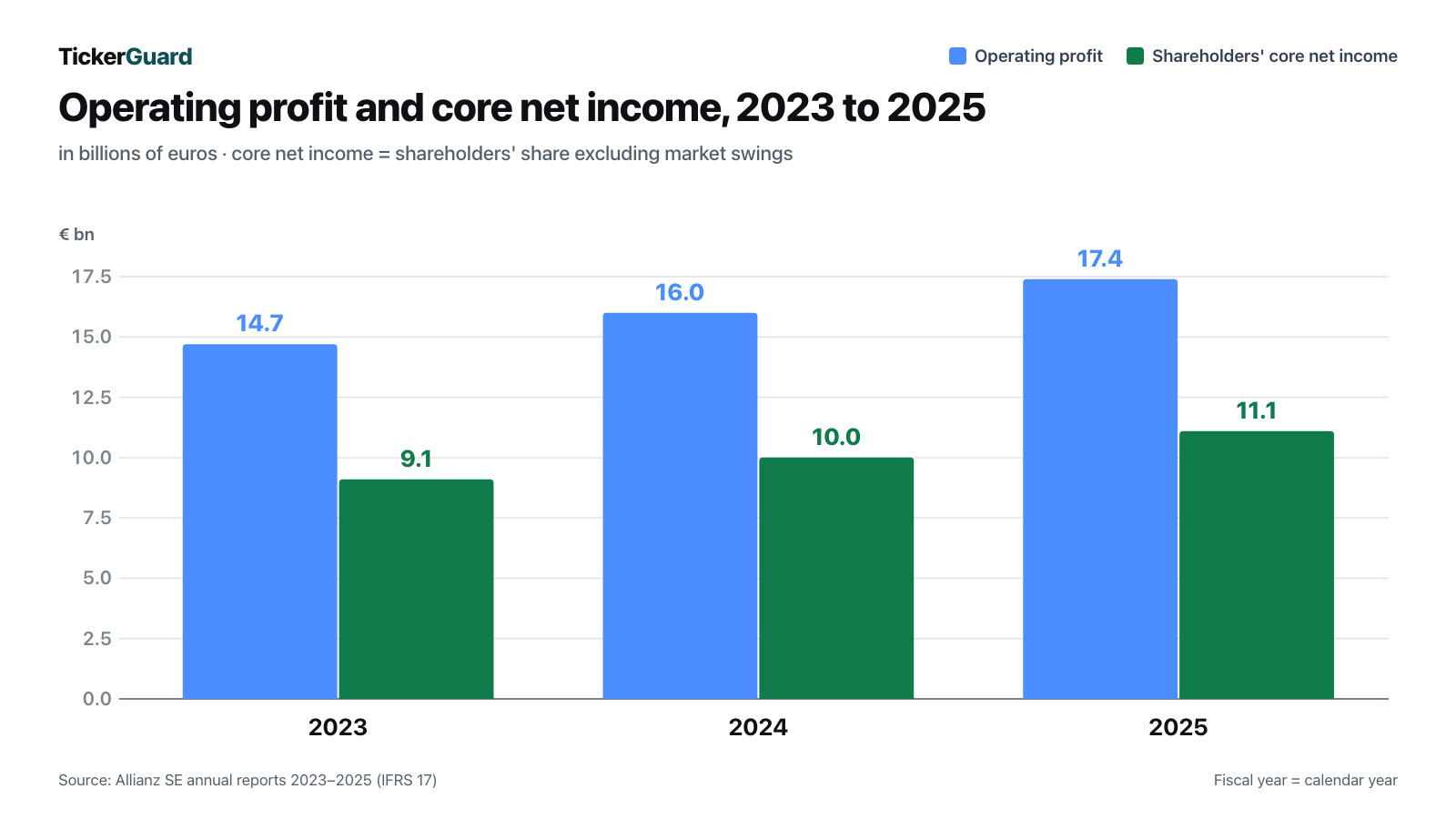
First, what deserves credit — and there is plenty. Since the switch to the IFRS 17 accounting standard (from 2023), operating profit rose from €14.7 billion (2023) to €16.0 billion (2024) and €17.4 billion (2025). Shareholders’ core net income — profit excluding capital market swings, in other words what the business itself earns — climbed from €9.1 billion to €10.0 billion and €11.1 billion. Per share, that was €28.61 in 2025, up 12.5 percent from 2024.
2026 is on plan so far. In the first half, operating profit rose 8.6 percent to €9.4 billion — 54 percent of the full-year outlook of €17.4 billion (plus or minus €1 billion). Asset management attracted €84 billion of new client money in the half-year, a record. The major rating agencies rate its financial strength AA (S&P) and Aa2 (Moody’s), both with a stable outlook (as of August 7, 2026) — the league in which creditors have little doubt about the ability to pay.
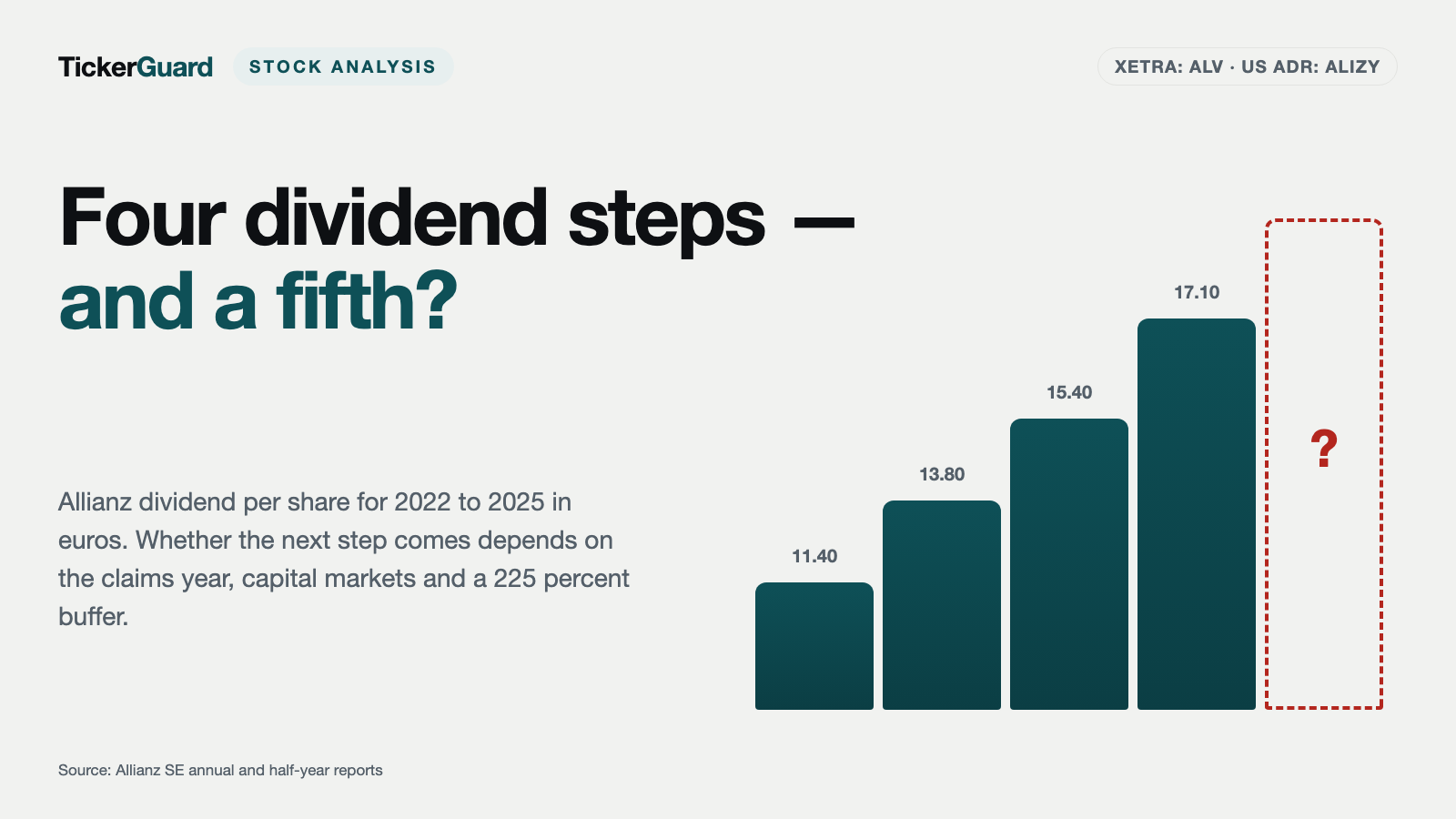
And then the dividend, the favorite number of many Allianz shareholders: €11.40 for 2022, €13.80 for 2023, €15.40 for 2024 and €17.10 for 2025 — a four-step staircase, most recently up 11.0 percent. The rule behind it is in the annual report: 60 percent of adjusted group net income goes to shareholders as a dividend, and the dividend should be at least as high as the year before. On top come share buybacks — twelve programs totaling €16.0 billion from 2017 to 2025. Remember: Allianz earns its money twice — by insuring and by investing. As long as both work, the staircase keeps climbing.
Uncomfortable truth no. 1: The record half-year contains a one-off gain
The headline for the first half of 2026 read: core net income up 15.5 percent to €6.4 billion, earnings per share up 17.5 percent to €16.44. Look closer and you find two things. First: in the first quarter of 2026, Allianz booked a gain of €1.1 billion from selling its 26 percent stakes in the Indian insurers of the Bajaj group. Second: in the second quarter on its own, core net income fell. Allianz says so itself:
“Shareholders’ core net income was at 2.6 (3.0) billion euros; 12.7 percent below last year. Adjusted for the divestment gain on the UniCredit Joint Venture last year and offsetting measures following the sale of the stake in our Indian Joint Ventures this year, the underlying growth was strong at 10 percent.”
— Allianz SE, Earnings release 2Q and 6M 2026, August 7, 2026

This is no trick — Allianz discloses the effects figure by figure: plus €1.1 billion Bajaj gain in the first quarter of 2026, minus €0.5 billion from offsetting measures in the first half, and in the prior year plus €0.3 billion from the UniCredit joint venture and minus €0.1 billion for an Indian tax provision. Adjusted, core net income grew 9 percent in the half-year and earnings per share 10 percent. That is good — but it is not 17.5 percent. The “offsetting measures” are explained in the annual report: Allianz plans to use the Indian gain over the course of 2026, “most likely weighted to the second half”, for growth and productivity projects and to sell bonds at a loss so it can reinvest the money at higher yields. Remember: a record number with a footnote is still a record — but the footnote decides how much of it comes back.
Uncomfortable truth no. 2: The 225 percent has a footnote — and hangs on the markets
The Solvency II ratio is to an insurer what the height of a levee is to a river town. The regulator calculates how much capital is needed to survive an extremely bad year — statistically, one that occurs only once every 200 years. 100 percent means: just enough. Allianz reported 225 percent as of June 30, 2026. The footnote:
“Based on quarterly dividend accrual; additional accrual to reflect FY dividend would impact Solvency II capitalization ratio by -7%-p as of June 30, 2026.”
— Allianz SE, Earnings release of August 7, 2026, footnote 4

With the full dividend, then, it is 218 percent — the half-year report says the same. That is exactly the year-end 2025 level. Part of the half-year increase also came from the Bajaj sale, a measure that does not repeat. Still more than double the regulatory minimum — but not a jump.
More important is how sensitive the ratio is to markets. The 2025 annual report does the math: if equity prices fall 30 percent, the ratio drops from 218 to 205 percent. Add interest rates 0.5 percentage points lower and credit spreads 0.5 percentage points wider at the same time, and it lands at 196 percent.
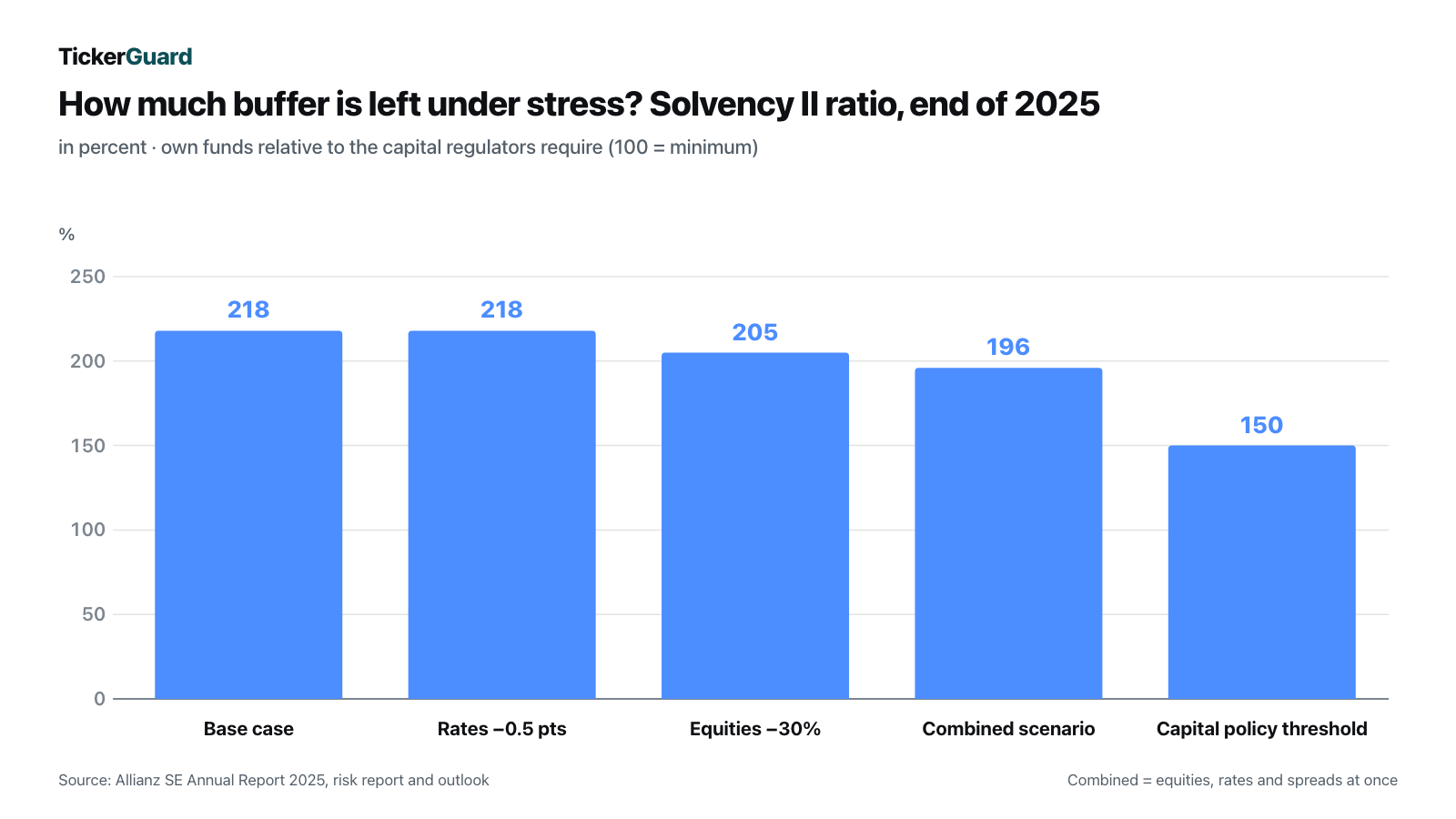
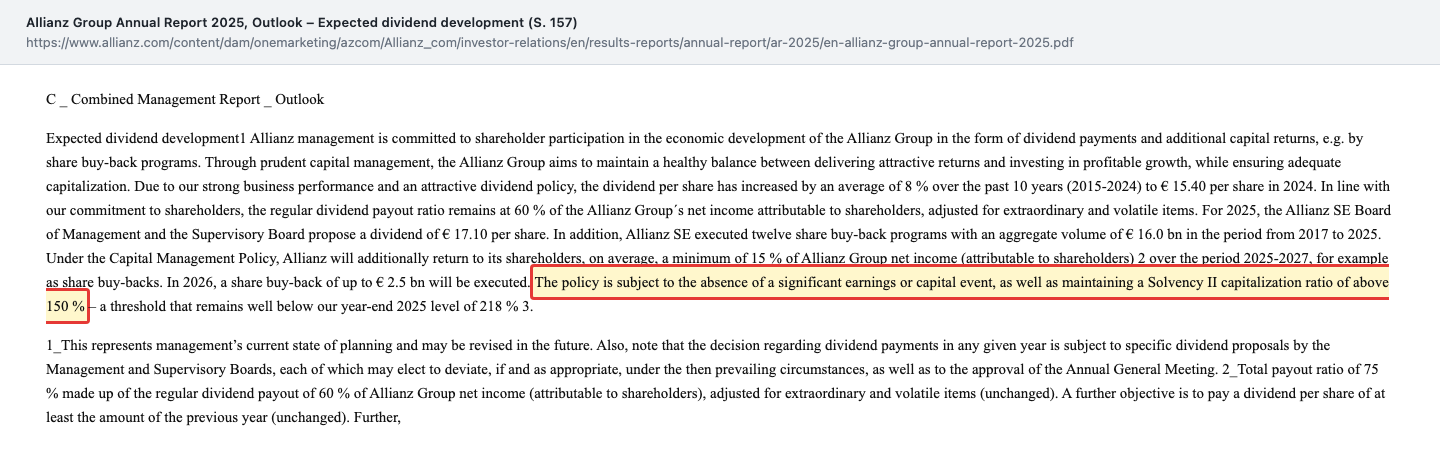
The 150 percent is the line that matters for dividend hunters. The payout policy comes with a condition:
“The policy is subject to the absence of a significant earnings or capital event, as well as maintaining a Solvency II capitalization ratio of above 150 %”
— Allianz SE, Annual Report 2025, Outlook – expected dividend development, page 157
Between 218 and 150 percent there is a wide safety margin, and even the combined stress scenario keeps it. Honestly, that is more strength than weakness. The uncomfortable part is simply the realization that the dividend staircase is not a law of nature but a policy with conditions. Remember: a levee is only as safe as the highest flood it was built for — and Allianz openly shows where its line is.
Uncomfortable truth no. 3: 2026 is a year of big spending
Allianz earns a lot — and in 2026 it is also spending a lot. In July and August 2026 alone it announced three deals that appear in the half-year report as events after the reporting date (note 8.12): for the insurer HSBC Life Singapore and a 15-year distribution agreement with HSBC Singapore it is paying a combined €2.0 billion (closing expected in the first half of 2027). Allianz Global Investors is buying UOB Asset Management for SGD 555 million, about €376 million (closing expected in 2027). And at PIMCO, Allianz is ending a legacy equity plan for employees:
“As former employees hold a 4.4 % ownership in PIMCO in total, Allianz will pay a consideration of at least € 1.4 bn in cash at closing in accordance with the M-unit Plan rules.”
— Allianz SE, Interim Report for the First Half-Year of 2026, note 8.12 (subsequent events), page 59
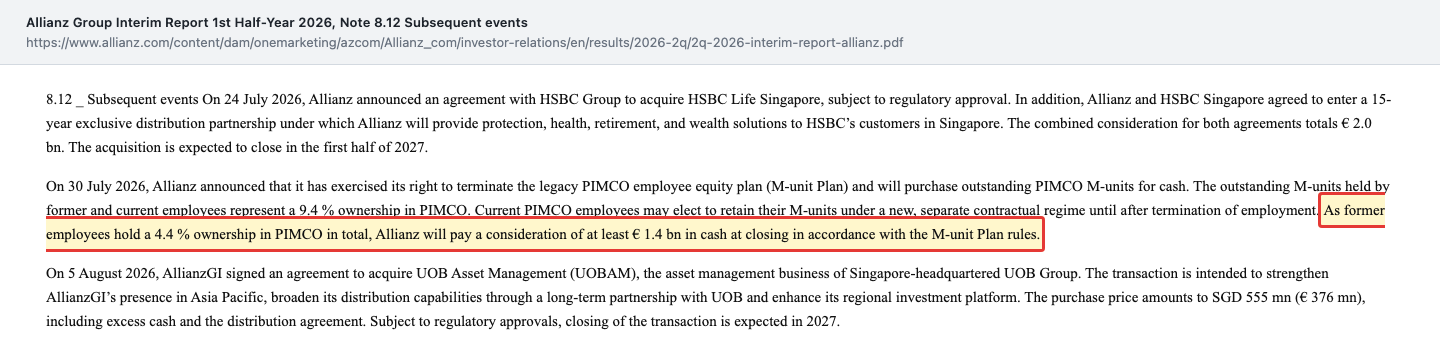
This surprises many: PIMCO, one of the world’s largest bond managers, is not 100 percent owned by Allianz. The so-called M units — stakes granted to employees between 2008 and 2020 — represent 9.4 percent of PIMCO. Current employees may keep their 5.0 percent for now; when those come back later, another payment will be due, and nobody knows its size today.
Let’s add it up: the dividend for 2025, paid in May 2026: €6.5 billion. The 2026 share buyback: up to €2.5 billion, €1.4 billion of it done by the end of June; by September 18, 2026, Allianz had bought back 6,065,345 of its own shares according to its mandatory notices. Plus HSBC Life Singapore (€2.0 billion), the PIMCO stakes (at least €1.4 billion) and UOB Asset Management (€0.4 billion). Together that is about €12.8 billion — more than the entire 2025 core net income of €11.1 billion, spread across 2026 and 2027. Allianz says the acquisitions should pay off over time (for HSBC Singapore a “double-digit return on investment in the mid-term”). Whether that works will only show in years. Remember: a company that earns a lot may spend a lot — but every euro can only be spent once: on acquisitions or on you.
Uncomfortable truth no. 4: Growth is getting harder — and asset management has a history
Beneath the records there are places where it creaks. In life and health, the present value of new business premiums (PVNBP) fell 4.9 percent to €43.4 billion in the first half of 2026, and the value of new business dropped 8.1 percent to €2.4 billion — adjusted for currency effects and the sale of UniCredit Allianz Vita, the present value rose 3 percent. In commercial property-casualty, internal growth was just 1 percent in the second quarter. And in the United Kingdom, the half-year report says the loss ratio worsened given an “increasingly challenging market environment”.
CEO Oliver Bäte is remarkably candid about pricing in the earnings release of August 7, 2026: “Insurance costs are rising faster than disposable income, and we take that challenge seriously.” For an insurer whose 2025 profit jump came largely from better pricing and loss ratios, that is an important sentence: price increases have a limit — and it sits in the customer’s wallet.
Then there is a legacy issue that shows how expensive mistakes in asset management can get. On May 17, 2022, the U.S. securities regulator, the SEC, announced that the U.S. unit Allianz Global Investors U.S. had misled investors about the risks of its “Structured Alpha” strategy, which lost billions in the March 2020 COVID crash. The unit paid more than $1 billion to the SEC, and together with Allianz SE more than $5 billion in restitution went to victims. Legally the chapter is largely closed: according to the 2025 annual report, a shareholder class action against Allianz was dismissed in June 2024, and the appeal failed in June 2025. For how PIMCO and Allianz Global Investors compare with a pure-play asset manager, see our DWS analysis. Remember: big numbers hide small cracks — you only see them when you look at the segments.
Valuation: about €159 billion for a record earner
At the Xetra closing price of €425.50 on September 28, 2026, Allianz was worth about €159 billion with roughly 374.2 million shares outstanding (380.2 million at the end of 2025 minus the 6.07 million bought back through September 18, 2026). Measured against 2025 core earnings per share of €28.61, that is a price-to-earnings ratio of about 15 — you are paying roughly 15 years of core earnings. The €17.10 dividend works out to a yield of about 4.0 percent at the same price. Shareholders’ equity stood at €62.9 billion on June 30, 2026, so the market value is about 2.5 times book value. The automatic key-figures box on this page may show a higher market value and a lower P/E: it comes from fundamental data and uses a different share count and earnings base; our calculation deducts the buybacks through September 2026 and uses core earnings per share.
How to read that? For a group with a core return on equity of 18.1 percent (2025), two and a half times book is no bargain, but no exaggeration either: a company that earns €18 on every €100 of equity each year is worth more than its book value. For context: in early September 2026, Allianz paid about €450 per share in its buybacks according to its mandatory notices, and in mid-September between about €443 and €450. That tells you only so much: the group buys back on a fixed schedule, not on a view about the price.
Opportunities and risks at a glance
What speaks for Allianz:
- Record earnings power: operating profit of €17.4 billion (2025), €9.4 billion in the first half of 2026 (+8.6 percent), 2026 outlook €17.4 billion plus or minus €1 billion.
- Three pillars, not one: property-casualty, life/health and asset management all contributed billions in profit in 2025.
- Capital strength: Solvency II ratio of 218 percent with full dividend accrual (June 30, 2026), 196 percent in the combined stress scenario; ratings AA (S&P) and Aa2 (Moody’s).
- Reliable payouts: dividend up from €11.40 (2022) to €17.10 (2025), 60 percent target payout plus buybacks; minimum goal: not below the prior year.
- Record asset-management inflows: €84 billion in the first half of 2026, €2.161 trillion of third-party assets under management.
What speaks against it:
- One-offs in the first half of 2026: a €1.1 billion Bajaj gain; excluding special effects, core net income grew 9 rather than 15.5 percent, and in the second quarter it fell 12.7 percent as reported.
- A capital ratio with a footnote: 225 percent only with quarterly dividend accrual, 218 percent with full accrual; a 30 percent equity drop costs 13 points.
- Heavy capital commitments: about €12.8 billion for the dividend, buyback and three acquisitions in 2026/2027; further PIMCO payments possible.
- Harder growth: life/health new business −4.9 percent in the half-year, commercial +1 percent in the second quarter, a tough UK market, a pricing limit at the customer.
- Natural catastrophes and capital markets remain, by Allianz’s own account, the biggest source of uncertainty for any outlook; ALIZY holders also carry euro-dollar currency risk.
A human conclusion
Back to the familiarity trap. The good feeling about Allianz is not unfounded: the numbers are strong, the balance sheet is robust, and the group lays its one-offs, stress scenarios and conditions on the table with remarkable openness. If you read up, you find no skeleton in the closet. But you do find a half-year that shone partly thanks to a one-off gain, a capital ratio you have to read together with its footnote, and a year in which billions are earmarked for acquisitions and payouts. Familiarity is a good reason to look closer — not a reason to skip the look. The next chance to check comes on November 12, 2026, with the figures for the first nine months. What you make of it is your decision. And that is exactly as it should be.
Sources
All original documents used in this analysis — for your own reading:
- Allianz SE — Interim Report for the First Half-Year of 2026 (August 7, 2026) — the most recent periodic report; Solvency II capitalization (pages 5 and 15), equity and buyback (page 24), earnings per share (page 57), note 8.12 subsequent events (page 59)
- Allianz SE — Earnings release 2Q and 6M 2026 (August 7, 2026) with results table, ratings and financial calendar
- Allianz SE — IR releases on UOB Asset Management (August 5, 2026), termination of the PIMCO M Unit Plan (July 30, 2026), HSBC Life Singapore (July 24, 2026) and Board of Management changes (July 24, 2026); inside information (latest ad hoc disclosure February 25, 2026, checked September 29, 2026)
- Allianz SE — buyback notice of September 22, 2026 (6,065,345 shares through September 18, 2026)
- Allianz SE — Allianz Group Annual Report 2025 (key figures, outlook and dividend policy pages 156–157, Solvency II sensitivities page 174, share capital, legal proceedings) and full-year 2025 earnings release (February 26, 2026)
- Allianz SE — earnings releases for fiscal years 2024 (February 28, 2025) and 2023 (February 23, 2024)
- Allianz SE — company articles “Responsible Use of AI at Allianz” (March 18, 2026) and partnership with Anthropic (January 9, 2026)
- U.S. Securities and Exchange Commission — press release 2022-84 of May 17, 2022 on Structured Alpha; ADR program registration (Form F-6EF) of March 6, 2018: 1 ALIZY certificate = 1/10 Allianz share, depositary JPMorgan, Rule 12g3-2(b) exemption; Allianz SE filing index (Form 25 of October 14, 2009, Form 15F of October 30, 2009)
- Price: Xetra closing price of €425.50 on September 28, 2026; market value, P/E, price-to-book and yield calculated by us. Other metrics: Source: fundamental data.
Transparency & disclaimer: This analysis is a journalistic assessment of publicly available information. It is not investment advice, not a financial analysis in the regulatory sense and not a solicitation to buy or sell securities. Investing in stocks involves substantial risk, up to and including total loss. All information without guarantee; the date of each data point is noted in the text. Positions held by the operator are disclosed daily; where one exists, it appears as a notice at the top of this deep dive.
Our Bottom Line at a Glance
- Earnings power positive
- Record operating profit of €17.4bn (2025), €9.4bn in H1 2026 (+8.6%); all three segments ahead of the midpoint of their full-year outlook (08/07/2026).
- Earnings quality 2026 neutral
- H1 2026 core net income +15.5%, adjusted for a €1.1bn Bajaj gain and other special effects +9%; Q2 −12.7% as reported.
- Capital strength positive
- Solvency II 225% (06/30/2026), 218% with full dividend accrual; 196% in the combined stress scenario (end of 2025), well above the 150% threshold of the capital policy.
- Capital deployment neutral
- About €12.8bn for dividend, buyback and acquisitions (HSBC Life Singapore €2.0bn, PIMCO M units ≥ €1.4bn, UOBAM €0.4bn) in 2026/2027.
- Core business growth neutral
- Life/health new business −4.9% in H1 2026 (adjusted +3%), commercial +1% in Q2, UK market tough; record €84bn inflows in asset management.
- Governance history neutral
- Structured Alpha resolution in 2022 (SEC, over $6bn combined); shareholder class action dismissed in 2024, appeal failed in 2025 (Annual Report 2025).
Allianz is a broadly diversified, highly profitable insurer and asset manager with a strong capital cushion. In 2026, though, the half-year also shines thanks to one-offs, the capital ratio has to be read with its footnote, and the dividend, buyback and acquisitions tie up about €12.8 billion. Not investment advice.
What Our Rating Means
Quality confirmed
Business model, numbers and balance sheet hold up to our review. Whether the current price supports an entry is a separate question — it hangs on the price, not on the company.
Green here stands for documented quality of the company: the business model holds across three segments, operating profit has risen every year since 2023, the Solvency II ratio stays at 196 percent even in the combined stress scenario, and the ratings sit in the AA range. The open points — one-offs in the first half of 2026, heavy capital commitments, weaker life/health new business — are questions of earnings quality and capital deployment, not threats to the company’s substance. Whether the stock is cheap at €425.50 (September 28, 2026) is not what this rating says. The decision is yours.
A journalistic assessment by our editorial team at the time of the deep dive, based on public sources — not investment advice and not a solicitation to buy or sell. Your personal circumstances (investment goals, risk capacity, taxes) cannot be taken into account. What our levels mean, how verdicts are formed, and what conflicts of interest exist →
Worth Noting
- Version of September 29, 2026, based on the 2025 Annual Report, the Interim Report for the first half of 2026 (the most recent periodic report), the earnings releases 2023 to 2026 and mandatory notices through September 22, 2026. Allianz landed on our research list through the U.S. ticker ALIZY, not through a scanner hit.
- Allianz has not reported to the U.S. SEC since 2009 (Rule 12g3-2(b) exemption); all evidence comes from the original reports on allianz.com and is quoted in the English original. Earnings call transcripts were not available.
- Market value, P/E, price-to-book and yield as well as the sum of capital commitments (€6.5 + 2.5 + 2.0 + 1.4 + 0.4 billion) are calculated by us from company data and the Xetra closing price of September 28, 2026. Do not confuse ALIZY (U.S. certificate, 1/10 share, in dollars) with ALV (original share in euros).
The full analysis as a PDF for later
We will send you this analysis as a PDF — to print, file away, and read at your own pace.
Frequently Asked Questions
ALIZY is an American Depositary Receipt: a certificate issued by JPMorgan that represents one-tenth of an Allianz share and trades over the counter in the U.S. in dollars. The original share trades as ALV on Xetra in euros. Since leaving the New York Stock Exchange in 2009, Allianz no longer files annual reports with the SEC.
For fiscal 2025, Allianz paid €17.10 per share, 11.0 percent more than the year before; a total of €6.5 billion went out in May 2026. The policy targets 60 percent of adjusted group net income and at least the prior-year dividend. At €425.50 per share (September 28, 2026), that is a yield of about 4.0 percent.
It compares own funds with the capital regulators require to survive an extremely bad year; 100 percent is the minimum. Allianz reported 225 percent as of June 30, 2026, or 218 percent with the full-year dividend. Payouts are tied to a ratio above 150 percent; in the combined stress scenario it stood at 196 percent at the end of 2025.
Shareholders’ core net income was €2.6 billion in the second quarter of 2026, 12.7 percent below the prior year. Allianz attributes this to a divestment gain from the UniCredit joint venture in the prior-year quarter and to offsetting measures after the sale of its Indian stakes. Adjusted, profit grew 10 percent; operating profit rose 10.6 percent.
No. Employees and former employees hold 9.4 percent of PIMCO through so-called M units. On July 30, 2026, Allianz terminated the plan: for the former employees’ 4.4 percent it will pay at least €1.4 billion in cash at closing. Current employees may keep their units for now.
According to its financial calendar, Allianz publishes results for the third quarter and first nine months of 2026 on November 12, 2026. For full-year 2026 the group targets an operating profit of €17.4 billion, plus or minus €1 billion; after the first half, 54 percent of that had been reached.
Found an error?
Did you spot a factual error, an outdated number, or a typo in this deep dive? Let us know briefly — your report goes straight to the editorial team.