Niagen Bioscience: The Science Bonus of a Vitamin Company That Now Wants to Be a Drug Company
Niagen Bioscience — ChromaDex until March 2025 — is at its core a vitamin-supplement business built around Tru Niagen. Since summer 2026 it talks like biotech: a telehealth platform for at-home injections, a drug candidate carrying FDA rare-disease status. The SEC filings show a genuine turnaround alongside that ($129.4 million revenue and $17.4 million profit in 2025) — but also a revenue decline in the latest quarter, an 83 percent collapse in operating cash flow, ongoing stock buybacks next to a brand-new $50 million share-sale program, and total dependence on a single, patent-protected supplier, W.R. Grace. Not investment advice — just a look at what is really behind the name.
 Thomas Mücke
Founder & Publisher
Thomas Mücke
Founder & Publisher
As of Today
As of: October 12, 2026
- Closing price
- 2.60 $ -2.20%
- Market Capitalisation
- 0.2 $B
- P/E
- 13.2
- Growth Score
- 9/10
- AAQS
- 6/10
Price change since August 28, 2026: -19.8%
This analysis has a cut-off date. The Stock Guard tells you when something material changes in the numbers. Reserve your free spot
Chart
Interactive price chart (TradingView).
52-week range: 2.60 $ to 7.60 $ · Last price: 2.60 $ (As of: October 12, 2026)
Note: pure fact-based analysis, not investment advice and not a solicitation to buy or sell. All figures without guarantee.
There's an investor trap that catches the careful ones especially — because it feels like the opposite of a gut call: the science bonus. It works like this: you read "coenzyme," "more than 525 published clinical studies," "U.S. Food and Drug Administration special status for a rare disease" — and your brain quietly shifts up a gear. "This is real science, not supplement-aisle hype." And because it is real science, you skip the step you'd normally take first with any other stock: reading the plain numbers. Niagen Bioscience, Inc. (Nasdaq: NAGE) of Los Angeles — known as ChromaDex Corporation until a year and a half ago — is exactly this case. At its core, the company sells a vitamin supplement called Tru Niagen on Amazon and its own website. But since the rebrand and the announcement of an in-house drug candidate in the summer of 2026, it talks like a biotech company on the verge of a breakthrough. So let's make a deal: before you buy the narrative or dismiss it, let's read together what the company itself told the U.S. securities regulator, the SEC — the annual report (Form 10-K) for 2025, the quarterly report (Form 10-Q) for the period ended June 30, 2026, and the mandatory filings around them. An SEC filing is honest under penalty of law. By the end, you decide whether the science carries the numbers — or just sounds good.
What Niagen Bioscience actually does — from supplement maker to drug bet
The name is new, and it says everything: according to the 2025 annual report (Form 10-K), the company changed its name from ChromaDex Corporation to Niagen Bioscience, Inc. effective March 19, 2025 — and with the name, its Nasdaq ticker from CDXC to NAGE.
"Effective March 19, 2025, the Company changed its name to 'Niagen Bioscience, Inc.'. In connection with the Company's new name, the Company changed the ticker symbol for the Company's common stock on Nasdaq, to 'NAGE'."
— Niagen Bioscience, Inc., Form 10-K for 2025, Item 1 "Company Overview"

The ChromaDex name dates to 2008 (the shell company traded as "Cody Resources, Inc." before that); 2013 brought the food-grade ingredient Niagen® itself, 2016 the Nasdaq listing, and 2017 the acquisition of Healthspan Research LLC and the consumer brand Tru Niagen®. In plain terms: Niagen is the patented form of nicotinamide riboside chloride (NRC), a building block for NAD+ — a coenzyme every cell in the body needs for its metabolism, and one that provably declines with age. Tru Niagen is the consumer capsule meant to deliver that building block; alongside it, the company sells the same ingredient as a raw material to other brands and pharmaceutical partners (the "Ingredients" segment). Until February 2026, there was a third, small segment: Analytical Reference Standards and Services, a lab-reagents business that was sold. Summer 2026 brought two additions that fuel the science bonus: Niagen Plus, a telehealth platform for pharmaceutical-grade Niagen delivered as an at-home injection (LegitScript-certified since June 2026), and NB4168, an oral drug candidate for the rare genetic disease Ataxia-Telangiectasia (A-T), for which the FDA granted Rare Pediatric Disease status and the European Medicines Agency (EMA) granted Orphan status in the summer of 2026. The company also engaged the contract research organization Evotec for preclinical work it expects to begin in the third quarter of 2026, per the earnings press release for the second quarter of 2026 (Exhibit 99.1 to the Form 8-K dated August 4, 2026).
"In July 2026, we publicly introduced NB4168, our proprietary lead investigational therapeutic candidate for the treatment of Ataxia-Telangiectasia (A-T). […] More recently, the U.S. Food and Drug Administration granted Rare Pediatric Disease (RPD) designation for NB4168 for the treatment of AT, and the European Medicines Agency (EMA) granted Orphan Medicinal Product Designation (OMPD) for NB4168, supporting our plans to advance the program globally."
— Niagen Bioscience, Inc., Form 10-Q for the period ended June 30, 2026, "Recent Developments"

Just how early this drug bet really is shows up in the segment numbers further down: the "pharmaceutical segment" generated zero dollars of revenue in the 2025 annual report. That's not a knock on the underlying science — we've seen the same pattern at other companies chasing rare-disease designations, such as the gene-therapy company Atrium Therapeutics — it's a matter of framing: an FDA special status speeds up a regulatory process; it does not substitute for clinical efficacy data or an actual approval. For now, the real money is still made by the vitamin capsule, not the pharma promise. That is the central tension of this analysis, and it runs through every chapter: the company's communications increasingly sound like biotech — its balance sheet and revenue sources are still more than 97 percent a consumer-products business whose growth has noticeably slowed.
Company history for investors
-
2008
Renamed ChromaDex Corporation
The shell company Cody Resources becomes ChromaDex — the starting point of today's corporate history.
-
2016
Nasdaq listing
ChromaDex lists on the Nasdaq — from here, the stock is freely tradable for retail investors.
-
2017
Healthspan Research acquisition, Tru Niagen launch
The acquisition creates the consumer brand Tru Niagen — still the company's largest revenue source today.
-
2024
First profitable fiscal year
After years of consistent losses, the company earns money for the first time: $8.6 million in net income.
-
2025
Renamed Niagen Bioscience, new ticker NAGE
On March 19, ChromaDex officially becomes Niagen Bioscience — the name signals the new pharmaceutical ambition.
-
2026
Sale of the lab-reagents business (ARS)
In February the company exits its smallest segment and books a gain on the sale.
-
2026
Drug candidate NB4168 and $50 million share program
In July, FDA special status for the drug candidate and a large new share-sale program arrive almost together.
How this stock landed on our desk
The trigger was an SEC filing dated July 10, 2026: a prospectus supplement (Form 424B5) under which Niagen Bioscience set up a stock-sale program of up to $50 million — an "at-the-market" facility that lets the company sell new shares into the market at any time through two banks, Canaccord Genuity and Roth Capital Partners. On its own, that would be a footnote. It gets interesting next to a second, equally SEC-disclosed number from the same quarterly report: in that same half-year, the same company bought back $5.1 million of its own stock — under a repurchase program launched in November 2025 and expanded to $20 million in March 2026. A company that pulls shares off the market with one hand while flinging the door wide open for up to $50 million of fresh equity with the other raises a simple question: what is the money actually needed for, and who ends up owning more or less of the company as a result? That's the point where we dug in further.
The numbers over the years — an honest look
First, what genuinely speaks for Niagen Bioscience — and it's a lot. The company pulled off a full turnaround in five years: from a business that lost money every year to one that earned $17.4 million in 2025. Revenue nearly doubled over that stretch, from $67.4 million (2021) to $129.4 million (2025), up 30 percent in the most recent year alone. Look at the curve:
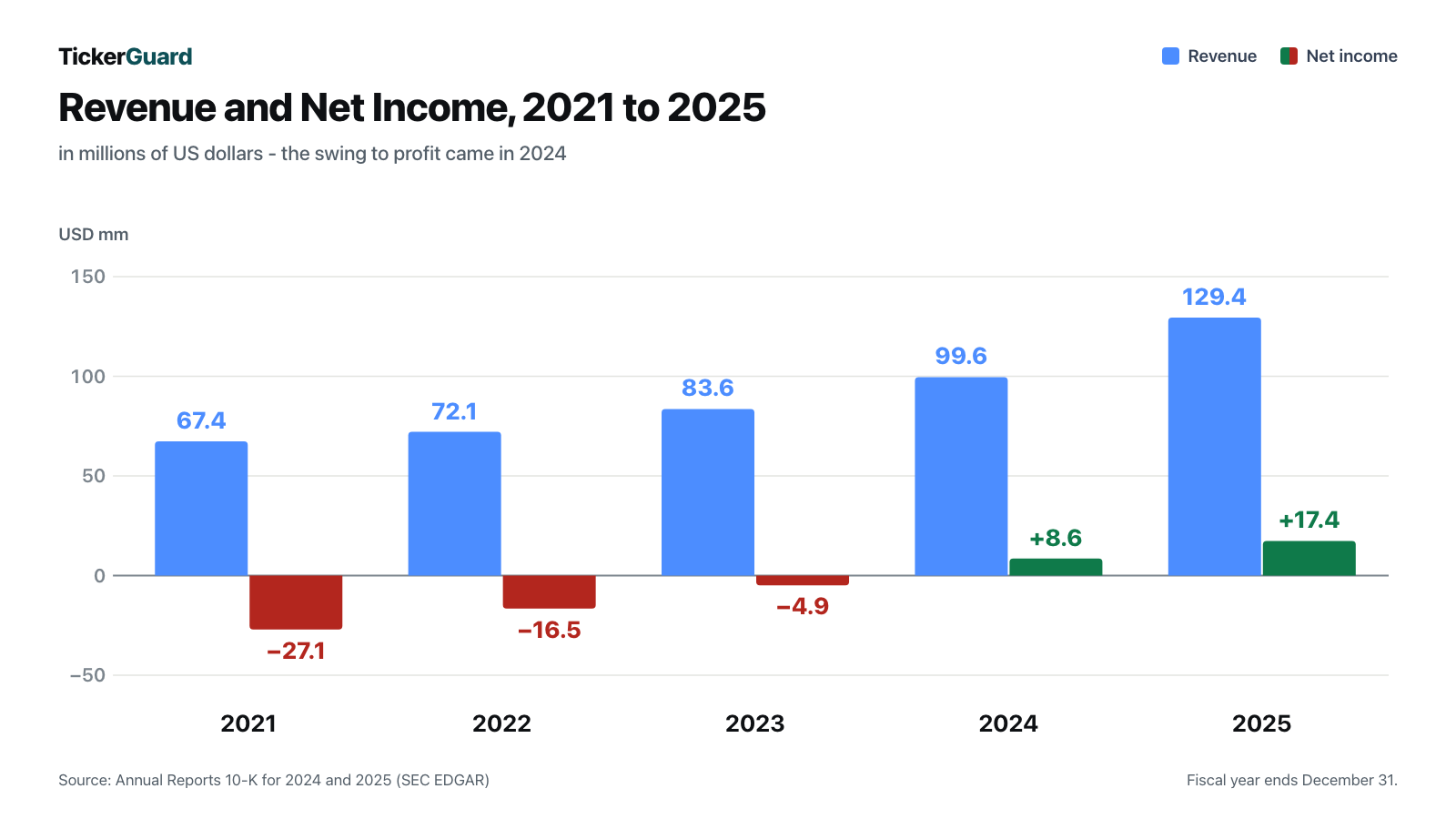
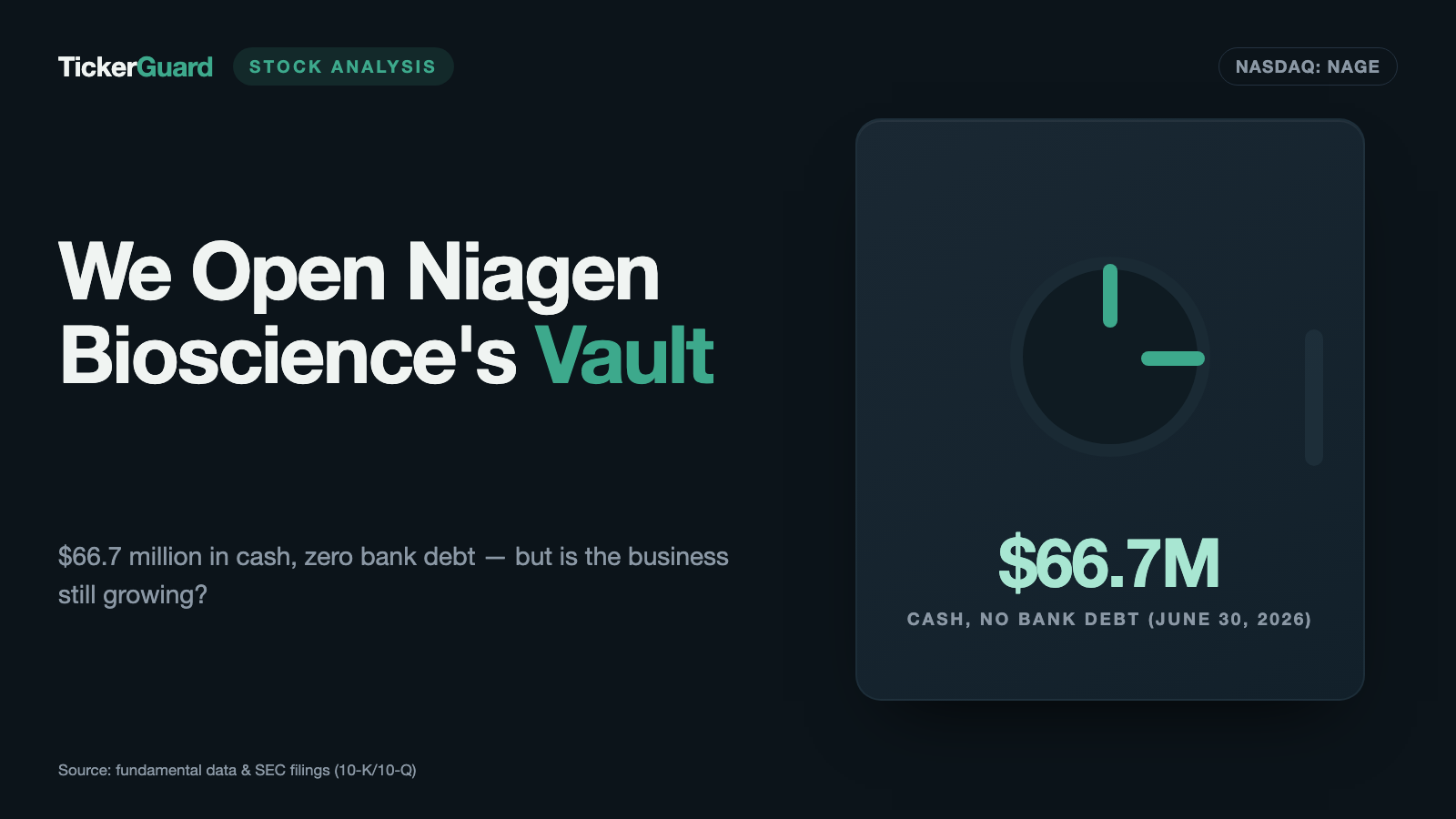
And that profit is largely real, not just accounting polish: of the $16.3 million in operating income for 2025, about $2.0 million came from a one-time item — the settlement of a royalty dispute with Queen's University Belfast — according to the annual report. The remaining roughly $14 million came from the ongoing business. The balance sheet as of June 30, 2026 is notably solid for a company this size, too: $66.7 million in cash, zero outstanding bank debt, and an undrawn $10 million credit line with Western Alliance Bank running through 2027. Customer concentration also improved over the year: in 2024, 12.5 percent of net sales came from a single wholesale customer (A.S. Watson Group) and another 11.7 percent from a second customer; in 2025, according to the annual report, no single customer topped 10 percent of net sales. That's genuine progress on risk. And yet, the last five quarters tell a story that doesn't quite square with this success narrative — more on that next.
What the filings reveal — the uncomfortable truths
Uncomfortable truth No. 1: the growth being marketed has already reversed in the most recent quarter
The five-year curve above is real. But it ends in 2025 — and the most recent quarterly report, filed August 4, 2026, paints a different picture for the second quarter of 2026: net sales came in at $29.8 million, down 4.3 percent from $31.1 million a year earlier. For the first half of 2026 combined, net sales of $61.3 million were essentially flat versus $61.6 million a year earlier. Operating profitability tells an even clearer story: Adjusted EBITDA, a non-GAAP measure the company itself reports to show ongoing operating performance excluding one-time items, has declined for three straight quarters since peaking in the third quarter of 2025 — from $6.4 million down to $3.0 million most recently.
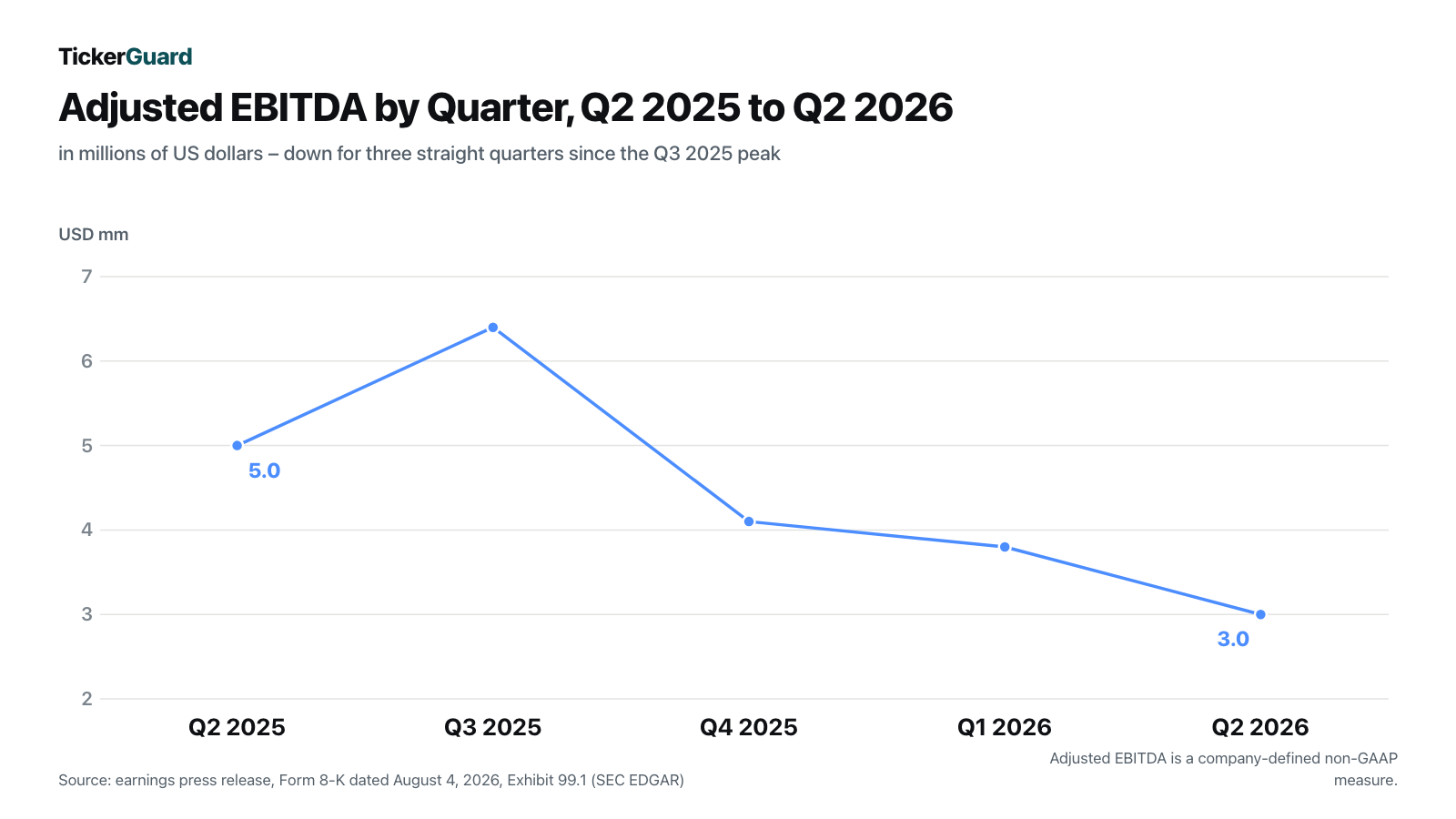
The company itself points squarely at the Ingredients segment — its raw-material sales to partner brands — in its 2026 outlook: it expects lower full-year sales there than in 2025, because "some of our commercial partners continue to face a more competitive market." At the same time, the company explicitly guides to higher spending in 2026 as it invests across sales, research, and administrative functions to build out its new bets — Niagen Plus and NB4168. In plain terms: the existing cash-flow engine is running somewhat slower, while two new, still-unproven engines are being started up that for now only cost money. That can work out. But it is the opposite of the growth story that the name "Bioscience" and the FDA headlines suggest.
Uncomfortable truth No. 2: operating cash flow collapsed 83 percent in a year — while the company kept buying back stock
Profit is an opinion, cash flow is a fact — that holds here too. In the first half of 2026, Niagen Bioscience generated only $1.6 million of cash from operations, down from $9.1 million in the first half of 2025 — an 83 percent decline, against a net income drop of "only" 16 percent ($7.3 million versus $8.7 million). That gap is a warning sign invisible in the headline profit number: it suggests working capital — inventory or receivables — built up while reported profit looked stable. Yet in that same half-year, the company still bought back $5.1 million of its own stock ($2.8 million of it in the second quarter alone) and, in parallel, opened the $50 million share-sale program described above. In fairness, the cash position remains comfortable at $66.7 million, and the company is nowhere near financial distress. But a company whose operating cash flow is collapsing while it keeps repurchasing its own stock owes investors a clear answer on capital allocation — not the other way around.
Uncomfortable truth No. 3: the core raw material comes exclusively from a single supplier that holds the relevant patents
Tru Niagen and every other Niagen product depend on a single chemical building block, nicotinamide riboside chloride (NRC). And that building block comes from exactly one source:
"We rely on a single supplier, W.R. Grace, for NRC and a limited number of third-party suppliers for the raw materials required to produce our products."
— Niagen Bioscience, Inc., 2025 Form 10-K, Risk Factors

This isn't a theoretical risk — it's contractually locked in. W.R. Grace holds its own patents on the crystalline form of NRC that, per the annual report, "limit the availability of alternative sources of supply" for food-grade NRC. The current supply agreement runs through April 30, 2029 per the filing's exhibit schedule and renews automatically unless either side gives notice. A second figure from the same report shows just how financially intertwined the two companies already are: as of December 31, 2025, 43.5 percent of Niagen Bioscience's total accounts payable was owed to this single supplier (2024: 47.2 percent). In plain terms: picture a restaurant whose signature dish depends on one patented ingredient — and the only bakery licensed to make that ingredient bakes it under a recipe the restaurant itself doesn't own. As long as the relationship holds, that's fine. If it breaks, there's no backup plan that kicks in quickly.
What Management Said on the Calls — and What It Actually Delivered
Three full earnings-call transcripts are available from the past year and a half: the third quarter of 2025 (November 4, 2025), the fourth quarter and full year 2025 (March 4, 2026), and the first quarter of 2026 (May 6, 2026). No usable transcript exists yet for the most recent report — the second quarter of 2026, filed August 4, 2026 — so those figures come from the accompanying press release (Exhibit 99.1 to the Form 8-K) instead. Read together, the three available calls make it possible to check what management promised against what the subsequent SEC filings actually showed.
Guidance discipline: from a record year to explicit caution
On the Q3 2025 call, CEO Robert Fried reported record revenue of $34 million (+33%) and raised full-year guidance for the second time, from 22-27% to 25-30% growth. On the full-year call, he looked back: the company had "began the year with an initial top line guidance of 18% growth" and "finished the year at 30%." For 2026, guidance was cut sharply to just 10-15% growth — a clear break from the prior pattern. Analyst Jeffrey Cohen (Ladenburg Thalmann) asked directly whether this was deliberately low, cautionary guidance likely to be revised upward later in the year, or whether management genuinely expected this slower pace. The answer was unusually candid:
"I would say the former more than the latter. I think we've been pretty consistent over the years. We don't want to hype the company or hype the stock. We want to be conservative in our approach and circle revenue that we have a high degree of confidence in."
— Robert Fried, CEO, Q4/full-year 2025 earnings call, March 4, 2026 (per the recorded webcast transcript).
The next quarterly report confirms this wasn't just talk: Q1 2026 revenue grew only 5% (excluding the divested reference-standards segment) — below the newly cut 10-15% range entirely, not just at its low end. The caution flagged on the call matched what actually showed up in the books three months later.
The missed milestone: the NOPARK Parkinson's trial
On the Q3 2025 call, Fried had described the Phase III NOPARK trial, completed in June 2025, in an upbeat tone, pointing to results expected in early 2026. On the following call, covering full-year 2025, Dr. Andrew Shao, Senior Vice President of Scientific and Regulatory Affairs, delivered the outcome:
"Regarding Parkinson's disease, as Rob mentioned in his remarks, the NOPARK study did not achieve its primary end point."
— Dr. Andrew Shao, SVP Scientific and Regulatory Affairs, Q4/full-year 2025 earnings call, March 4, 2026 (per the recorded webcast transcript).
That's a clearly stated failure, not a softened one. The company's response was a pivot: working with Norwegian trial lead Dr. Charalampos Tzoulis, it now plans to study whether the compound works preventively — before disease onset — rather than therapeutically in already-diagnosed patients. That's a plausible course correction, but it is also a new, unproven hypothesis following one that didn't pan out. It's the same caution worth applying to the NB4168 milestones discussed earlier: a procedural step or an announcement is not a result.
Cash flow and competition, in management's own words
On the Q1 2026 call, CFO Ozan Pamir attributed the operating-cash-flow decline described elsewhere in this analysis to two specific, checkable causes: inventory commitments to sole supplier W.R. Grace made "about six months ago," and a new Amazon policy imposing a seven-day hold on sales proceeds — a one-time timing effect. Both explanations are technically plausible and consistent with the balance-sheet figures; management said inventory levels should come down "throughout the remainder of the year" — a claim worth checking against the next report.
On the same call, Fried put a number on the competitive pressure from NMN sellers since the FDA's September 2025 reversal for the first time:
"In fact, there are more than 300 SKUs now on Amazon whereas in September there were zero."
— Robert Fried, CEO, Q1 2026 earnings call, May 6, 2026 (per the recorded webcast transcript).
Pressed for a precise dollar impact on Niagen's own sales, the answer stayed vague: higher keyword-bidding costs and more difficulty acquiring new-to-brand customers, but "I cannot give you a precise number." That's not an unusual hedge — isolating a single competitive effect rarely is precise — but it also means the unspecified reference in the 2026 outlook to a "more competitive market" for the Ingredients segment remains unquantified.
The regulatory backdrop includes not just the FDA but the Federal Trade Commission, which the annual report says polices supplement-industry advertising claims:
"In recent years, the FTC has instituted numerous enforcement actions against dietary supplement companies for failure to adequately substantiate claims made in advertising or for the use of false or misleading advertising claims."
— Niagen Bioscience, Inc., 2025 Form 10-K, "U.S. Advertising Regulations"
No FTC action against Niagen Bioscience itself appears anywhere in the filings reviewed — the passage describes the industry backdrop, not the company. What does stand out is how concentrated distribution is in a single channel: by its own account, the company markets Tru Niagen "primarily through proprietary e-commerce platforms, third-party online marketplaces, and strategic distribution partners," and on the calls reviewed, roughly three-quarters to more than 80% of consumer revenue came from e-commerce — chiefly its own website and Amazon. That's the exact channel where management says the NMN competition described above is driving up advertising costs.
Capital allocation, in management's own numbers
The pace of buybacks can also be reconstructed from the calls: on the full-year 2025 call (March 4, 2026), Fried put cumulative buybacks at just $250,000 out of the $10 million program. Just two months later, on the Q1 2026 call, that figure had jumped to $2.4 million out of a program by then expanded to $20 million — a sharp acceleration that lines up exactly with the swing to negative operating cash flow described above.
How good were the analysts' questions?
The same four firms — Ladenburg Thalmann, Canaccord Genuity, ROTH Capital Partners, and H.C. Wainwright — asked questions on all three calls; the Q1 2026 call also drew two additional firms, Titan Capital and Farmhouse Equity Research. Most of their questions were specific: clinic counts, dosing, gross-margin build, the history of the company's own guidance. Management answered most of them with numbers rather than deflection, with one recurring exception on the NMN competitive question: on the Q3 2025 call the answer was still "we haven't noticed anything yet," and on the Q1 2026 call, asked more pointedly, just as unquantified: "I cannot give you a precise number." Taken together, these three calls show a management team that is candid about strategic pivots but more guarded when it comes to quantifying fresh headwinds — a pattern consistent with the rest of this analysis: a solid core story facing a real, but not precisely measured, rough patch.
Valuation: what the market is paying for Niagen Bioscience
At a share price of $3.24 (as of August 28, 2026) and roughly 78.9 million shares outstanding (as of June 30, 2026, per the quarterly report), Niagen Bioscience carries a market capitalization of roughly $255 million. Measured against trailing four-quarter revenue of about $129.1 million, that's a price-to-sales ratio of just under 2.0 — not expensive for a company with roughly 65 percent gross margin and a patent-protected niche, but not a bargain either given the recent growth slowdown. Measured against trailing four-quarter net income of roughly $16.0 million, the price-to-earnings ratio works out to around 16 — a multiple that fits a mature consumer-products company better than a biotech story trading on approval hopes. Fundamental data show four analyst firms currently covering the stock (two "Strong Buy," two "Buy") with an average price target of roughly $12 — more than triple the current price. With only four firms involved, that's a thin sample that one very bullish analyst can easily skew; we'd treat that number as a rough sentiment indicator, not a reliable price target.
Opportunities and risks at a glance
What speaks for Niagen Bioscience:
- A documented full turnaround: revenue nearly doubled from $67.4 million (2021) to $129.4 million (2025); net income positive for two straight years since 2024 (2025: +$17.4 million), most of it from ongoing operations rather than one-time items.
- A genuinely healthy, debt-free balance sheet: $66.7 million in cash, zero bank debt, an undrawn $10 million credit line through 2027 (as of June 30, 2026).
- Customer concentration meaningfully reduced: two large customers made up roughly 24 percent of sales in 2024; no customer topped 10 percent in 2025.
- A patent-protected niche backed by real science: more than 525 published clinical studies on NAD+, a food-grade ingredient twice successfully reviewed under the FDA's new dietary ingredient (NDI) program, and approvals in Canada, the EU, Australia, and other markets.
- A 2024/2025 legal dispute with competitor Elysium Health resolved in Niagen Bioscience's favor: a $2.65 million settlement payment already fully collected.
What argues against it:
- Growth has reversed in the most recent quarter: net sales down 4.3 percent in Q2 2026; Adjusted EBITDA down for three straight quarters since Q3 2025 (from $6.4 million to $3.0 million); the Ingredients segment guided below last year's level in the company's own 2026 outlook.
- Operating cash flow collapsed 83 percent in the first half of 2026 (to $1.6 million from $9.1 million) even as the company kept buying back stock and simultaneously opened a $50 million share-sale program.
- Complete dependence on a single, patent-protected supplier (W.R. Grace) for the core ingredient NRC — 43.5 percent of all supplier payables relate to this one relationship.
- The drug pipeline (NB4168) is still preclinical: FDA and EMA special designations speed up a process but are not proof of efficacy or approval; the pharmaceutical segment contributed zero revenue in 2025.
- An unusually high withhold vote against two board members at the 2026 annual meeting — roughly 37 and 33 percent withheld, versus 1 to 4 percent for the other six nominees (per the Form 8-K dated June 29, 2026) — plus a mixed track record on past international pushes: a joint venture for the Chinese market set up in 2022 was unwound in late 2024 after the required regulatory approval was never obtained.
A human conclusion
Back to the science bonus from the opening. Its core problem isn't that the science behind Niagen Bioscience is fake or invented — the 500-plus clinical studies on NAD+ are real, the FDA approval history of food-grade Niagen is real, and the turnaround from 2021 to 2025 is real and genuinely impressive. Its core problem is that a compelling scientific story lets you skip the test every investment thesis requires: does the business that actually makes money today support the expectations set by an entirely different, still-unproven story? Anyone investing in Niagen Bioscience today is really buying two very different things: a solid but recently slower-growing consumer-products business with one critical supplier dependency — and an early, unproven drug bet whose FDA headlines so far are procedural milestones, not results. So the honest question isn't "Does this sound like a success story?" It's: would you pay this price if all you had in front of you was the vitamin-capsule business — with no pharma promise stacked on top? If yes, you have a thesis. If no, you had a bonus. What you make of that is your decision. And that's exactly as it should be.
Sources
All original documents used in this analysis, for your own reading:
- Niagen Bioscience, Inc. — Form 10-K for 2025 (filed March 4, 2026)
- Niagen Bioscience, Inc. — Form 10-Q for the period ended June 30, 2026 (filed August 4, 2026)
- Niagen Bioscience, Inc. — Second-quarter 2026 earnings press release, Exhibit 99.1 to the Form 8-K dated August 4, 2026
- Niagen Bioscience, Inc. — 2026 Annual Meeting voting results, Form 8-K dated June 29, 2026
- Niagen Bioscience, Inc. — Prospectus supplement (Form 424B5) for the $50 million at-the-market program (filed July 10, 2026)
- Niagen Bioscience, Inc. — earnings-call transcripts for Q3 2025 (November 4, 2025), Q4/full-year 2025 (March 4, 2026), and Q1 2026 (May 6, 2026), each a recording of the investor-relations webcast
- Full SEC filing history for Niagen Bioscience, Inc.: EDGAR overview (sec.gov)
- Fundamental data (metrics, share price, analyst estimates; as of August 28, 2026), cross-checked against the SEC filings and SEC XBRL financial data series.
Transparency & disclaimer: This analysis is a journalistic assessment of publicly available information and is not investment advice, not a regulated financial analysis, and not a solicitation to buy or sell securities. Equity investments carry substantial risk, including total loss. All figures are provided without guarantee; the data date is noted in the text throughout. Positions held by the operator are disclosed daily; where one exists, it appears as a notice at the top of this deep dive. Not investment advice.
Key figures at a glance
All monetary figures in millions of $; earnings per share as reported.
| Metric | 2021 | 2022 | 2023 | 2024 | 2025 |
|---|---|---|---|---|---|
| Revenue | 67.4 | 72.1 | 83.6 | 99.6 | 129.4 |
| Operating Income (EBIT) | -27.1 | -18.6 | -5.6 | 7.7 | 14.3 |
| Net Income | -27.1 | -16.5 | -4.9 | 8.6 | 17.4 |
| Net Margin | -40.2% | -23.0% | -5.9% | 8.6% | 13.4% |
| Earnings Per Share | -0.40 $ | -0.24 $ | -0.07 $ | 0.11 $ | 0.20 $ |
Source: fundamental data & SEC filings (annual and quarterly reports, 10-K/10-Q)
Our Bottom Line at a Glance
- Turnaround & Operating Substance positive
- Revenue nearly doubled from $67.4 million (2021) to $129.4 million (2025); net income positive for two straight years since 2024 (2025: +$17.4 million), most of it from ongoing operations rather than the $2.0 million one-time gain from a licensing settlement.
- Balance Sheet & Liquidity positive
- $66.7 million in cash, zero bank debt, an undrawn $10 million credit line through 2027 (as of 06/30/2026). Customer concentration meaningfully reduced: no customer topped 10 percent of sales in 2025 (2024: two customers made up roughly 24 percent combined).
- Recent Growth Momentum negative
- Net sales fell 4.3 percent in Q2 2026; Adjusted EBITDA has declined for three straight quarters since Q3 2025 (from $6.4 million to $3.0 million); the Ingredients segment is guided below last year's level in the company's own 2026 outlook.
- Cash Flow Quality & Capital Allocation negative
- Operating cash flow collapsed 83 percent in the first half of 2026 ($1.6 million versus $9.1 million), while the company kept buying back stock ($5.1 million) and simultaneously opened a $50 million share-sale program.
- Supply Chain Dependency negative
- The core ingredient NRC comes exclusively from W.R. Grace, which holds the relevant patents (43.5 percent of all accounts payable in 2025); the agreement runs through at least 04/30/2029, but there is no readily available alternative source.
- Pharmaceutical Pipeline (Optionality) neutral
- NB4168 carries FDA Rare Pediatric Disease and EMA Orphan designations since summer 2026 — genuine procedural accelerators, but without proof of efficacy or approval; preclinical studies are only planned to begin in 2026, and the segment contributed no revenue in 2025.
Niagen Bioscience has completed a genuine turnaround — from consistent losses to $17.4 million of profit in 2025 — and its balance sheet is fundamentally healthy. But the most recent quarterly report shows a growth dip (Q2 2026 net sales down 4.3 percent, Adjusted EBITDA down for three straight quarters) and an 83 percent collapse in operating cash flow, even as the company keeps buying back stock and opens a $50 million share-sale program. The new pharmaceutical ambition (NB4168) is real but unproven and generates no revenue. Not investment advice.
What Our Rating Means
Open questions
The business works in principle, but one material question is open. As long as it stays open, our findings do not carry a quality verdict.
The core business has funded itself for two years running and the balance sheet carries no debt — but a material operating question is open: is the Q2 2026 growth dip a temporary blip in the Ingredients business, or the start of a structural slowdown, at the same time the company is investing in two unproven new bets (Niagen Plus, NB4168) while operating cash flow is falling? Anyone waiting should check the next report for three things: does Adjusted EBITDA stabilize? Does operating cash flow recover? And does the company actually draw on the ATM facility even as it keeps buying back stock? The decision is yours.
A journalistic assessment by our editorial team at the time of the deep dive, based on public sources — not investment advice and not a solicitation to buy or sell. Your personal circumstances (investment goals, risk capacity, taxes) cannot be taken into account. What our levels mean, how verdicts are formed, and what conflicts of interest exist →
Worth Noting
- Niagen Bioscience landed on our research list via an SEC filing dated July 10, 2026 (Form 424B5, a $50 million share-sale program) — a striking contrast with the buyback program running in parallel.
- Until March 19, 2025, the company traded as ChromaDex Corporation under the ticker CDXC; transcripts, filings, and market data from before that date belong to the same legal entity (CIK 0001386570), not a different company.
- Three earnings calls were reviewed (Q3 2025, full-year 2025, Q1 2026); no transcript was available for the most recent report (Q2 2026, Form 8-K dated 08/04/2026), where this assessment relies on the accompanying press release and earnings presentation instead.
- The roughly $12 analyst price target comes from only four firms (as of 08/28/2026) and is a thin, easily skewed sample — not a reliable price anchor.
Stock Watch
This analysis is as of August 29, 2026. Stock Watch will tell you what's changed at NAGE since then.
Later $1 a month per stock — signing up is free, and you'll be the first to know when it launches.
The full analysis as a PDF for later
We will send you this analysis as a PDF — to print, file away, and read at your own pace. And we will add you to the free Stock Watch list for Niagen Bioscience, Inc. (NAGE), so you hear about it when something material in this analysis changes.
Frequently Asked Questions
Niagen Bioscience, Inc. (Nasdaq: NAGE) of Los Angeles sells the consumer brand Tru Niagen ($97.7 million of 2025 revenue) and supplies the patented NAD+ building block Niagen (NRC) as a raw material to partner brands ($28.7 million). Since 2026 it has added the telehealth platform Niagen Plus for pharmaceutical-grade Niagen and the preclinical drug candidate NB4168 for the rare genetic disease Ataxia-Telangiectasia.
The company traded as ChromaDex Corporation from 2008 (and as Cody Resources, Inc. before that). Effective March 19, 2025, per the annual report, it changed its name to Niagen Bioscience, Inc. and its ticker from CDXC to NAGE — a rebrand meant to signal the shift from a pure dietary-supplement maker to a bioscience company with pharmaceutical ambitions.
NB4168 is an oral drug candidate targeting the rare genetic disease Ataxia-Telangiectasia, which Niagen Bioscience publicly introduced in July 2026. The FDA granted Rare Pediatric Disease designation and the EMA granted Orphan status — both procedural accelerators, not proof of efficacy or approval. Preclinical studies through contract researcher Evotec are expected to begin in the third quarter of 2026 per the second-quarter 2026 earnings press release; the pharmaceutical segment generated no revenue in 2025.
Both run in parallel per the SEC filings: a repurchase program (up to $20 million, with $5.1 million used in the first half of 2026) and an "at-the-market" program opened on July 10, 2026 for up to $50 million, from which no shares had been sold as of the quarterly report. The company does not detail its reasoning for the ATM facility; it creates flexibility for future capital needs at a time when operating cash flow has fallen sharply.
Completely, for its core ingredient: the annual report names W.R. Grace as the sole supplier of nicotinamide riboside chloride (NRC), protected by Grace's own patents on the crystalline form of the compound. As of December 31, 2025, 43.5 percent of all accounts payable related to this single relationship; the current supply agreement runs through at least April 30, 2029 and renews automatically.
Three transcripts are available (Q3 2025, full-year 2025, Q1 2026). Management openly cut 2026 growth guidance from 30 percent down to 10-15 percent, disclosed that the NOPARK Parkinson's trial missed its primary endpoint, and for the first time quantified competing NMN listings on Amazon (from zero to more than 300 SKUs since September 2025) — while declining to put a precise number on the resulting sales impact.
At a roughly $255 million market cap (share price $3.24, August 28, 2026), the price-to-sales ratio is just under 2.0 and the price-to-earnings ratio is around 16 (both based on trailing four quarters) — a multiple that fits a mature consumer-products company better than a biotech story trading on approval hopes. An analyst price target of roughly $12 comes from only four firms, a thin sample.
Found an error?
Did you spot a factual error, an outdated number, or a typo in this deep dive? Let us know briefly — your report goes straight to the editorial team.