Atrium Therapeutics Stock: More Cash Than Market Value — and a Core Patent Estate Owned by Novartis
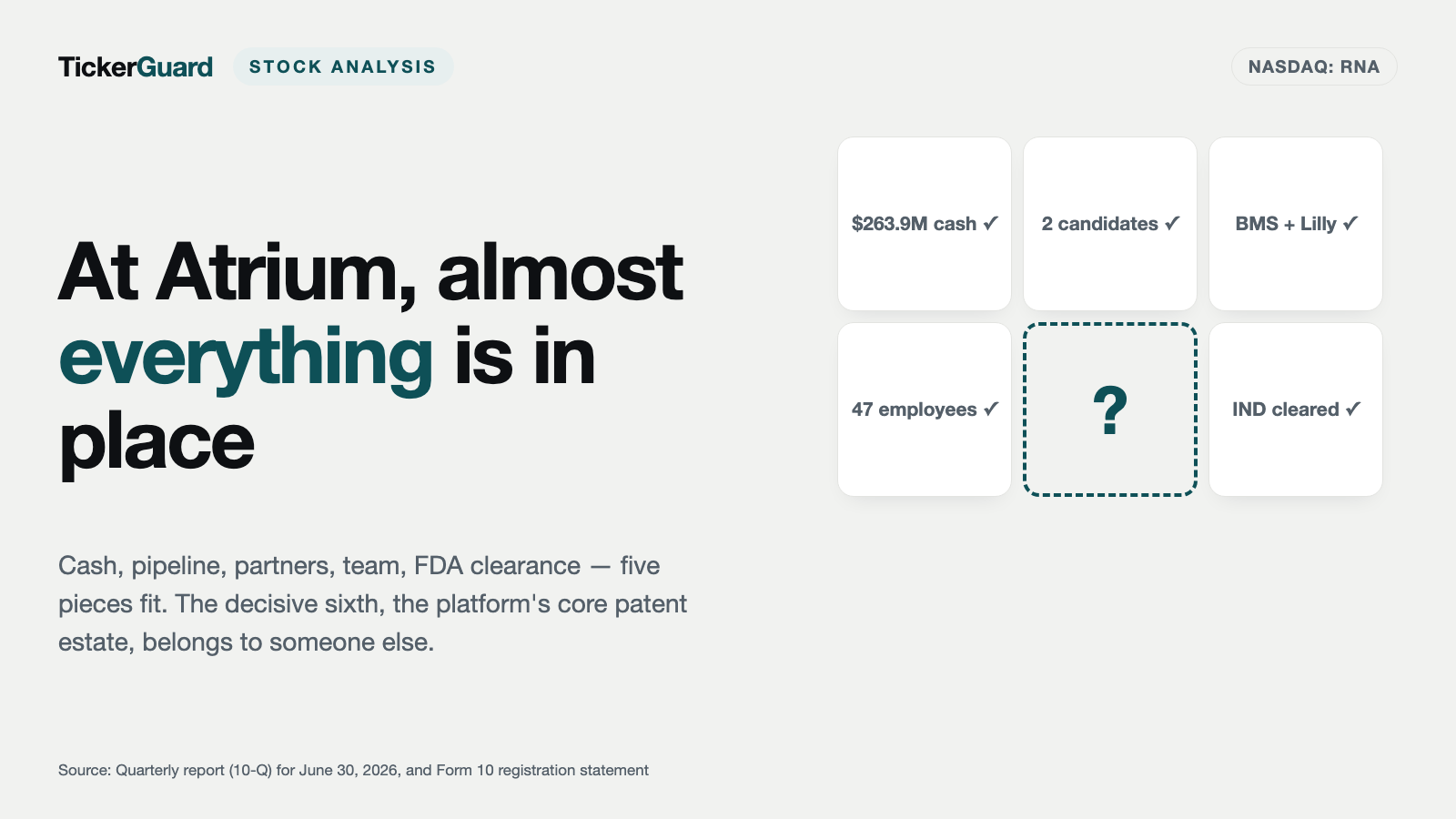
Since February 26, 2026 the RNA ticker has belonged to a different company than before. Avidity Biosciences went to Novartis; what was left over was distributed to the old shareholders as Atrium Therapeutics — with $270.0 million of seed capital, two cardiac candidates and 47 employees. As of June 30, 2026 the balance sheet held $263.9 million in cash and short-term investments, while on August 21, 2026 the market paid only about $225.8 million for the entire company. Anyone reading that as a risk-free discount has skipped the decisive sentence in the quarterly report: the patents behind the technology both candidates rest on do not belong to Atrium. They belong to Avidity — and therefore to Novartis. Not investment advice, but a look at what you actually buy when you buy cash.
 Thomas Mücke
Founder & Publisher
Thomas Mücke
Founder & Publisher
As of Today
As of: October 7, 2026
- Closing price
- 7.90 $ -0.80%
- Market Capitalisation
- 0.1 $B
- Growth Score
- 5/10
- AAQS
- 1/10
Price change since August 21, 2026: -40.2%
This analysis has a cut-off date. The Stock Guard tells you when something material changes in the numbers. Reserve your free spot
Chart
Interactive price chart (TradingView).
52-week range: 7.80 $ to 16.50 $ · Last price: 7.90 $ (As of: October 7, 2026)
Note: pure fact-based analysis, not investment advice and not a solicitation to buy or sell. All figures without guarantee.
There is one number on the stock market that strikes many investors like an open barn door: when a company holds more money in the bank than it costs on the exchange. The thought that follows almost automatically goes like this: even if everything goes wrong, I get my money back — and the business comes free on top. It is a comfortable thought because it removes the most uncomfortable part of investing, which is uncertainty. It feels like arithmetic rather than a bet.
Atrium Therapeutics delivers exactly that number. As of June 30, 2026 it held $263.9 million in cash and short-term investments. On August 21, 2026 the stock closed at $13.20, which across 17,105,643 shares makes a market value of roughly $225.8 million. The market is paying about one seventh less than the company holds in cash and government paper.
The catch in that comfortable thought: at a company that develops drugs, cash is not an asset sitting still. It is a countdown. And in Atrium's case something else applies, stated in a single subordinate clause in the quarterly report, that changes the whole calculation. That is what this analysis is about: what does this company actually own — and what is merely on loan?
What Atrium Therapeutics actually does — RNA parcels for the heart muscle
Atrium Therapeutics is a clinical-stage biopharmaceutical company: a firm that develops drug candidates but sells no approved product. It is headquartered in San Diego, California, and was incorporated in Delaware in September 2025. As of the February 2026 registration statement, 47 people worked there, 13 of them holding a Ph.D. or M.D.
The technology translates into an everyday image. An siRNA drug is a short genetic sequence that acts inside a cell like a switch: it causes a particular gene to be read out less strongly — that is called gene silencing. The problem is never the switch, it is the delivery. How do you get such a fragile molecule specifically into heart muscle cells rather than into the liver, where the body sends it first anyway? The answer from the platform Atrium inherited from Avidity: you attach the sequence to an antibody, a protein that works like an address label and only docks onto certain cell types. Drug plus address makes a parcel that arrives where it is meant to.
Two such parcels are in development today. ATR 1072 targets PRKAG2 syndrome — an inherited heart disease in which a genetic change causes sugar to accumulate in the heart muscle. The consequences are thickening of the muscle, conduction problems, arrhythmias and, in some cases, sudden cardiac death. The registration statement quantifies the prevalence: roughly one percent of hypertrophic cardiomyopathy cases, a condition whose overall prevalence lies between one in 200 and one in 500 people. No therapy today addresses the genetic cause — only symptoms are treated.
ATR 1086 targets PLN cardiomyopathy, another inherited form of heart muscle weakness. In an animal model, as the quarterly report describes it, the compound achieved a survival rate of 100 percent over at least 20 weeks in a mouse strain with a particularly severe course, whereas untreated animals died within eight weeks. An application for the first human trial is planned for 2027. Two further programs are in research without their target diseases being named.
On top of that come two collaboration agreements Atrium took over in the separation: with Bristol Myers Squibb (signed in November 2023, covering several cardiology targets) and with Eli Lilly (April 2019, immunology and other select indications). Every dollar Atrium has reported as revenue so far comes from those agreements — and from nothing else.
Company history for investors
-
2019
Avidity signs the research agreement with Eli Lilly
The agreement covering antibody oligonucleotide conjugates later passes to Atrium. For Atrium shareholders it has meant no money so far: no revenue was recognized from it through mid-2026.
-
2023
Bristol Myers Squibb joins as cardiology partner
The agreement signed in November 2023 becomes the sole revenue source of the later spin-off — with upfront payments still sitting on the balance sheet as deferred revenue in 2026.
-
2025
October: Novartis acquires Avidity, Atrium is incorporated
The merger agreement of 2025-10-25 provides for the cardiology business to be carved out beforehand. Avidity shareholders therefore receive two things: the merger consideration and shares in a new company.
-
2026
February: separation completed, trading begins
On 2026-02-26, 15,514,966 shares are distributed, one for every ten Avidity shares, funded with $270.0 million. The first closing price on 2026-02-27 was $14.75.
-
2026
July: FDA clears the first human trial
IND clearance for ATR 1072 turns a preclinical program into a clinical one. For shareholders the clock starts running toward the first data in the second half of 2027.
-
2026
August: second milestone worth $15 million
After the balance sheet date Atrium delivered a lead compound to Bristol Myers Squibb. For shareholders it is evidence that the only paying partner keeps paying.
How the stock landed on our desk
The trigger was simply the ticker: RNA, flagged by our in-house stock scanner for unusual mentions in investor forums. The first look into the SEC filings then produced a surprise that stands in for a larger problem.
The RNA ticker belonged for years to Avidity Biosciences. In October 2025 Avidity entered into a merger agreement with Novartis; Avidity today is an indirect wholly owned subsidiary of the Swiss group. Before closing, the cardiology business was carved out and placed into a new company — Atrium Therapeutics. On February 26, 2026 Avidity distributed all Atrium shares to its own shareholders: one Atrium share for every ten Avidity shares, 15,514,966 shares in total. The RNA ticker moved with it. Avidity has held no interest in Atrium since.
Anyone relying on price feeds or database master records therefore gets the wrong picture. The fundamental data provider we work with still listed, on August 22, 2026, an SEC identifier, an IPO date of June 28, 2013 and 511 employees under RNA — all of it legacy Avidity data. Atrium's actual SEC identifier is 0002093101, its first registration dates from December 10, 2025, and 47 people work at the company. It is not the same firm. It is only the same label.
We have described this kind of case before: at Fortrea, the Labcorp spin-off with the costly dowry, the question was likewise what a spun-off company really takes with it — and what it merely holds on paper.
The numbers over the years — with a footnote that matters
Before the numbers, a caveat belongs up front, because it shapes the comparison. Audited accounts exist for 2024 and 2025 — but they were signed off by two different firms: BDO USA, P.C. certified 2023 and 2024 on December 10, 2025, and Deloitte & Touche LLP certified 2025 on February 17, 2026. The change of auditor happened as the separation was being prepared; per the registration statement there were no adverse opinions and no disagreements. But the figures are, in accounting language, carved out: they describe not a standalone company but a business unit inside Avidity, to which costs were allocated. The report says so itself — the figures are not necessarily representative of what the company would have earned as a separate entity. The first half of 2026 is a hybrid: carved out until February 26, standalone thereafter.
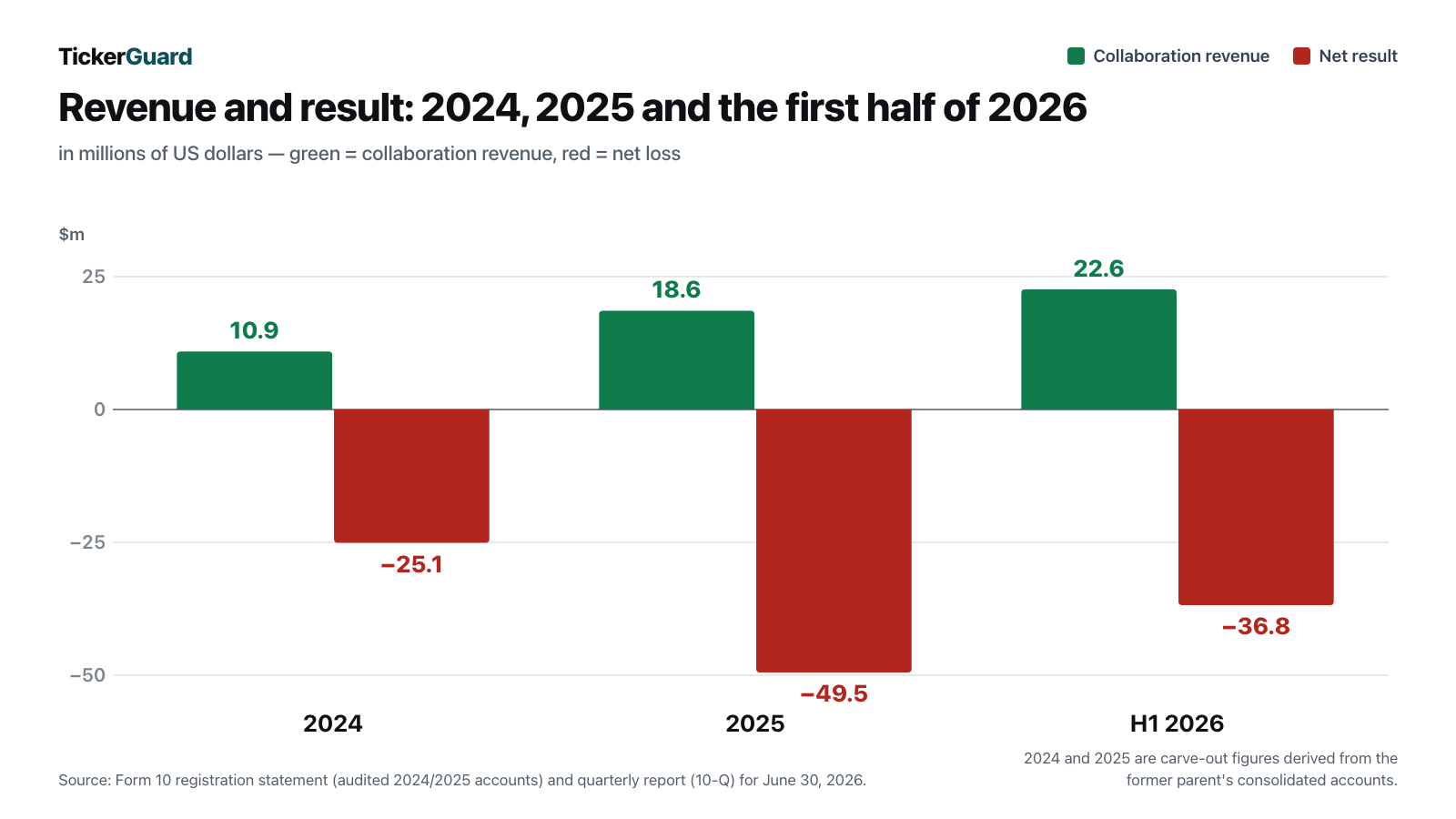
Revenue is rising, then — but it rises in jumps, because it hangs on single events. Of the $22.6 million in the first half of 2026, $15 million came from one milestone: Atrium delivered a development candidate to Bristol Myers Squibb in the first quarter and was entitled to bill for it. Strip that out and $7.6 million remain from ongoing research work for the partner — in the second quarter of 2026 alone $3.0 million, against $3.8 million in the prior-year quarter. That is not a growing business; it is steady contract research with occasional bonuses.
On the cost side one number stands out: general and administrative expenses jumped to $30.5 million in the first half of 2026, up from $5.5 million in the prior-year period. The report attributes this to $9.6 million of higher personnel costs — including an executive transition bonus and accelerated vesting of stock awards — plus $13.8 million for external professional services. Much of that is one-off separation cost. Taking the second quarter on its own, administrative expenses were $10.3 million and research expenses $15.3 million.
The balance sheet as of June 30, 2026 is the real asset of this company. The quarterly report puts it plainly:

Added together: $263.9 million of cash and short-term investments, set against $65.9 million of liabilities. Of those liabilities, $42.7 million is deferred revenue — advance payments from partners that are not repaid in money but worked off through research. Equity stands at $214.6 million, or $12.54 per share. The accumulated deficit of only $8.1 million looks harmless but is a bookkeeping artifact: the clock has been running only since February 26, 2026, and every loss before that sits in the former parent's accounts.
How long does the money last? Operating cash outflow in the first half of 2026 was $35.1 million. Extend that unchanged and the cash lasts a good three and a half years. That calculation flatters, however, because the $15 million milestone came in during that half. Without it, the outflow would have been roughly $50 million per half year — and the cash would last about two and a half years. Both figures sit comfortably above what the company itself has to commit to: the report confirms only that resources suffice for "at least 12 months" from the filing date. There is no going-concern warning in the report — a notable absence at a small biotech.
What the filings say: the uncomfortable truths
So far the story reads well: a solid balance sheet, two candidates, two large partners, a share price below the cash balance. The five findings that follow all come from the same quarterly report filed August 13, 2026 — and they explain why the market demands that discount.
First: the most important intellectual property does not belong to Atrium
This is the sentence everything turns on:
"much of the intellectual property and data that is material to our cardiology programs is owned by Avidity and is subject to certain existing third-party obligations."
— Atrium Therapeutics, SEC Form 10-Q for the quarter ended June 30, 2026, Risk Factors
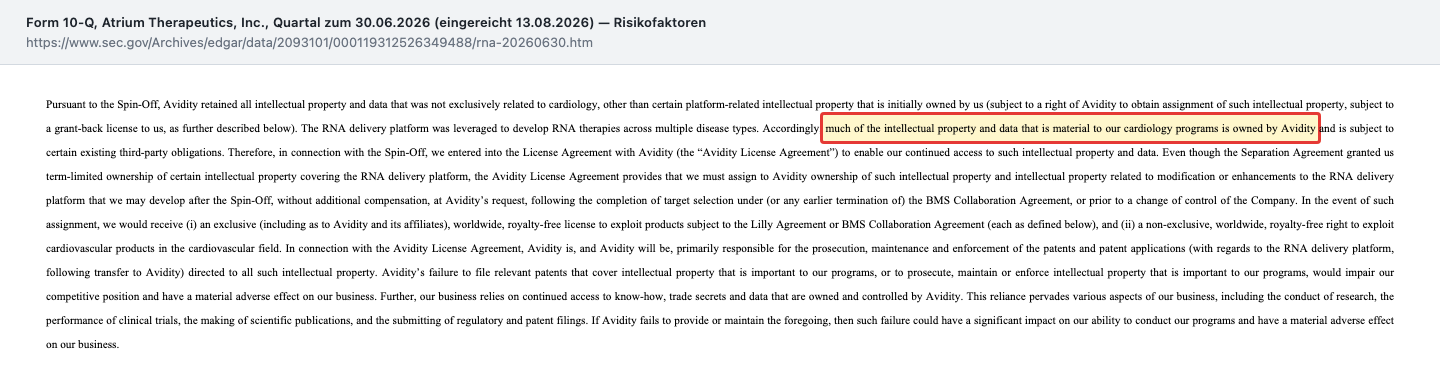
Atrium holds a license on those patents and data — the Avidity License Agreement. What that means in practice is set out in the same paragraph: Avidity, not Atrium, is responsible for filing, maintaining and enforcing the patents. Should Avidity fail to do so, the report states this would have "a material adverse effect" on the business. And whatever Atrium itself develops on top of the platform must be assigned to Avidity without additional compensation at Avidity's request, once target selection under the Bristol Myers Squibb agreement is complete — or ahead of a change of control at Atrium.
Translated into an everyday image: Atrium is a workshop operating in rented premises. It may use the workshop, for a clearly defined purpose. If it installs a better machine of its own, the machine belongs to the landlord — and the landlord may come and take it. Since February 2026 the landlord is Novartis.
Second: five years on a leash, ten years of first negotiation rights
The license agreement is not a plain usage contract. It contains restrictions that fix the company's room to maneuver for years.
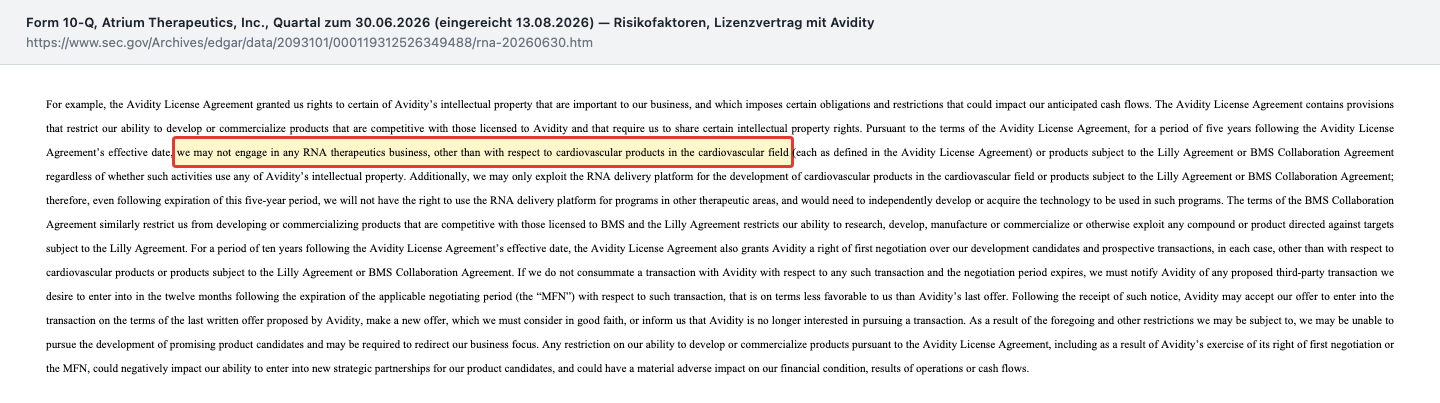
Three bindings sit in that paragraph. For five years Atrium may not engage in any RNA therapeutics business outside the cardiovascular field at all — regardless of whether Avidity intellectual property would be used. Even after that, the platform remains restricted to cardiovascular applications; for other therapeutic areas Atrium would have to develop or acquire the technology independently. And for ten years Avidity holds a right of first negotiation over development candidates and over transactions in which a third party would acquire rights to a drug — together with a clause requiring Atrium to bring back any later, less favorable third-party terms.
The report names the consequence for shareholders itself: these rights could limit the ability "to engage in certain strategic transactions that stockholders may consider favorable." For a company whose most realistic good ending is an acquisition by a large pharmaceutical group, that is a noticeable drag on precisely that outcome.
Third: every dollar of revenue comes from a single customer
The quarterly report is unambiguous here: collaboration revenue in the second quarter and the first half of 2026 related solely to the Bristol Myers Squibb agreement. From the Eli Lilly agreement, not a single dollar was recognized as revenue in either period or in the prior-year periods; the $10 million Lilly paid in August 2025 for a clinical development milestone still went to Avidity.
That leaves the entire revenue side hanging on one contractual partner — and the report's own risk summary states that Eli Lilly and Bristol Myers Squibb may each terminate their agreement unilaterally and for convenience, which could materially affect cash flows. As of June 30, 2026 there was still $42.7 million of deferred revenue on the balance sheet, to be recognized over the remaining research term. Losing the agreement would hit not only future milestones but that recognition as well.
The good news sits in the final note of the same report: in August 2026 Atrium achieved another milestone — delivery of a lead compound for an undisclosed cardiology indication — entitling it to a further $15 million. The partner is paying. For now.
Fourth: 1.59 million shares are already promised
Anyone calculating cash per share usually divides by the 17,105,643 shares on the cover page. Note 7 of the quarterly report names a number that is not included there.

These 1,590,677 shares — called Make Whole Awards in the report — compensate claims employees carried over from Avidity options and stock units. They must be settled, per the report, "in no event after March 15, 2027." That is 9.3 percent of additional shares — without a single dollar of new money coming in. Adding the 962,000 options and 431,000 stock units excluded as anti-dilutive as of June 30, 2026 takes the count above 20 million.
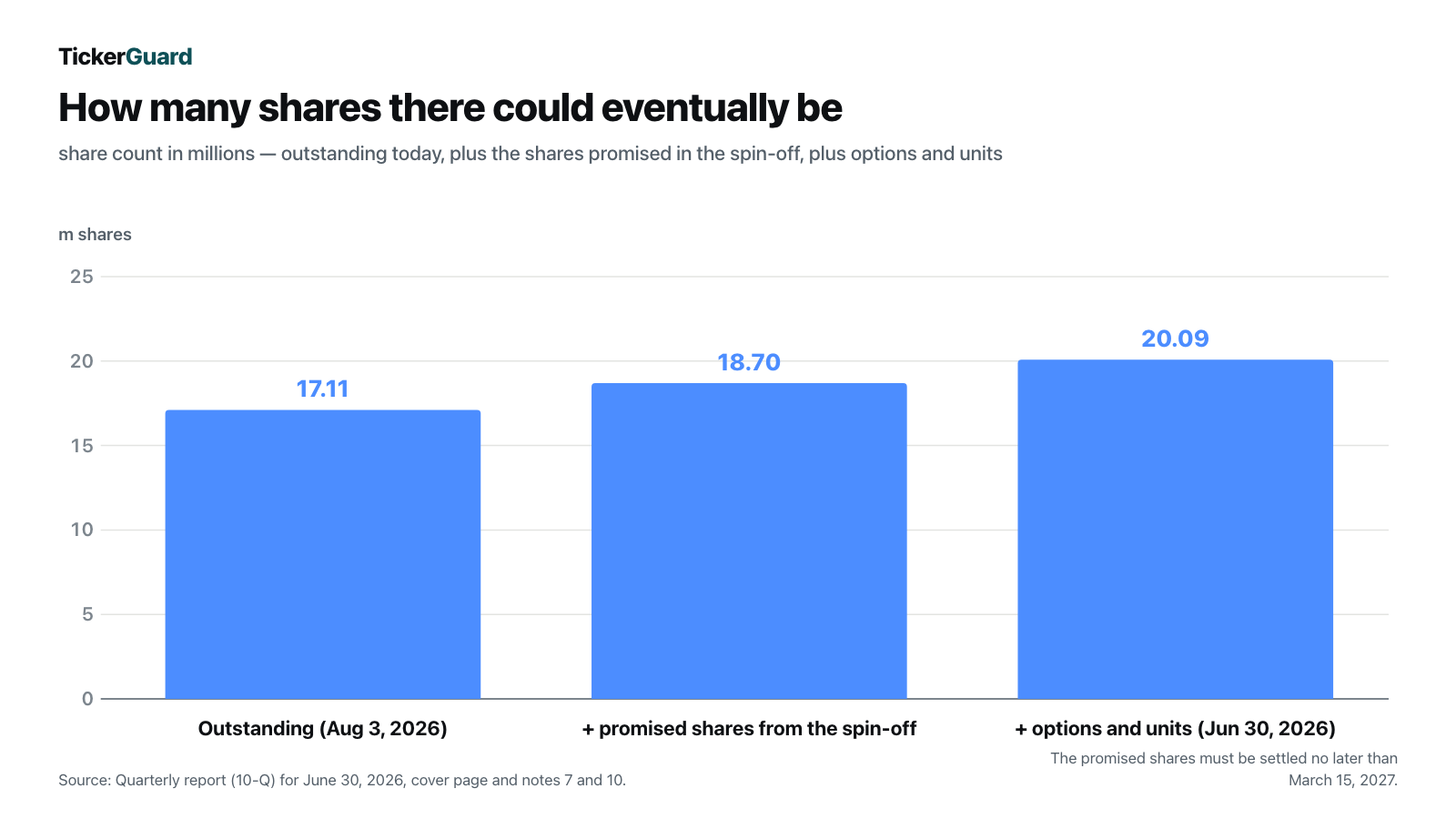
And the dilution does not stop there. The 2026 Incentive Award Plan initially reserved 2,909,446 shares, of which only 171,394 remained available as of June 30, 2026 — the pool is largely exhausted. It increases automatically each January 1 from 2027 through 2036 by up to five percent of shares outstanding. An employee stock purchase plan adds an annual top-up of up to one percent.
Fifth: Novartis is free to compete with the same technology
The license agreement is not a one-way street. It grants Avidity a non-exclusive, worldwide, irrevocable, royalty-free license to the same delivery platform — for cardiovascular products, excluding those covered by the Eli Lilly and Bristol Myers Squibb agreements. The report draws the conclusion itself and names the competitor: it may face direct competition from Avidity in the cardiac space, and Avidity and Novartis may have greater financial, technical and marketing resources.
That is an unusual starting position. A company with 47 employees and $263.9 million in cash faces a global group that may use the same technology free of charge, holds the patents, administers them, and additionally holds a right of first negotiation over the smaller rival's development candidates.
Valuation: the order of magnitude
At a company with no product revenue and no profit, the usual multiples are of no help. There is no price-to-earnings ratio because there are no earnings; a price-to-sales ratio would mislead because the revenue consists of milestones rather than a running business. What remains is the comparison with what sits in the bank.
At the closing price of $13.20 on August 21, 2026 and 17,105,643 shares, the market value is roughly $225.8 million. Against that stand:
- $15.43 per share of cash and short-term investments ($263.9 million as of June 30, 2026) — the share price sits about 14 percent below that.
- $12.54 per share of equity ($214.6 million) — a price-to-book ratio of roughly 1.05.
- $11.57 per share if all liabilities are deducted from the cash ($197.9 million), including the $42.7 million of deferred revenue that is in practice settled by work rather than money.
The market is therefore paying roughly the book value and assigning the pipeline, the platform license, both collaboration agreements and the imminent trial start a combined value of about zero. That can mean two things. Either the market considers the risks listed above so severe that cash is the only reliable figure. Or part of the legacy holder base simply sold Atrium because it was the wrong stock in the wrong portfolio — a familiar pattern after spin-offs, where index funds and specialist funds shed the new, small shares without regard to valuation. The price history since trading began suggests a mix of both: $14.75 on February 27, 2026, $16.54 on March 4, $11.18 on July 29 and back to $13.20 on August 21, 2026.
Bear in mind the fourth uncomfortable truth in every per-share calculation: the denominator rises to 18.70 million shares by March 15, 2027 at the latest. On that basis it is $14.11 of cash per share rather than $15.43. We have described comparable cases before — for instance at Firy, which likewise holds more cash than the market pays for the whole company.
Opportunities and risks at a glance
What speaks for the company. The balance sheet is exceptional for a firm this size: $263.9 million of cash without a dollar of financial debt, which pushes the need for dilutive equity raises years into the future. The target diseases are genetically well defined and lack any causal therapy, which opens regulatory pathways for rare diseases. FDA clearance for ATR 1072 has been in place since July 14, 2026, and Health Canada raised no objection. Two global groups have already validated the technology through contracts, and Bristol Myers Squibb triggered two $15 million milestones in 2026. The leadership consists of people who built the same platform at Avidity.
What speaks against it. No candidate has ever reached a human being; the first participant is expected by the end of 2026 and meaningful data only in the second half of 2027. The intellectual property material to the programs belongs to Avidity, and therefore to Novartis, which is free to compete on the same platform royalty-free. Room to maneuver is contractually constrained for five and ten years respectively, including a right of first negotiation that may explicitly hinder acquisitions. All revenue hangs on one partner who may terminate for convenience. By March 15, 2027 at the latest, 1,590,677 shares are added, and the incentive plan grows automatically from 2027. There is no audited annual report as a standalone company yet — the first 10-K is expected in early 2027. And the float is tight: the three large holders reporting as of June 30, 2026 together own 4,108,741 shares, just under a quarter (24.0 percent), on trading volume in the low six figures.
The bottom line
Back to the comfortable thought from the start: even if everything goes wrong, I get my money back. At Atrium Therapeutics the first half of that sentence is true — the money is there, $263.9 million, debt-free, in cash and U.S. Treasuries. The second half is not. Because you do not get that money back. It will be spent, as intended, at a pace of $35 to $50 million per half year, on trials whose outcome nobody knows. At a drug developer, a cash balance is not security. It is a budget with an expiry date.
And what you get for that budget is unusually cut. A company with two serious candidates, an experienced team and two large partners — but without ownership of the technology everything rests on, with a leash that forbids it for five years to take any step outside cardiovascular medicine, and with a right of first negotiation in someone else's hands that hinders exactly the outcome investors hope for at a firm like this. The discount to cash is therefore not an arithmetic error by the market. It is the price of a question that only the second half of 2027 will answer: does this technology work inside a human heart?
Whoever invests here is not buying safety but a bet with a decent cushion underneath. That is a substantial difference — and anyone who does not see it is buying for the wrong reason. Not investment advice; the decision is yours.
Sources
- Atrium Therapeutics, Inc. — Form 10-Q for the quarter ended June 30, 2026 (filed August 13, 2026): balance sheet, statement of operations, cash flow statement, notes 1, 5, 7, 10 and 11, and risk factors.
- Atrium Therapeutics, Inc. — Form 10-Q for the quarter ended March 31, 2026 (filed May 14, 2026).
- Form 10-12B/A registration statement, Exhibit 99.1 (Information Statement) — effective February 26, 2026, containing the 2025 accounts audited by Deloitte & Touche LLP on February 17, 2026 and the 2023 and 2024 accounts audited by BDO USA, P.C. on December 10, 2025, plus disclosures on the change of auditor, employees, leadership and disease background.
- Form 8-K of July 14, 2026 — FDA clearance of the investigational new drug application for ATR 1072.
- Form 8-K of August 13, 2026 — announcement of second-quarter 2026 results.
- Ownership filings SC 13G and SC 13G/A on Atrium Therapeutics, filed April 8, April 27, May 15, July 27 and August 14, 2026.
- Fundamental data (price history since trading began on February 27, 2026, share count, market value; as of August 22, 2026).
Disclaimer: this article is journalistic analysis and not investment advice, not a buy or sell recommendation and not a solicitation to acquire or dispose of securities. All figures come from the sources named and carry the as-of dates stated there. Shares of companies without an approved product can lose their entire value. Every investor remains responsible for their own decisions.
Key figures at a glance
All monetary figures in millions of $; earnings per share as reported.
| Metric | 2021 | 2022 | 2023 | 2024 | 2025 |
|---|---|---|---|---|---|
| Revenue | 9.3 | 9.2 | 9.6 | 10.9 | 18.6 |
| Operating Income (EBIT) | -118.1 | -178.9 | -235.6 | -378.9 | -76.8 |
| Net Income | -117.4 | -169.1 | -212.2 | -322.3 | -76.7 |
| Net Margin | -1,258.5% | -1,833.0% | -2,219.9% | -2,957.7% | -411.9% |
| Earnings Per Share | -2.83 $ | -3.24 $ | -2.91 $ | -2.89 $ | -4.48 $ |
Source: fundamental data & SEC filings (annual and quarterly reports, 10-K/10-Q)
Our Bottom Line at a Glance
- Balance sheet and financial strength positive
- As of 2026-06-30 the balance sheet held $263.9m of cash and short-term investments without a dollar of financial debt, against equity of $214.6m. Operating cash outflow in the first half was $35.1m; the company confirms at least twelve months of runway, and the arithmetic suggests two and a half to three and a half years depending on adjustments. There is no going-concern warning.
- Ownership of the technology negative
- The Form 10-Q for the quarter ended 2026-06-30 records that much of the intellectual property material to the cardiology programs is owned by Avidity — a Novartis subsidiary since February 2026. Atrium holds only a license, Avidity is responsible for filing and enforcing the patents, and Atrium's own platform improvements must be assigned back on request without additional compensation.
- Room to maneuver negative
- The license agreement bars Atrium for five years from any RNA therapeutics business outside the cardiovascular field and permanently restricts platform use to that field thereafter. For ten years Avidity holds a right of first negotiation over development candidates and transactions — the report itself names the risk that this hinders strategic transactions stockholders may consider favorable.
- Revenue base negative
- Revenue in the second quarter and first half of 2026 came solely from the Bristol Myers Squibb agreement; no revenue was recognized from the Eli Lilly agreement in any reported period. The report's risk summary states that both partners may terminate for convenience. As of 2026-06-30 there was still $42.7m of deferred revenue outstanding.
- Clinical evidence neutral
- The FDA cleared the IND for ATR 1072 on 2026-07-14 and Health Canada raised no objection. So far, however, only mouse and non-human primate data exist; no candidate has reached a human being. The first trial participant is expected by the end of 2026, first efficacy signals in the second half of 2027.
- Dilution negative
- 1,590,677 shares promised in the spin-off must be settled no later than 2027-03-15 — 9.3 percent more shares with no capital coming in. Together with the 962,000 options and 431,000 stock units as of 2026-06-30 the count would reach roughly 20.09m rather than 17.11m. The 2026 plan had 171,394 shares available on 2026-06-30 and grows each January 1 from 2027 by up to five percent of shares outstanding.
Atrium Therapeutics is the cardiology remainder of Avidity Biosciences that Novartis did not want in its acquisition — equipped with $270.0m of seed capital, two drug candidates and the agreements with Bristol Myers Squibb and Eli Lilly. As of 2026-06-30, $263.9m remained in cash and investments, more than the market value of roughly $225.8m at the closing price of 2026-08-21. The discount has documented reasons: the decisive intellectual property belongs to Avidity and therefore Novartis, which may compete on the same platform royalty-free; a five-year non-compete and a ten-year right of first negotiation narrow the field; all revenue hangs on one terminable partner; and 9.3 percent of additional shares arrive by March 2027. Whether the technology works inside a human heart will be decided in the second half of 2027 at the earliest. Not investment advice.
What Our Rating Means
Open questions
The business works in principle, but one material question is open. As long as it stays open, our findings do not carry a quality verdict.
The balance sheet argues for green: $263.9m of cash without financial debt, equity of $214.6m, no going-concern warning and more than two years of arithmetic runway. What is missing for green is proven quality in the business itself: no candidate has ever reached a human being, the first trial participant is expected only at the end of 2026, and the decisive data arrive in the second half of 2027 at the earliest. That is the classic open operational question. For red, conversely, there is no substance risk: the dependence on Avidity for intellectual property is severe but contractually secured, and the cash carries the company well beyond the critical four quarters. That the stock trades below its cash balance is a price argument and irrelevant to this rating. The decision is yours.
A journalistic assessment by our editorial team at the time of the deep dive, based on public sources — not investment advice and not a solicitation to buy or sell. Your personal circumstances (investment goals, risk capacity, taxes) cannot be taken into account. What our levels mean, how verdicts are formed, and what conflicts of interest exist →
Worth Noting
- This analysis was triggered by our in-house scanner for unusual investor-forum mentions flagging the RNA ticker on August 23, 2026.
- Risk of confusion: until February 2026 the RNA ticker belonged to Avidity Biosciences (SEC identifier 0001599901), today an indirect Novartis subsidiary. Atrium Therapeutics carries the new identifier 0002093101. In August 2026 some master-data providers still listed legacy Avidity records under RNA — for instance 511 employees and a 2013 IPO date. In fact there are 47 employees, and trading began on February 27, 2026.
- Data as of August 23, 2026. The 2024 and 2025 annual figures come from the Form 10-12B/A registration statement and are carve-out figures from Avidity's consolidated accounts. They were certified by two auditors: BDO USA, P.C. on 2025-12-10 for 2023 and 2024, and Deloitte & Touche LLP on 2026-02-17 for 2025. They describe the business as part of a group, not as a standalone company. There is no annual report (10-K) as a standalone company yet.
- Currency check: the most recent quarterly report (10-Q filed 2026-08-13) was reviewed together with the results announcement filed the same day (Form 8-K, Item 2.02) and every filing received afterwards — three ownership filings dated 2026-08-14. No further filings existed as of the data date.
- Price and market value figures are based on fundamental data. The market value was cross-checked against the share count on the cover of the quarterly report (17,105,643 shares as of 2026-08-03): 17,105,643 times $13.20 gives $225.8m and matches the data provider's figure.
Stock Watch
This analysis is as of August 23, 2026. Stock Watch will tell you what's changed at RNA since then.
Later $1 a month per stock — signing up is free, and you'll be the first to know when it launches.
The full analysis as a PDF for later
We will send you this analysis as a PDF — to print, file away, and read at your own pace. And we will add you to the free Stock Watch list for Atrium Therapeutics, Inc. (RNA), so you hear about it when something material in this analysis changes.
Frequently Asked Questions
No. Avidity Biosciences was acquired by Novartis and is today an indirect wholly owned subsidiary of the Swiss group. Before closing, the cardiology business was carved out into the newly formed Atrium Therapeutics, Inc. and distributed to Avidity shareholders on February 26, 2026 — one Atrium share for every ten Avidity shares. The RNA ticker moved with it, but the SEC identifier is new (0002093101), and Avidity holds no interest in Atrium. In August 2026 some price and master-data providers still carried legacy Avidity records under the ticker, for instance 511 employees rather than the actual 47.
At the closing price of $13.20 on August 21, 2026 the market value was roughly $225.8 million, while as of June 30, 2026 the company reported $263.9 million of cash and short-term investments. Two explanations combine. First, at a drug developer cash is not an asset sitting still but a budget to be spent on trials — $35.1 million flowed out in the first half of 2026. Second, the quarterly report names substantial constraints: the material intellectual property belongs to Avidity and therefore Novartis, room to maneuver is contractually restricted for five to ten years, and 1,590,677 additional shares arrive by March 15, 2027 at the latest.
According to the Form 10-Q for the quarter ended June 30, 2026, much of the intellectual property material to the cardiology programs is owned by Avidity — and therefore Novartis. Atrium holds a license. Avidity is responsible for filing, maintaining and enforcing the patents; a failure to do so would, by Atrium's own account, have a material adverse effect on its business. In addition, Atrium must assign its own improvements to the delivery platform to Avidity on request and without additional compensation, once target selection under the Bristol Myers Squibb agreement is complete or ahead of a change of control at Atrium.
Exclusively from the research collaboration and license agreement with Bristol Myers Squibb, which Avidity signed in November 2023 and Atrium assumed in the separation. No revenue was recognized from the April 2019 Eli Lilly agreement in 2025 or in the first half of 2026. Of the $22.6 million reported for the first half of 2026, $15 million came from a single milestone and the remaining $7.6 million from ongoing research services. In August 2026 Atrium triggered a second milestone worth a further $15 million. The report notes that both partners may terminate their agreements unilaterally and for convenience.
The company itself commits in the quarterly report only that existing resources will last at least twelve months from the filing date of August 13, 2026. The arithmetic allows more: at $35.1 million of operating cash outflow in the first half of 2026, the $263.9 million would last a good three and a half years. That calculation flatters, though, because a $15 million milestone came in during that half; without it the run rate would be roughly $50 million per half year, implying a good two and a half years. There is no going-concern warning in the report.
The FDA cleared the investigational new drug application on July 14, 2026, and Health Canada raised no objection. The Phase 1/2 trial is named Corventis. Clinical site initiation is under way and the company expects the first participant by the end of 2026. It guides to initial data supporting proof of concept in the second half of 2027. For the second candidate, ATR 1086, an IND filing is planned for 2027.
As of August 3, 2026, 17,105,643 shares were outstanding. On top of that come 1,590,677 shares promised to holders of former Avidity options and stock units, which the report says must be settled no later than March 15, 2027 — 9.3 percent of additional shares with no capital coming in. Adding the 962,000 options and 431,000 stock units excluded as anti-dilutive as of June 30, 2026 takes the total to roughly 20.09 million shares, or 17.4 percent more than today. The 2026 Incentive Award Plan had only 171,394 shares available on June 30, 2026 but grows each January 1 from 2027 by up to five percent of shares outstanding.
Per the ownership filings of August 14, 2026, each as of the June 30, 2026 record date: Sessa Capital IM, L.P. with 1,500,000 shares (8.8 percent), T. Rowe Price Associates with 1,472,984 shares (8.6 percent) and BlackRock with 1,135,757 shares (6.6 percent). A fourth filing stands out: RA Capital Management, a fund specializing in biotechnology, had reported 864,102 shares (5.6 percent) as of March 31, 2026 and reported zero as of June 30, 2026. Sessa Capital filed for the first time in the same period — the specialist went out, a generalist came in.
Found an error?
Did you spot a factual error, an outdated number, or a typo in this deep dive? Let us know briefly — your report goes straight to the editorial team.