Newegg: Only 6 Percent of the Shares Trade Freely — and the Majority Owner Has Pledged Its Stake to a Bank
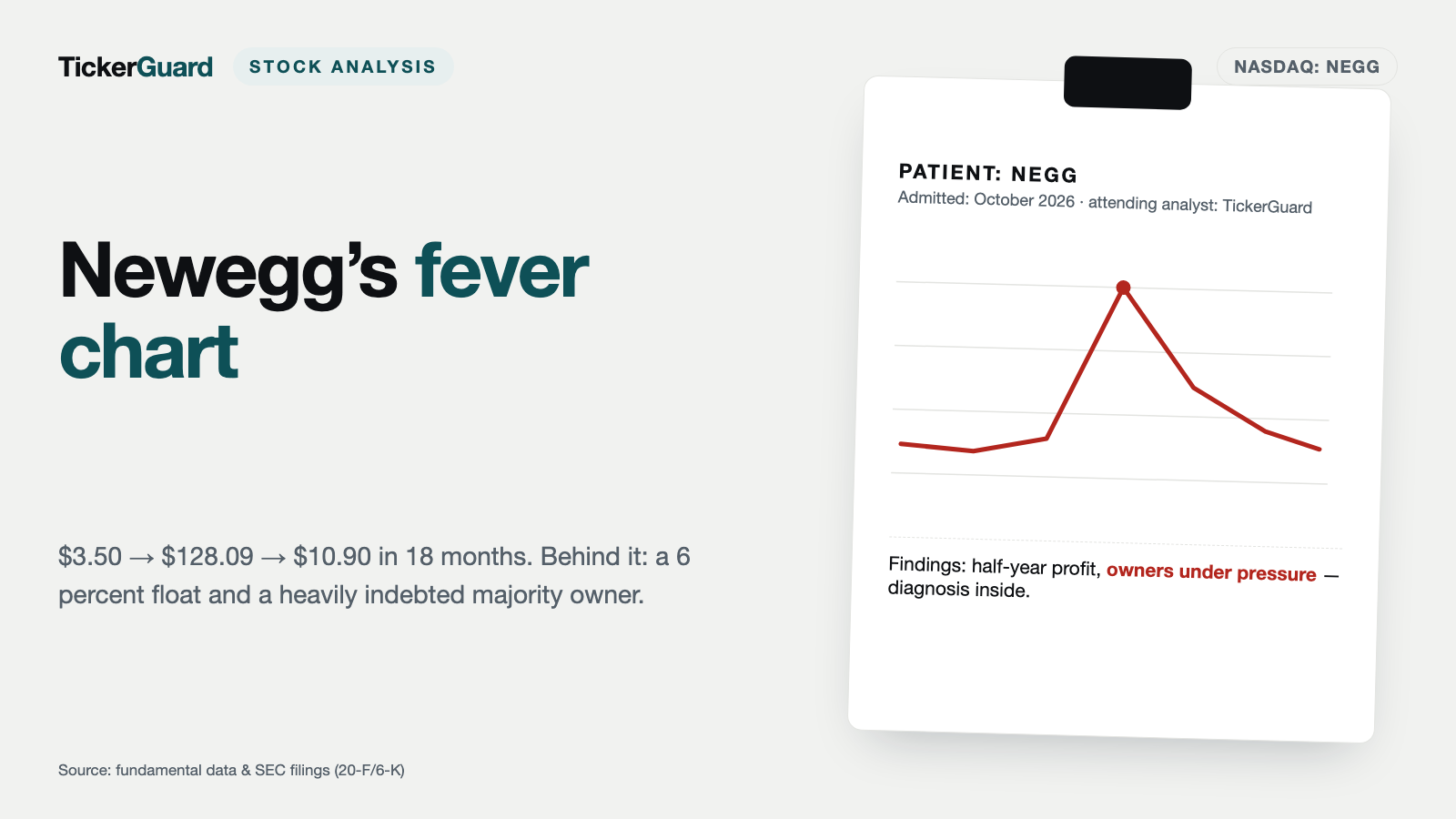
Up 36-fold, then down 91 percent: from 2025 to October 2026, Newegg's stock moved like a fever chart. The business barely explains it; the ownership does: only 6 percent of the shares trade freely, and 53 percent sit pledged with a Chinese majority owner whose parent faces a bankruptcy petition. Watch only the ticker here, and you miss half the story.
 Thomas Mücke
Founder & Publisher
Thomas Mücke
Founder & Publisher
As of Today
As of: October 16, 2026
- Closing price
- 10.90 $ -4.00%
- Market Capitalisation
- 0.2 $B
- P/E
- 43.8
- Growth Score
- 4/10
- AAQS
- 2/10
This analysis has a cut-off date. The Stock Guard tells you when something material changes in the numbers. Reserve your free spot
Chart
Interactive price chart (TradingView).
52-week range: 10.60 $ to 92.60 $ · Last price: 10.90 $ (As of: October 16, 2026)
Note: pure fact-based analysis, not investment advice and not a solicitation to buy or sell. All figures without guarantee.
The Swarm Illusion: A Stock Price Is Only as Smart as the People Who Set It
From an adjusted $3.50 to $128.09 in just over three months, then back to $10.90 — that is the path of Newegg's stock between May 2025 and October 2026. A stock price feels like the verdict of the many. Thousands of investors weigh the evidence, buy, sell — and out comes a price we trust because it bundles the wisdom of the crowd. That is where a very human investing weakness hides, one we will call the swarm illusion: we treat every price as the outcome of a large, well-informed market, even when only a small fraction of the shares actually changes hands.
Newegg is a textbook case. The stock closed at an adjusted $3.50 on May 5, 2025, climbed to $128.09 by Aug. 14, 2025, and stood at $10.90 on Oct. 16, 2026 (source: fundamental data; prices before April 7, 2025, adjusted for the combination of every 20 shares into one). An online retailer of PC parts does not become worth 36 times as much in three months. Something else moved: according to the Form F-3 of June 1, 2026, only 1,273,376 of 20,973,423 shares were held by anyone other than large shareholders, management and other affiliates on May 26, 2026 — 6.1 percent. The central tension of this analysis: Newegg's business has calmed down and was profitable again in the first half of 2026 — but the stock price is set by its owners, and the largest of them is buried in bank debt. Let's read together what the filings with the U.S. securities regulator, the SEC, actually say. No recommendation, no forecast — just the documents.
Company history for investors
-
2019
$15 million to Digital Grid
Newegg lends its future majority owner $15.0 million at 5 percent. Since June 30, 2024, the money has been due and not repaid.
-
2021
Listing via Lianluo Smart
Newegg goes public by merging with the Nasdaq-listed shell Lianluo Smart. Record revenue of $2,376.2 million — followed by four loss years.
-
2025
Share combination, price frenzy, stock sales
1-for-20 share combination on April 7, 2025, rally to $128.09 by Aug. 14, 2025; Newegg sells shares into the market for $35.2 million in net proceeds.
-
2026
Detention, bankruptcy petition, credit postponement
Chairman Zhitao He detained (January, released Feb. 24), bankruptcy petition against Hangzhou Lianluo (announced March 20), 7 million shares registered for resale, credit only until Nov. 25, 2026.
What Newegg Actually Does
Newegg Commerce, Inc., based in Diamond Bar near Los Angeles, has been selling technology online since 2001: graphics cards, processors, motherboards, memory, prebuilt PCs, consumer electronics and gaming gear. The business has two parts. In direct sales, Newegg buys the goods itself, stores them and resells them; on its marketplace, third-party sellers sell through Newegg.com and pay a commission. Gross merchandise value across both (GMV) was $1.77 billion in 2025, reported revenue $1,444.5 million. At the end of 2025, Newegg counted about 2.2 million active customers and 714 full-time employees.
Put simply: Newegg is the specialty store PC builders go to for a new graphics card — competing with Amazon, Best Buy and Walmart, which sell the same products. It is a thin-margin business: of every dollar of revenue, about 11.7 cents remained as gross profit in 2025, before salaries, warehouses, marketing and shipping. A retailer like this lives on two things: the right inventory at the right time, and new product generations that get customers to upgrade.
Two formalities belong up front. First, Newegg is incorporated in the British Virgin Islands and reports as a foreign private issuer: instead of an annual report on Form 10-K and quarterly reports on Form 10-Q, it files an annual report on Form 20-F and current reports on Form 6-K, with quarterly figures only as unaudited press releases. Second, Newegg came to Nasdaq in 2021 by merging with the Chinese listed shell Lianluo Smart — which is where the Hangzhou-based majority owner discussed below comes from. The fiscal year matches the calendar year.
How the Stock Landed on Our Desk
Newegg made our research list through the Reddit hype scan of Oct. 18, 2026 — that is, through the volume of discussion in investor forums, not through a financial metric. That fits the stock's history. In spring 2025, it traded at around an adjusted $4. From June 2025, private investor Vladimir Galkin bought in: on June 5, 2025, he reported 1,009,400 shares (5.2 percent, Schedule 13G); by Feb. 6, 2026, after 31 amendments, 4,392,812 shares (21.0 percent, Schedule 13D/A). In July 2025, Newegg launched a program to sell new shares directly into the market; on July 14, 2025, the price stood at $36.22 according to the prospectus (424B5). By year-end, the program had raised $35.2 million in net proceeds. The peak came on Aug. 14, 2025, with a $128.09 close.
It has been downhill since: on April 17, 2026, the stock traded at $44.77 according to the F-3; on May 28, 2026, at $18.61; on Oct. 16, 2026, at $10.90 — down 91.5 percent from the peak (our calculation). According to fundamental data, an average of about 44,000 shares a day changed hands in the 30 trading sessions through Oct. 16, 2026 (the average adds up all daily volumes and spreads them evenly across the days, so a few busy sessions pull it up). And one large holder is selling: Fred Chang, Newegg's founder, reported in a Schedule 13D/A on Oct. 16, 2026, that his company Tekhill sold 217,778 shares on 29 trading days from Sept. 1 to Oct. 12, 2026, at weighted average prices between $16.75 (the high, on Sept. 2) and $11.30 (Oct. 12). Through Oct. 15, Form 4 filings show further sales of 3,582 shares each, on Oct. 14 and 15 at $10.64 and $11.05.
That such insider filings exist at all for a foreign private issuer is new: since March 18, 2026, directors and officers of foreign private issuers must also report their trades on Form 4 (Holding Foreign Insiders Accountable Act, according to the annual report on Form 20-F). The rule for the rest of this analysis: When only six out of a hundred shares trade freely, the price says more about the sellers than about the business.
The Numbers Over the Years — Credit Where It Is Due
First, what deserves credit. Newegg survived the hangover after the pandemic boom without wrecking its balance sheet. After the record year 2021, with $2,376.2 million in revenue and $36.3 million in net income, the business shrank for three years. In 2025, revenue turned: up 16.9 percent to $1,444.5 million, driven by new graphics card generations and customers buying ahead of expected tariffs and memory shortages. The net loss narrowed from $43.3 million to $4.9 million. The chart shows the path:
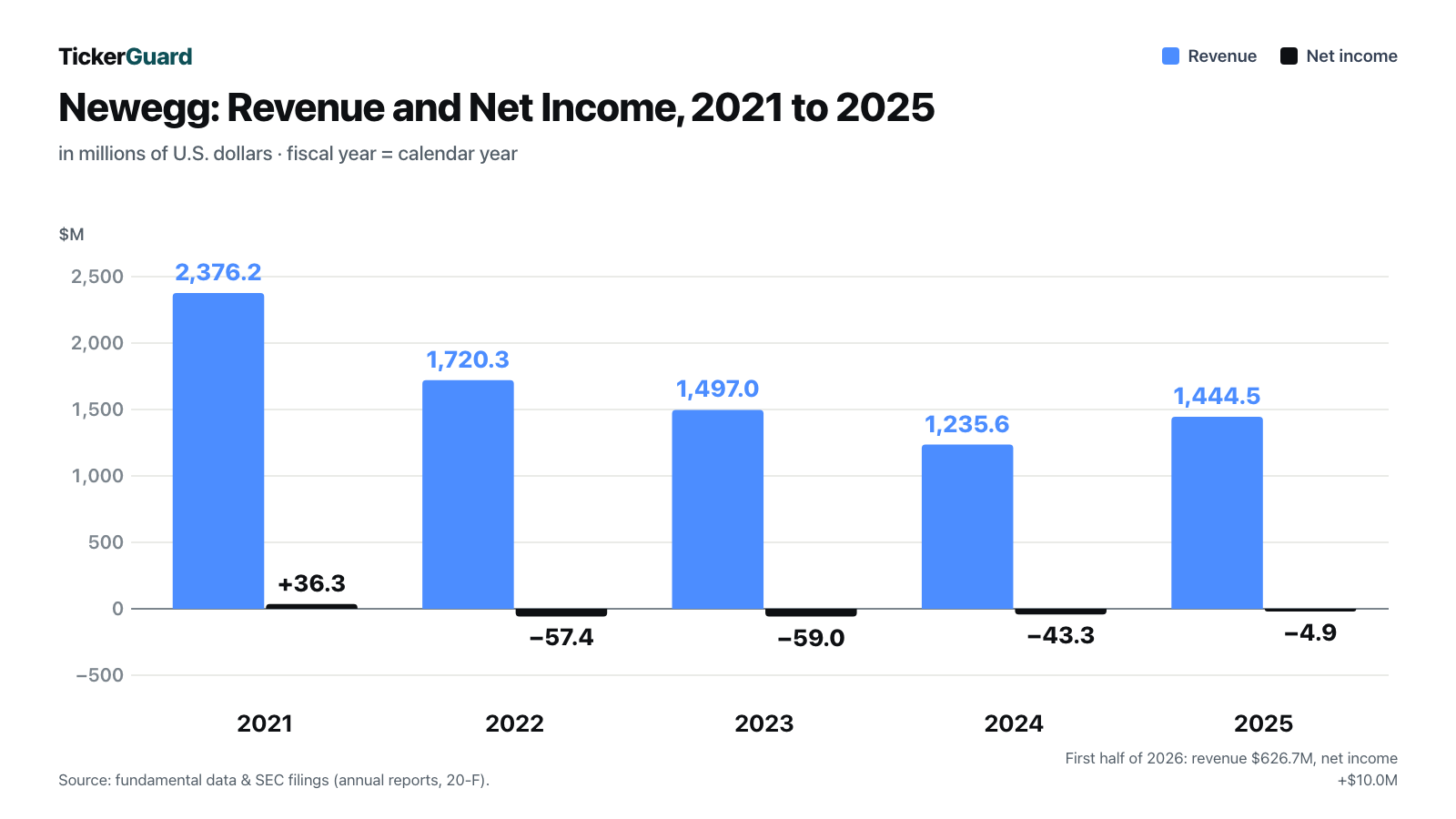
In 2026, the revenue trend did not continue, but the profit trend did. First-half revenue fell 9.9 percent to $626.7 million, as new product generations were missing and expensive memory chips made customers hesitate. At the same time, gross margin rose from 11.5 to 13.3 percent: Newegg had bought memory and graphics cards early and cheaply and could sell them at higher prices during the shortage. The bottom line showed $10.0 million in net income after a $4.2 million loss a year earlier. Keep this picture in mind: Newegg is making money again — but 1.6 cents per dollar of revenue, on less revenue than a year ago.
What the Filings Say — the Uncomfortable Truths
Uncomfortable Truth No. 1: The Profit Comes Mostly From Vanishing Stock Compensation
Newegg credits discipline for the turnaround. Christina Ching, then still interim CFO (appointed permanently on Sept. 14, 2026), wrote about the second quarter:
“Despite the top-line headwinds, our disciplined pricing, inventory management, and continued cost control drove Q2 2026 net income to $2.2 million, up from a net loss of $1.7 million a year ago.”
— Newegg Commerce, Q2 2026 results, Exhibit 99.1 to the Form 6-K of Aug. 27, 2026
The tables in the same release reveal another driver. Stock-based compensation — pay in the form of shares and options, which reduces earnings but costs no cash — fell from $11.6 million to $0.4 million in the first half. Net income improved by $14.2 million over the same period; about $11.2 million of that, or nearly four-fifths, is explained by the drop in this compensation alone (our calculation). The metric Newegg itself computes without stock compensation, adjusted EBITDA (earnings before interest, taxes, depreciation, amortization and stock compensation), rose only from $11.3 million to $13.7 million in the half — and fell from $5.9 million to $3.7 million in the second quarter. In plain terms: in the second quarter, the underlying business earned less than a year earlier; the profit appeared because a cost line nearly disappeared that was still $33.7 million in 2023 and $21.7 million in 2025. The cash flow statement shows where the cash stands: in the first half, operations consumed $19.5 million, as Newegg paid suppliers (payables down $37.5 million) and built inventory to $187.7 million. Cash fell from $107.8 million to $82.2 million.
To be fair: less stock compensation is good for shareholders, because it dilutes them less. And the memory inventory was a genuine advantage in 2026. How strongly the memory shortage is reshaping the industry is something we examined from the manufacturer's side in our Micron analysis. Newegg's guidance of April 28, 2026 — revenue of $1.23 billion to $1.47 billion and net income of $6.1 million to $15.7 million for 2026 — was neither confirmed nor changed with the quarterly results.
Uncomfortable Truth No. 2: Only 1.27 Million Shares Trade Freely — 7 Million Are Registered for Resale
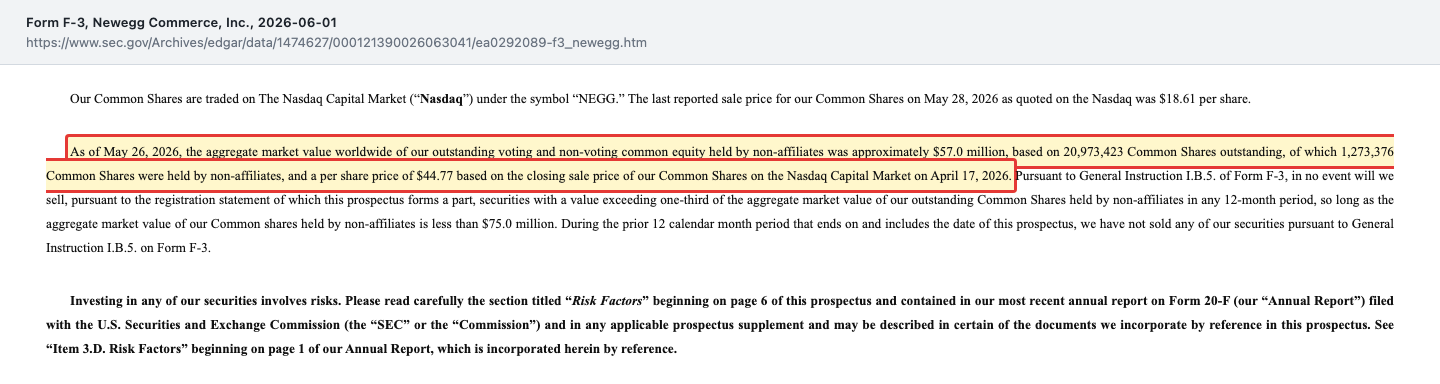
On June 1, 2026, Newegg filed a Form F-3, a shelf registration: Newegg itself may issue up to $250 million in shares and warrants, and three large holders may sell a combined 7.0 million shares. The cover page contains the sentence that explains the price swings:
“As of May 26, 2026, the aggregate market value worldwide of our outstanding voting and non-voting common equity held by non-affiliates was approximately $57.0 million, based on 20,973,423 Common Shares outstanding, of which 1,273,376 Common Shares were held by non-affiliates, and a per share price of $44.77 based on the closing sale price of our Common Shares on the Nasdaq Capital Market on April 17, 2026.”
— Newegg Commerce, Form F-3 of June 1, 2026, prospectus cover page
Who owns the rest is shown in the second chart. Three names hold almost everything: Digital Grid, a subsidiary of the Chinese company Hangzhou Lianluo, with 11.14 million shares (53.1 percent); investor Vladimir Galkin with 4.39 million; and Fred Chang's company Tekhill with 3.16 million (all as of May 26, 2026, per the F-3; after its sales through Oct. 15, 2026, Tekhill held 2,875,909 shares according to its Form 4). Another roughly 1.01 million belong to other affiliates, including Chang directly, his company Nabal Spring and management.
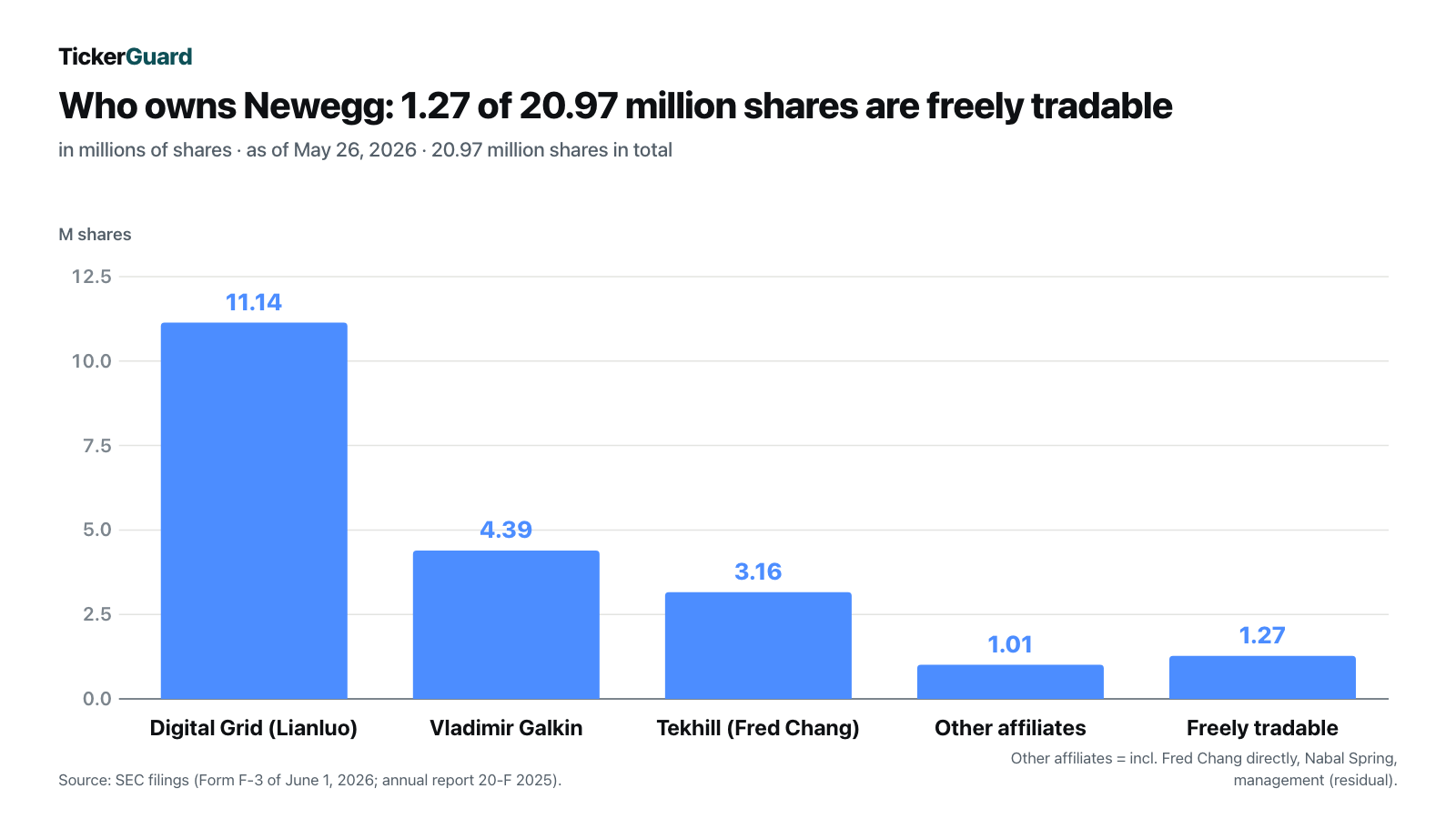
Picture a market stall with a few crates of apples on display and fifteen times as many in the warehouse behind it — and three owners have already filed notice that they may sell part of their stock. The 7.0 million registered shares (Digital Grid 4.0 million, Tekhill and Galkin 1.5 million each) amount to 5.5 times the free float (our calculation). Tekhill is already selling in the market and wrote in its Schedule 13D/A of Oct. 16, 2026:
“Tekhill intends to sell Common Shares available for sale under these ROFR Notices in open-market transactions on the NASDAQ Stock Market.”
— Fred Chang and Tekhill USA LLC, Schedule 13D/A (Amendment No. 4) of Oct. 16, 2026, Item 4
In a market this thin, even a small seller can move the price — in either direction. The months in which Vladimir Galkin bought shares in 2025 coincided with the steep rally; whether and how far one caused the other, the filings do not show. What happens next depends on how much of the registered supply actually hits the market.
Uncomfortable Truth No. 3: The Majority Owner Has Pledged Its Shares — and Its Parent Faces a Bankruptcy Petition
Digital Grid's 53.1 percent is not free. The annual report describes the situation in its section on major shareholders:
“The common shares owned by Digital Grid have been pledged to Bank of China Limited Zhejiang Branch (“BOC”), as collateral to support working capital loans and letters of credit provided by BOC to Hangzhou Lianluo, Digital Grid, and certain affiliates (other than Newegg).”
— Newegg Commerce, SEC annual report on Form 20-F for 2025, Item 7.A "Major Shareholders"
According to the report, a court has declared these loans in default in a final, non-appealable judgment; as of March 31, 2026, RMB 331 million (about $48 million) plus $146.9 million were outstanding. On top of that come claims of about $96 million by the Industrial and Commercial Bank of China against Hangzhou Lianluo. And then this sentence:
“On March 20, 2026, Hangzhou Lianluo announced that China Merchants Bank (“CMB”) has filed a bankruptcy liquidation petition against Hangzhou Lianluo in the Hangzhou Court on the grounds that Hangzhou Lianluo has failed to repay its outstanding loans.”
— Newegg Commerce, SEC annual report on Form 20-F for 2025, Item 3.D "Risk Factors"
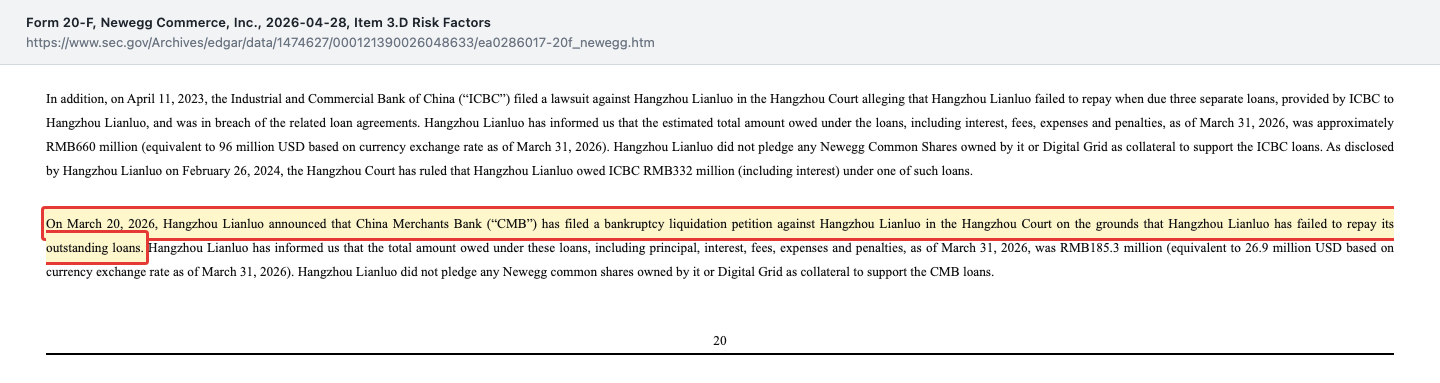
What this means for Newegg shareholders, Newegg spells out itself: Bank of China could sell the pledged shares or force their sale, possibly at a discount and over a short period, and thereby hand control of Newegg to a buyer. For scale: at the Oct. 16, 2026, price, Digital Grid's 11.14 million shares were worth about $121 million, while Bank of China's defaulted loans stood at about $195 million as of March 31, 2026 (our calculation). Then there is the person at the top: Zhitao He, chief executive of Hangzhou Lianluo and chairman of Newegg's board, was detained by a Chinese supervisory commission in January 2026 and released on Feb. 24, 2026; according to the annual report, the stock fell about 17.7 percent in intraday trading after the first announcement. Newegg gives no reasons: according to the annual report, the nature and status of any investigation are not known to the company. Newegg said the detention did not affect its business, and He has resumed his duties (6-Ks of Jan. 20 and Feb. 24, 2026). Newegg is a "controlled company" under Nasdaq rules and therefore, for example, does not need a majority of independent directors.
Uncomfortable Truth No. 4: Newegg Lent the Majority Owner $15 Million — Due Since June 2024
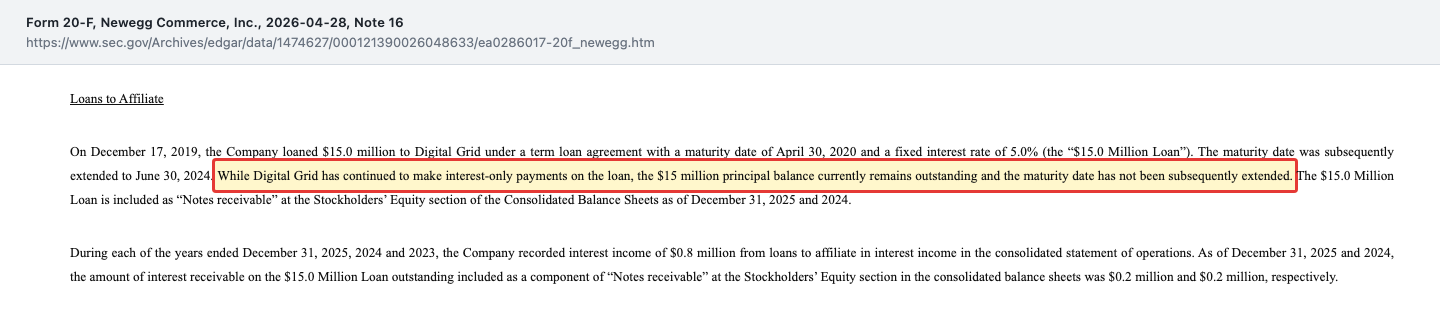
Money also flowed the other way. On Dec. 17, 2019, Newegg lent Digital Grid $15.0 million at 5 percent interest, originally due in April 2020. The notes to the annual report say what became of it:
“While Digital Grid has continued to make interest-only payments on the loan, the $15 million principal balance currently remains outstanding and the maturity date has not been subsequently extended.”
— Newegg Commerce, SEC annual report on Form 20-F for 2025, Note 16 "Related Party Transactions"
The accounting is the good part: Newegg does not carry the receivable as an asset but deducts it from shareholders' equity ($15.2 million as of June 30, 2026, about 8.9 percent of equity). A default would therefore not reduce reported equity any further. The episode is uncomfortable all the same: a listed company lent money to its own majority owner, which has not repaid it for more than two years while its banks wait for their money — and the borrower, through its votes, appoints four seats on the lender's board.
Uncomfortable Truth No. 5: The Credit Agreements Run Only Until Nov. 25, 2026
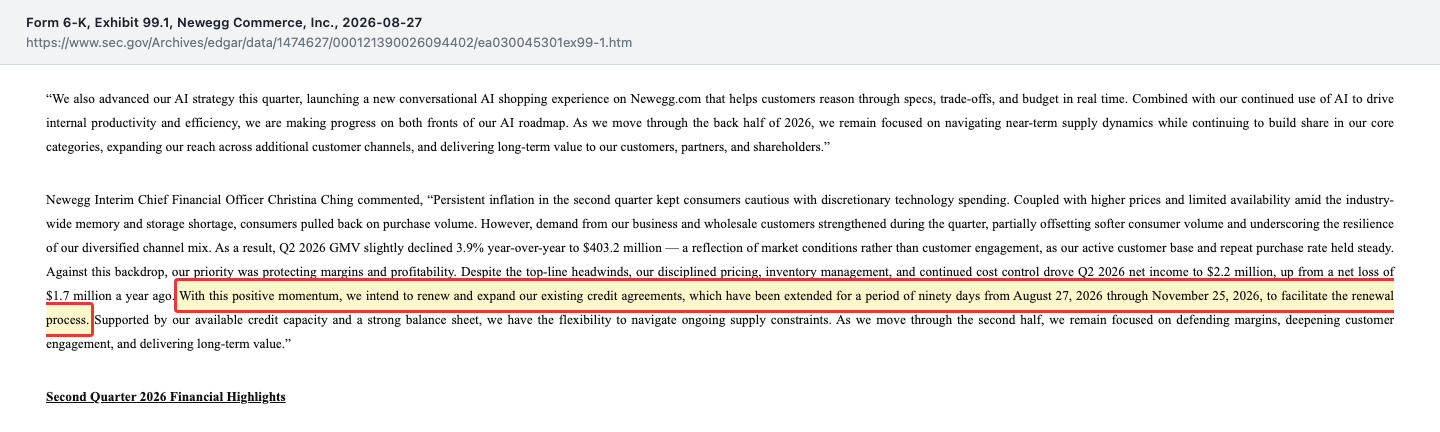
Newegg finances its inventory with revolving credit lines: up to $40 million from April through September, up to $50 million from October through March, plus a second line of $13.41 million since October 2025. Both were due to expire on Aug. 27, 2026. The results release of the same day says:
“With this positive momentum, we intend to renew and expand our existing credit agreements, which have been extended for a period of ninety days from August 27, 2026 through November 25, 2026, to facilitate the renewal process.”
— Newegg Commerce, Q2 2026 results, Exhibit 99.1 to the Form 6-K of Aug. 27, 2026
For context: this is not acute. As of June 30, 2026, only $2.2 million was drawn on the lines, cash stood at $82.2 million, and according to the annual report Newegg was in compliance with all covenants as of Dec. 31, 2025. Newegg attributes the 90 days to the ongoing renewal; until it closes, the financing is secured only for a short time. The lines are secured by inventory, receivables, real estate and subsidiary stock and restrict, among other things, related-party transactions — not a side issue with a majority owner like Digital Grid. By Nov. 25, 2026, Newegg has to report a new agreement.
Valuation: About $229 Million in Market Value, but Only $14 Million in Free Float
At the $10.90 close on Oct. 16, 2026, Newegg's market value was about $229 million, based on 20,973,423 shares (as of May 26, 2026, per the F-3). A cross-check with the weighted average price in the Form 4 filing for Oct. 15, 2026 ($11.045) gives about $232 million. Relative to revenue for the twelve months through June 30, 2026 ($1,375.5 million), that is 0.17 times; relative to net income for the same twelve months ($9.3 million), about 24 times; relative to equity ($171.2 million), 1.3 times (our calculations). Subtracting cash of $82.2 million and adding the $2.2 million drawn on the credit line leaves an enterprise value of about $149 million, excluding lease obligations.
Against the company's own 2026 net income guidance ($6.1 million to $15.7 million), the stock trades at 14.6 to 37.5 times earnings. A price of 0.17 times revenue sounds cheap, but for a retailer with 1 to 2 cents of net margin per dollar it is not an outlier. More important than any of these ratios is the number of shares that actually trade: the 1,273,376 freely tradable shares were worth only about $14 million at the same price (our calculation). The $229 million market value is therefore more an extrapolation from a few trades than a price at which anyone could buy the company. For how a hardware company with a broader shareholder base is valued, see our Corsair analysis.
Opportunities and Risks at a Glance
The case for Newegg:
- Profit instead of loss: $10.0 million in net income in the first half of 2026 after a $4.2 million loss, gross margin 13.3 percent versus 11.5 percent.
- Well-known brand among PC builders, about 2.2 million active customers (2025), a third-party marketplace as a second pillar.
- No acute balance-sheet stress: equity of $171.2 million, cash of $82.2 million, only $2.2 million drawn on credit (June 30, 2026); the receivable from Digital Grid is already deducted from equity.
- Stock-based compensation cut from $33.7 million (2023) to $0.4 million in the first half of 2026 — less dilution.
- 2026 guidance: $6.1 million to $15.7 million in net income; $10.0 million was booked in the first half.
The case against:
- Only 6.1 percent of shares freely tradable (May 26, 2026), 7.0 million shares of large holders registered for resale, Tekhill selling continuously.
- Majority owner Digital Grid: shares pledged to Bank of China, loans ruled in default, bankruptcy petition against its parent (announced March 20, 2026) — a possible change of control.
- $15 million loan to Digital Grid overdue since June 30, 2024.
- Profit turnaround mainly from lower stock compensation; adjusted EBITDA fell from $5.9 million to $3.7 million in Q2 2026, operating cash outflow of $19.5 million in the half.
- First-half 2026 revenue down 9.9 percent, credit agreements extended only until Nov. 25, 2026.
A Human Conclusion
Back to the swarm illusion. Whoever bought Newegg stock at $128 did not pay the verdict of thousands, but a price set by a few. And whoever sees a bargain merely because the price crashed falls for the same fallacy in reverse. The business behind the stock is neither one nor the other: a thin-margin specialty retailer that is profitable again in 2026 — largely because a cost line went away — with solid cash and credit agreements to renew by the end of November. Above it sits an ownership structure in which an indebted majority owner, a selling founder and a large investor together hold about 94 percent.
So the honest question for you is not "How far has the stock fallen?" but: Would you hold this stock if Digital Grid brought its 4 million shares registered for resale to a market where an average of about 44,000 shares changed hands per day recently — or if Bank of China enforced its pledge on the shares? If yes, you have a thesis about Newegg as a retailer. If only the chart convinced you, you bet on a swarm that isn't one here. What you make of it is your decision. And that is how it should be.
Sources
All original documents used in this analysis — to read for yourself:
- Newegg Commerce, Inc. — Q2 2026 results, Exhibit 99.1 to the Form 6-K of Aug. 27, 2026 (most recent periodic report)
- Newegg Commerce, Inc. — Q1 2026 results, Exhibit 99.1 to the 6-K of May 28, 2026 and fiscal 2025 results with 2026 guidance, Exhibit 99.1 to the 6-K of April 28, 2026
- Newegg Commerce, Inc. — SEC annual report on Form 20-F for 2025 (filed April 28, 2026) and Form 20-F for 2024 (filed April 28, 2025)
- Newegg Commerce, Inc. — Form F-3 of June 1, 2026 (effective since June 12, 2026) and prospectus 424B5 of July 15, 2025
- Newegg Commerce, Inc. — reports on Form 6-K of Jan. 20, 2026 and Feb. 24, 2026 (detention and release of the chairman), Feb. 4, 2026 (board) and Sept. 15, 2026 (CFO)
- Schedule 13D/A by Fred Chang and Tekhill USA LLC of Oct. 16, 2026, by Zhitao He and Digital Grid of June 15, 2026, by Vladimir Galkin of Feb. 9, 2026, and Schedule 13G of June 5, 2025
- Form 4 filings through Oct. 16, 2026, and the full filing history: EDGAR overview (sec.gov)
- Fundamental data (prices and trading volume, as of Oct. 16, 2026), reconciled with the SEC filings; prices before April 7, 2025, adjusted for the 1-for-20 share combination.
Transparency & disclaimer: This analysis is a journalistic assessment of publicly available information. It is not investment advice, not financial research in the regulatory sense and not a solicitation to buy or sell securities. Investing in stocks involves substantial risk, up to and including total loss. All information without guarantee; the data date is noted in the text. Positions held by the operator are disclosed daily; where one exists, it appears as a notice at the top of this deep dive.
Key figures at a glance
All monetary figures in millions of $; earnings per share as reported.
| Metric | 2021 | 2022 | 2023 | 2024 | 2025 |
|---|---|---|---|---|---|
| Revenue | 2,376.2 | 1,720.3 | 1,497.0 | 1,235.6 | 1,444.5 |
| Operating Income (EBIT) | 33.5 | -49.5 | -71.1 | -51.6 | -9.5 |
| Net Income | 36.3 | -57.4 | -59.0 | -43.3 | -4.9 |
| Net Margin | 1.5% | -3.3% | -3.9% | -3.5% | -0.3% |
| Earnings Per Share | 1.68 $ | -3.08 $ | -3.12 $ | -2.25 $ | -0.24 $ |
Source: fundamental data & SEC filings (annual and quarterly reports, 10-K/10-Q)
Our Bottom Line at a Glance
- Business & brand neutral
- Well-known specialty retailer for PC hardware with about 2.2 million active customers (2025) and a marketplace; 2025 revenue up 16.9 percent to $1,444.5 million, but down 9.9 percent in the first half of 2026.
- Earnings power neutral
- First half of 2026 with $10.0 million in net income, about $11.2 million of the improvement from lower stock compensation; adjusted EBITDA fell from $5.9 million to $3.7 million in Q2; net margin 1.6 percent.
- Balance sheet & liquidity neutral
- Equity of $171.2 million, cash of $82.2 million, only $2.2 million drawn on credit (June 30, 2026); but a $19.5 million operating cash outflow in the half and credit agreements extended only until Nov. 25, 2026.
- Ownership & governance negative
- Majority owner Digital Grid (53.1 percent) has pledged its shares to Bank of China, and its parent faces a bankruptcy petition (announced March 20, 2026); a $15 million loan to Digital Grid has been overdue since June 30, 2024.
- Tradability negative
- Only 1,273,376 shares (6.1 percent) freely tradable (May 26, 2026), 7.0 million shares of large holders registered for resale; Tekhill sold 217,778 shares from Sept. 1 to Oct. 12, 2026.
Newegg is profitable again in 2026, mainly because stock compensation fell away, and has solid cash. The stock price, however, is driven by a 6 percent free float, large holders with shares registered for resale (Tekhill is already selling) and a majority owner with pledged shares and defaulted bank loans. Not investment advice.
What Our Rating Means
Open questions
The business works in principle, but one material question is open. As long as it stays open, our findings do not carry a quality verdict.
The business carries itself; the problem is the owners. Newegg has positive equity, $82.2 million in cash with barely any credit drawn, no going-concern doubt and a first-half 2026 profit. The open operating question is whether that profit holds without the drop in stock compensation and with falling revenue; at 1 to 2 cents of net margin per dollar, the room for error is small. The heavy findings sit with the owners — a pledged majority stake, a bankruptcy petition against the parent, an overdue $15 million loan, a 6 percent free float. They can change control of Newegg and move the stock, but according to the filings they do not threaten the retailer's existence; the loan is already deducted from equity. If you wait, check the credit renewal by Nov. 25, 2026, and the third-quarter numbers after that. The decision is yours.
A journalistic assessment by our editorial team at the time of the deep dive, based on public sources — not investment advice and not a solicitation to buy or sell. Your personal circumstances (investment goals, risk capacity, taxes) cannot be taken into account. What our levels mean, how verdicts are formed, and what conflicts of interest exist →
Worth Noting
- Newegg made our research list through the Reddit hype scan of Oct. 18, 2026. Newegg is a foreign private issuer (British Virgin Islands): annual report on Form 20-F instead of 10-K, quarterly figures as unaudited press releases on Form 6-K. The most recent periodic report is the Q2 2026 results release (6-K of Aug. 27, 2026); all filings through Oct. 16, 2026, were reviewed (6-K of Sept. 15, 2026, Schedule 13D/A of Oct. 16, 2026, Form 144 and Form 4). Newegg had not announced a date for its third-quarter results as of Oct. 18, 2026.
- Price of $10.90: closing price on Oct. 16, 2026, per fundamental data; cross-checked with the weighted average price in the Form 4 filing for Oct. 15, 2026 ($11.045, a deviation of about 1 percent). Market value = 20,973,423 shares (F-3, as of May 26, 2026; balance sheet as of June 30, 2026: 20,974 thousand) × $10.90. Prices before April 7, 2025, are adjusted for the combination of every 20 shares into one ($3.50 on May 5, 2025).
- Twelve-month figures through June 30, 2026 = fiscal 2025 minus first half of 2025 plus first half of 2026: revenue 1,444.5 − 695.7 + 626.7 = $1,375.5 million; net income −4.9 + 4.2 + 10.0 = $9.3 million. Share of the earnings improvement explained by stock compensation: (11.6 − 0.4) / (10.0 + 4.2) = about 79 percent. Our calculations.
- Possible confusion: Digital Grid (Hong Kong) Technology Co., Limited is the subsidiary of Hangzhou Lianluo Interactive Information Technology, which was delisted from the Shenzhen exchange in 2024; Zhitao He controls both. According to Newegg, the figures on the bank debt come from Hangzhou Lianluo (as of March 31, 2026).
Stock Watch
This analysis is as of October 18, 2026. Stock Watch will tell you what's changed at NEGG since then.
Later $1 a month per stock — signing up is free, and you'll be the first to know when it launches.
The full analysis as a PDF for later
We will send you this analysis as a PDF — to print, file away, and read at your own pace. And we will add you to the free Stock Watch list for Newegg Commerce Inc (NEGG), so you hear about it when something material in this analysis changes.
Frequently Asked Questions
Newegg Commerce, Inc. (NASDAQ: NEGG), based in Diamond Bar, California, has been selling PC components, consumer electronics and gaming gear online since 2001, partly from its own inventory and partly through a marketplace for third-party sellers. In 2025, revenue was $1,444.5 million and the net loss $4.9 million; at year-end Newegg had about 2.2 million active customers and 714 full-time employees.
According to the Form F-3, on May 26, 2026, Digital Grid (a subsidiary of Hangzhou Lianluo, controlled by Zhitao He) held 11.14 million of the 20.97 million shares (53.1 percent), Vladimir Galkin 4.39 million and Fred Chang's company Tekhill 3.16 million. Only 1.27 million shares (6.1 percent) were held by non-affiliates.
Because only a small share of the stock trades: on May 26, 2026, 1.27 million of 20.97 million shares were held by non-affiliates. The price rose from an adjusted $3.50 (May 5, 2025) to $128.09 (Aug. 14, 2025) and fell to $10.90 by Oct. 16, 2026. At the same time, 7.0 million shares of large holders are registered for resale.
In the first half of 2026, yes: $10.0 million in net income after a $4.2 million loss a year earlier. About $11.2 million of the improvement came from lower stock-based compensation. From 2022 to 2025, Newegg posted losses, most recently $4.9 million. For 2026, Newegg guides to $6.1 million to $15.7 million in net income (guidance of April 28, 2026).
On Dec. 17, 2019, Newegg lent its current majority owner Digital Grid $15.0 million at 5 percent interest. The loan matured on June 30, 2024, and was not extended; Digital Grid pays interest only. Newegg deducts the receivable from equity ($15.2 million as of June 30, 2026), so a default would not reduce equity any further.
Newegg is incorporated in the British Virgin Islands and reports as a foreign private issuer. Instead of Forms 10-K and 10-Q, it files an audited annual report on Form 20-F and current reports on Form 6-K; quarterly figures come as unaudited press releases. The most recent periodic report is the second-quarter 2026 release of Aug. 27, 2026.
Found an error?
Did you spot a factual error, an outdated number, or a typo in this deep dive? Let us know briefly — your report goes straight to the editorial team.