Aurora Cannabis in a Takeover Fight: Curaleaf Offers $5 a Share — the Board Says No
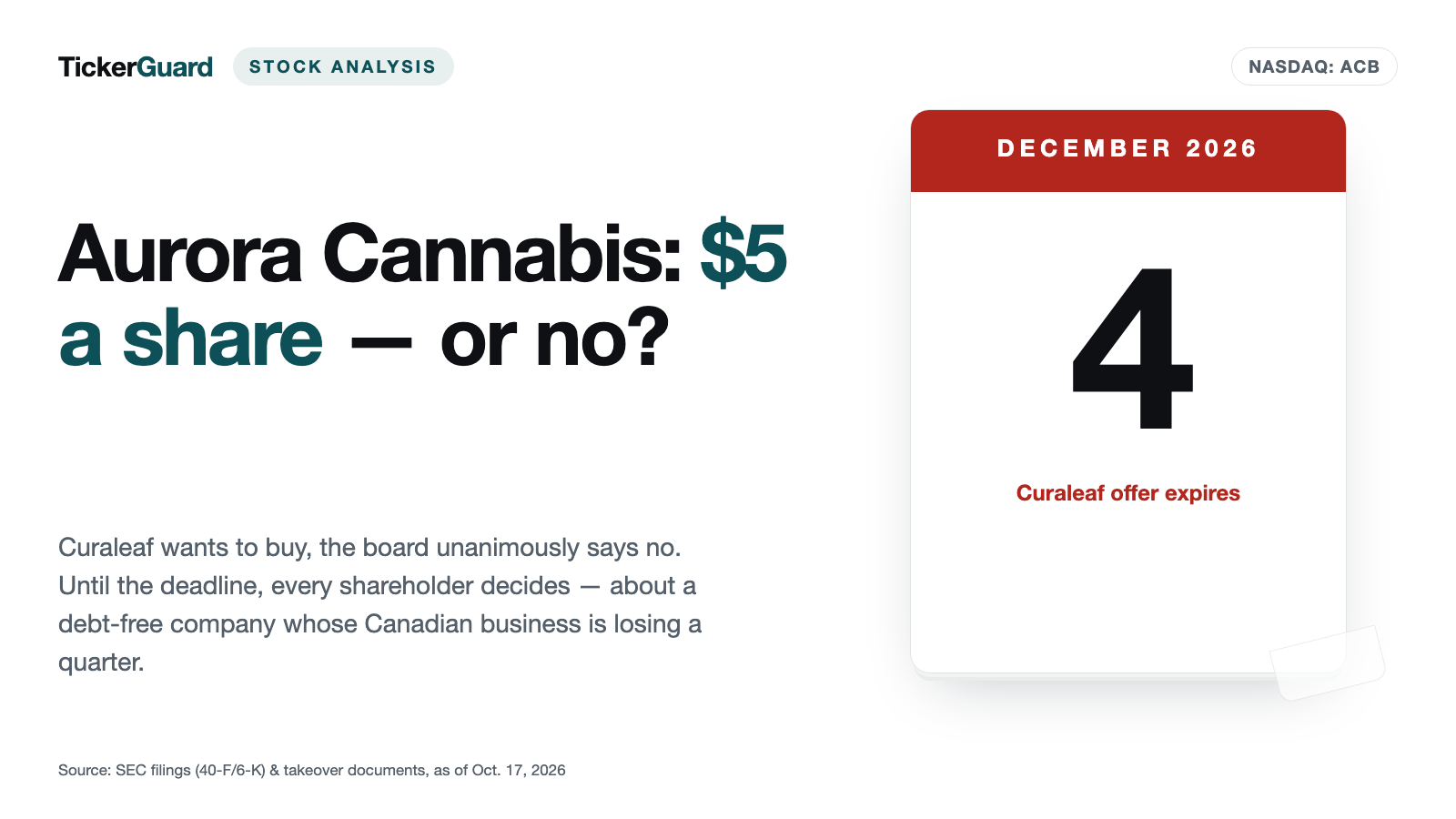
Curaleaf offers arithmetically $5 per Aurora share, the board unanimously says no, deadline December 4, 2026. In between stands a debt-free company whose accumulated deficit equals about 92 percent of its entire share capital — and whose Canadian business is losing a quarter. Three price anchors side by side, so none of them decides for you.
 Thomas Mücke
Founder & Publisher
Thomas Mücke
Founder & Publisher
Chart
Interactive price chart (TradingView).
Note: pure fact-based analysis, not investment advice and not a solicitation to buy or sell. All figures without guarantee.
There is an investor trap that loves to show up in takeover situations: the anchoring effect. Your mind grabs the first number it hears and measures everything else against it. With Aurora Cannabis (Nasdaq and TSX: ACB) of Edmonton, there are three such anchors at once. The first is the offer: $5 a share, which is how Curaleaf Holdings calculates its increased takeover bid of October 6, 2026. The second is the board’s no — in its Notice of Change of October 14, 2026, it unanimously calls the offer “inadequate.” And the third is the past: over the years, the company issued shares worth C$7.03 billion — for cash and as payment for acquisitions — and the accumulated deficit stands at C$6.45 billion. Anyone hanging on to just one of these anchors sees only half the picture. So let’s make a deal: we lay all three side by side and read what Aurora and Curaleaf themselves filed with the U.S. securities regulator, the SEC — the annual report (40-F) for the fiscal year ended March 2026, the quarterly report for April to June 2026 and the takeover documents through October 15, 2026. The companies are legally liable for these statements — even though takeover documents always present one party's view. And one thing up front: nobody knows how this fight ends as of October 17, 2026. In the end, the call is yours.
What Aurora Cannabis Actually Does — Medical Cannabis on Three Continents
Aurora grows cannabis, processes it and sells it — but, despite the name, almost only as a medicine these days. In everyday terms: Aurora is less a corner-store beer seller than a pharmacy wholesaler for a single, tightly regulated prescription product. The company supplies patients in Canada directly, with no middleman, and sells as a wholesaler to Germany, Poland, the United Kingdom, Australia and New Zealand. According to its annual report, Aurora is one of only three producers allowed to grow in Germany itself; the Leuna facility was expanded, according to a release of October 8, 2026, and is expected to more than double the anticipated flower harvest. The Canadian recreational business, once the big stock-market story of the industry, is being wound down: in the April to June 2026 quarter it brought in only C$2.1 million of revenue.
Important for every number in this article: Aurora reports under international accounting rules (IFRS) in Canadian dollars (C$), while the stock trades on Nasdaq in U.S. dollars — and the takeover offer is quoted in U.S. dollars. The fiscal year ends on March 31; “fiscal 2026” therefore covers April 2025 to March 2026, and the current fiscal 2027 began on April 1, 2026. That names the central tension of this analysis: a debt-free company with a fat cash pile and a growing European business — whose Canadian business is currently shrinking by a quarter and whose accumulated deficit has eaten up nearly all the share capital it ever issued. Is the offer too cheap, or is the cash the only thing that really counts?
Company history for investors
-
2014
Milk Capital becomes Aurora Cannabis
On 10/02/2014 the shell company founded in 2006 renames itself Aurora Cannabis. For years it then funds growth with new shares — C$7.03 billion of share capital by mid-2026.
-
2024
10-for-1 share consolidation
On 02/20/2024 every ten shares become one so the stock meets the Nasdaq minimum bid rule again. For shareholders, the visible mark of a long price decline.
-
2026
Bevo sold, reimbursement cut
In February 2026 Aurora sells the greenhouse unit Bevo and starts an ATM program; from 04/01/2026 the government program pays about 30 percent less — Canada medical down 25 percent.
-
2026
Curaleaf launches the hostile offer
On 08/18/2026 Curaleaf offers $0.75 plus 0.3463 of its shares per Aurora share, arithmetically $4.00. On 09/01/2026 the board recommends not tendering.
-
2026
Raised to $5, board says no again
On 10/06/2026 Curaleaf raises to $1.00 plus 0.4013 shares and extends to 12/04/2026. On 10/14/2026 the board again unanimously rejects it and seeks alternatives.
How the Stock Landed on Our Desk — a Hostile Takeover Bid
Aurora is not a hit from our in-house stock scanner. The stock reached our research list through an event: on August 18, 2026, Curaleaf Holdings filed Form SC 14D1F with the SEC — the starting gun for a takeover offer under Canadian law, addressed directly to shareholders. It is called “hostile” because it bypasses the board: Curaleaf is not asking the company, it is asking you. Since then a small paper war has developed — the board’s response (Directors’ Circular of September 1, 2026), several amendments, applications by both sides to the Alberta securities regulator and an increase of the offer. Scanner metrics would be misleading here anyway: as long as an offer is on the table, the price moves mainly with the question of whether and at what price a deal gets done. Keep this in mind from the start: in a takeover fight, the price is a bet on the outcome, not on the business. So we look at the two separately — first the offer, then the business.
The Offer in Detail — What Curaleaf Offers and What the Board Says
Curaleaf is a large U.S. cannabis operator whose stock trades in Toronto (TSX: CURA) and over the counter in the United States. Curaleaf announced the offer on August 11, 2026: $0.75 in cash plus 0.3463 Curaleaf shares per Aurora share, arithmetically $4.00, capped at $5.00. The increase followed on October 6, 2026. Since then:
- Consideration per Aurora share: $1.00 in cash plus 0.4013 Curaleaf shares — arithmetically $5.00, based on the Curaleaf closing price of C$14.21 on October 2, 2026.
- Cap: $6.00. If the Curaleaf stock rises sharply, you receive correspondingly fewer Curaleaf shares. There is no floor: if the Curaleaf stock falls, your offer falls with it.
- Deadline: until December 4, 2026, 11:59 p.m. Mountain Time (previously December 1), unless Curaleaf extends, accelerates or withdraws.
- Reference point before the offer: according to Curaleaf, the volume-weighted 30-day average price through August 10, 2026 was $2.75. Average here means all prices of those 30 days added up and weighted by the number of shares traded — days with heavy trading count more.
The board set up a special committee of independent members, obtained an opinion from the advisory firm Fort Capital and sticks to its no:
“The Aurora Board unanimously recommends that Aurora Shareholders REJECT the Hostile Bid and NOT TENDER their shares to the Hostile Bid.”
— Aurora Cannabis Inc., Notice of Change to Directors' Circular of October 14, 2026 (SC 14D9F/A, filed October 15, 2026)
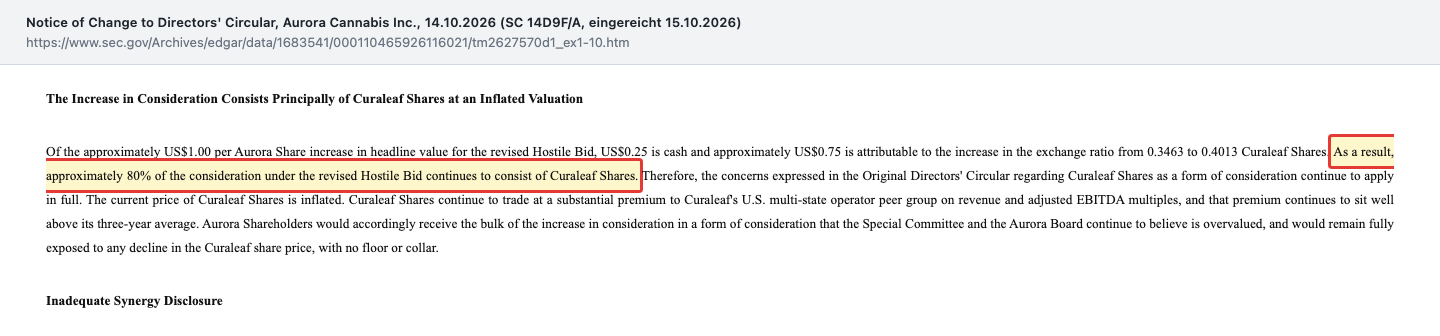
Two of the board’s arguments can be checked against the numbers. First: the cash component of $1.00 per share adds up to about $67 million — and at June 30, 2026, Aurora held the equivalent of $108 million in cash, restricted cash and short-term investments. In the board’s words: “The entire cash component of the revised Hostile Bid can therefore be funded from Aurora’s own balance sheet.” Second: the largest part of the consideration is not money but paper.
“As a result, approximately 80% of the consideration under the revised Hostile Bid continues to consist of Curaleaf Shares.”
— Aurora Cannabis Inc., Notice of Change of October 14, 2026, section “Reasons for Rejection of the Hostile Bid”
What the board wants instead, it also says: the special committee is examining alternatives — a sale to someone else or going it alone. Aurora has signed confidentiality and standstill agreements with several parties (“Aurora has entered into confidentiality and standstill agreements with multiple parties to date”), and these parties are reviewing internal documents. Whether that produces a better offer is open; the board itself writes that there is no assurance. Curaleaf, in turn, stresses that it has spoken with a “significant percentage” of shareholders, but names neither the holders nor the stake. And for acceptance, the majority counts: according to the Directors’ Circular, the offer requires, among other things, that enough shares are tendered (Minimum Deposit Condition). For you that means: until December 4, 2026, either side can still raise the stakes — as of October 17, 2026, the outcome is open.
The Numbers Over the Years — Honestly Appraised
First, what genuinely speaks for Aurora — and it is more than the stock’s history suggests. In fiscal 2026 (April 2025 to March 2026), net revenue rose 11 percent to C$320.6 million (prior year: C$288.9 million). The engine is the international medical business: C$176.5 million, up 29 percent, driven mainly by Germany and Poland. That is more than half of total revenue — Aurora is long since an exporter. Gross margin before fair value adjustments was about 50 percent. And the balance sheet is unusually clean for the industry: since the sale of the greenhouse subsidiary Bevo in February 2026, there is no bank debt on the books; at June 30, 2026, cash (C$69.3 million), restricted cash (C$49.1 million) and short-term investments (C$30.7 million) added up to C$149.1 million, with equity at C$527.1 million.
Now the curve that shows why the timing of the offer matters. It breaks the medical revenue of the last five quarters into Canada and International:
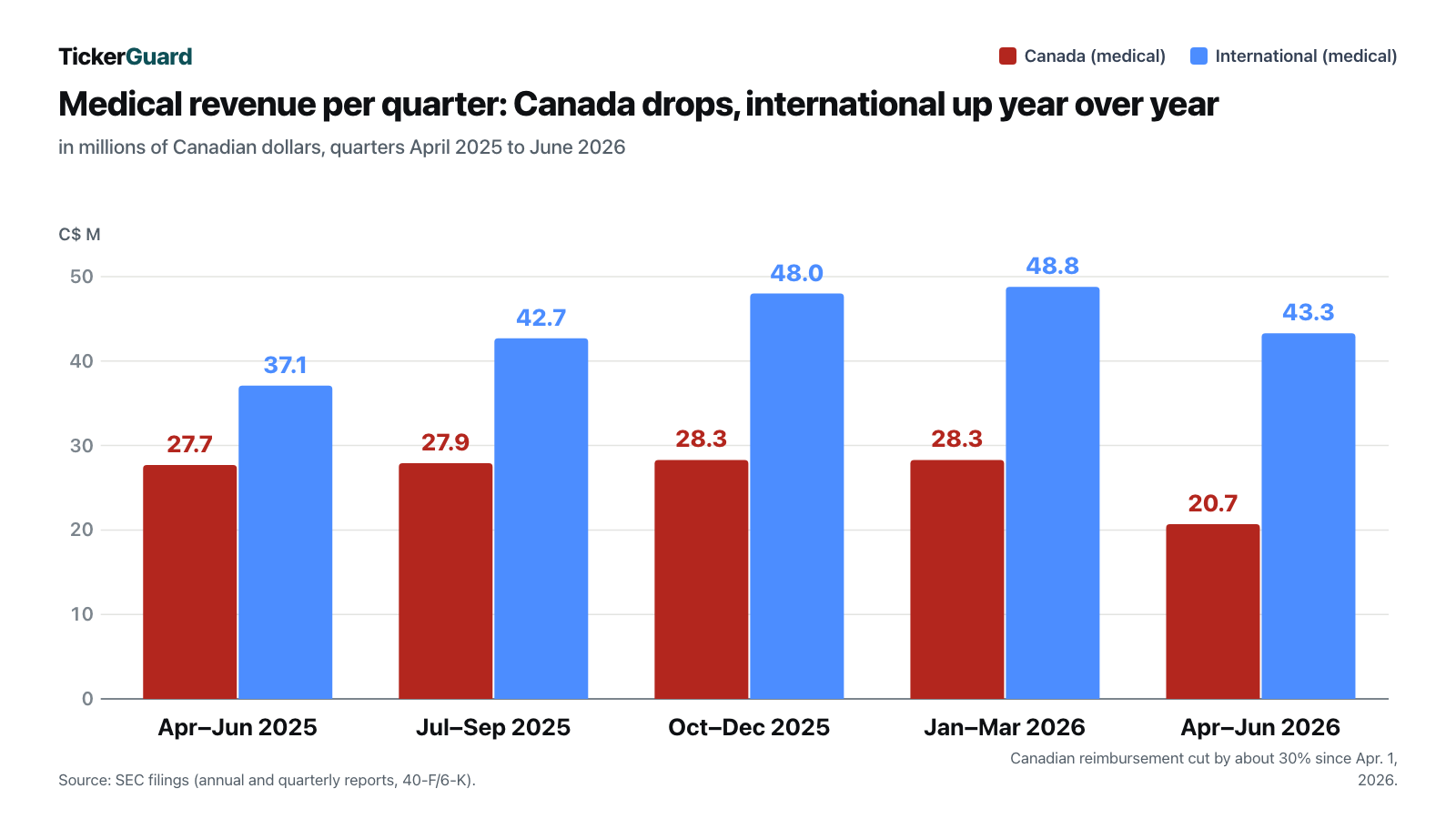
The bottom line looks less friendly. From continuing operations, fiscal 2026 showed a net loss of C$58.6 million (prior year: +C$27.1 million), including C$13.2 million of write-downs of goodwill and intangible assets. Including the discontinued Bevo and ICC operations (−C$77.3 million), the loss was C$136.0 million. Continuing operations consumed C$7.8 million of cash. And the first quarter of the new fiscal year confirms the direction: revenue down 9 percent to C$67.6 million, net loss of C$4.0 million, adjusted EBITDA (operating profit before depreciation, adjusted for one-offs) of C$3.4 million after C$10.8 million in the prior-year quarter, free cash outflow of C$5.8 million. For the second quarter (July to September 2026), Aurora said on August 5 and again on September 16, 2026 that it expects higher revenue and higher adjusted earnings than in the first. Remember the picture: the balance sheet is strong, the earning power is not — not yet or no longer, and that is exactly the question buyer and board are fighting over.
What the Filings Say — the Uncomfortable Truths
Uncomfortable truth No. 1: The accumulated deficit eats up about 92 percent of share capital
The balance sheet at June 30, 2026 contains two lines you have to put next to each other. Share capital — the value of all shares ever issued, whether for cash or as payment for acquisitions — comes to C$7.03 billion. The accumulated deficit comes to C$6.45 billion. In everyday terms: picture a shared flat where the roommates contributed $100 worth to the common kitty over the years, partly in cash, partly in furniture — and today, on balance, only $8 worth is left. Aurora was once one of the best-known names of the Canadian cannabis wave, financed with an endless stream of new shares. How far the price fell afterwards is shown by one sentence from the annual information form:
“On February 20, 2024, the Company completed a share consolidation on a 10 to 1 basis. […] The share consolidation was completed to restore compliance with the Minimum Bid Price Requirement and to ensure the Company continues to have access to a wide range of institutional investors.”
— Aurora Cannabis Inc., Annual Information Form of June 10, 2026 (Exhibit 99.7 to the 40-F annual report for fiscal 2026), section “General Development of the Business”
A consolidation changes nothing about value — ten coins of 10 cents become one coin worth a dollar. But you only need one when the price has fallen so far that the exchange threatens to kick you out. That is the third anchor from the beginning. It is real, but it is sunk: the accumulated losses do not come back through any takeover price. Whoever decides about Aurora today is deciding about the company of today, not about the hopes of back then.
Uncomfortable truth No. 2: A quarter of the Canadian business vanished overnight
Aurora’s old strength was the Canadian medical market: patients order directly from the company, many have their costs reimbursed, and the margin was correspondingly high. That very pillar took a hit on April 1, 2026:
“The 25% decrease was mainly due to changes in the federal reimbursement program effective April 1, 2026, which lowered reimbursement rates by approximately 30%.”
— Aurora Cannabis Inc., Earnings release for the first quarter of fiscal 2027 (6-K of August 5, 2026, Exhibit 99.1)
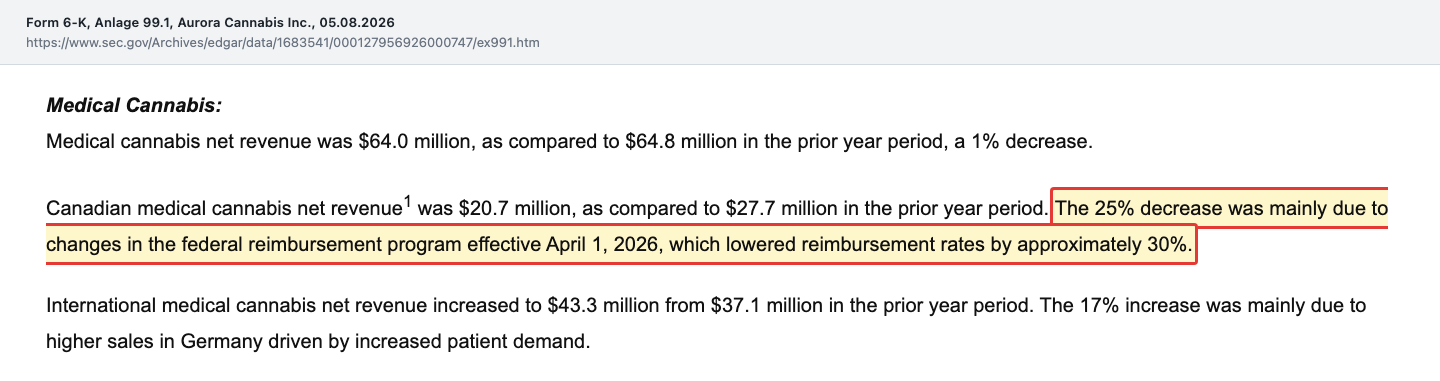
The consequences run through the whole income statement: the adjusted gross margin in the medical business fell from 69 to 61 percent, and Aurora itself expects declining revenue and lower adjusted earnings for fiscal 2027 than in the prior year. That is not a management mistake but a political decision that hits every provider — the board cites an analyst who calls it a “transitory, industry-wide headwind.” But “transitory” is a hope, not proof: the lower rates stand until someone changes them again. The offer falls exactly into this weak year.
Uncomfortable truth No. 3: One-fifth of revenue comes back as an inventory write-down
Cannabis is a perishable, moody commodity. What is not sold in time or does not meet the desired quality has to be written down. At Aurora, that is not a one-off slip but a permanent line item:
“During the year ended March 31, 2026, the Company recognized $65.1 million in inventory provisions and net realizable value adjustments (year ended March 31, 2025 – $65.3 million)”
— Aurora Cannabis Inc., MD&A for fiscal 2026 (exhibit to the 40-F annual report), section “Cost of Sales and Gross Margin”
C$65.1 million is about 20 percent of net revenue of C$320.6 million — two years in a row at almost identical levels. In the April to June 2026 quarter, another C$13.9 million was added. On top comes a quirk of the IFRS rules for agriculture: plants in the field are valued at an estimated market value even before harvest, and changes in that estimate run through gross profit. In the first quarter, exactly that flattered the result — gross profit rose even though revenue fell: “The increase in gross profit includes an increase in gain on changes in fair value of biological assets of $12.6 million, partially offset by a decrease in net revenue of $6.5 million.” The more honest figure is therefore the gross margin before fair value adjustments: 43 percent after 52 percent in the prior-year quarter. Remember: at Aurora, reported gross profit depends noticeably on estimated plant values — look at the line “before fair value adjustments.”
Uncomfortable truth No. 4: 11.5 percent more shares in circulation since March
Dilution means your slice of the pie gets smaller because new slices keep being cut. At Aurora it is happening again right now. In February 2026, the company set up a program under which it may sell up to $100 million (U.S. dollars) of new shares directly on the open market (ATM program, “at the market”). It also paid for the acquisition of the cannabis producer Safari Flower in April 2026 partly with 2,417,180 new shares. The quarterly report does the counting:
“At June 30, 2026, 63,310,061 Common Shares (March 31, 2026 – 58,947,593) were issued and outstanding.”
— Aurora Cannabis Inc., Interim financial statements April–June 2026 (6-K of August 5, 2026), Note 9 “Share Capital”

On the open market, Aurora sold 1,577,330 shares in the April to June 2026 quarter at an average of C$4.29 (the equivalent of $3.09) — above the later pre-offer reference price (30-day average to 08/10/2026: $2.75) and below today’s arithmetical offer value. By August 31, another 2,434,750 shares were added; the report does not break down where they came from. In total there are 65,744,811 shares, or 70,231,437 fully diluted (counting options and share rights). The program has itself become part of the fight: Curaleaf asked the Alberta securities regulator to stop further sales while the offer is pending; on September 14, 2026, Aurora countered that the program was announced more than six months before the offer. For you, the math matters: in a takeover, every new share gets the same price as yours.
Valuation: What Is an Aurora Share Worth?
A price-to-earnings ratio cannot be calculated for lack of earnings. So we lay side by side the anchors documented in the filings — all in U.S. dollars per Aurora share:
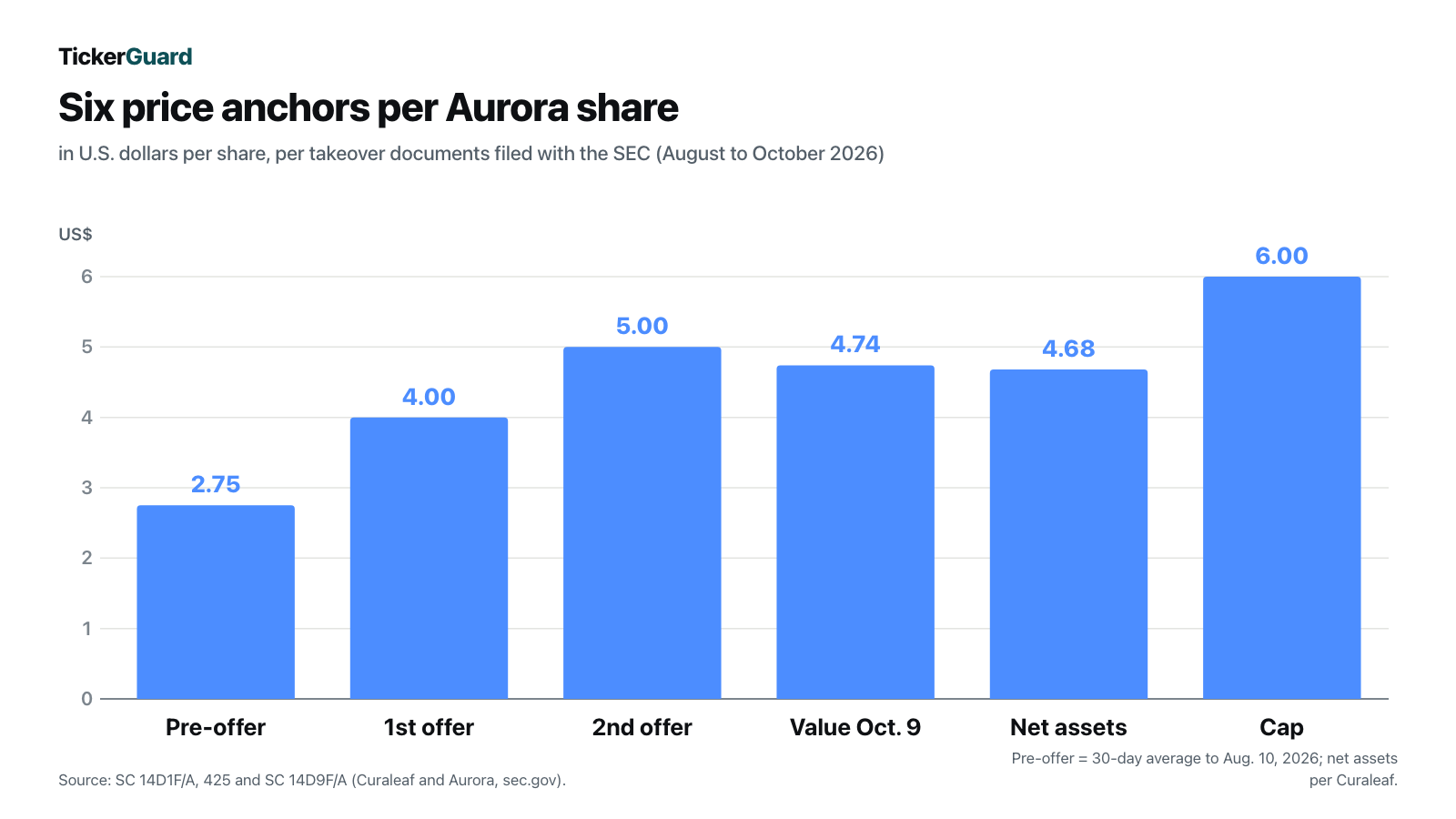
The most revealing number comes from the buyer itself. In its supplemental pro forma statements, Curaleaf provisionally allocated the purchase price across Aurora’s assets: consideration of $328.7 million ($4.92 per share) faces identifiable net assets of $313.2 million ($4.68 per share). What remains is $15.6 million of goodwill — the amount you pay for the business above the sum of its parts. That is 4.7 percent of the purchase price. In plain terms: beyond the valued assets, Curaleaf books only 4.7 percent of the purchase price as goodwill — licenses and permits are already part of the valued net assets. The board reads this as Curaleaf attributing “minimal value to Aurora's business beyond its balance sheet,” also criticizes the write-down of property, plant and equipment in that calculation — and builds its no on that.
For comparison, the market value: at 65.7 million shares (August 31, 2026) and the TSX close of C$6.11 on October 13, 2026 cited in the Notice of Change, the arithmetical market value comes to about C$402 million. That equals roughly 1.25 times revenue in fiscal 2026 and about 0.73 times the book value of C$8.33 per share (equity of C$527.1 million at June 30, 2026 over 63.3 million shares). Converted at the rate Curaleaf cites for October 2 (C$1 = $0.7015), C$6.11 is about $4.29 — so less than the arithmetical offer value. In mid-October 2026, the market did not fully trust the offer, or it was pricing in the risk in the Curaleaf stock; at any rate, it was not betting on a higher counteroffer on a large scale at that point. One detail strengthens Aurora’s negotiating position: according to the subsequent-event note in the quarterly report, about C$46.4 million from a dissolved self-insurance arrangement becomes freely available by the end of 2026 — money that is already part of the C$149.1 million of liquidity but was previously restricted. If you want to compare cannabis valuations, our Canopy Growth and Tilray analyses cover two Canadian competitors for comparison.
Upside and Risks at a Glance
What speaks for Aurora Cannabis:
- Debt-free balance sheet with C$149.1 million of cash, restricted cash and short-term investments (06/30/2026); about C$46.4 million of it, previously restricted, is to become freely available by the end of 2026.
- Growing international business: C$176.5 million of international medical revenue in fiscal 2026 (+29 percent), production in Germany as one of three producers in the country, expansion in Leuna completed (10/08/2026).
- A pending offer provides a reference value: arithmetically $5.00 per share (as of 10/06/2026), cap $6.00, no floor and dependent on the Curaleaf price — and the board is looking for a better solution with several interested parties.
- In mid-October 2026, the stock cost arithmetically about 0.73 times book value and 1.25 times annual revenue.
What speaks against it:
- No reliable earning power: net loss from continuing operations of C$58.6 million in fiscal 2026, again −C$4.0 million in the April to June 2026 quarter and a free cash outflow of C$5.8 million.
- With the reimbursement cut of about 30 percent from 04/01/2026, the Canadian business lost a quarter of its revenue; Aurora expects lower revenue and lower adjusted earnings for fiscal 2027.
- Permanent inventory write-downs of C$65.1 million (fiscal 2026, about 20 percent of revenue) and a gross profit partly driven by estimated plant values.
- Dilution: 11.5 percent more shares between 03/31 and 08/31/2026; accumulated deficit of C$6.45 billion against C$7.03 billion of share capital.
- Open outcome: if Curaleaf withdraws and no counteroffer comes, this reference value is gone. If the offer is accepted, about 80 percent of what you get is Curaleaf stock — with no floor.
A Human Conclusion
Back to the anchoring effect from the beginning. Three numbers pull at you: Curaleaf’s $5, the board’s “inadequate” and the C$7 billion of share capital ever issued. You may let go of the third — it is history, and no buyer pays for history. The first two are both driven by interests: Curaleaf speaks as the buyer, the board as a seller seeking a higher price or going it alone. Between them lies the company as the filings show it: debt-free, with plenty of cash and a European business that is growing — but without profit, with a shrinking Canadian business and a share count that keeps rising. The honest question for you is therefore not “Is $5 too little?” but: would you want to own this company even without a takeover offer — and if so, at what price? Whoever has an answer to that needs no one else’s anchor. A lot can still happen before December 4, 2026. What you make of it is your decision. And that is exactly as it should be.
Sources
All original documents used in this analysis — so you can check them yourself:
- Aurora Cannabis Inc. — Annual report 40-F for the fiscal year ended 03/31/2026 (filed June 11, 2026), including the consolidated financial statements, MD&A and Annual Information Form
- Aurora Cannabis Inc. — Interim financial statements and MD&A for April–June 2026 (quarterly report as 6-K, filed August 5, 2026) and the earnings release of the same day (6-K, Exhibit 99.1)
- Aurora Cannabis Inc. — MD&A for July–September 2025 (6-K of November 5, 2025)
- Curaleaf Holdings, Inc. — Takeover offer SC 14D1F (filed August 18, 2026) and Notice of Variation, Change and Extension (425, filed October 6, 2026) with the press release of October 5, 2026
- Aurora Cannabis Inc. — Directors' Circular of September 1, 2026 (SC 14D9F, filed September 2, 2026)
- Aurora Cannabis Inc. — Notice of Change to Directors' Circular of October 14, 2026 (SC 14D9F/A, filed October 15, 2026) and press release of October 14, 2026
- Aurora Cannabis Inc. — Release on the Leuna facility expansion (6-K of October 8, 2026)
- Full SEC filing history of Aurora Cannabis Inc.: EDGAR overview (sec.gov)
Transparency & disclaimer: this analysis is journalistic commentary on publicly available information. It is not investment advice, not a regulated investment research product and not a solicitation to buy or sell securities — nor a recommendation to tender or not to tender shares into a takeover offer. Equity investments carry substantial risk up to and including total loss. All information is provided without warranty; the as-of date for each figure is stated in the text (takeover status: October 17, 2026). The author holds no position in shares of Aurora Cannabis or Curaleaf at the time of publication.
Our Bottom Line at a Glance
- Balance sheet & liquidity positive
- No bank debt, C$149.1 million of cash, restricted cash and short-term investments and C$527.1 million of equity at 06/30/2026; of this, about C$46.4 million of previously restricted funds is to be released by the end of 2026. An unusually solid starting point for a cannabis producer.
- International business positive
- International medical revenue rose 29 percent to C$176.5 million in fiscal 2026 and 17 percent to C$43.3 million in the April to June 2026 quarter; Aurora produces in Germany as one of three producers in the country and expanded the Leuna facility (10/08/2026).
- Earning power negative
- Net loss from continuing operations of C$58.6 million in fiscal 2026 and −C$4.0 million in the April to June 2026 quarter; operating cash outflow of C$7.8 million (FY 2026), free cash outflow of C$5.8 million (Q1). Inventory write-downs of C$65.1 million equal about 20 percent of revenue.
- Canadian business negative
- Since 04/01/2026 the government program has reimbursed about 30 percent less; Canadian medical revenue fell 25 percent to C$20.7 million in the April to June 2026 quarter, the adjusted medical gross margin from 69 to 61 percent. Aurora expects declining revenue in fiscal 2027.
- Shareholder record & dilution negative
- Accumulated deficit of C$6.45 billion against C$7.03 billion of share capital (06/30/2026), 10:1 consolidation in February 2024; between 03/31 and 08/31/2026 the share count rose 11.5 percent to 65.7 million.
- Takeover situation neutral
- Curaleaf offers arithmetically $5.00 per share ($1.00 cash + 0.4013 Curaleaf shares, cap $6.00, no floor), deadline 12/04/2026; the board unanimously rejects it (10/14/2026) and is reviewing alternatives. Outcome open as of 10/17/2026.
Aurora Cannabis is a takeover fight with three anchors: the Curaleaf offer of arithmetically $5 per share (as of 10/06/2026, deadline 12/04/2026), the board’s unanimous no of 10/14/2026 and a past with C$6.45 billion of accumulated deficit. In between stands a debt-free company with C$149.1 million of liquidity and a growing European business, whose Canadian revenue fell by a quarter after the reimbursement cut and which keeps posting losses. Whoever tenders mostly swaps into Curaleaf stock (about 80 percent); whoever declines bets on a better offer or on going it alone. Not investment advice.
What Our Rating Means
Open questions
The business works in principle, but one material question is open. As long as it stays open, our findings do not carry a quality verdict.
Yellow, because the balance sheet holds but the earning power is open: Aurora has no bank debt and C$149.1 million of liquidity (06/30/2026), but it posts losses (FY 2026: −C$58.6 million continuing; Q1 FY 2027: −C$4.0 million) and lost a quarter of its Canadian revenue after the reimbursement cut. That is not a substance risk in the sense of red — at the recent outflows the cash lasts for many years. Whoever holds the stock is betting either on a better offer by 12/04/2026 or on the European business offsetting the Canadian slump; what remains open is whether the next quarterly report shows the announced recovery and whether the share count keeps rising. The decision is yours.
A journalistic assessment by our editorial team at the time of the deep dive, based on public sources — not investment advice and not a solicitation to buy or sell. Your personal circumstances (investment goals, risk capacity, taxes) cannot be taken into account. What our levels mean, how verdicts are formed, and what conflicts of interest exist →
Worth Noting
- Aurora Cannabis reached our research list through the hostile takeover offer from Curaleaf Holdings (SC 14D1F of 08/18/2026), not through a scanner hit. Status of the takeover: Notice of Change of 10/14/2026 (filed 10/15/2026), deadline 12/04/2026 — the outcome is open.
- Aurora reports under IFRS in Canadian dollars; the stock (Nasdaq) and the offer are quoted in U.S. dollars. The fiscal year ends on March 31 (FY 2026 = April 2025 to March 2026). The figures for fiscal 2026 and the prior year show continuing operations without the discontinued Bevo (sold in February 2026) and ICC operations.
- Valuation dated and evergreen: arithmetical market value from the share count (08/31/2026) and the TSX close of C$6.11 on 10/13/2026 cited in the Notice of Change, not a price-feed value. Analyses are evergreen, daily prices are not a buy argument. Do not confuse: Curaleaf (TSX: CURA) is the bidder, not a subsidiary.
The full analysis as a PDF for later
We will send you this analysis as a PDF — to print, file away, and read at your own pace.
Frequently Asked Questions
Aurora Cannabis Inc. (Nasdaq and TSX: ACB) of Edmonton, Canada, grows, processes and sells medical cannabis — directly to patients in Canada and as a wholesaler to Germany, Poland, the United Kingdom, Australia and New Zealand. In fiscal 2026 (April 2025 to March 2026), net revenue was C$320.6 million, C$176.5 million of it international. The Canadian recreational business is being wound down.
Since the increase of October 6, 2026, Curaleaf Holdings has offered $1.00 in cash plus 0.4013 Curaleaf shares per Aurora share — arithmetically $5.00 at the Curaleaf price of October 2, 2026, capped at $6.00. There is no floor. At the Curaleaf price of October 9, 2026, the package was worth $4.74, according to the Fort Capital opinion. The first offer in August was arithmetically $4.00.
Curaleaf’s offer runs until December 4, 2026, 11:59 p.m. Mountain Time, unless Curaleaf extends, accelerates or withdraws it. The deadline was originally December 1, 2026. Aurora’s board unanimously recommends not tendering and is examining alternatives with several interested parties. As of October 17, 2026, the outcome is open.
According to the Notice of Change of October 14, 2026, the board considers the offer inadequate: about 80 percent of the consideration is Curaleaf stock at an inflated valuation, the cash component of about $67 million could be paid from Aurora’s own treasury, and Curaleaf’s own purchase price allocation assigns almost no value beyond the balance sheet. A Fort Capital opinion supports the view.
No bank debt. At June 30, 2026, Aurora had no loans on its balance sheet, only lease liabilities of C$22.7 million. Cash (C$69.3 million), restricted cash (C$49.1 million) and short-term investments (C$30.7 million) added up to C$149.1 million; equity stood at C$527.1 million.
Because a federal reimbursement program has paid about 30 percent less since April 1, 2026. Canadian medical revenue therefore fell 25 percent to C$20.7 million in the April to June 2026 quarter, and the adjusted gross margin in the medical business fell from 69 to 61 percent. Aurora expects lower revenue overall in fiscal 2027 than in the prior year.
Aurora is a Canadian company and files with the SEC under the U.S.-Canada MJDS system, using Form 40-F (annual) and 6-K (quarterly), with IFRS accounts in Canadian dollars. The Nasdaq-listed stock and the Curaleaf offer, however, are quoted in U.S. dollars. The fiscal year ends on March 31: fiscal 2026 covers April 2025 to March 2026.
Found an error?
Did you spot a factual error, an outdated number, or a typo in this deep dive? Let us know briefly — your report goes straight to the editorial team.