M-tron Industries: A $96 Million War Chest, but the Acquisition Is Still Missing
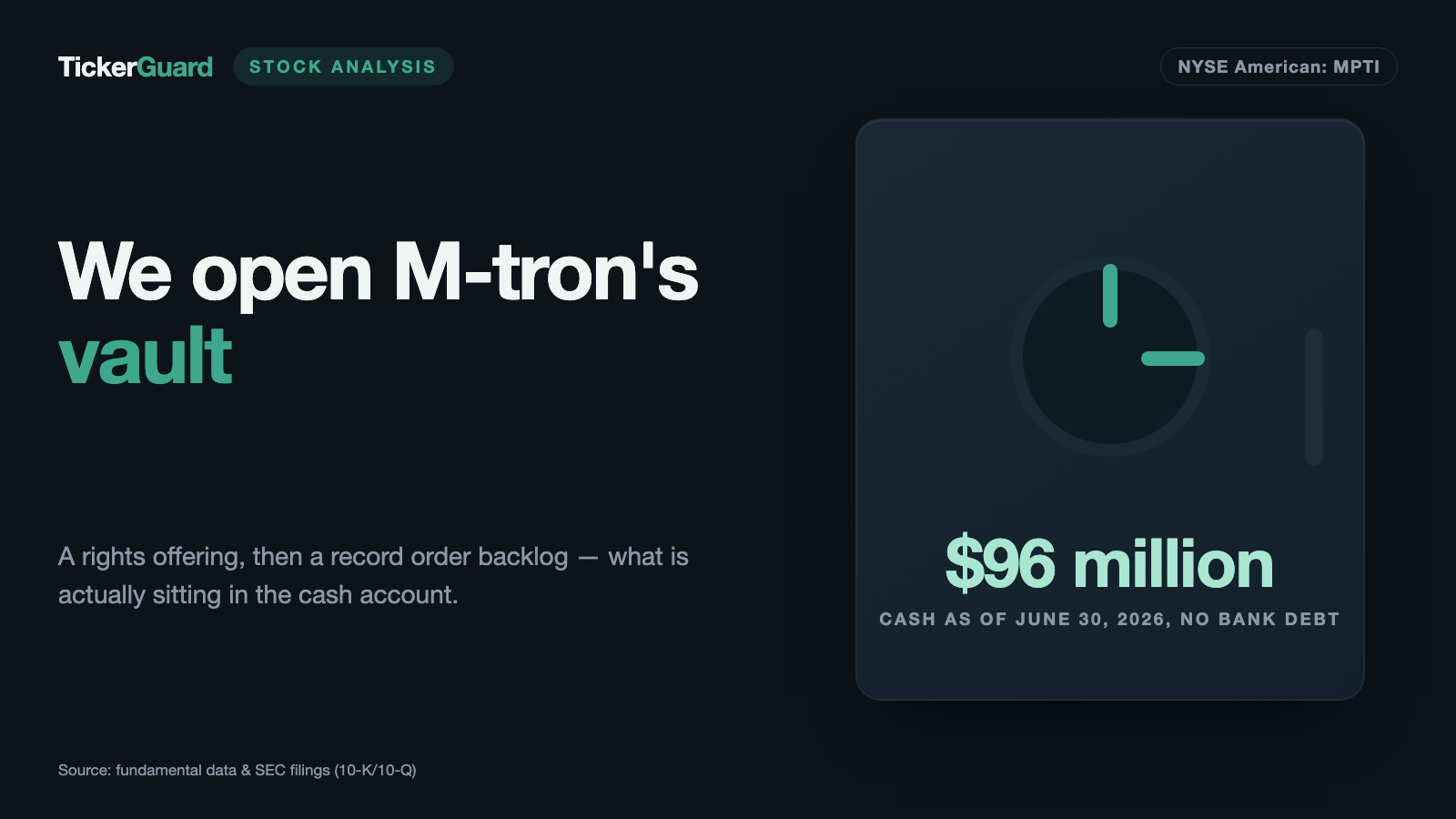
M-tron Industries builds the crystals and oscillators that keep missiles, radar systems, and Boeing and Airbus cockpits on time — and has grown double digits every year since spinning off from LGL Group in 2022. Its order backlog climbed to $84 million by the end of June 2026, yet two customers make up half of revenue, and between late 2025 and mid-2026 the company raised its share count by roughly 46 percent across two capital raises to build a $96 million war chest for acquisitions that have not happened yet. Not investment advice — just a look at what the SEC filings actually show.
 Thomas Mücke
Founder & Publisher
Thomas Mücke
Founder & Publisher
As of Today
As of: October 12, 2026
- Closing price
- 70.10 $ -0.80%
- Market Capitalisation
- 0.3 $B
- Growth Score
- 7/10
- AAQS
- 8/10
Price change since August 27, 2026: -10.5%
This analysis has a cut-off date. The Stock Guard tells you when something material changes in the numbers. Reserve your free spot
Chart
Interactive price chart (TradingView).
52-week range: 45.00 $ to 100.80 $ · Last price: 70.10 $ (As of: October 12, 2026)
Note: pure fact-based analysis, not investment advice and not a solicitation to buy or sell. All figures without guarantee.
There is an investor trap that works especially well right now, because the news cycle keeps feeding it: the headline trap. Drone warfare, missile defense, a defense budget management says is heading toward $1.5 trillion — and your brain jumps straight to "defense stocks are running." That's often even true. What the headline doesn't tell you is which specific company sits behind the ticker, how it actually makes money, and what its balance sheet really looks like. M-tron Industries (NYSE American: MPTI) of Orlando, Florida, is exactly that kind of ticker: a small supplier of frequency and spectrum control products whose components sit inside cruise missiles, radar systems, and Boeing and Airbus cockpits — and which raised its share count by roughly 46 percent across two capital raises between late 2025 and mid-2026 to build a $96 million cash pile. So let's make a deal: before you buy on a headline, let's read together what M-tron actually told the U.S. securities regulator, the SEC — the annual report (10-K) for 2025, the quarterly report (10-Q) for the period ended June 30, 2026, and the filings that go with them. In the end, the decision is yours.
What M-tron actually does — and where the company came from
Forget the ticker for a moment and picture a tuning fork. Any electronic device that needs to hold a signal on an exact frequency, or keep time down to the nanosecond — a radar, a radio, a GPS receiver, a missile that has to find its target — needs an electronic version of that tuning fork: a crystal or oscillator that sets the beat everything else in the device relies on. That is what M-tron builds: highly engineered frequency and spectrum control products — radio-frequency and microwave filters, crystal oscillators (OCXO, TCXO, VCXO), crystal resonators, integrated microwave assemblies, and solid-state power amplifiers. Not a finished product a consumer buys, but a component that sits deep inside other companies' systems — individually unremarkable, but nothing keeps time without it. The 10-K states the company's own history plainly: "Originally founded in 1965," with three manufacturing sites today in Orlando, Florida; Yankton, South Dakota; and Noida, India, plus a sales office in Hong Kong. The U.S. plants are ITAR-registered (the export-control regime for defense articles) and AS9100D-certified, the quality standard for aerospace — hurdles a new entrant cannot simply copy.
One thing matters for context: M-tron in its current form, as a standalone public company, has only existed since 2022. Before that, the business was a subsidiary of The LGL Group, Inc., which spun it off under an Amended and Restated Separation and Distribution Agreement dated August 19, 2022 — a "Separation," in plain English a parent company setting one of its divisions loose as its own publicly traded firm, with its own shares. The umbilical cord is thin but not fully cut: M-tron and LGL Group still operate under a Transitional Administrative and Management Services Agreement (mutual back-office services, financially trivial by now — a net $48,000 per year in both 2025 and 2024), and the 10-K discloses a leadership overlap openly:
"As a result of the Separation, certain of our directors and officers may have actual or potential conflicts of interest because of their positions or relationships with The LGL Group, Inc."
— M-tron Industries, Inc., Form 10-K for fiscal 2025, Risk Factors, "Risks Related to the Separation"

Specifically: Marc Gabelli — son of well-known value investor Mario Gabelli — sits on M-tron's board as "Special Advisor to the Chairman and Director" while also serving as Executive Chairman of LGL Group. M-tron's own Chairman is Bel Lazar, and Cameron Pforr holds both the CEO and CFO roles. None of this is a scandal — overlapping roles after a spin-off are common and fully disclosed — but it's worth knowing before reading further, so you understand where the company's institutional ties run deepest. And that is exactly the tension running through this deep dive: M-tron sits structurally right in the tailwind of Western defense spending — with a tiny, highly concentrated customer base, a stock that was just meaningfully diluted, and a war chest whose use is still undecided. The tailwind is real. Whether you want to buy it at this price and with this concentration risk is a separate question.
Company history for investors
-
1965
Product line founded
The 10-K traces the origin of today's business to 1965 — six decades of frequency-control experience long before any public stock existed.
-
2022
Spin-off from The LGL Group, Inc.
On 08/19/2022, LGL Group completes the Separation and Distribution Agreement — M-tron has traded standalone on NYSE American under MPTI ever since.
-
2025
Credit line secured but untapped
In December 2025, M-tron secures a $20 million credit line with Fifth Third Bank but draws nothing on it — a sign of financial restraint despite the pace of growth.
-
2026
Rights offering at $59.00 per share
On 04/27/2026, M-tron completes a rights offering that further increases share count and brings in $42.1 million for acquisitions still pending as of this analysis.
-
2026
T. Rowe Price discloses a 5.9 percent stake
On 08/14/2026, T. Rowe Price Investment Management files a Schedule 13G — an institutional investor crosses the 5 percent disclosure threshold.
How M-tron landed on our desk
No momentum chart brought us here — a regulatory filing did. On August 14, 2026, asset manager T. Rowe Price Investment Management, Inc. filed a Schedule 13G with the SEC, reporting 255,506 M-tron shares, equal to 5.9 percent of shares outstanding — crossing the 5 percent disclosure threshold that forces an institutional investor to identify itself publicly. That alone is not a buy signal; threshold filings say nothing about whether a position is being built up or wound down. But it does say something else worth noting: a large, fundamentals-focused asset manager built a meaningful position in a stock with only about 4.3 million shares outstanding — just months after M-tron itself raised fresh capital and reported a record order backlog. Enough reason to look closer and check the numbers ourselves, rather than trust the filing threshold alone.
The numbers over the years — an honest look
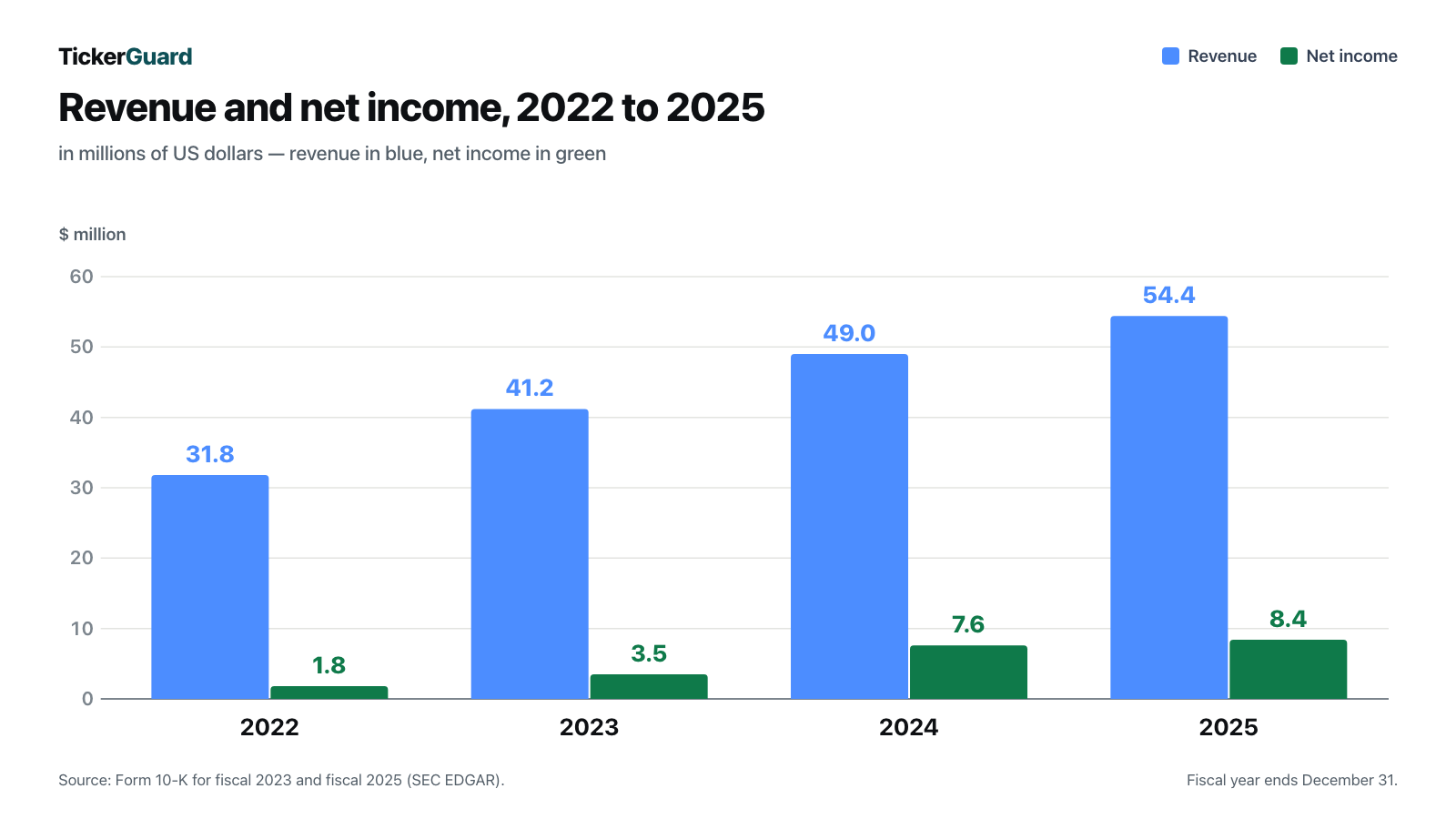
Start with what genuinely impresses: M-tron has grown revenue by double digits every single year since the 2022 spin-off. Revenue climbed from $31.8 million (2022) to $41.2 million (2023, up 29.3 percent), $49.0 million (2024, up 19.0 percent), and $54.4 million (2025, up 11.0 percent) — over the trailing twelve months through June 30, 2026, revenue already stands at $58.2 million. Net income grew even faster: from $1.8 million (2022) through $3.5 million (2023) and $7.6 million (2024) to $8.4 million (2025) — nearly a five-fold increase in four years.
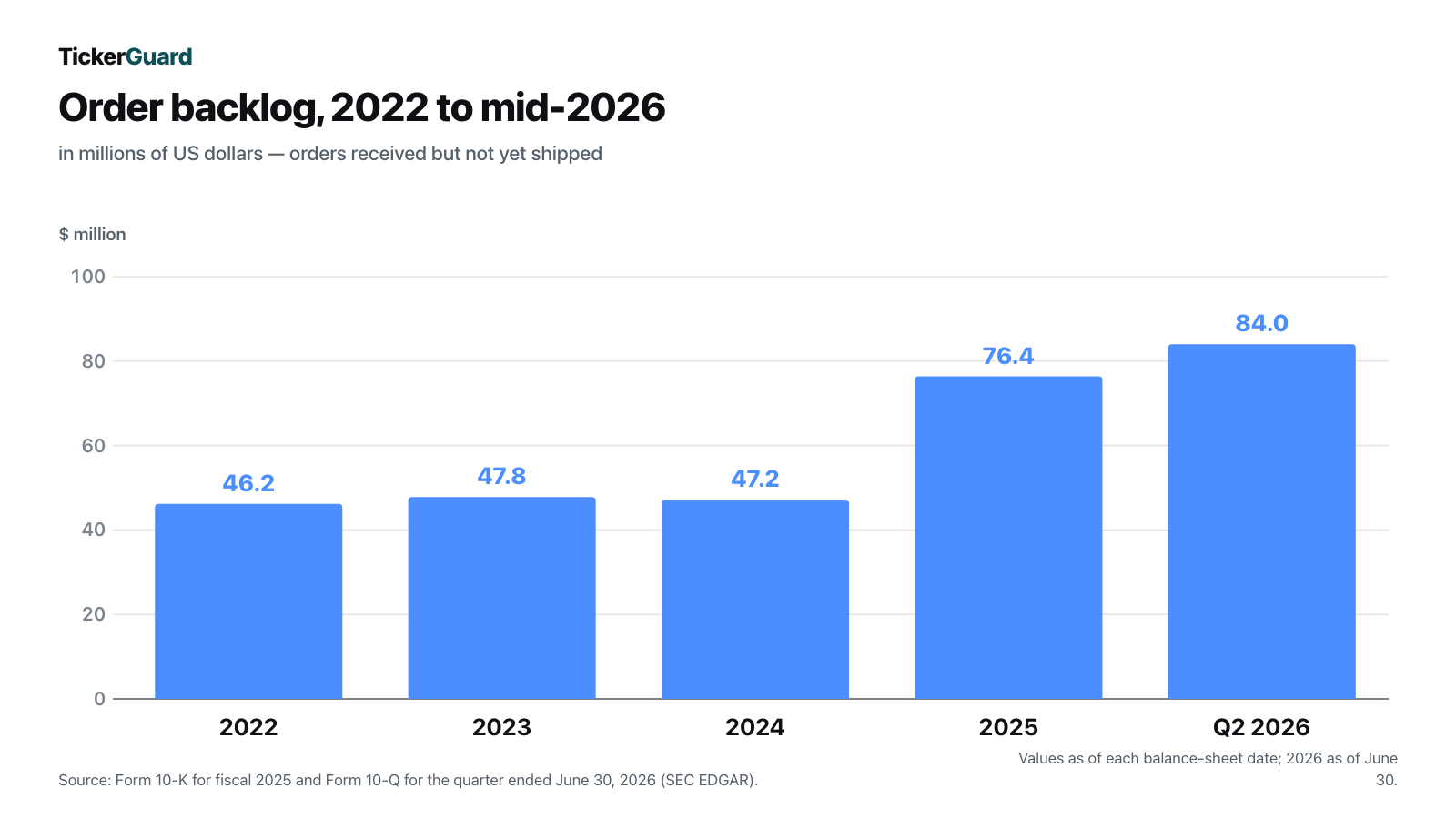
The engine behind that growth is the order backlog — signed but not yet shipped orders. It sat roughly flat between $46 million and $48 million from 2022 through 2024, then took off: $76.4 million at year-end 2025 (up 61.8 percent in twelve months) and $84.0 million as of June 30, 2026 — up 37.2 percent from the prior-year quarter. The 10-Q for the quarter ended June 30, 2026 attributes the latest increase to the "continued strength of our aerospace & defense and avionics customer orders"; on the second-quarter 2026 earnings call (08/13/2026), CEO Cameron Pforr added that several large counter-drone and electronic-warfare orders received over the prior two quarters were also driving the increase.
A quick look at gross margin (revenue minus manufacturing cost, divided by revenue — the higher it is, the more room for R&D, sales, and profit): it rose from 35.6 percent (2022) through 40.7 percent (2023) to 46.2 percent (2024), then slipped to 44.4 percent in 2025 — and to 41.2 percent in the second quarter of 2026. Management points to two causes: startup costs on newly ramping product lines, which are more expensive to manufacture at first, and tariffs, which shaved roughly one percentage point off margin in 2025. More on both below.
What management promised — and what actually happened
Two earnings calls are on record: the fourth-quarter and full-year 2025 call (March 26, 2026) and the second-quarter 2026 call (August 13, 2026). Together they offer a rare look at whether a management team delivers on what it announces — and where the tone shifts.
In March 2026, CEO Cameron Pforr was upbeat: he pointed to newly signed seven-year production agreements between Lockheed Martin, Raytheon, and the U.S. Department of War for precision-guided munitions — programs where M-tron says it has "one of the highest levels of missile content in its revenue among publicly listed U.S.-based companies" — and announced the rights offering to be ready for "larger transactions." Asked about gross margin, he was cautiously optimistic: the tariff drag would be "a little bit less" in 2026 than in 2025. By August 2026, five months later, the same Cameron Pforr sounds more measured. Second-quarter gross margin came in at 41.2 percent, down 2.4 points from 43.6 percent a year earlier — but roughly $500,000 of one-time, non-cash stock compensation tied to the 2025 annual bonus alone cost about 3.3 percentage points of margin, more than the entire year-over-year decline: strip that item out and margin would have edged up versus the prior-year quarter, not down. For the second half of 2026 he now guides to a range of "41.5 to 43.5, maybe 44 percent" — lower than the 46.2 percent posted in 2024, though not dramatically so. On the big seven-year programs, the tone has turned more cautious: March's optimism about signed framework agreements gave way in August to the caveat that "visibility is kind of slowly coming into focus," with the first incremental purchase orders from those agreements now expected only in the first quarter of fiscal 2027 — for production that ships in 2028. No promise was broken here, but converting the framework agreements into actual orders is taking longer than the March tone suggested.
On the acquisition question, the message has been consistent but unfulfilled: as early as March 2026, management said it wanted to use rights-offering proceeds for "accretive acquisitions." On the August call, asked directly about M&A pipeline, Pforr said the company had seen "an increase in deal flow" from investment banks since completing the capital raise and "still hope[s] to get a deal done this year." That is a stated intention, not a completed transaction — as of this writing, no acquisition has been announced. On Q&A quality: both calls answer concrete numeric questions directly (margin guidance, drone-related revenue quantified at "roughly $4 million" for 2026) without visible dodging — a good sign for communication discipline, even as the bigger strategic questions (program timing, acquisition target) necessarily stay vague.
What the filings reveal — the uncomfortable truths
Uncomfortable truth No. 1: two customers make up half of revenue
M-tron's growth is real. But it rests on a narrower base than total revenue suggests. For fiscal 2025, the 10-K discloses:
"For the year ended December 31, 2025, our largest and second largest customers accounted for 36.0% and 14.9% of the Company's total revenues, respectively. Additionally, as of December 31, 2025, four customers accounted for approximately 71.4% of our gross accounts receivable balance."
— M-tron Industries, Inc., Form 10-K for fiscal 2025, Risk Factors

Picture a small contracting business that does half its work for two developers. When those two are thriving, the business booms right along with them — but if either one loses interest, cuts its budget, or switches suppliers, that leaves a hole the other 96 customers can't fill overnight. To be fair, concentration is easing slightly — the top four customers combined made up 61.0 percent of revenue in 2025, down from 65.7 percent the year before, because the broader customer base is growing faster than the largest ones. And the two biggest customers are unlikely to be flight risks — management has identified Lockheed Martin and Raytheon among its customers, backed by multi-year, even seven-year framework agreements with the U.S. Department of War. Still, this remains a real concentration risk that belongs in any assessment of the stock — one the company itself discloses this openly under its own risk factors.
Uncomfortable truth No. 2: margin is eroding right when growth is strongest
Growth is not free. When a supplier ramps several new product lines at once, that costs more money up front than it brings in — tooling, scrap during the learning curve, unpracticed production lines. On an annual basis, that is exactly what is happening at M-tron: gross margin fell from 46.2 percent (2024) to 44.4 percent (2025), hurt by tariffs (roughly one point) and the ramp-up of new product lines. In the second quarter of 2026 margin came in at 41.2 percent, 2.4 points below the year-earlier quarter (43.6 percent) — at first glance, a sharpening of the trend. Look closer and the picture changes: roughly $500,000 of one-time, non-cash stock compensation tied to the 2025 bonus alone cost about 3.3 percentage points of margin — more than the entire year-over-year decline. Strip that item out and margin would have edged up versus the prior-year quarter, helped by tariffs actually easing slightly (from 1.25 to 1.1 percentage points of drag). The real, structural compression shows up not in the quarterly comparison but in the annual one: management guides to a range of 41.5 to a maximum of 44 percent for the second half of 2026 — clearly below the 46.2 percent posted in 2024. None of this is a red flag on its own — new product lines cost more than they bring in during the ramp-up, that is the ordinary price of fast growth. But anyone who only looks at the growth rate and skips past the margin trend is missing that more revenue right now does not automatically mean proportionally more profit — and anyone who reads the quarterly decline at face value as a worsening trend is missing the one-time item behind it.
Uncomfortable truth No. 3: nearly 46 percent more shares in under a year — and the war chest is still uninvested
The most striking single finding in the recent filings: M-tron sharply increased its share count within a few months. The 10-Q describes the so-called rights offering — an offer that gives existing shareholders preferential access to buy new shares — this way:
"On March 30, 2026, the Company issued 3,566,812 subscription rights (the "Rights") to holders of record of outstanding shares of the Company's common stock as of March 27, 2026 (the "Rights Offering"). Five (5) Rights entitled their holder to purchase one (1) share of Common Stock at a subscription price of $59.00 per share."
— M-tron Industries, Inc., Form 10-Q for the quarter ended June 30, 2026, Note "Rights Offering"

In share-count terms — and the sequence matters, because two separate capital actions are easy to conflate: by the end of 2025, M-tron had about 2.98 million shares outstanding. Between October 2025 and January 7, 2026, warrant holders exercised 80.8 percent of their warrants — 582,233 new shares (470,205 by year-end 2025, another 112,028 on January 7, 2026) for $27.7 million in gross proceeds — taking share count to 3,565,118 (as of the 10-K cover date, March 16, 2026). Only after that, in spring 2026, came the rights offering just quoted: completed April 27, 2026, with 83.6 percent of rights exercised for 713,362 new shares and $42.1 million in gross proceeds, plus roughly 68,000 more shares from option exercises through the end of July. The result: 4,346,476 shares by July 31, 2026 — up roughly 46 percent in about nine months. Together, both actions took M-tron from $20.9 million in cash at year-end 2025 to $96.2 million in cash as of June 30, 2026 — with zero bank debt; a $20 million credit line established with Fifth Third Bank in December 2025 remains untapped. Picture your neighborhood bakery selling nearly half again as many ownership stakes in itself, in two steps over a year, to fund a second location — except it hasn't found that second location yet. That is roughly the situation here: management itself calls the proceeds a war chest for "accretive acquisitions," but as of the August 2026 call had not closed a deal, saying only that it "still hope[s] to get one done this year." Until then, the combined capital raise dilutes every share that existed before the warrant exercise by roughly 46 percent, without that extra capital yet working inside the operating business.
Valuation — expensive for a niche supplier, but not detached from reality
At a market capitalization of roughly $337 million to $340 million (price $78.30 on August 27, 2026, on about 4.35 million shares outstanding), M-tron trades at roughly 31 times trailing-twelve-month net income and roughly 5.8 times trailing revenue. That is not a bargain — for a supplier generating $54 million to $58 million in annual revenue, that is an ambitious multiple that already prices in a good deal of future growth. In fairness, the $84 million order backlog already exceeds a full year of revenue in already-secured, not-yet-shipped demand — an anchor many smaller industrial suppliers cannot point to. The balance sheet is also unusually strong: the Altman Z-score, a formula that estimates how far a company sits from bankruptcy risk (above 3 is considered safe, M-tron scores around 23), signals essentially no balance-sheet risk. Buying M-tron today, in other words, is not a value play with a margin of safety — it is a growth bet on a structural defense and avionics upswing, at a price that already reflects a good part of that upswing.
Opportunities and risks at a glance
What speaks for M-tron:
- Four straight years of double-digit revenue growth (2022 through 2025) and an order backlog that jumped 61.8 percent in a single year to $76.4 million (end of 2025) — and further to $84.0 million by June 30, 2026.
- A rock-solid balance sheet: $96.2 million in cash, no bank debt, an Altman Z-score around 23 — a capital cushion for organic growth and potential acquisitions.
- Structural barriers to entry: ITAR registration, AS9100D certification, and decades-long customer relationships make it hard for new competitors to break into the same programs.
- Diversified end markets: aerospace and defense (65.2 percent of 2025 revenue), commercial avionics (22.7 percent, supplying Boeing and Airbus), and space (4.0 percent) — not a single-program bet.
- Documented institutional interest: T. Rowe Price disclosed a 5.9 percent stake on August 14, 2026.
What speaks against it:
- High customer concentration: 36.0 percent of 2025 revenue from a single customer, 50.9 percent from the top two combined — losing or shrinking either relationship would clearly hurt.
- Gross margin trending down: from 46.2 percent (2024) to 41.2 percent in the second quarter of 2026, driven by tariffs and new-program ramp costs; management guides to 41.5 to a maximum of 44 percent for the second half of 2026.
- Substantial fresh dilution: roughly 46 percent more shares outstanding between late 2025 and mid-2026 across a warrant exercise and then a rights offering — the roughly $70 million combined proceeds are not yet deployed into an acquisition.
- An ambitious valuation: roughly 31 times trailing earnings and 5.8 times trailing revenue — little cushion if growth stalls or a major order slips.
- Management says the large seven-year Lockheed Martin and Raytheon framework agreements will not bring incremental orders before the first quarter of fiscal 2027 at the earliest — patience is required.
A human close
Back to the headline trap from the top. Its danger is not that the headline is wrong — the defense and avionics upswing is real, and M-tron, with its ITAR registration, decades-old customer relationships, and a backlog that has swelled to $84 million, genuinely sits in that tailwind. Its danger is that the headline does the homework for you that a single stock actually demands: checking how much of the business rests on two customers, which part of the margin decline is a one-time item and which is structural, and whether roughly 46 percent of fresh dilution is already justified by an acquisition — or still has to be. So the honest question isn't "Is the defense sector hot right now?" but: would you trust a small, highly specialized supplier with a $337 million market value, when half its revenue runs through two doors and $96 million in fresh capital is still waiting for a use? If yes, you have a thesis that goes beyond the headline. If no, you had a headline. What you do with that is your call. Not investment advice.
Sources
All original documents used in this analysis, for your own reading:
- M-tron Industries, Inc. — Form 10-K for fiscal 2025 (filed March 26, 2026)
- M-tron Industries, Inc. — Form 10-K for fiscal 2024 (filed March 27, 2025)
- M-tron Industries, Inc. — Form 10-K for fiscal 2023 (filed March 25, 2024)
- M-tron Industries, Inc. — Form 10-Q for the quarter ended June 30, 2026 (filed August 12, 2026)
- M-tron Industries, Inc. — earnings call transcripts for the fourth quarter and full year 2025 (March 26, 2026) and for the second quarter of 2026 (August 13, 2026)
- M-tron Industries, Inc. — Form 8-A12B listing the subscription rights on NYSE American (filed March 30, 2026)
- T. Rowe Price Investment Management, Inc. — Schedule 13G on M-tron Industries, Inc. (filed August 14, 2026)
- Full SEC filing history for M-tron Industries, Inc.: EDGAR filing index (sec.gov)
- Fundamental data (metrics, valuation, analyst estimates; data as of August 27, 2026), cross-checked against the SEC filings.
- Further reading: our stock analysis of Redwire, another aerospace supplier with a similar growth and valuation dynamic.
Transparency & disclaimer: This analysis is a journalistic assessment of publicly available information and is not investment advice, not a regulated financial analysis, and not a solicitation to buy or sell securities. Stock investments carry substantial risk, including total loss. All figures are provided without guarantee; the data date is noted throughout the text. Positions held by the operator are disclosed daily; where one exists, it appears as a notice at the top of this deep dive.
Key figures at a glance
All monetary figures in millions of $; earnings per share as reported.
| Metric | 2021 | 2022 | 2023 | 2024 | 2025 |
|---|---|---|---|---|---|
| Revenue | 26.7 | 31.8 | 41.2 | 49.0 | 54.4 |
| Operating Income (EBIT) | 2.1 | 2.9 | 4.3 | 9.4 | 10.3 |
| Net Income | 1.6 | 1.8 | 3.5 | 7.6 | 8.4 |
| Net Margin | 5.9% | 5.6% | 8.5% | 15.6% | 15.5% |
| Earnings Per Share | 0.59 $ | 0.67 $ | 1.28 $ | 2.65 $ | 2.62 $ |
Source: fundamental data & SEC filings (annual and quarterly reports, 10-K/10-Q)
Our Bottom Line at a Glance
- Growth & order book positive
- Four straight years of double-digit revenue growth ($31.8 million in 2022 to $54.4 million in 2025, TTM $58.2 million through 06/30/2026); order backlog jumped from $47.2 million (end of 2024) to $84.0 million (06/30/2026) — more than a full year of secured demand.
- Balance-sheet quality positive
- $96.2 million in cash as of 06/30/2026, no bank debt, an unused $20 million credit line, and an Altman Z-score around 23 (above 3 is considered safe) — essentially no visible bankruptcy risk.
- Customer concentration negative
- The largest customer made up 36.0% of 2025 revenue, the top two combined 50.9%, and four customers 71.4% of receivables. Concentration is easing slightly (2024: 65.7% for the top four) but remains a material operating dependency without an immediate existential threat.
- Margin pressure & execution risk neutral
- Gross margin fell from 46.2% (2024) to 41.2% in the second quarter of 2026, driven by tariffs and ramp-up costs on new product lines; management guides to 41.5% to a maximum of 44% for the second half of 2026. Not a red flag, but an open operating question.
- Dilution & capital deployment neutral
- Roughly 46% more shares outstanding between late 2025 and mid-2026, in two steps (a warrant exercise, then a rights offering at $59.00/share); the roughly $70 million in combined proceeds had not been deployed into an acquisition as of the August 13, 2026 earnings call.
- Valuation neutral
- Roughly 31 times trailing net income and 5.8 times trailing revenue at a market capitalization of $337 million to $340 million (08/27/2026) — ambitious for the company's size, partly supported by the large order backlog.
M-tron Industries has grown double digits every year since spinning off from LGL Group in 2022, and sits structurally in the tailwind of Western defense spending, with ITAR-registered U.S. plants, seven-year framework agreements from Lockheed Martin and Raytheon, and an order backlog that has swelled to $84.0 million (06/30/2026). Against that stands high customer concentration (50.9% of 2025 revenue from two customers), a gross margin declining on an annual basis (46.2% in 2024 to 44.4% in 2025, with H2 2026 guidance of 41.5% to 44%), and fresh dilution of roughly 46% more shares outstanding since year-end 2025, whose roughly $70 million in proceeds still sit undeployed. Not investment advice.
What Our Rating Means
Open questions
The business works in principle, but one material question is open. As long as it stays open, our findings do not carry a quality verdict.
The business model works, the balance sheet is rock-solid, and the structural tailwind from defense and avionics spending is backed by real numbers — that speaks for quality. But a material operating question remains open: how much does the business really depend on two large customers, how quickly does the recently declining gross margin normalize, and what will the freshly diluted, still-undeployed war chest actually be used for? These are open operating questions, not solvency risks — but they are enough to wait for the next quarterly report before calling this "green." The decision is yours.
A journalistic assessment by our editorial team at the time of the deep dive, based on public sources — not investment advice and not a solicitation to buy or sell. Your personal circumstances (investment goals, risk capacity, taxes) cannot be taken into account. What our levels mean, how verdicts are formed, and what conflicts of interest exist →
Worth Noting
- M-tron landed on our research list through a threshold filing: T. Rowe Price Investment Management disclosed a 5.9 percent stake (Schedule 13G) on 08/14/2026 — not a buy signal by itself, but reason enough for a closer look.
- M-tron in its current form as a standalone company has only existed since the spin-off from The LGL Group, Inc. on 08/19/2022; the underlying product line traces back to a 1965 founding per the 10-K. Historical figures before 2022 come from the predecessor structure's combined financial statements and are only partly comparable.
- Not to be confused: the Form 15-12G filings dated 01/09/2026 and 05/13/2026 deregistered only the warrants ("MPTI WS") and the subscription rights ("MPTI RT") respectively — the reporting duty for the common stock, MPTI, explicitly continues per the same forms.
Stock Watch
This analysis is as of August 29, 2026. Stock Watch will tell you what's changed at MPTI since then.
Later $1 a month per stock — signing up is free, and you'll be the first to know when it launches.
The full analysis as a PDF for later
We will send you this analysis as a PDF — to print, file away, and read at your own pace. And we will add you to the free Stock Watch list for M-tron Industries, Inc. (MPTI), so you hear about it when something material in this analysis changes.
Frequently Asked Questions
M-tron Industries, Inc. (NYSE American: MPTI) of Orlando, Florida, designs and manufactures highly engineered frequency and spectrum control products: radio-frequency and microwave filters, crystal oscillators (OCXO, TCXO, VCXO), crystal resonators, integrated microwave assemblies, and solid-state power amplifiers. Its components sit inside radar systems, missiles, satellites, and Boeing and Airbus cockpits. In 2025, 65.2% of revenue came from aerospace and defense, 22.7% from avionics, 8.1% from industrial, and 4.0% from space.
M-tron was a subsidiary of The LGL Group, Inc. until 2022. On August 19, 2022, LGL Group completed the spin-off through an Amended and Restated Separation and Distribution Agreement, and M-tron has traded standalone on NYSE American ever since. The two companies still operate under a Transitional Administrative and Management Services Agreement (a net $48,000 per year in both 2025 and 2024), and Marc Gabelli — Executive Chairman of LGL Group — sits on M-tron's board as Special Advisor to the Chairman and Director.
Very: 65.2% of 2025 revenue came from aerospace and defense. Management has identified Lockheed Martin and Raytheon among its customers, backed by seven-year framework agreements with the U.S. Department of War for precision-guided munitions. On the August 13, 2026 earnings call, management said it expects the first incremental orders from those agreements no earlier than the first quarter of fiscal 2027, for production shipping in 2028.
In two steps: first a warrant exercise (582,233 shares, $27.7 million in gross proceeds, late 2025/early January 2026), which took share count to 3,565,118 (as of 03/16/2026). Then a rights offering at $59.00 per share, completed April 27, 2026 (713,362 shares, $42.1 million in gross proceeds). Together with roughly 68,000 more shares from option exercises, share count reached 4,346,476 by 07/31/2026 — up roughly 46% from about 2.98 million at year-end 2025. Cash grew to $96.2 million as of June 30, 2026 as a result. Management calls the purpose "accretive acquisitions," but as of the August 13, 2026 earnings call had not closed a deal.
Highly: for fiscal 2025, the 10-K discloses that the largest customer accounted for 36.0% and the second largest for 14.9% of total revenue — 50.9% combined. The top four customers made up 61.0% of revenue (2024: 65.7%) and 71.4% of accounts receivable. Concentration is easing slightly but remains a risk the 10-K itself flags under its own risk factors.
At a market capitalization of roughly $337 million to $340 million (price $78.30 on August 27, 2026), the stock trades at roughly 31 times trailing net income and roughly 5.8 times trailing revenue — ambitious for a supplier generating $54 million to $58 million in annual revenue. The $84.0 million order backlog (as of June 30, 2026) offers some offset, but the stock is not a bargain.
Found an error?
Did you spot a factual error, an outdated number, or a typo in this deep dive? Let us know briefly — your report goes straight to the editorial team.