Monument Mining: $53 Million of Profit in Nine Months — and a Reserve Book From 2018
Monument Mining Limited (TSX-V: MMY, MMTMF in the United States) runs a single producing gold mine in Malaysia and earned net income of $53.31 million from it in the nine months to March 31, 2026. It holds $101.76 million in cash, carries essentially no debt, and trades at roughly three times trailing twelve-month earnings. The figure that rarely gets read alongside those sits in section 2.1.1 of the very same report: the last independently reviewed reserve estimate is dated March 31, 2018 and was calculated at a gold price of $1,300 per ounce — and about 171,000 of the 223,000 ounces it planned for have already been sold. We put the quarterly report, the annual statements and seven years of production numbers side by side so you can judge the lap time and the number of laps remaining separately.
 Thomas Mücke
Founder & Publisher
Thomas Mücke
Founder & Publisher
As of Today
As of: October 2, 2026
- Closing price
- 0.60 $ +0.20%
- Market Capitalisation
- 0.2 $B
- P/E
- 2.8
- Growth Score
- 10/10
- AAQS
- 7/10
Price change since August 18, 2026: -8.4%
This analysis has a cut-off date. The Stock Guard tells you when something material changes in the numbers. Reserve your free spot
Chart
Interactive price chart (TradingView).
52-week range: 0.43 $ to 1.10 $ · Last price: 0.60 $ (As of: October 2, 2026)
Note: pure fact-based analysis, not investment advice and not a solicitation to buy or sell. All figures without guarantee.
Picture yourself at the edge of a running track. A runner comes past and the stopwatch shows his fastest lap of the evening, by some margin. Your head immediately does the math: that pace, extrapolated across the whole race, makes for a superb result. What your head does not ask in that moment is how many laps the race still has. Call this investor weakness the lap-time trap. We see the speed, we see it very precisely — and we miss the distance.
At Monument Mining Limited, both numbers sit in the same document, twenty pages apart. Page 1 of the quarterly report to March 31, 2026 carries the lap time: net income of $22.65 million in three months, $53.31 million in nine, $101.76 million in the bank. Page 7 carries the distance: the last independently reviewed reserve estimate carries an effective date of March 31, 2018, was calculated at a gold price of $1,300 per ounce, and the feasibility study built on it set out a life of mine of about six years. Those six years are gone. So let us make a deal: we read the quarterly report, the annual statements and seven years of production figures together — and put lap time and remaining distance side by side. What you do with that is your call.
What Monument Mining actually does — one mine, a concentrate and a promise
Monument Mining is a Canadian corporation headquartered in Vancouver that operates exactly one mine. It sits in Pahang State in the central gold belt of western Malaysia and is called Selinsing. The adjacent deposits Buffalo Reef, Felda Block 7, Peranggih and Famehub belong to it, all clustered around a processing plant with a capacity of one million tonnes per year. The company holds 100 percent of everything.
What happens there is open-pit mining in its classic form. In the quarter to March 31, 2026 the operation moved 2,379,309 tonnes of material, of which 224,398 tonnes were ore and 2,154,912 tonnes were waste. A stripping ratio of 9.60 to 1 means that almost ten tonnes of barren rock have to be cleared for every tonne of ore. From the ore — 243,367 tonnes processed, grading 1.67 grams of gold per tonne — came 11,700 ounces of gold at a recovery rate of 89.75 percent.
One detail sets Monument apart from many other gold producers: the company does not sell gold, it sells concentrate. Since the transition in the third quarter of fiscal 2023 the ore at Selinsing has been predominantly sulphide, meaning the gold is locked into sulphur compounds and can no longer simply be leached out. Instead it is upgraded into a concentrate by flotation, and that concentrate is sold to a smelter. The old carbon-in-leach circuit has been on care and maintenance ever since. For you as a reader that means one thing: between the gold price on the screen and the money in the bank sits someone else who takes a cut. We will get to that.
The second leg is called Murchison and lies in Western Australia, 765 kilometers northeast of Perth. It consists of the Burnakura and Gabanintha projects plus a 20 percent free carried interest in the Tuckanarra joint venture. The company describes itself as an established Canadian gold producer and mining asset developer, and the goal stated on its own home page is to become a mid-tier gold producer with multiple mines. How far Murchison is from that, we will see shortly.
Company history for investors
-
2007
Selinsing and Buffalo Reef acquired
On June 25, 2007 Monument secured its two Malaysian core properties. To this day they are the only source from which revenue arises.
-
2014
Murchison bought in Western Australia
Burnakura, Gabanintha and an interest in Tuckanarra were added as an intended second leg. By 2026 not a single ounce had been sold from them.
-
2019
Last reviewed reserve estimate
The Snowden report of January 31, 2019 (effective March 31, 2018) set out roughly 223,000 recoverable ounces over about six years. No update has followed since.
-
2023
Switch to sulphide flotation, a loss year
Moving from leaching to flotation pushed volume sold down to 7,060 ounces and the fiscal year into a loss of $6.27 million.
-
2025
Record year and first dividend declared
Fiscal 2025 delivered revenue of $98.64 million and profit of $37.54 million. On December 11, 2025 the board declared the first distribution in company history.
-
2026
$53 million of profit in nine months, $102 million in the bank
The report to March 31, 2026 shows a realized gold price of $5,166 per ounce — and the same 2018 reserve table it carried eight years earlier.
Why there is no SEC filing here — and where the numbers come from instead
Anyone searching for an annual report (10-K) or a quarterly report (10-Q) for Monument Mining at the U.S. securities regulator, the SEC, will find nothing. That is not an omission but a consequence of structure: Monument is a Canadian corporation listed on the TSX Venture Exchange in Toronto under the symbol MMY and in Frankfurt under D7Q1. The symbol MMTMF, under which many U.S. investors find the stock, is merely the secondary quotation on the OTC Pink market — an over-the-counter venue that carries no reporting obligations of its own.
The only SEC registration under the name carries the central index key 0001406194 and contains exactly one document: a paper filing dated July 9, 2007. The ticker and exchange fields of that registration are empty. That is all of it.
The mandatory reports live on SEDAR+, the Canadian counterpart to the SEC archive, and are mirrored on the company website. There are two kinds: audited annual financial statements to June 30, and three sets of unaudited interim statements with the accompanying management's discussion and analysis, or MD&A. Accounting follows IFRS, and — this is the second quirk — the reporting currency is the U.S. dollar, even though the company is Canadian and produces in Malaysia. All amounts in this analysis are therefore U.S. dollars unless expressly stated otherwise.
The fiscal year ends June 30. When fiscal 2026 is mentioned below, it means the period from July 1, 2025 to June 30, 2026. The latest available report covers nine months of it, to March 31, 2026. It is dated May 25, 2026 and was released on June 1, 2026. The annual statements for the now-completed fiscal 2026 had not been filed as of August 19, 2026; last year they appeared on October 15.
How this stock landed on our desk
Not through our in-house stock scanner. The trigger was the U.S. symbol MMTMF, which circulates in investor forums as a gold producer trading on a single-digit price-to-earnings ratio — and that description happens to be accurate. Over the twelve months to March 31, 2026, Monument Mining reported net income of $74.14 million ($20.84 million in the quarter to June 30, 2025 plus $53.31 million in the nine months after). Against a market value of roughly $227 million on August 18, 2026, that works out to a price-to-earnings ratio of about 3.
This is exactly where the lap-time trap bites. A price-to-earnings ratio is a fraction: price on top, earnings underneath. When the earnings in the denominator are a record built on a record commodity price, the fraction says very little about what will hold three years from now. A ratio of 3 can mean the stock is too cheap. It can equally mean the market does not believe those earnings will repeat. Which reading is right is settled not by the ratio but by the filings. So let us read them.
For context: at Matsa Resources we recently took apart the very same distinction — there it was the gap between a headline resource and the far smaller proven reserve. And if you want to see what a mid-tier gold producer, the thing Monument says it wants to become, actually looks like, our analysis of Endeavour Mining covers it.
The numbers over the years — given their due
Let us start with what genuinely impresses, because there is a good deal of it here.
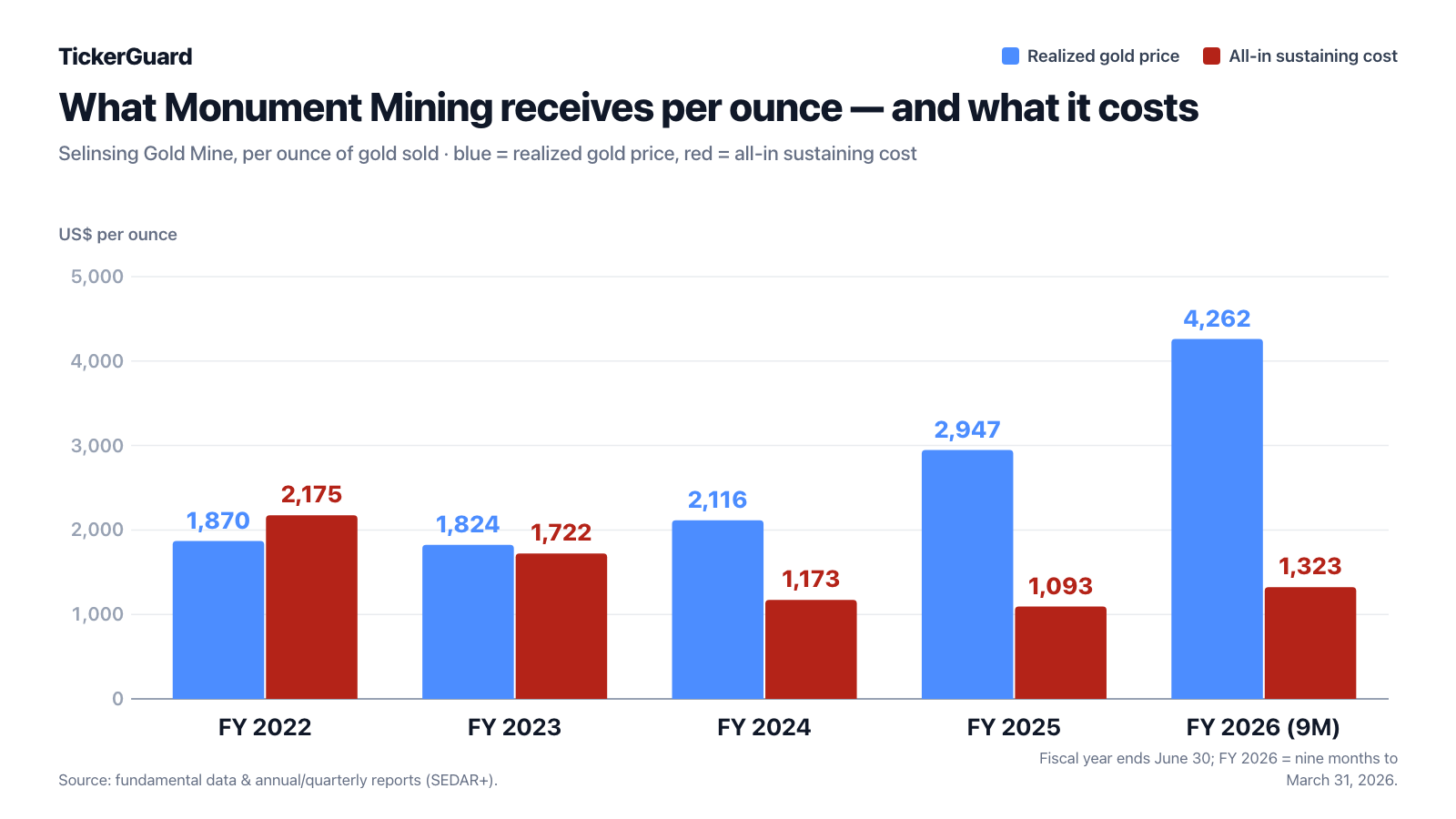
First, this company has a real turnaround behind it. In fiscal 2022 each ounce sold carried an all-in sustaining cost of $2,175 and generated $1,870 of revenue. That is not a rounding error; that is a business losing money on every ounce. The cause was a transition: the oxide ore that is easy to process was running out, and the new flotation plant for sulphide ore was only 69 percent complete because of a supply-chain disruption. Fiscal 2023 closed with a net loss of $6.27 million. Fiscal 2024 then showed $6.44 million of profit, fiscal 2025 $37.54 million, and the first nine months of fiscal 2026 already $53.31 million. The spread between revenue and all-in sustaining cost per ounce tells the same story in a single line: $1,824 against $1,722 in fiscal 2023, $2,116 against $1,173 in fiscal 2024, $2,947 against $1,093 in fiscal 2025 and $4,262 against $1,323 in the first nine months of fiscal 2026.
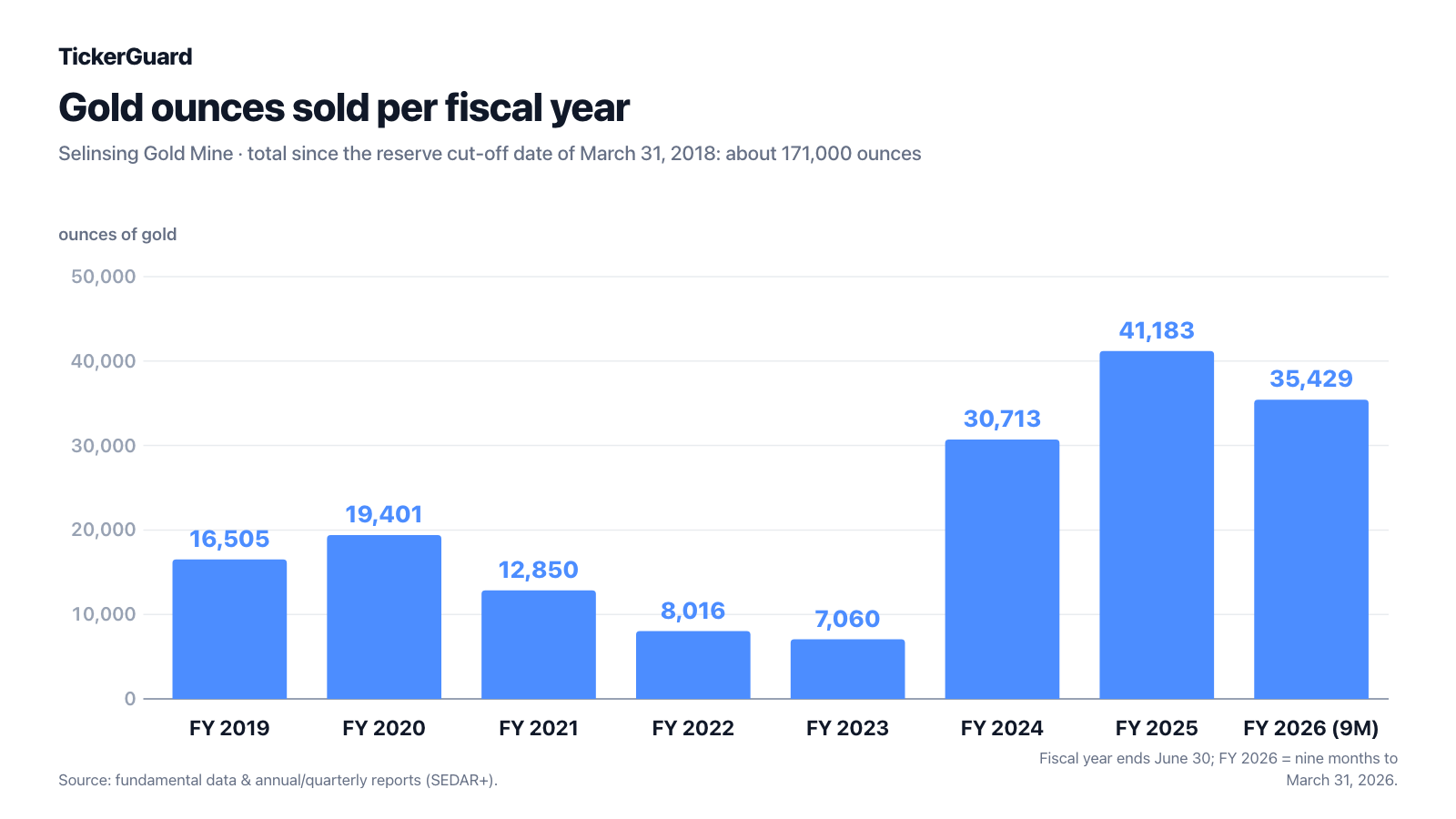
Second, the volume is back. From 7,060 ounces sold in fiscal 2023 the figure rose to 30,713 (2024) and 41,183 (2025). In the nine months to March 31, 2026 it was 35,429 ounces, an annualized run rate of roughly 47,000. The report credits a new filter press that removed a processing bottleneck, along with a recovery rate improved to 89.75 percent from 88.20 percent.
Third, the balance sheet is unusually clean. At March 31, 2026 the company held $101.76 million in cash and term deposits, working capital of $108.85 million and equity of $207.27 million. On the other side: total liabilities of $36.36 million, comprising $12.32 million of income tax payable, $10.86 million of trade payables and $8.49 million of asset retirement obligations. Interest-bearing financial debt is effectively absent — lease liabilities total $84,000. For a small gold producer that is anything but standard.
"As at March 31, 2026, the Company’s cash reserves totaled $101.76 million, comprising $11.16 million in cash on hand and $90.60 million in short-term investments - term deposits, compared to cash and cash equivalents of $45.94 million as at June 30, 2025, when no short-term investments - term deposits were held."
— Monument Mining Limited, MD&A for the quarter ended March 31, 2026, section 4 "Liquidity and Financial Condition", filed on SEDAR+ May 25, 2026

Fourth, money is flowing back to shareholders for the first time. On December 11, 2025 the board declared a special dividend of 2 Canadian cents per share, paid on January 19, 2026. In total that was $5.04 million, or 6.91 million Canadian dollars — the first distribution in company history. In February 2026 the TSX Venture Exchange named the company to its list of the fifty best-performing issuers of the prior year.
That is an honestly good picture. Now let us turn the page over.
What the filings say — the uncomfortable truths
Uncomfortable truth No. 1: the reserve book is from 2018 — and is nearly empty on paper
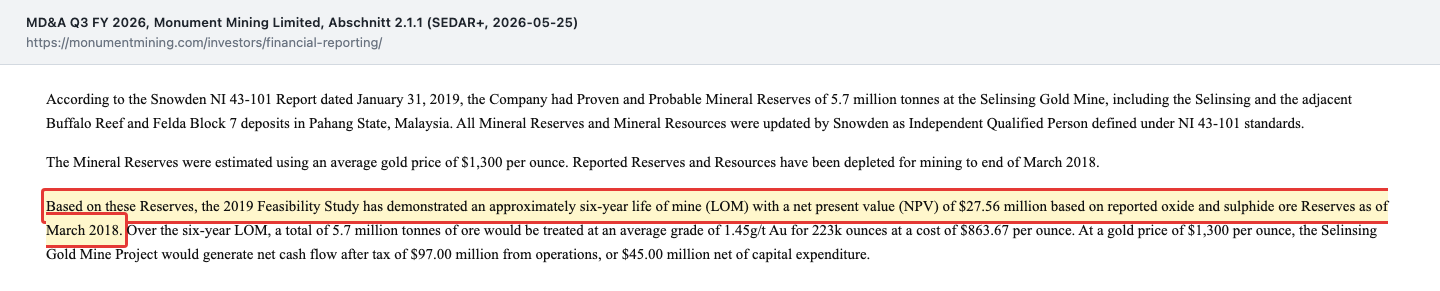
Section 2.1.1 of the same quarterly report that carries the record profit describes the ore base. And that section has not changed in years. Its basis is a report by the independent consultant Snowden dated January 31, 2019, whose reserves carry an effective date of March 31, 2018. They were estimated using a gold price of $1,300 per ounce. Disclosed were 5.738 million tonnes of ore at 1.45 grams of gold per tonne, or 267,000 contained ounces.
A quick definition, because in mining this is the distinction that matters. A resource is gold that geological work suggests is in the ground. A reserve is the portion of it for which a study has shown it can actually be extracted at a profit under assumed costs and prices. Only the reserve is a defensible statement about how much longer a mine will run. And the feasibility study built on this reserve is unambiguous:
"Based on these Reserves, the 2019 Feasibility Study has demonstrated an approximately six-year life of mine (LOM) with a net present value (NPV) of $27.56 million based on reported oxide and sulphide ore Reserves as of March 2018."
— Monument Mining Limited, MD&A for the quarter ended March 31, 2026, section 2.1.1, filed on SEDAR+ May 25, 2026
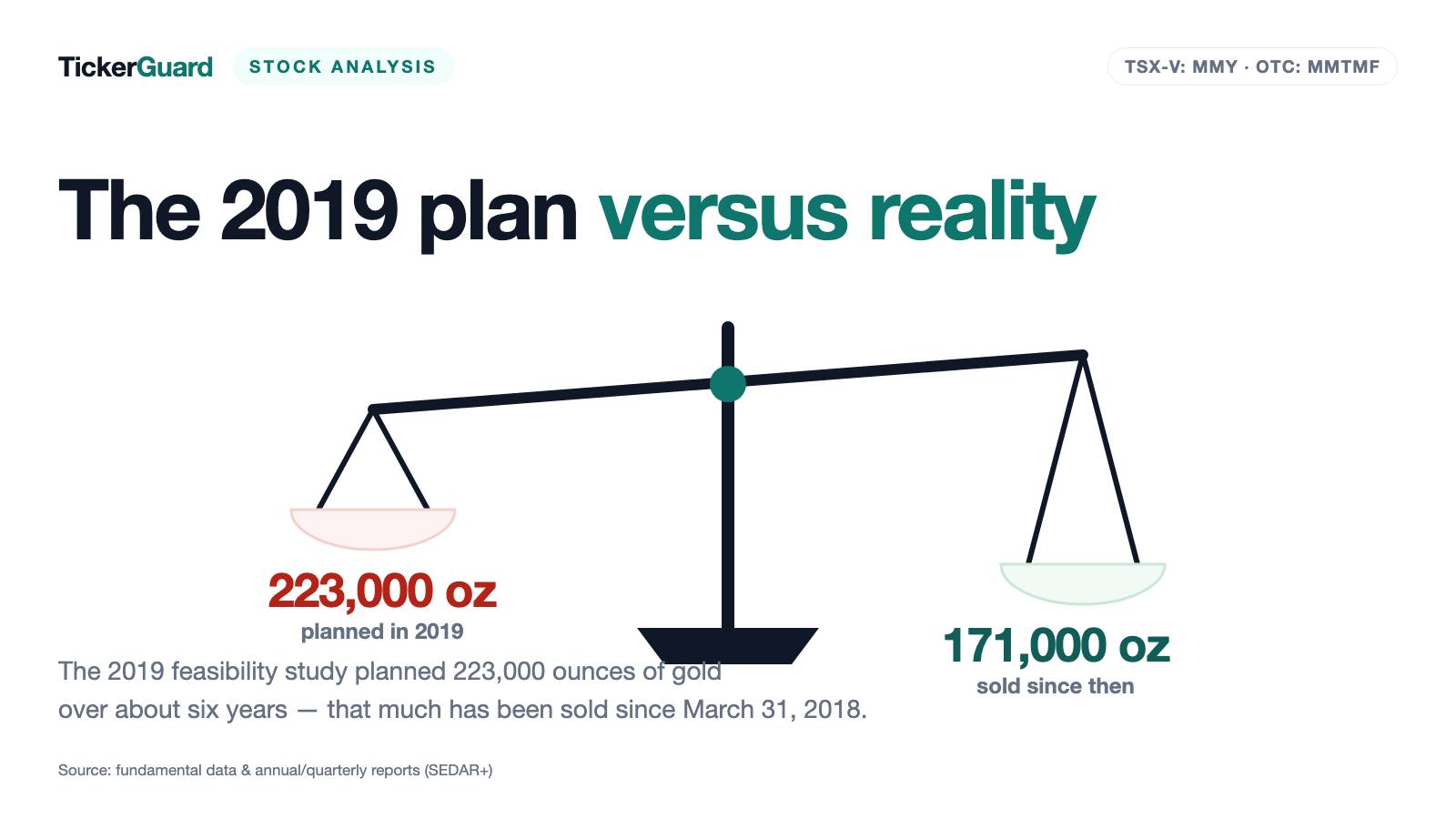
Over those six years, 5.7 million tonnes of ore were to be treated for 223,000 ounces of recovered gold at a cost of $863.67 per ounce. Now the counter-calculation. Add up what the company has itself disclosed as sold since the effective date — 16,505 ounces in fiscal 2019, 19,401 (2020), 12,850 (2021), 8,016 (2022), 7,060 (2023), 30,713 (2024), 41,183 (2025) and 35,429 in the first nine months of fiscal 2026 — and you arrive at 171,157 ounces. The April-to-June 2018 quarter is not even in that total, because fiscal 2018 falls outside the series.
So roughly 77 percent of the planned volume has been mined, and more than eight years have passed rather than six. This calculation is an order of magnitude, not an accounting entry: part of the gold sold came from stockpiles, from the old leach circuit, and from extensions at Felda Block 7 that were not in the 2018 reserve table. But the direction is unambiguous, and it is not disputed either. The company itself writes repeatedly of "mine life extension opportunities" and "resource growth potential". Nobody extends what is plentiful.
What is actually under way is a drill program. It began in the fourth quarter of fiscal 2025; in the quarter to March 31, 2026, 58 holes for 8,666 meters were drilled at Buffalo Reef, bringing the expansion program to 13,045 meters in total, with 9,078 samples dispatched to an independent laboratory. On May 29, 2026 the company reported assays from 23 further holes and declared phases I and II complete, with more results pending. This may turn out well. But until a new, independently reviewed reserve table is published, nobody outside the company knows how many laps this race still has.
Uncomfortable truth No. 2: the record $5,166 price does not reach the bank account
The headline of the quarter was a record realized gold price of $5,166 per ounce. That is what the report says, and it is true. Except: 10,478 ounces sold at $5,166 would be $54.13 million. Booked revenue was $47.04 million. The $7.09 million difference — or $677 per ounce, a good 13 percent — is explained in the report in four words: "net of smelter costs". Anyone selling concentrate rather than bullion shares the price with the smelter. What actually arrived was $4,489 per ounce.
This is not an accusation but the economics of the process, and it is disclosed. It matters nonetheless, because the same gap shows up every year: $552 per ounce in fiscal 2025, $442 in fiscal 2024. Anyone extrapolating profitability should use $4,489, not $5,166.
The second figure in this chapter sits right beside it and points the other way. Cash cost per ounce sold rose from $874 to $1,390 in a single year — up 59 percent. The company explains it plainly:
"Cash cost of $1,390 per ounce sold (Q3 FY 2025: $874/oz), reflecting higher royalty expenses and other government fees associated with the record-high average realised gold price achieved during the quarter;"
— Monument Mining Limited, MD&A for the quarter ended March 31, 2026, section 1.1, filed on SEDAR+ May 25, 2026

Note 20 of the interim statements carries the underlying figure: $6.797 million of royalties plus $0.465 million of rehabilitation fund levy for the quarter, together $7.262 million on revenue of $47.04 million. That is 15.4 percent. A year earlier it was 11.9 percent. Malaysia raised the royalty rate in September 2025 and additionally introduced a tax on mining-related services. Since the segment note shows that all revenue is generated in Malaysia, there is no second country across which this can be spread. At a very high gold price it is bearable; at a normal gold price it eats a noticeable share of the margin.
Uncomfortable truth No. 3: the second leg has been standing still for twelve years
Murchison is the promise in every corporate presentation: the second source of cash flow, the path to mid-tier producer status. It was acquired in 2014. What has happened since is described most soberly by the report itself:
"The Burnakura site also hosts a 250Ktpa gold processing facility, currently on care and maintenance, an accommodation camp, and supporting infrastructure, providing a solid foundation for future development."
— Monument Mining Limited, MD&A for the quarter ended March 31, 2026, section 2.2, filed on SEDAR+ May 25, 2026

"Currently on care and maintenance" means the plant is kept from decaying but produces nothing. The interim statements quantify both the cost and what sits on the balance sheet against it: in the quarter to March 31, 2026, $0.42 million flowed to Murchison, of which $0.25 million went to care and maintenance alone. The segment note shows $36.176 million of capitalized exploration and evaluation spending for Australia — 17.5 percent of total equity.
Capitalized exploration spending is an accounting treatment, not cash. It stays on the balance sheet for as long as the company judges eventual economic recovery to be probable. If that judgment changes, it must be written down, and the write-down hits equity rather than the bank account. Twelve years after acquisition, a preliminary economic assessment is in preparation, a fauna survey is complete, and a confirmation drill program at Gabanintha is planned once heritage processes and approvals are cleared. That is progress. After twelve years, it is very early progress.
Uncomfortable truth No. 4: nearly everything hangs on a number nobody in Vancouver controls
Let us decompose the move of the past year. In the quarter to March 31, 2026, 10,478 ounces were sold against 8,399 in the prior-year quarter — 25 percent more volume. Revenue over the same span rose from $19.85 million to $47.04 million, or 137 percent. Net income rose from $4.86 million to $22.65 million, a factor of 4.7. Volume explains a small part of that. The large part is explained by price, which nearly doubled from $2,945 to $5,166 per ounce.
For context, the London PM fix averaged $4,873 per ounce over the same quarter. Monument therefore did not sell better than the market; the market simply was that. That distinction matters because it tells you what you are actually betting on. A company with one mine, one product, one currency and one sales market is at heart a leveraged claim on the gold price — with the added risk that the mine eventually runs out, and the added benefit that costs grow only slowly alongside.
What happens when the price falls does not need to be simulated. It sits in the company's own numbers: in fiscal 2022 all-in sustaining cost was $2,175 against revenue of $1,870 per ounce. Operations were disrupted at the time, granted. Today the all-in sustaining cost runs at $1,323 to $1,583 per ounce, a level at which even a substantially lower gold price would still be workable. Just not with $53 million of profit in nine months.
Valuation: a $227 million market value, $102 million of it in cash
On August 18, 2026, MMTMF closed at $0.6551 on the U.S. secondary market. Against 346,218,368 shares outstanding — the figure comes from the quarterly report, stated as of May 25, 2026 — that gives a market value of roughly $227 million. The share count is pleasingly stable: all 15.97 million restricted share units were redeemed in July 2025, and the only remaining instruments are 1,716,661 options at 14.5 Canadian cents expiring January 18, 2029. Meaningful dilution — the effect of your slice of the pie shrinking because new slices are handed out — is not coming from there.
Deduct the $101.76 million of cash and term deposits (as of March 31, 2026; the market value is as of August 18, 2026, so the two dates sit a good four months apart) and roughly $125 million of enterprise value remains. Against that stand $74.14 million of net income over the last twelve reported months. That is a multiple of about 1.7 — an extraordinarily low figure for a producing, debt-free, dividend-paying mining company.
That valuation is not an anomaly; it is a statement. The market is paying roughly what the next two years might deliver, and no more. Translated: the majority of buyers and sellers do not expect earnings of this size to persist, whether because of the gold price or because of the remaining life of the mine. Whether they are right will be settled by exactly two documents: a new reserve estimate and the preliminary economic assessment for Murchison.
One point that honesty demands at this size: liquidity on the U.S. secondary market is thin. In the first half of August 2026, between 20,000 and 260,000 shares changed hands on a given day, most often around 100,000 — at a price near $0.65 that is roughly $65,000 of turnover per day. The home market in Toronto is deeper, but this is still not a position built or unwound in seconds. The trading range of the past twelve months ran from $0.32 to $1.15.
Upside and risks at a glance
What speaks for Monument Mining:
- The balance sheet is exceptionally clean: $101.76 million of cash and term deposits, working capital of $108.85 million, equity of $207.27 million and effectively no financial debt as of March 31, 2026. For a producer of this size that is rare.
- Operating cash flow is real and large: $27.26 million from operations in the quarter to March 31, 2026 alone, and $64.75 million before working-capital changes over nine months.
- The cost position has structurally improved: all-in sustaining cost fell from $2,175 per ounce in fiscal 2022 to $1,093 in fiscal 2025 and stood at $1,323 in the first nine months of fiscal 2026 — with room to fall further if the gold price and the price-linked levies come down.
- Volume is growing again: 41,183 ounces sold in fiscal 2025 against 7,060 in fiscal 2023, driven by a new filter press and a recovery rate of 89.75 percent in the quarter to March 31, 2026.
- Money is being returned for the first time: a $5.04 million special dividend paid January 19, 2026, and the cash position could comfortably support further distributions.
- There are two documented value levers not yet reflected in the numbers: the completed expansion drill program at Buffalo Reef and Felda (release of May 29, 2026) and Murchison with a resource estimate of 293,000 indicated plus 88,000 inferred ounces (SRK, July 2018).
What speaks against it:
- The last reviewed reserve estimate carries an effective date of March 31, 2018, was calculated at $1,300 per ounce, and is largely mined out measured against the roughly 171,000 of 223,000 planned ounces sold since. There is therefore no defensible public statement about the remaining life of the mine.
- The business rests on a single producing asset in a single country: per the segment note, all revenue is generated in Malaysia.
- The government take is rising: royalties and rehabilitation fund levy together accounted for 15.4 percent of revenue in the quarter to March 31, 2026, up from 11.9 percent a year earlier, following a rate increase effective September 2025 and a new tax on mining-related services.
- The headline realized price of $5,166 per ounce is not the revenue: after smelter costs, $4,489 per ounce arrived, roughly 13 percent less.
- Murchison has been idle since it was acquired in 2014, the processing plant is on care and maintenance, the resource estimate dates from July 2018, and a preliminary economic assessment was still only in preparation at March 31, 2026 — against $36.18 million of capitalized spending on the balance sheet.
- The profit jump is predominantly price-driven: on 25 percent more volume sold, revenue rose 137 percent, because the realized price nearly doubled from $2,945 to $5,166 per ounce.
- Tradability on the U.S. secondary market is limited: around 100,000 shares, or roughly $65,000, on a typical day in the first half of August 2026.
A human conclusion
Back to the running track. Monument Mining's lap time is real, verifiable and impressive: $53.31 million of profit in nine months, $101.76 million in the bank, no meaningful debt, and the first dividend in company history paid out. Anyone doubting those figures has not read the report. They are there, in the same set of books that everything else comes from.
The remaining distance is the open question — and it is open not because the company hides it, but because nobody has measured it again for eight years. The drill program is running, the samples are at the laboratory, and the last release on May 29, 2026 sounded confident. But a reserve table is a different thing from a press release about drill intercepts: it says how many ounces can be pulled out at what cost at a profit, and an independent qualified person signs for it. Until that table exists, what you are buying at Monument Mining is a very good lap time and an unknown number of laps.
So the honest question is not "is a price-to-earnings ratio of 3 cheap?" — for a commodity producer at the end of a price cycle, a low earnings multiple is as often a warning as an opportunity. The question is: are you willing to wait for the next annual report and decide then — knowing that this is precisely where the answer about the remaining distance could appear, and accepting the risk that it does not? What you do with that is your call. And that is exactly as it should be.
Sources
Every original document used in this analysis — read them yourself through Monument Mining's financial reporting archive, mirrored from SEDAR+:
- Monument Mining Limited — MD&A and unaudited condensed interim consolidated financial statements for the three and nine months ended March 31, 2026 (MD&A dated May 25, 2026, released June 1, 2026) — latest periodic report, fully evaluated
- Monument Mining Limited — MD&A and audited financial statements for the fiscal year ended June 30, 2025 (released October 15, 2025)
- Monument Mining Limited — MD&A for the fiscal year ended June 30, 2024 and the annual reports for the years ended June 30, 2022, 2021, 2020 and 2019 — the basis for the multi-year series of ounces sold
- Monument Mining Limited — news release "Monument Reports Third Quarter Fiscal 2026 Results" (June 1, 2026), including the remarks by President and CEO Cathy Zhai
- Monument Mining Limited — news release on the special dividend (December 11, 2025) and the releases of February 18, 2026 (TSX Venture 50) and May 29, 2026 (Buffalo Reef/Felda drill results)
- Monument Mining Limited — project and corporate overview (retrieved August 19, 2026)
- Fundamental data plus price and volume data for the U.S. secondary symbol MMTMF (retrieved August 18, 2026), reconciled against the 346,218,368 shares outstanding disclosed in the quarterly report to March 31, 2026.
Transparency & disclaimer: This analysis is journalistic commentary on publicly available information. It is not investment advice, not a regulated financial analysis, and not a solicitation to buy or sell securities. Equity investments carry substantial risk up to total loss; for small commodity producers with a single mine and limited tradability that risk is particularly pronounced. All amounts are in U.S. dollars unless otherwise stated, all figures without warranty; the effective date of each data point is noted in the text. Positions held by the operator are disclosed daily; where one exists, it appears as a notice at the top of this deep dive.
Key figures at a glance
All monetary figures in millions of $; earnings per share as reported.
| Metric | 2022 | 2023 | 2024 | 2025 | 2026 |
|---|---|---|---|---|---|
| Revenue | 14.2 | 12.4 | 51.4 | 101.1 | 161.2 |
| Operating Income (EBIT) | -1.0 | -0.1 | 13.7 | 52.5 | 85.8 |
| Net Income | -6.5 | -6.3 | 6.4 | 38.5 | 66.9 |
| Net Margin | -45.8% | -50.6% | 12.5% | 38.1% | 41.5% |
| Earnings Per Share | -0.02 $ | -0.02 $ | 0.02 $ | 0.11 $ | 0.19 $ |
Source: fundamental data & SEC filings (annual and quarterly reports, 10-K/10-Q)
Our Bottom Line at a Glance
- Balance sheet and liquidity positive
- At March 31, 2026 the company held $101.76 million in cash and term deposits, equity of $207.27 million and total liabilities of $36.36 million, of which $12.32 million was income tax payable. Interest-bearing financial debt is limited to lease liabilities of $84,000.
- Earnings power and cash generation positive
- The nine months to March 31, 2026 produced net income of $53.31 million and $64.75 million of operating cash flow before working-capital changes. Fiscal 2023 still showed a loss of $6.27 million — the turnaround is documented.
- Life of mine negative
- The last reviewed reserve estimate comes from the Snowden report dated January 31, 2019 with an effective date of March 31, 2018 and an assumed gold price of $1,300 per ounce. Of the 223,000 ounces the feasibility study planned over roughly six years, about 171,000 have been mined per the company's own sales figures. No new estimate existed as of August 19, 2026.
- Dependence on the gold price negative
- In the quarter to March 31, 2026, volume sold rose 25 percent while revenue rose 137 percent — the realized price climbed from $2,945 to $5,166 per ounce. Earnings are therefore overwhelmingly price-driven, and that price sits outside the company's control.
- Concentration risk in Malaysia negative
- Per the segment note at March 31, 2026, all revenue is generated in Malaysia. Royalties and rehabilitation fund levy there accounted for $7.262 million, or 15.4 percent of quarterly revenue, up from 11.9 percent a year earlier after a rate increase effective September 2025.
- Second leg Murchison neutral
- The project in Western Australia, acquired in 2014, carries $36.18 million of capitalized spending on the balance sheet at March 31, 2026, the processing plant is on care and maintenance, the resource estimate dates from July 2018, and a preliminary economic assessment was in preparation. Value lever and impairment risk sit equally close here.
Monument Mining earned net income of $53.31 million in the nine months to March 31, 2026, holds $101.76 million in cash and term deposits, carries essentially no financial debt, and paid the first dividend in its history in January 2026. The jump in profit, however, is overwhelmingly price-driven, and the decisive question is unanswered: the last reviewed reserve estimate is dated March 31, 2018 and was calculated at a gold price of $1,300 per ounce, with about 171,000 of the 223,000 planned ounces already sold. The second leg, Murchison, has been idle since 2014. The next annual report is where a new reserve table could appear. Not investment advice.
What Our Rating Means
Open questions
The business works in principle, but one material question is open. As long as it stays open, our findings do not carry a quality verdict.
Yellow rather than red, and deliberately so. There is no basis for red: no indication of a going-concern issue, equity is high and positive at $207.27 million, financial debt is effectively absent, and with $101.76 million in cash and term deposits plus $27.26 million of operating cash flow in the quarter to March 31, 2026 alone, the cash position is the opposite of a solvency risk. What is missing for green is the single most important answer a mining company owes: how much longer its only producing mine will deliver ore. The last reviewed reserve estimate carries an effective date of March 31, 2018, was calculated at $1,300 per ounce, and about 171,000 of the 223,000 ounces in the associated feasibility study have been mined per the company's own sales figures. Add to that a business whose entire revenue comes from a single country that raised its levy rate in September 2025, and a second project held since 2014 that still has no preliminary economic assessment. These are open operating questions, not solvency risks — hence yellow. That the stock looks strikingly cheap against trailing twelve-month earnings deliberately plays no part in this rating: price is not a quality attribute. The decision is yours.
A journalistic assessment by our editorial team at the time of the deep dive, based on public sources — not investment advice and not a solicitation to buy or sell. Your personal circumstances (investment goals, risk capacity, taxes) cannot be taken into account. What our levels mean, how verdicts are formed, and what conflicts of interest exist →
Worth Noting
- The trigger for this analysis was the U.S. symbol MMTMF, under which Monument Mining circulates in investor forums as a cheaply valued gold producer. There was no hit from our in-house stock scanner.
- Monument Mining is not an SEC filer, and the evidence is twofold: the ticker registry of the U.S. securities regulator, the SEC, lists neither MMTMF nor MMY, and the single EDGAR registration under the name (central index key 0001406194) holds exactly one document — a paper filing dated July 9, 2007 with no ticker or exchange entry. All company figures therefore come from the Canadian mandatory filings on SEDAR+: the quarterly report to March 31, 2026 (May 25, 2026), the annual statements to June 30, 2025 (October 15, 2025) and the annual reports for 2019 through 2024.
- All amounts are U.S. dollars because the company itself reports in U.S. dollars — despite being Canadian, producing in Malaysia and holding a project in Australia. The special dividend, by contrast, was declared in Canadian dollars (C$0.02 per share) and is marked as such in the text.
- Risk of confusion: at the U.S. securities regulator, a name search for "Monument Mining" leads under central index key 0002100603 to Metaplanet Inc. (symbol MPJPY), a Japanese company with no connection whatsoever to Monument Mining. Fundamental data files also list the country of domicile as "USA", even though the corporate seat, the production and the listings sit in Canada, Malaysia and Australia.
- The calculation "about 171,000 of 223,000 ounces mined" is an order of magnitude, not an accounting entry. It sums the sales volumes disclosed in the annual and quarterly reports for fiscal 2019 through fiscal 2026 (nine months); part of that gold came from stockpiles, from the old leach circuit and from extensions at Felda Block 7 that were not in the 2018 reserve table. The April-to-June 2018 quarter is not included in the total.
Stock Watch
This analysis is as of August 26, 2026. Stock Watch will tell you what's changed at MMTMF since then.
Later $1 a month per stock — signing up is free, and you'll be the first to know when it launches.
The full analysis as a PDF for later
We will send you this analysis as a PDF — to print, file away, and read at your own pace. And we will add you to the free Stock Watch list for Monument Mining Limited (MMTMF), so you hear about it when something material in this analysis changes.
Frequently Asked Questions
Monument Mining Limited is a Canadian corporation headquartered in Vancouver that operates the Selinsing Gold Mine in Pahang State, Malaysia. It does not sell gold bullion but gold concentrate produced by a flotation plant. It also holds the non-producing Murchison Gold Project in Western Australia, acquired in 2014.
Because Monument Mining is not an SEC reporting issuer. Its home listing is the TSX Venture Exchange in Toronto under the symbol MMY; MMTMF is only the secondary quotation on the OTC Pink market. The mandatory reports — annual statements and three quarterly statements with MD&A — are filed on the Canadian platform SEDAR+ and mirrored on the company website.
On June 30. Fiscal 2026 therefore ran from July 1, 2025 to June 30, 2026. The latest available report covers the nine months to March 31, 2026 and was released on June 1, 2026. The annual statements for fiscal 2026 had not been filed as of August 19, 2026; last year they appeared on October 15.
There is no defensible public answer. The last reviewed reserve estimate under the NI 43-101 standard comes from consultant Snowden, carries an effective date of March 31, 2018 and projected roughly 223,000 recoverable ounces over about six years. Since then the mine has sold about 171,000 ounces by its own disclosures. A new estimate is outstanding.
Predominantly because of the gold price. In the quarter to March 31, 2026, volume sold rose 25 percent to 10,478 ounces, but the realized price climbed from $2,945 to $5,166 per ounce. Revenue therefore grew 137 percent to $47.04 million and net income rose from $4.86 million to $22.65 million.
Once, so far. On December 11, 2025 the board declared a special dividend of 2 Canadian cents per share, paid on January 19, 2026 — $5.04 million in total, or 6.91 million Canadian dollars. The company has not announced a recurring distribution.
Essentially none. At March 31, 2026 the balance sheet showed total liabilities of $36.36 million, comprising $12.32 million of income tax payable, $10.86 million of trade payables and $8.49 million of asset retirement obligations. Interest-bearing financial debt is limited to lease liabilities of $84,000.
A cluster of assets in Western Australia acquired in 2014, comprising Burnakura and Gabanintha plus a 20 percent free carried interest in Tuckanarra. The 250,000-tonne-per-year processing plant is on care and maintenance, the resource estimate dates from July 2018, and a preliminary economic assessment was in preparation at March 31, 2026.
Found an error?
Did you spot a factual error, an outdated number, or a typo in this deep dive? Let us know briefly — your report goes straight to the editorial team.