Mega Union Technology: Revenue Up 64 Percent — 83 Percent of It From a Single Customer
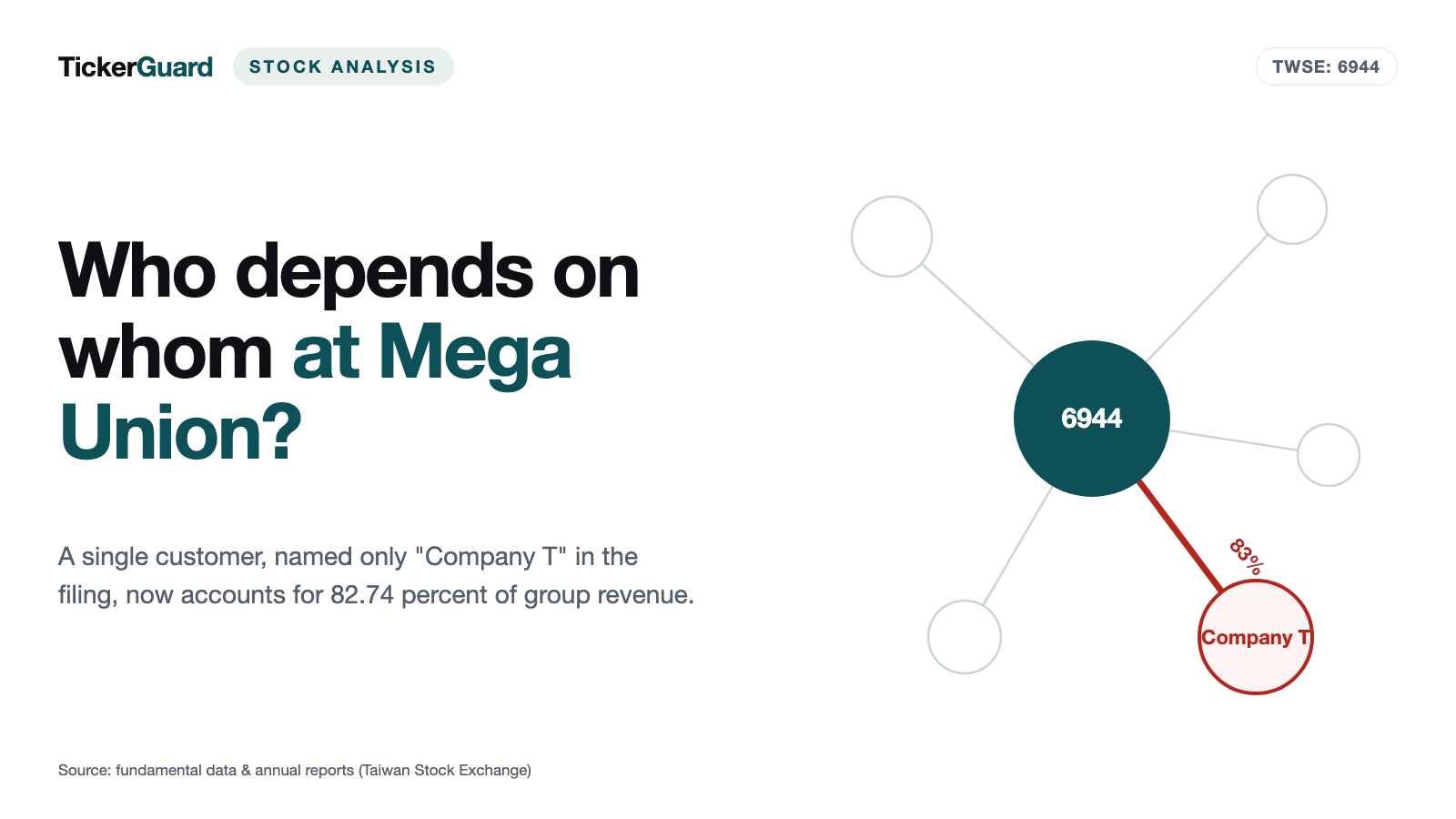
Mega Union Technology of Taiwan builds the ultrapure-water and wastewater-recycling plants without which no modern chip fab could run — and its revenue rose 64 percent in 2025 to NT$16.9 billion. But the annual report shows how narrow that foundation really is: a single customer, named only "Company T" in the filing, accounted for 82.74 percent of revenue in the latest quarter, up from 76.48 percent two years earlier. And even though NT$7.4 billion in cash sits on the balance sheet, the board just approved another NT$2.5 billion in zero-coupon convertible bonds. We read the original filings from Taipei. Not investment advice — just the numbers behind the growth curve.
 Thomas Mücke
Founder & Publisher
Thomas Mücke
Founder & Publisher
There is a bias that catches even level-headed investors off guard: the prestige bonus. When a small supplier sells to a world-famous, highly profitable giant, it instinctively feels safer than doing business with many small, unknown customers — surely "the biggest name in the industry" cannot simply fail. The problem: the prestige bonus confuses the customer's creditworthiness with the supplier's safety. A blue-chip customer does not protect you from that customer delaying orders, cutting its capital budget, or switching suppliers — if anything, you have tied your entire fate to one outside party's decisions. Mega Union Technology Inc. (TWSE: 6944) of Taiwan is a textbook case. The company builds the water-treatment plants without which no modern chip fab could run, and its revenue has grown for years in lockstep with the global semiconductor capacity build-out. But its own annual reports show that a single customer, named only "Company T," now accounts for more than four-fifths of revenue. So let's do what the prestige bonus skips: read how solid that one foundation really is. Not a buy recommendation — just a look behind the big name.
What Mega Union Actually Does
Mega Union was founded in 2004 in Taoyuan, Taiwan, and has since planned, built, operated, and maintained systems for a problem that never appears in chip-fab marketing but without which no fab can run: water. A modern semiconductor fab consumes millions of liters of extremely pure water daily to rinse wafers and dilute chemicals — even trace contamination can ruin entire production batches. At the other end of the process, highly contaminated wastewater full of acids, solvents, and metal traces must be treated before it can leave the site. A useful image: if a chip fab were a patient who cannot survive without impeccably clean blood, Mega Union builds the dialysis station — the unit that purifies the blood before it enters the body and detoxifies it again afterward, so the cycle doesn't collapse.
Concretely, Mega Union offers ultrapure-water plant construction, wastewater treatment and water-recycling systems, membrane cleaning and resin regeneration, laboratory services for water-quality testing, and the sale of consumables (filter media, membranes, meters) and water-treatment chemicals. The business splits into two segments: engineering (roughly 75 to 80 percent of revenue, project-driven, lower margin) and service (roughly 20 to 25 percent, recurring, at a notably higher margin — press coverage of the investor meeting put it at about 29 percent — maintenance, operation of existing plants, spare parts, and chemicals). Its main customers are semiconductor, optoelectronics, and chip packaging/testing plants and government agencies, with subsidiaries in Taiwan, Singapore, China, and — since 2024, operationally visible only since 2026 — the United States. As of April 30, 2026, the group employed 1,297 people (2024: 1,074; 2025: 1,241).
Company history for investors
-
2004
Founded in Taoyuan, Taiwan
Start as a specialized ultrapure-water and wastewater engineering firm — the base for today's position with semiconductor customers.
-
2008
First projects for "Company T" at Hsinchu Science Park
The start of a customer relationship that now provides more than four-fifths of revenue — both a strength and a concentration risk.
-
2025
Listing on the Taiwan Stock Exchange main board
Trading began May 28, 2025, with a July 2025 capital increase priced at NT$262 per share — the stock has more than doubled since.
-
2026
First US order for subsidiary Muaqua Engineering
Signed on July 20, 2026 — an early, still-unproven step in the planned diversification away from the home market.
-
2026
Shareholder meeting approves dividend plus 30% stock dividend
Approved June 25, 2026 for fiscal year 2025 — the share count grew further as a result, a pattern dating back to 2017.
-
2026
Board approves NT$2.5 billion in convertible bonds
Approved August 6, 2026 despite NT$7.45 billion in cash — another potential dilution step.
Where This Stock Is Landing on Investors' Desks
Mega Union is a newcomer to the stock market. The company first traded on Taiwan's Emerging Stock Market (a pre-listing over-the-counter segment) and moved to the main board of the Taiwan Stock Exchange only on May 28, 2025. The capital increase required for that step — a cash offering of new shares as a public subscription ahead of listing — priced at NT$262 per share in July 2025. Since then the stock has more than doubled: the 52-week range spans from NT$386.15 to NT$839.29, and at the time of writing (August 28, 2026) the stock traded at NT$712. Anyone scanning Taiwan's semiconductor supply chain in the summer of 2026 is hard-pressed to miss this move — fueled by numbers that raise no obvious questions at first glance: revenue up 64 percent in 2025, profit up 57 percent, and the first half of 2026 kept the momentum going. Curves like that currently pull investor capital into anything tied to the global build-out of chip manufacturing capacity — from equipment builders to specialty chemical suppliers. Mega Union is not the only freshly listed Taiwanese stock with a hotly sought IPO: our analysis of Hon Precision describes another semiconductor supplier whose November 2025 subscription period was oversubscribed more than 200,000-fold before the numbers were even known. At Mega Union it isn't oversubscription but customer concentration that makes a closer look worthwhile, as you'll see next.
The Numbers Over the Years
First, what is undeniably impressive. Group revenue moved from NT$7.67 billion (2021) through NT$10.03 billion (2022), NT$9.01 billion (2023, a down year) and NT$10.30 billion (2024) to NT$16.91 billion in 2025 — roughly US$534 million, up 64.2 percent year over year. Even more striking is the profit trajectory: net income climbed from just NT$198 million (2021) to NT$2.37 billion (2025, roughly US$75 million) — a twelvefold increase in four years. The net margin jumped from 2.6 percent (2021) to 11.9 percent (2023) and stood at 14.0 percent in 2025; the big jump landed exactly in the years Taiwan's semiconductor capacity build-out accelerated.
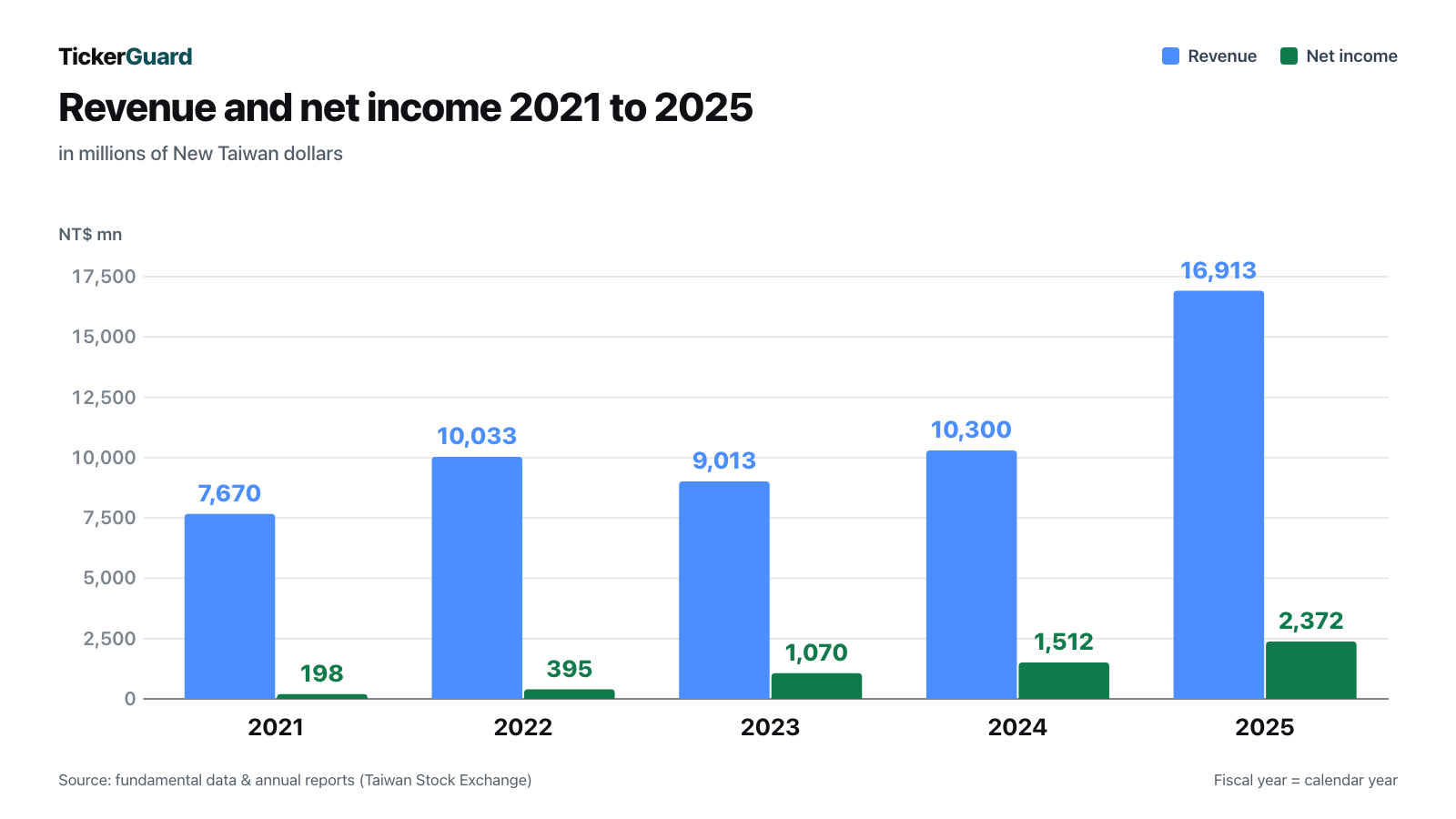
Operationally, the picture stays largely healthy too: free cash flow was still deeply negative at minus NT$859 million in 2021 (a heavy investment year), turned positive as early as 2022, and reached NT$2.45 billion in 2025. The first half of 2026 kept the growth going: revenue rose 44.5 percent to NT$9.79 billion, the gross margin climbed from 21.5 to 27.8 percent, and net income grew 76.9 percent to NT$1.65 billion. As of June 30, 2026, equity — reported at solid levels in the consolidated statements — stood against bank debt of only NT$728 million against NT$7.45 billion in cash — a balance sheet most growth companies would envy. But that very strength raises the question the next section tackles: how durable is growth that, by the company's own annual report, depends on a single customer for more than four-fifths of revenue?
What the Filings Show — Three Uncomfortable Truths
Uncomfortable Truth No. 1: A Single Customer Now Accounts for More Than Four-Fifths of Revenue
Every Taiwanese annual report must disclose which customers exceed ten percent of group revenue — anonymized, but with exact figures. At Mega Union, that produces a curve pointing the wrong way:
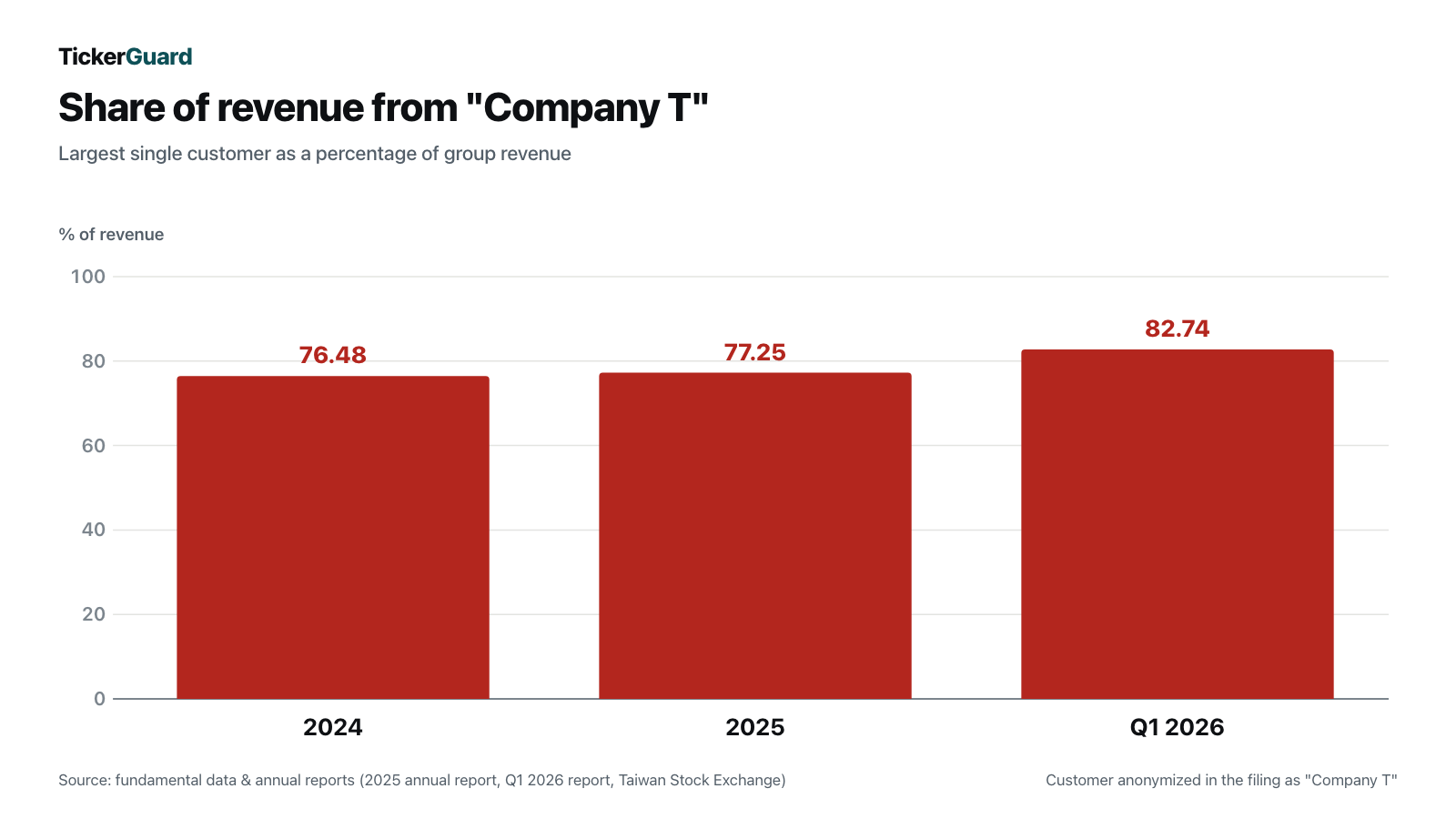
In absolute terms: "Company T" bought NT$7,877,768 thousand worth from Mega Union in 2024, NT$13,064,633 thousand in 2025 — and NT$3,894,243 thousand out of total revenue of NT$4,706,862 thousand in the first quarter of 2026 alone. The ten largest customers combined reached 95.56 percent of group revenue in 2025 (2024: 94.90 percent) — nearly the entire business rests on a handful of customers. Mega Union itself explains why in its risk chapter: the customer is the world's leading semiconductor company, with an estimated capital budget of US$38 to 42 billion for 2025 alone, and the company has supplied its ultrapure-water and wastewater systems since 2008 at the Hsinchu Science Park:
「全球半導體產業龍頭大廠T公司近幾年大幅擴大資本支出⋯本公司為T公司的廠區製程回收用水系統之主要供應廠商,自97年起,參與T公司於竹科製程水回收系統工程,迄今已經於竹科、中科及南科等地,協助業主完成50餘座的新建廠工程,彼此合作關係密切。」
(Original in Traditional Chinese — Mega Union's Annual Report is filed in Chinese with the Taiwan Stock Exchange; no English original exists for this passage.) Translation: "The world's leading semiconductor company, Company T, has massively expanded its capital expenditure in recent years … Our company is the main supplier of process-water recycling systems for Company T's fabs. Since 2008 we have participated in Company T's water recycling systems at the Hsinchu Science Park, and to date have helped the operator complete more than 50 new-fab projects at the Hsinchu, Central Taiwan, and Southern Taiwan science parks — a close working relationship."
— Mega Union Technology Inc., Annual Report 2025, sales-concentration risk chapter, page 82

The filing never discloses who "Company T" actually is — the customer's name is apparently contractually protected. Taiwanese financial media and investor forums independently and consistently identify the customer as TSMC, which matches the cited investment scale (US$30 billion in 2024 capex, an estimated US$38 to 42 billion for 2025) — a market inference, not a fact from the primary source. Either way, what matters to you as an investor is less the name than the mechanics: a company whose revenue depends on a single customer for more than four-fifths is no longer a diversified engineering firm — it is a bet on that one customer's capital spending mood. Mega Union itself names its countermeasures: expansion into Singapore and the US, and growing the higher-margin service business — both topics we return to below.
Uncomfortable Truth No. 2: Despite NT$7.45 Billion in Cash, NT$2.5 Billion More in Convertible Bonds Is Coming
The second uncomfortable truth concerns not the operating business but the capital structure. As of June 30, 2026, the group held NT$7,448,057 thousand in cash against combined short- and long-term bank debt of only NT$728,195 thousand — a net cash position of roughly NT$6.7 billion, or about US$212 million. In exactly this comfortable position, the board approved two new unsecured convertible bonds on August 6, 2026, according to the subsequent-events note:
「本公司於民國115年8月6日經董事會決議辦理發行國內第一次無擔保轉換公司債暨國內第二次無擔保轉換公司債,國內第一次無擔保轉換公司債發行總面額上限為$1,300,000,⋯票面利率為0%,發行期間為5年,國內第二次⋯發行總面額上限為$1,200,000⋯票面利率為0%,發行期間為5年,募得資金將用以轉投資海外子公司、購置廠房及裝修工程、興建倉儲廠、興建廠辦及購置設備。」
Translation: "The board resolved on August 6, 2026 to issue a first and second domestic unsecured convertible bond. The first has a maximum face value of NT$1,300,000 thousand … a 0 percent coupon and a five-year term; the second has a maximum face value of NT$1,200,000 thousand … a 0 percent coupon and a five-year term. Proceeds will be used to reinvest in overseas subsidiaries, purchase and renovate plant buildings, build warehouses, and construct offices and equipment."
— Mega Union Technology Inc., Q2 2026 consolidated financial report, subsequent-events note, page 41
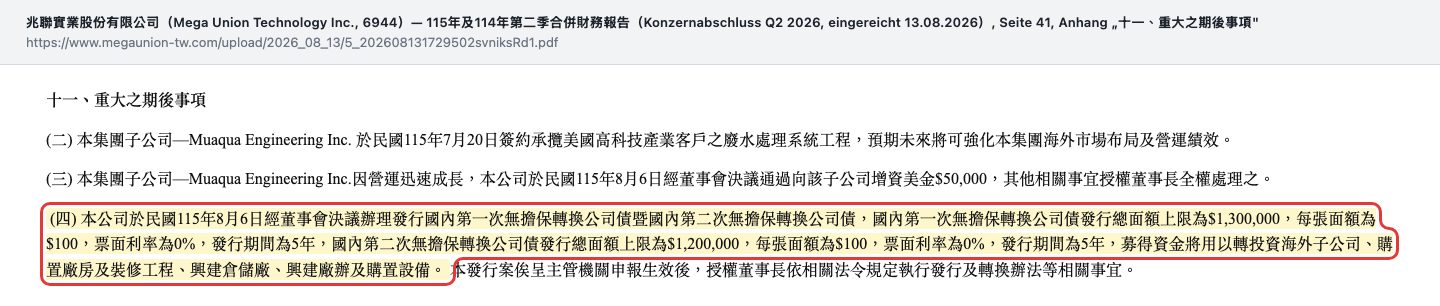
Together that is NT$2.5 billion (roughly US$79 million) in fresh, convertible capital — even though the balance sheet already shows nearly three times that much in free liquidity. One plausible reason is the new Arizona plant: the board approved a cost ceiling of up to NT$1.95 billion (roughly US$62 million) for land and construction on March 12, 2026; the land alone, at NT$375,241 thousand, was already fully paid as of June 30, 2026. That could almost be funded from existing cash alone. Why additional, potentially dilutive capital is being raised anyway is not explained in the filings — a plausible reading is a cushion for further, not-yet-announced expansion steps, or a deliberate choice to preserve cash for day-to-day operations and possible order swings from the dominant customer.
What that means for you as a shareholder shows up in the share-count history in the annual report: from 25,272,975 shares in September 2017, several cash capital increases, retained-earnings capital increases, employee stock-option exercises, and the 2025 listing brought the count to 76,687,912 shares (January 2026) — and after the 30 percent stock dividend the shareholder meeting approved on June 25, 2026 for fiscal year 2025, to 99,694,286 shares. That is nearly a fourfold increase in nine years.
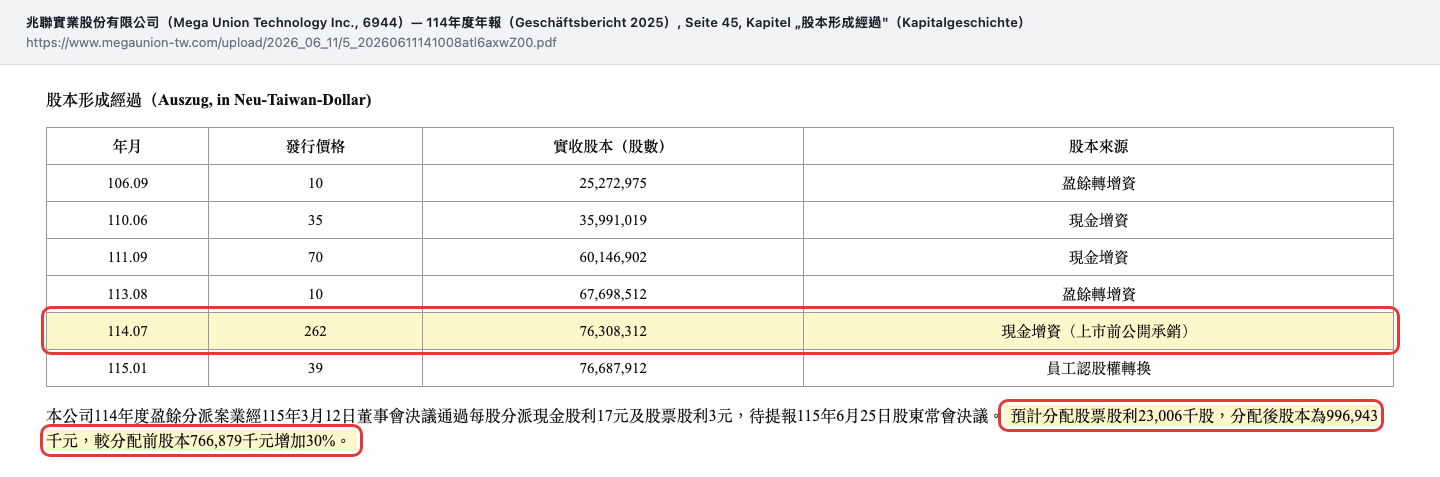
None of these individual steps is unusual — cash capital increases and stock dividends are standard practice in Taiwan, and the shareholder meeting approved each one separately. Taken together, though, they mean: whoever holds a Mega Union share today owns a smaller stake in a larger company than someone who bought in 2017 — and with the new convertible bonds, the next potential dilution step is already announced before its terms are even set.
Uncomfortable Truth No. 3: The First US Order Is Barely a Month Old
The third uncomfortable truth concerns the overseas expansion that is supposed to ease the customer concentration from Truth No. 1. On July 20, 2026, US subsidiary Muaqua Engineering Inc. signed its first contract — a wastewater treatment system for a US high-tech customer. Just over two weeks later, on August 6, 2026, the board approved a capital injection of US$50,000 thousand — that is, about US$50 million — into the same subsidiary, according to the subsequent-events note, "because its business is growing rapidly" — a substantial sum for a subsidiary with a single disclosed order so far. For the Arizona site, the board had already approved a cost ceiling of up to NT$1.95 billion on March 12, 2026; the land alone, at NT$375,241 thousand, was already fully paid as of June 30, 2026, while construction itself is still under way per the annual report.
That is ambitious for a company that can point to exactly one documented US order so far. Mega Union itself states plainly in its risk chapter why this expansion isn't free:
「兆聯近期亦隨著重要客戶至美國設立服務據點,以就近提供客戶貼身服務。」
Translation: "Our company recently followed an important customer to set up a service location in the United States, in order to provide that customer with close, on-site support."
— Mega Union Technology Inc., Annual Report 2025, "US Market" chapter, page 63
In other words: the move into the US does not follow an independent market strategy but the same major customer that already accounts for more than four-fifths of revenue in Taiwan — geographic diversification therefore does little to reduce customer-concentration risk as long as the new site primarily serves the same customer. Taiwanese press coverage also cites management's own warnings that significantly higher US labor and material costs could weigh on early profitability. None of this is cause for panic — many successful overseas expansions start exactly this way, with one customer and an ambitious construction plan — but it is also no evidence that the US has already solved the concentration problem. That can only be judged once the new plant is running and more than one customer places orders there.
How Mega Union Talks to Its Investors
An honest note up front, because it shapes the rest of this assessment: Mega Union holds no quarterly earnings calls and publishes no transcript of an analyst conversation. What is available: the annual report with reviewed interim financial statements, monthly revenue filings through Taiwan's regulator MOPS, and press coverage of a "法說會" (literally "investor explanation meeting," Taiwan's equivalent of an analyst conference), for which no official transcript exists. We were therefore unable, unlike with a US stock that publishes call transcripts, to review verbatim analyst questions and management answers. What the summarized press coverage of this investor meeting does suggest: management put the year-end 2025 order backlog at roughly NT$21.2 billion (still growing), described the revenue split as roughly 80 percent engineering to 20 percent service, and confirmed the Arizona investment. The same reports also cite internally acknowledged risks: higher US labor and material costs could weigh on early profitability there, and the higher-margin service business lacks a structural competitive edge against new entrants.
This self-assessment matches what the filings themselves show: a company that ties its success honestly to a single dominant customer and names the resulting risks without resolving them. One additional data point: in April 2025, a supplier filed suit against a Chinese subsidiary of Mega Union over a construction subcontractor dispute in a Shenzhen court; the group booked a provision of NT$18,318 thousand for it in 2025 — about 0.58 percent of the group's 2025 pre-tax profit, and, by the company's own assessment, without material impact on shareholders.
Valuation: What the Market Is Already Paying for the Growth
At a price of NT$712 (August 28, 2026), Mega Union trades at 22.7 times trailing four-quarter earnings (TTM earnings per share: NT$31.33) — market cap sits at roughly NT$71.0 billion, about US$2.24 billion or €1.93 billion. For fiscal year 2025, the shareholder meeting on June 25, 2026 approved a cash dividend of NT$17 per share plus a stock dividend of NT$3 (a 30 percent capital increase from retained earnings), ex-date July 23, 2026 — adjusted for that capital action, that works out to a dividend yield of roughly 1.8 percent at the current price. The balance sheet itself, as shown in Uncomfortable Truth No. 2, remains unusually solid: equity of NT$8.03 billion (year-end 2025) against bank debt of only about NT$1.09 billion, with an equity ratio of a bit more than half of total assets. But what has to carry this valuation is not primarily the balance sheet — it is the continuation of the growth pace, and with it, indirectly, the capital-spending mood of the one customer that, per the annual report, accounts for more than four-fifths of revenue.
Opportunities and Risks at a Glance
What speaks for Mega Union Technology:
- Real, documented revenue and profit growth: revenue from NT$10.30 to NT$16.91 billion in 2024/2025 (+64.2 percent), net income from NT$1.51 to NT$2.37 billion (+56.8 percent), continuing into the first half of 2026 (+44.5 percent revenue, +76.9 percent net income).
- An unusually solid balance sheet with NT$7.45 billion in cash against only NT$728 million in bank debt as of June 30, 2026 — a net cash position most growth companies lack.
- A long-standing, technically proven customer relationship dating to 2008, with more than 50 completed new-fab projects at the Hsinchu, Central Taiwan, and Southern Taiwan science parks, plus a growing, higher-margin service business (per press coverage, roughly 29 percent margin) as a partial counterweight to engineering.
- Active geographic diversification with subsidiaries in Singapore, China, and (since 2024, operationally visible only since 2026) the United States, backed by a concrete first US order (July 2026).
What speaks against it:
- Extreme and still-rising customer concentration: "Company T" already accounted for 82.74 percent of revenue in the first quarter of 2026 (2024: 76.48 percent), and the ten largest customers combined reached 95.56 percent (2025) — a massive concentration risk despite the decades-long relationship.
- Dilution on the horizon: NT$2.5 billion in new convertible bonds were approved despite a net cash position of roughly NT$6.7 billion; the share count has already grown nearly fourfold since 2017.
- A very short trading history (main-board listing only since May 2025), leaving a thin comparison base for how the stock behaves in tougher market phases.
- A US expansion still at a very early, unproven stage: a single documented order (July 2026), higher labor and material costs by management's own account, and an expansion that largely follows the same major customer rather than achieving independent diversification.
- No investor calls and no published transcript of a conversation — capital-market communication runs through the annual report, mandatory filings, and press coverage of an annual investor meeting.
A Human Conclusion
Back to the prestige bonus from the opening. Its core problem is not that a large customer is inherently a bad sign — on the contrary, the relationship between Mega Union and "Company T" is real, has grown since 2008, and is technically documented by more than 50 completed projects. Its core problem is that the size and reputation of the customer say nothing about your safety as a shareholder — they only speak to the customer's creditworthiness, not to the supplier's bargaining power or independence. A company that owes 83 percent of its revenue to a single customer has tied its fate to that customer's investment decisions — decisions Mega Union itself cannot influence. Add a capital structure that keeps diluting despite a full cash balance, and an overseas expansion that is so far more announcement than proof. None of that makes Mega Union a bad company — the technology is real, the balance sheet is strong, and the underlying trend toward more semiconductor manufacturing is real too. But it makes the stock one where the impressive growth curve obscures the actual question: how much of this growth would remain if "Company T" simply ordered more slowly for a single year — and are you willing to pay 23 times annual earnings today for that risk? Only you know the answer. Not investment advice.
Sources
All original documents used in this analysis — for your own reading:
- Mega Union Technology Inc. — Annual Report for fiscal year 2025, published June 11, 2026
- Mega Union Technology Inc. — Consolidated financial report for the second quarter of 2026, filed August 13, 2026
- Mega Union Technology Inc. — Sustainability/CSR report 2026, published August 26, 2026
- Taiwan Stock Exchange — "New Listed Company: Mega Union Technology Inc. (6944)," listing May 28, 2025
- Taiwan Stock Exchange — price history and trading data for Mega Union Technology Inc. (6944)
- Fundamental data (metrics, price history; as of August 28/29, 2026), reconciled against the original consolidated financial statements.
Transparency & disclaimer: This analysis is a journalistic assessment of publicly available information and does not constitute investment advice, a regulated financial analysis, or a solicitation to buy or sell securities. Equity investments carry substantial risk, including total loss. All information is provided without guarantee; the as-of date for each figure is noted in the text. The author holds no position in Mega Union Technology stock at the time of publication.
Our Bottom Line at a Glance
- Revenue and profit growth positive
- Revenue rose 64.2 percent in 2025 to NT$16.91 billion, and net income rose 56.8 percent to NT$2.37 billion; growth continued in the first half of 2026 with revenue up 44.5 percent and net income up 76.9 percent.
- Customer concentration negative
- A single customer, named "Company T" in the filing, already accounted for 82.74 percent of revenue in the first quarter of 2026, up from 76.48 percent in 2024 — a rising, not shrinking, concentration risk.
- Balance-sheet quality positive
- As of June 30, 2026, NT$7.45 billion in cash stood against only NT$728 million in bank debt — an unusually strong net cash position for a company of this size.
- Dilution negative
- Despite the full cash balance, the board approved two zero-coupon convertible bonds worth a combined NT$2.5 billion on August 6, 2026; the share count has already grown nearly fourfold since 2017.
- US expansion neutral
- New US subsidiary Muaqua signed its first order in July 2026; the planned Arizona plant is still under construction, and the expansion so far mostly follows the same major customer.
- Capital-market communication neutral
- Mega Union holds no quarterly earnings calls and publishes no transcript of an analyst conversation — communication runs through the annual report, MOPS filings, and press coverage.
Mega Union shows real, well-documented growth and an unusually solid balance sheet — but more than four-fifths of revenue depends on a single customer named only "Company T," and despite a full cash balance, the next round of dilution is already being prepared. Not investment advice.
What Our Rating Means
Open questions
The business works in principle, but one material question is open. As long as it stays open, our findings do not carry a quality verdict.
The operating substance is there: growth, the balance sheet, and the customer relationship built since 2008 are all documented, with no substance risk visible. But the extreme and still-rising customer concentration (82.74 percent from one customer), the dilution ahead from new convertible bonds despite a full cash balance, and the still-unproven US expansion are open operating questions — hence yellow rather than green.
A journalistic assessment by our editorial team at the time of the deep dive, based on public sources — not investment advice and not a solicitation to buy or sell. Your personal circumstances (investment goals, risk capacity, taxes) cannot be taken into account. What our levels mean, how verdicts are formed, and what conflicts of interest exist →
Worth Noting
- Hook for this analysis: the main-board listing in May 2025 and the subsequent growth curve driven by the semiconductor capacity build-out.
- As of: Annual Report 2025 (published 2026-06-11), Q2 2026 consolidated financial report (filed 2026-08-13), price data as of 2026-08-28.
- Possible confusion: the major customer named only "Company T" in the filing is identified by market observers as TSMC — that is a third-party inference, not confirmation from the primary source.
The full analysis as a PDF for later
We will send you this analysis as a PDF — to print, file away, and read at your own pace.
Frequently Asked Questions
Mega Union Technology Inc. (TWSE: 6944) of Taoyuan, Taiwan, plans, builds, and operates ultrapure-water and wastewater-recycling plants for semiconductor, electronics, and chip-packaging plants — mainly in Taiwan, with additional operations in Singapore, China, and, since 2026, the United States.
Anonymized as "Company T" in the annual report, Mega Union describes the customer as the world's leading semiconductor company, with an estimated capital budget of US$38 to 42 billion for 2025. Taiwanese financial media consistently identify the customer as TSMC — the filings themselves never disclose a name.
Very concentrated, and still rising: "Company T" accounted for 76.48 percent of revenue in 2024, 77.25 percent in 2025, and already 82.74 percent in the first quarter of 2026. The ten largest customers combined reached 95.56 percent of group revenue in 2025.
Very new: after previously trading on the Emerging Stock Market, Mega Union has been listed on the Taiwan Stock Exchange main board only since May 28, 2025. The pre-listing capital increase priced at NT$262 per share in July 2025.
The group held NT$7.45 billion in cash against only NT$728 million in bank debt as of June 30, 2026. Even so, the board approved two zero-coupon convertible bonds worth a combined NT$2.5 billion on August 6, 2026, partly for the new Arizona plant — the filings give no explicit reason why existing liquidity would not have sufficed.
Yes: for fiscal year 2025, the shareholder meeting on June 25, 2026 approved a cash dividend of NT$17 per share plus a stock dividend of NT$3 (a 30 percent capital increase from retained earnings) — adjusted for that action, roughly a 1.8 percent yield at the current price.
No. There are no quarterly earnings calls and no published transcript of an analyst conversation. Available materials are the annual report, monthly revenue filings through regulator MOPS, and press coverage of an annual investor meeting (法說會).
Found an error?
Did you spot a factual error, an outdated number, or a typo in this deep dive? Let us know briefly — your report goes straight to the editorial team.