Lakeland: Six Acquisitions, 63 Percent More Revenue — and Two Broken Loan Covenants in the Footnotes
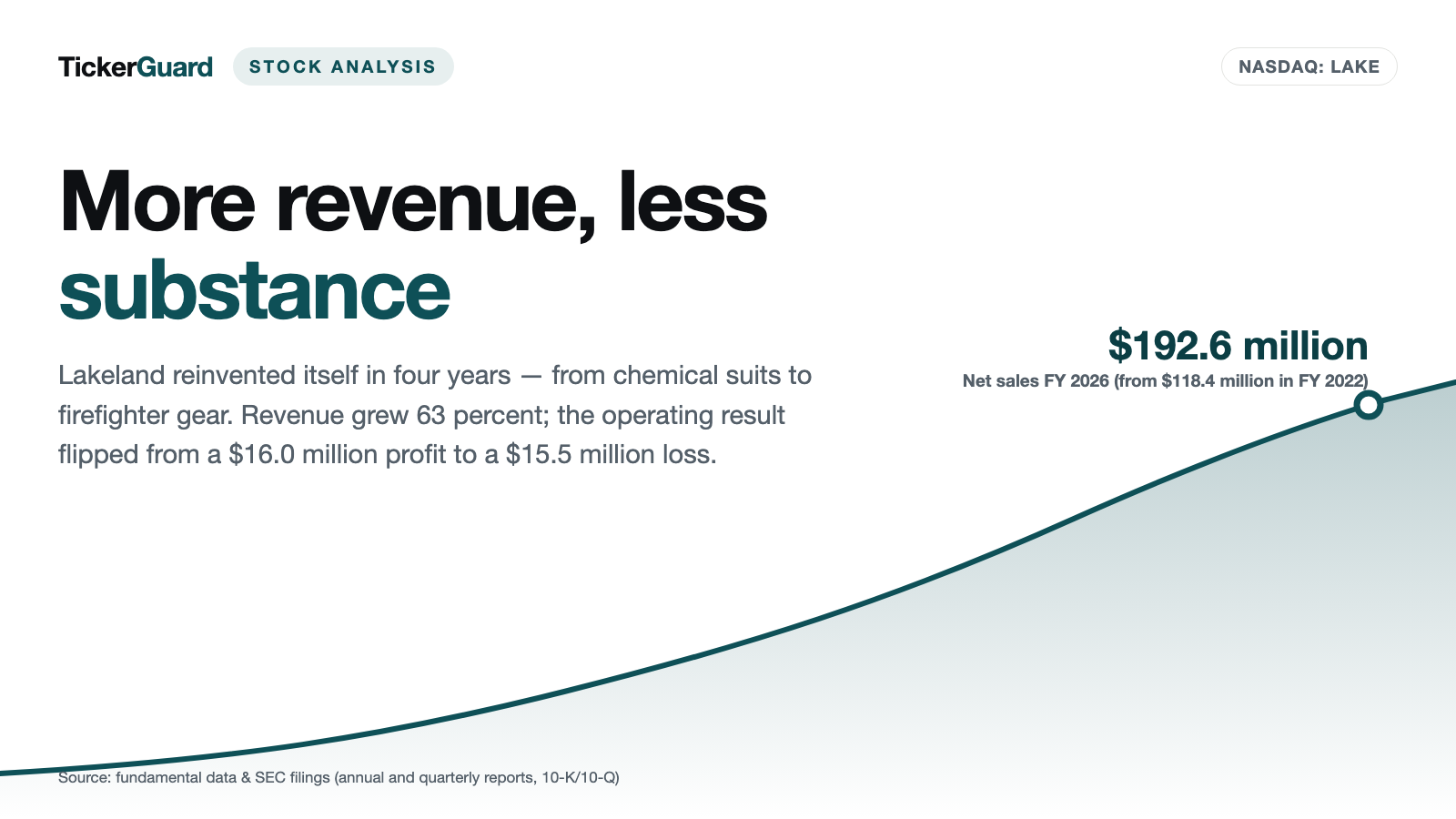
Lakeland Industries reinvented itself in four years: from a maker of chemical suits into a firefighter outfitter. Revenue climbed from $118.4 million to $192.6 million. We read the annual report (10-K) filed April 16, 2026 and the quarterly report (10-Q) filed June 9, 2026 — and found three sentences that made no headline: the operating result flipped from a $16.0 million profit to a $15.5 million loss, internal control over financial reporting has been ineffective for a second straight year, and in January 2026 the company breached two covenants on its credit facility. Not investment advice — just the question of what survives a transformation that takes longer than the cash lasts.
 Thomas Mücke
Founder & Publisher
Thomas Mücke
Founder & Publisher
As of Today
As of: September 17, 2026
- Closing price
- 10.50 $ +0.70%
- Market Capitalisation
- 0.1 $B
- Growth Score
- 2/10
- AAQS
- 3/10
Price change since September 8, 2026: -8.8%
This analysis has a cut-off date. The Stock Guard tells you when something material changes in the numbers. Reserve your free spot
Chart
Interactive price chart (TradingView).
52-week range: 7.60 $ to 17.30 $ · Last price: 10.50 $ (As of: September 17, 2026)
Note: pure fact-based analysis, not investment advice and not a solicitation to buy or sell. All figures without guarantee.
There is an investor weakness that tends to catch the kindest people, because it grows out of goodwill — call it the transformation hope. It works like this: a solid, boring company is stuck in a shrinking market and decides to reinvent itself. It buys things. It rebrands. It shows a new product range at trade fairs, and for the first time in years the press releases sound like a beginning. And we, watching from outside, quietly confuse two things: we mistake the busyness of the transformation for its success. Revenue is growing, after all — it is just that the growth was purchased. That is exactly where Lakeland Industries, Inc. (Nasdaq: LAKE) stands today, a maker of protective clothing incorporated in Delaware in 1986 that has been doing business as "Lakeland Fire + Safety" since fiscal 2026. So we read the annual report (10-K) for fiscal 2026, filed with the U.S. securities regulator, the SEC, on April 16, 2026, together with the most recent quarterly report (10-Q) of June 9, 2026, the earnings release published the same day and three older annual reports for the historical series. An SEC filing is honest under penalty of law. And this one tells a story in which two things are true at once: the transformation is real and far advanced — and it cost more than the revenue line lets on. What you make of that is up to you.
What Lakeland actually does — from chemical suits to turnout gear
Lakeland makes clothing that keeps people alive at work. The range splits neatly in half. One half is the legacy business: disposable protective suits (the white coveralls you know from every news report on a chemical spill or an outbreak), high-end chemical protective suits for hazmat work, durable woven garments and high-visibility clothing. The other half is the new business, and it is called Fire Services: turnout gear for firefighters, boots, gloves, particulate-blocking hoods, helmets — plus a growing service platform on which Lakeland inspects, cleans, decontaminates, repairs and rents fire departments' protective equipment. The company calls these sites Independent Service Providers.
One line from the annual report shows how far the center of gravity has shifted. In fiscal 2026 Lakeland sold $93.6 million of Fire Services, up from $63.0 million — a gain of 48.6 percent, and 48.6 percent of total net sales of $192.6 million. For comparison: disposables, the backbone of the company for decades, brought in $51.3 million (prior year $52.2 million), chemical suits $21.7 million (versus $21.5 million), and the wovens line $11.5 million after $16.8 million. Translated: the old business is flat or shrinking, and the new one now carries half the revenue. Geographically, $81.6 million came from the United States, $54.2 million from Europe, $16.4 million from Latin America and $14.5 million from Asia; more than half of net sales are made by units outside the United States, and the company operates in 16 foreign countries.
Manufacturing runs across nine locations in eight countries on five continents: China (AnQui City, owned), Mexico (Jerez, owned) and India (Noida, owned), plus leased plants in Vietnam, Argentina, Romania, New Zealand and in Des Moines and Spencer, Iowa. As of January 31, 2026 Lakeland employed roughly 2,600 people, only 225 of them in the United States and 2,375 abroad; about 1,500, or 57 percent of the global workforce, are covered by collective bargaining agreements or works councils. There is expressly no customer concentration — no single customer accounted for more than 10 percent of sales in fiscal 2025 or 2026.
That brings us to the central tension of this analysis, which runs through every chapter: Lakeland has carried out a real and strategically coherent transformation — from a consumables maker into an outfitter of fire departments with a recurring service business. It paid for that transformation with the very assets that were supposed to carry it: with its cash, its margin and its independence from its bank. We have seen how quickly an acquisition story turns into a question about earning power at marine gearbox builder Twin Disc; how thoroughly tariffs can dismantle a trading margin at children's apparel maker Carter's.
Company history for investors
-
2023
Acquisition of Pacific Helmets, New Zealand (November 30)
Roughly $6.3 million bought the first building block of the fire range. For shareholders this is where the shift from chemical protection to firefighter outfitting began.
-
2024
Three more acquisitions: Jolly, LHD and Veridian
Boots from Italy ($9.0 million, February), turnout gear and servicing from Germany ($14.8 million, July), gloves from Iowa ($26.3 million, December) — the range was complete, the cash box distinctly emptier.
-
2025
Equity raise at $22.00 per share (January 24)
2,093,000 new shares brought in $42.6 million net, which went to pay down the credit facility. Existing holders were diluted and subscribers watched the price fall afterwards.
-
2025
Tax assets written off, dividend cut (December)
The third quarter carried $13.7 million of tax expense on a $2.3 million pre-tax loss; on December 9, 2025 Lakeland suspended its quarterly dividend.
-
2026
Loan covenants broken and waived (April 13)
Bank of America waived non-compliance with two financial covenants as of January 31, 2026 — three days before the annual report was filed. The commitment stayed at $40 million.
-
2026
Two product lines sold (March 27)
Selling High Performance and High Visibility to National Safety Apparel brought $13.2 million in cash and the only quarterly profit in a long time — but cost $13.2 million of annual revenue.
How this stock landed on our desk
Lakeland did not reach our research list through a momentum or value hit in our in-house stock scanner. It came from a sweep of the stocks retail investors are talking about most right now (as of September 8, 2026). Lists like that are not a reason to buy — they are a list of questions. All they say is: a lot of people are discussing this company, and it is worth checking whether the filings tell the same story as the forums.
Two things about Lakeland can be measured before you open a single balance sheet. First, the range: in the twelve months to September 8, 2026 the stock moved between $7.15 and $17.96 — the high is two and a half times the low. Second, the bet against it: roughly 1.26 million shares were sold short, about 13 percent of all 9,869,164 shares outstanding, and given this stock's thin trading volume it would take a calculated 21 trading days to cover those positions (data as of September 8, 2026). Selling short means someone borrowed shares, sold them and hopes to buy them back cheaper. At a company with a market value of roughly $114 million, a bet that size is a clear signal that professional investors read the filings differently than the forums do.
A third point belongs here because it sets the time frame: on January 24, 2025 Lakeland issued 2,093,000 new shares at $22.00 and took in $42.6 million net, which went to pay down the credit facility. Anyone who subscribed then is down roughly half against the September 8, 2026 close of $11.51. That is not a verdict on the company — it is the reason this analysis starts with the balance sheet rather than the product range.
Anyone looking for a signal of confidence from the inside will not find one for this period. Between the June 9, 2026 quarterly report and September 8, 2026, fourteen insider reports (Form 4) were filed. They fall into exactly two groups. First, grants: on the day of the annual meeting, June 16, 2026, seven directors each received 7,553 shares and one of them a further 3,021 — 55,892 shares in total at a price of zero. Second, dispositions: on June 12, July 11 and August 1, 2026 directors and officers, including chief executive Jim Jenkins, gave back 8,503 shares in total at prices between $10.98 and $11.40 — not as open-market sales, but as shares withheld to cover taxes on vesting awards (transaction code F). There was not a single open-market purchase in those three months. That is not an accusation; grants and tax withholding run automatically. It simply means a price of around eleven dollars has so far moved nobody inside the company to reach into their own pocket.
The numbers over the years — given their due
Start with what genuinely impresses, because it is real. Lakeland built 63 percent more revenue in four years: from $118.4 million in fiscal 2022 through $112.8 million (2023), $124.7 million (2024) and $167.2 million (2025) to $192.6 million in fiscal 2026. Last year's step alone was $25.4 million, or 15.2 percent. Fire Services grew by $30.6 million, the U.S. business by $21.2 million (up 35.1 percent) and Europe by $12.1 million (up 28.7 percent). And the products connect to each other: turnout gear, boots, gloves, hoods and helmets have, according to the company, achieved certification under the new U.S. fire service standard NFPA 1970:2025, and U.K. subsidiary Eagle Technical received notice of an intended award under the National Fire Chiefs Council framework. Note the scale precisely: the company describes that framework as carrying a total potential value of up to £220 million over a seven-year term across all awarded suppliers — not for Lakeland alone. Reading that number as an order intake reads it wrong.
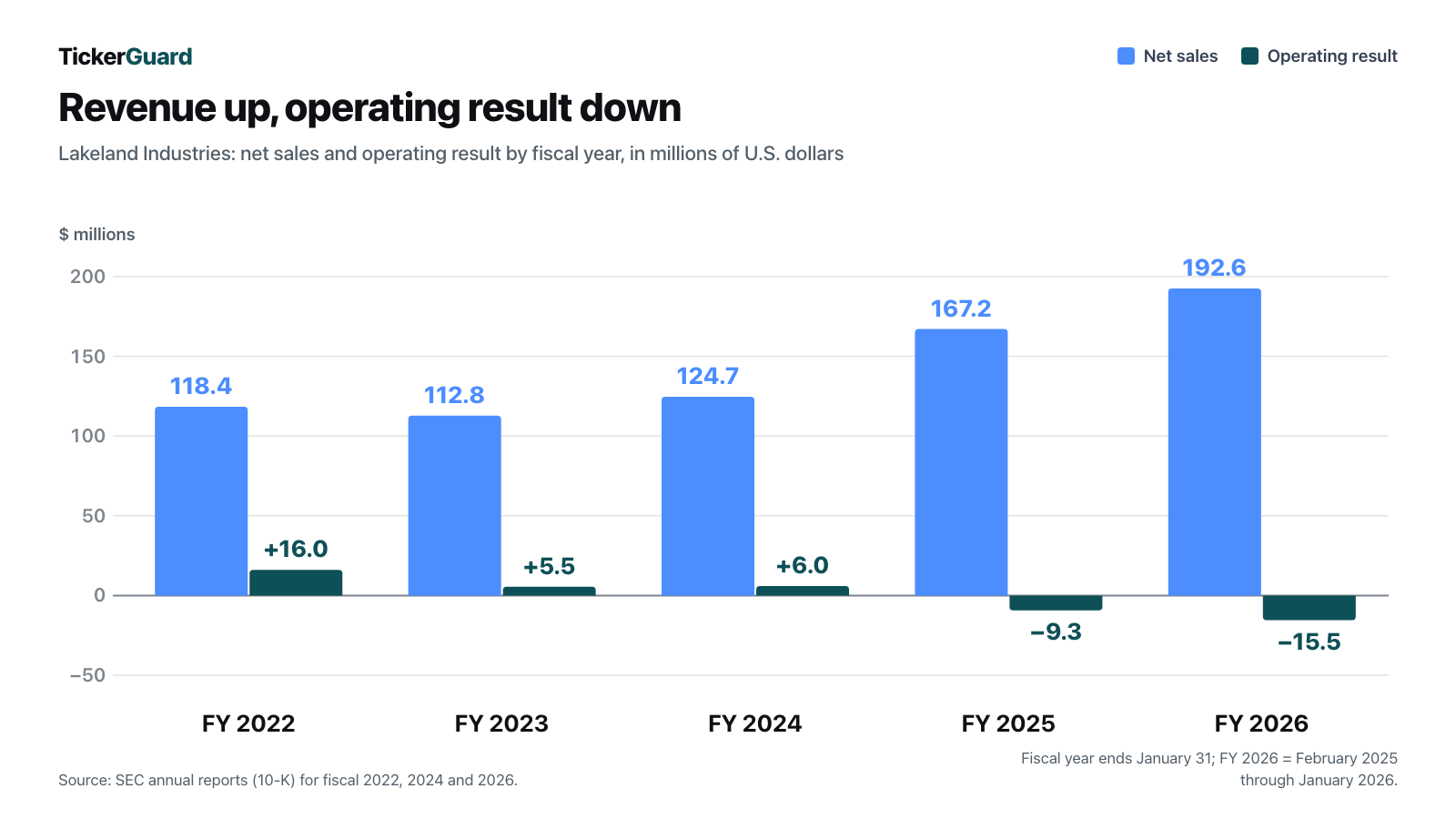
Now the other line of the same income statement. The operating result — the number that shows what the business itself earns, before interest and taxes — went like this: plus $16.0 million in fiscal 2022, plus $5.5 million in fiscal 2023, plus $6.0 million in fiscal 2024, minus $9.3 million in fiscal 2025 and minus $15.5 million in fiscal 2026. The net loss for the most recent year was $25.3 million, or $2.63 per share, after $18.1 million the year before. The decisive cause sits one line higher: gross margin fell from 41.1 percent to 32.9 percent. The company attributes that to higher personnel, freight, tariff and materials costs. In money: every additional revenue dollar left eight cents less gross profit than two years earlier — and on $192.6 million of sales, eight percentage points of margin is about $15.8 million, almost exactly the operating loss.
The cash view is harder still, because cash cannot be booked away. Operating cash flow was negative for two consecutive fiscal years: minus $15.9 million in fiscal 2025 and minus $15.8 million in fiscal 2026. Together that is roughly $32 million the running business consumed rather than earned in two years. It was funded from the credit facility: in fiscal 2026 Lakeland drew a total of $44.3 million and took in $12.5 million net from financing. Cash still fell from $17.5 million to $12.5 million.
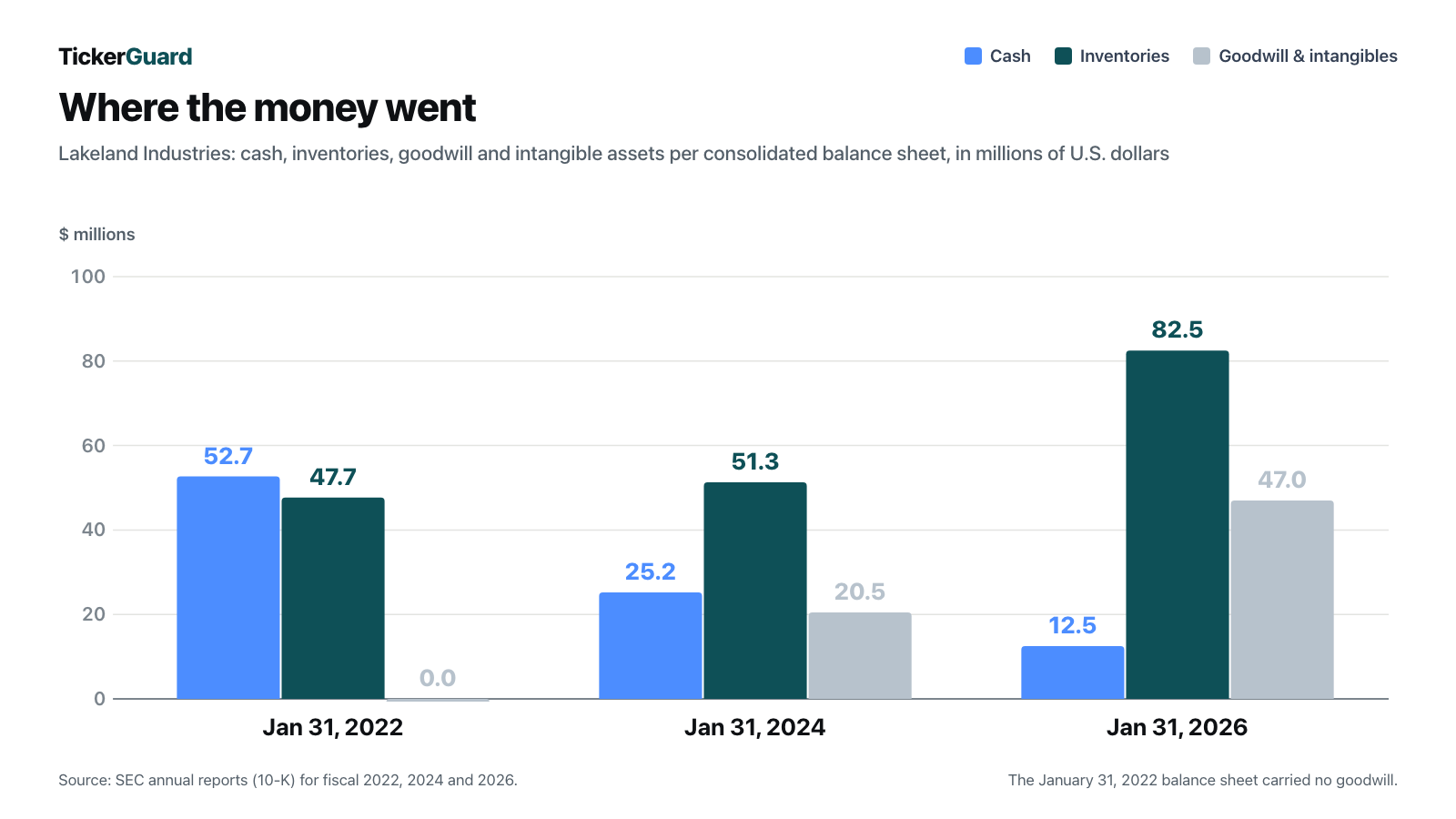
The chart shows where the money went, and it shows it without interpretation. On January 31, 2022 Lakeland held $52.7 million in cash, carried no goodwill on the balance sheet and had total liabilities of $15.7 million. Two years later, on January 31, 2024, it held $25.2 million of cash and $20.5 million of goodwill and intangible assets. And two years after that, on January 31, 2026, it had become $12.5 million of cash, $47.0 million of goodwill and intangible assets and total liabilities of $80.8 million. Inventories rose from $47.7 million to $82.5 million — the equivalent of 43 percent of a year's sales sitting on the shelf. Stockholders' equity, at $129.1 million, is actually slightly above the $125.1 million of 2022 — but only because a January 2025 equity raise brought in $42.6 million. The part the company earned itself, retained earnings, fell over the same period from $62.9 million to $23.9 million. Remember the rhythm: at Lakeland revenue did not grow because the company got better, but because it was bought bigger — and the balance sheet paid for it.
What the filings say — the uncomfortable truths
Six findings we located in the original documents. Every one of them appears verbatim in a filing to the U.S. securities regulator; none is a supposition.
Uncomfortable truth No. 1: as of January 31, 2026 Lakeland failed two loan covenants
A covenant is a promise to the bank: as long as certain ratios hold, the company may use the facility. If one of them breaks, the lender can in theory call the loan. Lakeland's Bank of America facility requires two things: a basic fixed charge coverage ratio of at least 1.20x and a funded debt to EBITDA ratio of no more than 3.5x — stepping down to 3.25x on February 1, 2026 and to 3.0x on February 1, 2027. And here is the sentence that is easy to skim past:
“On April 13, 2026, the Company and the Lender entered into a limited waiver (the “Limited Waiver”), pursuant to which the Lender waived the Company’s non-compliance as of January 31, 2026 with respect to two financial covenants under the Amended Loan Agreement.”
— Lakeland Industries, Inc., SEC quarterly report 10-Q for the period ended April 30, 2026, Note 6 “Long-Term Debt”

Give it a fair reading: the bank waived the breach, did not cut the $40.0 million commitment, did not pull the December 12, 2029 maturity forward and did not raise the rate. As of April 30, 2026 Lakeland states it was back in compliance with all covenants, had drawn $23.8 million with $16.2 million available, and paid 5.74 percent. This is not an emergency. But it is proof that the leverage limit is within reach — and the permitted ratio steps down again to 3.0x on February 1, 2027. Anyone holding this stock should have that date in their calendar.
Uncomfortable truth No. 2: the only quarterly profit came from selling two product lines
In the first quarter of fiscal 2027 (February through April 2026) Lakeland reported net income of $369,000 — after a $3.9 million loss in the prior-year quarter. That sounds like a turn. But the same income statement carries its own line: "Gain on sale of certain assets: 6,467", a $6.5 million disposal gain. On March 27, 2026 Lakeland had sold the inventory and intellectual property of its High Performance and High Visibility product lines to National Safety Apparel, LLC for $14.0 million, of which $13.2 million came in as cash. Without that one-time gain the quarter's operating result would have been minus $4.2 million instead of plus $2.3 million.
None of this is improper — a company may sell peripheral businesses, and Lakeland explains the step credibly in terms of simplification and liquidity. It simply has two consequences that belong together. First, the quarter's strong $5.8 million operating cash inflow also stems largely from the same transaction; the chief financial officer says so himself in the earnings release. Second, and this is the real point: the two divested lines together generated $13.2 million of revenue in fiscal 2026, or 6.9 percent of group sales. Into precisely that hole, chief executive Jim Jenkins reaffirmed on June 9, 2026 the target of high single-digit revenue growth for fiscal 2027. In the first quarter revenue grew 1.4 percent.
Uncomfortable truth No. 3: $7.6 million of tax expense on a $17.7 million loss
In fiscal 2026 Lakeland reported a pre-tax loss of $17.7 million — and beneath it, where a tax benefit would normally sit, a tax expense of $7.6 million. That is how a $17.7 million pre-tax loss became a $25.3 million net loss. The reason is called a valuation allowance on deferred tax assets, and it is simpler than it sounds. A company that loses money accumulates a future tax benefit: when it earns again, part of that income goes untaxed. But it may only carry that benefit on the balance sheet if it expects, more likely than not, to be able to use it. That is exactly what Lakeland could no longer claim:
“As such, the Company is no longer able to conclude that it is more likely than not that our U.S. deferred tax assets will be realized.”
— Lakeland Industries, Inc., SEC quarterly report 10-Q for the period ended October 31, 2025, Note 10 “Income Taxes”

Three numbers show what that means in practice. The valuation allowance stood at $6.6 million on January 31, 2025, at $18.3 million on January 31, 2026 and at $19.7 million on April 30, 2026. The jump landed in the third quarter of fiscal 2026: there Lakeland booked $13.7 million of tax expense on a $2.3 million pre-tax loss, an effective tax rate of negative 597.9 percent. For an investor this is a booking without a cash flow — but it is the company's own accounting passing judgment on the company's own future. And it has a side effect visible in the current year: because U.S. losses no longer create a tax benefit, the effective tax rate in the first quarter of fiscal 2027 was 78.5 percent. Of $1.7 million in pre-tax income, $0.4 million survived.
Uncomfortable truth No. 4: internal control has been ineffective for a second straight year
Every U.S. public company must assess annually whether its internal control over financial reporting works — whether the system that turns bookkeeping entries into consolidated accounts reliably prevents material misstatement. Lakeland's answer, two years running, is no.
“As a result of the material weakness identified, the Company’s management concluded that, as of January 31, 2026, the Company’s internal control over financial reporting was not effective based on the criteria in the 2013 COSO Internal Control – Integrated Framework.”
— Lakeland Industries, Inc., SEC annual report 10-K for fiscal 2026, Item 9A “Controls and Procedures”

The weakness itself is described precisely: for locations running neither Sage X3 nor Kingdee, the information technology general controls are missing, so the completeness and accuracy of those foreign subsidiaries' reporting packages is not adequately secured. Those reporting packages are what the consolidated accounts are built from. The identical finding appeared in the fiscal 2025 annual report — and the quarterly report of June 9, 2026 states that disclosure controls were still not effective as of April 30, 2026. As a remedy Lakeland is rolling out a single SAP system; the annual report also notes that the previous implementation partner was replaced and a new one only comes aboard in the first half of fiscal 2027. Read it soberly: a material weakness is not proof that the numbers are wrong. It is notice that nobody — including the company itself — can rule out with the usual confidence that an error would be caught.
Uncomfortable truth No. 5: $1.5 million in the U.S. bank accounts
As of January 31, 2026 Lakeland reported $12.5 million of cash. The annual report breaks it down, and the split is striking: roughly $1.5 million sat in accounts in the United States and roughly $11.0 million abroad — and $11.7 million of the total was uninsured. For a group whose headquarters, credit facility and largest market are all in the United States, that is a remarkably thin cushion at home. It also explains why the credit facility was worked so hard in fiscal 2026, with $44.3 million of draws: it was simply the liquidity reserve. Consistent with that, in the June 9, 2026 earnings release the chief financial officer says the company continues to work toward an asset-based lending structure to strengthen its liquidity position.
One more line belongs here, because it makes the priorities visible: the quarterly dividend of three cents per share that Lakeland introduced in February 2023 was suspended on December 9, 2025. In fiscal 2026 it still cost $1.2 million. Cutting a dividend is a sensible decision when the money is needed. It is also the most honest signal a board can send.
Uncomfortable truth No. 6: 965 firefighters are suing — and so are the shareholders
The chemistry that makes turnout gear resistant to water, oil and chemicals belongs to the PFAS family — the "forever chemicals" that barely break down in the environment or in the body. In the United States that has turned into a wave of litigation, and Lakeland is in the middle of it:
“As of April 7, 2026, the Company has been named as a defendant in 41 lawsuits involving PFAS-related personal injury claims. These include 38 lawsuits consolidated in In re: Aqueous Film-Forming Foams Products Liability Litigation, MDL No.: 2:18-mn-2873-RMG (District of South Carolina, Charleston Division) involving claims by 965 firefighters alleging that PFAS in their turnout gear caused personal injuries.”
— Lakeland Industries, Inc., SEC annual report 10-K for fiscal 2026, Item 1A “Risk Factors”

Important for context: Lakeland states in the notes that its exposure to losses in these matters is not reasonably estimable at this time — so no amount appears on the balance sheet, neither as a provision nor as a ceiling. That is accounting-correct and unsatisfying for an investor at the same time: a risk without a number cannot be valued, only watched. On top of that come two proceedings aimed not at the product but at the leadership. On February 23, 2026 a putative securities class action was filed in the U.S. District Court for the Southern District of New York against Lakeland and certain current and former senior officers, on behalf of investors who bought shares between December 1, 2023 and December 9, 2025. On May 4, 2026 a shareholder derivative action against the officers and directors alleging breach of fiduciary duty followed in the same court. Both are filed, pending proceedings — none of the allegations has been decided. Note the end date of the class period: it is the same day the dividend was cut.
Valuation — below book value, but which book?
At the September 8, 2026 close of $11.51 and 9,869,164 shares outstanding (as of June 5, 2026, per the quarterly report cover page), Lakeland carries a market value of roughly $114 million. Against fiscal 2026 net sales of $192.6 million that is a price-to-sales ratio of about 0.6 — low for an industrial name. There is no price-to-earnings ratio, because there are no earnings. And stockholders' equity stood at $130.5 million on April 30, 2026, above the market value: the price-to-book ratio is around 0.9. On paper you buy the company for less than its assets minus its debts are worth.
That sentence has to be finished with the balance sheet in hand. Of the $130.5 million of equity, $46.1 million is goodwill and intangible assets (as of April 30, 2026) — amounts created when the six companies were bought, with no market price of their own. Another $77.7 million sits in inventories, whose reserve for excess and obsolete stock the company raised over fifteen months from $3.5 million (January 31, 2025) through $4.7 million (January 31, 2026) to $5.0 million (April 30, 2026). Strip out goodwill and intangibles entirely and a tangible book value of roughly $84 million remains, about $8.50 per share — and the discount to book turns into a premium of roughly a third. Both calculations are correct; they simply answer different questions. And Lakeland has itself proved that goodwill is not a safe asset: across fiscal 2025 and 2026 it wrote off $13.1 million of it — $3.0 million on Pacific, $7.5 million on Eagle, $2.6 million on LHD.
The professionals are split. The average price target of the few analysts covering the stock was $16.50 as of September 8, 2026, well above the price. At the same time roughly 1.26 million shares were held short. A price target is an opinion; a short position costs its holder a borrow fee every day. When both exist at once, the message is mostly this: this stock is a bet on whether the transformation starts earning money in time.
Upside and risks at a glance
What speaks for Lakeland:
- The fire business really is growing. $93.6 million in fiscal 2026 after $63.0 million (up 48.6 percent), and another 11 percent in the first quarter of fiscal 2027 to $23.4 million — now roughly half of group revenue.
- The range is complete for the first time. After acquiring Jolly (boots), Pacific (helmets), Veridian (gloves, hoods) and LHD (turnout gear, servicing), Lakeland can equip a fire department head to toe and then maintain the equipment — certified to the new U.S. standard NFPA 1970:2025.
- The service business is recurring. Inspection, cleaning, decontamination and rental bind customers differently than a one-time sale; Lakeland bought two service operations in Arizona and California in 2025 and plans further locations.
- The balance sheet is not over-levered. $130.5 million of equity stands against $27.2 million of financial debt (April 30, 2026); the credit facility runs to December 2029, with $16.2 million of it available.
- No customer concentration. No single customer accounted for more than 10 percent of sales in fiscal 2025 or 2026.
What speaks against it:
- Two fiscal years without an operating profit — and a quarter rescued only by a sale. Operating losses of $9.3 million (fiscal 2025) and $15.5 million (fiscal 2026), after a $6.0 million profit in fiscal 2024; the first quarter of fiscal 2027 was positive only because of a $6.5 million disposal gain.
- Two years of negative operating cash flow. Minus $15.9 million and minus $15.8 million — roughly $32 million consumed by the running business.
- The breach of two loan covenants as of January 31, 2026, waived on April 13, 2026 — with a leverage limit that steps down again to 3.0x on February 1, 2027.
- Internal control over financial reporting has been ineffective for two straight years and was still ineffective as of April 30, 2026; the SAP implementation partner was replaced.
- Margin under pressure. Gross margin from 41.1 percent (fiscal 2025) to 32.9 percent (fiscal 2026) and further to 31.4 percent in the first quarter of fiscal 2027 — causes cited by the company: labor, freight, tariffs, materials, rent and certification costs.
- Legal risk without a number. 41 PFAS lawsuits involving claims by 965 firefighters, a securities class action since February 23, 2026 and a derivative action since May 4, 2026, both undecided — Lakeland expressly calls the exposure not reasonably estimable.
- Dilution. The weighted average share count rose from 7.43 million in fiscal 2025 to 9.63 million in fiscal 2026 (up 30 percent); on June 16, 2026 Lakeland registered a further 700,000 shares for a new incentive plan.
- Manufacturing concentrated in China and Vietnam under a tariff policy that changed twice within a few months.
A human bottom line
Back to the transformation hope from the opening. It is not stupid — it is often right. Companies do reinvent themselves, and some come out better. What regularly misleads us is the order in which the evidence arrives: the revenue from an acquisition is visible the day after the contract is signed. Whether the acquisition pays only shows up years later. In between, everything feels like progress — and it is exactly that in-between where Lakeland stands right now, in year four.
What we found in the filings is a company with an understandable plan and a very thin buffer. The plan is sound: fire departments need certified equipment, they need it regularly, and whoever also services it holds a customer for years. The buffer is not: $12.5 million of cash at year-end, $1.5 million of it in the United States, two years of roughly $16 million each in operating cash outflow, a breach of two loan covenants, a cancelled dividend and internal control reported as ineffective for a second straight year. The first quarterly profit in a long time came from selling two product lines — and with them went the revenue they used to bring.
There is a very good reason to look at this stock: you can buy it below its book equity, and if the fire business restores the margin the old business once had, today's price will look cheap in hindsight. There is an equally good reason to wait for the next two quarterly reports before doing anything: until the numbers show the transformation working operationally, everything else is hope — and hope is the currency in which investors most reliably overpay. We have shown you the numbers and the sentences from the original filings. What you make of that is your decision. And that is exactly as it should be.
Sources and disclosures
- SEC annual report (10-K) for fiscal 2026, Lakeland Industries, Inc., filed April 16, 2026 — business, segments, employees, risk factors, Item 9A, consolidated financial statements.
- SEC quarterly report (10-Q) for the period ended April 30, 2026, filed June 9, 2026 — credit facility and Limited Waiver, tariffs, inventories, litigation, share count.
- SEC quarterly report (10-Q) for the period ended October 31, 2025, filed December 9, 2025 — valuation allowance on deferred tax assets.
- First quarter fiscal 2027 earnings release, Exhibit 99.1 to the Form 8-K of June 9, 2026 — product line and regional figures, facility utilization, fiscal 2027 target.
- SEC annual report (10-K) for fiscal 2025 · for fiscal 2024 · for fiscal 2022 — historical series for revenue, operating result and balance sheet.
- Registration statement on Form S-8 dated June 16, 2026 — 700,000 shares for the 2026 equity incentive plan.
- Price, market value, short interest and analyst figures: source fundamental data, as of September 8, 2026.
Disclosure: This analysis is journalistic interpretation of publicly available corporate filings and is not investment advice, not a recommendation to buy or sell and not a solicitation to act. Equity investments can lead to the total loss of the capital invested; losses are possible at any time. Every figure carries the reporting date of its source and may have changed since — in particular, the report for the second quarter of fiscal 2027 had not been filed as of our editorial deadline on September 9, 2026. Positions held by the operator are disclosed daily; where one exists, it appears as a notice at the top of this analysis.
Key figures at a glance
All monetary figures in millions of $; earnings per share as reported.
| Metric | 2022 | 2023 | 2024 | 2025 | 2026 |
|---|---|---|---|---|---|
| Revenue | 118.4 | 112.8 | 124.7 | 167.2 | 192.6 |
| Operating Income (EBIT) | 16.0 | 5.5 | 6.0 | -9.3 | -7.5 |
| Net Income | 11.4 | 1.9 | 5.4 | -18.1 | -25.3 |
| Net Margin | 9.6% | 1.7% | 4.4% | -10.8% | -13.1% |
| Earnings Per Share | 1.41 $ | 0.24 $ | 0.72 $ | -2.43 $ | -2.63 $ |
Source: fundamental data & SEC filings (annual and quarterly reports, 10-K/10-Q)
Our Bottom Line at a Glance
- Revenue & market position positive
- Net sales rose 63 percent from fiscal 2022 to fiscal 2026, from $118.4 million to $192.6 million, and by 15.2 percent in the last year alone. Fire Services grew 48.6 percent to $93.6 million and now makes up almost half of group revenue; the first quarter of fiscal 2027 added another 11 percent to $23.4 million. No customer accounts for more than 10 percent of sales (10-K FY 2026, Item 1 and Item 7).
- Earning power negative
- The operating result fell from a $16.0 million profit in fiscal 2022 to losses of $9.3 million in fiscal 2025 and $15.5 million in fiscal 2026; the net loss was $25.3 million, or $2.63 per share. Gross margin dropped from 41.1 percent to 32.9 percent and further to 31.4 percent in the first quarter of fiscal 2027. The only positive quarter in a long while rests on a $6.5 million disposal gain (10-K FY 2026; 10-Q April 30, 2026).
- Balance sheet & liquidity negative
- Cash fell from $52.7 million on January 31, 2022 to $12.5 million on January 31, 2026, only $1.5 million of it in U.S. accounts; operating cash flow was negative for two straight years (−$15.9 million and −$15.8 million). At the same time goodwill and intangibles rose from zero to $47.0 million and total liabilities from $15.7 million to $80.8 million. Of $130.5 million of equity (April 30, 2026), $46.1 million is not tangible (10-K FY 2022 and FY 2026; 10-Q April 30, 2026).
- Financing & covenants negative
- As of January 31, 2026 Lakeland failed two financial covenants on its credit facility; Bank of America waived the breach on April 13, 2026. Of the $40.0 million facility, $23.8 million was drawn and $16.2 million available on April 30, 2026, the rate was 5.74 percent and maturity is December 12, 2029. The permitted leverage ratio steps down to 3.0x on February 1, 2027; the dividend was suspended on December 9, 2025 (10-Q April 30, 2026, Note 6; 10-K FY 2026, Item 5).
- Governance & controls negative
- Internal control over financial reporting was not effective as of January 31, 2025 and January 31, 2026, and disclosure controls were still not effective as of April 30, 2026; the cause is a material weakness in information technology general controls over foreign subsidiaries' reporting packages. The SAP implementation partner was replaced. A securities class action has been pending since February 23, 2026 and a shareholder derivative action against the officers and directors alleging breach of fiduciary duty since May 4, 2026, neither of them decided (10-K FY 2026, Item 9A and Item 1A; 10-Q April 30, 2026, Item 4 and Note 11).
- Strategy & valuation neutral
- The transformation into a full-line outfitter for fire departments is coherent on its merits: after six acquisitions since November 2023 for at least $66 million, Lakeland covers turnout gear, boots, gloves, hoods and helmets certified to NFPA 1970:2025 and is building a recurring service business. The market prices that at roughly $114 million (September 8, 2026), a price-to-sales ratio of about 0.6 and a price-to-book ratio of about 0.9 — about 1.4 on a tangible basis.
Lakeland Industries has spent four years turning itself from a maker of industrial protective clothing into a full-line outfitter for fire departments, achieving 63 percent revenue growth along the way — mostly purchased. The balance sheet paid for it: cash fell from $52.7 million to $12.5 million, liabilities rose from $15.7 million to $80.8 million, the operating result turned from a $16.0 million profit into a $15.5 million loss, and operating cash flow was negative by roughly $16 million in each of two consecutive years. Two loan covenants were broken as of January 31, 2026 and waived by the bank in April 2026; internal control over financial reporting has been ineffective for a second straight year; the dividend is gone. The plan behind the transformation is sound, the buffer to execute it is thin. Anyone investing here is buying the bet that margin returns before liquidity runs short. Not investment advice.
What Our Rating Means
Substance risk
We found at least one documented issue that threatens the company itself — regardless of how the stock is currently valued.
We assign red because several documented findings touch the substance of the company, not merely its share price. First, interest coverage: a $15.5 million operating loss in fiscal 2026 sits against $2.1 million of interest expense — the running business does not earn its interest. Second, the cash drain: minus $15.9 million and minus $15.8 million of operating cash flow in two consecutive years against $12.5 million of cash on January 31, 2026, only $1.5 million of it in the United States. Third, the breach itself: two financial covenants were not met as of January 31, 2026 and were only waived by the lender on April 13, 2026. Fourth, internal control over financial reporting, reported as not effective for a second straight year. What expressly does NOT count against the company: equity is clearly positive at $130.5 million, there is no going-concern warning, the credit facility runs to December 2029 and was back in compliance on April 30, 2026. Nor does the low share price or the sub-one price-to-book ratio drive the color — those are price arguments. Red here stands for the documented risk that the transformation needs more time than its own earning power can finance. The decision is yours.
A journalistic assessment by our editorial team at the time of the deep dive, based on public sources — not investment advice and not a solicitation to buy or sell. Your personal circumstances (investment goals, risk capacity, taxes) cannot be taken into account. What our levels mean, how verdicts are formed, and what conflicts of interest exist →
Worth Noting
- LAKE reached our research list on September 8, 2026 through a sweep of the stocks most discussed in retail investor forums — not through a hit in our in-house stock scanner. This is the first edition of our analysis on this ticker and rests entirely on the original filings to the U.S. securities regulator, the SEC.
- Timeliness note: the most recent period report evaluated is the quarterly report (10-Q) for the period ended April 30, 2026, filed June 9, 2026. Between then and our editorial deadline on September 9, 2026 the company filed a registration statement on Form S-8 (June 16, 2026), a current report on Form 8-K covering the annual meeting (June 18, 2026), fourteen insider reports (Form 4) and beneficial ownership reports (SCHEDULE 13G/A) — all reviewed and, where they change the picture, reflected in the text. No new period report was among them: the report for the second quarter of fiscal 2027 was not yet available. Lakeland's fiscal year ends January 31 — every quarterly figure carries that offset.
- Risk of confusion: the legal entity is Lakeland Industries, Inc.; the brand it has used since fiscal 2026 is "Lakeland Fire + Safety". There has been no legal name change and no change of ticker symbol. The ticker LAKE is assigned to this company alone in the U.S. securities regulator's ticker registry (CIK 0000798081).
- Price and valuation figures are dated September 8, 2026 (closing price $11.51, market value roughly $114 million based on 9,869,164 shares per the quarterly report cover page as of June 5, 2026). Our analyses are evergreen; a day's price is not a reason to buy.
Stock Watch
This analysis is as of September 9, 2026. Stock Watch will tell you what's changed at LAKE since then.
Later $1 a month per stock — signing up is free, and you'll be the first to know when it launches.
The full analysis as a PDF for later
We will send you this analysis as a PDF — to print, file away, and read at your own pace. And we will add you to the free Stock Watch list for Lakeland Industries Inc (LAKE), so you hear about it when something material in this analysis changes.
Frequently Asked Questions
Lakeland Industries, Inc. (Nasdaq: LAKE), based in Huntsville, Alabama, goes to market as "Lakeland Fire + Safety" and makes protective clothing: disposable suits, chemical protective suits, durable woven and high-visibility garments, and firefighter turnout gear, boots, gloves, hoods and helmets. It also runs a service platform that inspects, cleans, decontaminates, repairs and rents fire department equipment. Fiscal 2026 net sales were $192.6 million with roughly 2,600 employees.
Lakeland's fiscal year ends January 31. "Fiscal 2026" therefore covers February 2025 through January 2026, and the first quarter of fiscal 2027 is the calendar months February through April 2026. Anyone comparing Lakeland figures with calendar-year numbers from other companies should keep that one-month offset in mind, especially when comparing quarters.
Yes. Note 6 of the quarterly report filed June 9, 2026 states that on April 13, 2026 Bank of America entered into a limited waiver releasing the company from non-compliance with two financial covenants as of January 31, 2026. The $40.0 million commitment, the December 12, 2029 maturity and the interest rate were unchanged; as of April 30, 2026 Lakeland states it was back in compliance with all covenants. The permitted leverage ratio steps down to 3.0x on February 1, 2027.
Because of a one-time item. The $369,000 of net income includes a $6.5 million gain on the sale of the High Performance and High Visibility product lines to National Safety Apparel on March 27, 2026 (purchase price $14.0 million, of which $13.2 million in cash). Without that gain the operating result would have been minus $4.2 million. The two divested lines had generated $13.2 million of revenue in fiscal 2026.
Because of an accounting valuation allowance, not a payment to any tax authority. Lakeland had carried accumulated U.S. tax benefits from earlier losses on its balance sheet. In the third quarter of fiscal 2026 the company concluded those benefits were no longer more likely than not to be realized and removed them. The allowance grew from $6.6 million (January 31, 2025) to $18.3 million (January 31, 2026) and $19.7 million (April 30, 2026).
No, by its own assessment. Management declared internal control over financial reporting not effective as of January 31, 2025 and again as of January 31, 2026; disclosure controls were also not effective as of April 30, 2026. The cause is a material weakness in information technology general controls over the reporting packages of foreign subsidiaries. As a remedy Lakeland is rolling out a single SAP system, but it has replaced the implementation partner.
It depends which book value you use. At the September 8, 2026 close of $11.51 and 9,869,164 shares, the market value is roughly $114 million against $130.5 million of stockholders' equity — a price-to-book ratio of about 0.9. Strip out $46.1 million of goodwill and intangible assets and tangible book value is roughly $84 million, or about $8.50 per share — at which point the stock trades at a premium of roughly a third.
Not at present. Lakeland introduced a quarterly dividend of three cents per share in February 2023 and suspended it on December 9, 2025. It still cost $1.2 million in fiscal 2026. Any resumption is at the board's discretion; the annual report names neither a date nor a condition for it.
Found an error?
Did you spot a factual error, an outdated number, or a typo in this deep dive? Let us know briefly — your report goes straight to the editorial team.