Twin Disc: a record year at the 1918 marine gearbox builder — and a prior year that was rewritten after the fact
Twin Disc has been building marine and heavy industrial transmissions since 1918, and in fiscal 2026 it reported the highest revenue in its history at $381.3 million. We read the annual report (10-K) filed on September 4, 2026 — and found two things that never made a headline: the $27.1 million profit is larger than pre-tax income, and the company changed its inventory accounting during the fiscal year, restating every prior-year comparison figure. Not investment advice — just the question of what a comparison is worth when the yardstick moves with it.
 Thomas Mücke
Founder & Publisher
Thomas Mücke
Founder & Publisher
As of Today
As of: September 17, 2026
- Closing price
- 24.70 $ +1.60%
- Market Capitalisation
- 0.4 $B
- P/E
- 13.9
- Growth Score
- 6/10
- AAQS
- 3/10
Price change since September 4, 2026: +3.6%
This analysis has a cut-off date. The Stock Guard tells you when something material changes in the numbers. Reserve your free spot
Chart
Interactive price chart (TradingView).
52-week range: 13.30 $ to 25.20 $ · Last price: 24.70 $ (As of: September 17, 2026)
Note: pure fact-based analysis, not investment advice and not a solicitation to buy or sell. All figures without guarantee.
There is an investor trap nobody sees coming, because it does not sit in the number you are looking at but in the number you measure it against — call it the prior-year trap. It works like this: you read "profit up twentyfold" or "margin doubled", and your brain quietly assumes the comparison figure is fixed like a boundary stone. It is not always. Companies are allowed to change their accounting methods, and when they do, they run the past through the new method again. The boundary stone moves. That is exactly what happened at Twin Disc, Incorporated (Nasdaq: TWIN) of Wisconsin — a 108-year-old builder of marine and heavy-duty transmissions that reported the highest revenue in its history and a leap in profit in the summer of 2026. So we read the fresh annual report (10-K) for fiscal 2026, filed with the SEC on September 4, 2026, along with the earnings release of August 20, 2026 and thirteen analyst conference call transcripts spanning three and a half years. An SEC filing is honest under penalty of law. And this one tells a story in which two things are true at once: the business really has got better — and the number at the bottom still is not what it appears to be. In the end, you decide.
What Twin Disc actually does — and why the calendar misleads here
Twin Disc was founded in Wisconsin in 1918 and has been building the heavy, invisible hardware that turns power into motion ever since: marine transmissions, azimuth and surface drives, propellers and boat management systems on one side; powershift transmissions, hydraulic torque converters, power take-offs, industrial clutches, control and braking systems on the other. In plain terms, Twin Disc is the gearbox and clutch specialist for anything that moves on water or works hard off the road — from the luxury yacht to the patrol boat, from the airport crash tender to oilfield equipment. The group runs two segments, manufacturing (the plants) and distribution (its own dealer network), produces in the United States, Belgium, Canada, Finland, Italy, the Netherlands and Switzerland among others, and employed 1,087 people as of June 30, 2026 — 107 more than a year earlier. One quirk belongs right at the start, because it trips people up constantly: Twin Disc's fiscal year ends on June 30. "Fiscal 2026" therefore covers July 2025 to June 2026, and the fourth quarter of that fiscal year ended on June 30, 2026. Which brings us to the central tension of this analysis, running through every chapter: Twin Disc's operating business measurably improved in fiscal 2026 — but the two numbers that appear in every headline, the profit and the year-over-year comparison, are both shaped by accounting decisions rather than by the factory. How quickly a clean growth story turns into a question about earnings quality is something we saw at specialty materials group Materion — and why a full order book alone is not a margin, at electronics contract manufacturer Plexus.
Company history for investors
-
2024
Acquisition of Katsa Oy (Finland)
The gear maker extended manufacturing into northern Europe — in fiscal 2026 Katsa grew 30.8% and became a growth driver.
-
2025
Acquisition of Kobelt (Canada, February)
The controls and drives specialist added roughly $7.6 million of revenue in fiscal 2026 — a third of the revenue increase was therefore bought.
-
2025
Release of the US tax valuation allowance (December 26)
The one-off lifted second-quarter profit to $14.9 million on pre-tax income of just $0.7 million. It cannot be repeated.
-
2026
New $90 million credit agreement (June 30)
Term loan and revolver run to 2031, secured by substantially all personal property — more room to move, but also more collateral pledged.
-
2026
Inventory valuation switched from LIFO to FIFO
Equity as of June 30, 2025 rose retrospectively by $32.1 million without a dollar moving. Older metrics are no longer directly comparable.
-
2026
Record year and dividend increase (August)
Revenue of $381.3 million, operating income up 62%, quarterly dividend up 25% to 5 cents — the operating trend is clearly positive for the first time in years.
Why we rewrote this analysis
We run roughly 3,500 stocks through our scanners every day; Twin Disc landed on our research list in July 2026 via the "Joshua" growth scanner. At the time the most recent mandatory filing was the quarterly report (10-Q) for the period ended March 27, 2026. Two documents have arrived since, and they change the picture thoroughly enough that updating the old analysis would not have been sufficient. On August 20, 2026 Twin Disc reported fourth-quarter and full-year results as an exhibit to an 8-K; on September 4, 2026 the audited annual report (10-K) for fiscal 2026 followed. That 10-K contains not only a new year but also a new old year: in the closing quarter Twin Disc changed the valuation method for its US inventories and consequently recalculated every prior-year figure. Anyone looking up fiscal 2025 numbers today finds different values than in the summer of 2025 — not because someone miscalculated, but because the yardstick is a different one. That is why the words "as adjusted" appear at so many points in this analysis. They are not a footnote; they are the heart of the story. And they are the reason we keep every time series in this text on one basis of calculation: mixing adjusted and originally reported figures conjures up effects that never existed.
The fiscal 2026 numbers — given honest credit
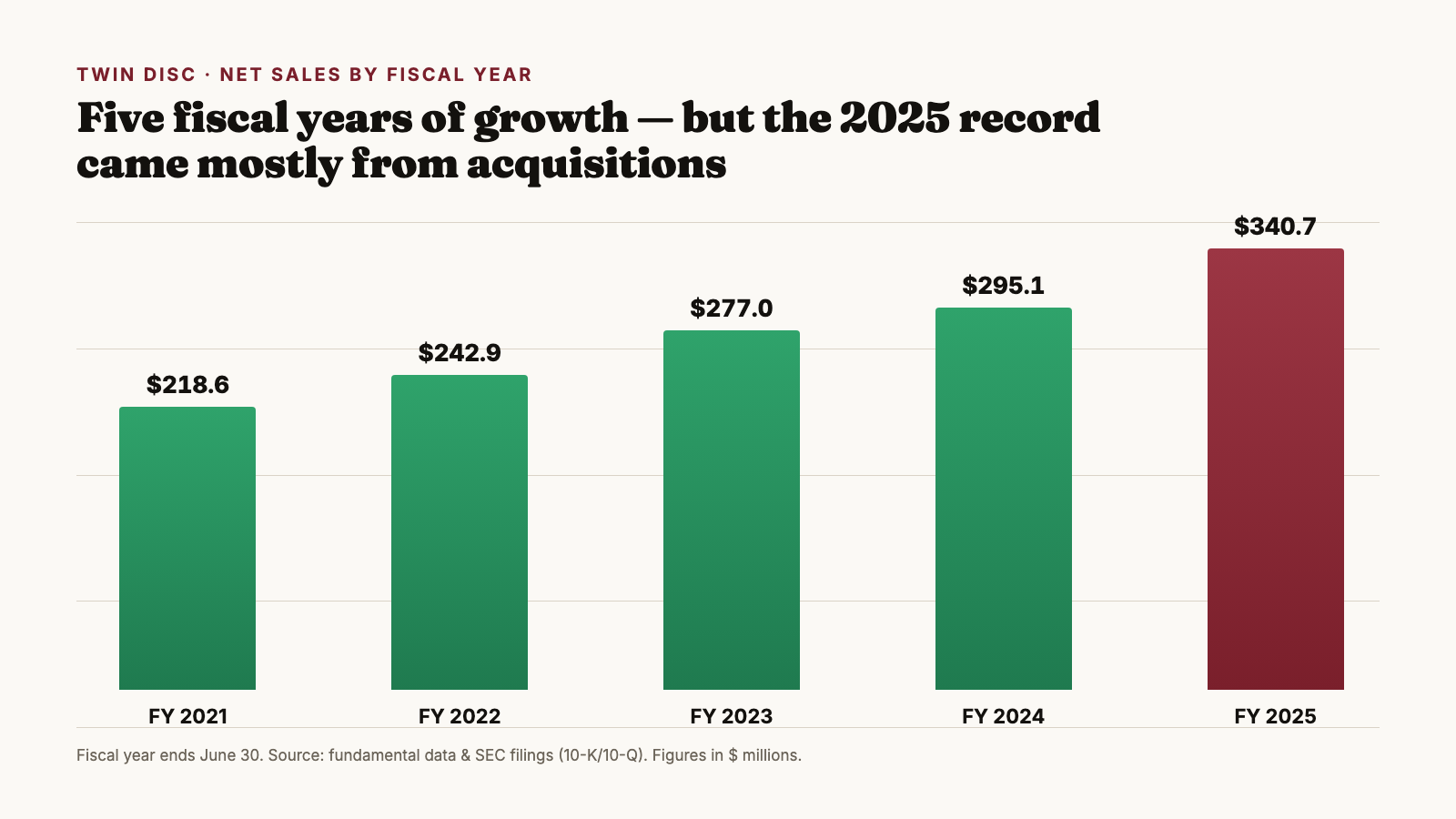
First what genuinely impresses, because it is real. Net sales rose 11.9% to $381.3 million in fiscal 2026 — the highest figure in company history and the fourth consecutive year of growth ($277.0 million in fiscal 2023, $295.1 million in 2024, $340.7 million in 2025). More important than the headline number is what happened underneath: operating income rose from $11.1 million to $18.0 million, roughly 62% — and that is the line the factory earned, without any tax or financing magic. Marketing, engineering and administrative expenses grew 2.5%, far more slowly than revenue, and fell from 24.2% to 22.2% of sales; that is genuine operating leverage. The six-month backlog stood at $178.3 million as of June 30, 2026, 18.5% above the prior year. Dutch propulsion subsidiary Veth grew 16.4%, Finnish Katsa 30.8%, the Swiss propeller operation 45.9%. And earnings before interest, taxes, depreciation and amortisation (EBITDA) rose 48.0% to $29.9 million according to the earnings release. Read this paragraph alone and you see an industrial stock where the turnaround is working.
Now turn the income statement around and look at the bottom. Twin Disc earned $13.6 million before tax in fiscal 2026. It reported net income of $27.1 million ($1.86 per diluted share). A net profit twice the size of pre-tax income only happens when the tax line is not a deduction but a credit. That is precisely what it was: instead of a tax expense, Twin Disc reported a tax benefit of $14.0 million, equivalent to an effective tax rate of minus 102.8%. Remember the rhythm: at Twin Disc it is still not the factory that determines the number at the bottom, but deferred tax. Where it comes from and why it cannot repeat is in the filings — and that is where we go next.
What the filings say — the uncomfortable truths
Uncomfortable truth no. 1: the prior year was rewritten after the fact
In the fourth quarter of fiscal 2026 Twin Disc switched the valuation of its US inventories from the LIFO method to the FIFO method. Briefly explained: under LIFO ("last in, first out") the most recently purchased goods are treated as consumed first for accounting purposes; under FIFO ("first in, first out") the earliest purchases are. When prices are rising, LIFO depresses reported inventory value and profit, while FIFO lifts both. The change itself is permitted and the company gives a sober rationale for it — but it moves not a single dollar and not a single screw. What matters is what it does to the past:
„The change in accounting method was applied retrospectively to all periods presented. Accordingly, prior-period consolidated financial statements have been adjusted as if the FIFO method had been used for the Company’s U.S. inventories in all periods presented. The retrospective application of the change increased the July 1, 2024 inventory balance and retained earnings by $30,937, net of tax.“
— Twin Disc, Incorporated, SEC annual report 10-K for fiscal 2026, Note A "Inventories, net" (identically worded in Note B)

What this means in practice can be shown with four numbers that all describe the same fiscal 2025 — on the left as Twin Disc reported them in the summer of 2025, on the right as they stand in today's 10-K. The net loss shrank from $1.9 million to $0.7 million, the loss per share from 14 cents to 5 cents, operating income rose from $9.9 million to $11.1 million, and equity as of June 30, 2025 grew from $164.4 million to $196.5 million — a gain of $32.1 million that no customer paid and no bank transferred. The current year was rewritten too: for the second quarter of fiscal 2026 Twin Disc reported earnings of $1.55 per diluted share back in February 2026; the 10-K now shows $1.04 for that same quarter. None of this is prohibited and none of it is hidden — it is all set out in Note S of the annual report. But it carries a consequence every investor should know: any metric built on a trailing twelve-month profit — the price-earnings ratio first among them — depends on whether the data provider has already picked up the restatement or is still carrying forward the old figures. For a few weeks, two different Twin Discs can appear in the same tables.
Uncomfortable truth no. 2: $7.4 million of tax benefit never reached the income statement
The second truth hangs on the first. For years Twin Disc had carried a full valuation allowance against its US deferred tax assets — in plain terms: the group was not allowed to recognise accumulated US tax benefits on the balance sheet because it could not count on future US profits with sufficient confidence. On December 26, 2025 it reversed that assessment. The annual report quantifies the whole exercise for the first time — and in doing so shows that a substantial part of the benefit never touched the income statement at all:
„The Company released $23.9 million of valuation allowance during fiscal 2026, of which $16.4 million was recognized as an income tax benefit in the Consolidated Statement of Operations and Comprehensive Income (Loss), and $7.4 million was recorded directly to retained earnings in connection with the change in inventory valuation method from LIFO to FIFO.“
— Twin Disc, Incorporated, SEC annual report 10-K for fiscal 2026, "Income Taxes and Valuation Allowances"
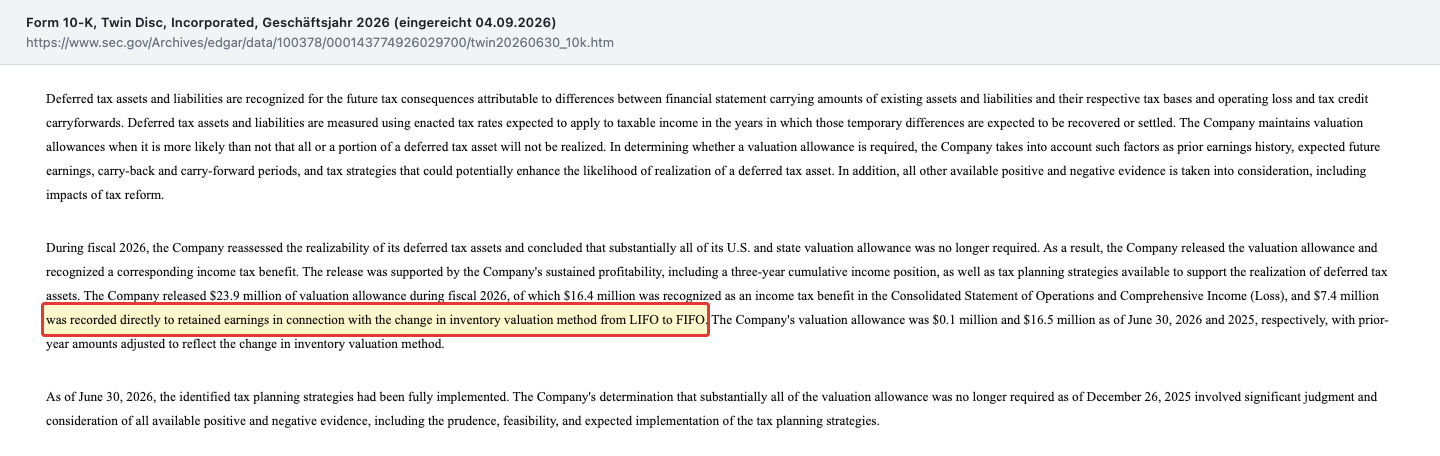
This release is a non-cash one-off: not a dollar enters the till, and the exercise cannot be repeated — a valuation allowance can only be released once. As of June 30, 2026, just $0.1 million remained of what had been $16.5 million. The well has run dry. That the $23.9 million released exceeds that opening balance has the same cause as everything else in this chapter: before the move to FIFO the valuation allowance stood at $24.0 million; $7.4 million of it fell away with the change and was booked straight into equity, while the remaining $16.4 million ran through the income statement. It is also notable that the accounting change and the tax benefit are connected — that appears in the auditor's report, which flags the matter explicitly as a critical audit matter — the only one in the entire audit. By the definition given in the audit report, such a matter is one that involved "especially challenging, subjective or complex" judgement. On the tax planning strategies it states verbatim that they included "contemplated tax accounting method changes" designed to accelerate future taxable income and increase the utilisation of expiring tax attributes. Chief Financial Officer Jeffrey Knutson put it more plainly on the conference call of August 20, 2026: the change had allowed the company to utilise expiring tax credits, contributing to the reversal of the valuation allowance in the second fiscal quarter.

Where the effect landed is easiest to see across the quarters — all four on the new basis of calculation, so nothing gets muddled.
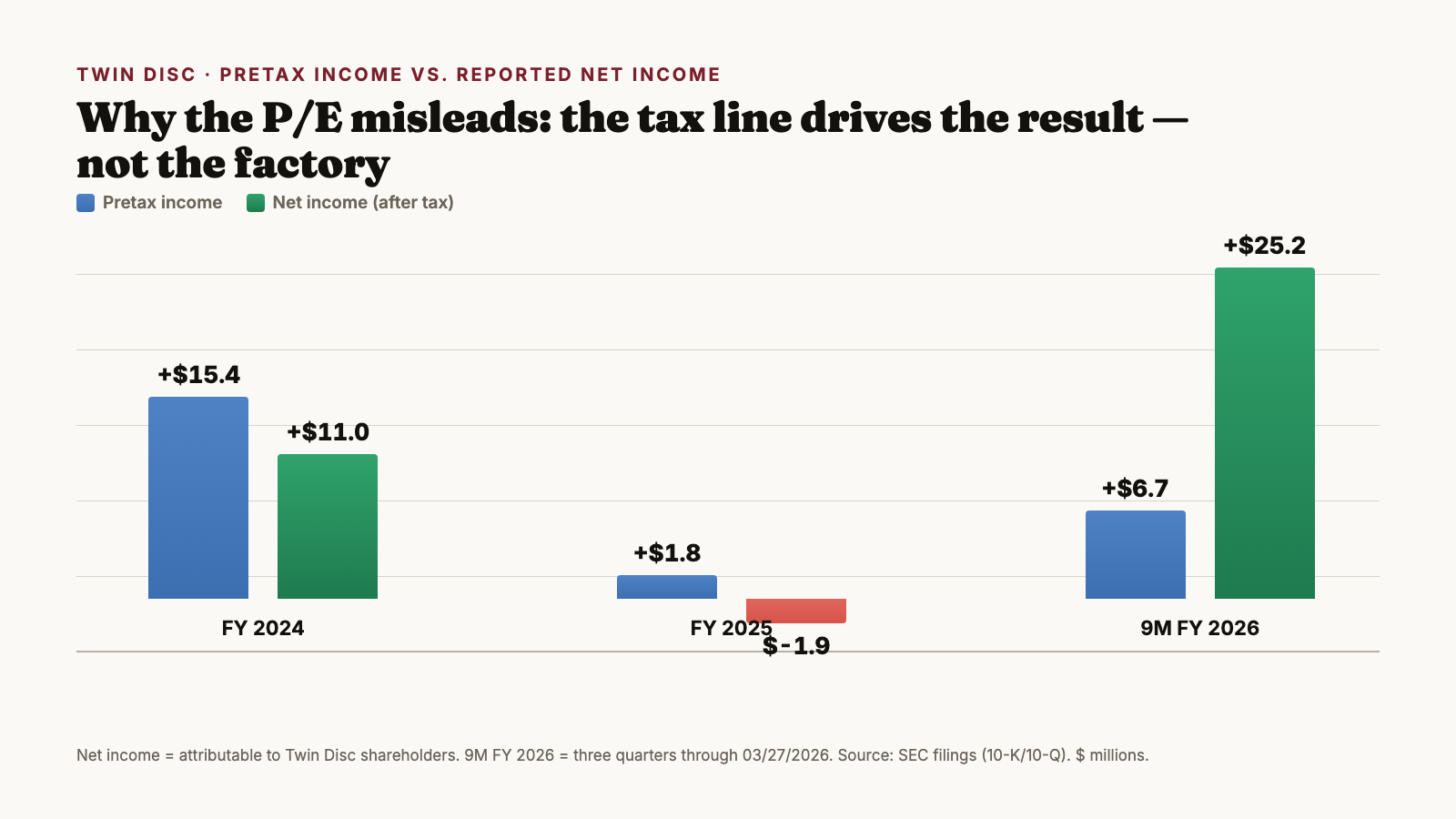
Uncomfortable truth no. 3: the US business still loses money
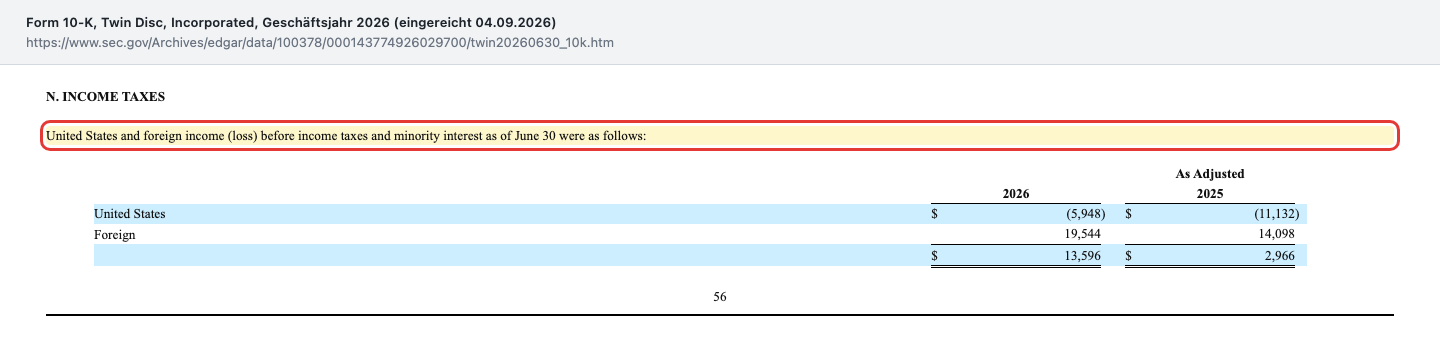
Why would a group carry a full valuation allowance against its US tax assets for years in the first place? Because it does not reliably make money at home. The tax note in the annual report splits pre-tax income by origin — and the picture remains unambiguous, even though it has improved: in fiscal 2026 foreign earnings of $19.5 million stood against a domestic pre-tax loss of $5.9 million. A year earlier it was $14.1 million in foreign earnings against an $11.1 million domestic loss. The US loss has therefore almost halved — that is real progress and the best justification for the tax release there is. Even so: the entire group profit and then some comes from abroad, from Veth in the Netherlands, the Swiss propeller works, Katsa in Finland and the Italian plants. The release of the tax valuation allowance therefore fell into a year in which the domestic business again posted a pre-tax loss — according to the annual report for fiscal 2025, the US result was negative in fiscal 2024 and 2025 as well (reported there on the basis applicable at the time). That is not a contradiction but a pointer to how differently book accounting and tax accounting calculate: management bases its assessment in Note N on improved results, on a cumulative three-year income position and on tax planning strategies; the audit report adds that the yardstick was cumulative taxable income — not book income. The auditor signed off on the exercise and at the same time flagged it as a critical audit matter. Even so, anyone buying the stock for its low price-earnings ratio should know that this ratio hangs on a home market that is currently losing money.
Uncomfortable truth no. 4: of 11.9% growth, 4.6% remains
Record revenue looks like a demand boom. In its earnings release of August 20, 2026 Twin Disc itself sets out how much of it came from its own efforts: adjusted for acquisitions and currency, full-year revenue rose 4.6% — not 11.9%. The annual report explains the gap: Kobelt, the Canadian controls specialist acquired in February 2025, contributed roughly $7.6 million of incremental revenue, and currency translation added $17.2 million of tailwind, essentially from a firmer euro. Both are hard cash and not phantom entries — but neither says anything about whether Twin Disc is selling more gearboxes. The spread between segments is also striking: while manufacturing grew 15.2%, distribution shrank 11.6%, or $15.2 million; the North American distribution business collapsed by 32.0% and the European one by 19.0%. And the margin did not follow the revenue: gross margin fell from 27.6% to 26.9%, partly because Twin Disc passed on $1.9 million of tariffs at no mark-up whatsoever — that alone cost around half a percentage point of margin. The closing quarter made it especially clear: revenue rose 18.3% to $114.4 million while gross profit fell 3.5% to $30.1 million. Growth that costs margin is not proof of quality — it is a bill that falls due later.
Uncomfortable truth no. 5: a full year of cash flow appeared in the final quarter
Free cash flow — the money genuinely left over after investment — came to $9.2 million in fiscal 2026 (operating cash flow of $22.9 million less $13.7 million of capital expenditure). That is positive, and that is good. Except: in the fourth quarter alone it was $17.2 million. Do the arithmetic and the first nine months of the fiscal year together consumed roughly $8 million of cash. A group that burns cash for three quarters and collects it all back in the fourth is not broken — for an equipment builder with long production cycles a strong closing quarter is normal. But it makes the metric fragile: measured against EBITDA of $29.9 million, the year's free cash flow represents a conversion rate of roughly 31% — well below the 60% the chief financial officer has repeatedly named as the target since autumn 2024. On the plus side: cash held steady at $16.0 million, debt fell 5.2% to $29.8 million, and inventories came down for the first time in years, from $184.1 million to $178.0 million (both figures on the new FIFO basis). On June 30, 2026 Twin Disc also signed a new credit agreement with Bank of Montreal and JPMorgan Chase for a $30 million term loan plus a $60 million revolving facility, maturing in 2031 and secured by substantially all personal property and 65% of the equity in certain foreign subsidiaries. Covenants were met and around $60 million was available at the balance sheet date.
What the analyst calls reveal — promises versus reality
Mandatory filings tell you what happened. Conference calls tell you what management expected — and putting both side by side shows how reliable the statements are. We read thirteen transcripts from April 2023 to August 20, 2026, with particular attention to the question-and-answer section: that is where analysts reveal what they really want to know, and where you see what gets no answer. Four findings.
First: the medium-term target was reset without the shift being flagged. In April 2023, Chief Financial Officer Jeffrey Knutson reaffirmed a revenue target of roughly $400 million at a 30% gross margin, to be reached "over the next 3 to 5 years". By August 2024 that had become a target of roughly $500 million at an unchanged 30% gross margin, but now "by 2030". The revenue bar was raised and the time horizon extended by years. The 30% margin has been hanging in the air for three and a half years; fiscal 2026 delivered 26.9%.
Second: on tariffs, management was wrong twice. In August 2025 Chief Executive John Batten stated that the company had quantified tariff exposure at "roughly 1% of cost of goods sold" and had pricing, alternative sourcing and surcharge mechanisms in place to offset any further impact. By November 2025 that had turned into guidance of 1% to 3% for the second quarter, described as temporary, with a return to roughly 1% in the second half. By February 2026 the burden was around 3% of cost of sales, and the promised return to 1% was withdrawn again in May 2026. The annual report carries the sober tally: $1.9 million of tariffs invoiced with no margin, roughly half a percentage point of gross margin.
Third: the defence pipeline got smaller — without comment. Defence has been the house growth story since the summer of 2025; the earnings release calls it a key structural growth driver, with demand from the US Navy and NATO. On the calls of August 2025 and May 2026 management put the associated project pipeline at roughly $50 million to $75 million. On the call of August 20, 2026 the prepared remarks had it at $30 million to $50 million as of June 30 — without a word of explanation. When an analyst asked precisely where the pipeline stood now, the answer came back as a different metric: the defence backlog had risen sharply. That is a different metric; it does not answer the question that was asked.
Fourth: the company itself cannot size its defence business. On the same call an analyst simply asked how big the military business had been in the fourth quarter and in fiscal 2026. The chief financial officer answered, in substance, that he did not have a good number; it was fragmented across all products and regions and much of it ran through distribution, and the company needed to do a better job of pulling that together analytically. It is an honest answer — but it means the company's central growth story is not measurable in revenue for outsiders, only as a share of the order book (most recently 17%, up 56% year over year). One further observation fits the pattern: on the conference call of May 6, 2026 not a single analyst asked a question, and in several other calls one analyst was the only questioner. Anyone hoping for pushback from the audience at a small cap like this will often wait in vain — the checking has to be done yourself.
In fairness, the other side belongs here too: one promise Twin Disc over-delivered on. In April 2023 Batten said the company wanted to resume the dividend but would not fund it with debt, only after establishing a track record of free cash flow. Two quarters later it was reinstated, and in August 2026 the board raised the quarterly dividend by 25% to 5 cents per share.
Valuation: a price-earnings ratio with two answers
Twin Disc closed at $23.85 on September 4, 2026; with 14,538,916 shares outstanding (as of August 10, 2026, per the annual report cover) that equates to a market capitalisation of roughly $347 million. Measured against reported earnings of $1.86 per diluted share, that gives a price-earnings ratio of about 13. Which sounds cheap — and this is exactly where the prior-year trap from the opening snaps shut a second time. Strip out the one-off $16.4 million tax benefit recognised in the income statement and roughly $10.7 million of profit remains, or about $0.73 per diluted share — and the price-earnings ratio is not 13 but roughly 33. Both numbers are arithmetically correct; they simply answer different questions. The first says what the company reported last fiscal year. The second says what it earned. The price-to-sales ratio of roughly 0.9 is fair to full for a gearbox builder running a 4.7% operating margin, and the price-to-book ratio of about 1.6 is relativised by the fact that book value itself just grew by $32 million through a change of method. In plain terms: the market is not paying today for a cheap profit machine but for the expectation that record revenue and improving operating income will eventually produce a record profit — this time without help from the tax line. There are anchors of substance for that: $219.9 million of equity, a $178.3 million order book, modest net debt of $13.8 million and a dividend paid since fiscal 2024 and now increased. No share was repurchased in all of fiscal 2026; 315,000 remain authorised.
Upside and risks at a glance
What speaks for Twin Disc:
- Four consecutive fiscal years of revenue growth to a record $381.3 million (+11.9% in fiscal 2026); six-month backlog of $178.3 million (+18.5% as of June 30, 2026).
- The operating business carries noticeably more: operating income +62% to $18.0 million, EBITDA +48.0% to $29.9 million, and administrative and selling costs down from 24.2% to 22.2% of sales — genuine operating leverage rather than an accounting effect.
- Foreign operations are growing strongly: Veth (Netherlands) +16.4%, Katsa (Finland) +30.8%, the Swiss propeller works +45.9%; the US pre-tax loss almost halved from $11.1 million to $5.9 million.
- Sound balance sheet: $219.9 million of equity against only $29.8 million of debt and $13.8 million net, a current ratio of 2.3, covenants met and roughly $60 million of undrawn credit; inventories reduced for the first time in years ($178.0 million versus $184.1 million).
- Wider capital returns: the quarterly dividend was raised 25% to 5 cents per share in August 2026, having been tied to demonstrated free cash flow back in 2023.
What speaks against it:
- Reported profit exceeds pre-tax income: $27.1 million after $13.6 million pre-tax, because the tax line showed a $14.0 million benefit (effective rate minus 102.8%). Adjusted for the one-off tax benefit, roughly $10.7 million remains — lifting the price-earnings ratio from about 13 to about 33. The well is dry: just $0.1 million of valuation allowance is left.
- The prior-year comparison rests on a new basis: the switch from LIFO to FIFO in the fourth quarter of fiscal 2026 lifted equity as of June 30, 2025 by $32.1 million, shrank the fiscal 2025 loss from $1.9 million to $0.7 million and cut previously reported quarterly earnings per share (Q2 fiscal 2026) from $1.55 to $1.04. Metrics built on trailing twelve-month profits can therefore diverge depending on the data vintage.
- Organic growth was only 4.6% (company figure, excluding acquisitions and currency); distribution shrank 11.6% and the North American distribution business by 32.0%. Gross margin fell from 27.6% to 26.9%, and in the closing quarter gross profit fell 3.5% despite an 18.3% revenue increase.
- The home market remains loss-making: a $5.9 million US pre-tax loss against $19.5 million of foreign earnings. The auditor classifies the tax release built on top of this as a critical audit matter because it required significant judgement.
- Free cash flow of $9.2 million arose entirely in the closing quarter ($17.2 million); the first nine months together cost roughly $8 million. The conversion rate of about 31% of EBITDA sits far below the 60% target named since 2024. Add tariff and currency risk with Europe accounting for roughly 42% of revenue.
A human conclusion
Back to the prior-year trap from the opening. Its essence is not that Twin Disc concealed anything — every single figure in this text sits openly in the annual report, complete with reconciliation table and auditor's note. Its essence is that we treat comparisons as stable when they are not always. Anyone who read the August 2026 headline "profit of $27 million after a loss last year" was holding two moving quantities against each other: a profit half of which the tax line produced, and a prior-year loss that had shrunk to a third in the meantime. The good news: underneath all of it sits a better company than a year ago. Operating income — the only figure in this report that depends neither on tax nor on valuation method — is up 62%; the order book is full, the cost ratio is falling, debt is falling, inventory is shrinking. So the honest question for you is not "has Twin Disc got better?" — it has. It is: how much are you paying today for the sequel, knowing that the tax credit will not return, that the home market is still losing money, and that only 4.6 of the 11.9 percentage points of growth came from the company's own efforts? Take operating income as your yardstick and you see a solid, cyclical niche supplier on the mend at a price that already anticipates a good deal. Take the $27.1 million at face value and you are paying twice for the same year. What you make of that is your decision. And that is exactly as it should be.
Sources
Every original document used in this analysis — for reading yourself:
- Twin Disc, Incorporated — SEC annual report 10-K for fiscal 2026 (ended June 30, 2026; filed September 4, 2026)
- Twin Disc, Incorporated — Fourth quarter and full year 2026 earnings release, Exhibit 99.1 to the SEC Form 8-K of August 20, 2026
- Twin Disc, Incorporated — SEC Form 8-K of July 6, 2026 (new credit agreement dated June 30, 2026)
- Twin Disc, Incorporated — SEC quarterly report 10-Q for the period ended March 27, 2026 (third quarter of fiscal 2026; filed May 6, 2026)
- Twin Disc, Incorporated — SEC annual report 10-K for fiscal 2024 (revenue figures for fiscal 2023 and 2024)
- Transcripts of Twin Disc, Incorporated analyst conference calls from April 2023 to August 20, 2026 (thirteen calls) — the basis for the chapter "promises versus reality"; the statements quoted are from the calls of April 28, 2023, August 15, 2024, August 21, 2025, November 5, 2025, February 4, 2026, May 6, 2026 and August 20, 2026.
- Complete SEC filing history for Twin Disc, Incorporated: EDGAR overview (sec.gov)
- Fundamental data (price and valuation figures, as of September 4, 2026), reconciled against the SEC filings.
- Screener and rating data: our in-house stock scanner, including the "Joshua" growth scanner.
Transparency & disclaimer: this analysis is a journalistic assessment of publicly available information. It is not investment advice, not a financial analysis in any regulatory sense, and not an invitation to buy or sell securities. Equity investments carry substantial risk up to and including total loss. All information without warranty; the date of each data point is noted in the text. Positions held by the operator are disclosed daily; where one exists, it appears as a notice at the top of this analysis.
Key figures at a glance
All monetary figures in millions of $; earnings per share as reported.
| Metric | 2022 | 2023 | 2024 | 2025 | 2026 |
|---|---|---|---|---|---|
| Revenue | 242.9 | 277.0 | 295.1 | 340.7 | 381.3 |
| Operating Income (EBIT) | 11.0 | 16.1 | 11.5 | 9.9 | 18.0 |
| Net Income | 10.5 | 10.4 | 11.0 | -1.9 | 27.1 |
| Net Margin | 4.3% | 3.7% | 3.7% | -0.6% | 7.1% |
| Earnings Per Share | 0.78 $ | 0.75 $ | 0.79 $ | -0.14 $ | 1.86 $ |
Source: fundamental data & SEC filings (annual and quarterly reports, 10-K/10-Q)
Our Bottom Line at a Glance
- Revenue & order book positive
- Four consecutive fiscal years of revenue growth to a record $381.3 million (FY 2026, +11.9%), six-month backlog of $178.3 million (+18.5% at June 30, 2026), Q4 revenue $114.4 million (+18.3%). Veth +16.4%, Katsa +30.8%, the Swiss propeller works +45.9% (10-K FY 2026, Item 7).
- Operating earnings power positive
- Operating income rose from $11.1 million to $18.0 million (+62%), EBITDA by 48.0% to $29.9 million, and administrative and selling costs fell from 24.2% to 22.2% of sales. This is the line that depends neither on tax nor on valuation method — and it shows real progress (10-K FY 2026; earnings release August 20, 2026).
- Earnings quality & the tax line negative
- Net income of $27.1 million exceeds pre-tax income of $13.6 million because the tax line was a $14.0 million benefit (effective rate −102.8%). Of $23.9 million of released US valuation allowance, $16.4 million ran through the income statement and $7.4 million went straight into equity; only $0.1 million remains — the effect will not return (10-K FY 2026, Note N).
- Comparability & growth quality negative
- The switch from LIFO to FIFO in Q4 FY 2026 retrospectively changed all prior-year figures (equity at June 30, 2025 from $164.4m to $196.5m, the FY 2025 loss from −$1.9m to −$0.7m, Q2 EPS from $1.55 to $1.04). Organic revenue grew only 4.6%; distribution shrank 11.6% and gross margin fell to 26.9% (10-K FY 2026, Notes B and S; earnings release August 20, 2026).
- Balance sheet & funding positive
- $219.9 million of equity stands against $29.8 million of debt and $13.8 million net; current ratio 2.3, covenants met, roughly $60 million available under the new agreement with Bank of Montreal and JPMorgan Chase (to 2031). Inventories fell for the first time in years ($178.0m versus $184.1m) and the quarterly dividend was raised 25% in August 2026.
- Cash flow & home market neutral
- Free cash flow of $9.2 million arose entirely in the closing quarter ($17.2 million); the conversion rate of roughly 31% of EBITDA sits far below the 60% target named since 2024. The US business lost $5.9 million pre-tax (prior year as adjusted −$11.1 million) against $19.5 million of foreign earnings — the direction is right, the destination is not reached (10-K FY 2026, Note N; earnings release August 20, 2026).
Twin Disc is a 108-year-old gearbox builder whose operating business measurably improved in fiscal 2026: record revenue of $381.3 million, operating income up 62% to $18.0 million, an order book up 18.5%, a falling cost ratio and a healthy balance sheet. But the two numbers that made the headlines are accounting outcomes: net income of $27.1 million exceeds pre-tax income of $13.6 million because the tax line credited a one-off $14.0 million — and the prior-year comparison was retrospectively changed by the switch from LIFO to FIFO. Organic revenue grew 4.6% and the home market is still losing money. Investing here means buying the continuation of the operating trend, not the reported profit figure. Not investment advice.
What Our Rating Means
Open questions
The business works in principle, but one material question is open. As long as it stays open, our findings do not carry a quality verdict.
The business model carries, the balance sheet is healthy ($219.9 million of equity against $29.8 million of debt), and there is no going-concern warning and no governance breach. But one material operating question is open: the US home market has posted a pre-tax loss for the third year running ($5.9 million in 2026), gross margin fell to 26.9% despite record revenue, organic growth was only 4.6%, and the whole year's free cash flow arose in the closing quarter. On top of that, half of the reported 2026 profit stems from a non-repeatable tax effect and the prior-year comparison was recalculated by the change in inventory valuation — both make earnings power considerably harder to judge. The operating turn has begun and is visible in the numbers, but it is not yet proven; hence yellow rather than green. We expressly do not see a threat to the substance of the business that would justify red. The decision is yours.
A journalistic assessment by our editorial team at the time of the deep dive, based on public sources — not investment advice and not a solicitation to buy or sell. Your personal circumstances (investment goals, risk capacity, taxes) cannot be taken into account. What our levels mean, how verdicts are formed, and what conflicts of interest exist →
Worth Noting
- TWIN reached our research list in July 2026 via the "Joshua" growth scanner in our in-house stock scanner. This edition was rewritten in full on September 5, 2026, after Twin Disc reported full-year results on August 20, 2026 and filed the audited annual report (10-K) for fiscal 2026 on September 4, 2026.
- Important for any metric built on trailing twelve-month profits: in the fourth quarter of fiscal 2026 Twin Disc switched inventory valuation from LIFO to FIFO and restated prior-year figures. Price-earnings ratios, returns on equity and earnings surprises may therefore rest on either the old or the new basis depending on each provider's data vintage. Every time series in this analysis uses the adjusted (FIFO) basis exclusively.
- Price and valuation figures are dated September 4, 2026 (close $23.85, market capitalisation roughly $347 million based on 14,538,916 shares per the annual report cover, as of August 10, 2026). Our analyses are evergreen; a daily price is not a reason to buy. Twin Disc's fiscal year ends June 30 — every quarterly figure carries that offset.
Stock Watch
This analysis is as of September 5, 2026. Stock Watch will tell you what's changed at TWIN since then.
Later $1 a month per stock — signing up is free, and you'll be the first to know when it launches.
The full analysis as a PDF for later
We will send you this analysis as a PDF — to print, file away, and read at your own pace. And we will add you to the free Stock Watch list for Twin Disc Incorporated (TWIN), so you hear about it when something material in this analysis changes.
Frequently Asked Questions
Twin Disc, Incorporated (Nasdaq: TWIN) of Milwaukee, Wisconsin, has been building marine and heavy off-highway power transmission equipment since 1918 — marine transmissions, azimuth and surface drives, propellers, plus powershift transmissions, torque converters, power take-offs, industrial clutches and braking systems. Customers span pleasure, commercial and military marine markets as well as energy, natural resources and industrial markets. Fiscal 2026 revenue (year ended June 30, 2026): $381.3 million, with 1,087 employees.
Twin Disc's fiscal year ends on June 30. "Fiscal 2026" therefore runs from July 2025 to June 2026, and the fourth quarter of that fiscal year covers the calendar months April to June 2026. Anyone comparing Twin Disc figures with calendar-year figures from other companies should keep that six-month offset in mind.
Because the tax line was a credit rather than a charge. Twin Disc generated pre-tax income of $13.6 million in fiscal 2026 and reported a tax benefit of $14.0 million — producing net income of $27.1 million (an effective tax rate of minus 102.8%). The cause is the release of the valuation allowance on US deferred tax assets: of $23.9 million released in total, $16.4 million was recognised in the income statement according to Note N.
In the fourth quarter of fiscal 2026 Twin Disc changed the valuation of its US inventories from the LIFO method ("last in, first out") to the FIFO method ("first in, first out") and restated all prior-year figures. Inventories and retained earnings as of July 1, 2024 rose by $30.9 million net of tax as a result, and equity as of June 30, 2025 went from $164.4 million to $196.5 million. No money moved — it is purely a change of measurement. The practical consequence: older comparison figures and metrics built on them, such as the price-earnings ratio, can differ depending on the data vintage.
Yes. For fiscal 2025 Twin Disc originally reported a net loss of $1.9 million, or 14 cents per share. Following the move to FIFO valuation, the annual report shows a loss of $0.7 million, or 5 cents per share, for that same year. Second-quarter earnings for fiscal 2026 were likewise restated from $1.55 to $1.04 per diluted share. The earlier figures were not wrong — they rest on a different basis of calculation.
Not yet. In fiscal 2026 the US business lost $5.9 million before tax while foreign operations earned $19.5 million. In the adjusted prior year it was an $11.1 million domestic loss against $14.1 million of foreign earnings — so the home market is improving markedly but remains in deficit. The group is carried by Veth in the Netherlands, the Swiss propeller works, Katsa in Finland and the Italian plants.
Only in smaller part. In its earnings release of August 20, 2026 Twin Disc itself reports organic growth of 4.6% for fiscal 2026 — adjusted for acquisitions and currency effects. Of the total 11.9% increase, roughly $7.6 million came from the Kobelt acquisition and $17.2 million from currency translation, essentially a firmer euro. While manufacturing grew 15.2%, the distribution segment shrank 11.6%.
That depends on which profit you use. Against reported earnings of $1.86 per diluted share, the September 4, 2026 close of $23.85 (market capitalisation roughly $347 million) gives a price-earnings ratio of about 13. Strip out the one-off $16.4 million tax benefit and roughly $0.73 per share remains — putting the ratio at about 33. With a 4.7% operating margin and a price-to-sales ratio of roughly 0.9, the stock is therefore not cheap but fairly to fully valued.
Found an error?
Did you spot a factual error, an outdated number, or a typo in this deep dive? Let us know briefly — your report goes straight to the editorial team.