La-Z-Boy: More Stores, More Revenue — and a Third Straight Year of Less Profit
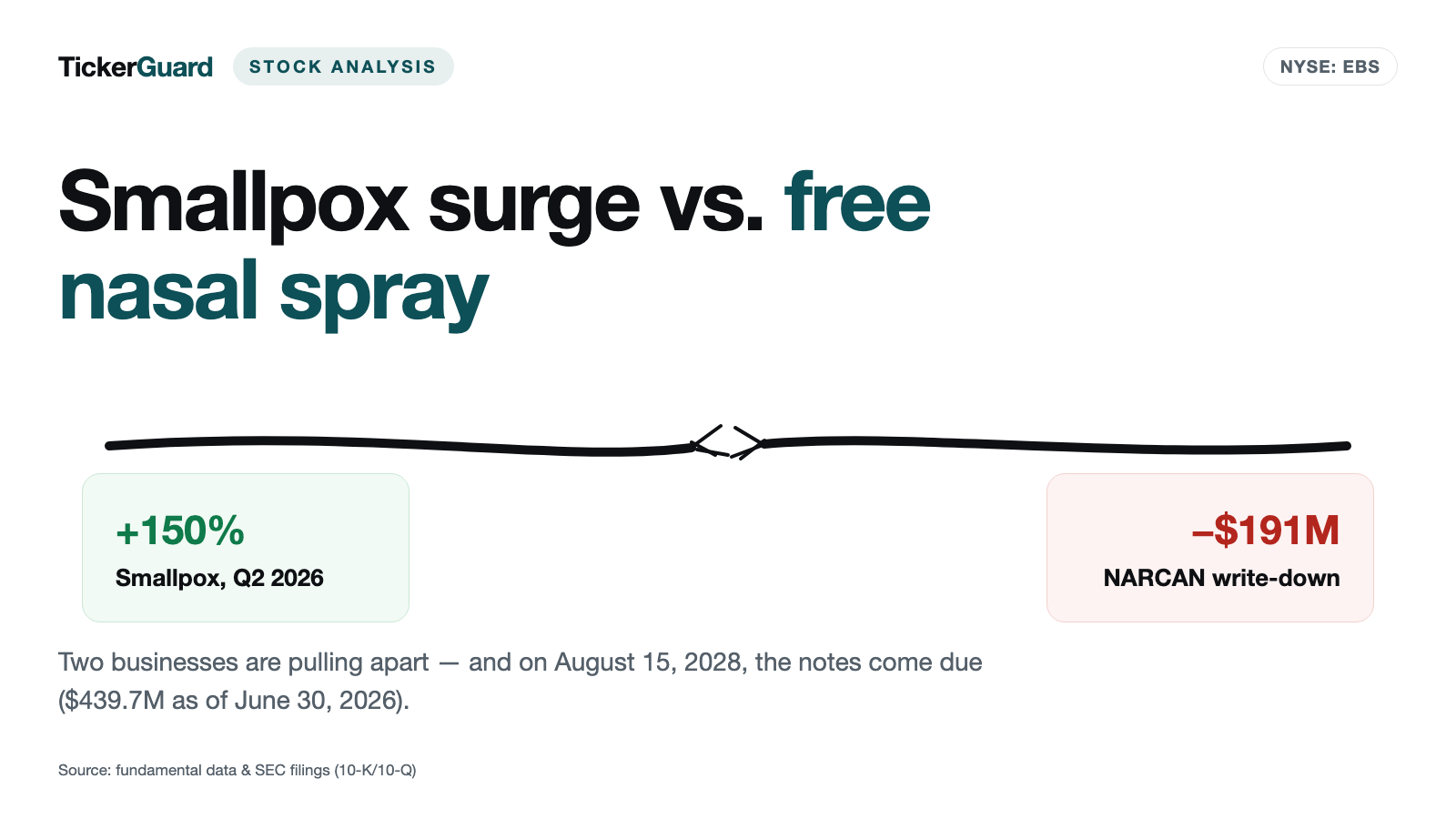
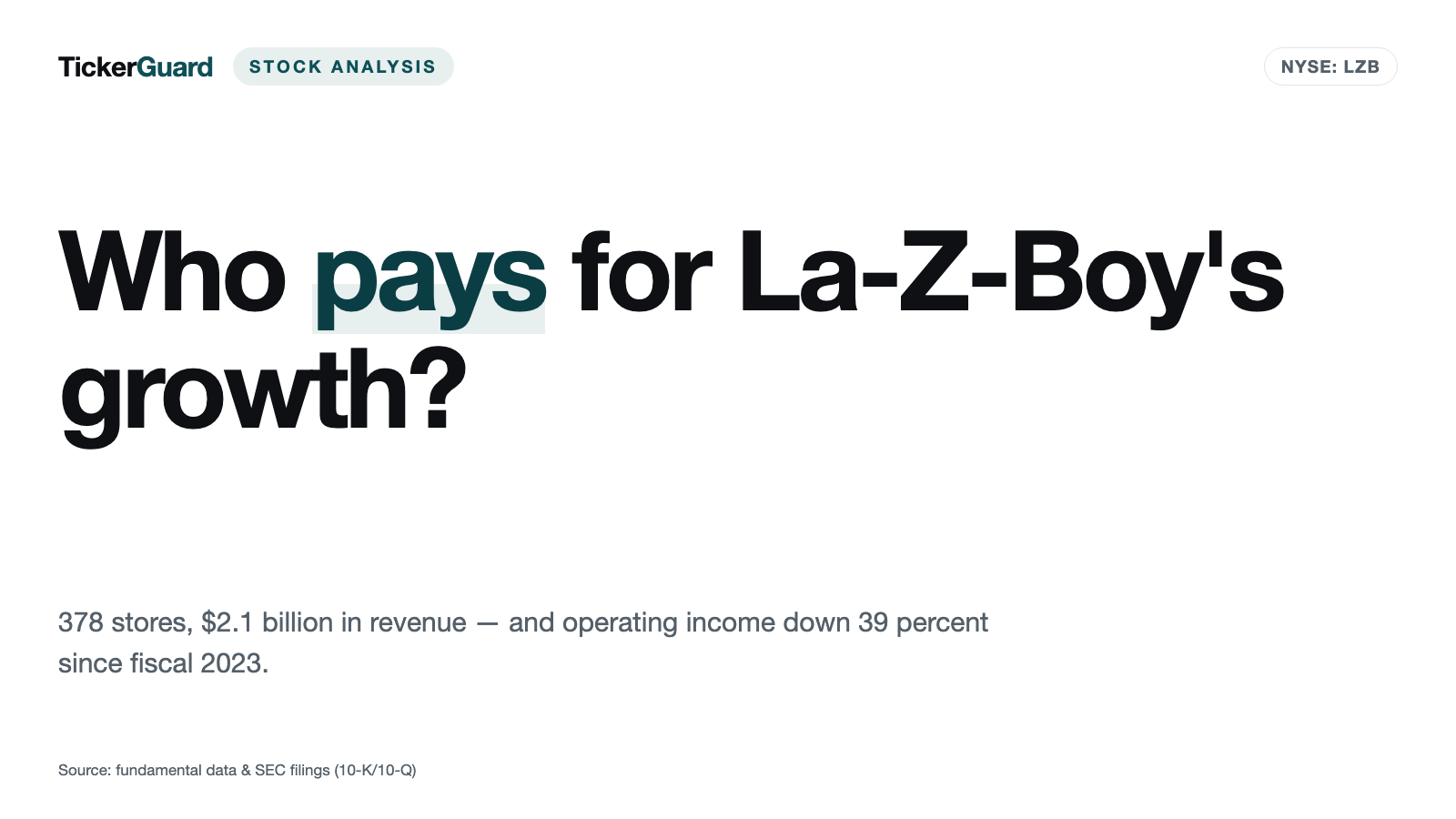
La-Z-Boy has been building recliners since 1927, and the balance sheet reads like a textbook: no financial debt, $267.3 million in cash, a store network that keeps growing. Yet operating income has fallen from $211.4 million in fiscal 2023 to $129.2 million in fiscal 2026 — on essentially flat revenue. The annual report explains why: the retail gain came from acquired and newly opened stores while the existing base shrank. Then the first quarter of fiscal 2027 delivered a $2.1 million operating loss, and the stock dropped about 17 percent on August 19, 2026. We read the filings to see what a comfortable name is worth once the margin gets thinner.
 Thomas Mücke
Founder & Publisher
Thomas Mücke
Founder & Publisher
As of Today
As of: October 6, 2026
- Closing price
- 29.70 $ +0.50%
- Market Capitalisation
- 1.2 $B
- P/E
- 14.9
- Growth Score
- 4/10
- AAQS
- 5/10
Price change since August 21, 2026: -11.9%
This analysis has a cut-off date. The Stock Guard tells you when something material changes in the numbers. Reserve your free spot
Chart
Interactive price chart (TradingView).
52-week range: 29.30 $ to 42.10 $ · Last price: 29.70 $ (As of: October 6, 2026)
Note: pure fact-based analysis, not investment advice and not a solicitation to buy or sell. All figures without guarantee.
There is an investor trap that does not feel like a trap at all. It feels like common sense: the comfort trap. It works like this — you see a name you have known since childhood, and your brain quietly stamps a seal of approval on it. "They have been around for a hundred years, everybody knows them, that does not break." Familiarity feels like knowledge, but it is only recognition. With La-Z-Boy Incorporated (NYSE: LZB) the trap is beautifully built, because the company literally sells comfort: the recliner America has been putting its feet up in since 1927. The stock reached our research list on August 19, 2026 through our in-house Reddit hype scanner — with all of 3 mentions in 24 hours, one day after the company reported its first quarter and the shares lost roughly 17 percent. So here is the deal: before you decide whether this is a bargain or a slide, we read together what La-Z-Boy itself told the U.S. securities regulator, the SEC — the annual report (Form 10-K) for fiscal 2026 and the quarterly report (Form 10-Q) filed on August 18, 2026. An SEC filing is honest under penalty of law. And this one describes a company where nearly everything checks out — except one number.
What La-Z-Boy actually does — build recliners and sell recliners
La-Z-Boy earns its money on two floors of the same building, and that is the key to everything that follows. Floor one is Wholesale: the company sews, upholsters and assembles sofas, chairs and motion furniture and sells them to furniture retailers — third-party dealers and its own stores alike. Floor two is Retail: the furniture stores with its own name over the door, selling to end consumers. Owning both floors means earning twice on the same recliner — once on the build, once on the sale. That is exactly what the strategy targets: as of April 25, 2026 the network counted 378 La-Z-Boy Stores, of which 230 were company-owned; the earnings release of August 18, 2026 counted roughly 380 stores and 234 company-owned. Over five years the ownership share of the network rose from 45 percent to 61 percent, with a target of 450 stores. Add more than 500 Comfort Studio locations inside third-party retailers and the digital brand Joybird with 16 small stores.
The manufacturing footprint is unusual. Unlike almost the entire U.S. furniture trade, La-Z-Boy still builds at home: in fiscal 2026 roughly 90 percent of the upholstered units sold in North America were produced in the United States, and imported finished goods accounted for only 5 percent of consolidated sales. Four major plants and nine distribution centers sit in the United States, alongside cut-and-sew operations in Mexico. Headcount at the end of fiscal 2026 was roughly 10,200 full-time equivalents (prior year: 10,600). And here is the central tension of this analysis, running through every chapter that follows: La-Z-Boy sells more furniture through its own stores than ever before — and earns less every year while doing it. The revenue is bought; the margin pays the bill.
One thing you need before reading the numbers: La-Z-Boy\'s fiscal year ends in late April, not in December. Fiscal 2026 ran through April 25, 2026, so it essentially covers May 2025 through April 2026. The first quarter of fiscal 2027 ended on July 25, 2026. Comparing La-Z-Boy with calendar-year companies therefore means comparing periods shifted by roughly eight months.
Company history for investors
-
1927
Founded as Floral City Furniture
Edward M. Knabusch and Edwin J. Shoemaker start out in Michigan; the first recliner follows in 1928. The brand that still carries the share price turns one hundred in March 2027.
-
2023
Profit peak in fiscal 2023
Revenue of $2,349.4 million, operating income of $211.4 million, margin 9.0 percent. From that level it fell three years in a row — this is the benchmark for everything that followed.
-
2025
Goodwill of the United Kingdom business written off
A $20.6 million impairment hit fiscal 2025 earnings. A year later U.K. manufacturing ceased entirely — the international business has been shrinking since.
-
2026
Restructuring year: Joybird written down, Casegoods sold, 15 stores acquired
Fiscal 2026 carried a $20.0 million Joybird impairment while $86.4 million went into store acquisitions. Revenue rose, operating income fell to $129.2 million.
-
2026
First quarter of fiscal 2027 with an operating loss
The report of August 18, 2026 shows revenue of $475.7 million and operating income of negative $2.1 million. The next day the price fell from $40.83 to $33.91 — roughly 17 percent.
How the stock landed on our desk
No momentum hit, no value screen: La-Z-Boy arrived through the Reddit hype scanner, part of our in-house stock scanner suite that watches for unusual attention in investor forums. The ticker was recorded on August 19, 2026, with 3 mentions in 24 hours — by Reddit standards a whisper, not a storm. The trigger is easy to date, though: on the evening of August 18, 2026 the company reported first-quarter results for fiscal 2027, and the analyst call followed on the morning of August 19. The closing price fell from $40.83 on August 18, 2026 to $33.91 on August 19, 2026 — roughly 17 percent in a day, on about seven times the usual trading volume.
Days like that trigger a second reflex that fits the comfort trap like a lid on a pot: a familiar name, down 17 percent, a price-to-earnings ratio in the low teens — that smells like a sale. Whether it is one depends not on the chart but on a single question: is the profit decline a stumble or a trend? That is exactly what the filings answer. Fix the standard in your mind right at the start: a cheap price is only cheap if the earnings hold.
The numbers over the years — credit where it is due
First the genuinely impressive part, which at La-Z-Boy is the balance sheet. The company carries no financial debt: the $200 million credit facility with Wells Fargo Bank (maturing July 1, 2030) was undrawn as of April 25, 2026, and all financial covenants were met. Cash stood at $303.2 million on April 25, 2026 and $267.3 million on July 25, 2026. Shareholders\' equity was $1,013.3 million against total assets of $1,994.7 million. Operating cash flow in fiscal 2026 came to $204.1 million — up from $158.1 million in fiscal 2024 and $187.3 million in fiscal 2025, almost back to the fiscal 2023 level of $205.2 million. And shareholders get paid: on August 18, 2026 the board declared a quarterly dividend of $0.242 per share, payable September 15, 2026; fiscal 2026 saw $37.9 million in dividends and $47.3 million spent repurchasing 1.3 million shares.
Revenue is steadier than the chart suggests, too: $2,047.0 million in fiscal 2024, $2,109.2 million in fiscal 2025 and $2,126.6 million in fiscal 2026 — three years of modest gains. Now the curve that shows the heart of the matter: what happened to operating income over the same period.
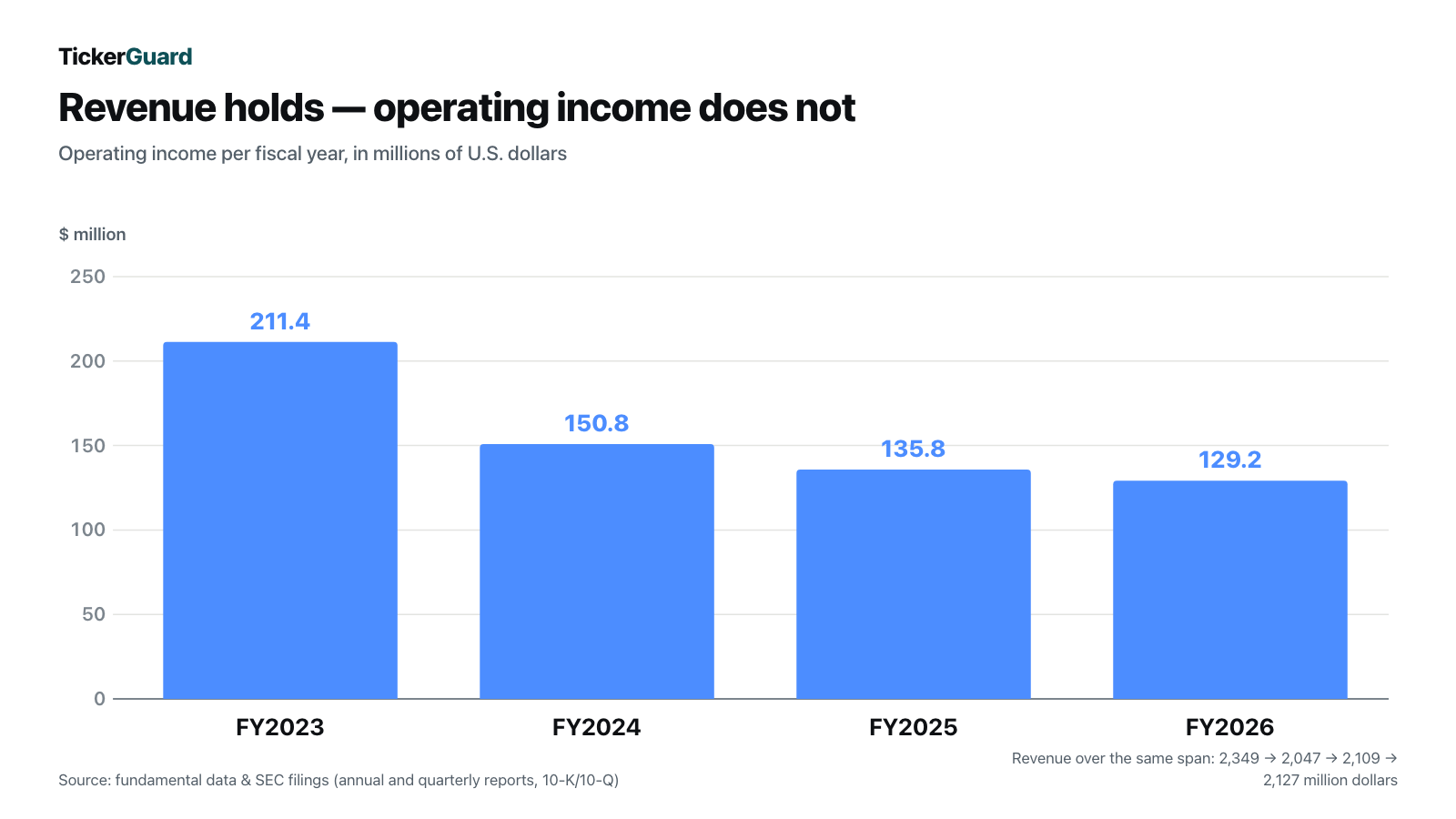
In percentage terms: operating margin slipped from 9.0 percent in fiscal 2023 to 6.1 percent in fiscal 2026. Operating margin tells you how many cents of every revenue dollar survive all running costs before interest and taxes — nine cents became barely six. On roughly $2.1 billion of revenue, each lost percentage point is worth about $21 million of profit per year. Fix the picture in your mind: revenue is a flat line, profit is a staircase going down. Why that is the case is spelled out in the filings — and remarkably openly.
What the filings say — the uncomfortable truths
Uncomfortable truth No. 1: the retail gain was bought, not grown
The good news headline for fiscal 2026 read: retail sales up 6 percent to $950.7 million. The annual report itself breaks down where that increase came from:
"The Retail segment's sales increased $52.3 million, or 6%, in fiscal 2026 compared with fiscal 2025, primarily due to $60.1 million of incremental sales resulting from our fiscal 2026 retail store acquisitions and the full-year impact of our fiscal 2025 retail store acquisitions, along with $31.7 million of sales from the addition of new retail stores, net of closed stores. These increases were partially offset by a decline in delivered same-store sales."
— La-Z-Boy Incorporated, Form 10-K for fiscal 2026, Item 7 (MD&A), Retail Segment

Do the arithmetic: $60.1 million plus $31.7 million is $91.8 million of growth from acquired and new stores — yet the segment only gained $52.3 million. The difference of roughly $39.5 million is the arithmetic remainder, which the filing describes as a decline in delivered same-store sales without quantifying it. As a picture:
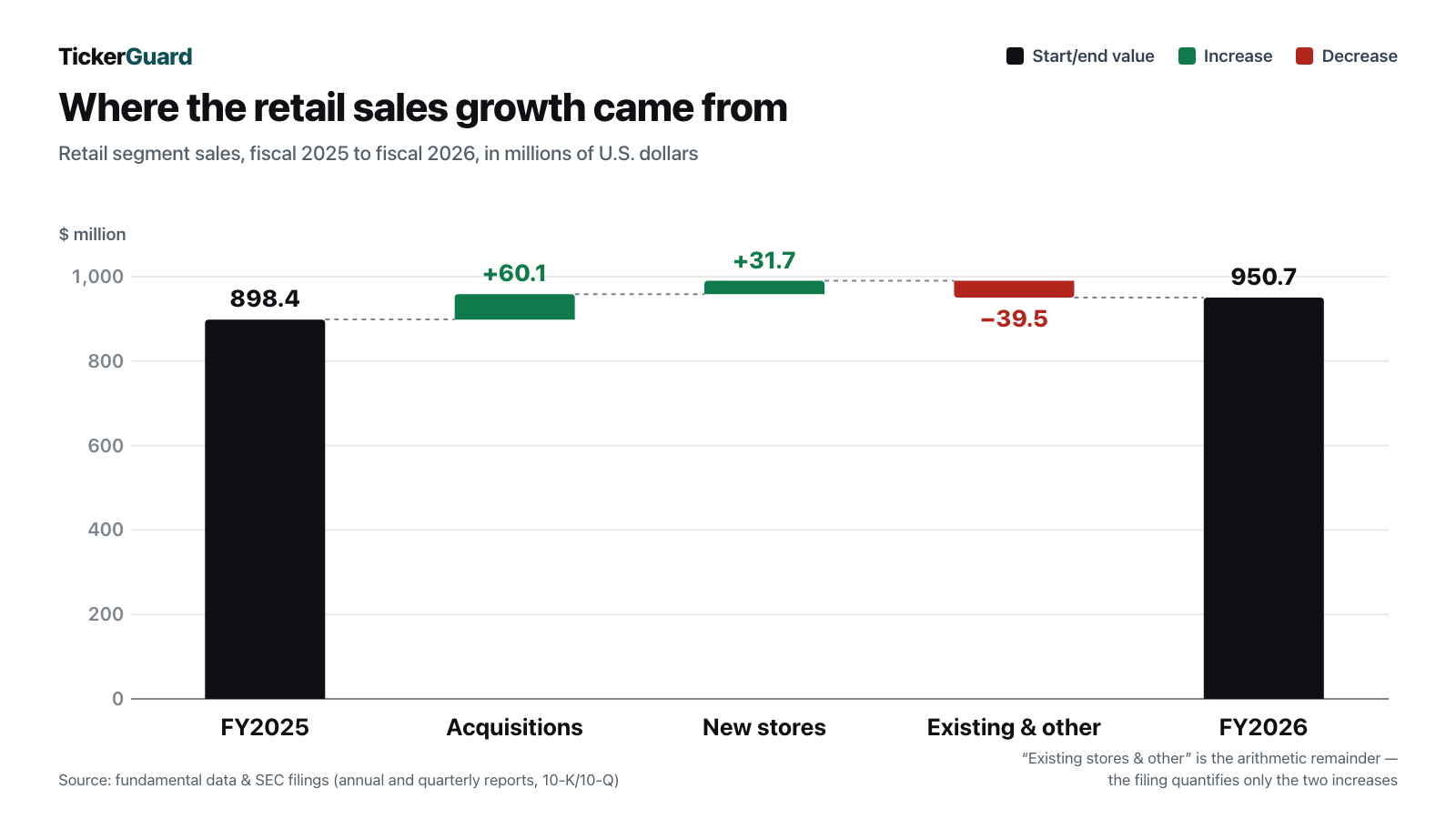
This is not accounting pedantry; it is the difference between two entirely different companies. Organic growth — more revenue from the same stores — costs nothing and lifts the margin, because fixed costs spread across more sales. Bought growth costs cash: in fiscal 2026 La-Z-Boy paid $86.4 million for acquisitions, and another $15.7 million in the first quarter of fiscal 2027 for three Gulf Coast stores. The number that describes the existing base stood at minus 3 percent written same-store sales in fiscal 2026. In the first quarter of fiscal 2027 that figure did turn to plus 3 percent — the first real bright spot in a long while. Yet the pattern held: of $21.4 million in additional sales, $16.4 million came from acquisitions and $6.3 million from new stores, $22.7 million combined — once again more than what actually landed. Anyone who runs both floors of the same building knows this arithmetic from the restaurant trade: at Papa John\'s we saw the same effect, where company-owned units inflate revenue and buy the cost base along with it.
Uncomfortable truth No. 2: the first quarter produced a real operating loss — and a very wide gap to the adjusted number
In the first quarter of fiscal 2027 (quarter ended July 25, 2026) sales fell 3.4 percent to $475.7 million. Gross profit was almost unchanged at $208.7 million versus $209.2 million — so manufacturing was not the problem. What exploded were selling, general and administrative expenses: from $187.2 million to $210.8 million, up 12.6 percent on falling sales. The result: an operating loss of $2.1 million against a $22.0 million profit in the prior-year quarter, and negative $0.06 per diluted share instead of positive $0.44.
The company sets an adjusted figure against that: $0.43 per diluted share. The $0.49 gap consists of $17.6 million for closing the two smallest plants, $4.1 million for terminating an inherited retirement plan, a $2.6 million loss on the divestiture of the Casegoods wholesale business and smaller items. Such adjustments are permitted and common — but they are not a law of nature. Two things temper the prettier number. First, even excluding the $9.3 million impairment for the Mexican plant in San Luis Río Colorado and the $2.6 million Casegoods divestiture loss, both of which sit inside SG&A, that expense line would still have risen from $187.2 million to roughly $199 million — on 3.4 percent less revenue. Second, the adjustments are not new. Fiscal 2026 carried a $20.0 million goodwill impairment in the income statement, fiscal 2025 a $20.6 million one. A company that has a one-time charge every year does not have a one-time charge.
For the second quarter of fiscal 2027 the chief financial officer guided to sales of $500 million to $520 million and an adjusted operating margin of 4.0 to 5.5 percent (earnings release of August 18, 2026). For comparison: in fiscal 2023 the reported full-year margin was 9.0 percent.
Uncomfortable truth No. 3: Joybird, the digital hope, has been costing money for years
Joybird was meant to be La-Z-Boy\'s answer to online furniture retail: its own brand, direct to consumer, a younger audience. What became of it sits in a footnote beneath the goodwill table of the quarterly report:
"Includes $46.9 million and $20.6 million of accumulated impairment losses in Corporate and Other and the Wholesale segment, respectively."
— La-Z-Boy Incorporated, Form 10-Q for the quarter ended July 25, 2026, Note 5 "Goodwill and Other Intangible Assets"
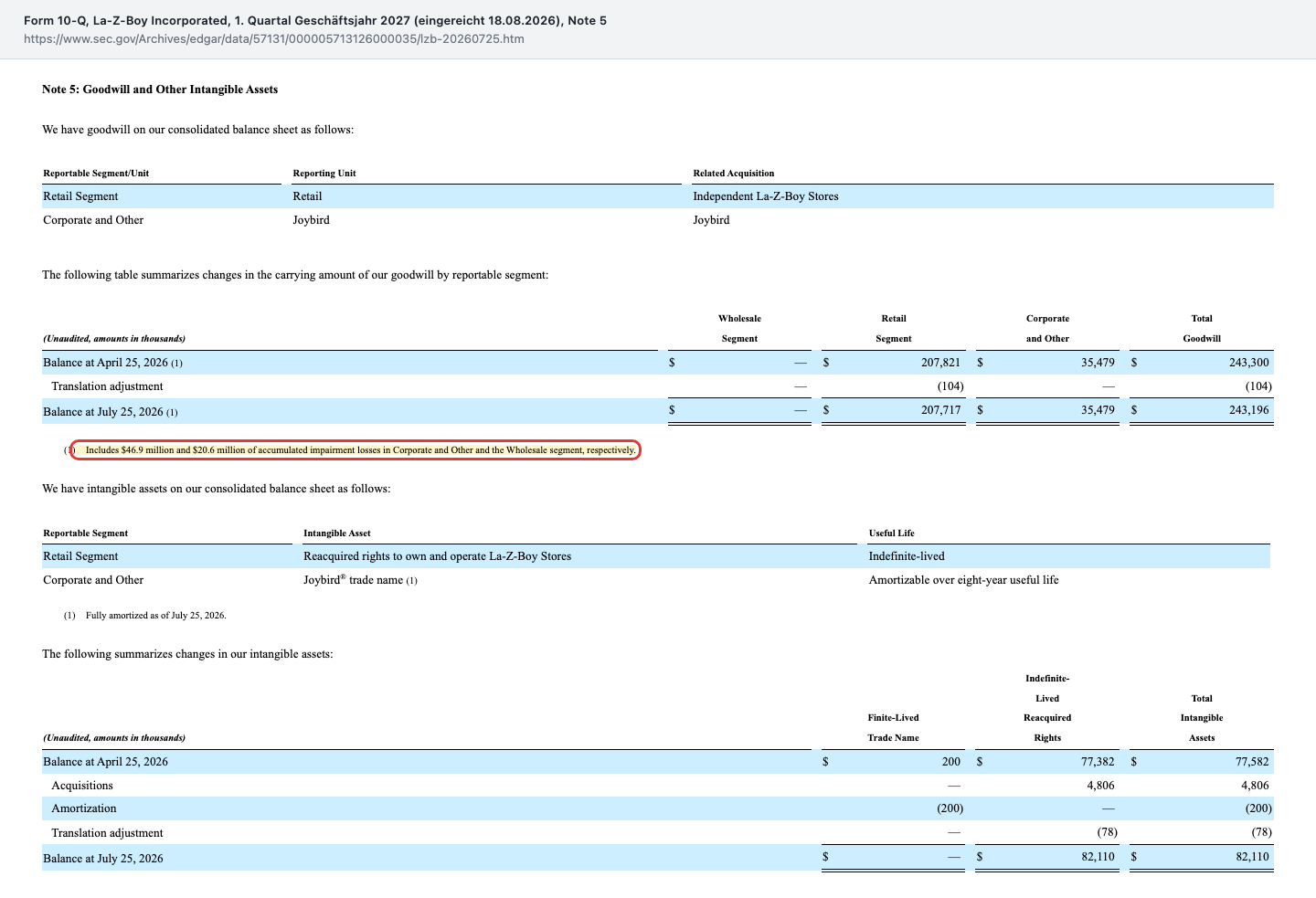
In plain terms: goodwill is the premium a buyer paid above the tangible value of what it acquired — hope, expressed as a number. When the hope shrinks, the number must be written down, and that hits profit directly. At Joybird those write-downs now total $46.9 million, leaving $35.5 million. The fiscal 2026 write-down alone was $20.0 million — equal to 15 percent of that year\'s entire operating income. And the direction has not changed: Joybird sales of $130.8 million in fiscal 2026 (down 10 percent), $26.5 million in the first quarter of fiscal 2027 with written sales down 17 percent. The Joybird plant in Tijuana is being closed and production moved to U.S. plants by the end of fiscal 2027.
Uncomfortable truth No. 4: "no debt" is true — and leaves out $657.8 million of rent
La-Z-Boy really does carry no bank debt, and that is a genuine advantage. It just does not describe the full obligation picture of a company whose business model consists of renting hundreds of retail locations:
"As of April 25, 2026, we had operating and finance lease payment obligations of $657.8 million and $2.3 million, respectively, with $111.1 million and $1.0 million, payable within 12 months, respectively."
— La-Z-Boy Incorporated, Form 10-K for fiscal 2026, Item 7 "Contractual Obligations"

For scale: the $657.8 million is more than twice the cash balance of $303.2 million as of April 25, 2026. On the balance sheet the discounted lease liabilities show up as $564.3 million, and $541.5 million as of July 25, 2026. None of this is scandalous — leases are the standard operating tool of a retail chain, and the credit facility even carries a "consolidated net lease adjusted leverage ratio" covenant precisely for that reason. But it changes the picture: a retailer without bank debt is not debt-free; it simply holds its obligations in lease contracts. And every newly acquired store brings fresh lease years with it.
Uncomfortable truth No. 5: the tariff tailwind is a boomerang
The marketing story goes: we build in the United States, so tariffs barely touch us. That is true, and lately it helped twice over — in the first quarter of fiscal 2027, tariff refunds and pricing actions lifted Wholesale gross margin by 240 basis points. Except the company\'s own risk section contains the sentence that turns the story around:
"Conversely, if certain tariffs are eliminated or reduced, we may face additional competition from foreign manufacturers entering the United States market and from domestic retailers who rely on imported goods, putting pressure on our prices and margins, which could adversely affect our results of operations."
— La-Z-Boy Incorporated, Form 10-K for fiscal 2026, Item 1A Risk Factors

In February 2026, according to the annual report, the U.S. Supreme Court invalidated certain tariffs imposed under the International Emergency Economic Powers Act. La-Z-Boy is eligible for refunds but recorded none in its fiscal 2026 financial statements, because the amount and timing remain uncertain. The effect now surfaces in the current fiscal year — as a one-time tailwind. The lasting part of the same news is the headwind: cheaper imported furniture attacks exactly where La-Z-Boy\'s advantage lies. A moat rented from trade policy does not belong to you.
Valuation: what the market pays for a 100-year-old brand
At the closing price of $33.71 on August 21, 2026, with 40,052,771 shares outstanding (cover page of the quarterly report, as of August 11, 2026), the market value is roughly $1.35 billion. Against fiscal 2026 that produces the following orders of magnitude: a price-to-sales ratio of about 0.6 (revenue $2,126.6 million), a price-to-earnings ratio of about 14 (diluted earnings per share $2.47) and a price-to-book ratio of about 1.3 (book value per share $25.30 as of July 25, 2026). The $267.3 million cash balance equals roughly $6.67 per share — close to 20 percent of the share price sits inside the company as cash. The quarterly dividend of $0.242 annualizes to $0.97 and therefore a yield of roughly 2.9 percent at that price.
How should that be read? A price-to-sales ratio of 0.6 sounds cheap but says little about a retailer — retailers structurally carry a lot of revenue and thin margins. The more telling figure is the price-to-earnings ratio of about 14: not a fire-sale price, just a normal price for a stable business. The catch sits in the denominator. The $2.47 per share comes from fiscal 2026 — a year in which operating income had already fallen for the third time in a row, and one quarter before it turned negative. The professionals lean the same way: the mean analyst target was $41 (fundamental data, as of August 22, 2026), above the market price — but grounded in expected earnings, not reported ones. That big-ticket home purchases hang on mortgage rates and moving decisions is something we saw most recently at Mohawk Industries: whoever sells furniture or flooring ultimately sells household moves. Fix this for valuation: a low price-to-earnings ratio on a falling earnings number is not a margin of safety, it is a bet that the fall stops.
Upside and risks at a glance
What speaks for La-Z-Boy:
- A balance sheet without financial debt: $267.3 million of cash as of July 25, 2026, the $200 million credit facility (maturing July 1, 2030) untouched, all covenants met, shareholders\' equity of $1,013.3 million.
- Brand and network: in business since 1927, the second-largest single-branded furniture retail network in the United States with roughly 380 stores, plus more than 500 studio locations inside third-party retailers — a route to market no newcomer rebuilds in a few years.
- Domestic manufacturing: roughly 90 percent of the upholstered units sold in North America come from U.S. plants, and imported finished goods are only 5 percent of revenue — short lead times and limited tariff exposure.
- The existing base is turning: written same-store sales in retail rose 3 percent in the first quarter of fiscal 2027, after minus 3 percent in fiscal 2026 — the first positive reading in a while, with total written sales up 16 percent.
- Shareholder returns with substance: $37.9 million of dividends and $47.3 million of buybacks in fiscal 2026, a new $300 million repurchase authorization effective May 14, 2026 and a quarterly dividend of $0.242 declared on August 18, 2026.
What speaks against it:
- Operating income has fallen three years running: $211.4 million → $150.8 million → $135.8 million → $129.2 million (fiscal 2023 through 2026), with margin down from 9.0 percent to 6.1 percent — on essentially unchanged revenue.
- The growth was bought: $91.8 million of gains from acquisitions and new stores against an actual increase of $52.3 million in fiscal 2026; the acquisitions consumed $86.4 million in cash, and every store adds rent and payroll.
- The first quarter of fiscal 2027 delivered a $2.1 million operating loss and negative $0.06 per share; free cash flow was negative $7.6 million while $34.8 million went to shareholders — cash fell from $303.2 million to $267.3 million in three months.
- Joybird remains a money loser: $46.9 million of accumulated goodwill impairments, a fully amortized trade name, fiscal 2026 sales down 10 percent, written sales down 17 percent in the first quarter of fiscal 2027, and a plant closure in Tijuana.
- Obligations beyond balance-sheet debt: $657.8 million of future lease payments as of April 25, 2026, $111.1 million of it within a year; plus a wholesale backlog that fell from $119.5 million to $74.9 million, and a tariff advantage whose removal — by the company\'s own risk factor — brings competition back.
A human bottom line
Back to the comfort trap. Its core is not that La-Z-Boy is a bad company — quite the opposite: a business with no bank debt, $267 million in cash and a brand dating to 1927 has more substance than most stocks people write about on Reddit. Its core is that familiarity replaces the check. The name feels safe, so the stock feels safe — and the one number that matters never gets looked up. Here that number is operating income, and it has fallen 39 percent since fiscal 2023 while revenue, store count and market share all rose. That is not bad luck; it is the arithmetic of the chosen path. Growth that is purchased delivers revenue immediately and costs forever.
So the question at the end is not "cheap or expensive" but something far more concrete: do you believe the existing stores will grow again on their own — fast enough for operating income to find a floor before the next lease years and the next acquisition raise the cost base? If yes, you are buying a solid balance sheet, a 100-year-old brand and a route to market nobody rebuilds quickly, at an ordinary price. If no, you are buying a name that feels good and a profit line that has pointed the same way for three years. Both answers are defensible — they depend on how long you are willing to wait and how much patience your portfolio can carry. What you do with that is your decision. And that is exactly as it should be.
Sources
Every primary document used in this analysis, for you to read yourself:
- La-Z-Boy Incorporated — Form 10-K for fiscal 2026 (year ended April 25, 2026, filed June 16, 2026)
- La-Z-Boy Incorporated — Form 10-K for fiscal 2025 (year ended April 26, 2025, filed June 17, 2025)
- La-Z-Boy Incorporated — Form 10-Q for the quarter ended July 25, 2026 (first quarter of fiscal 2027, filed August 18, 2026)
- La-Z-Boy Incorporated — Earnings release furnished as Exhibit 99.1 to the Form 8-K of August 18, 2026 (quarterly results and second-quarter outlook)
- Complete SEC filing history for La-Z-Boy Incorporated: EDGAR overview (sec.gov)
- Fundamental data (price, market value, valuation ratios, analyst target; as of August 21/22, 2026), reconciled against the SEC filings.
- Reddit mentions: 3 in 24 hours, first recorded on August 19, 2026 through our in-house stock scanner.
Transparency & disclaimer: this analysis is journalistic commentary on publicly available information. It is not investment advice, not a regulated financial analysis and not a solicitation to buy or sell securities. Equity investments carry substantial risk up to total loss. All information without warranty; the as-of date for each figure is stated in the text. Positions held by the operator are disclosed daily; where one exists, it appears as a notice at the top of this deep dive.
Key figures at a glance
All monetary figures in millions of $; earnings per share as reported.
| Metric | 2022 | 2023 | 2024 | 2025 | 2026 |
|---|---|---|---|---|---|
| Revenue | 2,356.8 | 2,349.4 | 2,047.0 | 2,109.2 | 2,126.6 |
| Operating Income (EBIT) | 206.8 | 211.4 | 150.8 | 135.8 | 129.2 |
| Net Income | 150.0 | 150.7 | 122.6 | 99.6 | 102.0 |
| Net Margin | 6.4% | 6.4% | 6.0% | 4.7% | 4.8% |
| Earnings Per Share | 3.39 $ | 3.48 $ | 2.83 $ | 2.35 $ | 2.47 $ |
Source: fundamental data & SEC filings (annual and quarterly reports, 10-K/10-Q)
Our Bottom Line at a Glance
- Balance sheet and liquidity positive
- No financial debt: the $200 million credit facility maturing July 1, 2030 was undrawn as of April 25, 2026 and all covenants were met. Cash of $267.3 million and shareholders' equity of $1,013.3 million as of July 25, 2026, with operating cash flow of $204.1 million in fiscal 2026 — up from $158.1 million (fiscal 2024) and $187.3 million (fiscal 2025), almost back to the fiscal 2023 level of $205.2 million.
- Brand and route to market positive
- In business since 1927, the world's largest producer of reclining chairs and the second-largest single-branded furniture retail network in the United States: 378 stores as of April 25, 2026 (230 company-owned), roughly 380 per the earnings release of August 18, 2026 (234 company-owned), plus more than 500 studio locations inside third-party retailers. Roughly 90 percent of the upholstered units sold in North America come from U.S. plants.
- Earnings trend negative
- Operating income has fallen three years running: $211.4 million (fiscal 2023), $150.8 million (2024), $135.8 million (2025), $129.2 million (2026) — down 39 percent, while revenue moved only from $2,349.4 million to $2,126.6 million. Margin slipped from 9.0 percent to 6.1 percent, and the first quarter of fiscal 2027 produced a $2.1 million operating loss.
- Quality of growth negative
- The gain was bought: in fiscal 2026 acquisitions added $60.1 million and new stores $31.7 million of retail sales, yet the segment gained only $52.3 million; written same-store sales were 3 percent below the prior year. The acquisitions consumed $86.4 million in cash. In the first quarter of fiscal 2027 the existing base did turn to plus 3 percent.
- Joybird negative
- According to the Form 10-Q for the quarter ended July 25, 2026, $46.9 million of goodwill on the digital brand has already been written off, leaving $35.5 million; the trade name is fully amortized. Sales of $130.8 million in fiscal 2026 (down 10 percent), written sales down 17 percent in the first quarter of fiscal 2027, and the Tijuana plant closing by the end of fiscal 2027.
- Shareholder returns and obligations neutral
- Reliable distributions (quarterly dividend of $0.242 declared August 18, 2026; $37.9 million of dividends and $47.3 million of buybacks in fiscal 2026) and a new $300 million authorization effective May 14, 2026. In the first quarter of fiscal 2027, $34.8 million went to shareholders against free cash flow of negative $7.6 million; on top of that sit $657.8 million of future lease payments as of April 25, 2026.
La-Z-Boy is a company with a strikingly clean balance sheet and a structural margin problem. No bank debt, $267.3 million in cash, a brand dating to 1927 and the second-largest single-branded furniture retail network in the United States stand against operating income that has fallen from $211.4 million in fiscal 2023 to $129.2 million in fiscal 2026 — on essentially unchanged revenue. The annual report explains why: the retail gain came from acquisitions ($60.1 million) and new stores ($31.7 million) while the existing base shrank. The first quarter of fiscal 2027 produced the first operating loss in years, $2.1 million. Not investment advice.
What Our Rating Means
Open questions
The business works in principle, but one material question is open. As long as it stays open, our findings do not carry a quality verdict.
The business works: a 100-year-old brand, roughly 380 stores, domestic manufacturing, no financial debt, $267.3 million of cash as of July 25, 2026 and $204.1 million of operating cash flow in fiscal 2026. No substance risk is documented anywhere — no going-concern language, no negative equity, no maturity wall. What is missing for green is the decisive quality: the most important operating question about this company is open. Operating income has fallen for a third straight year and is down 39 percent without revenue giving way; the gain came from acquired stores while written same-store sales fell 3 percent in fiscal 2026, and the first quarter of fiscal 2027 ended in an operating loss. Whether the turnaround in the existing base holds will be decided in the coming quarters, not on the balance sheet. That is an open operating question, not a substance risk — hence yellow. The decision is yours.
A journalistic assessment by our editorial team at the time of the deep dive, based on public sources — not investment advice and not a solicitation to buy or sell. Your personal circumstances (investment goals, risk capacity, taxes) cannot be taken into account. What our levels mean, how verdicts are formed, and what conflicts of interest exist →
Worth Noting
- The hook for this analysis is our in-house Reddit hype scanner: 3 mentions in 24 hours, first recorded on August 19, 2026 — one day after the quarterly report of August 18, 2026 and the price move from $40.83 to $33.91.
- Data as of August 23, 2026. All company figures come from the Form 10-K for fiscal 2026 (filed June 16, 2026), the Form 10-K for fiscal 2025 (filed June 17, 2025), the Form 10-Q for the quarter ended July 25, 2026 (filed August 18, 2026) and the earnings release furnished as Exhibit 99.1 to the Form 8-K of August 18, 2026. Price and valuation data from fundamental data, as of August 21/22, 2026.
- The fiscal year ends in late April. Fiscal 2026 ran through April 25, 2026 and the first quarter of fiscal 2027 through July 25, 2026. Comparisons with calendar-year companies are therefore shifted by roughly eight months.
- The minus $39.5 million shown as "Existing & other" in the waterfall chart is an arithmetic remainder: the annual report quantifies only the two increases ($60.1 million and $31.7 million) and describes the offset as a decline in delivered same-store sales without putting a figure on it.
- The mean analyst target of $41 (fundamental data, as of August 22, 2026) is a third-party figure quoted for context, not a target set by this publication.
- The company's adjusted measures (first quarter of fiscal 2027: operating margin 3.9 percent, $0.43 per diluted share) are non-GAAP. They exclude, among other items, $17.6 million for closing the two smallest plants, $4.1 million for terminating an inherited retirement plan and a $2.6 million loss on the Casegoods wholesale divestiture.
Stock Watch
This analysis is as of August 26, 2026. Stock Watch will tell you what's changed at LZB since then.
Later $1 a month per stock — signing up is free, and you'll be the first to know when it launches.
The full analysis as a PDF for later
We will send you this analysis as a PDF — to print, file away, and read at your own pace. And we will add you to the free Stock Watch list for La-Z-Boy Incorporated (LZB), so you hear about it when something material in this analysis changes.
Frequently Asked Questions
La-Z-Boy Incorporated (NYSE: LZB) of Monroe, Michigan, is the world's largest producer of reclining chairs and also a furniture retailer. The Wholesale segment manufactures upholstered furniture and ships to dealers; the Retail segment operates company-owned La-Z-Boy stores. As of April 25, 2026 the network had 378 stores, 230 of them company-owned. The digital brand Joybird adds 16 small stores.
Because most of the growth was purchased. Retail sales rose $52.3 million in fiscal 2026; according to the annual report (Form 10-K), $60.1 million came from store acquisitions and $31.7 million from new stores while the existing base shrank. Every acquired store brings rent and payroll with it. Operating income fell from $211.4 million in fiscal 2023 to $129.2 million in fiscal 2026, with margin down from 9.0 percent to 6.1 percent.
On August 18, 2026 La-Z-Boy reported the first quarter of fiscal 2027: sales of $475.7 million (down 3.4 percent), an operating loss of $2.1 million after a $22.0 million profit a year earlier, and negative $0.06 per diluted share instead of positive $0.44. The closing price fell from $40.83 on August 18, 2026 to $33.91 on August 19, 2026, roughly 17 percent. Adjusted for plant closures and divestiture losses the company reported $0.43 per share.
In late April. Fiscal 2026 ran through April 25, 2026 and therefore covers essentially May 2025 through April 2026; fiscal 2027 ends on April 24, 2027. The first quarter of fiscal 2027 ended on July 25, 2026. Comparing La-Z-Boy with calendar-year companies means comparing periods shifted by roughly eight months.
No bank debt: the $200 million credit facility maturing July 1, 2030 was undrawn as of April 25, 2026 and all financial covenants were met. Lease obligations are a different matter: $657.8 million of future operating lease payments as of April 25, 2026, $111.1 million of it within twelve months. On the balance sheet the discounted lease liabilities were $541.5 million as of July 25, 2026.
Yes, quarterly. On August 18, 2026 the board declared $0.242 per share, payable September 15, 2026 to shareholders of record on September 3, 2026. Annualized that is $0.97, or roughly 2.9 percent against the closing price of $33.71 on August 21, 2026. In fiscal 2026 the company paid $37.9 million in dividends and repurchased $47.3 million of its own shares.
Joybird is La-Z-Boy's digital direct-to-consumer upholstery brand with 16 small U.S. stores. It is doing poorly: sales fell 10 percent to $130.8 million in fiscal 2026, and written sales dropped 17 percent in the first quarter of fiscal 2027. According to the quarterly report (Form 10-Q), $46.9 million of Joybird goodwill has already been written off, the trade name is fully amortized, and the Tijuana plant is being closed.
Found an error?
Did you spot a factual error, an outdated number, or a typo in this deep dive? Let us know briefly — your report goes straight to the editorial team.