Kura Oncology: $519 million in the bank — and $454 million of it is already spoken for
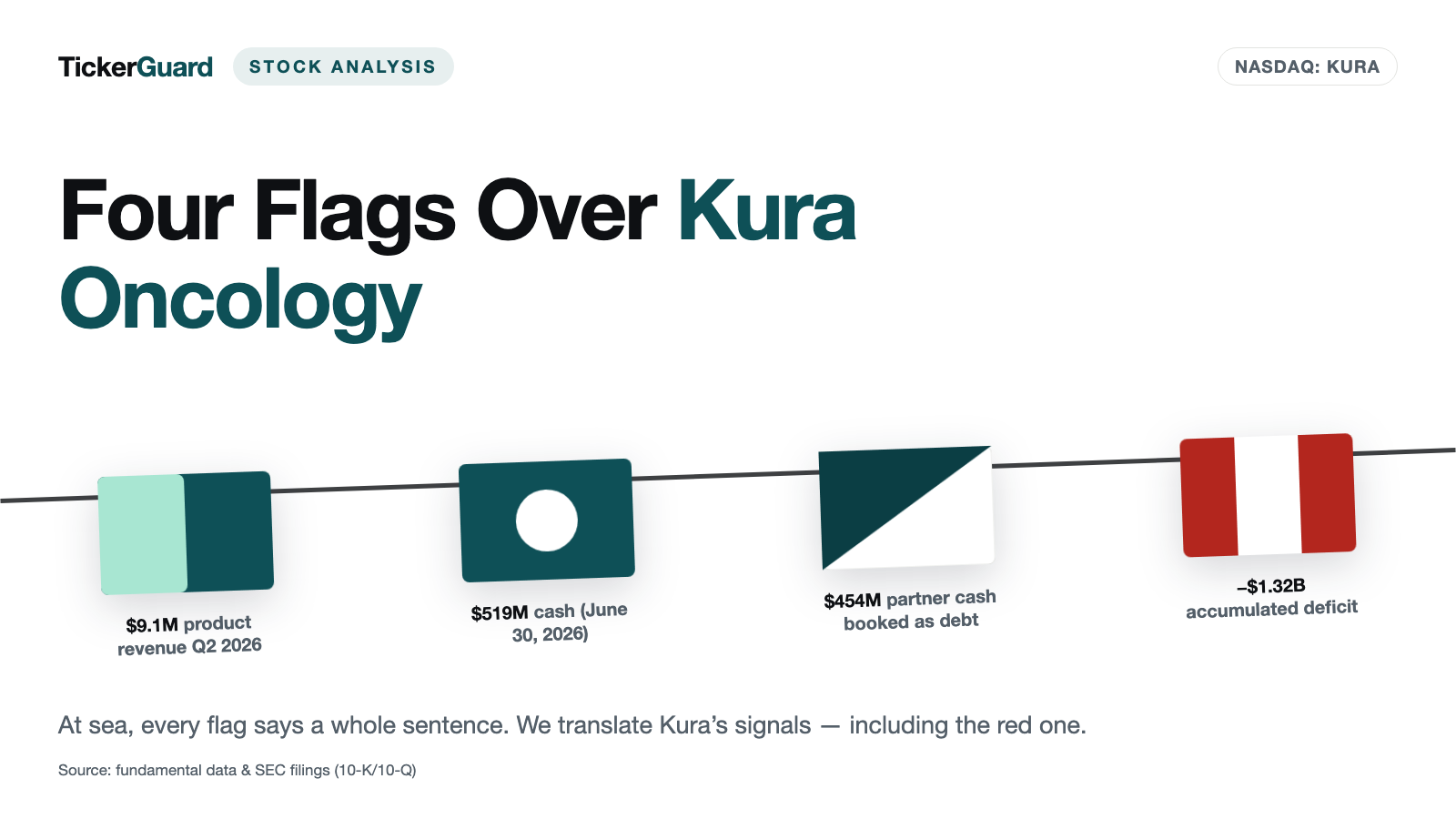
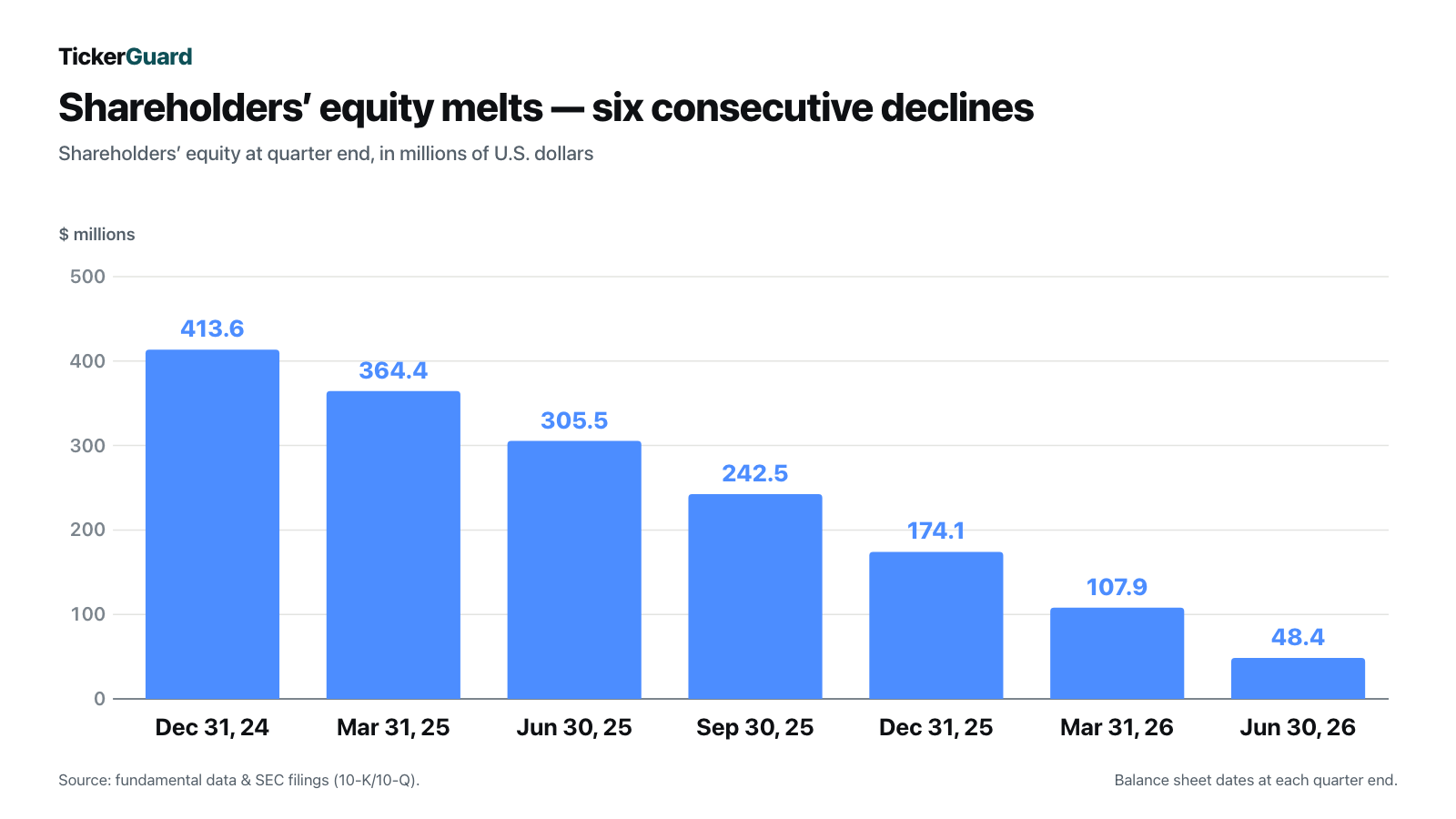
Kura Oncology has done what most biotech companies never manage: it owns an approved drug and it is selling it. KOMZIFTI produced $9.1 million of revenue in the second quarter of 2026, 57 percent more than in the quarter before. At exactly that moment, shareholders’ equity has nearly vanished — from $364.4 million on March 31, 2025 to $48.4 million on June 30, 2026. The reason is not a scandal but a single balance sheet line: $454.1 million of contract liabilities owed to Japanese partner Kyowa Kirin. We read the quarterly report for June 30, 2026, the 2025 annual report and everything filed since with the U.S. securities regulator, the SEC. Not investment advice — just the question of who really owns the cash in the account.
 Thomas Mücke
Founder & Publisher
Thomas Mücke
Founder & Publisher
As of Today
As of: September 17, 2026
- Closing price
- 11.70 $ +4.60%
- Market Capitalisation
- 1.0 $B
- Growth Score
- 4/10
- AAQS
- 4/10
Price change since September 4, 2026: -11.7%
This analysis has a cut-off date. The Stock Guard tells you when something material changes in the numbers. Reserve your free spot
Chart
Interactive price chart (TradingView).
52-week range: 7.40 $ to 13.60 $ · Last price: 11.70 $ (As of: September 17, 2026)
Note: pure fact-based analysis, not investment advice and not a solicitation to buy or sell. All figures without guarantee.
There is an investor trap so ordinary that we barely notice it: the bank balance illusion. You know it from your own life. On the first of the month there is $3,000 in the checking account, and for a moment it feels like room to breathe. Then rent, insurance, childcare and the car payment go out — and by the twentieth the room to breathe turns out to have been an arithmetic error. The balance never told you how wealthy you were. It only told you when the debits land. With companies we make the same mistake, just with more zeros: we read “$519 million in cash” and hear safety. Kura Oncology, Inc. (Nasdaq: KURA) of San Diego is the textbook case — and, unusually, one attached to genuinely good news. The company launched its first proprietary drug in November 2025, it sells better every quarter, and yet only $48.4 million of shareholders’ equity is left. So let us make a deal: before you decide for or against this stock, we read together what the company itself filed with the U.S. securities regulator, the SEC — the quarterly report (Form 10-Q) for June 30, 2026, filed on August 12, 2026, the annual report (Form 10-K) for 2025 filed on March 5, 2026, and everything that followed. An SEC filing is honest under penalty of law. And this one describes a drug that works, a partner in Japan that already owns a large share of the money in the account, and a deadline called 2028. In the end, the decision is yours.
What Kura Oncology actually does — one company, one drug, one partner
Kura Oncology is a biopharmaceutical company developing cancer drugs that do not attack the tumor as a whole but a single genetic switch inside the tumor cell. The everyday image: instead of demolishing an entire house to get rid of a faulty light switch, you replace the switch. That is precision medicine.
The lead product is KOMZIFTI (active ingredient ziftomenib), an oral medicine taken once a day. It blocks a protein called menin and is used against a particular form of acute myeloid leukemia (AML), an aggressive blood cancer. More precisely: in adults whose leukemia has returned after treatment or never responded to it, and whose tumor cells carry a mutation in the NPM1 gene. According to the 2025 annual report (10-K), NPM1 mutations are among the most common genetic alterations in this disease, “representing approximately 30% of AML.” The FDA approved KOMZIFTI on November 13, 2025, and commercial sales began on November 21, 2025. Two further programs run alongside: darlifarnib, a combination agent for solid tumors, and the preclinical candidate KO-7246. As of December 31, 2025 Kura employed 260 full-time staff, split evenly between research, development and supply chain on one side and selling, general and administrative roles on the other.
And then there is the partner. On November 20, 2024 Kura signed a collaboration and license agreement with Japanese pharmaceutical group Kyowa Kirin. Kura leads development, manufacturing and commercialization in the United States and books all U.S. sales; Kyowa Kirin holds the rights for the rest of the world, co-promotes in the United States and shares U.S. profits and losses equally. Through June 30, 2026 Kura had received or firmly expected $597.1 million under that agreement, of which $570.0 million in upfront and milestone payments. That defines the central tension of this analysis, and it runs through every chapter: the Japanese partner made Kura what it is, paid for the launch, and simultaneously holds the single largest item on the balance sheet — as a liability, not a gift.
Company history for investors
-
2015
Nasdaq listing (November 5)
The listed shell was named Zeta Acquisition Corp III until March 2015. Anyone comparing older price series is comparing a different business.
-
2022
Loan facility of up to $125 million
Only $10.0 million was ever drawn. The good news for shareholders: Kura has stayed effectively debt-free ever since.
-
2023
$150 million at-the-market facility established
Not a single share had been sold under it through June 30, 2026 — so the dilution reserve is still sitting there, ready.
-
2024
License agreement with Kyowa Kirin (November 20)
The partner funds the launch and takes the world outside the United States. That cash appears as a liability on the balance sheet, not as equity.
-
2025
FDA approval of KOMZIFTI (November 13)
After ten years without revenue, selling starts on November 21. From here the company is measured in prescriptions, not slide decks.
-
2026
Shareholders approve 6.5 million plan shares (June 4)
That equals 7.3 percent of shares outstanding. Two of the three directors up for election drew unusually high withheld votes.
-
2026
Second full selling quarter (August 12)
$9.122 million of product revenue — and shareholders’ equity of just $48.4 million. Both numbers appear in the same report.
How the stock reached our desk
Kura Oncology did not arrive on the research list through a momentum or value hit from our in-house stock scanner, but through the SEC filing feed. On August 12, 2026 two documents landed on the same day: the quarterly report (10-Q) for June 30, 2026 and the earnings release as a Form 8-K with Exhibit 99.1. The combination inside them is exactly the pattern we hunt for in filings — a revenue line pointing sharply upward and an equity line that fell by more than half in the same quarter. When two numbers in the same report run in opposite directions, there is almost always a story in between that no headline tells.
The market itself is deeply split on this stock, and that is measurable: 13.1 million shares were sold short — roughly 15 percent of all shares outstanding, at a trading volume that would arithmetically need ten days to cover those positions (as of September 6, 2026). Selling short means someone borrowed shares, sold them, and hopes to buy them back cheaper. That many bets against a company whose drug is just taking off is unusual — and a signal that approval was not the end of the argument. Note the finding right at the start: with Kura the analysis does not begin with efficacy, it begins with the balance sheet.
Who stands on the other side of those bets is also on the public record — and it is the chief executive himself. In the two weeks after the quarterly report, Troy E. Wilson bought 100,000 shares in the open market twice: on August 17, 2026 at a weighted average of $11.12 and on August 24, 2026 at $12.39 — roughly $2.35 million of his own money, held through a family trust whose position rose to 479,194 shares (insider filings, Form 4). In the same window two other executives sold: Chief Legal Officer Teresa Brophy Bair 31,487 shares at $12.63 (August 19, 2026) and Chief Commercial Officer Brian Powl 4,345 shares at $11.89 (August 21, 2026), both under pre-arranged Rule 10b5-1 plans, where the timing is not chosen freely. Read it soberly: a chief executive buying is no proof that a stock will rise. It is, however, the only opinion an insider can express that costs him money.
The numbers over the years — given their due
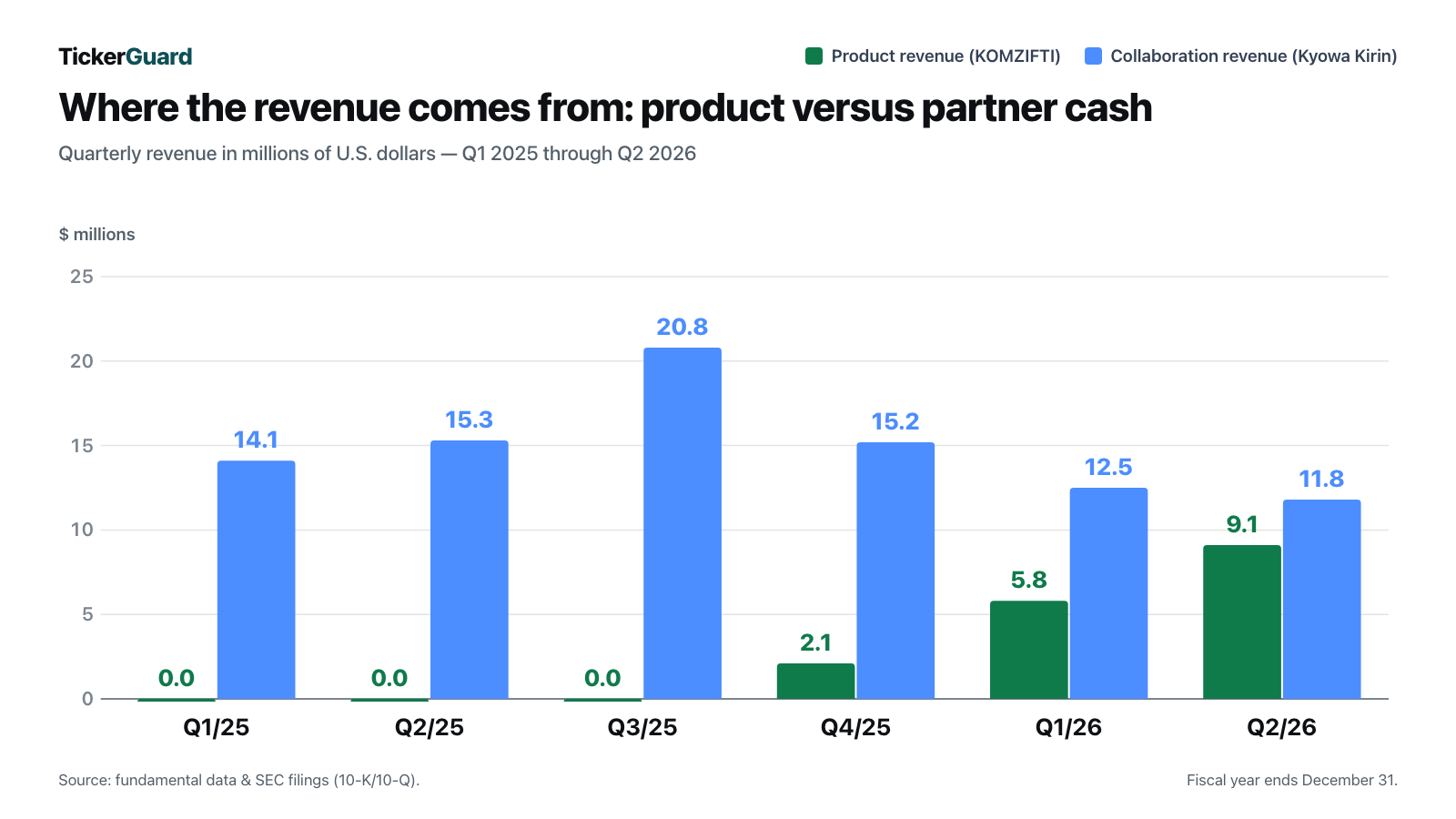
Start with what genuinely impresses. From 2015 through 2023 Kura Oncology booked no revenue at all — not out of weakness, but because a company without an approved drug has nothing to sell. In 2024 the first $53.9 million arrived, entirely from the Kyowa agreement. In 2025 it was $67.5 million, including $2.1 million from real product sales in the final six weeks of the year. Then it accelerated: $5.766 million of product revenue in the first quarter of 2026, $9.122 million in the second — up 57 percent in three months. The earnings release adds the operating detail: roughly 115 new patient starts in the second quarter (35 percent more than in the first) and more than 250 total prescriptions (up 59 percent). For a drug in its second full selling quarter that is a good start, and it should not be talked down.
Except that the revenue line consists of two very different halves. One is selling. The other is accounting.
On the cost side the picture is unchanged and heavy. In the second quarter of 2026, $20.874 million of revenue faced $93.884 million of operating expenses — $61.891 million of research and development, $31.750 million of selling, general and administrative expenses, and $0.243 million of cost of product sales. The bottom line was a net loss of $68.327 million, including $8.2 million of non-cash share-based compensation. The shift inside those numbers matters: selling, general and administrative expenses rose from $25.169 million to $31.750 million in a single year — the price of turning a research house into a commercial organization. Cumulative losses since inception now stand at $1,315.7 million — roughly $1.32 billion — against $1,365.4 million of paid-in capital. The difference between the two is almost exactly what is left as shareholders’ equity today.
Fairness demands a word on where the money came from. Kura did tap shareholders, but not recently: a public offering in June 2023 sold 5,660,871 shares at $11.50 (net proceeds about $93.6 million), and a private placement in January 2024 sold 1,376,813 shares at $17.25 plus pre-funded warrants for a further 7,318,886 shares — net proceeds of roughly $145.8 million. After that the money came from the partner: a $330.0 million upfront payment from Kyowa Kirin in November 2024, plus $240.0 million of development milestones achieved through the end of 2025. The at-the-market facility of $150.0 million established in November 2023 — a program that lets a company drip new shares into the open market — was completely untouched as of June 30, 2026, and share count rose in the first half of 2026 only from 87.855 million to 88.954 million, or 1.3 percent. Anyone who has watched typical biotech dilution over the years knows how rare that has been since early 2024. Which brings us to the uncomfortable truths.
What the filings say — the uncomfortable truths
Uncomfortable truth no. 1: of the $519 million in the bank, $454 million is already spoken for
This is the heart of the bank balance illusion, and it is written out in the quarterly report. On June 30, 2026 Kura held $519.0 million of cash, cash equivalents and short-term investments. On the other side of the balance sheet sit $539.4 million of liabilities — and the largest item is not a loan but a contract liability:
“As of June 30, 2026, the total contract liability was $454.1 million, of which $55.5 million was classified as current, and $398.6 million was classified as long-term.”
— Kura Oncology, Inc., Form 10-Q for the quarter ended June 30, 2026, Note 7 “Kyowa Kirin Collaboration and License Agreement”

The everyday image: picture a contractor whose largest client has wired $100,000 upfront for a job that finishes in three years. The account shows $100,000. That does not make him rich — he still owes the work. That is exactly Kura’s position: Kyowa Kirin has paid, Kura has to deliver. Which is why $587.8 million of total assets leaves only $48.4 million of shareholders’ equity. And why the most common shorthand at this point — “lots of cash, almost no debt” — is simply the wrong sum here. Remember: a prepayment is neither revenue nor a reserve. It is an obligation with a due date.
Uncomfortable truth no. 2: more than half of revenue is that prepayment being released
The same money shows up a second time — in the revenue line. Of $20.874 million of total revenue in the second quarter of 2026, $11.752 million was collaboration revenue, meaning the pro-rata release of exactly that contract liability for development services performed. Only $9.122 million was medicine actually sold. Put differently: 56 percent of reported revenue is not fresh money but the accounting distribution of cash that arrived up to two years ago.
That has an awkward property: this half of revenue shrinks by design. It stood at $20.750 million in the third quarter of 2025 and has fallen every quarter since — to $15.2 million, then $12.5 million, then $11.8 million. Product revenue is therefore growing against a falling counterweight. Which is why total revenue in the second quarter of 2026 ($20.874 million) looks almost identical to the third quarter of 2025 ($20.750 million), even though not a single dose was sold in one quarter and $9.1 million worth in the other. Anyone tracking only the “total revenue” line sees stagnation where a substitution is taking place. How far revenue growth and balance sheet condition can diverge at cancer drug companies is visible in our analysis of ImmunityBio: there, revenue from the approved product rose 668 percent in 2025 to $113 million — behind it stood $4.4 billion of accumulated losses and a going-concern warning, which Kura precisely does not have.
How the equal split of the U.S. business shows up in the numbers is also in the notes — and it is less than you would assume. Kura books all U.S. product revenue itself; profit and loss sharing with Kyowa Kirin runs through a separate line that amounted to only $27.1 million through June 30, 2026. A further $276.8 million of consideration allocated to commercialization services and profit and loss and expense sharing is described in the report as “constrained” — not yet recognizable as revenue because it is too uncertain — and remains inside contract liabilities.
Uncomfortable truth no. 3: the plan through 2028 rests on a partner that may leave on twelve months’ notice
Now to runway. The decisive passage in the quarterly report is two sentences long, and the second one matters:
“We believe that our cash, cash equivalents and short-term investments as of June 30, 2026 will be sufficient to fund our current operating plan into the fourth quarter of 2027. In addition, when combined with the anticipated $180.0 million in payments under the Kyowa License Agreement, we expect to have sufficient capital to advance our ziftomenib AML program through the first topline results from KOMET-017, anticipated in 2028.”
— Kura Oncology, Inc., Form 10-Q for the quarter ended June 30, 2026, “Liquidity and Capital Resources”

Those $180.0 million are not in the account yet — they are “anticipated.” The report does not say what they consist of: it names neither the triggering milestone nor a date. And the same note describes how firm that anticipation is:
“Kyowa Kirin may terminate the Kyowa License Agreement for convenience upon twelve months’ prior written notice.”
— Kura Oncology, Inc., Form 10-Q for the quarter ended June 30, 2026, Note 7 “Kyowa Kirin Collaboration and License Agreement”

To be fair: there is no sign that Kyowa Kirin wants out. Quite the opposite — the partners dosed the first patient in a Japanese registrational trial in April 2026, and Kyowa Kirin fields its own sales force in the United States. But the contract is the contract, and it is one-sided: only Kyowa Kirin holds a termination right for convenience. For you as a shareholder that means: you own a stake not only in a drug but in a business relationship the other side can end at any time. Kura lists exactly this point in its own risk factors, in the chapter on dependence on third parties.
A side detail that fits the picture: on July 24 and 27, 2026 Kura signed new employment agreements with Chief Executive Troy E. Wilson, Chief Commercial Officer Brian Powl and Chief Operating Officer Kathleen Ford that raise severance in the event of a takeover (a “Corporate Transaction”) — for Wilson to 24 months of base salary, 200 percent of target bonus and full acceleration of every equity award (Form 8-K filed July 29, 2026, Item 5.02). That is not an announcement of a sale; it only shows the company has prepared for the case.
One more personnel item belongs to the current state of play: on September 8, 2026 the board appointed Jennifer Fulk as Chief Financial Officer. She takes over two roles the company had been covering internally — principal financial officer from Chief Executive Troy E. Wilson, who had been doing both jobs, and principal accounting officer from Thomas Doyle. Her agreement provides for a base salary of $550,000, a bonus of up to 45 percent, options on 450,000 shares and a one-time performance award covering 173,438 shares, vesting in tranches tied among other things to net product revenue; her severance, too, steps up on a “Corporate Transaction” (Form 8-K filed September 8, 2026, Item 5.02). Two things sit inside that: the company is affording a dedicated finance chief for the first time since February 2022 while the launch scales — and potential new shares grow by another 0.6 million or so.
Uncomfortable truth no. 4: success can eat its own market
This one is the most counterintuitive — and it comes from the company itself. In rare diseases there are two figures: prevalence, everyone living with the condition today, and incidence, the number of new cases each year. A newly approved drug harvests the standing population first. After that, only new cases remain — and there are fewer of them. Kura puts it like this:
“In addition, initial sales of KOMZIFTI may deplete the prevalence pool of patients in KOMZIFTI’s approved indication more quickly than expected, which would have a negative impact on sales of KOMZIFTI in the future.”
— Kura Oncology, Inc., Form 10-K for 2025, Item 1A “Risk Factors”

Which is why the number that matters going forward is not revenue but new patient starts: roughly 115 in the second quarter of 2026. As long as it rises, the standing population has not been exhausted. And it is why Kura talks about the frontline setting in every release — using the drug at the start of treatment rather than after a relapse. That is what the KOMET-017 registrational trials are for; first topline results are expected in 2028. Until then, expanding the market is a hope carrying trial risk, not revenue.
Uncomfortable truth no. 5: the dream margin of the first year is an accounting artifact
In the second quarter of 2026, $9.122 million of product revenue faced only $0.243 million of cost of product sales — arithmetically a gross margin of 97 percent. Before anyone builds a business model on that, read the explanation in the report: before approval in November 2025, all manufacturing costs were expensed immediately as research and development. That created inventory carried at zero cost. As long as that inventory is being sold, cost of goods is artificially low. The report itself says it expects cost of product sales to rise relative to revenue as those inventories are depleted. Translated: today’s margin is borrowed, not earned. Anyone extrapolating future profits from it is being too generous.
One more number belongs in this chapter because it is easy to overlook. On June 4, 2026 shareholders approved 6.5 million additional shares for the employee equity plan — 7.3 percent of shares outstanding in a single resolution. Together with options and awards already granted, roughly 32.8 million potential shares sat above the 88.954 million outstanding on June 30, 2026: 15.8 million options, 2.7 million options under a separate inducement plan, 2.2 million unvested restricted stock units, 0.8 million performance-based units and 11.2 million shares still available for grant. That is dilution potential of roughly 37 percent. Dilution, in everyday terms: the cake stays the same size but gets cut into more slices — your slice shrinks without you doing anything wrong.
Valuation: what the market pays for nine million dollars a quarter
There is no price-to-earnings ratio at Kura because there are no earnings — and, on the company’s own plan, there will be none before 2028 at the earliest. That leaves revenue as the yardstick. At a closing price of $13.25 on September 4, 2026 and 88.954 million shares outstanding, market capitalization is roughly $1.18 billion. Against $77.2 million of revenue over the trailing four quarters, that is a price-to-sales ratio of about 15. For context: 15 is a multiple fast-growing software companies carry; here it is explained only by the fact that a good half of that revenue is a shrinking accounting figure and the other half went from zero to $9.1 million a quarter within a year. Annualize product revenue alone (4 × $9.122 million = $36.5 million) and market capitalization sits at 32 times. Both numbers say the same thing: what is being paid for is not the business of today but the business of 2028 and beyond.
Two anchors help, and both come from filings rather than price tables. First, the quarterly report states that between November 5, 2015 (the start of trading) and June 30, 2026, the high and low prices of the common stock were $43.00 and $2.50. The September 4, 2026 price therefore sits roughly 69 percent below the historic high — even though the drug is now approved and selling. Second, book value per share is only $0.54, given $48.4 million of equity and 88.954 million shares. At an industrial company, a price-to-book ratio of 24 would rightly raise eyebrows; at a biotech whose largest balance sheet item is a contract liability, the ratio is simply meaningless. That is a lesson in itself: metrics that work for a factory can be worthless for a research house. How differently two cancer drug makers can look from a similar starting point is visible in our analysis of Puma Biotechnology, where a single approved product has carried a whole company for years — only with falling rather than rising revenue.
A third point belongs to honesty: leverage is tiny. Of a loan facility of up to $125.0 million from Hercules Capital, Kura has drawn only $10.0 million; the interest rate was 9.15 percent on June 30, 2026, plus an end-of-term fee of about $1.5 million. No further draws are available, and the agreement bars new debt without the lenders’ consent. So the $519.0 million of cash is not inflated by borrowings — it is, as described, tied up by an obligation to perform.
Upside and risks at a glance
What speaks for Kura Oncology:
- An approved, selling drug: KOMZIFTI has been approved in the United States since November 13, 2025; product revenue rose from $2.132 million (2025) to $5.766 million (Q1 2026) and $9.122 million (Q2 2026), alongside roughly 115 new patient starts and more than 250 prescriptions in the second quarter of 2026.
- A well-funded partner that has already paid: $597.1 million received or firmly expected from Kyowa Kirin as of June 30, 2026, plus up to $693.0 million of further milestones in the existing field and tiered double-digit royalties outside the United States.
- Almost no dilution since early 2024: the last equity raise was a private placement in January 2024 (net proceeds about $145.8 million); after that the money came from the partner. Share count rose only 1.3 percent in the first half of 2026 to 88.954 million, and the $150.0 million at-the-market facility has been untouched since November 2023.
- Very little debt: only $10.0 million drawn against $519.0 million of cash, and no going-concern warning in the quarterly report for June 30, 2026.
- A second leg in preparation: darlifarnib showed combination activity in renal cell and KRAS-mutated tumors in early 2026 trials, and a dedicated platform study is slated to start in the first half of 2027.
What speaks against it:
- Shareholders’ equity is nearly consumed: $48.4 million on June 30, 2026 after $364.4 million five quarters earlier, with a net loss of $68.3 million in the second quarter of 2026 alone — at that pace and without fresh capital, the equity line is arithmetically exhausted quickly.
- The cash is committed: $454.1 million of liabilities are contract liabilities owed to Kyowa Kirin; the company’s own runway ends in the fourth quarter of 2027, and reaching the 2028 trial readout assumes a further $180.0 million of anticipated partner payments.
- A one-sided termination right: Kyowa Kirin may end the license agreement for convenience on twelve months’ notice, and Kura lists dependence on this partner in its own risk factors, in the chapter on dependence on third parties.
- Competition in the same indication: revumenib (REVUFORJ) is another approved menin inhibitor for relapsed or refractory NPM1-mutated AML; the annual report also names Syndax, Janssen, Dainippon Sumitomo, Servier, Biomea Fusion and CHARM Therapeutics as competitors with menin programs.
- Dilution potential of roughly 37 percent: on June 30, 2026, 88.954 million shares outstanding faced roughly 32.8 million potential shares from options, awards and unissued plan shares — 6.5 million of them approved only on June 4, 2026.
A human conclusion
Back to the bank balance illusion. It is not a failure of arithmetic but of convenience: a big number feels like an answer, and we stop asking. At Kura Oncology that misleads in both directions. Read only “$519 million in cash” and you see a safe company whose equity has fallen 87 percent in five quarters. Read only “$48 million of equity” and you see a struggling company that sells an approved drug, carries almost no debt and has its bills covered into 2027. Each is half the truth, and the whole one sits in the same balance sheet: the money is there, but it has already been promised to a purpose.
What you actually buy, if you buy this stock, is three concrete things. First: a drug that generated $9.1 million of revenue in its second full quarter — real, growing and small against $93.9 million of quarterly costs. Second: a relationship with Japan that paid for the launch and that the other side may end on twelve months’ notice. Third: a date in 2028, when the first large registrational trial for the much bigger frontline market reads out — and until then the question of whether the money lasts without your slice of the cake getting smaller. So the honest question is not “does the drug work?” It plainly does. It is: can you hold, for two and a half years, a company whose bank balance looks high although the money is already spoken for, and whose success depends on a trial readout that will not arrive before 2028? If yes, you have a thesis. If no, you had a bank balance. The decision is yours.
Sources
Every original document used in this analysis, so you can read it yourself:
- Kura Oncology, Inc. — Form 10-Q for the quarter ended June 30, 2026 (filed August 12, 2026)
- Kura Oncology, Inc. — Form 10-Q for the quarter ended March 31, 2026 (filed May 12, 2026)
- Kura Oncology, Inc. — Form 10-K for 2025 (filed March 5, 2026)
- Kura Oncology, Inc. — Form 10-K for 2024 (filed February 28, 2025)
- Kura Oncology, Inc. — Second quarter 2026 earnings release, Exhibit 99.1 to the Form 8-K filed August 12, 2026
- Kura Oncology, Inc. — Form 8-K filed July 29, 2026, Item 5.02 (amended executive employment agreements)
- Kura Oncology, Inc. — Form 8-K filed September 8, 2026, Item 5.02 (appointment of Jennifer Fulk as Chief Financial Officer)
- Kura Oncology, Inc. — Form 8-K filed June 4, 2026, Items 5.02 and 5.07 (2026 annual meeting)
- Kura Oncology, Inc. — Proxy statement DEF 14A for the 2026 annual meeting (filed April 10, 2026)
- Insider filings (Form 4) by Troy E. Wilson: purchase of August 17, 2026 and purchase of August 24, 2026; sales by Teresa Brophy Bair (August 19, 2026) and Brian Powl (August 21, 2026)
- Complete SEC filing history of Kura Oncology, Inc.: EDGAR overview (sec.gov)
- Fundamental data (prices, market capitalization, short interest, headcount; as of September 6, 2026), reconciled against the SEC filings.
Transparency & disclaimer: this analysis is journalistic commentary on publicly available information. It is not investment advice, not a regulated financial analysis and not a solicitation to buy or sell securities. Equity investments carry substantial risk, including total loss. All information is provided without warranty; the as-of date for each figure is stated in the text. The author holds no position in Kura Oncology shares at the time of publication.
Key figures at a glance
All monetary figures in millions of $; earnings per share as reported.
| Metric | 2021 | 2022 | 2023 | 2024 | 2025 |
|---|---|---|---|---|---|
| Revenue | 0.0 | 0.0 | 0.0 | 53.9 | 67.5 |
| Operating Income (EBIT) | -131.3 | -139.9 | -165.8 | -193.2 | -303.6 |
| Net Income | -130.5 | -135.8 | -152.6 | -174.0 | -278.7 |
| Net Margin | – | – | – | -322.9% | -412.9% |
| Earnings Per Share | -1.97 $ | -2.03 $ | -2.08 $ | -2.02 $ | -3.18 $ |
Source: fundamental data & SEC filings (annual and quarterly reports, 10-K/10-Q)
Our Bottom Line at a Glance
- Product and launch positive
- KOMZIFTI has been approved in the United States since November 13, 2025 and selling since November 21, 2025. Product revenue rose from $2.132 million (2025) to $5.766 million (Q1 2026) and $9.122 million (Q2 2026); the earnings release of August 12, 2026 adds roughly 115 new patient starts and more than 250 prescriptions in the quarter.
- Balance sheet substance negative
- Shareholders’ equity fell from $413.6 million (December 31, 2024) via $364.4 million (March 31, 2025) to $48.4 million (June 30, 2026) — six consecutive declines, with a net loss of $68.3 million in the second quarter of 2026 alone. Of $587.8 million in total assets, $454.1 million is a contract liability owed to Kyowa Kirin. The accumulated deficit stands at $1,315.7 million.
- Funding and runway neutral
- The $519.0 million of cash funds operations “into the fourth quarter of 2027” per the Form 10-Q for June 30, 2026; reaching the first KOMET-017 results in 2028 requires a further $180.0 million anticipated from Kyowa Kirin. On the positive side: only $10.0 million of drawn debt, a $150.0 million at-the-market facility untouched since November 2023, and no going-concern warning.
- Partner dependence negative
- Kyowa Kirin may terminate the license agreement for convenience on twelve months’ notice (Form 10-Q for June 30, 2026, Note 7). Kura lists dependence on this partner in its own risk factors, in the chapter on dependence on third parties. At the same time, $11.752 million of $20.874 million in quarterly revenue comes from releasing the Kyowa prepayment — a position that shrinks by design.
- Market size and competition neutral
- NPM1 mutations account for roughly 30 percent of AML cases (10-K 2025), yet the annual report itself warns that initial sales may deplete the patient pool faster than expected. Revumenib (REVUFORJ) is another approved menin inhibitor in the same indication, and the far larger frontline market depends on the KOMET-017 registrational trial with first results expected in 2028.
- Dilution neutral
- Very restrained since early 2024: the last equity raise was a private placement in January 2024 (net proceeds about $145.8 million); share count rose only 1.3 percent in the first half of 2026 to 88.954 million, and the $150.0 million at-the-market facility has been unused since November 2023. Pressure is building, though: roughly 32.8 million potential shares (37 percent) sit in options, awards and plan reserves, 6.5 million of them approved only on June 4, 2026.
Kura Oncology has cleared the hardest hurdle in biotech: a proprietary, approved drug that sells better every quarter ($9.122 million in the second quarter of 2026, up 57 percent). The price sits in the same balance sheet: shareholders’ equity fell from $364.4 million to $48.4 million in five quarters, and $454.1 million of the $519.0 million cash pile is committed as a contract liability to Kyowa Kirin. The funding plan reaches the fourth quarter of 2027 on its own; everything after that depends on a partner that may walk away on twelve months’ notice, and on a trial readout in 2028. Not investment advice.
What Our Rating Means
Open questions
The business works in principle, but one material question is open. As long as it stays open, our findings do not carry a quality verdict.
Yellow, because a material operating question is open while no substance risk is evidenced. For yellow: commercial success is only two full quarters old, $9.122 million of quarterly revenue faces $93.884 million of quarterly costs, and the decisive expansion into frontline therapy hinges on a trial readout expected in 2028. Explicitly against red: the Form 10-Q for June 30, 2026 contains no going-concern warning, shareholders’ equity is positive at $48.4 million, runway “into the fourth quarter of 2027” is well beyond four quarters, and debt is only $10.0 million. The thin equity line is the consequence of a prepayment, not of over-indebtedness. The stock is still expensive at about 15 times sales — but that is a price argument, not a quality verdict. Before buying we would wait for two numbers in the next report: new patient starts and the equity line. The decision is yours.
A journalistic assessment by our editorial team at the time of the deep dive, based on public sources — not investment advice and not a solicitation to buy or sell. Your personal circumstances (investment goals, risk capacity, taxes) cannot be taken into account. What our levels mean, how verdicts are formed, and what conflicts of interest exist →
Worth Noting
- Kura Oncology reached the research list through the SEC filing feed: on August 12, 2026 the Form 10-Q for June 30, 2026 and the earnings release (Form 8-K, Item 2.02) were filed on the same day — with rising product revenue and equity down by more than half. All filings through September 8, 2026 were reviewed in addition — including the SC 13G/A of August 14, 2026 (Montanova Capital/Averill Master Fund, 8,575,422 shares), the insider filings (Form 4) of August 17, 19, 21 and 24, 2026, and the Form 8-K of September 8, 2026 (Item 5.02), with which Kura appointed a dedicated Chief Financial Officer for the first time since February 2022.
- Possible confusion: the listed shell was named Zeta Acquisition Corp III until March 10, 2015; trading under the ticker KURA began on November 5, 2015. Price and revenue series before that date do not describe today’s business. The brand name is KOMZIFTI, the active ingredient ziftomenib — older releases use only the ingredient name.
- Valuation data are dated and evergreen: closing price $13.25 on September 4, 2026, market capitalization roughly $1.18 billion, other market data (short interest, 52-week range, headcount) as of September 6, 2026. The balance sheet date for all balance and income figures is June 30, 2026. Analyses are evergreen; a daily price is not a reason to buy.
Stock Watch
This analysis is as of September 8, 2026. Stock Watch will tell you what's changed at KURA since then.
Later $1 a month per stock — signing up is free, and you'll be the first to know when it launches.
The full analysis as a PDF for later
We will send you this analysis as a PDF — to print, file away, and read at your own pace. And we will add you to the free Stock Watch list for Kura Oncology Inc (KURA), so you hear about it when something material in this analysis changes.
Frequently Asked Questions
Kura Oncology, Inc. (Nasdaq: KURA) of San Diego develops and sells cancer drugs that target individual genetic alterations inside tumor cells. Its first proprietary product is KOMZIFTI (ziftomenib), an oral medicine for a specific form of acute myeloid leukemia. In development are darlifarnib for solid tumors and the preclinical candidate KO-7246. The company had 260 full-time employees as of December 31, 2025.
KOMZIFTI is a menin inhibitor: an oral medicine taken once a day that blocks a protein preventing leukemia cells from maturing. The U.S. Food and Drug Administration approved it on November 13, 2025 for adults with relapsed or refractory NPM1-mutated acute myeloid leukemia, and commercial sales began on November 21, 2025. NPM1 mutations account for roughly 30 percent of AML cases according to the 2025 annual report (10-K).
Because much of that money is a prepayment against services still owed. On June 30, 2026, $519.0 million of cash, cash equivalents and short-term investments faced $539.4 million of liabilities, including $454.1 million of contract liabilities from the Kyowa Kirin collaboration. Of $587.8 million in total assets, only $48.4 million therefore remains as shareholders’ equity — down from $364.4 million on March 31, 2025.
The company states in its quarterly report for June 30, 2026 that the $519.0 million on hand will fund its current operating plan “into the fourth quarter of 2027.” Only together with a further $180.0 million anticipated from Kyowa Kirin does Kura expect sufficient capital to reach the first topline results of the KOMET-017 registrational trial in 2028. The report contains no going-concern warning.
The Japanese pharmaceutical group has been Kura’s development and license partner for ziftomenib since November 20, 2024. Kura leads development, manufacturing and commercialization in the United States and books all U.S. sales; U.S. profits and losses are shared equally. Rights outside the United States belong to Kyowa Kirin. Through June 30, 2026 Kura had received or firmly expected $597.1 million from the agreement. Kyowa Kirin may terminate for convenience on twelve months’ notice.
No price-to-earnings ratio can be calculated because there are no earnings: the net loss in the second quarter of 2026 alone was $68.3 million. At a closing price of $13.25 on September 4, 2026 and 88.954 million shares, market capitalization is roughly $1.18 billion — about 15 times trailing four-quarter revenue of $77.2 million and about 32 times annualized product revenue. What is being paid for is the future, not the present.
On June 30, 2026, 88.954 million shares were outstanding. Alongside them stood 15.8 million options, 2.7 million options under a separate inducement plan, 2.2 million unvested restricted stock units, 0.8 million performance-based units and 11.2 million shares still available for grant — roughly 32.8 million potential shares, or 37 percent. Of those, 6.5 million were approved by shareholders only on June 4, 2026. An untouched $150.0 million at-the-market facility sits on top.
The 2025 annual report (10-K) names revumenib (brand name REVUFORJ) as another FDA-approved menin inhibitor in the same indication — relapsed or refractory NPM1-mutated acute myeloid leukemia as well as relapsed or refractory KMT2A-rearranged acute leukemia. Kura also lists Syndax, Janssen (Johnson & Johnson), Dainippon Sumitomo, Servier, Biomea Fusion and CHARM Therapeutics as companies with menin programs. KOMZIFTI also competes with established chemotherapies and other targeted agents.
Found an error?
Did you spot a factual error, an outdated number, or a typo in this deep dive? Let us know briefly — your report goes straight to the editorial team.