Kongsberg Is Chasing the 100 Billion Mark — But Compared to What Base, Exactly?
A record order backlog of 158 billion kroner, a revenue target set to triple today's figure, a share price up twelvefold in five years: Kongsberg delivers headlines by the week. What the headlines leave out — the Norwegian arms maker cut itself in half in April 2026. Kongsberg Maritime was spun off and now trades on its own, which means almost every comparison number in this analysis had to be redrawn from scratch, and the group itself had to let a 2018 export license get pulled back in May. Not investment advice — just an attempt to hold the record numbers up against their own fine print.
 Thomas Mücke
Founder & Publisher
Thomas Mücke
Founder & Publisher
There is an investor weakness that catches the most attentive readers of all — because it feels like the opposite of naivety: the headline-number trap. You read a press release, your eye jumps straight to the biggest, boldest figure — "record order backlog: 158 billion kroner!", "2029 revenue target: 100 billion!" — and your brain automatically fills in the rest: growth, safety, upside. What almost never happens is that you stop to ask whether the "before" number is still measuring the same thing as the "after" number. At Kongsberg Gruppen ASA (Euronext Oslo Børs: KOG) that is exactly the case — and it is not a footnote, it is the key to practically every metric in this analysis. On April 23, 2026 the Norwegian defense and technology group literally cut itself in half: Kongsberg Maritime, for decades the maritime half of the business, was spun off and now trades on its own on the Oslo exchange. So let's make a deal: before we talk about a 100-billion-kroner revenue target, let's read the Quarterly Report for the 2nd quarter and 1st half of 2026 (published July 13, 2026) together — prepared under IFRS, overseen under Norwegian and EU capital-markets law. A report like that is honest because it stands under exchange oversight. And it tells the story of a company that really is growing — but also of a comparison base that shifted under investors' feet, an export license its own home state pulled back, and a cash pile that shrank to a quarter of its size in six months. In the end, you decide what's left of the headline.
What Kongsberg actually makes — missiles, radar and a joint venture underwater
Kongsberg was founded in 1814 as a state-owned weapons factory in the small Norwegian town of Kongsberg — today the Norwegian state, at 50.004 percent, is still by far the largest owner, as the company discloses on its own investor-relations page. After the spin-off of Kongsberg Maritime, the remaining, listed Kongsberg is organized into three segments. Defence Systems (first half 2026: NOK 9,229 million in revenue, 18.4 percent EBIT margin) builds air-defense and counter-drone systems, including the NASAMS system now used by 14 nations, plus remote weapon stations. Missiles & Aerostructures (NOK 5,650 million, 17.1 percent margin) manufactures the Joint Strike Missile family (JSM/NSM) and supplies composite and titanium components for the F-35 fighter jet. Discovery (NOK 4,394 million, 16.1 percent margin) bundles sonars, the HUGIN family of autonomous underwater vehicles, and, through the 50-percent-owned joint venture Kongsberg Satellite Services (KSAT), a global network of ground stations for satellite communication. On top sit further stakes whose proportional result Kongsberg folds into the group figures: a 49.9 percent stake in the Finnish defense group Patria Oyj (earnings contribution first half 2026: NOK 201 million, more than four times the prior year) and Kongsberg Thales Defence Communications, a joint venture formed with Thales in June 2025 that is set to become operational in 2026. Another sign of tightening ties across Europe's defense-tech ecosystem: in December 2025, Kongsberg, the German sensor maker Hensoldt and the AI defense company Helsing agreed to team up on a European space-reconnaissance system called KIRK — we cover Hensoldt's own numbers, and a similar pattern of headline order growth against tighter cash flow, in a separate deep dive on Hensoldt. The report itself describes the current market like this: "Market activity remains high, with a continuous pipeline of campaigns and procurement processes." That marks the central tension of this analysis, and it runs through every chapter: Kongsberg really is growing strongly in its operating business — but almost every number used to prove that growth was redrawn by the spin-off, and the group itself gives three reasons in the same report why the record figures aren't the whole story.
Company history for investors
-
2025
Sonatech acquisition agreed (June)
Kongsberg Discovery announces the acquisition of the U.S. underwater-acoustics specialist — U.S. approval is still pending a year later.
-
2025
KIRK partnership with Helsing announced (December)
Kongsberg, Helsing and HENSOLDT agree on a European space-reconnaissance system — a signal for investors of growing ties to AI-enabled defense technology.
-
2025
Board resolves the spin-off of Kongsberg Maritime (December 17)
The first formal step toward the company split that would reshape almost every metric a year later.
-
2026
Shareholders approve the spin-off (January 22)
Investors get certainty on the timeline — the demerger completes three months later.
-
2026
Demerger completed, Kongsberg Maritime trades independently (April 23)
From this date, Maritime no longer counts in Kongsberg's figures — every prior-year comparison since needs two viewpoints.
-
2026
Capital Markets Day: target of NOK 100 billion revenue by 2029 (June 10)
The group publicly commits to a growth ambition that would triple revenue from the last full year, 2025 (NOK 32,752 million).
-
2026
Zone 5 acquisition completed (June 9)
Entry into mass production of low-cost missiles in the U.S. — with short-term margin pressure during the scale-up.
-
2026
Export license for Malaysia withdrawn (May, disclosed in the July quarterly report)
Norway pulls back a license granted in 2018 — a precedent that raises questions about future large contracts.
Why we're looking now
Three events collided almost simultaneously in 2026 and make Kongsberg a worthwhile checkpoint right now. First, the final completion of the Maritime spin-off on April 23, 2026 — the first full quarterly report to show the company entirely "after" has only been available since July 13, 2026. Second, the Capital Markets Day on June 10, 2026, where the group made one of the most ambitious public growth statements in European defense with the goal of tripling revenue by 2029 and nearly quintupling it by 2033. And third, the quiet sentence buried in Note 13 of that same report, disclosing that the Norwegian government withdrew an export license from its own group in May 2026 — a development that did not show up in any of the big Kongsberg headlines of the summer. All three events sit in the same, publicly available document. The rest of this analysis reads it to the end.
The numbers over the years — honestly appraised
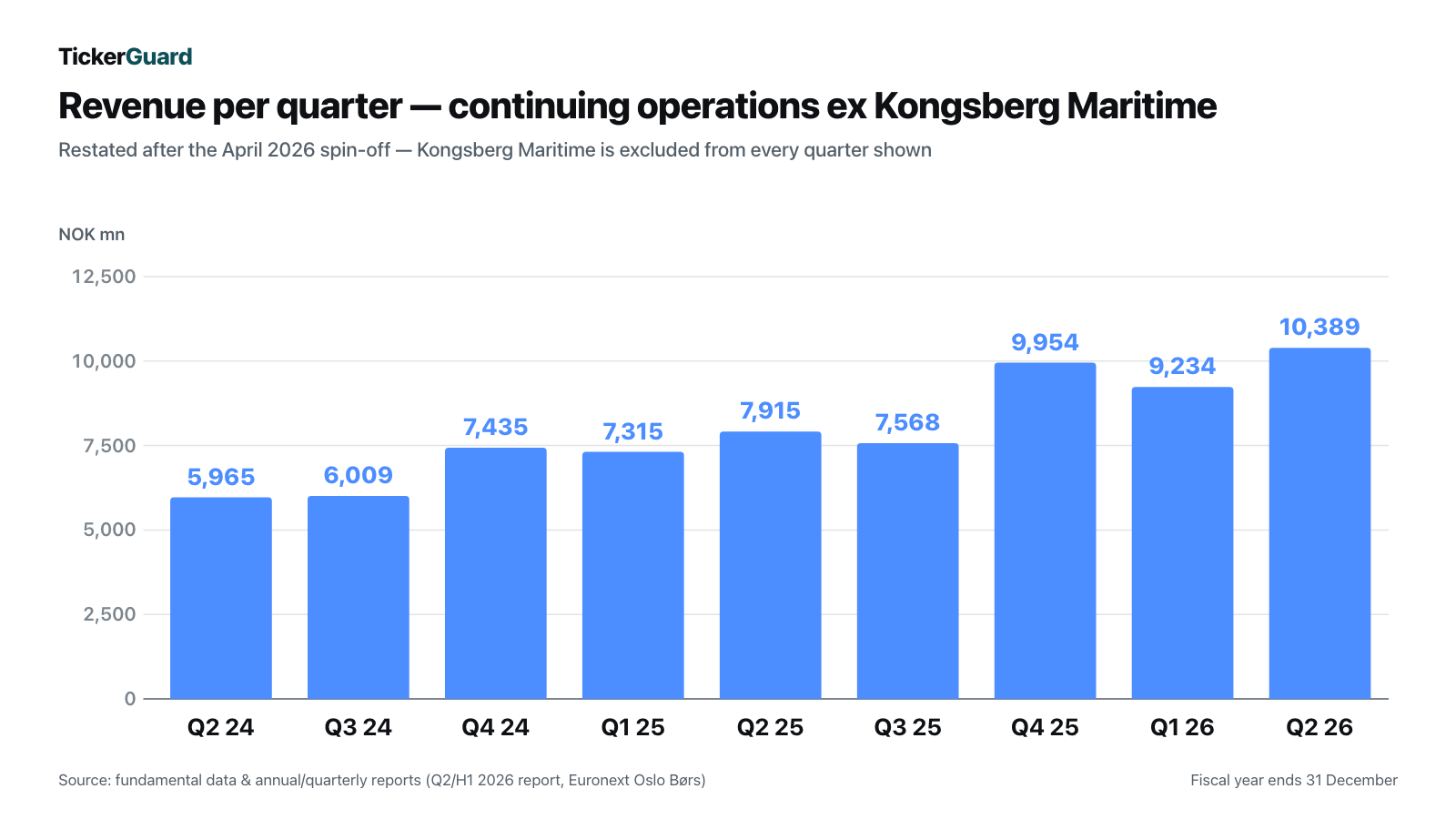
First, what genuinely speaks for Kongsberg — and operationally that is a great deal. Revenue from the continuing business climbed from NOK 5,965 million in the second quarter of 2024 to NOK 10,389 million in the second quarter of 2026 — a 74 percent rise over eight quarters, with Kongsberg Maritime excluded from every single one of those figures. For the full first half of 2026 that comes to NOK 19,623 million, up 29 percent from the prior-year period (NOK 15,230 million).
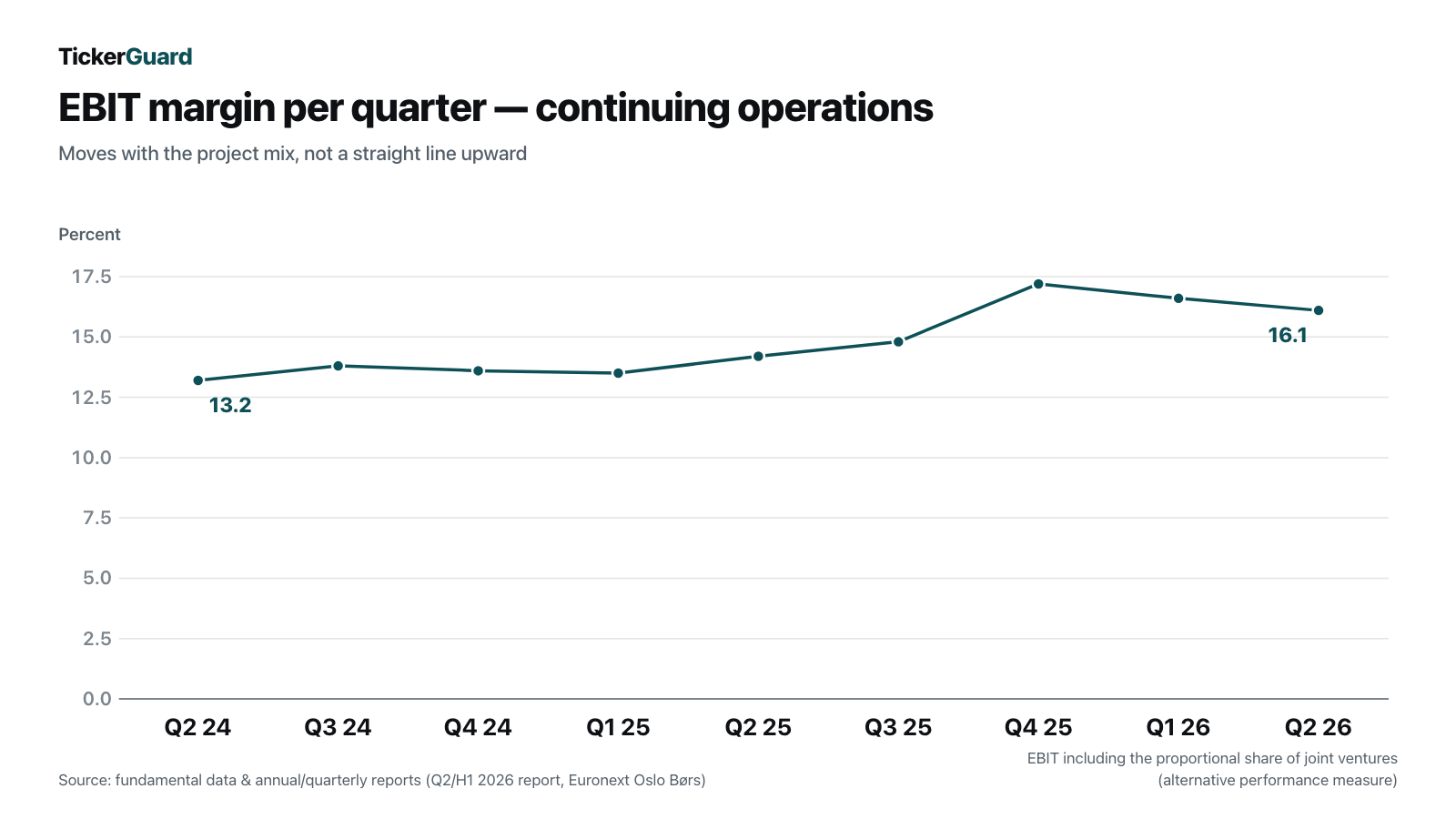
Profitability climbed in parallel, though not in a straight line. The EBIT margin (including the proportional share of joint ventures, disclosed by Kongsberg itself as an "alternative performance measure") stood at 13.2 percent in the second quarter of 2024, climbed to its peak of 17.2 percent in the fourth quarter of 2025, and stood at 16.1 percent in the second quarter of 2026 — a 49 percent rise in absolute EBIT (NOK 1,669 million versus NOK 1,121 million), a point the report itself highlights.
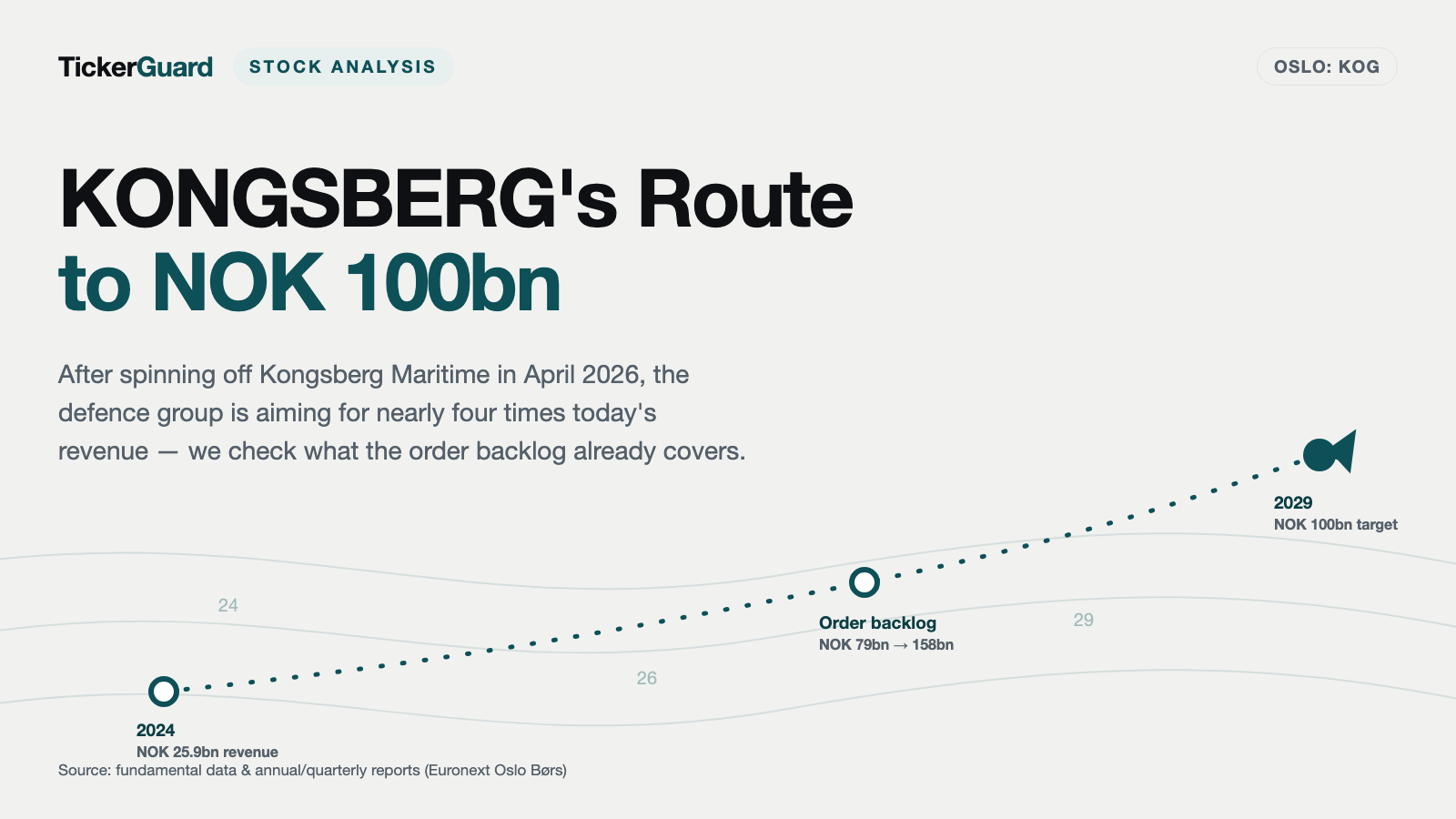
And the order backlog — the real crown jewel of the Kongsberg story — reached a record NOK 157,540 million as of June 30, 2026, nearly double the NOK 79,366 million from summer 2024 (+98 percent). Order intake in the first half of 2026 alone came to NOK 43,608 million. On that basis, the group announced one of the boldest growth statements in the European defense sector at its Capital Markets Day on June 10, 2026:
"KONGSBERG aims to triple revenues to NOK 100 billion by 2029 and to NOK 150 billion by 2033. Over the same period, we target an operating margin of at least 16 percent."
— KONGSBERG, Quarterly Report Q2/H1 2026, CEO's foreword, p. 3 (referencing the Capital Markets Day of June 10, 2026)
Let's pause here before reading on: the word "triple," per the report, is measured against a base the group itself doesn't state in that same sentence — and that is precisely where the headline-number trap can snap shut. Measure against fiscal 2024 (roughly NOK 25.9 billion of continuing-operations revenue, NOK 25,892 million exactly, per the quarterly report) and 100 billion is 3.9 times that — almost a quadrupling. Measure against the last full year, 2025 (NOK 32,752 million), and it is only 3.1 times — almost exactly the tripling the group itself claims. Both figures sit in the same table of the same report; which one is meant, the group does not say. That is the headline-number trap in miniature: depending on the base year you pick, the very same statement sounds like 3.1x growth or like almost 3.9x. Which brings us straight into the uncomfortable truths.
What management said on the calls — and what came of it
Our database holds no in-house transcripts for Kongsberg's own conference calls — an automated match returned zero hits on August 30, 2026, which is what you would expect from a Norwegian company that isn't registered with the U.S. securities regulator, the SEC. Instead, we reviewed the analyst-call transcripts published by Investing.com for the fourth-quarter 2025, first-quarter 2026 and second-quarter 2026 results, plus the Capital Markets Day transcript of June 10, 2026 (Seeking Alpha) — flagged as a secondary source, not blended with the audited report figures. The most striking pattern across all three calls: analysts repeatedly ask about margin, and management repeatedly answers evasively. On the first-quarter 2026 call, CFO Martin Wien Fjell pre-emptively warned that margin "will fluctuate depending on the project and product mix" — despite the quarter's strong 16.6 percent margin at the time. On the second-quarter 2026 call, an analyst from Pareto Securities asked directly about the margin impact of Ukraine's "donation" programs (weapons deliveries financed through Western governments' donation schemes); the CFO declined to quantify it and pointed again to "project and product mix." Asked a similar question by Bank of America about the margin decline in the Defence Systems segment, management said this was an expected consequence of "successful production scale-up." And when an analyst from Arctic Securities asked what revenue contribution the freshly acquired Zone 5 unit would deliver in 2026 and 2027, the CFO noted that the integration was only three weeks old and no figure could be given yet. Management was notably more forthcoming, though, when asked about the biggest risk to its own 2029/2033 ambition: asked by an analyst from Defence Nordic what worries CEO Eirik Lie most, he answered without hedging that the biggest challenge is securing the supply chain — "we work on that every day." That recurring Q&A reflex — concrete margin questions parried with "project and product mix," concrete figures on fresh acquisitions not yet available — weighs more heavily for our assessment than the prepared opening remarks, which consistently emphasize the record numbers.
What the filings say — the uncomfortable truths
Uncomfortable truth no. 1: the comparison base was redrawn — and earnings per share looks like a decline as a result
Anyone googling how Kongsberg's earnings per share has developed in the summer of 2026 runs into what looks like bad news: reported total earnings per share fell to NOK 3.73 in the first half of 2026, down 16 percent from NOK 4.43 a year earlier. According to the group income statement, though, this is purely a construction artifact of the restructuring: earnings per share from the continuing business — the exact business the stock still represents today — rose from NOK 1.66 to NOK 2.91 over the same period, up 75 percent. The report itself explains how the two views diverge:
"The result from the maritime operations in 2026 is only included until the demerger was completed in 23 April 2026."
— KONGSBERG, Quarterly Report Q2/H1 2026, Note 9 "Discontinued business," p. 26

Translated into an everyday picture: imagine a family business sells off half its workshop and then compares this year's profit with last year's, when both workshop halves were still running — of course the total looks smaller, even though the remaining workshop is doing better than ever on its own. For you as a reader, that means: every metric you compare against the prior year at Kongsberg needs to be checked twice — once as a whole-group figure (distorted by the Maritime exit) and once as "continuing operations" (the actually relevant number). Automated finance portals that simply carry forward the total EPS line will show a 2026 earnings decline at Kongsberg that is, in truth, a strong earnings increase.
Uncomfortable truth no. 2: cash melted to a quarter of its size in six months — right as the 100-billion promise was growing
At the end of 2025 the (then still whole) group held NOK 20,189 million in cash. As of June 30, 2026 that figure was down to NOK 4,859 million — a drop of more than three-quarters in six months. Three items explain the outflow: the regular dividend payment of NOK 5,014 million, the cash payment for the Zone 5 acquisition of NOK 3,801 million, and a negative operating cash flow of NOK 2,115 million in the first half — driven, per the report, "mainly by the demerger effect of Kongsberg Maritime," meaning restructuring effects of the spin-off itself rather than the ongoing operating business in the narrow sense. The net cash position (cash minus financial debt) stays positive at −NOK 1,704 million, but that is now just a bit over a ninth of the NOK 14,830 million at year-end 2025. The equity ratio fell over the same period from 28.1 to 21.2 percent. For context: Kongsberg additionally has an undrawn syndicated credit line of NOK 3,000 million and an overdraft facility of NOK 1,500 million — so the liquidity reserve isn't exhausted, but the buffer the group is starting its own tripling ambition with is considerably thinner than it was half a year ago. Rating agency Nordic Credit Rating affirmed a long-term issuer rating of A− with a stable outlook (standalone credit assessment BBB+) on April 8, 2026 — that is, before the cash outflow of the second quarter had fully shown up.
Uncomfortable truth no. 3: the group's own home state pulls an export license — right in the middle of the biggest missile boom in the company's history
Buried in the notes to the quarterly report, under the unassuming heading "Other," sits a sentence that did not show up in any of the big Kongsberg headlines of summer 2026:
"In May, it became known that the Norwegian authorities have withdrawn the export license of NSM missiles from KONGSBERG to Malaysia. This is related to the contract KONGSBERG announced on 18 April 2018 of 124 million euros. Accounting assessments related were taken into account in the financial statements as of Q2 in accordance with IFRS. Due to ongoing negotiations between the parties, it is all the information KONGSBERG can provide at this time."
— KONGSBERG, Quarterly Report Q2/H1 2026, Note 13 "Other," p. 28

€124 million is modest measured against first-half revenue of roughly €1.74 billion (converted at Kongsberg's own stated period-end rate of NOK 11.28 per euro). The real message is a different one: the Norwegian state — Kongsberg's largest single shareholder, at over 50 percent — can retroactively pull back an export license once granted for a Kongsberg product. At its core this is not a Kongsberg-specific risk but one typical of every arms exporter — though given the scale of the current JSM contracts (Canada NOK 4.7 billion, Germany NOK 3.5 billion, U.S. Air Force NOK 2.7 billion — all signed in the second quarter of 2026), it takes on a very different weight than the comparatively small 2018 Malaysia contract.
What the quarterly report leaves open, Malaysian government sources have since filled in publicly: according to consistent press reports, Malaysia's defense ministry is now demanding compensation of about €226.1 million (roughly 1.06 billion ringgit) from the Kongsberg subsidiary Kongsberg Defence & Aerospace — more than 1.8 times the original €124 million contract value. The claim reportedly breaks down into €129.86 million already paid and an additional €96.26 million in follow-on costs from the undelivered shipment. Initial negotiating rounds between Kongsberg and the Malaysian government were scheduled for mid-August 2026; as of August 27, 2026, Malaysian authorities were reportedly still waiting for a response from Kongsberg, while the navy explores replacement systems from Turkey, South Korea and Europe in parallel. Neither the exact claim amount nor the state of negotiations is, so far, part of any Kongsberg report of its own — the group itself cited only "ongoing negotiations" in the quarterly report without figures; the €226 million number comes from Malaysian government statements as cited by the press there.
Uncomfortable truth no. 4: a strategic U.S. acquisition has been stuck for over a year at an American review authority
In June 2025, the Kongsberg Discovery segment announced the acquisition of U.S. underwater-acoustics specialist Sonatech. More than a year later — in the second-quarter 2026 quarterly report — the deal still hasn't closed:
"KONGSBERG continues to work towards obtaining the necessary regulatory approvals while also evaluating alternative ways to realise the strategic potential of the company should the required approvals from U.S. authorities not be secured."
— KONGSBERG, Quarterly Report Q2/H1 2026, "Other business / other matters" section, p. 6

The report doesn't name the authority, but the context — a Norwegian, majority state-owned defense group buying a U.S. underwater-acoustics company with naval and defense-technology ties — points strongly to a review by the U.S. Committee on Foreign Investment (CFIUS), which investigates exactly this type of acquisition for national-security risk. Notable is the phrase "evaluating alternative ways to realise the strategic potential" — a listed company publicly admitting that an already-announced, strategically justified acquisition could ultimately look very different, or fall apart entirely. For judging Kongsberg's stated U.S. expansion strategy — the Zone 5 acquisition completed in June 2026 as well (89.6 percent, NOK 4,485 million purchase price plus NOK 522 million of contingent consideration) targets the same market — that is a reality check: not every announced U.S. acquisition by a foreign, state-influenced defense group sails through in the end.
Valuation — what the stock really costs
As of the analysis date (closing price NOK 312.30 on August 28, 2026), Kongsberg's market capitalization stands at NOK 274.70 billion — an exact match at 879,609,245 shares outstanding, with no deviation from the reported market cap. Converted at Kongsberg's own stated period-end rate of June 30, 2026 (€1 = NOK 11.28, $1 = NOK 9.91), that comes to roughly €24.4 billion or $27.7 billion — for context, a size that places the stock in an internationally comparable category. Based on trailing-twelve-month earnings from the continuing business (NOK 5.99 per share), the price-to-earnings ratio works out to roughly 52 — on estimated 2026 earnings (per analyst estimates from our fundamental-data source), roughly 48. The price-to-sales ratio sits at around 7.7, and enterprise value runs to roughly 30 times EBITDA. For comparison: the share price itself has increased more than twelvefold since 2021 (stock splits already accounted for) — a valuation that already prices in a great deal of future growth. Take the 2029 revenue ambition of NOK 100 billion at face value and apply the targeted margin of at least 16 percent, and you land at a hypothetical operating profit of roughly NOK 16 billion in 2029 — against today's market cap, that would work out to a price-to-earnings ratio in the low teens, provided revenue and margin are actually achieved and the share count doesn't grow materially. Whether that happens is a bet on an ambition, not a fact — and that is exactly where the valuation risk sits: today's price already pays for a lot of that future, the uncertainties described in the previous chapter (cash reserve, export-license precedent, blocked U.S. acquisition) included.
Opportunities and risks at a glance
What speaks for Kongsberg:
- A record order backlog of NOK 157,540 million as of June 30, 2026 (+98 percent since summer 2024) delivers multi-year revenue visibility — 59 percent of the backlog is scheduled for 2028 and later.
- Operating growth is real and broadly supported: 74 percent revenue growth over eight quarters in the continuing business, EBIT margin up from 13.2 to 16.1 percent, growth across all three segments in the second quarter of 2026 (Defence Systems +53%, Missiles & Aerostructures +19%, Discovery +21%).
- Solid financing structure despite the cash drawdown: still a net cash position (net financial debt of −NOK 1,704 million), undrawn credit lines of NOK 4,500 million, and an A− issuer rating (Nordic Credit Rating, affirmed April 8, 2026).
- Structural tailwind from European defense spending and NATO procurement programs, documented by large second-quarter 2026 contracts (JSM Canada/Germany/U.S. Air Force, NASAMS Kuwait) and the Capital Markets Day ambition to grow revenue to NOK 150 billion by 2033.
What speaks against it:
- The Maritime spin-off distorts every prior-year comparison: reported total earnings per share fell nominally 16 percent in 2026, even though the continuing business generated 75 percent more earnings per share — a trap for any automated metric comparison.
- Cash fell from NOK 20,189 million to NOK 4,859 million in six months, and the equity ratio from 28.1 to 21.2 percent — with operating cash flow negative in the first half.
- The Norwegian state, as Kongsberg's largest shareholder, itself pulled back an export license for a Kongsberg product in May 2026 — Malaysia is reportedly now demanding compensation of around €226 million, with no settlement as of late August 2026; a precedent whose relevance to the much larger current JSM contracts is unresolved.
- The Sonatech acquisition has been stuck for over a year at a U.S. approval authority; Kongsberg itself is already evaluating alternatives — a warning sign for the broader U.S. expansion strategy too.
- Valuation is rich (P/E around 52 on the continuing business, price-to-sales around 7.7) and already prices in a substantial share of the 2029/2033 ambition — management itself repeatedly dodges analyst questions on margin trends.
A human conclusion
Back to the headline-number trap from the start. Its core problem isn't that the big numbers are wrong — Kongsberg does have a record order backlog, a rising margin, and one of the most ambitious growth statements in European defense. Its core problem is that an impressive number can stop you from asking the number right next to it: what base is this actually being measured against? Whoever hears "Kongsberg" and thinks of growth without footnotes misses three things sitting in the very same report as the record figures themselves: that the comparison base shifted because the company cut itself in half, that cash shrank to a quarter of its size in six months, and that the group's own home state reserves the right to pull back export licenses once granted. That doesn't make Kongsberg a bad company — the operating business is demonstrably growing and profitable. But it does make the stock one where the headline and the footnote matter equally. So the honest question for you isn't "do I trust a company with a 100-billion ambition?" but: do you trust yourself to ask, at every future Kongsberg headline, what base it's actually being measured against? If yes, you have the tool for this stock. If no, you had a headline. What you make of it is your decision. And that's exactly as it should be.
Sources
All original documents used in this analysis — to read for yourself:
- KONGSBERG — Quarterly Report, 2nd quarter / 1st half 2026 (published July 13, 2026)
- KONGSBERG — Signing of demerger plan for the spin-off of Kongsberg Maritime (December 17, 2025)
- KONGSBERG — Financial results Q4 2025 (February 6, 2026)
- KONGSBERG — CEO's perspective: Record backlog, clear growth path (July 13, 2026)
- KONGSBERG — KONGSBERG and Helsing team up to realise European space ambitions (December 10, 2025)
- KONGSBERG — Major shareholders (50.004 percent state ownership)
- The Vibes — Kongsberg seeks resolution talks with Malaysia over RM1.06 billion NSM missile claim (July 5, 2026) — press coverage of Malaysia's compensation claim, not part of any Kongsberg report of its own.
- Analyst conference calls (secondary source, no in-house transcripts in our database): Investing.com transcripts for Q4 2025, Q1 2026 and Q2 2026; Seeking Alpha transcript of the Capital Markets Day of June 10, 2026.
- Fundamental data (metrics, price and valuation data; data as of August 29–30, 2026), reconciled with the Quarterly Report Q2/H1 2026 (market-cap cross-check: exact match).
Transparency & disclaimer: This analysis is a journalistic contextualization of publicly available information and is not investment advice, not a financial analysis in the regulatory sense, and not a solicitation to buy or sell securities. Stock investments carry substantial risks up to total loss. All information without warranty; the data cut-off is noted in the text. The author holds no position in Kongsberg shares at the time of publication.
Our Bottom Line at a Glance
- Operating growth positive
- Revenue from the continuing business grew 74 percent over eight quarters (NOK 5,965 million to NOK 10,389 million), the EBIT margin climbed from 13.2 to 16.1 percent, and all three segments grew by double digits in the second quarter of 2026. Real, broadly supported growth, not a one-off effect.
- Order picture & visibility positive
- A record order backlog of NOK 157,540 million as of June 30, 2026, nearly double the summer-2024 figure (+98 percent), with 59 percent scheduled for delivery in 2028 and later. Large, named contracts (JSM Canada/Germany/U.S. Air Force, NASAMS Kuwait) give the visibility concrete substance.
- Comparability & reporting quality negative
- The Maritime spin-off distorts virtually every prior-year comparison: total earnings per share fell 16 percent nominally in 2026, while the continuing business generated 75 percent more earnings per share. Whoever carries forward the wrong line draws the wrong conclusion — a risk easily missed in automated comparisons.
- Liquidity & balance sheet neutral
- Cash fell from NOK 20,189 million to NOK 4,859 million in six months, the equity ratio from 28.1 to 21.2 percent, and operating cash flow was negative in the first half. The net position stays positive and undrawn credit lines of NOK 4,500 million exist — no solvency risk, but a markedly thinner cushion than half a year ago.
- Political & regulatory risk negative
- The Norwegian state itself withdrew an export license from Kongsberg in May 2026 (NSM Malaysia, €124 million); Malaysia is reportedly now demanding compensation of around €226 million, with no settlement as of late August 2026. In parallel, the Sonatech acquisition (U.S.) has been stuck for over a year at a U.S. approval authority — Kongsberg itself says it is already evaluating alternatives. Both are documented, ongoing matters with an open outcome, not hypothetical risks.
Kongsberg shows a rare operating combination: strong, broadly supported revenue and margin growth, backed by a record order backlog and one of the most ambitious growth ambitions in European defense. At the same time, the spin-off of Kongsberg Maritime in April 2026 shifted the comparison base for almost every metric, shrank cash to a quarter of its size in six months, and exposed two ongoing, unresolved regulatory questions — an export license withdrawn by the group's own home state and a U.S. acquisition blocked for over a year. Not investment advice.
What Our Rating Means
Open questions
The business works in principle, but one material question is open. As long as it stays open, our findings do not carry a quality verdict.
The operating business clearly carries its weight: 74 percent revenue growth over eight quarters, a rising margin, a record order backlog, a continuing net-cash position and an affirmed A− rating. What keeps this from green is that several operational questions remain open: the group repeatedly dodges margin questions on analyst calls, cash shrank to a quarter of its size in six months against negative operating cash flow, a U.S. acquisition (Sonatech) has been stuck at an approval authority for over a year, and the group's own home state pulled back an export license in May 2026. None of this is a solvency risk — the balance sheet stays net-cash positive, and the operating business grows profitably — but several open questions coincide at once, and when in doubt, we apply the more cautious rating. The decision is yours.
A journalistic assessment by our editorial team at the time of the deep dive, based on public sources — not investment advice and not a solicitation to buy or sell. Your personal circumstances (investment goals, risk capacity, taxes) cannot be taken into account. What our levels mean, how verdicts are formed, and what conflicts of interest exist →
Worth Noting
- Kongsberg is not an SEC filer; mandatory reporting runs through Euronext Oslo Børs under Norwegian and EU capital-markets law. The primary source for this analysis is the Quarterly Report Q2/H1 2026 (July 13, 2026), not a 10-K or 10-Q.
- Since the spin-off of Kongsberg Maritime on April 23, 2026, all group figures in this analysis refer to the continuing business (Defence Systems, Missiles & Aerostructures, Discovery), retrospectively restated — not to be confused with the whole-group figures published before the spin-off.
- Our database holds no in-house conference-call transcripts for Kongsberg; we reviewed publicly available transcripts from Investing.com and Seeking Alpha, flagged as a secondary source. Price and valuation data cutoff: August 28–30, 2026.
- The specific amount of Malaysia's compensation claim in the NSM export-license dispute (around €226 million) comes from press reports independent of Kongsberg's own quarterly report (including The Vibes, July 5, 2026), not from a Kongsberg document of its own — the group itself has not confirmed this figure.
The full analysis as a PDF for later
We will send you this analysis as a PDF — to print, file away, and read at your own pace.
Frequently Asked Questions
Kongsberg Gruppen ASA (Euronext Oslo Børs: KOG) is a Norwegian defense and technology group headquartered in Kongsberg. Since the spin-off of Kongsberg Maritime on April 23, 2026, the group is organized into Defence Systems (air defense, counter-drone systems), Missiles & Aerostructures (the Joint Strike Missile family JSM/NSM, F-35 components) and Discovery (sonars, autonomous underwater vehicles HUGIN, satellite ground stations via KSAT). The Norwegian state holds 50.004 percent of the shares.
The board resolved the spin-off on December 17, 2025, the extraordinary general meeting approved it on January 22, 2026, and it was completed on April 23, 2026. Kongsberg shareholders received one share of the new Kongsberg Maritime ASA for every share held; it has traded independently on Euronext Oslo Børs ever since. According to the company, the goal was to run the defense and maritime segments separately, since each faces different customer, supply-chain and capital-allocation requirements.
Reported total earnings per share fell to NOK 3.73 in the first half of 2026 (prior year NOK 4.43) because last year's figure still carried heavy profit contributions from the now-divested Kongsberg Maritime business. Earnings per share from the continuing business — the business the stock still represents today — rose over the same period from NOK 1.66 to NOK 2.91, up 75 percent.
Norwegian authorities withdrew Kongsberg's export license in May 2026 for a NSM missile contract with Malaysia announced in 2018, worth €124 million. Kongsberg confirms the matter in the Quarterly Report Q2/H1 2026 (Note 13) and cites ongoing negotiations between the parties; related accounting assessments were already reflected in the financial statements as of the second quarter of 2026. Press reports now put Malaysia's compensation claim at around €226 million — more than 1.8 times the original contract value; as of late August 2026 no settlement had been reached, and Kongsberg itself has not confirmed the claim amount.
Kongsberg Discovery agreed to acquire U.S. underwater-acoustics specialist Sonatech in June 2025. According to the Quarterly Report Q2/H1 2026, regulatory approval in the U.S. is still outstanding more than a year later; Kongsberg says it is already evaluating alternative ways to realize the strategic potential should approval not come through.
The order backlog reached a record NOK 157,540 million as of June 30, 2026 — nearly double the NOK 79,366 million from summer 2024 (+98 percent). Thirteen percent of the backlog is scheduled for the remainder of 2026, 28 percent for 2027, and 59 percent for 2028 and later. That provides multi-year revenue visibility, but it is not guaranteed revenue — framework agreements only count once actual orders are called off, per the company.
Measured against trailing-twelve-month earnings from the continuing business (NOK 5.99 per share), the August 28, 2026 closing price (NOK 312.30) implies a price-to-earnings ratio of roughly 52 — well above the broad European market average. The price-to-sales ratio sits at around 7.7. Part of the rich valuation reflects the record order backlog and the 2029/2033 growth ambition — but both are a promise, not an already-delivered result.
Found an error?
Did you spot a factual error, an outdated number, or a typo in this deep dive? Let us know briefly — your report goes straight to the editorial team.