King Slide: The Rail Maker That Turned Its Founder Into Taiwan's Richest Man
When Lin Tsung-chi founded a small rail factory in Kaohsiung in 1986, he had only an elementary-school education and years as a furniture-maker's apprentice behind him. Forty years later, on August 11, 2026, press estimates put him at roughly $16.7 billion and named him Taiwan's richest person — because his company, King Slide, builds the metal rails that Nvidia's AI servers slide in and out of their racks on. Five days earlier the stock had become the third "ten-thousand-dollar stock" in Taiwan Stock Exchange history, and gross margin climbed to a record 87.4 percent in the second quarter of 2026. We read the investor presentation and six years of financial statements to see what holds up and what is risk. No buy or sell recommendation.
 Thomas Mücke
Founder & Publisher
Thomas Mücke
Founder & Publisher

There is a moment every investor knows, even if they rarely admit it: you read about someone who built a fortune out of nothing, and for a second you don't think "respect," you think "why not me?" On August 11, 2026, Taiwan delivered that moment in extra-large format. Lin Tsung-chi, an 85-year-old man who started as a furniture-factory apprentice at age ten and never went past elementary school, was named Taiwan's richest person by press estimates putting his fortune at roughly $16.7 billion. His company: King Slide Works, a maker of metal rails from Kaohsiung that almost nobody outside the financial press has heard of. Five days earlier, the stock had closed at TWD 10,100, becoming only the third "ten-thousand-dollar stock" in Taiwan Stock Exchange history — a price at which a single board lot costs more than a compact car.
Stories like that are exactly the kind of thing that fuels FOMO, the fear of missing out on something big. But the honest question isn't "how did I miss this?" — it's "what do the numbers actually say?" We read the investor presentation dated August 7, 2026 and six years of financial statements to find out. Every figure in this analysis is evergreen and carries its own as-of date; the TWD 14,300 price serves only as a valuation anchor from August 28, 2026.
What King Slide Actually Does
Before a server rack sits in a data center, someone has to make sure the actual server module can be pulled in and out of the rack smoothly, precisely, and without jamming — a technician swapping a failed server has no patience for a drawer that sticks. That is exactly the business of King Slide Works Co., Ltd., based in Kaohsiung, Taiwan: the company builds ball-bearing rail systems that guide server, network, and storage modules precisely into their racks, plus cable management arms that carry network cables along as a module slides in and out without tangling. The company describes itself this way in its own investor presentation:
"No.1 server rail kits manufacturer … A total solution provider of mechanical green products."
— King Slide Works Co., Ltd., investor presentation dated August 7, 2026, p. 3
The company was founded in 1986 by Lin Tsung-chi as a small maker of door handles, hinges, and furniture slides. The leap into today's core business came in 2001: computer maker Compaq (now part of HP) needed a backup supplier for server rails on short notice. Lin delivered engineering drawings within a week and got certified — the first order was small, roughly $100,000, but it opened the door to a market that now overshadows everything else. King Slide has traded on the Taiwan Stock Exchange since 2005 (after an earlier over-the-counter listing in 2003), and has been active in the kitchen-cabinet segment since 2008 to originally broaden the business — a diversification that, as the rest of this analysis shows, is barely noticeable today.
The end market that matters today is stated plainly: "Cloud Computing, AI and Big Data drive worldwide server demand," reads one of the presentation's own slides — describing what King Slide's customers benefit from, not claiming that the company itself sells artificial intelligence. King Slide builds mechanics, not software and not chips; it benefits from the fact that its customers — the major cloud providers and their contract manufacturers — are building servers for AI data centers in record volumes, and every one of those servers needs a rail. Other Taiwanese suppliers ride the same AI-server boom without selling AI themselves — for instance Asia Vital Components, with its cooling technology for data centers, which we have already analyzed.
Company history for investors
-
1986
Founded in Kaohsiung as a door-handle and furniture-slide maker
Lin Tsung-chi founds King Slide, initially for door handles, hinges, and furniture slides — the starting point of today's server business lies fifteen years in the future.
-
2001
First server-rail order from Compaq
A short-notice backup order worth roughly $100,000 opens the door to the business that carries King Slide today.
-
2005
Listed on the Taiwan Stock Exchange
After an earlier over-the-counter listing in 2003, the stock moves to the regular market segment of the Taiwan Stock Exchange.
-
2023
Revenue falls by a quarter
Revenue drops 26.1 percent to TWD 5.76 billion — proof that this business is cyclical too, just before the AI boom takes hold.
-
2025
Revenue jumps 72.8 percent to a record level
AI-server demand from major cloud providers drives revenue to TWD 17.50 billion; in the second quarter, a currency loss nearly wipes out the entire quarterly profit at the same time.
-
2026
Record margin, ten-thousand-dollar stock, Taiwan's richest person
Gross margin reaches 87.4 percent in the second quarter, the stock becomes Taiwan's third ten-thousand-dollar stock on August 6, 2026, and founder Lin Tsung-chi is named the country's richest person on August 11, 2026, per press estimates.
How This Stock Landed On Our Desk
The reason for this analysis is unremarkable, and honestly worth naming as such: a founder who becomes his country's richest person within days, while his stock hits a symbolic five-figure price, is a story that spreads on its own — through forums, press coverage, and "did you see this?" messages. That pull of record numbers, a rags-to-riches founder, and a prominent Nvidia connection is exactly what prompted us to read the original filings rather than rely on the headline. What became of the record quarter and the founder's wealth surge is the subject of the rest of this analysis.
The Numbers Over the Years — an Honest Accounting
Anyone looking only at the recent headlines misses that the path here was anything but a straight line. King Slide's revenue actually fell in 2023: TWD 7.80 billion (2022), a decline to TWD 5.76 billion (2023, -26.1 percent), then a recovery to TWD 10.13 billion (2024, +75.8 percent), and finally a jump to TWD 17.50 billion (2025, +72.8 percent) — equal to roughly $553 million or €477 million (exchange rates as of August 29, 2026: $1 = TWD 31.63, €1 = TWD 36.68). Gross margin stood at 76.0 percent in 2025, a level classic machinery makers can only dream of.
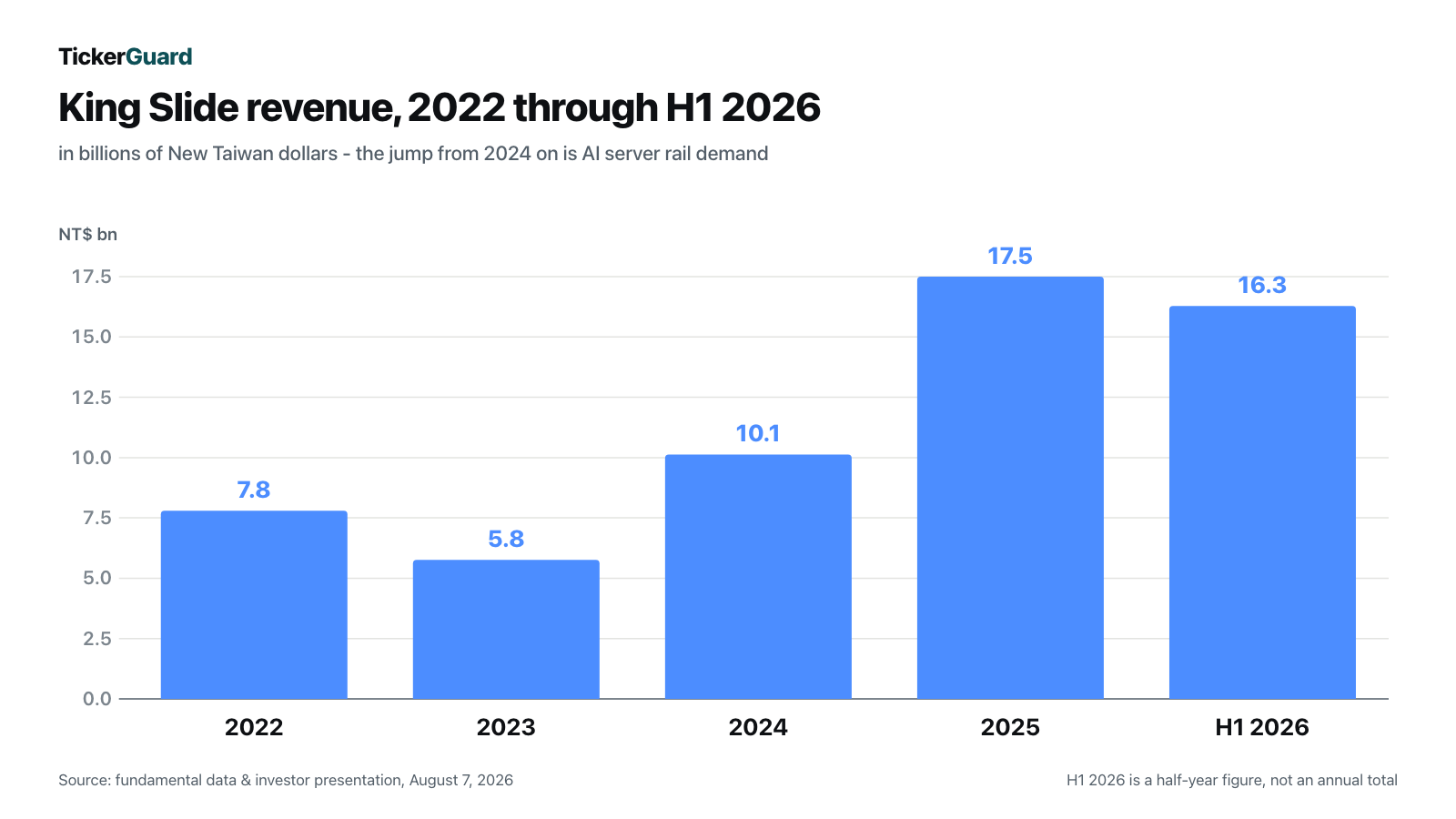
The first half of 2026 topped even that pace: TWD 16.28 billion in revenue in just six months, up 98.9 percent year over year. The second quarter of 2026 alone brought in TWD 10.83 billion — up 156.1 percent versus the second quarter of 2025 — at a gross margin that climbed to a record 87.42 percent. Net profit rose 1,054.2 percent in the same quarter to TWD 7.09 billion, earnings per share to TWD 74.38. In the first half of 2026 alone, King Slide earned TWD 110.96 per share — already more than the entire year of 2025, which brought in TWD 103.23.
What the Analyst Conferences Show — Without Official Transcripts
An honest caveat up front: for King Slide, there are no publicly available transcripts of analyst calls — unlike many U.S. stocks, where verbatim records of the question-and-answer sessions exist. Instead we reviewed the written investor presentation dated August 7, 2026, plus summaries of that day's analyst conference from Taiwanese financial portals (blog.fugle.tw, leveragetw.com). That is weaker evidence than a verbatim transcript — we flag that deliberately here rather than glossing over it.
What these summaries do show is still revealing. Asked whether an 87.4 percent gross margin would immediately trigger customer price negotiations, management reportedly answered, per these summaries, that there has been "daily pricing pressure for 20 years" and that the company counters it with "created added value" — no suggestion that the current margin is durably secured. Asked about margin sustainability for the third and fourth quarters of 2026, management pointed to "25 years of technical experience and innovation" and said results would be "not bad" — without naming a concrete figure. On currency sensitivity, the same sources report that a one-percent currency swing moves gross margin by roughly 0.5 to 0.6 percentage points; the main raw material is cold-rolled steel, not aluminum.
Several concrete developments were named: the Houston, Texas plant reportedly completed certification and successfully finished test production, with mass production planned for September 2026. In Taiwan, King Slide is reportedly planning its third and fifth expansion phases at an investment of roughly TWD 10 billion, moved up by about one and a half to two years versus the original schedule; the new 220,000-square-meter footprint is more than double phases one and two combined. On global demand, management pointed to expected growth in worldwide capital spending by major cloud providers from roughly $750 billion (2025) to roughly $1 trillion (2026) — a market figure, not a company-specific forecast. At the same time, individual chip-generation product cycles are reportedly getting shorter, per the same reports — from one to two years previously down to six to twelve months now — meaning every new generation requires newly engineered rails.
What the Filings Show — the Uncomfortable Truths
Uncomfortable Truth No. 1: A Currency Swing Nearly Ate an Entire Quarter's Profit
Anyone reading only annual figures misses how exposed a single quarter's result can be. In the second quarter of 2025, revenue (TWD 4.23 billion) and gross profit (TWD 3.28 billion) actually rose slightly versus the first quarter — and yet earnings per share collapsed from TWD 26.35 to just TWD 6.45. The reason is in the IFRS income statement in the investor presentation: a net foreign-exchange loss of TWD 2,243,341,000 in that single quarter — against an operating profit of TWD 2,966,083,000 in the same period. The currency loss consumed roughly three-quarters of operating profit before any taxes were even paid.
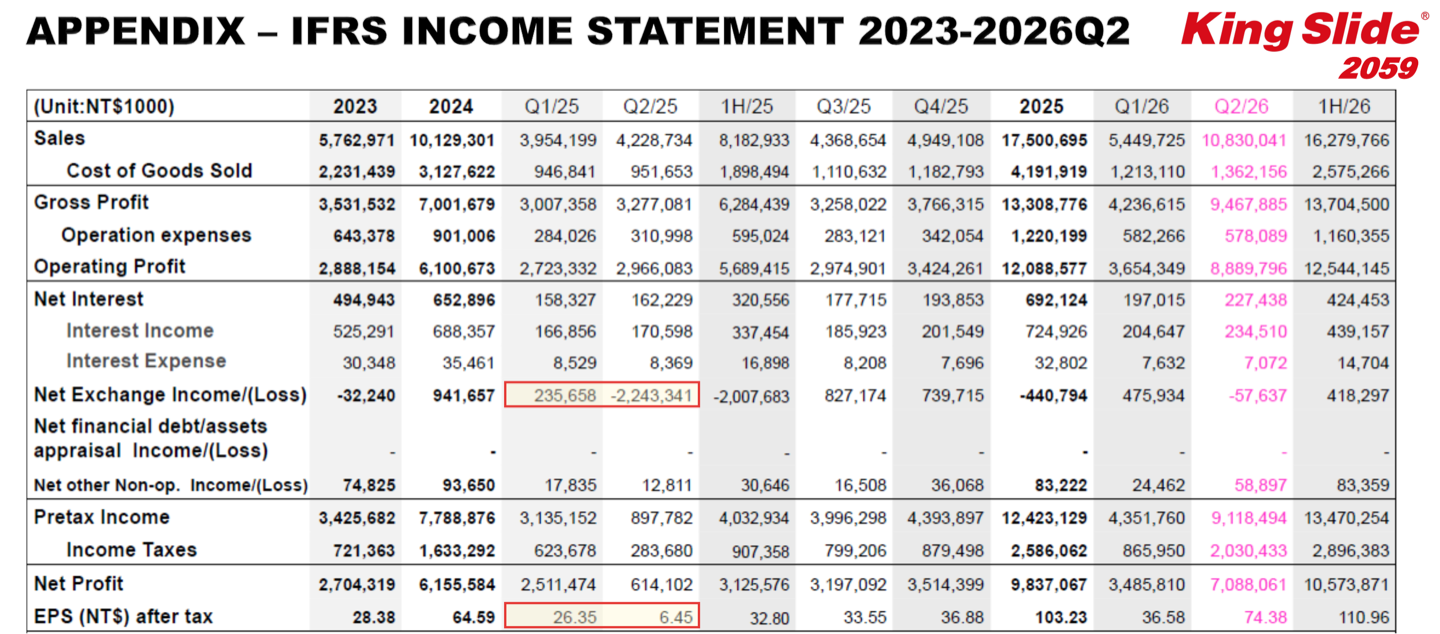
Per summaries of the August 7, 2026 analyst conference (blog.fugle.tw), management itself put the currency sensitivity of gross margin at roughly 0.5 to 0.6 percentage points per percentage point of currency movement — at a company that bears most of its costs in Taiwan dollars but invoices a growing share of revenue in U.S. dollars. None of the sources reviewed mention a systematic currency-hedging program. In the first half of 2026, the effect actually ran positive, with a net currency gain of TWD 418,297,000 — evidence that the line can swing in either direction, not evidence that it is under control.
Uncomfortable Truth No. 2: The Founding Business Has Shrunk to a Remnant — the Old Risk Spread Is Gone
King Slide started in 1986 as a maker of door handles, hinges, and furniture slides, and as recently as 2008 deliberately expanded its kitchen-cabinet business so as not to depend solely on the server business. That diversification is history today: per the segment breakdown in the investor presentation, exactly 97.87 percent of consolidated 2025 revenue came from "Rail Kit" (rail systems, overwhelmingly for servers), while hinges (0.89 percent), other products (1.21 percent), and classic slide rails (0.03 percent) together make up less than two percent.
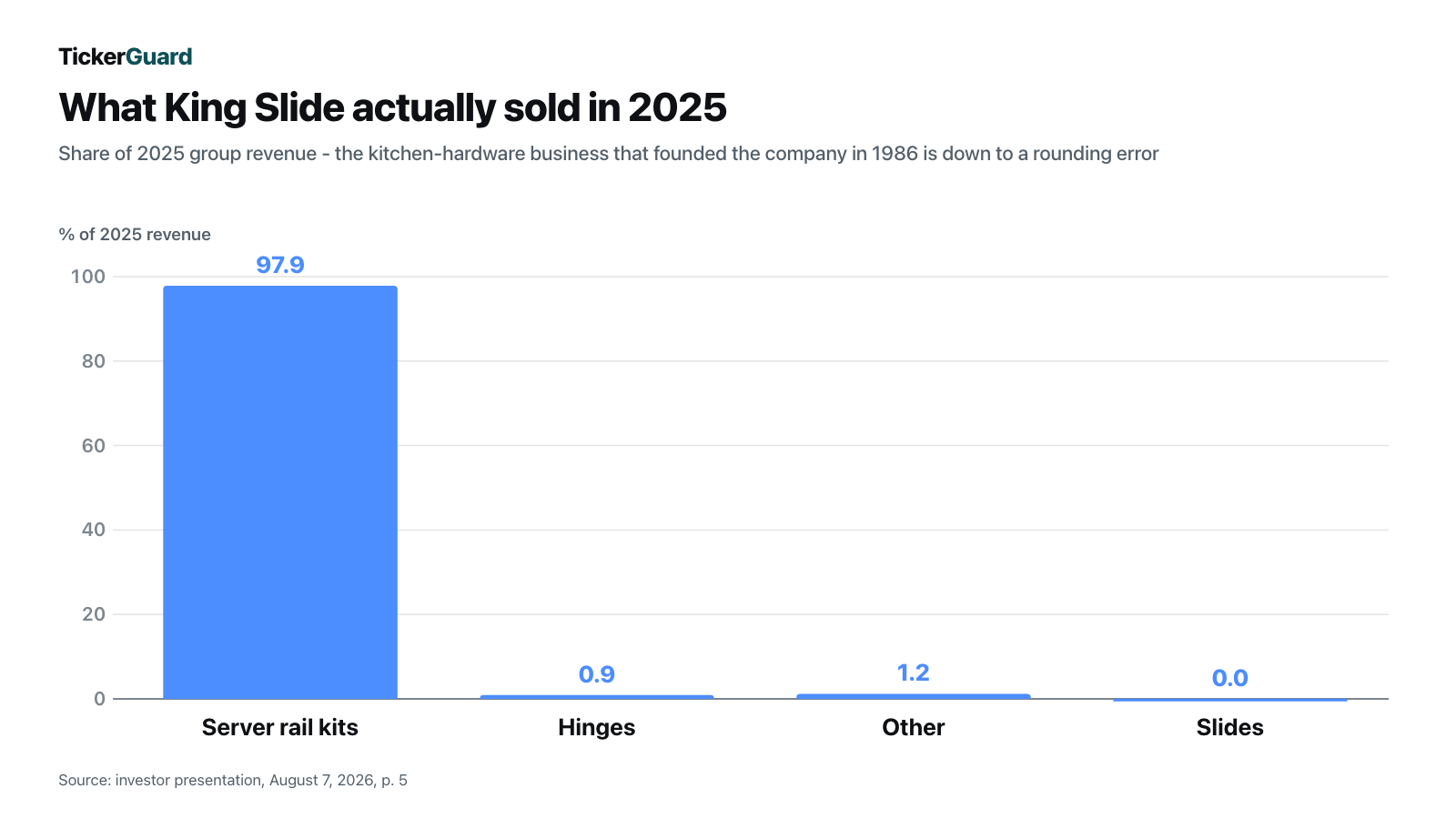
On the remaining kitchen-slide market, King Slide is also a minor player: per its own presentation, the company holds only about 2 percent market share there, while European makers Blum (50 percent) and Hettich (30 percent) dominate the market. King Slide's entire current scale — and with it, its founder's fortune — now depends almost entirely on a single end market: the capital-spending cycle of major cloud providers building AI data centers. That is not a footnote; it is the core of this stock's valuation question.
Uncomfortable Truth No. 3: A Record Margin Management Itself Won't Project Forward
An 87.42 percent gross margin in a single quarter is an extraordinary number for a company that manufactures physical metal rails — higher than most software companies post. That is exactly why it is notable how cautious management was, per the reviewed summaries of the analyst conference, when asked whether that level could hold: it avoided a concrete forecast for the third and fourth quarters of 2026 and instead pointed to "25 years of technical experience," without naming a figure. The presentation's own metrics table also shows that gross margin did not move in a straight line historically: from 76.1 percent in the first quarter of 2025, through 74.6 percent in the third quarter, to 87.4 percent in the second quarter of 2026 — a jump of more than 10 percentage points within a few quarters that management itself attributes to "economies of scale" and a "more favorable product mix," not to a structural repricing of its own pricing power. For a reader, that means: a pullback in margin to the still very high 2025 level (roughly 76 percent) would not be a sign of a broken business — it would be a return to a level the company itself would not describe as a low point.
Valuation — the Most Expensive Stock We Have Seen in a While
With 95,297,000 shares outstanding and a price of TWD 14,300 (August 28, 2026), market capitalization works out to roughly TWD 1.36 trillion — about $43.1 billion or €37.1 billion (exchange rates as of August 29, 2026). Based on the summed earnings per share of the last four quarters (33.55 + 36.88 + 36.58 + 74.38 = TWD 181.39), the price-to-earnings ratio works out to roughly 78.8 — close to the 79.8 figure reported by fundamental data. The price-to-sales ratio on trailing-twelve-month revenue stands at roughly 53, price-to-book at roughly 40 — by every one of these metrics, one of the most expensive stocks this newsroom has analyzed in recent months.
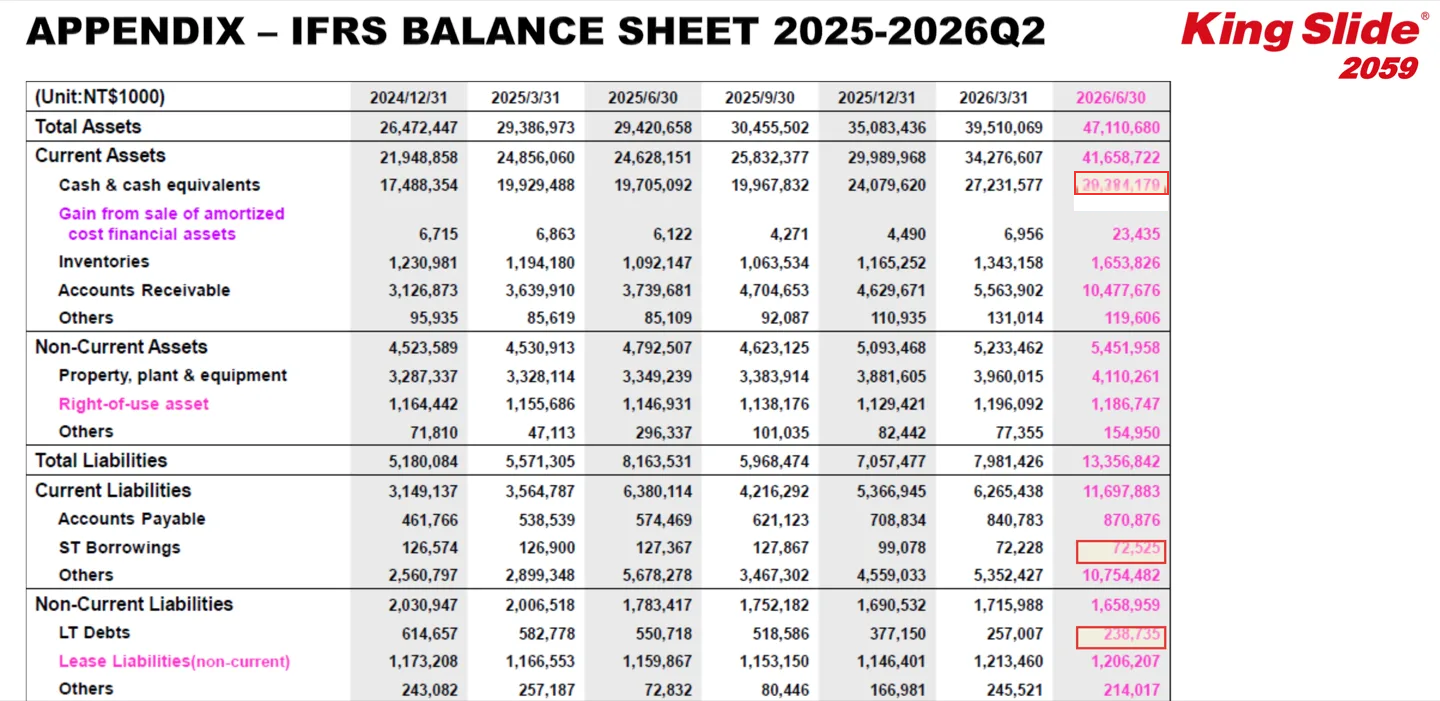
What makes the valuation more tolerable than at some other AI beneficiaries: there is an exceptionally solid balance sheet behind it. As of June 30, 2026, King Slide held TWD 29.38 billion in cash against short-term financial debt of just TWD 72.5 million and long-term debt of TWD 238.7 million — practically debt-free relative to its balance-sheet size.
The analyst consensus price target reported by fundamental data stands at TWD 14,129.5 — slightly below the current price, a sign that part of the analyst community already sees the valuation as stretched. The 2026 consensus earnings estimate of TWD 352.26 per share (fundamental data, multi-analyst consensus) implies a forward price-to-earnings ratio of roughly 40.6 — lower than the trailing P/E, but that is an estimate, not an already-delivered result, and it depends on the current margin level holding up at least partially through the second half of 2026.
Opportunities and Risks at a Glance
Opportunities: structurally growing end-market demand (AI servers require more elaborate, higher-value rails than classic servers, because more weight and more cooling capacity need to be moved), an immaculate balance sheet with high net liquidity, an already well-advanced capacity expansion in the U.S. (Houston) and Taiwan with concrete timelines, more than 3,750 granted patents as a barrier to entry, and management that has pursued the same premise for four decades: high-margin niche products over mass-market goods. Risks: a valuation that leaves practically no room for disappointment (trailing P/E of roughly 79); an earnings exposure to currency swings that wiped out nearly an entire quarter's profit in 2025; a near-total loss of the company's former product diversification, now that the kitchen-slide business has shrunk to under two percent of revenue; a record margin that management itself won't project forward; and a structural dependence on the capital-spending cycle of a handful of major cloud providers, whose spending plans can change at any time.
A Human Verdict
The story of Lin Tsung-chi is seductive precisely because it feels so complete: an elementary-school graduate who started as an apprentice at age ten, who forty years later becomes his country's richest person as his stock rushes past a symbolic price milestone. But that very completeness makes the real lesson harder than a simple "success story, so buy": revenue really has exploded, margin really is extraordinarily high, the balance sheet really is robust — and yet a single quarter from 2025 shows how quickly a currency swing can eat almost an entire profit, and the company has concentrated so completely on one end-market story in recent years that the old risk spread no longer exists. Anyone buying in today at TWD 14,300 is no longer buying the catch-up story of an underestimated niche manufacturer — they are already paying for a slice of a future that has to keep unfolding exactly as rosily as the current price assumes. What you make of that is your call. And that's a good thing. No buy or sell recommendation.
Sources
This analysis draws on: King Slide Works Co., Ltd.'s investor presentation dated August 7, 2026 (kingslide.com, 32 pages, including an IFRS balance sheet, income statement and cash flow appendix 2005-2026Q2); the investor-relations pages of kingslide.com; summaries of the August 7, 2026 analyst conference by Taiwanese financial portals blog.fugle.tw and leveragetw.com; press coverage of the founder's biography and his ranking as Taiwan's richest person (bnext.com.tw, Aug. 11, 2026); press coverage of the plant expansion and market environment (finance.technews.tw, digitimes.com); and fundamental data (balance sheet, income statement, price and valuation metrics, as of August 28-29, 2026). No publicly available analyst-call transcripts exist for 2059.TW. Note: this analysis is journalistic interpretation of publicly available information, not investment advice and not a buy or sell recommendation.
Our Bottom Line at a Glance
- Growth positive
- Revenue rose 72.8 percent in 2025 to TWD 17.50 billion; the first half of 2026 already added TWD 16.28 billion — 93 percent of the entire prior-year revenue. Growth is carried by AI-server rack demand from major cloud providers.
- Currency risk negative
- In the second quarter of 2025, a net foreign-exchange loss of TWD 2.24 billion wiped out roughly three-quarters of operating profit and dragged earnings per share down by more than three-quarters, even though the operating business grew over the same period. No evidence of systematic hedging in the sources reviewed.
- End-market and product concentration negative
- Server rail systems already made up 97.87 percent of revenue in 2025; the former kitchen-slide business has shrunk to under two percent. The old risk spread across two end markets effectively no longer exists — King Slide's fate now hangs almost entirely on the capital-spending cycle of a handful of major cloud providers.
- Balance sheet and liquidity positive
- Practically debt-free: short-term financial debt of just TWD 72.5 million, long-term debt of TWD 238.7 million, against cash of TWD 29.38 billion (June 30, 2026). The balance sheet carries the ongoing capacity expansion in the U.S. and Taiwan without visible financing pressure.
- Valuation negative
- At TWD 14,300 (August 28, 2026) and summed trailing-four-quarter earnings per share of TWD 181.39, the stock trades at a P/E ratio near 79, a P/S ratio near 53, and a P/B ratio near 40 — by every classic metric, one of the most expensive stocks this newsroom has recently analyzed. The analyst consensus price target sits slightly below the current price.
- Margin durability neutral
- Gross margin climbed from 74.6 to 87.4 percent (record, Q2 2026) within a few quarters — an extraordinary jump that management itself declined to project forward, pointing instead to daily pricing pressure over 20 years. No verbatim analyst-call transcripts available, only a written investor presentation and press summaries.
King Slide is operationally delivering on what the record stock price promises: 72.8 percent revenue growth in 2025, a gross margin that climbed to 87.4 percent in the second quarter of 2026, and a practically debt-free balance sheet. But a single quarter from 2025 shows how quickly a currency swing can wipe out nearly an entire profit, the former secondary business has shrunk to a remnant, and the valuation leaves little room for disappointment at a P/E near 79. Not investment advice.
What Our Rating Means
Open questions
The business works in principle, but one material question is open. As long as it stays open, our findings do not carry a quality verdict.
Yellow here is not about an existential question — the balance sheet is practically debt-free, the cash pile of TWD 29.38 billion (June 30, 2026) is well stocked, the company has four decades of history including survived downturns (revenue still fell 26 percent in 2023), and it pays dividends reliably. Yellow stands because two operating questions remain open that are central to the durability of the current valuation: first, the second quarter of 2025 shows exactly how exposed earnings are to currency swings, without any visible systematic hedging program — a line that wiped out nearly an entire quarter's profit in 2025 is not a theoretical risk. Second, the current record margin of 87.4 percent is not yet proven durable: management itself avoided a concrete forecast at the August 7, 2026 analyst conference and pointed to ongoing customer pricing pressure. The business model itself — niche leadership in demanding server rail systems with high patent density and a documented capacity expansion — clearly holds up; whether the margin holds at this level, and how the company handles its near-total concentration on a single end market through the next downturn in the AI investment cycle, will show at the earliest in the Q3 2026 report.
A journalistic assessment by our editorial team at the time of the deep dive, based on public sources — not investment advice and not a solicitation to buy or sell. Your personal circumstances (investment goals, risk capacity, taxes) cannot be taken into account. What our levels mean, how verdicts are formed, and what conflicts of interest exist →
Worth Noting
- This analysis first appeared on 2026-08-30. All company figures come from the investor presentation dated August 7, 2026 (most recent period report reviewed, figures as of June 30, 2026) — not from press reports. Price, share count, and valuation metrics carry an as-of date of August 28-29, 2026; the trailing-twelve-month earnings per share was added up by us from the four most recently reported quarterly figures, not taken unchecked from a data feed.
- No publicly available analyst-call transcripts exist for 2059.TW (checked 2026-08-29: transcripts:sync returned no hits). The chapter on the analyst conference therefore relies on written presentation material and summaries by Taiwanese financial portals rather than verbatim transcripts.
- Press coverage of the founder's biography and his ranking as Taiwan's richest person (bnext.com.tw) is an external, named source with a date — it does not come from King Slide's own corporate reports and is labeled accordingly. The wealth estimate is a press estimate, not an audited figure.
The full analysis as a PDF for later
We will send you this analysis as a PDF — to print, file away, and read at your own pace.
Frequently Asked Questions
King Slide Works Co., Ltd. (TWSE: 2059), based in Kaohsiung, Taiwan, builds precision ball-bearing rail systems that guide server, network, and storage modules in and out of data center racks, plus cable management arms. The company started in 1986 as a maker of furniture and kitchen slides; today 97.87 percent of revenue (2025) comes from server rail systems.
No. King Slide describes itself in its own investor presentation as a maker of mechanical rail systems, not an AI provider. "Cloud Computing, AI and Big Data" are named there explicitly as demand drivers for its customers, not as a property of its own products. The company benefits from the fact that its customers — major cloud providers — build servers for AI data centers, and every one of those servers needs a rail.
King Slide is listed on the Taiwan Stock Exchange, not in the United States — there is no SEC registration, no 10-K, no 10-Q. Instead the company must file annual and half-year reports plus investor presentations, published through the Taiwan Stock Exchange and its own investor-relations page. This analysis draws on the investor presentation dated August 7, 2026, with a full IFRS numbers appendix going back to 2005.
Significantly: in the second quarter of 2025, a net foreign-exchange loss of TWD 2.24 billion wiped out most of operating profit and dragged earnings per share down from TWD 26.35 to TWD 6.45 — even though revenue and gross profit actually rose slightly in the same quarter. Per summaries of the August 7, 2026 analyst conference, a one-percent currency swing moves gross margin by roughly 0.5 to 0.6 percentage points.
Yes: for fiscal year 2025, a dividend of TWD 51 per share was declared, with an ex-dividend date of August 27, 2026 (reference price TWD 14,459.0). For fiscal year 2024 it was TWD 32.20 per share. The dividend yield sits below one percent given the high share price.
At a price of TWD 14,300 (August 28, 2026) and summed earnings per share of TWD 181.39 over the last four quarters, the price-to-earnings ratio works out to roughly 79. The price-to-sales ratio stands at roughly 53, price-to-book at roughly 40 — a very high valuation by every one of these metrics.
Lin Tsung-chi was born in Kaohsiung in 1941, started working as a furniture-factory apprentice at age ten, and attended only elementary school. He founded King Slide in 1986, initially as a maker of door handles and furniture slides. On August 11, 2026, press estimates (bnext.com.tw) put his fortune at roughly $16.7 billion and named him Taiwan's richest person.
It has shrunk to a remnant: in 2025, kitchen slides together with the hinge business made up only about 2 percent of consolidated revenue, versus 97.87 percent for server rail systems. On the remaining kitchen-slide market, King Slide holds only about 2 percent market share by its own account, while European makers Blum (50 percent) and Hettich (30 percent) dominate.
Found an error?
Did you spot a factual error, an outdated number, or a typo in this deep dive? Let us know briefly — your report goes straight to the editorial team.