Kestrel Group: the 2025 Profit Was Made by the Accountant — and One Client Brings in 86 Percent of the Fees
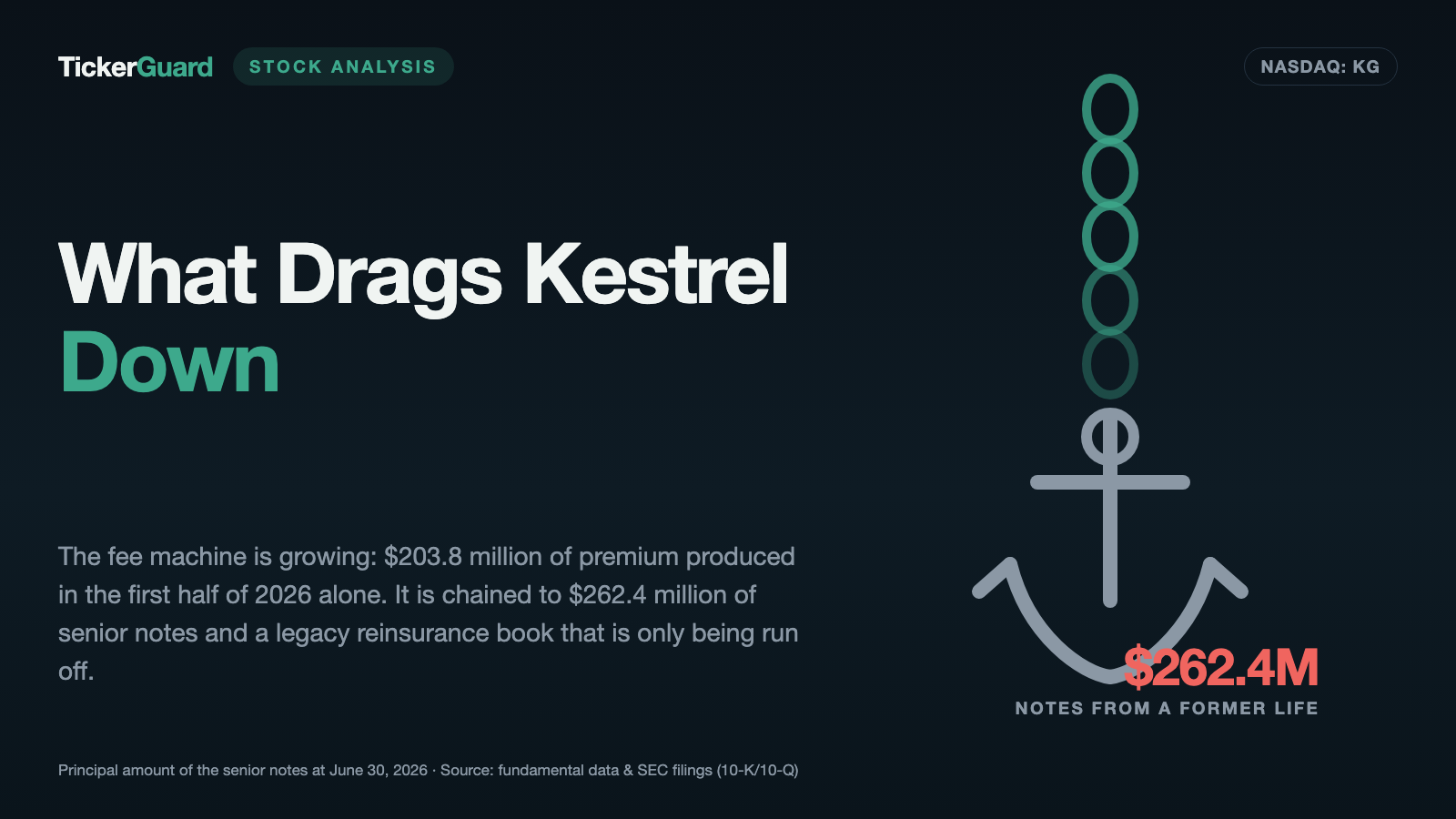
On paper Kestrel Group looks like a bargain: $46.7 million of net income for 2025, $8.08 per share, against a market value of roughly $60 million. The annual report filed with the U.S. securities regulator, the SEC, settles the riddle in a single sentence: $68.3 million of that figure was a one-off accounting gain from the merger with Maiden Holdings. Strip it out and a $21.6 million loss remains. Underneath sits a growing fee machine that already produced $203.8 million of premium in the first half of 2026 — chained to $262.4 million of notes the bond market now values at $120.8 million. We read the filings to find out what this company actually lives on, and who sits at the other end of the chain.
 Thomas Mücke
Founder & Publisher
Thomas Mücke
Founder & Publisher
As of Today
As of: October 7, 2026
- Closing price
- 5.10 $ 0.00%
- Market Capitalisation
- 40.0 $M
- Growth Score
- 4/10
- AAQS
- 2/10
Price change since August 21, 2026: -33.9%
This analysis has a cut-off date. The Stock Guard tells you when something material changes in the numbers. Reserve your free spot
Chart
Interactive price chart (TradingView).
52-week range: 4.90 $ to 26.20 $ · Last price: 5.10 $ (As of: October 7, 2026)
Note: pure fact-based analysis, not investment advice and not a solicitation to buy or sell. All figures without guarantee.
There is an investor trap that needs no greed and works all the more reliably for it: the bottom-line trap. It goes like this. You see a number at the foot of the table — net income, earnings per share — and your brain files it as a fact. At Kestrel Group Ltd (NASDAQ: KG) that number reads: $46.7 million of net income for 2025, or $8.08 per share. The company's market value on August 21, 2026 was roughly $60 million (fundamental data). Put those two lines side by side and you appear to have a stock that costs less than a single year of profit. That is usually where the thinking stops. So let us make a deal: before you believe the number, we will read together what Kestrel itself told the U.S. securities regulator, the SEC — the annual report on Form 10-K for 2025, the quarterly report on Form 10-Q for the period ended June 30, 2026, and the current reports on Form 8-K in between. SEC filings are honest under threat of penalty. And this one resolves the riddle in a single sentence. What you make of it is your call.
What Kestrel Group Actually Does — a Fee Business Built on Borrowed Licences
Kestrel Group has been what it is today since May 27, 2025. On that day Kestrel Group LLC — a small, young specialty services firm from Austin, Texas — combined with Maiden Holdings, a Bermuda reinsurer whose actual business has been in run-off since 2019. Maiden shares stopped trading on Nasdaq at the close on May 27; the next morning trading began under the ticker KG. The company is based in Hamilton, Bermuda, and had 44 employees as of March 6, 2026, spread across Bermuda, the United States, the United Kingdom, Germany and Sweden.
What does it do? Two very different things, and you only understand Kestrel once you hold them apart.
The first business is called Program Services and is what the industry calls fronting. Picture a tradesman who holds a master craftsman's licence but does not want to take on jobs himself. Instead he lends the licence to others who work on their own account — and takes a slice of every contract. That is exactly what Kestrel does with insurance licences. Managing general agencies, or MGAs, and capacity providers that lack a U.S. licence or a strong enough rating can issue policies through Kestrel's partner carriers. Kestrel charges fees of generally up to about 5 percent of gross written premium and shares that fee with the licence owner. The underwriting risk is borne overwhelmingly by the capacity providers, not by Kestrel. Capital-light, high-margin — and, as we will see, hanging by a single thread.
Because the licences are not Kestrel's. The annual report names all four carriers: Sierra Specialty, Rochdale Insurance, Park National Insurance and Republic Fire and Casualty — each rated A- ("Excellent") by A.M. Best, and each a subsidiary of AmTrust Financial Services. Kestrel itself has no financial strength rating at all; the annual report says so plainly. Kestrel holds an option to buy the AmTrust carriers within three years of the merger — an option, not a contract. And AmTrust is at the same time a significant shareholder in Kestrel.
The second business is called Legacy Reinsurance and is Maiden's inheritance: a reinsurance book that has written no new business since January 1, 2019 and is only being run off. At June 30, 2026 it carried $554.3 million of loss reserves, of which $478.8 million related to contracts with affiliates — that is, with AmTrust. Which names the central tension of this analysis, and it runs through every chapter: a small, fast-growing fee business is chained to a large, shrinking legacy book — and both ends of the chain lead to the same two counterparties.
Company history for investors
-
2019
The reinsurance business goes into run-off
New business with AmTrust ends on January 1, 2019 and in July Maiden transfers loss reserves to Cavello. What fills Kestrel's balance sheet today stopped earning money then — it only cost.
-
2024
The combination is announced
On December 30, 2024 Kestrel Group LLC and Maiden Holdings announce their tie-up. For Maiden shareholders it meant swapping a run-off case for a growth story burdened with legacy liabilities.
-
2025
Maiden Holdings becomes Kestrel Group
The combination closes on May 27, 2025 and trading under KG begins the next day. Fair value accounting produced the $68.3 million bargain purchase gain that shaped the full-year result.
-
2025
Old Kestrel accounts for 2023 and 2024 withdrawn
On August 11, 2025 the audit committee declares earlier financial statements unreliable and identifies a material weakness in revenue recognition — at the heart of the fee business.
-
2026
A first annual report of its own — and an auditor change
Kestrel files its Form 10-K for 2025 on March 13, 2026; barely two weeks later Ernst & Young is dismissed and Grant Thornton engaged. No disagreements were reported.
-
2026
First half of 2026: more fees, a bigger loss
Premium produced of $203.8 million exceeds the whole of the prior year while the half-year loss reaches $15.5 million. Book value per share fell from $16.57 to $14.57 in six months.
How the Stock Landed on Our Desk
Kestrel Group did not reach our research list through a valuation or momentum filter but through our in-house Reddit hype scanner, which flags unusual clusters of mentions in retail forums — as of August 23, 2026. Honesty requires a footnote: when we cross-checked the public mention list (ApeWisdom) the same day, KG no longer appeared on it. The hype was over before we had opened the first page of the annual report. That is not a curiosity but the norm: forum attention is heat lightning, not a compass.
What makes the stock interesting anyway are the ratios a screener throws out for it — and almost all of them mislead. Earnings per share of $8.08 for 2025 against a single-digit share price looks like a price-to-earnings ratio below 1. A price-to-book ratio of roughly 0.5 looks like a classic value find. Both need explaining, and the explanation is not in the screener but in the notes. Keep the finding in mind from the start: at Kestrel, every ratio is only as good as the footnote beneath it.
The Numbers Over the Years — Fairly Credited
Let us start with what genuinely speaks for this company — and that is more than the red ink suggests. The fee business is growing quickly.
The metric Kestrel itself uses for its program business is premium produced — the premium written by its clients, from which the fee is derived. It rose from $103.8 million in 2024 to $188.3 million in 2025. Then came 2026: the first half alone brought $203.8 million, more than the whole of the prior year, including $109.6 million in the second quarter. Fee revenue followed: $3.6 million in 2024, $6.1 million in 2025, $6.9 million in the first half of 2026 alone. Segment fee income — fees less allocated administrative costs — reached $4.0 million in the first half of 2026, against $12,000 in the same period a year earlier. That is real, capital-light growth, and it should not be talked down.
The second serious asset sits in the tax code. From the Maiden past the group carries $471.6 million of net operating loss carryforwards as of June 30, 2026, $88.2 million of which never expire. Together with other items that produces a net U.S. deferred tax asset of $139.9 million, or $17.88 per share — carried at zero on the balance sheet because a full valuation allowance is held against it. For comparison: book value per share on the same date was $14.57. Should Kestrel ever earn sustained profits, releasing that allowance alone would more than double book value. That is precisely what management's stated strategy is aiming at.
And now the number we started with. Look closely and 2025 net income of $46.7 million splits into two very unequal parts:
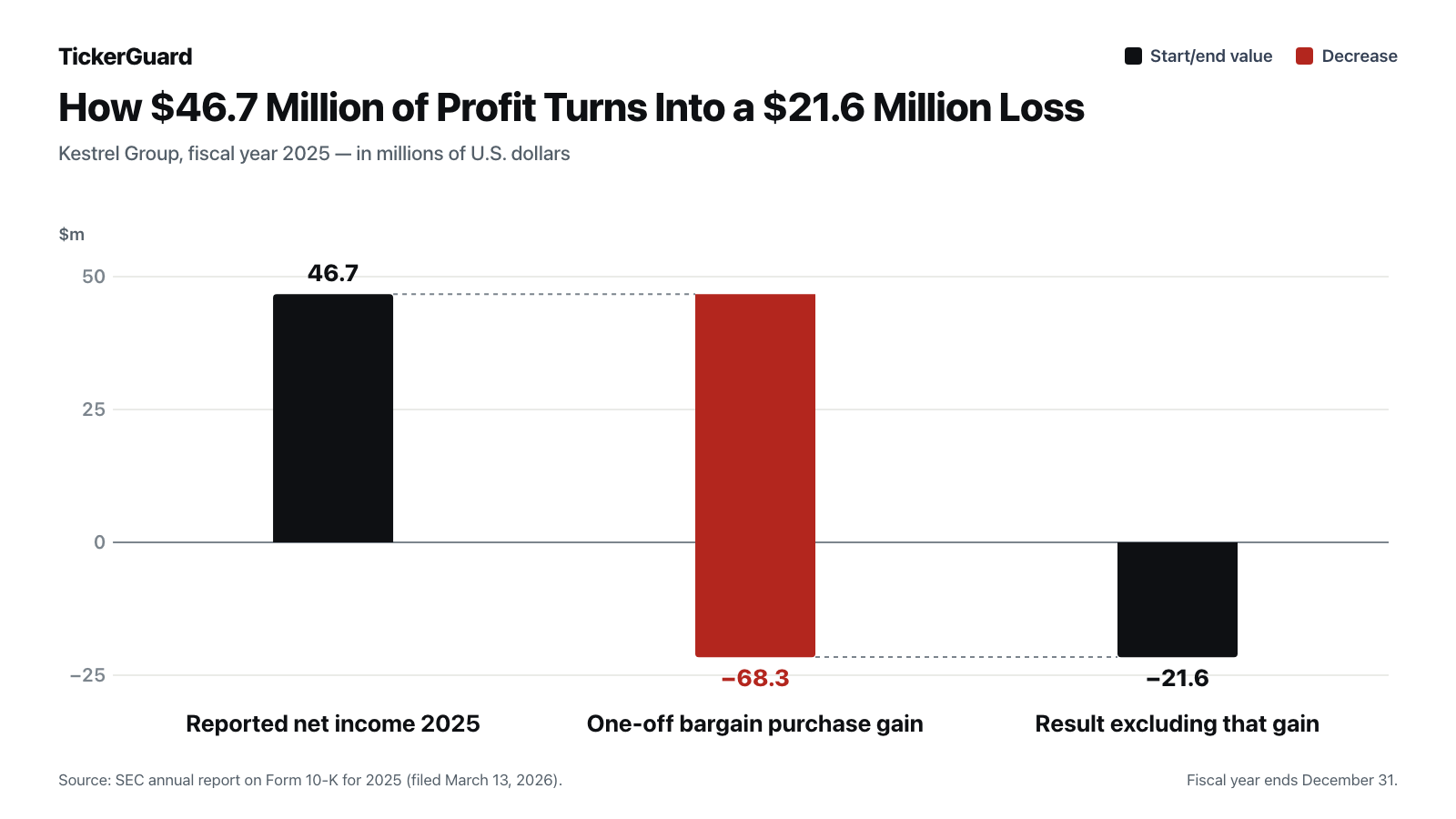
Management reads it the same way internally. Its own measure, adjusted for one-off items, shows an operating loss of $13.8 million for 2025 (minus $2.41 per share) and $17.4 million for the first half of 2026 (minus $2.23 per share). And the simplest test of all gives the same picture: in the first half of 2026, total revenues of $16.9 million met general and administrative expenses of $22.7 million — overhead alone costs more than the whole house takes in. Add $8.1 million of interest and amortization expense. The bottom line: a $15.5 million loss for the half year, $8.1 million of it in the second quarter.
What the Filings Say — the Uncomfortable Truths
Uncomfortable truth no. 1: the 2025 profit never sat in a bank account
When two companies merge and the buyer pays less for the acquired assets than those assets are worth under fair value rules, the difference must be booked immediately as income. The term of art is gain on bargain purchase. Not a cent of cash moves. It is an entry, not a business. At Kestrel that item came to $68.3 million for 2025. The annual report spells out the consequence itself:
"Excluding the gain on bargain purchase, the Company incurred a net loss of $21.6 million for the year ended December 31, 2025 compared to a net loss of $1.3 million for 2024."
— Kestrel Group Ltd, Form 10-K for 2025, "Results of Operations"

A gain of this kind is no scandal, incidentally — it is mandatory when a business is acquired below fair value. But it says something: the market thought Maiden was worth less than the accounting rules assign to its assets. Anyone celebrating the gain is, at heart, celebrating the fact that nobody else would pay more.
Uncomfortable truth no. 2: 85.8 percent of fees come from one client program
The growth in the fee business is real — but it is not broad. It is one customer. The quarterly report for the period ended June 30, 2026 puts it bluntly: "Kestrel's revenue is highly concentrated because of a capacity distribution agreement with an individual single customer." In numbers: in the second quarter of 2026, 85.8 percent of all fee revenue came from that one program, and 82.0 percent in the first half. A year earlier the figures were 33.5 and 39.5 percent. Growth has not diluted the dependency — it has deepened it.
"Program services revenue is presently highly concentrated due to capacity distribution agreements with two client programs representing 82.0% and 9.9% of total fee revenue earned in the six months ended June 30, 2026, respectively."
— Kestrel Group Ltd, Form 10-Q for the period ended June 30, 2026, "Program Services"

In fairness, Kestrel discloses that this one large client comprises twelve separate sub-programs and that no single one accounts for more than 30 percent of fee revenue. That softens the risk without removing it — a contract is a contract, and it can end as a whole. Beneath it lies a second layer of the same dependency: what Kestrel sells is access to four insurance carriers owned by AmTrust. If their rating falls, the product falls. The annual report lists that as a risk itself. What you are buying here is not a business with many customers but an intermediary position between two large parties.
Uncomfortable truth no. 3: $459.8 million hangs on one reinsurer — which disputes part of it
Now it gets serious on the balance sheet. Much of the old Maiden book has been passed on: in 2019 Maiden Reinsurance transferred loss reserves to Cavello Bay Reinsurance, a subsidiary of run-off specialist Enstar Group. What sits in Kestrel's balance sheet is therefore no longer a liability but a receivable: Kestrel pays the claims and recovers the money from Cavello. At December 31, 2025 that amounted to $459.8 million — $427.0 million under the run-off agreement and $32.8 million under a retrocession. At June 30, 2026, total reinsurance recoverables on unpaid losses stood at $412.1 million.
Set those figures next to shareholders' equity: $114.0 million at June 30, 2026. The receivable from a single counterparty is roughly four times total equity. And that counterparty has raised objections:
"Cavello asserts that $46.7 million in identified claims and approximately $25.0 million in potential additional claims would fall outside the applicable coverage and reserves all of its rights under the applicable agreements if these matters are not resolved."
— Kestrel Group Ltd, Form 10-K for 2025, Note 8 "Reinsurance"

For balance, and without alarmism: Cavello has posted collateral in the form of letters of credit — $362.5 million was required at December 31, 2025. S&P affirmed Enstar at BBB+ on February 13, 2026 and Cavello itself at A. This is not an insolvent counterparty but a dispute over the scope of coverage. Still: $71.7 million in dispute is more than 60 percent of shareholders' equity. At that scale, the outcome is no longer a footnote.
Uncomfortable truth no. 4: the bond market pays 46 cents on the dollar for the debt
Two listed bonds come from the Maiden past: 6.625 percent due 2046 for $110.0 million and 7.75 percent due 2043 for $152.4 million — $262.4 million of principal in total. They are carried at $175.0 million because they were recorded at fair value at the merger. What investors actually pay for them must be disclosed in the notes — and that may be the most honest figure in the whole report:
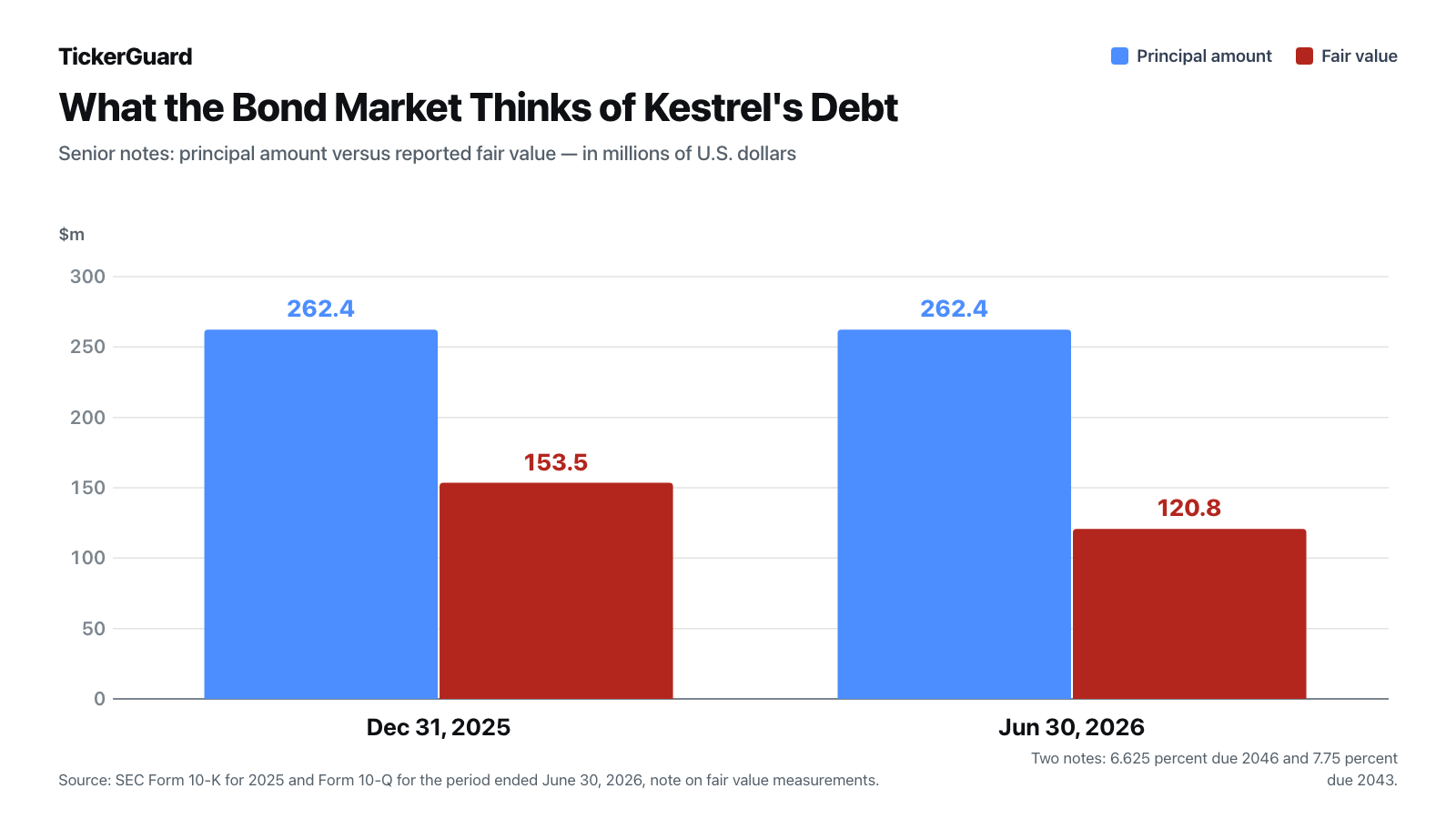
That is a double signal, and both sides deserve naming. First: bondholders rank ahead of shareholders. If they will pay only 46 cents, they consider full repayment at par unlikely — a vote of no confidence in the balance sheet, not in the fee machine. Second: that very discount is an opportunity. A company able to buy back its own notes at 46 cents retires a dollar of debt for 46 cents. It just needs the money — and that is where it gets thin.
"At June 30, 2026, unrestricted cash, cash equivalents and fixed maturity investments were $23.3 million compared to $35.0 million held at December 31, 2025, a decrease of $11.7 million for the six months ended June 30, 2026."
— Kestrel Group Ltd, Form 10-Q for the period ended June 30, 2026, "Liquidity and Capital Resources"

Management states explicitly that liquidity is sufficient for the next twelve months — negative operating cash flow (a $41.0 million outflow in the half year) is expected to be offset by inflows from running down the investment portfolio. That is plausible for as long as investments can be sold. But the filing names the weak point itself: the further the legacy book melts down, the more the remaining assets consist of illiquid holdings. At June 30, 2026, $151.7 million sat in level 3 — the category without observable market prices, whose value has to be estimated. That is more than total shareholders' equity. On top of that, every distribution to the holding company depends on approval from the Vermont insurance regulator, because the money sits in the regulated subsidiary Maiden Reinsurance.
One word on the history, because honesty demands it. On August 11, 2025 Kestrel had to declare the accounts of the old Kestrel Group LLC for 2023 and 2024 no longer reliable — errors in the timing of revenue recognition on certain service contracts, together with a material weakness in internal control over exactly that revenue recognition. That chapter is closed: the auditor gave internal control over financial reporting a clean opinion as of December 31, 2025. It still belongs in the picture, as does the auditor change on April 1, 2026 — barely two weeks after signing off on 2025, Ernst & Young was dismissed and Grant Thornton engaged; no disagreements were reported.
Valuation — the Order of Magnitude
A price-to-earnings ratio cannot be formed meaningfully here: the 2025 profit was an accounting entry, and the twelve months since have been loss-making. That leaves book value. At June 30, 2026 it was $14.57 per share, or $13.31 diluted. Market value on August 21, 2026 was roughly $60 million on 7,824,030 shares outstanding (fundamental data) — so the stock traded at a little over half of book. Discounts like that do not appear without reason; they are a price tag on uncertainty, not a coupon. We have described a very similar pattern at another company that earns money on someone else's balance sheet: our analysis of Pathward Financial shows how heavily such intermediary models depend on the counterparty.
On the other side of the scales sit three things that cannot be waved away. First, the unrecognised tax asset of $17.88 per share — more than the share price. Second, the discount on the company's own bonds, which would make any repayment work disproportionately hard. Third, the fee business, whose segment income swung from essentially zero to $4.0 million between the first halves of 2025 and 2026. Buying here is a bet that the small healthy business grows faster than the large sick one shrinks — and that $262.4 million of notes maturing in 2043 and 2046 can be serviced.
One warning belongs to the trading itself and has nothing to do with the company: the free float was roughly 1.6 million shares on August 21, 2026 (fundamental data). On a base that narrow, even small orders move the price noticeably — in both directions. The twelve-month range ran from $7.51 to $29.13. Anyone who values reliable execution should factor that in. How closely regulation and business model are intertwined at insurers is something we also took apart in our analysis of Citizens Inc.
Opportunities and Risks at a Glance
Opportunities
- The fee business is growing fast and consumes little capital: premium produced rose from $103.8 million in 2024 to $188.3 million in 2025 and $203.8 million in the first half of 2026 alone; segment fee income reached $4.0 million in the half year against $12,000 a year earlier.
- A tax asset carried at zero: $471.6 million of loss carryforwards produce a deferred tax asset of $139.9 million, or $17.88 per share, at June 30, 2026 — fully reserved against. Sustained profits would make it visible step by step.
- The bond discount cuts both ways: $262.4 million of principal against $120.8 million of fair value at June 30, 2026. Every repurchase below par raises book value per share.
- A call option on its own suppliers: Kestrel may acquire the four AmTrust carriers within three years of the May 27, 2025 merger — which would dissolve the biggest structural dependency.
- Book value sits well above the share price: $14.57 per share at June 30, 2026, against a market value of roughly $60 million on 7,824,030 shares as of August 21, 2026.
Risks
- One customer, one supplier: 85.8 percent of fee revenue from a single client program in the second quarter of 2026, and the licences and ratings being sold belong to AmTrust. A contract ending or a rating downgrade would hit the entire growth business directly.
- Underlying earnings are negative: a $21.6 million loss in 2025 excluding the accounting gain, $15.5 million in the first half of 2026; general and administrative expenses of $22.7 million against total revenues of $16.9 million in the half year.
- One counterparty carries half the balance sheet risk: $459.8 million recoverable from Cavello at December 31, 2025, up to $71.7 million of it disputed — more than 60 percent of shareholders' equity of $114.0 million at June 30, 2026.
- Debt and liquidity do not match: $262.4 million of notes against $23.3 million of unrestricted funds at June 30, 2026, $11.3 million of interest expense in 2025, and a debt-to-total-capital ratio of 69.7 percent. Distributions from the regulated subsidiary require approval from the Vermont regulator.
- Hard-to-value assets and live bondholder litigation: $151.7 million in level 3 at June 30, 2026; at the same time two bondholders continue to pursue, before the New York appellate court, an attempt to accelerate the $152.4 million note — the complaint was dismissed on June 17, 2025 and the appellants filed their brief on April 8, 2026.
- A thin market: roughly 1.6 million shares of free float as of August 21, 2026, with a twelve-month range of $7.51 to $29.13.
A Human Conclusion
Back to the bottom-line trap. Its cunning is not that the number is wrong — $46.7 million of profit belongs in the report, under rules that apply to everyone. Its cunning is that it answers a question you never asked. You wanted to know: does this company make money? The bottom line answered: how did shareholders' equity change in the year of the merger? Two entirely different questions, one number.
Put the number aside and what remains is an unusually candid company in an unusually uncomfortable position. It tells you itself that one client brings in 86 percent of its fees. It writes down itself what was left without the accounting gain. It discloses itself that the bond market gives its debt only 46 cents on the dollar. None of it had to be dug out — it only had to be read. And then you face the real question, which no ratio answers: do you believe a 44-person company can work off a $262 million debt inheritance while running its only healthy business on a major shareholder's licence and keeping one of its largest debtors in a legal dispute? If yes, the discount to book value is your margin of safety. If no, it is the warning somebody wrote down for you voluntarily. What you make of it is your call. And that is exactly as it should be.
Sources
Every original document used in this analysis, for you to read yourself:
- Kestrel Group Ltd — SEC Form 10-K for 2025 (filed March 13, 2026)
- Kestrel Group Ltd — SEC Form 10-Q for the period ended June 30, 2026 (filed August 7, 2026)
- Kestrel Group Ltd — SEC Form 10-Q for the period ended March 31, 2026 (filed May 8, 2026)
- Kestrel Group Ltd — SEC proxy statement DEF 14A for the 2026 annual general meeting (filed April 24, 2026)
- Kestrel Group Ltd — SEC Form 8-K filed August 11, 2025 (Item 4.02, non-reliance on previously issued financial statements)
- Kestrel Group Ltd — SEC Form 8-K filed April 6, 2026 (Item 4.01, change of certifying accountant)
- Kestrel Group Ltd — SEC Form 8-K filed June 8, 2026 (Item 8.01, final award in the GLS arbitration)
- Kestrel Group Ltd — SEC Form 8-K filed May 14, 2026 (Item 5.02, performance-based share awards)
- Complete SEC filing history for Kestrel Group Ltd: EDGAR overview (sec.gov)
- Fundamental data (price, market value, free float, twelve-month range; as of August 21, 2026), reconciled with the SEC filings.
- Origin: our in-house Reddit hype scanner, flagged August 23, 2026; a cross-check of the public mention list (ApeWisdom) the same day returned no entry.
Transparency & disclaimer: this analysis is journalistic commentary on publicly available information. It is not investment advice, not a regulated financial analysis and not a solicitation to buy or sell securities. Equity investments carry substantial risk up to and including total loss. All information is provided without warranty; the as-of date of every figure is stated in the text. Positions held by the operator are disclosed daily; where one exists, it appears as a notice at the top of this deep dive.
Key figures at a glance
All monetary figures in millions of $; earnings per share as reported.
| Metric | 2021 | 2022 | 2023 | 2024 | 2025 |
|---|---|---|---|---|---|
| Revenue | 98.7 | 58.1 | 1.3 | 3.8 | 34.0 |
| Operating Income (EBIT) | 30.6 | -49.3 | -4.4 | 0.1 | 49.6 |
| Net Income | 25.6 | -60.4 | -4.2 | -1.3 | 46.7 |
| Net Margin | 26.0% | -103.8% | -316.9% | -33.6% | 137.2% |
| Earnings Per Share | 5.95 $ | -13.86 $ | -0.42 $ | -0.13 $ | 8.15 $ |
Source: fundamental data & SEC filings (annual and quarterly reports, 10-K/10-Q)
Our Bottom Line at a Glance
- Fee business positive
- The fronting business is growing quickly and consumes little capital: premium produced rose from $103.8 million in 2024 to $188.3 million in 2025 and $203.8 million in the first half of 2026 alone, with fee revenue moving from $3.6 million to $6.1 million and then $6.9 million in the half year. Segment fee income swung from $12,000 in the first half of 2025 to $4.0 million in the first half of 2026.
- Quality of earnings negative
- The $46.7 million of 2025 net income consists of a $68.3 million one-off accounting gain; the Form 10-K puts the result excluding it at a loss of $21.6 million. In the first half of 2026, total revenues of $16.9 million met general and administrative expenses of $22.7 million, leaving a $15.5 million loss.
- Dependencies negative
- A single client program produced 85.8 percent of fee revenue in the second quarter of 2026, against 33.5 percent a year earlier. The licences and A- rating being marketed belong to AmTrust, which is also a shareholder, nominates three of the seven board seats and shares in the fee. Kestrel itself has no financial strength rating.
- Balance sheet and liquidity negative
- At June 30, 2026, $262.4 million of notes (debt to total capital resources of 69.7 percent) faced just $23.3 million of unrestricted funds, with interest expense of $11.3 million in 2025. A $459.8 million receivable from a single reinsurer at December 31, 2025 stands against $114.0 million of equity, up to $71.7 million of it disputed. $151.7 million of investments have no observable market prices.
- Hidden value neutral
- Loss carryforwards of $471.6 million produce a deferred tax asset of $139.9 million, or $17.88 per share, at June 30, 2026 — fully reserved and therefore carried at zero. Add the discount on the company's own notes ($120.8 million versus $262.4 million). Both only become value once sustained profits appear, and that remains unproven.
- Tradability negative
- Free float stood at roughly 1.6 million of 7,824,030 shares outstanding on August 21, 2026; insiders held about 48.9 percent according to fundamental data, with subsidiary Maiden Reinsurance holding a further 22.2 percent at June 30, 2026 — accounted for as treasury stock yet entitled to vote. The twelve-month range ran from $7.51 to $29.13.
Kestrel Group is the bottom-line trap in its purest form: $68.3 million of the $46.7 million reported for 2025 was an accounting gain from the merger — strip it out and a $21.6 million loss remains, followed by a further $15.5 million in the first half of 2026. Underneath sits a real, fast-growing fee business that already produced $203.8 million of premium in the first half of 2026 — but draws 85.8 percent of its fees from one client and operates on a major shareholder's licences. Against that stand $262.4 million of notes versus $23.3 million of unrestricted funds, a $459.8 million receivable from a single reinsurer, and an unrecognised tax asset of $17.88 per share that only sustained profits would reveal. Not investment advice.
What Our Rating Means
Substance risk
We found at least one documented issue that threatens the company itself — regardless of how the stock is currently valued.
Red here is not about the price but about substance. Three documented findings would each be enough on their own. First, the company does not earn its interest: in the first half of 2026, $8.1 million of interest and amortization expense met a pre-tax loss of $15.6 million, with a $41.0 million operating cash outflow and only $23.3 million of unrestricted funds. Second, the entire growth business hangs on a single counterparty: AmTrust supplies the licences and rating without which there is no product, and one client program produced 85.8 percent of fee revenue in the second quarter of 2026. Third, the receivable from one reinsurer ($459.8 million at December 31, 2025) is a multiple of shareholders' equity of $114.0 million, and up to $71.7 million of it is disputed. That the bond market values the company's own debt at about 46 cents on the dollar is the outside confirmation. None of this is a judgement on price: the discount to book value and the unrecognised tax asset of $17.88 per share are real, and if the fee machine keeps growing at this rate something could come of it. The decision is yours.
A journalistic assessment by our editorial team at the time of the deep dive, based on public sources — not investment advice and not a solicitation to buy or sell. Your personal circumstances (investment goals, risk capacity, taxes) cannot be taken into account. What our levels mean, how verdicts are formed, and what conflicts of interest exist →
Worth Noting
- Kestrel Group reached our research list through our in-house Reddit hype scanner, flagged on August 23, 2026. A cross-check of the public mention list (ApeWisdom) the same day no longer contained the ticker — the origin is documented, but not evidence of a sustained trend.
- Easily confused: Kestrel Group Ltd was named Ranger Bermuda Topco Ltd before the merger and is the successor to Maiden Holdings, Ltd. (formerly NASDAQ: MHLD). Some market data providers still carry Maiden-era reference data for KG, including a listing year before 2025; what matters is that trading under KG began on May 28, 2025. The two listed bonds continue to trade under the symbols MHLA and MHNC.
- As-of dates: company figures come from the Form 10-K for 2025 (filed March 13, 2026) and the Form 10-Q for the period ended June 30, 2026 (filed August 7, 2026); ownership and compensation data from the DEF 14A proxy statement filed April 24, 2026 and the Forms 8-K filed March 16, 2026 and May 14, 2026. Price, market value and float data come from fundamental data as of August 21, 2026.
- On the recency check: the most recent filing at the time of research was the quarterly report for the period ended June 30, 2026. The Form 8-K filed the same day (Item 2.02) refers to an earnings press release as Exhibit 99.1; that exhibit is not part of the EDGAR submission itself, so every half-year figure in this analysis rests on the quarterly report. Kestrel issued no guidance for 2026 in the filings reviewed.
- The bondholder litigation brought by WUSO Holding Corporation and 683 Capital Partners, which seeks to accelerate the $152.4 million note, is not closed: the complaint was dismissed on June 17, 2025 and the appellants filed their brief on time on April 8, 2026; Kestrel has said it will file in opposition.
- The sale of the Swedish subsidiaries Maiden Life and Maiden General has failed: the Swedish Financial Supervisory Authority declined the original acquisition in June 2025 and rejected the amended agreement covering Maiden General alone on May 20, 2026. Neither entity is classified as held for sale any longer; the company decided on April 7, 2026 to place Maiden Life into managed run-off and expects to do the same with Maiden General (Form 10-Q for the period ended June 30, 2026).
Stock Watch
This analysis is as of August 26, 2026. Stock Watch will tell you what's changed at KG since then.
Later $1 a month per stock — signing up is free, and you'll be the first to know when it launches.
The full analysis as a PDF for later
We will send you this analysis as a PDF — to print, file away, and read at your own pace. And we will add you to the free Stock Watch list for Kestrel Group Ltd (KG), so you hear about it when something material in this analysis changes.
Frequently Asked Questions
Kestrel Group Ltd (NASDAQ: KG), based in Hamilton, Bermuda, runs two businesses. In its Program Services segment it sells managing general agencies (MGAs) and capacity providers access to four U.S. insurance carriers owned by AmTrust, charging fees of generally up to about 5 percent of gross written premium — an arrangement known as fronting. In its Legacy Reinsurance segment it runs off the old reinsurance book of Maiden Holdings, which has written no new business since 2019. Kestrel had 44 employees as of March 6, 2026.
Because the result contains a one-off accounting gain from the merger with Maiden Holdings: a $68.3 million gain on bargain purchase. That item arises when the fair value of the acquired assets exceeds the purchase price; no cash changes hands. The Form 10-K for 2025 states itself that excluding the gain, a net loss of $21.6 million remained. The first half of 2026 then produced a further loss of $15.5 million.
Heavily, and on several levels. All four insurance carriers whose licences and A- rating Kestrel markets in its fronting business are owned by AmTrust, and the fee is shared with AmTrust. The reinsurance book being run off comes overwhelmingly from AmTrust contracts — at June 30, 2026, $478.8 million of the $554.3 million of loss reserves related to affiliates. AmTrust is also a shareholder with 8.5 percent as of April 15, 2026 and may nominate three of the seven board seats.
Cavello, a subsidiary of Enstar Group, assumed a large part of the old Maiden loss reserves in 2019. As a result, Kestrel had $459.8 million recoverable from Cavello at December 31, 2025. On July 18, 2025 Cavello objected to the dates of loss assigned to a significant number of claims, asserting that $46.7 million of identified and roughly $25.0 million of potential additional claims fall outside the coverage. Kestrel believes the agreement supports its position but says it cannot predict the outcome.
Kestrel discloses the fair value of its two notes in the filings: against $262.4 million of principal, fair value was $120.8 million at June 30, 2026, down from $153.5 million at December 31, 2025 — about 46 cents on the dollar rather than 58. Bondholders therefore consider full repayment unlikely. The background is the ongoing losses, unrestricted funds of only $23.3 million at June 30, 2026, and maturities in 2043 and 2046.
From the Maiden past the group carries $471.6 million of net operating loss carryforwards as of June 30, 2026, of which $88.2 million never expire. From these Kestrel calculates a net U.S. deferred tax asset of $139.9 million, or $17.88 per share. The balance sheet carries it at zero because a full valuation allowance is held against it: the company says more evidence of usability is needed. Only sustained profits would make it visible.
Based on 9,182,352 shares outstanding at April 15, 2026, Terry Ledbetter and Bradford Luke Ledbetter each held 11.3 percent, Talkot Capital 8.6 percent and AmTrust 8.5 percent. There is also an unusual feature: the group's own subsidiary Maiden Reinsurance holds 2,237,534 shares of its parent — 22.2 percent at June 30, 2026 — which are treated as treasury stock for accounting purposes but carry votes since the 9.5 percent voting limitation was removed on April 29, 2025.
Yes. On August 11, 2025 the audit committee declared the accounts of the old Kestrel Group LLC for 2023 and 2024 no longer reliable: revenue on certain service contracts had been recognised in the wrong periods — understated by roughly $2.4 million in 2023 and overstated by roughly $1.6 million in 2024. The company put the cumulative effect on shareholders' equity at $674,000. A material weakness in internal control over revenue recognition was identified at the same time; as of December 31, 2025 the auditor again gave internal control over financial reporting a clean opinion.
Found an error?
Did you spot a factual error, an outdated number, or a typo in this deep dive? Let us know briefly — your report goes straight to the editorial team.