Invivyd: The Only Revenue Has an Expiration Date — and It Is Printed in an FDA Letter
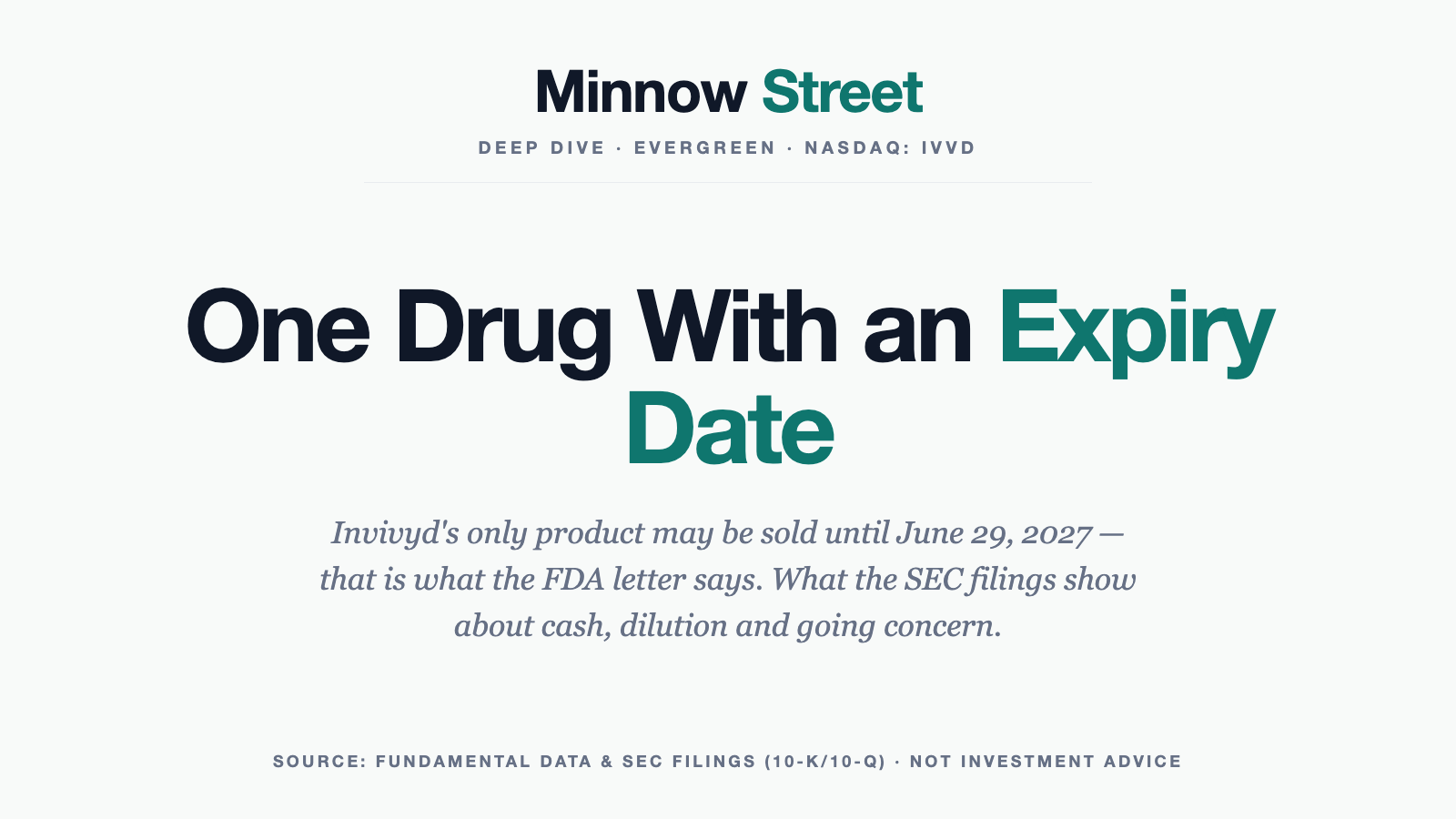
Invivyd sells exactly one product: PEMGARDA, an antibody meant to protect the severely immunocompromised from COVID-19. It is not approved — only authorized for emergency use — and that authorization ends, per a mandatory filing with the U.S. securities regulator SEC, on June 29, 2027. The same summer, Nasdaq set a deadline of January 19, 2027, because the bid price had closed below one dollar for 30 trading days. The quarterly report as of March 31, 2026 lists $184.2 million in cash, a $41.4 million quarterly loss and substantial doubt about the company's ability to continue as a going concern. On top of that, the share count rose from 119.8 million to 294.6 million in sixteen months. Not a buy recommendation — just the question of what is left of a company once its permit runs out.
 Thomas Mücke
Founder & Publisher
Thomas Mücke
Founder & Publisher
As of Today
As of: September 22, 2026
- Closing price
- 0.964 $ -5.50%
- Market Capitalisation
- 0.3 $B
- Growth Score
- 2/10
- AAQS
- 3/10
This analysis has a cut-off date. The Stock Guard tells you when something material changes in the numbers. Reserve your free spot
Chart
Interactive price chart (TradingView).
52-week range: 0.535 $ to 2.90 $ · Last price: 0.964 $ (As of: September 22, 2026)
Note: pure fact-based analysis, not investment advice and not a solicitation to buy or sell. All figures without guarantee.
There is an investor trap that catches biotech and pharma stocks with particular reliability, and it has to do with a stamp. Call it the rubber-stamp trap. It works like this: you read that a regulator "authorized" a drug. Your mind immediately pictures a seal — something permanent, official, almost patent-like. What you don't read is the fine print: some authorizations are temporary by design and can be revoked by letter. Invivyd, Inc. (Nasdaq: IVVD) is the textbook case. The company, based in New Haven, Connecticut, sells exactly one product — the antibody PEMGARDA, meant to protect people with severely weakened immune systems from COVID-19. It has never been approved. It has carried an Emergency Use Authorization since March 2024. And on July 6, 2026, Invivyd had to report to the U.S. securities regulator, the SEC, that this authorization has been terminated — effective June 29, 2027. So let's make a deal: before you build a bargain thesis out of a falling share price and a cash pile, let's read together what the company itself has reported — the annual report (10-K) for 2025, the quarterly report (10-Q) as of March 31, 2026, and the mandatory filings (Form 8-K) from the summer of 2026. An SEC filing is honest under penalty of law. In the end, the decision is yours.
What Invivyd actually does — an antibody for people vaccines can't reach
Invivyd develops monoclonal antibodies. In plain terms: a vaccine is a training camp — it teaches the immune system to build its own defenses. A monoclonal antibody is a ready-made mercenary force injected directly. That's more expensive and works for a limited time only, but it has one decisive advantage: it works even in people whose immune system can't be trained at all — cancer patients on chemotherapy, transplant recipients, people on strong immunosuppressants. PEMGARDA (pemivibart) is built for exactly that group: it is prevention, not treatment, delivered as a 4,500-milligram infusion. The label carries a boxed warning for observed severe allergic reactions.
Part of the company history worth knowing before reading older news: until September 12, 2022 the company was named Adagio Therapeutics, Inc. Under that name it went public in August 2021 and subsequently burned through significant cash on the predecessor antibody adintrevimab, which was outpaced by viral evolution. Those years still show up in the balance sheet today: the accumulated deficit since inception stood at $995.9 million as of March 31, 2026, against $1,198.9 million paid in by shareholders. Put differently: roughly 83 cents of every dollar shareholders put in has already been spent. Today PEMGARDA is the only product on the market; the pipeline holds the successor antibody VYD2311 (Phase 3 trial DECLARATION, headline results expected in the third quarter of 2026), the program VBY329, and, since April 2026, a measles antibody named VMS063.
That frames the central tension of this analysis, and it runs through every chapter: Invivyd has managed to turn a research project into a real, growing sales business — but the permit to run that business carries an expiration date the company neither set nor controls.
How this stock reached our desk
Not through a momentum or value screener, but through the SEC event trail: within 18 days in July 2026, Invivyd filed two mandatory reports that both go to the substance of the business — on July 6, 2026 the termination of the emergency authorization, and on July 24, 2026 the Nasdaq deficiency notice over a sub-$1 bid price. Added to that was a valuation picture that piqued our curiosity: market capitalization was in the range of $190 to $220 million (data as of August 7, 2026) — against cash of $184.2 million as of March 31, 2026 and zero debt. On paper, the operating business comes almost for free.
That's exactly where it pays to slow down. A company whose market capitalization roughly equals its cash is either a bargain — or the market is betting the cash will be spent before anything durable comes out of it. No single ratio tells you which reading is correct. Only the filings do. Keep this sentence in mind from the start: cash is not value if nobody knows what it's going to be spent on.
The numbers over the years — given their due
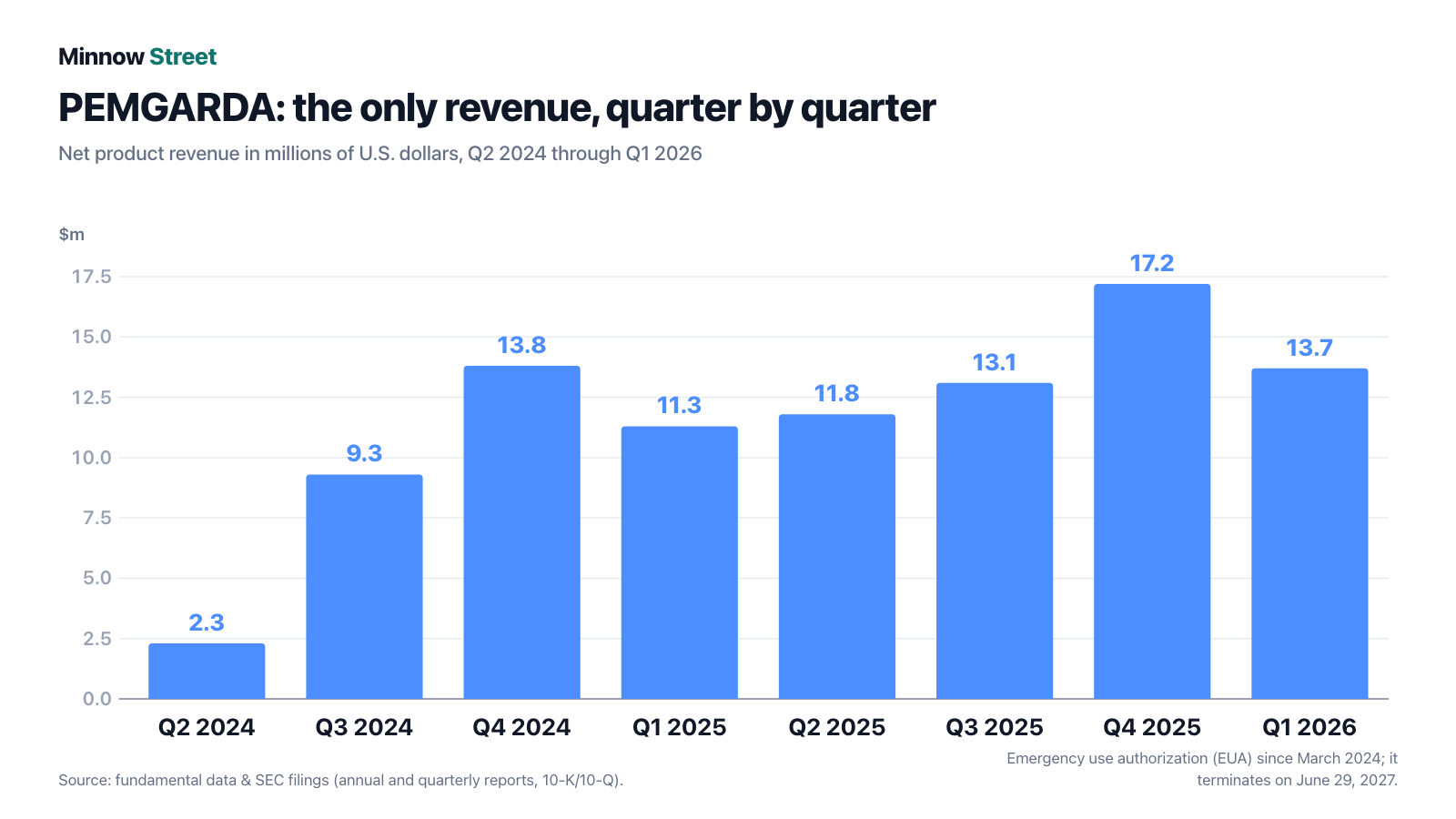
First, what genuinely impresses — and it's more than the headlines suggest. Invivyd has made the leap that most biotech companies never do: from pure research shop to a company that actually sells something. In 2023 revenue was still zero, against a net loss of $198.6 million. In 2024, the year of launch, product revenue reached $25.4 million and the loss narrowed to $169.9 million. And in 2025, $53.4 million in revenue — more than a doubling — with a net loss of only $52.5 million. In two years, the annual loss shrank to a quarter of its former size. That's not a footnote.
Half the reason is discipline: research spending fell from $137.3 million in 2024 to $38.3 million in 2025. The other half is the sales business itself, which grew quarter after quarter:
The balance sheet looks healthy at first glance, too. As of March 31, 2026: $241.7 million in total assets, $184.2 million in cash, $203.1 million in shareholders' equity — and liabilities of only $38.7 million, with not a single bank loan or bond in them, just trade payables, accruals and lease obligations. A debt-free biotech is a rarity and a real advantage: there's no creditor who can pull the plug.
And yet the picture tips in a direction that shouldn't be glossed over in the first quarter of 2026. The quarterly loss rose again — from $16.3 million (Q1 2025) to $41.4 million. Research spending jumped from $10.6 million to $30.7 million, of which $22.8 million went to the Phase 3 trial DECLARATION alone. Operating cash outflow for the quarter was $41.7 million. Run the math against the cash balance: $184.2 million divided by $41.7 million is a little over four quarters. April 2026 brought in another $19.4 million net through the at-the-market program — that shifts the math by weeks, not years. Which brings us to the uncomfortable truths.
What the filings say — the uncomfortable truths
Uncomfortable truth No. 1: the permit ends June 29, 2027 — by letter
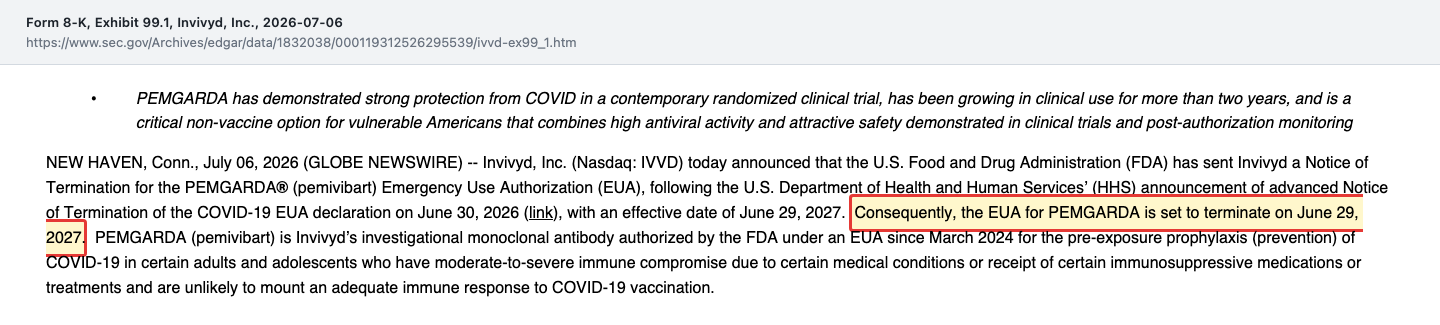
This is the core of the story. PEMGARDA is not an approved drug. It remains an investigational antibody that may be sold under an Emergency Use Authorization (EUA). Such an authorization exists only for as long as the U.S. Department of Health and Human Services (HHS) has declared an emergency. On June 30, 2026, HHS terminated the COVID-19 emergency declaration effective June 29, 2027. What follows for Invivyd is spelled out in the company's own notice of July 6, 2026:
"Consequently, the EUA for PEMGARDA is set to terminate on June 29, 2027."
— Invivyd, Inc., SEC Form 8-K, filed July 6, 2026, Exhibit 99.1
The way out is called a BLA — a full approval ("Biologics License Application"), the application that would turn the temporary permission into a permanent right. Invivyd considers itself prepared; Chairman Marc Elia says in the same notice that the company believes it has sufficient data to support a filing and approval. The decisive caveat sits three paragraphs later — and it's the real story:
"Invivyd is in active dialogue with FDA on next steps, although, to date, neither HHS nor FDA has expressly provided Invivyd with such written advice regarding a PEMGARDA regulatory approval pathway."
— Invivyd, Inc., SEC Form 8-K, filed July 6, 2026, Exhibit 99.1
Translated into an everyday picture: your store's temporary permit has been revoked, you have a twelve-month wind-down period — and on the question of how to get a permanent permit, the regulator hasn't put anything in writing yet. You can keep selling. You just don't know if you'll have anything left to sell afterward. For a company whose entire revenue hangs on this one product, that's not a risk factor among many — it's the existential question.
Uncomfortable truth No. 2: the filing itself doubts the company's survival
There's a phrase in annual reports that should make any reader stop: the notice of "substantial doubt about the ability to continue as a going concern." It doesn't mean a company closes tomorrow. It means: by its own planning, the money won't last twelve months past the filing's publication date unless fresh capital comes in. At Invivyd, this sentence appears not just in management's discussion, but in the auditor's report accompanying the 2025 annual report — and it appears again in the most recent quarterly report:
"Based on current operating plans and excluding future external financing, the Company will not have sufficient cash and cash equivalents to fund its operating expenses and capital requirements beyond one year from the issuance of these condensed consolidated financial statements, and therefore, the Company has concluded that there is substantial doubt about its ability to continue as a going concern."
— Invivyd, Inc., SEC quarterly report 10-Q as of 03/31/2026, Note 1

Let's run the numbers: $184.2 million in cash as of March 31, 2026, an operating cash outflow of $41.7 million for the quarter. That covers a little over four quarters. The $19.4 million raised in the April 2026 share offering helps, but doesn't change the order of magnitude. And the outflow is rising, because the Phase 3 trial DECLARATION costs money. What similar constellations do when a single event decides everything showed up in our Travere Therapeutics stock analysis — there, too, one product carries the entire company.
Uncomfortable truth No. 3: from 119.8 million shares to 294.6 million
When a company permanently spends more than it takes in, and no bank will finance it, there's exactly one way forward: new shares. In an everyday picture: the pie doesn't get bigger, more people just sit down at the table — your slice gets smaller. At Invivyd, that's not a side effect; it's the financing model itself. The numbers from the balance sheets:
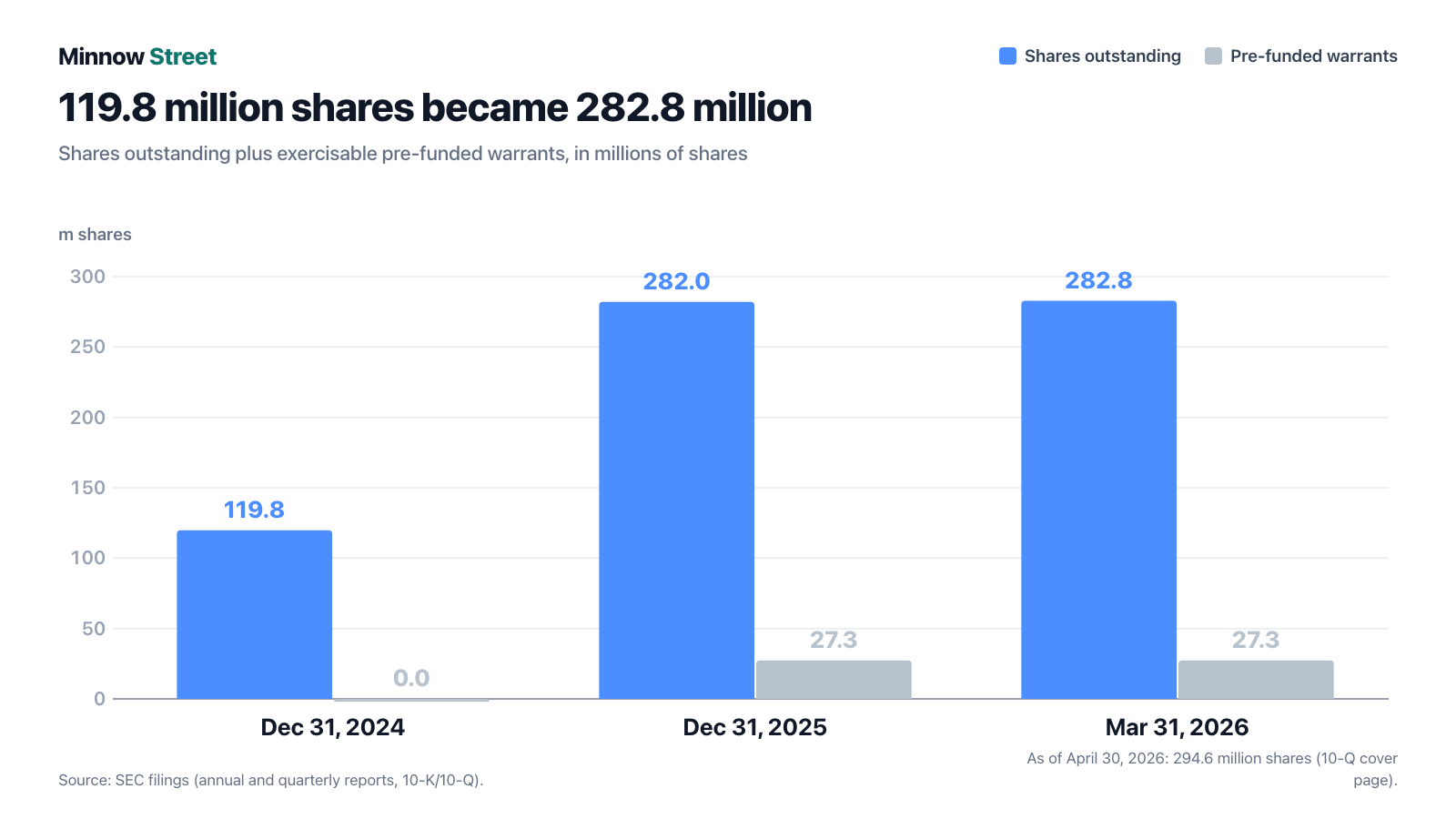
The path there reads like a fever chart of the stock. Through the at-the-market program with Cantor Fitzgerald, Invivyd sold shares in 2024 at an average of $4.50 ($39.3 million net), and in 2025, 23,055,402 shares at an average of $1.49 ($33.4 million net). In August 2025 came a large offering: 89,234,480 shares at $0.52, plus pre-funded warrants for a further 21,342,442 shares — $53.5 million net combined. In November 2025, after a price recovery, 44,000,000 shares at $2.50 plus warrants for 6,000,000 shares: $117.2 million net. And in April 2026, another 11,803,589 shares at an average of $1.70 for $19.4 million net.
What that means for you as a shareholder shows up in a comparison of two loss figures. In the first quarter of 2025, Invivyd lost $16.3 million, or 14 cents per share. In the first quarter of 2026 it lost $41.4 million — two and a half times as much — but only 13 cents per share. Loss per share fell even as the loss itself rose. Not because business improved, but because there are twice as many shares. Keep this picture in mind: a falling loss per share is not progress if only the denominator grew.
And the ammunition isn't spent yet. As of March 31, 2026, the full $75 million at-the-market program remained available (of which $19.4 million net was used in April), plus $275 million of additional securities under the shelf registration from December 2025. Authorized shares total one billion; issued shares stand at just over 294 million. The legal road to further dilution remains wide open.
Uncomfortable truth No. 4: Nasdaq set a clock — it runs to January 19, 2027
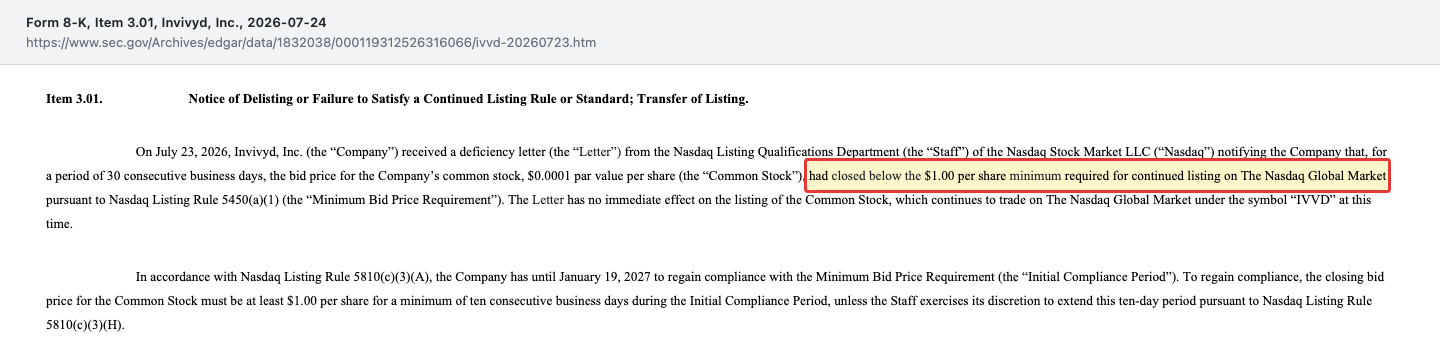
On July 23, 2026, Invivyd received a letter from Nasdaq. The reason is a straightforward rule: companies listed on the Nasdaq Global Market must maintain a bid price of at least one dollar.
"… the bid price for the Company's common stock, $0.0001 par value per share (the "Common Stock"), had closed below the $1.00 per share minimum required for continued listing on The Nasdaq Global Market pursuant to Nasdaq Listing Rule 5450(a)(1)."
— Invivyd, Inc., SEC Form 8-K, filed July 24, 2026, Item 3.01
In fairness: this is not a delisting yet, and the rules provide several lifelines. If the closing price reaches one dollar again for ten consecutive trading days by January 19, 2027, the matter is resolved. After that, Invivyd may get an additional 180 days — but only if it moves to the smaller Nasdaq Capital Market and meets that market's requirements. The classic fix would be a reverse stock split: ten shares become one, and the price mathematically multiplies by ten. That repairs the listing, not the business — and it fits the pattern: here, the price is a symptom, not a problem in its own right.
Uncomfortable truth No. 5: three wholesalers carry 86 percent — and there has been no CEO since May 2024
Two findings that would each be unremarkable alone say something together about how exposed the company is. First, the dependence on a handful of customers. Invivyd doesn't sell PEMGARDA through pharmacies but through specialty wholesalers, which supply infusion centers and physicians. How narrow that funnel is shows up in the annual report:
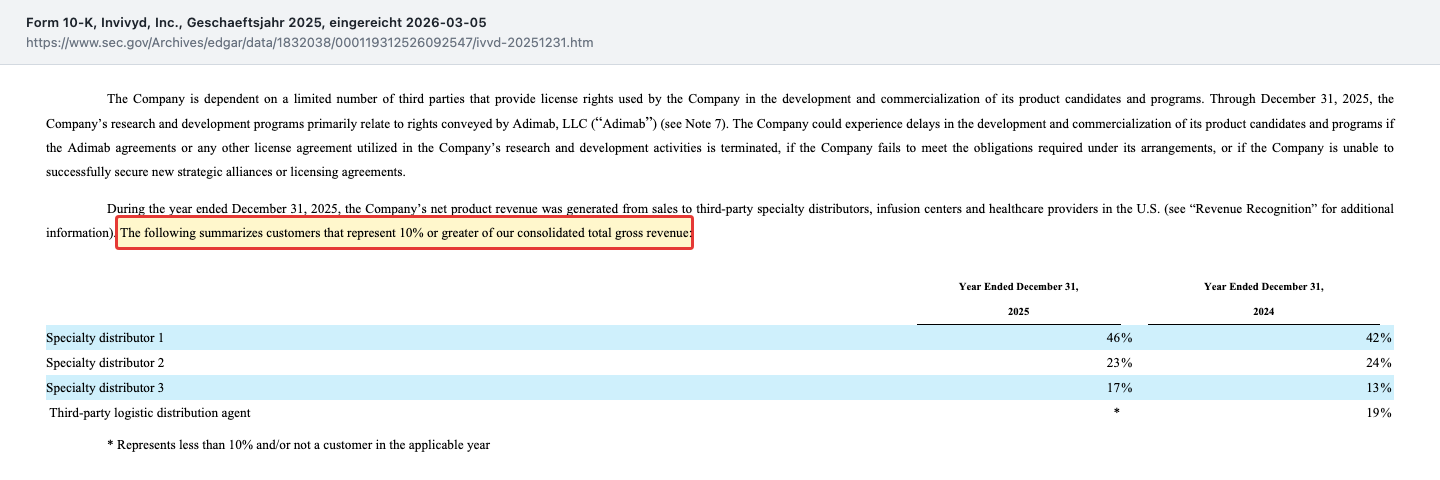
The receivables picture is the same story: as of December 31, 2025, the same three wholesalers accounted for 44, 22 and 20 percent of gross accounts receivable. If one of them drops out or negotiates harder, it doesn't hit one segment — it hits the whole company.
Second, leadership. The 2025 annual report contains a sentence that's easy to skim past because it's tucked into the risk section: "Since May 2024, William Duke, Jr., our Chief Financial Officer, has served as our 'principal executive officer'." — in plain English, since May 2024 the finance chief has also held the top executive role, "until a permanent successor can be identified." The quarterly report as of March 31, 2026 confirms it on the signature page: William Duke, Jr. signs there simultaneously as Principal Executive Officer, Principal Financial Officer and Principal Accounting Officer — one person, three roles. No mandatory filing about the appointment of a CEO (Form 8-K, Item 5.02) has been made since. Chairman Marc Elia serves as the company's public voice instead. A biotech fighting for the survival of its only product's legal basis, and doing so for more than two years without a dedicated CEO, is fighting that battle with one hand tied behind its back.
Valuation: the market pays for the cash — the business comes free
There's no price-to-earnings ratio here, because there's no profit. Three other anchors are more useful, all dated. First: market capitalization was in the range of $190 to $220 million (data as of August 7, 2026), based on 294,607,452 shares as of April 30, 2026 — consistent with the sub-$1.00 bid price documented in the Nasdaq deficiency notice of July 24, 2026. Second: against that stands $184.2 million in cash as of March 31, 2026, plus $19.4 million from the April offering, with zero debt. Enterprise value — market capitalization minus net cash — is therefore close to zero. Third: shareholders' equity stood at $203.1 million as of March 31, 2026, or roughly 72 cents per share; the stock trades below book value. Measured against trailing twelve-month revenue of roughly $56 million, that puts the price-to-sales ratio at roughly three and a half.
Sounds like a bargain — and that's exactly where caution is warranted. An enterprise value near zero doesn't mean "free." It means: the market expects the operating business to consume the cash rather than grow it. With $41.7 million of quarterly cash outflow, that's not an unreasonable assumption. And the balance sheet holds one more item that can muddy this math: $25.45 million in inventory, carried as a long-term asset — against cost of product revenue of only $3.75 million for the full year 2025, that works out to roughly seven years of sales, right as the June 2027 sales window slams shut. If any of that gets written down, shareholders' equity shrinks accordingly. For a look at what happens at the other end of the COVID scale, when a revenue stream disappears entirely, our Moderna stock analysis shows the same mechanism at a very different scale.
What about the professionals' view: the analyst consensus most recently sat in the low double-digit dollar range (data as of August 7, 2026) — a multiple of the trading price. That's normal for binary biotech situations and says one thing above all: the estimators are pricing in approval success. If it fails, the target is moot. At Invivyd, fair value isn't a calculation — it's a bet on two regulatory decisions.
Opportunities and risks at a glance
What speaks for Invivyd:
- A real, growing sales business: PEMGARDA brought in $53.4 million of revenue in 2025 (2024: $25.4 million), with Q4 2025 the strongest quarter at $17.2 million. The annual loss shrank from $198.6 million (2023) through $169.9 million (2024) to $52.5 million (2025).
- A debt-free balance sheet with substance: $184.2 million in cash and $203.1 million in shareholders' equity as of March 31, 2026, against liabilities of $38.7 million that include no bank debt. No creditor can pull the plug.
- A second shot in the chamber: headline results from the Phase 3 trial DECLARATION for the successor antibody VYD2311 are expected in the third quarter of 2026, and it's designed for a full regulatory approval application. There's also the planned comparison trial LIBERTY and the measles antibody VMS063.
- A market vaccines don't reach: for the severely immunocompromised, an antibody is the only reliable prevention available — exactly the argument Invivyd is making to the FDA for full approval.
- The stock trades below book value (roughly 72 cents of equity per share as of March 31, 2026), and enterprise value is near zero — any positive surprise lands on a very low bar of expectations.
What speaks against it:
- All of the revenue has an official expiration date: PEMGARDA's emergency authorization ends June 29, 2027, and per the company's own notice of July 6, 2026, no written path to full approval has been provided to date.
- Substantial doubt about the company's survival appears in both the quarterly report as of March 31, 2026 and the auditor's report on the 2025 annual report. Cash of $184.2 million against a quarterly cash outflow of $41.7 million works out to a little over four quarters.
- Massive dilution: from 119.8 million shares (12/31/2024) to 294.6 million (4/30/2026), plus 27.3 million from pre-funded warrants and 36.4 million from options and warrants. Authorized shares total one billion; $75 million of at-the-market capacity and $275 million of shelf capacity remain open.
- Listing risk: a Nasdaq deficiency notice dated July 23, 2026, with a cure deadline of January 19, 2027. A cure via reverse split fixes the rule, not the business.
- Concentration and leadership risk: three specialty wholesalers accounted for 46, 23 and 17 percent of gross revenue in 2025; since May 2024 the finance chief has also served as top executive, and no permanent CEO has been appointed.
A human conclusion
Back to the rubber-stamp trap from the start. Its core isn't that the regulator did anything wrong, and certainly not that PEMGARDA is a bad drug — it demonstrably helps people who otherwise have few options, and Invivyd has built a genuinely solid sales operation. Its core is that we read a permanence into the word "authorized" that was never on the page. Whoever buys Invivyd shares today isn't buying a company with an approved drug and a full treasury. They're buying three things: a sales business with a remaining term to June 29, 2027; a cash pile of $184.2 million that, at the current burn rate, covers a little over four quarters and whose only real use is to buy two regulatory decisions; and the prospect that every further financing round shrinks their own slice again. This can work out. If DECLARATION delivers and the FDA opens a path to approval, today's math will look absurdly cautious in hindsight. If it doesn't, a cash pile without a business eventually just becomes a shrinking cash pile. So the honest question isn't "is the stock cheap?" It's: would you bet $184 million on two letters that haven't been written yet? If yes, you have a thesis. If no, you had a stamp. What you make of it is your decision. And that's exactly as it should be.
Sources
Every original document used in this analysis — for you to read yourself:
- Invivyd, Inc. — SEC quarterly report 10-Q as of 03/31/2026 (filed May 14, 2026)
- Invivyd, Inc. — SEC annual report 10-K for 2025 (filed March 5, 2026)
- Invivyd, Inc. — SEC annual report 10-K for 2024 (filed March 20, 2025)
- Invivyd, Inc. — SEC Form 8-K of July 6, 2026, Exhibit 99.1 (termination of the emergency authorization)
- Invivyd, Inc. — SEC Form 8-K of July 24, 2026, Item 3.01 (Nasdaq deficiency notice)
- Invivyd, Inc. — SEC Form 8-K of May 14, 2026, Exhibit 99.1 (first-quarter 2026 results)
- Full SEC filing history of Invivyd, Inc. (CIK 0001832038, formerly Adagio Therapeutics, Inc.): EDGAR overview (sec.gov)
- Fundamental data (market capitalization, valuation multiples, analyst consensus; data as of August 7, 2026), reconciled with the SEC filings.
Transparency & disclaimer: this analysis is journalistic commentary on publicly available information. It is not investment advice, not a regulated financial analysis, and not a solicitation to buy or sell securities. Equity investments carry substantial risk up to and including total loss; at a company with documented doubt about its ability to continue as a going concern, that risk is especially pronounced. All information without warranty; the as-of date of each figure is stated in the text. Positions held by the operator are disclosed daily; where one exists, it appears as a notice at the top of this deep dive.
Key figures at a glance
All monetary figures in millions of $; earnings per share as reported.
| Metric | 2021 | 2022 | 2023 | 2024 | 2025 |
|---|---|---|---|---|---|
| Revenue | 0.0 | 0.0 | 0.0 | 25.4 | 53.4 |
| Operating Income (EBIT) | -226.9 | -248.0 | -212.8 | -176.9 | -55.6 |
| Net Income | -226.8 | -241.3 | -198.6 | -169.9 | -52.5 |
| Net Margin | – | – | – | -669.4% | -98.2% |
| Earnings Per Share | -2.05 $ | -2.23 $ | -1.81 $ | -1.43 $ | -0.30 $ |
Source: fundamental data & SEC filings (annual and quarterly reports, 10-K/10-Q)
Our Bottom Line at a Glance
- Regulatory foundation negative
- PEMGARDA is not approved, only authorized for emergency use — and per the mandatory filing (Form 8-K) of July 6, 2026, that authorization ends June 29, 2027. That gives the company's entire revenue an officially set expiration date. By its own account, neither the Department of Health and Human Services nor the FDA has, to date, put a path to full approval in writing.
- Financial strength & going concern negative
- The quarterly report as of March 31, 2026 and the auditor's report accompanying the 2025 annual report both cite substantial doubt about the company's ability to continue as a going concern. Cash of $184.2 million against an operating cash outflow of $41.7 million for the quarter works out to a little over four quarters, plus $19.4 million from the April 2026 offering. The accumulated deficit is $995.9 million.
- Commercial build-out positive
- Invivyd has made the leap from research shop to selling company: $0 revenue (2023), $25.4 million (2024), $53.4 million (2025), with Q4 2025 the strongest quarter at $17.2 million. At the same time, the annual loss fell from $198.6 million to $52.5 million, and research spending from $137.3 million to $38.3 million.
- Capital structure & dilution negative
- From 119,835,162 shares (12/31/2024) to 294,607,452 (04/30/2026), plus 27,342,442 pre-funded warrants and 36,430,766 options and warrants. Issue prices ranged between $0.52 (August 2025) and $2.50 (November 2025). One offsetting positive: zero debt — the $38.7 million of liabilities are trade payables, accruals and lease obligations.
- Concentration & leadership negative
- Three specialty wholesalers accounted for 46, 23 and 17 percent of gross revenue in 2025; the same three made up 44, 22 and 20 percent of gross accounts receivable as of 12/31/2025. No permanent CEO has been appointed since May 2024: CFO William Duke, Jr. signs the quarterly report simultaneously as Principal Executive Officer, Principal Financial Officer and Principal Accounting Officer.
- Valuation neutral
- Market capitalization was in the range of $190 to $220 million (data as of August 7, 2026) against $184.2 million of cash and $203.1 million of shareholders' equity as of March 31, 2026 — enterprise value near zero, stock below book value. That's cheap by the math and simultaneously the market's opinion that the cash will be spent before anything durable comes of it.
Invivyd has turned a research project into a real sales business: $53.4 million of revenue in 2025, up from zero in 2023, an annual loss down to a quarter of its 2023 level, and no debt. But the permit to run that business carries a date: PEMGARDA's emergency authorization ends June 29, 2027, and per the company's own notice of July 6, 2026, no written path to full approval exists to date. On top of that comes substantial doubt about the company's survival in the most recent quarterly report, a little over four quarters of cash runway, a tripling of the share count in sixteen months, and a Nasdaq deadline of January 19, 2027. Everything hinges on two regulatory decisions and a trial whose headline results are expected in the third quarter of 2026. Not investment advice.
What Our Rating Means
Substance risk
We found at least one documented issue that threatens the company itself — regardless of how the stock is currently valued.
Red isn't about the share price or the valuation here — the stock trades below book value, and cheap alone would never be a reason for red. Red applies because three documented substance findings land together. First: the auditor and the company itself cite substantial doubt about the ability to continue as a going concern — the hardest finding a financial statement can carry. Second: cash runway sits at roughly four quarters ($184.2 million in cash against $41.7 million of cash outflow in the first quarter of 2026), and the outflow is rising because the Phase 3 trial is under way. Third: the sole revenue source loses its legal basis on June 29, 2027, with no replacement path committed to in writing. Add to that the Nasdaq compliance deadline of January 19, 2027. Against these sit real strengths — a working sales operation, growing revenue, no debt, and a trial that could change everything. But the doubt rule calls for the more cautious rating whenever a documented substance risk is present. What you make of it is your decision.
A journalistic assessment by our editorial team at the time of the deep dive, based on public sources — not investment advice and not a solicitation to buy or sell. Your personal circumstances (investment goals, risk capacity, taxes) cannot be taken into account. What our levels mean, how verdicts are formed, and what conflicts of interest exist →
Worth Noting
- Invivyd reached our research list through the SEC event trail: two mandatory filings within 18 days in July 2026 — the termination of the emergency authorization (July 6) and the Nasdaq deficiency notice (July 24) — plus a market capitalization roughly equal to its cash. The company was named Adagio Therapeutics, Inc. until September 12, 2022; older news items run under that name.
- Data currency: the most recent period report is the quarterly report (10-Q) as of March 31, 2026, filed May 14, 2026. Every SEC filing dated on or after that day was reviewed; material among them are the mandatory filings of July 6 and July 24, 2026, both of which postdate the quarterly report and therefore don't appear in it. The share count comes from the cover page of the quarterly report (294,607,452 as of April 30, 2026). Market data as of August 7, 2026.
- Terminology and possible confusion: PEMGARDA is prevention, not treatment, of COVID-19, and it doesn't replace vaccination for people who can be vaccinated. "EUA" is a temporary emergency authorization, not an approval; "BLA" would be the full approval application. Pre-funded warrants count economically as shares, because they can be exercised for $0.0001 each — that's why they sit inside the weighted-average share count of 309,670,101 used for the first quarter of 2026.
Stock Watch
This analysis is as of August 26, 2026. Stock Watch will tell you what's changed at IVVD since then.
Later $1 a month per stock — signing up is free, and you'll be the first to know when it launches.
The full analysis as a PDF for later
We will send you this analysis as a PDF — to print, file away, and read at your own pace. And we will add you to the free Stock Watch list for Invivyd Inc. (IVVD), so you hear about it when something material in this analysis changes.
Frequently Asked Questions
Invivyd, Inc. (Nasdaq: IVVD), headquartered in New Haven, Connecticut, develops and sells monoclonal antibodies against viral infections. Its only product on the market is PEMGARDA (pemivibart), an infusion to prevent COVID-19 in people with severely weakened immune systems for whom vaccination isn't enough. Product revenue was $53.4 million in 2025. The pipeline holds the successor antibody VYD2311 and the programs VBY329 and VMS063 (measles).
Because PEMGARDA was never approved. The drug has carried only an Emergency Use Authorization since March 2024. It depends on the COVID-19 emergency declaration by the U.S. Department of Health and Human Services (HHS), which was terminated on June 30, 2026, effective June 29, 2027. Invivyd reported via a mandatory filing (Form 8-K) on July 6, 2026 that the FDA subsequently delivered notice terminating PEMGARDA's authorization on the same date — after a twelve-month transition period.
It means that, by the company's own planning, the money won't last twelve months past the report's publication date unless fresh capital comes in. Invivyd states this itself in the quarterly report (10-Q) as of March 31, 2026; the auditor names it too in the report accompanying the 2025 annual report. The numbers behind it: $184.2 million in cash as of March 31, 2026 against an operating cash outflow of $41.7 million in the first quarter of 2026 alone — a little over four quarters of runway.
Substantially. As of December 31, 2024, 119,835,162 shares were outstanding; by December 31, 2025 that had grown to 281,987,033, and by April 30, 2026 to 294,607,452. On top of that come 27,342,442 shares from pre-funded warrants and 36,430,766 shares from options, restricted stock and other warrants. Shares were issued at prices including $0.52 (August 2025), $2.50 (November 2025) and an average of $1.70 (April 2026). Authorized shares total one billion.
Not immediately, but the clock is running. On July 23, 2026, Invivyd received a deficiency notice because its bid price had closed below $1.00 for 30 consecutive trading days. By January 19, 2027, the closing price must reach at least one dollar for ten consecutive trading days. After that, a second 180-day period may be possible, but only after moving to the smaller Nasdaq Capital Market. The stock continues trading unchanged under "IVVD" for now.
Yes. Until September 12, 2022, the company was named Adagio Therapeutics, Inc.; it also went public under that name in August 2021. The SEC lists Adagio Therapeutics as a former name under CIK 0001832038. The predecessor antibody adintrevimab, which was outpaced by viral evolution, dates from the Adagio era — a significant portion of the $995.9 million accumulated deficit (as of March 31, 2026) was incurred during those years.
That's the central question. Market capitalization was in the range of $190 to $220 million (data as of August 7, 2026), while cash stood at $184.2 million as of March 31, 2026 — against zero debt. Enterprise value is therefore near zero, and the stock trades below book value (roughly 72 cents of equity per share). By the math, that's cheap. But it's also the market's opinion that the business will consume the cash rather than grow it — not an unreasonable view given $41.7 million of quarterly cash outflow.
No permanent CEO has been appointed. Per the 2025 annual report, Chief Financial Officer William Duke, Jr. has also served as the top executive since May 2024, "until a permanent successor can be identified." In the quarterly report as of March 31, 2026, he signs simultaneously as Principal Executive Officer, Principal Financial Officer and Principal Accounting Officer. Chairman Marc Elia serves as the company's public voice. Michael Mina joined as Chief Medical Officer and Chief Epidemiologist as of July 31, 2026 (Form 3 filed August 4, 2026).
Found an error?
Did you spot a factual error, an outdated number, or a typo in this deep dive? Let us know briefly — your report goes straight to the editorial team.