Innovative Aerosystems: net income jumped 84 percent — its own quarterly report explains why that is not a growth jump
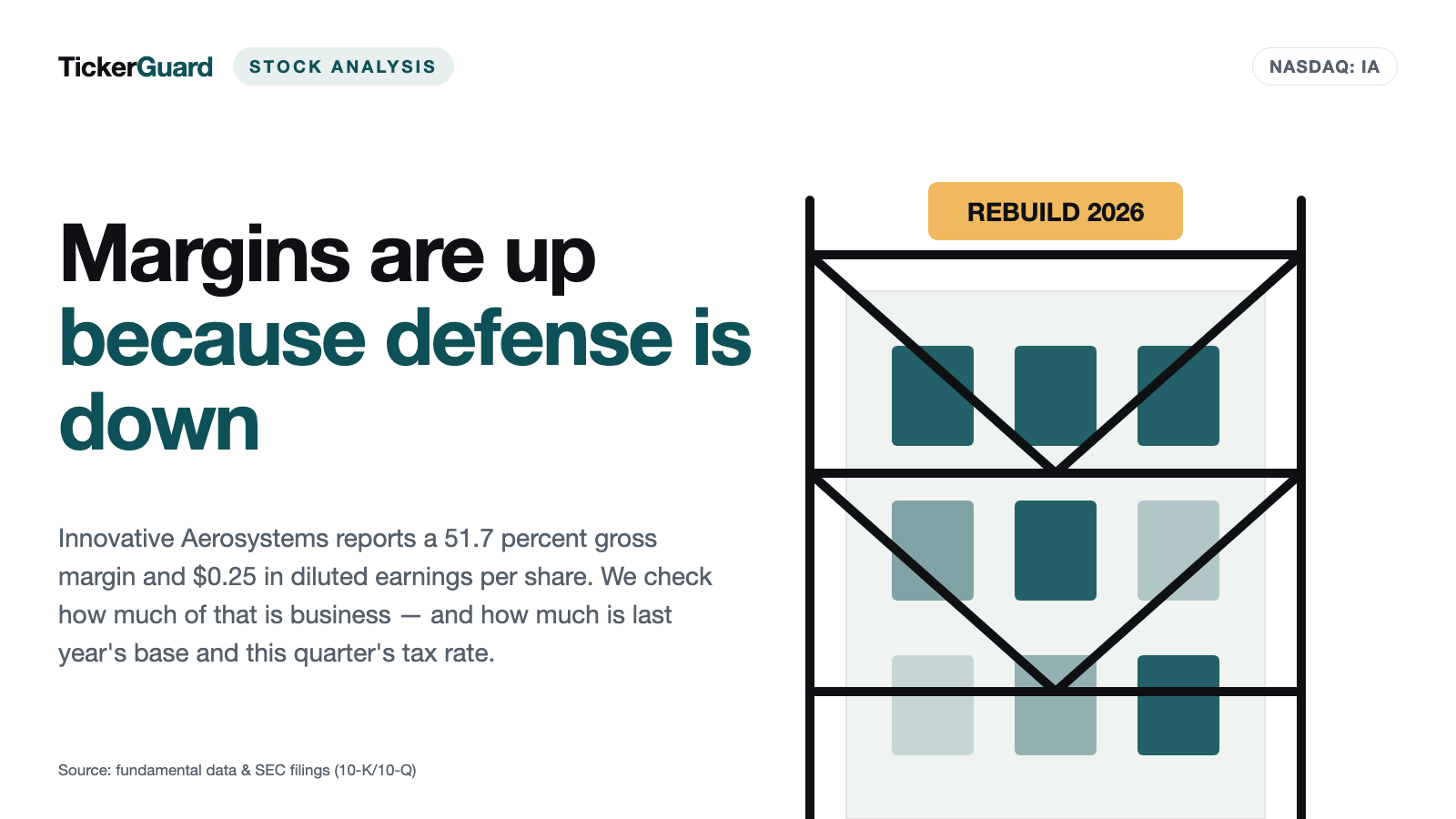
Innovative Aerosystems (Nasdaq: IA, ISSC until August 2026) builds cockpit electronics for airliners, business jets and military aircraft. In the quarter ended June 30, 2026, gross margin climbed to 51.7 percent from 35.6 percent a year earlier and net income rose from $2.4 million to $4.5 million. The same filing also shows a tax rate of 10.5 percent instead of 21.5 percent, an F-16 business that shrank from $12.6 million to $5.7 million, and a pro forma table under which nine-month revenue and profit would both have declined. Not investment advice — just the question of how much of this earnings jump will still be there next year.
 Thomas Mücke
Founder & Publisher
Thomas Mücke
Founder & Publisher
As of Today
As of: August 24, 2026
- Closing price
- 21.00 $ -2.40%
- Market Capitalisation
- 0.4 $B
- Growth Score
- 6/10
- AAQS
- 8/10
Price change since August 27, 2026: -0.8%
This analysis has a cut-off date. The Stock Guard tells you when something material changes in the numbers. Reserve your free spot
Chart
Interactive price chart (TradingView).
52-week range: 8.30 $ to 30.60 $ · Last price: 21.00 $ (As of: August 24, 2026)
Note: pure fact-based analysis, not investment advice and not a solicitation to buy or sell. All figures without guarantee.
There is a reflex built into all of us, and it has an unassuming name: the percentage trap. It works like this. You read a headline — "earnings per share up 79 percent", "record gross margin" — and your brain has finished the assessment before you have read a single line of the filing. Percentages feel objective. They are only half so: every percentage has a numerator and a denominator, and the denominator is last year. If you do not know the denominator, you do not know the number. Innovative Aerosystems — the trade name the company has done business under since October 6, 2025, while its legal name remains Innovative Solutions and Support, Inc.; its shares traded on Nasdaq under the ticker ISSC until August 18, 2026, and under "IA" since — filed a quarterly report on August 13, 2026 that sets off exactly this reflex. So let us make a deal. Before you form a view on the percentages, we read the report they came from together: the quarterly report (10-Q) for the period ended June 30, 2026, the earnings release of the same day, and five earnings calls from the past twelve months. The filing supplies the counter-calculation itself. The decision at the end is yours.
What Innovative Aerosystems actually does
Innovative Aerosystems builds avionics — the electronics inside a cockpit. In everyday terms: everything the pilot looks at, presses, and trusts. Flat-panel displays instead of round dials. Air data systems, which turn air pressure into airspeed and altitude. Autothrottles, essentially cruise control for the engines. Autopilots, flight management computers, mission computers. The company was incorporated in Pennsylvania in 1988, sits in Exton outside Philadelphia, listed on Nasdaq on August 4, 2000, and had 147 full-time employees as of September 30, 2025, up from 133 a year earlier. About 37 percent of them work in engineering; the company reports holding 171 patents.
It sells in two directions. First as original equipment to airframe makers: Pilatus, Textron, Boeing. Second — and this is the bigger lever — as retrofit equipment for aging fleets, from freighters through business jets to fighter aircraft. A 1990s freighter gets a modern cockpit without anyone buying a new airplane. That retrofit business carries the highest margins, because there is no discount war with an airframe manufacturer at the other end.
Growth in recent years has come mainly from one route: acquisitions. In 2023 and 2024 the company bought several product lines from Honeywell, including the F-16 electronics — digital flight control computers and display generators for the most widely built Western fighter. In February 2026 it added Moog's S-TEC autopilot line for $3.5 million in cash; in late March 2026 further Honeywell product lines (navigation radios, multifunction displays, transponders, power generation and two more autopilots); and on July 21, 2026 its first complete operating business: Aydin Displays of Birdsboro, Pennsylvania, for $24.5 million in cash, funded entirely from the credit facility. Aydin builds ruggedized displays for naval, ground and airborne use, employs roughly 50 people and is expected to generate about $16 million of revenue in calendar 2026. The new name, the new ticker, the long-term target of $250 million in annual revenue — all belong to the same story: turning a niche instrument maker into an integrated avionics platform supplier.
Which frames the central tension of this analysis, and it runs through every chapter that follows: the company's record margin comes precisely from the part of the business that is currently shrinking — defense. And the growth the acquisitions are meant to deliver has not shown up in the numbers yet.
Company history for investors
-
2000
Nasdaq listing
On August 4, 2000 the instrument maker from Exton, incorporated in Pennsylvania in 1988, lists under the ticker ISSC — a small cap that will trade under that symbol for the next two decades.
-
2023
First large Honeywell product lines
The Honeywell lines, including the F-16 electronics, double the revenue base within two years. For shareholders this begins the phase in which acquisitions carry the growth.
-
2025
A credit facility of up to $100 million
On July 18, 2025 the company closes a credit facility of up to $100 million (with an option for $125 million) running to July 2030 — the financing frame for the acquisitions of the following months.
-
2025
Record year and a new trade name
$84.3 million of revenue and $15.6 million of net income in the fiscal year to September 30; on October 6, 2025 the company begins doing business as Innovative Aerosystems — its legal name remains Innovative Solutions and Support, Inc.
-
2026
Three deals in spring, Aydin in July
The Moog autopilot line for $3.5 million, further Honeywell lines in March and Aydin Displays for $24.5 million in July. Total debt rises within a year from $23.3 million to roughly $79 million.
-
2026
Russell 2000 entry and the ticker change to "IA"
Index inclusion on June 29 and the ticker change from ISSC to IA on August 18. For investors the main change is who owns the stock — BlackRock reported a first position of just over 1.0 million shares at the end of July.
How the stock landed on our desk
Innovative Aerosystems came onto our research list not through a price breakout but through the quarterly report of August 13, 2026 — more precisely, through the gap between two numbers in it. Pre-tax income for the third quarter of fiscal 2026 rose 61.2 percent; net income rose 83.7 percent. When two growth rates for the same quarter are 22 percentage points apart, the difference is not in the business. It is in the tax line. That always deserves a second look.
Two events in the same month added attention: inclusion in the Russell 2000 Index on June 29, 2026, which typically forces index funds to buy, and the change of the ticker from ISSC to "IA" at the market open on August 18, 2026. Neither says anything about what the company is worth, but both change who owns it: at the end of July 2026 BlackRock reported an initial position of 1,043,570 shares — roughly 5.8 percent of the 17,899,173 shares outstanding. Note the finding right at the start: a new ticker and an index entry are labels. They do not change the numbers underneath.
The numbers over the years
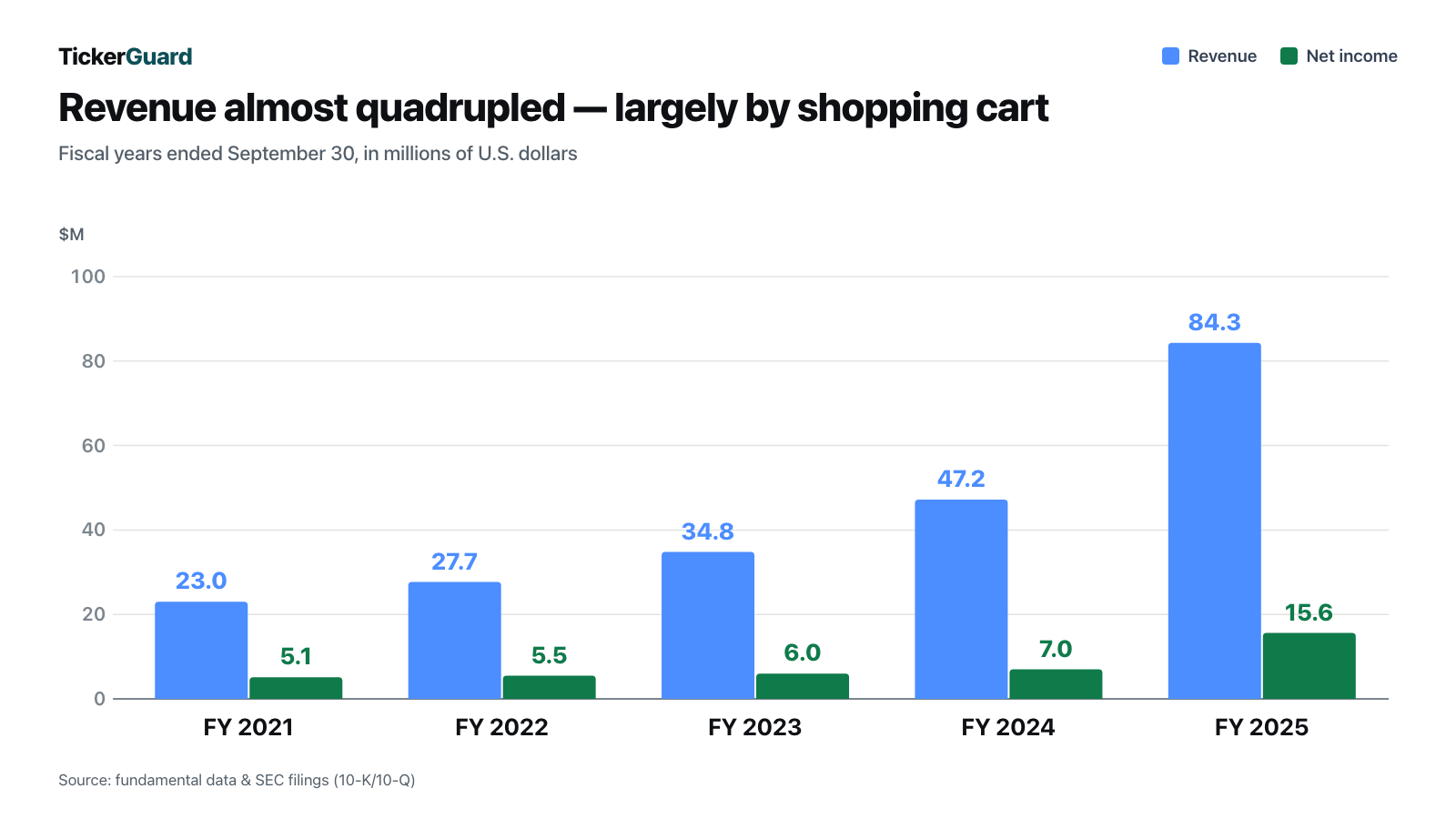
First the part that genuinely impresses, and there is plenty of it. Revenue grew from $23.0 million in fiscal 2021 to $84.3 million in fiscal 2025, the year that ended on September 30, 2025. Net income climbed over the same span from $5.1 million to $15.6 million. The company was profitable in every one of those five years — not a given for a small cap of this size. The first nine months of fiscal 2026 added $70.9 million of revenue, up 14.3 percent, and $12.0 million of net income; management guided to $28 million to $30 million for the closing quarter.
The balance sheet reads well at first pass too. Cash from operations in the first nine months of fiscal 2026 was $15.5 million, up from $10.3 million a year earlier; after $3.2 million of capital expenditure, free cash flow was $12.3 million, more than double the prior-year figure of $4.8 million. Backlog stood at $82.9 million at June 30, 2026 — roughly $10.5 million above the year-ago level of $72.4 million, and $5.5 million above the $77.4 million at the start of the fiscal year (September 30, 2025). And customer concentration has improved dramatically: in the year-ago quarter two customers accounted for 52 percent and 8 percent of net sales; in the third quarter of fiscal 2026 it was four customers at 21, 10, 8 and 6 percent. Anyone who has watched a supplier hang on a single buyer knows what that transition is worth.

So much for the credit side. It is real, it is documented, and it belongs at the front. It does not explain why gross margin has swung between 35.6 percent and 63.2 percent across five quarters.
What management promised — and what arrived
Judging a management team does not require a character sketch. It requires an archive. Five public earnings calls between August 14, 2025 and August 13, 2026 are on the record. You can read them like minutes: what was announced, and what happened?
Promised and delivered — the revenue guidance. For the first quarter of fiscal 2026, Chief Financial Officer Jeffrey DiGiovanni gave a range of $18 million to $20 million in December 2025; the quarter came in at $21.8 million. For the second quarter, $20 million to $22 million; it came in at $22.4 million. For the third quarter, $24 million to $26 million; it came in at $26.7 million. Three guides, three results at or above the top of the range. The closing quarter is now guided to $28 million to $30 million. That is a pattern, not luck — and it points to a management team that prefers to understate.
Promised and delivered — the F-16 recovery. Back in August 2025 the company said F-16 revenue would dip in the closing quarter of fiscal 2025 and then ramp back, because production was being moved from Honeywell to Exton. That is exactly what happened. In May 2026 Chief Executive Officer Shahram Askarpour put the durable run rate at "3 to $5 million a quarter"; the third quarter of fiscal 2026 delivered $5.7 million, and he confirmed the frame on the call:
“we're hitting that kind of $5 million range per quarter that we think is sustainable long term.”
— Shahram Askarpour, Chief Executive Officer, Innovative Aerosystems, third-quarter fiscal 2026 earnings call, August 13, 2026
Reversed — the margin story. Here it is worth putting two statements three months apart side by side. On May 14, 2026 the chief financial officer said: "We continue to expect our gross margins to be in the mid-40% range over the long term … As our military business ramps back up, which has lower gross margins, we would expect our gross margins to normalize." On August 13, 2026 the same question drew this from the chief executive: "around 50% is … seems to be where we're heading … our ultimate goal is to try to keep it there." In one quarter, "mid-40s, and it will come back down" became "around 50 percent, and we want to stay there". The chief financial officer moved the emphasis to a different measure in the same call: "we're really focusing on the EBITDA margin, where we've said before about 25% to 30%".
Still open — the acquired revenue. In May 2026 the chief executive sized the quarter's three acquisitions this way: "Together, these transactions are projected to contribute $10 million in annual revenue with a blended gross margin profile of approximately 50%." The quarterly report of August 13, 2026 discloses $2.3 million of net sales attributable to the acquired businesses for the first nine months of fiscal 2026. Those deals had been in the group for roughly four to five months by then; annualized, that is about $6 million — well short of the $10 million announced. It need not be a broken promise: product-line carve-outs need certifications, tooling and supply agreements, and the chief executive himself said in February 2026 that such transitions get planned "for five to six months" and typically take "roughly more like nine months". But it is the one number against which the growth promise will be measured a year from now.
The tone overall. In the question-and-answer sessions management stays forthcoming and specific — quoting F-16 revenue in dollars, correcting analysts, giving ranges. Two things still stand out. First, the definition of "organic": in February and May 2026 the company said organic revenue for fiscal 2026 would be "essentially flat"; in August it became organic growth of "over 40%" — but only after stripping the F-16 business out of both periods along with the acquisitions. Both statements are correct; they simply measure different things. Second, the contract value of the first eVTOL award: asked about the $50 million figure, the chief executive deflected and called it "kind of a nominal number". The condition behind it came from Chief Financial Officer Jeffrey DiGiovanni instead: the figure assumes all 400-plus aircraft in the customer's backlog are built. First deliveries are planned for late 2027, full production for 2028.
Doing the math: what is left of the earnings jump
Now to the actual work. Net income for the third quarter of fiscal 2026 rose from $2,443,814 to $4,489,323, or 83.7 percent; diluted earnings per share went from $0.14 to $0.25, or 78.6 percent. Those numbers are correct. They rest on four props, and each one needs handling separately.
Prop one: the tax rate. The effective tax rate for the quarter was 10.5 percent, against 21.5 percent a year earlier. The filing gives the reason itself:
“The effective tax rate for the three months ended June 30, 2026 was 10.5% and differs from the statutory tax rate primarily due to the effect of temporary and permanent tax differences related to stock-based compensation and favorable return to provision adjustments.”
— Innovative Solutions and Support, Inc., SEC quarterly report 10-Q for the period ended June 30, 2026, Note 4 "Income Taxes"

Run the counter-calculation. Pre-tax income was $5,017,138. At the prior-year rate of 21.5 percent, net income would have been roughly $3.94 million — across 18,270,332 diluted shares, about $0.22 rather than $0.25 per share. Roughly three of the eleven extra cents therefore come from the tax line rather than the business. And that this was an exception is stated two lines further down in the same filing: for the first nine months the effective rate is 21.8 percent.
Prop two: the depressed prior-year quarter. Gross margin jumped from 35.6 percent to 51.7 percent. That sounds like an efficiency leap; it is largely a base effect. In the third quarter of fiscal 2025 Honeywell was still building the F-16 electronics and, at its own cost, stocking safety inventory to bridge the production move to Exton — at a gross margin below 25 percent on those revenues, as the chief financial officer explained at the time. Hold the 51.7 percent against the series rather than against that one weak quarter and the picture changes.
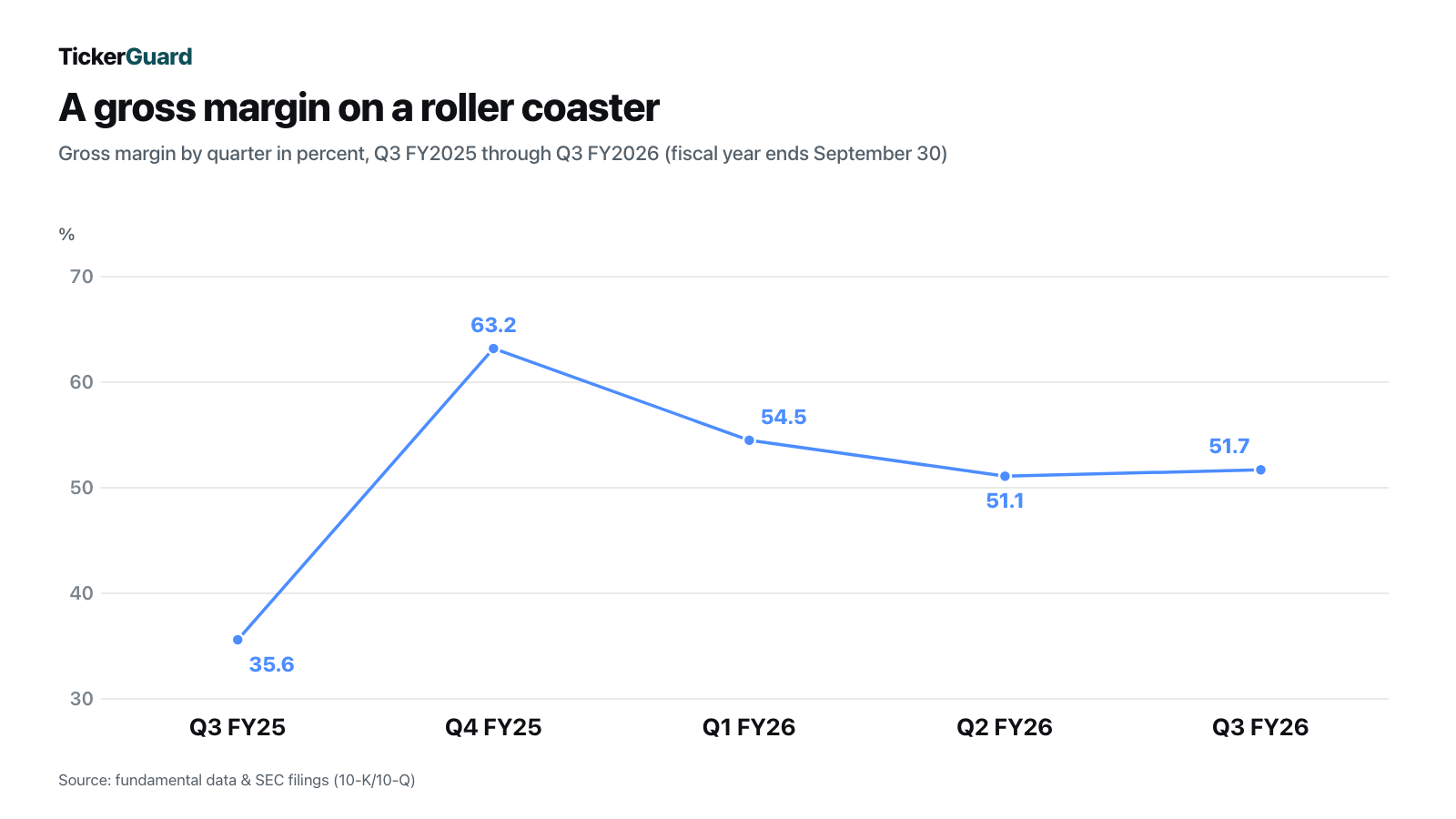
And one more thing belongs to this prop: the margin rose because the low-margin defense business shrank. The quarterly report spells it out — commercial aftermarket sales up $4.0 million, business aviation up $2.1 million, service revenue up $1.3 million, but military net sales down $4.9 million. Over nine months, military sales fell $10.8 million. That is the uncomfortable side of the record margin: it is a mix effect. Which is exactly why the chief financial officer warned in May 2026 that margins would "normalize" once defense ramps back up — and ramping defense back up is the company's stated plan.
Prop three: the pro forma table in the notes. This is the finding that explains the most and gets the least attention. When a company acquires, it must show in the notes what the numbers would have looked like had the acquisitions been in place a year earlier. Innovative Aerosystems did so for the nine months ended June 30, using a hypothetical acquisition date of October 1, 2024. The result:
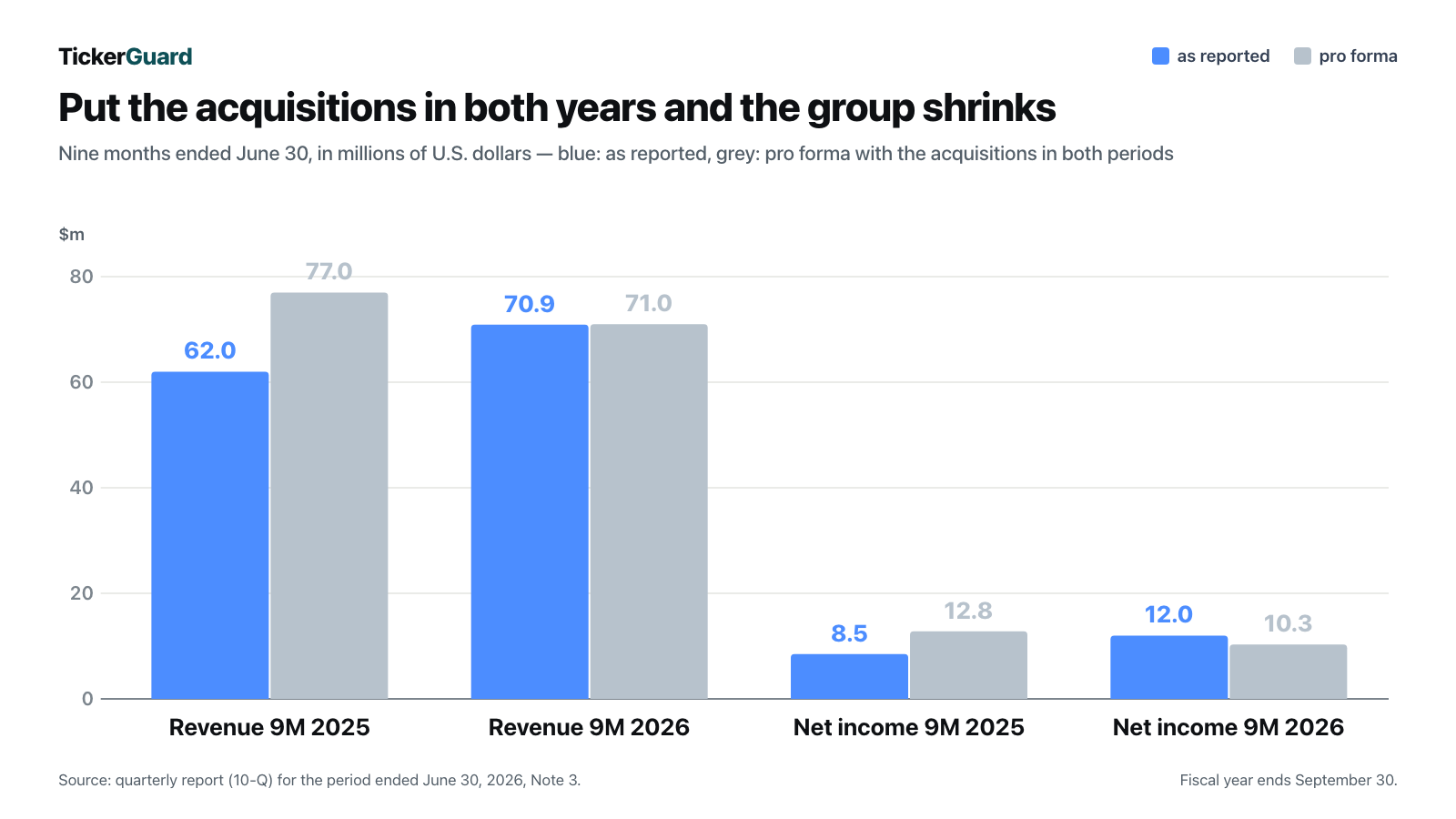
The table needs the right reading. It does not say the company is shrinking. It says the acquired product lines generated considerably more revenue under their former owners than they do so far under the new roof. That is common in product-line carve-outs while certifications, tooling and supply chains transfer. It is also the most honest like-for-like comparison available — and it shows that the increase the headline reports is to a large extent an addition effect rather than newly won business. Whether the acquisitions deliver on their promise will be decided in the next four quarterly filings.
Prop four: the adjusted measure. Alongside earnings under U.S. accounting rules (GAAP) of $0.25 per share, the earnings release reports "adjusted" earnings of $0.33. The main adjustment is amortization of acquired intangible assets — the write-down of what was paid in the acquisitions. That is common practice and unobjectionable in itself. But the amount added back, $1,299,934, is exactly the entire depreciation and amortization line for the quarter, while the quarterly report puts amortization of acquired intangibles at $911,678 and depreciation on property and equipment separately at $441,491. Roughly $388,000 of ordinary depreciation on buildings and machinery is therefore added back too; over nine months the figure is about $1.3 million. The rule of thumb: an adjusted number is only as good as the list of what was adjusted out.
What the filings say: the uncomfortable truths
Uncomfortable truth no. 1: a single program carried more than a third
Customer concentration has fallen. Program concentration has not. The annual report for fiscal 2025 states it under risk factors:
“The F-16 program, which consists of multiple production and sustainment contracts, is our largest program and represented 36.7% of our total consolidated net sales in 2025. A decision by the U.S. Government, international partners, or FMS customer countries to cut spending on this program or reduce or delay planned orders would have an adverse impact on our business and results of operations.”
— Innovative Solutions and Support, Inc., SEC annual report 10-K for fiscal 2025, Item 1A "Risk Factors"

Two findings interlock here. F-16 revenue fell from $12.6 million to $5.7 million year over year, which lowers the share and lifts the margin. At the same time management calls that $5 million per quarter the sustainable level and intends to expand the defense business. Together those mean the share of low-margin defense work is meant to rise again. Anyone extrapolating the 51.7 percent gross margin is implicitly extrapolating that the company's most important growth plan does not work out. How heavily program concentration can weigh is something our analysis of CPI Aerostructures showed at another supplier.
Uncomfortable truth no. 2: four-fifths of equity is purchased value
At June 30, 2026 the balance sheet shows total assets of $147.96 million and equity of $77.20 million. On the asset side, $15.77 million of that is goodwill — the premium paid above tangible net assets for customer relationships and reputation — and $46.03 million is intangible assets, $61.81 million together. That is 42 percent of total assets and roughly 80 percent of equity. Strip both out and tangible equity is about $15.4 million, which across 17,899,173 shares outstanding as of July 31, 2026 is roughly $0.86 per share.
This is not an accounting scandal. It is the logical consequence of an acquisition strategy. But it changes the risk calculus. As long as the acquired product lines deliver, the carrying value is justified. If they fall short of expectations — and the pro forma table raises exactly that question — an impairment is the next accounting consequence. Such a write-down costs no cash, but it eats equity, and loan covenants attach to equity measures. For scale: amortization of the acquired assets already weighs on reported earnings on a scheduled basis — the filing puts it at $1.39 million for the closing quarter of fiscal 2026 alone and $5.94 million for fiscal 2027.
Uncomfortable truth no. 3: the reported leverage is three weeks old
"Our net leverage at the end of the quarter was 1.4x despite the recent acquisitions." That sentence from the August 13, 2026 earnings call is accurate and still misleading if read as a statement about the present. It refers to June 30, 2026: $54.5 million of total debt, $10.7 million of cash, hence $43.8 million of net debt, divided by trailing twelve-month adjusted EBITDA of $31.5 million. On July 21, 2026, three weeks after the balance sheet date, the company drew another $24.5 million under the same facility to buy Aydin Displays. That amount appears in none of those figures.
For context: a year earlier, at June 30, 2025, total debt stood at $23.3 million. It has therefore more than doubled since and sits at roughly $79 million after the Aydin purchase. For a company generating $15.5 million of operating cash flow in nine months that is no acute problem, and the facility of up to $100 million, with an option for $125 million, runs to July 2030. But the interest burden is visibly growing: $1.02 million of interest expense in the third quarter of fiscal 2026 against $0.41 million a year earlier — two and a half times as much, straight off pre-tax income.
A second point belongs in the same chapter. Operating cash flow for the quarter alone fell from $7.21 million to $5.09 million, even as net income rose 84 percent. The reason sits in working capital: inventories grew from $25.80 million at September 30, 2025 to $32.08 million, and receivables from $12.96 million to $15.98 million. Growth ties up cash; that is normal. But anyone reading the nine-month headline of "free cash flow up 155 percent" should know that the most recent quarter on its own produced less cash than the year-ago quarter.
Valuation
On August 27, 2026 the stock closed at $21.17. Across 17,899,173 shares outstanding that is a market capitalization of roughly $379 million. Over the trailing twelve months — the closing quarter of fiscal 2025 plus the first nine months of fiscal 2026 — revenue totals $93.2 million and net income roughly $19.1 million, or about $1.05 per diluted share. That works out to a price-to-earnings ratio of roughly 20 and a price-to-sales ratio of about 4.1. Add net debt including the Aydin financing and enterprise value is around $447 million, or a little over fourteen times trailing adjusted EBITDA. Book value is $4.31 per share; tangible book value is $0.86 per share.
How should that be read? A price-to-earnings ratio of 20 is not exotic for a growing avionics supplier running a 50 percent gross margin — Astronics, a larger neighbor in the same market, trades in similar territory, and we looked at it in detail in a separate analysis. But it is a price that assumes the earnings base holds. That is precisely where this analysis lands: the trailing twelve-month figure contains one quarter taxed at 10.5 percent and one quarter — the closing quarter of fiscal 2025 — carrying a one-off $1.8 million gross benefit from the pandemic-era U.S. employee retention credit, which the chief financial officer himself called a "onetime benefit". Both drop out. Analyst estimates reflect it: consensus sits at roughly $1.13 per share for the current fiscal year and roughly $1.03 for the following one (data as of August 27, 2026) — the professionals expect reported earnings per share to fall again next year. The company pays no dividend. The 52-week range ran from $8.13 to $30.94; that is not a valuation metric, but it does indicate how fast expectations turn here.
Upside and risks at a glance
Upside
- Retrofit market with a tailwind: aging commercial, cargo and military fleets need modern cockpits. Commercial aftermarket sales rose $4.0 million in the third quarter of fiscal 2026 and carry the highest margins.
- From component to platform: with the Moog and Honeywell autopilots, its own displays, air data and flight management systems, and now the Aydin displays, the company can supply complete cockpits rather than individual boxes — raising revenue per aircraft.
- First production award for the new platform: in August 2026 a leading Japanese developer of electric vertical takeoff and landing (eVTOL) aircraft ordered the primary display and avionics architecture for its aircraft — the first award for the Liberty Flight Deck. Engineering work starts in the closing quarter of fiscal 2026, initial production is targeted for late 2027.
- Much broader customer base: the largest customer accounted for 21 percent of net sales in the third quarter of fiscal 2026, against 52 percent a year earlier.
- Financing headroom: $53.7 million of cash and available credit at June 30, 2026, with the facility running to July 2030.
Risks
- The margin lives on mix: the 51.7 percent gross margin exists because low-margin military sales fell $4.9 million. If defense ramps back up as planned, the margin falls — as the chief financial officer said himself in May 2026.
- Acquisitions not delivering yet: $2.3 million of revenue from acquired businesses over nine months against an announced $10 million per year. On a pro forma basis, nine-month revenue and net income would both have declined.
- F-16 program concentration: 36.7 percent of consolidated net sales in fiscal 2025. Cuts or delays by the U.S. government or partner nations would hit directly.
- Balance sheet quality: roughly 80 percent of equity is goodwill and acquired intangibles; if the product lines underperform, an impairment follows.
- Rising interest cost and young debt: $1.02 million of quarterly interest expense against $0.41 million a year earlier, and roughly $79 million of total debt after the Aydin purchase versus $23.3 million a year ago.
- Thin trading: with just under 17.9 million shares outstanding — about 6 percent of them held by directors and management, per the proxy statement of March 2026 — the stock is volatile; the 52-week range of $8.13 to $30.94 shows it.
A human conclusion
Remember the percentage trap from the opening? It is set particularly elegantly here, because the company deceives nobody. Everything this analysis holds up against the headline sits in the same documents as the headline itself: the 10.5 percent tax rate, the depressed prior-year quarter, the pro forma table, the $4.9 million decline in military sales. You only have to read past the first bullet list of the press release.
What remains is a genuinely solid picture — and one open question. Solid: a niche supplier profitable in each of the past five years, one that has beaten its own quarterly guidance three times in a row, halved its customer concentration, and sells into a retrofit market with real tailwind. Open: whether the acquisitions of the past three years eventually bring the business they had under their former owners — and whether a gross margin around 50 percent survives the return of the very defense work the company wants to grow.
The next two filings will answer that. The fiscal 2026 annual report will show how much revenue the acquired businesses actually contributed over twelve months; the first fiscal 2027 filing will show what the Aydin displays are worth and what they cost in interest. Until then: the earnings jump is real, but it is not repeatable in its current form. What you make of that is your decision. And that is exactly as it should be.
Sources and transparency
- SEC quarterly report (10-Q) for the period ended June 30, 2026, filed August 13, 2026 — balance sheet, income statement, customer concentration, effective tax rate, pro forma disclosures, subsequent events
- SEC Form 8-K of August 13, 2026 with Exhibit 99.1 — third-quarter fiscal 2026 earnings release, non-GAAP reconciliations, announced ticker change
- SEC annual report (10-K) for fiscal 2025, filed December 23, 2025 — business description, headcount, risk factors, F-16 share, fiscal 2023 through 2025 figures
- SEC Form 8-K of July 21, 2026 — acquisition of Aydin Displays for $24.5 million
- SEC quarterly report (10-Q) for the period ended March 31, 2026 and for the period ended December 31, 2025 — the fiscal 2026 quarterly path
- The company's public earnings calls of August 14, 2025, December 18, 2025, February 12, 2026, May 14, 2026 and August 13, 2026 — guidance, margin statements, F-16 run rates, acquisition expectations
- Source: fundamental data & SEC filings (annual and quarterly reports, 10-K/10-Q) for share price, market capitalization, 52-week range, ownership and analyst estimates; data as of August 27, 2026
Disclaimer: This article is journalistic commentary on publicly available company filings. It is not investment advice, not a recommendation to buy or sell, and not a solicitation to buy or sell securities. Equity investments can lead to the total loss of the capital invested. All figures come from the original documents linked above and carry the reporting dates stated there; they may have changed since publication. Positions held by the operator are disclosed daily; where one exists, it appears as a notice at the top of this deep dive.
Key figures at a glance
All monetary figures in millions of $; earnings per share as reported.
| Metric | 2021 | 2022 | 2023 | 2024 | 2025 |
|---|---|---|---|---|---|
| Revenue | 23.0 | 27.7 | 34.8 | 47.2 | 84.3 |
| Operating Income (EBIT) | 3.9 | 7.2 | 7.4 | 9.7 | 20.1 |
| Net Income | 5.1 | 5.5 | 6.0 | 7.0 | 15.6 |
| Net Margin | 22.0% | 19.9% | 17.3% | 14.8% | 18.5% |
| Earnings Per Share | 0.29 $ | 0.32 $ | 0.35 $ | 0.40 $ | 0.88 $ |
Source: fundamental data & SEC filings (annual and quarterly reports, 10-K/10-Q)
Our Bottom Line at a Glance
- Growth and profitability positive
- Revenue up from $23.0 million in fiscal 2021 to $84.3 million in fiscal 2025 and net income from $5.1 million to $15.6 million, profitable in each of those five years. The nine months through June 30, 2026 added $70.9 million of revenue and $12.0 million of net income.
- Guidance track record positive
- Three quarterly guides beaten in a row: $18m to $20m guided and $21.8m delivered; $20m to $22m guided and $22.4m delivered; $24m to $26m guided and $26.7m delivered (earnings calls of December 18, 2025, February 12, 2026, May 14, 2026 and August 13, 2026). The F-16 dip announced in August 2025 and the recovery that followed also played out as described.
- Quality of the earnings jump negative
- Net income for the quarter ended June 30, 2026 rose 83.7 percent while pre-tax income rose only 61.2 percent — the difference comes from an effective tax rate of 10.5 percent instead of 21.5 percent, about three cents per share. The prior-year quarter was depressed by the F-16 production move, and the adjusted figure adds back $1,299,934 as amortization while the filing reports $911,678 for it.
- Contribution from acquisitions negative
- The acquired businesses contributed just $2.3 million of net sales in the nine months through June 30, 2026, against roughly $10 million a year announced in May 2026. The pro forma table in the same filing shows $71.0 million instead of $77.0 million of revenue and $10.3 million instead of $12.8 million of net income on a like-for-like basis.
- Balance sheet and leverage neutral
- Equity of $77.20 million at June 30, 2026, roughly 80 percent of it goodwill and intangible assets. Total debt of $54.5 million against $23.3 million a year earlier, plus $24.5 million for Aydin Displays on July 21, 2026. Set against that: $12.3 million of free cash flow in nine months and a credit facility running to July 2030.
- Market position and concentration neutral
- Customer concentration has fallen sharply — the largest buyer accounted for 21 percent of net sales in the quarter ended June 30, 2026 against 52 percent a year earlier. The F-16 program still represented 36.7 percent of consolidated net sales in fiscal 2025 and remains the largest program per the annual report.
Innovative Aerosystems is a consistently profitable niche avionics supplier that has almost quadrupled revenue in four years and halved its customer concentration. But the earnings jump in the quarter ended June 30, 2026 rests on a 10.5 percent tax rate, a depressed prior-year quarter and a military business that shrank by $4.9 million; the company's own pro forma table shows a decline on a like-for-like basis. What remains open is whether the acquisitions of the past three years bring the business they promised. Not investment advice.
What Our Rating Means
Open questions
The business works in principle, but one material question is open. As long as it stays open, our findings do not carry a quality verdict.
Yellow, because the business fundamentally works while one material operating question stays open. In its favor: five consecutive profitable years, revenue up from $23.0 million to $84.3 million, $12.3 million of free cash flow in nine months, customer concentration halved from 52 to 21 percent, and a management team that has beaten its own quarterly guidance three times in a row. Against that stands the central open question of this analysis: the acquired product lines contributed $2.3 million of revenue over nine months against roughly $10 million a year announced, and the company's own pro forma table shows a like-for-like decline of 7.7 percent in revenue and 19.8 percent in net income. Add to that the fact that the record gross margin is a mix effect of a military business that fell $4.9 million and is meant to grow again. Red would be wrong: there is no evidence of a threat to the substance of the company, equity is clearly positive, operating cash flow is solidly positive and the credit facility runs to July 2030. The price — roughly $379 million of market capitalization on August 27, 2026 at a price-to-earnings ratio near 20 — is a price argument, not a quality argument, and does not move the rating. The decision is yours.
A journalistic assessment by our editorial team at the time of the deep dive, based on public sources — not investment advice and not a solicitation to buy or sell. Your personal circumstances (investment goals, risk capacity, taxes) cannot be taken into account. What our levels mean, how verdicts are formed, and what conflicts of interest exist →
Worth Noting
- Trigger for this analysis: the quarterly report (10-Q) for the period ended June 30, 2026, filed August 13, 2026, together with the earnings release (8-K, Exhibit 99.1) of the same day.
- Data basis: annual and quarterly figures come from the annual report (10-K) for fiscal 2025 (filed December 23, 2025) and the quarterly reports for the periods ended December 31, 2025, March 31, 2026 and June 30, 2026. Price, market capitalization and valuation figures are as of August 27, 2026.
- Possible confusion: the company has traded under the ticker "IA" since August 18, 2026 and does business as Innovative Aerosystems, but its legal name remains Innovative Solutions and Support, Inc. (CIK 0000836690). Older sources filed under "ISSC" refer to the same entity. There is no connection to the similarly named software firm "Innovative Solutions" or to Aerojet Rocketdyne.
Stock Watch
This analysis is as of August 29, 2026. Stock Watch will tell you what's changed at ISSC since then.
Later $1 a month per stock — signing up is free, and you'll be the first to know when it launches.
The full analysis as a PDF for later
We will send you this analysis as a PDF — to print, file away, and read at your own pace. And we will add you to the free Stock Watch list for Innovative Solutions and Support (ISSC), so you hear about it when something material in this analysis changes.
Frequently Asked Questions
Innovative Solutions and Support, Inc. — trading as Innovative Aerosystems since October 2025 — builds avionics, meaning cockpit electronics: flat-panel displays, air data systems, autothrottles, autopilots, flight management and mission computers. Its customers are airframe makers such as Pilatus, Textron and Boeing, and operators of aging fleets retrofitting their cockpits. The company is based in Exton, Pennsylvania, and had 147 full-time employees as of September 30, 2025.
The company rebranded to Innovative Aerosystems in October 2025 and announced in its August 13, 2026 earnings release that the ticker would follow. Since the market open on August 18, 2026 the shares trade on Nasdaq under "IA" instead of "ISSC". It is the same legal entity with the same identifier at the U.S. securities regulator, the SEC (CIK 0000836690); older sources filed under "ISSC" or "Innovative Solutions & Support" refer to the same company.
In the quarter ended June 30, 2026 revenue grew 10.7 percent, pre-tax income 61.2 percent and net income 83.7 percent. Three reasons: the share of high-margin commercial aftermarket business rose while low-margin military sales fell $4.9 million; the year-ago quarter carried the cost of moving F-16 production; and the effective tax rate was 10.5 percent instead of 21.5 percent, which alone accounts for roughly three cents of earnings per share.
It shows what the numbers would look like had the Moog and Honeywell acquisitions been part of the group from October 1, 2024. On that like-for-like basis, the nine months ended June 30, 2026 would show $71.0 million of revenue and $10.3 million of net income, against $77.0 million and $12.8 million a year earlier — declines of 7.7 percent and 19.8 percent. The reason: the acquired product lines generated more revenue under their former owners than they do so far under the new roof.
At June 30, 2026 total debt was $54.5 million and cash $10.7 million, leaving net debt of $43.8 million, or 1.4 times trailing twelve-month adjusted EBITDA. On July 21, 2026 the company borrowed a further $24.5 million to acquire Aydin Displays, an amount not yet reflected in that ratio. A year earlier total debt had been $23.3 million.
The Liberty Flight Deck is the company's new, freely customizable cockpit system. In August 2026 Innovative Aerosystems announced its first production award for it: a leading Japanese developer of electric vertical takeoff and landing (eVTOL) aircraft engaged the company to design the primary display and avionics architecture for its aircraft. Engineering work begins in the closing quarter of fiscal 2026, initial production is targeted for late 2027 and full production for 2028. The roughly $50 million contract value quoted assumes all 400-plus aircraft in the customer's backlog are built.
The stock closed at $21.17 on August 27, 2026; across 17,899,173 shares outstanding that is roughly $379 million of market capitalization. Against trailing twelve-month figures of $93.2 million in revenue and about $19.1 million in net income, that is a price-to-earnings ratio of roughly 20 and a price-to-sales ratio of about 4.1. Book value is $4.31 per share and tangible book value, after removing goodwill and intangibles, about $0.86. The company pays no dividend.
On September 30. Fiscal 2026 therefore runs from October 1, 2025 through September 30, 2026, and the third quarter of that fiscal year ended on June 30, 2026. Anyone comparing these figures with calendar years is shifted by one quarter. The annual report (10-K) for fiscal 2025 was filed on December 23, 2025; the fiscal 2026 edition is due correspondingly late in calendar 2026.
Found an error?
Did you spot a factual error, an outdated number, or a typo in this deep dive? Let us know briefly — your report goes straight to the editorial team.