Iljin Electric: The Order Boom Is Real — the Controlling Shareholder Sold Anyway
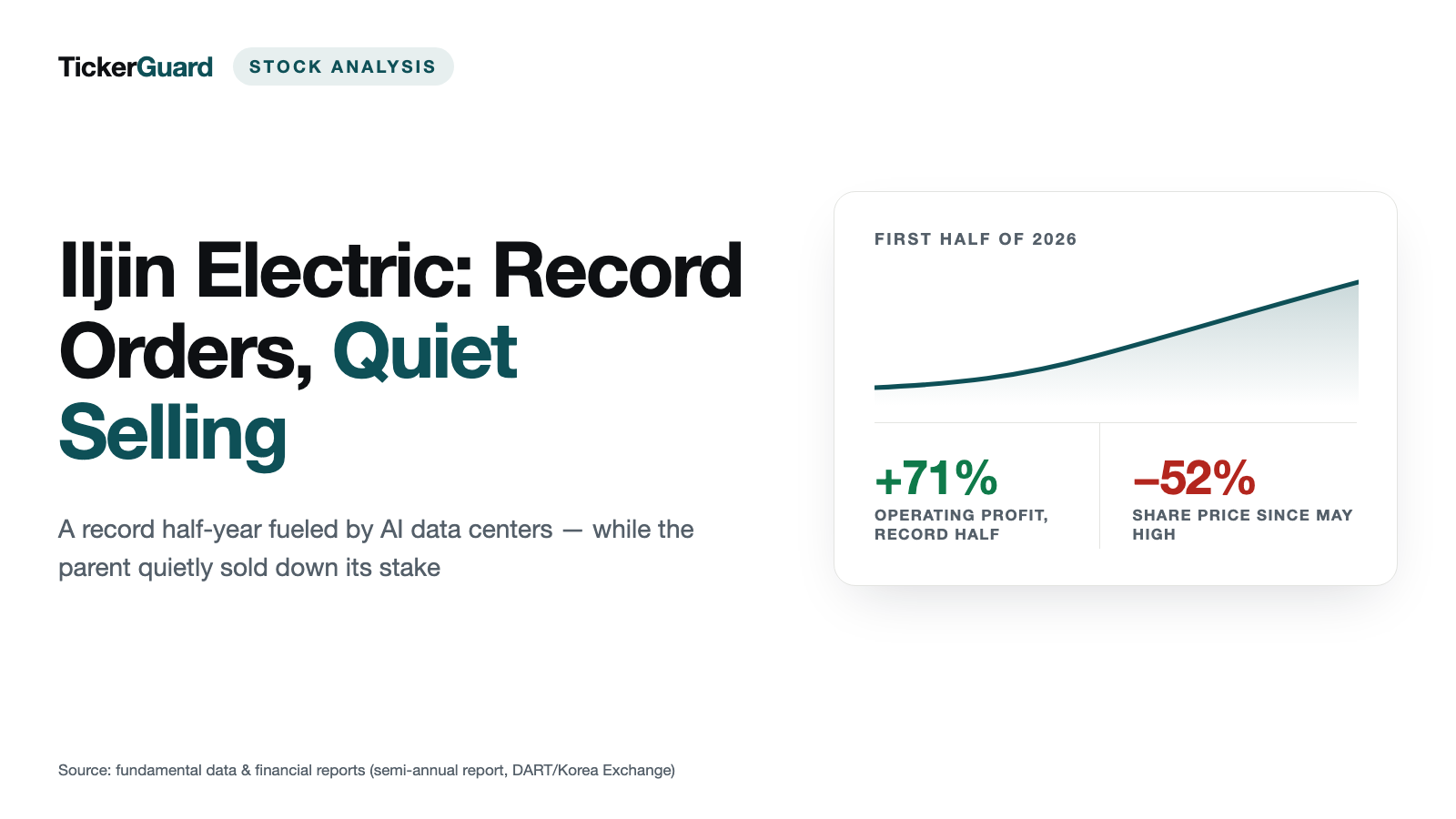
Iljin Electric (KOSPI: 103590) builds high-voltage transformers and cables for a power grid that can barely keep up with the electricity demand of AI data centers: its order backlog stood at $1.94 billion at the end of June 2026, and operating profit for the first half of 2026 rose 71.3 percent to a record. In the middle of that very boom, controlling shareholder Iljin Holdings gave up 2,986,714 of its own shares in six months — through an expired exchangeable bond and a price return swap, while the stock hit a high of KRW 144,100 in May 2026 and then gave back more than half of that gain by September. Not a buy or sell recommendation — just the question of what that timing means for investors weighing whether to buy in right now.
 Thomas Mücke
Founder & Publisher
Thomas Mücke
Founder & Publisher
There is a reflex that can get expensive on the stock market: the moment the words "artificial intelligence" show up next to a chart that has already run up double digits, a feeling kicks in for many investors that has nothing to do with reading a balance sheet — the fear of missing out. FOMO. It never stops to ask whether a company is actually telling that story itself, or just happens to be standing in its slipstream.
Iljin Electric Co., Ltd. (KOSPI: 103590) is a textbook case. The South Korean company doesn't sell chips, software, or cloud capacity. It builds high-voltage cables, transformers, and switchgear — the basic hardware of a power grid. And yet its order backlog stood at $1.94 billion as of June 30, 2026, operating profit for the first half of 2026 rose 71.3 percent to a first-half record, and the stock climbed 148 percent from its January low to its May 2026 high. The reason: every new AI data center needs electricity, every additional gigawatt needs lines and transformers, and the United States is building out both at scale right now.
The deal for this piece: no recommendation, no price target. We read the semi-annual report filed August 11, 2026 — the only periodic filing that fully covers the numbers through June 30, 2026 — and look at what's behind the headline. The central tension running through every chapter: the boom is real and documented in the numbers. And the company's own controlling shareholder sold into it.
What Iljin Electric actually does
Picture the power grid as a loop: power plants generate electricity, high-voltage lines carry it long distances, transformers step the voltage down in stages, and switchgear finally distributes it to factories, data centers, and homes. Iljin Electric builds the hardware for that loop — across two segments. The cable segment makes bare copper and aluminum conductors, high- and medium-voltage cable, and insulated wire; it generated KRW 814.9 billion in the first half of 2026, about 71 percent of group revenue. The heavy electrical equipment segment — gas-insulated switchgear (GIS), transformers, circuit breakers — brought in KRW 327.2 billion, just under 29 percent, but is growing faster and appears to carry the higher-margin order book (more on that below).
As a standalone, publicly listed company, Iljin Electric has existed only since July 2, 2008, when its manufacturing division was spun off (인적분할, a common Korean form of corporate demerger) from holding company Iljin Holdings and incorporated separately; the listing on the Korea Exchange followed on August 1, 2008. The roots go back further: the Iljin Group was founded in 1968 as Iljin Metal Industry Co. and made transmission equipment from the start. Headquarters and a main plant sit in Hwaseong-si, Gyeonggi Province, south of Seoul; a second key plant for transformers is in Hongseong, and another cable plant is in Ansan. As of June 30, 2026, the group employed 1,148 people (1,026 permanent, 122 fixed-term), with an average tenure of 7.6 years.
Iljin Electric is controlled by holding company Iljin Holdings, led by Vice Chairman Heo Jeong-seok (허정석, born 1969, son of group founder Heo Jin-gyu), who holds roughly 29.1 percent of the holding company — a founder-family-led group structure common in South Korea, seen for instance at trading holding company Lotte as well. Important for everything that follows: Iljin Electric files no 10-K and no 10-Q. It is not a U.S. reporting company; its mandatory filings sit in Korea's electronic disclosure system DART, run by the Financial Supervisory Service, under K-IFRS accounting, with a calendar-year fiscal year. Every figure in this analysis therefore carries "Source: fundamental data & financial reports (annual/semi-annual report, DART/Korea Exchange)" instead of "SEC filings."
What's currently supercharging this market, the company describes itself in the semi-annual report — explicitly as its own read of the market, not as marketing copy:
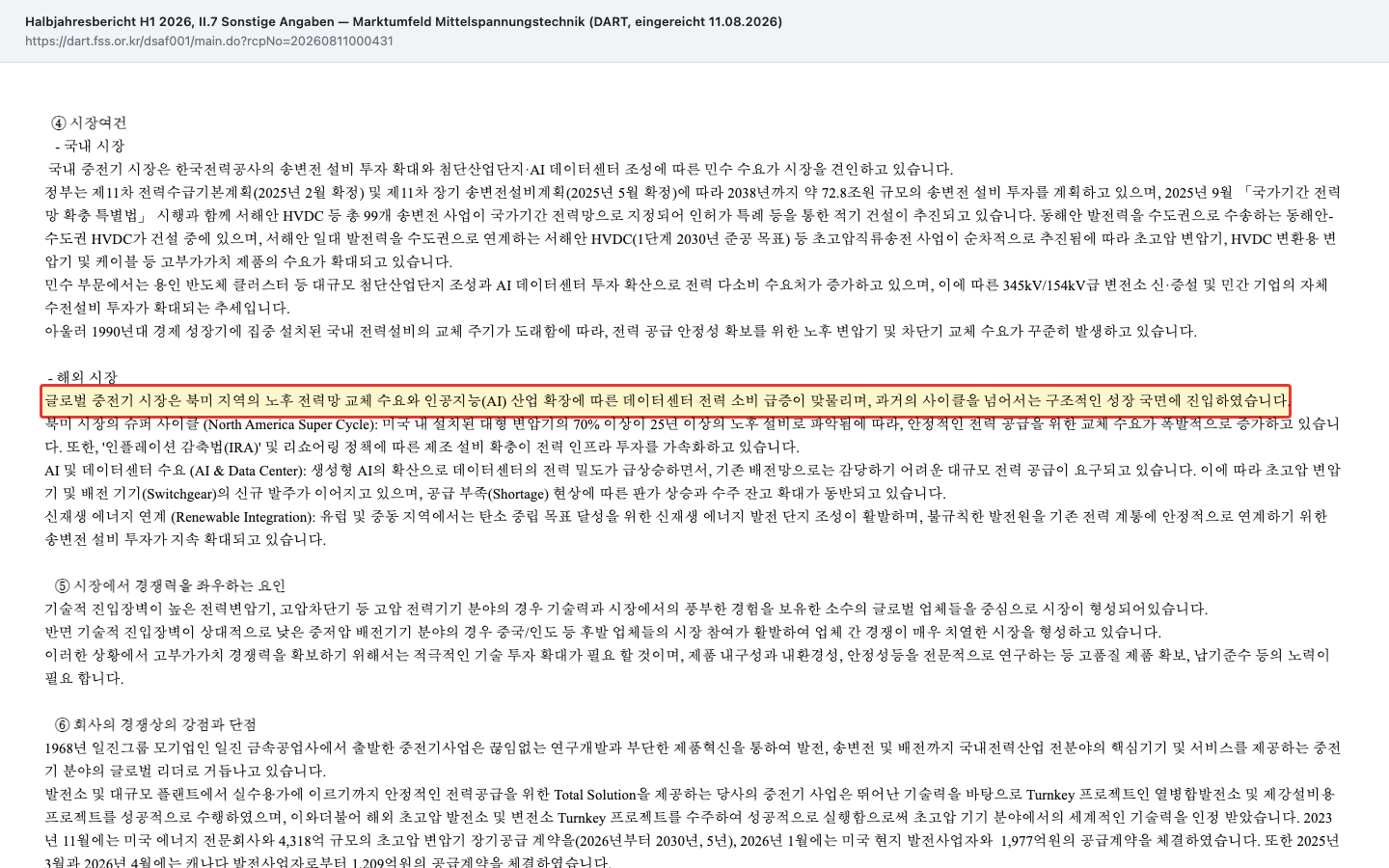
"글로벌 중전기 시장은 북미 지역의 노후 전력망 교체 수요와 인공지능(AI) 산업 확장에 따른 데이터센터 전력 소비 급증이 맞물리며, 과거의 사이클을 넘어서는 구조적인 성장 국면에 진입하였습니다."
— Iljin Electric, semi-annual report H1 2026, section II.7 "Other matters," filed August 11, 2026 (DART). Translated: "The global market for heavy electrical equipment, driven by aging North American grid replacement demand converging with the surge in data center power consumption from the expansion of the AI industry, has entered a structural growth phase that surpasses past cycles."
The distinction matters: Iljin Electric is not part of the "AI industry" in the narrow sense — it sells neither AI software nor AI hardware, and based on the filings reviewed does not itself use AI operationally to any meaningful degree. It benefits as an infrastructure supplier from demand that others trigger — chipmakers like Nvidia, for instance, whose data-center processors create the power demand that Iljin Electric then wires up. That distinction matters for how durable the growth is: it depends on the pace of data-center and grid-buildout programs in the U.S. and elsewhere — not on an AI product of its own that Iljin Electric would control.
Company history for investors
-
2008
Spin-off from Iljin Holdings and IPO
Iljin Electric becomes a standalone company on July 2, 2008, and lists on the Korea Exchange on August 1, 2008 — since then valued separately from the holding company's balance sheet.
-
2023
Largest single order in company history
In November 2023, Iljin Electric secures a KRW 431.8 billion order for high-voltage transformers in the U.S., delivery 2026 through 2030 — the foundation of today's order backlog.
-
2025
Iljin Holdings issues an exchangeable bond on Iljin Electric shares
On October 20, 2025, the parent company issues an exchangeable bond backed by Iljin Electric shares — the first building block of the later stake reduction.
-
2026
Price high and stake reduction in May
The stock hits its half-year high of KRW 144,100 on May 4, 2026; in the same window, most of Iljin Holdings' bond exercise and price-return-swap settlement takes place — the bond terms had been fixed since October 2025.
-
2026
Record semi-annual report
On August 11, 2026, Iljin Electric reports record first-half revenue and operating profit, plus an order backlog of $1.94 billion — the data basis for this analysis.
Where Iljin Electric landed on our desk
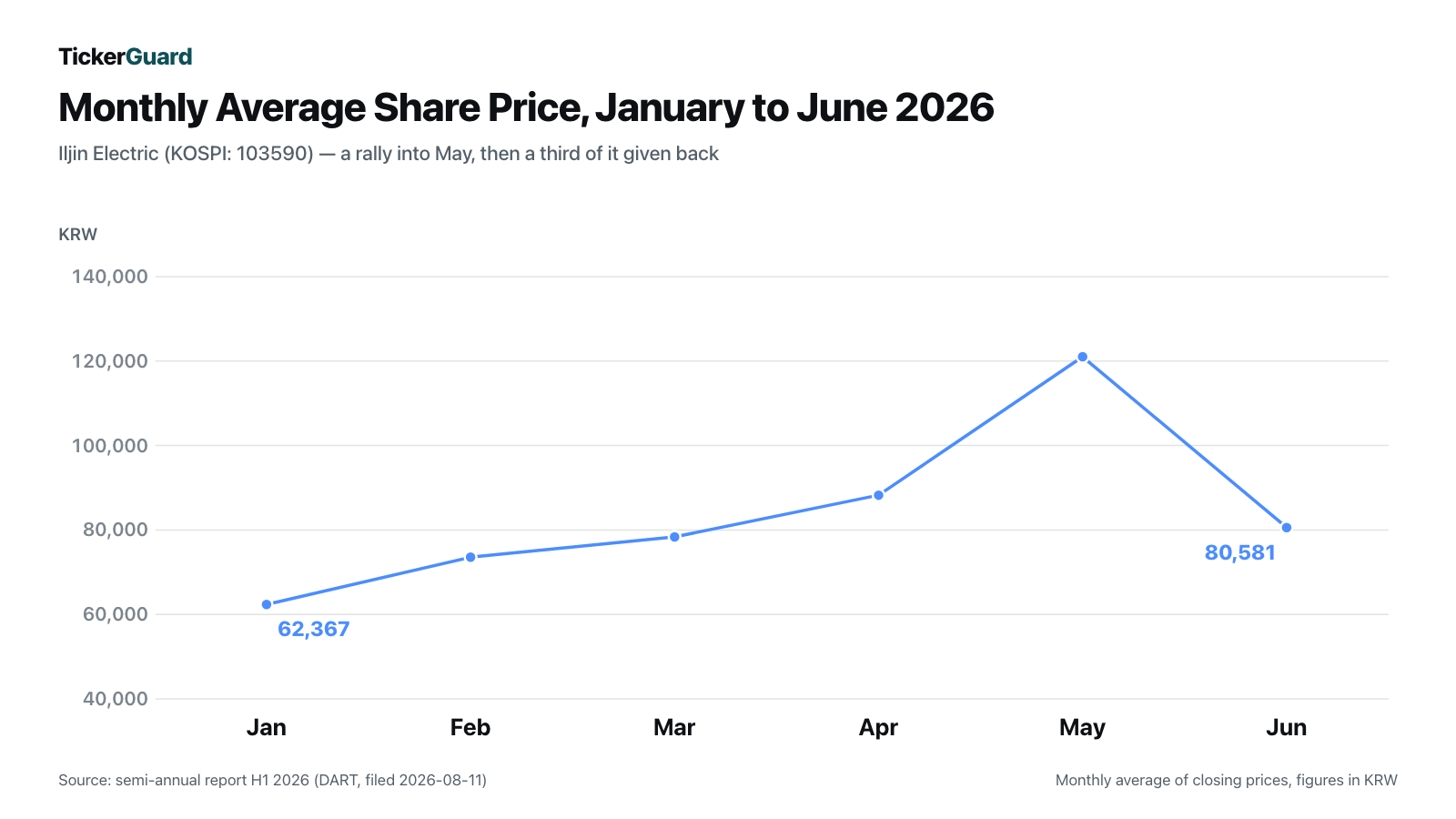
Honesty first: Iljin Electric didn't land on the research list through a buy recommendation or an analyst note, but through a combination that rarely shows up together. As of early September 2026, the fundamental data showed a stock that had risen from a monthly average price of KRW 62,367 in January 2026 to KRW 121,022 in May 2026 — nearly double — before giving back more than a third by the June monthly average, and roughly 43 percent versus the May average by the September 3, 2026 price of KRW 69,400. At the same time, the same company was reporting record numbers for exactly that period: the highest revenue and operating profit ever recorded for a first half. That combination — a spiking stock, then a slide, while the operating numbers actually kept getting better — raises a question plain metrics can't answer: what's behind that combination?
So we read the semi-annual report filed August 11, 2026, plus the cover pages of the FY2025 annual report and the Q1 2026 quarterly report for context. One disclosure that shapes the evidence: no transcripts of analyst calls exist for this company — we checked our own transcript archive (zero hits for 103590.KO), which is the norm for Korean issuers and not a company-specific red flag. The chapter on management's promises therefore relies on DART filings rather than call transcripts.
The numbers over the years
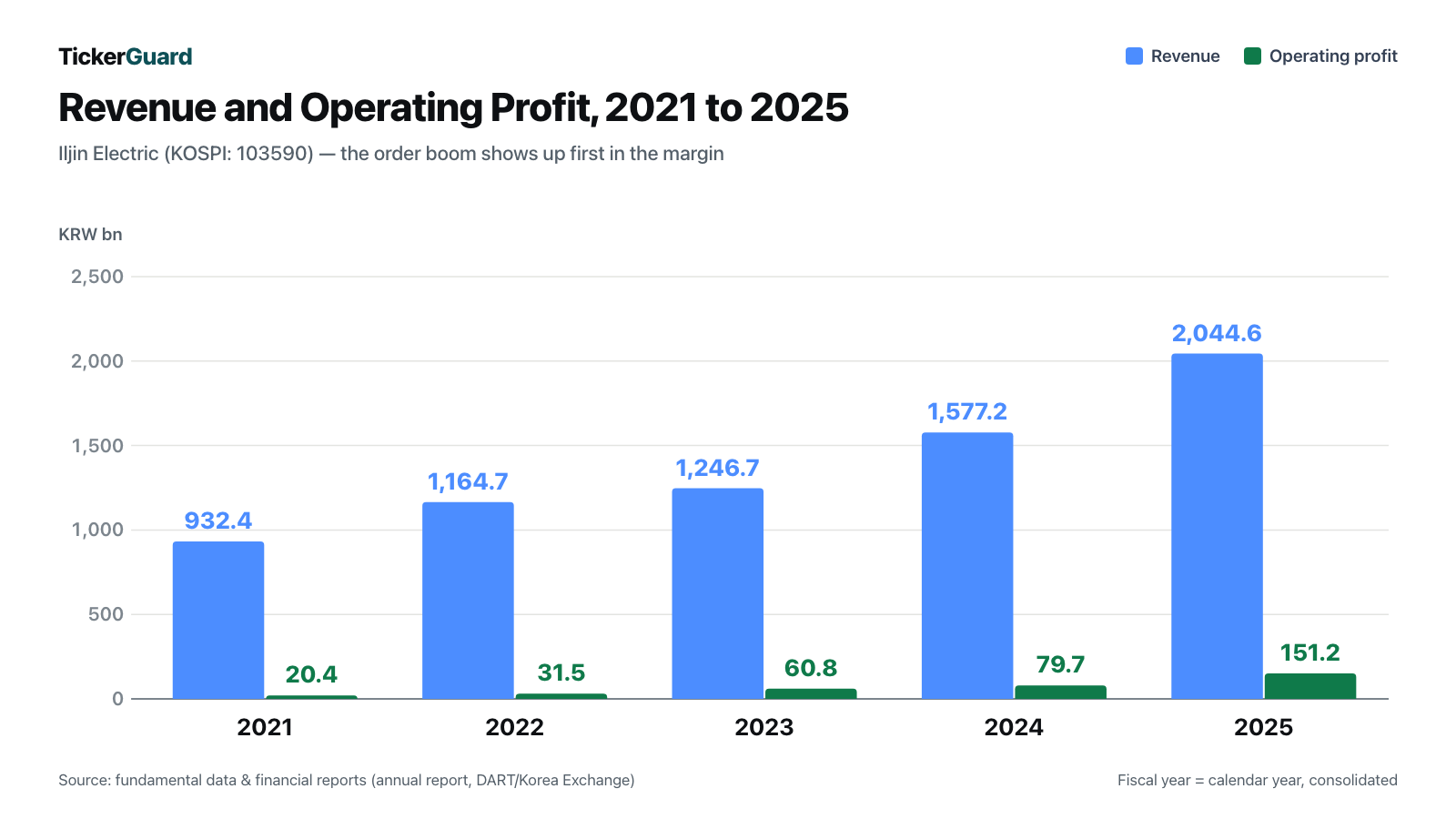
First, what genuinely holds up. Revenue turned from a choppy mid-hundreds-of-billions-of-won figure into a genuine growth story over the past decade: KRW 932.4 billion (2021), KRW 1,164.7 billion (2022), KRW 1,246.7 billion (2023), KRW 1,577.2 billion (2024), KRW 2,044.6 billion (2025) — converted at the September 3, 2026 reference rate (1 EUR = KRW 1,576.75), that's roughly €1.30 billion in 2025 revenue, or about $1.51 billion at KRW 1,356.63 per dollar. The first half of 2026 alone brought in KRW 1,143.5 billion (roughly $843 million) — 16.7 percent more than the same period a year earlier.
More telling than revenue is what's left over. Operating profit grew markedly faster than revenue: from KRW 20.4 billion (2021) through KRW 31.5 billion (2022), KRW 60.8 billion (2023), and KRW 79.7 billion (2024) to KRW 151.2 billion in 2025 — the margin climbed from 2.2 to 7.4 percent over those five years. In the first half of 2026, operating profit reached KRW 122.7 billion, up 71.3 percent year over year and, on its own, already 81 percent of all of the prior full year's profit.
The order backlog confirms this isn't a one-off. As of June 30, 2026, the semi-annual report showed total order value of $2,396.2 million, of which $457.1 million had already been billed — leaving an open order backlog of $1,939.1 million, commonly rounded to $1.94 billion. Of that, $1,290.1 million (66.5 percent) was the higher-margin heavy-equipment segment and $1,470.2 million (75.8 percent) was export business — mostly North America. For scale: the open backlog alone already exceeds all of 2025's group revenue (KRW 2,044.6 billion, or roughly $1.51 billion) by about 29 percent.
Capacity utilization shows the order book is straining at its limits: in the first half of 2026, the heavy-equipment segment ran at 108 percent of nominal capacity, per the semi-annual report, through extra shifts, while the cable segment ran at 97 to 99 percent. For 2026, the company plans roughly KRW 59.6 billion of additional investment in maintenance, R&D, and a new office building at the Hongseong plant, where transformer manufacturing capacity was already expanded from KRW 220 billion to KRW 430 billion (production value).
What management promised — and what came of it
With no call transcripts to check, management can only be judged against what it has documented in mandatory filings and the trade press. And that record is unusually concrete: in November 2023, Iljin Electric announced what it called the largest single order in its history — KRW 431.8 billion (about $333.2 million at the time) for 15 different transformer types, including 345-kilovolt units, for an undisclosed U.S. utility on the East Coast, delivery 2026 through 2030. The 2026 semi-annual report confirms in its business overview that further orders followed: a KRW 197.7 billion agreement with a U.S. power generator in January 2026, and two agreements with a Canadian power generator worth a combined KRW 120.9 billion in March 2025 and April 2026. Trade press pegs the second Canadian tranche, from April 2026, at roughly $88 million for 21 transformers in the 245-kilovolt class, delivery in the first half of 2027 — in the same range as the DART figure.
What management didn't promise but did deliver in practice: the Hongseong capacity expansion progressed as outlined in prior reports, and the export share of the order backlog rose steadily — from 74 percent at the end of Q1 2026 (per trade press) to 75.8 percent at the end of Q2 2026 (per the semi-annual report) — a steady, not a sudden, trend. Taken together, the pattern since 2023 holds: management delivers orders roughly as announced, and the numbers grow within what its own stated capacity can support — without a single event, such as an acquisition or a one-off gain, carrying the story.
What the filings say — the uncomfortable truths
Uncomfortable truth no. 1: growth is increasingly financed with borrowed money
A boom needs working capital before it produces profit — raw materials get bought, components get made, invoices get issued, long before customers pay. At Iljin Electric that shows up clearly on the balance sheet as of June 30, 2026: trade receivables rose from KRW 389.3 billion to KRW 455.1 billion in six months, and inventories from KRW 335.5 billion to KRW 386.6 billion — a combined increase of KRW 116.9 billion. Part of that was financed through short-term borrowings, which doubled over the same period, from KRW 72.3 billion to KRW 143.2 billion.
The result: the debt-to-equity ratio rose from 149.7 percent (end of 2024) through 159.2 percent (end of 2025) to 161.1 percent as of June 30, 2026 — moderate for an industrial company this size, but with a clear direction. In fairness: cash also grew over the same half-year, from KRW 137.6 billion to KRW 188.6 billion, and equity rose from KRW 588.7 billion to KRW 654.2 billion — this is not a balance sheet in distress. Credit rating agency NICE last rated the company's senior unsecured bonds A- on May 10, 2024 — before the current growth surge, and, as far as documented in the semi-annual report, not updated since.
Uncomfortable truth no. 2: the controlling shareholder sold into the price high
This is the finding that triggered this analysis. The 2026 semi-annual report's shareholder section documents a change that looks unremarkable at first glance — a percentage that fell — and turns into a concrete, dated selling story on closer reading. As of January 1, 2026, parent company Iljin Holdings held 23,483,712 shares (49.25 percent). As of June 30, 2026, that was down to 20,496,998 shares (42.98 percent) — a drop of 2,986,714 shares, or 6.27 percentage points, in six months.
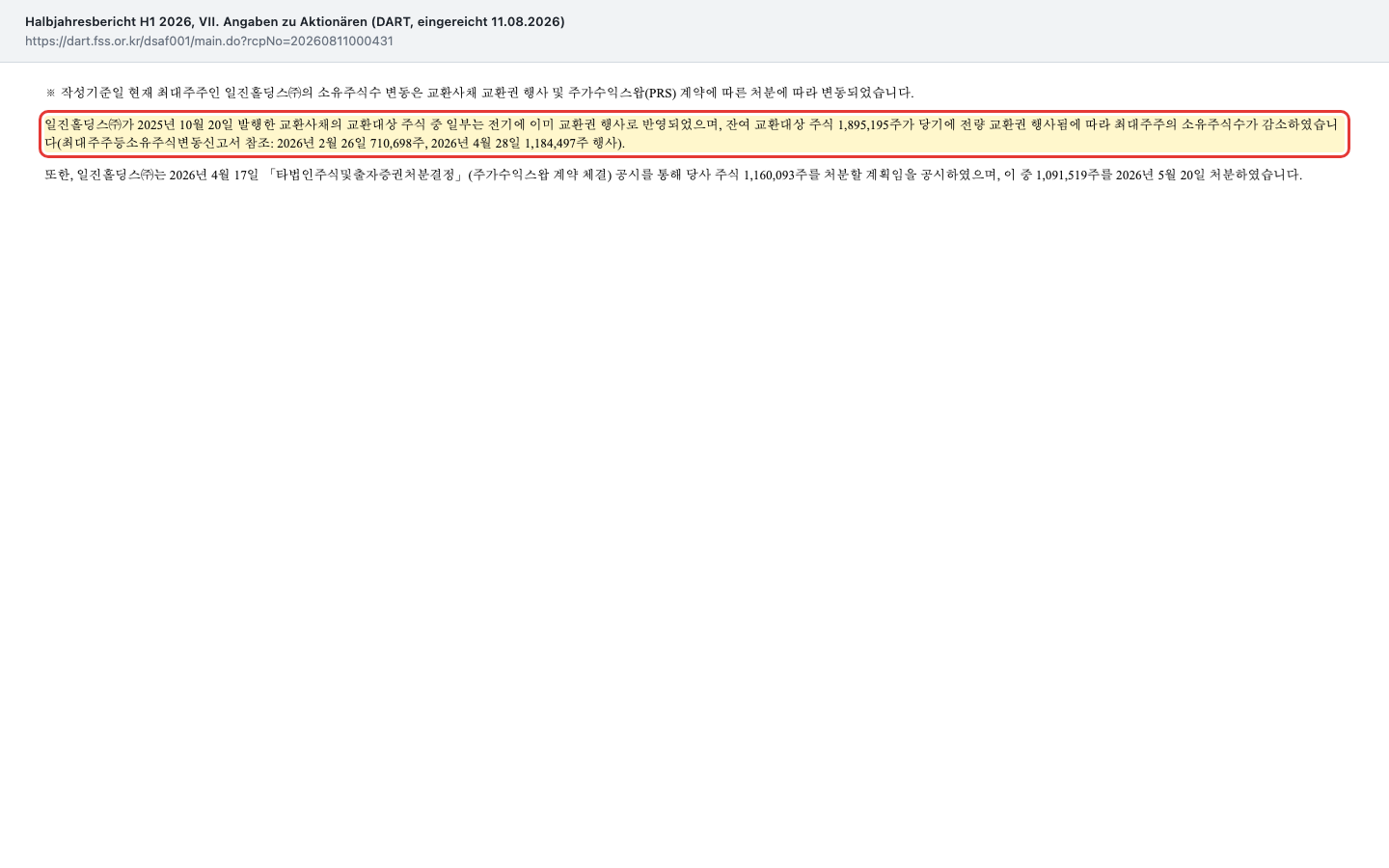
The report names the mechanism, too. Iljin Holdings had issued an exchangeable bond (교환사채) on October 20, 2025, backed by Iljin Electric shares; part of the exchange right had already been exercised the year before, and the remaining 1,895,195 shares were fully exchanged in the first half of 2026 — 710,698 shares on February 26, 2026, and another 1,184,497 shares on April 28, 2026. In addition, Iljin Holdings announced a price return swap (PRS) contract on April 17, 2026, covering 1,160,093 shares, of which 1,091,519 had already settled by May 20, 2026.
Nothing about either instrument is hidden — both are publicly disclosed transactions, an exchangeable bond is a routine financing tool, and a price return swap is a well-known way for controlling shareholders to extract liquidity from a stake without selling on the open market. What stands out is the timing: the bulk of the transactions — the bond exercises in February and April, the swap settlement on May 20 — fell right inside the window in which the stock climbed from roughly KRW 78,000 to its half-year high of KRW 144,100 on May 4, 2026, and began falling shortly after. Whether that was coincidence, the disciplined execution of a pre-arranged program, or both at once, can't be settled from the filings alone — but the scale and the timing are a fact, not a suspicion.
The mechanics carry a caveat that puts this in context without discrediting it: for an exchangeable bond, the issuer fixes the exchange price and terms at issuance — here on October 20, 2025 — and it is the bondholders, not Iljin Holdings, who then decide when to exchange; the cash from selling the underlying shares flowed to the holding company back when the bond was issued in 2025, not at the February and April 2026 exchange dates. For a price return swap, it is also common for the seller to retain some or all of the stock's economic price exposure even though legal ownership changes hands; whether that applies here isn't stated in the report. And the swap contract itself was announced on April 17, 2026 — before the May 4 high, not after it; only the bulk of its settlement, on May 20, fell into the declining market. In short: the stake has demonstrably shrunk, but whether Iljin Holdings actually "sold at the high" or mostly fulfilled obligations locked in earlier can't be settled from the public filings alone.
Uncomfortable truth no. 3: an antitrust dispute with the largest domestic customer is still open
The contingent-liabilities section of the semi-annual report lists three unresolved court cases against the same counterparty: state utility Korea Electric Power Corporation (KEPCO) and the Korea Fair Trade Commission (KFTC). Iljin Electric is appealing, before the Seoul High Court (second instance), a KFTC fine and corrective order worth KRW 1.05 billion; separately, it is challenging a KEPCO bidding restriction worth KRW 100 million (first instance). In the other direction, KEPCO is suing Iljin Electric before the Seoul Eastern District Court for KRW 2 billion in damages (also first instance).
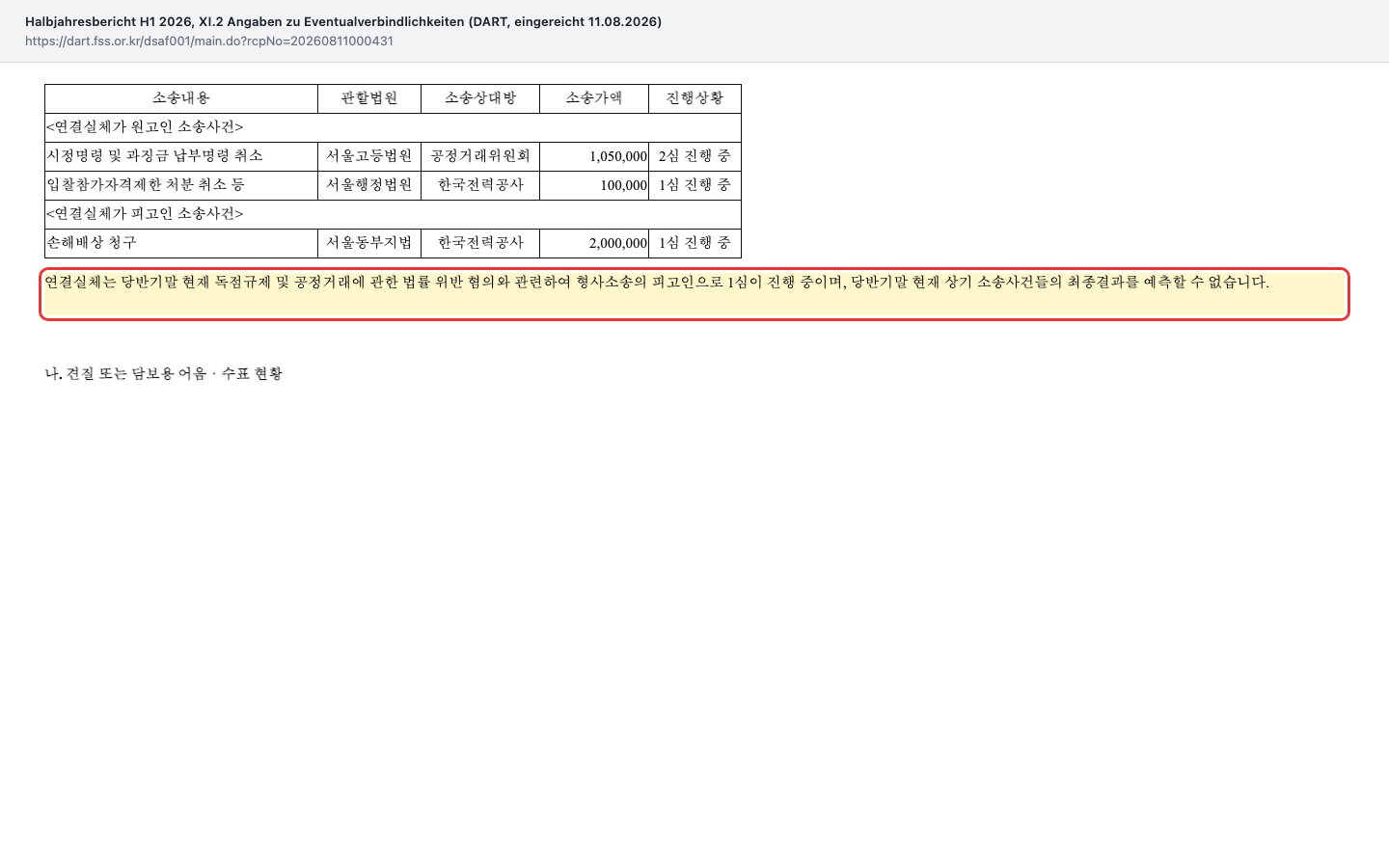
The report also confirms that the group "is currently a defendant in a first-instance criminal proceeding related to alleged violations of the Monopoly Regulation and Fair Trade Act" as of the half-year end. The company states in writing that the outcome of these cases cannot be predicted as of the report date. Financially, the amounts at stake (a combined roughly KRW 3.15 billion) are small next to first-half net income of KRW 85.8 billion — the real risk isn't the fine, it's that KEPCO, as the largest domestic buyer of grid equipment, could impose a repeated or tightened bidding restriction that hits the domestic business, even though exports (75.8 percent of the order backlog) carry the larger share of growth.
Valuation — pricey for a cyclical bet
Two calculations are worth putting side by side. Based on reported 2025 group earnings per share (KRW 2,179), the stock costs 31.9 times trailing earnings at the September 3, 2026 price of KRW 69,400 — a classic growth premium. Using the analyst consensus for the current fiscal year 2026 instead (KRW 3,759.67 per share, based on 3 estimates per fundamental data as of September 3, 2026), the P/E drops to roughly 18.5 times — not implausible given the documented order backlog, but it assumes the second half performs at least as strongly as the first.
On book value: equity stood at KRW 654.2 billion as of June 30, 2026, spread across 47,677,269 shares outstanding — about KRW 13,721 of book value per share. At the current price, the market is paying roughly 5.1 times book, well above what would be typical for a plain industrial supplier. For comparison, equity grew 30.8 percent from the end of 2024 through June 30, 2026 (KRW 500.3 billion to KRW 654.2 billion) — the market is pricing in not just real substance but, to a significant degree, the expectation that the order boom continues for years. The dividend is a side note in all this: for fiscal 2025, Iljin Electric paid KRW 500 per share (a 22.95 percent payout ratio, versus KRW 300 and 30.96 percent the year before) — a yield of roughly 0.7 percent at the current price.
Opportunities and risks at a glance
What speaks for it: an order backlog of $1.94 billion that already exceeds all of 2025's full-year revenue by about 29 percent and is three-quarters export business; a margin that rose from 2.2 to 7.4 percent and kept expanding in the first half of 2026; a structural demand trend (aging U.S. grids, AI data centers, the energy transition) that industry forecasts see continuing through 2030 (the ultra-high-voltage cable market is projected to grow from roughly $9.6 billion to $18.8 billion, +14.3 percent a year, per the CRU market study from April 2026 cited in the semi-annual report); ongoing capacity expansions meant to support further growth.
What speaks against it: a debt-to-equity ratio that climbed from 149.7 to 161.1 percent in eighteen months while short-term borrowings doubled; a controlling shareholder that visibly reduced its stake near the price high, with settlement dates clustered around the high, without the filings explaining why; three open lawsuits and a criminal proceeding with the largest domestic customer, none resolved; capacity utilization as high as 108 percent, showing further growth needs fresh investment; a credit rating that hasn't been updated since May 2024, even though revenue and balance-sheet structure have shifted markedly since; and a stock that gained roughly 148 percent between January and May 2026 and then gave back more than half of that by September — a volatility profile that can hit FOMO buyers especially hard.
A human conclusion
The reflex this piece opened with is easy to explain at Iljin Electric, but hard to justify. Yes, the company genuinely benefits from a trend that's electrifying a lot of investors right now — literally as much as figuratively. The numbers behind that aren't marketing promises; they're audited facts documented in the semi-annual report: record revenue, record margin, an order book that stretches years out. Anyone who sees only that buys with the same feeling that drives every hype cycle: just don't be the one who's late.
Look closer, and next to that sits a balance sheet increasingly funded by short-term debt, an unresolved legal risk with the largest domestic customer, and — most strikingly — a controlling shareholder whose stake shrank noticeably right as its own company's stock hit a high. None of that disproves the boom, and the mechanics behind the reduced stake are more complicated than a headline suggests (see the relevant chapter). But the combination is the difference between a story you believe because it sounds good, and one you understand because you read the filings. Not investment advice — just a reminder that a controlling shareholder reducing its stake while the market is buying is worth at least as much as a headline about record numbers.
Sources
Semi-annual report H1 2026 (DART, filed August 11, 2026, rcpNo 20260811000431) · Annual report FY2025 (DART, filed March 11, 2026, rcpNo 20260311001795) · Quarterly report Q1 2026 (DART, filed May 15, 2026, rcpNo 20260515003635) · Fundamental data (prices, valuation metrics, balance-sheet series 2016-2025, analyst estimates; data as of September 3, 2026) · Seoul Economic Daily, reports dated May 15, 2026, April 6, 2026, and August 11, 2026 · KED Global, report dated November 28, 2023 · ECB reference rates as of September 3, 2026. This analysis is not investment advice.
Our Bottom Line at a Glance
- Operating substance positive
- Revenue and operating profit hit records in the first half of 2026 (+16.7% and +71.3%), and margin rose from 2.2 percent (2021) to 10.7 percent (H1 2026). The $1.94 billion order backlog already exceeds all of 2025 full-year revenue by about 29 percent and is three-quarters export business.
- How growth is financed negative
- Short-term borrowings doubled to KRW 143.2 billion in six months, and the debt-to-equity ratio rose from 149.7 percent (end of 2024) to 161.1 percent (06/30/2026). Cash and equity grew too, but the A- credit rating hasn't been updated since May 2024.
- Controlling-shareholder signal negative
- Iljin Holdings cut its stake from 49.25 to 42.98 percent in six months — via a 2025 exchangeable bond (exchange timing sat with bondholders, proceeds reached the holding company already in 2025) and an April 2026 price return swap, mostly settled around the May 2026 price high. Cleanly disclosed, and the swap's economic exposure isn't clear from the filing — but timing that raises questions.
- Legal risk with the largest customer neutral
- Three open court cases and a first-instance criminal proceeding with KEPCO and the antitrust regulator are financially small (a combined roughly KRW 3.15 billion) but touch the relationship with the largest domestic buyer. The company says the outcome is unpredictable.
- Valuation neutral
- The stock trades at 31.9 times 2025 earnings, or roughly 18.5 times the 2026 analyst consensus, and 5.1 times book value — a clear growth premium that assumes the second half stays strong.
Iljin Electric shows a real, DART-documented order boom in 2026 tied to U.S. grid buildout and AI data centers' power demand: record revenue, a margin that has roughly tripled since 2021, and a $1.94 billion order backlog. At the same time, the balance sheet is increasingly funded with short-term debt, an antitrust and criminal case with the largest domestic customer remains open, and the controlling shareholder gave up nearly 3 million shares in six months — mostly around the May 2026 price high. Not investment advice.
What Our Rating Means
Open questions
The business works in principle, but one material question is open. As long as it stays open, our findings do not carry a quality verdict.
The rating sits at yellow: operating substance is strong and documented across multiple filings, but several open questions remain unresolved without the substance itself being threatened — the pace at which growth is funded through short-term debt rather than operating cash flow, the unexplained but well-dated selling behavior of the controlling shareholder around the price high, and three still-open legal disputes with the largest domestic customer. None of these individually amounts to a going-concern-level substance risk; taken together, they don't support a green rating either. This is explicitly not a price call and not a statement about entry timing. The decision is yours.
A journalistic assessment by our editorial team at the time of the deep dive, based on public sources — not investment advice and not a solicitation to buy or sell. Your personal circumstances (investment goals, risk capacity, taxes) cannot be taken into account. What our levels mean, how verdicts are formed, and what conflicts of interest exist →
Worth Noting
- Data basis: semi-annual report H1 2026 (filed 08/11/2026), FY2025 annual report (filed 03/11/2026, cover page verified), Q1 2026 quarterly report (filed 05/15/2026, cover page verified). Price and valuation data as of 09/03/2026.
- Not an SEC filer: no 10-K, no 10-Q, no 20-F exist. Mandatory filings sit in Korea's DART disclosure system under K-IFRS accounting.
- No publicly available analyst-call transcripts exist for 103590.KO (checked against the platform's own transcript archive, 0 hits). The chapter on management's promises therefore relies on DART filings; this is disclosed in the article.
- Possible confusion: Iljin Electric is part of the Iljin Group (including Iljin Holdings, Iljin Materials, Iljin Display) — each company is separately listed and financially independent of the others.
- The scale of the U.S. and Canadian orders (November 2023, January and April 2026) is partly sourced from trade press (Seoul Economic Daily, KED Global), cross-checked against the wording in the 2026 semi-annual report, and flagged as a secondary source where it goes beyond DART.
The full analysis as a PDF for later
We will send you this analysis as a PDF — to print, file away, and read at your own pace.
Frequently Asked Questions
Iljin Electric Co., Ltd. (KOSPI: 103590), based in Hwaseong-si, South Korea, makes high-voltage cables, transformers, and gas-insulated switchgear for power grids. The cable segment generated about 71 percent of revenue in the first half of 2026, the heavy electrical equipment segment nearly 29 percent while growing faster. As a standalone company, Iljin Electric has existed since its spin-off from holding company Iljin Holdings on July 2, 2008.
No. Iljin Electric doesn't sell AI products, and based on the filings reviewed doesn't itself use AI to any meaningful degree. The company benefits as an infrastructure supplier from the fact that new AI data centers create additional electricity demand, which requires grid buildout, transformers, and cable — the 2026 semi-annual report itself names that link as a market growth driver, not as its own line of business.
Per the semi-annual report, the monthly average price rose from KRW 62,367 in January 2026 to KRW 121,022 in May 2026 (an intraday high of KRW 144,100 on May 4, 2026) and fell back to KRW 80,581 by June 2026; by September 3, 2026, the stock stood at KRW 69,400, more than half below the May high. The rally was driven by record results and the order boom tied to U.S. grid buildout and AI data centers; the subsequent decline can't be pinned on a single event based on the filings alone.
Iljin Holdings cut its stake from 49.25 to 42.98 percent (2,986,714 shares) between January and June 2026 through two channels: the full exercise of an exchangeable bond issued in October 2025 (1,895,195 shares, in February and April 2026), and a price return swap contract announced in April 2026 covering 1,160,093 shares, of which 1,091,519 settled by May 20, 2026. Both transactions are publicly disclosed; the report does not state the specific motives.
As of June 30, 2026, the open order backlog stood at $1,939.1 million (roughly $1.94 billion) per the semi-annual report, of which 66.5 percent was heavy electrical equipment and 75.8 percent export business. Total order value (including $457.1 million already billed) was $2,396.2 million.
The 2026 semi-annual report lists three open court cases with state utility KEPCO and the Korea Fair Trade Commission, plus an ongoing first-instance criminal proceeding over alleged antitrust violations. The amounts at stake are small next to first-half net income (a combined roughly KRW 3.15 billion versus KRW 85.8 billion) — the real risk lies in the customer relationship with KEPCO as the largest domestic buyer. The company states the outcome is unpredictable.
Yes. For fiscal 2025, Iljin Electric paid KRW 500 per share (a 22.95 percent payout ratio of group net income), up from KRW 300 (30.96 percent) in 2024. At the September 3, 2026 price of KRW 69,400, that is a yield of roughly 0.7 percent — this is primarily a growth story, not an income play.
Found an error?
Did you spot a factual error, an outdated number, or a typo in this deep dive? Let us know briefly — your report goes straight to the editorial team.