Höegh Autoliners: Quarterly Dividend Falls 83 Percent — Six Days Later Came New Shares
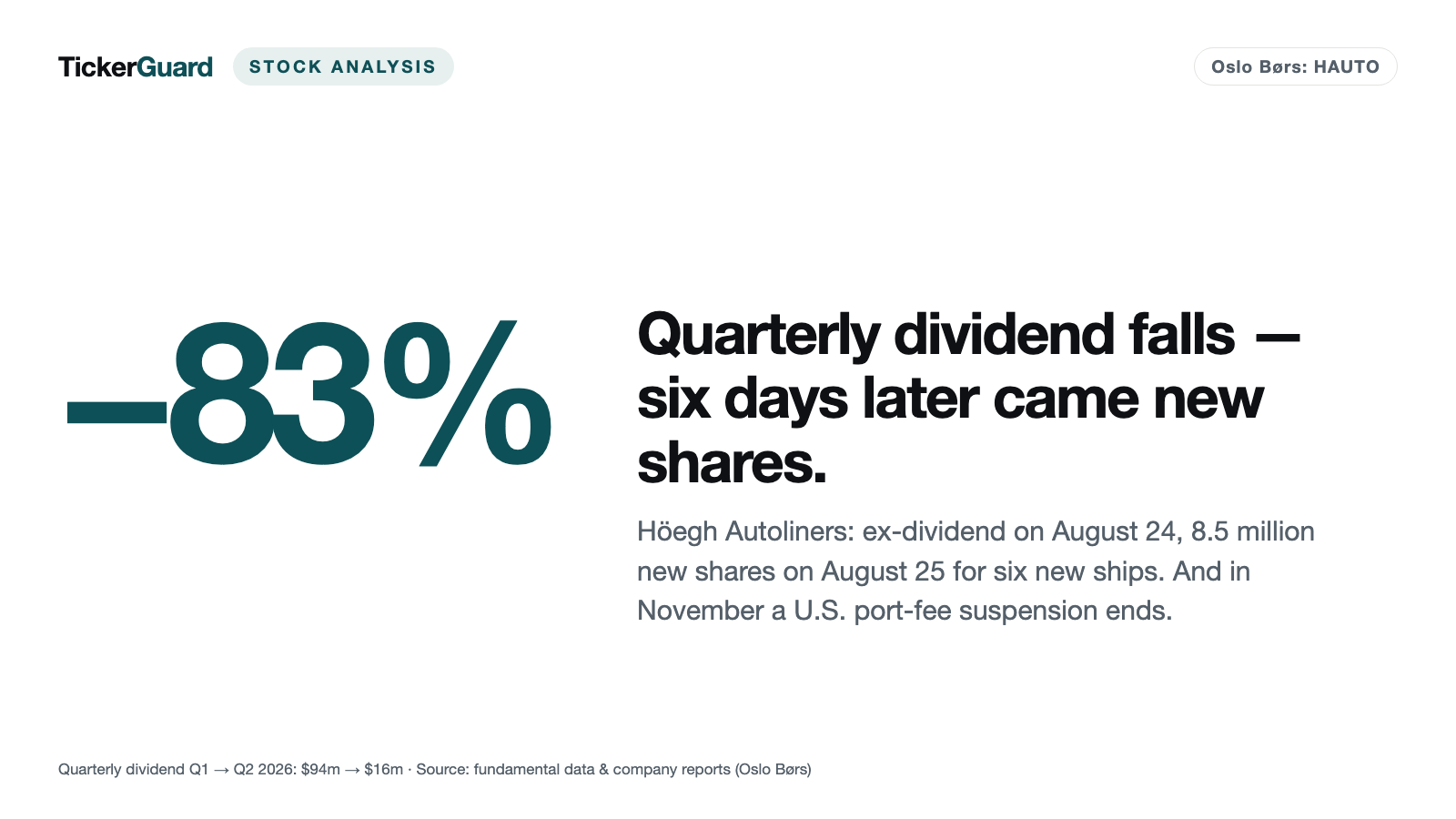
The Norwegian car-carrier shipping company declared dividends of $424 million for 2025, which the company itself described as a 22.9 percent yield. In August 2026 the quarterly dividend dropped to $16 million (prior quarter: $94 million), and six days later Höegh raised $152 million from investors for new ships. On top of that, the suspension of a U.S. port fee the company itself estimated at $60 to $70 million a year runs out in November.
 Thomas Mücke
Founder & Publisher
Thomas Mücke
Founder & Publisher
There is a calculation almost every investor does in their head without noticing: take the latest dividend, multiply it up to a full year, divide by the share price — and treat the result as a property of the stock. Call it the dividend extrapolation. Höegh Autoliners practically invites it. For 2025, the Norwegian shipping company resolved dividends totaling $424 million and described them in its own annual report as a 22.9 percent dividend yield. Since its stock market listing at the end of 2021, according to the company, $1.53 billion flowed to shareholders through the end of 2025, 15 quarters in a row.
Then came the summer of 2026. On August 20, Höegh announced a second-quarter dividend of $16 million, resolved by the board the day before — after $94 million for the first quarter. On August 24 the stock traded ex-dividend. On the evening of August 25, Höegh announced a private placement: 8.5 million new shares at NOK 167, about $152 million in total. Anyone carrying the spring extrapolation in their head suddenly faced a different question: is this a dividend stock that just needs fresh money — or a shipping company buying ships ahead of demand in the middle of a boom? That is exactly what we read the reports to find out.
What Höegh Autoliners does — floating parking garages for cars
Höegh Autoliners ASA, based in Oslo, operates so-called RoRo ships, short for “roll-on/roll-off.” The everyday picture: a floating parking garage with many decks. Cars, excavators, combine harvesters and trucks drive up a ramp onto the ship and off again at the destination port — no crane, no container. In the second quarter of 2026, Höegh operated 44 vessels, 37 of them owned. In August 2026, 24 percent of volume was heavy cargo on its own wheels and breakbulk, known in company jargon as “High & Heavy”; the rest was cars.
The money is made per cubic meter of cargo space. In the second quarter of 2026, Höegh carried 4.0 million cubic meters and earned, net of fuel surcharges, $79.0 per cubic meter. Most of it runs through contracts with carmakers: according to the 2025 annual report, about 85 percent of revenue comes from contracts with an average remaining term of 2.9 years. In the fourth quarter of 2025, the contract share was 84 percent, according to the company. The group reports in U.S. dollars; the stock trades in Norwegian kroner on Euronext Oslo Børs (symbol HAUTO, ISIN NO0011082075). The largest shareholder is the family company Leif Höegh & Co AS with 36.04 percent; Leif O. Høegh chairs the board, and Morten W. Høegh is his deputy.
Important for the chain of evidence: Höegh does not report to the U.S. Securities and Exchange Commission (SEC) — there is no Form 10-K annual report and no Form 10-Q quarterly report. This analysis rests on the English original reports from the Oslo exchange’s announcement system: the audited annual report for 2025 (auditor PwC), the quarterly reports through the second quarter of 2026, and all stock exchange notices through October 8, 2026.
Company history for investors
-
2021
Listing on Euronext Growth Oslo
First listed on November 29, 2021, move to the main list on May 2, 2022. Since then Höegh has paid $1.53 billion in dividends through the end of 2025, by its own account.
-
2023
Highest EBITDA of 2023 to 2025: $736 million
The peak of the recent earnings series. Since then EBITDA has fallen every year — to $621 million in 2025, and by another 17 percent in the first half of 2026.
-
2025
U.S. port fee and new dividend formula
In October Höegh estimates the new U.S. fee at $60 to $70 million a year and switches the payout to “cash above a minimum balance.” From November 10 the fee is suspended for one year.
-
2026
August: $16 million dividend, then new shares
The quarterly dividend falls from $94 to $16 million; six days after the resolution Höegh orders six ships and places 8.5 million new shares at NOK 167.
-
2026
November: fee and quarterly report
The one-year suspension of the U.S. port fee ends; on November 19 the Q3 report follows, with the next dividend.
How the stock landed on our desk
Through the forum ranking of the German finance portal wallstreet-online — the list of stocks that German retail investors are currently writing about the most. There, Höegh appeared under the Frankfurt symbol V02, a secondary listing in the open market. A list like that measures attention, not quality. And the stock has certainly drawn attention: at the end of 2025 it closed at NOK 98.05, on October 7, 2026 at NOK 177.20 — a gain of about 81 percent in a little over nine months, not counting dividends.
We have examined an Oslo-listed shipping company with a controlling shareholder before: our analysis of the tanker company Frontline. At Höegh, the owner family subscribed to the new shares in August in proportion, that is, at exactly its 36.04 percent.
The numbers over the years — given their due
First, what impresses. Höegh has been earning very well for years. EBITDA — earnings before interest, taxes, depreciation and amortization, roughly what running the ships throws off — was $736 million (2023), $692 million (2024) and $621 million (2025), on revenue of about $1.4 billion in each of those years. Net profit after tax came to $592, $620 and $513 million. CEO Andreas Enger, in his letter to shareholders, put the return on invested capital for 2025 at 26 percent.
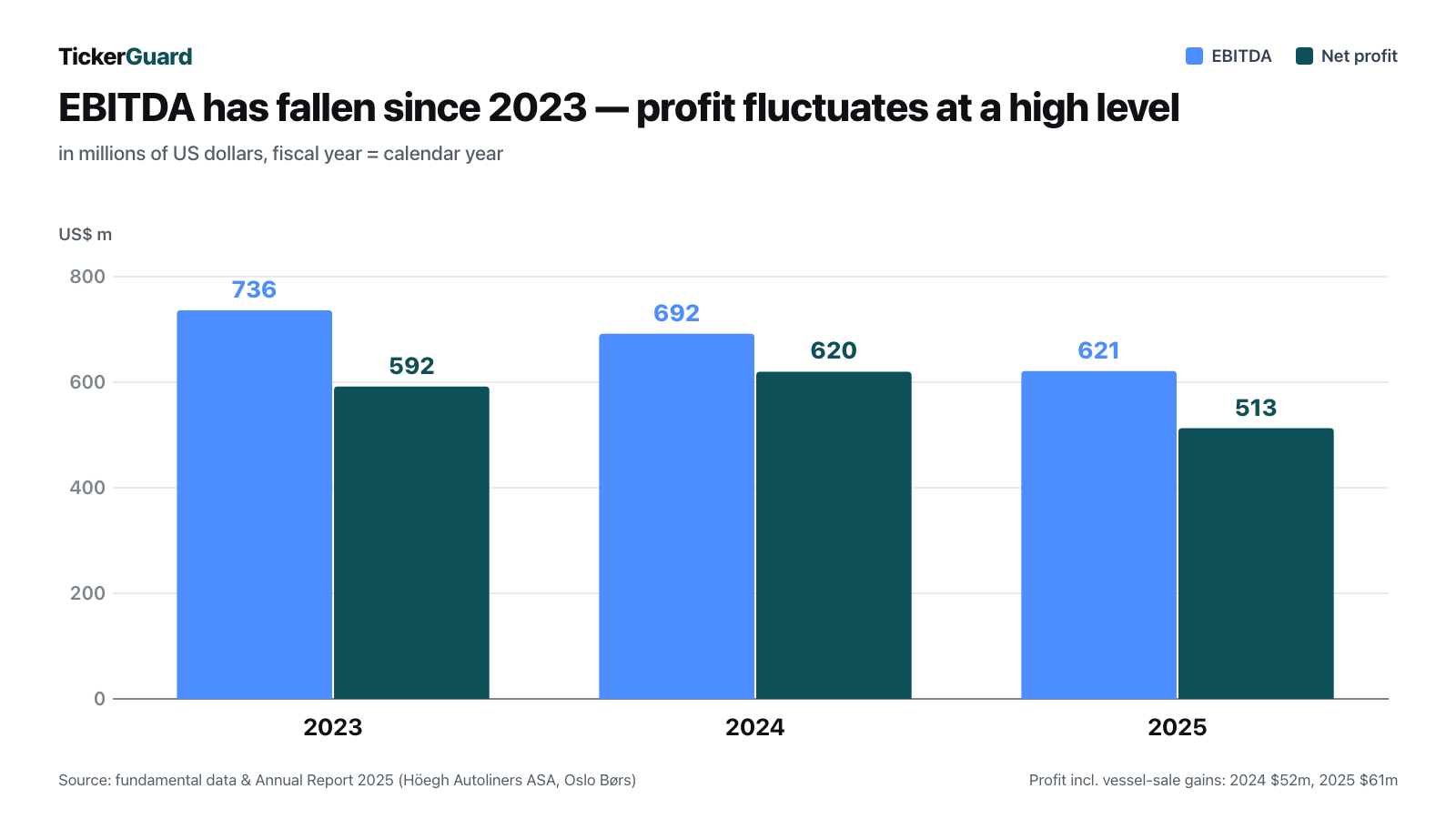
The direction is clear all the same: EBITDA has fallen in each of the three years, and in 2026 that continues. In the first half of 2026 it came to $267 million, after $320 million in the first half of 2025, a decline of 17 percent. Net profit after tax fell from $278 million to $188 million — and the prior year included a $41 million gain from a ship sale. The 2024 profit was also boosted by one-off items: it includes $52 million from ship sales and a tax income of $36 million. Measured by the pure ship operation, the three years show a falling line at a high level — not a rising one.
Where the decline comes from is shown by a cost block that has quietly grown: to have enough cargo space for demand from China, Höegh charters additional ships. Charter expense rose from $5.7 million (2024) to $79.3 million (2025) and came to $63.0 million in the first half of 2026 alone. At the same time, the net freight rate fell from $85.1 per cubic meter (2024) to $80.3 (2025) and $79.0 in the second quarter of 2026. More cost for cargo space, less revenue per cubic meter — that explains the decline in EBITDA better than any headline.
The balance sheet takes this in stride. As of June 30, 2026, equity stood at $1,270 million, an equity ratio of 53 percent. Net debt — bank debt, other interest-bearing debt and leases minus cash — was $757 million; against EBITDA of the last four quarters of about $567 million (our own calculation from unrounded figures: 620.6 minus 320.4 plus 266.6), that is 1.3 times. In June 2026, Höegh restructured its bank loans at a lower margin and with a longer term: the $640 million main loan runs until June 2034, the $200 million revolving credit facility until March 2030. All loan covenants were met as of the reporting date.
Uncomfortable truth No. 1: The dividend is a remainder, not a promise
The dividend extrapolation assumes that the payout is a fixed quantity. At Höegh it explicitly is not. Since October 2025 a new formula applies: what is paid out is whatever sits above a targeted minimum cash balance at quarter-end. The trigger, according to the 2025 annual report, was the overnight jump in U.S. port fees in October 2025 — more on that shortly. The following chart shows the result:
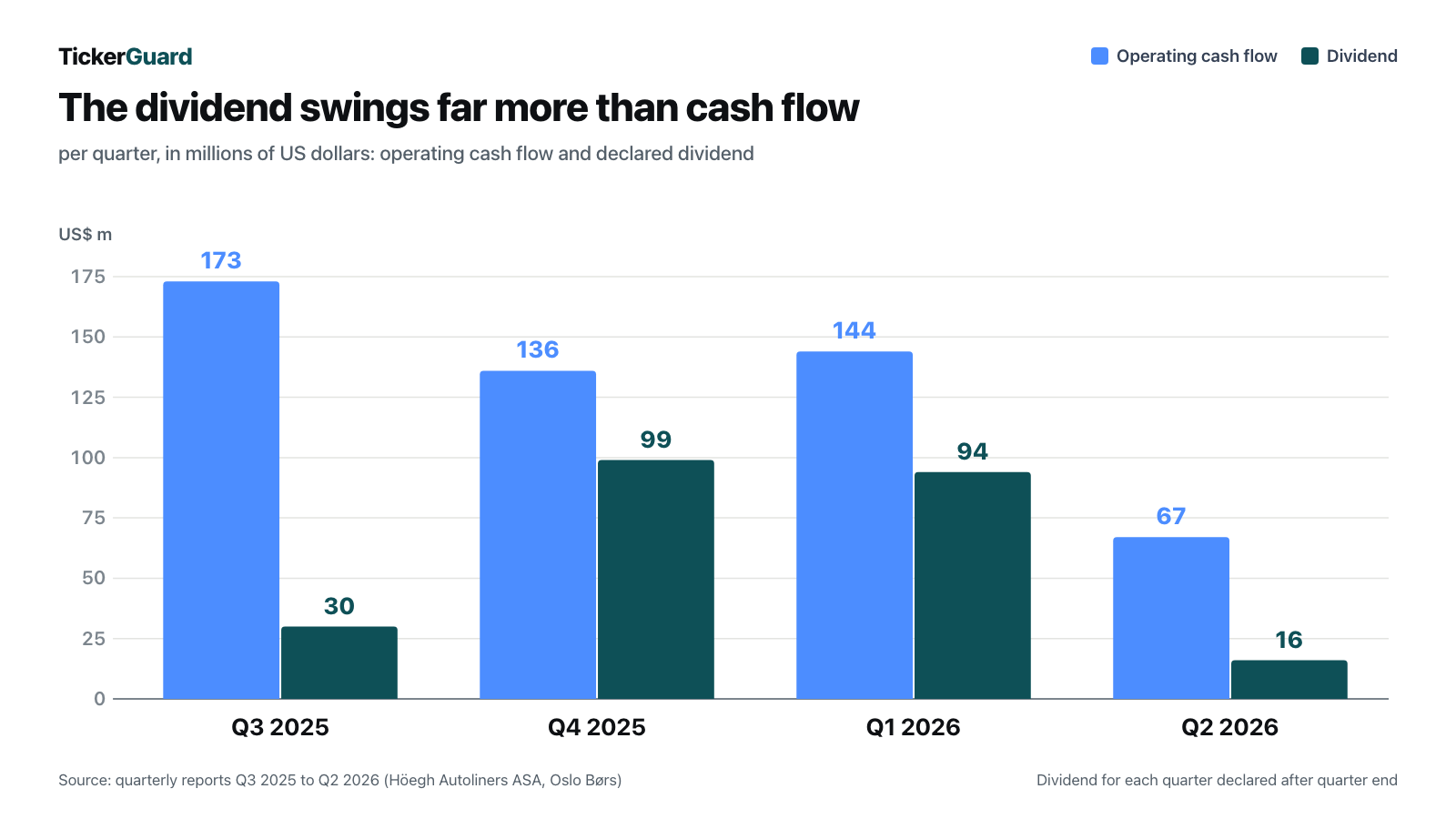
The third quarter of 2025 shows this most clearly: $173 million flowed in from operations, but only $30 million was paid out. Shortly after the quarter ended, on October 14, 2025, the U.S. port fees took effect; with its third-quarter report of October 30, Höegh switched the calculation to the minimum cash balance — citing a rapidly changing market environment with reduced visibility and the aim of strengthened liquidity.
In the second quarter of 2026, only $67 million flowed in from operations, after $144 million in the first quarter and $153 million a year earlier. The reason is in the report itself:
“Operating cash flow during Q2 was negatively impacted by increased fuel inventory following higher fuel prices, and increased receivables from higher activity and one-off cargo moves.”
— Höegh Autoliners ASA, Q2 2026 quarterly report, Directors’ report, page 5
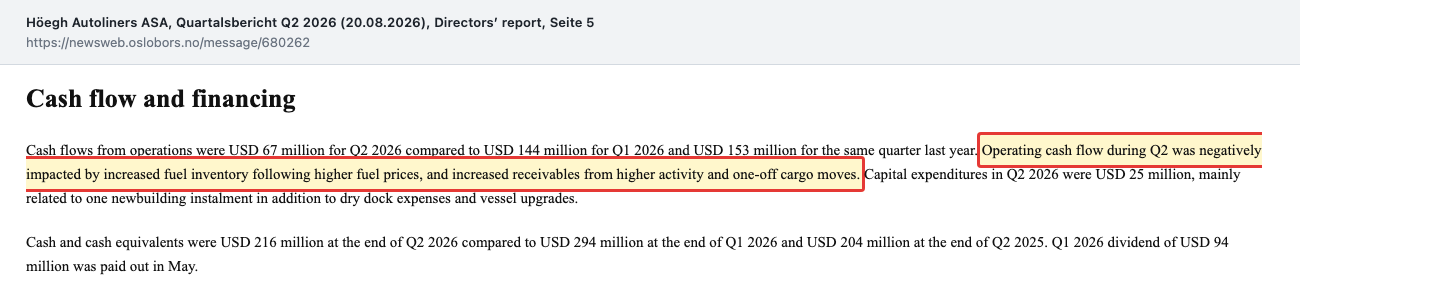
In numbers: receivables rose by $34 million in the quarter, fuel inventory by $23 million. Behind it is the Middle East conflict, which drove fuel prices up. Höegh passes higher fuel costs on through contractual surcharges — historically about 95 percent, according to the CEO letter — but with a delay of five to six months. For the third quarter, the board expects the money to come back:
“Q3 remains impacted by high fuel prices and delayed BAF revenue, while cash conversion is expected back to normal.”
— Höegh Autoliners ASA, Q2 2026 quarterly report, Outlook, page 12

There are first signs of that: according to the monthly trading updates, the gross freight rate, which includes the fuel surcharges, rose from $93.1 per cubic meter in June to $99.3 in July and $97.8 in August 2026, while the net rate stayed at just over $80. And it also means: the $16 million dividend was not a cut out of distress but what the formula calculated. That is exactly why it is no good for extrapolation, in either direction. Add up the four most recently declared quarterly dividends ($30, $99, $94 and $16 million, $239 million in total) and, at the market value of October 7, 2026, you get a yield of about 6.5 percent. That is respectable — but far from the 22.9 percent in the annual report for 2025, which was measured against the much lower market value at the end of 2025 (NOK 18.7 billion).
Uncomfortable truth No. 2: Paying out and raising money at the same time
Six days after the dividend resolution of August 19 — one day after the ex-date — Höegh ordered six more Aurora-class ships from the Chinese yard China Merchants Heavy Industry (Jiangsu), for delivery from 2029 to 2031. The company also secured options on four more ships at the same price and building slots for another four. The program could thus grow to as many as 26 Aurora ships; twelve have already been delivered or ordered. The announcement names no purchase price, only “highly attractive terms.” That same evening Höegh placed 8.5 million new shares at NOK 167 — about 4.5 percent more shares, proceeds of about $152 million:
“The net proceeds from the Private Placement will, together with debt financing, be used to fully finance the newbuilding programme.”
— Höegh Autoliners ASA, stock exchange notice “Successfully Completed Private Placement,” August 25, 2026

You can read this the way the company means it: shareholders are meant to help carry large investments so the payout formula can stay untouched. The family subscribed in proportion, the book was oversubscribed several times according to the notice, and the issue price was only about 4 percent below the close of August 25 (NOK 174.00). This is not an emergency capital raise. For you as a shareholder, though, the circle is the same: part of the money that goes out as a dividend comes back in through new shares — the $152 million equals a good third of the $424 million Höegh declared as dividends for 2025. Anyone who could not take part — and in a private placement only selected investors could; according to the notice, the board expressly provided no repair offering for the remaining existing shareholders — holds a 4.3 percent smaller stake in the company afterwards (8.5 of now 199.3 million shares). And what the ten to fourteen new ships will cost in the end, how much of it runs through loans and when the installments fall due, is not stated in any of the notices.
Uncomfortable truth No. 3: A fee that is only suspended
In October 2025, the U.S. Trade Representative (USTR) put new port fees into effect — part of the trade dispute with China — that also hit Höegh’s car carriers. Höegh put a number on the burden in its quarterly report itself:
“The yearly impact is estimated to ~USD 60-70 million, and the Company is working diligently to mitigate the impact.”
— Höegh Autoliners ASA, Q3 2025 quarterly report, Outlook, page 11

A few weeks later the U.S. suspended the fees for one year; the report for the fourth quarter of 2025 says: “USTR port fees suspended by one year from 10 November 2025.” One year from November 10, 2025, ends in November 2026. In the quarterly report of August 20, 2026, the fee no longer appears, and no stock exchange notice since that day has mentioned it (as of October 8, 2026). The trade outlet FreightFigures pointed out on September 24, 2026 that, according to the U.S. trade agency’s notice of November 13, 2025, the suspension of the U.S. port fees for ships with Chinese owners, operators or build origin runs through November 9, 2026 inclusive and only shifts with a new notice — even after U.S. Treasury Secretary Scott Bessent announced on September 23 that the rest of the trade truce with China would be extended to January 10, 2027. That is an external source, not a statement by Höegh, and it does not name the car-carrier fee specifically. That the same end date applies to this fee is our conclusion from Höegh’s own statement “one year from 10 November 2025.”
For scale: $60 to $70 million equals about 15 percent of the profit of the last four quarters ($424 million, our own calculation from the reports) and about half of the EBITDA of the second quarter of 2026 ($122 million). Whether and how much of it Höegh could pass on to customers, the reports do not say.
What the stock costs
At the close of NOK 177.20 on October 7, 2026, and 199.3 million shares, Höegh is worth about NOK 35.3 billion on the stock market, roughly $3.7 billion or €3.3 billion (exchange rates of October 7, 2026). Cross-check: at the placement price of NOK 167 and today’s share count (including the new shares registered on August 31), the value is NOK 33.3 billion — so the price is a good 6 percent above it.
Against the profit of the last four quarters of $424 million, that gives a price-to-earnings ratio of about 8.7. That looks cheap — but shipping profits swing with freight rates, and a P/E based on the profit of good years says little about what remains in weaker ones. Equity stood at $1,270 million on June 30, 2026; together with the gross proceeds of the placement of about $152 million, that is roughly $1.42 billion — the market value thus equals about 2.6 times book value. Höegh itself states that the market values of its ships were 39 percent above book values as of June 30, 2026. Even if you roughly add these hidden reserves (our own rough estimate: about $0.7 billion on $1.75 billion of book value for the ships), the stock still costs clearly more than the assets on the balance sheet. So what is being paid for is the expectation that the good years will continue.
Opportunities and risks at a glance
What speaks for Höegh Autoliners:
- Strong tailwind from China: Chinese vehicle exports rose 73 percent in the second quarter of 2026 and in June topped one million vehicles a month for the first time; the board speaks of fully utilized ships. How important export markets are to Chinese carmakers is shown, for example, in our analysis of XPeng.
- High contract share: about 85 percent of revenue from contracts with an average remaining term of 2.9 years (annual report 2025); in July 2026, Höegh extended a contract with a large Asian carmaker to December 2029, by its own estimate about $300 million of additional revenue.
- Solid balance sheet: equity ratio of 53 percent, net debt at 1.3 times EBITDA, loans restructured in June 2026 (main loan until 2034, credit facility until 2030), all loan covenants met.
- Modern fleet: eight Aurora ships in service that, according to the company, emit up to 58 percent less CO₂ than conventional car carriers; four more from summer 2027 that can also run on ammonia.
- Market value of the ships 39 percent above book value, according to the company (June 30, 2026).
What speaks against it:
- Falling earnings power: EBITDA from $736 million (2023) to $621 million (2025), down 17 percent in the first half of 2026; charter expense from $5.7 to $79.3 million within a year.
- U.S. port fee: the company’s own estimate of $60 to $70 million a year is, according to Höegh’s own statement, suspended only for one year from November 10, 2025.
- Swinging dividend: $94 million for the first quarter, $16 million for the second quarter of 2026 — the formula pays only what sits above the minimum cash balance.
- New shares and new commitments: 8.5 million new shares in August 2026, plus six ordered ships without a published price, options on four more.
- Growing supply: according to the quarterly report, 147 car carriers are on order worldwide through 2030, about 21 percent of the existing fleet — if demand from China falls back, many new ships will meet less cargo.
A human conclusion
Back to the dividend extrapolation from the start. The 22.9 percent for 2025 is no invention; it is in the annual report. But it describes a look back at a much lower share price at the time, not a property of the stock. The reports show a company that earns very well, has a healthy balance sheet and is carried by China’s car exports — and whose earnings power has nonetheless been falling for three years, whose payout follows its cash, and which in the same month paid a dividend and issued new shares.
The next chance to check is coming soon: the report for the third quarter is announced for November 19, 2026 — nine days after the suspension of the U.S. port fee runs out. Then we will see whether the money from the fuel surcharge comes back, how high the dividend turns out and whether the $60 to $70 million is back on the bill. Until then, one simple thought helps against the extrapolation: at Höegh, a dividend is what is left over — not what is promised. The decision is yours.
Sources
All original documents used — for you to read yourself (Newsweb announcement system of Oslo Børs):
- Höegh Autoliners ASA — Q2 2026 quarterly report and dividend resolution (August 20, 2026)
- Höegh Autoliners ASA — Order for six more Aurora ships (August 25, 2026)
- Höegh Autoliners ASA — Completion of the private placement (August 25, 2026) and registration of the capital increase (August 31, 2026)
- Höegh Autoliners ASA — Trading Update August 2026 (September 10, 2026)
- Höegh Autoliners ASA — Contract extension with an Asian carmaker (July 10, 2026)
- Höegh Autoliners ASA — Q1 2026 quarterly report (May 8, 2026)
- Höegh Autoliners ASA — Annual Report 2025 (audited, auditor PwC, published April 16, 2026)
- Höegh Autoliners ASA — Q4 2025 results (February 25, 2026)
- Höegh Autoliners ASA — Q3 2025 quarterly report (October 30, 2025)
- Höegh Autoliners ASA — Financial calendar (November 25, 2025)
- FreightFigures — Report on the extension of the U.S.-China trade truce and the end of the port fee suspension (September 24, 2026) — external source, not a company statement
- Fundamental data (price and exchange-rate history, data as of October 7, 2026); market value, price-to-earnings ratio and dividend yield calculated by us from the reports.
This analysis is a journalistic assessment based on publicly available company reports. It is not investment advice and not a solicitation to buy or sell securities. Stocks can lose value, up to and including a total loss. All figures carry the date of their source; prices are dated snapshots. Positions held by the operator are disclosed daily; where one exists, it appears as a notice at the top of this deep dive.
Our Bottom Line at a Glance
- Demand and contracts positive
- Chinese vehicle exports rose 73 percent in the second quarter of 2026, and the ships are fully utilized, according to the board. About 85 percent of revenue comes from contracts with an average remaining term of 2.9 years; in July 2026 an extension to 2029 worth about $300 million was added.
- Earnings power negative
- EBITDA fell from $736 million (2023) to $621 million (2025) and by another 17 percent in the first half of 2026. Charter expense rose from $5.7 to $79.3 million in one year, and the net freight rate fell from $85.1 to $79.0 per cubic meter.
- Balance sheet positive
- Equity ratio of 53 percent, net debt of $757 million or 1.3 times EBITDA of the last four quarters, main loan until 2034, credit facility until 2030, all loan covenants met (June 30, 2026).
- Dividend and capital neutral
- Since October 2025 the dividend follows cash: $94 million for the first, $16 million for the second quarter of 2026. Six days after the dividend decision came 8.5 million new shares at NOK 167 for six new ships whose price is not published.
- Regulation negative
- The new U.S. port fees, whose burden Höegh itself estimated at $60 to $70 million a year, have been suspended only for one year since November 10, 2025. The quarterly report of August 20, 2026 does not mention it.
Höegh Autoliners earns very well with its car carriers, stands on a solid balance sheet and profits from the export boom of Chinese carmakers. But earnings power has been falling since 2023, the dividend dropped to $16 million for the second quarter of 2026, new shares for six new ships followed shortly after, and the U.S. port fee, with a self-estimated burden of $60 to $70 million a year, is only suspended. Not investment advice.
What Our Rating Means
Open questions
The business works in principle, but one material question is open. As long as it stays open, our findings do not carry a quality verdict.
Yellow stands for an open operating question, not for a risk to the substance: the balance sheet is solid (equity ratio of 53 percent, net debt at 1.3 times EBITDA, main loan until 2034, credit facility until 2030), the business is highly profitable and about 85 percent secured through contracts. What is open instead: earnings power has been falling for three years, driven by sharply higher charter expense and falling net freight rates, and with the end of the U.S. port fee suspension in November 2026 a burden could return that Höegh itself estimated at $60 to $70 million a year — about 15 percent of the profit of the last four quarters. On top come six new ships whose price is not published, in a market in which newbuildings for about 21 percent of the fleet are on order worldwide. Whether the good years hold will show at the earliest in the report for the third quarter on November 19, 2026. The decision is yours.
A journalistic assessment by our editorial team at the time of the deep dive, based on public sources — not investment advice and not a solicitation to buy or sell. Your personal circumstances (investment goals, risk capacity, taxes) cannot be taken into account. What our levels mean, how verdicts are formed, and what conflicts of interest exist →
Worth Noting
- This analysis was prompted by the forum ranking of the German finance portal wallstreet-online (most-discussed stocks among German retail investors), where the stock appeared under the Frankfurt open-market symbol V02. The thread running through it is the dividend extrapolation: the tendency to multiply the latest payout up to a year and take it for a fixed property of the stock.
- On the evidence: Höegh Autoliners is not an SEC filer (no SEC identifier, checked October 8, 2026). All company figures come from the audited Annual Report 2025 (auditor PwC), the quarterly reports Q3 2025 through Q2 2026 and the stock exchange notices on the Newsweb system through October 8, 2026. The quarterly reports are unaudited (IAS 34).
- Our own calculations: profit of the last four quarters $424 million (2025 profit 513.5 minus first half of 2025 277.8 plus first half of 2026 188.3); EBITDA of the last four quarters about $567 million (620.6 minus 320.4 plus 266.6); market value 199,269,749 shares times NOK 177.20, converted at NOK 9.5724 per U.S. dollar and NOK 10.7182 per euro (October 7, 2026); dividend yield from the four most recently declared quarterly dividends ($239 million).
- On the U.S. port fee: the estimate of $60 to $70 million and the one-year suspension from November 10, 2025 come from Höegh's reports (Q3 2025, Q4 2025). The trade outlet FreightFigures (September 24, 2026) gives November 9, 2026 as the end of the suspension of U.S. port fees for ships with a Chinese connection; it does not name the car-carrier fee specifically — that the same end date applies there is our conclusion from Höegh's statement “one year from 10 November 2025.”
The full analysis as a PDF for later
We will send you this analysis as a PDF — to print, file away, and read at your own pace.
Frequently Asked Questions
Höegh Autoliners ASA of Oslo operates RoRo ships onto which cars, construction machinery and other rolling cargo drive over ramps. In the second quarter of 2026 it ran 44 vessels, 37 of them owned. Revenue in 2025 was about $1.43 billion.
Höegh is a Norwegian public limited company with its home listing on Euronext Oslo Børs (symbol HAUTO) and is not registered with the U.S. Securities and Exchange Commission. This analysis rests on the audited annual report for 2025, the quarterly reports through the second quarter of 2026 and all stock exchange notices on the Newsweb system through October 8, 2026. In Frankfurt the stock trades in the open market under the symbol V02.
Since October 2025, Höegh pays out whatever sits above a targeted minimum cash balance at quarter-end. In the second quarter of 2026 only $67 million flowed in from the business, because higher fuel inventory and receivables tied up cash. That is why the dividend fell from $94 million (first quarter) to $16 million ($0.0839 per share).
For newbuildings: on August 25, 2026, Höegh ordered six more Aurora ships (delivery 2029 to 2031) with options on four more and placed 8.5 million new shares at NOK 167 the same evening, about $152 million in total. The proceeds are meant to finance the newbuilding program together with loans; Höegh has not published a purchase price for the ships.
In October 2025 the U.S. Trade Representative introduced new port fees that also hit Höegh. Höegh estimated the burden in its report for the third quarter of 2025 at about $60 to $70 million a year. Since November 10, 2025, the fee has been suspended for one year according to Höegh's own statement, that is, until November 2026. The quarterly report of August 20, 2026 does not mention it.
The largest shareholder is the family company Leif Höegh & Co AS with 36.04 percent (as of August 31, 2026); Leif O. Høegh is chairman and Morten W. Høegh deputy chairman of the board. Folketrygdfondet reported a stake of about 5 percent at the end of August 2026.
At NOK 177.20 (October 7, 2026), Höegh is worth about NOK 35.3 billion or $3.7 billion. Against the profit of the last four quarters of $424 million, that gives a P/E of about 8.7 and roughly 2.6 times book value. Because shipping profits swing with freight rates, a P/E based on the profit of good years says little about what remains in weaker ones.
Found an error?
Did you spot a factual error, an outdated number, or a typo in this deep dive? Let us know briefly — your report goes straight to the editorial team.