HJ Shipbuilding: Up Fourfold in Three Years — and Still 72 Percent Below Its 2007 High
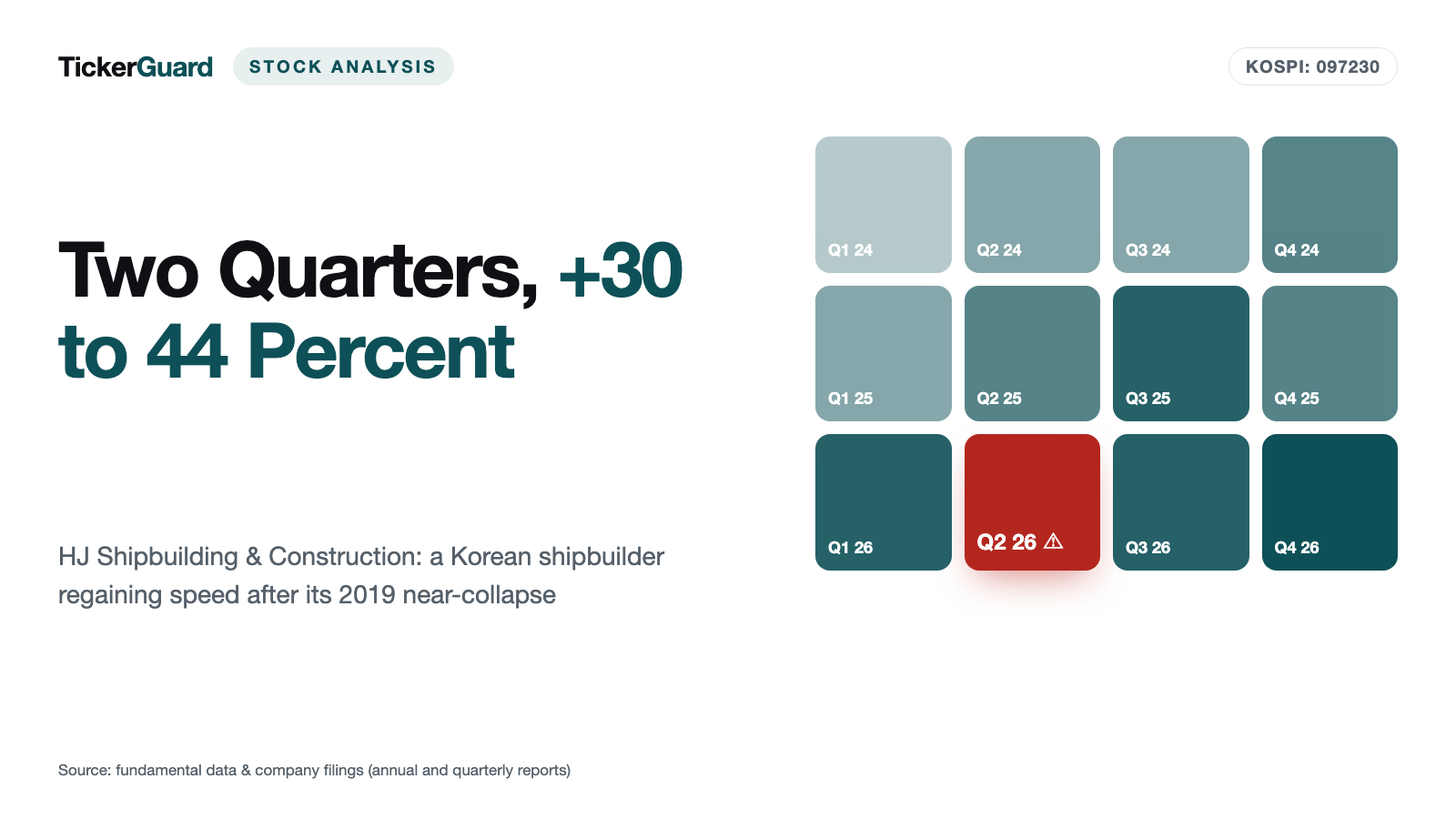
HJ Shipbuilding & Construction, the Korean yard almost nobody wanted to save in 2019, just posted two quarters of 32 and 44 percent revenue growth — after two years in which practically nothing grew. The stock has more than quadrupled since 2023. Sounds like a hot stock. It is — measured from a trough, not from its 2007 all-time high, which the stock is still 72 percent below. Not investment advice — just the question of which anchor is the honest one.
 Thomas Mücke
Founder & Publisher
Thomas Mücke
Founder & Publisher
Picture yourself running into an old shipbuilding-industry contact in 2019, and he tells you about the turnaround case Hanjin Heavy Industries: the Philippine subsidiary yard in Subic Bay is insolvent, the group's equity ratio has fallen to minus 140 percent, creditor banks are taking over. You would probably write the stock off. Seven years later, that exact company — renamed HJ Shipbuilding & Construction along the way — sat at rank 3 on our in-house "Revenue Inflection" scanner on August 23, 2026 (after a correction to the scanner's currency conversion made later the same day (August 23, 2026): rank 12 of 28), the stock has more than quadrupled since 2023, and revenue grew 32 and 44 percent in two consecutive quarters. Sounds like the comeback of the year. Before you get swept up in that number: it's a textbook case of the anchoring bias — our brain grabs the first reference point it sees (here: the price three years ago) and measures everything against it. The more honest anchor sits further back: on August 31, 2007, the stock traded at more than three-and-a-half times today's price. It is still 72.4 percent below that high. Let's make a deal: we look at both anchors — the near one and the far one — and then read what the 2026 half-year report actually says.
What HJ Shipbuilding actually does
HJ Shipbuilding & Construction Co., Ltd. is a South Korean industrial group based in Busan that runs two very different businesses: shipbuilding and construction. The company was founded in July 1937 as Chosun Heavy Industries Co., Ltd., was named Korea Shipbuilding & Engineering from 1949 to 1990, and Hanjin Heavy Industries & Construction from 1990 through the end of 2021 — the name under which the yard became internationally known, including for its near-collapse.
The shipbuilding segment (53.4 percent of group revenue in the 2026 half-year report, the larger of the two) builds commercial vessels such as containerships and LNG bunkering vessels, but also special-purpose and naval ships: by the company's own history it is South Korea's sole builder of the Solgae-class landing ship fast (LSF-II), the Chamsuri-class high-speed patrol boat, and the Dokdo-class amphibious landing ship — the flagship of the South Korean navy. Since 2024 it has added a growing U.S. Navy maintenance, repair and overhaul (MRO) business, with the successful repair of the supply ship USNS Amelia Earhart in 2024/25 as its proof point. The construction segment (46.0 percent of revenue) builds residential and commercial buildings, roads, bridges and tunnels as well as plant-construction projects — usually as lead consortium member with a majority stake, most recently in a 174-billion-won road contract on August 20, 2026 (60 percent consortium share).
The market story reads like a turnaround fairy tale: nearly bankrupt, rescued, now riding a shipbuilding boom. That's partly true — South Korea's entire shipbuilding industry has benefited since 2023/24 from a global ordering boom for high-value vessels (LNG carriers, large containerships), and HJ Shipbuilding is riding that wave. But the company's own communications also point to something else: it wants to be more than a passenger in that boom. In June 2026, co-CEO Yoo Sang-cheol signed an agreement with HD Hyundai Avikus at the Posidonia shipping fair in Athens, under which the AI- and IoT-based autonomous navigation solution "HiNAS Control" will be fitted to vessels HJ Shipbuilding builds.
"As ship unmanning is actively progressing, the need to proactively respond to the future vessel market is growing."
— Yoo Sang-cheol, co-CEO (shipbuilding) of HJ Shipbuilding & Construction, press release on the Posidonia agreement with HD Hyundai Avikus, June 4, 2026 (originally quoted in Korean; translation ours)
One important nuance: HJ Shipbuilding is not selling AI here — the technology comes from partner HD Hyundai Avikus, and HJ builds it into its ships to stay competitive in the market for high-value, "smart" vessels. The company reports no AI-derived revenue anywhere in its disclosures.
Company history for investors
-
1937
Founded as Chosun Heavy Industries
The origin of today's Busan yard — nearly 90 years before the current capital raise and newspaper acquisition.
-
2019
Near-collapse: Subic Bay insolvency
The Philippine subsidiary yard falls into creditor administration, the group's equity ratio drops to minus 140 percent — shareholders live through the trough.
-
2021
Rescue by the Dongbu-led consortium
Ecoprime Marine Pacific takes over the majority from the creditor banks led by the KDB; the stock gets a new private majority owner instead of creditor banks.
-
2023
Balance-sheet low: 750 percent leverage
An operating loss of 109bn won at a margin of minus 5.0 percent — the reference point against which the later turnaround can be measured.
-
2025
Capital raise: financial investors withdraw
A 200-billion-won share block ends up entirely with the majority shareholder after the stock nearly quintupled in three months — a dilution and concentration signal for shareholders.
-
2026
Half-year report: operating income up eightfold
For the first time in years, a double-digit margin path comes into view — proof that the shipbuilding order boom is actually converting into cash.
-
2026
Kookje Shinmun newspaper acquisition announced
Capital flows toward an asset outside the core business while the balance sheet remains highly leveraged — a signal shareholders should watch on capital discipline.
Where the stock showed up in our scanner
HJ Shipbuilding sat at rank 3 on the list of our in-house "Revenue Inflection" stock scanner as of August 23, 2026 (33 hits total); after a correction to the scanner's currency conversion made later the same day (August 23, 2026), the stock ranks 12 of 28 there. The rule behind it, to replicate yourself: the most recent at least two quarters must each have grown 30 to 70 percent versus the same quarter a year earlier, while the four quarters before that each grew below 15 percent — a jump after a quiet stretch, not sustained acceleration. On top of that, trailing four-quarter revenue must be at least $100 million (or the equivalent in reporting currency), no more than two accelerating quarters may be on record (so the find is still early in its cycle), and there can be no heavy dilution. The backtest behind it (our Revenue Inflection backtest study) found that fresh acceleration beat established steady growers by 16.6 percent versus 9.9 percent annualized.
The scanner row from August 23, 2026, translated and put in context: trailing four-quarter revenue base of 2,131.0 billion won per the scanner dataset at the time (the scanner's "$M" column header still showed the raw won figure mislabeled as dollars at that point; that error was fixed later the same day (August 23, 2026), and the scanner has since shown 1,538.7 $M for this stock); our own quarterly series, cited below, adds up to 2,353.2 billion won for the same four quarters (452.2 + 629.7 + 541.4 + 729.9) — a gap we cannot resolve from the sources reviewed, so we flag it rather than smooth it over. Two accelerating quarters, a fundamentals rating of "C" at 51 out of 100, a Piotroski score of 5 out of 9 (a nine-point balance-sheet health test; 5 is middling — a genuinely healthy company scores 8 or 9), a market cap of 1,529.6 billion won, a price of 16,940 won, one-year return of plus 20.3 percent but a six-month return of minus 33.7 percent — a roller coaster even within a single year.
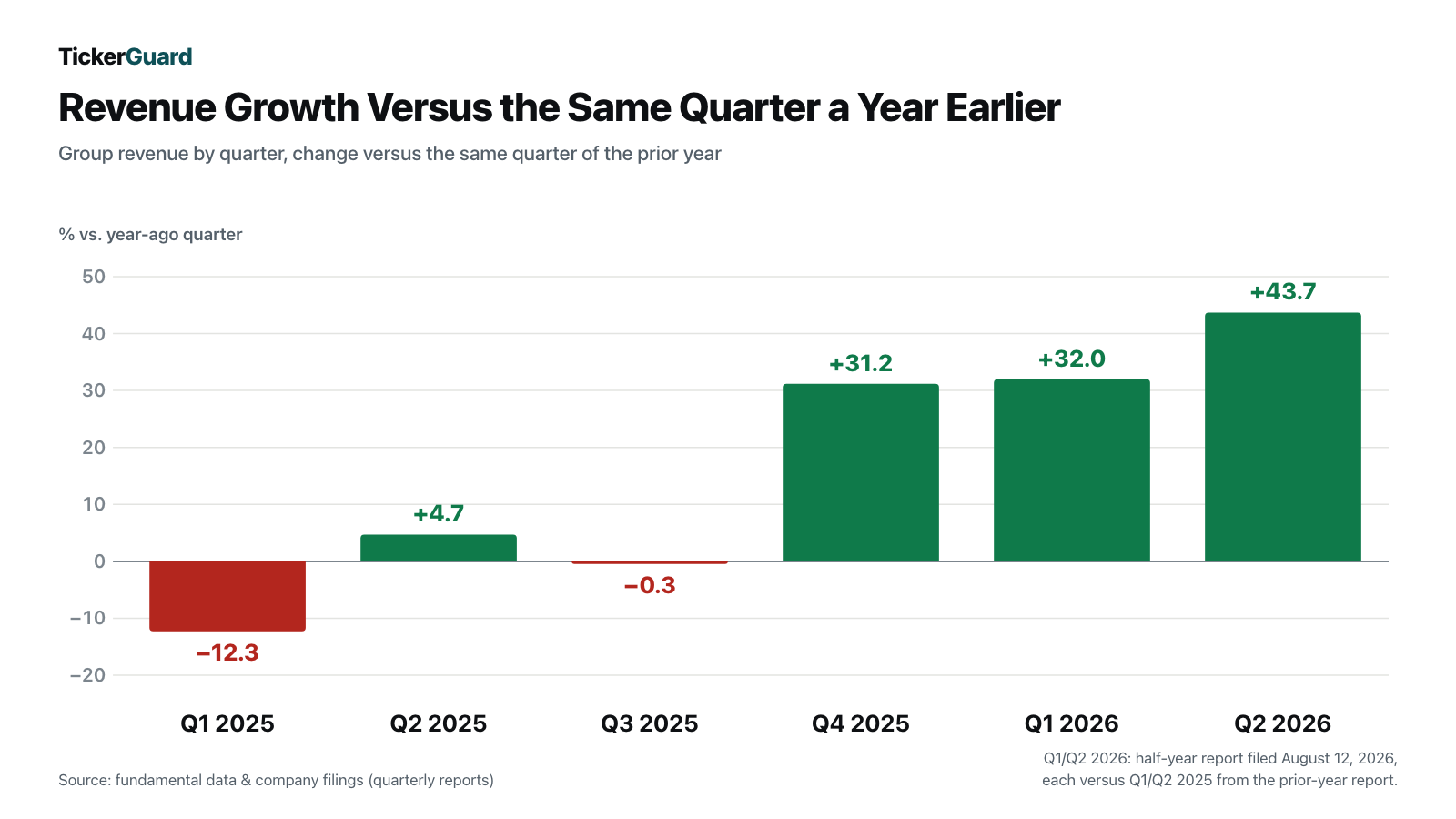
The two accelerating quarters can be named precisely: group revenue grew 32.0 percent to 541.4 billion won in the first quarter of 2026 (prior year: 410.1 billion) and 43.7 percent to 729.9 billion won in the second quarter of 2026 (prior year: 507.8 billion) — both squarely inside the scanner's 30-to-70-percent band. The four quarters before that: first quarter 2025 minus 12.3 percent, second quarter 2025 plus 4.7 percent, third quarter 2025 minus 0.3 percent — all three cleanly under the 15 percent threshold. The fourth quarter of 2025 is where it gets uncomfortable: revenue there already grew 31.2 percent versus the year-earlier quarter — technically a third accelerating quarter, not two. It's possible the scanner works off a smoothed or differently bounded series than the raw quarterly numbers used here; we cannot prove that, so we'll say it plainly: applying the "no more than two accelerating quarters" rule strictly to the raw quarterly figures, this is already the third — the stock may be less early in its cycle than the scanner rank suggests.
Where did the growth come from? More than three-quarters of it from shipbuilding, not construction. In the first half of 2026, shipbuilding revenue rose 75.5 percent to 678.6 billion won (prior year: 386.6 billion), while construction revenue grew only about 10 percent to 584.4 billion won. Consistent press coverage attributes the driver to revenue recognition on high-value shipbuilding contracts booked in 2024 — shipbuilding revenue is recognized on a percentage-of-completion basis, typically two to three years behind order intake. That makes it organic in the sense that no acquisition, land sale or deconsolidation sits behind it — it's the routine working-through of a full order book that, per a mid-2025 container-news.com report, stood at roughly 8.8 trillion won. That fresh orders keep arriving in 2026 too, not just the 2024 cohort being worked off, shows up in the shipbuilding order book: at the end of the first quarter of 2026 it held 36 vessels worth 2,285.8 billion won, up from 30 vessels worth 1,904.9 billion won a year earlier. The flip side: if the effect comes from working through booked orders, it's finite — once the 2024 cohort is delivered, the next wave of orders has to carry the margin.
The numbers over the years — honestly appraised
Let's start with what genuinely impresses: the earnings jump in the first half of 2026. Per the half-year report (period end June 30, 2026, filed August 12, 2026), group revenue rose 38.5 percent year over year to 1,271.3 billion won, operating income grew eightfold from 10.8 to 89.4 billion won, and a net loss of 1.1 billion won became a net profit of 88.1 billion won. Operating margin climbed from 1.2 to 7.0 percent.

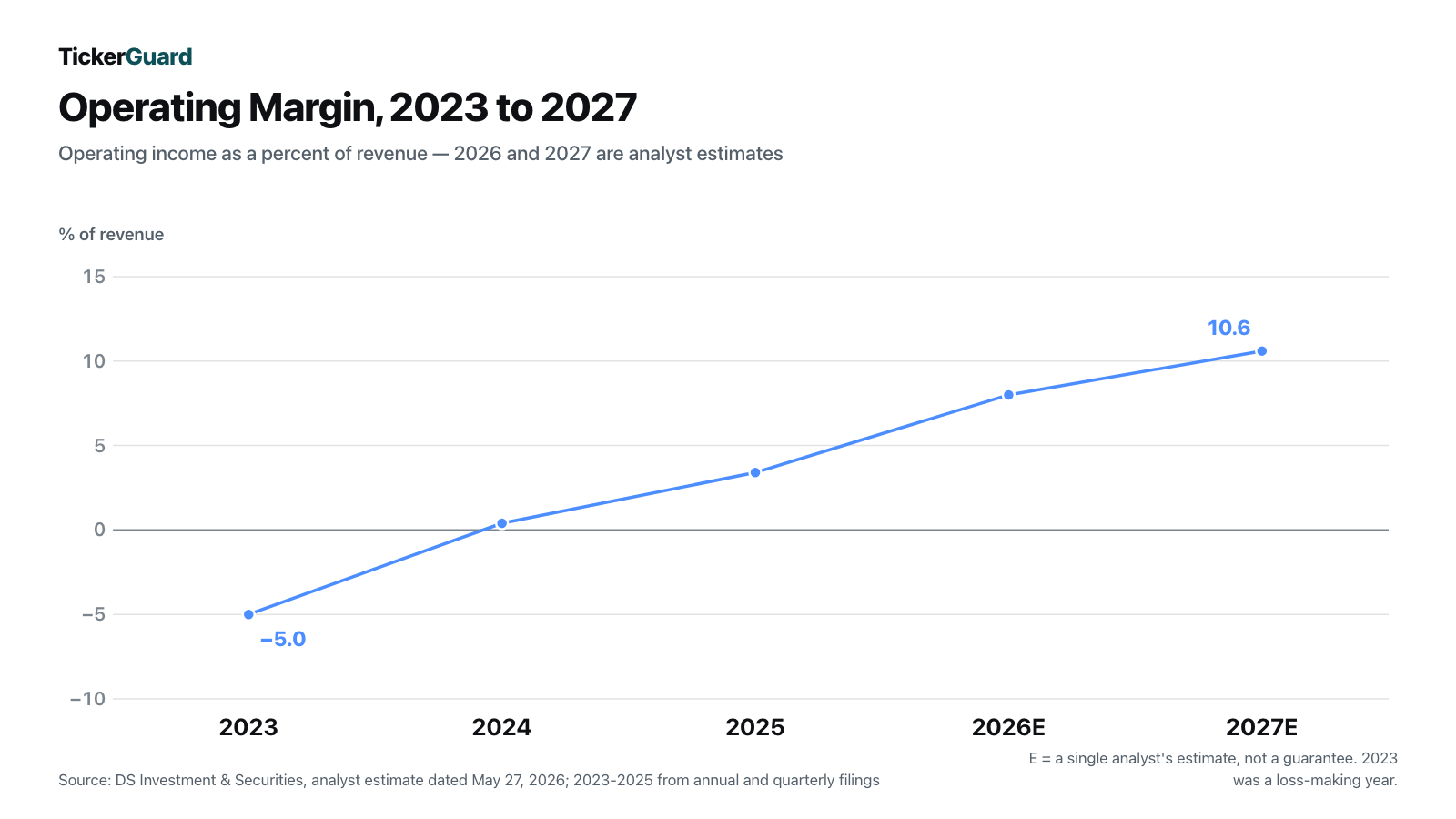
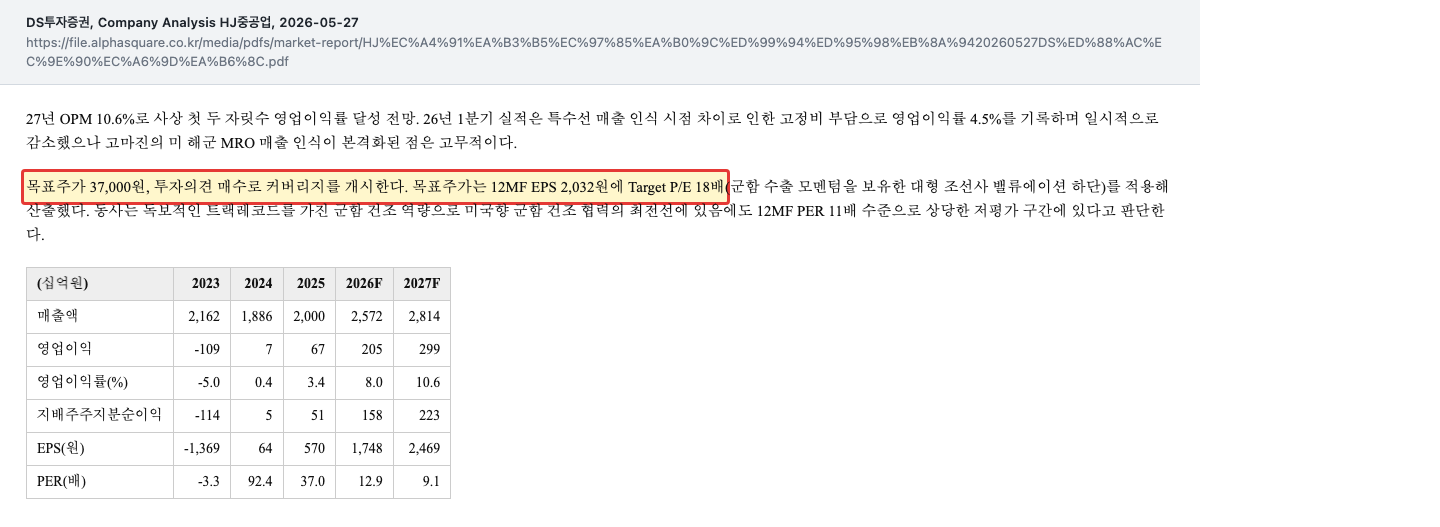
Zoom out and the story turns more sober. Per the DS Investment & Securities analyst report (May 27, 2026, figures in billion won, K-IFRS consolidated), the annual series looked like this: 2023 revenue of 2,162 billion won on an operating loss of 109 billion (margin minus 5.0 percent) and earnings per share of minus 1,369 won — the year the balance sheet hit bottom. 2024 tipped just into positive operating income (7 billion won, margin 0.4 percent). 2025 followed with operating income of 67 billion won (margin 3.4 percent) on revenue of 2,000 billion won. The analyst forecasts operating income of 205 billion won for 2026 (margin 8.0 percent) and, for 2027, the company's first-ever double-digit operating margin of 10.6 percent on 299 billion won of operating income — a single analyst's estimates, not a guarantee, but a plausible trend line if you take the 7.0 percent already achieved in the first half of 2026 as an interim marker.
And then the balance sheet, which is what makes those numbers meaningful. The debt-to-equity ratio (a standard Korean disclosure metric, "부채비율") stood at 750 percent at the end of 2023 and 565 percent in mid-2025. Converting the 27.3 percent equity ratio in the dataset dated August 16, 2026 to the same metric works out to roughly 266 percent — noticeably better than the 350 percent target set for the October 2025 capital raise, but still two-and-a-half times what counts as sound. The Altman Z-Score, a composite of five balance-sheet ratios (readings below 1.81 signal distress, below 1.0 are considered especially critical), stands at 0.5 per the dataset — one of the weakest readings we've seen in this scanner series. Some context: part of these liabilities are, as is typical for shipbuilders, customer advance payments for vessels under construction, which show up as liabilities but are not classic financing risk. That explains part of the number — not all of it: the same dataset's narrow net financial-debt ratio of roughly 7 percent shows the actual interest burden is manageable, even as the overall balance sheet stays thinly capitalized.
What the filings say — three uncomfortable truths
Uncomfortable truth No. 1: the 2021 rescue ran through a thinly capitalized special-purpose vehicle that has itself since been diluted. When creditor banks led by the Korea Development Bank (KDB) put their 66.85 percent stake in the near-insolvent Hanjin Heavy Industries up for sale in April 2021, a consortium led by Dongbu Construction won the bid. The purchase ran through a purpose-built vehicle, Ecoprime Marine Pacific Co., Ltd., to which Dongbu Construction contributed about 85 billion won for 38.64 percent, while two private-equity firms (NH PE, Opus PE) each added a further 50 billion won — both have since fully sold their stakes, per Investchosun. The acquisition closed on September 3, 2021; in December 2021 the trademark license for the name "Hanjin" expired, and the company has traded as HJ Shipbuilding & Construction since. Ecoprime Marine Pacific initially kept a majority stake (62.43 percent as last reported by Wikipedia for 2025) — but per the 2026 half-year report, only 48.9 percent (including two related co-holders). The stake has fallen even as new shares were added — more on that below.
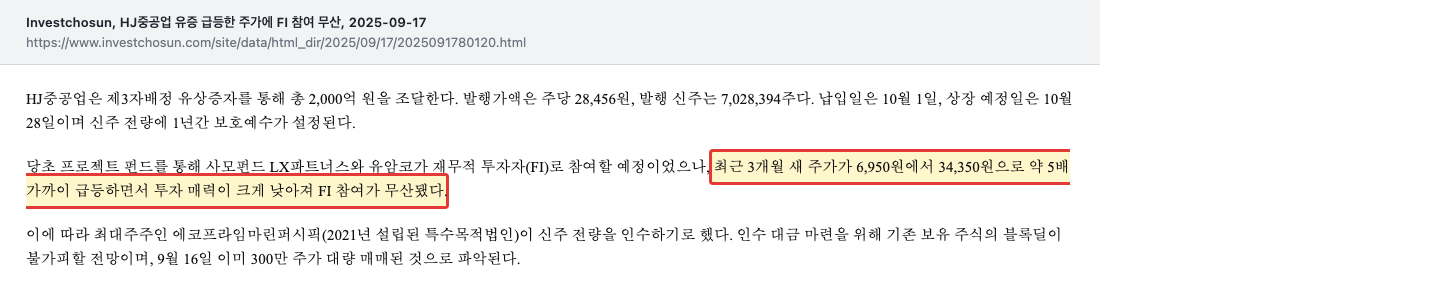
Uncomfortable truth No. 2: in October 2025, the planned financial investors in a 200-billion-won capital raise pulled out — because the stock had risen too fast. The plan originally had private-equity firms LX Partners and Yuamco join as financial investors via a project fund in a third-party share allotment (7,028,394 new shares at 28,456 won, roughly 200 billion won in total). The plan collapsed after the stock rose from 6,950 to 34,350 won within three months — almost a fivefold gain that made the agreed issue price unattractive to the investors. In the end, majority shareholder Ecoprime Marine Pacific absorbed the entire issue itself, partly funding the purchase through a block sale of about 3 million existing shares on September 16, 2025.
"최근 3개월 새 주가가 6,950원에서 34,350원으로 약 5배 가까이 급등하면서 투자 매력이 크게 낮아져 FI 참여가 무산됐다."
Translation: "Because the share price surged nearly fivefold within the past three months, from 6,950 won to 34,350 won, its investment appeal fell sharply and the financial investors' participation fell through."
— Investchosun, report on HJ Shipbuilding & Construction's capital raise, September 17, 2025
For shareholders, that means 7,028,394 new shares — about 8.4 percent more than before the issue — sit entirely with a single, already-dominant party, plus a one-year lock-up that expires on October 28, 2026. What happens to that block afterward is an open question — more in the side-finds section for this analysis.
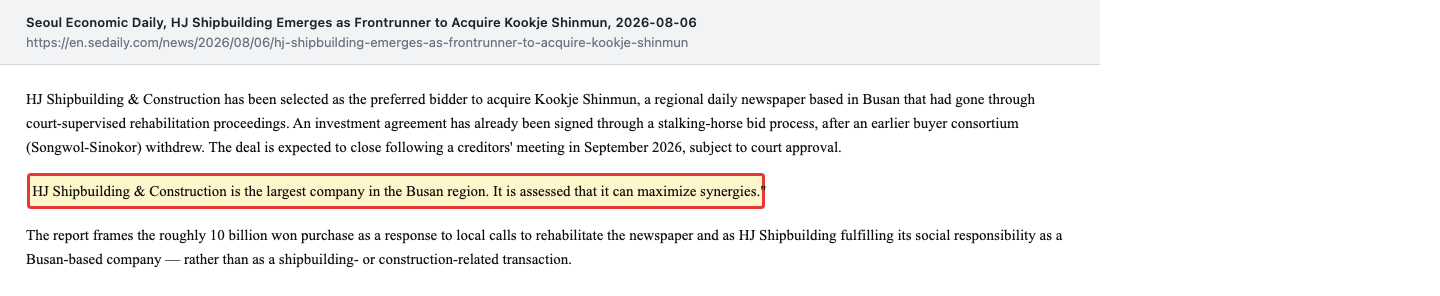
Uncomfortable truth No. 3: a heavily leveraged shipbuilder is buying an insolvent regional newspaper. On August 6, 2026 — three weeks before the data cutoff used here — HJ Shipbuilding was named preferred bidder for the Busan daily Kookje Shinmun, which had gone through court-supervised rehabilitation. The purchase price is roughly 10 billion won — trivial against group revenue, but equal to about 6 percent of the cash the company reported holding per the dataset dated August 16, 2026. An investment agreement is already signed; closing is expected after a creditors' meeting in September 2026.
"HJ Shipbuilding & Construction is the largest company in the Busan region. It is assessed that it can maximize synergies."
— Seoul Economic Daily, "HJ Shipbuilding Emerges as Frontrunner to Acquire Kookje Shinmun," August 6, 2026
The stated rationale is civic responsibility as the region's largest employer — no shipbuilding or construction logic sits behind it. That's not a balance-sheet catastrophe, but it's a capital-allocation choice worth questioning at a company carrying roughly 266 percent leverage: why now, and why a newspaper?
Valuation: what the stock costs
At the August 21, 2026 price of 16,940 won, HJ Shipbuilding carries a market capitalization of 1,529.6 billion won (90,295,344 shares times 16,940 won). On the analyst's 2026 earnings-per-share estimate (1,748 won), that works out to a P/E of roughly 9.7; the 14.5 figure carried in the scanner dataset likely reflects a different earnings basis (analyst estimate versus trailing twelve months) — either way, the valuation looks moderate for a stock only just entering a double-digit margin path. Price-to-sales, on our own quarterly series (trailing revenue of 2,353.2 billion won), works out to roughly 0.65 — on the scanner's diverging figure it would be roughly 0.7; either way low but not unusual for a capital-intensive industrial name. Price-to-book of roughly 2.2, though, is no longer a bargain after the multi-year rally.
The "professionals' view" is thin here: we found exactly one current, traceable analyst report — DS Investment & Securities initiated coverage on May 27, 2026 with a "Buy" and a 37,000-won target, derived from a twelve-month-forward EPS estimate of 2,032 won and a target P/E of 18 (in the analyst's assessment, the low end of what large warship-export-capable yards command). The stock traded at 22,550 won on the report date — implying 64.1 percent upside at the time. It has since fallen further, to 16,940 won on August 21, 2026 — were the target unchanged at 37,000 won, the implied upside would now be closer to 118 percent. The scanner dataset's separate price-target field instead shows 5,166 won with a target distance of minus 71.1 percent — a figure that matches none of the analyst opinions we found and is most likely a stale or erroneous artifact of a thin, outdated consensus base. We would not put any weight on that single number.
We found no public analyst conference calls with a transcript or recording for HJ Shipbuilding — unlike SEC filers, there is no standardized requirement for one, and a targeted search for conference-call transcripts, investor-relations recordings or non-deal roadshows came up empty. What does exist are occasional corporate briefings ("기업설명회") announced through the Korea Exchange's KIND disclosure system, plus the written quarterly and half-year reports themselves — neither comes with a publicly accessible transcript.
Opportunities and risks at a glance
What speaks for HJ Shipbuilding:
- Operating margin sextupled within a year (1.2 to 7.0 percent, half-year comparison), driven by a full shipbuilding order book.
- As the sole Korean builder of several naval vessel classes (Solgae, Chamsuri, Dokdo), the company holds a rare niche — plus a growing U.S. Navy MRO business with a proven reference (USNS Amelia Earhart).
- The October 2025 capital raise has already pushed the calculated debt ratio below the company's own target (roughly 266 versus 350 percent).
- The order book stood at roughly 8.8 trillion won in mid-2025 — more than four times 2025 annual revenue.
What speaks against it:
- An Altman Z-Score of 0.5 signals deep financial distress territory, and even after the capital raise, leverage remains high at roughly 266 percent.
- All three of the last quarters (Q4 2025 +31.2%, Q1 2026 +32.0%, Q2 2026 +43.7%) exceed 30 percent — the scanner officially counts only two, but the raw data points to three, which calls the "early phase" framing into question.
- About 7.03 million fresh shares from the capital raise come out of lock-up on October 28, 2026 — a potential supply overhang.
- Acquiring an insolvent regional newspaper doesn't fit the core business and raises capital-discipline questions at a balance sheet that remains heavily leveraged.
- No dividend, thin and hard-to-verify analyst coverage, no public conference-call transcripts.
Our conclusion
Back to the anchoring bias from the opening: yes, HJ Shipbuilding has more than quadrupled since 2023, and yes, the two most recent quarters show a real, shipbuilding-driven earnings jump — not an accounting trick. But the second anchor, the distant one from 2007, is a reminder that this company took two decades to go from a proud yard to a bankruptcy case and now to a cautious comeback — and that its balance sheet still carries that journey. A 266 percent debt ratio, an Altman Z of 0.5, and a capital raise that hasn't even cleared its lock-up yet are not footnotes; they're the frame around the 32 and 44 percent growth. What you make of it is your decision. And that is exactly as it should be.
Sources and disclosures
- HJ Shipbuilding, 2026 half-year report (period end June 30, 2026, filed with DART on August 12, 2026) — DART blocked automated access, so checked via a mandatory-disclosure summary dated August 12, 2026, cross-read against several independent business outlets
- DS Investment & Securities, Company Analysis, May 27, 2026
- Investchosun, capital-raise report, September 17, 2025
- Seoul Economic Daily, Kookje Shinmun acquisition, August 6, 2026
- Seoul Economic Daily, road contract, August 20, 2026
- Baird Maritime, Q1 2026 figures
- Wikipedia (EN), HJ Shipbuilding & Construction — company history and ownership
- Quarterly revenue series from mandatory disclosures and press coverage (Q1 2024-Q2 2026), cross-checked against the half-year figures and the Baird Maritime report
- Also relevant: our Revenue Inflection backtest study
This analysis is a journalistic contextualization of publicly available information and is not investment advice. Equity investments carry the risk of total loss. Positions held by the operator are disclosed daily; where one exists, it appears as a notice at the top of this deep dive.
Our Bottom Line at a Glance
- Operating turnaround positive
- Operating margin rose from 1.2 percent in the first half of 2025 to 7.0 percent in the first half of 2026 (half-year report, filed August 12, 2026) — driven by revenue recognition on shipbuilding orders booked in 2024, not one-off items.
- Naval and U.S. Navy MRO niche positive
- By its own history, the sole Korean builder of several naval vessel classes, with a proven U.S. Navy maintenance reference (USNS Amelia Earhart) — a rare, hard-to-replicate position (DS Investment & Securities analyst report, May 27, 2026).
- Historically thin capitalization negative
- Debt-to-equity of 750 percent at the end of 2023, 565 percent in mid-2025, still roughly 266 percent by calculation after the capital raise (dataset dated August 16, 2026); an Altman Z-Score of 0.5 sits deep in distress territory — weak even accounting for shipbuilding-typical customer advances.
- October 2025 capital raise and expiring lock-up negative
- Financial investors withdrew after the stock rallied quickly; the majority shareholder absorbed the entire 200-billion-won issue (about 7.03 million new shares, +8.4 percent). Its lock-up expires October 28, 2026 (Investchosun, September 17, 2025).
- Kookje Shinmun capital allocation neutral
- The roughly 10-billion-won planned acquisition of the insolvent Busan daily Kookje Shinmun (preferred-bidder status since August 6, 2026, closing expected September 2026) has no business link to shipbuilding or construction and raises a capital-discipline question at a still highly leveraged balance sheet, without being solvency-threatening on its own. We treat this as an open watch item, not a proven harm — hence neutral rather than negative.
- Thin capital-markets transparency negative
- No dividend, no publicly findable analyst conference-call transcripts, and only one current, traceable analyst report (DS Investment & Securities, May 27, 2026) — a separate 5,166-won target carried in the dataset matches no source we could find.
HJ Shipbuilding shows a real earnings jump grounded in a full shipbuilding order book — but on a balance sheet that still carries the marks of its near-collapse, alongside an unusual capital allocation and a soon-expiring lock-up on fresh shares. Not investment advice.
What Our Rating Means
Open questions
The business works in principle, but one material question is open. As long as it stays open, our findings do not carry a quality verdict.
The operating business is visibly working — margin sextupled within a year, the order book is full. But one material operational question stays open: whether the turnaround holds up beyond the current global shipbuilding boom, while the balance sheet, at roughly 266 percent leverage and an Altman Z of 0.5, offers little buffer, and management is simultaneously directing capital toward an asset outside the core business. That is not a documented substance risk (red) — there is no going-concern language, no negative equity, no interest coverage below 1 — but it is also not documented, robust quality (green). We would at least hesitate before pricing the last two quarters in as the new normal. The decision is yours.
A journalistic assessment by our editorial team at the time of the deep dive, based on public sources — not investment advice and not a solicitation to buy or sell. Your personal circumstances (investment goals, risk capacity, taxes) cannot be taken into account. What our levels mean, how verdicts are formed, and what conflicts of interest exist →
Worth Noting
- Hook: rank 3 on our in-house "Revenue Inflection" scanner, run of August 23, 2026; after a correction to the scanner's currency conversion made later the same day (August 23, 2026), rank 12 of 28.
- Data as of August 16-23, 2026; periodic filing: 2026 half-year report, period end June 30, 2026, filed August 12, 2026.
- Not to be confused with the Korean rival shipbuilder HD Hyundai (HD현대), which is the AI-navigation partner but a separate, unrelated company.
The full analysis as a PDF for later
We will send you this analysis as a PDF — to print, file away, and read at your own pace.
Frequently Asked Questions
HJ Shipbuilding & Construction (KOSPI: 097230, Busan) operates two segments: shipbuilding (containerships, LNG bunkering vessels, naval and coast guard vessels plus U.S. Navy maintenance, about 53 percent of revenue in the 2026 half-year report) and construction (residential, infrastructure and plant construction, about 46 percent). The company was founded in 1937.
Hanjin Heavy Industries & Construction fell into a severe crisis from 2016/2019 onward (insolvency of its Philippine subsidiary yard Subic Bay, group equity ratio of minus 140 percent). In 2021, a consortium led by Dongbu Construction acquired the majority via the special-purpose vehicle Ecoprime Marine Pacific; at the end of 2021 the trademark license for "Hanjin" expired, and the company has traded as HJ Shipbuilding & Construction ever since.
There is no sign of acute insolvency risk — the company has been privately owned since 2021, is operationally profitable, and posted net income of 88.1 billion won in the first half of 2026. The balance sheet remains thinly capitalized, though: an Altman Z-Score of 0.5 (dataset dated August 16, 2026) sits deep in the zone considered critical, even though part of that reflects customer advance payments typical for shipbuilders.
HJ Shipbuilding was named preferred bidder on August 6, 2026 for the insolvent Busan daily Kookje Shinmun (about 10 billion won). The company cites its role as the region's largest employer and potential synergies; there is no business link to shipbuilding or construction, and closing is still pending a creditors' meeting expected in September 2026.
The first quarter of 2026 (revenue up 32.0 percent to 541.4 billion won) and the second quarter of 2026 (up 43.7 percent to 729.9 billion won) — after four quieter quarters ranging from minus 12.3 to plus 4.7 percent. More than three-quarters of the growth came from the shipbuilding segment, from revenue recognition on high-value orders booked in 2024.
No. Per the dataset dated August 23, 2026, the dividend yield is 0 percent, and the company has no ongoing payout history.
HJ Shipbuilding issued about 7.03 million new shares (roughly 8.4 percent more than before) at 28,456 won in October 2025, about 200 billion won in total. Planned financial investors withdrew after the stock had nearly quintupled; majority shareholder Ecoprime Marine Pacific absorbed the entire issue. The one-year lock-up on those shares expires October 28, 2026.
We found exactly one current, traceable analyst opinion: DS Investment & Securities initiated coverage on May 27, 2026 with "Buy" and a 37,000-won target (stock then at 22,550 won). A separate 5,166-won target carried in the scanner dataset matches no source we could find and is likely a stale data artifact.
Found an error?
Did you spot a factual error, an outdated number, or a typo in this deep dive? Let us know briefly — your report goes straight to the editorial team.