Guyoung Technology: 43 Percent Growth -- and Debt That Doubled in a Year
Ranked fifth on our in-house "Revenue Accelerator" scanner (August 23, 2026) with 43 percent quarterly growth. That same year, 2025, total liabilities more than doubled, a guarantee for the subsidiaries now exceeds total shareholders equity -- and the chairman transferred his stake to his son at a historically low price.
 Thomas Mücke
Founder & Publisher
Thomas Mücke
Founder & Publisher
There is an investor weakness that likes to hide behind a stock screener: the speedometer trap. You see a needle swing hard to the right -- here, a 43 percent growth rate -- and your brain quietly translates that into "strong engine, well maintained." What a speedometer never shows is the fuel gauge. Whether the engine is running on its own fuel or on borrowed fuel, speed alone will not tell you. Guyoung Technology Co., Ltd. (KOSDAQ: 053270) of Daegu, South Korea, is exactly that case: an auto parts maker whose quarterly revenue jumped more than 40 percent year over year twice in a row -- and which our in-house "Revenue Accelerator" scanner ranked fifth of 33 matches on August 23, 2026 (after a correction to the scanner's currency conversion made later the same day (August 23, 2026): rank 20 of 28). So let's make a deal: we look at the speedometer. Then we look at the fuel gauge -- the balance sheet, the guarantees, and the question of who actually paid for this acceleration. The decision is yours.
One note up front, because it shapes the whole analysis: Guyoung Technology trades on Korea's KOSDAQ exchange, not in the United States. There is therefore no annual report on Form 10-K and no quarterly report on Form 10-Q filed with the U.S. securities regulator, the SEC. Mandatory disclosures instead run through DART, the electronic filing system of Korea's Financial Supervisory Service, and through KIND, the disclosure service run by the Korea Exchange (KRX). The figures in this analysis come from several independent, DART-referencing financial data services and business media, plus the company's own website -- each cited with its filing date and cross-checked where possible. Where a figure differs between sources, that is stated in the text, not swept aside.
What Guyoung Technology Actually Makes -- Seat Frames, Oil Pans and a Second Home in Alabama
Guyoung Technology makes metal auto parts -- picture a company that presses, welds and coats steel and aluminum coils into a car's skeletal parts, the pieces you never see as a driver but without which the car would not hold together. The product range, per the company's own website, includes seat frames, body and chassis parts, engine and transmission brackets, control arms, shafts and accumulators -- more than 1,000 individual part numbers. Since December 2023 a second leg has been added in Daegu: a plant for EV battery housings, the protective shells around an electric car's battery pack.
The company's own timeline traces its roots to a predecessor, Migwang Industries, founded in June 1986; it was re-incorporated as "(주)구영" (Guyoung Co.) in November 1989, renamed "(주)구영테크" (Guyoung Technology) in January 2001, and has traded on the KOSDAQ since February 2002. Headquarters are in Daegu in southeastern South Korea, where two plants stand (the original plant with 11,700 pyeong of land / 7,634 pyeong of building, and the second plant for EV battery housings completed in 2023), plus a third plant in Yeongcheon in Gyeongsangbuk-do province.
Internationally, Guyoung Technology has been present since 2004 (China) and 2002 (United States) -- overseas plants are not a new phenomenon here. In China the group runs two plants in Shandong province (Weihai and Mudeung/Wendeng). In the U.S. there are four sites across Alabama and Michigan: a plant in Evergreen, Alabama (per the company's own website in operation since June 2002 and supplying Hyundai and Kia's local U.S. production directly -- the same website's corporate timeline instead dates the formal incorporation of the U.S. subsidiary to June 2006, presumably the date of the legal re-registration, with the plant itself already producing four years earlier), a second plant in Montgomery, Alabama (specializing in seat frames), a sales office in Southfield near Detroit, Michigan -- and, new since fall 2025, the group's largest U.S. plant: CAR TECH in Opelika, Alabama. At 36,700 pyeong of land and 12,650 pyeong of building space it is larger than the Evergreen plant, and the company's own website describes its customer base there like this:
"2018년 5월 생산을 시작한 Car Tech는 현재 BMW, VOLVO, Volkswagen, Daimler의 주요 공급업체들에 부품을 현지 공급하고 있습니다."
Translation: "Car Tech, which began production in May 2018, currently supplies parts locally to the major suppliers of BMW, Volvo, Volkswagen and Daimler."
— Guyoung Technology Co., Ltd., company website, Opelika/CarTech site

That is the strategic core of the CAR TECH deal. Guyoung Technology still relies heavily on Hyundai and Kia. The company's own website lists its main customers this way:
"이제 구영테크는 대한민국을 넘어 중국 미국 등지에 해외법인을 설립하고 현대기아자동차, 현대 모비스, GM, 크라이슬러 등 세계적인 자동차 기업의 기술 파트너로서 글로벌 기업의 새로운 역사를 써 내려가고 있습니다."
Translation: "Guyoung Technology has now established overseas subsidiaries beyond South Korea in China, the United States and elsewhere, and as a technology partner of world-class automotive companies such as Hyundai-Kia Motors, Hyundai Mobis, GM and Chrysler, is writing a new chapter as a global enterprise."
— Guyoung Technology Co., Ltd., company website, major customers section

None of the sources checked for this analysis carried a reliable percentage for how much revenue comes from Hyundai/Kia specifically -- the company does not disclose one publicly, and the underlying filings could not be extracted as text. That Hyundai/Kia forms by far the largest customer block is treated as uncontroversial across several independent sources; that is exactly why the deliberate opening toward BMW, Volvo, VW and Daimler through CAR TECH makes strategic sense -- even though, as you will see, it came at a steep price.
Company history for investors
-
1989
Re-incorporation as (주)구영
From the predecessor firm Migwang Industries, founded in 1986, Guyoung Co. emerges -- the foundation of today's group.
-
2002
Listing on the KOSDAQ
The stock becomes publicly tradable for the first time -- a starting point for investors, with no known relisting or delisting incident since.
-
2006
First U.S. subsidiary (Evergreen plant running since 2002)
The group expands into the U.S. for the first time to supply Hyundai/Kia locally -- the foundation for today's four U.S. sites.
-
2023
Second Daegu plant for EV battery housings
The new plant gives the group a second leg in the electric-vehicle business -- for shareholders, a step diversifying away from the classic internal-combustion business.
-
2025
Acquisition of CAR TECH in Alabama
The deal opens new customers (BMW, Volvo, VW, Daimler) but pushes the group's debt to more than double within a year.
-
2026
Succession and record quarters
The chairman transfers nearly his entire stake to his son, while revenue jumps more than 40 percent year over year for two quarters running.
How the Stock Landed on Our Desk
Guyoung Technology ranked fifth of 33 matches on our in-house stock scanner "Revenue Accelerator" on August 23, 2026 (published at /aktien/scanner/umsatzbeschleuniger, reproducible by any reader); after a correction to the scanner's currency conversion made later the same day (August 23, 2026), the stock ranks 20th of 28 there. The scanner looks for a specific pattern: the most recent two-plus quarters each grow 30 to 70 percent versus the same quarter a year earlier, while the four quarters before that each grew under 15 percent -- a "fresh acceleration" rather than an already-mature trend, additionally filtered on a minimum revenue base equivalent to $100 million and no more than two such accelerated quarters, so only the early phase gets caught. Our own backtest study of the scanner found that stocks showing this fresh-acceleration pattern historically returned 16.6 percent a year, well above the 9.9 percent posted by already-established growers.
The scanner row for Guyoung Technology (as of August 23, 2026) listed, among other figures: a revenue base (trailing four quarters) of KRW 470.5 billion -- the scanner's column header labeled "million $" still showed the raw won figure mislabeled as dollars at that point; that error was fixed later the same day (August 23, 2026), and the scanner has since shown 339.7 $M for this stock -- two accelerated quarters, a market cap of KRW 54.4 billion, a fundamentals rating of "B" (66 of 100 points), a Piotroski score of 3 of 9 (a nine-point test of balance-sheet health; a score of 3 is weak, a genuinely healthy company sits at 7 to 9), a growth score of 4, an Altman Z-Score of 0.7 (a bankruptcy-risk indicator; values under 1.8 count as the warning zone), and a price-to-earnings ratio of 0.0 alongside a return on equity of 1,446.3 percent -- the scanner display shows evident data artifacts for these two metrics; what matters are the values calculated here from the annual report: the price-to-earnings ratio is roughly 2.43, the return on equity roughly 14.65 percent -- both scanner values differ from the calculated value by exactly a factor of 100, consistent with a decimal-point processing error. The market cap figure, by contrast, checked out almost exactly.
To name the two accelerated quarters concretely: they are the fourth quarter of 2025 (revenue KRW 122.7 billion, up 45.9 percent from KRW 84.1 billion in the fourth quarter of 2024) and the first quarter of 2026 (revenue KRW 147.6 billion, up 42.9 percent from KRW 103.3 billion in the first quarter of 2025). Both figures are corroborated across several independent financial data services as well as verbatim quotes in the Korean business press. The following second quarter of 2026 grew, by our own calculation, a further roughly 36.8 percent to KRW 141.3 billion -- so the pace is already moderating slightly (46 to 43 to 37 percent), though it stays inside the band the scanner looks for. More on that in the next chapter -- including where this growth actually comes from.
The Numbers Over the Years -- Honestly Appraised
First, what genuinely impresses: Guyoung Technology's revenue rose 5.6 percent to KRW 377.4 billion in 2024 and 12.9 percent to KRW 426.2 billion in 2025 (roughly $307.5 million or EUR 263.2 million at the August 21, 2026 exchange rates) -- a solid but unremarkable acceleration over the full year. The real story only shows up quarter by quarter:
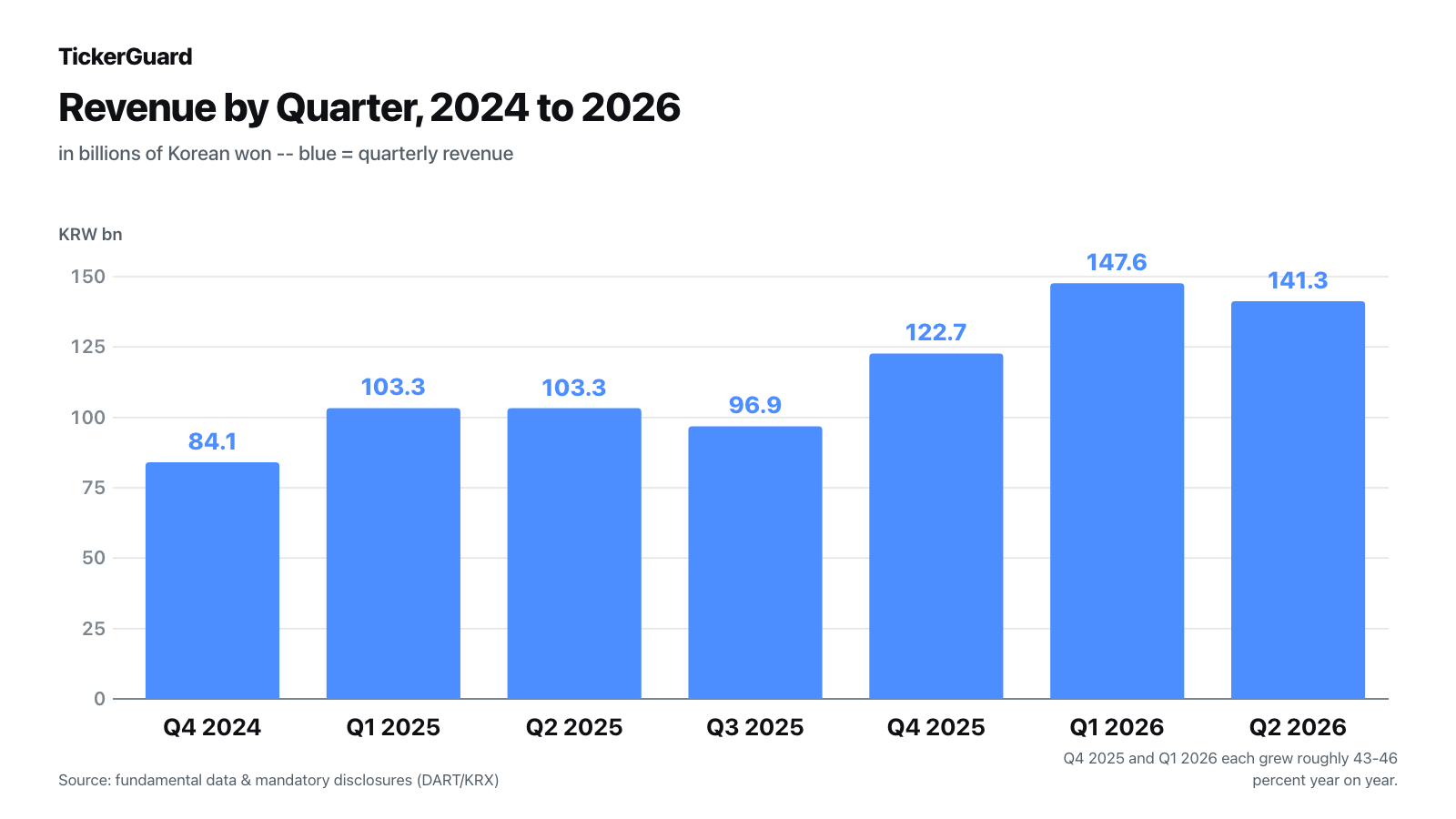
The break shows up even more clearly once you look closely at the calm period before it: from January through September 2025, cumulative revenue grew only 3.5 percent against the same period a year earlier -- KRW 303.5 billion (the sum of the three individual quarters, 103.3 + 103.3 + 96.9) versus KRW 293.3 billion in the first nine months of 2024. Operating margin in those calm quarters was already quietly eroding: 7.3 percent in the first quarter of 2025, 4.8 percent in the second and 4.0 percent in the third (fundamental data) -- revenue held steady, but earning power was already giving way. Only after that did the picture flip: per our own fundamental data (as of June 1, 2026), consolidated revenue grew 42.9 percent in the first quarter of 2026, and net income grew 42.9 percent as well -- the driver named explicitly is the "diversification of North American customers through the CAR TECH acquisition," plus supply to "global automakers such as BMW." That is a mixed picture: part of the jump is a pure consolidation effect -- CAR TECH's revenue shows up in the group accounts for the first time since the acquisition closed in fall 2025, which is not "organic" growth of the pre-existing business. Another part is genuine operating growth -- new EV component orders, a broader customer base. None of the sources checked gave a concrete won figure for the pure consolidation share, so the acceleration cannot cleanly be split into "organic" and "from the acquisition" -- only that both play a role.
The bottom line also shows a mixed picture: operating income fell 15.7 percent to KRW 24.3 billion in 2025 despite rising revenue (2024: KRW 28.9 billion) -- margin compressed. Net income, by contrast, rose 23.9 percent to KRW 22.6 billion (2024: KRW 18.2 billion), helped in part by items outside the ongoing business. Operating cash flow stayed positive at KRW 26.4 billion (2024: KRW 33.4 billion), but declined. Anyone equating "revenue growth" with "more earning power" would be wrong here -- revenue grew in 2025, but operating margin shrank. And one more figure belongs in this chapter, because it shows the real price of the acceleration:
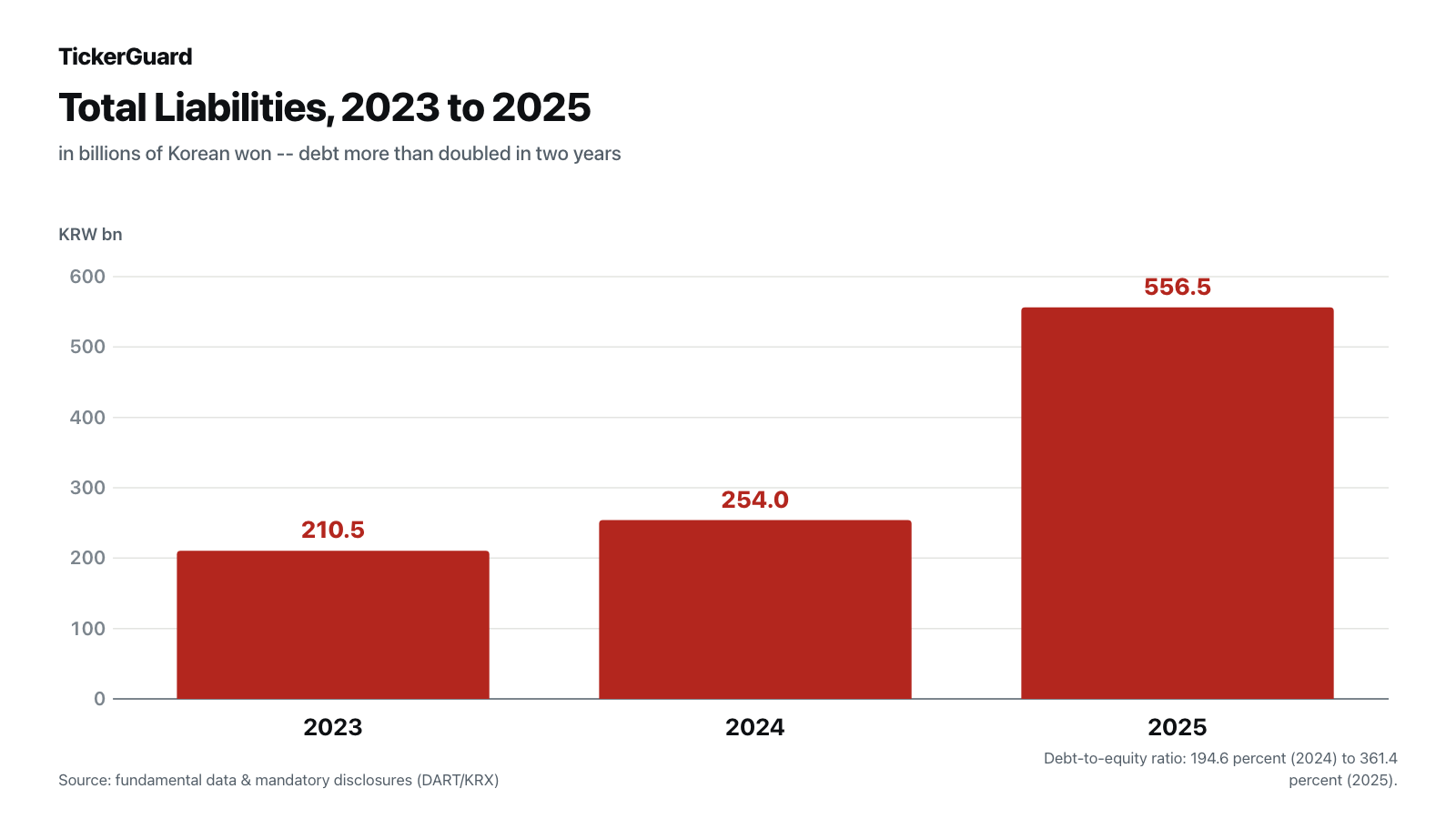
This curve belongs right next to the revenue curve -- not as a footnote, but as the second half of the same story. What is behind it is the subject of the next chapter.
What the Filings Say -- the Uncomfortable Truths
Uncomfortable truth No. 1: debt more than doubled in 2025
From the end of 2024 to the end of 2025, Guyoung Technology's total liabilities grew from KRW 254.0 billion to KRW 556.5 billion -- up 119 percent in a single year, or 2.6 times in two years since the end of 2023 (KRW 210.5 billion). The debt-to-equity ratio (total liabilities divided by shareholders equity) jumped from 194.6 to 361.4 percent. Short-term borrowings rose 144.3 percent to KRW 131.7 billion, long-term borrowings 152.2 percent to KRW 187.6 billion. Picture a household whose income rose 13 percent last year -- while its credit card balance more than doubled in that same year. The income growth is real. It just does not answer the question of how that debt gets repaid once the growth pace slows again. For Guyoung Technology, concretely: the equity ratio -- shareholders equity as a share of total assets -- stood at only about 21.7 percent at the end of 2025, down from roughly 34 percent two years earlier. Nearly four-fifths of the balance sheet is now financed with borrowed money. The most recent periodic report -- the H1 2026 semi-annual report, filed August 14, 2026 -- gives the second-quarter income figures, but a full balance sheet (liabilities, equity) as of June 30, 2026 could not be extracted from the available sources; the figures above therefore rely on the last fully documented balance-sheet date, December 31, 2025.
Uncomfortable truth No. 2: guarantees for the subsidiaries exceed total shareholders equity
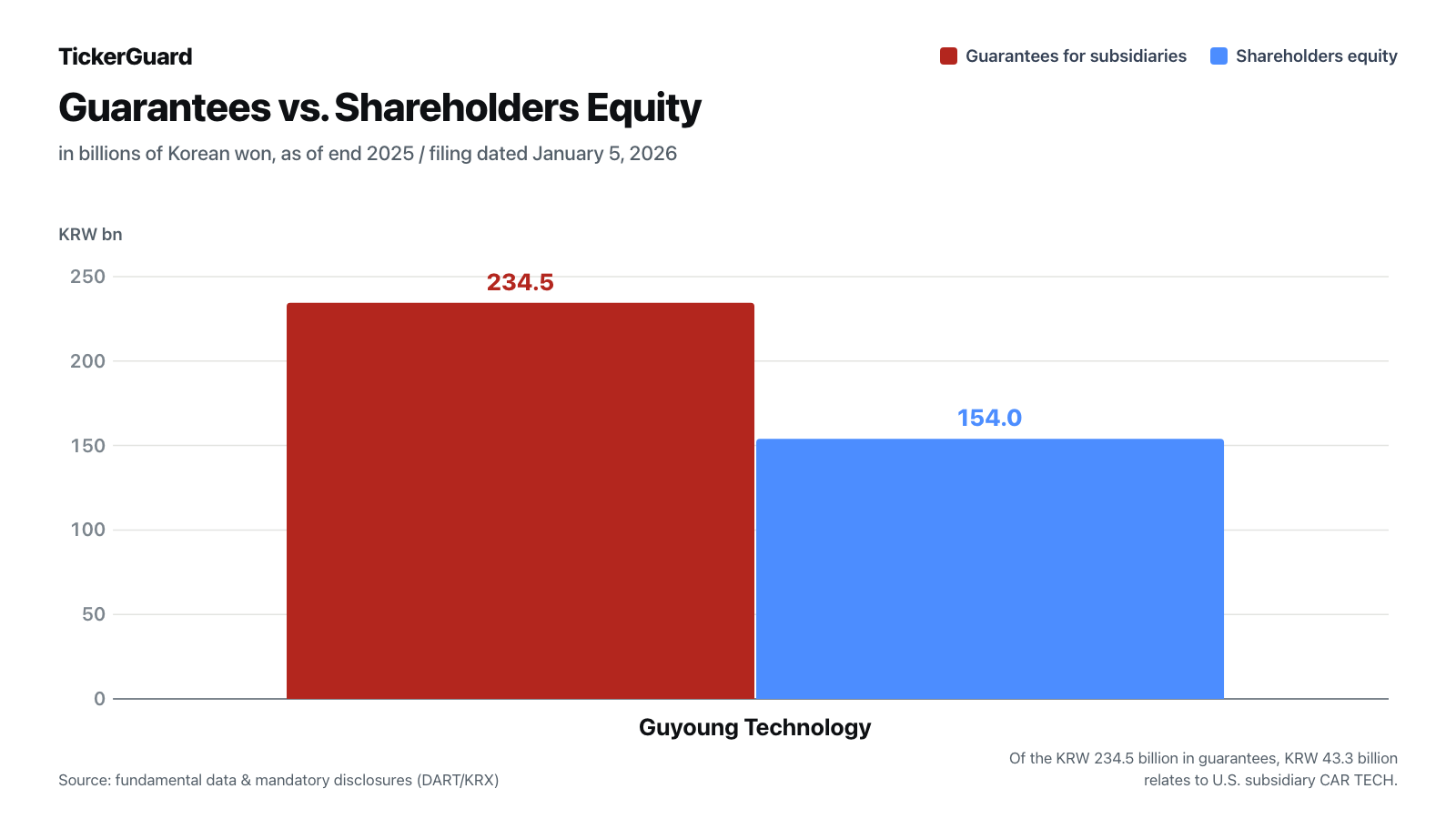
A major driver of this debt is the U.S. subsidiary CAR TECH, acquired in fall 2025. On January 5, 2026, Guyoung Technology filed a debt guarantee for CAR TECH with the Korea Eximbank worth KRW 43.263 billion (roughly $30 million), to refinance an earlier $10 million loan and draw new credit. The more striking figure from the same filing is the second one: the group's total guarantee obligations add up to KRW 234.485 billion -- more than the group's entire shareholders equity of KRW 154.0 billion as of December 31, 2025 (about 152 percent). And the acquisition already required an expensive top-up: only six months after the original purchase, worth roughly KRW 8.3 billion, a trade article (ibtomato.com, April 13, 2026, headline translated: "Guyoung Technology, KRW 29.5 billion capital raise six months after the acquisition -- concerns CAR TECH is a 'bottomless jar'") reported a reinvestment of roughly KRW 29.5 billion in two tranches -- about three times the original purchase price. Guyoung Technology also had to correct a filing about the CAR TECH investment as early as July 23, 2025, after the Korea Exchange demanded a correction for insufficient disclosure content. In other words: during the largest acquisition in company history, disclosure discipline is exactly where the process slipped.
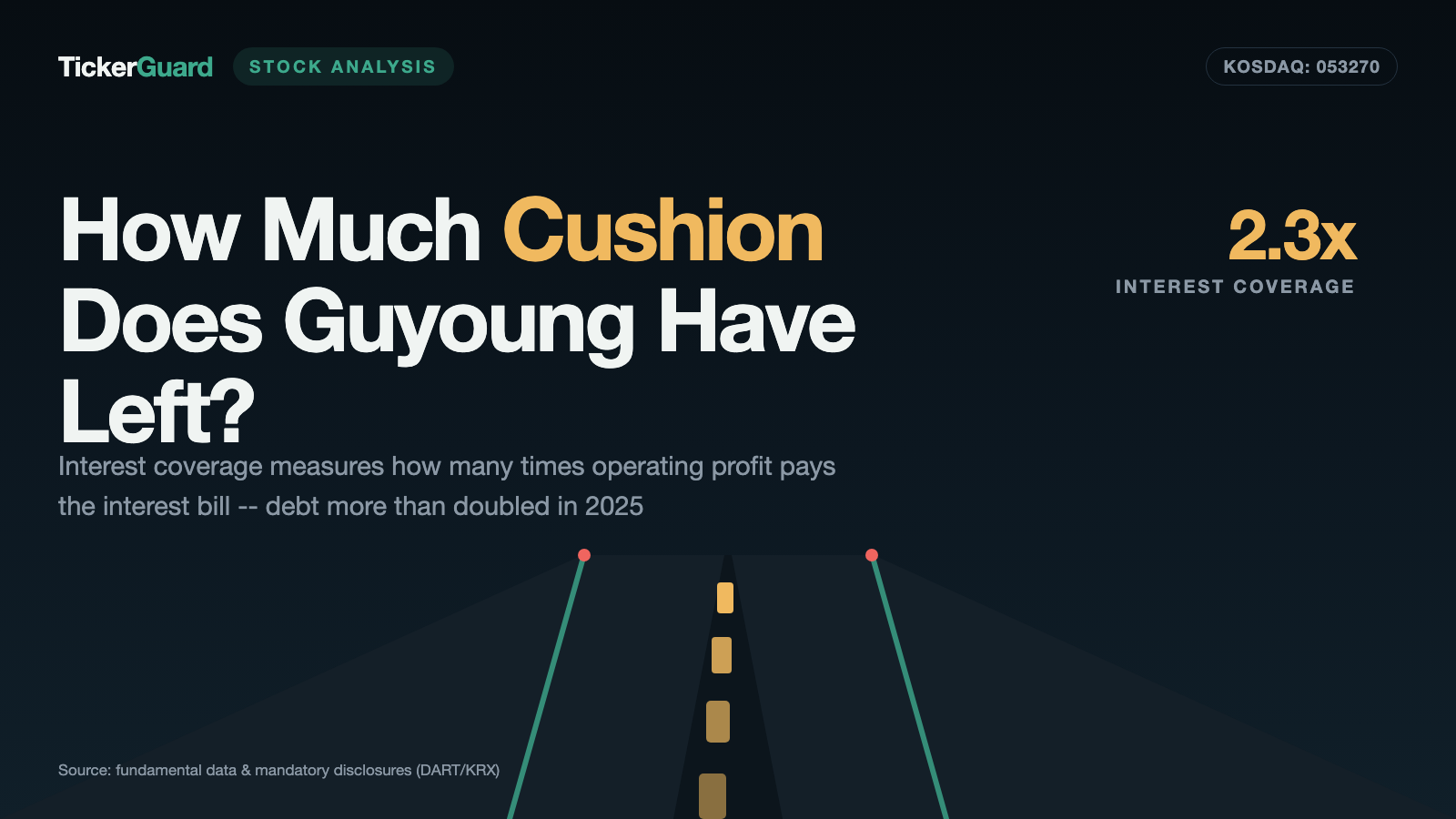
What this debt costs per year can be estimated: with operating income of KRW 24.3 billion and interest coverage of roughly 2.3 times (fundamental data, as of August 23, 2026), the implied interest expense for 2025 comes to roughly KRW 10.6 billion -- more than a third of operating income flows to creditors on paper. A smaller maturity also lands at the end of 2026: an unsecured convertible bond issued in 2021 ("7th tranche," outstanding principal amount of roughly KRW 1.9 billion as of May 26, 2026, conversion price KRW 2,801 per share) comes due on November 26, 2026. At the current price of KRW 1,999, the stock trades well below the conversion price, making redemption rather than conversion the more likely outcome -- adding further strain to already tight liquidity.
Uncomfortable truth No. 3: the chairman transferred nearly his entire stake at a historically low price point
In mid-2026, Chairman Lee Hee-hwa transferred 3,500,000 common shares -- about 97 percent of his direct shareholding -- to his son Lee Jong-myung, the company's vice president, at no cost; the transfer was filed with DART on July 15, 2026. The son's stake rose to roughly 20.0 percent, while Lee Hee-hwa retained only 0.34 percent directly; the family's combined stake stayed unchanged at about 45.7 percent. The timing stands out: per an assessment by business outlet etoday.co.kr (article dated August 7, 2026), market capitalization equaled only about 12 percent of 2025 annual revenue -- under Korean law, gift tax is assessed on the current share price, so a lower price means a lower tax bill for the family. This is a common, tax-motivated practice in Korea and not illegal. Whether the timing was deliberate is not established; etoday.co.kr characterized the move in its headline as a "low-price succession" (저가 승계).
Uncomfortable truth No. 4: no public analyst call -- the IR page is a construction site in the literal sense
For SEC filers, an analyst call transcript is standard reading for any analysis -- at Guyoung Technology, there simply is not one, at least not publicly available. Neither the company website nor a targeted search turned up a recording or transcript of an analyst call. And the company's own investor relations page confirms that in its own way:

The "실시간 주가" (real-time share price) and "환율" (exchange rate) subpages of the same IR section show the identical construction-site notice. That does not mean there is no analyst contact at all -- research notes from individual Korean securities firms (including Korea Investment & Securities and IBK Securities) suggest at least some institutional exchange takes place. But a freely accessible recording for retail investors, of the kind common for SEC filers via popular financial portals, does not appear to exist here.
Valuation: a P/E of 2.4 -- Cheap, or Cheap for a Reason?
At the KRW 1,999 price (August 21, 2026), Guyoung Technology's price-to-earnings ratio is roughly 2.43 -- well below what is typical elsewhere in the Korean auto-parts sector. The price-to-book ratio sits at roughly 0.36, enterprise value to EBITDA at roughly 8.44. The dividend of KRW 70 per share equals a yield of about 3.5 percent at the anchor price, with a payout ratio of only about 8.5 percent of annual net income -- so the dividend is covered by a wide margin even if earnings swing. At first glance this looks like a textbook "value" case: a company trading for less than a third of book value and roughly 2.4 times annual earnings.
A second look tempers that. A P/E of 2.4 is a bargain for a company with a healthy balance sheet -- for a company whose debt-to-equity ratio has nearly doubled in a single year, from 195 to 361 percent, it looks more like a warning sign: the market is not undervaluing current profits so much as pricing in higher risk already. Two figures support that reading. First, the Altman Z-Score of only 0.73 (as of August 23, 2026) -- a bankruptcy-risk indicator built from five balance-sheet ratios, where values under 1.8 count as the warning zone; 0.73 sits well below that. Second, the Piotroski score of only 3 of 9 possible points -- a nine-point test of fundamental balance-sheet health where a genuinely healthy company sits at 7 to 9; 3 is weak. Per our own fundamental data (as of August 23, 2026), operating income covers interest expense roughly 2.3 times over -- still comfortably above the critical threshold of 1, but not a figure to rest on if debt keeps climbing. A low P/E at Guyoung Technology, in short, looks less like a missed bargain and more like the price the market demands for a real, documented risk. One note on how to read this: the price box above carries the date of the last core-data import and can differ from the as-of date used in this text, which is deliberately anchored to August 21, 2026 (anchor price KRW 1,999) and stays that way.
Opportunities and Risks at a Glance
What speaks for Guyoung Technology:
- Genuine, double-digit revenue acceleration: up 45.9 percent in the fourth quarter of 2025 and 42.9 percent in the first quarter of 2026 versus the respective year-earlier quarter, corroborated across several independent sources.
- Deliberate customer diversification away from the long-standing Hyundai/Kia concentration: through the new U.S. subsidiary CAR TECH, the group now also supplies suppliers of BMW, Volvo, Volkswagen and Daimler.
- Very low valuation by classic metrics: P/E around 2.4, P/B around 0.36, dividend yield around 3.5 percent at a payout ratio of only about 8.5 percent.
- Positive shareholders equity (KRW 154.0 billion, end of 2025) and continued positive operating cash flow (KRW 26.4 billion in 2025) despite the debt dynamics.
- More than 35 years as a Tier 1/Tier 2 supplier to Hyundai/Kia, with international plants dating back to 2004 (China) and 2002 (U.S., the Evergreen plant; the U.S. subsidiary was formally incorporated in 2006 per the corporate timeline) -- overseas expansion is not a new experiment.
What speaks against it:
- Total liabilities more than doubled in 2025 (KRW 254.0 to 556.5 billion), the debt-to-equity ratio rose from 194.6 to 361.4 percent, the equity ratio fell to about 21.7 percent.
- The group's total guarantee obligations for its subsidiaries (KRW 234.5 billion, KRW 43.3 billion of it for the U.S. subsidiary CAR TECH) exceed the group's entire shareholders equity (KRW 154.0 billion) -- a default at any one subsidiary would hit a sum larger than the entire book value shareholders currently hold.
- Part of the revenue acceleration is a consolidation effect from the CAR TECH acquisition, not purely organic growth of the pre-existing business -- the available sources do not cleanly separate the two shares.
- One correction demand from the Korea Exchange (July 23, 2025) around the CAR TECH acquisition, plus a "low-price succession" of the chairman's stake to his son at a historically depressed price, are governance warning signs during the largest acquisition in company history.
- An Altman Z-Score of only 0.73 and a Piotroski score of only 3 of 9 (as of August 23, 2026) -- both fundamental indicators sit well inside the warning zone; no publicly accessible analyst call for context.
A Human Conclusion
Back to the speedometer trap from the opening. The needle at Guyoung Technology really does show a genuine acceleration -- 43 to 46 percent revenue growth in two consecutive quarters is no rounding error and no data glitch; it is corroborated across several independent sources. But the fuel gauge next to it shows something the scanner alone does not measure: debt that more than doubled in that same year, a guarantee for a U.S. subsidiary that is larger than the group's entire shareholders equity, and a chairman who transferred nearly his whole stake to his son at a time when market capitalization equaled only about 12 percent of annual revenue. One does not rule out the other -- a company can genuinely grow and be financed more riskily than two years ago, at the same time. So the honest question is not "Is this stock growing fast?" but: would you get into a car whose speedometer reads 100 miles an hour if you did not know whether there was enough left in the tank to make the next curve? If you think that question does not matter, you have found a growth stock at a bargain price. If it does, you have seen a number without reading the balance sheet behind it. The decision is yours.
Sources
All sources used in this analysis -- for your own reading. Since a KOSDAQ stock like this one has no SEC filings, the primary sources are the company website and the DART filings cited by the business media below:
- Guyoung Technology Co., Ltd. -- company website, company overview, history, major customers, U.S. sites, investor relations (all retrieved August 23, 2026)
- DART (Korea Financial Supervisory Service), corp code 00202060 -- company navigation page; most recent mandatory filings via KIND: semi-annual report 2026 (filed August 14, 2026), Q1 2026 quarterly report (May 15, 2026), 2025 annual report (March 16, 2026)
- ibtomato.com -- "구영테크, 인수 반년 만에 295억 유증…카테크 '밑 빠진 독' 우려" (April 13, 2026, debt levels, CAR TECH reinvestment)
- digitaltoday.co.kr -- debt guarantee for CAR TECH (January 5, 2026), share transfer to Lee Jong-myung (July 15, 2026)
- etoday.co.kr -- "매출 4000억대에 시총은 겨우 500억…구영테크 낮은 몸값에 저가 승계 마무리" (August 7, 2026)
- Our own backtest study of the "Revenue Accelerator" scanner
- Fundamental data (metrics, price and valuation data; as of August 23, 2026, price date August 21, 2026)
Transparency & disclaimer: This analysis is a journalistic contextualization of publicly available information and is not investment advice, not a regulated financial analysis, and not a solicitation to buy or sell securities. Equity investments carry substantial risk, including total loss. All figures are provided without guarantee; data dates are noted throughout the text. Positions held by the operator are disclosed daily; where one exists, it appears as a notice at the top of this deep dive.
Our Bottom Line at a Glance
- Revenue growth positive
- Quarterly revenue grew 45.9 percent in the fourth quarter of 2025 and 42.9 percent in the first quarter of 2026 versus the respective year-earlier quarter -- corroborated across several independent sources and consistent with the scanner criterion (30 to 70 percent growth after calmer prior quarters).
- Debt & balance sheet negative
- Total liabilities rose 119 percent in 2025 to KRW 556.5 billion, the debt-to-equity ratio from 194.6 to 361.4 percent, the equity ratio fell to about 21.7 percent (as of December 31, 2025). Guarantees for subsidiaries (KRW 234.5 billion) exceed total shareholders equity (KRW 154.0 billion).
- Earnings quality neutral
- Operating income fell 15.7 percent in 2025 despite rising revenue, while net income rose 23.9 percent -- a mixed picture. Operating cash flow stayed positive at KRW 26.4 billion in 2025, but declined (2024: KRW 33.4 billion).
- Governance & ownership negative
- One correction demand from the Korea Exchange around the CAR TECH acquisition (filing dated July 23, 2025), plus a share gift from the chairman to his son at a historically low price (filed July 15, 2026; market cap only about 12 percent of annual revenue per etoday.co.kr, August 7, 2026), are warning signs.
- Valuation neutral
- Cheap, but for a reason: a P/E of roughly 2.43 and a P/B of roughly 0.36 (price KRW 1,999 as of August 21, 2026) sit well below what a growing supplier typically costs, and the roughly 3.5 percent dividend yield is comfortably covered at only about 8.5 percent payout ratio -- but in our assessment the low price mainly reflects the real debt risk, not an overlooked bargain.
- Transparency negative
- No publicly accessible analyst call or transcript found; the company's own IR subpages for financial data, share price and exchange rate showed only a construction-site notice instead of content as of the retrieval date (August 23, 2026).
Guyoung Technology delivers a genuine, multiply-corroborated revenue acceleration of 43 to 46 percent in two consecutive quarters -- driven in part by the new U.S. subsidiary CAR TECH, which diversifies the group away from its long-standing Hyundai/Kia concentration. That came at the cost of debt that more than doubled in 2025 (KRW 254.0 to 556.5 billion), guarantee obligations for subsidiaries (KRW 234.5 billion, KRW 43.3 billion of it for CAR TECH) that exceed total shareholders equity (KRW 154.0 billion), and one correction demand from the exchange (July 23, 2025) plus a share gift from the chairman to his son at a historically low share price. In our assessment, the low valuation (P/E around 2.4) reflects real risk more than an overlooked bargain. Not investment advice.
What Our Rating Means
Open questions
The business works in principle, but one material question is open. As long as it stays open, our findings do not carry a quality verdict.
Yellow -- and at the more cautious edge of the tier, not its middle. Green is out of reach because the balance sheet cannot yet be called reliable: total liabilities more than doubled in 2025, the debt-to-equity ratio jumped from 194.6 to 361.4 percent, and guarantee obligations for subsidiaries (KRW 234.5 billion) already exceed total shareholders equity (KRW 154.0 billion) today -- a documented, material operating risk, not merely a price argument. Red is out of reach for now because the hard trigger is missing: equity remains positive, interest expense is still covered roughly 2.3 times over by operating income per our own fundamental data, operating cash flow stayed positive in 2025, and there is neither a going-concern warning nor a finding of misstated accounts by a regulator or auditor -- the exchange's correction demand (July 23, 2025) concerned insufficient disclosure, not a demonstrated accounting violation. The Altman Z-Score of just 0.73 and the Piotroski score of 3 of 9 (as of August 23, 2026) show, though, that the picture could shift toward red quickly with another round of borrowing or a setback at CAR TECH. The low price-to-earnings ratio plays no role in this rating whatsoever -- a cheap price is not a quality signal.
A journalistic assessment by our editorial team at the time of the deep dive, based on public sources — not investment advice and not a solicitation to buy or sell. Your personal circumstances (investment goals, risk capacity, taxes) cannot be taken into account. What our levels mean, how verdicts are formed, and what conflicts of interest exist →
Worth Noting
- Guyoung Technology is not an SEC filer -- its home exchange is Korea's KOSDAQ. This analysis rests on the mandatory disclosures filed with Korea's Financial Supervisory Service through the DART/KIND system (most recent periodic report: the H1 2026 semi-annual report, filed August 14, 2026) plus the company website. The original DART documents could not be extracted as text with the available retrieval tools; figures come from several independent, DART-referencing financial data services and were cross-checked where possible (e.g., net income back-computed from EPS times share count against the separately reported annual result, a gap of under 0.1 percent).
- Confusion risk: there is another Korean company with a very similar romanization, Koh Young Technology (KOSDAQ 098460, 3D semiconductor inspection equipment) -- not to be confused with Guyoung Technology (KOSDAQ 053270, auto parts), the subject of this analysis.
- Open items from the research: the exact date of the large mid-2026 share gift (sources give either June 15 or July 15, 2026; filed with DART on July 15, 2026), the exact balance-sheet total/equity as of June 30, 2026 (a renewed attempt still found only second-quarter income figures; the original DART documents still could not be extracted as text), a reliable percentage for the Hyundai/Kia revenue share, and whether the outstanding principal of the convertible bond issued in 2021 (roughly KRW 1.9 billion per a filing dated May 26, 2026, due November 26, 2026) has changed since.
- The hook for this analysis is our in-house stock scanner "Revenue Accelerator" (as of August 23, 2026, rank 5 of 33 matches; after a correction to the scanner's currency conversion later the same day: rank 20 of 28) -- not an SEC criterion, but an in-house metrics rule.
The full analysis as a PDF for later
We will send you this analysis as a PDF — to print, file away, and read at your own pace.
Frequently Asked Questions
Guyoung Technology Co., Ltd. (KOSDAQ: 053270) of Daegu, South Korea, makes metal auto parts: seat frames, body and chassis parts, engine/transmission brackets, accumulators and, since late 2023, EV battery housings. Its main customers, per its own website, are Hyundai-Kia Motors, Hyundai Mobis, GM and Chrysler. Plants are located in South Korea, the United States (Alabama, Michigan) and China.
Quarterly revenue grew 45.9 percent in the fourth quarter of 2025 and 42.9 percent in the first quarter of 2026 versus the same quarter a year earlier. Analysts attribute this mainly to the U.S. subsidiary CAR TECH, acquired in October 2025 (whose revenue is consolidated for the first time -- partly an acquisition effect, not purely organic growth), plus rising demand for EV components.
Total liabilities rose from KRW 254.0 billion (end of 2024) to KRW 556.5 billion (end of 2025, up 119 percent). A major driver was the acquisition and follow-on financing of U.S. subsidiary CAR TECH: only six months after the purchase a capital injection of roughly KRW 29.5 billion followed, and since January 2026 the group has guaranteed KRW 234.5 billion in subsidiary debt -- more than its entire shareholders equity.
Both were data errors in the automated processing, not real values. The actual price-to-earnings ratio is about 2.43, the actual return on equity about 14.65 percent -- both wrong figures are off from the correct value by exactly a factor of 100, consistent with a decimal-point error. The displayed market cap of KRW 54.4 billion, by contrast, was accurate.
Not that our research could find publicly. Neither the company website nor a targeted search turned up a recording or transcript of an analyst call; the company's own investor relations subpages for financial data, share price and exchange rate showed only a construction-site notice as of the retrieval date (August 23, 2026). Individual Korean securities firms publish research notes, suggesting some limited institutional IR contact.
The family around founder and Chairman Lee Hee-hwa holds a combined stake of about 45.7 percent. In mid-2026, Lee Hee-hwa transferred 3.5 million shares (about 97 percent of his direct stake) at no cost to his son, Lee Jong-myung, whose stake rose to about 20.0 percent as a result -- at a time when market capitalization equaled only about 12 percent of annual revenue. Free float sits at about 54.3 percent.
Because the company trades on Korea's KOSDAQ exchange and is not registered with the U.S. securities regulator, the SEC. Mandatory disclosures instead run through DART, the electronic filing system of Korea's Financial Supervisory Service (annual report 사업보고서, quarterly report 분기보고서, semi-annual report 반기보고서), plus KIND, the disclosure service of the Korea Exchange (KRX).
Found an error?
Did you spot a factual error, an outdated number, or a typo in this deep dive? Let us know briefly — your report goes straight to the editorial team.