Gravity: A 24-Year-Old Revenant Conquers a New Country Every Year — and Just Paid Its First-Ever Dividend
Gravity Co., Ltd. showed up on our scanner as a "revenue inflection" — a company whose growth is supposedly just getting started. The primary filings with the U.S. securities regulator, the SEC, tell a more precise story: the entire business rests on a single franchise launched in 2002, Ragnarok Online, whose newest offshoot, Ragnarok M: Classic, became the top revenue driver in 2025 with 27.6 percent — a year earlier, a different game held that spot with nearly half of revenue. GungHo, a Japanese company that is both licensee and competitor, has held majority control since 2008. And on August 7, 2026, the board approved the company's first-ever dividend — three months after the annual report promised the opposite. Not investment advice, just a look under the label "inflection."
 Thomas Mücke
Founder & Publisher
Thomas Mücke
Founder & Publisher
As of Today
As of: October 8, 2026
- Closing price
- 67.20 $ -0.40%
- Market Capitalisation
- 0.5 $B
- P/E
- 7.7
- Growth Score
- 4/10
- AAQS
- 3/10
Price change since August 21, 2026: -5.6%
This analysis has a cut-off date. The Stock Guard tells you when something material changes in the numbers. Reserve your free spot
Chart
Interactive price chart (TradingView).
52-week range: 55.70 $ to 75.20 $ · Last price: 67.20 $ (As of: October 8, 2026)
Note: pure fact-based analysis, not investment advice and not a solicitation to buy or sell. All figures without guarantee.
There is an investor trap that catches fans of old cult brands especially — the revenant trap. A name goes quiet for a while, then suddenly resurfaces in a new country, with new graphics, with what looks like a fresh growth story — and your mind fills in the rest: "finally a comeback, finally real growth." That it is the same undead thing that was buried and revived once before (and once before that) is easy to miss. Gravity Co., Ltd. (Nasdaq: GRVY) out of Seoul is a textbook case: the entire company lives off Ragnarok Online, an online role-playing game that launched in August 2002 — today, 24 years later, its newest mobile offshoot, Ragnarok M: Classic, is the company's single biggest revenue driver at 27.6 percent. A year earlier, a different game held that exact spot with nearly half of revenue — whose share then collapsed to about a quarter. On our in-house stock scanner "Revenue Inflection," Gravity showed up on August 23, 2026 at rank 4 (after a correction to the scanner's currency conversion made later the same day (August 23, 2026): rank 19 of 28): a company whose growth is supposedly just getting started. So let's make a deal: before we take the word "inflection" at face value, we read together only what Gravity itself reported to the U.S. securities regulator, the SEC — the annual report (20-F) for 2025 and the interim reports (6-K) through August 7, 2026. These filings carry truthfulness obligations backed by criminal penalties. And they describe a majority shareholder in Tokyo who is simultaneously a licensee and a competitor, a margin that Apple's App Store and Google Play share in — and the first-ever dividend of a 26-year-old company, approved just months after the annual report promised the opposite. In the end, the decision is yours.
What Gravity actually does — an old game out of Seoul, controlled from Tokyo
Gravity Co., Ltd. is a South Korean developer and publisher of online and mobile games based in Seoul — a company that builds games and distributes them worldwide: partly self-operated (online games, mostly on PC), partly through licensees in individual countries (in Japan, through GungHo — more on that shortly), and partly directly through the App Store and Google Play (mobile games). Nearly the entire business — online and mobile alike — traces back to a single invention from 2002: the role-playing game Ragnarok Online, one of the first South Korean online games to gain international traction. Since then, Gravity has carved endless spin-offs from it: Ragnarok Online II, Ragnarok M: Eternal Love, Ragnarok Origin, Ragnarok X: Next Generation, Ragnarok M: Classic — each carries the same brand name, the same universe, often the same characters, just repackaged for a new platform or a new market. That the original still draws a crowd shows up as a hard number in the annual report: in Taiwan, Hong Kong and Macau alone, Ragnarok Online logged 10,852 peak concurrent users in the first quarter of 2026 — down from 16,702 in the same market in 2023, a decline the filing itself attributes mainly to users migrating to the newer mobile spin-offs. The 20-F annual report for 2025 says it plainly: alongside Ragnarok Online, the company offers six other online games — "none of our other online games to date have been as commercially successful as Ragnarok Online." In everyday terms: picture a bakery that has run on a single base recipe for 24 years — and claims every year to have invented a "new" bread, when it is really just shipping the same flour to a different town. Mobile games made up 81.2 percent of 2025 revenue, with the rest coming from classic online games and other licensing.
And a majority shareholder sits over all of it: since April 1, 2008, Japanese game developer GungHo Online Entertainment (best known for the mobile hit Puzzle & Dragons) has held majority control of Gravity — and is simultaneously Gravity's licensee for the Japanese market. That names the central tension of this analysis, and it runs through every chapter: a scanner flags "inflection," but the business behind it has lived off the same idea for 24 years, is controlled by its own licensee and competitor — and just returned cash to shareholders for the first time ever.
Company history for investors
-
2002
Ragnarok Online launches in South Korea
The brand behind essentially 100 percent of today's revenue is now roughly 24 years old — with no proven second hit franchise.
-
2008
GungHo acquires 52.4 percent of the shares
From this day, the Japanese licensee and competitor controls the board — still holding 59.3 percent of the vote today.
-
2017
The shift to mobile games pays off commercially
From here, Gravity increasingly funds itself through App Store commissions instead of its own servers — revenue grows, but the margin structurally declines.
-
2024
Ragnarok Origin delivers 42.1 percent of annual revenue
A single game carried nearly half of group revenue — a year later its share had shrunk to 11.1 percent.
-
2025
Ragnarok M: Classic launches in Southeast Asia and Taiwan/Hong Kong/Macau
The same mechanism repeats: a new country, the same IP, a new revenue driver holding 27.6 percent of 2025 revenue.
-
2026
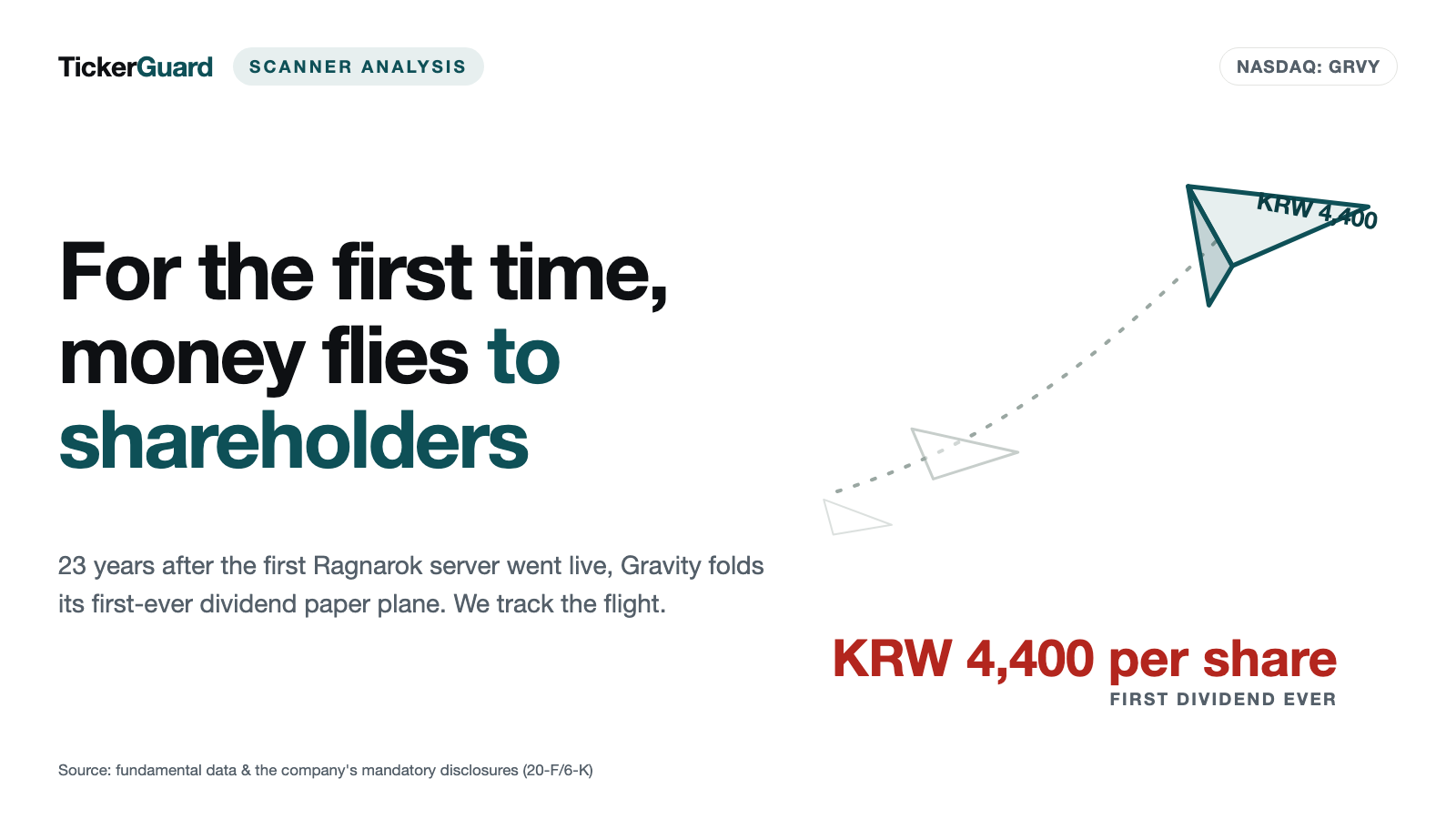
The board approves the first dividend in company history
KRW 4,400 per share after 26 years without a payout, approved just months after a "no intention" denial in the annual report.
Where the stock shows up — and why the "inflection" is only half real
Gravity landed on our list through our in-house stock scanner "Revenue Inflection" — rank 4 of 33 hits in the August 23, 2026 run; after a correction to the scanner's currency conversion made later the same day (August 23, 2026), the stock ranks 19 of 28 there. The logic, briefly: the scanner looks for companies whose revenue grew 30 to 70 percent versus the same quarter a year earlier in at least the two most recent quarters, after the four quarters before that each grew under 15 percent — the idea being that a company just starting to accelerate has more room to run than one that has been sprinting for years. To keep the find from being noise, the scanner also requires a revenue base of at least $100 million over the trailing four quarters, at most two such inflection quarters (an early rather than a long-running phase), and no heavy share dilution. The companion study ran the question over 13.5 years and 20,356 signals: companies at the start of a growth story beat established compounders on average — 16.6 versus 9.9 percent per year (more in the Revenue Inflection backtest study).
Gravity's scanner row from August 23, 2026, in short — at that point a note of caution was warranted: the scanner's column header read "$M," but for a company reporting in won, the figure at the time was actually the raw won value mislabeled as dollars. That error was fixed later the same day (August 23, 2026); the scanner has since shown 391.3 $M for this stock. Our own recalculation from the four most recent 6-K quarterly figures (Q3 2025 through Q2 2026) yields a revenue base of roughly KRW 576.1 billion — the scanner's stated figure of 541,884.6 (in millions of won) on August 23, 2026 diverged slightly from that, likely due to a different quarter cutoff used by the data vendor. Two inflection quarters, 32 percent price volatility, an in-house fundamental score of B (60 of 100 points), a Piotroski score of 6 of 9 (a nine-point test of balance-sheet quality — 6 is okay, not great; a genuinely healthy company scores 8 or 9), a bankruptcy check with no warning flags (0 of 3), a price-to-earnings ratio of 8.1, a price-to-sales ratio of 1.3, and a price-to-book ratio of 1.0.
But which two quarters does the scanner actually mean — and is the growth it found really the start of something new? We checked, using Gravity's own quarterly filings (6-K) with the SEC.
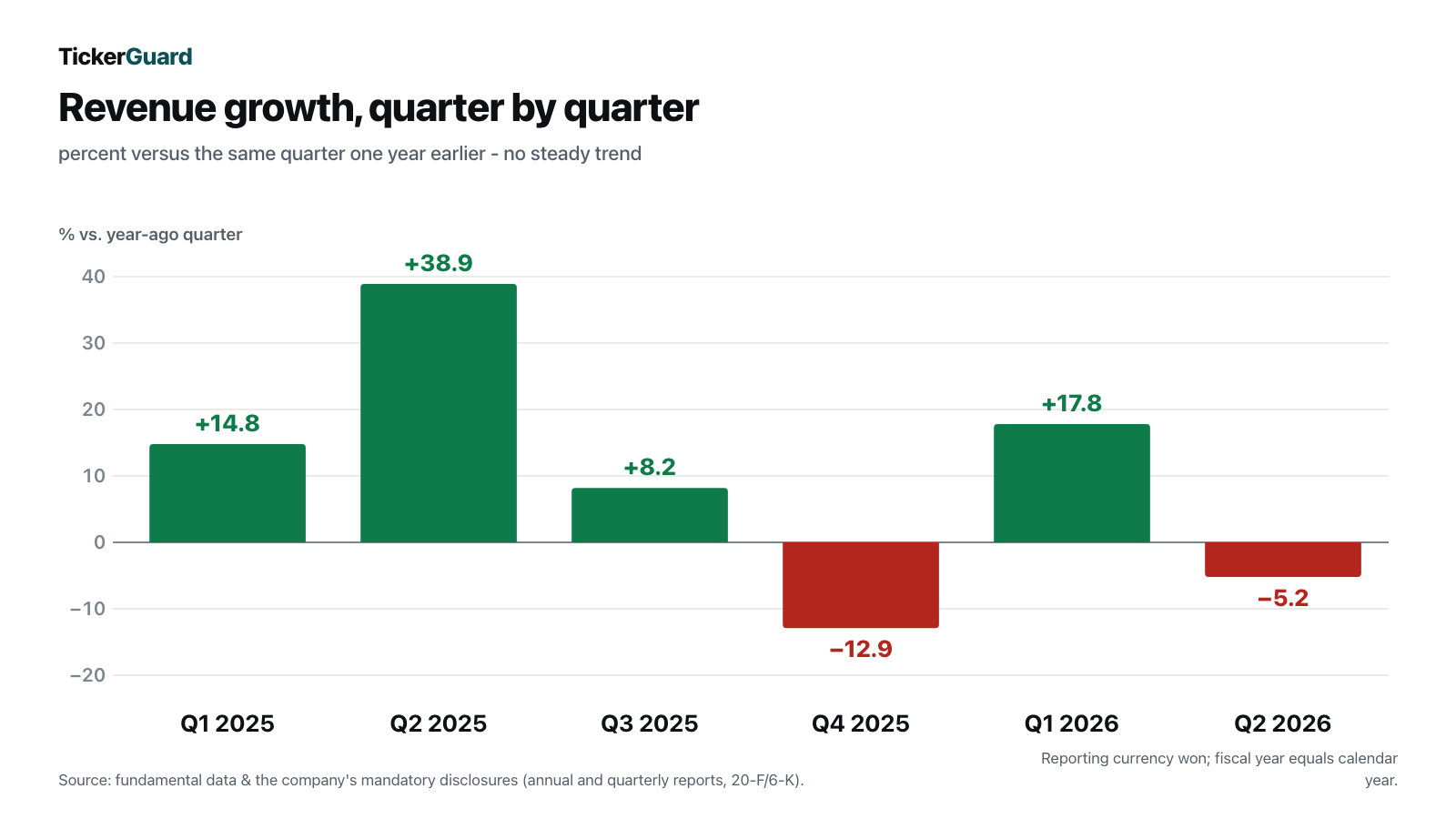
At the group level, the recent growth story looks bumpier than the scanner suggests: only one quarter, the second of 2025, clearly cleared the 30 percent mark (+38.9 percent versus the second quarter of 2024); every other recent quarter came in below that or even negative — most recently, in the second quarter of 2026 (reported August 7, 2026), at −5.2 percent — even as operating profit (KRW 27.6 billion, +40.2 percent) and net profit (KRW 24.3 billion, +83.8 percent) both jumped versus the year-ago quarter, proof of how little a single quarter says about the trend at Gravity. One level down, in the "online games" reporting segment (not to be confused with the far larger mobile business), the picture does look like a genuine streak: 32.1 percent growth in the third quarter of 2025, 37.8 percent in the first quarter of 2026, 35.0 percent in the second quarter of 2026 — three consecutive quarters inside the inflection band. But where does that growth come from? Not from new game ideas. It comes from exactly the mechanism this whole analysis is built on: Ragnarok Online was extended into new countries during the period — Thailand, Latin America and other markets were added. Every new country counts as a new customer on the income statement, but it is the same 24-year-old server flying a new flag. Remember the pattern: an old game entering a new country looks like growth in the statistics — but it is still the same old game. In the far larger mobile business (81.2 percent of group revenue), the same pattern repeats in an even more dramatic form — more on that in the first uncomfortable truth.
The numbers over the years — honestly appraised
First, what genuinely speaks for Gravity — and that is more than the shrinking profit suggests. Revenue rose 11.9 percent in 2025 to KRW 560.5 billion (roughly $388.0 million per the annual report), up from KRW 500.8 billion the year before. The balance sheet is spotless: KRW 742.7 billion in total assets, of which KRW 637.4 billion is equity — an equity ratio of 85.8 percent that is unusually high for a publicly traded company. KRW 203.6 billion (roughly $140.9 million) sits in cash, with essentially no meaningful debt. For a company with roughly 1,000 employees group-wide (499 at the parent, 546 at subsidiaries — 44 of them seconded from the parent and double-counted in that sum, as of December 31, 2025), that is remarkably solid substance — none of it borrowed.
Then comes the catch, and it sits exactly where you wouldn't expect it in a growing company: profit.
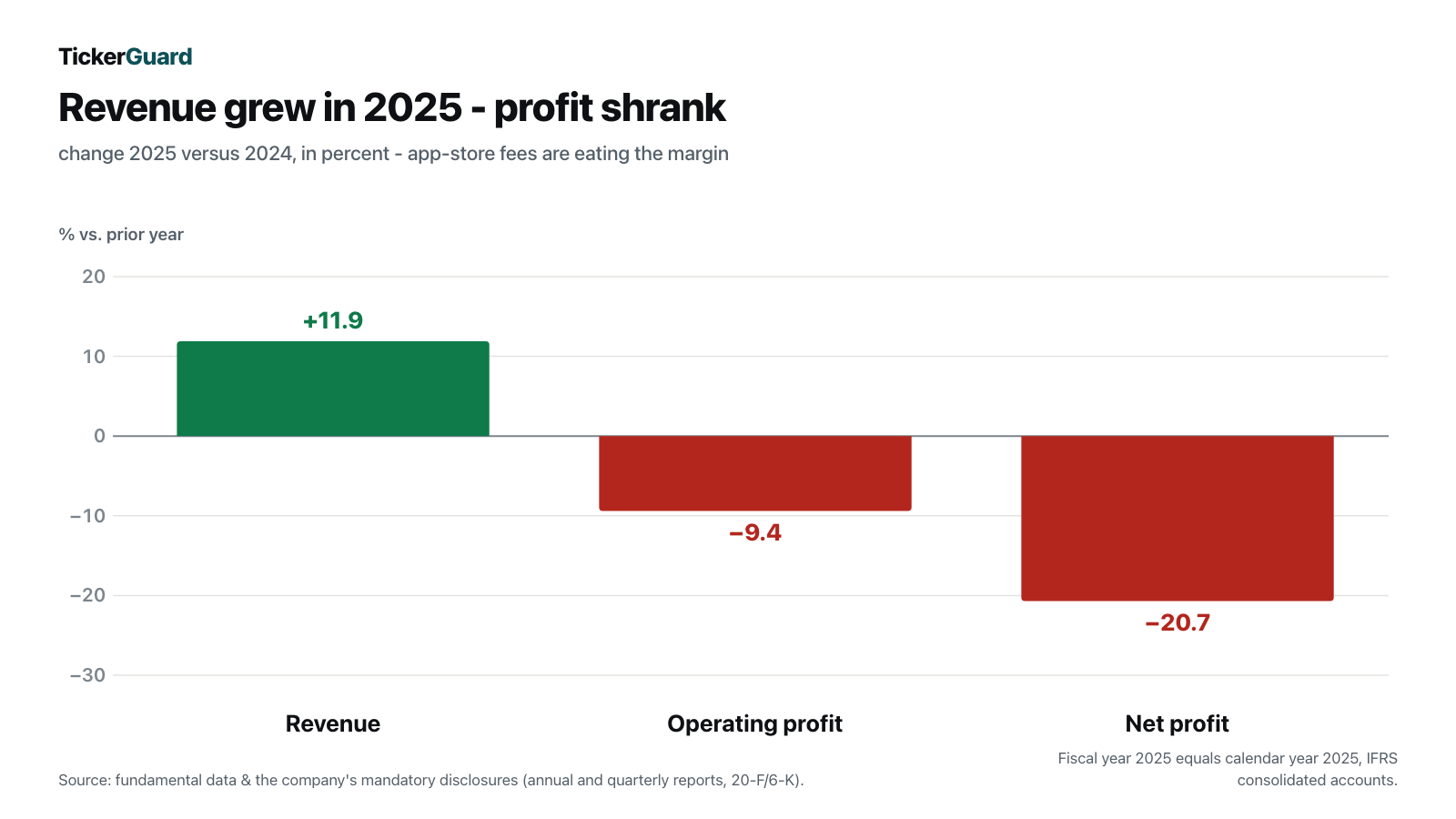
Operating profit fell 9.4 percent in 2025 to KRW 77.4 billion (margin 13.8 percent versus 17.0 percent the year before), and net profit dropped even further, 20.7 percent, to KRW 67.3 billion. A company that sells more and earns less has a margin problem — and that is exactly the second uncomfortable truth of this analysis, right below.
What the filings say — the uncomfortable truths
Uncomfortable truth no. 1: everything hangs on a 24-year-old name — and roughly 7 percent of it on a single licensee
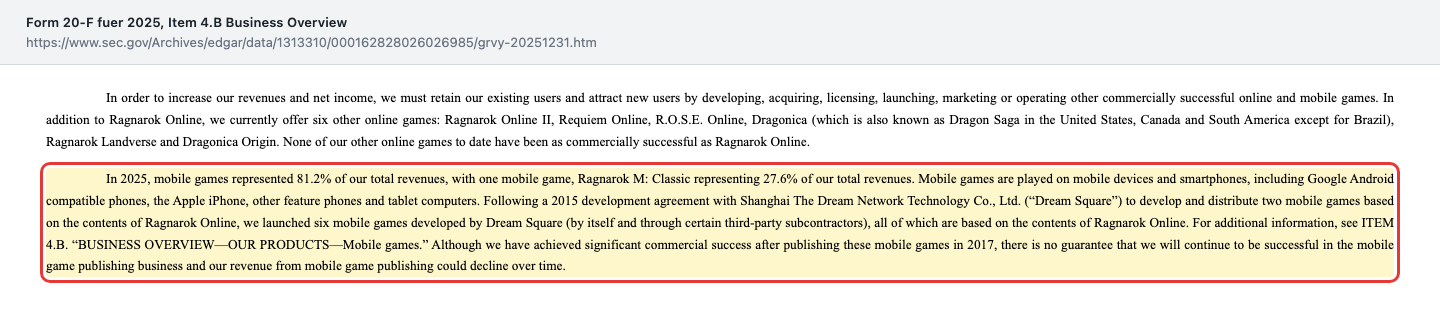
The 20-F annual report for 2025 spells out the single-game dependency without hedging:
"In 2025, mobile games represented 81.2% of our total revenues, with one mobile game, Ragnarok M: Classic representing 27.6% of our total revenues."
— Gravity Co., Ltd., SEC annual report 20-F for 2025, Item 4.B Business Overview
The tricky part: this top title changes every year. In 2024, that exact spot did not belong to Ragnarok M: Classic but to Ragnarok Origin — at a striking 42.1 percent of total annual revenue. A year later its share had collapsed to 11.1 percent, because the game had lost its novelty premium while Ragnarok M: Classic, freshly launched in Southeast Asia (February 2025) and Taiwan, Hong Kong and Macau (April 2025), took its place — the same mechanism as the segment growth above, just one floor up, at the level of the whole company. Combined, the four leading mobile titles — Ragnarok M: Classic (27.6 percent), Ragnarok X: Next Generation (13.4 percent), Ragnarok Origin (11.1 percent) and Ragnarok M: Eternal Love (6.9 percent) — made up roughly 59 percent of group revenue in 2025. All four, like every other title in the portfolio, are built on the same IP launched in 2002.
Part of that dependency is additionally concentrated in a single counterparty:
"Overseas license fees and royalty payments generated from our mobile games represented 8.9% of our total revenues in 2025 [...] with 81.7% of our 2025 revenues from mobile game license fees and royalty payments attributable to license arrangements with Nuverse (Hong Kong) Limited."
— Gravity Co., Ltd., SEC annual report 20-F for 2025, Item 3.D Risk Factors

Doing the arithmetic: 8.9 percent of total group revenue in 2025 came from overseas-licensed mobile-game revenue, and 81.7 percent of that — roughly 7.3 percent of total group revenue — went through Nuverse (Hong Kong) Limited, responsible for Ragnarok X: Next Generation in Taiwan, Hong Kong, Macau and Southeast Asia. Per the filing, that license runs an initial two years from the start of commercialization, with automatic one-year extensions after that — a renewal window that recurs every year.
Uncomfortable truth no. 2: the majority shareholder sits in Tokyo — and is simultaneously licensee and competitor
Since April 1, 2008, Japanese game developer GungHo Online Entertainment has held majority control of Gravity. The annual report states the consequence bluntly:
"As GungHo controls 59.3% of our outstanding voting power as of the date hereof, we are a "controlled company" within the meaning of the NASDAQ Stock Market Rules and may rely on exemptions from certain corporate governance requirements."
— Gravity Co., Ltd., SEC annual report 20-F for 2025, Item 3.D Risk Factors

As a "controlled company," Gravity does not need an independent board majority or an independent compensation committee under Nasdaq rules — exemptions the company explicitly relies on, per the filing. On top of that comes a personnel overlap the report also discloses: five of Gravity's directors — including Co-CEO Yoshinori Kitamura and Executive Director Kazuki Morishita, who also chairs GungHo's board — simultaneously hold leadership roles at GungHo. And GungHo is not just a shareholder; since July 2002 it has also been Gravity's licensee for the Japanese market (contract most recently renewed in September 2025) — and, at the same time, an independent, competing game developer. In everyday terms: picture a franchisee who is also the majority owner of headquarters and separately runs competing outlets under a different name — the conflicts of interest are plain, disclosed, but real. The annual report names them itself: GungHo "may direct our management toward strategies [...] to the detriment of our other shareholders." Not illegal, fully disclosed — but the opposite of independent shareholder democracy.
Uncomfortable truth no. 3: App Store and Google Play take their cut — which is why revenue grows but profit doesn't
Why did profit fall in 2025 even as revenue rose? Part of the answer sits in the distribution structure of the mobile business, by far the largest revenue driver at 81.2 percent:
"Our mobile games increasingly leverage the global connectivity and distribution of mobile platforms including Apple's App Store [...] and the Google Play Store [...] In 2025, 72.1% of our revenues were generated through third-party mobile platforms."
— Gravity Co., Ltd., SEC annual report 20-F for 2025, Item 3.D Risk Factors
Nearly three-quarters of revenue runs through the App Store and Google Play — and both take a commission on every purchase before anything reaches Gravity at all. The filing itself names this as the reason mobile margins run lower than the classic online-game business. The result: gross margin fell from 38.7 to 35.0 percent in 2025, operating profit dropped 9.4 percent, and net profit fell 20.7 percent — even as revenue rose 11.9 percent (chart above). In everyday terms: a market stall forced to sell only through an expensive middleman books more revenue on paper but keeps less of it. Remember the pattern: rising revenue and falling profit are not a contradiction at Gravity — they are the same story, told from two sides.
Uncomfortable truth no. 4: the first dividend in company history — three months after the denial
The annual report filed April 24, 2026 is unambiguous on this point:
"Since our inception, we have not declared or paid any dividends on our common shares. [...] We have no intention to pay dividends in the near future."
— Gravity Co., Ltd., SEC annual report 20-F for 2025, Item 8.A Dividend Policy
Less than four months later, on August 7, 2026, the same board did the opposite:
"GRAVITY Co., Ltd. [...] resolved to pay the interim cash dividend for the fiscal year 2026 on August 7, 2026 at the Board of Directors meeting."
— Gravity Co., Ltd., SEC filing 6-K dated August 7, 2026, Resolution on Cash Dividend Payment
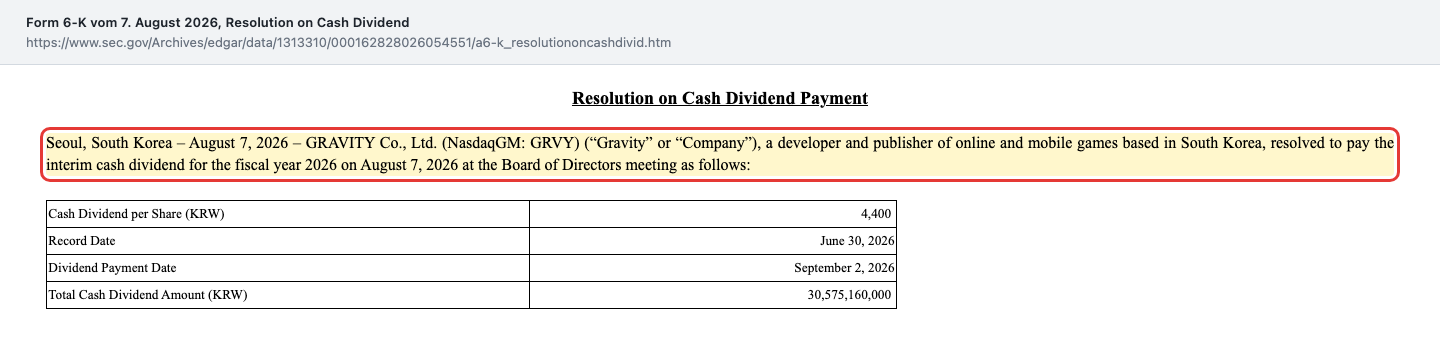
KRW 4,400 per share, record date June 30, 2026, payment date September 2, 2026, total amount KRW 30,575,160,000 — converted at that day's dollar rate (KRW 1,409.94 per dollar) roughly $21.7 million; measured against the KRW 67.5 billion in 2025 profit attributable to the parent company\'s shareholders, that is a payout ratio of roughly 45.3 percent. Not illegal, not unusual — capital returns are often decided quickly when the cash is available (KRW 203.6 billion, essentially debt-free). But the reversal shows how little a "no intention" clause in an annual report actually promises. Whether the interim dividend becomes a lasting policy will only be clear from the next resolution.
Valuation: cheap on paper — but cheap for what?
At first glance, Gravity looks inexpensive: a price-to-earnings ratio of roughly 8.1 (trailing four quarters — on a full-year 2025 basis it would be roughly 10), a price-to-sales ratio of roughly 1.3, a price-to-book ratio of roughly 1.0 (as of August 21, 2026 — the last trading day before this analysis went to press; the price box above carries the date of the last master-data import and may show a different date) — metrics that make many value investors sit up. Market capitalization sits around $0.5 billion, backed by 6,948,900 shares outstanding (as of April 24, 2026, the most recent document naming a share count) and equity of roughly $452 million — the stock trades close to book value, not at a growth premium. But a low P/E is not a free pass, it is a question: cheap for what? For a business whose largest revenue driver has to reinvent itself every year (see truth no. 1), whose margin is structurally handed to outside platforms (truth no. 3), and whose control sits with a shareholder who is simultaneously a competitor (truth no. 2), a P/E of 8 is not a bargain in the classic sense — it is the price the market demands for exactly these uncertainties. The "professionals' view": for such a small, thinly traded foreign listing, no reliable, publicly accessible analyst coverage with price targets exists — one more reason to rely on the primary filings rather than consensus estimates.
Opportunities and risks at a glance
What speaks for Gravity:
- Profitable, essentially debt-free business with an equity ratio of 85.8 percent and KRW 203.6 billion in cash (as of December 31, 2025).
- 24 years of evidence that the Ragnarok IP can keep extending into new markets internationally — most recently Latin America, Thailand, Southeast Asia, Taiwan, Hong Kong and Macau.
- First-ever dividend in company history (KRW 4,400 per share, approved August 7, 2026; yield roughly 4.4 percent, calculated using the August 7, 2026 exchange rate and the $71.20 share price as of August 21, 2026) as a shareholder-friendly signal — if it repeats.
- Valuation near book value (P/B roughly 1.0) and a P/E of roughly 8.1, historically cheap for a consistently profitable business.
- Small, manageable cost base: roughly 1,000 employees group-wide (499 parent, 546 subsidiaries incl. 44 seconded), no bloated corporate overhead.
What speaks against it:
- Total dependency on a single, 24-year-old IP with no proven second hit — the largest single title changes annually (Ragnarok Origin 42.1 percent in 2024 → 11.1 percent in 2025, replaced by Ragnarok M: Classic at 27.6 percent).
- Majority shareholder GungHo (59.3 percent of the vote) is simultaneously licensee and independent competitor; "controlled company" status weakens shareholder protection, and five directors sit on both sides of the table.
- Falling earnings quality: net profit −20.7 percent despite the revenue gain, because 72.1 percent of revenue runs through commission-charging third-party platforms (App Store, Google Play).
- Single-licensee concentration risk: roughly 7.3 percent of 2025 group revenue hangs on Nuverse (Hong Kong), a contract with an annually recurring renewal window.
- Revenue growth has already turned again — in the most recent quarter (Q2 2026), group revenue shrank 5.2 percent year over year.
A human conclusion
Back to the revenant trap from the start. Its core is not that a comeback is inherently bad — Gravity has built, with Ragnarok Online, a brand that keeps conquering new countries after 24 years, carries a spotless balance sheet, and just returned cash to shareholders for the first time. Its core is that "inflection" on a scanner does not automatically mean "new beginning." Whoever reads the numbers through to the end is really buying three very concrete things: a business whose top revenue driver reinvents itself every year or two, without a proven second, independent pillar ever emerging; a margin structurally handed to the App Store, Google Play and a single licensee in Hong Kong; and a majority shareholder in Tokyo who discusses its own conflict of interest openly in the filings yet still holds voting control. That can be perfectly fine for you — if you trust this pattern for the years ahead and understand that the next "new" growth driver will probably be named Ragnarok again. So the honest question for you is not "is something new accelerating here?" but: would you invest in a company that has resold its one product in a loop for 24 years — controlled by a shareholder that is also an independent competitor? If yes, you have a thesis. If no, you had a scanner row. What you make of it is your decision. And that is exactly as it should be.
Sources
All original documents used in this analysis — to read for yourself:
- Gravity Co., Ltd. — SEC annual report 20-F for fiscal year 2025 (filed April 24, 2026)
- Gravity Co., Ltd. — SEC filing 6-K, second quarter 2026 results (filed August 7, 2026)
- Gravity Co., Ltd. — SEC filing 6-K, Resolution on Cash Dividend Payment (filed August 7, 2026)
- Gravity Co., Ltd. — SEC filing 6-K, first quarter 2026 results (filed May 8, 2026)
- Gravity Co., Ltd. — SEC filing 6-K, preliminary fourth quarter/fiscal year 2025 results (filed February 13, 2026)
- Gravity Co., Ltd. — SEC filing 6-K, third quarter 2025 results (filed November 7, 2025)
- Gravity Co., Ltd. — SEC filing 6-K, second quarter 2025 results (filed August 8, 2025)
- Gravity Co., Ltd. — SEC filing 6-K, first quarter 2025 results (filed May 9, 2025)
- Full SEC filing history of Gravity Co., Ltd. (CIK 0001313310): EDGAR overview (sec.gov)
- Fundamental data (metrics, scanner row; data as of August 23, 2026) and price data (valuation metrics; data as of August 21, 2026, last trading day before this analysis went to press), reconciled with the SEC filings.
- Hook: in-house stock scanner "Revenue Inflection," rank 4 of 33 hits, last computed August 23, 2026 (after a correction to the scanner's currency conversion made later the same day (August 23, 2026): rank 19 of 28); see also the Revenue Inflection backtest study.
- USD/KRW exchange rate for August 7, 2026 (KRW 1,409.94 per dollar): Federal Reserve Board, H.10 Foreign Exchange Rates.
Transparency & disclaimer: This analysis is a journalistic contextualization of publicly available information and is not investment advice, not a financial analysis in the regulatory sense, and not a solicitation to buy or sell securities. Stock investments carry substantial risks up to total loss. All information without warranty; the data cut-off is noted in the text. Positions held by the operator are disclosed daily; where one exists, it appears as a notice at the top of this deep dive.
Key figures at a glance
All monetary figures in millions of ₩; earnings per share as reported.
| Metric | 2021 | 2022 | 2023 | 2024 | 2025 |
|---|---|---|---|---|---|
| Revenue | 413,938.0 | 463,618.0 | 725,516.0 | 500,845.0 | 560,548.0 |
| Operating Income (EBIT) | 96,719.0 | 104,708.0 | 160,367.0 | 85,384.0 | 79,782.0 |
| Net Income | 65,947.0 | 83,162.0 | 132,019.0 | 84,919.0 | 67,464.0 |
| Net Margin | 15.9% | 17.9% | 18.2% | 17.0% | 12.0% |
| Earnings Per Share | 9,490.14 ₩ | 11,967.48 ₩ | 18,998.27 ₩ | 12,220.32 ₩ | 9,708.45 ₩ |
Source: fundamental data & SEC filings (annual and quarterly reports, 10-K/10-Q)
Our Bottom Line at a Glance
- Balance sheet & substance positive
- Equity ratio 85.8 percent, KRW 203.6 billion in cash, essentially no financial debt (as of December 31, 2025). Unusually solid for a company this size.
- Revenue growth neutral
- Group revenue grew a real 11.9 percent in 2025, with some quarters topping 30 percent — but the growth comes from extending the same 24-year-old IP into new countries, not from new products, and already turned negative again in the most recent quarter (Q2 2026: −5.2 percent).
- Earnings quality negative
- Despite the revenue gain, net profit fell 20.7 percent in 2025, because 72.1 percent of revenue runs through commission-charging third-party platforms (App Store, Google Play), which pushed gross margin from 38.7 to 35.0 percent.
- IP concentration negative
- Essentially 100 percent of revenue depends on the Ragnarok Online brand launched in 2002. The largest single title changes annually (Ragnarok Origin 42.1 percent in 2024 → 11.1 percent in 2025); no proven second pillar exists.
- Governance & control negative
- Majority shareholder GungHo Online Entertainment (59.3 percent of the vote, as of April 24, 2026) is simultaneously licensee and independent competitor; five directors sit on both sides. "Controlled company" status on Nasdaq further weakens shareholder protection.
- Capital return neutral
- The first dividend in company history, approved August 7, 2026 (KRW 4,400 per share), is a real, positive signal — but arrived just 3.5 months after a "no intention" clause in the annual report. Whether it becomes a lasting policy is unresolved.
Gravity shows how deceptive a scanner \"inflection\" signal can be: a 24-year-old IP that extends into a new country year after year and looks like fresh growth in reality only grew revenue in 2025 (up 11.9 percent), not profit (down 20.7 percent) — in the most recent quarter (Q2 2026) even revenue turned negative again, the majority shareholder is simultaneously licensee and competitor, and whether the first-ever dividend becomes lasting policy remains open; not investment advice.
What Our Rating Means
Open questions
The business works in principle, but one material question is open. As long as it stays open, our findings do not carry a quality verdict.
The balance sheet is genuinely healthy and the company consistently profitable — that speaks for substance. But three operational questions remain open: whether Gravity ever builds a second pillar independent of Ragnarok Online; whether the margin recovers from its App-Store and licensee dependence; and whether the first-ever dividend becomes a policy or stays a one-off. Whoever invests is relying on a majority shareholder that is officially also a competitor. None of these questions is a substance risk in the sense of insolvency — but each of them decides whether the scanner row turns into more than a one-time snapshot. The decision is yours.
A journalistic assessment by our editorial team at the time of the deep dive, based on public sources — not investment advice and not a solicitation to buy or sell. Your personal circumstances (investment goals, risk capacity, taxes) cannot be taken into account. What our levels mean, how verdicts are formed, and what conflicts of interest exist →
Worth Noting
- Gravity landed on the research list through our in-house scanner "Revenue Inflection" (rank 4 of 33, as of August 23, 2026; after a correction to the scanner's currency conversion made later the same day (August 23, 2026): rank 19 of 28). The scanner's column header "$M" showed the raw won value mislabeled as dollars on August 23, 2026 — the KRW 541,884.6 revenue base at the time was in millions of won, not millions of dollars; that error was fixed later the same day (August 23, 2026), and the scanner has since shown 391.3 $M for this stock.
- No public earnings conference calls or transcripts were found for Gravity (research covered the IR site, SEC filings and third-party sources, as of August 23, 2026) — quarterly results are released only through written 6-K filings.
- All valuation and price figures are evergreen and dated; a daily price is not a buy argument. Not to be confused: Gravity Co., Ltd. (GRVY, Seoul) is not the same company as other firms sharing the name in other industries.
Stock Watch
This analysis is as of August 26, 2026. Stock Watch will tell you what's changed at GRVY since then.
Later $1 a month per stock — signing up is free, and you'll be the first to know when it launches.
The full analysis as a PDF for later
We will send you this analysis as a PDF — to print, file away, and read at your own pace. And we will add you to the free Stock Watch list for Gravity Co Ltd (GRVY), so you hear about it when something material in this analysis changes.
Frequently Asked Questions
Gravity Co., Ltd. (Nasdaq: GRVY) of Seoul develops and publishes online and mobile games. Nearly the entire business — 81.2 percent from mobile games in 2025 — rests on the Ragnarok Online franchise launched in 2002 and its spin-offs, including Ragnarok M: Classic, Ragnarok X: Next Generation and Ragnarok Origin. Japanese game developer GungHo Online Entertainment has held majority control since 2008.
Only partly. Group revenue rose 11.9 percent in 2025, with some quarters topping 30 percent — but most of that growth comes from extending Ragnarok titles into new countries, not from new products. The former top title, Ragnarok Origin, collapsed from 42.1 percent of revenue (2024) to 11.1 percent (2025), and in the most recent quarter (Q2 2026) total revenue already shrank 5.2 percent again.
72.1 percent of 2025 revenue ran through the App Store and Google Play, whose commissions compress the margin. Gross margin fell from 38.7 to 35.0 percent, operating profit dropped 9.4 percent to KRW 77.4 billion, and net profit fell 20.7 percent to KRW 67.3 billion — despite an 11.9 percent revenue gain.
Japanese game developer GungHo Online Entertainment has held majority control since April 1, 2008 (59.3 percent of the voting interest as of April 24, 2026). GungHo is simultaneously Gravity's licensee for Japan and an independent competitor; five of Gravity's directors also hold positions at GungHo. Nasdaq officially classifies Gravity as a "controlled company" with relaxed governance duties.
Unclear. On August 7, 2026 the board approved the first dividend in company history (KRW 4,400 per share, roughly $21.7 million total) — just 3.5 months after the annual report stated the company had "no intention" to pay dividends. Whether a second dividend follows cannot be read from the filings so far.
Ragnarok Online is an online role-playing game Gravity launched in August 2002 — one of the first commercially successful South Korean online games internationally. Per the annual report, "none" of the company's six other online games "have been as commercially successful as Ragnarok Online." Essentially all of today's revenue traces back to Ragnarok Online and its mobile spin-offs.
Based on our research (investor relations site gravity.co.kr, all SEC filings 6-K/20-F, third-party search, as of August 23, 2026), Gravity does not hold public earnings conference calls and does not publish transcripts. Quarterly results are released only as a written press release inside the 6-K filing.
In 2025, 72.1 percent of group revenue ran through third-party platforms such as Apple's App Store and Google Play. Both take a commission on every purchase and can change their terms unilaterally — a risk the annual report itself names as a potential trigger for reduced visibility, restricted distribution or lower revenue.
Found an error?
Did you spot a factual error, an outdated number, or a typo in this deep dive? Let us know briefly — your report goes straight to the editorial team.