Gorilla Technology Stock: An AI Label — and 77 Percent of Revenue From One Government Invoice
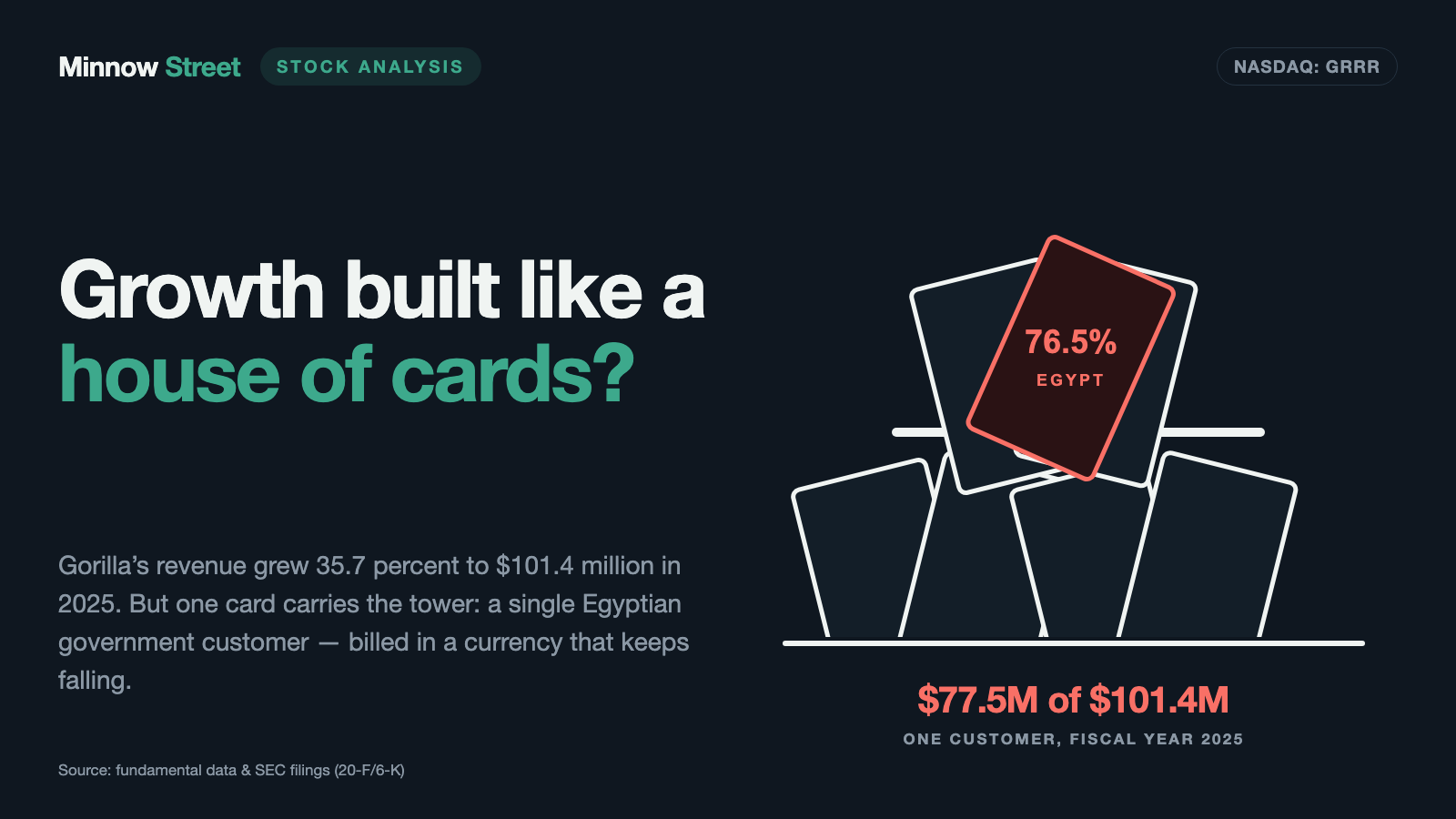
Gorilla Technology sells Edge AI, video analytics and smart-city systems, and its revenue grew 35.7 percent to $101.4 million in fiscal year 2025. We read the annual report (20-F) the company filed with the SEC — and the growth has one address: $77.5 million of it came from a single Egyptian government customer, billed in a currency that lost 11.5 percent against the dollar in one year. Gross margin has more than halved since 2023, operating cash flow was negative three years running, invoiced and unbilled work exceeded a full year of revenue at year-end 2025, and since June 2026 the balance sheet carries $232.0 million of convertible notes. Not investment advice — just a careful look at what happens when growth is a promise and the cash keeps saying maybe.
 Thomas Mücke
Founder & Publisher
Thomas Mücke
Founder & Publisher
As of Today
As of: September 17, 2026
- Closing price
- 13.00 $ +2.10%
- Market Capitalisation
- 0.4 $B
- Growth Score
- 3/10
- AAQS
- 5/10
Price change since August 4, 2026: +11.1%
This analysis has a cut-off date. The Stock Guard tells you when something material changes in the numbers. Reserve your free spot
Chart
Interactive price chart (TradingView).
52-week range: 9.50 $ to 21.80 $ · Last price: 13.00 $ (As of: September 17, 2026)
Note: pure fact-based analysis, not investment advice and not a solicitation to buy or sell. All figures without guarantee.
Anyone who has ever sent an invoice knows the small, treacherous moment of joy. The work is done, the number is on the page, and for a heartbeat it feels like money. It is not. It is a promise — and the distance between the two is measured in weeks, sometimes in lawyers, occasionally in nothing at all. Freelancers learn this the hard way. Investors forget it every time they read the word revenue, because in a press release revenue looks exactly like money: same currency sign, same confident digits. Psychologists would file this under the general human habit of trusting the label over the contents. Let us call it the invoice illusion. Hardly any stock in the summer of 2026 is a better classroom for it than Gorilla Technology Group (Nasdaq: GRRR): a company that sells Edge AI, video analytics and smart-city systems, that grew revenue 35.7 percent to $101.4 million in fiscal year 2025 — and that has not produced a full year of positive operating cash flow in three.
So let us make a deal: we drop the AI adjectives and read together what Gorilla itself reported to the U.S. securities regulator, the SEC — honest under penalty of law. And because Gorilla is registered as a foreign private issuer — a Cayman Islands company headquartered in London — the documents here are not called 10-K and 10-Q but 20-F (the annual report for foreign private issuers, filed for 2025 on April 15, 2026) and 6-K (interim reports): same penalty of law, different forms, looser rhythm — quarterly figures arrive as voluntary attachments, not as audited obligations. At the end you get the findings, not a verdict on your behalf.
What Gorilla actually does — the AI label, and the network behind it
Gorilla describes itself in language that leaves no doubt about which decade it wants to belong to. From the annual report: the company delivers "AI-driven solutions that power Smart Cities, Enterprises, Government, Manufacturing, Telecommunications, Retail, Transportation, Logistics, Healthcare, and Education", and its "Edge AI-driven solutions process data directly at the network's edge". Edge AI, translated into everyday terms: instead of shipping every camera image to a distant data center to be analysed, the analysis happens in a box next to the camera — faster, cheaper on bandwidth, and the sensitive footage never leaves the building. Gorilla has been at this since 2001, starting in video analytics in Taiwan and moving through licence-plate recognition, facial recognition and cybersecurity. The word "AI" appears more than 300 times in the annual report. That is the label. Now the contents.
Gorilla reports in two segments, and the split is not close. Security Convergence — building and securing networks for governments — produced $97.8 million of the $101.4 million in fiscal year 2025: 96.5 percent. Video IoT, the AI-video-analytics business the company's story is built on, contributed $3.5 million: 3.5 percent. And almost all of the Security Convergence money traces back to one document, signed on June 26, 2023:

The Egypt Contract is a firm-fixed-price contract with the Government of the Arab Republic of Egypt to build a "secure governmental air-gapped network" — a network deliberately kept physically separated from the public internet, the way a bank vault is kept separate from the lobby. Gorilla buys much of the hardware and software from approved third-party vendors, integrates and installs it, and guarantees it for twelve months. Its own performance is secured by a bank guarantee of about 4 percent of the contract price, roughly EGP 309 million. Disputes go to arbitration, and — a sentence worth reading slowly — "The Egypt Contract is governed by Egyptian law."
Which brings us to the central tension of this analysis, and it runs through every chapter that follows: Gorilla is priced and discussed as an AI company, but it earns its money as a systems integrator for one government customer — in a currency that keeps falling, on invoices that keep not being paid. That is not an accusation; every part of it comes from the company's own filing. It is simply a different business than the label suggests. Companies whose story and whose numbers live in different countries are a recurring subject here — we took apart a similar gap at the SPAC-listed Lotus Technology, where a legendary badge outshone the balance sheet.
How the ticker landed on our desk
Honesty first: this stock did not reach us through a quality or momentum filter. It came through our Reddit hype scanner, which evaluates daily which micro and small caps are suddenly the talk of the U.S. stock forums (data basis: ApeWisdom). On July 16, 2026 it counted 6 mentions within 24 hours — barely a murmur, and exactly the register in which forums like to pass around "the AI small cap nobody has noticed yet".
Gorilla Technology has had its own row in our company universe only since July 27, 2026 — it was created with this analysis. The scanner has since run the numbers, and the first reading is sobering (data as of July 27, 2026, priced off the July 24, 2026 close): a fundamental grade of C on a rating of plus 1 on our scale — mid-table, neither a distinction nor a warning. A Piotroski score of 3 out of 9: that test checks nine features of the books for whether they are improving or deteriorating; fundamentally healthy companies sit at 8 or 9, and at 3 more features point down than up. And an Altman Z-score of 3.03: we use the book-value variant, Z″, whose distress line historically sits at 1.1 and whose safe zone begins at 2.6. That places Gorilla in safe territory — but with a narrow margin, at a company whose story about AI data centers sounds like a great deal more cushion than that.
Three rankings are still missing — relative strength, the Stan Weinstein stage and the EPS rating. Our price history for this stock is simply too short for them; it is one day old. And the only metric screen GRRR hits at all is, of all things, "Below the 50- & 200-SMA": a downtrend list, not a quality list and not a momentum list. Translated, the price sits below both of its long-term moving averages — which fits the price history we are about to put in figures in the valuation chapter. That the stock also turns up on our helper lists "Reddit Hot Stocks" and "Beifang" we do not count as a separate finding: both were created by this very piece of research. All of these lists are recalculated every night and sit in the open in our in-house stock scanner; what stands here is a dated snapshot, not a permanent state. None of it changes the core of the job: a company with one day of data history is not judged on rankings but on its original filings. All the more reason to actually read them. The same applies to the analyst side, as we will see: two analysts is not a consensus, it is a duet.
The numbers over the years — honestly appraised
Start with what genuinely impresses, because it is real. Revenue grew from $64.7 million (2023) via $74.7 million (2024) to $101.4 million (2025) — up 35.7 percent in the latest year and 57 percent in two. For a company with 200 employees (as of December 31, 2025), that is half a million dollars of revenue per head. The balance sheet looks nothing like a distressed one: total assets of $271.9 million against liabilities of $75.8 million, equity of $196.1 million, cash of $99.5 million and total indebtedness of only $13.8 million at year-end 2025. There is no going-concern qualification in this annual report — we looked. Management and the auditors judged disclosure controls effective as of December 31, 2025. Anyone expecting a company on the edge will not find one here.
Now turn the invoice over. The first thing that does not fit is the margin:
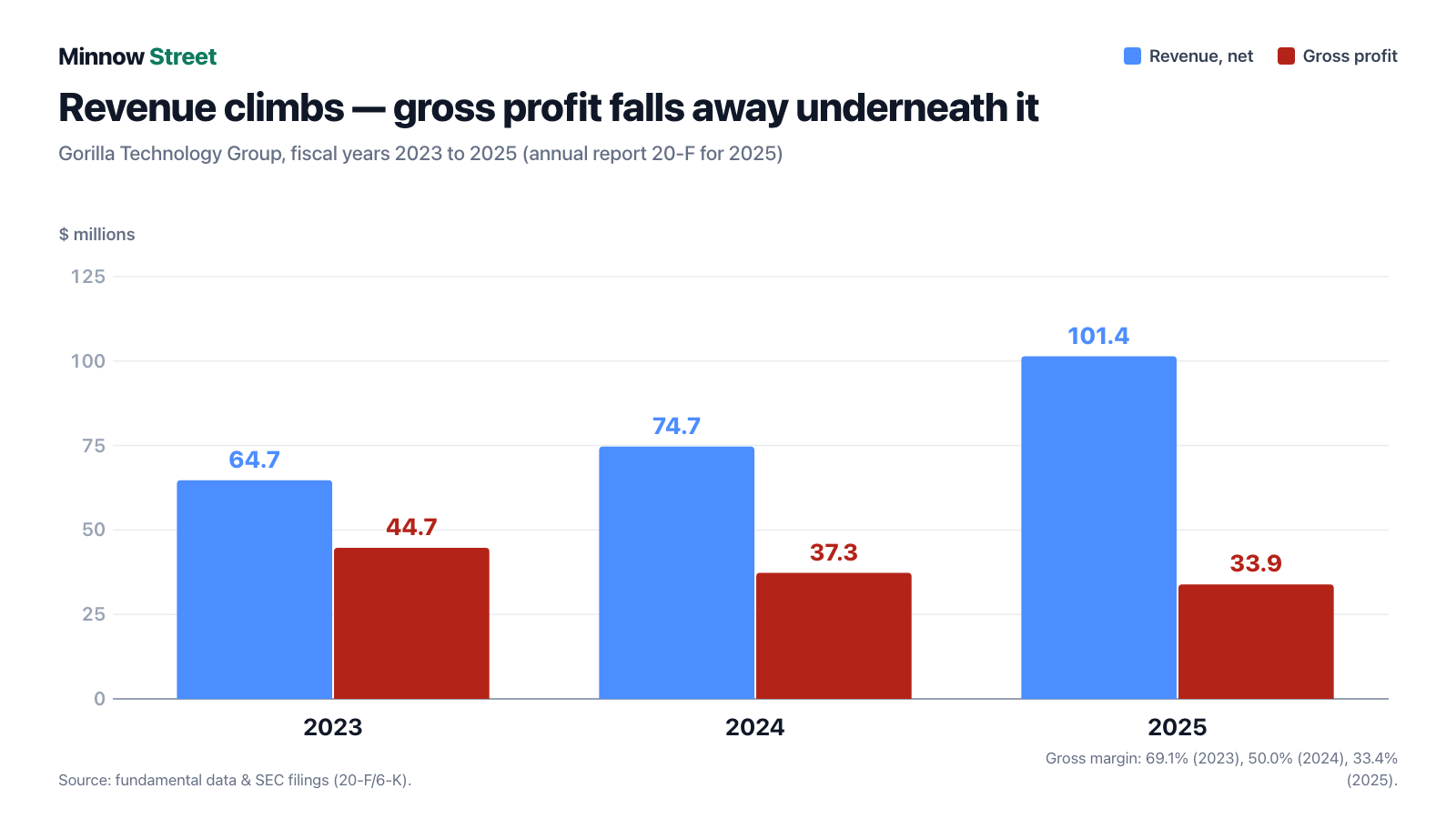
Read those two panels together, because separately each is harmless and together they are the whole company. Gross margin — of every $100 of revenue, what is left after the direct cost of delivering it — fell from 69.1 percent (2023) via 50.0 percent (2024) to 33.4 percent (2025). That is not a rounding drift; it means gross profit in absolute dollars shrank, from $44.7 million to $33.9 million, while revenue rose by more than a third. Gorilla grew by selling something structurally cheaper than what it used to sell. The cost breakdown says what: the two largest expense lines by nature in 2025 were hardware (change in inventory of finished goods, $33.7 million, up from $18.6 million) and outsourcing charges ($29.5 million, up from $14.2 million) — together $63.2 million, against $16.9 million of employee benefit expense and just $3.1 million of research and development. Remember the proportion: Gorilla spends nearly ten times more on buying in hardware and outside labour than on developing its own technology. A software company with 69 percent margins turned into a 33 percent integrator that resells other people's boxes — that is what the growth actually consists of.
The bottom line follows from there. Fiscal year 2023 was profitable: net income of $13.5 million ($1.92 per share). Then came 2024 with a net loss of $64.8 million (minus $6.13 per share) — mostly a non-cash $59.5 million remeasurement of the company's own warrants and preference shares — and 2025 with an operating loss of $13.7 million and a net loss of $11.3 million (minus $0.51 per share). One note on a discrepancy you may meet elsewhere: move the $21.0 million of currency losses below the operating line, as some data services do, and 2025 arithmetically turns into a positive operating result of about $7.4 million. The company's own income statement does not do that: it books foreign currency exchange losses inside operating expenses and prints "Operating income (loss) (13,668,487)". We follow the filing.
What has happened since the annual report
Between the annual report of April 15, 2026 and the end of July, more happened at Gorilla than in many a full fiscal year. Four items are indispensable for an honest reading.
First: the auditor was replaced. On April 30, 2026 — two weeks after the annual report was filed — Gorilla appointed UHY LLP as its independent registered public accounting firm and dismissed Marcum Asia CPAs LLP, effective immediately. Marcum Asia had audited the 2024 and 2025 accounts, serving since January 31, 2024. The disclosure is unremarkable: no adverse opinion, no disagreements on accounting matters, no other reportable events. What matters for a reader is only this: anyone reading about "Gorilla's auditor" has to read the date with it — the 2025 numbers come from Marcum Asia, everything from 2026 comes from UHY.
Second: there are figures for the first quarter of 2026 — as a voluntary attachment to an interim report (6-K) of May 27, 2026, expressly unaudited and unreviewed. They cut both ways. Revenue rose 54.6 percent to $28.2 million. Gross margin fell further, to 21.1 percent (prior-year quarter: 35.1 percent). The operating loss jumped to $41.1 million and the net loss to $37.0 million (minus $1.42 per share). Two line items carry almost all of that:

The good news from the same quarter: operating cash flow turned positive for the first time, to plus $6.6 million after minus $10.7 million a year earlier. How solid that plus is, we examine in truth no. 3. And even the company's preferred adjusted EBITDA slipped in the quarter to minus $8.3 million, after plus $5.2 million a year before.
Third: Gorilla is pivoting into data centers — and funding it with convertible notes. On June 5, 2026 the company placed $107.0 million of 7.50 percent convertible notes due 2031; net proceeds about $102.4 million, explicitly for the equity portion of data center equipment purchases for a second project with Yotta Data Services. On July 17, 2026 a further $125.0 million followed as Series B on the same terms; net proceeds about $120.1 million, this time for advance payments on committed data center capacity and equipment for the "NeutraDC Batam" project in Indonesia. Add the announcements from the quarterly release: a 200-megawatt campus in Korat, Thailand, with a first land instalment paid, and the intention to build toward roughly 500 megawatts of capacity by the end of 2028.
Fourth: guidance was raised. For full-year 2026 Gorilla now expects revenue of $160 million to $200 million — against $101.4 million the year before. That is the number the company will be measured against in its next filings.
Uncomfortable truth no. 1: one customer is 77 percent of the company
Picture a baker whose shop keeps getting busier — and then you learn that three of every four rolls go to a single buyer, who happens to be a foreign government. That is Gorilla, and the annual report states it in the plainest terms available:
"Gorilla derives and expects to continue to derive a significant portion of its revenues from a select group of key clients, including government entities such as the Government of the Arab Republic of Egypt ("GoE"), the Criminal Investigation Bureau of Taiwan, Taoyuan Airport and private companies such as Freyr Technology AI Pte. Ltd. ("Freyr"). Reliance on a concentrated client base poses risks of fluctuations in demand, which may have a material adverse effect on our business, results of operations, financial condition and cash flows."
— Gorilla Technology Group Inc., SEC annual report 20-F for 2025, Item 3.D "Risk Factors"

"A significant portion" is the language of the risk chapter. The segment note puts a number on it, and the number is larger than the phrase suggests:

$77,527,614 of $101,360,657 — 76.5 percent from one customer. And this is not new: the same customer was 79.1 percent of revenue in 2024 ($59.1 million) and 80.8 percent in 2023 ($52.3 million). Meanwhile "Customer C" in Taiwan, worth $11.0 million in 2024, dropped to zero in 2025 — the rest of the business is not growing into the gap, it is shrinking out of it. Two further facts belong beside this. First, the annual report notes that "As of December 31, 2025 and 2024, one customer accounted for more than 10% of total accounts receivable, net" — the concentration is not only in the revenue, it is in the money still owed. Second, and most importantly for anyone modelling the years ahead, the contract has an end. The backlog — what the company calls the transaction price allocated to unsatisfied long-term contracts — fell from $170.9 million to $101.3 million in a single year, a drop of nearly 41 percent, and management expects to recognise the remainder "as revenue from 2026 to 2027". Remember the arithmetic: Gorilla is not building a customer base, it is working one contract down — and roughly a year and a half of it is left.
Uncomfortable truth no. 2: the invoice is written in a falling currency
Now the detail that turns a concentration risk into something more specific. The Egypt Contract is not denominated in dollars. It entitles Gorilla to "approximately EGP 8.4 billion" — Egyptian pounds — over four years. Gorilla reports in U.S. dollars. Everything owed to it in Egyptian pounds therefore has to be retranslated at every balance sheet date, and if the pound has weakened in the meantime, the loss goes straight through the income statement. It did, twice, and heavily:
"Foreign currency exchange losses, net primarily relate to devaluation losses recognized on the remeasurement of monetary assets denominated in the Egyptian pound due to depreciation of the Egyptian pound against the U.S. dollar. The average exchange rate of the U.S. dollar against the Egyptian pound increased from 44.18 during fiscal year 2024 to 49.28 during fiscal year 2025, representing a depreciation of 11.5% against the U.S dollar."
— Gorilla Technology Group Inc., SEC annual report 20-F for 2025, Item 5.A "Operating Results"

The price of that sentence: $21.0 million of foreign currency exchange losses in 2025, after $27.8 million in 2024 — against a 2025 gross profit of $33.9 million. Put plainly, the currency ate roughly six out of every ten dollars of gross profit. And most of it is not yet even realised: the cash flow statement backs out $20.2 million of unrealised exchange losses in 2025 ($22.4 million in 2024), which means the loss sits on receivables and unbilled work that have not been converted into dollars at all. The revenue note says the same thing from another angle: contract assets were reduced "by currency exchange losses primarily due to depreciation of the Egyptian pound against the U.S. dollar". The invoice shrinks while it waits. And it kept shrinking: the first quarter of 2026 alone added $18.9 million of exchange losses.
Here is where it becomes a judgement call about how you are being shown the business. Gorilla reports an adjusted EBITDA of $19.1 million for 2025 and an adjusted net income of $19.9 million ($0.88 adjusted diluted earnings per share) — against an IFRS net loss of $11.3 million and minus $0.51 per share. The single largest bridge between those two worlds is a line item called "Exchange loss from currency devaluation": $25.7 million added back in 2025, and $25.3 million in 2024. Adjusted figures exist for a reason, and excluding volatile currency swings is a defensible convention for many companies. But for this company the currency is not noise around the business — the currency is a structural feature of the only contract that matters, and it has cost more than $48 million across two years. Remember the mechanism: an adjustment that removes your biggest recurring risk does not make it smaller, it only makes it invisible on that particular slide.
Uncomfortable truth no. 3: the revenue is booked, the cash is not
This is where the invoice illusion stops being a metaphor. Every dollar of Gorilla's 2025 revenue was recognised over time — not a cent at a point in time. In everyday terms: the company books revenue as the work progresses, on management's estimate of how far along it is, long before an invoice is issued and much longer before anyone pays. The annual report is candid about the machinery: performance obligations are satisfied first, contract assets are recognised, then invoices are issued at "billing milestones", then the amount becomes an account receivable, and then — one hopes — money arrives. Follow that chain to the balance sheet as of December 31, 2025 and you find $54.1 million of accounts receivable, net plus $57.9 million of unbilled contract assets: $112.0 million in total, more than an entire year of revenue, still uncollected. A year earlier the same two lines were $25.7 million and $34.3 million. (Before the loss allowance, receivables come to $55.1 million.)
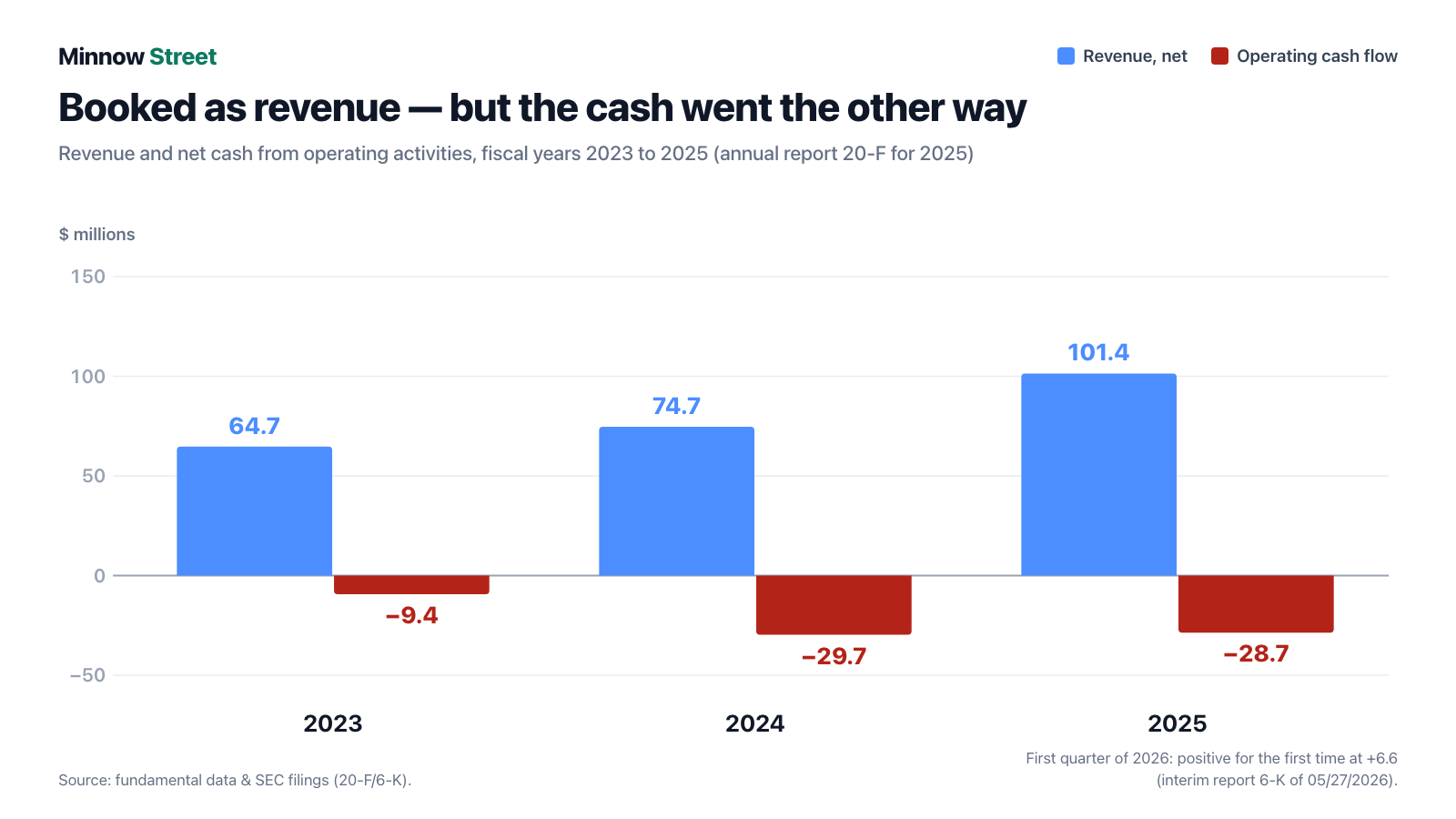
The cash flow statement makes the consequence unambiguous, and so does the company:
"Gorilla has generated negative operating cash flows and has supplemented working capital through proceeds from a registered direct offering completed in July 2025 and the exercise of private warrants during fiscal year 2025."
— Gorilla Technology Group Inc., SEC annual report 20-F for 2025, Item 5.B "Liquidity and Capital Resources"

Net cash used in operating activities: minus $28.7 million (2025), minus $29.7 million (2024), minus $9.4 million (2023) — cumulatively about $67.8 million of cash out the door across three years in which the income statement showed $240.7 million of revenue. The $99.5 million of cash that makes the balance sheet look comfortable did not come from the business: financing activities contributed $101.2 million in 2025 alone.
Fairness requires the other side. The receivables are not obviously rotten: Gorilla's own provision matrix shows $26.5 million of the $55.1 million not past due at all, nothing more than 365 days overdue at year-end 2025, and a total loss allowance of just $0.9 million. That is a real improvement — a year earlier the same table carried $7.4 million in the "over 365 days past due" bucket at a 100 percent expected loss rate, written off in full. It can also be read the other way: the company has already had to write off a government receivable once.
And then came the first quarter of 2026, with a headline claiming the opposite. "Gorilla Technology Converts Growth Into Cash", the company titled its quarterly release, and indeed: plus $6.6 million of operating cash flow after minus $10.7 million a year earlier, with receivables and contract assets down from $112.0 million to $90.1 million. It sounds like a breakthrough. Work through the cash flow statement and it gets quieter: of the $21.9 million decline, only $4.2 million shows up there as an inflow — while $20.1 million of unrealised currency losses is added back. Most of the reduction in receivables is therefore not a payment but a write-down: the Egyptian pound made the outstanding invoices smaller. Fittingly, the cash balance itself edged down in the quarter, from $99.5 million to $98.4 million. Remember the distinction that runs this whole chapter: revenue is an opinion about work performed; cash is a fact about money received.
Uncomfortable truth no. 4: the share count — after a reverse split
If the business does not fund itself, someone else has to, and at Gorilla that someone is the shareholder. The share capital note traces it precisely. Shares outstanding stood at 7,565,099 on January 1, 2024, at 18,058,135 on December 31, 2024, and at 26,188,972 on December 31, 2025 — an increase of 246 percent in two years — and at 27,757,474 on June 1, 2026 per the prospectus supplement. The 2024 jump came from converting preference shares (7,032,012 shares) and exercising warrants (2,218,750); the 2025 jump came overwhelmingly from warrants again (6,019,162 shares) plus 2,529,946 shares sold for cash.
And here is the detail that makes the number worse rather than better: all of those figures are already adjusted for a 10-to-1 share consolidation — a reverse split — that took effect on April 15, 2024. A reverse split exists to reduce the share count. Gorilla did one, and the count still more than tripled afterwards. Dilution in plain words: your slice of the cake gets smaller, and nobody asks you first.
The engine is still running. Between December 31, 2025 and June 1, 2026, 1,823,581 new shares were issued on the vesting and settlement of restricted stock units alone, plus 2,650 on option exercises, against 257,729 shares repurchased. What those awards cost shows up in the interim report: $20.9 million of stock-based compensation in a single quarter, after $216 in the prior-year quarter and $4.8 million in all of fiscal year 2025. A further tranche vested on July 13, 2026; five insider filings (Form 4) dated July 15, 2026 show 119,178 shares for chief executive Jayesh Chandan and roughly 11,000 to 14,300 each for four directors — no sales, only grants.
Uncomfortable truth no. 5: $232 million with a built-in slide
In the summer of 2026 Gorilla raised money twice, in a form that deserves particular attention from shareholders. On June 5, 2026 it placed $107.0 million of 7.50 percent convertible notes maturing on June 15, 2031. On July 17, 2026 a further $125.0 million followed as Series B, on the same terms. Together that is $232.0 million — and roughly $17.4 million of interest a year on a business whose 2025 gross profit was $33.9 million.
A convertible note is a loan with a swap option built in: the holder can exchange it for shares if that suits better than cash. The conversion price starts at about $25.4826 per share — at the time of the second placement a 52 percent premium to the closing price of $16.77 on July 14, 2026. At that price both notes together would create roughly 9.1 million new shares, about a third of the current count. That is the friendly version. The unfriendly one sits right next to it:
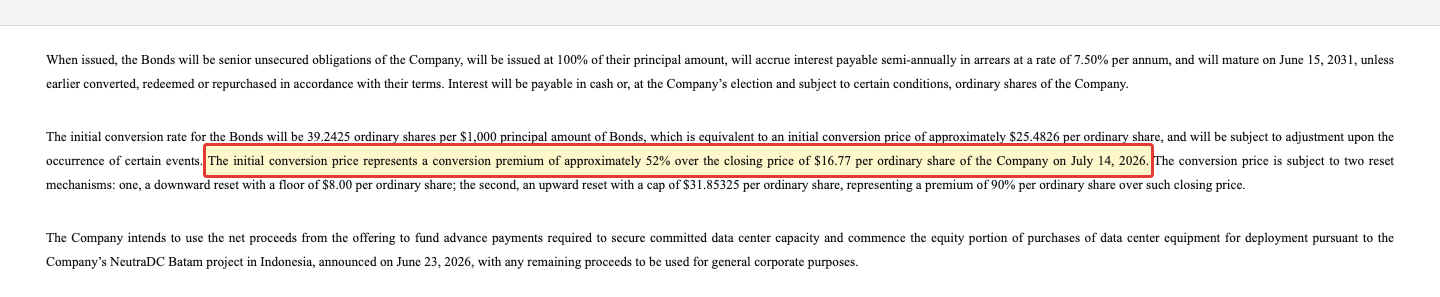
Both notes carry an automatic downward reset: on set dates — the first is March 15, 2027 — the conversion price is lowered if the share price sits below it. For the June notes that slide runs down to $6.00, for the Series B to $8.00. Do the unfavourable arithmetic: $107.0 million at $6.00 is 17.8 million shares, $125.0 million at $8.00 is 15.6 million — together roughly 33.5 million new shares against 27.76 million today. The company would have more than doubled without a single existing shareholder being asked. Authorised share capital stands at 73.5 million shares; the room just about covers it.
That is one side. The other: those $232 million are a genuine liquidity cushion, and they are earmarked. The proceeds fund data center capacity in Southeast Asia — specifically the equity portion of equipment for a second project with Yotta Data Services and advance payments for the "NeutraDC Batam" project in Indonesia. Look at the balance sheet today and you see roughly $321 million of liquidity ($98.4 million at March 31, 2026 plus $102.4 million and $120.1 million of net proceeds) — against $13.2 million of bank debt plus the $232.0 million of convertible notes. Remember the pattern: almost every dollar on this balance sheet that looks like strength was bought with a piece of the company. The mechanics of financing a story faster than the business earns it are something we walked through in detail at iQIYI, another foreign private issuer whose filings tell a plainer tale than its ticker.
What the stock costs
A single market value would be a snapshot with a short shelf life here, so we work with a range — and exclusively with prices documented in SEC filings. As of June 1, 2026 there were 27,757,474 ordinary shares outstanding (prospectus supplement). On June 2, 2026 the closing price recorded there was $21.78; on July 14, 2026 the Series B press release cites $16.77. That puts the market value between roughly $605 million and $466 million — the stock lost a good quarter of its value in those six weeks.
And it has fallen further. The most recent closing price available to us is dated July 24, 2026 at $12.01; on the same 27,757,474 shares that is a market value of about $333 million — another good quarter below the July 14 anchor. That figure is a price data cut-off from our own price database, not a number documented in an SEC filing, which is why every multiple below is still calculated on the documented range. The GRRR stock page accordingly shows the smaller, more current value — not a contradiction, but the same slide in the share price, measured a month later.
Against fiscal year 2025 revenue of $101.4 million that is a price-to-sales ratio of 4.6 to 6.0. Measured against the company's own 2026 guidance of $160 million to $200 million, the multiple falls to 2.3 to 3.8 — provided the guidance is met. An honest price-to-earnings ratio does not exist: 2025 was a loss year under IFRS. You will nevertheless see a strikingly low forward multiple quoted for this stock, built on an estimate of about $1.61 of earnings per share for the current year. Treat that number with the care it deserves — it descends from the adjusted earnings line, the one that adds back the currency devaluation losses discussed in truth no. 2. On the company's own reported basis, 2025 delivered minus $0.51 per share and the first quarter of 2026 minus $1.42. A single-digit price-to-earnings ratio that only exists after you remove the company's largest recurring cost is not a valuation, it is a hypothesis.
The professionals' view is thin enough that "consensus" overstates it: two analysts cover the stock, both rate it a strong buy, and the average price target is $39.50 (data as of July 26, 2026). Two strong buys and no other opinion is not a second opinion; it is an echo. Note also what the market value already embeds: a large share of the enterprise is cash the company raised from investors or borrowed, not value it earned. The honest way to frame the bet: you are paying a mid single-digit multiple of revenue for a company whose current revenue engine has roughly a year and a half of backlog left, and whose replacement engine — data centers in Southeast Asia — so far appears in the numbers mainly as an outlay. The predecessor of that story is instructive: the $1.4 billion Freyr framework produced, in the words of the annual report, "No revenue [...] in fiscal year 2025".

Opportunities and risks at a glance
What speaks for Gorilla Technology:
- Real growth and real delivery: revenue up 35.7 percent to $101.4 million in fiscal year 2025, up 57 percent in two years, and up a further 54.6 percent to $28.2 million in the first quarter of 2026 — the Egypt network is being built, invoiced and partly collected, not merely announced.
- A solid-looking balance sheet: total assets of $271.9 million against liabilities of $75.8 million, equity of $196.1 million, $99.5 million of cash and only $13.8 million of total indebtedness at year-end 2025 — no going-concern qualification, no reported material weakness, disclosure controls judged effective.
- Liquidity has been extended substantially: $232.0 million of convertible notes raised in June and July 2026 for combined net proceeds of about $222.5 million — enough runway to bridge several years of the historical cash burn.
- Collections improved: the loss allowance on receivables fell to $0.9 million (2025) from $7.5 million (2024), with nothing more than 365 days past due at year-end, and operating cash flow turned positive for the first time in the first quarter of 2026 (plus $6.6 million).
- Optionality on a much larger stage: the three-year, $1.4 billion Freyr framework, a second project with Yotta Data Services, the "NeutraDC Batam" data center in Indonesia and a 200-megawatt campus in Korat, Thailand — plus a genuine 25-year track record in video analytics. The company's own 2026 revenue guidance is $160 million to $200 million.
What speaks against it:
- Extreme customer concentration: $77.5 million of $101.4 million — 76.5 percent — from a single Egyptian government customer (79.1 percent in 2024, 80.8 percent in 2023), while the second-largest customer fell from $11.0 million to zero; and the backlog behind it dropped 41 percent, from $170.9 million to $101.3 million, with the remainder due to be recognised by 2027.
- Currency risk that has already materialised: the contract is denominated in Egyptian pounds; foreign currency exchange losses of $21.0 million (2025) and $27.8 million (2024) against a 2025 gross profit of $33.9 million, plus $18.9 million in the first quarter of 2026 alone — most of it still unrealised, sitting on receivables and unbilled work.
- Three straight years without positive operating cash flow: minus $28.7 million, minus $29.7 million, minus $9.4 million; $112.0 million of receivables plus unbilled contract assets as of December 31, 2025 — more than a full year of revenue. The plus $6.6 million of the first quarter of 2026 rests largely on non-cash add-backs, and the cash balance fell in the same quarter from $99.5 million to $98.4 million.
- Heavy and continuing dilution: shares outstanding from 7,565,099 to 27,757,474 in just over two years — after a 10-to-1 reverse split — plus $20.9 million of stock-based compensation in a single quarter and $232.0 million of notes whose conversion price can reset down to $6.00 and $8.00 respectively. In the unfavourable case that is roughly 33.5 million new shares.
- The label outruns the business: the AI-video-analytics segment (Video IoT) is $3.5 million of $101.4 million — 3.5 percent — while gross margin fell from 69.1 to 33.4 percent and on to 21.1 percent in the first quarter of 2026; hardware and outsourcing cost $63.2 million against $3.1 million of research and development. Coverage is two analysts, the auditor was replaced effective April 30, 2026, and as an emerging growth company Gorilla is exempt from the auditor attestation of its internal controls.
A human conclusion
Back to the invoice on the desk. Finding one: the work is real. Gorilla genuinely builds a secure government network in Egypt, genuinely bills it, and genuinely booked $101.4 million of revenue for it — this is not a shell with a slide deck, and the balance sheet carries $196.1 million of equity and no going-concern doubt. Finding two: the invoice is not the money. Three years of negative operating cash flow, $112.0 million of receivables and unbilled work exceeding a full year of revenue at year-end, and $48.8 million of currency losses across two years on a contract denominated in a falling pound — the gap between what was earned and what arrived is the company's defining feature, not a footnote to it. Even the first positive quarter is mostly the pound shrinking the invoices rather than the customer paying them.
Finding three: the gap was funded by you. The share count more than tripled after a reverse split, and the cash cushion everyone points to is the proceeds of that dilution plus $232.0 million of convertible debt with a built-in downward slide. Finding four: the label and the ledger point in different directions. The AI story is the reason this ticker gets discussed; AI video analytics is 3.5 percent of the revenue. And since June 2026 a second story has joined it — data centers in Southeast Asia — which so far exists in the numbers as an outlay, not as income.
None of this is hidden. Gorilla discloses the customer, the currency, the cash flow and the dilution — in a 20-F, under penalty of law, with a table that names the Egyptian customer and the exact dollar figure. That is worth saying plainly, because a company that publishes its own uncomfortable numbers is doing the thing we ask companies to do. The question the filing cannot answer for you is the one the invoice illusion always poses: are you buying the number on the page, or the money behind it? If Egypt pays on time and the pound steadies and the data center frameworks turn into contracts, the current price will look like the bargain two analysts think it is. If any one of those three gives way — the customer, the currency, or the successor contract — there is no fifth of the business to cushion it, because there is no fifth. There is one card carrying the tower. What you make of that is your decision. And that is exactly as it should be.
Sources
All original documents used in this analysis — to read for yourself:
- Gorilla Technology Group Inc. — SEC annual report 20-F for fiscal year 2025 (filed April 15, 2026)
- Gorilla Technology Group Inc. — SEC annual report 20-F for fiscal year 2024 (filed April 30, 2025)
- Gorilla Technology Group Inc. — SEC interim report 6-K of May 27, 2026 (first-quarter 2026 figures, unaudited)
- Gorilla Technology Group Inc. — SEC interim report 6-K of May 6, 2026 (change of auditor effective April 30, 2026)
- Gorilla Technology Group Inc. — SEC prospectus supplement 424B5 of June 5, 2026 ($107.0 million 7.50% convertible notes due 2031)
- Gorilla Technology Group Inc. — SEC interim report 6-K of July 17, 2026 ($125.0 million Series B convertible notes, with the press release of July 15, 2026)
- Gorilla Technology Group Inc.'s complete SEC filing history: EDGAR overview (sec.gov), including the five insider filings (Form 4) of July 15, 2026
- Fundamental data (metrics, annual series, valuation, analyst coverage; data as of July 26, 2026), reconciled with the SEC filings.
- Reddit mentions: in-house Reddit hype scanner based on ApeWisdom data (6 mentions in 24 hours, as of July 16, 2026).
- Own metrics from our in-house stock scanner (data as of July 27, 2026, priced off the July 24, 2026 close): fundamental grade C on a rating of 51 out of 100, Piotroski 3 of 9, Altman Z 3.03, price $12.01 and therefore a market value of about $333 million; sole screen hit "Below the 50- & 200-SMA". Relative strength, Stan Weinstein stage and EPS rating are not yet available for lack of price history; the lists are recalculated daily.
Transparency & disclaimer: This analysis is a journalistic contextualization of publicly available information and is not investment advice, not a financial analysis in the regulatory sense, and not a solicitation to buy or sell securities. Stock investments carry substantial risks up to total loss. All information without guarantee; the data cut-off is noted in the text in each case. Positions held by the operator are disclosed daily; where one exists, it appears as a notice at the top of this deep dive.
Key figures at a glance
All monetary figures in millions of $; earnings per share as reported.
| Metric | 2021 | 2022 | 2023 | 2024 | 2025 |
|---|---|---|---|---|---|
| Revenue | 42.2 | 22.4 | 64.7 | 74.7 | 101.4 |
| Operating Income (EBIT) | -8.2 | -86.5 | 17.1 | -66.9 | 8.5 |
| Net Income | -8.5 | -87.5 | 13.5 | -64.8 | -11.3 |
| Net Margin | -20.2% | -390.6% | 20.9% | -86.8% | -11.1% |
| Earnings Per Share | -3.93 $ | -17.83 $ | 1.64 $ | -6.13 $ | -0.51 $ |
Source: fundamental data & SEC filings (annual and quarterly reports, 10-K/10-Q)
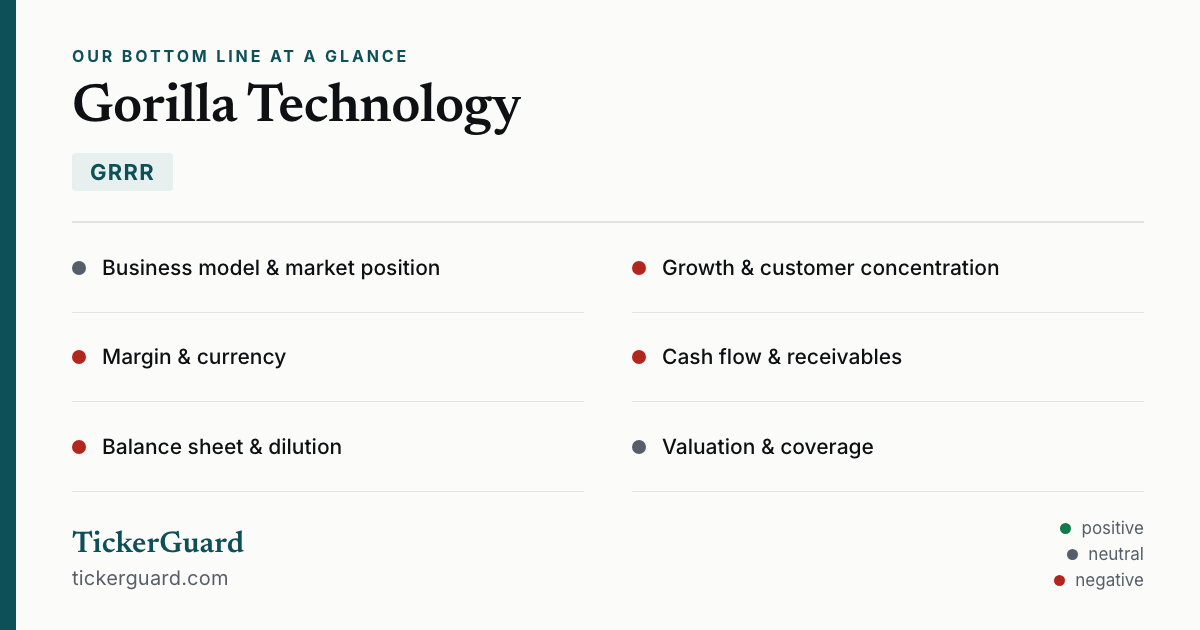
Our Bottom Line at a Glance
- Business model & market position neutral
- A genuine 25-year track record in video analytics and a real, delivered government network in Egypt — but the AI story and the ledger diverge: Security Convergence (systems integration) is 96.5 percent of fiscal year 2025 revenue, the AI-video-analytics segment Video IoT only 3.5 percent ($3.5 million of $101.4 million), and hardware plus outsourcing cost $63.2 million against $3.1 million of research and development (annual report 20-F for 2025).
- Growth & customer concentration negative
- Revenue grew 35.7 percent to $101.4 million in fiscal year 2025 and a further 54.6 percent to $28.2 million in the first quarter of 2026, but $77.5 million — 76.5 percent — came from a single Egyptian government customer (2024: 79.1 percent; 2023: 80.8 percent), while the second-largest customer fell from $11.0 million to zero. The backlog behind it dropped 41 percent to $101.3 million and is expected to be recognised by 2027; the announced successor, the $1.4 billion Freyr framework, produced no revenue in 2025.
- Margin & currency negative
- Gross margin fell from 69.1 percent (2023) via 50.0 percent (2024) to 33.4 percent (2025) and on to 21.1 percent in the first quarter of 2026 — gross profit in dollars shrank from $44.7 million to $33.9 million despite 57 percent revenue growth. On top, the Egyptian pound denomination cost $21.0 million (2025), $27.8 million (2024) and $18.9 million in the first quarter of 2026 in exchange losses; the reported adjusted EBITDA of $19.1 million exists only after adding $25.7 million of exactly those losses back.
- Cash flow & receivables negative
- Three straight years of negative operating cash flow (−$28.7 / −$29.7 / −$9.4 million); as of December 31, 2025, accounts receivable of $54.1 million plus unbilled contract assets of $57.9 million total $112.0 million — more than a full year of revenue. The $99.5 million of cash came from financing (+$101.2 million in 2025), not from customers. The first quarter of 2026 turned positive at plus $6.6 million, but of the $21.9 million decline in receivables and contract assets only $4.2 million appears as an inflow, against $20.1 million of unrealised currency losses added back.
- Balance sheet & dilution negative
- The balance sheet itself is sound — equity of $196.1 million, only $13.8 million of total indebtedness, no going-concern qualification, disclosure controls judged effective (12/31/2025). But it was bought with stock: shares outstanding rose from 7,565,099 to 27,757,474 in just over two years, after a 10-to-1 reverse split, plus $20.9 million of stock-based compensation in a single quarter and $232.0 million of 7.50 percent convertible notes whose conversion price can reset down to $6.00 and $8.00 — roughly 33.5 million new shares in the unfavourable case.
- Valuation & coverage neutral
- On the closing prices documented in SEC filings ($21.78 on June 2, 2026 and $16.77 on July 14, 2026) and 27,757,474 shares, the market value ranged between roughly $605 million and $466 million — 4.6 to 6.0 times fiscal year 2025 revenue, or 2.3 to 3.8 times the company guidance for 2026 ($160–200 million). The price has slid further since: to $12.01 at the July 24, 2026 price data cut-off, about $333 million of market value. No price-to-earnings ratio exists, and the very low forward multiple quoted elsewhere rests on an adjusted estimate that excludes the currency losses. Coverage is two analysts, both strong buy, average price target $39.50 (data as of July 26, 2026) — an echo rather than a consensus.
Gorilla Technology is discussed as an AI company and earns its money as a systems integrator for one government. Revenue grew 35.7 percent to $101.4 million in fiscal year 2025 — but $77.5 million of it came from a single Egyptian government customer, billed in a currency whose devaluation cost $48.8 million over two years; gross margin more than halved to 33.4 percent and fell on to 21.1 percent in the first quarter of 2026, and $112.0 million of invoiced and unbilled work was still uncollected at year-end. The balance sheet looks solid, but it was funded by tripling the share count after a reverse split and by $232.0 million of convertible notes. Not investment advice.
What Our Rating Means
Substance risk
We found at least one documented issue that threatens the company itself — regardless of how the stock is currently valued.
Whoever holds today is betting that Egypt keeps paying, that the pound stops falling, and that the data center frameworks become revenue before the current backlog — about a year and a half of it — runs out in 2027; there is no diversified second leg to cushion any of those three, because three quarters of the company is one contract. Whoever buys today pays a mid single-digit multiple of revenue for that bet and additionally carries the dilution risk of $232.0 million of convertible notes whose conversion price can slide to $6.00 and $8.00. What would change the picture is visible and checkable: a receivables balance that falls through payment rather than devaluation, a second quarter of positive operating cash flow, or a signed data center project with revenue attached. The decision is yours.
A journalistic assessment by our editorial team at the time of the deep dive, based on public sources — not investment advice and not a solicitation to buy or sell. Your personal circumstances (investment goals, risk capacity, taxes) cannot be taken into account. What our levels mean, how verdicts are formed, and what conflicts of interest exist →
Worth Noting
- GRRR landed on our research list through our Reddit hype scanner (ApeWisdom data): 6 mentions in 24 hours as of July 16, 2026. Forum mentions are sentiment signals, not quality signals. Gorilla has had its own row in our company universe only since July 27, 2026 — it was created with this analysis. The first scanner run on it returned (data as of 07/27/2026, priced off the 07/24/2026 close): fundamental grade C on a rating of 51 out of 100, Piotroski 3 of 9 — weak, since fundamentally healthy companies sit at 8 or 9 — and an Altman Z of 3.03, which on the book-value variant we use, Z″ (distress below 1.1, safe from 2.6), is safe territory, but with a narrow margin. Relative strength, Stan Weinstein stage and EPS rating are still missing because our price history for this stock is one day old; the only metric screen it hits is the downtrend list "Below the 50- & 200-SMA". All lists are recalculated every night — this is a dated snapshot.
- Gorilla is a foreign private issuer: the figures come from the annual report on Form 20-F (IFRS), not from a 10-K, and interim numbers arrive as voluntary 6-K attachments rather than audited quarterly reports — the first-quarter 2026 figures are expressly unaudited and unreviewed. Move the $21.0 million of currency losses below the operating line, as some data services do, and 2025 arithmetically turns into a positive operating result of about $7.4 million; the company's own income statement reports an operating loss of $13.7 million. We follow the filing.
- Valuation figures deliberately rest only on prices documented in SEC filings ($21.78 on June 2, 2026 from the prospectus supplement, $16.77 on July 14, 2026 from the Series B press release) and on the 27,757,474 shares stated there as of June 1, 2026. The share price has fallen further since: at the July 24, 2026 price data cut-off it stood at $12.01, equal to a market value of about $333 million — that is the figure shown on the stock page, and the reason it comes out smaller than the range in the text. Analyses are evergreen; daily prices are not a buy argument.
Download the verdict card (traffic light and rating of this analysis as an image, PNG)
Stock Watch
This analysis is as of August 26, 2026. Stock Watch will tell you what's changed at GRRR since then.
Later $1 a month per stock — signing up is free, and you'll be the first to know when it launches.
The full analysis as a PDF for later
We will send you this analysis as a PDF — to print, file away, and read at your own pace. And we will add you to the free Stock Watch list for Gorilla Technology Group Inc. (GRRR), so you hear about it when something material in this analysis changes.
Frequently Asked Questions
Gorilla Technology (Nasdaq: GRRR) sells Edge AI, video analytics, network and cybersecurity systems — but in practice it earns its money as a systems integrator for governments. In fiscal year 2025, $97.8 million of $101.4 million in revenue (96.5 percent) came from the Security Convergence segment and only $3.5 million (3.5 percent) from Video IoT, the AI-video-analytics business. $77.5 million of the total was paid by a single Egyptian government customer.
A foreign private issuer is a non-U.S. company listed on a U.S. exchange. It files no annual report on Form 10-K and no quarterly reports on Form 10-Q, but an annual report on Form 20-F and interim reports on Form 6-K. In practice that means no obligation to publish audited quarterly figures. Gorilla's first-quarter 2026 numbers arrived as a voluntary attachment to a 6-K — expressly unaudited and unreviewed. The accounts are prepared under IFRS.
Almost entirely. In fiscal year 2025, one customer located in Egypt — the Government of the Arab Republic of Egypt — accounted for $77,527,614 of $101,360,657 in revenue, or 76.5 percent (2024: 79.1 percent; 2023: 80.8 percent). The underlying firm-fixed-price contract for a secure government network was signed on June 26, 2023, is worth approximately EGP 8.4 billion over four years, and is governed by Egyptian law.
Because its main contract is denominated in Egyptian pounds while it reports in U.S. dollars. Everything owed to Gorilla in pounds is retranslated at each balance sheet date, and the pound kept weakening: the average dollar rate rose from 44.18 (2024) to 49.28 (2025), a depreciation of 11.5 percent. The result was foreign currency exchange losses of $21.0 million in 2025, $27.8 million in 2024 and a further $18.9 million in the first quarter of 2026 — most of it unrealised.
Not under its own reported figures. Fiscal year 2025 showed an operating loss of $13.7 million and a net loss of $11.3 million (minus $0.51 per share), after a $64.8 million net loss in 2024; the last profitable year was 2023 ($13.5 million). The first quarter of 2026 brought an operating loss of $41.1 million. Gorilla also reports an adjusted EBITDA of $19.1 million for 2025 — but that figure is reached by adding back $25.7 million of Egyptian pound devaluation losses.
Because all of the revenue is recognised over time — as work progresses — long before invoicing and payment. As of December 31, 2025, accounts receivable ($54.1 million) plus unbilled contract assets ($57.9 million) totalled $112.0 million, more than a full year of revenue. Net cash used in operating activities was minus $28.7 million (2025), minus $29.7 million (2024) and minus $9.4 million (2023). The first quarter of 2026 turned positive at plus $6.6 million, mostly through non-cash add-backs.
Substantially. Shares outstanding rose from 7,565,099 (January 1, 2024) via 18,058,135 (December 31, 2024) and 26,188,972 (December 31, 2025) to 27,757,474 (June 1, 2026) — and that is already after a 10-to-1 reverse split effective April 15, 2024. In June and July 2026 Gorilla added $232.0 million of 7.50 percent notes convertible at an initial $25.4826 per share, with downward reset floors of $6.00 and $8.00.
It depends entirely on which earnings number you accept. On the closing prices documented in SEC filings ($21.78 on June 2 and $16.77 on July 14, 2026) and 27,757,474 shares, the market value ranged between about $605 million and $466 million — 4.6 to 6.0 times fiscal year 2025 revenue of $101.4 million. There is no price-to-earnings ratio, because 2025 was a loss year under IFRS; the very low forward multiple quoted elsewhere rests on an adjusted estimate that excludes the currency losses.
Found an error?
Did you spot a factual error, an outdated number, or a typo in this deep dive? Let us know briefly — your report goes straight to the editorial team.