Global Unichip: The Stock Nearly Quintupled — and TSMC Sits at Every Lever
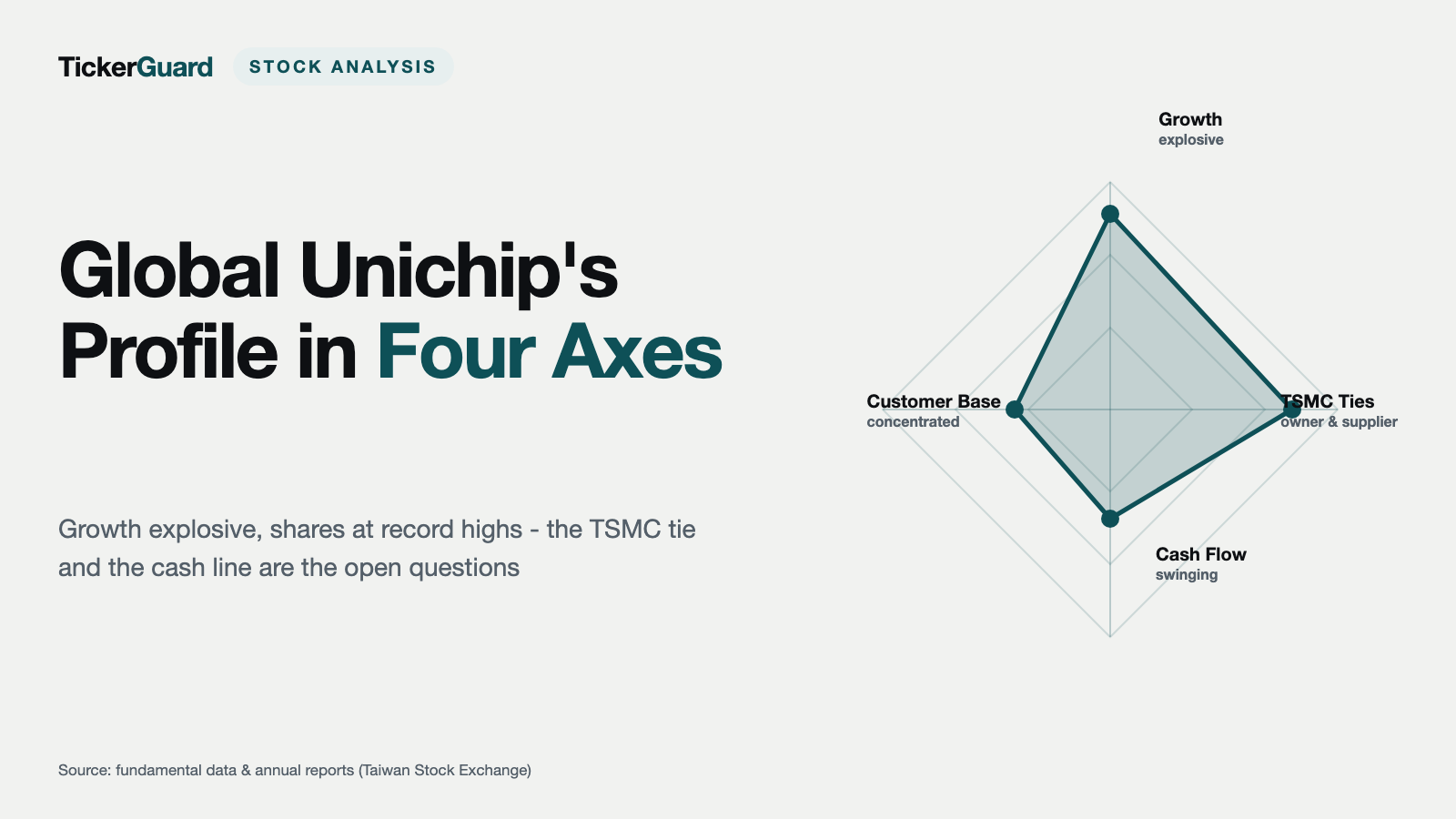
Global Unichip designs and manufactures custom AI chips for large cloud companies — and the stock climbed from NT$1,255 to NT$6,100 in eleven months (as of August 28, 2026). What the 2025 annual report shows: TSMC owns 34.84 percent of the company, holds key board seats, and accounted for 91 percent of all purchases in 2025. Three customers make up 44 percent of revenue, operating cash flow turned negative in three of the last six quarters — and on August 19, 2026, the board approved the largest debt financing in the company's history. Not investment advice — just the question of how many of these pillars have to hold up at the same time.
 Thomas Mücke
Founder & Publisher
Thomas Mücke
Founder & Publisher
There is an investor trap that especially good-looking charts spring: FOMO, the fear of missing out. Picture the chart: on September 26, 2025, Global Unichip shares cost NT$1,255. Eleven months later, on August 26, 2026, they hit NT$6,125 — a 52-week high, nearly five times higher. On August 28, 2026, the stock closed at NT$6,100 (roughly $193 or €166, exchange rate as of August 31, 2026), just 0.4 percent below that high. Anyone seeing this chart for the first time rarely thinks "compelling business model" — more likely, "damn, I could have had that." That is exactly the moment people stop thinking and start chasing. Let's make a deal instead: leave the chart where it is, and read the filings — the 2025 annual report (April 16, 2026) and the three most recent quarterly results releases. They deliver the tension that runs through this whole piece: a company whose success hinges on a single corporate name — as its largest shareholder, as practically its sole supplier, and, as it turns out, as the training ground for its own leadership. That name is TSMC.
What Global Unichip Actually Does
Global Unichip Corp. (GUC, Chinese: 創意電子) is a fabless ASIC design house based in Hsinchu, Taiwan — TSMC's own website calls the company a "market leader in advanced ASIC (application-specific integrated circuit) services" (TSMC, tsmc.com, accessed August 31, 2026). Picture it this way: a large cloud company wants a custom chip for a specific job — say, an AI training accelerator. It has the idea and the budget, but no in-house chip-design team and certainly no fab. GUC handles both. First comes the NRE business (non-recurring engineering, the one-time design work) — circuit design, physical layout, integration with advanced packaging like TSMC's CoWoS. Then comes turnkey manufacturing: GUC orders the wafers from the foundry, handles packaging, test, and delivery — turnkey, as the name says. By 2025, the larger, more capital-intensive turnkey business already dominated: turnkey revenue reached NT$25,736 million, a record (4Q25 results release, January 29, 2026).
Nearly all revenue now flows through the cloud category: since the fourth quarter of 2025, GUC has reclassified revenue into Cloud, Consumer, Edge AI, Automotive, and Others — in the second quarter of 2026, Cloud made up 79 percent of total revenue, driven mainly by CPU, AI accelerator, and BMC projects (2Q26 results release, July 30, 2026). The customer mix by region shifted sharply in 2026: the US revenue share jumped from roughly 33 percent to over 60 percent per the July 31, 2026 earnings call, while China fell from roughly 33 percent to under 20 percent — a result of US export controls that shifted part of the packaging and testing work for cryptocurrency customers from China to Taiwan (BigGo Finance, earnings call summary, July 31, 2026). Cryptocurrency applications made up over 30 percent of revenue in the second quarter of 2026 per the same source — the single largest driver, though management explicitly wants to scale it back in favor of automotive projects in the second half.
GUC employed 874 people as of December 31, 2025 (up from 839 at the end of 2024 and 819 at the end of 2023) and spent NT$3,330 million on research and development — 9.8 percent of annual revenue (2025 annual report, section 1-3.1). For a look at Taiwan's semiconductor supply chain beyond the biggest names, our Delta Electronics analysis covers another Taiwanese company riding the same AI data center boom — on the power-supply side rather than chip design.
Company history for investors
-
1998
Founded and renamed
Founded as Chuangyi Electronics Corporation, renamed Global Unichip Corp. in October 1998 — the foundation for today's ASIC business.
-
2006
IPO on the Taiwan Stock Exchange
Shares started trading under ticker 3443 on November 3, 2006 — GUC has paid a dividend every year since.
-
2023
TSMC reconfirms board seats
Effective May 18, 2023 (three-year term), TSMC representatives again take key board seats, with ownership unchanged at 34.84 percent.
-
2026
New board chair with a TSMC background
Liz Chang takes over as chair in May 2026 per earnings-call coverage — bringing, by her own account, 29 years of TSMC experience.
-
2026
Record debt financing approved
The board approves a loan facility and convertible bond totaling up to NT$65.5 billion on August 19, 2026 — more than the company's entire balance sheet at the time.
-
2026
52-week high reached
On August 26, 2026, shares mark their year-to-date high of NT$6,125 — nearly five times the low from September 2025.
The Numbers Over the Years — an Honest Look
First, what genuinely impresses. Revenue grew from NT$13.57 billion (2020) through NT$24.04 billion (2022) to NT$34.14 billion in 2025 — up 36 percent from 2024 and a record, even though 2024 itself was a down year against 2023 (NT$25.04 billion versus NT$26.24 billion). Net income climbed from NT$850 million (2020) to NT$3,770 million (2025, roughly $119 million) — up 9 percent from 2024 and also a record, though with a far slower growth rate than revenue.
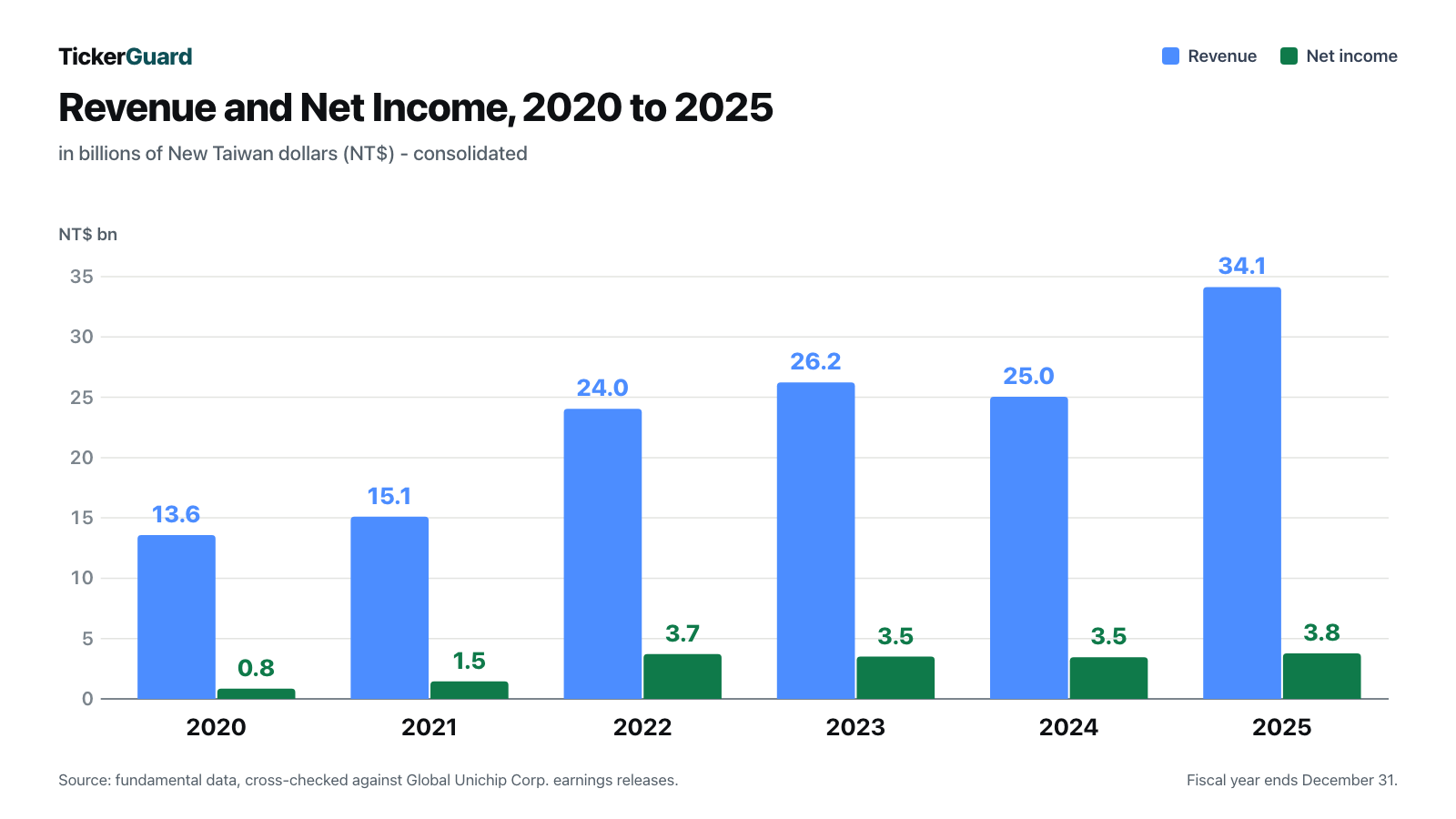
The revenue jump in 2025 and its acceleration in 2026 trace back to turnkey manufacturing: it grew from NT$10,293 million in the fourth quarter of 2025 (up 147 percent year over year) through NT$9,805 million in the first quarter of 2026 to NT$11,586 million in the second quarter of 2026 (up 188 percent year over year). But that growth came with a gross margin that swings hard from quarter to quarter: 33.3 percent in 2Q25, then 24.2 percent in 3Q25, 19.0 percent in 4Q25 (turnkey already 83 percent of revenue that quarter), 27.2 percent in 1Q26, and 21.5 percent in 2Q26. GUC attributes this to product mix — turnkey revenue structurally carries a lower margin than pure design work (NRE), and its share of the total shifts significantly quarter to quarter.
What Management Says — and What Came of It
Full disclosure up front: our own database holds zero conference-call transcripts for Global Unichip — querying the transcript table via the company relation returned no rows, and a targeted backfill attempt found nothing new either. Unlike US names with complete SEC-linked transcripts, this section relies on the official but terse written results releases plus a summary of the July 31, 2026 earnings call from the Taiwanese financial outlet BigGo Finance, which includes direct management quotes — flagged here as a secondary source, not a substitute for a verified transcript.
That summary contains management's most candid admission on competitive pressure: asked by Morgan Stanley about share loss to competitors, President Dai Shang-Yi (戴尚義 — also referred to elsewhere as "Sean Tai," see the note below) reportedly acknowledged that intensifying competition inevitably compresses gross margins — an admission that lines up exactly with the swinging margins described above. On capacity tightness at Taiwan's packaging and test houses (OSAT), Dai described a role reversal per the same source: where the company once fought for foundry capacity, it now fights for OSAT capacity — a consequence of the sharp demand shift.
On the US export controls that in 2026 forced part of the crypto-customer workload from Chinese to Taiwanese packaging houses, Dai reportedly called the adjustment "very painful," while staying optimistic beyond 2026. On the crypto dependency itself — over 30 percent of revenue in the second quarter of 2026 — he stressed that the five-year plan deliberately keeps crypto's weighting low starting in 2026, reportedly saying he did not want the business to look reliant on that "fat filler." For the cloud business with large data-center operators (CSPs), he flagged 2027 as the peak year for mass production — 2026, he said, is almost entirely design work (NRE). New in the role: Board Chair Liz Chang (張麗絲), who took over per BigGo Finance in May 2026 and says she brings 29 years of TSMC experience — her first quoted remark as chair centered on deepening the collaboration with TSMC. For context: the 2025 annual report (board table, term effective May 18, 2023) still lists F. C. Tseng as chair and Sean Tai as president, both as TSMC representatives — the leadership change apparently happened between the annual report's printing and mid-2026, though this analysis cannot pin down the exact date from a primary source.
What can be checked against actual results: at the July 31, 2026 call, management guided full-year 2026 revenue to grow double digits, with NRE revenue declining (single digits) and turnkey revenue growing double digits, alongside compressing gross and operating margins, per BigGo Finance. The odd part: in the first half of 2026, NRE revenue actually rose both quarter over quarter and year over year (2Q26: NT$2,310 million, up 41 percent quarter over quarter and 11 percent year over year) — meaning the guided full-year NRE decline would have to materialize entirely in the second half. That is not a broken forecast, but it does require a steep drop in Q3 and Q4 that the numbers so far do not show.
What the Filings Show — the Uncomfortable Truths
Uncomfortable truth #1: TSMC is shareholder, board overseer, and near-sole supplier all at once
The 2025 annual report's shareholder table lists TSMC at exactly 34.84 percent ownership (46,687,859 shares, board term effective since May 18, 2023). That alone would be a remarkable concentration for a listed company. It goes further: the same table shows TSMC representatives holding both the board chair and — as of the report date — the president's seat, plus additional director seats held by TSMC executives, including the company's then-CFO.
Then there is the supplier side. Section 2-4-2 of the annual report lists suppliers accounting for more than 10 percent of purchases:
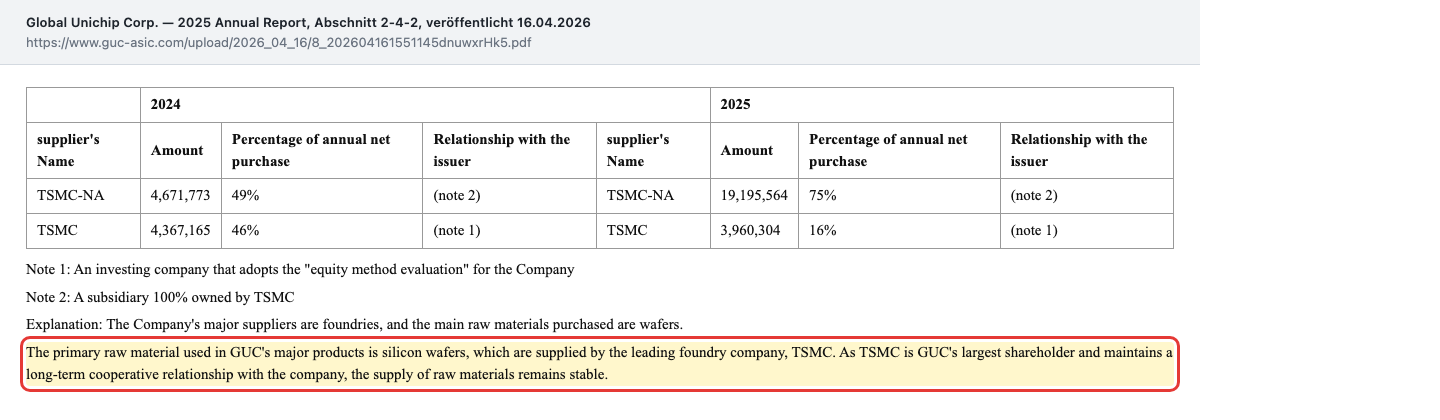
The detail: TSMC-NA (a wholly owned TSMC subsidiary) accounted for 75 percent of 2025 purchases (NT$19,196 million), TSMC itself for another 16 percent (NT$3,960 million) — 91 percent combined, down slightly from 95 percent the year before (49 percent plus 46 percent). The report states the reason plainly:
"The primary raw material used in GUC's major products is silicon wafers, which are supplied by the leading foundry company, TSMC. As TSMC is GUC's largest shareholder and maintains a long-term cooperative relationship with the company, the supply of raw materials remains stable."
— Global Unichip Corp., 2025 Annual Report, section 2-4-2
Regardless of how GUC frames it, TSMC's own corporate site is blunter. There, TSMC explicitly describes itself as "GUC's sole foundry supplier" (TSMC, tsmc.com, accessed August 31, 2026). Picture it this way: imagine your landlord also sits on your board, owns a third of your company, and happens to be your only supplier of the one raw material your business runs on. That does not have to end badly — TSMC has every incentive for GUC to keep succeeding, since it profits twice over, as shareholder and as wafer seller. But it does mean GUC's leverage in negotiating with its single most important business partner is structurally limited, and every decision TSMC makes on capacity allocation or pricing hits GUC not as an independent counterparty, but as a controlled subsidiary in nearly everything but name.
Uncomfortable truth #2: three customers make up 44 percent of revenue — names unknown
The customer side of the same annual report shows a similar concentration pattern, just anonymized:
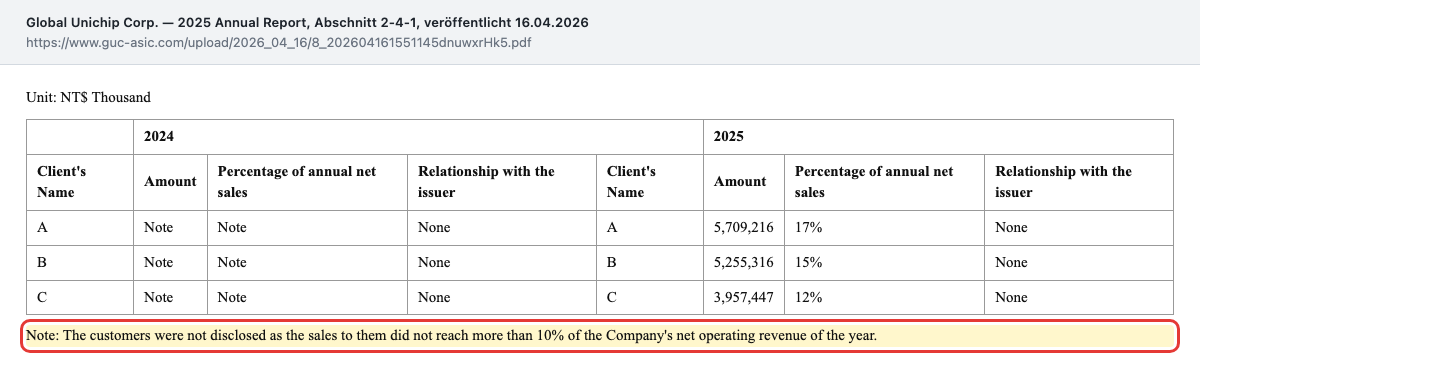
Customer A accounted for 17 percent of 2025 net sales (NT$5,709 million), Customer B for 15 percent (NT$5,255 million), Customer C for 12 percent (NT$3,957 million) — 44 percent combined. The footnote explains why none of the three names appear: none of them crossed the 10 percent disclosure threshold in 2024. Public speculation ties a major new cloud project with a "large North American cloud provider" — some market observers reportedly suspect Google, per the BigGo earnings-call summary — to a ramp starting in late 2026; that is explicitly flagged as speculation, not a customer identification confirmed by GUC itself, and is not presented here as fact.
What can be said independent of names: a customer concentration of 44 percent across three accounts means the loss or slowdown of a single contract can cost a double-digit percentage of group revenue — without outsiders knowing in advance which customer it is. That is not an indictment so much as a structural feature of the ASIC business model: building highly customized chips for a handful of very large cloud companies naturally means a handful of very large customers. Concentration is the flip side of specialization.
Uncomfortable truth #3: operating cash flow flipped negative three times — then came the multi-billion financing
This is where a record profit can hide something. Between the first quarter of 2025 and the second quarter of 2026, operating cash flow was negative in three of six quarters:
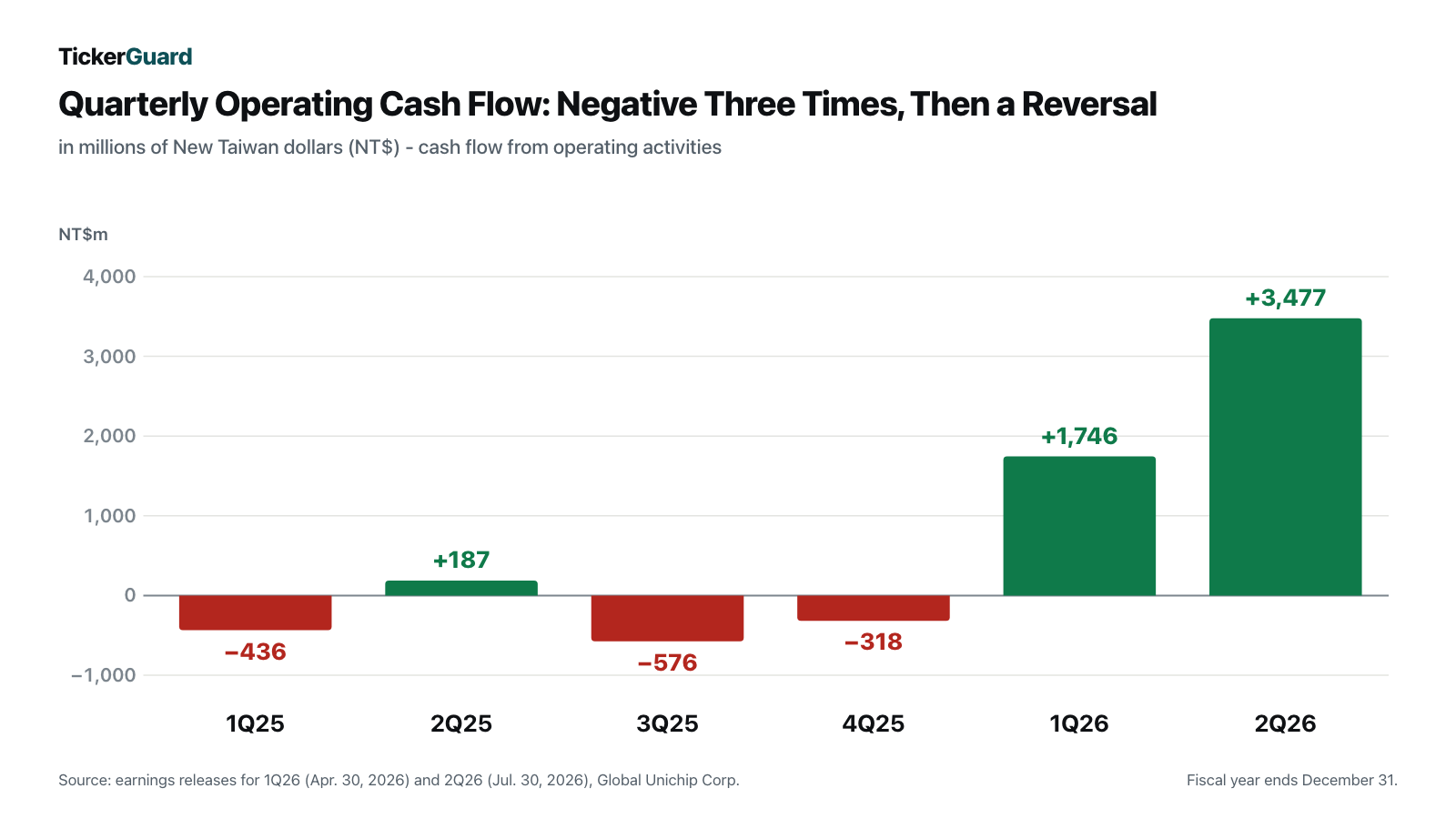
The reason for the negative quarters is stated plainly in the 4Q25 results release:
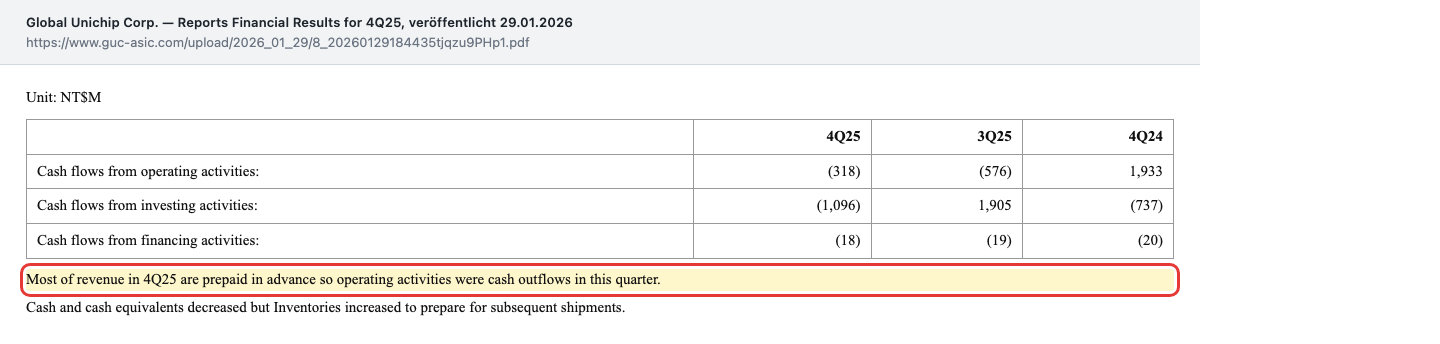
Verbatim: "Most of revenue in 4Q25 are prepaid in advance so operating activities were cash outflows in this quarter" — in effect, most of the underlying inputs (wafers, packaging) were paid for in the fourth quarter before the associated revenue came in as cash. Inventory tells the same story: it rose from NT$2,794 million at the end of 2024 to NT$10,148 million at the end of 2025 (up 263 percent) and further to NT$14,540 million by June 30, 2026 — GUC is buying and building today for orders it will only get paid for later. Inventory turnover days stretched in parallel from 68 days (4Q24) to 89 days (4Q25) and 119 days (2Q26).
The reversal came in 2026: operating cash flow turned to plus NT$1,746 million in the first quarter and plus NT$3,477 million in the second — per the 2Q26 results release, "primarily driven by an increase in contract liabilities," meaning customer prepayments rose. In other words, the same mechanism that cost cash in 2025 (paying inputs before collecting revenue) reversed in 2026 as customers began prepaying more themselves. And yet, on August 19, 2026 — in the middle of that recovery — the board approved the largest debt financing in the company's history: a syndicated loan of NT$40 billion (led by Mega International Commercial Bank, five-year term, upsizable to NT$50 billion) and the first unsecured overseas convertible bond of up to $800 million (roughly NT$25.5 billion) — together up to NT$65.5 billion (roughly $2.1 billion, or up to NT$75.5 billion if the loan is upsized to its maximum), more than the company's entire balance sheet as of June 30, 2026 (NT$37.4 billion). The stated purpose — working capital and foreign-currency funding for materials — is plausible given the growing inventory build, but it is also a board raising a record amount of debt just as operating cash flow was already turning positive on its own. More on this, including the open question of the bond's conversion price, in this analysis's side-finds section.
Valuation
At the August 28, 2026 close of NT$6,100, Global Unichip carries a market capitalization of roughly NT$806.1 billion — about $25.5 billion or €21.9 billion (exchange rate as of August 31, 2026). Based on trailing twelve-month earnings per share, that works out to a price-to-earnings ratio of roughly 154 — high, but not especially informative for a company with such volatile quarterly margins. More telling is the analyst consensus: 16 analysts expect average 2026 earnings per share of NT$51.85 (range NT$45.73 to NT$60.51), implying a P/E of roughly 118 on the consensus estimate. For 2027, the estimates diverge sharply: 18 analysts average NT$113.11 per share, but the range spans from NT$68.61 to NT$202.14 — nearly a threefold gap between the most pessimistic and most optimistic analyst. That spread is itself a data point: it shows how little agreement exists among professionals on how sustainable the current growth pace really is.
The average analyst price target sits at NT$5,636.76 — roughly 8 percent below the August 28, 2026 close. In other words, analysts on average see the stock as having already run ahead of their own fair-value estimate, even after many of them likely raised their 2026 and 2027 estimates meaningfully in recent months. On a sales basis, the price-to-sales ratio stands at roughly 17.4, and enterprise value (roughly NT$783.2 billion) works out to roughly 110 to 115 times trailing twelve-month EBITDA — multiples more typical of a young growth stock than a company that has been publicly listed since 2006 with nearly two decades of history. A price-to-book ratio of roughly 59 further shows how small the balance-sheet substance (NT$13.5 billion in equity as of June 30, 2026) is relative to the market valuation — typical for a fabless design house without its own factories, but also a reason a single disappointing quarter can hit the share price disproportionately hard.
GUC has paid a dividend every year since its 2006 IPO — for fiscal 2025, that is NT$20 per share (ex-dividend date June 8, 2026), a yield of roughly 0.3 percent at the current price, on a payout ratio of roughly 51 percent based on trailing twelve-month earnings per share (NT$39.10); based on the audited fiscal 2025 profit per the shareholder letter (NT$28.13 per share), that ratio would be roughly 71 percent. For value-oriented investors, that is not an argument for the stock — at this P/E, the dividend yield is nearly a footnote. For another look at Taiwan's semiconductor supply chain beyond the household names, our Hon Precision analysis covers a very different link in the same chain.
Upside and Risks at a Glance
What speaks for Global Unichip:
- A company in the middle of the strongest demand cycle in its history: 2025 revenue up 36 percent to a record, second-quarter 2026 turnkey revenue up 188 percent year over year, with cloud applications (CPU, AI accelerators, BMC) making up 79 percent of revenue.
- The tight TSMC relationship cuts both ways, but it is also an advantage: guaranteed capacity access at one of the world's most sought-after foundries, plus early access to leading-edge packaging technology (CoWoS, SoIC-X, CPO) ahead of many competitors.
- Operating cash flow turned clearly positive in the first half of 2026 (NT$1,746 million and NT$3,477 million per quarter), driven by higher customer prepayments — a sign customers are willing to help finance the growth.
- An unbroken dividend record since 2006 and an ownership base with high insider and institutional stakes (40.3 and 33.7 percent) point to a company with a stable ownership structure, even if much of it traces back to a single shareholder.
What speaks against it:
- TSMC is the largest shareholder (34.84 percent), holds key board seats through its representatives, and per the annual report supplied 91 percent of all 2025 purchases — TSMC itself calls itself GUC's "sole foundry supplier." Every decision TSMC makes on capacity or terms hits GUC directly, without the leverage an independent supplier-customer relationship would provide.
- Three customers made up 44 percent of net sales in 2025 per the annual report, and their identities are not public — the loss or slowdown of a single one of these accounts could hit group revenue by a double-digit percentage.
- Operating cash flow was negative in three of the last six quarters, and gross margin swung between 19.0 and 33.3 percent over the same period — a business whose earnings quality depends heavily on any given quarter's product mix.
- On August 19, 2026, the board approved debt financing of up to NT$65.5 billion — more than total assets as of June 30, 2026 — with final terms, especially the planned bond's conversion price, still unknown as of this analysis's cutoff.
- Valuation is ambitious: a P/E of roughly 118 on the 2026 analyst consensus, an average analyst price target already about 8 percent below the current price, and 2027 earnings estimates that span nearly a threefold range among analysts.
A Human Takeaway
Back to the FOMO trap from the opening. Yes, the chart is real: nearly a fivefold gain in eleven months, a company in the middle of the strongest demand cycle in its history, record revenue, record profit. Anyone who sees this chart and wants to buy immediately is right about the first half of that sentence. But the filings behind this chart tell a second story too: a shareholder that is simultaneously overseer and practically the sole supplier; three anonymous customers carrying nearly half of revenue; a cash position that went negative three times in six quarters; and a record debt financing approved at the very moment the cash position was recovering on its own. None of this, on its own, disproves the growth story — cloud chips for AI accelerators are, in 2026, simply a business that grows fast and needs a lot of upfront financing. But all of these pillars have to hold up at once for the chart to stay the way it is. What you make of it is your decision. And that is exactly how it should be.
Sources
All original documents used in this analysis — for your own reading:
- Global Unichip Corp. — 2025 Annual Report (published April 16, 2026)
- Global Unichip Corp. — Fourth-quarter 2025 results release (January 29, 2026)
- Global Unichip Corp. — First-quarter 2026 results release (April 30, 2026)
- Global Unichip Corp. — Second-quarter 2026 results release (July 30, 2026)
- TSMC — Value Chain Alliance profile of Global Unichip Corp., accessed August 31, 2026
- BigGo Finance — summary of the July 31, 2026 earnings call, accessed August 31, 2026 (secondary source for management quotes, not a verified transcript)
- cnyes.com — report dated August 20, 2026 on the board resolution of August 19, 2026 (syndicated loan and convertible bond)
- Fundamental data (share price, valuation ratios, analyst consensus; as of August 28, 2026) and exchange rates (as of August 31, 2026), cross-checked against the original documents listed above.
Transparency & disclaimer: this analysis is a journalistic assessment of publicly available information. It is not investment advice, not a financial analysis in the regulatory sense, and not a solicitation to buy or sell securities. Equity investments carry substantial risk, including total loss; stocks outside your home market add currency and country risk. All figures are provided without guarantee; the data date for each figure is noted in the text, and the overall data date for this piece is August 31, 2026. The author holds no position in Global Unichip shares at the time of publication.
Our Bottom Line at a Glance
- Growth and demand positive
- 2025 revenue rose 36 percent to a record NT$34,141 million, and second-quarter 2026 turnkey revenue rose 188 percent year over year. Cloud applications (CPU, AI accelerators, BMC) made up 79 percent of revenue in the second quarter of 2026.
- Dependency on TSMC negative
- TSMC owns 34.84 percent of the company, holds key board seats through its own representatives, and per the annual report supplied 91 percent of all purchases in 2025 (2024: 95 percent). TSMC itself describes itself as GUC's "sole foundry supplier" — GUC's leverage with its own most important business partner is structurally limited.
- Customer concentration negative
- Three customers made up 44 percent of net sales in 2025 per the annual report (17, 15, and 12 percent), and their identities are not public. A slowdown at any one of these accounts could hit group revenue by a double-digit percentage.
- Cash flow and earnings quality neutral
- Operating cash flow was negative in three of the last six quarters (1Q25, 3Q25, 4Q25), but turned clearly positive in the first half of 2026 (NT$1,746 million and NT$3,477 million), driven by higher customer prepayments. Gross margin swung between 19.0 and 33.3 percent over the same period depending on product mix.
- New debt financing neutral
- On August 19, 2026, the board approved a syndicated loan and a convertible bond totaling up to NT$65.5 billion — more than total assets as of June 30, 2026. The stated purpose (working capital, foreign-currency funding) is plausible, but the bond's final terms had not been set as of this analysis's cutoff.
- Valuation negative
- A trailing P/E of roughly 154 and roughly 118 on the 2026 analyst consensus; the average analyst price target already sits about 8 percent below the August 28, 2026 price. 2027 earnings estimates span nearly a threefold range among analysts — a sign of real uncertainty about how sustainable the current growth pace is.
Global Unichip is growing in the middle of the strongest demand cycle in its history — revenue and profit hit records in 2025, and turnkey revenue grew sharply again in 2026. At the same time, the original filings show three structural dependencies: TSMC as shareholder, board overseer, and near-sole supplier all at once; customer concentration of 44 percent across three anonymous accounts; and operating cash flow that was negative in three of six quarters before the board approved record debt financing on August 19, 2026. Not investment advice.
What Our Rating Means
Open questions
The business works in principle, but one material question is open. As long as it stays open, our findings do not carry a quality verdict.
Yellow is not about an existence question here — Global Unichip's operating business clearly holds up: record revenue and record profit in 2025, turnkey revenue that grew sharply again in 2026, and operating cash flow that turned clearly positive in the first half of 2026. The balance sheet as of June 30, 2026 shows no sign of distress either: NT$10,034 million in cash, positive equity of NT$13,465 million, no indication of a going-concern issue. Yellow stands because two operating questions remain open that a pure growth read would skip past. First, the structure: TSMC owns 34.84 percent, holds key board seats through its own representatives, and per the annual report supplied 91 percent of all purchases in 2025 — a concentration TSMC itself confirms by calling itself GUC's "sole foundry supplier," and one that structurally limits GUC's leverage with its own most important business partner. Second, earnings quality: three anonymous customers carry 44 percent of revenue, gross margin swung between 19.0 and 33.3 percent by quarter, and operating cash flow had only just turned positive in three of six quarters before the board approved the largest debt financing in company history at that very moment. None of this is a documented break in the company's substance, but these are open operating questions the next quarterly release has to answer. The next checkable milestone is the third-quarter 2026 results release, expected in late October 2026 based on the prior cadence. The decision is yours.
A journalistic assessment by our editorial team at the time of the deep dive, based on public sources — not investment advice and not a solicitation to buy or sell. Your personal circumstances (investment goals, risk capacity, taxes) cannot be taken into account. What our levels mean, how verdicts are formed, and what conflicts of interest exist →
Worth Noting
- Not a US filer: Global Unichip has no SEC CIK. All company figures in this analysis come from the 2025 annual report (April 16, 2026) and the 4Q25, 1Q26, and 2Q26 results releases, sourced directly from guc-asic.com and read via pdftotext — not from a data-provider feed.
- No conference-call transcript in our own database (transcripts:sync --tickers=3443.TW --backfill=12 on production, 0 hits; EarningsTranscript query via the company relation, 0 rows). The management quotes in the "What Management Says" section come from a third-party summary of the July 31, 2026 earnings call (BigGo Finance) and are flagged as a secondary source.
- Top leadership could not be fully confirmed from a primary source: the 2025 annual report's board table (term effective May 18, 2023) still lists F. C. Tseng as chair and Sean Tai as president (both TSMC representatives); the naming of Liz Chang as new chair and Dai Shang-Yi as president comes from BigGo Finance's earnings-call coverage (as of July 31, 2026) and is flagged accordingly.
- All dollar and euro figures in this analysis are our own rounded conversions at the exchange rate as of August 31, 2026 (1 USD ≈ NT$31.65, 1 EUR ≈ NT$36.78) — not figures reported in the original filings, and not a forecast of future exchange rates.
- No connection to internal scanners, signals, or watchlists: this analysis was produced as a standalone public piece of research, independent of what prompted it.
The full analysis as a PDF for later
We will send you this analysis as a PDF — to print, file away, and read at your own pace.
Frequently Asked Questions
Global Unichip (GUC), based in Hsinchu, Taiwan, is a fabless ASIC design house: it designs custom chips for cloud providers and technology companies (mainly cloud computing and cryptocurrency applications in 2025) and then handles turnkey manufacturing through wafers, packaging, and testing. TSMC owns 34.84 percent of the company and, by its own description, is GUC's sole foundry supplier.
Shares climbed from a 52-week low of NT$1,255 (September 26, 2025) to a 52-week high of NT$6,125 (August 26, 2026) — driven by a surge in turnkey revenue (up 188 percent in the second quarter of 2026 year over year) from cloud and AI-accelerator projects, plus cryptocurrency customers who, per management, even paid in advance to secure capacity.
Very. TSMC owns 34.84 percent of the company per the 2025 annual report, holds key board seats through its representatives, and together with its subsidiary TSMC-NA supplied 91 percent of GUC's purchases in 2025. TSMC itself describes itself on its own website as "GUC's sole foundry supplier."
Because inputs (wafers, packaging) are paid for before the associated revenue is collected: per the fourth-quarter 2025 results release, most inputs were prepaid before the related revenue came in as cash. Inventory rose from NT$2,794 million (end of 2024) to NT$14,540 million (June 30, 2026) as a result. Cash flow turned positive again in the first half of 2026, driven by higher customer prepayments.
A syndicated loan of NT$40 billion (upsizable to NT$50 billion) and the company's first unsecured overseas convertible bond of up to $800 million — together up to NT$65.5 billion (roughly $2.1 billion). That is more than total assets as of June 30, 2026 (NT$37.4 billion). Final terms for the convertible bond had not been set as of this analysis's cutoff.
Very. Per the 2025 annual report, three customers together made up 44 percent of net sales (17, 15, and 12 percent) — their names are not public, since none of them crossed the 10 percent disclosure threshold in 2024.
Yes, every year since its 2006 IPO. For fiscal 2025, that is NT$20 per share (ex-dividend date June 8, 2026), a yield of roughly 0.3 percent at the August 28, 2026 price — at this P/E, more of a footnote than a reason to buy.
Global Unichip is listed on the Taiwan Stock Exchange, not in the US — a lookup with the U.S. securities regulator, the SEC, returns no central filer number (CIK) for the ticker. Mandatory disclosure instead runs through a Taiwanese annual report and quarterly results releases, which this analysis relies on.
Found an error?
Did you spot a factual error, an outdated number, or a typo in this deep dive? Let us know briefly — your report goes straight to the editorial team.