Delta Electronics: A Record Quarter That Feels Like a Loss
Delta Electronics just reported the best quarter in its 38-year trading history — and the stock still trades 27 percent below its May high. We read the investor presentation and the English-language earnings-call transcript: the AI data-center business is genuinely booming and management even raised its own target — but two of four segments are losing money, and Delta itself flags a political risk in the U.S. Not investment advice.
 Thomas Mücke
Founder & Publisher
Thomas Mücke
Founder & Publisher
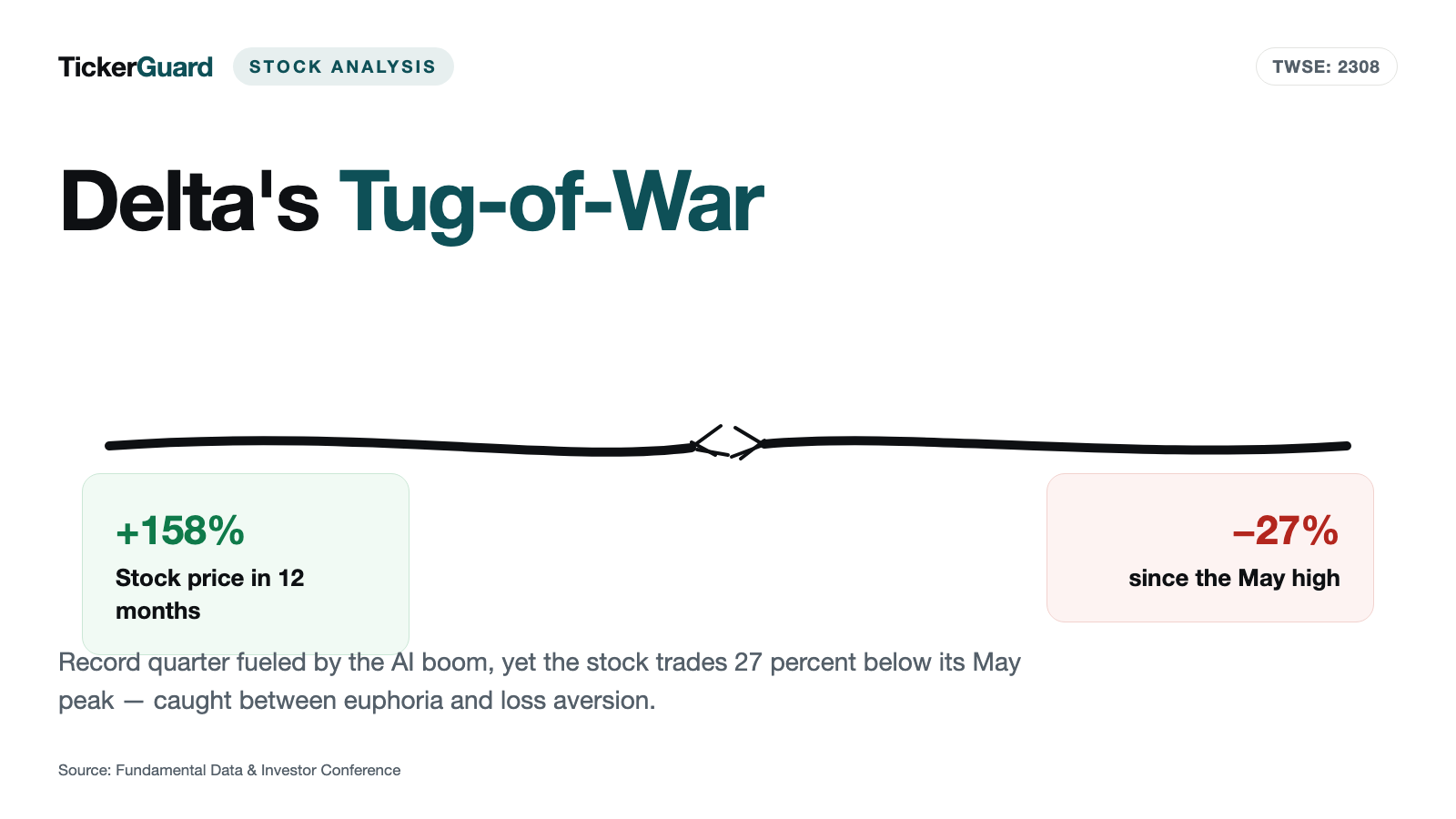
Loss aversion is one of the best-documented weaknesses in investor psychology: a loss hurts roughly twice as much, psychologically, as an equivalent gain feels good — that's the core finding of Kahneman and Tversky's prospect theory, dating back to the 1970s. That exact feeling hits anyone holding Delta Electronics stock in the summer of 2026: on May 27, 2026, the stock hit a 52-week high of TWD 2,520. Three months later, on August 28, 2026, it trades at TWD 1,830 — down 27 percent. Anyone who bought in May is staring at a painful paper loss. And that's despite the Taiwanese power-and-thermal-management group reporting, on July 30, 2026, by far the best quarter in its history: record revenue, record profit, record EBITDA. That contradiction — record numbers alongside a falling stock price — invites one of two mistakes: panic-selling because the loss hurts, or ignoring the gap because the growth story sounds too good to question. We read the numbers, the earnings call, and the segment data before choosing either reaction. Every figure in this analysis is evergreen and carries its own date; the TWD 1,830 price serves only as a valuation anchor as of August 28, 2026.
What Delta Electronics actually does
Delta Electronics, Inc. (台達電子工業股份有限公司) was founded in Taiwan in 1971 and has traded on the Taiwan Stock Exchange since December 19, 1988 (TWSE: 2308, ISIN TW0002308004) — with roughly 38 years of trading history, this is no market newcomer but one of Taiwan's most established electronics groups. The company describes itself as the "global leader in power and thermal management solutions" (company statement, Taiwan Stock Exchange company data sheet, as of Aug. 31, 2026). Delta is led by Chairman and CEO Ping Cheng, President and Chief Operating Officer Simon Chang, and Chief Financial Officer Beau Yu; founder Chong Hua Cheng serves as Honorary Chairman.
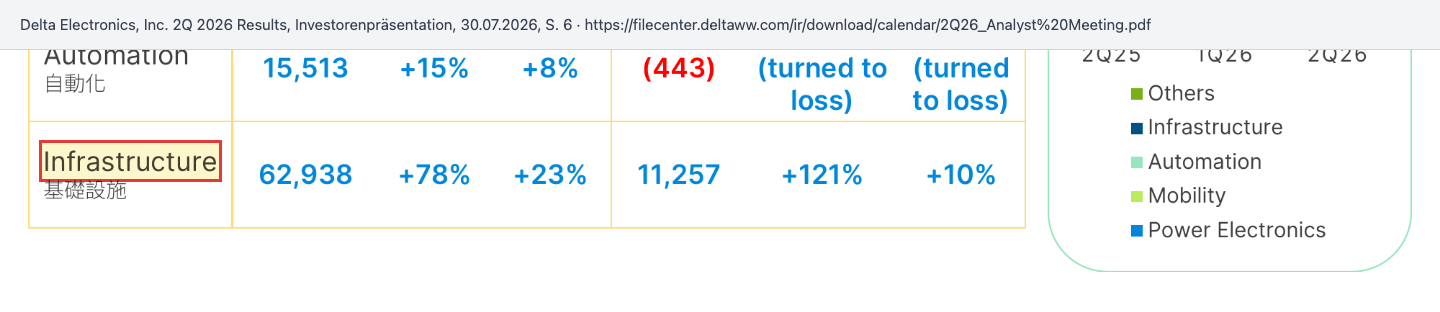
The company reports across four segments. Power Electronics (components, power supplies, fans, and thermal management) is the largest, at 53 percent of group revenue in the second quarter of 2026 — it covers everything from conventional power supplies to the power modules used in AI servers. Infrastructure (ICT infrastructure, energy infrastructure, display solutions) is the fastest-growing segment at 34 percent of revenue — this is where data-center power, liquid cooling, and uninterruptible power supplies live. Automation (industrial and building automation) accounts for 8 percent, and Mobility (EV powertrain systems) for 5 percent (investor presentation, Jul. 30, 2026, p. 6). In other words, Delta is not a pure "AI play" — it's a broadly diversified industrial group in which the two largest segments, Power Electronics and Infrastructure, happen to benefit most from the data-center and AI boom, while the two smaller segments have problems of their own. More on that in the "uncomfortable truths" chapter. If you already know the Taiwanese AI-server supply chain from another analysis: we previously covered Jentech Precision, a much smaller supplier from the same thermal-management niche — Delta, at roughly $130 billion in market capitalization, is a multiple of that size, but shares the same underlying dependence on the pace of data-center buildout.
As of August 28, 2026, Delta reported registered capital of TWD 25,975,433,290, which — at a par value of TWD 10 per share — corresponds to exactly 2,597,543,329 shares outstanding (Taiwan Stock Exchange company data sheet, as of Aug. 31, 2026). That figure independently matches the "2,598 million shares" cited in the company's own July 30, 2026 investor presentation. Roughly 25.9 percent of shares are held by insiders, roughly 38.5 percent by institutional investors, and free float stands at about 60.4 percent (1,569.5 million shares; fundamental data, as of Aug. 28-30, 2026).
Company history for investors
-
1971
Founded in Taiwan
Delta Electronics is founded — more than five decades before today's AI data-center story.
-
1988
Listed on the Taiwan Stock Exchange
The stock begins trading on the TWSE on Dec. 19, 1988.
-
2025
Record year with accelerating growth
Revenue rises 31.8 percent to TWD 554.9 billion, and net profit nearly doubles.
-
2026
Depreciation life for AI equipment shortened
Starting April 2026, Delta depreciates newly acquired AI manufacturing equipment over three years instead of up to five — a prudence measure, per management.
-
2026
52-week high
On May 27, 2026, the stock reaches its year-to-date high of TWD 2,520.
-
2026
Best quarter in company history
On Jul. 30, 2026, Delta reports record revenue, record profit, and record EBITDA for the second quarter — and raises its own AI-revenue target from roughly 20 to more than 25 percent.
Where this stock landed on our desk
The trigger for this analysis is exactly the contradiction described above: a stock up roughly 158 percent over twelve months (as of Aug. 28, 2026), yet trading 27 percent below an all-time high set just three months earlier — immediately after a quarter that rewrote the company's own history on nearly every metric. That combination is a textbook case for loss aversion: staring at the short-term price chart makes a stock that remains extraordinarily successful over the long run look like a mistake. We wanted to know whether the numbers justify the pullback — or whether the psychological reflex to avoid a loss is currently overriding a sober valuation.
The numbers over the years
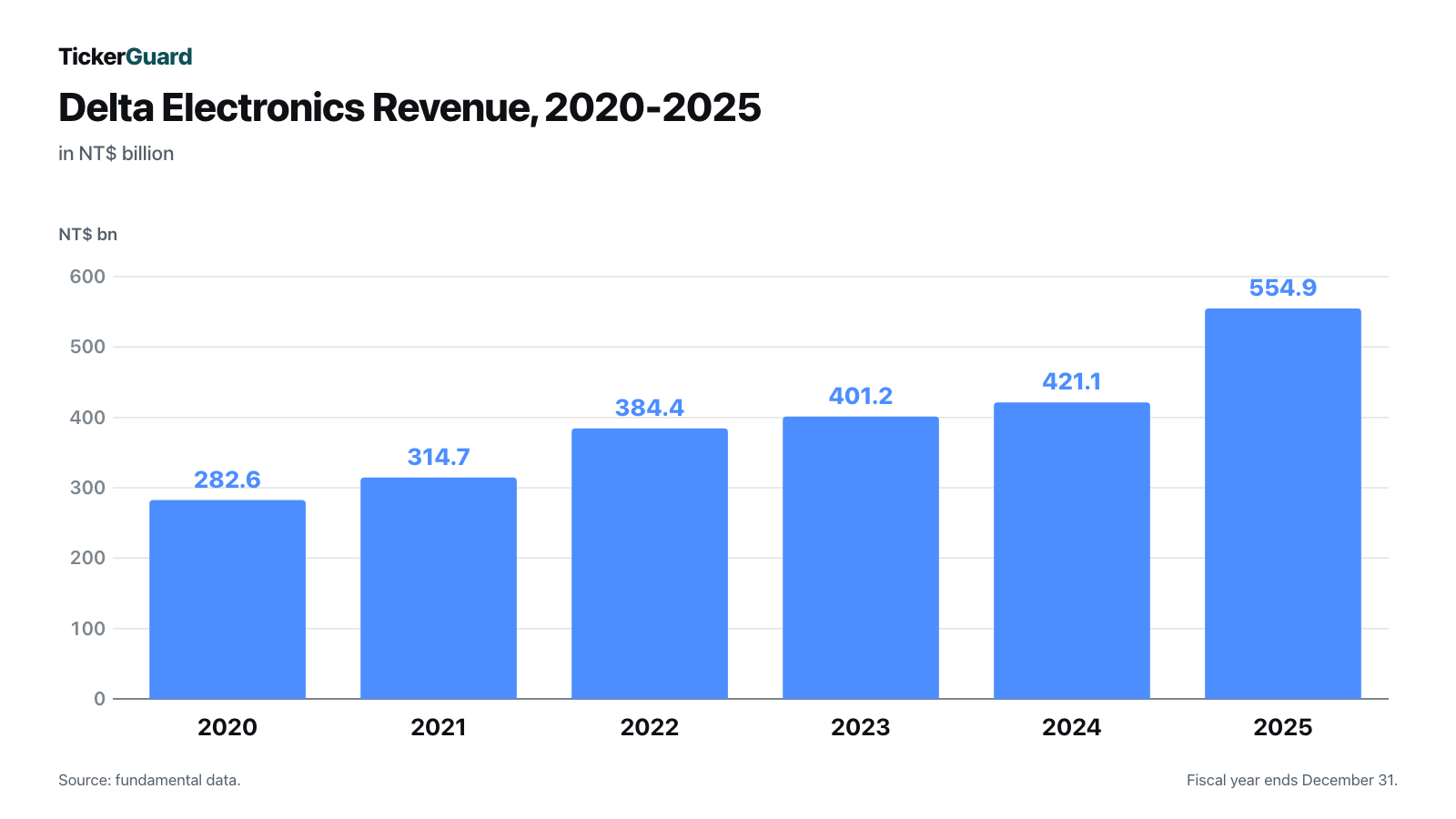
Delta's group revenue grew from TWD 282.6 billion (2020) through TWD 314.7 billion (2021), TWD 384.4 billion (2022), and TWD 401.2 billion (2023) to TWD 421.1 billion in 2024 — solid but not spectacular growth. 2025 marked a clear acceleration: TWD 554.9 billion in revenue, up 31.8 percent year over year, with net profit of TWD 67.9 billion — nearly double the TWD 35.2 billion earned in 2024, on "only" 32 percent more revenue, an early sign of improving profitability.
2026 has accelerated further still: in the first half, Delta booked TWD 342.6 billion in revenue, up 41 percent year over year, at a gross margin of 36.3 percent (1H 2025: 33.7 percent) and net profit of TWD 45.7 billion — 89 percent higher than the first half of 2025. Earnings per share reached TWD 17.59 in the first half of 2026 alone — already more, by the company's own account, than Delta earned in any previous full fiscal year (Delta Electronics, 2Q 2026 Results Meeting, transcript, Jul. 30, 2026, Rodney Liu, Investor Relations Director).
The balance sheet has kept pace with that growth without piling on debt: as of December 31, 2025, Delta held TWD 151.4 billion in cash against TWD 74.0 billion in combined short- and long-term bank debt — a net cash position of roughly TWD 77.4 billion. The equity ratio stood at 41.9 percent, and free cash flow reached TWD 52.6 billion (2024: TWD 37.8 billion) — even as capital expenditure rose from TWD 35.1 billion to TWD 46.1 billion, as Delta simultaneously builds new plants in Taiwan, China, Thailand, and the United States.
What the earnings call shows
Delta publishes an English-language transcript of its analyst conference every quarter — a verbatim record including a Q&A session, comparable to a U.S. earnings call. This analysis draws on the transcript of the July 30, 2026 call (Delta Electronics, 2Q 2026 Results Meeting, 3:00 p.m. Taiwan time); an automated search of our own earnings-transcript database for ticker 2308.TW came back empty (as of Aug. 31, 2026), so the analysis relies directly on the document Delta itself published, which carries the company's own disclaimer that the original spoken Mandarin remarks prevail in case of any discrepancy.
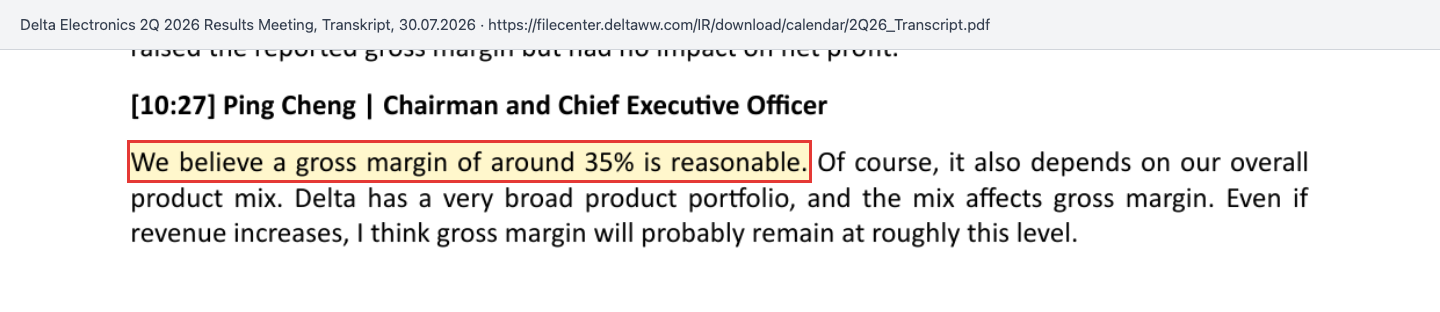
The tone of the call was broadly upbeat but notably cautious in two places. First, CFO Beau Yu himself tempered expectations around the gross margin, which had hit a record 37.0 percent in the first quarter of 2026: part of that, he said, came from one-time income tied to an order cancellation and from delivery terms on certain liquid-cooling products, "which raised the reported gross margin but had no impact on net profit." Chairman and CEO Ping Cheng added that a gross margin of around 35 percent is "reasonable" and would "probably remain at roughly this level" — an explicit pushback against the idea that the first-quarter record was the new normal.
"We believe a gross margin of around 35% is reasonable. Of course, it also depends on our overall product mix. Delta has a very broad product portfolio, and the mix affects gross margin. Even if revenue increases, I think gross margin will probably remain at roughly this level."
— Ping Cheng, Chairman and Chief Executive Officer, 2Q 2026 Results Meeting, transcript, Jul. 30, 2026
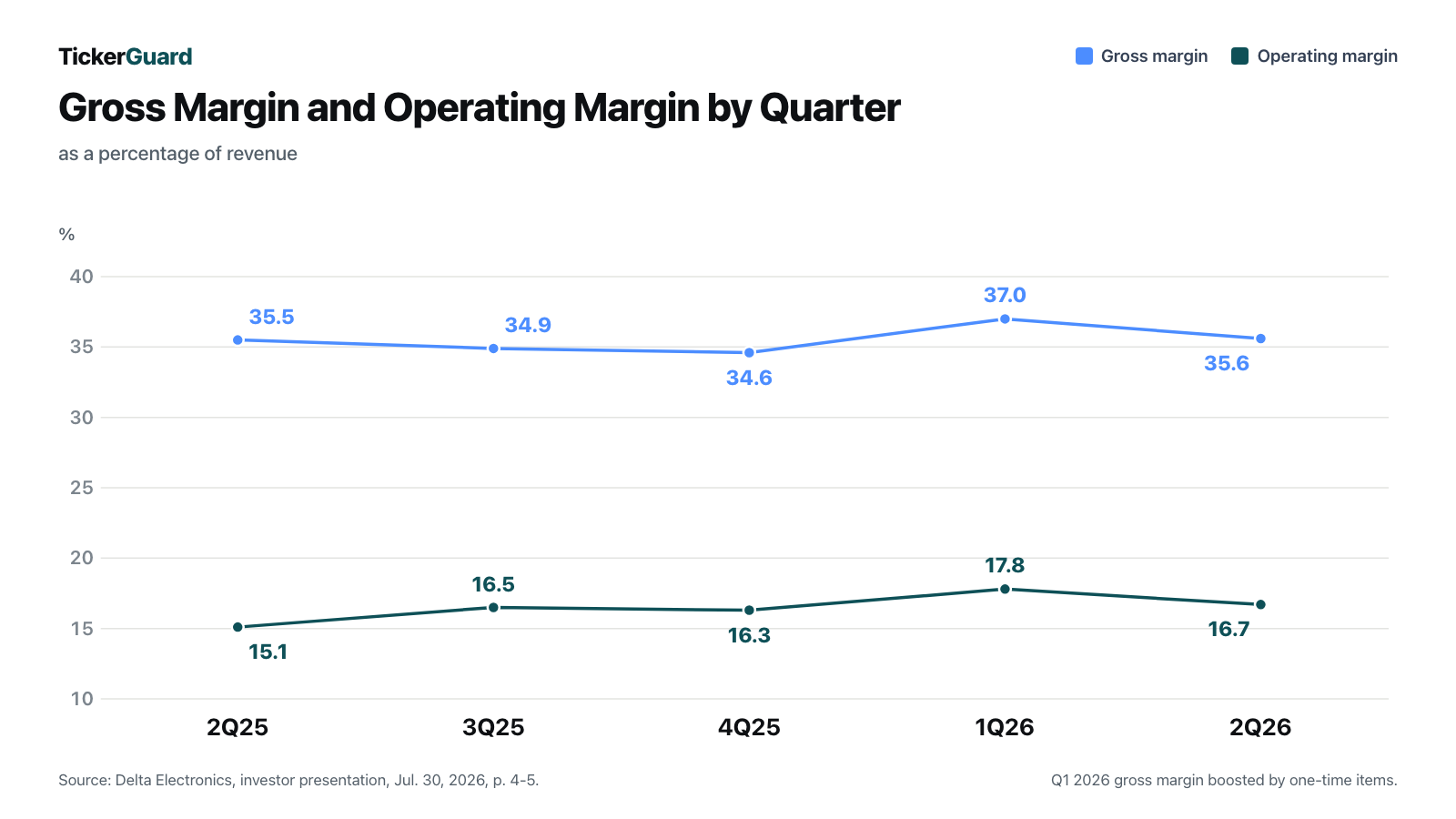
The quarterly series over the past five quarters bears this out: gross margin ranged between 34.6 percent (Q4 2025) and the 37.0 percent outlier in Q1 2026, before slipping back to 35.6 percent in Q2 2026 — close to the "reasonable" level Ping Cheng cited. Operating margin moved in a noticeably tighter band over the same period, between 15.1 and 17.8 percent (investor presentation, Jul. 30, 2026, p. 4-5).
At the same time, management raised its own target for AI-related revenue. One analyst asked directly whether the roughly 20 percent AI-revenue target cited at the previous conference still held. CFO Beau Yu replied that AI-related products would "definitely account for more than 25% of total revenue this year," and that liquid-cooling products would rise from roughly 10 percent of revenue in 2025 to "definitely exceed 12%" this year. Delta, in other words, raised its own target within a single quarter — a promise that stands in contrast to the muted margin guidance and shows management optimism and management caution coexisting in the very same call, rather than pointing in one uniform direction.
In the Q&A, management also openly flagged three operating risks: first, component shortages — Chairman and CEO Ping Cheng named MOSFETs as one of the components in tight supply; second, a credit-impairment charge tied to a legal dispute with a Taiwanese power-generation equipment customer, now in court-mediated settlement proceedings, for which Delta has booked a 100 percent provision under its own accounting policy; and third, a political risk in the United States, covered in its own chapter below among the uncomfortable truths.
What the numbers reveal — the uncomfortable truths
Uncomfortable truth #1: Two of four segments are shrinking or losing money — in the best quarter in company history
Record second-quarter 2026 revenue masks a highly uneven picture at the segment level. While Power Electronics (revenue up 50 percent, segment profit up 50 percent) and especially Infrastructure (revenue up 78 percent, segment profit up 121 percent) pulled the group higher, the Automation segment swung to a segment loss of TWD 443 million despite 15 percent revenue growth year over year — the same segment had been profitable a year earlier. Management blamed a memory-chip shortage that prevented planned shipment volumes and drove up purchasing costs. The Mobility segment (EV powertrain systems) also stayed deep in the red, with a loss of TWD 386 million — though that was 48 percent narrower than the first-quarter 2026 loss — even as revenue fell 23 percent year over year. Taken together: two of Delta's four segments, representing 13 percent of group revenue, posted losses in the best quarter in company history.
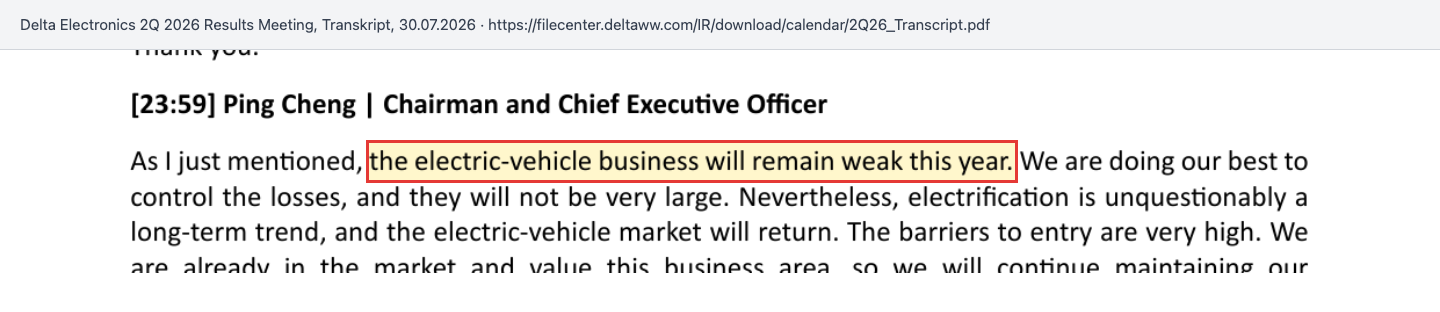
Asked by an analyst whether the Mobility and Automation losses would persist or widen in the second half, Chairman Ping Cheng was unambiguous on the EV business:
"As I just mentioned, the electric-vehicle business will remain weak this year. We are doing our best to control the losses, and they will not be very large. Nevertheless, electrification is unquestionably a long-term trend, and the electric-vehicle market will return. The barriers to entry are very high."
— Ping Cheng, Chairman and Chief Executive Officer, 2Q 2026 Results Meeting, transcript, Jul. 30, 2026
Management was more upbeat on Automation: the products have since been redesigned with a second memory-chip source, backlog should be cleared in the second half, and the segment should "perform better than in the first half" and "should not remain loss-making."
Uncomfortable truth #2: Roughly 55 percent of Americans are worried about AI, and more than ten U.S. states are weighing legislation against data-center construction
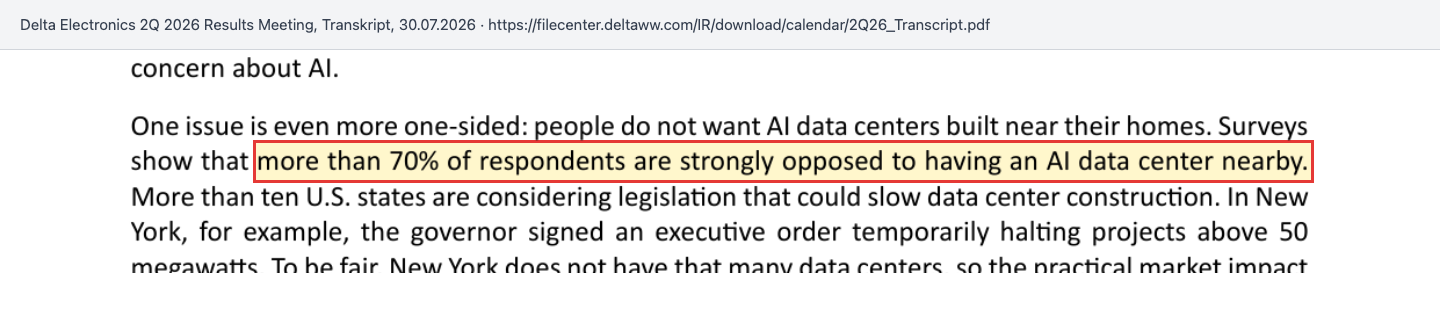
More than half of group revenue now comes from data-center-related business (Rodney Liu, Investor Relations Director, on the Jul. 30, 2026 call) — meaning Delta is directly exposed to the continued momentum of the U.S. AI-infrastructure boom, its largest market for data-center equipment. Asked whether the market was right to worry about hyperscaler cash flow and returns on capital, Lanford Liu, Vice President of Corporate Investment, said all four major cloud providers had indicated capital spending would at least hold steady or rise further — then volunteered a third risk that hadn't come up in prior analyst questions: American public opinion. Recent surveys, Liu said, now clearly show that Americans concerned about AI outnumber those who view it favorably — roughly 55 to 56 percent of respondents express significant concern about artificial intelligence. On one narrower question, the picture is even more one-sided:
"One issue is even more one-sided: people do not want AI data centers built near their homes. Surveys show that more than 70% of respondents are strongly opposed to having an AI data center nearby. More than ten U.S. states are considering legislation that could slow data center construction. In New York, for example, the governor signed an executive order temporarily halting projects above 50 megawatts."
— Lanford Liu, Vice President, Corporate Investment, 2Q 2026 Results Meeting, transcript, Jul. 30, 2026
This isn't a critic's assessment — it came from Delta's own investor-relations team, volunteered in answer to an analyst question, a remarkably candid disclosure of a risk that no financial metric captures. Liu added some context: New York has comparatively few data centers, so the practical market impact is limited "even though the symbolic impact is bigger" — and rising AI-usage figures (he cited Copilot subscribers climbing to roughly 30 million) still point to sustained hyperscaler investment appetite. The risk is neither dismissed nor overstated here — but it's real, and it comes straight from the company, not from an outside analyst.
Uncomfortable truth #3: Delta shortened the depreciation life of AI equipment from three-to-five years to three, effective April 2026
One detail from the online Q&A that hasn't shown up in press coverage of the quarter: Delta shortened the depreciation period for newly acquired AI-related manufacturing equipment from a previous three-to-five years to a uniform three years — a change CFO Beau Yu said took effect in April 2026 and was agreed with the company's auditors. A shorter depreciation life means higher annual depreciation charges on the same investment, weighing on reported profit — a conservative accounting move that management itself tied to the pace of technological change.
"For equipment, given the risks associated with the current AI cycle, we reached an agreement with our auditors to shorten the depreciation period to three years. Much of this equipment was previously depreciated over five years. We now apply the three-year period as a matter of prudence. If any project encounters a problem, we will quickly recognize the necessary provision."
— Ping Cheng, Chairman and Chief Executive Officer, 2Q 2026 Results Meeting, transcript, Jul. 30, 2026
The change bears directly on capital expenditure, which Chairman and CEO Ping Cheng said should rise to roughly TWD 70 billion in 2026 — he put last year's spending, in his own words on the call, at TWD 46.6 billion (fundamental data lists a near-identical TWD 46.1 billion for 2025), a roughly 50 percent increase — a significantly larger equipment base will now be depreciated faster. Anyone reading upcoming quarterly results should keep this in mind: reported profit growing more slowly than still-strong revenue growth could just as easily reflect this deliberately more conservative accounting as any weakening of the underlying business.
Valuation
With 2,597,543,329 shares outstanding and a price of TWD 1,830 (Aug. 28, 2026, closing price per the Taiwan Stock Exchange), market capitalization comes to roughly TWD 4,753.50 billion — about $150.05 billion or €129.63 billion (exchange rates as of Aug. 28-30, 2026: $1 = TWD 31.68, €1 = TWD 36.67). Fundamental data lists market cap at TWD 4,753.50 billion for the same date — our own calculation matches almost exactly.
Based on trailing-twelve-month earnings per share (TWD 31.29), the price-to-earnings ratio works out to roughly 58.5 — a high multiple for a $130 billion-plus industrial group, one that already prices in the growth story. Using the consensus estimate from 22 analysts for the current fiscal year 2026 (TWD 40.70 EPS, an expected 76 percent increase), the P/E drops to roughly 45; for the 2027 estimate (TWD 64.17, also from 22 analysts, up an expected 58 percent), it drops further to roughly 29. Revenue consensus stands at TWD 778.4 billion for 2026 (21 analysts, up 40 percent) and TWD 1,094.7 billion for 2027 (up 41 percent) — consensus estimates assume the current growth pace continues rather than normalizes.
Against book value per share of TWD 113.07, the price-to-book ratio comes to roughly 16.2 — also not a cheap multiple, though understandable given a return on equity of roughly 30 percent (fundamental data, trailing twelve months). The dividend yield sits at roughly 0.6 percent (TWD 11.60 dividend per share, ex-date Jun. 17, 2026), with a payout ratio of roughly 37 percent of profit — modest enough not to jeopardize capacity-expansion spending. Notable for a growth stock of this size: per fundamental data, Delta has paid a dividend every year since at least 1996, including through the 2008-2009 financial crisis and the Covid-19 pandemic. The TWD 1,830 price sits well above the 200-day moving average (roughly TWD 1,572), but 27 percent below the 52-week high of TWD 2,520 (May 27, 2026) — and after a 52-week low of TWD 680 on September 3, 2025, that range alone shows how volatile the stock has traded over the past year.
Opportunities and risks at a glance
Opportunities: a structurally growing data-center and AI business that, by the company's own account, already exceeds half of group revenue and whose target share management just raised (from roughly 20 to more than 25 percent); a practically debt-free balance sheet with roughly TWD 77 billion in net cash; free cash flow that keeps growing despite sharply rising capital spending; a nearly 30-year unbroken dividend record; and a management team that openly discusses operating problems — the Automation loss, component shortages, U.S. political risk — on its own earnings call rather than glossing over them. Risks: a price-to-earnings ratio that, even against the most optimistic available consensus estimate (2027), still sits at roughly 29; two of four segments (Mobility, Automation) that have posted losses so far in 2026; a U.S. political risk that Delta itself openly names and that could affect its most important growth segment; a memory-chip and power-semiconductor shortage that management says could pressure margins in the second half; and share-price volatility that produced a 27 percent drop from an all-time high within three months, even as the underlying quarterly numbers hit records.
A human conclusion
Loss aversion works so reliably because it turns a short-term snapshot into the whole truth. Anyone who bought at TWD 2,520 in May 2026 is genuinely sitting on a 27 percent paper loss — that feeling is real, and the pain makes sense. What a pure focus on the price chart leaves out: over that same period, the company behind the stock reported its best quarter in history, raised its own AI-revenue growth target, and spoke openly about the problems it actually has — shrinking peripheral segments, component shortages, political headwinds in the U.S. None of these problems is invented or hidden; they're stated, word for word, in the company's own earnings-call transcript. Anyone staring only at the red number in their own portfolio risks selling out of fear of a further loss at precisely the moment the underlying business is at its strongest. Anyone looking only at the record numbers, conversely, misses that the valuation remains demanding even against the cheapest available earnings estimate, and that two of four segments are currently losing money. As so often, the honest answer sits between panic and euphoria. Not investment advice.
Sources
This analysis draws on: the official Taiwan Stock Exchange company data sheet for Delta Electronics, Inc. (ticker 2308), accessed Aug. 31, 2026; the investor presentation "Delta Electronics, Inc. 2Q 2026 Results" dated Jul. 30, 2026 (20 pages, deltaww.com); the English-language transcript of the "Delta Electronics 2Q 2026 Results Meeting" analyst conference dated Jul. 30, 2026, 3:00 p.m. Taiwan time (13 pages, deltaww.com); and fundamental data (price, valuation, and balance-sheet metrics plus analyst consensus estimates from up to 22 analysts, as of Aug. 28-30, 2026). No publicly available verbatim transcripts exist in our own transcript database for 2308.TW (automated check, as of Aug. 31, 2026) — this analysis instead relies on the conference transcript Delta itself published. Note: this analysis is journalistic coverage of publicly available information, not investment advice and not a recommendation to buy or sell.
Our Bottom Line at a Glance
- Growth positive
- Revenue rose 31.8 percent in 2025 to TWD 554.9 billion and grew a further 48 percent year over year in the second quarter of 2026, driven by the data-center and AI business, which now makes up more than half of group revenue.
- Margin and segment mix neutral
- Gross margin hit a record 37.0 percent in Q1 2026, which management itself frames as boosted by one-time items; a sustainable level, per the chairman, is closer to 35 percent. Two of four segments (Mobility, Automation) have posted losses so far in 2026.
- Balance sheet and liquidity positive
- Practically debt-free: roughly TWD 77.4 billion in net cash (Dec. 31, 2025), an equity ratio of 41.9 percent, growing free cash flow despite sharply higher capital spending, and a dividend paid, per fundamental data, without interruption since at least 1996.
- Segment and component risk neutral
- Mobility (electric vehicles) will stay unprofitable in 2026 by management's own account; Automation swung to a loss on a memory-chip shortage. Management expects Automation to improve in the second half but continues to flag tight power-semiconductor (MOSFET) supply as a risk.
- Political and regulatory risk neutral
- Delta itself flags, on its own earnings call, U.S. public opposition to AI data-center construction (over 70 percent opposition in cited surveys, more than ten states weighing restrictive legislation) as a real but, per management, not currently existential risk to its most important growth segment.
- Valuation negative
- Trailing price-to-earnings ratio of roughly 58.5, a calculated 45 and 29 against the 2026 and 2027 consensus estimates — demanding even against the cheapest available estimate. The stock has risen roughly 158 percent over twelve months but trades 27 percent below its 52-week high.
Delta Electronics shows a business that is genuinely growing fast: revenue and profit hit records in the second quarter of 2026, the data-center and AI business already makes up more than half of group revenue, and the balance sheet is practically debt-free. The 27 percent decline from the May high looks more like an already very rich prior valuation and market nervousness than a deterioration in the operating numbers. Against these strengths stand two unprofitable smaller segments, a political risk in the U.S. that Delta itself openly names, and a valuation that remains demanding even against the cheapest available earnings estimate. Not investment advice.
What Our Rating Means
Quality confirmed
Business model, numbers and balance sheet hold up to our review. Whether the current price supports an entry is a separate question — it hangs on the price, not on the company.
The core business (Power Electronics and Infrastructure, together 87 percent of revenue) is growing fast and profitably, the balance sheet is very healthy with a net-cash position and an equity ratio of roughly 42 percent, and there is no existential dependence on a single customer or counterparty. The losses in Mobility and Automation, and the political risk in the U.S., are documented operating risks the company itself discloses openly — they belong in the risk assessment but do not lower the quality rating absent evidence of a group-wide solvency risk. The high price-to-earnings ratio is a valuation argument, not a quality argument.
A journalistic assessment by our editorial team at the time of the deep dive, based on public sources — not investment advice and not a solicitation to buy or sell. Your personal circumstances (investment goals, risk capacity, taxes) cannot be taken into account. What our levels mean, how verdicts are formed, and what conflicts of interest exist →
Worth Noting
- Trigger for this analysis: the contradiction between a record quarter (Jul. 30, 2026) and a 27 percent decline from the 52-week high (May 27, 2026) — a textbook case of loss aversion.
- Data as of: investor presentation and earnings-call transcript dated Jul. 30, 2026 (second quarter 2026, as of Jun. 30, 2026), fundamental data as of Aug. 28-30, 2026, TWSE company data sheet as of Aug. 31, 2026.
- Distinct from other Taiwan analyses in our archive: Delta Electronics publishes a genuine, company-issued English-language earnings-call transcript including a Q&A session — unlike many other Taiwan-listed names, for which only investor presentations without a verbatim record are available.
The full analysis as a PDF for later
We will send you this analysis as a PDF — to print, file away, and read at your own pace.
Frequently Asked Questions
Delta Electronics, Inc. (TWSE: 2308) of Taipei, Taiwan, is a power-and-thermal-management group founded in 1971, with four segments: Power Electronics (components, power supplies, fans; 53% of revenue), Infrastructure (data-center and energy infrastructure; 34%), Automation (industrial/building automation; 8%), and Mobility (EV powertrain systems; 5%; investor presentation, Jul. 30, 2026).
No. Delta makes physical power and thermal-management hardware that gets built into AI data centers — by its own account, more than half of group revenue now comes from data-center-related business. But Delta itself sells neither AI software nor AI models.
The stock hit a 52-week high of TWD 2,520 on May 27, 2026, and fell to TWD 1,830 by Aug. 28, 2026 — down 27 percent — even though the group reported record revenue, record profit, and record EBITDA for the second quarter of 2026 on Jul. 30, 2026. The valuation had already run up considerably beforehand, and management itself tempered margin expectations for the second half.
Yes. Unlike many other Taiwan-listed stocks, Delta itself publishes an English-language verbatim transcript of its quarterly conference, including a Q&A session. This analysis draws on the Jul. 30, 2026 transcript; our own transcript database held no entry for ticker 2308.TW (as of Aug. 31, 2026).
Mobility (EV powertrain systems) and Automation (industrial/building automation). In the second quarter of 2026, Mobility lost TWD 386 million on 23 percent lower revenue, while Automation swung to a TWD 443 million loss despite 15 percent revenue growth (a memory-chip shortage). Together, the two segments make up roughly 13 percent of group revenue.
At a price of TWD 1,830 (Aug. 28, 2026), the trailing price-to-earnings ratio is roughly 58.5. Against the 2026 consensus estimate (TWD 40.70 EPS, 22 analysts), that works out to roughly 45; against the 2027 estimate (TWD 64.17), roughly 29 — assuming those consensus estimates hold.
Delta trades on the Taiwan Stock Exchange (TWSE) and is not SEC-registered — there is no 10-K, no 10-Q. Required disclosures instead take the form of quarterly reports, investor presentations, and — in Delta's case, unusually — an English-language earnings-call transcript.
Yes. Per fundamental data, Delta has paid a dividend every year since at least 1996, including through the 2008-2009 financial crisis and the Covid-19 pandemic. The most recent dividend of TWD 11.60 per share (ex-date Jun. 17, 2026) works out to a yield of roughly 0.6 percent at the current price, with a payout ratio of roughly 37 percent of profit.
Found an error?
Did you spot a factual error, an outdated number, or a typo in this deep dive? Let us know briefly — your report goes straight to the editorial team.