Gemini Stock: $28 to $4.28 in Eleven Months — and the Crypto Exchange's Biggest Lender Is Its Own Founders' Family Office
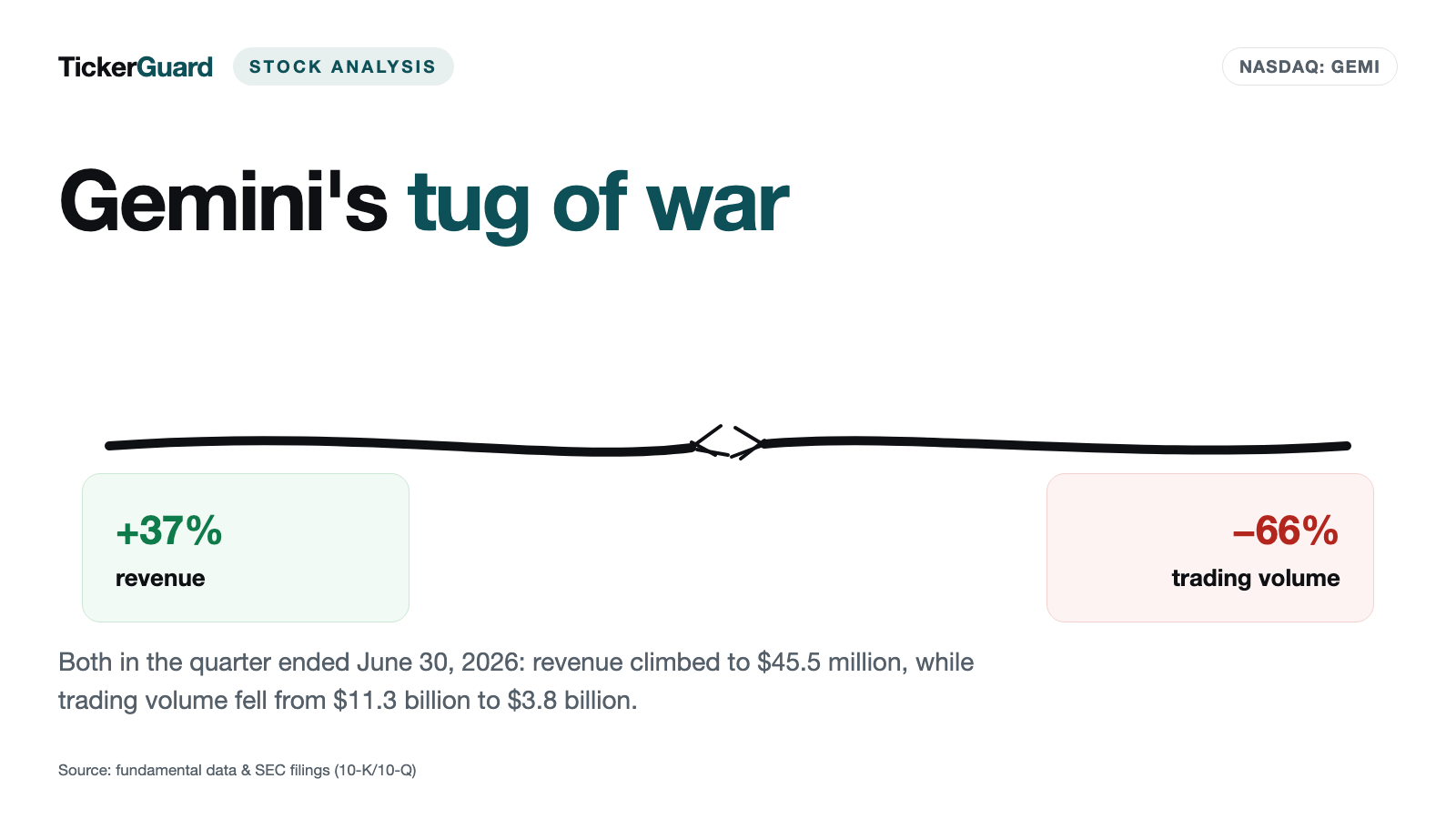
Gemini is one of the best-known names in crypto — and its stock has fallen roughly 85 percent since the IPO: from $28.00 on September 12, 2025 to $4.28 on August 21, 2026. In the quarter ended June 30, 2026 the crypto exchange simultaneously reported revenue up 37 percent, while trading volume dropped two thirds, customer balances more than halved, and $258.8 million of bitcoin borrowings from the founders' family office sit on the books, callable within a single business day. We read the quarterly report line by line to see what survives of the growth headline.
 Thomas Mücke
Founder & Publisher
Thomas Mücke
Founder & Publisher
As of Today
As of: September 17, 2026
- Closing price
- 4.40 $ +6.00%
- Market Capitalisation
- 0.6 $B
- Growth Score
- 3/10
- AAQS
- 3/10
Price change since August 21, 2026: +2.8%
This analysis has a cut-off date. The Stock Guard tells you when something material changes in the numbers. Reserve your free spot
Chart
Interactive price chart (TradingView).
52-week range: 3.50 $ to 28.10 $ · Last price: 4.40 $ (As of: September 17, 2026)
Note: pure fact-based analysis, not investment advice and not a solicitation to buy or sell. All figures without guarantee.
There is an investor trap that springs precisely when a famous company trades for the first time — call it the premiere trap. It works like this: you know the name, you know the founders, you know the story. And because you know the name, the first trading day does not feel like speculation. It feels like an invitation. Gemini Space Station, Inc. (Nasdaq: GEMI) offered exactly that on September 12, 2025: the crypto exchange built by Cameron and Tyler Winklevoss, founded in 2014, regulated in New York, known worldwide. The prospectus set the IPO price at $28.00 per share; after the underwriters' over-allotment option was exercised in full, the company placed 15,479,137 of its own shares — gross proceeds of about $433.4 million.
So let us make a deal. Before you mistake a brand for a business, we will read together what Gemini itself told the U.S. securities regulator, the SEC: the annual report (Form 10-K) for 2025, the quarterly report (Form 10-Q) for the period ended June 30, 2026, and the current reports in between. Filings like these must be truthful under penalty of law. And this one describes revenue rising 37 percent while the trading business shrinks by two thirds; a credit card that generates nearly as much loss as revenue; $258.8 million of debt owed to the founders' own family office — and a management team that declares its own controls not effective. What you make of it is up to you.
What Gemini actually does
At its core Gemini is a crypto exchange: a marketplace where retail and institutional customers buy, sell and store bitcoin, ether and other digital assets. It earns fees per trade — the more volume crosses the book, the more revenue arrives. Around that sit an OTC desk for large single transactions (over the counter, meaning trades negotiated directly between two parties rather than routed through the open order book), institutional-grade custody, staking (lending crypto to a blockchain network in return for rewards) and GUSD, a stablecoin regulated by the New York Department of Financial Services.
For several years the company has been adding new legs, quickly. There is a Gemini Credit Card, issued through partner bank WebBank, which pays crypto rewards instead of airline miles. Since December 2025 there are prediction markets ("Gemini Predictions"), where users trade contracts on the outcome of events. And since July 7, 2026 customers in eligible U.S. states can trade U.S. stocks commission-free. The ambition is stated plainly in the quarterly report: an integrated platform for money and markets.
The scale, as of June 30, 2026: roughly 580,000 monthly transacting users (year-end 2025: 601,000 — the user count has thus edged down in the first half of 2026) and $8.4 billion of assets on the platform. As of December 31, 2025 the company employed approximately 650 people worldwide; in February 2026 it announced a reduction of up to roughly 200 positions. The quarterly report as of June 30, 2026 does not disclose an updated headcount.
One point belongs at the very start because it colors everything else: Gemini has two classes of stock. The Class A shares that trade on Nasdaq carry one vote; the Class B shares, which do not trade, carry ten votes. As of August 7, 2026 there were 54,525,418 Class A and 75,126,784 Class B shares outstanding. Per the prospectus, the two co-founders held all Class B shares after the IPO, representing 94.7 percent of combined voting power; Nasdaq therefore treats Gemini as a "controlled company," which permits exemptions from certain committee independence rules. In plain terms: buying this stock buys you an economic stake, not influence.
Company history for investors
-
2025
Nasdaq IPO at $28.00 a share
On September 15, 2025 Gemini placed 15,937,501 shares after full over-allotment, of which 15,479,137 were its own (about $433.4 million gross, $406.3 million net); Nasdaq, Inc. bought $50.0 million alongside. Equity moved from negative $795.4 million to positive $540.9 million by year-end.
-
2025
Prediction markets and a futures market license
In December 2025 Gemini Predictions launched and the company secured its Designated Contract Market license. For shareholders it is the first revenue line not tied to crypto trading — initially $0.5 million a quarter.
-
2026
Exit from Europe and Australia
On February 5, 2026 Gemini announced the wind-down of the UK, EU, other European jurisdictions and Australia — up to 200 jobs and offices in London, Malta and San Francisco. Half-year cost: $7.9 million.
-
2026
Three executives leave on the same day
On February 17, 2026 the COO, CFO and chief legal officer all departed. No COO was appointed in their place and the finance role has been interim since — five months after the IPO.
-
2026
$100 million of fresh capital, paid in bitcoin
On May 14, 2026 the founders' family office subscribed for new shares worth $100.0 million, delivering 1,258 bitcoin. Because the price then fell, Gemini booked about $22.1 million of losses — the raise doubled as a price bet.
-
2026
Commission-free U.S. stock trading begins
Since July 7, 2026 U.S. customers in eligible states can trade equities without commission. For shareholders it is the attempt to break the dependence on crypto trading — the revenue contribution is still open.
-
2026
The company's own clearinghouse goes live
On August 4, 2026 Gemini brought its own clearinghouse online, following the license granted on April 29, 2026. It could settle futures and options in-house — a license stack almost no competitor holds.
How this stock landed on our desk
Not through a metrics screen in our in-house stock scanner: for a company that has only traded since September 12, 2025, momentum, trend and multi-year filters have no reliable history to work with. The trigger was the SEC filing list. On August 13, 2026 Gemini filed its quarterly report for the period ended June 30, 2026 — and that report is what put the company on our desk. It sets the growth headline and the core business volumes side by side; from those the direction of travel becomes measurable.
The second reason is the distance between expectation and outcome. The IPO price was $28.00. On August 21, 2026 the stock closed at $4.28; the preceding 52-week range ran from $3.385 to $45.89 (fundamental data, as of August 23, 2026). Roughly eleven months separate the premiere from that close. Such a gap is neither a reason to buy nor a reason to sell — it is a reason to read the filing.
We have taken apart the question of how tightly a business model can hang on the bitcoin price once before: our Metaplanet analysis covered a company whose entire result is glued to the price of the bitcoin on its balance sheet. Gemini is a different case — here it is not the balance sheet but the revenue that hangs on the crypto market. How tightly is the subject of the next chapter.
The numbers over the years — honestly credited
Start with what genuinely impresses: Gemini grows, and it has done so without interruption for years. Revenue rose from $98.1 million in 2023 to $142.2 million in 2024 and $179.6 million in 2025 — up 83 percent in two years. Monthly transacting users grew from 448,000 to 512,000 to 601,000 over the same period, and annual trading volume from $12.5 billion to $38.6 billion to $52.7 billion. The trend continued into this year: revenue of $95.7 million in the first half of 2026 against $68.6 million a year earlier.
The IPO also repaired the balance sheet. As of December 31, 2024 stockholders' equity stood at negative $795.4 million. A year later, after the offering and the conversion of convertible notes and shareholder loans into equity, it was positive $540.9 million. Alongside the $406.3 million net proceeds from the offering, Nasdaq, Inc. — the operator of the exchange itself — bought shares for $50.0 million at $26.25 apiece in a concurrent private placement.
But the loss grew faster than the revenue.
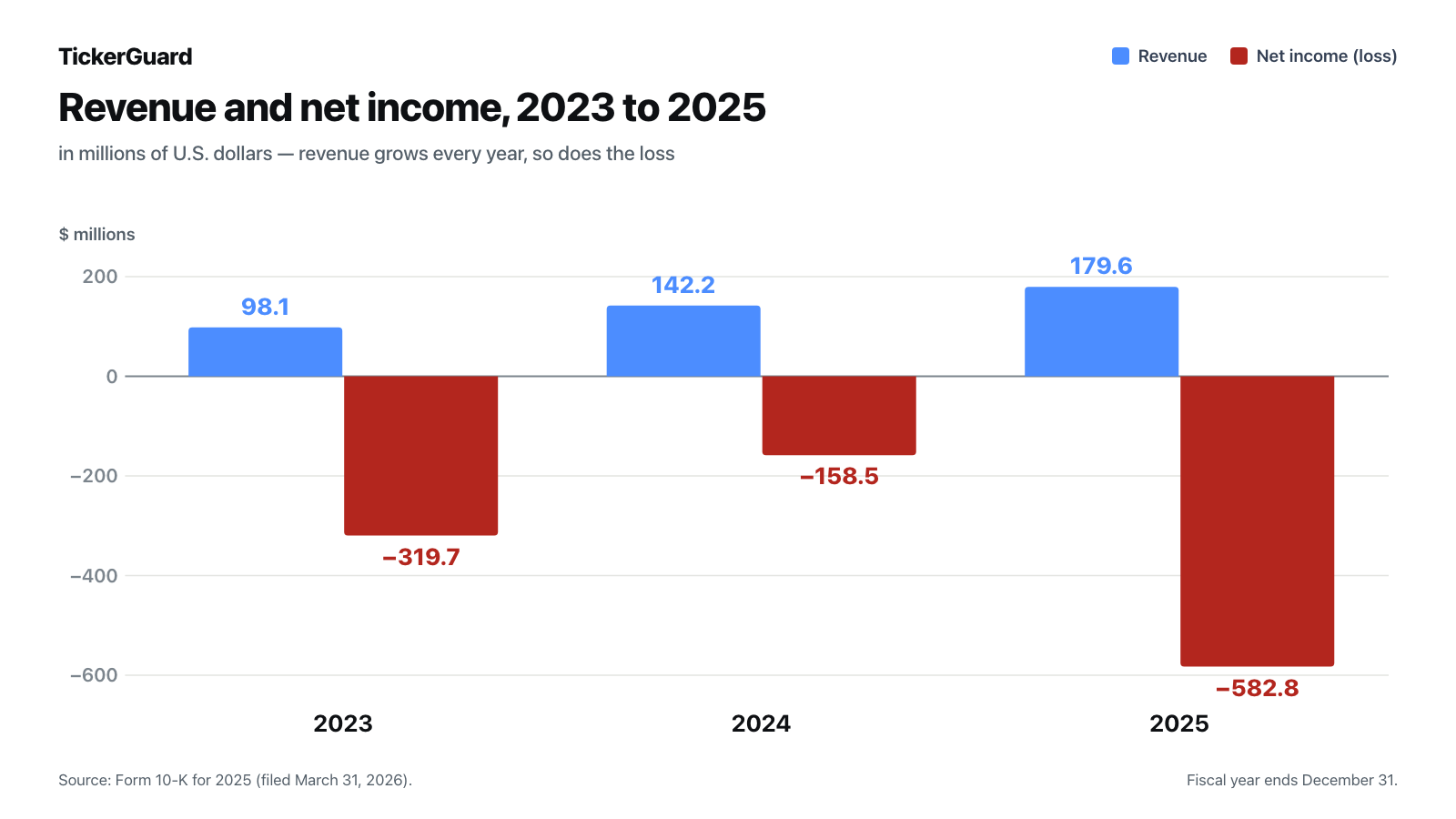
The jump in the 2025 loss is largely an accounting event: the IPO triggered heavy stock-based compensation expense, plus fair-value changes on convertible notes and shareholder loans that converted into equity at listing. That makes the company's own adjusted measure worth a look: adjusted EBITDA (earnings before interest, taxes, depreciation and amortization — roughly, what the operating business earns or burns before accounting effects). It was negative $112.3 million in 2023, negative $13.2 million in 2024 and negative $258.0 million in 2025. In other words, Gemini was close to break-even in 2024 and has moved sharply away from it since.
In the quarter ended June 30, 2026 revenue rose 37 percent to $45.5 million and the net loss narrowed 19 percent to $107.7 million, or $0.89 per share. The rebuild shows on the cost side: total operating expenses fell 15 percent sequentially, from $144.5 million to $122.4 million, and per the earnings release operating loss improved for the third consecutive quarter. Total salaries and compensation excluding stock-based compensation fell 20 percent to $27.9 million. Marketing acquisition and brand spend dropped from $9.5 million in the prior-year quarter to $63,000 — down 99 percent. That is thrift in the literal sense, and it is also a decision not to invest in growth.
Then comes the number that puts everything in place: where the new revenue is coming from.
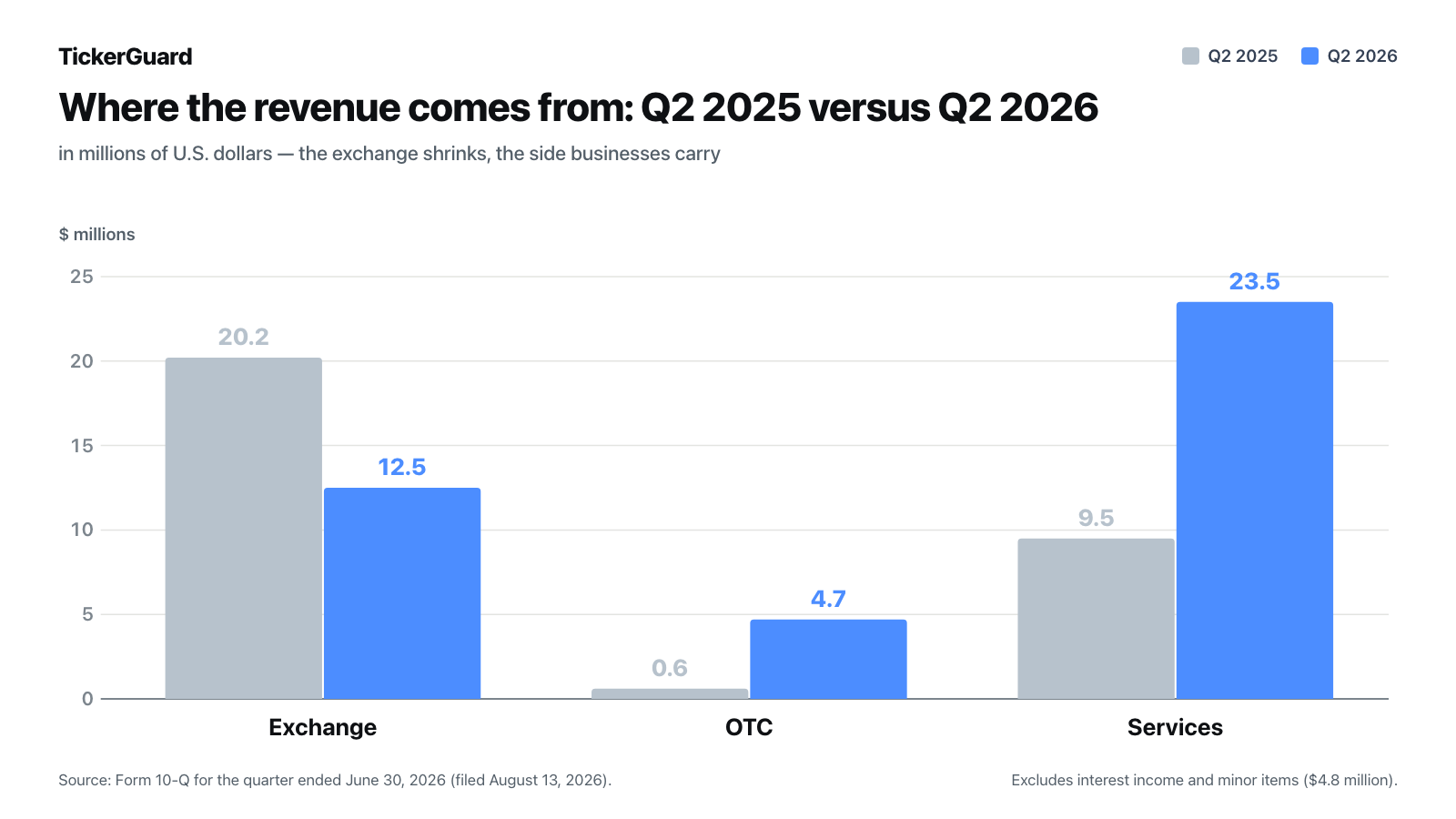
The gap to the $45.5 million of total revenue is made up of smaller items deliberately left out of the chart: $0.5 million from prediction markets, $2.4 million of interest income on the dollar reserves backing the GUSD stablecoin, $1.7 million of corporate interest on the company's own balances, and roughly $0.1 million of other transaction and other revenue — about $4.7 million in total.
What the filings say — the uncomfortable truths
Uncomfortable truth No. 1: the core business is shrinking while revenue grows
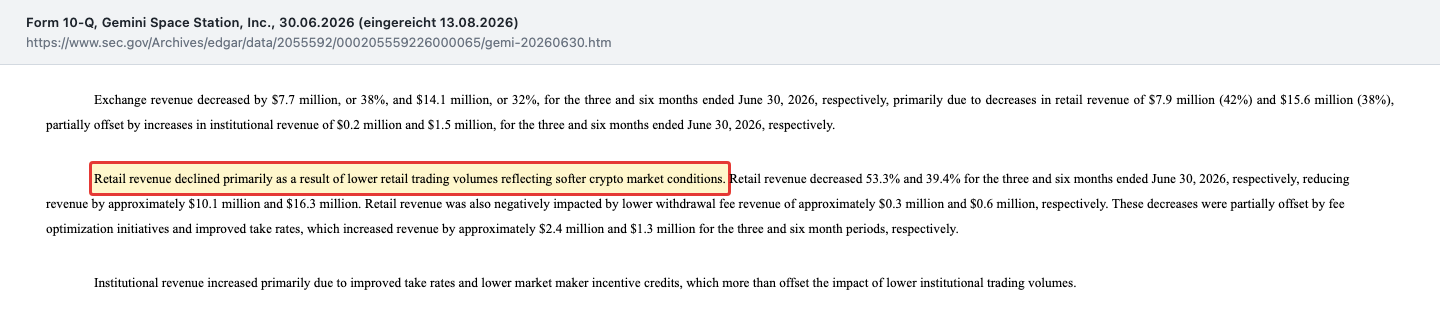
A crypto exchange earns on trading. Trading at Gemini has collapsed. In the quarter ended June 30, 2026 the platform matched $3.8 billion of trades — against $11.3 billion in the prior-year quarter, a drop of two thirds. Retail volume fell from $1.5 billion to $0.7 billion, institutional volume from $9.8 billion to $3.1 billion. Exchange revenue fell accordingly from $20.2 million to $12.5 million, down 38 percent.
"Retail revenue declined primarily as a result of lower retail trading volumes reflecting softer crypto market conditions."
— Gemini Space Station, Form 10-Q for the quarter ended June 30, 2026, "Transaction Revenue"
Assets on the platform melted too: from $18.2 billion (June 30, 2025) to $8.4 billion (June 30, 2026). Much of that reflects lower crypto prices, but not all of it — the company explicitly cites institutional custody outflows as well. Custodial fee revenue therefore fell from $1.9 million to $0.6 million, and $73.2 million flowed out of customer custodial accounts in the half year, which the filing attributes to elevated customer redemptions.
The exchange share of total revenue consequently fell from 60.8 percent to 27.5 percent in a single year. You can read that positively, as a successful broadening. You can also read it plainly: the business Gemini was built for, and that carries its brand, now accounts for barely a quarter of revenue. And part of the replacement is of questionable quality. The $2.7 million advisory fee booked in the quarter was not paid in cash but in warrants from a single strategic customer — revenue that only turns into money if the warrants are ever worth something. And the $4.7 million from the OTC desk came, per the filing, from "several large-value, client-driven transactions"; the company itself warns these levels "may not be indicative of future periods."
Uncomfortable truth No. 2: the credit card generates nearly as much loss as revenue
The single biggest contributor to growth is the Gemini Credit Card: $16.2 million of revenue in the quarter ended June 30, 2026, against $4.9 million a year earlier, up 231 percent. Right beside it sits a second number. In the same quarter Gemini booked $16.1 million of provisions for expected credit losses on card receivables — money it does not expect to get back. A year earlier the figure was $1.7 million. Add $8.2 million of crypto rewards paid to cardholders and $1.0 million of card issuance costs.
The reason for the jump is fraud. In the first quarter of 2026 Gemini set aside a discrete $4.1 million reserve for an identity fraud event — and had to add to it in the second quarter.
"… identified additional fraud patterns and affected accounts associated with the same earlier-identified fraud cohort …"
— Gemini Space Station, Form 10-Q for the quarter ended June 30, 2026, "Transaction losses"
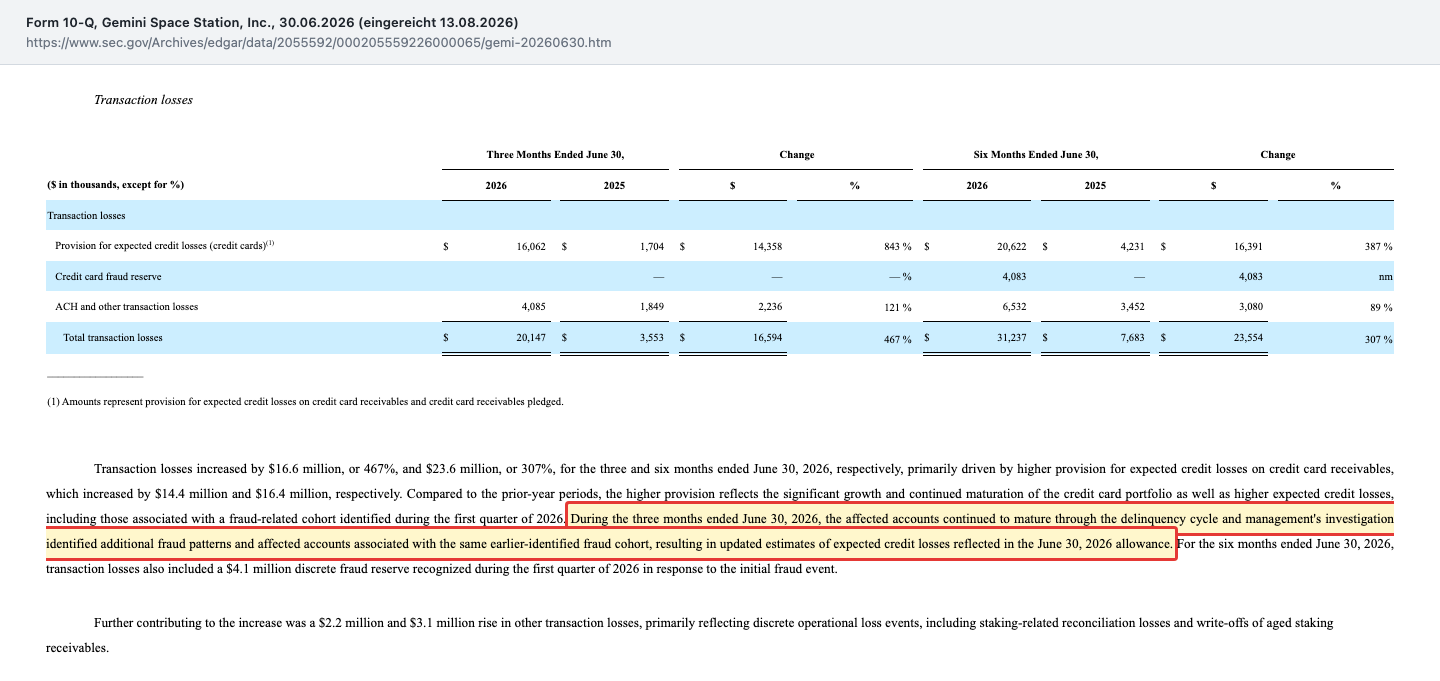
Management believes the elevated provision is concentrated in that cohort and does not signal broad deterioration; additional fraud detection has been implemented. That may well be right. The book has grown fast over the past year, rising from $93.5 million to $219.6 million — though it has been roughly flat, even slightly down, since year-end 2025 ($219.8 million). And the quarter's arithmetic stands as it is: $16.2 million of revenue against $16.1 million of provisions plus $8.2 million of rewards. A credit card is not a fee business but a lending business — you extend money to consumers and carry their default risk. Where the funding comes from is notable too: a credit facility from Ripple Labs, drawn to $146.9 million as of June 30, 2026, bearing 7.0 percent interest and secured by $185.7 million of credit card receivables.
Uncomfortable truth No. 3: $258.8 million owed to the family office — callable the same day
Gemini has borrowed bitcoin and ether from Winklevoss Capital Fund (WCF), the founders' family office, for years. The purpose is to meet regulatory capital requirements at subsidiaries and to post collateral with other lenders. As of June 30, 2026, 4,419 bitcoin were outstanding, carried at $258.8 million. The terms sit in Note 14 — and they are unusual.
"All principal loan amounts have no stated maturity date but are callable upon written notice by WCF."
— Gemini Space Station, Form 10-Q for the quarter ended June 30, 2026, Note 14

The next sentence is the real point: once called, Gemini has until the end of that same business day to return everything. For scale, unrestricted cash on the same date was $188.6 million. Repayment is in kind, in bitcoin rather than dollars — and Gemini held $331.0 million of its own crypto assets at the reporting date. The structural fact remains: the company's largest single creditor is also its controlling owner.
That entanglement has tightened this year, not loosened. On May 14, 2026 WCF subscribed for new Class A shares worth $100.0 million — paid not in cash but in 1,258 bitcoin. Because the bitcoin price then fell, Gemini booked roughly $22.1 million of realized and unrealized losses on that very holding; 988 bitcoin worth $57.9 million remained as of June 30, 2026. The capital raise was therefore also an unhedged price bet — and it is the main reason adjusted EBITDA for the second quarter of 2026 came in at negative $74.0 million, worse than the prior-year quarter's negative $51.9 million, even as revenue grew.
Uncomfortable truth No. 4: management calls its own controls not effective
Every U.S. issuer must state in every quarterly report whether its controls work. Gemini states the opposite.
"… our disclosure controls and procedures were not effective at the reasonable assurance level due to the material weaknesses in our internal control over financial reporting …"
— Gemini Space Station, Form 10-Q for the quarter ended June 30, 2026, Item 4 "Controls and Procedures"
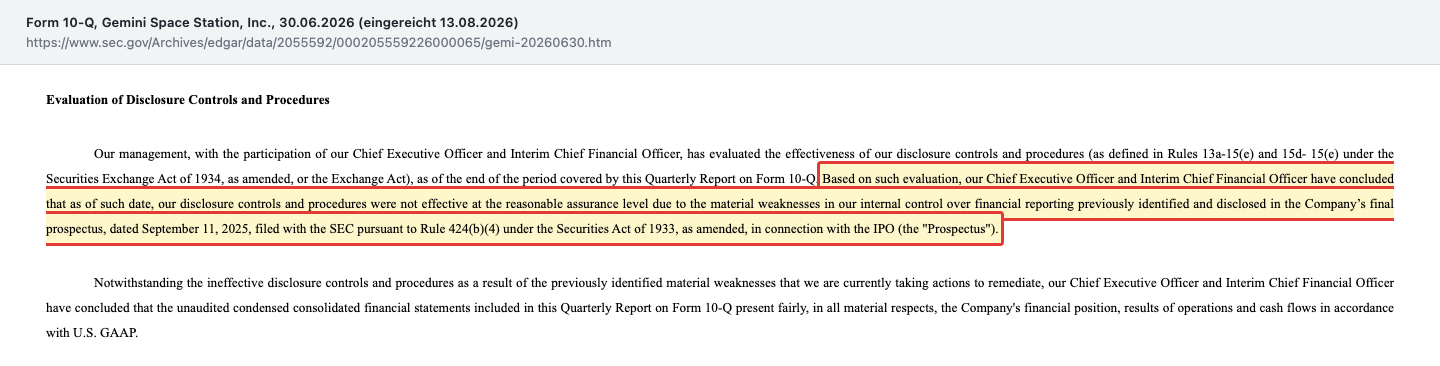
Five weaknesses were disclosed in the prospectus dated September 11, 2025 and remained unremediated as of June 30, 2026: insufficient personnel for a timely financial close, an ineffective risk assessment process that produced improperly designed controls, accounting policies not thoroughly communicated and monitored — and two that weigh especially heavily for a crypto custodian. Controls over the reconciliation of digital assets between the internal ledger and the public blockchain were not effectively designed or implemented, and neither were controls over the launch of new products, including the reconciliation of crypto held in corporate and customer accounts.
For scale: what is at stake is the traceability of $8.4 billion of customer assets. Two points belong to fairness here. First, such weaknesses are common at newly listed companies — they arise because a private business does not have the processes of a public one, and Gemini says it is working on remediation. Second, the filing explicitly states the deficiencies did not result in a material misstatement and that the quarter's statements present fairly in all material respects. This is not a scandal. It is an open construction site at the most sensitive point of the business.
Uncomfortable truth No. 5: five months after the IPO, half the leadership was gone
On February 5, 2026 Gemini announced it would wind down operations in the United Kingdom, the European Union, other European jurisdictions and Australia — including a reduction in force of roughly 200 employees and the exit of offices in London, Malta and San Francisco. Twelve days later, on February 17, 2026, came the second announcement: chief operating officer Marshall Beard, chief financial officer Dan Chen and chief legal officer Tyler Meade all departed — all three effective immediately, all three on the same day. Beard also resigned from the board, expressly without any disagreement.
No successor COO was appointed; those duties, including revenue-generating responsibilities, were assumed by Cameron Winklevoss on top of his existing role. Chief accounting officer Danijela Stojanovic was named interim CFO. The restructuring cost roughly $7.9 million in the first half of 2026 in severance, lease termination fees and impairments. It visibly relieves the running cost base — but a company that half a year after its IPO still fills the CFO chair on an interim basis, while carrying an unremediated control weakness, has little slack at exactly that spot.
Valuation: what the market pays for Gemini today
Let us work in orders of magnitude rather than decimals. As of August 7, 2026 there were 54,525,418 Class A and 75,126,784 Class B shares outstanding, roughly 129.7 million shares in total. At the closing price of $4.28 on August 21, 2026, that is a market value of about $555 million.
What does that buy? Measured against 2025 revenue of $179.6 million, the market pays a little over three times annual revenue; annualizing the first half of 2026 ($95.7 million) gives just under three times. There is no price-to-earnings ratio, because there are no earnings. Stockholders' equity stood at $468.3 million as of June 30, 2026, so the market value sits only about one fifth above book. Put differently: the market values Gemini barely above the accounting assets that remain once all debts are settled, and credits the business itself with very little on top.
A look at the funding position explains why. On the asset side as of June 30, 2026: $188.6 million of cash and $331.0 million of own crypto holdings, of which $56.8 million is held for regulatory requirements. On the liability side: $258.8 million owed to the family office, $146.9 million drawn under the Ripple facility and $75.0 million from Galaxy Digital — roughly $481 million in total. Net, only a thin surplus remains. Against that stands cash used in operating activities of $105.9 million in the first half of 2026 alone, versus $18.5 million a year earlier. The company states its resources are sufficient for at least the next twelve months, and the filing carries no going-concern qualification. Accumulated deficit stands at $2.26 billion.
And the professionals? The average analyst price target was $5.08, and short interest stood at 11.2 million shares, roughly 21.9 percent of the float (fundamental data, as of August 23, 2026). Translated: analysts see some room above, but roughly one in five tradable shares is positioned against the stock. That is unusually heavy — and a signal that the doubts about this story are not ours alone.
Upside and risks at a glance
What speaks for Gemini:
- Revenue has grown without interruption for years: $98.1 million (2023), $142.2 million (2024), $179.6 million (2025), and $95.7 million in the first half of 2026 against $68.6 million a year earlier.
- The rebuild is working on costs: operating expenses fell 15 percent sequentially to $122.4 million in the second quarter of 2026, and per the earnings release operating loss improved for the third consecutive quarter.
- The license stack is rare: a Designated Contract Market license (December 2025), a Derivatives Clearing Organization license (April 29, 2026), money transmitter licenses in all U.S. states and a New York-regulated stablecoin. The clearinghouse went live on August 4, 2026.
- The product range is broadening fast: prediction markets since December 2025 with more than 225 million contracts traded cumulatively and volume up 93 percent quarter over quarter, plus commission-free U.S. stock trading since July 7, 2026.
- The balance sheet is positive again after the IPO: equity moved from negative $795.4 million (December 31, 2024) to positive $468.3 million (June 30, 2026), with no going-concern qualification in the filing.
What speaks against it:
- The core business is shrinking: quarterly trading volume from $11.3 billion to $3.8 billion, exchange revenue from $20.2 million to $12.5 million, assets on platform from $18.2 billion to $8.4 billion.
- The new growth is expensive: $16.2 million of card revenue against $16.1 million of credit loss provisions and $8.2 million of crypto rewards; $2.7 million of advisory revenue was paid in warrants.
- Disclosure controls were not effective as of June 30, 2026 — five weaknesses known since the prospectus, including the reconciliation of digital assets against the blockchain.
- $258.8 million of liabilities to the founders' family office carry no maturity and are callable within a single business day, against $188.6 million of cash.
- Cash used in operating activities rose to $105.9 million in the first half of 2026, from $18.5 million a year earlier.
- The founders hold roughly 94.7 percent of voting power through the Class B shares (per the prospectus); Gemini is a controlled company and may opt out of certain Nasdaq committee independence rules.
- Leadership gap: the COO, CFO and chief legal officer all left on February 17, 2026; the CFO role has been interim since, and no COO was appointed.
A human conclusion
Back to the premiere trap. Its core is not that Gemini is a bad company — it is a regulated, licensed house with more than ten years of history and one of the best-known brands in its industry. Its core is that a premiere says nothing about a business. On September 12, 2025 you paid $28.00 for a name and a narrative. What you actually bought showed up eleven months later in a 150-page quarterly report: an exchange whose trading volume has fallen to a third, a credit card business that pays back its own growth in loss provisions, and a balance sheet whose controlling owners are also its biggest creditor.
You can read two entirely opposite stories out of this, and both are evidenced. One: a company mid-rebuild, cutting costs, improving operating results for a third straight quarter, assembling a derivatives, clearing and equities license stack that lays the foundation for something larger — valued at barely more than book. The other: a crypto exchange losing volume and share in the crypto business, plugging the shortfall with side businesses of unproven quality, while its own controls are declared not effective.
So the honest question is not "is Gemini cheap?" It is: do you trust a house that cannot yet put effective controls behind its own numbers to build a financial super app — at the pace its cash position dictates? If yes, you get an option on a rare license stack at roughly book value. If no, you understand why one in five tradable shares is positioned against it. What you make of it is your decision. And that is exactly as it should be.
Sources
- Form 10-Q for the quarter ended June 30, 2026, Gemini Space Station, Inc., filed August 13, 2026 (CIK 0002055592)
- Q2 2026 earnings release, Exhibit 99.1 to the Form 8-K of August 13, 2026
- Form 10-K for 2025, filed March 31, 2026
- Form 8-K of February 17, 2026, Item 5.02 (departure of the COO, CFO and chief legal officer)
- Form 424B4 prospectus (dated September 11, 2025; filed with the SEC on September 15, 2025 — IPO price of $28.00, voting power split, concurrent private placement with Nasdaq, Inc.)
- Source: fundamental data & SEC filings (annual and quarterly reports, 10-K/10-Q) — price, valuation and short interest data as of August 23, 2026
Journalistic analysis, not investment advice and not a solicitation to buy or sell securities. Stocks can lose their entire value; that applies with particular force to a recent listing in a cyclical market. All figures come from the sources named above and carry the as-of dates stated there. The author holds no position in Gemini Space Station, Inc. at the time of publication.
Key figures at a glance
All monetary figures in millions of $; earnings per share as reported.
| Metric | 2023 | 2024 | 2025 |
|---|---|---|---|
| Revenue | 98.1 | 142.2 | 146.2 |
| Operating Income (EBIT) | -311.6 | -165.8 | -524.2 |
| Net Income | -319.7 | -158.5 | -582.8 |
| Net Margin | -325.7% | -111.5% | -398.7% |
| Earnings Per Share | -2.03 $ | -0.99 $ | -4.97 $ |
Source: fundamental data & SEC filings (annual and quarterly reports, 10-K/10-Q)
Our Bottom Line at a Glance
- Growth positive
- Revenue rose from $98.1 million (2023) to $142.2 million (2024) and $179.6 million (2025), and in the first half of 2026 to $95.7 million from $68.6 million a year earlier. Monthly transacting users grew to 580,000 as of June 30, 2026 from 523,000 a year before.
- Core business negative
- In the quarter ended June 30, 2026 exchange trading volume fell from $11.3 billion to $3.8 billion, exchange revenue from $20.2 million to $12.5 million and assets on platform from $18.2 billion to $8.4 billion. The exchange share of total revenue dropped from 60.8 percent to 27.5 percent.
- Quality of the new revenue negative
- The $16.2 million of credit card revenue in the quarter ended June 30, 2026 sits against $16.1 million of credit loss provisions after a fraud cohort and $8.2 million of crypto rewards. The $2.7 million advisory fee was paid in warrants, and the company itself flags the $4.7 million of OTC revenue as potentially not repeatable.
- Controls and reporting negative
- As of June 30, 2026 management classifies disclosure controls as not effective, citing five material weaknesses known since the prospectus of September 11, 2025 — including the reconciliation of digital assets between the internal ledger and the blockchain. Per the filing, no material misstatement resulted.
- Funding and dependencies negative
- Cash of $188.6 million and own crypto holdings of $331.0 million (June 30, 2026) against roughly $481 million of financial liabilities, $258.8 million of which is owed to the founders' family office with no maturity and callable within one business day. Cash used in operating activities in the first half of 2026: $105.9 million against $18.5 million.
- Cost rebuild positive
- Operating expenses fell 15 percent from the first to the second quarter of 2026, from $144.5 million to $122.4 million, and total salaries and compensation excluding stock-based compensation fell 20 percent to $27.9 million. Per the earnings release of August 13, 2026, operating loss improved for the third consecutive quarter.
Gemini is one of the best-known crypto brands in the world and has traded on Nasdaq since September 12, 2025. Revenue is growing — $45.5 million in the quarter ended June 30, 2026, up 37 percent — yet the core business is shrinking: trading volume fell from $11.3 billion to $3.8 billion and assets on platform from $18.2 billion to $8.4 billion. The new growth comes from a credit card whose loss provisions almost matched its revenue in the same quarter, from an OTC desk the company itself calls potentially not repeatable, and from an advisory fee paid in warrants. On top of that sit $258.8 million of bitcoin loans from the founders' family office, callable within one business day, and disclosure controls management itself calls not effective as of June 30, 2026. Not investment advice.
What Our Rating Means
Substance risk
We found at least one documented issue that threatens the company itself — regardless of how the stock is currently valued.
The red rating here is not about the share price and not about the valuation. It rests on two evidenced findings that touch the substance of the business. First, as of June 30, 2026 the CEO and interim CFO themselves classify disclosure controls as not effective, citing five material weaknesses unremediated since the prospectus of September 11, 2025 — including, of all things, the reconciliation of digital assets between the internal ledger and the blockchain. For a house safeguarding $8.4 billion of customer assets that is not a footnote; it is the core control of the business. Second, $258.8 million of the financial liabilities are owed to the founders' family office, with no stated maturity, callable at any time and repayable by the end of the same business day — against $188.6 million of unrestricted cash. A good deal argues against the rating, and it belongs on the record: stockholders' equity is clearly positive at $468.3 million, the filing carries no going-concern qualification, management considers its resources sufficient for at least twelve months, revenue is growing and operating results have improved for a third consecutive quarter. Where the evidence sits between two levels, the more cautious one applies — and here a core business whose volume has fallen to a third in a single year comes on top of the control and dependency findings. The decision is yours.
A journalistic assessment by our editorial team at the time of the deep dive, based on public sources — not investment advice and not a solicitation to buy or sell. Your personal circumstances (investment goals, risk capacity, taxes) cannot be taken into account. What our levels mean, how verdicts are formed, and what conflicts of interest exist →
Worth Noting
- Gemini reached our research list through the SEC filing list: the trigger was the quarterly report for the period ended June 30, 2026, filed on August 13, 2026. Metrics screens in our in-house stock scanner do not yet apply to a stock that has only traded since September 12, 2025.
- Risk of confusion: "Gemini" is also the name of a well-known AI product family from a U.S. technology group, and a zodiac sign. This analysis refers exclusively to the crypto exchange Gemini Space Station, Inc. (Nasdaq: GEMI, CIK 0002055592), headquartered in New York.
- Two share classes: the market value of about $555 million refers to all 129.7 million shares (Class A and Class B) at the closing price of August 21, 2026. Counting only the 54.5 million traded Class A shares produces a far smaller number — and omits 58 percent of the capital.
- Analyses are written to stay valid: every figure carries its own as-of date. Price, valuation and short interest data are as of August 23, 2026 and are not a reason to buy.
Stock Watch
This analysis is as of September 5, 2026. Stock Watch will tell you what's changed at GEMI since then.
Later $1 a month per stock — signing up is free, and you'll be the first to know when it launches.
The full analysis as a PDF for later
We will send you this analysis as a PDF — to print, file away, and read at your own pace. And we will add you to the free Stock Watch list for Gemini Space Station, Inc. (GEMI), so you hear about it when something material in this analysis changes.
Frequently Asked Questions
Gemini Space Station, Inc. (Nasdaq: GEMI), headquartered in New York, runs a crypto exchange for retail and institutional customers. Around it sit an OTC desk for large single trades, institutional custody, staking, the New York-regulated stablecoin GUSD, a credit card paying crypto rewards, prediction markets launched in December 2025 and, since July 7, 2026, commission-free U.S. stock trading. The company was founded in 2014 by Cameron and Tyler Winklevoss.
The IPO priced on September 11, 2025 and the stock began trading on Nasdaq under the symbol GEMI on September 12, 2025. The offer price was $28.00 per Class A share; per the 10-K for 2025, after the underwriters exercised their over-allotment option in full, a total of 15,937,501 shares were placed, of which 15,479,137 were sold by the company — gross proceeds to Gemini of about $433.4 million (net $406.3 million). Nasdaq, Inc. concurrently bought shares worth $50.0 million at $26.25 apiece. On August 21, 2026 the stock closed at $4.28.
Because the growth comes from elsewhere. In the quarter ended June 30, 2026 exchange revenue fell from $20.2 million to $12.5 million. At the same time credit card revenue rose from $4.9 million to $16.2 million, OTC revenue from $0.6 million to $4.7 million, and an advisory fee paid in warrants contributed $2.7 million. The exchange share of total revenue therefore dropped from 60.8 percent to 27.5 percent.
The net loss was $582.8 million in fiscal 2025 and $216.7 million in the first half of 2026. The more telling figure is cash used in operating activities: $105.9 million in the first half of 2026 against $18.5 million a year earlier. Against that stood $188.6 million of cash and $331.0 million of own crypto holdings as of June 30, 2026. The company states its resources are sufficient for at least twelve months; the filing carries no going-concern qualification.
There are two share classes: the Class A stock traded on Nasdaq carries one vote, the untraded Class B stock ten votes. As of August 7, 2026 there were 54,525,418 Class A and 75,126,784 Class B shares outstanding. Per the prospectus, founders Cameron and Tyler Winklevoss held all Class B shares after the IPO, representing 94.7 percent of combined voting power. Nasdaq therefore treats Gemini as a controlled company.
In the Form 10-Q for the quarter ended June 30, 2026 the CEO and interim CFO classify disclosure controls as not effective, citing five material weaknesses already disclosed in the prospectus dated September 11, 2025. Two of them concern the reconciliation of digital assets between the internal ledger and the blockchain. The filing also records that no material misstatement resulted from the deficiencies.
To meet regulatory capital requirements at its subsidiaries and to post collateral with other lenders. As of June 30, 2026, 4,419 bitcoin borrowed from Winklevoss Capital Fund were outstanding, carried at $258.8 million, at fees between 4.0 and 5.0 percent. These loans have no stated maturity but are callable at any time, and must then be returned by the end of the same business day.
Found an error?
Did you spot a factual error, an outdated number, or a typo in this deep dive? Let us know briefly — your report goes straight to the editorial team.