Espey: 98 Years Old, Record Margins — and a Crack in the Order Book
Espey Mfg. & Electronics (NYSE American: ESP) has built power supplies for the military since 1928 out of a single plant in Saratoga Springs — and the stock ran from its 52-week low of $35.5 to as high as $74.5. The quarterly report as of March 31, 2026 shows why: gross margin climbed to a record 37.0 percent, and cash swelled to $46.7 million. At the same time, new orders fell 60 percent in nine months, and six customers account for 74 percent of revenue. Not investment advice — just the question of whether you judge a stock by its latest quarter or by its order book.
 Thomas Mücke
Founder & Publisher
Thomas Mücke
Founder & Publisher
As of Today
As of: October 9, 2026
- Closing price
- 60.00 $ +0.60%
- Market Capitalisation
- 0.2 $B
- P/E
- 15.6
- Growth Score
- 6/10
- AAQS
- 5/10
Price change since August 26, 2026: -4.7%
This analysis has a cut-off date. The Stock Guard tells you when something material changes in the numbers. Reserve your free spot
Chart
Interactive price chart (TradingView).
52-week range: 36.40 $ to 72.20 $ · Last price: 60.00 $ (As of: October 9, 2026)
Note: pure fact-based analysis, not investment advice and not a solicitation to buy or sell. All figures without guarantee.
There is an investor trap that shows up best in the rearview mirror: you look at a stock chart that has more than doubled within a year — from $35.5 to $74.5 (52-week range, data as of August 26, 2026) — and something in your head immediately whispers FOMO, the fear of missing an "overlooked gem." At a 98-year-old company out of a small city in upstate New York, that feeling is especially seductive: no hype, no meme-stock ticker on Reddit, just a solid, unglamorous manufacturer suddenly posting record margins. Espey Mfg. & Electronics Corp. (NYSE American: ESP) of Saratoga Springs looks exactly like that find. So let's make a deal before you buy the "hidden gem" story: we read together the latest quarterly report (10-Q) as of March 31, 2026, the annual report (10-K) for 2025, and the mandatory filings from the past twelve months — documents filed, under penalty of law, with the U.S. securities regulator, the SEC. The record margin really is there, in black and white. But right next to it is the fact that new orders fell 60 percent in nine months, and six customers account for three-quarters of revenue. In the end, the decision is yours.
What Espey Actually Makes
Espey Mfg. & Electronics Corp. was founded in 1928 in the state of New York — nearly a century of company history before anyone talked about military electronics as a stock market theme. Its headquarters and its only plant sit at the same address to this day: 233 Ballston Avenue in Saratoga Springs, New York, a single building with more than 174,000 square feet (about 16,200 square meters) of manufacturing space — free and clear, no mortgage. Translated into an everyday picture: Espey is not a conglomerate with plants on three continents, it is a single factory floor that has stood in the same spot for nearly a hundred years. There the company builds power supplies, power converters, filters, power transformers, magnetic components, power distribution units, uninterruptible power supplies (UPS) and antennas — components you never see because they sit inside radar systems, warships and locomotives. Customers are almost entirely the U.S. military, other U.S. government agencies, defense contractors and foreign governments; a small slice of the business goes to the rail industry. Nearly all contracts are fixed-price — Espey quotes a price up front and then bears the risk itself if materials or labor cost more than planned.
The company employed 152 people as of August 31, 2025, about a third of them unionized (IBEW). At the top since January 1, 2022 sits David A. O'Neil as President & CEO — not an outsider, but someone who has known the company's numbers for decades: he had been CFO and Treasurer of the firm since January 4, 2000, before that at the accounting firm KPMG. His new employment agreement dated September 8, 2025 sets a base salary of $400,000 and a bonus of up to $250,000. Since February 15, 2025, Kaitlyn O'Neil has served as Principal Financial Officer — and yes, the shared surname is not a typo, but it is not a family dynasty either: the 2025 proxy statement explicitly states the two are not related. One more detail for continuity rather than drama: longtime auditor Freed Maxick merged with a larger firm in 2025, and since then Withum has audited the books — a change through merger, not a falling-out (mandatory filing 8-K dated October 1, 2025). Finally, the employee stock ownership plan (ESOP) has held a sizable block of shares since 1989; combined with management, insiders and the ESOP control about 23 percent of the shares (data as of August 26, 2026).
That names the central tension of this analysis, and it runs through every chapter: Espey is earning more than it ever has, sitting on a mountain of cash — and at the same time carries an order book that has grown noticeably thinner within a year, concentrated on a handful of customers. Full cash register, thinner order book.
Company history for investors
-
1928
Founded in Saratoga Springs
Espey begins operations — nearly a century later, the same company still builds military power supplies at the same location.
-
2022
David O'Neil becomes CEO
The longtime CFO takes over leadership — an internal transition rather than a restart under an outside course.
-
2023
Dividend returns after suspension
The dividend cut during the downturn is reinstated — a signal that management again views the balance sheet as sound.
-
2023
First Navy grant: $7.4 million
The U.S. Navy pays for part of Espey's plant modernization — the start of a close, but also dependency-creating, partnership.
-
2025
Record new orders of $86.4 million
Two large contracts totaling $49.4 million drive the best order year in company history — the comparison base for the later collapse.
-
2025
Special dividend of $0.75
Part of the fat cash pile flows back to shareholders, on top of the regular $0.25 quarterly dividend.
-
2026
Quarterly report with a raised forecast
Management raises its profit forecast mid-year — while new orders in the same report fell 60 percent.
Where This Stock Landed on Our Desk
The hook for this analysis is simply the latest mandatory filing: on May 12, 2026, Espey filed its quarterly report (10-Q) for the third quarter of fiscal year 2026 (the period through March 31, 2026) with the U.S. securities regulator, the SEC — and the report delivered two headlines at once. First, gross margin climbed to 37.0 percent, a record, well above the 28.6 percent of the year-ago quarter. Second, net income for the quarter rose 68 percent to $2,864,662. No surprise the stock ran from its 52-week low of $35.5 up to $74.5 in the months that followed (data as of August 26, 2026) — more than a doubling. Whoever reads only the headline sees a success story. Whoever reads the whole report also sees that nine-month revenue, at $32.7 million, came in slightly below the prior-year figure of $34.4 million — per management's discussion and analysis (MD&A), simply the timing of shipment milestones and unit volumes, not a trend break. This exact combination of record margin and a shrinking order book is what makes Espey a case you should judge by the footnotes, not the stock chart. Two smaller U.S. military-electronics makers where we've done the same exercise are BK Technologies and Astronics — both show how differently "small, profitable, government customer" can feel in practice.
The Numbers Over the Years
First, what genuinely impresses. Over five fiscal years, Espey has grown from a barely profitable small manufacturer into a solid margin compounder: revenue rose from $27.7 million (fiscal year 2021) through $32.1 million (2022), $35.6 million (2023) and $38.7 million (2024) to $43.9 million in fiscal year 2025. More important than revenue growth is the margin trend: gross margin climbed over the same period from 12.1 percent through 17.0, 22.6 and 27.5 percent to 28.9 percent — and, as shown above, all the way to 37.0 percent in the third quarter of the current fiscal year 2026. Net income turned from a small loss (-$0.2 million, 2021) through $1.3 million, $3,677,131 and $5,815,140 (2024) to $8.1 million in fiscal year 2025 — operating cash flow that year was $21.0 million.
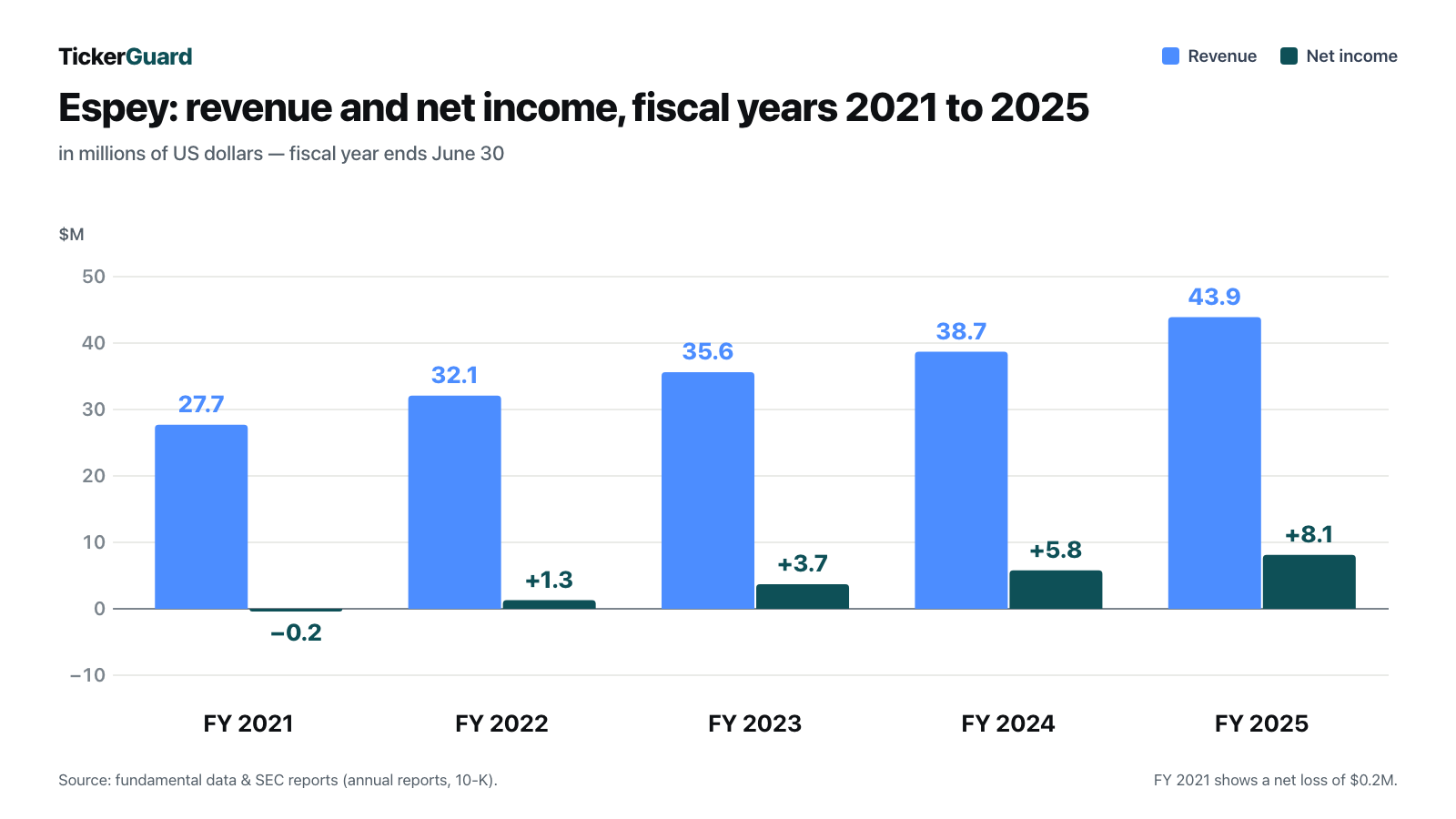
On a nine-month basis for the current fiscal year 2026 (through March 31, 2026), net income stands at $7,839,607 — up 50 percent from $5,211,303 in the year-ago period, on nearly unchanged revenue ($32.7 million versus $34.4 million). The balance sheet is just as impressively tidy: cash and short-term securities totaled $46.7 million as of March 31, 2026 — not a single dollar of bank debt sits against it, and a $3 million credit line was renewed in February 2026 but has not been drawn in the past two fiscal years. Equity grew from $50.8 million (June 30, 2025) to $56.4 million. But before the euphoria takes over: it's exactly in these numbers — and in what sits behind the margin — that the uncomfortable truths below live.
What the Filings Say: The Uncomfortable Truths
Uncomfortable truth No. 1: new orders fell 60 percent in nine months
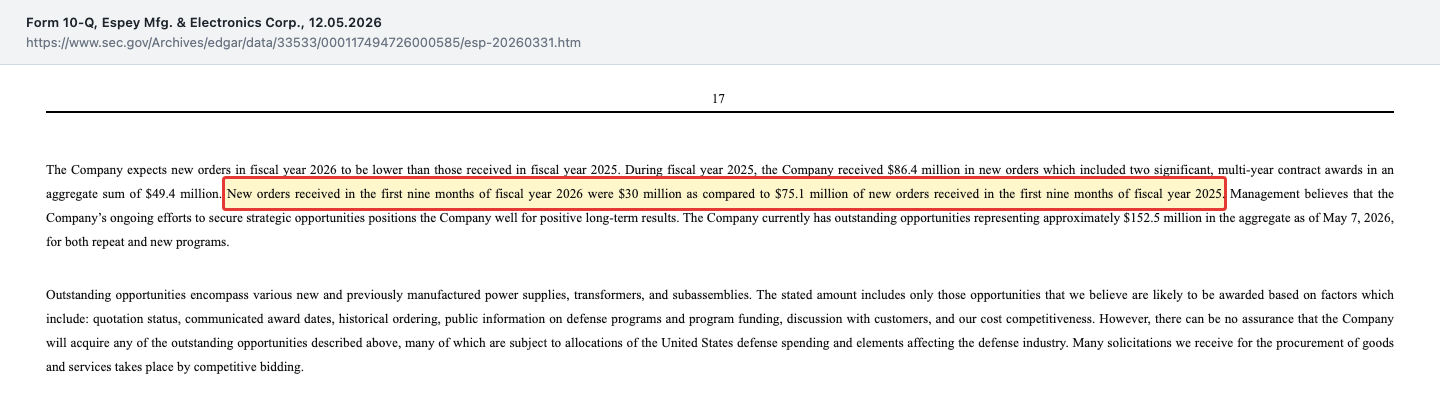
A 37 percent gross margin is impressive — but a margin says nothing about how full the order book is for the years ahead. And that is exactly where the quarterly report turns uncomfortable: in the first nine months of fiscal year 2026, Espey booked new orders of $30.0 million — in the year-ago period it was $75.1 million. That is a 60 percent decline. The order backlog itself has barely reacted so far: as of March 31, 2026 it stood at $137.1 million, barely below the $138.0 million a year earlier — the old large orders simply keep running off while new supply stalls. For context: the entire fiscal year 2025 brought in $86.4 million in new orders — the highest level in years — including two multi-year contracts totaling $49.4 million — large orders of that kind don't land every year, and their absence explains part of the decline. Management itself expects new orders below the 2025 level for fiscal year 2026. The pipeline of possible future orders — labeled "outstanding opportunities" in the filing — also sits lower, at about $152.5 million (as of May 7, 2026), versus about $163 million as reported in the annual report as of August 31, 2025.
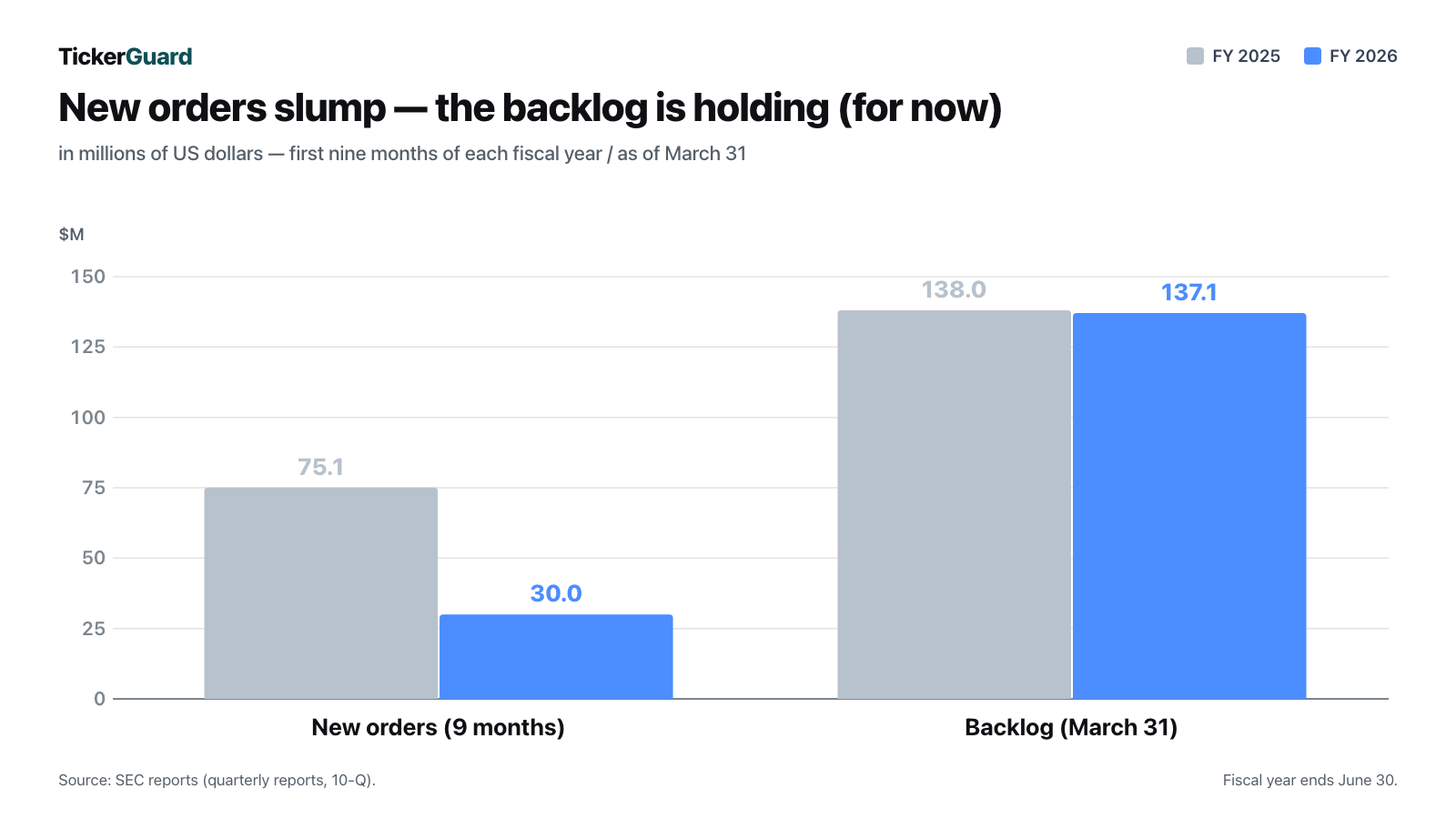
Translated into an everyday picture: imagine a custom carpenter whose workshop is stacked to the rafters with already-paid-for orders — but whose storefront shows far fewer new customers walking in this year. He still has plenty to do, but the question of what sits in the workshop two years from now is suddenly open. That is exactly Espey's position: the order backlog still holds, but the new supply is stalling.
Uncomfortable truth No. 2: six customers are three-quarters of revenue — and three customers are two-thirds of the backlog
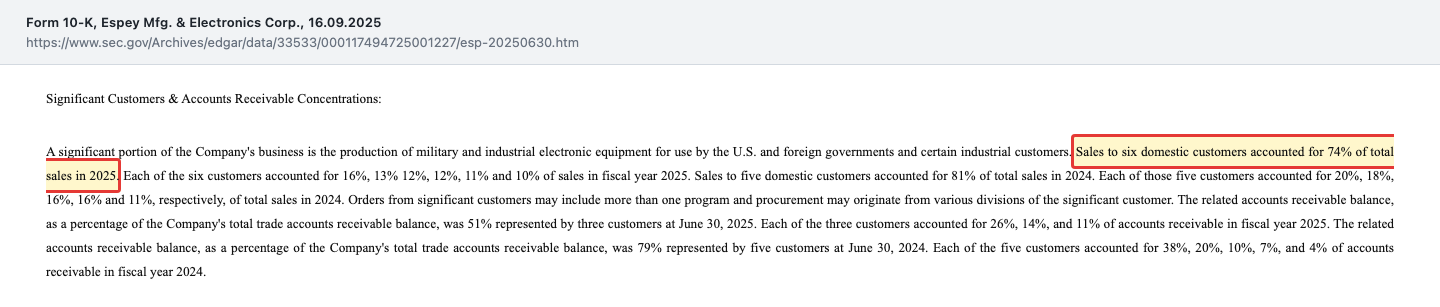
The second uncomfortable finding sits in the notes to the 2025 annual report: in fiscal year 2025, 74 percent of revenue came from just six domestic customers (with shares of 16, 13, 12, 12, 11 and 10 percent) — the year before it was even higher, at 81 percent spread across five customers. The order backlog is even more concentrated: of the $137.1 million backlog as of March 31, 2026, $92.7 million comes from just three customers (prior year: $97.7 million from three customers) — nearly two-thirds of the entire order book. In fairness: these customers are mostly defense contractors, the U.S. Department of Defense and other U.S. government agencies — this is not a concentration risk tied to one financially shaky mid-size company, it is a bet on the creditworthiness of the U.S. government. Still, the everyday comparison applies: if your neighbor told you his small trade business was thriving, but three clients accounted for two-thirds of his books — would you pause? If any one of those three large customers drops out, delays a contract or cuts a budget, that is not a side issue, it's a core risk.
Uncomfortable truth No. 3: part of the record profit comes from interest and lower taxes, not the factory floor
Now to earnings quality — and here it pays to not let the $7.8 million nine-month profit stand unadjusted. First: Espey's fat cash pile throws off interest on its own. In the first nine months of fiscal year 2026 the company booked $1,311,366 in interest income (year-ago period: $852,544) — that is roughly 14 percent of pretax income of $9,464,773. That money isn't earned by the factory floor, it's earned by the bank account. Second, the effective tax rate fell to 17.2 percent (nine-month basis, prior year about 18.3 percent) — mainly due to tax benefits from exercised stock options and dividends on ESOP shares; that too lifts reported earnings per share without a single additional power supply being sold. In fairness, there is a counterpoint: operating income (EBIT) rose 70 percent in the third quarter to $2,983,370 (prior year $1,751,122) — and the quarterly report discloses no special items. So the core of the increase is real, driven by product mix and manufacturing efficiency, not a one-time gain. What looks notably weaker, though: nine-month operating cash flow fell from $18.2 million to just $6.3 million — because Espey built up inventory sharply ($26.6 million versus $17.8 million as of June 30, 2025), partly offset by higher customer prepayments. Espey's customers are increasingly paying an upfront share of production: so-called contract liabilities climbed from $22.9 million to $33.5 million, up 46 percent. Remember the picture: operating profit is largely real — but "interest plus tax benefit" is not a law of nature, and it can reverse once the cash pile shrinks or interest rates fall.
The Navy grant: an opportunity and a dependency signal at once
One finding fits neither the "good" nor the "bad" box, but both at once: Espey has received two government grants in recent years totaling $10.8 million — $7.4 million in fiscal year 2023, another $3.4 million in the second quarter of fiscal year 2025. For comparison: that is roughly 21 percent of equity as of June 30, 2025 and about 6 percent of today's market capitalization — a substantial sum for a company this size. The quarterly report explains the purpose:
"The awards received by the Company are in support of facility and capital equipment upgrades for testing and qualification for the United States Navy."
— Espey Mfg. & Electronics Corp., SEC quarterly report 10-Q as of March 31, 2026, Liquidity and Capital Resources section
The grants are part of a larger Navy program:
"These funding awards are part of the Navy's investment to improve and sustain the Surface Combatant Industrial Base."
— Espey Mfg. & Electronics Corp., SEC quarterly report 10-Q as of March 31, 2026, Liquidity and Capital Resources section
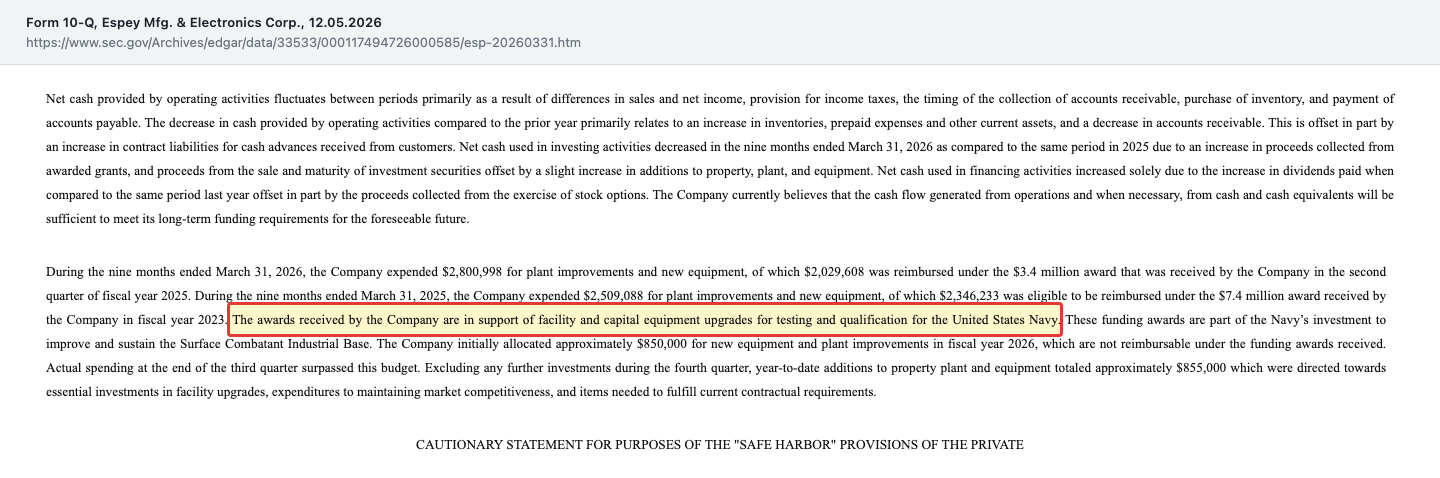
In practical terms: in the first nine months of fiscal year 2026, Espey invested $2,800,998 in capital equipment, of which $2,029,608 was reimbursed from the $3.4 million grant — the company's own share was about $855,000. The opportunity: the U.S. Navy is paying for part of Espey's own factory modernization, which saves capital and deepens the relationship with its most important customer group. The dependency signal: when a supplier is embedded so tightly in a government investment program that the Navy even helps finance its test equipment, it is no longer an interchangeable vendor — but it is also no longer independent of that one customer's budget decisions.
On the margins, without dramatizing it: in June 2026 several executives and directors sold shares tied to option exercises — CEO O'Neil sold about 2,500 shares at $67.71 on June 22, 2026, along with smaller sales by CHRO Pickering, Director Corr and Director Helmetag in May and June 2026. Combined, that is well under 1 percent of shares outstanding — a common pattern after a stock doubling, not an alarm signal, but also not buying.
What Management Promises — and What Comes True
At most companies this size, you would now turn to the transcript of the last earnings call. At Espey there isn't one: the company holds no earnings calls — no conference calls, no analyst Q&A, not even a separate earnings press release (8-K) for its quarterly results. The only forecast source is the written "Business Outlook" section in the annual and quarterly reports. That makes this section all the more important — and comparing promise to outcome all the more revealing.
In the annual report for fiscal year 2024 (filed September 27, 2024), management wrote:
"Management expects revenues in fiscal year 2025 to be higher than revenues recognized during fiscal year 2024 and expects net income per share to exceed fiscal 2023 reported results, however net income per share is anticipated to fall below fiscal 2024 results."
— Espey Mfg. & Electronics Corp., SEC annual report 10-K for fiscal year 2024, Business Outlook
The outcome: revenue did rise, to $43.9 million — well above the $38.7 million booked in fiscal year 2024, the baseline the forecast set out to beat. But on profit, management undersold itself badly: instead of falling below the prior year ($5.8 million), net income for 2025 climbed to $8.1 million — well above what its own forecast had implied. The same caution showed up around new orders: the 2024 report only pointed to new orders above the then-current level of $52.4 million — actual new orders in 2025 came in at $86.4 million — the highest level in years. A clear pattern: underpromise, then overdeliver.
A year later, in the annual report for 2025 (filed September 16, 2025), the same cautious tone repeated for the current fiscal year 2026:
"Management expects revenues in fiscal year 2026 to be higher than revenues recognized during fiscal year 2025. Net income per share is anticipated to fall below fiscal 2025 results..."
— Espey Mfg. & Electronics Corp., SEC annual report 10-K for fiscal year 2025, Business Outlook
Eight months later, in the quarterly report dated May 12, 2026, the tone shifted mid-year — a forecast raise, not a repeat of the caution:
"Further, management believes that net income for fiscal year 2026 will exceed net income from fiscal year 2025."
— Espey Mfg. & Electronics Corp., SEC quarterly report 10-Q as of March 31, 2026, Business Outlook
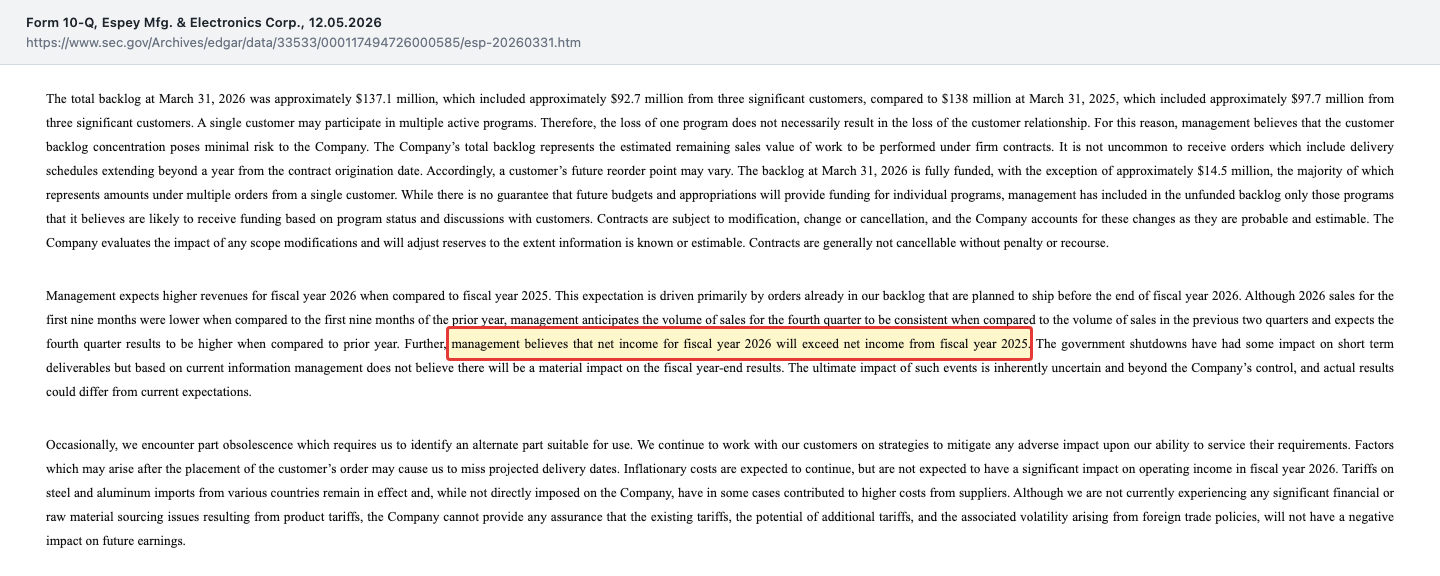
The math supports it: nine-month profit of $7.8 million was already close to the full fiscal year 2025 level (8.1 million) at the time of this raise. The report also notes that U.S. government shutdowns had "some impact on short term deliverables," but no material full-year effect is expected. What is missing here and must stay evergreen: the annual report (10-K) for the fiscal year that ended June 30, 2026 had not yet been filed as of this analysis — it is expected in September 2026 (in prior years it arrived September 16 and September 27, respectively). Whether the raised forecast comes true, nobody knows at this point — including this analysis.
Valuation: Cash, Interest and a P/E With Two Faces
How expensive is Espey? At a closing price of $62.94 (August 26, 2026) and 2,995,922 shares outstanding (10-Q cover page, as of May 6, 2026), market capitalization comes to about $188 million. Of that, $46.7 million is pure net liquidity — cash plus short-term securities with zero bank debt — nearly a quarter of the entire market cap. Whoever buys the stock is, arithmetically, buying a good deal of cash along with it. The trailing-twelve-month price-to-earnings ratio sits at about 16, the dividend yield at about 2.8 percent (both data as of August 26, 2026) — at first glance a moderate, almost unremarkable valuation for a company posting record margins.
But this is exactly where the view we prepared in uncomfortable truth No. 3 pays off: part of the nine-month profit of $2.74 per diluted share comes from interest income (about 14 percent of pretax income) and from a lower tax rate (17.2 percent instead of about 18.3 percent) — both effects of the fat cash pile and the capital structure, not the factory floor. Strip those two effects out roughly, and you're left with a noticeably smaller, but purely operating, profit — so the roughly-16 P/E on the total profit rests partly on a "borrowed" foundation of interest and tax benefits. That doesn't automatically make Espey expensive: for a debt-free company with rising operating margin and plenty of cash, a P/E of 16 is no alarm bell. It just means the valuation tells two stories at once — one of a solid, growing manufacturer, and one of a well-stocked bank account that earns a return of its own. For context, the same question — how much of the profit comes from the actual business versus side effects — plays a very similar role at BK Technologies and Astronics.
Opportunities and Risks at a Glance
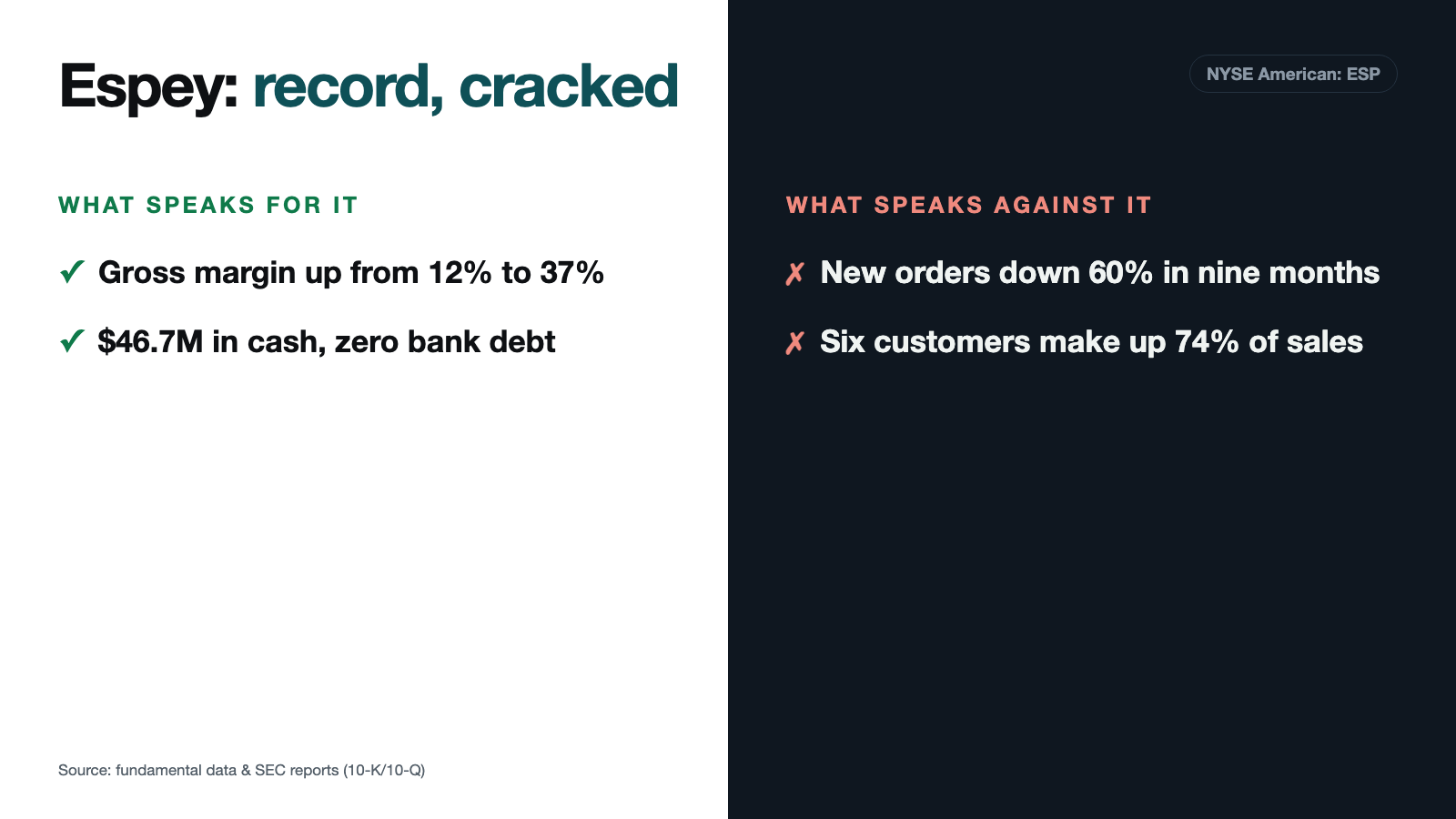
What speaks for Espey:
- Record gross margin of 37.0 percent in the third quarter of fiscal year 2026, capping a five-year uptrend from 12.1 percent (2021) to 28.9 percent (2025) on a full-year basis.
- A spotless balance sheet: $46.7 million in net liquidity with zero bank debt, an unused credit line, and equity of $56.4 million as of March 31, 2026.
- Anchored in a government investment program: $10.8 million in Navy grants for facility and test equipment since fiscal year 2023, part of the "Surface Combatant Industrial Base" program.
- Customers are paying more upfront: contract liabilities rose 46 percent to $33.5 million — a sign that customers are betting on Espey's ability to deliver.
- Restored dividend continuity since February 2023, plus a special dividend of $0.75 in September 2025.
What speaks against it:
- New orders in the first nine months of fiscal year 2026 collapsed 60 percent ($30.0 million versus $75.1 million); the pipeline fell from about $163 million to about $152.5 million.
- High customer concentration: six customers account for 74 percent of 2025 revenue, three customers for $92.7 million of the $137.1 million order backlog.
- Part of the record profit comes from interest income (about 14 percent of pretax income) and a lower tax rate, not from manufacturing alone.
- Nine-month operating cash flow fell from $18.2 million to $6.3 million because inventory was built up sharply.
- The annual report for the fiscal year that ended June 30, 2026 is still outstanding — the raised forecast remains unconfirmed at this point.
A Human Conclusion
Back to the FOMO from the start. The stock's doubling from $35.5 to $74.5 is real, the record margin of 37.0 percent is real, the $46.7 million in cash is real. Whoever wants to sell Espey as an "overlooked gem" has honest material for that case. But the same reports that show the gem also show the crack: new orders that fell 60 percent in nine months, an order book that hangs two-thirds on three customers, and a record profit that partly comes from interest and tax benefits rather than the factory floor. Espey holds no earnings call where an analyst could press management on why new orders fell so sharply — the only answer that exists sits, matter-of-factly, in the next mandatory filing. So the honest question for you isn't "Am I missing the rally?" but: do you trust a 98-year-old company to refill its order book before the old orders run out? The answer to that question is known only to you — and to the next annual report, expected in September 2026. What you make of it is your decision. And that is exactly as it should be.
Sources
All original documents used in this analysis — to read for yourself:
- Espey Mfg. & Electronics Corp. — SEC quarterly report 10-Q as of March 31, 2026 (filed May 12, 2026)
- Espey Mfg. & Electronics Corp. — SEC annual report 10-K for fiscal year 2025 (filed September 16, 2025)
- Espey Mfg. & Electronics Corp. — SEC annual report 10-K for fiscal year 2024 (filed September 27, 2024)
- Espey Mfg. & Electronics Corp. — SEC mandatory filing 8-K dated September 8, 2025 (special dividend)
- Espey Mfg. & Electronics Corp. — SEC mandatory filing 8-K dated September 9, 2025 (CEO employment agreement)
- Espey Mfg. & Electronics Corp. — SEC proxy statement DEF 14A, filed October 28, 2025
- Espey Mfg. & Electronics Corp. — Insider filing (Form 4), David O'Neil, June 23, 2026
- Full SEC filing history of Espey Mfg. & Electronics Corp.: EDGAR overview (sec.gov)
- Fundamental data (price, valuation, metrics; data as of August 26, 2026), reconciled with the SEC filings.
Transparency & disclaimer: This analysis is a journalistic contextualization of publicly available information and is not investment advice, not a financial analysis in the regulatory sense, and not a solicitation to buy or sell securities. Stock investments carry substantial risks up to total loss. All information without warranty; the data cutoff is noted in the text. The author holds no position in Espey shares at the time of publication.
Key figures at a glance
All monetary figures in millions of $; earnings per share as reported.
| Metric | 2022 | 2023 | 2024 | 2025 | 2026 |
|---|---|---|---|---|---|
| Revenue | 32.1 | 35.6 | 38.7 | 44.0 | 46.1 |
| Operating Income (EBIT) | 1.5 | 4.3 | 6.5 | 8.1 | 11.6 |
| Net Income | 1.3 | 3.7 | 5.8 | 8.1 | 11.2 |
| Net Margin | 3.9% | 10.3% | 15.0% | 18.5% | 24.2% |
| Earnings Per Share | 0.52 $ | 1.49 $ | 2.29 $ | 3.02 $ | 3.89 $ |
Source: fundamental data & SEC filings (annual and quarterly reports, 10-K/10-Q)
Our Bottom Line at a Glance
- Balance sheet & cash positive
- As of March 31, 2026, $46.7 million in cash and securities sit on the books with zero bank debt, plus a $3 million credit line renewed in February 2026 but never drawn.
- Margin trend positive
- Gross margin rose from 12.1 percent (fiscal year 2021) to 28.9 percent (2025) and hit a record 37.0 percent in the third quarter of fiscal year 2026.
- Order backlog negative
- New orders in the first nine months of fiscal year 2026 collapsed 60 percent ($30.0 million versus $75.1 million); the pipeline fell from about $163 million to about $152.5 million.
- Customer concentration negative
- Six customers account for 74 percent of 2025 revenue, three customers for $92.7 million of the $137.1 million order backlog as of March 31, 2026 — mostly government agencies and defense contractors.
- Earnings quality neutral
- About 14 percent of nine-month pretax income comes from interest income, plus a lower tax rate (17.2 percent instead of about 18.3 percent) — but the operating profit increase (EBIT +70 percent in the third quarter) is real.
- Management communication neutral
- Espey holds no earnings calls; its only forecast source is the written Business Outlook, which has historically been too cautious and was raised mid-year in May 2026.
Espey Mfg. & Electronics is a 98-year-old, debt-free manufacturer with a gross margin that has risen from 12.1 to 37.0 percent, and $46.7 million in net cash as of March 31, 2026. At the same time, new orders collapsed 60 percent in nine months, and six customers account for three-quarters of revenue. The annual report for the fiscal year that ended June 30, 2026 is still outstanding. Not investment advice.
What Our Rating Means
Open questions
The business works in principle, but one material question is open. As long as it stays open, our findings do not carry a quality verdict.
Yellow, because the company is solid — profitable, debt-free, with a gross margin that has risen for five straight years and $46.7 million in cash as of March 31, 2026 — but one material operational question remains open: new orders fell 60 percent in nine months, six customers account for 74 percent of revenue, and three customers for two-thirds of the order backlog. That is not a substance risk — the customers are mostly the U.S. military and other government agencies, not a financially shaky mid-size company — but it is a concentration and an order drought that rule out green. That part of the record profit comes from interest and a lower tax rate is likewise not a balance-sheet breach, but it belongs in an honest reading of the numbers. The decision is yours.
A journalistic assessment by our editorial team at the time of the deep dive, based on public sources — not investment advice and not a solicitation to buy or sell. Your personal circumstances (investment goals, risk capacity, taxes) cannot be taken into account. What our levels mean, how verdicts are formed, and what conflicts of interest exist →
Worth Noting
- Hook for this analysis: the quarterly report (10-Q) as of March 31, 2026, filed May 12, 2026.
- Data cutoff: annual and quarterly figures come from the annual report 10-K for fiscal year 2025 (filed September 16, 2025) and the quarterly report as of March 31, 2026. Price and valuation figures are as of August 26, 2026.
- The annual report (10-K) for the fiscal year that ended June 30, 2026 had not yet been filed at the time of this analysis (expected September 2026; prior years: September 16/27).
- Possible mix-up: Kaitlyn O'Neil (Principal Financial Officer since Feb 15, 2025) shares a surname with CEO David O'Neil but, per the 2025 proxy statement, is not related to him.
Stock Watch
This analysis is as of August 27, 2026. Stock Watch will tell you what's changed at ESP since then.
Later $1 a month per stock — signing up is free, and you'll be the first to know when it launches.
The full analysis as a PDF for later
We will send you this analysis as a PDF — to print, file away, and read at your own pace. And we will add you to the free Stock Watch list for Espey Mfg & Electronics Corp (ESP), so you hear about it when something material in this analysis changes.
Frequently Asked Questions
Espey Mfg. & Electronics Corp. (NYSE American: ESP) has manufactured power supplies, power converters, filters, power transformers and antennas since 1928, out of a single plant in Saratoga Springs, New York — mostly for the U.S. military, other U.S. government agencies and the rail industry. The company employed 152 people as of August 31, 2025, and works almost entirely under fixed-price contracts.
The stock ran from its 52-week low of $35.5 to $74.5 (data as of August 26, 2026), driven by the quarterly report as of March 31, 2026: gross margin hit a record 37.0 percent, and net income for the quarter rose 68 percent. Nine-month revenue, however, came in slightly below the prior year.
In the first nine months of fiscal year 2026, new orders totaled $30.0 million, versus $75.1 million in the year-ago period — a 60 percent decline. The full fiscal year 2025 had still delivered $86.4 million, the highest level in years, helped in part by two large contracts.
In fiscal year 2025, 74 percent of revenue came from six domestic customers. The order backlog is even more concentrated: of $137.1 million as of March 31, 2026, $92.7 million comes from just three customers — mostly defense contractors, the U.S. Department of Defense and other U.S. government agencies.
No. Espey publishes no earnings calls and no separate earnings press release for its quarterly results. The only forecast source is the written "Business Outlook" in its annual and quarterly reports — where management has historically forecast more cautiously than what ultimately occurred.
Between fiscal year 2023 and the second quarter of fiscal year 2025, the U.S. Navy paid Espey two grants totaling $10.8 million for modernizing its plant and test equipment — part of the "Surface Combatant Industrial Base" program. That strengthens the relationship with its most important customer group, but also deepens the dependency on it.
Yes. After suspending the payout in March 2021, Espey has paid a dividend again since February 2023 — at first in smaller steps ($0.20 in total in fiscal 2023, $0.675 in fiscal 2024), and since fiscal year 2025 as a regular quarterly dividend of $0.25 per share. A special dividend of $0.75 followed in September 2025. For the first nine months of fiscal year 2026, that adds up to $1.50 per share.
Fiscal year 2026 ended June 30, 2026; the corresponding annual report (10-K) had not yet been filed as this analysis was completed (as of late August 2026). In the two prior years it arrived on September 16 and September 27, respectively — a similar timeframe is expected again in 2026.
Found an error?
Did you spot a factual error, an outdated number, or a typo in this deep dive? Let us know briefly — your report goes straight to the editorial team.