Radios for the Worst Day of Your Life: BK Technologies Earns More — and Will Soon Report Less
BK Technologies (NYSE American: BKTI) builds rugged handheld radios for firefighters, forestry agencies and police. Gross margin climbed from 19.3 percent in the supply-chain year of 2022 to 51.9 percent in the second quarter of 2026, cash sits at a record $29.9 million, and there is no debt on the balance sheet. Even so, the company's own 2026 earnings guidance comes in below what it actually earned in 2025 — not because anything is breaking, but because two effects that flattered the record years of 2024 and 2025 are going away. Not investment advice — just the question of whether you judge a company by what it earns or by what it reports.
 Thomas Mücke
Founder & Publisher
Thomas Mücke
Founder & Publisher
As of Today
As of: October 9, 2026
- Closing price
- 73.50 $ +0.20%
- Market Capitalisation
- 0.3 $B
- Growth Score
- 8/10
- AAQS
- 8/10
Price change since August 25, 2026: -4.2%
This analysis has a cut-off date. The Stock Guard tells you when something material changes in the numbers. Reserve your free spot
Chart
Interactive price chart (TradingView).
52-week range: 62.60 $ to 97.00 $ · Last price: 73.50 $ (As of: October 9, 2026)
Note: pure fact-based analysis, not investment advice and not a solicitation to buy or sell. All figures without guarantee.
There's an investing weakness that doesn't have a proper name in the textbooks, but has caught nearly everyone at least once: vertigo. You open the chart of a small company and see a staircase that takes your breath away — roughly $3.30 in early January 2023, roughly $12.40 in early January 2024, roughly $33.85 in early January 2025, roughly $75.20 in early January 2026, and a 52-week high of $104.55 as of August 26, 2026. More than thirty times over in a little more than three years. Your brain renders a verdict in half a second: too late. And because it renders that verdict, you never get to the numbers. That's not caution, it's a shortcut. So let's do it differently and read the numbers together — not from a press release, but from the reports BK Technologies Corporation (NYSE American: BKTI) must file with the U.S. securities regulator, the SEC, under penalty of law: the Form 10-Q for the quarter ended June 30, 2026, the fiscal 2025 Form 10-K, and the transcripts of five quarterly earnings calls spanning a year.
It helps to know the central puzzle up front: in 2026, BK Technologies' business gets better and its reported profit gets smaller. That is not a typo and not a warning sign. It is the result of two accounting effects we'll walk through in detail below. Anyone watching only the bottom line will see a step backward in 2026 where the business is actually stepping forward. Anyone dazzled by the record years of 2024 and 2025 was admiring a profit that looked prettier than the business earned. Both statements are true at once, and together they are the real story of this stock.
What BK Technologies Actually Does
BK Technologies builds two-way radios. Not smartphones, not headsets — what the industry calls land mobile radio (LMR): rugged voice radios that keep working when nothing else does. Picture a wildfire where the cell network has collapsed or never existed in the first place; these are the devices first responders talk on. Customers are fire departments, forestry agencies, police and other public-safety organizations. The company is based in West Melbourne, Florida, and employed 120 people as of December 31, 2025, 115 of them full-time. Manufacturing itself is outsourced to contract manufacturer East West Manufacturing — BK designs, sells and supports; someone else builds.
Three devices form the product core. The BKR 5000 is the workhorse: a single-band handheld launched in late 2020, with more than 95,000 units shipped through the first quarter of 2026. The BKR 9000 is the pricier multiband handheld — it operates across several radio bands, which matters when agencies from different jurisdictions work the same incident; average selling price runs around $2,500 per unit according to the November 6, 2025 earnings call, and 2025 shipments came in at 2.5 times the 2024 level. The BKR 9500 is the mobile (in-vehicle) radio that made its public debut in April 2026: management says more than 200 units were ordered "sight unseen," before certification. The application with the Federal Communications Commission is filed, approval is expected in early 2027, and deliveries are planned for the first half of 2027.
On top of the hardware sits a growing software layer: BK ONE as the management platform, InteropONE for push-to-talk over cellular networks, BKRplay as the bridge between radio and smartphone (beta completed in the second quarter of 2026, commercial launch planned for January 2027), the portable RelayONE repeater (launched in the second quarter of 2025), plus a licensing agreement with Tango Tango, whose push-to-talk service reaches more than 1,500 agencies and over 35,000 active users according to company statements.
Scale matters here, so keep it in view. The main competitor is Motorola Solutions, which is many times larger. On the March 12, 2026 call, BK Technologies put its own market share at roughly 3 to 3.5 percent and named 10 percent as the goal; management sizes the U.S. market for these devices at about $2.3 billion (August 14, 2025 call). BK is the small player in a market with a very large incumbent — which is both the opportunity and the risk. If you want the spectrum side of the same public-safety ecosystem, our Anterix stock analysis covers the airwaves; this one covers the hardware.
One note on history, because it trips up research: the company was called Adage through 1997, then RELM Wireless Corporation, and since 2018 BK Technologies; a holding-company reorganization followed in 2019. Older sources filed under "RELM Wireless" refer to the same business. John Suzuki has been CEO since July 2021; Scott Malmanger is chief financial officer.
Company history for investors
-
1997
Adage becomes RELM Wireless
The company takes the name it will carry for two decades. For investors today it is mainly a footnote: older sources on RELM refer to the same business.
-
2018
Renamed BK Technologies
The radio brand becomes the corporate name; a holding reorganization follows in 2019. A signal that everything is meant to revolve around the public-safety radio core.
-
2021
John Suzuki becomes CEO, Vision 2025 launches
The new chief sets out to double revenue against 2020 and reach a 20 percent EBITDA margin — the first checkable yardstick shareholders had for this management team.
-
2022
Supply-chain crisis crushes the margin
Gross margin falls to 19.3 percent and the year ends with an $11.6 million net loss. Anyone buying then needed patience — the recovery only began in 2023.
-
2025
Record year, vision targets essentially met
$86.1 million in revenue and $13.5 million in net income: margin goals beaten, the revenue doubling narrowly missed at up 95 percent. Management delivered.
-
2026
Vision 2030 and the BKR 9500 debut
A new goal: $13 in earnings per share by 2030. The second quarter brings record cash of $29.9 million — and the first earnings decline, caused solely by higher taxes.
How This Stock Landed on Our Desk
The trigger is public and carries a date: on August 13, 2026, BK Technologies filed its Form 10-Q for the second quarter of 2026 and published the matching earnings release the same day as Exhibit 99.1 to a Form 8-K. What's inside looks contradictory at first glance — and contradictions like that are exactly why you read the filing instead of the headline.
The CEO summed up the quarter this way:
“We delivered double-digit revenue growth, expanded gross margins to nearly 52%, generated another record cash balance while remaining debt free, and continued executing against our Vision 2030 roadmap.”
— BK Technologies Corporation, earnings release, August 13, 2026 (SEC Exhibit 99.1 to Form 8-K)
Every single claim in that sentence is accurate. And in the very same quarter, reported diluted earnings per share fell from $0.96 to $0.79. Record margin and falling profit at the same time — that is the tension running through this analysis. It doesn't resolve through argument, but through one line in the income tax note, which we'll get to shortly.
The Numbers Over the Years
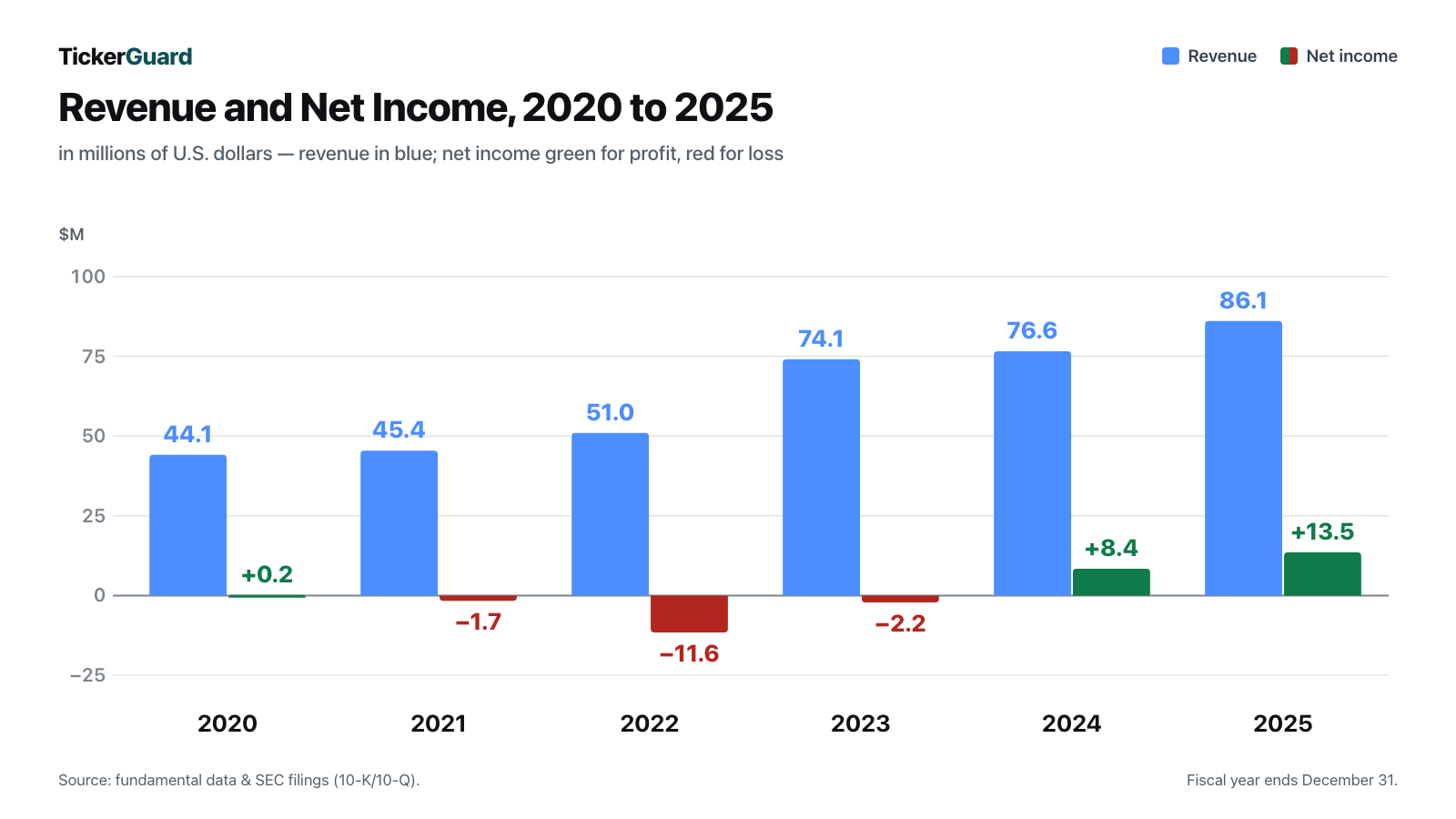
Start with what genuinely impresses, because there is plenty. Revenue rose from $44.1 million in 2020 to $86.1 million in 2025 — close to a doubling in five years. Getting there was no straight line: 2021 closed with a net loss of $1.7 million, 2022 with a loss of $11.6 million, 2023 with a loss of $2.2 million. Only in 2024 did the picture flip, with $8.4 million in net income, followed by $13.5 million in 2025. Three loss years, then two record years — a recovery from a real crisis, not a smooth ascent.
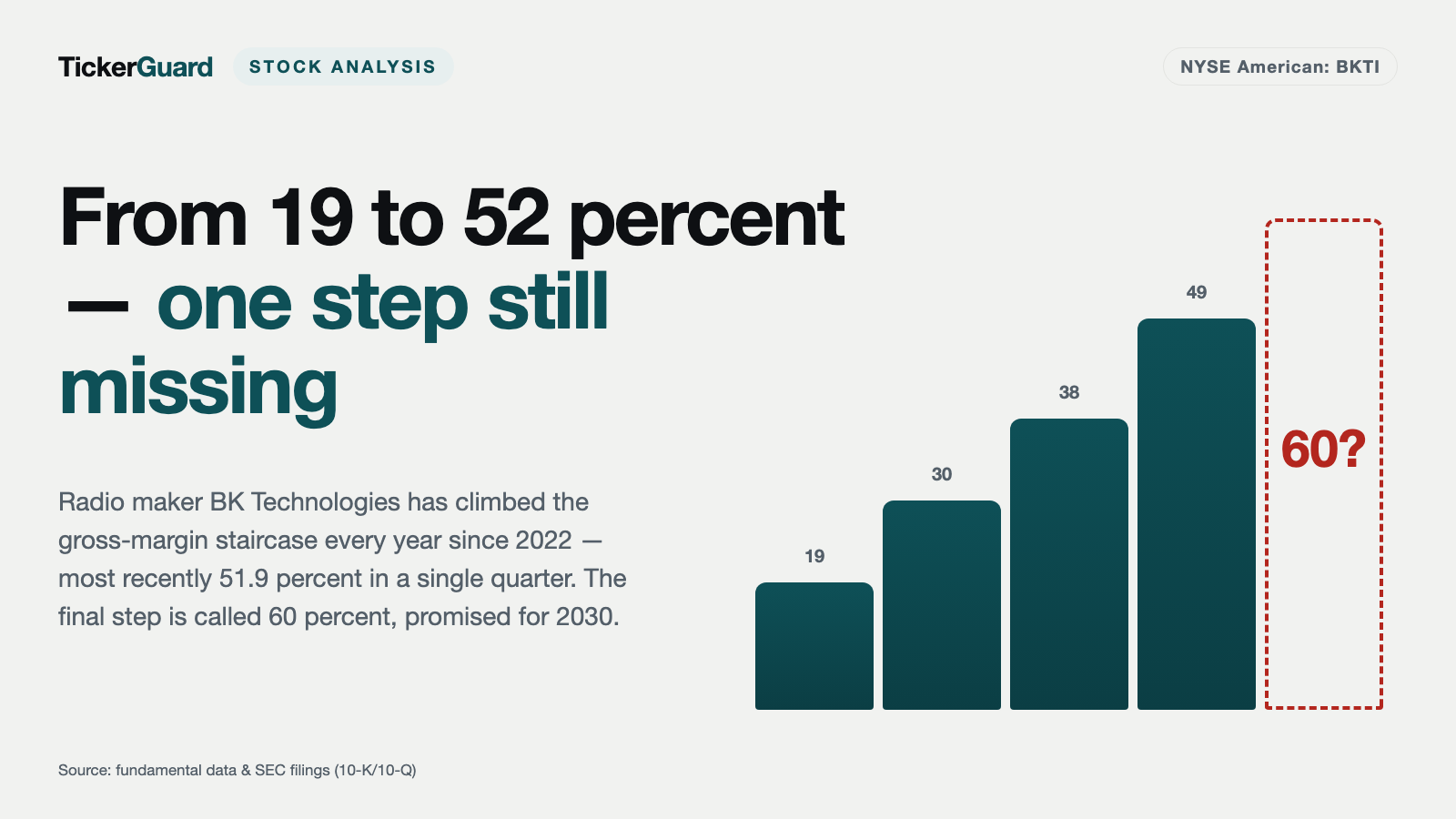
The real story, though, sits in the margin line rather than the revenue line. Gross margin — the share of revenue left after the direct cost of building the product — was 35.8 percent in 2021, collapsed to 19.3 percent in 2022, recovered to 30.0 percent in 2023, then 37.9 percent in 2024, 48.8 percent in 2025, and reached 51.9 percent in the second quarter of 2026, the highest in company history. Rounded, the staircase reads 19, 30, 38, 49 — and most recently 51.9 percent in the second quarter of 2026; the next step, 60 percent, is so far only a promise for 2030.
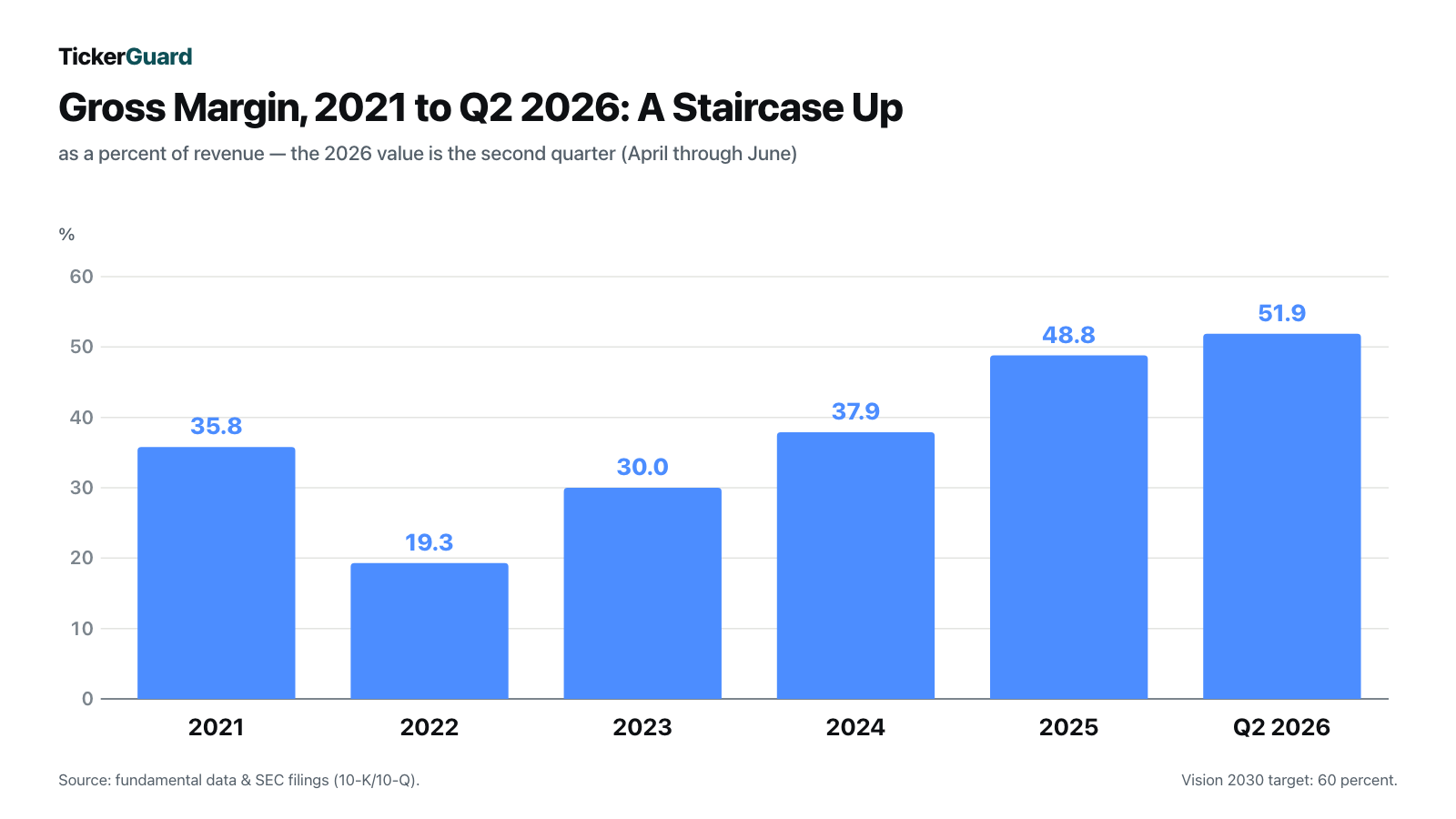
Why that matters: a rising gross margin means every additional radio sold leaves more behind. The product mix is shifting toward pricier multiband hardware and toward software, and both carry better margins than the entry-level device. A margin that climbs from 19 to 52 percent is not an accounting trick — it is a hard change in the shape of the business.
Now the latest quarter in detail (Form 10-Q filed August 13, 2026, period ended June 30, 2026): revenue of $23.4 million, up 10.6 percent from $21.2 million a year earlier. Gross margin of 51.9 percent versus 47.4 percent — 445 basis points, or about 4.5 percentage points, better. Selling, general and administrative expense rose from $6.0 million to $8.3 million, with the biggest jump in engineering and product development: $4.0 million versus $2.3 million. Operating income therefore slipped to $3.8 million from $4.0 million, and operating margin fell from 18.9 percent to 16.4 percent. Then comes the line that matters: pre-tax income was $4.003 million versus $4.016 million a year earlier — effectively unchanged. Net income still fell from $3.7 million to $3.2 million, and diluted earnings per share from $0.96 to $0.79. For the first half of 2026, revenue rose 11.2 percent to $44.7 million, net income moved sideways from $5.873 million to $5.930 million, and diluted earnings per share went from $1.51 to $1.47.
The balance sheet as of June 30, 2026 is the strongest part of the filing. Cash of $29.9 million versus $22.8 million at year-end 2025, no debt at all, working capital of $46.1 million versus $37.3 million, and equity of $52.0 million versus $44.7 million. Assets include $12.2 million in receivables and $15.1 million in inventories; liabilities include $2.8 million in current and $6.7 million in long-term deferred revenue, mostly from extended warranties — cash already collected that is recognized as revenue over the term. Operating cash flow for the first half of 2026 was $7.5 million (prior year: $6.0 million), capital expenditures were $0.7 million, share buybacks came to $133,000, and cash taxes paid totaled $1.6 million. One detail worth flagging: no software development costs were capitalized at all in the first half of 2026, against $0.9 million a year earlier — more on that below.
The company also reports its own non-standard figures ("non-GAAP"). On that basis, the second quarter of 2026 shows adjusted net income of $4.1 million, or $1.01 per diluted share (prior-year quarter: $5.1 million, or $1.30), and adjusted EBITDA of $4.5 million at a 19.4 percent margin (prior year: $4.4 million, 20.9 percent). What gets added back is mainly stock-based compensation (about $512,000 in the quarter) and non-cash tax items. For the trailing twelve months through June 30, 2026, the company reports $13.6 million in net income (up 14 percent), $19.0 million in what it calls free cash flow after tax (up 49 percent, a company-defined non-GAAP measure) and 15.7 percent revenue growth.
For full-year 2026, management reaffirmed its guidance on August 13, 2026: at least $90 million in revenue, gross margin of at least 50 percent, GAAP diluted earnings per share of $3.15 and adjusted diluted earnings per share of $3.55. Compare that with what 2025 actually delivered: $3.44 GAAP diluted ($3.69 basic) and $4.32 adjusted diluted. More revenue, better margin — and a lower reported profit per share. That puzzle gets solved in uncomfortable truth #2.
What Management Promised — and What Came of It
Before the uncomfortable parts, management has earned a fair interim report card. We read five public quarterly earnings calls in full — August 14, 2025, November 6, 2025, March 12, 2026, May 14, 2026 and August 13, 2026. The Q&A carries more weight than the prepared remarks: that's where a team either answers a number or works around it.
Promised and delivered. In August 2025, management raised its full-year targets sharply: GAAP earnings per share from $2.40 to $3.15, adjusted from $2.80 to $3.80, and gross margin from 42 percent to above 47 percent. What landed: $3.44 GAAP diluted, $4.32 adjusted diluted, 48.8 percent gross margin, and revenue growth of 12.5 percent where only a "high single digit" rate had been guided. All four targets beaten. The promise to ship two to three times as many BKR 9000 units in 2025 as in 2024 came in at 2.5 times. And when the CEO predicted on November 6, 2025, in the middle of the government shutdown, that it would end before year-end, he was right: the fourth quarter of 2025 came in at $21.5 million, up 20 percent, the strongest closing quarter in company history.
The big vision before this one. In 2021, shortly after Suzuki took over, the company set "Vision 2025": double revenue against the 2020 base and reach a 20 percent EBITDA margin. Result: the doubling was narrowly missed ($44.1 million to $86.1 million is up 95 percent), and the margin target was beaten at 20.5 percent. In between came the 2022 supply-chain crisis, during which gross margin dropped as low as 14 percent in one quarter according to the March 12, 2026 call, and a delay of roughly 18 months on the BKR 9000. Missing a target by five percentage points while surviving a once-in-a-generation supply crunch is not a failure — it is the most realistic way an ambitious target ever gets hit.
Now the places where the tone shifted. Three of them deserve attention, and all three came out of the Q&A rather than the script.
First, the tax cliff. The news that taxes would rise sharply from 2026 did not come from management — an investor dug it out in the Q&A in August 2025. The question: with net operating loss carryforwards nearly exhausted, are real cash taxes coming? The CFO's answer: yes, a rate of 25 to 26 percent going forward. Asked whether the earnings guidance was therefore too cautious, he replied:
“I remain conservative.”
— BK Technologies Corporation, chief financial officer Scott Malmanger, quarterly earnings call of August 14, 2025
That is not a bad answer — investors are better served by cautious guidance than by bold guidance. What stands out is who had to ask before the number reached the table.
Second, the FCC timeline. In May 2026, certification of the BKR 9500 by the Federal Communications Commission was still expected "in 2026." By August 2026 it had become "early 2027," with deliveries still planned for the first half of 2027. That is a small slip, openly communicated — but it is exactly the pattern to keep an eye on at a company whose last major device already arrived roughly 18 months late.
Third, the backlog. On the August 13, 2026 call, an investor observed that backlog was falling and no longer worked well as a leading indicator. The CEO did not disagree in substance: lead times have become so short that orders barely sit in backlog at all, the exception being large Forest Service awards. That is a plausible explanation — and simultaneously an admission that one of the few metrics outsiders could use to gauge the next few months has lost much of its signal.

The next big promise. On March 12, 2026, the same team introduced "Vision 2030": $170 million in revenue, 60 percent gross margin, a 35 percent adjusted EBITDA margin, $13 in earnings per share and more than $55 million in free cash flow. That is materially more ambitious than Vision 2025 — and it comes from a team that essentially delivered Vision 2025. Both things are true, and both belong in your head when the next quarterly reports land.
How management itself frames the latest quarter comes through most clearly in one sentence from the August 13, 2026 call — and it leads straight into the next section:
“The variation in our bottom line was driven almost entirely by a $560,000 year-over-year increase in our income tax provision and not by any softness in our underlying business.”
— BK Technologies Corporation, CEO John Suzuki, quarterly earnings call of August 13, 2026
What the Filings Reveal: the Uncomfortable Truths
Uncomfortable truth #1: the most important customer is a government with a budget fight
BK Technologies flags the risk in its own annual report, and does so bluntly:
“We depend heavily on sales to the U.S. Government.” … “For the year ended December 31, 2025, approximately 29% of our sales were to agencies and departments of the U.S. Government, including but not limited to, agencies of the DHS, DoA, DoD and DoI.”
— BK Technologies Corporation, fiscal 2025 Form 10-K, Risk Factors
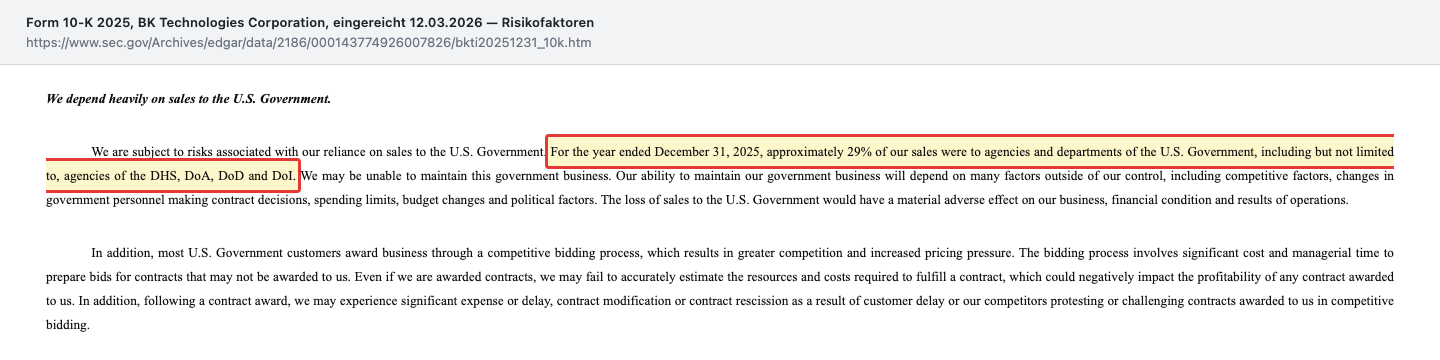
The annual average actually understates it. Individual quarters run far more concentrated: 43.0 percent of first-quarter 2026 revenue came from federal agencies, against 10.9 percent in the prior-year quarter. The second quarter of 2026 came in at 26.9 percent, and the first half at 34.5 percent versus 11.5 percent a year earlier. On top of that sits a single buyer the filings identify only as "Customer A," accounting for 39.0 percent of revenue in the first quarter of 2026 and still 14.3 percent in the second.
Why this is more than a footnote became clear in the fall of 2025: during the government shutdown, federal customers asked in writing that finished shipments be held back (quarterly earnings call of November 6, 2025). Revenue that was contractually secure slipped purely because of a budget fight in Washington. That it worked out in the end — the fourth quarter of 2025 came in at $21.5 million, the strongest in company history — does not change the mechanics. Seasonality compounds it: wildfire season and the September 30 federal fiscal year-end make the second and third quarters structurally strong. Judging BKTI on a single quarter in isolation is therefore a mistake. For a sense of how deeply this kind of government dependence can shape an entire business model, see our Iridium stock analysis, where a single federal contract underpinned the company for decades.
Uncomfortable truth #2: the profit dip that isn't one — and the record that was flattered
Here is the resolution of the puzzle from the opening. The income tax note in the quarterly report carries the decisive sentence:
“For the three and six months ended June 30, 2026, the Company recorded an income tax expense of $835 and $1,517, respectively, resulting in an effective tax rate of 20.86% and 20.37%.”
— BK Technologies Corporation, Form 10-Q for the quarter ended June 30, 2026, Note 4 "Income Taxes"
One thing to know before reading that: the figures in the quote are stated in thousands of dollars, as is standard in these filings. So $835 means $835,000 of tax expense in the quarter, and $1,517 means $1,517,000 for the half year. The prior-year quarter carried $275,000 at an effective rate of 6.85 percent; the prior-year half was 13.86 percent. The statutory rate the company uses as its starting point is 27.52 percent.
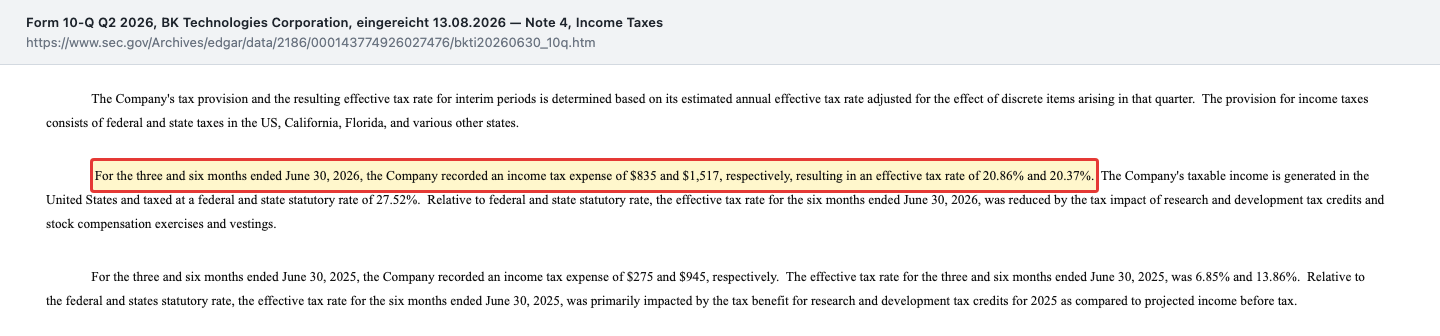
Run the arithmetic. Pre-tax income in the second quarter of 2026 was $4.003 million, against $4.016 million a year earlier — a difference of $13,000, which is nothing. The entire decline in net income from $3.7 million to $3.2 million comes from roughly $560,000 in additional tax expense. Spread across the diluted share count, that is about $0.14 per share. Without the tax effect, quarterly earnings would not have fallen at all — they would have been essentially flat, on 10.6 percent higher revenue and 4.5 percentage points of additional gross margin.
Now run it backwards. If the low tax rate is disappearing in 2026, then it was present in 2024 and 2025 — and it made the reported profits of those years look larger than the operating business earned. In 2025 the effective rate was just 16 percent, because accumulated loss carryforwards from the loss years and research credits held the expense down. Those carryforwards are used up. For 2026 the company expects roughly 26 percent, a burden management puts at about $0.42 to $0.55 per diluted share. That is the first of two reasons the 2026 GAAP guidance ($3.15) sits below actual 2025 results ($3.44) even as revenue is set to grow.
The second reason is an accounting decision management announced on the March 12, 2026 call: BKR 9500 development costs have been expensed as incurred since 2026 rather than capitalized. In everyday terms: those outlays used to be treated like buying a machine whose cost spreads over years; now they are treated like the electricity bill — fully absorbed in the current year. The cash is identical either way; only reported 2026 profit drops, by roughly $0.50 per share. The effect is already visible in the half-year figures: no software development costs were capitalized in the first half of 2026 at all, against $0.9 million a year earlier.
Together the two effects fully explain the guidance dip — and neither is a reason for comfort or alarm, but a reason for precision. Comparing BK Technologies' 2026 with its 2025 means comparing two differently computed years. The more honest comparison runs through pre-tax income, cash flow and gross margin.
Uncomfortable truth #3: the quiet dilution
Dilution sounds harmless and isn't: your slice of the pie gets smaller because additional slices are handed out, even though the pie itself stays the same size. At BK Technologies the effect is larger than you'd expect at a company this profitable, for a simple reason: there are very few shares. As of August 6, 2026, 3,769,389 shares were outstanding, against 10 million authorized.
In the second quarter of 2026, the company used 3,751,175 shares on a basic basis but 4,023,206 shares on a diluted basis — a gap of roughly 7 percent, coming from employee options and restricted stock units. Against a total of just under 3.8 million shares, more than 270,000 additional potential shares is not a rounding item; it is a real number. In August 2025 the company also issued 39,250 shares as employees hit their restricted stock unit targets.
That has a second consequence worth knowing. The adjusted figure the company likes to show removes precisely this stock compensation: $0.79 per share under the official rules against $1.01 "adjusted." So a good fifth of the adjusted profit consists of items that were added back — mostly stock compensation and non-cash tax items. This is industry standard and cleanly reconciled, but it is still real cost: paying employees in stock consumes no cash, yet it does consume part of your ownership of the company.
Valuation
Now the price — and with it, back to the vertigo from the opening. As a dated anchor: the stock closed at $76.76 on August 25, 2026. Multiplied by the 3,769,389 shares outstanding, that is a market capitalization of roughly $289 million for a company with a bit over $90 million in annual revenue.
Against trailing twelve-month net income of $13.6 million (through June 30, 2026), that works out to a price-to-earnings ratio of about 21. Measured against the company's own 2026 GAAP guidance of $3.15 per share, it is about 24; against the adjusted guidance of $3.55, about 22. The price-to-sales ratio is around 3.2 (trailing twelve-month revenue of roughly $90.6 million, as of August 26, 2026). The 52-week range runs from $60.00 to $104.55 — the stock trades well below its high, and far above the roughly $3.30 of early January 2023.
How do the professionals see it? Honest answer: almost nobody does. The earnings calls draw questions from small shops such as Lake Street and a handful of specialist funds; there is no meaningful analyst consensus for BKTI. At a $289 million market capitalization that is entirely normal — and it cuts both ways. There is less outside opinion to push against, and there is also less institutional attention to cushion the stock when things get bumpy.
And Vision 2030? A calculation, explicitly not a price target: if the $13 per share earnings goal were actually hit, the stock would today trade at roughly 5.9 times that future profit. That sounds like a bargain, with one decisive caveat: a 60 percent gross margin and $170 million in revenue are promises, not numbers. The team essentially delivered on its previous vision; whether it can do so again will be settled in the quarterly reports of the next four years, not today.
Opportunities and Risks at a Glance
What argues for BK Technologies:
- The margin staircase is real: gross margin from 19.3 percent (2022) through 30.0, 37.9 and 48.8 percent to 51.9 percent in the second quarter of 2026 — driven by the shift to pricier multiband hardware and software.
- The agency transition from single-band to multiband radios is a multi-year tailwind, not a quarterly blip; BKR 9000 shipments in 2025 came in at 2.5 times the 2024 level.
- The BKR 9500 can roughly double the addressable device market: mobile radios account for about 35 to 40 percent of the U.S. market management sizes at $2.3 billion, and more than 200 units were ordered before certification.
- Recurring software revenue is building: BK ONE, InteropONE, BKRplay (commercial launch planned for January 2027) and the Tango Tango license covering more than 1,500 agencies.
- The balance sheet carries no debt: $29.9 million in cash and $52.0 million in equity as of June 30, 2026, with $7.5 million of operating cash flow in the first half alone.
- Management has a track record on the record: Vision 2025 beat its margin goal and narrowly missed the revenue doubling — despite a supply-chain crisis and an 18-month delay on its most important new device.
What argues against it:
- Government concentration: 29 percent of 2025 revenue and 38 percent of 2024 revenue came from U.S. federal agencies; the first quarter of 2026 hit 43.0 percent, and a single buyer ("Customer A") accounted for 39.0 percent on its own.
- Tax normalization compresses reported profit: an effective rate of just 16 percent in 2025 versus roughly 26 percent expected in 2026 — $0.42 to $0.55 per share, with nothing deteriorating operationally.
- FCC certification of the BKR 9500 is still outstanding and has already slipped from "2026" to "early 2027"; deliveries are not planned until the first half of 2027.
- Backlog fell from $21.8 million to $14.2 million as of December 31, 2025, and management itself now treats it as only a partial leading indicator — outside visibility is thin.
- Motorola Solutions dominates the market; BK holds 3 to 3.5 percent and wants 10 — a fight against a far larger opponent.
- Valuation has priced in part of the growth: from roughly $3.30 in early January 2023 to $76.76 on August 25, 2026, with a price-to-earnings ratio of about 21 on trailing results and about 24 on the company's own 2026 guidance.
- Only about 3.8 million shares are outstanding: trading is thin, single orders move the price, and volatility is correspondingly high — the 52-week range of $60.00 to $104.55 says it plainly.
A Human Conclusion
Back to the vertigo. It is not a stupid feeling — a stock that has multiplied more than thirty-fold in a little over three years deserves suspicion. But vertigo is a statement about the chart, not about the company. In those same three years, the company turned a 19 percent margin into a 52 percent margin, an $11.6 million loss into a $13.5 million profit, and a strained cash position into $29.9 million with not a dollar of debt. Those are two different questions, and they need two different answers.
So the honest question is not "has this stock run too far?" but: do you judge a company by what it earns, or by what it reports? In 2026 those two numbers will diverge meaningfully for the first time in years, and in the uncomfortable direction: more revenue, better margin, smaller reported profit. Anyone who doesn't know that will read a headline about an "earnings decline" in the spring of 2027 and draw the wrong conclusion. Anyone who does know it will read pre-tax income, cash flow and gross margin instead — and see a different picture.
What remains are the two things no amount of accounting literacy makes disappear: dependence on a customer that pays its invoices only once Washington agrees on a budget, and a very small share count that amplifies every move. What you do with that is your decision. And that's exactly as it should be.
Sources and Transparency
Every primary document used in this analysis, so you can read it yourself:
- BK Technologies Corporation — Form 10-Q for the quarter ended June 30, 2026 (filed August 13, 2026)
- BK Technologies Corporation — second-quarter 2026 earnings release, SEC Exhibit 99.1 to Form 8-K filed August 13, 2026
- BK Technologies Corporation — fiscal 2025 Form 10-K (filed March 12, 2026)
- BK Technologies Corporation — Form 10-Q for the quarter ended March 31, 2026 (filed May 14, 2026), for customer concentration and unit shipment disclosures
- BK Technologies Corporation — quarterly earnings calls of August 14, 2025, November 6, 2025, March 12, 2026, May 14, 2026 and August 13, 2026 (publicly available transcripts)
- Complete SEC filing history for BK Technologies Corporation (CIK 0000002186): EDGAR overview (sec.gov)
- Source: fundamental data & SEC filings (annual and quarterly reports, 10-K/10-Q) for price, market capitalization and valuation metrics; data as of August 25 to 26, 2026.
Transparency & disclaimer: This analysis is a journalistic assessment of publicly available information and does not constitute investment advice, a regulated financial analysis, or a solicitation to buy or sell any security. Equity investments carry significant risk, including total loss. All information is provided without warranty; data as-of dates are noted throughout the text. The author held no position in BK Technologies shares at the time of publication.
Key figures at a glance
All monetary figures in millions of $; earnings per share as reported.
| Metric | 2021 | 2022 | 2023 | 2024 | 2025 |
|---|---|---|---|---|---|
| Revenue | 45.4 | 51.0 | 74.1 | 76.6 | 86.1 |
| Operating Income (EBIT) | -1.2 | -11.1 | -0.8 | 7.8 | 16.0 |
| Net Income | -1.7 | -11.6 | -2.2 | 8.4 | 13.5 |
| Net Margin | -3.7% | -22.8% | -3.0% | 10.9% | 15.7% |
| Earnings Per Share | -0.57 $ | -3.44 $ | -0.65 $ | 2.25 $ | 3.44 $ |
Source: fundamental data & SEC filings (annual and quarterly reports, 10-K/10-Q)
Our Bottom Line at a Glance
- Balance sheet & cash positive
- As of June 30, 2026 the company carries $29.9 million in cash (December 31, 2025: $22.8 million) and $52.0 million in equity with no debt whatsoever; operating cash flow in the first half of 2026 was $7.5 million.
- Growth & the margin staircase positive
- Revenue from $44.1 million (2020) to $86.1 million (2025); gross margin from 19.3 percent (2022) through 30.0, 37.9 and 48.8 percent to 51.9 percent in the second quarter of 2026 — driven by the mix shift to multiband hardware and software, not by one-off items.
- Government and customer concentration negative
- 29 percent of 2025 revenue and 38 percent of 2024 revenue came from U.S. federal agencies; the first quarter of 2026 reached 43.0 percent, and a single buyer ("Customer A") accounted for 39.0 percent alone. During the fall 2025 shutdown, federal customers asked in writing that shipments be held back.
- Reported profit versus tax effects neutral
- The effective tax rate rose from 6.85 percent to 20.86 percent in the second quarter of 2026, with roughly 26 percent expected for the full year against 16 percent in 2025. Pre-tax income held steady at $4.003 million — the 2024 and 2025 record profits were flattered by minimal tax rates, and 2026 GAAP guidance ($3.15) sits below actual 2025 results ($3.44).
- Product pipeline & FCC neutral
- The BKR 9500 can roughly double the addressable device market and drew more than 200 orders before certification — but FCC approval is still outstanding and has slipped from "2026" to early 2027, with deliveries not planned until the first half of 2027.
BK Technologies is a profitable, debt-free niche manufacturer with a documented margin staircase from 19.3 to 51.9 percent and a record $29.9 million in cash as of June 30, 2026. Reported profit will still fall in 2026 — because of tax normalization and an accounting change, not weakness. What stays open is heavy dependence on U.S. federal agencies, a backlog cut nearly in half, and the pending FCC certification of its most important new device. Not investment advice.
What Our Rating Means
Quality confirmed
Business model, numbers and balance sheet hold up to our review. Whether the current price supports an entry is a separate question — it hangs on the price, not on the company.
Green, because the quality of the business is documented: five years of rising gross margin up to 51.9 percent in the second quarter of 2026, two consecutive profitable years at $8.4 million and $13.5 million in net income, $29.9 million in cash with no debt as of June 30, 2026, and a management team that essentially delivered on its previous target framework. The falling reported profit in 2026 is an arithmetic problem, not a business problem — pre-tax income held steady at $4.003 million in the quarter. The objections still stand and belong on the table: 43.0 percent federal revenue in a single quarter and an unnamed buyer at 39.0 percent are genuine concentration, backlog has nearly halved, FCC certification of the BKR 9500 is pending, and with just under 3.8 million shares outstanding the stock trades thin and swings hard. The price — roughly $289 million in market capitalization on August 25, 2026 — already discounts part of the hoped-for growth; that is a price argument, not a quality argument, and it does not move this rating. The decision is yours.
A journalistic assessment by our editorial team at the time of the deep dive, based on public sources — not investment advice and not a solicitation to buy or sell. Your personal circumstances (investment goals, risk capacity, taxes) cannot be taken into account. What our levels mean, how verdicts are formed, and what conflicts of interest exist →
Worth Noting
- Trigger for this analysis: the Form 10-Q for the quarter ended June 30, 2026, filed August 13, 2026, together with the earnings release (Form 8-K, Exhibit 99.1) of the same day.
- As-of dates: annual and quarterly figures come from the fiscal 2025 Form 10-K (filed March 12, 2026) and the Forms 10-Q for the quarters ended March 31, 2026 and June 30, 2026. Price, market capitalization and valuation figures are as of August 25 to 26, 2026.
- Not to be confused: "BK" is also a familiar shorthand for Burger King, which has nothing to do with this company, and these radios are not a Motorola product line. The company was named RELM Wireless Corporation through 2018 — older sources under that name refer to the same business (CIK 0000002186).
Stock Watch
This analysis is as of August 26, 2026. Stock Watch will tell you what's changed at BKTI since then.
Later $1 a month per stock — signing up is free, and you'll be the first to know when it launches.
The full analysis as a PDF for later
We will send you this analysis as a PDF — to print, file away, and read at your own pace. And we will add you to the free Stock Watch list for BK Technologies Inc (BKTI), so you hear about it when something material in this analysis changes.
Frequently Asked Questions
BK Technologies Corporation (NYSE American: BKTI) of West Melbourne, Florida, builds rugged two-way land mobile radios for firefighters, forestry agencies, police and other public-safety organizations. Its core products are the BKR 5000 handheld, the BKR 9000 multiband handheld and the BKR 9500 mobile radio, plus a growing software layer. The company had 120 employees as of December 31, 2025; manufacturing is outsourced to East West Manufacturing.
Two effects, neither operational. First, tax normalization: the effective rate was just 16 percent in 2025 thanks to exhausted loss carryforwards, and roughly 26 percent is expected for 2026 — worth $0.42 to $0.55 per share according to management. Second, BKR 9500 development costs are expensed as incurred from 2026 rather than capitalized, costing roughly $0.50 per share. Pre-tax income in the second quarter of 2026 was essentially unchanged at $4.003 million.
Heavily. Approximately 29 percent of fiscal 2025 sales went to agencies and departments of the U.S. federal government, and 38 percent in 2024 (fiscal 2025 Form 10-K). Individual quarters run more concentrated still: 43.0 percent in the first quarter of 2026, 26.9 percent in the second, and 34.5 percent for the half year. In the fall of 2025, federal customers asked in writing that shipments be held back during the government shutdown.
A target framework for 2030 presented on March 12, 2026: $170 million in revenue, 60 percent gross margin, a 35 percent adjusted EBITDA margin, $13 in earnings per share and more than $55 million in free cash flow. Its predecessor, "Vision 2025," was essentially met: the EBITDA margin beat the 20 percent goal at 20.5 percent, while the revenue doubling was narrowly missed at up 95 percent.
The stock closed at $76.76 on August 25, 2026; against 3,769,389 shares outstanding, that is a market capitalization of roughly $289 million. It works out to a price-to-earnings ratio of about 21 on trailing twelve-month net income of $13.6 million (through June 30, 2026), about 24 on the 2026 GAAP guidance and about 22 on the adjusted guidance. The price-to-sales ratio is around 3.2 (as of August 26, 2026).
The BKR 9500 made its public debut in April 2026, with more than 200 units ordered before certification according to management. The application with the Federal Communications Commission is filed, approval is expected in early 2027 and deliveries are planned for the first half of 2027. In May 2026 management still expected certification "in 2026," so the date has already slipped once.
Found an error?
Did you spot a factual error, an outdated number, or a typo in this deep dive? Let us know briefly — your report goes straight to the editorial team.