Digital Daesung: Missed Its Own Purchase Forecast Twice — and Bought More Anyway
Digital Daesung runs one of South Korea's best-known online cram platforms for high-school students and repeat exam-takers, plus reading education for elementary pupils and boarding cram schools. In 2024, the group bought into subsidiary Igam for KRW 30.9 billion — based on a forecast from auditor Samil PwC. That forecast has not held a single year since: in 2024, Igam missed the expected operating profit by 33 percent, in 2025 by 48 percent. In May 2026, Digital Daesung bought another 9.9 percent anyway — and in the first half of 2026, Igam swung into its widest loss yet. Not investment advice, just a look at the filings anyone can read themselves at dart.fss.or.kr.
 Thomas Mücke
Founder & Publisher
Thomas Mücke
Founder & Publisher
There is an investor weakness that catches even seasoned investors — precisely because it feels like discipline: the doubling-down reflex. It works like this: you built a position, the numbers come in worse than hoped — and instead of re-checking the thesis, you double the stake, because "now more than ever" feels smarter than "I was wrong." That exact pattern shows up at Digital Daesung (KOSDAQ: 068930), one of the best-known names in South Korea's private-education industry — only it is not a retail investor doing it, it is the group itself, toward its own subsidiary. The group runs one of South Korea's large online cram platforms for high-school students and repeat exam-takers, reading education for elementary pupils, and several boarding cram schools. In 2024 it bought into subsidiary Igam for KRW 30.9 billion, based on the plan underlying a valuation opinion from Samil PwC. That plan has not held a single year since. In May 2026, Digital Daesung bought another 9.9% of Igam anyway. What the filings say — filings anyone can read themselves on South Korea's disclosure platform DART (dart.fss.or.kr) — is what we lay out here, without a buy recommendation, but with a question every reader should ask themselves at the end: would you buy more if your own forecast had already missed twice?
What Digital Daesung actually does
Digital Daesung is an education holding company — in everyday terms, a cram-school and publishing group that reaches nearly every age bracket of the Korean school system through different brands. Founded on March 10, 2000, listed on the KOSDAQ since October 17, 2003, headquartered in Seoul. Its CEO is Kim Hee-sun, a Yonsei University graduate and former manager at Samsung C&T. The group has three segments. First, the elementary segment: under the brand "Hanuri" (한우리열린교육), Digital Daesung runs a franchise network for reading and discussion education, plus the tutoring franchises "Daesung N-School" and "Dasuin" (math). Together 15.5% of 2025 group revenue. Second, by far the largest segment (84.0% of revenue), the high-school and repeat-taker segment: the online course platform "Daesung Mimac" for prepping the national College Scholastic Ability Test (CSAT), Korean-language test-prep content via subsidiary Igam, and several boarding cram schools — "Gangnam Daesung Quetta" (since 2010), a 2018-founded boarding academy specializing in medical-school admission prep, a long-established Busan location, and the 50%-owned but fully consolidated school "Hobeop." Third, a small other segment (0.5%). The group is therefore less a tech company than an education conglomerate combining franchise, content and real-estate-heavy schooling businesses under one roof — and it is exactly this mix of wholly owned operations and partly owned, acquired subsidiaries that runs through this entire analysis as its central tension.
Company history for investors
-
2012
Subsidiary Igam is founded
Igam is set up as a developer of Korean-language test content — the foundation for the later acquisition and this analysis's most uncomfortable truth.
-
2018
Two new boarding cram schools
Hobeop and the medical-school-focused boarding academy are founded — one of them later only half-owned but fully folded into the group accounts.
-
2024
First Igam purchase for KRW 30.9 billion
Digital Daesung raises its Igam stake from 49.53% to 84.05% — backed by a three-year plan that will not hold in a single year.
-
2026
Value-up plan with 50% commitment
The group promises shareholders at least half of adjusted profit through 2028 — a promise it clearly exceeds in its very first year.
-
2026
Second Igam purchase despite two missed forecasts
The stake rises from 84.05% to 93.95%, partly paid with treasury shares handed to Igam managers — shortly before Igam reports its largest loss since the initial stake.
Where the stock showed up on our desk
Honesty first: Digital Daesung did not catch our attention because of a price move, but because a name from its shareholder list had already turned up somewhere else. In the list of 5%-plus shareholders as of December 31, 2025, alongside the founding family sits value investor VIP Asset Management with 5.2% (1,346,926 shares) — the same Korean value boutique we had already flagged as a new entrant in our MK Electron analysis. A second signal came from the business press: in July 2026, Korean outlet Hankyung reported that Digital Daesung won the "2026 Korea AX Award" for an AI-powered subtitle service on its online platform — a service that uses a language model to learn each instructor's voice and speech pattern and generate subtitles automatically. A value investor with a track record plus an unexpected AI footnote at a cram-school group: reason enough to open the filings.
The numbers over the years — honestly appraised
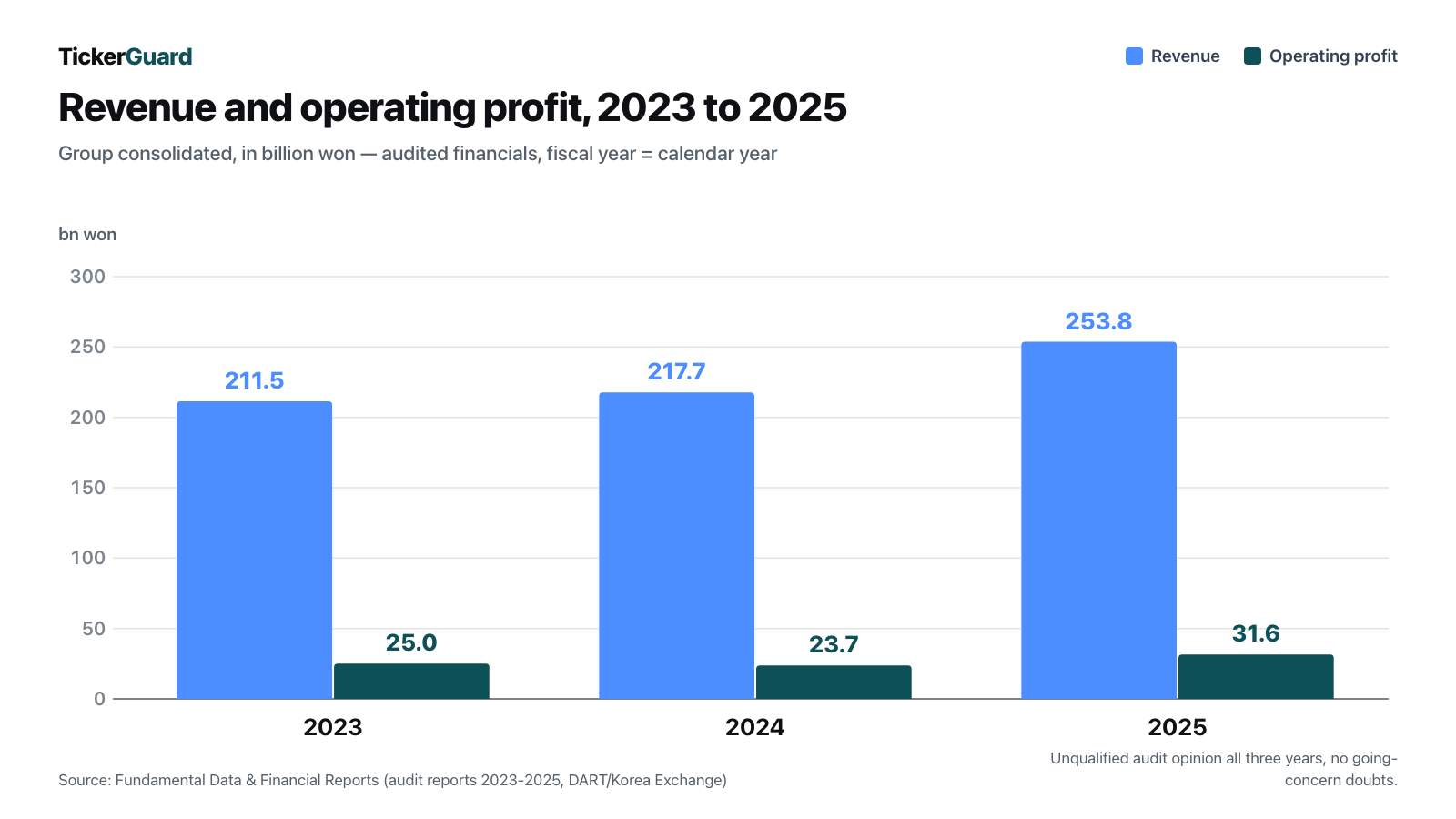
First, what genuinely impresses: Digital Daesung is growing, and audited. Group revenue rose from KRW 211.5 billion (2023) through KRW 217.7 billion (2024) to KRW 253.8 billion in 2025 — up 16.5%, or roughly EUR 159 million at the reference rate of September 1, 2026 (KRW 1,593.17 per euro). Operating profit rose over the same period from KRW 25.0 billion through KRW 23.7 billion to KRW 31.6 billion, up 33.1% — the operating margin climbed from 11.8% (2023) through 10.9% (2024) to 12.4% (2025). All three years carried an unqualified audit opinion from auditor Daeju, with no going-concern doubts.
The official fair-disclosure filing of February 25, 2026 names one of the two growth drivers itself — and it is not just "more demand":
"고등 온라인 부문 매출 증가, 종속회사 편입으로 인한 매출액 및 손익구조가 전년대비 큰폭으로 증가"
Translation: "Revenue increase in the high-school online segment; revenue and the profit-and-loss structure increased significantly year over year due to the inclusion of a subsidiary."
— Digital Daesung Co., Ltd., fair-disclosure filing on the 30% result change, DART, 2026-02-25
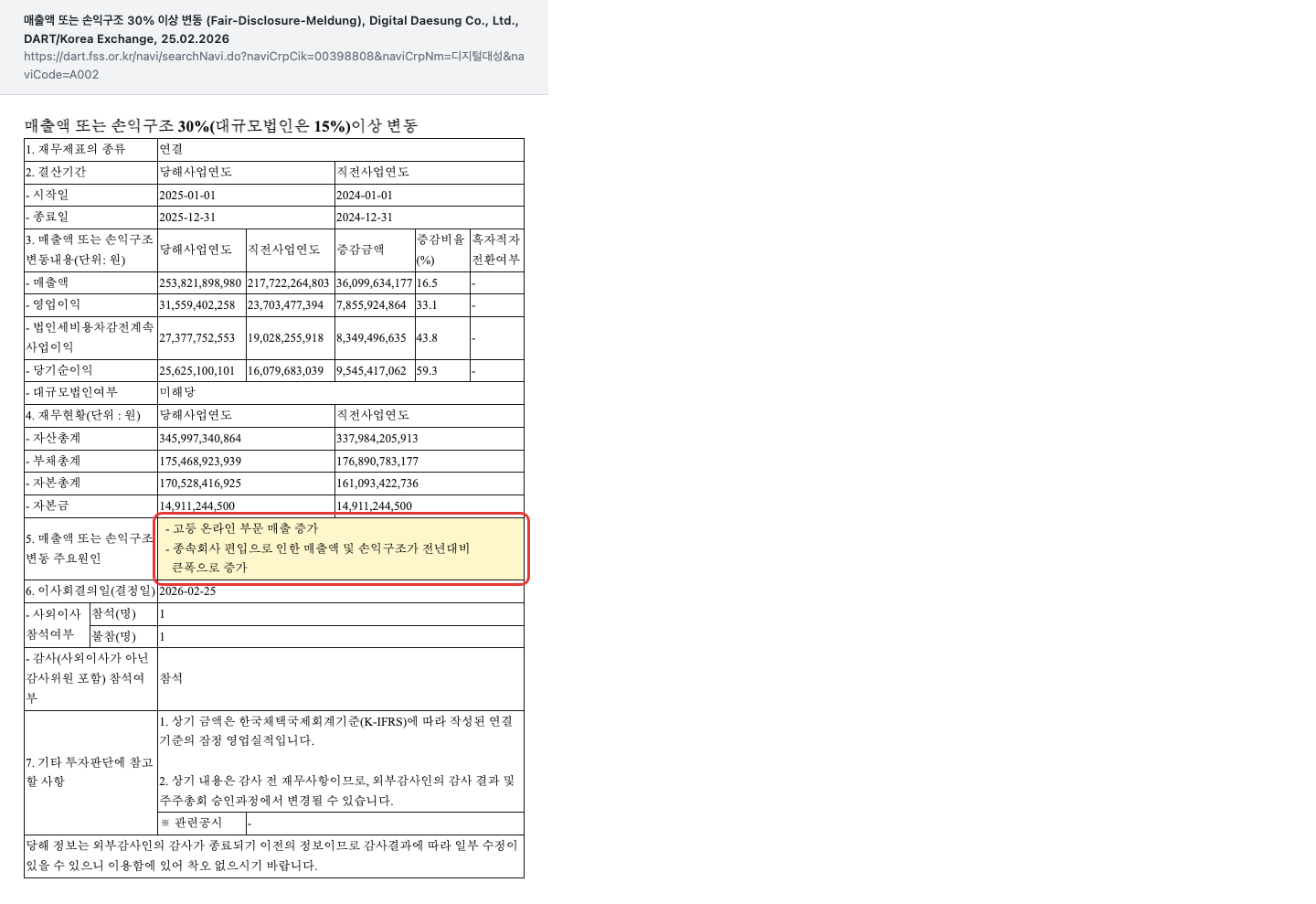
That subsidiary is boarding school Hobeop — more on that below, since it is one of the uncomfortable truths. First, the first half of 2026: revenue KRW 138.8 billion, operating profit KRW 25.3 billion — after just six months already 80% of the entire 2025 operating profit. Cash nearly doubled, from KRW 25.2 billion to KRW 46.5 billion. That, too, is a genuine strength: a growing, cash-generating business whose numbers are confirmed by an independent auditor.
What management promised — and what actually happened
Honestly upfront: for Korean KOSDAQ names like Digital Daesung, there are no publicly available earnings-call transcripts — we checked this explicitly with our own transcript tool (as of September 2, 2026, zero hits). What does exist is something even more concrete than a quote on a call: a financial plan underlying an external valuation that the group itself published as the justification for a purchase — and that has since been tested against reality twice. When Digital Daesung bought another 34.52% of subsidiary Igam in March 2024, the purchase price of KRW 30.9 billion had to be backed by an external valuation. Accounting firm Samil PwC based that valuation on a three-year plan for Igam — and the fiscal 2025 annual report lists plan against actual:
"2025년에는 학령인구 감소 및 경기 침체의 영향으로 교육 콘텐츠 전반에 대한 소비가 위축되었으며 … 수능 국어 난이도 하향 정책에 따라 학습 긴장도가 완화되면서 고난이도 콘텐츠에 대한 수요가 감소하여, 매출액이 당초 예측 대비 감소하였습니다."
Translation: "In 2025, overall consumption of education content contracted due to the decline in the school-age population and the economic slowdown … as the policy of lowering the difficulty of the Korean-language section of the CSAT eased learning intensity, demand for high-difficulty content fell, and revenue came in below the original forecast."
— Digital Daesung Co., Ltd., fiscal 2025 annual report, DART, section "material events after the reporting date — Igam share acquisition", filed 2026-03-18
The figures, concretely (Igam, standalone financials, in millions of won): for 2024, the valuation plan called for revenue of 29,995, operating profit of 11,584 and net income of 9,185 — actual came in at 26,508, 7,768 and 7,175, missing by 11.6%, 32.9% and 21.9% respectively. For 2025, the plan called for revenue 30,597, operating profit 11,177, net income 8,863 — actual came in at 22,767, 5,859 and 6,183, a shortfall of 25.6%, 47.6% and 30.2%. Two years, two plans, two clear misses — and for 2026 a third plan is still on the books (revenue 31,152, operating profit 10,309, net income 8,176) that, given the first half of 2026 (more below), looks unlikely to hold. What the group did reliably deliver on: the shareholder-return promise announced in November 2025 and formally adopted in March 2026. It committed to at least 50% of adjusted group profit as shareholder return for 2025 through 2028 — and actually delivered 75.3% for 2025 (KRW 13.3 billion cash dividend plus buybacks). A management that keeps its word on shareholder cash but misses its own acquisition forecast twice: that contrast carries the chapters below.
What the filings say — the uncomfortable truths
Uncomfortable truth No. 1: The doubling-down reflex — buying more of a subsidiary that just reported its largest loss yet
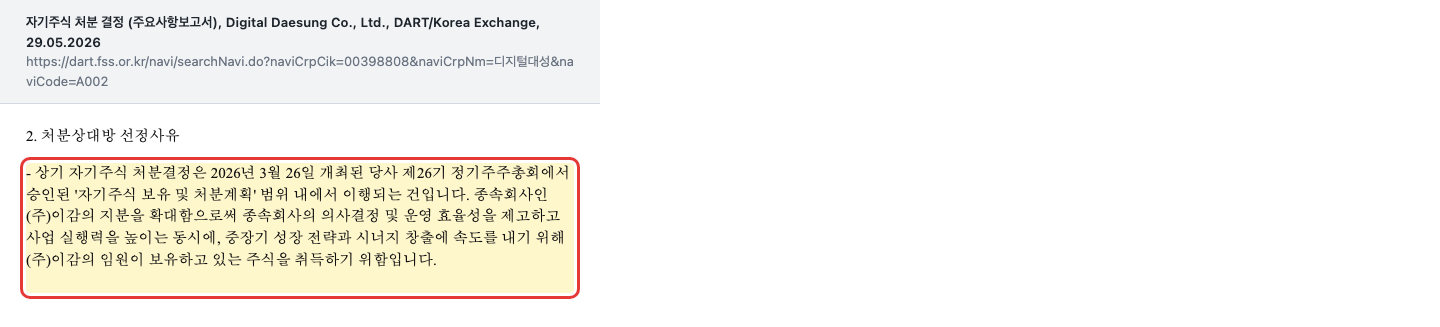
After two years of missed forecasts, the obvious question would be: what went wrong, and should the commitment be reconsidered? Digital Daesung chose the opposite. On May 29, 2026, the group bought 800,000 more Igam shares (9.9%) for KRW 8.87 billion at KRW 11,093 per share — raising its stake from 84.05% to 93.95%. The deal was paid partly in cash, partly through a transfer of treasury shares: 551,204 Digital Daesung shares went, on the same date, to two Igam managers, Kwon Jong-cheol and Cho Seong-jin, who were simultaneously the sellers of the Igam stake. The ad-hoc filing explains the purchase as follows:
"종속회사인 (주)이감의 지분을 확대함으로써 종속회사의 의사결정 및 운영 효율성을 제고하고 사업 실행력을 높이는 동시에, 중장기 성장 전략과 시너지 창출에 속도를 내기 위해 (주)이감의 임원이 보유하고 있는 주식을 취득하기 위함입니다."
Translation: "By expanding the stake in subsidiary Igam, decision-making and operational efficiency at the subsidiary are to be improved and execution strength increased; at the same time, the acquisition of shares held by Igam executives is intended to accelerate the mid- to long-term growth strategy and the creation of synergies."
— Digital Daesung Co., Ltd., ad-hoc filing, treasury-share disposal, DART, 2026-05-29
Then came the first half of 2026 — the first reporting period after that second purchase. Igam reported revenue of KRW 5.13 billion, essentially unchanged from the prior-year half (KRW 5.12 billion) — but a net loss of KRW 859 million, more than 30 times the small KRW 25 million loss of H1 2025.
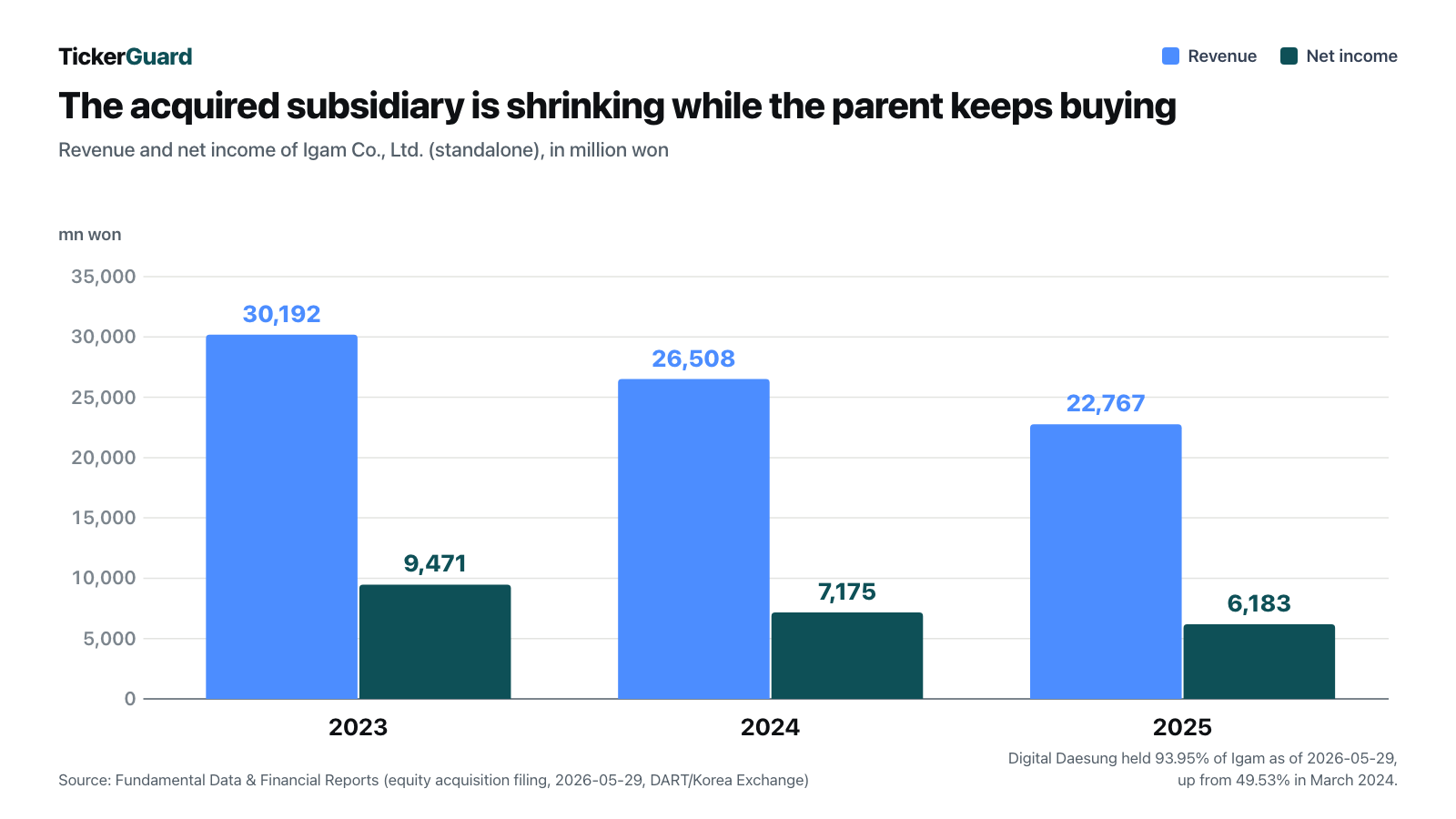
In everyday terms: imagine you bought a stake in a café two years ago because an appraiser projected rising sales. Both following years, sales stayed noticeably below the projection. Now you buy more shares — and in the very first half-year after that, the café posts a noticeably larger loss than ever before. This need not be labeled a mistake — 2026 figures are not final, and one half-year is not a full-year record. But the sequence of events — missed forecast, buy more, largest loss yet — is exactly the pattern that makes the doubling-down reflex so hard to tell apart from the behavior described at the top of this piece.
Uncomfortable truth No. 2: A third of the balance sheet is only half-owned — and a fifth of profit goes to outsiders
Reading a group revenue figure of KRW 253.8 billion, most readers assume it all "belongs" to Digital Daesung. That is not quite right. Boarding school Hobeop Gangnam Daesung (founded 2018) is only half-owned by the group — it is nonetheless fully consolidated, because Digital Daesung judges that it exercises de facto control:
"호법강남대성기숙학원(주)의 소유 지분율은 과반수 미만이나, 실질지배력을 고려하여 종속기업으로 분류하였습니다."
Translation: "The ownership stake in Hobeop Gangnam Daesung Boarding Academy is below a majority, but it was classified as a subsidiary in consideration of de facto control."
— Digital Daesung Co., Ltd., fiscal 2025 annual report, DART, consolidated notes, note 1 "general information"
This school is no side note: as of June 30, 2026, it contributed KRW 112.7 billion in assets to the group balance sheet — a good third of the KRW 343.9 billion total. And it explains the lion's share of growth in boarding-school revenue, which jumped from KRW 32.2 billion (2023) through KRW 41.1 billion (2024) to KRW 69.1 billion (2025) — exactly the "inclusion of a subsidiary" the fair-disclosure filing above cited as a growth driver. The flip side: because Digital Daesung owns only half, only half of Hobeop's profit economically belongs to the group — the rest sits on the balance sheet as "non-controlling interests." Together with the 15.95% still held by outside shareholders at Igam at the time (before the May 2026 top-up cut that stake to 6.1%), that amounted in 2025 to KRW 4.7 billion — 18.4% of the reported group net income of KRW 25.6 billion — going to outside minority shareholders, not to Digital Daesung shareholders. The gap is even starker at the parent level: Digital Daesung's standalone financial statements — what the parent earns without its subsidiaries — show just KRW 12.4 billion in profit for 2025, less than half the often-quoted group figure of KRW 25.6 billion. Anyone reading "Digital Daesung" and "KRW 25.6 billion profit" in the same sentence is reading a figure a meaningful share of which comes from a school the group only half-owns.
Uncomfortable truth No. 3: Contracts with individual star instructors sit on the balance sheet — the auditor flags it explicitly as a risk
Digital Daesung's success formula in the high-school segment rests on well-known "일타강사" (literally "one-shot instructors") — star teachers whose name alone sells courses. To lock them in exclusively, the group pays large upfront fees, so-called "전속계약금" (exclusivity contract fees), booked as intangible assets — as of December 31, 2025 totaling KRW 20.4 billion (2024: KRW 24.1 billion), roughly 6% of total assets and roughly 12% of group equity. Auditor Daeju names exactly this line item as a "key audit matter" in all three audited years:
"핵심감사사항: 전속계약금의 손상평가 (별도 및 연결)"
Translation: "Key audit matter: impairment assessment of exclusivity contract fees (standalone and consolidated)."
— Daeju Accounting Corp, audit opinion in the fiscal 2025 annual report, DART, section V "audit opinion", filed 2026-03-18
This is not a going-concern flag and not a balance-sheet manipulation — the auditor confirmed an unqualified opinion all three years. But it is a structural signal: a meaningful share of group assets hangs on the economic value of individual, replaceable people — should a star instructor lose their draw or move to a competitor, this exact balance-sheet item would need to be reassessed. The AI subtitle technology the group itself won the "2026 Korea AX Award" for — which uses a language model to learn individual instructors' speech patterns — is, in that light, also an attempt to technically defuse this dependency; but the technology is not sold to third parties, it remains an internal tool.
Valuation: solid substance, with question marks on capital discipline
On September 1, 2026, Digital Daesung stock cost around KRW 8,640, a market cap of roughly KRW 220 billion (about EUR 138 million). Against reported group earnings per share of KRW 801 (2025), that is a price-to-earnings ratio of roughly 10.8 — not a rich price for a growing, dividend-paying education group, especially since H1 2026 alone, at KRW 928 EPS, already exceeded all of last year's full-year result. The dividend yield stood at roughly 6.0% on the record date (KRW 520 per share), backed by the value-up plan's 50%-minimum payout commitment through 2028. On the other side sits a valuation built on a group profit of which, as shown above, a good fifth economically belongs to outside minority shareholders, and a buying pattern at Igam that has yet to confirm any of its own forecasts. Anyone judging the stock on P/E alone misses both distortions; anyone accounting for them arrives at a somewhat more cautious, but still not expensive, valuation.
Opportunities and risks at a glance
What speaks for Digital Daesung:
- Consistent, audited growth: revenue up 16.5%, operating profit up 33.1% (2025); H1 2026 earnings per share (KRW 928) already exceed all of last year's full-year result (KRW 801); unqualified audit opinion all three years, no going-concern doubts.
- Shareholder-friendly capital policy, delivered in practice: value-up plan with at least 50% payout for 2025–2028, actually reaching 75.3% in 2025 (dividend plus buybacks); no convertible bonds or warrants, so no dilution risk.
- Solid balance sheet with cash nearly doubled (KRW 46.5 billion by mid-2026) and a moderate P/E of roughly 10.8 at around a 6% dividend yield.
- Established brand portfolio (Daesung Mimac, Hanuri, Gangnam Daesung) with a long history and diversified revenue across three age groups of the school system.
What speaks against it:
- A doubling-down pattern at Igam: two consecutive years of clearly missed purchase-time forecasts (operating profit 32.9% and 47.6% below plan), followed by a further purchase in May 2026 — and a first, sharply widened loss half-year right after.
- A consolidation scope built on "de facto control" rather than majority ownership at a subsidiary (Hobeop) that accounts for a third of total assets and much of revenue growth; 18.4% of 2025 group profit went to outside minority shareholders.
- Structural dependence on individual star instructors, visible on the balance sheet as KRW 20.4 billion in exclusivity contract fees (roughly 12% of equity) — flagged by the group's own auditor as a key audit matter.
- Concentrated ownership: the founding family and affiliated companies now control 56.7% of shares (including treasury shares) through a layered ownership chain, limiting minority shareholders' influence accordingly.
- Structural industry headwind: the group itself cites South Korea's shrinking school-age population as a reason for weaker demand at Igam — a demographic drag that is not limited to this one subsidiary.
A human conclusion
Back to the doubling-down reflex from the opening. Its core is not that buying more is always wrong — sometimes a second investment really is the right response to new information. Its core is that it always feels right, regardless of whether it is — because the alternative, admitting the original call was wrong, feels worse than any uncertain continuation. Digital Daesung has a strong, audited core business that keeps its word on shareholder returns, and its numbers are not in doubt. But in its biggest acquisition decision of the past few years, the group displays exactly the pattern retail investors are warned against too: a forecast that missed twice, followed by doubling the stake, followed by the position's worst result yet. That does not have to turn out to be a mistake — education subsidiaries can recover, and the group is visibly investing in this one's future. The honest question for you, then, is not "Is Digital Daesung a good stock?" but: Would you buy more yourself if your own forecast had missed twice in a row — or would you ask why first? What you make of it is your decision. And that is exactly as it should be.
Sources
All original documents used in this analysis — for readers to check themselves at dart.fss.or.kr (corporate code 00398808):
- Digital Daesung Co., Ltd. — annual report (사업보고서) for fiscal year 2025, filed March 18, 2026
- Digital Daesung Co., Ltd. — half-year report (반기보고서) as of June 30, 2026, filed August 14, 2026
- Digital Daesung Co., Ltd. — fair-disclosure filing on the 30% result change, February 25, 2026
- Digital Daesung Co., Ltd. — corporate value-up plan (기업가치제고계획), March 17, 2026
- Digital Daesung Co., Ltd. — ad-hoc filing, treasury-share disposal, May 29, 2026
- Digital Daesung Co., Ltd. — filing, share acquisition in Igam Co., Ltd., May 29, 2026
- Digital Daesung Co., Ltd. — preliminary Q2 2026 group results, August 3, 2026
- Digital Daesung Co., Ltd. — 2026 shareholder-return policy notice, July 30, 2026
- Full DART filing history: DART overview (dart.fss.or.kr)
- Fundamental data (price, market cap, ratios; as of September 1, 2026), cross-checked against the DART filings.
Transparency & disclaimer: This analysis is a journalistic interpretation of publicly available information and not investment advice, not a financial analysis in the regulatory sense, and not a solicitation to buy or sell securities. Stock investments carry substantial risk, up to and including total loss. All figures without guarantee; the as-of date for each figure is noted in the text. The author holds no position in Digital Daesung stock at the time of publication.
Our Bottom Line at a Glance
- Operating growth positive
- Group revenue up 16.5% to KRW 253.8 billion in 2025, operating profit up 33.1% to KRW 31.6 billion — all three years under an unqualified audit opinion. H1 2026 already exceeded 80% of the entire prior-year operating profit, at KRW 25.3 billion.
- Capital discipline on acquisitions negative
- Subsidiary Igam, bought for KRW 30.9 billion in 2024, missed the purchase-time valuation plan in both 2024 and 2025 by 32.9% and 47.6% on operating profit. In May 2026 the group bought more shares anyway for KRW 8.9 billion — and Igam swung into a loss more than 30 times larger than the prior-year half in H1 2026.
- Consolidation scope & earnings quality negative
- A third of total assets sits in half-owned but fully consolidated school Hobeop; 18.4% of 2025 group profit went to outside minority shareholders. Digital Daesung's standalone profit of just KRW 12.4 billion is less than half the often-quoted group figure.
- Shareholder returns positive
- The March 2026 value-up plan commits to at least 50% payout of adjusted group profit for 2025 through 2028; 2025 actually delivered 75.3% (dividend plus buybacks), with no convertible bonds or warrants and thus no dilution risk.
- Governance & ownership structure neutral
- Insiders and affiliated companies control 56.7% of shares (including treasury shares) through a layered ownership chain (Daesung Publishing → Daesung Education Publishing → individuals) — typical for Korean family-controlled groups, but limiting minority-shareholder influence. The auditor gave an unqualified opinion all three years, with no governance or accounting breach.
- Balance sheet & liquidity positive
- Equity of KRW 170.5 billion, cash nearly doubled to KRW 46.5 billion by mid-2026, no going-concern doubts. Roughly 12% of equity (KRW 20.4 billion), however, is exclusivity fees paid to individual star instructors, which the auditor flags as a key audit matter.
Digital Daesung delivers a strong, audited core business and keeps its word on shareholder returns — 2025 saw double-digit growth in revenue and operating profit, with actual payouts exceeding the group's own promise. Its biggest acquisition decision of recent years tells a different story: subsidiary Igam, bought in 2024, missed its own purchase forecast two years running, and the group bought more anyway in May 2026 — shortly before Igam reported its largest loss since the initial stake. On top of that, a meaningful share of group profit comes from a subsidiary the group only half-owns. Not investment advice.
What Our Rating Means
Open questions
The business works in principle, but one material question is open. As long as it stays open, our findings do not carry a quality verdict.
The core business holds up: revenue, operating profit and cash are all growing, the balance sheet is solid, the auditor gave an unqualified opinion three years running with no going-concern doubts, and shareholder returns are actually delivered. We still rate Digital Daesung yellow because one material operating question remains open: capital discipline at subsidiary Igam — two consecutive forecast misses, followed by a further purchase and then the first larger loss — is a documented, but not an existential, problem, since Igam is only a small part of the group balance sheet. Whether the stock is attractive at the current price is for the scanners to decide, not this rating.
A journalistic assessment by our editorial team at the time of the deep dive, based on public sources — not investment advice and not a solicitation to buy or sell. Your personal circumstances (investment goals, risk capacity, taxes) cannot be taken into account. What our levels mean, how verdicts are formed, and what conflicts of interest exist →
Worth Noting
- Data as of: fiscal 2025 annual report (사업보고서, filed March 18, 2026) and half-year report as of June 30, 2026 (반기보고서, filed August 14, 2026), both public at dart.fss.or.kr, corporate code 00398808; price and market data as of September 1, 2026.
- No publicly available earnings-call transcripts exist for Korean KOSDAQ names (a targeted check of our own transcript tool on September 2, 2026, returned zero hits). All quotes come from mandatory DART filings, not SEC forms.
- Digital Daesung is not listed on a US exchange and is not subject to SEC reporting; all figures are based on K-IFRS financial statements and mandatory Korean filings at DART.
The full analysis as a PDF for later
We will send you this analysis as a PDF — to print, file away, and read at your own pace.
Frequently Asked Questions
Digital Daesung Co., Ltd. (KOSDAQ: 068930), based in Seoul, is a South Korean education group. It runs reading education for elementary pupils (brand "Hanuri"), the online course platform "Daesung Mimac" for prepping South Korea's national college-entrance exam, Korean-language test-prep content via subsidiary Igam, and several boarding cram schools for high-school students and repeat exam-takers. CEO is Kim Hee-sun.
Group revenue rose 16.5% in 2025 to KRW 253.8 billion. Per its own fair-disclosure filing of February 25, 2026, that was driven by higher revenue in the online high-school segment and by fully consolidating boarding school Hobeop into the group accounts, even though Digital Daesung owns only 50% of it. Boarding-school revenue jumped from KRW 32.2 billion (2023) to KRW 69.1 billion (2025) as a result.
Digital Daesung bought an additional 34.52% of Igam in March 2024 for KRW 30.9 billion, based on the plan underlying a valuation opinion from accounting firm Samil PwC. That plan missed badly in both 2024 and 2025 (operating profit 32.9% and 47.6% below plan, respectively). In May 2026, Digital Daesung bought another 9.9% anyway (stake now 93.95%) — in H1 2026, Igam then swung into a loss more than 30 times larger than the prior-year half.
Yes. For fiscal 2025, Digital Daesung paid KRW 520 dividend per share (total KRW 13.3 billion), a payout ratio of 63.8% of group net income. Combined with a share-buyback program, the group reached a total 2025 shareholder return of 75.3% of adjusted group profit — above the 50%-minimum commitment set out in its March 2026 value-up plan for the years 2025 through 2028.
The largest shareholder is publishing company Daesung Publishing (10.85%), itself controlled 12.25% by Daesung Education Publishing, which in turn belongs to two individuals. Together with further family- and group-affiliated companies plus treasury shares, insiders and affiliated companies controlled roughly 56.7% of shares (including treasury shares) as of December 31, 2025. Value investor VIP Asset Management holds 5.2%.
As of September 1, 2026, the stock cost roughly KRW 8,640, putting the price-to-earnings ratio at roughly 10.8 against 2025 group earnings per share of KRW 801; the dividend yield stood at roughly 6.0%. Worth keeping in mind: roughly 18% of 2025 group profit economically belonged to outside minority shareholders of two subsidiaries — the parent's standalone profit of KRW 12.4 billion was well below the often-quoted group figure.
No. For Korean KOSDAQ names like Digital Daesung, there are no publicly available earnings-call transcripts — a targeted check of our own transcript tool returned zero hits on September 2, 2026. This analysis therefore relies on Korea's mandatory DART filings and the purchase-time valuation plan for subsidiary Igam disclosed within them.
Found an error?
Did you spot a factual error, an outdated number, or a typo in this deep dive? Let us know briefly — your report goes straight to the editorial team.